A perennial tension exists in the relationship between government and the arts. Sometimes this relationship is adversarial. For a short time in 2011, a “cowboy poetry” festival, partly funded by public monies, became a centerpiece of discussions to cut funding to the National Endowment for the Arts (NEA) and balance the federal budget. In the late 1980s and early 1990s, the NEA was a lightning rod of controversy in an embittered battle about the lines “between decency and immorality and free expression and censorship” (Lewis Reference Lewis2006, 131). Sometimes this relationship between government and the arts is healthy, such as when government funding allows artists to innovate, foster diversity, create new art forms, or even establish a dialogue that criticizes the government that helped to fund them. And broadly defined, public funding for arts and culture generate many societal benefits; for example, the arts and culture are often viewed as a vital component of urban and community development programs (Markunsen and Gadwa Reference Markunsen and Gadwa2010; Strom Reference Strom2002). Despite these potential benefits, the early 2010s marked a period of heightened tensions, increased scrutiny, and declining budgets for the arts and culture.
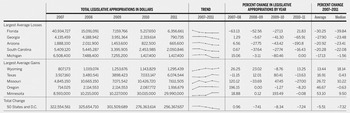
In 2011, legislative appropriations to state arts agencies decreased by 12.9% (National Assembly of State Arts Agencies (NASAA) 2011a), and the April 2011 federal budget compromise reflected $12.5 million in cuts to both the NEA and the National Endowment for the Humanities (NEH). The year 2011 also marked the third year in a row that state art agencies experienced funding cuts by the states, decreasing overall state funding to about $0.87 per capita (NASAA 2011a). Overall, about two-thirds of the states proposed cuts to state arts agencies for FY 2012; the median proposed cut was 19% (NASAA 2011b). Some of these cuts are substantial (see table 1). In 2011, Kansas governor Sam Brownback used a line-item veto to zero-out the proposed $689,000 budget for the state's 45-year-old Kansas Arts Commission, to spur the creation of a private, not-for-profit entity (notably, the cut represented less than .005% of the state's $13.8 billion budget). After the loss of an estimated $1.3 million in matching federal and regional grants, the legislature appropriated $700,000 to establish a Creative Arts Industries Commission in FY 2013. Brownback approved the budget in June 2012.
State Legislative Appropriations to State Arts Agencies by Top Five Average Appropriations Gains and Losses (2007–2011)

Source: National Assembly of State Arts Agencies (2011c), Annual Appropriations and Revenue Survey Data
Both South Carolina and Pennsylvania's arts commissions avoided similar fates when the South Carolina House of Representatives voted to override governor Nikki Haley's line-item veto and restore the commission's $1.9 million budget, and the Pennsylvania Senate voted to restore most of the 70% in budget cuts that had previously passed the state's House of Representatives. However, Governor Haley's 2013 executive budget proposal eliminated funding for the South Carolina Arts Commission. Budget cuts are also playing out in political subdivisions, seeing an 8.1% cut in local expenditures between 2009 and 2010 (Han Reference Han2010). For example, the Pinellas County Commission in Florida eliminated its 34-year-old arts council in 2010, and set aside $300,000 to be used as seed money for a private organization to assume the council's duties.
Although current cuts to arts and culture funding are grounded in the need for balanced budgets and reduced deficits, these efforts also reflect long-standing unresolved legacies that fragment arts and culture policy and leave funding for the arts and culture vulnerable to additional cuts. These legacies include the absence of a unifying arts and cultural policy (due, in part, from the political compromise that established the NEA in the 1960s), the lingering effects of the 1990s NEA debate and “culture war” (see, for example, Shockley and McNeely Reference Shockley and McNeely2009), and a “weak normative justification” for public funding (Lewis and Brooks Reference Lewis and Brooks2005).
ARTS AND CULTURE POLICY
An overarching cultural policy is conspicuously absent in the United States (see for example, Wallman Reference Wallman2007). In countries such as France and China, a central ministry or administrative agency oversees cultural policy. Comparatively, many other countries have centralized ministries dedicated to funding the arts and culture. In contrast, the United States lacks both a centralized agency to oversee cultural policy and a national statement of cultural policy (and it has long resisted attempts to establish either). Even the establishment of the NEA emphasized decentralization through a partnership between the federal and state governments to avoid federal domination over arts and culture policy (Lowell Reference Lowell2004).
This situation can be both a blessing and a curse for arts communities in the United States. On one hand, policy decentralization allows an incredible diversity that fosters innovation, reflects local needs, and promotes a sphere where the arts can innovate largely free from government constraints. On the other hand, a policy vacuum is created that is filled by a hodge-podge of federal, state, and local mandates and regulations that leaves arts communities that depend on outside funding sources to the whims of politics and the vagaries of a free-market system. Therefore, the United States does not lack a culture policy; it just lacks a coherent culture policy. As a result, arts and culture policy in the United States is piecemeal, ad-hoc, and often results in contradictory, competing, and overlapping statements of public policy.
What is cultural policy? This sweeping term often describes policy for enterprises such as orchestras, museums, arts education, and the like. It can refer to what many consider high culture but also to popular or mass culture. Cultural policy, however, is in constant flux. It spans issues such as national heritage, the nonprofit sector and philanthropy, artist's rights (including free expression and intellectual property), education, entertainment, and even pornography and censorship. It is understood, often implicitly, that the sum of US cultural policy includes decisions made in arts-related (or even semi-related) policy domains. For instance, Wallman (Reference Wallman2007) makes a compelling case that cultural policy is heavily influenced by the enforcement of decency norms in the broadcast arena. This regulatory enforcement spills over and defines the boundaries of decency and indecency in the cultural and artistic sphere. Ultimately, elements of US cultural policy are administered by a multitude of government agencies, programs, endowments, government corporations, commissions, and independent trusts. One estimate suggests the administration of cultural policy spans 200 programs across 30 agencies (see Wyszomirski Reference Wyszomirski2004).
DEFINITION OF ARTS
Much like defining arts and culture policy, defining “the arts” is a nearly impossible task as it encompasses a range of enterprises, activities, and end results. Craik (Reference Craik2005) provides some insight from an Australian study, suggesting that the public makes the distinction between elite (“big A”) arts, such as the opera or orchestras and the “little a” arts such as popular or mass culture. Although the public recognizes the arts as “theater, literature, music, visual arts and crafts,” it also tends “to define arts more generally as including fashion design, graphic design, pub bands, rock and pop music, children's art and amateur drama” (Craik Reference Craik2005, 10). Larson (Reference Larson1997) further exemplifies the range (and even the rifts) among the arts when discussing ways to determine the “health” of US arts and culture. He writes that:
matters of taste come into play in these discussions, along with distinctions between the nonprofit arts and the entertainment industry, between ‘high’ and ‘low’ culture, between allegedly ‘uplifting’ pursuits and seemingly ‘mindless’ diversions. Because most of us have passionate opinions concerning the art we enjoy, assessments of the current state of American culture are particularly risky, and consensus, unlikely
(7).Although defining the arts may seem little more than an intellectual exercise, the scope of its definition can have a broad impact on budgetary decisions. For example, should broadcast media be included in the arts? Some US lawmakers seem to think so, at least to the extent that Congress supported the Corporation for Public Broadcasting (CPB) to the tune of about $420 million in FY 2010. The CPB provides grants for cultural programming and provides support for Public Broadcasting Service (PBS), National Public Radio (NPR), and Public Radio International (PRI) broadcasts and broadcasters. For basic necessity, the NEA (2011) breaks down grants into several broad categories: “arts communities, arts education, dance, design, folk and traditional arts, literature, local arts agencies, media arts [including film/radio/television], museums, music, musical theater, opera, presenting (including multidisciplinary art forms), theater, and visual arts” (5). These categories, however, cannot capture the full range and diversity within each category. Consider, for example, the symphonic arts. The NEA (2007, vii) points out that the nearly 1,200 symphony orchestras in the United States run the gamut from full-time professional orchestras to amateur groups; each orchestra has its own repertoire ranging from contemporary music, to renaissance music, to baroque.
PUBLIC FUNDING OF THE ARTS
A major public policy dialogue involves the extent to which governments fund arts and culture. Historically, US public funding for the arts has lagged behind European (Zimmer and Toepler Reference Zimmer and Toepler1999) and other industrial countries. In 2000, the US per capita public spending for the arts totaled about $6 per person; in contrast, Germany spent about $85 US, France about $58 US, and Canada about $46 US (NEA 2000). For countries with arts councils, one study suggests that NEA grants amount to about 33.5 cents per capita, the Canada Council for the Arts grants equal about $3.16 US per capita, and Arts Council England tops the list, with grants totaling about $17.53 US per capita (McCaughey Reference McCaughey2005). And historical increases in public funding for the arts (especially between the mid-1960s and the mid-1990s) have been eclipsed by increases in the number of artists and nonprofits arts organizations (Larson Reference Larson1997). Throughout much of the 2000s, the NEA experienced moderate annual increases in federal funding, but state support for the arts experienced significant cuts (see, for example, Lowell Reference Lowell2004).
Why do government entities fund the arts? Several narratives justify public funding of the arts. One narrative is deeply rooted in the economy of the arts, including a discussion of public goods and market failures. When the market system cannot sustain an enterprise that is thought to have public value, then government intervention can be justified. To some extent, commoditization of the arts persists, but without public funding it may be difficult for the public to pay market prices for the arts and culture, and especially for the “high arts.” This argument is also intimately connected to increasing access and equity to cultural opportunities. In essence, public funding acts to democratize arts and culture by creating opportunities for citizens to engage in or experience artistic endeavors. It is also often understood that the government has an obligation to promote “artistic excellence” and that doing so is a legitimate function of the public sector. These beliefs were primary justifications for creating the NEA in 1965, but these may be less persuasive in contemporary policy and budgetary debates.
Indeed, one scholarly account suggests that arts advocates have recently reframed support for the arts away from market failure justifications to one that stresses the positive externalities of the arts and culture to society at large. These include improved educational outcomes, increased economic impact, and the revival of decaying urban centers (Strom and Cook Reference Strom and Cook2004) as an integral component of economic development (Markunsen and Gadwa Reference Markunsen and Gadwa2010; Strom Reference Strom2002) and even for future generations (for a discussion of bequest value, see Brooks Reference Brooks2004). While the nonprofit arts and culture industry receive fewer than $4 billion from federal, state, and local sources each year, they can generate up to $30 billion in revenue to these levels of government (Americans for the Arts 2007). Arguably, vibrant arts communities promote tourism, encourage people to move into communities, discourage outmigration, and promote social capital.
FUNDING STRUCTURE
The model of public arts funding in the United States rests on a decentralized network of federal, state, and local agencies that often provide funding through competitive grants. Additional support for the arts typically comes from generated income, such as box office receipts and private funding sources, including individuals, corporations, and foundations. The NEA (2007) identifies three broad categories of arts support: direct public support, other public support, and private donations.
Direct public support generally includes public arts appropriations that are distributed through the NEA, state and regional arts agencies, and the roughly 4,000 local and county arts agencies. The largest single public sector funder of the arts in the United States is the NEA in its mission to “support excellence in the arts, both new and established,” to “bring arts to all Americans” and to “provide leadership in arts education” (NEA 2011). Until the 2011 federal budget agreement cut $12.5 million from the NEA, the agency had received only modest annual budgetary increases since its funding suffered an appreciable cut in 1996. In FY 2011, the NEA had an appropriated budget of about $155 million. Even with the modest budgetary increases between 1996 and 2010, NEA funding dropped in terms of percent of nonmilitary discretionary funding (from .13% in 1979 to .03% in 2009) and has not kept up with the rate of inflation (2011 funding levels fall below 1992 funding levels when adjusted for inflation) over the years (Americans for the Arts 2010).
Federal and state governments contribute only about 13% of total arts funding. Although the NEA is the closest entity to a centralized cultural agency that the United States has (Reid, Reference Reid2009), it contributes only about 1% of overall arts funding. However, NEA grants can establish legitimacy and support for a project or an organization. Every dollar granted by the NEA can generate up to 7 or 8 additional dollars in terms of matching grants, donations, or earned revenue (NEA 2007).
To this extent, the NEA works with organizations and can help them set leadership or direction, but it does not directly set arts and culture policy. Former chair Dana Gioia characterized the NEA leadership role as one of collaboration and partnership that fosters public and private support to facilitate “artistic freedom, experimentation and diversity” (NEA 2007, viii). A good example of this role can be seen in a 1990 statement by Garrison Keillor to the Senate Subcommittee on Education:
In 1974, a grant from the NEA enabled us to start A Prairie Home Companion in Minnesota. Help which was crucial, because the show was not that great to start with, we had 12 people in the audience for our first broadcast, and we made the mistake of having an intermission and lost half of them…. By the time the show became popular and Lake Wobegon became so well-known that people thought it was real, the Endowment had vanished from the credits, its job done
(In Brighouse Reference Brighouse1995, 54).Other public support includes congressionally authorized expenditures on certain artists, arts projects, or arts and cultural groups that are separate from NEA appropriations, as well as monies that are appropriated for the Smithsonian Institution, federal museums and theaters, library services, the National Endowment for the Humanities, and the Corporation for Public Broadcasting. Public support also takes the form of earmarks that members of Congress insert into appropriation bills to help their districts. In 2008, Americans for the Arts identified about $41 million in congressional earmarks to cultural organizations funded by programs that are managed by a variety of agencies, including the US Department of Education, the US Department of Housing and Urban Development and even the US Department of Defense (America for the Arts 2008).
Finally, the third category is comprised of private donations, and this category actually overshadows public funding in the United States. Some argue that many private donations are actually indirect government support since the US tax code is structured to encourage corporate and private sponsorship of the arts. Overall, Americans donated about $13.5 billion to the arts and humanities in 2008. All told, donations from individuals, corporations, and foundations make up about 43% of arts all funding.
PUBLIC FUNDING AND PUBLIC SCRUTINY
When comparing public funding of the arts to other public works or public goods, Brighouse (Reference Brighouse1995) writes that that there is a higher burden on the arts funding for three reasons: First, the arts are “more intimately connected to the disputes among different ways of life than are many other goods,” (56) for instance, Christian or Muslim art may express faith, reinforce beliefs, or proselytize. Second, there is little broad-based consensus on what constitutes art or artistic endeavors, and third, the public often expects tax dollars to reflect “value neutrality,” and this norm can come into question when artists produce works designed to challenge or to even shock the viewer. Because people value art in different ways, some citizens might believe that public monies help privilege a position, a point of view, or even a specific group.
Arts funding policy was relatively stable during the 1970s, which can be attributed to a fairly inattentive public, very few controversial works that received public funding (or at least that garnered national attention), supportive presidential administrations (some accounts suggest that Nixon saw arts funding as a cost effective way to build political capital with the so-called northeastern elites he was so often at odds with), and the fact that NEA grants benefitted virtually every congressional district. Another account suggests that the NEA had helped forge strong public support of government involvement in the arts; this era was also characterized by little debate regarding the legitimacy of government intervention in the arts (Frederking Reference Frederking, Hjorth and Steyaert2009). However, in the late 1980s and early 1990s the conditions were right for opponents to recast arts funding as “morality policy” (Lewis Reference Lewis2006). Although largely metaphorical, the culture wars “served as a social construction” that allowed opponents to “knit together disparate issues into a compelling narrative frame” (Thomson Reference Thomson2010, 277).
Much of this destabilization can be traced to the late 1980s, when two exhibits provoked national controversy. One included a work by Andres Serrano that depicted a crucifix soaked in urine and another by Robert Mapplethorpe that contained a number of homoerotic images. These works thrust public funding for the arts into a national debate that pitted government censorship against freedom of expression and First Amendment rights. However, these debates were only “ostensibly about the public funding of controversial art. More fundamentally, they were about the values conveyed by or embodied in the very notion of government support for the arts in the United States” (Shockley and McNeely Reference Shockley and McNeely2009, 12). Implicit to the legitimate use of public monies included broader issues of fiscal restraint, the role of governments versus markets, privileging elites, and morality policy (see, for example, Lewis Reference Lewis2006; Strom and Cook Reference Strom and Cook2004). Work by Lewis (Reference Lewis2006) suggests that the culture war of the 1990s also tapped into long-standing preexisting divides, including attitudes toward domestic spending, support for the arts, morality, and censorship.
From a policy perspective, the 1990s reflect an episodic punctuation in the arts policy environment (Shockley Reference Shockley2011). During periods of policy instability, existing policy frames are challenged or replaced by competing policy frames. These changes can occur rapidly, and a new equilibrium is reached. These changes may signal changes to policy and budgetary decisions (True Reference True, Baumgartner and Jones2002). During the culture wars, public support eroded for the role of government as an entrepreneur in arts policy and production (Frederking Reference Frederking, Hjorth and Steyaert2009) and policy “fundamentally shifted the U.S. cultural field and the overall approach to national arts policy” and “transformed the NEA's protective ‘iron triangle’ into an issue network” (Shockley and McNeely Reference Shockley and McNeely2009, 20).
Inasmuch as public policy making is a “struggle over ideas” (see Stone, Reference Stone1997), the culture wars also helped activate and legitimize competing policy frames within arts policy. During this time, ideas of morality became inextricably linked to the debate surrounding the proper role of government funding for the arts. While much of the instability in arts policy has settled down (see Shockley Reference Shockley2011), the remnants of this struggle are still playing out in the budgetary arena. Amid a nationwide fiscal downturn and a prevailing antitax mood (fueled, in part, by the so-called Tea Party movement), funding cuts for the arts, the humanities, arts education, and public radio and television are couched in fiscal discipline and balanced budgets. Much like the 1990s debate, the most recent debates are centered in fiscal discipline, but seek legitimacy from drawing attention to selected artistic endeavors. In 2011, this included a single exhibit and an annual poetry festival.
2011 CUTS TO ARTS AND CULTURAL FUNDING
Shortly after the 2010 elections, attention was drawn to an uncompleted film by David Wojnarowicz titled, A Fire in My Belly, which was displayed at the Smithsonian Institution's National Portrait Gallery. Eleven seconds of the unfinished work depicts a crucifix covered in ants. In late 2010, a spokesman for Representative John Boehner stated that “American families have a right to expect better from recipients of funds in a tough economy” (Washington Post, December 1, 2010). Representatives Boehner and Cantor called for Smithsonian officials to either pull the work or face additional budgetary scrutiny. The second example centers around “cowboy poetry” after Senate Majority Leader Harry Reid referenced a cowboy poetry festival in Elko, Nevada, as an example of a potential casualty of NEA and NEH funding cuts. Supporters of cuts to the NEA and NEH questioned the overall value of this medium, given its limited appeal (suggesting elitism) during an economic downturn (emphasizing fiscal discipline).
Calling into question the appropriateness, morality, or the value of an artistic endeavor can generate leverage for groups that seek a reduced government role in arts funding. The frames established during the 1990s (see, for example, Thomson Reference Thomson2010) are easily resurrected and remain powerful symbols within the policy arena and among the public. As a testament to the power and longevity of these symbols, the Smithsonian pulled the privately funded A Fire in My Belly fewer than 24 hours after the controversy erupted.
At the federal level, House Republicans called for the elimination of the NEA and NEH ($167.5 million each), and the CPB ($445 million) as a part of a broader $2.5 trillion budget reduction initiative over 10 years. The Obama administration's 2012 executive budget proposal had already called for a 13% decrease in NEA funding, and the two sides compromised on $12.5 million cuts for both the NEA and NEH and a $15 million cut for the CPB. The Obama administration's 2013 budget message called for an increase to fund the NEA at $154 million; this was also when Republican presidential primary candidates Mitt Romney and Newt Gingrich were calling for deep cuts to the NEA, NEH, and CPB.
The 2011 debate embodied two trends: devolution and the privatization of arts and cultural funding driven by a prevailing attitude that the private sector (and self-generating revenue) will make up for proposed cuts in public funding. Indeed, a 2010 “waste action alert” distributed by the House Republican Study Committee Sunset Caucus wrote that “the arts receive tens of billions of dollars each year, and the NEA subsidy represents less than 1% of this money. Support for the arts can easily be supported by state and local governments, and private donations.”
States also have faced a series of unprecedented fiscal crises over the last 10 years, and any further devolving of responsibility to the states for funding the arts and cultural sectors may have long-term negative impact on arts and cultural funding. Historically, state budgets for the arts and culture have cycled with state economies, receding during economic downturns and slowly expanding as state economies grow (see Lewis and Rushton Reference Lewis and Rushton2007). Efforts to further privatize the arts and cultural sector should only proceed with caution. Portions of the arts and cultural sector already exist because of a myriad of public, private, and not-for-profit funding streams, and many arts and cultural groups have learned to leverage funds from multiple public and private sources. A key component to their ability to leverage private funds rests on the legitimacy and clout that a grant from the NEA, NEH, or a state arts council can bestow on that group. Proponents of further privatizing the arts and cultural sectors also argue that public funding should be eliminated because it “crowds out” sources of private revenue. However, one careful study by Brooks (Reference Brooks2000) suggests that generally, low levels of public subsidies may “crowd in” (encourage private donations) rather than “crowd out” (discourage private donations). Although it may be tempting—and politically popular—to cut federal and state funding for the arts and cultural sectors, Robinson (Reference Robinson2010) offers the following cautionary statement: “it is also important not to automatically turn to the arts as low-hanging fruit; that is, easy cuts that can be made because the public perception is that these organizations can support themselves in a market economy” (30).
CONCLUSIONS
Whether cuts to the arts and culture are couched in a debate over morality policy or balanced budgets, the common denominator between the 2011 debates and the debates of the 1990s boils down to a question of spending public monies for outputs that might be disagreeable to the few. Overall, the NEA, NEH, and the CPB amount to less than .0004% of the overall budget. Even the United States's comparatively small public funding for the arts and humanities has an important role in a democratic society, and continued funding presents an acceptable risk that some artistic endeavors might occasionally offend some people.
Public funding for the arts and culture sector has proved to be a worthy investment—in both tangible and intangible terms. Funding the arts has become a core policy underlying economic redevelopment effort, especially in urban areas. Investing in arts and culture generates additional revenues for state and local economies. Public funding of the arts and culture also has had a positive impact for disaster recovery efforts after September 11, Hurricane Katrina (see, for example, National Institute for Conservation 2005), and the rebuilding of the collapsed I35 Bridge in Minneapolis. Moreover, much like the “cultural outreach” that was used during the Cold War era, artistic endeavors can help enhance and repair the US image abroad after its ongoing presence in Iraq and Afghanistan (Noonan Reference Noonan2005).
From a normative standpoint, public funding for the arts and culture sectors stands to undergird a number of democratic institutions. In Provoking Democracy: Why We Need the Arts, Levine (Reference Levine2007) offers a simple premise: while healthy democracies are necessary for the arts to flourish, the arts are necessary and vital to healthy democracies. One of the concerns she raises is that in democratic societies, majoritarianism can silence alternative points of view. To this end, we need artists and especially those who are at the fringes or avant-garde to provoke us as citizens and to encourage us to consider other points of view. This group can generate cutting-edge ideas and help insulate minority viewpoints from majority rule.
Maybe that is why it is important to provide funding for all kinds of culture and arts—from the high arts to the popular (or the mass) to the avant-garde. The power of ideas cannot be underestimated in a democratic society, and the arts and humanities are a fertile breeding ground for ideas. Levine argues that art can provoke conversation and discourse, which is important in a democratic society. Citizens do not have to agree with an artist's point of view, but when an artistic endeavor challenges citizens to think outside their comfort zones they are challenged to consider an alternate point of view.
In political discourse, it takes the fringes to help define the center. In the arts, the debate around decency is illustrative of this. For instance, most reasonable people would not consider an artistic study of a nude model as offensive, especially if there is a larger artistic merit to the work. However, imagine a world without the works of Robert Mapplethorpe or David Wojnarowicz. How would the tasteful nude study be perceived without the avant-garde? Would such a work then exist on the fringes of what community standards define as tasteful?
Arts and cultural funding also serves democratic society in the form of fostering social capital. Put simply, social capital is fostered by the loose ties or informal networks that form when people become engaged with their communities. This can range from joining civic clubs, volunteering, and attending community events. From these relationships, norms of reciprocity develop. Practical applications could include neighbors helping and looking out for their neighbors or the “good old barn raisings” of the frontier days. Social capital leads to shared norms among social groups, collective action, and high levels of civic engagement. High levels of social capital undergird healthy democracies.
Ultimately, much of support for the arts is built on the time and talent of volunteers. The NEA (2007) estimates that donations of volunteer time for philanthropic endeavors are equivalent to about 390,000 full-time volunteers. Arguably, this is a recipe for strengthened democracy. The loose ties and informal networks that are created between citizens are crucial to a sustained democracy. Sustained funding for the arts creates opportunities for engagement on many levels. Arts programming and well-designed public space that showcase the arts provide venues for citizens to engage one another, and the artistic endeavors that are produced can bring communities together. Former NEA chair Dana Gioia (Reference Gioia2007) argued that active engagement in the arts and culture “awakens a heightened sense of identity and civic awareness,” and that because of this, “art is not escapism, but rather an invitation to activism.”