Introduction
Scholars have increasingly recognized workplaces as socially and politically driven, complex political networks, and firms expect their employees to possess and develop certain skills that can allow those employees to survive and thrive in the political environment of an organization (Ferris, Ellen, McAllister, & Maher, Reference Ferris, Ellen, McAllister and Maher2019). The notion of political skill has long been a central topic in the organizational politics literature, and scholars have viewed such skill as a reliable tool that individuals can use to cope with complex political environments (Ferris et al., Reference Ferris, Ellen, McAllister and Maher2019; Munyon, Summers, Thompson, & Ferris, Reference Munyon, Summers, Thompson and Ferris2015; Zettler & Lang, Reference Zettler and Lang2015). Historically, researchers have developed two competing perspectives on political skill. One such perspective, which Pfeffer (Reference Pfeffer1981) and Mintzberg (Reference Mintzberg1983) initially introduced based on the notion of organizational politics, describes political skill as the capability to engage in political behavior with the aim of gaining power. This perspective focuses on the manipulative, deceptive, and self-serving aspects of political skill (Ferris, Fedor, Chachere, & Pondy, Reference Ferris, Fedor, Chachere and Pondy1989, Reference Ferris, Ellen, McAllister and Maher2019; Harris, Andrews, & Kacmar, Reference Harris, Andrews and Kacmar2007a). From a more neutral perspective, Ferris et al. (Reference Ferris, Treadway, Kolodinsky, Hochwarter, Kacmar, Douglas and Frink2005, Reference Ferris, Treadway, Perrewé, Brouer, Douglas and Lux2007) redefined political skill and suggested that this term refers to ‘the ability to effectively understand others at work and to use this understanding to influence others to act in ways that enhance one's personal and/or organizational objectives’ (Ferris, Treadway, Perrewé, Brouer, Douglas, & Lux, Reference Ferris, Treadway, Perrewé, Brouer, Douglas and Lux2007: 292). Similarly, McAllister, Ellen, and Ferris (Reference McAllister, Ellen and Ferris2018) argued that political skill refers to an individual's capacity to engage in opportunity recognition, opportunity evaluation, and opportunity capitalization (McAllister, Ellen, & Ferris, Reference McAllister, Ellen and Ferris2018: 5). Indeed, based on Ferris et al.'s (Reference Ferris, Treadway, Perrewé, Brouer, Douglas and Lux2007) neutral perspective on political skill, a large and growing body of literature has suggested that political skill benefits employees and organizations in many respects, such as in terms of pay, engagement, career growth, and job performance (Basit, Reference Basit2020; Öztürk & Emirza, Reference Öztürk and Emirza2022; Philip, Reference Philip2021; Sibunruang & Kawai, Reference Sibunruang and Kawai2023). Generally, these two competing perspectives suggest that political skill may result in both positive and negative outcomes. However, a great deal of research has focused on the ‘bright side’ of political skill from this neutral perspective (Frieder, Ferris, Perrewé, Wihler, & Brooks, Reference Frieder, Ferris, Perrewé, Wihler and Brooks2019; Magnusen & Kim, Reference Magnusen and Kim2016; Munyon, Frieder, Satornino, Carnes, Bolander, & Ferris, Reference Munyon, Frieder, Satornino, Carnes, Bolander and Ferris2021; Sibunruang & Kawai, Reference Sibunruang and Kawai2023). Although several studies have suggested that politically skilled individuals tend to disguise their self-serving motives or even engage in immoral counterproductive work behavior (Clements, Boyle, & Proudfoot, Reference Clements, Boyle and Proudfoot2016; Harvey, Harris, Kacmar, Buckless, & Pescosolido, Reference Harvey, Harris, Kacmar, Buckless and Pescosolido2014; Treadway, Shaughnessy, Breland, Yang, & Reeves, Reference Treadway, Shaughnessy, Breland, Yang and Reeves2013; Zahid, Butt, & Khan, Reference Zahid, Butt and Khan2019), our theoretical understanding of the latent unethical aspects of political skill remains far from complete.
Specifically, leaders in an organization have the power to allocate resources and stipulate rewards or punishments for their subordinates in accordance with their beliefs (Boal & Schultz, Reference Boal and Schultz2007; Cortis, Foley, & Williamson, Reference Cortis, Foley and Williamson2022). Recent literature has suggested that subordinates may engage in unethical pro-supervisor behavior (UPSB) that violates organizational rules and values to advance the leader's interests (Johnson & Umphress, Reference Johnson and Umphress2019). UPSB can be even more detrimental to organizations than other types of unethical behavior (Li, Jain, & Tzini, Reference Li, Jain and Tzini2021). To advance their interests in terms of gaining power and status, politically skilled subordinates prefer to employ political influence tactics that may be considered to be self-serving, manipulative, or even unsanctioned by organizational rules with the aim of ingratiating themselves to their leaders (Ferris et al., Reference Ferris, Ellen, McAllister and Maher2019). Previous research has suggested that manipulative strategies are positively associated with individuals' neglect of their ethical standards in pursuit of their own interests (Castille, Buckner, & Thoroughgood, Reference Castille, Buckner and Thoroughgood2018). Thus, scholars have generally viewed upward ingratiation to leaders as a form of tactical ‘bribery’ with respect to those leaders and have thus identified this behavior as immoral (Parker & Parker, Reference Parker and Parker2017). As such, do politically skilled subordinates engage in UPSB to benefit their leaders? Additionally, what is the internal mechanism underlying this relationship? Thus, the primary goal of this study is to investigate the relationship between political skill and UPSB.
To explore the mechanism underlying the relationship between political skill and UPSB, we employ social exchange theory (Blau, Reference Blau1964; Cook & Rice, Reference Cook, Rice and DeLamater2006). Cropanzano and Mitchell (Reference Cropanzano and Mitchell2005) defined social exchange as an exchange relationship based on an obligation to help and reciprocate. Positive social exchange relationships strengthen mutual trust and emotional commitment for both parties (Cropanzano & Mitchell, Reference Cropanzano and Mitchell2005). However, positive social exchange not only enhances mutual trust but is also positively related to neutralization, which leads individuals to ignore or mask the moral properties associated with exchange relationships (Mishra, Ghosh, & Sharma, Reference Mishra, Ghosh and Sharma2022; Umphress & Bingham, Reference Umphress and Bingham2011). Thus, social exchange mechanisms provide an essential rationale for unethical pro-other behavior (Mishra, Ghosh, & Sharma, Reference Mishra, Ghosh and Sharma2022). Via the mechanism of social exchange, leaders and subordinates also establish high-quality exchange relationships based on affect, contribution, and loyalty (Dulebohn, Bommer, Liden, Brouer, & Ferris, Reference Dulebohn, Bommer, Liden, Brouer and Ferris2012). Politically skilled individuals excel at establishing high-quality leader–member exchange (LMX), thus enabling leaders and subordinates to experience positive reciprocity (Brouer, Duke, Treadway, & Ferris, Reference Brouer, Duke, Treadway and Ferris2009; Epitropaki, Kapoutsis, Ellen, Ferris, Drivas, & Ntotsi, Reference Epitropaki, Kapoutsis, Ellen, Ferris, Drivas and Ntotsi2016; Magnusen & Kim, Reference Magnusen and Kim2016). Subordinates who perceive high-quality LMX may generally engage in UPSB as a way of being ‘good followers’ and exhibiting reciprocity toward their leaders (Li, Jain, & Tzini, Reference Li, Jain and Tzini2021). Based on social exchange theory (Blau, Reference Blau1964; Cook & Rice, Reference Cook, Rice and DeLamater2006), the second goal of this study was thus to improve our understanding of the relationship between political skill and UPSB by investigating the mediating role of LMX in this context.
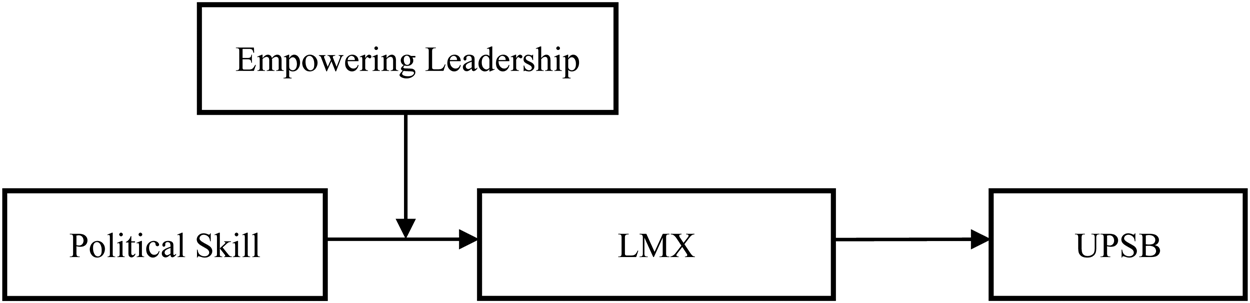
Moreover, we posit that when supervisors exhibit high levels of empowering leadership, politically skilled subordinates may be more likely to establish high-quality LMX and engage in UPSB. Empowering leaders are likely to provide subordinates with opportunities to obtain access to power and autonomy (Ahearne, Mathieu, & Rapp, Reference Ahearne, Mathieu and Rapp2005; Arnold, Arad, Rhoades, & Drasgow, Reference Arnold, Arad, Rhoades and Drasgow2000; Pearce & Sims, Reference Pearce and Sims2002). Based on a combination of social exchange theory (Blau, Reference Blau1964; Cook & Rice, Reference Cook, Rice and DeLamater2006) with the theoretical framework of social influence proposed by McAllister, Ellen, and Ferris (Reference McAllister, Ellen and Ferris2018), politically skilled subordinates prefer to capitalize on these opportunities by establishing and maintaining high-quality LMX and continue to engage in UPSB to exhibit reciprocity toward their leaders. Accordingly, we propose a moderated mediation model according to which LMX mediates the effect of political skill on UPSB, whereas empowering leadership moderates this effect. We present our conceptual framework in Figure 1.
Theoretical model.

Our research contributes to and advances the political skill and UPSB literature in several ways. First, while previous studies have focused mostly on the ‘bright side’ of political skill (Andrews, Kacmar, & Harris, Reference Andrews, Kacmar and Harris2009; Douglas & Ammeter, Reference Douglas and Ammeter2004; Harris, Kacmar, Zivnuska, & Shaw, Reference Harris, Kacmar, Zivnuska and Shaw2007b; Liu, Ferris, Zinko, Perrewé, Weitz, & Xu, Reference Liu, Ferris, Zinko, Perrewé, Weitz and Xu2007), by focusing on and examining the relationship between political skill and UPSB, we contribute to the political skill literature by expanding the small but growing stream of research investigating the ‘dark side’ of political skill (Clements, Boyle, & Proudfoot, Reference Clements, Boyle and Proudfoot2016; Harvey et al., Reference Harvey, Harris, Kacmar, Buckless and Pescosolido2014; Zahid, Butt, & Khan, Reference Zahid, Butt and Khan2019). Second, by examining LMX as a mediator in this context, we advance the political skill and unethical behavior literature by investigating the social exchange mechanism underlying the relationship between political skill and UPSB. Third, we expand our knowledge of the boundary conditions that can influence the extent to which politically skilled subordinates reciprocate for the benefits that they receive from their leaders by establishing high-quality LMX and engaging in UPSB. The present work also demonstrates the value of integrating empowering leadership into UPSB studies.
Theoretical framework
Political skill and UPSB
UPSB refers to a violation of organizational rules and values by a subordinate with the aim of advancing the leader's interests (Johnson & Umphress, Reference Johnson and Umphress2019; Liu, Liao, & Liu, Reference Liu, Liao and Liu2020). The construct of UPSB includes two components: the aim of benefitting leaders and an immoral manner of accomplishing this task. For instance, a subordinate might misrepresent the truth to help the leader convey a good impression, intentionally conceal the leader's mistakes, or even take the blame for the leader when necessary. We postulate that politically skilled employees are more likely to engage in unethical behaviors to benefit their supervisors. According to social-political influence theory (Ferris et al., Reference Ferris, Treadway, Perrewé, Brouer, Douglas and Lux2007, Reference Ferris, Ellen, McAllister and Maher2019), politically skilled individuals prefer to engage in political behavior (e.g., the use of ingratiation as an influencing tactic) to pursue their own interests with regard to gaining power and status in their interactions with their leaders. Ingratiators are ‘yes men’ who surround leaders, which may be viewed as a form of tactical ‘bribery’ with regard to leaders (Clements & Washbush, Reference Clements and Washbush1999; Johnson, Kidwell, Lowe, & Reckers, Reference Johnson, Kidwell, Lowe and Reckers2019; Kim, LePine, & Chun, Reference Kim, LePine and Chun2018). Thus, although ingratiation is often unethical, manipulative, and unsanctioned by formal rules (Harris et al., Reference Harris, Kacmar, Zivnuska and Shaw2007b; Parker & Parker, Reference Parker and Parker2017; Vigoda-Gadot & Talmud, Reference Vigoda-Gadot and Talmud2010; Yan, Xie, Zhao, Zhang, Bashir, & Liu, Reference Yan, Xie, Zhao, Zhang, Bashir and Liu2020; Zahid, Butt, & Khan, Reference Zahid, Butt and Khan2019), the ability of politically skilled employees to disguise their self-serving motives encourages leaders to evaluate politically skilled employees' ingratiation in a nonnegative manner (Blickle et al., Reference Blickle, Kückelhaus, Kranefeld, Schütte, Genau, Gansen-Ammann and Wihler2020; Treadway et al., Reference Treadway, Shaughnessy, Breland, Yang and Reeves2013; Wu, Kwan, Wei, & Liu, Reference Wu, Kwan, Wei and Liu2013). Particularly, to flatter their supervisors, politically skilled employees may employ ingratiation tactics such as other-enhancement, favor rendering, and opinion conformity (Appelbaum & Hughes, Reference Appelbaum and Hughes1998). Accordingly, even if the leader makes a mistake, politically skilled employees may not offer any criticism or may even provide cover for the leader through other-enhancement and opinion confirmation. In the study conducted by Zahid, Butt, and Khan (Reference Zahid, Butt and Khan2019), the authors noted that in the context of a high level of organizational politics, politically skilled employees may employ political manipulation to grant favors to their colleagues and superiors for self-serving purposes. Furthermore, the interest of such individuals in attaining power and influence may also lead them to focus on goal attainment, thus inducing them to overlook the morality of the means by which they achieve those goals (Castille, Buckner, & Thoroughgood, Reference Castille, Buckner and Thoroughgood2018). Researchers have shown that, like Machiavellians, politically skilled individuals prefer to adopt a utilitarian ethical philosophy and exhibit a subconscious drive to overlook moral constraints (Brouer et al., Reference Brouer, Duke, Treadway and Ferris2009). Thus, individuals with political skill may feel as if engaging in UPSB can not only allow them to ingratiate themselves to their leaders but also advance their self-interests. Therefore, we propose the following hypothesis:
Hypothesis 1: Political skill relates positively to UPSB.
Political skill and LMX
LMX refers to the process of continuous, differential, and mutual relationship-oriented interaction between leaders and followers (Dulebohn et al., Reference Dulebohn, Bommer, Liden, Brouer and Ferris2012; Graen & Uhl-Bien, Reference Graen and Uhl-Bien1995; Wayne & Green, Reference Wayne and Green1993). Relationships featuring LMX relationship are positively linked to the trust and reciprocity of subordinates and the corresponding obligations between the relevant parties (Dulebohn et al., Reference Dulebohn, Bommer, Liden, Brouer and Ferris2012; Liden, Sparrowe, & Wayne, Reference Liden, Sparrowe, Wayne and Ferris1997). We propose that political skill relates positively to LMX. Based on the interconnections between political skill and LMX, Ferris et al. (Reference Ferris, Treadway, Kolodinsky, Hochwarter, Kacmar, Douglas and Frink2005) define political skill in terms of the following four dimensions: apparent sincerity, social astuteness, interpersonal influence, and networking ability. First, social astuteness may ensure that politically skilled employees are also skilled at identifying their leaders' internal preferences, accepting and fulfilling their leaders' role requirements and satisfying their leaders' expectations (Epitropaki et al., Reference Epitropaki, Kapoutsis, Ellen, Ferris, Drivas and Ntotsi2016; Wihler, Blickle, Ellen, Hochwarter, & Ferris, Reference Wihler, Blickle, Ellen, Hochwarter and Ferris2017). Second, by hiding their self-serving intentions, politically skilled employees interact with their leaders in a seemingly sincere and reliable manner with the aim of eliciting favorable evaluations from their leaders and establishing quality relationships (Ferris et al., Reference Ferris, Treadway, Perrewé, Brouer, Douglas and Lux2007). Third, the interpersonal influence and networking ability of politically skilled employees enables them to enhance their trust and reputation and ultimately shapes their interactions with their leaders (Ferris et al., Reference Ferris, Treadway, Kolodinsky, Hochwarter, Kacmar, Douglas and Frink2005, Reference Ferris, Treadway, Perrewé, Brouer, Douglas and Lux2007). Previous studies have suggested that the influence tactics (e.g., ingratiation, impression management) used by politically skilled subordinates may allow those subordinates to accrue social capital with their supervisor and can be beneficial with regard to their ability to obtain favorable performance assessments from their leaders, thereby leading to higher-quality LMX relationships (Epitropaki et al., Reference Epitropaki, Kapoutsis, Ellen, Ferris, Drivas and Ntotsi2016; Koopman, Matta, Scott, & Conlon, Reference Koopman, Matta, Scott and Conlon2015; Uhl-Bien, Graen, & Scandura, Reference Uhl-Bien, Graen and Scandura2000; Wei, Chiang, & Wu, Reference Wei, Chiang and Wu2012). Therefore, we propose the following hypothesis:
Hypothesis 2: Political skill relates positively to LMX.
LMX and UPSB
Recent research has found that individuals may engage in unethical behavior that benefits others, such as unethical pro-organizational behavior (Umphress & Bingham, Reference Umphress and Bingham2011; Umphress, Bingham, & Mitchell, Reference Umphress, Bingham and Mitchell2010), unethical pro-family behavior (Liu, Liao, & Liu, Reference Liu, Liao and Liu2020), unethical pro-group behavior (Thau, Derfler-Rozin, Pitesa, Mitchell, & Pillutla, Reference Thau, Derfler-Rozin, Pitesa, Mitchell and Pillutla2015), or UPSB (Johnson & Umphress, Reference Johnson and Umphress2019). We propose that LMX relates positively to UPSB. First, based on the principle of reciprocity, high-quality LMX instills in subordinates a strong sense of responsibility to leadership and a sense of the importance of fulfilling their obligations (Carnevale, Huang, Uhl-Bien, & Harris, Reference Carnevale, Huang, Uhl-Bien and Harris2020; Tse, Reference Tse2008). Second, LMX may encourage employees to behave unethically. When subordinates perceive high positive social exchange associated with high-quality LMX, subordinates may emphasize the importance of reciprocating for the positive treatment they receive from their leaders more strongly (Bolino, Turnley, Gilstrap, & Suazo, Reference Bolino, Turnley, Gilstrap and Suazo2010; Brandes & Franck, Reference Brandes and Franck2012; Lewicki, Tomlinson, & Gillespie, Reference Lewicki, Tomlinson and Gillespie2006). High-quality LMX may lead subordinates to separate behavioral risks from their own responsibilities and blur their moral awareness, thus reducing their perceptions of behavioral responsibility and ultimately encouraging them to engage in unethical behaviors to benefit their leaders or organizations (Hamilton, Reference Hamilton1978; Umphress, Bingham, & Mitchell, Reference Umphress, Bingham and Mitchell2010; Vriend, Said, Janssen, & Jordan, Reference Vriend, Said, Janssen and Jordan2020; Yang, Zhang, & Lang, Reference Yang, Zhang and Lang2019). Previous research has demonstrated that high-quality LMX can induce subordinates to break ethical rules and use unethical means to benefit their leaders (Bryant & Merritt, Reference Bryant and Merritt2021; Vriend et al., Reference Vriend, Said, Janssen and Jordan2020).
Furthermore, we contend that LMX plays a mediating role in the relationship between political skill and UPSB. According to social exchange theory (Blau, Reference Blau1964; Cook & Rice, Reference Cook, Rice and DeLamater2006), positive social exchange is a key explanatory mechanism associated with UPSB because strong social exchange relationships are related positively to employees' tendency to disregard the moral consequences of their behaviors and thus exhibit moral disengagement (Umphress & Bingham, Reference Umphress and Bingham2011; Wang, Long, Zhang, & He, Reference Wang, Long, Zhang and He2019). As illustrated above, politically skilled subordinates can establish and maintain high-quality LMX relationships with their leaders by employing political influence tactics (Ferris et al., Reference Ferris, Treadway, Kolodinsky, Hochwarter, Kacmar, Douglas and Frink2005, Reference Ferris, Treadway, Perrewé, Brouer, Douglas and Lux2007); accordingly, high-quality LMX may be positively associated with politically skilled subordinates' tendency to engage in UPSB to exhibit reciprocity toward their leaders. Recent studies have supported the claim that LMX is the key mechanism underlying UPSB. For example, Bryant and Merritt (Reference Bryant and Merritt2021) suggested that LMX mediates the relationship between interpersonal justice and willingness to engage in UPSB. Therefore, we propose the following hypothesis:
Hypothesis 3: LMX relates positively to UPSB.
Hypothesis 4: LMX mediates the relationship between political skill and UPSB.
The moderating role of empowering leadership
Previous studies have mostly defined empowering leadership as the process of delegating greater authority and responsibility to subordinates to foster autonomous decision-making, convey confidence in subordinates' high performance, and provide subordinates with autonomy in the absence of bureaucratic constraints (Arnold et al., Reference Arnold, Arad, Rhoades and Drasgow2000; Cheong, Yammarino, Dionne, Spain, & Tsai, Reference Cheong, Yammarino, Dionne, Spain and Tsai2019; Sharma & Kirkman, Reference Sharma and Kirkman2015). We suggest that supervisor empowering leadership may moderate the relationship between political skill and LMX. The reason for this moderating effect may be as follows. First, according to the social influence-based theoretical framework of political skill proposed by McAllister, Ellen, and Ferris (Reference McAllister, Ellen and Ferris2018), politically skilled subordinates have an inner need to pursue power and influence that drives them to engage successfully in influence behaviors. When politically skilled individuals recognize opportunities based on the surrounding context, they also evaluate the viability (e.g., through power assessment and risk assessment) of capitalizing on these opportunities by exerting social influence. Thus, when such individuals perceive that they are empowered by their supervisors, the socially astute nature of their political skill enables them to identify such opportunities proactively and thus to capitalize on these opportunities by establishing and maintaining high-quality LMX relationships. In contrast, low levels of perceived empowering leadership attenuate the relationship between political skill and LMX. When supervisors do not offer empowerment or even behave in an authoritative manner, politically skilled subordinates may have less discretion with regard to decision-making and political manipulation; thus, politically skilled subordinates in such a situation may find it difficult to establish quality relationships with supervisors through social influence due to their lack of power or the potential risk (McAllister, Ellen, & Ferris, Reference McAllister, Ellen and Ferris2018). Previous studies have suggested that when leaders engage in empowering behavior, politically skilled subordinates who feel psychologically empowered proactively take advantage of favorable contextual circumstances and impact their jobs and work environments in meaningful ways, such as by establishing and maintaining high-quality relationships (Khan & Akhtar, Reference Khan and Akhtar2018; Sabar, Snell, Susanto, Teofilus, Nasution, & Fauzi, Reference Sabar, Snell, Susanto, Teofilus, Nasution and Fauzi2022; Tillmann, Boerner, & Sparr, Reference Tillmann, Boerner and Sparr2018). Therefore, we expect empowering leadership to have a positive moderating effect on the relationship between political skill and LMX.
Based on the aforementioned arguments, we have proposed theoretical hypotheses suggesting that LMX mediates the relationship between political skill and UPSB and that empowering leadership moderates the relationship between political skill and LMX. We thus propose an integrated model according to which empowering leadership moderates the indirect relationship between political skill and UPSB. Therefore, we propose the following hypotheses:
Hypothesis 5: Empowering leadership moderates the positive relationship between political skill and LMX such that this relationship is stronger (vs. weaker) among employees who encounter higher (vs. lower) levels of empowering leadership.
Hypothesis 6: Empowering leadership moderates the positive indirect relationship between political skill and UPSB such that this relationship is stronger (vs. weaker) among employees who encounter higher (vs. lower) levels of empowering leadership.
Methods
Participants and procedures
The three-wave data collection process took place from May 2021 to June 2021. We recruited employees from five corporations (one hotel, one insurance company, one auto sales company, one architectural design company, and one high-tech company) in Chengdu and Chongqing, both of which are located in southwestern China. Before collecting the data, we sent invitations to HR managers who agreed to distribute our survey in their companies. These HR managers assisted us in recruiting full-time employees from their companies. With the assistance of these HR managers, we were able to obtain the names, positions, and emails of these sample employees. We sent informed consent forms and online questionnaires to the participants via email and matched identification codes across the three time points. Participation was completely voluntary, and participants were assured that their responses would be anonymous. To maximize response rates, we compensated the participants with US$5 (approximately RMB 30) for their time. Following the recommendations of Podsakoff, MacKenzie, and Podsakoff (Reference Podsakoff, MacKenzie and Podsakoff2012) regarding time lags, we collected our data in three waves of approximately 5 weeks each. At time 1, 640 participants reported their gender, age, education, tenure, and level of political skill, and 592 participants returned fully completed questionnaires (for a response rate of 92.5%). At time 2 (approximately 5 weeks after time 1), the participants reported the levels of empowering leadership and LMX exhibited by their immediate leaders, and 497 participants responded to our time 2 survey (for a response rate of 83.95%). At time 3, we obtained 442 valid survey questionnaires regarding UPSB (for a response rate of 88.93%). In summary, the response rates associated with our survey met the relevant expectations for response rates in the context of organizational science research (Anseel, Lievens, Schollaert, & Choragwicka, Reference Anseel, Lievens, Schollaert and Choragwicka2010).
Finally, the demographic information of our sample was as follows. In total, 236 participants (53.3%) were female, and 206 participants (46.7%) were male. In total, 167 participants (37.7%) were between 21 and 25 years old, 147 participants (33.2%) were between 26 and 30 years old, 52.3% of the participants held a college degree or higher, and approximately 70.5% of the participants had job experience ranging from 1 to 5 years.
Measures
For the translation from the original English scales, we followed the translation and back-translation procedures recommended by Brislin (Reference Brislin, Altman, Rapoport and Wohlwill1980). The participants responded to our questions on a Likert-type scale with responses ranging from 1 (strongly disagree) to 5 (strongly agree).
Political skill
Political skill was measured using the 18-item scale developed by Ferris et al. (Reference Ferris, Treadway, Kolodinsky, Hochwarter, Kacmar, Douglas and Frink2005). The dimensions of this scale were as follows: apparent sincerity, interpersonal influence, social astuteness, and networking ability. The following is an example of the items included in this scale: ‘I am able to communicate easily and effectively with others’ (Cronbach's α = .75).
LMX
LMX was measured using the seven-item scale developed by Graen and Uhl-Bien (Reference Graen and Uhl-Bien1995). The following is an example of the items included in this scale: ‘My supervisor understands my problems and needs’ (Cronbach's α = .87).
UPSB
UPSB was measured using the six-item scale developed by Johnson and Umphress (Reference Johnson and Umphress2019). The following is an example of the items included in this scale: ‘Because it benefited my supervisor, I have withheld negative information about my supervisor's performance from others’ (Cronbach's α = .86).
Empowering leadership
Empowering leadership was measured using the 12-item scale developed by Ahearne, Mathieu, and Rapp (Reference Ahearne, Mathieu and Rapp2005). The following is an example of the items included in this scale: ‘My supervisor often consults me on strategic decisions’ (Cronbach's α = .89).
Control variables
Following previous suggestions regarding the use of control variables (Bernerth & Aguinis, Reference Bernerth and Aguinis2016; Carlson & Wu, Reference Carlson and Wu2012), we controlled for gender, age, education, and working tenure since these factors are related to UPSB (Li, Jain, & Tzini, Reference Li, Jain and Tzini2021).
Analytical strategy
To test the hypothesized model, we first examined the internal consistency, demographic characteristics, and correlations among the variables. Second, we evaluated discriminant validity by conducting a confirmatory factor analysis (CFA) using Mplus 7.0 software. Third, to test the indirect and conditional indirect effects, we followed the suggestions of Preacher, Zyphur, and Zhang (Reference Preacher, Zyphur and Zhang2010) by using Hayes (Reference Hayes2013) PROCESS models 4 and 7. We evaluated indirect effects with 95% confidence intervals using 5000 bootstraps. The significance of an indirect effect is supported if the confidence intervals exclude zero. We followed the guidelines suggested by Edwards and Lambert (Reference Edwards and Lambert2007) and tested the moderating effect using a simple slope test (Lai, Li, & Leung, Reference Lai, Li and Leung2013). We further tested the conditional indirect effect with bootstrapped confidence intervals using the approach described by Preacher, Rucker, and Hayes (Reference Preacher, Rucker and Hayes2007), and we also assessed the confidence interval corresponding to the difference between the two indirect effects in relation to the conditional indirect effect.
Results
Common method bias test
We first tested for potential common method bias (CMB) using Harman's single-factor test (Podsakoff, MacKenzie, & Podsakoff, Reference Podsakoff, MacKenzie and Podsakoff2012). The single-factor model exhibited a good fit, and the results showed that the largest amount of variance explained by a single component was 9.514% (Podsakoff, MacKenzie, & Podsakoff, Reference Podsakoff, MacKenzie and Podsakoff2012). We further used the unmeasured latent method factor (ULMF) method to examine the degree of CMB (Podsakoff, MacKenzie, & Podsakoff, Reference Podsakoff, MacKenzie and Podsakoff2012). The results revealed that the fit statistics for the measurement model using the ULMF (χ2 = 818.73; df = 342; CFI = .95; TLI = .94; IFI = .95; RMSEA = .052) indicated a slight improvement in model fit. The method factor accounted for 18.83% of the total variance (less than 25%). Accordingly, CMB was not a serious concern in our study.
Confirmatory factor analysis
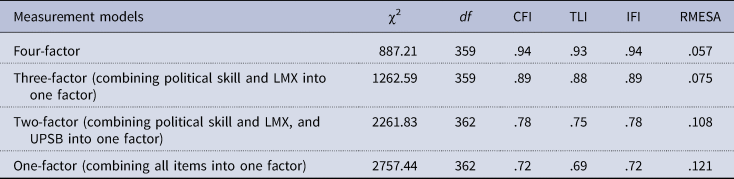
CFA was conducted to examine the distinctiveness of all self-reported variables. As shown in Table 1, the four-factor model (political skill, LMX, UPSB, and empowering leadership) exhibited a significantly better fit than any other model. The results of the CFA were as follows: chi-square (χ2) = 887.21, degrees of freedom (df) = 359, CFI = .94, IFI = .93, TLI = .94, and RMSEA = .057. We examined the average variance extracted (AVE) and composite reliability to evaluate the convergent validity in further detail. According to the relevant acceptable criteria drawn from previous studies (Bagozzi & Yi, Reference Bagozzi and Yi1988; Fornell & Larcker, Reference Fornell and Larcker1981), as shown in Table 2, the results indicated support for the model's convergent validity, as expected. To evaluate discriminant validity, the results indicated that the interconstruct correlations were smaller than the square root values of AVE, thus suggesting that the measures captured distinct constructs. The discriminant validity was at an acceptable level according to the criteria suggested by Hair, Ringle, and Sarstedt (Reference Hair, Ringle and Sarstedt2011) (see Table 3).
Confirmatory factor analysis

CFI, comparative fit index; IFI, incremental fit index; TLI, Tucker–Lewis index; RMSEA, root mean square error of approximation.
Convergent validity

AVE, average variance extracted; CR, composite reliability.
Discriminant validity

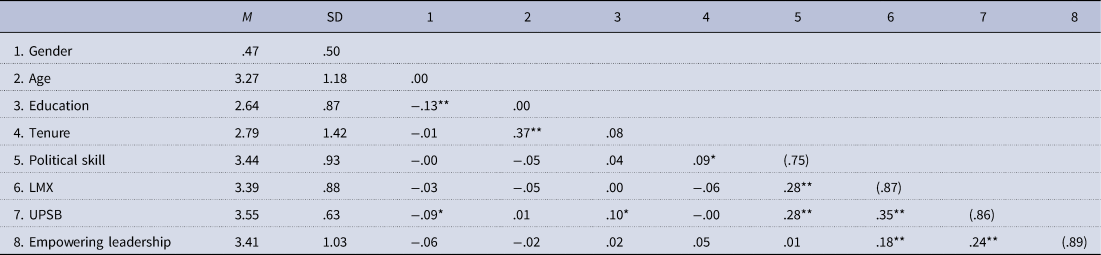
Note: N = 442; Cronbach's α reliabilities displayed on the diagonal; *p < .05, **p < .01, ***p < .001.
Descriptive statistics
Table 4 presents the means, standard deviations, and Pearson's correlation analysis results. In line with our predictions, the results indicated positive relationships among political skill (time 1), LMX (time 2) (r = .28, p < .01), and UPSB (time 3) (r = .28, p < .01). In addition, LMX (time 2) was positively correlated with UPSB (time 3) (r = .35, p < .01). Empowering leadership (time 2) was positively correlated with UPSB (time 3) (r = .24, p < .01).
Results of descriptive statistical analysis

Note: N = 442; Cronbach's α reliabilities displayed on the diagonal; *p < .05, **p < .01, ***p < .001. Two-tailed test.
Hypothesis testing
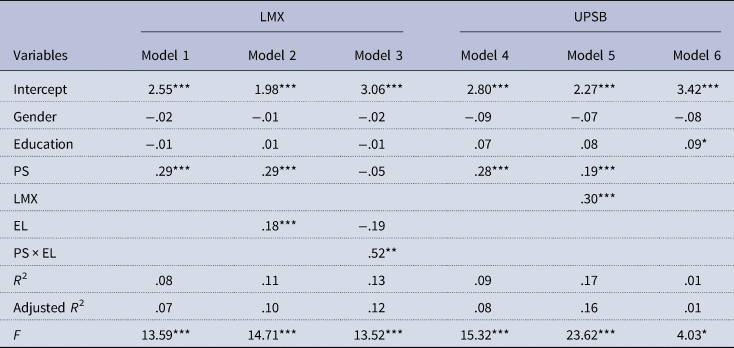
First, we examined the mediating role of LMX. As displayed in Table 5, political skill was positively and significantly associated with UPSB (β = .28, p < .001) and LMX (β = .29, p < .001), and LMX was positively associated with UPSB (β = .30, p < .001), thereby supporting hypotheses 1–3. A bias-corrected bootstrapping technique (n = 5,000) (PROCESS, model 4; Hayes, Reference Hayes2013) was also used to test this mediating effect. Moreover, we found a significant indirect relationship between political skill and UPSB (estimate = .05, SE = .01, 95% CI [.028–.095]), thus supporting hypothesis 4.
Moderated mediation analysis

EL, empowering leadership; PS, political skill.
Note: N = 442; *p < .05, **p < .01, ***p < .001.
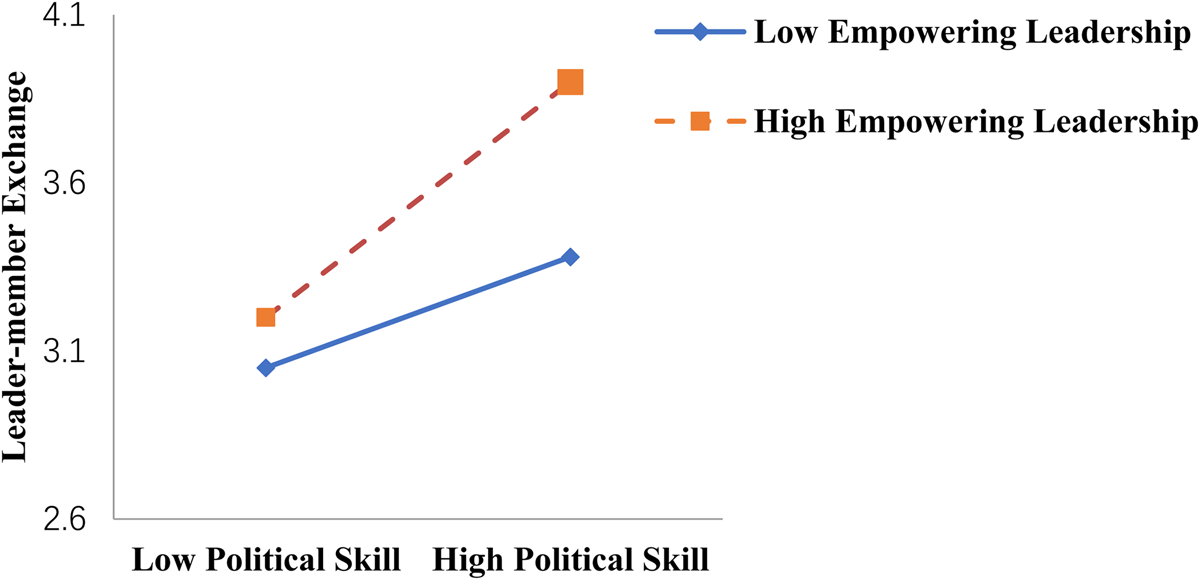
Second, we examined the moderating role of empowering leadership in the positive relationship between political skill and LMX using the PROCESS syntax (model 7) (Edwards & Lambert, Reference Edwards and Lambert2007; Hayes, Reference Hayes2013). We created an interaction term between political skill and empowering leadership. As shown in model 3 (see Table 5), this interaction term was significant (β = .52, p < .01). With respect to our interaction hypothesis, due to the time-separated assessment of political skill and empowering leadership and according to the results of the CFA, common method variance (CMV) was unlikely to have significant effects on the interaction test (Lai, Li, & Leung, Reference Lai, Li and Leung2013). Subsequently, we conducted a simple slope analysis, as presented in Figure 2 (Aiken & West, Reference Aiken and West1991). The simple slope test showed that the positive relationship between political skill and UPSB is stronger when empowering leadership is high (β = .37, SE = .05, p < .001) than when empowering leadership is low (β = .17, SE = .05, p < .01), thus supporting hypothesis 5.
Moderating effect.

We further tested the conditional indirect effect using bootstrapped confidence intervals. As shown in Table 6, the bootstrapping analyses indicated that the conditional indirect effect of political skill on UPSB via LMX was significant, thus suggesting that the indirect effects of political skill on UPSB differ significantly across different levels of empowering leadership, namely, when an immediate supervisor's level of empowering leadership is high (+1 SD, indirect effect = .080, SE = .023, 95% CI [.038–.131]) versus low (−1 SD, indirect effect = .038, SE = .01, 95% CI [.051–.071]). These results indicate significant differences in the indirect effect (Δβ = .042, SE = .02, 95% CI [.013–.097]), thus supporting hypothesis 6.
Conditional indirect effects

Note: N = 442; CI, confidence interval. Bootstrapping repetitions. N = 5,000.
Discussion
Why do politically skilled employees engage in UPSB? We found empirical evidence regarding the key psychological mechanism by which political skill influences UPSB via LMX. Specifically, consistent with our predictions, we found that political skill has a positive effect on LMX and UPSB and that it has a positive indirect effect on UPSB by increasing LMX. In addition, we discovered that immediate supervisor empowering leadership is a boundary condition that moderates both the direct and indirect effects of political skill on UPSB. Our findings have multiple theoretical implications.
Theoretical implications
First, in answer to the call for further research concerning the ‘dark side’ of political skill (Zahid, Butt, & Khan, Reference Zahid, Butt and Khan2019), our results suggest that politically skilled employees may engage in unethical behavior to benefit their supervisors. According to social-political influence theory (Ferris et al., Reference Ferris, Treadway, Perrewé, Brouer, Douglas and Lux2007, Reference Ferris, Ellen, McAllister and Maher2019), this finding could be explained by the fact that politically skilled subordinates prefer to engage in UPSB to further their own interests in terms of increasing their power and status. While the studies conducted by Zahid, Butt, and Khan (Reference Zahid, Butt and Khan2019) suggested that politically skilled individuals prefer to engage in unethical pro-self-behavior (e.g., self-serving counterproductive work behavior) when facing high levels of organizational politics, our findings appear both to be consistent with and to go beyond the conclusions of Zahid, Butt, and Khan (Reference Zahid, Butt and Khan2019), who argued that politically skilled people prefer to engage in unethical pro-other behavior (e.g., UPSB) (Veetikazhi, Kamalanabhan, Malhotra, Arora, & Mueller, Reference Veetikazhi, Kamalanabhan, Malhotra, Arora and Mueller2022). Obviously, politically skilled employees engage in UPSB to satisfy and mask their self-serving motives; thus, to some degree, these findings are broadly in alignment with the conclusions of previous studies conducted by Treadway et al. (Reference Treadway, Shaughnessy, Breland, Yang and Reeves2013) and Harvey et al. (Reference Harvey, Harris, Kacmar, Buckless and Pescosolido2014). Furthermore, only a few recent studies have demonstrated that contextual factors (e.g., identification, supervisor support, and leader bottom-line mentality) have positive impacts on UPSB (Johnson & Umphress, Reference Johnson and Umphress2019; Lee, Reference Lee2020; Li, Jain, & Tzini, Reference Li, Jain and Tzini2021; Mesdaghinia, Rawat, & Nadavulakere, Reference Mesdaghinia, Rawat and Nadavulakere2019). This study also contributes to the UPSB literature by developing the nomological network of UPSB and identifying political skill as an antecedent of UPSB.
Second, based on social exchange theory (Blau, Reference Blau1964; Cook & Rice, Reference Cook, Rice and DeLamater2006), our study provides a comprehensive explanation for the mechanism underlying the relationship between political skill and UPSB. Our findings suggest that LMX appears to mediate the relationship between political skill and UPSB. In line with social exchange theory (Blau, Reference Blau1964; Cook & Rice, Reference Cook, Rice and DeLamater2006), individuals with political skill can more easily gain the trust of their superiors and establish a high level of LMX. Hence, politically skilled individuals may experience moral disengagement from ethical restrictions due to positive LMX and engage in more UPSB as a reciprocal behavior. These findings appear to respond to and extend the work of Zahid, Butt, and Khan (Reference Zahid, Butt and Khan2019) and contribute to the political skill literature by exploring the mediating mechanisms by which political skill is translated into unethical behavior. Moreover, while previous research has employed social exchange mechanisms to explain how situational factors (e.g., interpersonal justice, supervisor support) trigger UPSB (Bryant & Merritt, Reference Bryant and Merritt2021; Li, Jain, & Tzini, Reference Li, Jain and Tzini2021), our results appear to extend these studies by confirming the mediating role of LMX in the relationship between political skill and UPSB.
Finally, we found that empowering leadership is a boundary condition that moderates political skill and the indirect effect of the relationship between political skill and UPSB. These results address the call for research concerning the factors that moderate the effects of political skill (Kimura, Reference Kimura2015). According to social exchange theory (Blau, Reference Blau1964; Cook & Rice, Reference Cook, Rice and DeLamater2006), politically skilled employees who face high levels of empowering leadership are more likely to establish and maintain high-quality LMX relationships and thus to engage in UPSB to reciprocate for the benefits they receive from empowering leaders. Although several previous studies have explored the positive link between political skill and unethical behavior to some degree, our results seem to go beyond the conclusions of those studies by reporting empirical evidence concerning the boundary conditions associated with the relationship between political skill and unethical behavior (Clements, Boyle, & Proudfoot, Reference Clements, Boyle and Proudfoot2016; Zahid, Butt, & Khan, Reference Zahid, Butt and Khan2019). This research thus not only enriches the literature concerning political skill but also answers calls for more empirical investigations of the moderators of UPSB (Johnson & Umphress, Reference Johnson and Umphress2019). Additionally, several previous studies have found that when employees perceive that their leaders are highly empowering, they are more likely to feel less constrained by organizational rules (Mai, Welsh, Wang, Bush, & Jiang, Reference Mai, Welsh, Wang, Bush and Jiang2021; Zhang, Tian, Ma, Tian, Li, & Liang, Reference Zhang, Tian, Ma, Tian, Li and Liang2021). Our findings partially support these perspectives by demonstrating the moderating role of empowering leadership in the indirect effect of political skill on UPSB.
Practical implications
The findings of this study have several significant managerial implications for organizations. First, the findings suggest that politically skilled employees may be more likely to engage in behaviors intended to assist their leaders via UPSB. As a result, organizations and managers should be aware of the potential ‘dark side’ of political skill. To mitigate the effects of the ‘dark side’ of political skill, appropriate interventions can be implemented to mitigate the potential moral risks associated with such skills. Second, our study indicates that LMX mediates the relationship between political skill and UPSB. Therefore, we encourage organizations and managers to be aware of the perceived reciprocity that motivates employees to engage in UPSB in the context of LMX. To address this issue, organizations can offer coaching programs intended to enhance the moral awareness of both leaders and employees. Third, regarding our results concerning the moderating role of immediate supervisors' empowering leadership in this context, organizations should establish a manager empowerment risk mechanism to enable managers to become aware of the risks of empowerment with respect to potential ethical costs associated with that factor.
Limitations and directions for future research
Several limitations of the present study should be noted. First, we followed the suggestions of Johnson, Rosen, and Djurdjevic (Reference Johnson, Rosen and Djurdjevic2011) by collecting data in a temporally separated manner. However, the use of self-report survey data may nevertheless have led to issues with CMV (Podsakoff, MacKenzie, & Podsakoff, Reference Podsakoff, MacKenzie and Podsakoff2012). Future studies can use experimental methods and qualitative techniques to identify the causal relationships present in this context more precisely. Second, although this study showed that LMX serves as the focal mediator in the relationship between political skill and UPSB, it is possible that other theoretical frameworks (e.g., organizational identification) could also explain the internal mechanism underlying this relationship (Basit, Reference Basit2020; Thompson, Buch, & Kuvaas, Reference Thompson, Buch and Kuvaas2017). Therefore, we encourage future studies to include other mediating mechanisms to open the ‘black box’ of the relationship between political skill and unethical behavior. Third, we encourage researchers to include other boundary conditions associated with the positive effect of political skill on UPSB that may buffer or exacerbate that effect. For instance, Machiavellian traits can make employees with strong political skill even ‘darker’ (Castille, Buckner, & Thoroughgood, Reference Castille, Buckner and Thoroughgood2018; Gürlek, Reference Gürlek2021). Thus, boundary conditions such as individual and situational factors should be given more attention in future studies to extend our work. Fourth, we collected data only in China. Future research could also explore culture-related moderators (e.g., collectivism, power distance, and traditionality) to increase the external validity of these results.
Conclusions
In conclusion, this study builds on social exchange theory and provides initial empirical evidence suggesting that political skill has a positive effect on UPSB and that it has a positive indirect effect on UPSB by increasing LMX. Furthermore, this study highlights the fact that empowering leadership serves as a boundary condition that moderates the relationship between LMX and UPSB. The findings of this exploration of the relationship between political skill and UPSB provide several insights that are relevant to the political skill and UPSB literature. We hope that our study can offer nuanced insights that can facilitate further work aimed at improving our understanding of the potential ‘dark side’ of political skill and the factors that influence UPSB in the workplace.
Acknowledgment
This study was supported by the Doctoral Research Initiation Project of Jilin University of Finance and Economics (RES0005525).
Conflict of interest
We declare that we have no financial and personal relationships with other people or organizations that can inappropriately influence our work.
Ethical standards
All procedures performed in studies involving human participants were in accordance with the ethical standards of national research committee and with the 1964 Helsinki declaration and its later amendments or comparable ethical standards.