Acute puerperal metritis (APM) is an acute systemic illness due to infection of the uterus, occurring within 21 d after parturition. The definition also includes an abnormally enlarged uterus and a fetid watery red-brown uterine discharge (Sheldon et al. Reference Sheldon, Lewis, LeBlanc and Gilbert2006). These symptoms are associated with fever (>39·5 °C) and signs of systemic illness such as decreased milk yield, dullness or other signs of toxaemia, decreased dry matter intake, elevated heart rate, dehydration (Sheldon et al. Reference Sheldon, Williams, Miller, Nash and Herath2009b). In studies applying these criteria, the incidence rate of APM was about 20% (Drillich et al. Reference Drillich, Beetz, Pfützner, Sabin, Sabin, Kutzer, Nattermann and Heuwieser2001; Benzaquen et al. Reference Benzaquen, Risco, Archbald, Melendez, Thatcher and Thatcher2007; Dubuc et al. Reference Dubuc, Duffield, Leslie, Walton and LeBlanc2010). An older study reported an incidence rate of 40% (Markusfeld, Reference Markusfeld1987); however, the author did not provide a clear definition of APM.
It has been demonstrated that APM reduced feed intake, decreased long-term milk yield, and increased the chance of culling in multiparous but not primiparous cows (Dann et al. Reference Dann, Morin, Bollero, Murphy and Drackley2005; Dubuc et al, Reference Dubuc, Duffield, Leslie, Walton and LeBlanc2011; Wittrock et al. Reference Wittrock, Proudfoot, Weary and von Keyserlingk2011). Most recently the effect of APM on culling has been investigated in a study using 2178 cows in 6 herds in North America (Dubuc et al. Reference Dubuc, Duffield, Leslie, Walton and LeBlanc2011). Metritis did not have a direct effect on culling risk at 30 and 63 d in milk (DIM) or on the cumulative culling hazard up to 300 DIM. Reproductive diseases, however, made pregnancy less likely, which was a substantial risk factor for culling (Dubuc et al. Reference Dubuc, Duffield, Leslie, Walton and LeBlanc2011).
Substantial economic losses are incurred by reduced milk yield, culling and treatment costs. The total costs per case of metritis have been calculated to approximate to US$ 329–386 (Overton & Fetrow, Reference Overton and Fetrow2008). The reported incidence rates and the opportunity costs underline the importance of this disease. It is obvious that strategies for effective prevention, accurate and early diagnosis, and efficacious treatment of APM are essential. Antibiotic therapy has been adopted as a common treatment for metritis (Azawi, Reference Azawi2008). Today the systemic use of antibiotics is recommended by many authors (Drillich et al. Reference Drillich, Beetz, Pfützner, Sabin, Sabin, Kutzer, Nattermann and Heuwieser2001; LeBlanc et al. Reference LeBlanc, Duffield, Leslie, Bateman, Keefe, Walton and Johnson2002; Sheldon & Dobson, Reference Sheldon and Dobson2004). Most frequently used drugs for treatment of APM are penicillin, oxytetracycline, ampicillin and ceftiofur (Smith et al. Reference Smith, Arthur Donovan, Risco, Littell, Young, Stanker and Elliott1998; Drillich et al. Reference Drillich, Beetz, Pfützner, Sabin, Sabin, Kutzer, Nattermann and Heuwieser2001; Currin, Reference Currin2010).
Antibiotic use is associated with selective pressure for the emergence of resistant bacteria, which underscores the importance of their prudent use (Fishman, Reference Fishman2006). More recently, several publications have addressed serious concerns regarding resistance in zoonotic pathogens (Tragesser et al. Reference Tragesser, Wittum, Funk, Winokur and Rajala-Schultz2006; CVMP, 2009; Mann et al. Reference Mann, Siler, Jordan and Warnick2011). Ceftiofur, a third generation cephalosporin, approved for the treatment of APM has been widely used in research trials (Zhou et al. Reference Zhou, Boucher, Dame, Moreira, Graham, Nantel, Zuidhof, Arfi, Flores, Neubauer and Olson2001; Chenault et al. Reference Chenault, McAllister, Chester, Dame, Kausche and Robb2004; Drillich et al. Reference Drillich, Voigt, Forderung and Heuwieser2007) and is a common treatment on commercial dairy farms. Advantages include demonstrated efficacy, a zero day withdrawal period for milk, and fewer group changes which are disruptive (Cook & Nordlund, Reference Cook and Nordlund2009; Schirmann et al. Reference Schirmann, Chapinal, Weary, Heuwieser and von Keyserlingk2011). Multi-drug resistant Salmonella species have been associated with the usage of third generation cephalosporins in dairy cows and their function as a reservoir for these pathogens (Frye & Fedorka-Cray, Reference Frye and Fedorka-Cray2007). Third-generation cephalosporins are valued for treating serious infections in human medicine. As a result, the use of ceftiofur in dairy cows could be a potential threat to the ability to cure life-threatening infections in humans (Allen & Poppe, Reference Allen and Poppe2002).
Particularly, rectal temperature and assessment of vaginal discharge have been recommended as screening tools to identify diseased animals. It is noteworthy, however, that there is a lack of science-based information on the value or significance of measuring rectal temperature as a diagnostic tool to identify infectious diseases in the post-partum period (Benzaquen et al. Reference Benzaquen, Risco, Archbald, Melendez, Thatcher and Thatcher2007). Sheldon (Sheldon et al. Reference Sheldon, Cronin, Goetze, Donofrio and Schuberth2009a) pointed out that having no ‘gold standard’ for the diagnosis of uterine diseases complicates the measurement of sensitivity and specificity of clinical definitions. It is simply assumed that the diagnostic performance of these tests (i.e. sensitivity and specificity) is sufficient for field use. Improved diagnostics to identify the aetiology of infections and help direct therapy belongs to the multifactorial interventions to prevent emergence and further spread of antibiotic resistance (Fishman, Reference Fishman2006).
Therefore, the overall objective of this study was to investigate how relevant research publications address the validity of diagnostic methods for APM in dairy cows. Specifically we set out to determine the proportion of studies that (1) provide a concise definition for APM, (2) cite references to support the use of the selected diagnostic methods to identify cows with APM, and (3) discuss test characteristics of the diagnostic methods and possibility of errors.
Materials and Methods
A systematic literature search was conducted on 02 April 2011 utilizing the ScienceDirect search engine (www.sciencedirect.com) to find articles involving the diagnosis of acute metritis. The search terms ‘acute AND metritis’ OR ‘puerperal AND metritis’ OR ‘postpartum AND metritis’ AND ‘dairy cow’ were used for the search in all fields. The search was conducted for Journal of Dairy Science, Theriogenology, Animal Reproduction Science and The Veterinary Journal. The data range was set to all years. Retrieval and management of references was performed with Endnote (Version X4.0.2; Thomson Reuters EndNote, New York NY, USA).
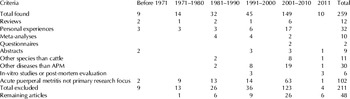
Using these criteria, the search revealed 259 articles published in the 4 journals specified. After exclusion of meta-analyses (n = 1), reviews (n = 12), personal experiences (n = 32), abstracts (n = 9), questionnaires (n = 2) and data analysis (n = 8) 195 articles remained. Of those, 40 publications were excluded because of other species than cattle (n = 11) and other diseases than acute metritis (n = 29) as defined previously (Sheldon et al. Reference Sheldon, Lewis, LeBlanc and Gilbert2006). Post-mortem and in-vitro evaluations (n = 6) were likewise excluded. From the remaining 149 articles 48 were identified as addressing acute metritis as the main research topic and used for a systematic evaluation (Table 1). The other 102 publications did not address metritis in the primary research objective (e.g. considered metritis merely as a risk factor for another disease or reduced milk yield).
Results of a literature search using the search criteria ‘acute AND metritis’ OR ‘puerperal AND metritis’ AND ‘dairy cow’ conducted in 4 journals (Journal of Dairy Science, Theriogenology, The Veterinary Journal and Animal Reproduction Science) with an impact factor of 1·7–2·9 considering specific exclusion criteria

For the evaluation of the literature the focus was set on the diagnostic methods used to identify cows with APM. Specifically, we determined whether the author gave a concise definition of APM and cited a reference for the definition. Also the investigator (i.e. author, veterinarian, farm personnel, not specified) and the time of diagnosis relative to calving were recorded.
Furthermore, the number and type of diagnostic methods used to identify cows with APM including references were determined considering the presence of references provided. Each diagnostic method was checked individually for 4 criteria (description of implementation, the definition of possible findings, thresholds, and test characteristics, such as sensitivity, specificity and accuracy) according to the STARD checklist which consists of 25 items to improve the accuracy and completeness of reporting of studies of diagnostic accuracy (Smidt, Reference Smidt, Rutjes, van der Windt, Ostelo, Bossuyt, Reitsma, Bouter and de Vet2003). Presence and absence of such information was coded with yes (1) and no (0), respectively (Table 2).
Evaluation of the description of diagnostic methods in 48 research articles from Journal of Dairy Science, Theriogenology, The Veterinary Journal and Animal Reproduction Science according to the STARD-checklist

† coded as yes
‡ coded as no
When multiple methods were used each one was evaluated individually. Furthermore, it was evaluated whether a certain combination of methods was defined and weighted in respect to the diagnostic performance.
Findings of the 48 assessed articles were documented with Excel (Microsoft Office 2010, Microsoft Deutschland GmbH, Munich, Germany) and statistically analysed with SPSS (Version 19.0, SPSS Inc., Munich, Germany). Frequency distributions were calculated for the criteria specified. Combinations of diagnostic methods were summarized in a cross table.
Results
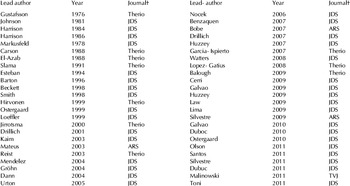
In Journal of Dairy Science, Theriogenology, The Veterinary Journal and Animal Reproduction Science 162, 55, 21 and 21 papers were published, respectively. According to the exclusion criteria 211 publications had to be withdrawn (Table 1). Therefore, a total of 48 articles were eligible for further analysis (Table 3).
Research articles (n = 48) from Journal of Dairy Science, Theriogenology, Animal Reproduction Science and The Veterinary Journal used for final evaluation

† ARS=Animal Reproduction Science, JDS=Journal of Dairy Science, TVJ=The Veterinary Journal, Therio=Theriogenology
In 25 (52·1%) papers the author provided a definition of APM. References for the definition were cited in 9 of those 25 publications (36·0%). Most often Sheldon et al. (Reference Sheldon, Lewis, LeBlanc and Gilbert2006) was cited (n = 7), whereas Olson et al. (Reference Olson, Bretzlaff, Mortimer and Ball1986), Roberts et al. (Reference Roberts1986), Földi et al. (Reference Földi, Kulcsár, Pécsi, Huyghe, de Sa, Lohuis, Cox and Huszenicza2006), Paisley et al. (Reference Paisley, Mickelsen and Anderson1986) and Smith et al. (Reference Smith, Arthur Donovan, Risco, Littell, Young, Stanker and Elliott1998) were cited once each. In 3 publications (33·3%) multiple citations for the definition of APM were listed.
The diagnosis of APM was performed by one of the authors (n = 19) or not specified in 29 publications (60·4%). In 10, 7 and 2 studies diagnosis had been conducted by the farm veterinarian (20·8%), the farm personnel (14·6%), and by farm personnel and the investigator together (4·2%), respectively. The time of diagnosis relative to calving was specified in 33 (68·8%) of the articles. In 2, 10 and 1 of these papers APM was diagnosed on days 3–6, days 6–10 and on day 14 post partum, respectively. In the remaining 20 papers the investigator conducted the diagnosis on multiple times from days 0–10 after parturition.
The total number of diagnostic methods counted in the 48 publications was 124 (mean 2·6 ± 1·6 sd; median 2·5 ± 1·75 IQR; minimum: 0; maximum: 7).
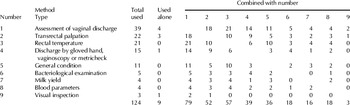
Overall 9 different diagnostic methods were used (Table 4). Most of the studies utilized a combination of 2–7 diagnostic methods to identify cows with APM. In 36 publications, more than 1 method had been used. In 23 (64%) and 9 (25%) publications it was described how the diagnostic methods were combined and the methods weighted within the combination, respectively. In the remaining 13 articles using more than 1 diagnostic criterion no information was provided on the combination or weighting of the diagnostic methods used to identify cows with APM.
Distribution of methods utilized alone or in combination to diagnose acute puerperal metritis in dairy cattle considering 48 peer-reviewed publications of 4 journals (Journal of Dairy Science, Theriogenology, The Veterinary Journal and Animal Reproduction Science) with an impact factors of 1·7–2·9

In 34 of the 124 cases (27·4%) the implementation of the diagnostic methods was described. In 93 (75·0%) and 22 (17·7%) of the cases possible findings and precise thresholds were defined. Test characteristics have been presented in only 3 cases (2·4%).
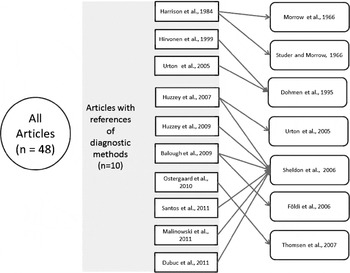
The diagnostic methods were referenced in 10 articles (20·8%). Sheldon et al. (Reference Sheldon, Lewis, LeBlanc and Gilbert2006) and Dohmen et al. (Reference Dohmen, Lohuis, Huszenicza, Nagy and Gacs1995) were cited 5 and 2 times, respectively (Fig. 1). Morrow et al. (Reference Morrow, Roberts, McEntee and Gray1966), Studer & Morrow (Reference Studer and Morrow1978), Tennant et al (Reference Tennant and Peddicord1968), Földi et al. (Reference Földi, Kulcsár, Pécsi, Huyghe, de Sa, Lohuis, Cox and Huszenicza2006), Sheldon et al (Reference Sheldon, Lewis, LeBlanc and Gilbert2006), Urton et al. (Reference Urton, von Keyserlingk and Weary2005) and Thomsen et al. (Reference Thomsen, Ostergaard, Sorensen and Houe2007) were cited once in 4 articles. The remaining studies (n = 38; 79·2%) did not list any references for the diagnostic methods used.
Citation map showing the distribution of citations provided for the implementation of diagnostic methods for acute puerperal metritis.

Vaginal discharge has been assessed and classified in 39 (81·3%) of the studies. In 10 of these articles (25·6%) the authors provided specific information about their reasoning concerning the classification of vaginal discharge. In 31 of these studies (79·5%) specific findings indicative of a disease were defined. In 4 (10·2%) articles thresholds were quoted. Test characteristics were not mentioned in any of these studies.
Transrectal palpation has been used in 22 studies (45·8%) in combination with other methods and in 3 studies as the only diagnostic test. Diagnostic performance of transrectal examination in practice has been described in one of 22 articles. In 16 of those papers specific findings were described. Test characteristics were described in one article; information on thresholds was not given.
Rectal temperature has been used to diagnose cows with APM in 21 of the publications (43.8%) in various combinations with other criteria. The implementation for measuring the rectal temperature has been described in 7 of the 21 publications (33·3%). In the majority of publications, findings (n = 17; 81·0%) and thresholds (n = 16; 76·0%) were provided. Data on test characteristics were completely missing.
Screening for vaginal discharge with a gloved hand, by vaginoscopy or the metricheck device has been conducted in 15 studies (31·3%) in combination with other methods and in one study as the only diagnostic test. The implementation of using the gloved hand, a speculum or the metricheck device was described in 8 articles (53·3%). Findings were specified in 10 out of 15 papers. A threshold for the diagnosis was described in one paper. Test characteristics were not stated.
The general condition of the cows examined has been used in 11 (22·9%) studies. A quantitative scoring system was not described, but 8 articles provided a description of possible findings. Thresholds and test characteristics for evaluating the general condition of cows were not given.
In 5 studies a bacteriological examination has been conducted. The implementation was specified in 3 of those. In 2 of them outcomes were defined. Thresholds were not specified but test characteristics were provided in 1 publication.
A drop in milk yield in combination with other criteria was evaluated in 4 studies (8·3%). In all 4 publications the decrease has been specified. In none of the cases were data on thresholds or test characteristics provided.
In 4 studies (8·3%) blood parameters have been determined [haptoglobin (n = 4), fibrinogen (n = 1), α1 glycoprotein (n = 1), N-acetyl-β-d-glucosaminidase activity (n = 1)] in combination with an evaluation of vaginal discharge, rectal temperature, and transrectal palpation of the uterus. In all 4 studies the sampling and analytical procedures have been described. In one study the results are missing. Thresholds and test characteristics have been provided in one article.
Visual inspection of the tail and perianal area has been used in 3 studies (6·3%). In one of them the inspection, conducted by the farm's veterinarian served as the only criterion to diagnose APM. Data on the diagnostic performance of visual inspection of the tail and perianal area has not been described by any of the authors. Descriptions of findings were specified in 2 articles. Thresholds and test characteristics were not given.
In 4 studies diagnosis of APM has been mentioned but the authors did not specify the methods.
Discussion
The overall objective of this study was to evaluate how relevant quality criteria of diagnostic methods to identify cows with APM are addressed in the current literature. Therefore we conducted a literature search in the Science Direct database considering Journal of Dairy Science, Theriogenology, Animal Reproduction Science, and The Veterinary Journal. These Journals have a special section or focus on animal reproduction and have impact factors of 1·72–2·79 (Reuters, Reference Reuters2011). This procedure generated a convenience sample but does not give a representative overview of all the literature published. One should be aware that using such a selection of journals may introduce a potential bias. Our goal, however, was to get a sample of research publications from peer-reviewed and high-quality journals that have a proven impact on management practices in the field of dairy reproduction and on future research. Our main research question was how intervention studies addressed quality criteria for diagnostic methods used during the trials. The focus was on clinical studies to generate information how the authors performed their diagnosis on APM in the field. Therefore, specific inclusion (e.g. cattle, metritis as main subject) and exclusion (e.g. meta-analyses, reviews, personal experiences) criteria were defined. Applying those criteria, 48 of 259 articles (18·5%) were eligible for final analyses.
Recently several attempts have been made in the field of equine and canine medicine to systematically assess the evidence of certain intervention strategies (Fahie & Shettko, Reference Fahie and Shettko2007; Simoneit et al. Reference Simoneit, Heuwieser and Arlt2011; Haimerl et al. Reference Haimerl, Arlt and Heuwieser2012). Despite tremendous efforts the checklists used are prone to subjective interpretation, and inter-observer repeatability was only moderate. Therefore we assessed only distinct criteria that could be classified as present or absent (e.g. definition of APM, references for diagnostic procedures, test characteristics) or on a continuous scale (e.g. number of diagnostic methods used, days post partum when diagnosis was conducted). Therefore the results presented can be considered reproducible and objective.
In 4 of the 48 (8·3%) studies the diagnostic methods were not described at all. This constitutes a serious flaw that precludes valid conclusions. Authors of research publications should describe each intervention and diagnostic method thoroughly to allow a clinician wanting to use the intervention to know exactly how to perform the method used in the trial (Smidt, Reference Smidt, Rutjes, van der Windt, Ostelo, Bossuyt, Reitsma, Bouter and de Vet2003; Glasziou et al. Reference Glasziou, Meats, Heneghan and Shepperd2008). Only 10 articles (20·8%) cited references for the diagnostic methods utilized. According to the STARD checklist, the description should cover the full test protocol including the specification of materials and instruments together with their instructions for use, and specific measures in participants. If no citations are available, details must be provided in the text (Smidt, Reference Smidt, Rutjes, van der Windt, Ostelo, Bossuyt, Reitsma, Bouter and de Vet2003). If this is not the case, it might be difficult to estimate the validity of the diagnostic methods used.
Frequently, the definition or characterization of the various manifestations of uterine disease either lack precision or definitions vary among research groups (Sheldon et al. Reference Sheldon, Lewis, LeBlanc and Gilbert2006). Therefore, we evaluated whether the author gave a clear definition of the disease addressed in the study. Without a definition of a disease, it is hardly possible to distinguish between healthy and diseased cows, interpret test results, and provide recommendations for a larger population. Almost half of all articles, evaluated in our study did not provide such descriptions.
The diagnostic tests have been performed by one of the authors (n = 29), the farm veterinarian (n = 10), and by farm personnel (n = 7). One could speculate that the validity of a diagnosis is higher when performed by an animal health professional compared with farm personnel. At least we assume that the risk of an inaccuracy is higher, since the qualifications of the farm personnel to diagnose APM can differ widely. It is noteworthy that none of the studies evaluated an intra- or in case of multiple investigators an inter-observer repeatability of findings indicative of APM. Only very recently, first data on intra- and inter-observer variability on diagnostic methods relevant for the detection of APM were published (Burfeind et al. Reference Burfeind, von Keyserlingk, Weary, Veira and Heuwieser2010; Leutert et al. Reference Leutert, von Krueger, Plöntzke and Heuwieser2012; Suthar et al. Reference Suthar, Burfeind, Bonk, Voigtsberger, Keane and Heuwieser2011)
APM usually occurs within 14 d after calving (Sheldon et al. Reference Sheldon, Lewis, LeBlanc and Gilbert2006) and should therefore be diagnosed within this period. All of the authors, indicating the time of diagnosis (n = 33) were within this period. Since case definitions in the literature are highly confounded by diagnostic method and the interval post partum at which diagnosis is made (LeBlanc, Reference LeBlanc2008) a failure to report the time of diagnosis of APM constitutes a flaw that limits the evidence of the conclusions drawn.
Despite its frequent use the assessment of vaginal discharge has been discussed controversially in current literature. Vaginal discharge can be both a natural phenomenon after calving and a pathological condition (Lowder, Reference Lowder1993). Furthermore, the mere assessment of discharge without knowing where it comes from (i.e. vagina, cervix, and uterus) may not be reflective of endometrial inflammation. Cows with vaginal discharge might have cervicitis or vaginitis, but no endometrial inflammation (Dubuc et al. Reference Dubuc, Duffield, Leslie, Walton and LeBlanc2010). This limitation applies for the diagnosis of APM as well. On the other hand, the assessment of vaginal discharge has been described as an effective, simple and non-invasive method, especially for field use (LeBlanc et al. Reference LeBlanc, Duffield, Leslie, Bateman, Keefe, Walton and Johnson2002; Sheldon et al. Reference Sheldon, Lewis, LeBlanc and Gilbert2006; Pleticha et al. Reference Pleticha, Drillich and Heuwieser2009). Also, a correlation between the type of discharge, the bacterial contamination of the uterus and the immune response of the diseased animal has been demonstrated (Williams et al. Reference Williams, Fischer, Pfeiffer, England, Noakes, Dobson and Sheldon2005).
After all, vaginal discharge by itself is a useful and important criterion to incorporate into a clinical examination (LeBlanc et al. Reference LeBlanc, Duffield, Leslie, Bateman, Keefe, Walton and Johnson2002; Williams et al. Reference Williams, Fischer, Pfeiffer, England, Noakes, Dobson and Sheldon2005; Sheldon et al. Reference Sheldon, Lewis, LeBlanc and Gilbert2006). Colour, smell and viscosity of vaginal discharge should be assessed (Sheldon et al. Reference Sheldon, Lewis, LeBlanc and Gilbert2006). A description of these sensorial assessments was provided in 39 studies. Thresholds used to distinguish between healthy and diseased animals were not specified. Also, attempts were not described to objectify findings. In 4 articles, vaginal discharge was used as the only diagnostic criterion for APM without specifying how the discharge was obtained.
The second most commonly used diagnostic tool for APM was a transrectal palpation of the uterus (n = 22). Generally, this method is the most prevalent for the assessment of uterine infections (LeBlanc, Reference LeBlanc2008). It is well known, however, that transrectal palpation is a subjective method with limited sensitivity (Okano & Tomizuka, Reference Okano and Tomizuka1987).
Frequently, rectal temperature was measured to diagnose APM. A high repeatability of rectal temperature measurements in dairy cows has been recently demonstrated (Burfeind et al. Reference Burfeind, von Keyserlingk, Weary, Veira and Heuwieser2010). However, when rectal temperature is used as a diagnostic criteria, frequencies of both type I (fever when the animal is actually healthy) and type II errors (no fever when the animal is actually sick) are significant (Kristula et al. Reference Kristula, Smith and Simeone2001; Sheldon & Dobson, Reference Sheldon and Dobson2004; Wagner et al. Reference Wagner, Schimeck and Cend2007). A type I error causes financial losses to the producer since a healthy animal is unnecessarily treated. In case of APM an antibiotic drug would be used without need and selection pressure on pathogens exerted potentially contributing to the emergence of resistance. A type II error leaves a beneficial treatment effect on health and performance unrealized and might constitute an animal welfare issue, as the sick animal is not being treated and continues to suffer.
None of the 48 studies addressed the issue of sensitivity or specificity of rectal temperatures for the diagnosis of APM. Plausible factors (e.g. ambient temperature, parity) that can influence body temperature were discussed only in 2 papers. Also the time of the temperature measurements relative to calving varied from 1 to 21 d post partum.
Owing to these limitations fever has been considered less reliable than including an examination for abnormal uterine discharge because pyrexia is not consistently associated with pathogenic bacteria in the uterine lumen (Sheldon & Dobson, Reference Sheldon and Dobson2004). In all 21 studies rectal temperature was used in combination with other diagnostic methods.
While the assessment of the general condition is recommended as part of a clinical examination (Jackson & Cockcroft, Reference Jackson and Cockcroft2002) it is a subjective criterion that is difficult to validate. External signs of toxaemia, potentially occurring in APM, are lacking enough accuracy since they do not appear constantly (Paleniki et al. Reference Paleniki, Dolezeli, Kratochvilz, Cechi, Zajici, Jani and Vyskocil2009).
Four of 48 studies monitored milk yield as part of the APM diagnosis. A drop in milk yield can be observed from the first day of APM (Smith et al. Reference Smith, Arthur Donovan, Risco, Littell, Young, Stanker and Elliott1998). However, it has also been observed that milk yield corresponds poorly with mild or subclinical conditions (Urton et al. Reference Urton, von Keyserlingk and Weary2005) and can even increase in cows with a mild fever (Rajala-Schultz et al. Reference Rajala-Schultz, Gröhn and McCulloch1999).
In the past few years several papers discussed the diagnostic value of acute phase proteins as an indicator for APM (Smith et al. Reference Smith, Arthur Donovan, Risco, Littell, Young, Stanker and Elliott1998; Regassa & Noakes, Reference Regassa and Noakes1999). A haptoglobin concentration >10 mg/dl has been shown to indicate an acute infectious process in dairy cows and can support the diagnosis of APM (Hirvonen et al. Reference Hirvonen, Huszenicza, Kulcsàr and Pyörälä1999). Haptoglobin is particularly valuable in the early diagnosis of APM, because the concentration already increased 2 d before the clinical signs of APM were diagnosed (Huzzey et al. Reference Huzzey, Veira, Weary and von Keyserlingk2007). Furthermore, a relationship has been demonstrated between an elevated haptoglobin concentration and the bacterial contamination of the uterus (Williams et al. Reference Williams, Fischer, Noakes, England, Rycroft, Dobson and Sheldon2007). Haptoglobin is not specific for uterine infections, however, and therefore should not be used as a single diagnostic criterion for APM (Smith et al. Reference Smith, Arthur Donovan, Risco, Littell, Young, Stanker and Elliott1998; Drillich et al. Reference Drillich, Voigt, Forderung and Heuwieser2007).
Overall, 9 different methods for the diagnosis of APM were reported. Interestingly, none of the publications provided evidence or discussed whether the combination of methods increased the overall diagnostic performance to identify cows with APM.
For an ideal combination of diagnostic methods it is of interest to estimate their sensitivity and specificity. Ideally, each diagnostic procedure has a different property, leading to an increased overall sensitivity and specificity of the screening or diagnosis programme (Qin, Reference Qin and Zhang2010). Because a gold standard to verify inflammation of the uterus is lacking (Drillich et al. Reference Drillich, Voigt, Forderung and Heuwieser2007), only few studies reported data on sensitivity and specificity and those that do reflect only a comparison of a new method with a reference method. Therefore it is impossible to determine a potential increase in sensitivity or specificity for a combination of methods. Only few authors (n = 7) discussed the diagnostic methods for APM and their possible limitations.
The most frequently cited paper has been authored by 4 internationally recognized experts in the field of uterine diseases (Sheldon et al. Reference Sheldon, Lewis, LeBlanc and Gilbert2006). This paper provides current and probably the best evidence to support diagnostic methods for the detection of APM in dairy cows. The author's advice is to perform the diagnosis on the basis of clinical signs of illness and the assessment of vaginal discharge. A scoring system for APM has been recently developed (Sheldon et al. Reference Sheldon, Williams, Miller, Nash and Herath2009b). Unlike the one for endometritis (Sheldon & Dobson, Reference Sheldon and Dobson2004) this has not been consistently adopted yet for APM. Overall, our results clearly demonstrate that more high-quality research is necessary to better understand relationships between limitations of diagnostic methods and diagnostic and therapeutic errors.
Our findings encourage authors to explicitly describe implementation of diagnostic methods and to define possible findings, thresholds, and test characteristics or discuss the missing thereof. Practitioners and herd personnel should be aware of the potential of type I and type II errors. In some cases information on the magnitude of such errors is not available owing to the lack of a gold standard. It is obvious that more high-quality research is necessary to address issues related to APM and crucial to the dairy industry such as prudent use of antibiotics, animal welfare and financial costs.