Introduction
The spread of Coronavirus produced a global health crisis unprecedented in modern history with citizens across the globe experiencing severe consequences of the pandemic in terms of their health as well as financial and social hardship.Footnote 1 Furthermore, the political ramifications of this crisis are only starting to be understood in the scholarly literature. Conventional wisdom associates crises and external threats with increasing support for populist positions and parties (Kriesi and Pappas, Reference Kriesi and Pappas2015). This is supported by empirical research, showing that populism, understood ‘as a unique set of ideas, one that understands politics as a Manichean struggle between a reified will of the people and a conspiring elite’ (Hawkins and Rovira Kaltwasser, Reference Hawkins, Rovira Kaltwasser, Hawkins, Carlin, Littvay and Rovira Kaltwasser2018: 3) is able to capitalise on the grievances and negative feelings generated by previous crises such as the financial crisis of 2008 or the ‘refugee crisis’ of 2015.
Yet, in this respect, several questions remain unanswered. First, with regard to the mechanisms that connect threat and crises to populism, public debates and pundits often emphasise fear as the dominant emotion that drives individuals into the arms of populism. However, recent scholarly literature suggests anger to be the dominant emotion that drives populism (e.g., Rico et al., Reference Rico, Guinjoan and Anduiza2017). Second, it remains unclear whether populism, and in particular populist attitudes, flourish in the wake of every threat, or whether there are differences regarding the nature of the threat. In this vein, while previous research has shown that economic crises (Rico et al., Reference Rico, Guinjoan and Anduiza2017; Rhodes-Purdy et al., Reference Rhodes-Purdy, Navarre and Utych2021), terror attacks (Marcus et al., Reference Marcus, Valentino, Vasilopoulos and Foucault2019; Vasilopoulos et al., Reference Vasilopoulos, Marcus, Valentino and Foucault2019), or immigration (Erisen and Vasilopoulou, Reference Erisen and Vasilopoulou2022) promote different forms of populist support, it remains unclear whether a hazard such as the Covid-19 pandemic threat, which is less connected to the classical political grievances underlying populism, is also related to populist support. Lastly, while populist attitudes are understood as a combination of a Manichean outlook, anti-elitist, and people centrist attitudes, it is so far almost unknown whether threat-triggered emotions are equally associated with all these sub-dimensions.
Against this background, we apply the affective intelligence theory (AIT) (Marcus et al., Reference Marcus, Valentino, Vasilopoulos and Foucault2019) to evaluate whether negative emotions elicited by the Covid-19 pandemic, a crisis less connected to traditional populist issues, are related to populist attitudes. We follow previous literature by assuming that anger and fear are the dominant emotions that emerge as a response to a threatening event (Marcus et al., Reference Marcus, Valentino, Vasilopoulos and Foucault2019). While both emotions are considered as negatively valenced, they initiate different behavioural and attitudinal responses. Given the confrontational and adversarial nature of populism, we expect that pandemic-elicited anger is positively related to populist attitudes. On the contrary, fear, which prompts risk-aversive and compromise-oriented behaviour, is expected to be negatively related to populist attitudes.
We test these notions in the context of the Covid-19 pandemic, using 18 samples from six European countries (France, Germany, Italy, Spain, Switzerland, and the United Kingdom (UK)) at three different time points between November 2020 and March 2022. Our analyses based on repeated cross-sectional data support the contention that anger elicited by pandemic threat is significantly and positively related to populist attitudes in most countries while the relationship between fear and populist attitudes is negative, albeit less consistent. In addition, we show that the link between anger and populist attitudes is driven, in particular, by two sub-dimensions of populism: anti-elitism and Manichean outlook.
Taken together, our study contributes to two different strands of literature in two important respects. First, we add to a growing field of research by exploring the psychological underpinnings of populism. In this vein, we provide new empirical insights into the emotional bedrocks of populism by showing that pandemic threat-elicited anger, rather than fear, positively relates to populist attitudes. By focussing on the Covid-19 pandemic as an understudied threat that is less connected to classical populist grievances, we present evidence that the type of threat does not seem to matter for the relationship between anger and populist attitudes. Rather, it is the nature of anger that prompts populist support.
Second, by honing in on how the pandemic threat and different emotional reactions to it relate to citizens’ populist attitudes, we add additional evidence that anger and fear elicited by the pandemic seem to have distinct political consequences and crucially concern different aspects of European politics. Consequently, our study adds another piece of evidence that anger, in the context of the pandemic, fosters exclusionary attitudes and behaviours (e.g., Erhardt et al., Reference Erhardt, Freitag and Filsinger2022; Freitag and Hofstetter, Reference Freitag and Hofstetter2022). In this vein, we also complement recent studies on the pandemic and populism (Froio, Reference Froio2022; Wondreys and Mudde, Reference Wondreys and Mudde2022; Zanotti and Turnbull-Dugarte, Reference Zanotti and Turnbull-Dugarte2022) by showing that during the pandemic, populist attitudes only flourished among the angry. As anger was the less dominant response during the pandemic, we might offer a plausible explanation for why populist forces did not perform well during the pandemic.
Previous research: threat, emotions, and populism
In recent years, we can observe a growing interest in emotions in the social and political sciences. In particular, scholars increasingly focus on the behavioural and attitudinal consequences of different emotions. In general, emotions can be defined as ‘a complex syndrome of reactions to our circumstances that include electrochemical processes in the brain, changes in automatic and motor systems (e.g., breathing, heart rate, muscle tensions, facial expressions), and behavioural impulses’ (Brader and Cikanek, Reference Brader, Cikanek and Berinsky2019: 203). Importantly, emotions have crucial functions by telling us what is going on around us and whether or how we should be concerned with it (Bonansinga, Reference Bonansinga2020). Put differently, emotions have a diagnostic power and help us explain political behaviour and attitudes (Brader and Cikanek, Reference Brader, Cikanek and Berinsky2019).
Recent advances in the study of emotions follow a functional neuroscience perspective. In this regard, the AIT argues that three brain systems operate constantly and routinely to sort information people are confronted with. Depending on the information received, different affective appraisals such as enthusiasm, fear, and anger are evoked. The latter two emotional reactions have attracted particular attention in recent years as they are considered as distinct responses to threatening circumstances (Marcus et al., Reference Marcus, Valentino, Vasilopoulos and Foucault2019). Both are neural correlates to different regions of the brain, which are triggered by distinct perceptions and aspects of threat (Vasilopoulos et al., Reference Vasilopoulos, Marcus, Valentino and Foucault2019).
Anger is activated if the brain detects a noxious threat that is harmful to familiar norms and practices as well as jeopardising the attainment of the individual’s goals (Marcus et al., Reference Marcus, Valentino, Vasilopoulos and Foucault2019). Conversely, fear is triggered by threats that seem novel and uncertain (Marcus et al., Reference Marcus, Valentino, Vasilopoulos and Foucault2019). Importantly, the AIT holds that these different appraisals are executed simultaneously and largely independently, i.e., rather than feeling angry or fearful, respondents experience both, anger and fear, when confronted with a threat (Vasilopoulos et al., Reference Vasilopoulos, Marcus, Valentino and Foucault2019). What is more, the adaptation strategy to the threat depends on the extent an individual experiences both emotions at the same time or whether one emotion is experienced more strongly than the other (Marcus et al., Reference Marcus, Neuman and MacKuen2000; Marcus et al., Reference Marcus, Valentino, Vasilopoulos and Foucault2019). Importantly, fear and anger evoked by an external threat crucially differ in their behavioural and attitudinal consequences by initiating different modes of information processing, decision-making, and behaviour (Brader and Cikanek, Reference Brader, Cikanek and Berinsky2019; Marcus et al., Reference Marcus, Valentino, Vasilopoulos and Foucault2019).
Following these insights, recent research has investigated the role that anger and fear play in support for populism (Rico et al., Reference Rico, Guinjoan and Anduiza2017; Vasilopoulos et al., Reference Vasilopoulos, Marcus, Valentino and Foucault2019). Focussing on voting for radical (right-wing) populist parties, Vasilopoulos et al. (Reference Vasilopoulos, Marcus, Valentino and Foucault2019) show that in the wake of terror attacks, anger increases the likelihood of voting for the Front National (FN) in France. Contrary to conventional wisdom but in line with the contentions of AIT, fear is negatively related to voting for this radical right-wing populist party. Moreover, Marcus et al. (Reference Marcus, Valentino, Vasilopoulos and Foucault2019) find that in the 2014 European parliament elections, anger about the economic situation in France increased the probability of voting for the FN, in particular for those at the right end of the political spectrum. They also observe a significant and positive effect of anger regarding the terror attacks on Paris in November 2015. Again, fear in response to these threatening events did not fuel support for the radical right. Focussing on threats based on immigration, Erisen and Vasilopoulou (Reference Erisen and Vasilopoulou2022) show that anger about immigration, rather than fear, is crucial in linking anti-immigration attitudes and support for radical right-wing parties, mainly because angry respondents process information differently and thus tend to overestimate the perceived threat of immigration. For Germany, Nguyen et al. (Reference Nguyen, Salmela, von Scheve and Oswald2022) indicate that generalised anger predicts support for the radical right-wing populist party Alternative für Deutschland (AfD). Thus, while pundits and politicians often argue that populism is based on fear, the contentions of the AIT and previous research imply that fear is not positively related to such a confrontational and exclusionary style of politics.
While previous studies have focussed on (radical right-wing) populist party support, we aim to investigate the influence of emotions on populist attitudes. Studying attitudes instead of vote choice is of crucial importance as ‘voters are always recruited on the basis of several issues and concerns’, which makes it difficult to extract support for populism from vote choice (Spruyt et al., Reference Spruyt, Keppens and van Droogenbroeck2016: 336). Thus, with explaining populist attitudes, we focus on the positions that underlie the support for populist politics, which have been shown to affect a range of different political outcomes including vote choice (van Hauwaert and van Kessel, Reference van Hauwaert and van Kessel2018).
Thus far, only a few studies have looked at the emotional underpinnings of populist attitudes. For Spain, Rico et al. (Reference Rico, Guinjoan and Anduiza2017) show that anger over the economic crisis fuels populist attitudes. Similarly, Rhodes-Purdy et al. (Reference Rhodes-Purdy, Navarre and Utych2021) find that economic distortions evoke anger that, in turn, activates cultural stereotypes which then trigger populist attitudes.
In sum, recent research has shown relatively convincingly that anger rather than fear fuels populist support, although these findings are more established for populist voting than for populist attitudes. More importantly, these previous studies mostly focus on threats that are crucially related to populist grievances or mobilising issues. Immigration, cultural threats, terror attacks, or economic crises, all played important roles in the rise of populism and populist forces in the last decades (Kriesi and Pappas, Reference Kriesi and Pappas2015). In this vein, the question arises whether emotions elicited by threats that are less connected to the classical political grievances underlying populism also fuel populist attitudes. Put differently, by studying the Covid-19 pandemic, we test whether emotional responses, elicited by this different kind of threat, are related to populist attitudes.
Covid-19 threat, emotional reactions, and populist attitudes
The Covid-19 pandemic and its manifold concomitants have sparked considerable interest in its social, economic, and health-related consequences. Given the importance of the pandemic in everyday life, there has been a lot of recent research focussing on the political consequences of the pandemic such as political trust (e.g., Bol et al., Reference Bol, Giani, Blais and Loewen2021), attitudes toward democracy (e.g., Lupu and Zechmeister, Reference Lupu and Zechmeister2021), and support for governmental measures (e.g., Vasilopoulos et al., Reference Vasilopoulos, Mcavay, Brouard and Foucault2022). Yet, the influence of the pandemic on populist attitudes has thus far not been at the centre of scholarly attention. Populism is best understood ‘as a unique set of ideas, one that understands politics as a Manichean struggle between a reified will of the people and a conspiring elite’ (Hawkins and Rovira Kaltwasser, Reference Hawkins, Rovira Kaltwasser, Hawkins, Carlin, Littvay and Rovira Kaltwasser2018: 3). Generally, scholars observe three distinct subdimensions of populism: a moral struggle between good and bad (Manichean outlook), anti-elitism, and people centrism (Castanho Silva et al., Reference Castanho Silva, Andreadis, Anduiza, Blanusa, Corti, Delfino, Rico, Ruth, Spruyt, Steenbergen, Littvay, Hawkins, Carlin, Littvay and Kaltwasser2018). In our study, we focus on populist attitudes understood as an individual-level manifestation of populism that has independent causal power by affecting certain tendencies and proclivities such as voting for populist parties (Castanho Silva et al., Reference Castanho Silva, Andreadis, Anduiza, Blanusa, Corti, Delfino, Rico, Ruth, Spruyt, Steenbergen, Littvay, Hawkins, Carlin, Littvay and Kaltwasser2018; van Hauwaert and van Kessel, Reference van Hauwaert and van Kessel2018). Importantly, the three subdimensions mentioned above are jointly necessary conditions for populist attitudes, i.e., ‘understanding populist attitudes as an attitudinal syndrome suggests considering citizens as populists only if they exhibit anti-elitist orientations and a Manichean outlook and support popular sovereignty’ (Wuttke et al., Reference Wuttke, Schimpf and Schoen2020: 358; italics in original). Following from the non-compensatory nature of populism, ‘populist attitudes are the set of evaluative reactions to these’ three subdimensions (van Hauwaert et al., Reference van Hauwaert, Schimpf and Azevedo2020: 3).
The Covid-19 pandemic can be defined as ‘a serious threat to the basic structures or the fundamental values and norms of a system, which under time pressure and highly uncertain circumstances necessitates making vital decisions’ (Rosenthal et al., Reference Rosenthal, Charles and ‘t Hart1989: 10). The novelty and severity of the virus, combined with its rapid human-to-human transmission, make it a severe health crisis. In this regard, the pandemic undermines deeply rooted convictions of security, health, and welfare (Taylor, Reference Taylor2019). Yet, next to these health-related issues, the pandemic triggered concerns about an economic recession as well as severe societal disruptions caused by the virus itself and the various countermeasures implemented to curb infections. Thus, the pandemic can be regarded as a societal crisis that has its origins in a health-related crisis. Yet, people may perceive different threats from the pandemic and react with anger and fear as dominant negative reactions to such a threatening situation (Marcus et al., Reference Marcus, Valentino, Vasilopoulos and Foucault2019). This assumption is supported by our data with which we show that perceived economic, social, and infectious threats are all positively related to both anger and fear (see Table S18 in the online appendix). Consequently, following AIT, we argue that Covid-19 constitutes a multi-faceted pandemic threat which predominantly induces fear and anger (Marcus et al., Reference Marcus, Valentino, Vasilopoulos and Foucault2019).
There are several reasons to expect that a pandemic threat is likely to evoke anger. First, the pandemic potentially prevents individuals from achieving their goals. For example, an infection with the virus has health-related implications in terms of sickness and a potential for Long-Covid, causing not only multi-layered personal restrictions in everyday life but also long-term negative consequences. In this vein, an infection might also have negative social and financial externalities as do many of the various countermeasures introduced by governments. To that end, the pandemic threat posed by Covid-19 presents an obstacle for individuals to achieve their personal goals (Marcus et al., Reference Marcus, Valentino, Vasilopoulos and Foucault2019). Second, the pandemic presents a noxious hazard to known norms, in particular those that are considered fundamental to the social, political, and economic order (Marcus et al., Reference Marcus, Neuman and MacKuen2000; Brader and Marcus, Reference Brader and Marcus2013). In the context of the current pandemic, this might include challenges to personal freedom in the form of governmental measures, democratic concerns, but also financial and social threats as well as threats to personal health and security (Erhardt et al., Reference Erhardt, Freitag and Filsinger2022).
Third, a principal component of anger is the belief that others cause harm or regulate the sources of a harmful event or threat (Steenbergen and Ellis, Reference Steenbergen, Ellis and Redlawsk2006). As the responsibility for the health, economic, and social consequences of the pandemic can be easily attributed to fellow citizens or political decision-makers and their inappropriate actions (Bor et al., Reference Bor, Jørgensen, Lindholt and Petersen2022), anger is likely evoked by pandemic threat.
Regarding their relationship, we argue that anger and populist attitudes are positively associated. First, anger is connected to the search and definition of scapegoats that are (made) responsible for the situation (Rico et al., Reference Rico, Guinjoan and Anduiza2017). Populism offers culprits for the frustrating situation in the form of political elites. In times of the pandemic, populist actors have increasingly presented themselves as ‘defender[s] of freedom’ (Lehmann and Zehnter, Reference Lehmann and Zehnter2022: 1) and blamed governmental actors for the negative externalities of the pandemic and its countermeasures (Froio, Reference Froio2022; Zanotti and Turnbull-Dugarte, Reference Zanotti and Turnbull-Dugarte2022). Recent research has shown that angry individuals tend to put less trust in the government and reject governmental countermeasures (Erhardt et al., Reference Erhardt, Freitag, Filsinger and Wamsler2021; Vasilopoulos et al., Reference Vasilopoulos, Mcavay, Brouard and Foucault2022). In this vein, anger and populism resonate well as the blame for pandemic threat can be targeted towards the government and political elites.Footnote 2 Thus, the polarising positions of populism offer a well-suited home for angry individuals as they present the elites as the responsible agents for the problems and troubles of the people, while at the same time, forming a community that is based on the exclusion of those who are claimed to be responsible.
In addition, anger typically urges an aggressive and confrontational response, which echoes the inherently adversarial and polarising character of populism. Put differently: ‘Anger serves to launch defences against challenges to extant core norms by those who threaten’ (Marcus et al., Reference Marcus, Valentino, Vasilopoulos and Foucault2019: 119). In this vein, anger has been connected to punitive policy preferences which are in line with the confrontational nature of populism (Lerner et al. Reference Lerner, Gonzalez, Small and Fischhoff2003; Brader and Cikanek, Reference Brader, Cikanek and Berinsky2019). Consequently, people who express pandemic threat-elicited anger are particularly likely to find comfort in the confrontational and exclusionary nature of populism. Lastly, Brader and Cikanek (Reference Brader, Cikanek and Berinsky2019) show that angry individuals tend to rely on superficial modes of information seeking and processing, making them more likely to follow heuristics and favour simple solutions. As populism is sometimes characterised by offering simple solutions to complex problems, angry individuals might be more likely to hold populist attitudes. During the pandemic, populist actors often favoured less governmental interventions and disregarded the severity of the virus, making them and populism in general more attractive for angry individuals (Lehmann and Zehnter, Reference Lehmann and Zehnter2022). In sum, we formulate hypothesis 1 as follows:
HYPOTHESIS 1: Pandemic threat-elicited anger is positively related to populist attitudes.
Next to anger, we assume that the novelty and the perpetual insecurities of the Covid-19 pandemic evoke fear, since fear ‘occurs when individuals appraise a situation as being unpleasant, highly threatening and uncertain’ (Albertson and Gadarian, Reference Albertson and Gadarian2015: 8). Given that the Covid-19 infectious disease is the first major pandemic that has hit Western European societies since the Spanish flu (1918–1920), Covid-19 is likely to be perceived as a novel threat (Taylor, Reference Taylor2019). Furthermore, since Covid-19 has a relatively quick human-to-human transmission and a potentially lethal course, it is also likely to be regarded as highly threatening. In addition, there are also uncertainties regarding the ever-present threat of further variants of the virus. Similarly, citizens might consider uncertainties regarding the (long-term) social and economic consequences of the pandemic and its countermeasures.
Although pundits and politicians often claim that populism works through fear, we follow recent research and argue that pandemic-elicited fear is unlikely to relate positively to populist attitudes. Fearful people are characterised by risk-averse behaviour (Marcus et al., Reference Marcus, Neuman and MacKuen2000; MacKuen et al., Reference MacKuen, Wolak, Keele and Marcus2010; Vasilopoulos et al., Reference Vasilopoulos, Marcus, Valentino and Foucault2019). During the pandemic, this might imply higher acceptance of civil liberty restrictions that aim to prevent infections (Vasilopoulos et al., Reference Vasilopoulos, Mcavay, Brouard and Foucault2022) as well as higher levels of trust in the government that enacts these preventive measures (Erhardt et al., Reference Erhardt, Freitag, Filsinger and Wamsler2021).
As populist forces regarded the virus as innocuous and have mostly shown a fundamental opposition against the countermeasures and the political elites enacting them (Lehmann and Zehnter, Reference Lehmann and Zehnter2022; Wondreys and Mudde, Reference Wondreys and Mudde2022), risk-averse behaviour and search for information typical of fearful individuals makes it unlikely that they adopt populist attitudes. Instead, it is more likely that these citizens will conclude that the risk of following such lenient approaches is much higher than supporting the current governmental measures. Thus, the simple and unelaborate solutions to the pandemic by populists are unlikely to resonate with fearful citizens.
Additionally, fear is shown to increase individuals’ preferences for deliberative decision-making and compromise which is at odds with the confrontational nature of populism (MacKuen et al., Reference MacKuen, Wolak, Keele and Marcus2010). Populist attitudes promote a unilateral decision-making by the one true populace while, at the same time, they regard political compromise as betrayal of the popular will. In this vein, fearful respondents who look for deliberative forms of decision-making that involve compromise, and the balancing of different information and opinions, are unlikely to submit to such a confrontational and exclusionary style of politics. Put differently, ‘the populist worldview is at odds with the appraisal and behavioural tendencies that characterize fear’ (Rico et al., Reference Rico, Guinjoan and Anduiza2017: 448). Against this backdrop, we formulate hypothesis 2 as follows:
HYPOTHESIS 2: Pandemic threat-elicited fear is negatively related to populist attitudes.
Research design
To empirically test our hypotheses about the relationships between pandemic threat-elicited emotions and populist attitudes, we rely on original survey data from the six following European countries: France, Germany, Italy, Spain, Switzerland, and the UK. More precisely, we use three web-based surveys fielded at three different points in time during the Covid-19 pandemic (survey wave 1: 24th November 2020–18th January 2021; survey wave 2: 22nd April−21st May 2021; survey wave 3: 25th January−8th March 2022). We obtained around 1,000 respondents per country and wave which results in a total of around 18,000 respondents. Respondents were recruited through SurveyEngineFootnote 3 access panels and received a small monetary incentive after completing the survey. To obtain meaningful interpretations of our data, we used quota sampling so that the sample resembles the general population of the respective countries in terms of sex, age, and education (and language for Switzerland). This should allow broader conclusions for the respective populations. The quotas were drawn from the Organisation for Economic Cooperation and Development (2019) and WKO (2020). More information on the surveys as well as descriptive statistics are presented in the online appendix in Tables S1 to S4.
The six countries under study offer a good amount of variation to test our hypotheses in different political, epidemiological, and institutional contexts, which might increase the generalisability of our findings. First, considering that we study pandemic threat-elicited emotions, the epidemiological context is of importance. While all six countries were severely hit by the pandemic during our study, they also display substantial variation. For example, the second Covid-19 wave (late 2020 to early 2021) was particularly hard for the UK and Switzerland, with high case and fatality numbers accompanied by relatively slow countermeasures by the respective governments. France had high case and fatality numbers during the third wave of the pandemic (spring 2021). Furthermore, the countries vary in their general approach to counter the negative effects of the pandemic. Generally, Switzerland and parts of the UK followed a lenient approach with less stringent measures, while France, Germany, Italy, and Spain enacted stringent lockdown measures during parts of the pandemic (Hale et al., Reference Hale, Angrist, Goldszmidt, Kira, Petherick, Phillips, Webster, Cameron-Blake, Hallas, Majumdar and Tatlow2021) that only recently were reduced after the decline in cases following the omicron wave in March and April 2022. Second, regarding our dependent variable, the six countries also offer useful variation when it comes to the strength, shape, and history of populism in the political system.
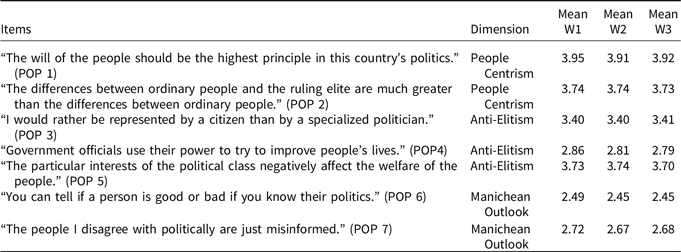
To measure populist attitudes empirically, we use seven items that capture the respective dimensions of populism (Akkerman et al., Reference Akkerman, Mudde and Zaslove2014; Castanho Silva et al., Reference Castanho Silva, Andreadis, Anduiza, Blanusa, Corti, Delfino, Rico, Ruth, Spruyt, Steenbergen, Littvay, Hawkins, Carlin, Littvay and Kaltwasser2018; van Hauwaert et al., Reference van Hauwaert, Schimpf and Azevedo2020). While previous research often relied on factor analyses or mean scores to aggregate survey items for measuring populist attitudes, these approaches are at odds with the non-compensatory nature of the concept of populist attitudes (for a thorough and excellent discussion see Wuttke et al., Reference Wuttke, Schimpf and Schoen2020). Given that the “peculiarity of the populist set of ideas lies precisely in the combination of” (Hawkins and Rovira Kaltwasser, Reference Hawkins, Rovira Kaltwasser, Hawkins, Carlin, Littvay and Rovira Kaltwasser2018: 6) people centrism, anti-elitism, and a Manichean outlook, populist attitudes are a non-compensatory concept (Wuttke et al., Reference Wuttke, Schimpf and Schoen2020: 358). Consequently, we employ a theoretical approach which captures this non-compensatory nature of populism.
The items for the respective subdimensions show positive but relatively small (average) inter-item correlations (people centrism: 0.35; anti-elitism: 0.33; Manichean outlook: 0.46; see Tables S6, S8, and S10 in the online appendix). Scale analyses based on Spearman Brown reliability coefficients and Cronbach’s alpha show relatively low values (people centrism: 0.53; anti-elitism: 0.57; Manichean outlook: 0.63; see online appendix S5, S7, and S9). The relatively low internal consistency indicated by these analyses is most likely due to the fact that the respective items intentionally capture different aspects of the respective subdimensions of populism. In order to maximise the extent to which small item batteries can measure complex social science constructs, this is a necessary trade-off. In this regard, we consider our items as appropriate measures for populist attitudes, especially given that replicating our analyses with the single items as dependent variables does not substantially alter our conclusions (see Figures S14–S20 in the online appendix).
We sum up the items of each subdimension of populism listed in Table 1 and then take the geometric mean of all three dimensions (Mohrenberg et al., Reference Mohrenberg, Huber and Freyburg2021). This procedure ensures that people who score 0 on either dimension of populism have an overall 0 on the combined populism scale. For ease of interpretation, we rescale the variable to range from 0 (no populist attitudes) to 1 (high levels of populist attitudes). Figure S1 in the online appendix shows that populist attitudes are fairly widespread in all countries and that the main variation in populism is between countries, with Germany and Switzerland having generally lower levels of populist attitudes compared to Spain and France with the highest levels of populist attitudes.
Items for populist attitudes

Notes: Items adjusted from different scales (Akkerman et al., Reference Akkerman, Mudde and Zaslove2014; Castanho Silva et al., Reference Castanho Silva, Andreadis, Anduiza, Blanusa, Corti, Delfino, Rico, Ruth, Spruyt, Steenbergen, Littvay, Hawkins, Carlin, Littvay and Kaltwasser2018; van Hauwaert et al., Reference van Hauwaert, Schimpf and Azevedo2020). Reverse coded statement is POP 4.
In order to uncover citizens’ emotional reactions to the Covid-19 pandemic threat, we asked respondents the following question: ‘Thinking back to the last weeks and months: How often have you felt the following emotions in relation to a possible infection with the Coronavirus?’ The respondents were then presented with a list of emotional states and the following answer options: (1) ‘never’; (2) ‘seldom’; (3) ‘sometimes’; (4) ‘often’; (5) ‘very often’. This question is an adapted version of the positive and negative affect schedule questionnaire (PANAS, see Watson et al., Reference Watson, Clark and Tellegen1988).
For fear, we use ‘anxious’ and ‘worried’ as indicators. The two items show a Spearman-Brown reliability coefficient of 0.75 (survey wave 1), 0.76 (survey wave 2), and 0.77 (survey wave 3). For anger, we rely on ‘angry’ and ‘hostile’ as indicators. The two items show a Spearman-Brown reliability coefficient of 0.73 (survey wave 1), 0.74 (survey wave 2), and 0.74 (survey wave 3). We show the Spearman-Brown reliability coefficients for fear and anger by country and survey in the online appendix (see S12 and S13). For both, anger and fear, we combined the two items in an additive score and rescaled the variables to range from 0 to 1.
As one would expect due to their shared negative valence, fear and anger are positively correlated (survey wave 1: r = 0.50; survey wave 2: r = 0.52; survey wave 3: r = 0.55).Footnote 4 Overall, this approach is in line with the way previous research has measured emotional reactions to threatening events (Marcus et al., Reference Marcus, Valentino, Vasilopoulos and Foucault2019). Given this correlation and the contentions of AIT that both emotions are elicited simultaneously, we follow previous research and include anger and fear simultaneously in a single model in order to control for the extent that respondents feel the respective other emotion.
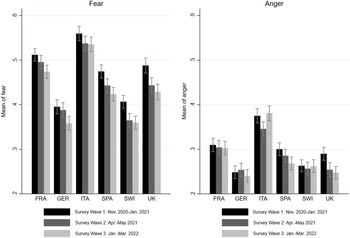
A short look at the descriptive statistics of anger and fear reveals some noteworthy observations. Starting with pandemic threat-elicited fear, we see that fear was an important emotional reaction during the pandemic although there is considerable variation across countries. Figure 1 shows that the levels of fear are highest in France and Italy throughout the pandemic, followed by the UK and Spain. German and Swiss citizens display significantly lower levels of fear in all stages of the pandemic. These overall patterns are in line with the pandemic situation in the six countries with Italy, Spain, France, and the UK considered to be hit harder than Germany and Switzerland. Furthermore, we also observe that fear has generally declined over the course of the pandemic. Fear was highest during the second Covid-19 wave (alpha wave) in late 2020 and early 2021 and significantly lower during the omicron wave in early 2022. This holds for all countries.
Mean of anger and fear with 95% confidence intervals per country and survey wave.
Notes: Displayed are country and survey-wave mean levels of fear and anger with 95% confidence intervals. Variables range from 0 (no fear/anger) to 1 (high fear/anger).
Source: Original survey data (see Research Design).

Concerning anger, the average levels are lower than for fear in all six countries. Higher levels of anger are mostly triggered in Italy, France, and to a lesser extent in Spain. What is interesting is that there is little temporal variation in anger on the aggregate level. The levels of anger remain relatively constant with the exception of the UK where anger is significantly lower during the omicron wave in early 2022.
In order to control for a number of factors that are shown to potentially influence populist attitudes but also might affect respondents’ emotional responses to pandemic threat, we include a number of control variables. We control for the respondents’ age, sex, education (three categories: (1) primary, lower secondary education; (2) upper, post-secondary education; (3) tertiary education), income situation, and self-reported health (on a scale from (1) very bad to (5) very good). Additionally, we also include political attitudes, i.e., an 11-point left-right self-placement measure (squared; to account for extremity) as well as a 5-point measure for political interest. Summary statistics for all variables across all countries and survey waves can be found in Tables S2–S4 in the online appendix.
To model the relationship between pandemic threat-elicited emotions and populist attitudes, we regress populist attitudes on our measures of anger and fear as well as the described set of control variables. We use linear regression models with country and survey fixed-effects and subnational region clustered standard errors. Next to the coefficients for the full sample, we also present marginal effects for each country and survey wave using interaction effects.
Empirical findings
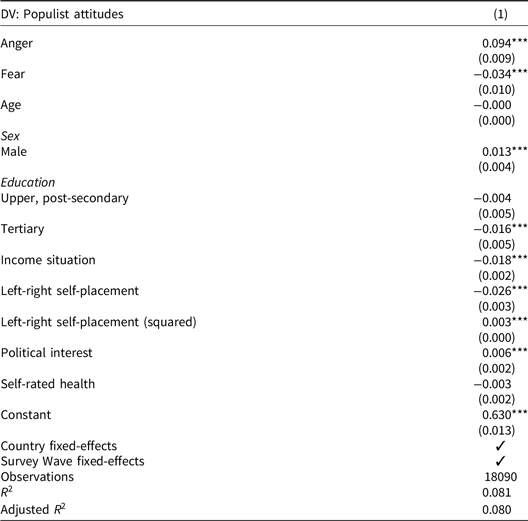
Table 2 presents the main results of our OLS model regressing populist attitudes on pandemic threat-elicited anger and fear as well as our set of socio-demographic and political control variables. We test anger and fear simultaneously to account for the fact that according to AIT, both emotions are simultaneously experienced rather than situated orthogonally. We maintained that anger is positively related to populist attitudes and our analysis provides clear empirical support for this contention. Respondents who are angry with regard to a possible infection with the Coronavirus are more populist. Respondents who have never felt angry regarding such an infection have a predicted populist attitudes score of around 0.47, while people who very often felt angry have a predicted populist attitudes score of around 0.57. This relationship amounts to around 50 percent of a standard deviation. Thus, we find support for hypothesis 1 that pandemic threat-elicited anger is significantly and positively related to populist attitudes.
Linear regression models for the relationship between pandemic-elicited emotions and populist attitudes

Notes: Linear regression coefficients with region-clustered standard errors in parentheses, *P < 0.05, **P < 0.01, ***P < 0.001. Reference Category (RF) for sex: female; RF Education: lower secondary or less
Source: Original survey data (see Research Design).
For fear, we expected that this pandemic threat-elicited emotion would be negatively related to populist attitudes. Indeed, our analyses also support this hypothesis. People who very often felt fear score around 0.48 on the populist attitudes scale while people who never felt fear score around 0.52. Thus, the coefficient of fear is considerably smaller than the coefficient of anger. Nevertheless, these analyses seem to support hypothesis 2.
The coefficients of our other covariates are in line with our expectations and previous research. In general, populist attitudes are higher among men, people with lower education, a less secure income situation and higher interest in politics. Ideology displays the expected u-shaped relationship indicating that those on the extreme left and right of the political spectrum have higher levels of populist attitudes. Age and self-rated health do not display any significant coefficients.
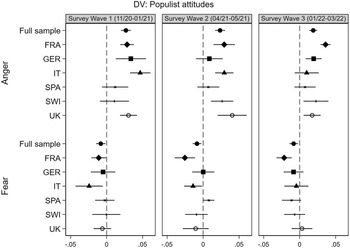
Our cross-national data at three different points in time allows us to take a more detailed look at the different countries through the pandemic. To do so, we interact our key independent variables, anger and fear, with country and survey-wave dummies. Figure 2 reports the marginal effects of anger and fear for each country in each survey wave. Overall, the results of our analysis for anger are relatively robust across most of our countries and the three time points. We find a significant and positive relationship between anger and populist attitudes in France and the UK in all survey waves and in Germany, Italy, and Switzerland in two out of three survey waves. Only in Spain, anger shows no relationship with populist attitudes in any survey wave.
Marginal effects of pandemic-elicited emotions on populist attitudes by country-survey wave.
Notes: Marginal effects calculated from a linear regression model with region-clustered standard errors, 95% confidence intervals, N = 18,090. Full results in Table S15 in the online appendix.
Source: Original survey data (see Research Design).

With only six countries, it is difficult to explain country differences, but we may speculate on some reasons for these differences. First, our null findings for Spain are contrary to the findings by Rico et al. (Reference Rico, Guinjoan and Anduiza2017), which might be due to the fact that in our survey period, the Spanish government includes a populist party (PODEMOS), which potentially alters how pandemic threat and its emotional responses affect citizens’ populist attitudes. Second and similarly, one could argue that in Italy, the presence of populist parties within the government leads to less consistent relationships between anger and populist attitudes in all three waves. Third, for Switzerland, we think that the consensual form of government combined with its direct-democratic traditions certainly limits how anger might shape populist attitudes in general, evident in the non-significant finding in survey wave 1. Yet, the significant and positive coefficients in survey waves 2 and 3 could be very well based on the respective popular votes on Covid-19 that were held shortly before these two survey periods. The fact that both ended in favour of Covid-19 regulations might have sparked anger that was directed against the elites, even in an otherwise consensual country. Fourth, in Germany, we might explain the insignificant finding for anger in wave 2 with a combination of lower numbers of infections and the reversal of certain countermeasures. Yet, it is important to note that we cannot test any of these explanations, which is a task for future research.
For fear, the results are much less robust compared to the full sample analyses. Here, we only find negative and significant coefficients in France and to a lesser extent in Italy. In Germany, Spain, Switzerland, and the UK, the coefficients of fear do not reach conventional levels of statistical significance in any survey wave. This significantly undermines support for hypothesis 2 obtained by the full sample analysis and rather points to an inconsistent relationship between fear and populist attitudes that might be highly context specific. This could also be seen as an indication for countervailing effects of fear itself. Although there is a lot of literature arguing that fear does not align with populist ideologies and discourses, others argue that anxiety and fear might play an important role (Webster and Albertson, Reference Webster and Albertson2022). Future studies might explore this in more detail to see whether fear has heterogeneous relationships with populism depending on the individual’s and the societal context.
In sum, our findings suggest that the current pandemic does not uniformly relate positively or negatively to populist attitudes in six European countries. Rather, this relationship depends on whether people predominantly react with anger or fear to the Covid-19 pandemic threat. While anger about a possible infection with the Coronavirus is mainly positively related to populist attitudes, fear is either negatively or not at all related to populist attitudes.
Analyses of the subdimensions
We now turn to the relationships between fear, anger, and the three subdimensions of populism. While populist attitudes are understood as the combination of people centrism, anti-elitism, and a Manichean outlook, it is still worthwhile to investigate whether pandemic threat and the elicited emotions are related to the respective subdimensions separately. Such an investigation might give an additional perspective on why populism does (not) flourish in times of pandemic threat. Thus, this is an important part of the investigation as it might uncover potentially different relationships between emotional reactions and the different subdimensions.
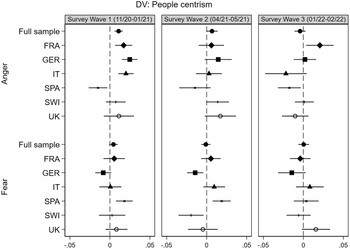
Figure 3 shows marginal effects of anger and fear by country-survey wave on people centrism. What becomes evident is that the relationship between anger and people centrism is inconsistent across countries and over time. We only find significant and positive coefficients for anger in France, Germany, and Italy in the first wave and in France in the third wave. Interestingly, we even find a negative significant coefficient for anger in Spain in the first and third survey waves. All other coefficients do not reach conventional levels of statistical significance. For fear and people centrism, we find almost no statistically significant relationships except for a negative coefficient in Germany in survey wave 2 and two positive coefficients in Switzerland in waves 1 and 2. Overall, anger and fear do not seem to affect the people centrism component of populism in a systematic and consistent manner.
Marginal effects of pandemic-elicited emotions on people centrism by country-survey wave.
Notes: Marginal effects calculated from a linear regression model with region-clustered standard errors, 95% confidence intervals, N = 18,090. Full results in Table S15 in the online appendix.
Source: Original survey data (see Research Design).

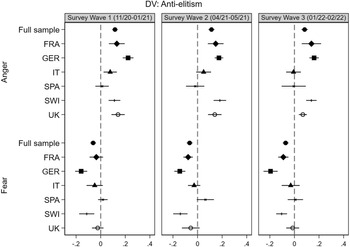
Turning to the second dimension of populist attitudes, anti-elitism, the picture is clearer (see Figure 4). Here, we find significant and positive coefficients for anger in France, Germany, Switzerland, and the UK in all three survey waves. People who react with anger to pandemic threat exhibit higher levels of anti-elitist attitudes. For Italy and Spain, we cannot corroborate this relationship. Considering the coefficients of fear, we also see relatively consistent relationships. In France, Germany, and Switzerland, we see a negative and significant relationship with anti-elitist attitudes in all three survey waves (with the exception of France in wave 1). In all other countries, however, fear and anti-elitism are not systematically associated.
Marginal effects of pandemic-elicited emotions on anti-elitism by country-survey wave.
Notes: Marginal effects calculated from a linear regression model with region-clustered standard errors, 95% confidence intervals, N = 18,090. Full results in Table S15 in the online appendix.
Source: Original survey data (see Research Design).

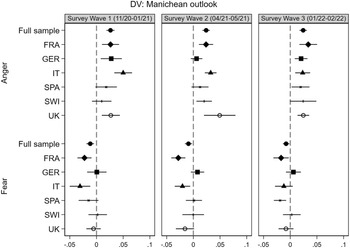
Lastly, regarding the relation between anger and a Manichean outlook on society, there is a relatively consistent pattern (see Figure 5). Out of the possible 18 coefficients, 14 are significant and positive, implying that those who react with anger to pandemic threat are more likely to see society as divided into good and bad. For fear and this third dimension of populism, we only see that 6 out of 18 coefficients are significant and negative, pointing towards a very inconsistent relationship.
Marginal effects of pandemic-elicited emotions on Manichean outlook by country-survey wave.
Notes: Marginal effects calculated from a linear regression model with region-clustered standard errors, 95% confidence intervals, N = 18,090. Full results in Table S15 in the online appendix.
Source: Original survey data (see Research Design).

Robustness checks
While our findings are robust, the cross-sectional nature of our data does not allow us to causally identify the effects of emotions on populist attitudes. Thus, one could argue that, rather than emotions preceding populist attitudes, respondents with populist attitudes are more or less inclined to react with certain emotions to threatening stimuli. Following the literature, we think that our proposed direction is in line with the contentions from previous research. Most studies convincingly show that emotions affect political judgement and attitudes and that decision-making and political attitudes are a function of emotions and cognition (Bonansinga, Reference Bonansinga2020).
Yet, there has been ample debate in the literature on whether there is a so-called ‘endogenous affect’, implying that pre-existing attitudes induce emotional responses (Ladd and Lenz, Reference Ladd and Lenz2011). Drawing on neuroscientific insights, Marcus et al. (Reference Marcus, MacKuen and Neuman2011) and Brader (Reference Brader2005) forcefully argue and show that emotions are not endogenous to political attitudes but have independent causal power (Sirin and Villalobos, Reference Sirin and Villalobos2021). In this regard, Vasilopoulos (Reference Vasilopoulos2021: 7) summarises that ‘affective reactions have a causal impact on political behaviour, rather than being mere epiphenomena of political decisions.’ Despite these convincing results from the literature, we cannot fully rule out reciprocal effects between emotions and populist attitudes, but the presence of these should not affect the validity of our theoretical arguments (Rico et al., Reference Rico, Guinjoan and Anduiza2017).
To solidify our empirical results, we performed a series of robustness checks to see whether our results hold across different specifications and to further strengthen our confidence in the proposed relationships.Footnote 5 First, as personality traits might be a source of both emotional responses and populist attitudes, we test whether such deep-rooted dispositional traits distort our results. Including the Big Five personality traits does not alter our main conclusions as the coefficients of anger (and fear) remain significant and in the expected directions (see Table S17 and Figures S2, S5, S8, S11 in the online appendix). For the Big Five themselves, we find that conscientious, agreeable, and open respondents tend to have lower levels of populist attitudes while the reverse is true for neurotic individuals. Extraversion is not significantly related to populist attitudes.
Second, we include threat perceptions related to the Covid-19 pandemic into our models to see whether they change how anger and fear are related to populist attitudes. Including perceptions of infectious, social, or financial threat into our models does not alter our main conclusions regarding fear and anger, although social and financial threat perceptions are positively related to populist attitudes (see Table S17 as well as Figures S3, S6, S9, and S12 in the online appendix). Third, we also include the information whether respondents have been infected with the Covid-19 virus to see whether the experience of an infection invokes certain (emotional) reactions that distort the relationships between anger, fear, and populist attitudes. As shown in the online appendix, this is not the case (see Table S17 as well as Figures S4, S7, S10, and S13). Fourth, including a question that taps into respondents’ perceptions of the governmental measures to combat the pandemic (on a scale from (1) do not go far enough to (5) go way too far) does not alter the main conclusions as anger (and fear) remain statistically significant and in the expected directions (see Table S16 in the online appendix).
Conclusion
Our study evaluates how anger and fear elicited by the Covid-19 pandemic threat relate to populist attitudes in six European countries. Following insights of AIT, we argued that the Covid-19 pandemic threat prompts anger and fear, which in turn have distinct relationships with populist attitudes. We tested these contentions using data from three original surveys conducted between November 2021 and March 2022 in France, Germany, Italy, Spain, Switzerland, and the UK. Our results show that citizens experiencing anger are more prone to express populist attitudes, while those that experience fear are less likely to express such exclusionary stances. The relationships are robust across most of our countries and survey waves for anger but less so for fear. As additional analyses show, anger mainly relates to the anti-elitist and Manichean dimensions of populism and less so to people centrism.
Our analyses offer a step towards a better understanding of the threat-induced emotional foundations of populism. Although they point in the right direction, we need more studies that empirically examine the psychological underpinnings of populist stances during hard times. As such, our approach has its limitations that require further attention. Although our study moves beyond previous single case studies in scrutinising the relationship between emotions and populist attitudes across six European countries, our case selection is limited to Western and Southern European countries. Thus, the question of whether our findings travel to different country contexts arises. Furthermore, our data is strictly cross-sectional, thus preventing us from drawing any causal inferences based on the uncovered relationships. It might very well be that people with populist attitudes are more likely to express anger rather than fear with regard to pandemic threat, compared to those without populist attitudes (Nguyen et al., Reference Nguyen, Salmela, von Scheve and Oswald2022). Yet, a large segment of the literature is in line with our contention that emotions influence attitudes rather than vice versa. Our study might thus function as a starting point for future studies to focus on experimental manipulation (e.g., Rhodes-Purdy et al., Reference Rhodes-Purdy, Navarre and Utych2021) or a longitudinal design (Rico et al., Reference Rico, Guinjoan and Anduiza2017) in order to offer causally robust conclusions. Such designs might also disentangle the mechanism through which anger affects populist attitudes empirically. Additionally, our study was only able to test anger and fear with regard to a possible Coronavirus infection, and thus, only indirectly touches upon other threats of the pandemic such as financial losses or social isolation. While our findings are robust to the inclusion of different threat perceptions, future research might investigate multi-layered threats in more detail to see whether different aspects of a (pandemic) threat arouse distinct emotions that have different political and social consequences. Experimental studies are particularly suited for this. Lastly, our study followed most of the previous literature by measuring emotions through self-reported survey items. Recently, studies have made progress in using different methods including facial expressions and other techniques, which can be fruitfully applied in experimental designs (Marcus et al., Reference Marcus, Neuman and MacKuen2017).
Despite these caveats, our findings align with and expand two different strands of literature, thus having crucial implications for future research. First, we add to the literature that investigates the emotional foundations of populism by showing that anger as a response to an external threat that is less connected to traditional populist grievances, is positively related to populist attitudes. By showing that anger elicited by the Covid-19 pandemic fosters populist attitudes, we underscore that anger rather than fear is the emotional bedrock of populism, even in crises that do not fully align with populist grievances.
Second, the empirical insights provided by our analyses are in line with recent findings on the importance of emotions during the pandemic and how they affect crucial aspects of politics. For example, it was found that pandemic threat-elicited anger is related to lower levels of trust in the government (Erhardt et al., Reference Erhardt, Freitag, Filsinger and Wamsler2021) and less to support for the restriction of civil liberties (Vasilopoulos et al., Reference Vasilopoulos, Mcavay, Brouard and Foucault2022). Even more so, pandemic threat-elicited anger seems to be connected to exclusionary attitudes such as a preference for authoritarian governance (Erhardt et al., Reference Erhardt, Freitag and Filsinger2022), anti-immigrant sentiments (Freitag and Hofstetter, Reference Freitag and Hofstetter2022) and ethnic conceptions of nationhood (Wamsler et al., Reference Wamsler, Freitag, Erhardt and Filsinger2022) and, as we show here, populist attitudes.
Relatedly, our study complements recent research on how populist parties fared during the pandemic (Froio, Reference Froio2022; Wondreys and Mudde, Reference Wondreys and Mudde2022; Zanotti and Turnbull-Dugarte, Reference Zanotti and Turnbull-Dugarte2022) by honing in on how the pandemic relates to populist attitudes. By doing so, we offer an explanation why populist forces did not necessarily perform well during the pandemic, although pundits and scholars often connect populist success to different crises and threats. The reasons might lie in the emotional responses to pandemic threat and their distinct consequence for political attitudes.
As additional analyses show (see Table S19 in the online appendix), angry respondents seem to prioritise the economy over public health considerations and regard the measures as too restrictive. Against this background, they might consider populism as an attractive political option in times of the pandemic, given that radical and populist parties stylised themselves as ‘defender[s] of freedom’ (Lehmann and Zehnter, Reference Lehmann and Zehnter2022: 1). Yet, given that fearful respondents react differently to pandemic threat than angry individuals, this strategy is not necessarily successful, especially when considering that fear seems to be the dominant emotion triggered by a pandemic. Overall, our analyses might help to understand why populism has not necessarily flourished during the Covid-19 pandemic as only those citizens reacting with anger to pandemic threat are more inclined to hold populist attitudes.
Supplementary material
To view supplementary material for this article, please visit https://doi.org/10.1017/S1755773923000036.
Data availability statement
The data that support the findings of this study will be made openly available in Open Science Framework: DOI: 10.17605/OSF.IO/U95DB
Acknowledgements
An earlier version of this paper was presented at the Annual Scientific Meeting of the International Society of Political Psychology (ISPP) 2022 in Athens. The authors would like to thank all participants for their helpful and constructive comments. In particular, we would like to thank Hilary Izatt, Sonja Zmerli, Justin Robinson, and Cillian McHugh. We would also like to thank the three anonymous reviewers for their feedback. All errors remain our own.
Financial support
This article was written as part of a research project on ‘The Politics of Public Health Threat’ that is financially supported by the Swiss National Science Foundation (SNSF, Grant No. 100017_204507) and the Berne University Research Foundation (25/2020).
Conflict of interest
The author declares that they have no conflict of interest.
The article is currently not considered for publication by any other journal.
Notes on contributors
Maximilian Filsinger, is a Postdoctoral Researcher at the Chair of Political Sociology at the Institute of Political Science at the University of Bern, Switzerland. His research interests lie in the fields of comparative public opinion research and political sociology with particular emphasis on (affective) polarisation, political attitudes such democratic regime preferences, populist attitudes and political trust as well as social capital theory.
Nathalie Hofstetter, is a PhD candidate at the Institute of Political Science at the University of Bern, Switzerland. She received a bachelor’s degree in Social Sciences and a master’s degree in Political Science from the University of Bern, Switzerland. Her areas of interest are political psychology and political sociology. She has published on personality and emotions in Current Psychology and the Journal of Ethnic and Migration Studies.
Markus Freitag is Professor of Political Sociology at the Institute of Political Science, University of Bern, Switzerland. He has published on trust, social capital, direct democracy, comparative public policy, voter participation, political attitudes, civil war, and personality.