

I. Introduction
International human rights law has often struggled to provide effective remedies to victims of human rights violations.Footnote 1 The issue of effective remedies has been identified as a particular problem within the field of business and human rights. John Ruggie, in his role as United Nations (UN) Special Representative on human rights and transnational corporations, identified a ‘patchwork of mechanisms’ that was ‘incomplete and flawed’.Footnote 2 In recognition of this problem, Ruggie developed the United Nations Guiding Principles on Business and Human Rights (UNGPs) which, inter alia, require that companies establish or participate in mechanisms that provide access to remedy for rightsholders whose human rights have been infringed upon as a result of corporate actions.Footnote 3 This is a part of what has become known as ‘Access to Remedy’ or the ‘Third Pillar’ of the UNGPs.
According to the UNGPs, remedy can be provided by various fora. Judicial remedies are ‘at the core’ of ensuring access to remedy.Footnote 4 However, other mechanisms are also identified as important. Government-sponsored non-judicial mechanisms such as labour inspectorates, employment tribunals and national human rights institutions are identified as playing an ‘essential role’ in complementing and supplementing judicial mechanisms. The UNGPs also recognize a third category of mechanisms, private remedies in which the government has no direct role, so-called non-state-based non-judicial grievance mechanisms (NSBGMs). These can include companies’ operational level grievance mechanisms, development bank complaint mechanisms, and multi-stakeholder initiative complaint mechanisms. An example from this last category of grievance mechanisms is the focus of this article.
There is significant debate about the potential of NSBGMs to provide access to effective remedy.Footnote 5 Empirical inquiry as to when and how NSBGMs might contribute to providing access to remedy for rightsholders remains under-explored.Footnote 6 This article contributes to that debate by focusing on a critical methodological question: how should we assess whether NSBGMs are providing access to remedy for rightsholders? While there is increasing recognition that access to an effective remedy means that complaints mechanisms should be effective in terms of both process and outcome, the focus of much of the existing scrutiny of complaints mechanisms is on the procedural aspects, and in particular, the effectiveness criteria for grievance mechanisms set out in the UNGPs. This article argues that these are not sufficient to ensure a proper assessment of whether an effective remedy is available for rightsholders. More focus is warranted on determining whether the outcomes of NSBGMs are effective in order to make a determination of effectiveness. To test this hypothesis, a case study which investigates the complaints mechanism of the Roundtable on Sustainable Palm Oil (RSPO) is undertaken. The RSPO complaint mechanism fulfils more of the UNGPs’ effectiveness criteria than most other NSBGMs, but we find that there are fundamental problems in terms of the outcomes which it produces for rightsholders.
While our study focuses on one relatively narrow aspect of the business and human rights debate, it is an important contribution to broader issues within the field. It has been recognized by this journal that scholarship on business and human rights has so far ‘engaged relatively scarcely in empirical analysis’ and that as a result, various hypotheses about business and human rights performance have not been properly tested.Footnote 7 This article presents the findings of such an empirical investigation. As a result of our findings, we make suggestions about the ways in which NSBGMs should be assessed in the future to ensure that their role in providing access to effective remedies for rightsholders is properly evaluated. This matters to broader debates about access to remedy. By scrutinizing more carefully and precisely how each individual mechanism contributes (or does not contribute) to the overall goal of achieving effective remedy, we build up a more accurate picture of the current situation and we are better placed to advocate for reforms that will improve remedies in the future.
The remainder of the article is set out as follows. We first explore different approaches to assessing the effectiveness of NSBGMs in providing a remedy, querying the focus on procedural aspects, and stressing the importance of analysing the outcomes of cases for rightsholders (section II). This is followed by an explanation of how the RSPO and its complaint mechanism function and an assessment of how well it meets the UNGPs’ effectiveness criteria (section III). In section IV we introduce an alternative approach and methodology for assessing the effectiveness of the RSPO complaints mechanism, focusing on the outcomes produced for claimants, and then present the results using this methodology (section V). In section VI, we reflect on these results, in light of the wider literature on NSBGMs and access to remedy, and consider the implications for how NSGBMs are assessed in terms of their ability to provide an effective remedy in the future. Section VII concludes the article.
II. Assessing the Effectiveness of NSBGMs in Providing a Remedy
Rights and remedies are fundamentally interdependent. International human rights law recognizes that the right to an effective remedy is integral to ensuring that substantive rights are adequately protected.Footnote 8 In the field of business and human rights, this has also been widely recognized, and is central to the way in which the UNGPs have been constructed. Under the UNGPs, the state must provide effective judicial and non-judicial remedy mechanisms to address business-related human rights abuses.Footnote 9 In terms of judicial remedies, a transnational corporation may be subject to courts enforcing legal human rights norms both in the country where they are headquartered and the host countries where they operate.Footnote 10 In terms of non-judicial remedies, states should create their own accountability mechanisms as well as cooperate through institutions such as the Organisation for Economic Co-operation and Development (OECD) National Contact Point system. The role of NSBGMs in complementing these other mechanisms is discussed below. Significant work has been undertaken to map out the extent of this patchwork of remedies.Footnote 11 There is also an emerging debate over the effectiveness of these mechanisms to provide remedies to rightsholders.Footnote 12 Recent work which has sought to survey the current situation in relation to judicial remedies in domestic jurisdictions has found it to be ‘patchy, unpredictable, often ineffective and fragile’, Footnote 13 while government-sponsored non-judicial mechanisms in many situations do not offer ‘an accessible or realistic route to an effective remedy’.Footnote 14 Concern over the current inadequacies is perhaps best demonstrated by the significant political and academic support for a binding human rights treaty. A key attraction of such a treaty is its capacity to provide more effective remedies to rightsholders.Footnote 15
Our contribution focuses on one particular aspect of the remedies ecosystem, NSBGMs. Compared to other forms of remedy, there is a debate about the inherent capacity of these mechanisms to play any kind of legitimate or meaningful role in addressing human rights-related disputes between companies and rightsholders.Footnote 16 While sceptics argue such mechanisms are unsuited to addressing the conflicts that arise between companies and communities, other commentators, as well as key UN actors, have been keen to stress that NSBGMs do have an important role to play. John Ruggie argued that while judicial remedies were central to ensuring access to remedy globally, both government-sponsored non-judicial mechanisms and NSBGMs were vital to supplement them. More recently, the United Nations Working Group on Business and Human Rights (subsequently ‘the UN Working Group’) has made clear that NSBGMs are still considered an important component of the ‘bouquet of remedies’ which should be available to rightsholders.Footnote 17
While key UN actors have therefore defended the role that NSBGMs can play in achieving access to remedy, their precise role within the overall architecture of the remedy eco-system is more ambiguous. One interpretation provided by Ruggie is that NSBGMs complement state-based judicial and non-judicial mechanisms, providing a more immediate point of initial recourse, possible early resolution of issues in at least some instances, and an early warning system for management which allows for pre-emptive action on issues that might otherwise escalate.Footnote 18 He also saw them as potentially playing a replacement role. Where national courts and government-sponsored non-judicial mechanisms lack the capacity to provide an effective remedy themselves, NSGBMs might play a more central role in providing redress.Footnote 19 When making judgments about the effectiveness of NSGBMs, it is therefore important to consider what they are effective at doing: can they act as an effective complement to, or replacement for, other forms of remedy?
Moving on to consider different approaches to evaluating the effectiveness of NSBGMs, the UNGPs recognize that there are both procedural and substantive aspects to access to remedy, and the UN Working Group has reaffirmed that remediation should be effective in terms of both process and outcome.Footnote 20 However, there has been much more focus on unpacking what the procedural aspects of effective remedy entail.Footnote 21 This commenced with Principle 31 of the UNGPs which sought to ‘provide a benchmark for designing, revising or assessing a non-judicial grievance mechanism to help ensure that it is effective in practice’.Footnote 22 According to these criteria, non-judicial grievance mechanisms should be legitimate, accessible, predictable, equitable, transparent, rights-compatible and a source of continuous learning. These effectiveness criteria focus on the procedural aspects of grievance mechanisms, or the ‘characteristics’ that any grievance mechanism should have if it is to be successful.Footnote 23 They aspire to create requirements for how grievance mechanisms should operate so that there are not insurmountable barriers to rightsholders who wish to make complaints (e.g., as a result of excessive costs, lack of information as to how they operate, etc.) and they are procedurally fair to rightsholders who decide to use them (e.g., by being clear on timeframes and potential outcomes that might be achieved, ensuring access to information and expertise necessary to pursue a case, etc.). These procedural criteria have become the focus for evaluating whether NSBGMs are providing effective remedies. They are discussed by industry associations, companies and multi-stakeholder initiatives (including RSPO) as standards against which to instigate, review and reform the operation of their complaints mechanisms.Footnote 24 They are utilized in academic studies that investigate how NSBGMs are operating.Footnote 25 They are also translated into benchmarking processes which compare NSBGMs’ performance. For instance, the Corporate Human Rights Benchmark compares the performance of companies’ operational level grievance mechanisms using indicators that draw upon the UNGPs’ effectiveness criteria.Footnote 26 As such, the UNGPs’ effectiveness criteria have become critical to the way in which NSBGMs are evaluated as well as being central to claims that efforts have been taken to strengthen complaints mechanisms by a number of authorities responsible for running them.
While they have become central to the evaluation of the NSBGM’s complaints mechanisms, the UNGPs’ effectiveness criteria leave the issue of outcomes largely unaddressed. The only criterion which touches upon the issue of outcomes states that grievance mechanisms should ‘ensure that outcomes and remedies accord with internationally recognized human rights’.Footnote 27 This criterion has been found to be ambiguous and to be difficult to translate into metrics whereby the effectiveness of outcomes can actually be measured.Footnote 28 In light of this, commentators have raised concerns that focusing on the process of how an NSBGM operates may marginalize the more fundamental question of what outcomes are actually achieved for rightsholders and that an NSBGM which meets the standards of procedural fairness demanded by the UNGPs might still fail to provide an effective remedy for claimants.Footnote 29
One study has already been undertaken on the outcomes achieved for stakeholders from NSBGMs.Footnote 30 It examined the mechanisms used in ten case studies of corporate–community human rights disputes in India and Indonesia. The authors compared and contrasted individual cases from across various mechanisms to identify how outcomes for rightsholders differ depending on a variety of factors. Key factors include how the institutions responsible for enacting the complaint mechanisms are designed; their authority and capacity to investigate claims and implement judgments; and their ability to address power imbalances and empower communities so that they can influence how complaints processes are framed and the remedies that they ultimately receive.Footnote 31 This study therefore makes an important contribution in identifying a range of factors that can influence the ability of various types of mechanisms to produce effective remedies for rightsholders. A partner institution involved in the study, the Corporate Accountability Coalition, has also prepared in-depth analysis of a number of complaint mechanisms.Footnote 32
Our own study takes a different approach. We conduct a comprehensive investigation into the effectiveness of a single NSBGM, the complaint mechanism of the Roundtable on Sustainable Palm Oil. RSPO is a multi-stakeholder initiative which brings together seven types of stakeholders in the palm oil industry ‘to develop and implement global standards for sustainable palm oil’.Footnote 33 We chose the RSPO complaint mechanism as the subject of our study because, as is documented below in section III, it performs particularly well when compared with other NSBGMs in terms of the UNGPs’ effectiveness criteria. By undertaking a comprehensive assessment of a single NSBGM with relatively high levels of procedural fairness as defined by the UNGPs, we are able to demonstrate how it is still possible for that NSBGM to produce poor outcomes for rightsholders. This then allows us to raise broader questions about how we should assess the effectiveness of NSBGMs more generally. First, we explain why the RSPO complaints mechanism is a worthy choice for our study.
III. The RSPO and its Complaint Mechanism
Palm oil is an increasingly important and controversial part of the world agricultural system. In recent decades it has become the most sold plant-based oil and is used in everything from snack foods, to cosmetics, to industrial lubricants to biofuels. It has been estimated that fully fifty per cent of products in a typical North American or UK grocery store contain palm oil.Footnote 34 Palm oil grows in the tropics primarily within ten degrees of the equator. When well managed, it is extremely productive per hectare planted, producing six to ten times the quantity of other oil crops.Footnote 35 It has grown to cover well over twenty million hectares, with much of the expansion occurring in tropical forests. Indonesia and Malaysia produce about two-thirds of world supply. There are twelve million hectares planted in Indonesia alone, up from less than half a million hectares thirty years ago.Footnote 36 There are also significant productive regions in West Africa and South America.
RSPO was founded in 2004 and sought to address the severe criticism palm oil received. This criticism has progressively increased. There are substantiated claims that palm oil production has decimated rainforests, destroyed wildlife habitats, displaced communities, caused widespread air and water pollution, resulted in violations of multiple labour rights, dismantled indigenous groups, unleashed massive carbon emissions including on peat lands, led to localized extinctions of orangutans, and many others.Footnote 37 There continue to be widespread efforts to ban palm oil in products and retail outlets.Footnote 38 It is among the most vilified agricultural products in the world.Footnote 39
The RSPO Standards have evolved to include, at their core, the protection of what it calls ‘High Conservation Value’ forests (such as tropical rain forests), endangered species habitat, the rights of communities and Indigenous peoples to consent to the use of land for plantations, and labour rights.Footnote 40 Among the organizations’ founders are large, mostly Malaysian, companies, several of which are parts of enormous corporate conglomerates. They remain central to the organization. However, it is a multi-stakeholder initiative with a stated vision of being a ‘roundtable’ for diverse interests. RSPO’s membership includes representatives from ‘oil palm growers, palm oil processors or traders, consumer goods manufacturers, retailers, banks and investors, environmental or nature conservation NGOs and social or developmental NGOs’.Footnote 41 It has over four thousand members and claims that nineteen per cent of the world’s palm oil is RSPO certified.Footnote 42 RSPO’s success in achieving its stated goals has been the subject of significant academic analysis, with the most cited studies questioning its effects on deforestation and habitat degradation, as well as raising issues about its legitimacy among those who have resisted expansion of oil palm cultivation.Footnote 43
The RSPO complaint mechanism was established in 2009 and has been refined over the years. It has formal rules, a professional secretariat panel, an appeal process and a stable of outside investigators.Footnote 44 The process begins with a complaint and a written response from the respondent company. There is an initial determination that the complaint is appropriate for decision through the RSPO process. A complaints panel is constituted of representatives from RSPO’s multi-stakeholder members who declare themselves to have no professional, financial or personal relationship to the parties to the case. The complaints panel manages the dispute. Often, a third-party investigator is appointed by the complaints panel to go in person to judge the situation on the ground. The investigator then submits a report to the complaints panel. The complaints panel issues an initial interim order determining whether the RSPO standards have been violated and, when necessary, ordering actions to be taken by the member company to return to compliance. These actions are then monitored, sometimes for years. The monitoring ends with the actions bringing the member company back into compliance and the claim is officially closed. A party who disagrees with the decision of the complaints panel can pursue an appeal procedure with an appeal panel.Footnote 45
The RSPO can also go from adjudication mode to settlement facilitation mode. This can happen anytime from immediately upon receiving the claim up until late in the monitoring stage after an order. Sometimes both tracks proceed simultaneously, with the RSPO encouraging dialogue and settlement while continuing to examine the case. Remedies ordered by the complaints panel are injunctive, that is, they are requests that the member company act or refrain from acting. There are no monetary awards or any forms of restitution. The ultimate sanction is to decertify a member company or operation. However, the complaints panel has power only over RSPO members and so a company can avoid its jurisdiction at any time by withdrawing from membership.
In 2013, a Resolution of the RSPO General Assembly required alignment of the complaints mechanism with the UNGPs’ effectiveness criteria.Footnote 46 Not only is the RSPO complaint mechanism formally aligned in this way, but it also performs far better than the vast majority of NSBGMs when assessed against those criteria. The Multi-Stakeholder Initiative Database (MSI Database) catalogues 45 different MSIs across industries from mining to telecommunications, clothing to fisheries.Footnote 47 Its analysis of MSIs’ complaints mechanisms recognizes that the vast majority of MSIs do not meet the standards set by the effectiveness criteria.Footnote 48 However, according to its analysis, RSPO is one of the very best performers. In terms of transparency, it is one of only four MSIs with complaints mechanisms that disclose information about the number and status of current and historic claims, publishes information about individual complaint decisions and conducts analysis of complaints received.Footnote 49 Our own analysis found that RSPO provides more details about complaint decisions than any other MSI. In terms of equitability, RSPO is one of only three MSIs that offers complainants both access to an advocate or other forms of assistance and a translation service.Footnote 50 In terms of accessibility, RSPO is one of only six MSIs which explicitly requires potential complainants to be given information about the complaint process, and one of only 12 that guarantees anonymity to the complainant.Footnote 51 In terms of predictability, unlike most other MSIs, RSPO does specify expected timeframes for most stages of the complaints process.Footnote 52 In terms of legitimacy, it is one of 20 MSI complaint mechanisms which has an explicit conflict of interest policy which states how it ensures that the decision-maker is free from any interest in the outcome.Footnote 53
Analysis undertaken of other types of NSBGMs reveals that the majority of companies’ operational level grievance mechanisms and development bank complaints mechanisms also perform poorly when measured against the UNGP’s effectiveness criteria.Footnote 54 Particularly in terms of accessibility, transparency, equitability and legitimacy, there are very few grievance mechanisms that are comparable to RSPO.Footnote 55 Overall then, it is reasonable to conclude that RSPO performs well when compared with other NSBGMs according to the UNGPs’ effectiveness criteria.
IV. Approach and Methodology
We sought to investigate the extent to which the RSPO complaints mechanism provides an effective substantive remedy in terms of the outcomes achieved for rightsholders. In doing so, we relied upon the way in which effective substantive remedy is defined by the UN Guiding Principles and the way it is subsequently elaborated upon by the UN Working Group. The UN Guiding Principles defines effective substantive remedy as one which will ‘counteract or make good any human rights harms that have occurred’.Footnote 56 This may be achieved through such remedies as ‘apologies, restitution, rehabilitation, financial or non-financial compensation and punitive sanctions (whether criminal or administrative, such as fines), as well as the prevention of harm through, for example, injunctions or guarantees of non-repetition’.Footnote 57 In their July 2017 report, the UN Working Group ‘unpacks the concept of access to effective remedies’ under the UN Guiding Principles.Footnote 58 The UN Working Group states that ‘merely providing access to remedial mechanisms will not suffice: there should be an effective remedy in practice at the end of the process’.Footnote 59 It notes that the aim of remedy is ‘to place an aggrieved party in the same position as he or she would have been had no injury occurred’.Footnote 60 The report goes on to explain that effective remedy combines the related elements of prevention, redress and deterrence, and discusses restitution, compensation, rehabilitation, satisfaction, guarantees of non-repetition, as well as other remedies.Footnote 61 The Report also asserts the centrality of rightsholders in determining whether an effective remedy has occurred and states that this requires that ‘the effectiveness of a remedy should be judged also from the perspective of affected rights holders’.Footnote 62
Synthesizing these pronouncements into a definition of effective remedy that can be utilized in our study we find an effective substantive remedy to occur when there is a:
-
(1) Cessation of the continuing violations of the human rights infringed; and
-
(2) Restoration to the rightsholder of full enjoyment of the rights, and/or adequate reparation for the harm suffered due to the lost enjoyment of those rights.
In making a determination of whether these conditions are satisfied, our approach involves first inquiring as to whether the relevant authority (in our case the RSPO) itself considers that a remedy has been provided. Where this is the case, we then consider the outcomes of those cases from the rightsholders’ perspective to determine whether they consider their rights violations to be remedied. In so doing, we take seriously the Working Group’s requirement that the effectiveness of a remedy should be judged from the perspective of rightsholders. Our approach is then to compare the perspectives of rightsholders on whether the remedy is effective to the way it was presented by the relevant authority, and if there is a disparity, then the claim is placed in a special ‘discordant’ category.Footnote 63 As described below, this result did not occur with any of the RSPO claims, and so we do not have a discordant category in our data. Future studies will inevitably involve discordant scenarios where approaches will have to be devised for reaching a determination of whether an effective substantive remedy has in fact occurred.
We are also cognizant of the fact that substantive outcomes could be fundamentally undermined by procedural aspects of the claims process. If procedural failings are sufficiently grave, this might lead to the conclusion that no substantive effective remedy has been, or could be, achieved. Therefore, we also seek to ascertain if there are procedural aspects of the claim that might lead to the effective frustration of substantive outcomes. For instance, this could be because of the length of time taken to achieve an effective remedy. We therefore seek evidence of such procedural issues in our examination of all materials in relation to the case produced by the relevant authority, and where such evidence exists, seek community perspectives to ascertain whether they perceive an effective remedy to be frustrated.
In operationalizing our approach into a methodology for conducting the study, there were two key stages. The first stage of our methodology was to review all the RSPO claims in which an order had been entered or a settlement reached. We did this by scrutinizing the claims files available on the RSPO claims website.Footnote 64 Because the point of study is access to remedy for infringements of human rights, we reviewed the formal statement of claims in the claims file (including later amendments, if any) and determined if each claim raised a human rights issue.Footnote 65 Some claims solely involved topics clearly removed from human rights; these included issues such as orangutan habitat, individual contract terms or use of the RSPO certification in retail outlets. These claims were excluded from the study. Any claims that mixed human rights and non-human rights claims were included. There were also claims that were brought by RSPO itself in response to a public report, and in which no claimant ever came forward.Footnote 66 As those claims had no individuals or groups requesting a remedy, they were excluded from this analysis. At this point we had identified a set of human rights claims in the RSPO complaint mechanism.
The human rights claims files were then reviewed to determine if a ruling was made by the RSPO complaints panel. The rulings are formal decision documents submitted by the complaints panel in each case in which a ruling was made. For claims in which no ruling was made, we determined if there was a recognition that a settlement was made between the parties leading to the case being closed. This was noted either by the complaints panel or on the RSPO website describing the claim. At this point we had a set of human rights claims which had been resolved, either by ruling of the complaints mechanisms or by settlement of the parties. We then placed each of these resolved claims into one of three groups: Group 1 (ruling made in favour of claimants), Group 2 (no ruling made in favour of claimant) and Group 3 (no ruling made, but case settled by mutual agreement of the parties).
Group 3 (settled claims) was the most difficult group to analyse further. No Group 3 claim file included the terms of the settlement. This non-disclosure is not the decision of RSPO, but is the result of RSPO’s policy to respect confidentiality requests by a party.Footnote 67 In other dispute resolution systems, such as court litigation or arbitration, it is common practice to make settlements confidential, particularly settlements of claims against companies. The company may consider it disadvantageous to appear to be publicly recognizing that a claim has merit. It may also wish to keep the details of what remedy has been agreed secret for fear that it might incentivize others to make similar claims.Footnote 68 It is reasonable to assume that rightsholders received some value, and gave up some value, to obtain these settlements, but to judge whether remedy was achieved would be speculation uninformed by facts. Once a claim was identified as being in Group 3, we did not investigate it any further.
The Group 2 claims were the ones in which the claimant did not prevail and was not awarded any remedy. These varied from a ruling by the complaints panel that the respondent company’s position was correct, to the claim being dismissed for lack of prosecution and responsiveness by the claimant, to the claim being withdrawn without explanation. Once a claim was identified as being in Group 2, we did not investigate it any further.
The Group 1 claims (ruling in favour of claimants) were the focus of our remaining research and analysis. These claims were further investigated to determine what remedy was actually received by the claimants according to the RSPO claim files. We noted what remedy was ordered by RSPO, but because our focus is on the remedy itself, our goal was to determine what actually happened.
In one important subset of Group 1 claims, in response to rulings against them, the respondent companies left RSPO, or the operation at issue was sold to a company that was not an RSPO member. In one case, the company was ordered by the Complaints Panel to leave RSPO. For these claims, no remedy at all was actually received by the rightsholders, due to the company or operation intentionally leaving RSPO’s jurisdiction, or being ordered to do so. The RSPO system as a whole may well have been strengthened by removing these companies from RSPO certification, but that is an issue separate from that of remedy for rightsholders. The rightsholders received nothing in these cases. We did a further review of media reports, NGO and company statements and interviewed some claimants regarding these claims. The five claimants we spoke to were universally disappointed with the outcome of the process and frustrated that the RSPO claims mechanism was ineffectual in these cases.Footnote 69
For the remaining Group 1 claims, we contacted the person or entity acting as the representatives of the claimant in the RSPO complaint mechanism. Very rarely, this was the rightsholders themselves, but was almost always a local or international NGO or labour union.Footnote 70 As discussed in more detail below, there were four such Group I claims. We interviewed ten individuals who worked for NGOs that brought the four claims.Footnote 71 The goal of these interviews was to get the perspective of the claimants on their use of the RSPO complaint mechanism generally and to confirm the facts as presented in the RSPO claim files. In particular, we wanted to confirm that the orders made by RSPO had been carried out in reality and in what way the claimants had received a remedy for the violation of their human rights. Questions were therefore asked which were intended to elicit evidence of objective facts, such as whether community land was still being used by a company as part of a palm oil plantation, or whether community members were still incarcerated for anti-company protests.
When, as discussed in more detail below, the claimants’ representatives did, in fact, assert that there had been some form of effective and meaningful remedy for their human rights violations, we visited the affected rightsholders in person to verify the validity of their assertion, witness the situation on the ground and interview multiple rightsholders and people knowledgeable about the situation. We did this because representative organizations often have their own objectives and perspectives that may be distinct from those of the rightsholders they represent. As explained below, there was only one case in which it was necessary to visit the rightsholders themselves and witness the remedy that had been received. This claim was examined in detail. The area and community were visited four times over four years. This case was a land claim and the land itself was visited to confirm that it had not been incorporated into the palm oil plantation. We interviewed farmers working the land, community leaders, people who lived next to the land and company representative about the status and use of the land. In addition, we conducted semi-structured interviews with leaders among the claimant group, various individual community members, a lengthy public town hall meeting with the claimant community, an in-depth focus group with representative community members, and private interviews with multiple individual claimants. In all, 89 rightsholders participated in the focus group or group discussions we organized and ran. In addition, 24 of the participants in these groups were also interviewed individually.
Alongside our interrogation of the substantive outcomes in cases, we also inquired about the claimants’ perceptions of going through every step of the claims process, and the time and effort involved (i.e., their perception of the procedural aspects of the process) to understand if they perceived these as frustrating their efforts to obtain a substantive outcome. In doing so, we also sought to uncover new information that we did not know, but it was relevant to understanding whether an effective remedy had actually been achieved. For instance, as explained below, the rightsholder interviews revealed that one respondent company that lost an RSPO claim, provided an effective remedy, and then retaliated against some of the claimant group. This was new information that was not part of the RSPO claim or included in the claims file.
There were 58 RSPO resolved claims when we finished our review in February 2020.Footnote 72 Of those, three were merged into other claims or otherwise were not considered meaningful as separate claims. This left 55 claims in which there had been a ruling or settlement. Of those, 39 were determined to be human rights claims at least in part. These claims fell into four general categories: land, labour, pollution and violence. Thirty of the claims included significant land issues. Often the issue was whether the land cleared, planted and incorporated into the plantation was actually owned or legally controlled by the company. Land titles may have been in question or the legal right of the company to publicly ‘forest’ land was disputed. Another common claim was under the RPSO requirement that a plantation could only be established with the free prior and informed consent (FPIC) of the local community with customary or user rights to the land (Community FPIC).Footnote 73 This RSPO standard includes the principle of FPIC of indigenous peoples as recognized by the UN Declaration on the Rights of Indigenous Peoples and ILO Convention 169. Indeed, some RSPO claims are by indigenous groups. However, the RSPO FPIC standard also encompasses local communities, whether or not they are indigenous. This greatly expands the applicability of FPIC. The pollution claims were usually made in addition to other claims and generally concerned mill waste contaminating surface water. The labour claims generally concerned conditions of work, payment and worker safety. The rare violence claims alleged excessive force used by plantation private security personnel or by public security at the behest of the company.
V. Outcomes of Cases
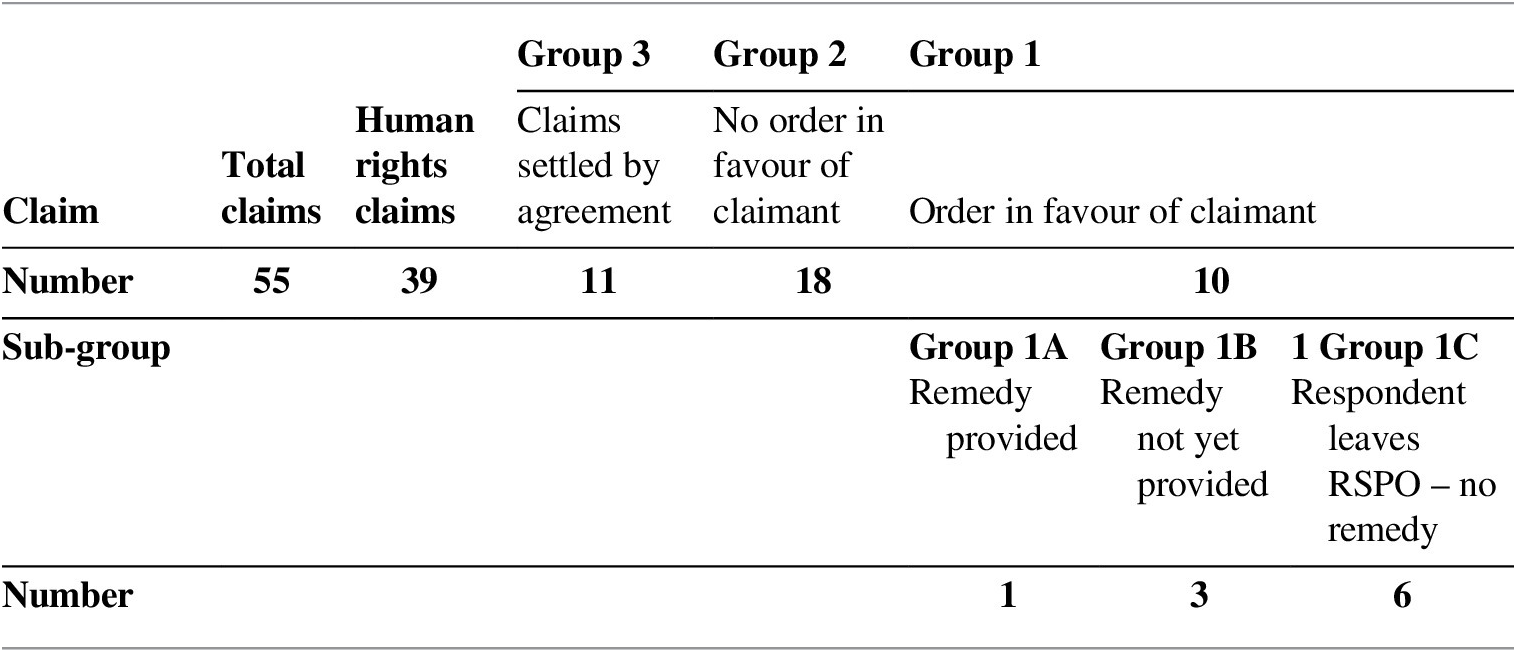
In this section, we analyse the substantive outcomes of cases. Utilizing the categorization of claims we developed in the previous section, we found the following results; Group 1 (claims in which there was a ruling in favour of the claimant) contained 10 claims. Group 2 (claims in which there was not a ruling in favour of the claimant) contained 18 claims. Group 3 (claims in which the parties agreed to settle) contained 11 claims. It is the Group 1 claims, and the extent to which they provided an effective remedy to the claimants, that we analyse below. One immediate observation about the numbers of Group 1 claims is how frequently the RSPO member company was found to be in the wrong. In 10 of the 28 cases that were not resolved by settlement, there was a clear ruling by the RSPO complaints panel against the company. Those decisions were made publicly and can be used by the NGO claimants in all their diverse efforts (media coverage, protests, court cases, etc.) to obtain their ends.Footnote 74 However, this benefit to the NGO claimants does not mean that the rightsholder themselves achieved an effective remedy.
Of the ten Group 1 claims, in six cases the respondent company left RSPO (Group 1C in Table 1). In none of those cases did the claimant obtain a remedy for human rights violations. Of the remaining four claims in Group I, in three of the cases the remedy has not yet been substantially achieved (Group 1B). In one case, the rightsholders prevailed, the remedy was ordered, it was carried out and the rightsholders did, in fact, obtain a remedy (Group 1A). These cases and groups are discussed in more detail below.
Claim groups

For the cases in Group 1C, the pattern is rather consistent. There was a clear ruling against the company. In each case, the company protested and sometimes appealed the ruling. Monitoring continued and found non-compliance. Threating communications came from the Complaints Panel. Ultimately the company quit RSPO (three cases) or sold the plantation at issue to a company that was not an RSPO member (two cases). The company then, logically, argued RSPO had no jurisdiction and ignored the ruling. In the one remaining case, the Complaints Panel suspended the membership status of the company, only allowing it to return once it could prove compliance. There is no record that it attempted to do so. In none of these cases did the claimants receive any benefit, other than, perhaps, the satisfaction of seeing the respondent company leaving RSPO. Applying the definition of effective remedy stated above, there was no cessation, restoration or reparation of any kind. The company or plantation at issue simply exited the certification scheme and the grounds of complaint persisted unremedied. These companies lost the ability to obtain RSPO certification for their products. Such a certification is generally considered a financial benefit, and so these companies did voluntarily forego that benefit; but no remedy was provided to rightsholders for the human rights infringements which RSPO found to exist in these cases. Far from an effective remedy, these actions must be deemed ‘effective evasion’.
The Group 1B claims are those in which a remedy was ordered, but has not yet been provided. For the three Group 1B claims we provide summaries of key aspects of the case so that the rationale for why no remedy has been yet provided is clear.
Alman, S.H. gampo Alam, Pucuak Adat Nagari Kapa (Indigenous leader of the Nagari Kapa) supported by the Forest People Programme et al.
v PT Permata Hijau Pasaman (a subsidiary of Wilmar International Limited) Footnote 75
The Nagari Kapa Indigenous community of Sumatra, Indonesia, accused the respondent company, a subsidiary of the world’s largest palm oil producer, of incorporating their land, without their consent, into its plantation over 20 years ago. The RSPO claim commenced in 2014 and eventually included allegations that the claimants had been charged, arrested and pressured by police to drop the RSPO claim. These criminalization claims have not been ruled on by the RSPO. On the land issues, the RSPO Complaint Panel ruled in favour of the community and ordered the company to cooperate in formally turning over land rights to the community through a government land agency and to reach agreement with the community regarding a full remedy. The respondent company appealed the ruling, then withdrew the appeal in 2017. The company was ordered to, and did, submit a Letter of Non-Reprisal promising not to ‘employ any act of harassment or intimidation’ to the claimants.Footnote 76 More than two years after the withdrawal of the appeal, the RSPO has facilitated meetings between the parties but no agreement has been reached, and there is no evidence that progress has been made in reaching an agreed conclusive remedy.Footnote 77 The company is still in possession of the disputed land.
Green Advocates on behalf of communities in Greenville, Butaw and Kpanyan et al.
v Golden Veroleum (Liberia) (a subsidiary of Golden Agri Resources Ltd) Footnote 78
This is a particularly complex case involving many communities in central Liberia against a subsidiary of the world’s fifth largest palm oil producer. The claim was filed in 2012 and involved multiple issues including the company’s failure to obtain community consent to expand onto its land. The RSPO ruled in 2016 that community consent had not been obtained. The company appealed, and when it lost the appeal in 2018, publicly announced that it was leaving the RSPO. Two years later, it is still listed as a member and is actively engaging with the RSPO Complaint Panel on the claim. The company states that it stopped all clearing of new land since the RSPO ruling, although it completed work, including planting and construction of a mill, on land that had been cleared prior to the ruling.Footnote 79 The communities claim that the mill occupies a sacred site.Footnote 80 There have been violent protests involving these parties in the past and at present the affected communities are uncertain and frustrated as to how the land acquisition will be addressed and resolved.Footnote 81 The company has put in a new community relations team since the RSPO ruling and states that it is committed to RSPO standards and community respect.Footnote 82 The ultimate resolution of these issues is uncertain.
Environmental Investigation Agency (‘EIA’), Aliansi Masyarakat Adat Nusantara (AMAN) and the community of Muara Tae
v PT Borneo Surya Mining Jaya (a subsidiary of First Resources Limited) Footnote 83
This claim was filed in 2012 and alleges that First Resources, a multi-billion dollar palm oil corporation based in Singapore, had failed to get the free, prior and informed consent of a local community to include their land in its plantation. The Muara Tae is a traditional community in Kalimantan, the portion of the island of Borneo that is part of Indonesia. The RSPO Complaints Panel ordered the company to stop all expansion while the claim was being resolved. RSPO did an investigation that found multiple violations of RSPO principles, and validated the claim made by the Muara Tae regarding its land. The RSPO ordered the company to obtain the Muara Tae’s FPIC. However, the boundaries of the community land needed to be agreed upon, and, until they were, the RSPO ordered the company not to expand its plantation onto 892 hectares of what it believed to be part of the approximately 4300 hectares of claimed community land. The RSPO brought in a third-party facilitator to get the parties to agree on multiple unresolved issues. The Muara Tae strongly objected to the facilitator and relations broke down. The community refused to participate in the joint mapping of the disputed land and withdrew from the case.Footnote 84 Environmental Investigation Agency (EIA), an international NGO that was a claimant in the case, stated that ‘the decision of the community of Muara Tae to withdraw from the RSPO dispute resolution process … was the result of the failure of the RSPO dispute resolution process to provide the community with sufficient input into its design and conduct’.Footnote 85 In 2015, the RSPO admitted that ‘the Complaints Panel cannot be effective in the absence of a genuine will by the parties to cooperate and work together towards mutually beneficial solutions’.Footnote 86 The case was closed as ‘unresolved’ in 2018. EIA states that while the 892 hectares identified in the order have not been further developed by First Resources, ‘the land conflict continues’.Footnote 87
Applying our definition of effective remedy to the Group IB claims, it becomes evident that the essential elements of cessation, restoration and/or reparation are clearly still absent. Moving on to the sole Group 1A claim, where a remedy was provided, the key issues in relation to the case and the remedy provided were as follows.
Sustainable Development Institute v Equatorial
Palm Oil (a subsidiary of Kuala Lumpur Kepong Berhad) Footnote 88
This case was brought in 2013 by a local NGO on behalf of the Jogbahn Clan of the Bassa tribe in Liberia against a subsidiary of the world’s third largest palm oil producer. It challenged a plantation’s threatened expansion onto community land without its consent. The company claimed that it had a right to expand under its Concession Agreement with the Government of Liberia. It had obtained and occupied thousands of hectares up to the very boundary of the community land. It had the power and stated intention of incorporating that land into the plantation, and that incorporation appeared imminent when the claim was brought. The power dynamics were such that all of the land claimed by the company for this plantation had been occupied and planted and no opposition by any community or individual landowner had been successful. The fear of imminent expropriation of this land was so great in 2013 that members of the Jogbahn Clan marched protesting it, and were, reportedly, violently arrested by the local police at the company’s request. They were quickly released by a magistrate with no charges, but the police attack on the protest remains a traumatic event in the eyes of the community.Footnote 89 Neither the Jogbahn Clan members nor the NGO representing them had faith in the court system to protect them. The NGO representative called the court system ‘hopeless’ and one Clan member in a public meeting said flatly ‘RSPO is more caring than the government’. This last statement was echoed by loud agreement from the others present. A complaint was filed in October 2013 with the RSPO complaints mechanism, which was investigated and upheld. In response to the Complaint Panel’s ruling, the company stopped the expansion at the very border of the community’s land. It held a joint mapping exercise to determine the exact boundary of the claimed community land and signed a Memorandum of Understanding (MOU) promising not to enter the land without the community’s free, prior and informed consent.Footnote 90 One of the Jogbahn elders stated during a public ‘town hall’-style meeting that the NGOs representing them in the RSPO claim ‘taught us the word “FPIC”’.
Since the MOU was signed and the case was closed in 2016, the community has repeatedly complained that the company is trying to inappropriately circumvent the MOU by approaching individuals who are not authorized community representatives to undermine and attempt to reverse it.Footnote 91 They also claim that all members of the claimant group working on the plantation were terminated and told they could not return to work there until the land is handed over to the company.Footnote 92 There continues to be hostility over this land and the company’s efforts to obtain it, but, to date, the land remains in community hands and no new claims have been made to the RSPO regarding these perceived attempts to retaliate and undo the remedy delivered by the first claim. Due to a change in business plans, the company states that it is not currently attempting to obtain the community land.Footnote 93 When 70 members of the Jogbahn Clan were asked at a public meeting if they would someday convey the land to EPO, they responded, loudly, in one voice ‘Never!’.
Applying the definition of effective remedy to this case, it is clear that the primary substantive issue was the ownership and use of a defined parcel of land. The company sought to take possession of the land, but the RSPO ruling led to a cessation of these efforts. This was, in one sense, a situation where a human rights violation was yet to happen. However, the conflicting claims by the company and community to the land presented a real ongoing human rights infringement. For example, why plant crops or a rubber tree that produces for decades on land the company was about to occupy? Also, the Jogbahn Clan claimed this land as part of its traditional heritage and to give the Clan no say in, much less compensation for, the land’s expropriation was an injury to their traditional property rights and to their own identity and dignity. The RSPO ruling effectively gave the Jogbahn Clan their say and they said ‘no’. The company respected that decision at least to the extent of not actually occupying the land and assuring all that it would not occupy it without the community’s prior consent.
The RSPO did provide an effective remedy here to the claim submitted. The claimants are today using their land for their own benefit. The unbroken blanket of plantation palm oil trees go right up to the land’s western border. While there are potentially new claims that the company has acted in bad faith attempting to change the community’s position on the land, those claims have not been submitted to the RSPO.
Overall then, only one of the 10 cases that produced a ruling in favour of the claimant led to a remedy being provided to the community, albeit with the community claiming that the company has taken action to undermine that result. We have focused on the outcomes of cases because we argue that these present the most important evidence of how the system is functioning from the complainant’s perspective. We are not thereby claiming that the process which produces these outcomes does not matter. In our interviews, there was some praise from claimants for aspects of the RSPO claim process. Its ease of filing and accessibility were noted.Footnote 94 In some cases, the RSPO investigation method was considered accurate and reliable.Footnote 95 The overall competence of the RSPO complaint panels was also recognized.Footnote 96 Most of these commenters emphasized that, although flawed, the RSPO complaint mechanism provided a tool that did not otherwise exist.Footnote 97
At the same time, the most common criticism was the length of time it takes for a claim to be determined.Footnote 98 Even in the one case in which a remedy was ordered and actually received by the claimants (the Group 1A case, Equatorial Palm Oil in Liberia), the claimants’ one criticism of the RSPO process was the amount of time it took.Footnote 99 An analysis of all of the human rights complaints brought through the RSPO complaints mechanism, considering the time between the submission of the claim to the time when the case was formally closed by RSPO, shows that cases varied greatly in duration. Analysing in terms of the groups identified above, we find the results presented in Table 2.
Duration of claims
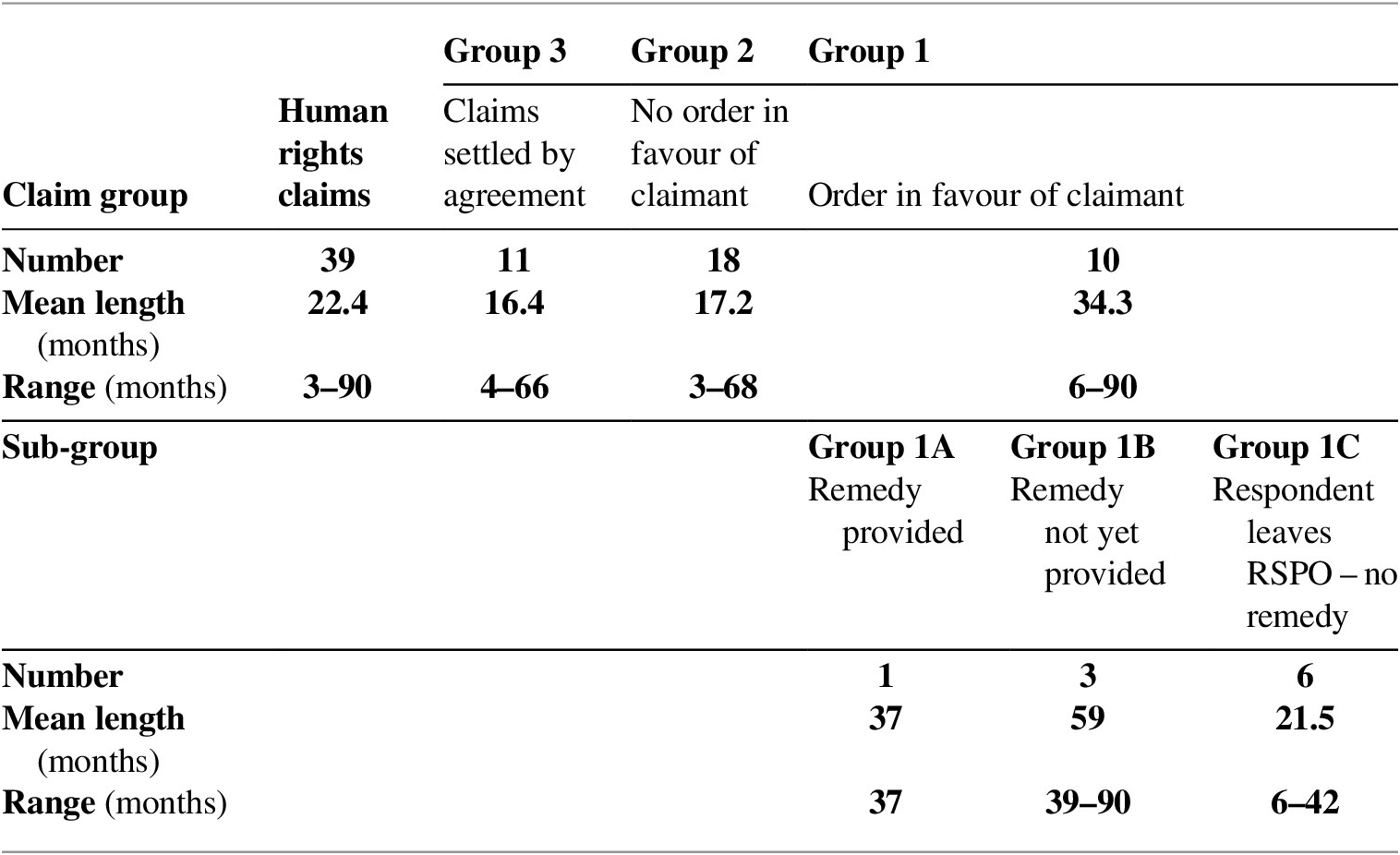
As is typical of most adjudicative systems, the duration range is broad. Some cases are withdrawn, dismissed or settled quickly. Others take a full process of investigation, decision, monitoring, further decision, and appeal. The RSPO process is not quick. An average human rights claim takes two years to conclude. The average for a ‘winning’ claim (Group 1) is almost three years. Group 1B claims are currently averaging four and a half years, but because the remedy has not yet been provided in those cases, the final time periods will be even longer. One large, complex case (Golden Veroleum (Liberia)) is already at over seven years and there is no end in sight. This raises broader issues about the appropriate methods by which to gauge issues relating to the timeliness of cases, which we return to consider in the following section.
VI. Implications for the Future Study of Whether NSBGMs Provide Effective Remedy
Our findings about the RSPO complaints mechanism bring new evidence to debates about the way in which we should assess whether NSBGMs are providing an effective remedy. Below we reflect on the key findings of our study, how they resonate with the existing literature which studies the effectiveness of NSBGMs, and implications of our findings for how we study whether NSBGMs are providing an effective remedy in the future.
Measured in terms of the UNGPs’ effectiveness criteria, we have demonstrated how the RSPO is a complaint mechanism which has many of the characteristics that should make a grievance mechanism successful in terms of providing effective remedies to claimants. It is more demonstrably transparent, accessible and equitable than the vast majority of other NSBGMs. It also performs comparatively well in terms of legitimacy and predictability. However, our analysis of the substantive remedies achieved for rightsholders in practice confirms concerns raised in the literature, that focusing on the process of how an NSBGM operates may marginalize the more fundamental question of what outcomes are actually achieved for rightsholders. Footnote 100 Only one case in the 10-year history of the mechanism is a clear adjudicative win providing a remedy for rightsholders, and that came after a long, time-consuming fight on an issue that appeared to be clear-cut in the claimants’ favour. Even after the victory, with community land still untouched by the planation, there are serious allegations that the company has used unfair pressure tactics to undo the result. Our case study therefore provides evidence to support the claim that an NSBGM which meets the standards of procedural fairness demanded by the UNGPs’ effectiveness criteria might still fail to provide an effective remedy for claimants.Footnote 101 The corollary of this is that future studies of the effectiveness of NSBGMs must focus at least as much on outcomes as on processes, but there are also a number of more nuanced ways in which our findings speak to the way such studies should be conducted.
First, our study speaks to the importance of investigating carefully how and why outcomes occurred as they did. In our case study, there were a significant number of cases in which the RSPO ruled against its member companies. This would indicate a process which can validate legitimate claims. However, the action that followed on from a successful claim was inherently limited, and undoubtedly could not be considered to be capable of providing effective remedy in terms of providing appropriate outcomes to all claimants. Complaints panels cannot, for instance, award monetary compensation or provide any form of restitution. The range of elements identified by the UN Working Group as integral to the provision of effective remedy are certainly not therefore available to the RSPO process.Footnote 102 Still, in a number of cases, the RSPO complaints panels ordered remedies that could have materially affected the lives of the people who brought the claims. It is its record on enforcing those remedies in order to produce meaningful outcomes for claimants which is arguably its biggest weakness.
In those claims where there was an order in favour of the claimant, the most common reason for non-enforcement was because the company was no longer an RSPO member. In five of these cases the company quit RSPO or sold the plantation at issue to a non-member company. In the other case, the Complaints Panel withdrew the membership status of the company. This result may be considered effective in terms of safeguarding the legitimacy of RSPO’s certification process, but it does not provide any remedy (much less an effective remedy) to rightsholders that addresses their human rights issues. These situations demonstrate the limitations of a voluntary system where terminating membership is a genuine alternative to providing a remedy to rightsholders. The prevalence of these claims is significant. These are not rare cases or outliers, but a category which demonstrates a proven technique useful and effective for companies violating human rights: leave the certification scheme and avoid having to provide a remedy. This is a clear limitation on any voluntary scheme acting as an NSBGM: if a member company’s cost of departing the scheme is less than the cost of addressing a complaint, there are significant and proven dangers that many will leave the scheme. This is a problem which any voluntary scheme must solve in order become a genuine human rights NSBGM. It is also confirmation of the need to scrutinize carefully the power dynamics of any individual NSBGM in order to determine its capacity to achieve effective remedy.Footnote 103
In the other cases where orders were made in favour of the claimants, a remedy has not yet been provided. There are two claims still in process that could end as wins for the claimants. However, they have already taken years of effort, and an ultimate resolution that remedies human rights infringements is uncertain at best, hopeless at worst. They may well already be in the category of ‘justice delayed and so denied’. These cases are indicative of a process that is often very tardy in producing results, where claimants must be prepared to face a process lasting years. One of the stated advantages of NSBGMs is that they should provide more expeditious processes than litigation through the courts.Footnote 104 In the case of the RSPO’s complaints mechanism, it is not at all clear that this is the case. Our findings also cast doubt on the way in which the UNGPs’ effectiveness criteria measure procedural effectiveness. On the issue of timeliness, the criteria require that claimants are provided with ‘a clear and known procedure with an indicative time frame for each stage’.Footnote 105 However, our analysis of the duration of RSPO claims, combined with interviews with rightsholders, revealed that it is more vital to measure the actual time taken for claimants to obtain the remedy they are seeking. This reaffirms the UN Working Group’s assertion that it is crucial that the effectiveness of a remedy should be judged from the perspective of affected rights holders,Footnote 106 and raises questions about the degree to which the UNGPs’ effectiveness criteria measure those procedural aspects of the claims process that are most important to those rightsholders. Future studies may therefore benefit from making stakeholder concerns more central to measuring the procedural aspects of NSBGMs.
A final observation raises an important question about the feasibility of conducting future studies. In terms of outcomes for claimants, perhaps the most satisfactory results were achieved in those eleven claims that resulted in an agreed settlement (Group 3). It can justifiably be presumed that the claimants received some benefit there. It is also likely that those claimants gave up something to arrive at the final agreement. Unfortunately, there is no transparency in these settled cases and so it is not known what their real benefit was to rightsholders. Confidentiality is often a pre-requisite to a corporation’s willingness to compromise a serious claim, particularly one potentially affecting the company’s reputation. Requiring transparency could chill the settlement process and would almost certainly reduce the number of settled cases. Balancing these interests is a challenge for all NSBGMs. As other studies have found, complaints mechanisms in many other MSIs are far less transparent, and do not publish the results of any cases.Footnote 107 Companies’ operational level grievance mechanisms also rarely (if ever) publicize the results of any complaints which they address.Footnote 108 The problems with a lack of transparency as identified here are therefore greatly exacerbated across other NSBGMs and will mitigate against the kind of study we have undertaken here for many other (although not all) NSBGMs in the future. This is an issue we return to consider in the conclusion.
VII. Conclusion
Our case study has raised serious questions about the capacity of the RSPO complaint mechanism to provide effective access to remedy for human rights violations. Even as a complement to judicial and other forms of remedy, its value appears very limited. With dozens of cases over more than ten years, effective remedy was ordered and achieved exactly once. It cannot therefore be relied upon to produce timely outcomes in decided cases that lead to effective remedies. It fares even worse when considered as a replacement for other forms of remedy. Beyond its lack of capacity to enforce judgements, the aims of the system can actually be at odds with the goal of providing effective remedy for rightsholders, particularly where it withdraws membership from the company, leaving rightsholders without a means of obtaining remedy.
The ramifications of these findings stretch far beyond this single case. Building on previous studies which have raised generalized concerns about using the UNGPs’ effectiveness criteria as the basis for determining whether NSBGMs are actually effective in practice, our detailed investigation of a single NSBGM provides clear evidence of the need to develop alternative frameworks of assessment. As the RSPO complaints mechanism performs well when compared with other NSBGMs in relation to the UNGPs’ effectiveness criteria, but performs poorly when evaluating actual outcomes for complainants, this raises serious questions about the UNGPs’ effectiveness criteria as a measure of effective remedy.Footnote 109 They appear insufficient to distinguish between NSBGMs that are actually producing effective remedies for rightsholders and those that are not. However, they remain the primary point of engagement for NSBGMs when thinking about issues relating to effective remedy. The RSPO is one of many NSBGMs which has sought to strengthen its complaints mechanism with reference to the UNGPs’ effectiveness criteria. While the UNGPs and the UN Working Group both stress the importance of outcomes in determining effective remedies, they have not yet operationalized this in a way that has significantly influenced the practice of evaluating and reforming NSBGMs.
Future studies of other NSBGMs should therefore carefully examine outcomes for complainants, alongside revised procedural criteria which prioritize issues of greatest importance to rightsholders, such as the length of time cases actually take in practice. We have provided an approach and methodology that can be utilized in other studies, although we recognize that study of other NSBGMs will require addressing new methodological issues that have not been an issue in our case, such as how to deal with cases where the perspectives of rightsholders differed on the effectiveness of the remedy, in comparison to the way in which it was presented by the relevant authority. A more significant impediment to such future study is the absence of levels of transparency in the majority of NSBGMs which made our study possible. It is reasonable to expect the most transparent mechanisms to be the ones that perform best for rightsholders in practice. Their proponents have put them on show because they are sufficiently confident to open them up to scrutiny. The failings of the RSPO should therefore increase scepticism about NSBGMs that are not transparent. Claims about providing an ‘effective remedy’ should only be treated seriously if mechanisms provide sufficient information to allow for the serious scrutiny of outcomes.