Although the genus Umbilicaria is among the better known lichen genera, a number of type questions for its species remain to be solved (e.g. Hestmark Reference Hestmark1993, Reference Hestmark2007, Reference Hestmark2010, Reference Hestmark2014; Jørgensen et al. Reference Jørgensen, James and Jarvis1994). On 28 August 1841, the already famous paleontologist and glaciologist Louis Agassiz summited the peak Jungfrau (German for ‘virgin’ or ‘maiden’) in the Swiss Bernese Alps (46°32′12″N, 7°57′45″E). The 4158 m peak had acquired its name because of its constant white snow cover, a colour of innocence and perhaps inaccessibility. Yet Agassiz's ascent is only reckoned to be the fourth of the Jungfrau, first scaled in 1811. In Agassiz's company was his assistant Edouard Desor, the Scottish physicist James David Forbes, the Nantes geologist du Chatelier, as well as their four local guides Jacob Leuthold, Michel Bannholzer, Johannes Alplanalp and Johannes Jaun from Meyringen. Close to the summit “To our great surprise, we discovered on the surface of the exposed rock, as well as on the fragments detached from it, many lichens in a very fresh state, some of which occupied a surface of many inches in diameter.” (Desor Reference Desor1841: 153, Reference Desor1842: 326). They collected some specimens of these high altitude lichens, and, after their safe return to lower altitudes, these samples were delivered to the renowned Swiss lichenologist Ludwig Emanuel Schaerer (1785–1853) for further study. Schaerer communicated his lichen determinations to Agassiz, and these manuscript notes by Schaerer (in Latin) were quoted in a footnote in the account given of the ascent by Edouard Desor, printed in Bibliothèque Universelle de Genève in the November 1841 issue (Desor Reference Desor1841: 153–154), and subsequently in English translation in The Edinburgh New Philosophical Journal in April the following year (Desor Reference Desor1842: 327). Schaerer found that four of the species were already known from other high Alpine localities and previously treated by himself in several works. A fifth species was, however, new to him, and in honour of the locality he proposed the name Umbilicaria Virginis. He had earlier published a substantial paper on Umbilicaria systematics (Schaerer Reference Schaerer and Seringe1823) and was thus in a good position to recognize a new taxon. He republished the diagnosis of U. virginis the following year in an addendum to his Lichenum Helveticorum Spicilegium (Schaerer Reference Schaerer1842: 564–565), to which the notes he sent Agassiz in 1841 were presumably a draft, and later in his Enumeratio Critica Lichenum Europeaorum (Schaerer Reference Schaerer1850: 25). Both the latter works have occasionally been cited as the first description of U. virginis, but Schaerer himself in both works points to his description included in Desor's report of November 1841 (Schaerer in Desor Reference Desor1841: 153–154), which is certainly the protologue. This Latin protologue by Schaerer decribes U. virginis in great detail:
“Diagn. U. glauca, subtus ochroleuca, hirsuta; apotheciis superficialibus, disco æquabili, margine tenui prominente. Descript. Thallus coriaceous umbilicatus, juvenilis monophyllus, orbicularis, ambitu integriusculo; adultior plures emittit lobos, ambitusque [/ – page change] ejus crenatus fit et lobatus. Diameter in speciminibus, quæ coram habeo, a paucis lineis ad bipollicarem usque extenditur. Pagina adversa in juniori lichene æquabilis est, in adultiori rugosa et undata fere ut in Umb. pustulata; color ejus in statu humecto glaucus, in sicco murinus vel obscurior tenuissimoque pulvere albo obductus, unde adhibita lente tenuissime exasperatus apparet. Pagina aversa ochroleuca est, ad ambitum fusca, vel pilis validis simplicibus ramosisque concoloribus præter umbilicum dense vestita, vel bulbillis eaorum exasperata.”
An enhanced English translation may read: “Diagnosis: upper side powderish white, beneath pale (whitish-yellow), hairy; apothecia on upper side, plane disc with less prominent margin. Description: thallus coriaceous umbilicate, young ones monophyllous, circular, with an integrated outline, in adult ones several project lobes, and the outline is crenulate and lobate. The diameter of the specimens at hand extends but for a few lines up to two inches. The lower [upper?] side in young lichens is smooth, in adults rugose and almost wavy [ridged] as in Umbilicaria [Lasallia] pustulata. The colour when moist is greenish, when dry grey and covered with a fine white powder, from which it slowly appears to be covered [as they grow]. The lower side is pale, darker towards the margins, densely clothed with similarly coloured robust-growing, simple or branched, hairs [i.e. rhizinomorphs] except around the umbilicus [holdfast], and also covered with tiny bulbs.”
Schaerer then gave some distinguishing characters from Umbilicaria hirsuta, with which U. virginis may be confused. While U. hirsuta only rarely features apothecia, and then usually in larger/older thalli, apothecia are present also in small/young U. virginis. [Umbilicaria hirsuta mainly reproduces asexually, by soredia containing the intact symbiosis, while U. virginis reproduces only sexually, by unicellular, hyaline, ovoid to more elongate ascospores developed eight per ascus in the plane (leiodisc) apothecia]. The apothecia of U. virginis have a plane disc, while those of U. hirsuta are gyrose. In addition, it may be added that the rhizinomorphs of U. virginis are commonly branched, occasionally planate, resembling the antlers of deer (good drawing in Frey Reference Frey1933: 314, fig. 45g).
In his Enumeratio, Schaerer presented a more concise characterization: “Thallus incano-pruinosus, humectus glacus, subtus ex ochroleuco-fuscus, papillosus et hirsutus. Apothecia opaca, sessilia; disco aequabili, excipuli margine tenui.” (Schaerer Reference Schaerer1850: 25).
The protologue does not contain any data on collector, site, date, herbarium location etc. because these are of course implied by Desor's text. Such data were, however, added by Schaerer the following year in his Lichenum Helveticorum Spicilegium, where under ‘Habitat’ we read: “ad scopulum gneissiacum, qui exstat decempedali intervallo a summon cacumine montin Jungfrau, cujus altitude cl. Tralles 12,870 pedes supra mare mediterraneum æstumat; hinc nostrum lichenem retulerunt viri audacissimi Agassiz ejusque comites in aërium Virginis caput 28 Augusti anni 1841 enisi, magno me hercle opera et arduo!” (Schaerer Reference Schaerer1842: 565). It was not the custom in Schaerer's time to designate particular specimens as type, and the question of what is the type of Umbilicaria virginis has remained open.
The noted Swiss expert on Umbilicaria, Edouard Frey, who in the 1920s discovered and published many new localities of U. virginis from his climbing sojourns in the Alps, states that:
“The Herbarium Schaerer as well as that of Müller-Argoviensis (both in Herberium Boissier, Geneva) contain good original specimens of this species.[…] The original specimens come from the summit of the Jungfrau, Berner Oberland, Switzerland, 10 feet beneath the highest summit, thus from roundly 4160 meter above sea level.” My translation of: “Sowohl das Herbarium Schaerer, als dasjenige von Müller-Argoviensis (beide in Herbier Boissier, Genf) enthalten gute Originalexemplare diseser Art. […] Die Originalexemplare stammen vom Gipfel der Jungfrau, Berner Oberland, Schweiz, 10 Fuss unter dem höchsten Gipfel, also rund 4160 m/M.” (Frey Reference Frey1929: 249).
Frey did not, however, select a particular collection or specimen as a type, and apparently did not publish anything more specific than this, for instance in his comprehensive systematic treatment of Umbilicaria for Rabenhorsts's crytogamic flora (Frey Reference Frey1933: 312–320) where type specimens are not mentioned.
Llano (Reference Llano1950: 92) simply states for U. virginis: “Type: In Institute of Systematic Botany, University of Geneva, Switzerland”, without further indication of locality, collector, dates, etc. Krog (Reference Krog1968: 85) and Poelt (Reference Poelt1977: 431–432) chose not to mention a type at all, in their treatments of Alaska and Himalayan Umbilicaria.
Some confusion was created by Wei & Jiang (Reference Wei and Jiang1993: 90), who stated for U. virginis “Type: Sibiria orientalis (Sievers) (H-Nyl. 31633, holotype!)” and then gave a ‘type observation’ of this specimen, which is only a small fragment. This manoeuvre seems based on the fact that Nylander, in his Lichenes Scandinaviæ (Reference Nylander1861: 117), described in passing a new species, U. rugifera Nyl., based on specimens received from Siberia, collected by Sievers. As Wei & Jiang (Reference Wei and Jiang1993: 90) list ‘U. rugifera’ as a later synonym of U. virginis, they here in effect typified an illegitimate synonym, claiming also that it was a holotype, disregarding whether original material for Schaerer's description of U. virginis may exist. This typification ought then to be disregarded, unless one considers ‘U. rugifera’ a taxon separate from U. virginis.
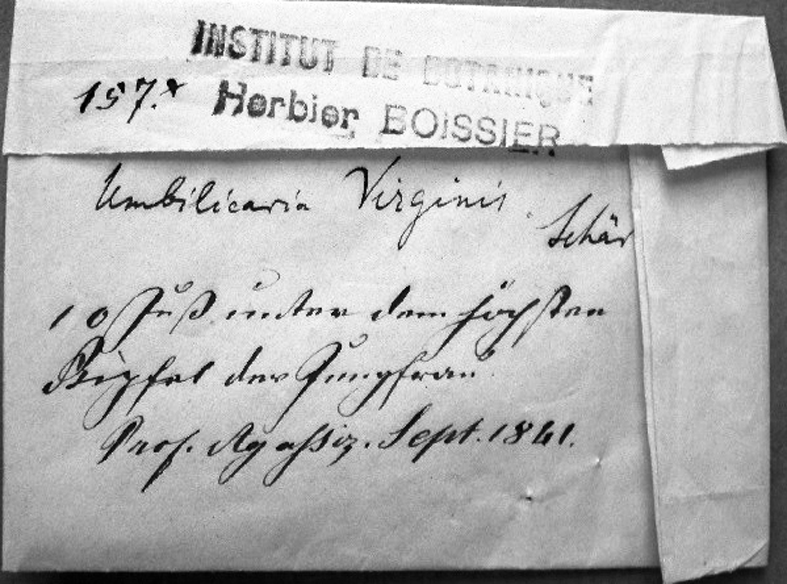
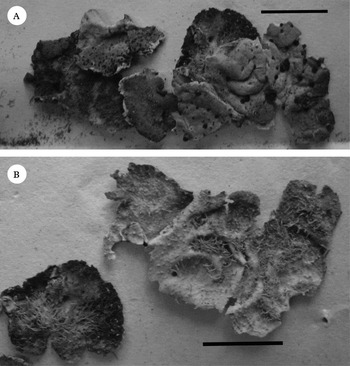
The question is whether some of the original material for U. virginis from Jungfrau can still be identified in G, as stated by Frey (Reference Frey1929). During a recent visit to G, I discovered a collection that clearly belongs to the original material but was not in any way annotated as type. The collection has a printed label stating that it is originally from “Herbier Lichnologique Schærer” and a handwritten label “Umbilicar [sic] Virginis Schaer. Enum. p. 25. n.s.” Inside the new brown envelope is an older envelope on which is printed: “Institut de Botanique Herbier Boissier”, and in ink the text: “157x. Umbilicaria Virginis Schärer 10 Fuss unter dem höchsten Gipfel des Jungfraus. Prof. Agassiz. Sept. 1841.” (Fig. 1). Inside the envelope are four thalli of U. virginis, two larger than the other two but all fairly small (Fig. 2). It then seems reasonable to designate this collection as lectotype.
Umbilicaria virginis, envelope containing lectotype collection (G). Photograph GH.

Umbilicaria virginis, lectotype (G00262350). A, habitus; B, lower side of two thalli. Photographs GH. Scale: A & B=1 cm.

Umbilicaria virginis Schaer.
Bibl. Universelle de Genève, Nouv. Ser. 36: 153 (1841); type: the entire collection: Switzerland, Geneva (G), barcode: G00262350, herbarium sheet with printed label: « Herbier Lichnologique Schærer » Printed: ,,Institut de Botanique Herbier Boissier“. In ink: ,,157x. Umbilicaria Virginis Schärer 10 Fuss unter dem höchsten Gipfel des Jungfraus. Prof. Agassiz. Sept. 1841. » (Lectotype, designated here).
=Gyrophora virginis (Schaer.) Frey, Hedwigia 69: 248 (1929).
=Omphalodiscus virginis (Schaer.) Schol. Nyt. Mag. Naturvid. 75: 25 (1934).
There is also a smaller collection in G with the label “Herbier Müller Arg 1896. Umbilicaria Virginis S. Jungfrau. Leg Agassiz. Ex herb. Sch. com amiciis Boissier” (G00110997). It seems likely that this too is part of the original collection made at Jungfrau in 1841 by Agassiz and his companions. The lectotype G00262350 chosen here is, however, more certainly original material and of better quality.
The author wishes to thank Conservateur Philippe Clerc at the Conservatoire et Jardin Botaniques, Geneva, for the always excellent help during my several visits.