A striking feature of Umlazi Township today – so taken for granted that it is hardly commented upon – is that women, be they grandmothers in their seventies or unmarried young women in their twenties, play a central role in the organization and funding of schooling. This article examines the early years of this Durban township to draw attention to the ‘bond of education’, the material-emotional family connections that enabled schooling and resulted from schooling. I argue that in urban areas in the 1960s, children's education became more important to parents, especially mothers, and helped to create particular bonds between them and their children that frequently ensured that children supported their parents as they aged.
Take, for instance, 82-year-old Precious Mhlongo. Growing up in one of Natal's depleted rural ‘reserves’, she began school only at the age of nine. Her father had discouraged her from studying but after he passed away her mother, a strong Christian, schooled her for five years, the maximum that she could afford. Precious recalls how, when she was young, elders frequently opposed girls' schooling:
They said that girls should marry and not study … they said that I am going to be isigebengu, ihumusha, isifebe [roughly: scoundrel, prostitute, loose woman] … they said that education is a thing of the white people … my mother liked education but my father didn't.Footnote 1
After her schooling, Precious married a migrant laborer but over time he failed to support their rural home and eventually they divorced. By her thirties, she was working as a live-in domestic worker in the city of Durban and a decade later, the early 1970s, she acquired a ‘matchbox’ house in Umlazi, registering it in her son's name. Over the last forty years, Precious has lived in this same township house with her children, grandchildren, and great-grandchildren, always encouraging them to study. Her children attended the best schools in Umlazi and, after the end of apartheid, some of her grandchildren enrolled in formerly ‘white’ schools; recently, she looked after her daughter's son so that he could attend a nearby formerly ‘coloured’ school.Footnote 2 In turn, her children's sense of obligation is reflected in the improvements they have made to the house when they found work – extensions, a new refrigerator, a television, and other items.
Precious's life traverses a starkly racialized system of schooling whereby in the 1960s the state funded a ‘white’ child's education at 14 times the rate of resources devoted to educating an ‘African’ child.Footnote 3 The 1953 Bantu Education Act was premised on the belief, in the infamous words of Henrik Verwoerd, that there was no place for Africans ‘above the level of certain forms of labour’.Footnote 4 Scholars have now mapped out in rich detail the key contours of Bantu education: the state's taking over of English-orientated mission schools and promotion of ‘ethnic’ language instruction, the expansion of primary education to fulfill the needs of a booming industrial sector, the skills shortages that resulted in substantial increases in secondary schooling in the 1970s, and political opposition that exploded with the 1976 Soweto student uprising.Footnote 5 This article, however, approaches Bantu education from the perspective of families and urban life in the 1960s, including women's struggles to secure a foothold in cities and changing kinship bonds in a region that had long valued ‘wealth-in-people’.Footnote 6 If, as Caroline Bledsoe showed in Sierra Leone, schooling creates powerful social debts, we might ask the following question: how did Bantu education – premised on the expansion of relatively inexpensive public schooling (first, primary and, later, secondary) – reconfigure the emotional bonds, flow of resources, and living situations in a township like Umlazi?Footnote 7 How, in other words, can we understand a woman like Precious who was discouraged from attending school when she was young but then, under apartheid and into the post-apartheid era, expended significant energy and resources to educate her children and grandchildren?
In the late 1950s and 1960s, Durban's township population grew enormously as the city was racially zoned to comply with the 1950 Group Areas Act, a cornerstone of ‘high apartheid’. Built in south Durban on mission reserve land, Umlazi Township – together with KwaMashu Township constructed to the city's north – housed the majority of Africans forcefully removed from what became white Durban. Today, Umlazi is the country's second largest township (after Soweto) with a population of more than half a million people.Footnote 8 Evidence for the ‘bond of education’ is found in a number of sources, considered from several angles. The next section begins with a court case brought by a woman seeking custody of her granddaughter who she educated; this is used to explore, at a quite abstract level, the changing value of children as society became more urbanized and dependent on wage labor. Following sections consider education in the context of concrete changes to Durban's geography in the 1960s, namely, unmarried women's struggles to secure housing and married women's move into family houses. The final section explores the changing nature of the education system itself as it shifted from a somewhat elite mission system to mass Bantu education – a much despised move that nevertheless arguably gave mothers a larger stake in schooling. Note that this article explores the economic aspects of schooling; the changing meaning of education and the cultural redefinitions of childhood are important and entangled social processes that are touched on here, but not brought to the fore.
THE CHANGING VALUE OF CHILDREN
The ‘bond of education’ described here was not new. Women like Precious's mother had long embraced Christian principles more keenly than men, whether related to monogamy, companionate marriage, or schooling.Footnote 9 However, the growing dependence of black South Africans on the urban labor market influenced perceptions of childhood in important ways. Let us consider, as a window into this shift, a 1971 civil case when the courts awarded Nosipho Ngubane, a widowed former domestic worker, custody of her grandchild, Jade. Why would Nosipho take her daughter and son-in-law to court to claim custody of a child? It is clear that the couple was not mistreating or failing to support Jade; her son-in-law was a relatively well-paid police officer who had just secured a family house in Umlazi Township. Nosipho's main argument, rather, was that because she had raised and educated her grandchild – who was attending Standard 7 – she was entitled to her custody.Footnote 10
To understand the significance of this case some further background is necessary. Nosipho's daughter, Gertrude, gave birth to Jade in 1959. A decade later, when Gertrude married, she and her husband took her two children from their grandmother's care, against Nosipho's wishes. Because Gertrude's second child was fathered by her husband Patrick, the child's custody was not in dispute. However Gertrude and Patrick claimed guardianship of Jade not only because of Gertrude's status as her mother but because they argued that Patrick was, in fact, her father – an assertion that did not hold up in court. At the time of the court case, Nosipho lived in Durban's oldest township, Lamontville, and had successfully applied to court for ‘emancipation’. Being emancipated did not free a woman from the clutches of customary law (that required the much harder ‘exemption’) but it did enable her to head her own household, rent a township house, and initiate legal action.Footnote 11
Key to the court's decision to grant Nosipho custody of Jade was an interpretation of customary law whereby the child was said to belong to the head of the child's appropriate ‘homestead’ – the child in question had been born out of wedlock and so belonged to the homestead now headed by Nosipho. In addition, Nosipho made the moral argument that she had raised and educated Jade. Here she found support from her brother-in-law and former legal guardian who told the court: ‘The child is hers … Because she brought [the] child up.’ The court agreed, dismissing the common law argument that Gertrude's child belonged to her and finding Gertrude and Patrick to be unreliable witnesses.
In the convoluted world of customary law, Nosipho's lawyers had cleverly combined an argument that rested on her legal rights as head of a household while presenting the moral case that Nosipho had invested in the raising of the child. In doing so, they called to mind two perspectives on the value of children: one rooted in homestead heads' rights over their children in a labor-intensive rural economy, and a newer one whereby an independent woman had a bond with a child because of her investment in the child's upbringing, including her schooling (Jade's view was not considered to be of legal interest although statements implied that she was close to her grandmother). Beginning with the first perspective, anthropologists and historians of Africa have long argued that children are highly valued in labor-intensive agrarian economies.Footnote 12 In Kwa-Zulu Natal, such valuing of children meant that ilobolo represented much more than the exchange of women (a view reflected in the translation ‘bridewealth’) and was arguably, as other scholars have noted, more accurately a form of ‘childprice’: if a woman was infertile, the payment could be returned or a sister allowed to raise seed, and if a husband died his place could be taken by his brother in an ukungena (levirate) marriage.Footnote 13
It was from this agrarian world that nineteenth-century settlers and their interlocutors distilled and codified the key principles of Zulu customary law, including the belonging of children to an umuzi (homestead) head.Footnote 14 While this view aided Nosipho's court victory, the demise of the agrarian economy and rise of wage labor helps to explain how the male-male payment of ilobolo had become increasingly detached from children: in the first half of the twentieth century, ilobolo became more associated with wives and less with their reproductive capacity. This is reflected in civil court cases, whereby fewer men claimed that ilobolo payments should be returned if a wife was infertile. In addition, young men toiling to pay ilobolo over many years, rather than it being granted by their fathers, meant that women came to value this payment as a sign of men's ability to provide for and love them.Footnote 15 If scholars have a point that ilobolo should have been labeled ‘childprice’ rather than ‘brideprice’, by the mid-century it had gone a long way toward becoming the latter.Footnote 16
Related to ilobolo were important changes to inhlawulo (damages). Historical accounts state that inhlawulo, a much smaller amount than ilobolo, was given to a father by a man who deflowered his daughter.Footnote 17 In the first half of the twentieth century, as virginity testing declined and premarital childbirth became more common, inhlawulo came to be seen as a payment of ‘damages’ when a man impregnated a woman. As the larger male-male payment of ilobolo became detached from children (or women's reproductive capacity), this smaller male-male payment became more attached to children. Inhlawulo usually entailed a single cow plus one or two goats. To summarize the first part of this argument: if seen through the prism of ilobolo and inhlawulo, children became less ‘valued’ in male-male exchanges over the first half of the twentieth century; in economic terms, they moved from the center to the periphery of the domain of male-headed houses.
How then did women ‘value’ children differently than men? Of course, in a rural economy, women gained status from bearing children and so it is not possible to argue that the rural homestead was simply a male domain. We did learn, however, that Nosipho's brother-in-law had collected Gertrude's ilobolo payment; in other words, she had not benefited from this substantial payment. Yet, education was marked differently. In the corridors of the Bantu Commissioner's Court, where Nosipho's case was heard, would have stood women seeking judgments to enforce maintenance laws – many arguing that they were paying considerable expenses for their children's education. Longstanding, if hard to pursue, legal claims by women for seduction damages, substantiated by childbirth, were enhanced by the 1960 Children's Act and the 1963 Maintenance Act.Footnote 18 In one typical maintenance case heard in 1966, a laborer at Durban's airport was forced to pay R4 a month for each of his three children until they were 16 years old.Footnote 19 Given that a domestic worker could earn less than R16 a month and an experienced teacher could earn less than R40 a month, this was a significant amount.Footnote 20 Such awards placed a direct monetary value on women's raising and educating of children.
The argument that children became more ‘valuable’ but costly to women is also consistent with falling fertility rates that date back to the 1960s and, thus, predate the state's massive efforts to introduce family planning in the 1970s.Footnote 21 In a dramatic decline, unmatched on the continent, the total fertility rate dropped from seven to six children per woman in the 1960s to three by 1996.Footnote 22 John Caldwell's well-known thesis on fertility decline is that schools endow children with a sense of individualism that erodes their ‘vertical’ support of parents and therefore reduces the stake that families, and especially women, have in children.Footnote 23 Another explanation for drops in fertility rates, more consistent with this study's empirical findings, is that parents, recognizing the resources that schooling required and expecting that school-educated children would be better able to support them one day, bore and educated fewer children; Caldwell himself later stressed how educated children retained an obligation toward their parents, acting as a form of ‘insurance’.Footnote 24
Returning to the court case and the question of why a grandmother would take her own daughter to court over the custody of her child, the relationship between Nosipho and her daughter Gertrude had clearly soured. Although it is not easy to discern motive, Nosipho and her brother's statements suggest that her decision to pursue the custody case rested, in part, on her emotional and financial investment in her granddaughter's schooling. Children, rarely now valued for their contribution to a male-led agrarian homestead, entailed considerable expenses not least the cost of education. It is likely that Nosipho believed that her efforts to raise her granddaughter created obligations that could be met by domestic work and future support. Indeed, educational investments were both durable in that they could not be sold off (like, for example, livestock) in times of need, but fragile in that they were embodied in a sense of personal debt that needed to be actively maintained. By winning the court case, Nosipho ensured that Jade stayed with her in a way that nurtured this social bond and its expectations. Enveloping these negotiations was the dramatic rise of wage labor, to which we return.
MORAL DEBATES OVER THE ‘VALUE’ OF EDUCATION
As noted earlier, elderly informants recall how ‘over-educated’ rural girls raised concerns that they would abandon rural homesteads. One emotive word used to berate a woman whose actions threatened the integrity of the homestead was isifebe. This can be translated as ‘prostitute’, an occupation associated with urban women (that is, women who had abandoned rural homes) and more generally ‘loose’ or ‘immoral’ women (in this context strongly implying that she was unlikely to be seen as marriageable).Footnote 25 While fathers, who received a daughter's ilobolo and thus had much to lose from non-marriage, led the charge against immorality, Mrs Nene, in her sixties, remembers that it was not only men who had a stake in rural homes and thus discouraged girls' schooling: ‘I stayed with my granny and she told me that girls who study will be naughty and that it is better to learn about the work in the house, and then marry.’Footnote 26 A small number of well-educated Christian families did see investment in a girl's secondary school education as desirable to attract a respectable Christian son-in-law, and some educated women envisioned a period of working in the city as a step toward marriage.Footnote 27 However, for the vast majority of residents in early twentieth-century Natal, a girl's education was considered a possible obstacle to marriage, which was by far the most important social achievement for a young woman.
Yet overpopulation rooted in colonial land dispossession gradually sucked the life out of rural ‘reserves’ and challenged their moral underpinnings. Researching links between rural Natal and Durban in the late 1950s, anthropologist Mphiwa Mbatha documented how the migrant-labor system increasingly came to dominate men's lives: he found that men older than forty years of age tended to work 3·4 years for every one year of ‘rest’ whereas those younger than forty, worked 31·8 years for a year's rest!Footnote 28 The tightening of pass laws also gave men an incentive to stay in town and accrue time toward ‘Durban Native’ status (the term used in Durban for Section 10 rights that granted permanent residence to those who either were born in the city or had worked there for ten years for one employer or 15 years for several).Footnote 29 By 1969, 142,000 men worked in Durban, half in the manufacturing and construction sectors.Footnote 30 Rural hardship also drove an increasing number of women to cities like Durban, perhaps to join a husband or to craft a new existence following his abandonment or death: in 1921, there were 6·6 males to every female in Durban, but by 1970 this figure had dropped to 1·2.Footnote 31 Although it is important to recognize geographic and other differences, it is fair to say that over time residents in rural areas became less harsh in their judgment of girls' schooling. Education increasingly appeared not as threat but as a way to improve rural livelihoods, a view boosted by the building of new primary schools, staffed mainly by women teachers, in the wake of the 1953 Bantu Education Act.
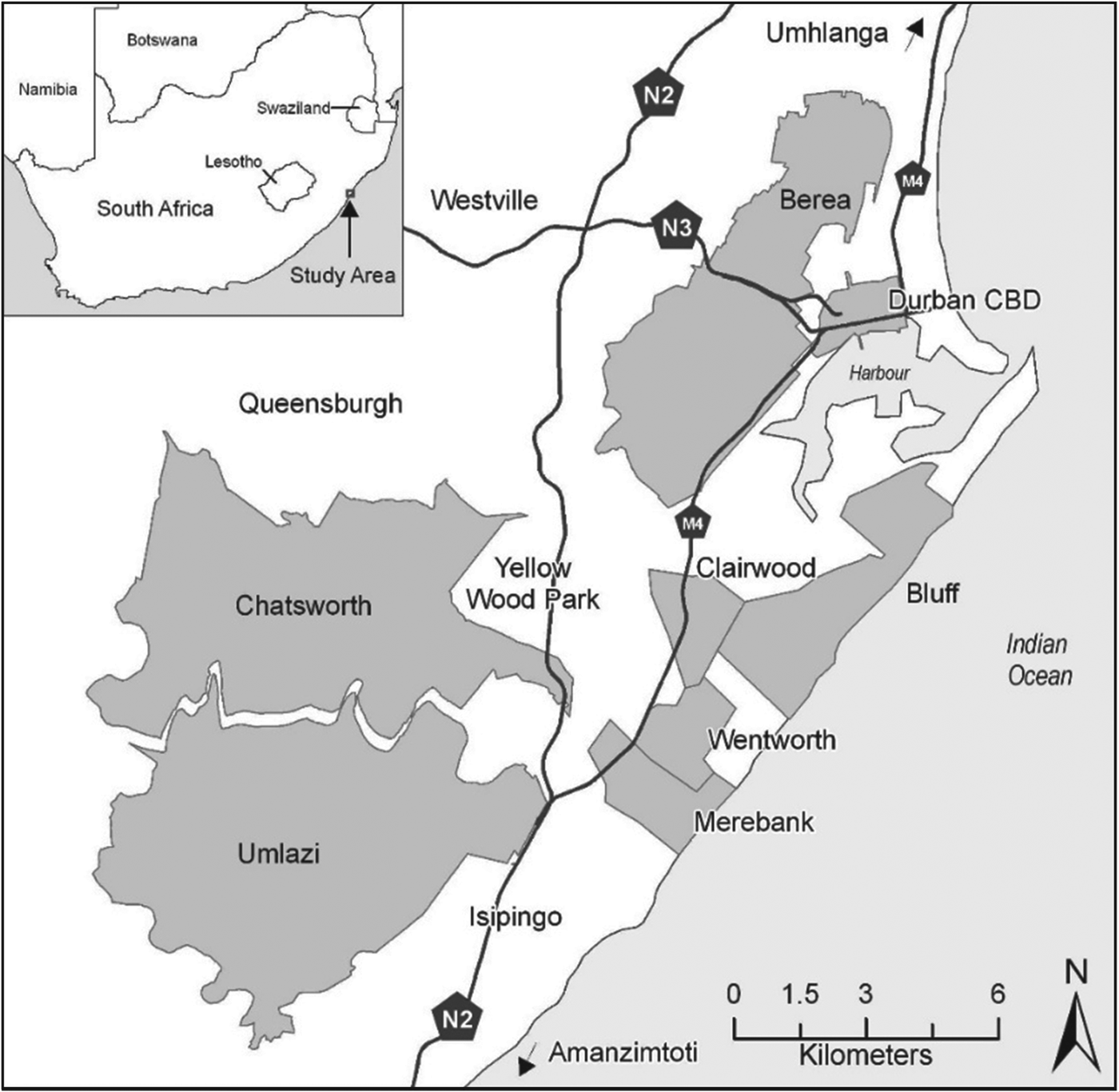
South and central Durban today, including Umlazi Township.

MATRIFOCALITY IN DURBAN: UNMARRIED WOMEN IN CITIES AND THEIR CHILDREN
The movement of single women from rural reserves and sometimes white-owned farms to cities made matrifocality a major concern among South African anthropologists in the 1950s and 1960s.Footnote 32 A key finding of Eleanor-Preston Whyte's research on domestic workers in Durban and Berthold Pauw's work on urban life in East London was that women were choosing to live without the support of a husband: ‘In town the father-role loses almost all significance … the father is also “dispendable” as a link with the economic system in the town.’Footnote 33 In the early 1950s, Durban's unmarried African women might have stayed in a small municipal hostel in central Durban, in a suburb with an employer's family if working as a domestic worker, or in a small township (for example, Lamontville, Chesterville, or the more centrally located, and for that reason ultimately demolished, Baumanville) with family or as a tenant. However, to the particular disfavor of state officials, thousands of other unmarried women lived, sometimes cohabiting with men, in informal houses or shacks. The largest concentration of shacks by far, with an estimated 60,000 to 100,000 residents, was Cato Manor/Umkhumbane, located just west of the Berea ridge and therefore within walking distance or a short bus ride of central and industrial Durban.Footnote 34
Female residents of Cato Manor could earn an income without education, especially from informal activities like brewing and selling traditional beer. On the other hand, domestic work, by far the most common form of wage labor for Durban's women, usually required some knowledge of English: in the mid-1960s, one estimate was that 25,000 domestic workers were employed in the city, two-thirds of whom were living with their employers.Footnote 35 In her 1969 doctoral dissertation on this group, Preston-Whyte found that most domestic workers were unmarried but had children who they looked upon as ‘security and comfort’ for old age, with daughters remaining especially faithful to them. ‘Extremely close bonds were found to exist between mothers and daughters … The key to success was seen as education … They envisaged daughters as nurses or teachers and sons as doctors and lawyers.’Footnote 36 Researching domestic workers two decades later, Jacklyn Cock similarly argued that ‘their hopes for the future focused on their children, and education was seen as the means whereby their children could escape to a better life. Something no one can take away from you.’Footnote 37
This ‘bond of education’ was buttressed by the intimate nature of domestic work itself. While domestic workers’ children were increasingly restricted by apartheid laws from living in ikhaya (backyard rooms for domestic workers), acts of racial ‘maternalism’ often came to center on employers’ support for their domestic workers' children, sometimes in a small way in the giving of hand-me-down clothes and sometimes more substantially.Footnote 38 If racial paternalism had long tailored relations between white and black miners and farmers, racial ‘maternalism’ was typically enacted between a madam (employer) and her maid.Footnote 39 One reason that domestic workers tolerated – and still endure – long hours, poor pay, and sometimes authoritarian and racist working conditions is precisely because the madam of the house might help to better the lives of their children. Former domestic workers with whom I spoke in Umlazi tended to evaluate their working years not so much in terms of the salary that they earned, but whether ‘umlungu wami’ (‘my white person’) was good or bad in a maternalistic/paternalistic sense: were they ‘izinja’ (‘dogs’) or did they have ‘inhliziyo entle’ (‘a good heart’)?Footnote 40 A generation ago, it was in fact Precious's madam, Mrs. Woods, who had financed the cost of her children's school fees, clothes, and books. During our interview, Precious's granddaughter emphasized the continued close relationship between the families by quickly pulling out the contact details of Mrs. Woods's daughter. This woman, who Precious helped to raise, is now married but still supports Precious's family. Of course, this rather positive recollection of racial dependence must be interpreted in the context of today's massive unemployment and the presence of a white interviewer; however, it is clear that white women (and to a lesser extent white men) have long shaped the relationship between black domestic workers and their children.Footnote 41
Despite this long history of matrifocality, by the late 1950s, the bulldozing of Durban's shack settlements and the building of KwaMashu and then Umlazi townships made it much harder for single women to stay in Durban. Put another way, the social-spatial foundations of matrifocality – a degree of freedom over housing and income generation – were becoming increasingly precarious. Monotonous townships, being rapidly built and extended across the country at this time, were premised on segregating black urban dwellers from ‘white’ cities and stabilizing labor in a ‘compressed’ class structure.Footnote 42 However, townships also reconstituted the African family along patriarchal lines; it was the ‘industrial man’ and his family who were supposed to access a township house. Between 1957 and 1970, the number of township houses in Durban increased from 4,300 to 37,500, which amounted to an addition of 200,000 people living in family houses in the 1960s.Footnote 43 The iconic ‘51/9’ and ‘51/6’ ‘matchbox’ houses were explicitly designed by the National Building Research Institute to provide male-headed family houses at a low cost. Supposedly able to restore ‘self-respect’, a typical four-room house was 580 sq. ft and placed on relatively large sites of approximately 3,500 sq. ft; the roads were designed to enable future vehicular access to the houses.Footnote 44 These families, in turn, would inhabit discrete neighborhoods and enjoy new leisure facilities such as a golf course, swimming pool, and tennis courts.Footnote 45 What then – in the face of such a patriarchal redrawing of cities – were the options for single women and their children?
Records show that, despite the patriarchal intent of the township project, in the 1960s, a surprising number of single women accessed township houses. Key to single women's ability to persuade government officials that they headed respectable (perhaps ‘acceptable’ is a better term) families was their commitment to their children's education. These sentiments left a paper trail when women applied to be declared ‘emancipated’ so as to attain or keep a four-room house – a legal move that Umlazi residents recall some township officials encouraging. In the 1960s, hundreds of women applied and achieved emancipation, virtually all employed as domestic workers, nurses, or teachers, and most between the ages of 30 and 50 (they would have needed long service to secure the Section 10 rights necessary for family housing).Footnote 46 Indeed, emancipation applications appear to have been approved fairly routinely.
Winnifred Mhlongo, educated to Standard 6 and the mother of four children born outside of wedlock, was, at first take, an unlikely candidate for emancipation in 1966 given the strong emphasis that courts placed on a woman's respectability. She was forthcoming in her application: ‘I no longer have an intention of getting married but desire to devote all of my life to the upbringing of my children, for whom I am the sole support.’ The court accepted, however, that she should be emancipated in order to apply for a family house in Clermont, Pinetown, and noted the evidence of her thrifty habits and her current guardian's support for emancipation (both legal requirements).Footnote 47 Another successful applicant for emancipation was Nesta Msomi, a widow working as a live-in domestic worker in Durban. She had two children, a daughter living with relatives in rural Mtinkulu and a son, Joseph, attending teacher training at the University College of Zululand. She told the court: ‘I have very high aspirations in as far as the education of my children is concerned, despite my meagre earnings.’ Her employer supportively wrote that she ‘has proved herself to be a thoroughly honest and trustworthy servant … has dedicated herself to her children. It is to provide a home and to foster a family life that she is making this endeavour to obtain accommodation at Umlazi.’ The reverend from the Methodist church also wrote to support Mrs Msomi's application.Footnote 48
Single women secured houses in Umlazi not only because of their tenacity but also because Durban city government faced tremendous pressure from the national government to remove Durban's shacks.Footnote 49 The destruction of Cato Manor was envisaged by city officials in the 1940s and implemented under the 1950 Group Areas Act.Footnote 50 Some cohabiting couples rushed to marry to smooth the path to township housing and a life with their children.Footnote 51 However, in a climate of intense protests against the tightening of pass laws and forced removals – opposition led in Cato Manor by women – the city relaxed rules to allow some unmarried couples and single women to access family houses. S. Bourquin, a government official who liked to think of himself as a benevolent leader of Durban's Bantu administration, acknowledged that unmarried people were often quite ‘respectable people who, for some length of time, have lived together as man and wife’. Also, he agreed that a single woman could access township housing ‘if she is living together with her own children who are dependent upon her and for whom she is providing a home’.Footnote 52 While accessing a township house still required permanent (Section 10) urban rights, research by Iain Edwards on Cato Manor suggests that officials awarded this relatively freely.Footnote 53
In the late 1960s, however, the avenues for single women to attain township houses narrowed considerably. Consistent with the mounting state controls on urban women, including through pass laws, a 1967 circular from the Department of Bantu Administration and Development decreed that no more single women were to be placed on housing waiting lists.Footnote 54 By 1968, Bourquin was replying to letters from women's patrons (usually a domestic worker's madam) with the news that the growing housing backlog meant that the city had to give priority to men.Footnote 55 By the early 1970s, the social justice group Black Sash assisted a large number of township widows to oppose evictions, noting that state officials now lamented the ‘racket’ of emancipation.Footnote 56 As the 1970s progressed, the waiting lists for rental housing grew long, making it extremely difficult for both women and men to access housing in Umlazi.
MAKING AND BREAKING NUCLEAR FAMILIES IN UMLAZI
It is difficult to gauge the proportion of single women who acquired houses in Umlazi in the 1960s, but it was probably no greater than 10 per cent, meaning that most township houses were occupied by couples.Footnote 57 These married township residents were more likely to be employed and Christian than rural dwellers – that is, already exposed to education.Footnote 58 This is both because officials preferred to allocate houses to nuclear families, and because Christian men and women were more likely to break with the migrant labor system. In urban areas like Umlazi, new media circulated quickly, including magazines that portrayed children in sentimental and not economic terms. One school principal, quoted in Bona magazine in 1965, said of parenting: ‘You should not expect any gain, just parental satisfaction and the fulfillment of duty.’Footnote 59 On a day-to-day basis, schooling and especially knowledge of English enabled residents to challenge the authoritarian and sometimes racist attitude of white township administrators. Township ethnographies also reveal that children's level of schooling became a sign of a family's social status. Monica Wilson and Archie Mafeje recorded that educated residents in Cape Town were dubbed by the mocking name ‘ooscuse me’, and Leo Kuper went as far as to write of an educated ‘African bourgeoisie’ in Durban.Footnote 60 A study of KwaMashu Township in 1975 found that parents had ‘exceptionally high aspirations for their children's schooling’.Footnote 61
To put it simply, not only women but many township men had a passion for schooling. At the same time, the rate of marriage was declining and there was a growing sense of fragility within marriages, rural, and urban.Footnote 62 Here, African women's particular attraction to education has to be seen in light of the brutal reality of gender and racial inequalities. The most common form of female salaried employment, domestic work, offered few chances for promotion and much lower wages than male work. In the legal realm, African men had preferential access to family houses, land, and inheritance, and this placed wives who did not work in a particularly vulnerable position. In urban areas, these tensions could be accentuated if marriages were simply arranged for convenience to access a township house or if a husband had financial and other commitments to a rural area.
Sisters Sindiswa and Noxolo Mbatha live in a very run down four-room Umlazi house with broken windows and an overgrown garden. Their late father acquired the house when he worked for the state railway company, choosing to live in Umlazi with his eldest son and leaving his wife and daughters in the rural reserve. He discouraged his daughters from becoming educated even though in the 1970s most of their friends would have attended schools: ‘Our father said that if we study we will see boys and qoma (attain a boyfriend) … maybe our father thought that he wouldn't get ilobolo, that we wouldn't marry.’Footnote 63 Today, their inability to find work leads them to resent the fact that they never went to school.
Even if both township mothers and fathers supported schooling, they did not necessarily make equal commitments to financing it. Household studies conducted in the 1970s and 1980s in Durban's townships found that residents with higher incomes spent more on education.Footnote 64 Though some families continued to pay for expensive boarding schools that in the mid-1960s might cost R80 a year, township education, considerably cheaper, still required the payment of fees and purchase of uniforms and books – ironically, the latter were given free to white students.Footnote 65 One estimate of annual costs for a Standard 3 child in the mid-1960s was R2 for school fees, R2·45 for texts and exercise books, and R8 for a school uniform.Footnote 66 Expenses rose sharply with the level of education: the cost of books nearly tripled from Standard 1 to Standard 6.Footnote 67 These educational costs would have competed with men's other expenses, which could include not only household items but socializing at beer halls, supporting local soccer matches, or even lobola-ing another woman.Footnote 68
Although care should be taken when making generalizations about household expenditures, we can make a cautious comparison between a mother's attention to a child's education – ‘something no one can take away from you’ – and what James Ferguson has termed the ‘bovine mystique’.Footnote 69 Migrant men in Lesotho, he noted, invested earnings in cattle because this represented a ‘stored asset for the future’ protected from what they perceived to be women's frivolous expenses. In contrast, by diverting female and sometimes-male wages into the domain of education, mothers knew that the future ability of their children to find work was being enhanced year by year. This was an investment in social relations that could not be sold off when times got bad or when relatives made desperate claims. Like the famous rotating credit schemes embraced by women across the continent, education was a domain that protected meagre incomes and provided benefits in the long term. Relevant here, Mbatha noted in his 1960 study that especially when husband-wife relations are not good, ‘the tendency of the mother to lavish love upon and to cling to her children carries the hope that the child will be grateful for the love and care shown and support her in her old age’.Footnote 70
However, if mothers and sometimes fathers were committed to a ‘bond of education’, what expectations were placed on those they educated? Most elderly informants in Umlazi remember that men particularly celebrated having sons. Men's privileged access to land, inheritance, and political rights underpinned the importance of the birth of a couple's first son; without a son, a man had no one to take forward his name and uphold the domestic basis of male power, the umuzi (homestead). In turn, for widows or divorced women, sons could be vital in mediating access to rural land and urban housing (as in the case of Precious, whose story opened this article). Yet, as women were increasingly drawn into schools and wage labor, many mothers described how daughters provided more reliable day-to-day support than sons and ‘will help you with many things'.Footnote 71
Certainly, the ‘feminization of schooling’ in South Africa is consistent with both mothers' attention to their daughters' education and the growing availability of work for women. In contrast to some other parts of the continent, boys and girls attended South African primary schools in similar numbers in the 1960s (or, put another way, girls and boys were similarly discouraged from attending schools). In the 1970s, girls matched and then overtook boys in attending secondary schools.Footnote 72 One study using 1991 census data found that the education level of African mothers was more closely correlated with the education level of their daughters than with their sons.Footnote 73 These close bonds between a mother and her daughters, and the attention given to education, are prominent themes in interviews and other sources, though we need to be cautious about drawing too sweeping conclusions; testimonies by older Umlazi women and men today are of course mediated by the particular twists and turns in their own histories. A woman married in the 1950s or 1960s, for instance, may well have anticipated outliving her older husband but she probably would not have foreseen herself playing such an enduring role in financing schooling – a situation that today results from such women earning pensions while their children face rising unemployment and deaths caused by the HIV/AIDS epidemic. The nurse quoted below, now in her eighties, is widowed and currently lives with and pays for her deceased daughter's children to attend a formerly-white school. Her enduring practical and financial support for schooling no doubt shapes her recollections of the past, though she is surely correct in making a connection between township wives' vulnerability and the attention they devoted to schooling:
Phindile Dlamini: The owner of the house was a man. If there was a problem a man said ‘this is my house I'm going to xosha (send you out) you if you fail to obey my rules'.
Mark Hunter: Do you think that women educated their daughters because men were unreliable? If a daughter is educated and becomes a teacher or nurse, she will look after her mother?
Phindile Dlamini: Yes, you are right; the daughter loves the mother more than the father, they are very close. Sometimes you find the man working but not coming back home with the money … the mother struggles to find something for the children to eat. When children are educated, they will support the mother because they know how she struggled for them to get an education.Footnote 74
Bongiwe Phiri came to the Durban area in 1940 to study at the famous mission school, Adams College, where she completed Standard 7. Its alumni include the African National Congress's (ANC's) first President John Dube, former cabinet minister Nkosazana Dlamini-Zuma (also the former wife of the current president Jacob Zuma), and former head of the KwaZulu homeland Mangosuthu Buthelezi. After leaving school, Bongiwe worked as a cleaner in various hotels in the city and then married a factory worker; the couple then moved into Umlazi Township. Like many women of her age, she married an older man who passed away a number of years ago, leaving her widowed at a relatively young age. Her four children all studied at highly regarded schools in Umlazi; two found professional jobs in nursing and teaching, while another moved overseas to work as a chef. Today, the most visible signs of her educated children's support lay in the elaborate modifications to the house, including new rooms, a tiled roof (replacing asbestos), new doors, burglar bars, and a kitchen containing a sparkling new oven. She remembered that when she was young ‘mothers liked school more … they knew that education was the key to success’. She continued, ‘Girls don't abandon the home, my daughter who is overseas is sending me money. When a son is married, he forgets about looking after his family because he is looking after his wife.’
Mandla Shange, who I interviewed three times, confirmed Bongiwe's view of daughters' and sons' differential support for their mothers.Footnote 75 Born in 1938, he grew up in Bulwer while his parents lived in Cato Manor/Umkhumbane. His father worked at a large brick company, and his mother worked as a primary school teacher before leaving that poorly paid profession to become a domestic worker. It was his mother, by then separated from her husband, who paid for him to attend boarding school until Standard 8 from her salary as a domestic worker, which must have been an enormous strain. He eventually became a traffic policeman in Durban and purchased a house in Umlazi (after many problems caused by his being raised in a reserve and therefore not having urban rights). When I asked him about whether daughters or sons tended to repay the debt to their parents – the other side of the bond of education – he said that he had provided some financial support to his mother. She had continued as a domestic worker until her death, however, and he added with a smile, perhaps one encouraged by the presence of a male interviewer, that ‘daughters were friends, they supported their mothers … we used to just look for girlfriends'!
What these narratives of ‘reliable daughters and unreliable sons’ perhaps downplay, however, is that daughters were seen not only as potential sources of earnings but as providers of domestic labor and care; their ‘reliability’ thus stemmed from their ability to respond flexibly to household events and make different contributions simultaneously or at different times. Sons, in contrast, generally contributed less to caring and domestic work but had higher average earnings than daughters. A study of contributions to Umlazi household in the mid-1980s that included residents and non-residents found that ‘male workers, who have education levels of more than Standard 9, aged between 31 and 50 years and who are employed as factory workers, will contribute most to the household’.Footnote 76 Turning the clock back to when this group was schooled in the 1960s and 1970s, we can see that they would have been on the crest of a country-wide wave of rising levels of schooling, albeit in comparison to previous levels that were low. Also relevant to the social mobility of this group were significant wage increases, especially in industrial work that followed the ‘Durban strikes’ in 1973 and the subsequent unionization of the workforce.
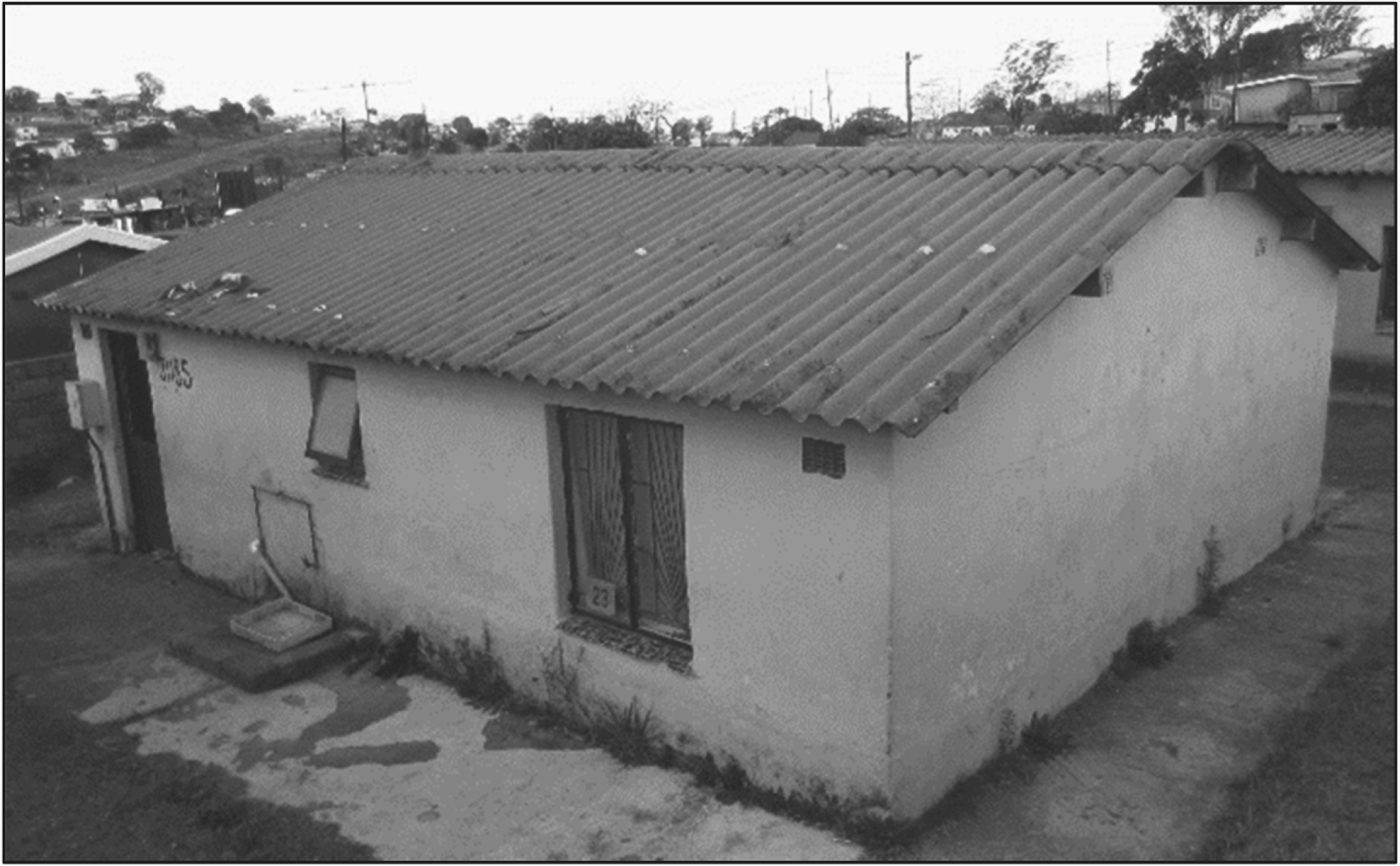
It is also important to recognize that intergenerational support was heavily mediated by living situations. Though some younger residents left home to live with a spouse or to secure employment, housing shortages made it increasingly difficult for family members to break away from the family township house. Thus, many daughters and especially sons moved into backyard buildings, in the case of a son sometimes with his wife (a backyard building is visible in Fig. 2). A son or daughter's investments in a township house could therefore be simultaneously for themselves, their siblings, their parents, their spouses, and their children. Put another way, relations among kin and to the township house became connected in important ways. Here, it is important to note that a striking theme in interviews with women – young and old – was their strong commitment to the idea of the township house as a ‘family house’ or ikhaya. This terminology locates the house as a structure to be used by multiple family members and thus protected from individual inheritance claims, invariably by men. In a salient example of this point – as well as the importance of women's domestic and caring work to the household – one woman in her late teens relayed how she had been left a house by her grandmother, for whom she had cared when she was ill.Footnote 77 Seen in this context, the ‘bond of education’ was one component of wider, always gendered, acts of reciprocity, care, love, and sometimes betrayal.
A 51/9 ‘matchbox’ house in Umlazi Township. These family houses were designed for working men and their families but some ‘emancipated’ women also accessed them. In the photograph's upper right corner is a partial view of a backyard structure in which family members or tenants could live. Photo: Mark Hunter, 2012.
FROM ELITE TO MASS EDUCATION UNDER APARTHEID
The National Party's victory in the 1948 elections led to not only intensified urban segregation but the infamous 1953 Bantu Education Act. Up until this point, Christian missionaries controlled virtually all schools for Africans. Educating small numbers in institutions that varied widely in quality, mission schools favored boys rather than girls at higher grades. As elsewhere on the continent this predominantly male educated elite played a central role in birthing the country's nationalist movement. The ANC's first President, John Dube, was schooled at Adams Mission School near Durban and was a keen educationalist, founding Ohlanga School just outside the city.Footnote 78 Although in the 1940s and 1950s leaders like Nelson Mandela transformed the ANC into a mass movement, they shared with their predecessors the experience of mission schools and a faith that education provided powerful tools for challenging the racist state.
In contrast, for the apartheid government educated African leaders were ‘detribalized’ and dangerously frustrated, and this justified the state's takeover of mission schools, devolution of control to ‘traditional’ authorities, and replacement of English-medium with African-language instruction at lower grades. Bantu education thus limited Africans' educational paths by prioritizing basic over secondary education and reducing the influence of mission schools. As Meghan Healy-Clancy has shown in her rich account of Inanda Seminary, however, the state considered educated women less threatening than educated men.Footnote 79 This fact raises important questions about the way that Bantu education played out in urban areas and intimate lives.
There were – we might note at this point – a few prominent schools established by the Durban municipality, and in which women had a large stake. From the 1930s, Christian black women (sometimes together with liberal white women) had encouraged the municipality to pay attention to child welfare issues.Footnote 80 In the pre-apartheid period, there was some acceptance among municipal officials that African families might live in the city and a cluster of schools grew quickly to serve the children of Baumanville, a housing complex built for married Africans. Thembisa Waetjen has written that Loram Secondary School, the largest of these schools, was staffed by ‘deeply committed, professionalized teaching staff’ and it was here that activists Govan Mbeki and Eppainette Moerane, parents of former president Thabo Mbeki, met as teachers.Footnote 81 Tellingly, studies of Loram and Baumanville emphasize the enthusiasm women had for education; indeed, one reason to bring a daughter to the city was to escape negative ‘rural’ attitudes toward girls' schooling.Footnote 82 By admitting children who lived locally, the school also enrolled a higher proportion of girls than mission schools did as a whole. However, despite its popularity, Loram was closed in 1962, falling victim to Group Areas legislation that sought to purge central Durban of non-whites. In the era of high apartheid, officials moved urban dwellers into townships and sought to make ethnic homelands the appropriate places for secondary schools.
The state's devolution of power to ethnic homelands – it granted ‘independence’ to four between 1976 and 1981 – was a central plank of its policy of ‘separate development’. Yet homelands never became viable political or economic structures. In educational terms, an official policy of favoring ethnic rural education was at stark odds with the country's urban-centered economy. Indeed, homelands themselves incorporated urban areas like Umlazi and these soon became choice destinations for flagship homeland schools, continuing schooling's urban bias.Footnote 83 In addition, the concentration of Africans in lower grades (shown in Fig. 3) meant that the few who achieved higher grades gained a potentially privileged position in the labor market. Since pass laws discriminated against rural job seekers this meant that urban dwellers and thus school-leavers had favored access to the labor market; as Jonathon Hyslop has noted, ‘any level of urban education was by definition more valuable in the labour market than an equivalent level of rural education’.Footnote 84 In Umlazi, this meant that mothers who had successfully navigated apartheid legislation to remain in the city – and many of course were brutally ‘returned’ to rural areas – saw their children benefit from proximate schools and a thriving urban labor market.Footnote 85 Umlazi, in particular, profited from its in-between status, a township located on the ‘rural’ Umlazi reserve. Even before secondary education expanded in the 1970s to meet the demands of industry and staff ‘homelands’, Umlazi seems to have received comparably more educational resources than KwaMashu and other Durban townships. In 1968, it hosted the only day school in Natal that taught up to Standard 10 (the required standard for university entrance), Menzi High.Footnote 86
Children's enrollment in schools in 1968 by race and grade. These figures display the numerical growth in African pupils a decade after the implementation of Bantu education and their concentration in lower grades compared to whites; note that only 1,149 African students progressed to Standard 10.
Significantly, many Umlazi residents who themselves had studied at prestigious boarding schools seemed to have been comfortable with their children enrolling in Umlazi's best schools. Phindile Dlamini, quoted above, who was born in 1942 and attended Loram School and then a boarding school before becoming a nurse, moved into Umlazi in 1968 with her Christian husband.Footnote 87 She can recall in detail the history of township schools and has a keen sense of their standing. Her children attended well-performing township secondary schools of that time, Menzi High and Vukuzakhe High (which had boarding facilities to accommodate non-local students). In the turbulent 1980s, ANC-aligned youth demanded ‘liberation before education’ and vigorously opposed the KwaZulu government's targeting of schools to recruit students into Inkatha, the ethnic Zulu organization that ran the homeland. Yet although scores of students dropped-out for political reasons, Inkatha had some success in attracting businesses to invest in education, especially in commercial and technical schooling.Footnote 88 A study of Umlazi in 1985 found that ‘[in] comparison to rural areas in KwaZulu, as well as other urban areas, educational achievement in Umlazi was of a high standard.’ Fifty per cent of residents aged 15–29 had completed Standards 7–9 compared to 25 per cent aged 30–90; 26 per cent aged 15–29 had completed the senior certificate (Std. 10) and above compared to 11 per cent aged 30–90.Footnote 89 While in the 1970s unemployment rose, during this decade (when many children of Umlazi's first residents left school), an increasing number of black South Africans became factory supervisors, teachers, nurses, and routine white-collar workers.Footnote 90
CONCLUSION
Today's grandmothers or gogos, as they are affectionately known, were the last generation to be cast as isifebe when educated and the first to see, sometimes even fund, their grandchildren's attendance at formerly white schools. In the 1960s, many positioned their children's education as vital to their own uncertain futures – marked as they were by poorly paid work, precarious urban rights and intimate lives, and virtually no chance of progressing in the labor market. In fact, an educated child even enabled single women to extend the definition of a respectable/acceptable family and access family houses. Education mattered too for married women since marriages were by no means always permanent and men's earnings were on average considerably higher than women's. This passion for education (and a certain skepticism toward men) tended to be passed down from generation to generation, especially from mothers to daughters.
Why might such an analysis be important today? James Ferguson's recent account of ‘declarations of dependence’ in Southern Africa has reanimated some of the literature on which this article stands: that is the rich Africanist scholarship on the centrality of wealth-in-people and fertility to past societies, the racial paternalism that has often permeated wage labor, and the ongoing crisis over rising levels of unemployment.Footnote 91 As scholars consider Ferguson's efforts to show how people in the region value dependence and not simply independence, it is worth remembering that education is one of the most powerful examples of an institution that promotes individualism and yet creates profound obligations that cut across and help to form kinship relations. While the dramatic recent decline in wedlock has thrown into sharp relief marriage's dependence on male wage labor, much less is known about how gender relations have also been key to, and formed through, contestations over education. For example, while it seems obvious that the significant (in emotional and material terms) payments of ilobolo and inhlawulo must be considered in relation to marriage, it is less obvious that they might have links to changes in schooling. Moreover, although important work on the ‘feminization of schooling’ has demonstrated that since the 1970s girls have outnumbered boys in higher grades, we know very little about the gendered bonds that schooling helps to make or break.
More widely, as Daniel Magaziner's recent work on art and schooling shows, there is a growing recognition of the need to question an ‘epistemological framework that presents South African history along the binary of good and evil’.Footnote 92 Here, we can note that it was men who had the most access to the upper echelons of the mission education system, and often virulently opposed its replacement with Bantu education. Although urban women never uncritically embraced Bantu education, the system's support for mass – if low levels of – schooling provided urban children relatively easy access to education while influx controls and the booming labor market ensured relatively favourable employment prospects for them. Even when unemployment began to rise in the 1970s, new work opportunities opened up for the rising numbers who had some secondary schooling. Thus, although Group Areas legislation brutally moved many urban African women to rural ‘homes’, women who found footholds in urban areas benefited from heavy investment in the bond of education. Together with greatly reduced marriage rates from the 1980s onwards, this gendered bond of education remains one of the most salient features of township life and class formation today.