Although clinical disorders and personality pathology have been traditionally conceived as distinct groups of pathology (Clark, Reference Clark2005), empirical evidence does generally not support this conceptual bifurcation. More specifically, there has been a historical belief that personality disorders, in contrast to clinical disorders, reflect enduring patterns that are relatively stable over time. Recent longitudinal studies, however, have demonstrated a natural plasticity of personality symptoms both in adulthood (Cohen, Crawford, Johnson, & Kasen, Reference Cohen, Crawford, Johnson and Kasen2005; Lenzenweger, Reference Lenzenweger1999; Livesley, Reference Livesley2005; Skodol et al., Reference Skodol, Gunderson, Shea, McGlashan, Morey and Sanislow2005; Zanarini, Frankenburg, Hennen, Reich, & Silk, Reference Zanarini, Frankenburg, Hennen, Reich and Silk2005) and at younger ages (De Clercq, Van Leeuwen, Van den Noortgate, De Bolle, & De Fruyt, Reference De Clercq, De Fruyt and Widiger2009). Furthermore, it has been demonstrated that clinical symptoms and Axis I disorders display a higher stability over time than initially assumed (Briggs-Gowan et al., Reference Briggs-Gowan, Owens, Schwab-Stone, Leventhal, Leaf and Horwitz2003; Costello, Mustillo, Erkanli, Keeler, & Angold, Reference Costello, Mustillo, Erkanli, Keeler and Angold2003; Roza, Hofstra, van der Ende, & Verhulst, Reference Roza, Hofstra, van der Ende and Verhulst2003). In addition, a mass of literature reports on the substantial overlap between personality and psychopathology in adults (Widiger, Reference Widiger2003) and children (Tackett, Reference Tackett2006), including shared genetic etiological factors (Bienvenu, Hettema, Neale, Prescott, & Kendler, Reference Bienvenu, Hettema, Neale, Prescott and Kendler2007; Krueger, Markon, Patrick, & Iacono, Reference Krueger, Markon, Patrick and Iacono2005). These research findings all suggest that personality and psychopathology are closely interconnected, given their similar nature and developmental course over time. Much is to be studied, however, to unravel their complex longitudinal interrelations from childhood onward. Delineating these trait–psychopathology connections from the various etiological models makes it possible to map causally oriented pathways of maladjustment toward adulthood (De Clercq et al., Reference De Clercq, De Fruyt and Widiger2009). The current study aims to explore the etiology of these associations between early maladaptive traits and psychopathology over time, relying on comprehensive and age-specific dimensional conceptualizations of maladaptive personality and psychopathology.
Etiological Models of Trait–Psychopathology Associations
Four different models have been generally proposed as plausible etiological explanations for the relations between personality and psychopathology. According to the predisposition/vulnerability model, the presence of particular personality traits increases the probability of developing a clinical disorder, whereas the complication/scar model posits that an existing clinical disorder may cause changes in personality. The pathoplasty/exacerbation model postulates that co-occurring general personality traits and clinical disorders or symptoms may have an independent etiology and onset, but personality can influence the course or manifestation of these clinical disorders or symptoms. Finally, the spectrum model assumes that personality traits and clinical disorders form a spectrum ranging from general traits to subclinical characteristics to full-blown psychopathology because of shared underlying etiological factors (Krueger & Tackett, Reference Krueger and Tackett2003; Mineka, Watson, & Clark, Reference Mineka, Watson and Clark1998). The latter model is closely connected to the continuity model, referring to the systematic phenomenological covariation of personality and psychopathology within and across time, without pronouncing upon etiology or causality of this covariation. From this perspective, the continuity hypothesis can be considered a prerequisite condition of the spectrum hypothesis (De Bolle, Beyers, De Clercq, & De Fruyt, Reference De Bolle, Beyers, De Clercq and De Fruyt2012). More recently, integrative models have been proposed that combine these etiological models into an overarching framework on the links among general personality, personality pathology, and psychopathology (i.e., Clark, Reference Clark2005; Krueger & Tackett, Reference Krueger and Tackett2003). These integrative models assume that the empirical connection between personality and psychopathology is mostly consistent with the continuity/spectrum hypothesis, and that complication, pathoplasty, and vulnerability effects further extend and augment this continuity/spectrum model.
De Bolle et al. (Reference De Bolle, Beyers, De Clercq and De Fruyt2012) and Tackett (Reference Tackett2006) provided a detailed and comprehensive overview of the evidence in support of the proposed etiological models that exist on the trait–psychopathology association in preadulthood. They concluded that various studies empirically underscored each of these models, supporting the idea that these etiological models are not mutually exclusive, and that different models perhaps explain different types of psychopathology (Dolan-Sewell, Krueger, & Shea, Reference Dolan-Sewell, Krueger, Shea and Livesley2001). The literature reviewed by Tackett (Reference Tackett2006) has, however, mainly been provided by relying on only one single model, without controlling for the effects of other etiological associations. This methodological choice may have resulted in biased findings and complicates the transparency of the conclusions culled from these designs. From a more rigorous perspective, De Bolle et al. (Reference De Bolle, Beyers, De Clercq and De Fruyt2012) showed that the effects of the continuity model preponderate the general trait–psychopathology relation in childhood and reported more focused evidence for the pathoplasty and complication models, depending on the particular personality–psychopathology association under consideration. More specifically, they found continuity associations between internalizing and externalizing psychopathology, on the one hand, and each of the personality dimensions, on the other hand. In addition to these continuity associations, they reported complication effects from internalizing problems on emotional instability and conscientiousness, and from externalizing problems on extraversion, benevolence, and conscientiousness. Pathoplasty effects were found for benevolence on both internalizing and externalizing problem behavior and for extraversion on externalizing problem behavior. These findings highlight the dimensional nature of traits and psychopathology, suggesting that they primarily need to be understood as continuous and related constructs, although they both also represent a unique set of characteristics that appear to have a reciprocal influence from a more causally oriented pathway.
However, the literature discussed above addressed the associations between child and adolescent psychopathology and personality from a general trait variation perspective. A closely related and essential research question pertains to the relation between childhood maladaptive traits and psychopathology across time. Given the vast amount of evidence supporting the similar dimensional nature of personality and psychopathology (Krueger, Reference Krueger2005), it may be interesting to see whether similar etiological relations with constructs of psychopathology exist across the spectrum of general and pathological trait variance. De Clercq et al. (Reference De Clercq, Van Leeuwen, Van den Noortgate, De Bolle and De Fruyt2009) illustrated that childhood maladaptive traits and broad dimensions of internalizing and externalizing psychopathology generally show similar longitudinal patterns in terms of shape and change over time in a community-based childhood sample, providing indirect support for the continuity model. However, this study did not address the link between (change patterns of) maladaptive traits and psychopathology. To the best of our knowledge, only De Clercq, Van Leeuwen, De Fruyt, Van Hiel, and Mervielde (Reference De Clercq, Van Leeuwen, De Fruyt, Van Hiel and Mervielde2008) examined the associations between childhood maladaptive traits and psychopathology. They found particular strong correlations between internalizing problems and emotional instability and introversion and between externalizing problems and disagreeableness, even after controlling for item-overlap between the constructs of maladaptive personality and psychopathology. Given the cross-sectional design of this study, however, no conclusions could be drawn on the nature (e.g., continuity association, pathoplasty associations, or complication associations) of these personality–psychopathology associations. An empirical test of these hypotheses may help to unravel the specific mechanisms that underlie the development of early maladaptation, and may further define how these processes parallel the adaptive trait–psychopathology development. The current study will, therefore, simultaneously investigate the continuity, pathoplasty, and complication models,Footnote 1 using three-wave data on personality pathology and psychopathology from community and referred children and adolescents. This approach enables disentanglement of the different models and pronouncement upon the specific applicability of each of these models to explain the nature of the maladaptive traits–psychopathology associations at a young age.
Conceptualization of Personality Dysfunction and Psychopathology
There has long been compelling evidence that childhood clinical disorders can be hierarchically organized in the two-dimensional frame of internalizing and externalizing disorders (Achenbach, Reference Achenbach1991). More recently, these two broad super factors of internalization and externalization were also found to be relevant for integrating adult psychopathology (Krueger, Reference Krueger1999). Together, the literature suggests that clinical and more trait-related pathology can be meaningfully captured by means of dimensional models that generalize across the life span.
Furthermore, there is a general consensus on the basic dimensional structure of maladaptive personality in adulthood, with emotional dysregulation versus emotional stability, extraversion versus introversion, antagonism versus compliance, and constraint versus impulsivity as the four broad maladaptive trait dimensions (Widiger & Simonsen, Reference Widiger and Simonsen2005). De Clercq, De Fruyt, Van Leeuwen, and Mervielde (Reference De Clercq, De Fruyt, Van Leeuwen and Mervielde2006) reported that the basic dimensional structure of early maladaptive trait characteristics can be conceptualized along four broad trait factors, labeled as emotional instability, introversion, compulsivity, and disagreeableness. Substantial empirical evidence has indicated that this childhood dimensional model of personality pathology shows a striking similarity to its adult counterpart with respect to structure, content, and development (De Clercq et al., Reference De Clercq, Van Leeuwen, Van den Noortgate, De Bolle and De Fruyt2009). In addition, it has been demonstrated that these four maladaptive trait dimensions are extreme variants of four of the five five-factor model (McCrae & Costa, Reference McCrae, Costa, John, Robins and Pervin2008) personality dimensions, together tapping four trait continua: emotional stability/emotional instability, extraversion/introversion, conscientiousness/compulsivity, and agreeableness/disagreeableness (Widiger & Simonsen, Reference Widiger and Simonsen2005). Integrating maladaptive and general personality trait dimensions within a five-factor model framework provides a basis for meaningfully comparing and relating personality–psychopathology associations from a general versus pathological trait perspective.
Present Study
The present study aims to simultaneously investigate the continuity, pathoplasty, and complication models as plausible explanations of the nature of maladaptive personality–psychopathology associations at a young age. In line with the theoretical considerations of Clark (Reference Clark2005) and Krueger and Tackett (Reference Krueger and Tackett2003) and the empirical findings of De Bolle et al. (Reference De Bolle, Beyers, De Clercq and De Fruyt2012), we hypothesize to find substantial support for the continuity model and more focused support for the complication and pathoplasty models. More specifically, consistent with other studies in the field (Lilienfeld, Reference Lilienfeld2003), we expect that emotional instability will be related to both internalizing and externalizing behaviors, because this personality dimension is mainly responsible for the frequently found correlation between the internalizing and externalizing dimensions. Therefore, we expect to find significant associations between emotional instability, on the one hand, and internalizing and externalizing psychopathology, on the other hand, both within and across time. Furthermore, in line with the findings of De Bolle et al. (Reference De Bolle, Beyers, De Clercq and De Fruyt2012), we expect to find that the maladaptive counterparts of agreeableness (i.e., disagreeableness) will be more strongly related to externalizing behavior, whereas the maladaptive variants of emotional stability (i.e., emotional instability) and extraversion (i.e., introversion) will be more strongly related to internalizing behavior. Based on the findings of De Clercq et al. (2006), we expect that compulsivity would be more strongly associated with internalizing than with externalizing psychopathology. Finally, we expect to find more focused support for the complication and pathoplasty models, depending on the specific personality–psychopathology relation under consideration.
Maladaptive traits and psychopathological constructs are even more closely related from a conceptual point of view than the general trait–psychopathology constructs because they both describe aspects of maladaptation at the extreme end of behavioral, emotional, and cognitive dimensions. Therefore, we hypothesize that maladaptive trait–psychopathology associations differ from the general trait–psychopathology associations in terms of strength, but not in terms of direction.
Method
Participants and procedure
In the current study, the same samples as in De Bolle et al. (Reference De Bolle, Beyers, De Clercq and De Fruyt2012) were used.Footnote 2 More specifically, data of both a referred and a community sample of children were collected in the course of the Personality and Affect Longitudinal Study. Participants of both samples were recruited at baseline at Time 1 (T1) by third-year undergraduate psychology students of Ghent University and follow-up assessments were organized via mail at 1 year at Time 2 (T2) and 2 years at Time 3 (T3) after initial assessment. Data collection was approved by the Ghent University Ethical Review Board. All participants were assured that the information would be treated as confidential and would only serve research purposes. Written informed consent was obtained from all mothers and children. The combined sample consists of 717 children (54.4% girls), aged from 8 to 14 years (M = 10.74, SD = 1.37).
Community sample
Students were instructed to recruit a child from the general population in their own family or social environment, after detailed information on study aims, procedure, and ethics of data collection was provided. Given that Ghent University students originate from different regions in Flanders, this sampling method guarantees an adequate geographical distribution of the current sample (n = 571; 55% girls; mean age = 10.70, SD = 1.23). All children were between 8 and 14 years old, with Dutch as the native language of both mother and child. Exclusion criteria included having a mental handicap and/or having any physical constraints or disabilities. Students visited the families at home and asked mother and child to complete a set of questionnaires in two separate rooms, to ensure that their independent opinion was assessed. Students were instructed not to assist participants and were only allowed to explain the meaning of item wordings that were not clear to the child or the mother. The response ratio was 71.8% for the T2 and 65.5% for the T3 data.
Referred sample
Referred children (n = 146; 52.1% girls; mean age = 10.87, SD = 1.84) were recruited via a broad range of general mental health services, listed on an online directory with registered providers of psychological care in Flanders. The first author coordinated the selection of mental health services in order to ensure a broad geographical coverage across Flanders, and provided all contact information of a particular service to each of the students. Students were instructed to contact one of the treating psychologists of childhood internalizing problems by telephone and to explain the study aims, the procedures, and the ethics of data collection. When psychologists agreed to participate, the first child (and his parents) on the psychologist's appointment schedule that qualified for the study was asked to take part in the current research. Parents and child were given a package of questionnaires, consent forms, and information letters, and were asked to return the completed questionnaires at the next appointment in a sealed envelope, which was directly forwarded to the researchers. The response ratio was 82.9% and 68.5% for T2 and T3, respectively.
Parallel to the population sample, Dutch was the native language of both mother and child, and a condition of a mental or physical handicap served as an exclusion criterion. The primary reason for referral was the presence of anxiety symptoms (20.7%), depressive symptoms (14.5%), grief or emotional problems due to parental divorce (11.3%), behavioral problems (10.7%), personality or identity problems (7.6%), developmental disorders (6.9%), psychosomatic symptoms (5.0%), learning problems (5.0%), social problems (3.8%), attention or concentration problems (2.5%), sleeping problems (1.9%), eating problems (1.3%), enuresis problems (1.3%), or self-mutilation/suicide attempts (0.6%). For 6.9% of the children, the initial reason for counseling was not available. At T1, 11.3% of the referred children were situated in the intake phase; 20.3% received psychological advice or further orientation, 63.2% received psychotherapy, and 5.3% visited the mental health center because of persisting or recurring problems.
Measures
Psychopathology
Mothers completed the Dutch version of the Child Behavior Checklist (CBCL; Verhulst, Van der Ende, & Koot, 1996) at each assessment period to evaluate their child's behavioral and emotional problems in the past 6 months. The CBCL contains 113 items that are scored on a 3-point scale (0 = not true, 1 = somewhat or sometimes true, and 2 = very or often true). Two empirically derived broadband scales can be computed: internalizing problems (including the anxiety/depression, somatic complaints, and social withdrawal syndrome scales) and externalizing problems (including the delinquent behavior and aggressive behavior syndrome scales). The Cronbach α values for internalizing and externalizing problems were 0.91 and 0.90 at T1, 0.91 and 0.92 at T2, and 0.92 and 0.94 at T3.
Personality symptoms
Mothers were asked to complete the Dimensional Personality Symptom Item Pool (DIPSI; De Clercq, De Fruyt, & Mervielde, Reference De Clercq, De Fruyt and Mervielde2003) at T1, T2, and T3 to assess their child's personality symptoms. The DIPSI consists of 172 concrete maladaptive trait items, empirically structured in 27 reliable and homogeneous lower level facets that are hierarchically organized in a replicable four-dimensional higher order structure: disagreeableness (including extreme low-end variants of benevolence such as dominance/egocentrism and irritable/aggressive traits), emotional instability (referring to both anxious and depressive traits, and also including a dependency component), introversion (describing extreme low-end variants of extraversion, such as withdrawn traits and shyness), and compulsivity (including the high extremes of conscientiousness traits such as perfectionism and extreme order). All DIPSI items are scored on a 5-point Likert scale (1 = hardly characteristic, 5 = very characteristic). Good internal consistencies were obtained for the DIPSI domains: αs ranged from 0.80 (compulsivity) to 0.93 (emotional instability and introversion) at T1, from 0.84 (compulsivity) to 0.94 (emotional instability) at T2, and from 0.86 (compulsivity) to 0.95 (emotional instability and introversion) at T3.
Statistical analyses
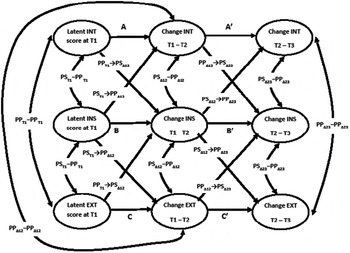
Evidence for the pathoplasty, complication, and continuity models will be investigated simultaneously (see Figure 1 for a conceptual multivariate latent change model [LCM] linking internalizing and externalizing problems to emotional instability across time). Because the within-time correlation between personality and psychopathology at initial assessment may also reflect persisting vulnerability effects, we will only consider correlated change between personality and psychopathology as empirical evidence for the continuity model.
Conceptual latent change model linking internalizing and externalizing problems to emotional instability. T1, Time 1 first measurement occasion; T2, Time 2 second measurement occasion; T3, Time 3 third measurement occasion; INT, internalizing problems; EXT, externalizing problems; INS, emotional instability; PS, personality symptoms (i.e., INS in the present example); PP, psychopathology (i.e., INT and EXT in the present example). Paths A, A′, B, B′, C, and C′ represent the autoregressive paths for changes in INT, INS, and EXT, respectively. For example, A reflects whether children's INT level at T1 predicts change in INT from T1 to T2, whereas A′ reflects whether change in INT from T1 to T2 is predictive of change in INT from T2 to T3. Paths PST1 − PP T1, PS△12 − PP△12, and PS△23 − PP△23 reflect the continuity hypothesis, because they encompass that (changes in) INT and/or EXT and INS are related across time. These paths are corrected for covariation between INT and EXT (i.e., paths PPT1 − PP T1, PP△12 − PP△12, and PP△23 − PP△23). However, because the PST1 − PPT1 path may reflect the persistence of a vulnerability effect, only PS△12 − PP△12 and PS△23 − PP△23 will be considered as evidence of the continuity model. Paths PPT1 → PS△12, and PP△12 → PS△23 are informative about the complication hypothesis, reflecting an effect of INT/EXT or a change in INT/EXT on subsequent change in INS. Paths PST1 → PP△12, and PS△12 → PP△23 display the pathoplasty hypothesis, encompassing that personality (INS) affects the subsequent development of INT/EXT.

Preparatory to fitting the LCMs, confirmatory factor analysis (CFA) was conducted to fit the measurement models and, as such, estimate latent scores for the constructs of interest. To obtain the latent or factor scores of the maladaptive personality factors, a four-factor model with the DIPSI marker facets as indicators (De Clercq et al., Reference De Clercq, De Fruyt, Van Leeuwen and Mervielde2006) was estimated for each measurement occasion separately. Likewise, to estimate the factor scores of internalizing and externalizing problems, CFA was performed for each measurement occasion with the CBCL syndrome scales anxiety/depression, somatic complaints, and social withdrawal as indicators for the internalizing factor and the CBCL syndrome scales delinquent behavior and aggressive behavior as indicators for the externalizing factor. For these CFAs, we used maximum likelihood estimation with standard errors and a mean- and variance-adjusted χ2 test statistic that is robust to nonnormality. The latent scores for disagreeableness, emotional instability, introversion, compulsivity, internalizing, and externalizing problems were saved and used as single indicators in the multivariate LCMs for the respective factors. The error variances of these indicators were fixed to zero to identify the models. In total, four multivariate LCMs were estimated, each combining one personality factor with both internalizing and externalizing problems. In these multivariate LCMs, we controlled for age, sex, clinical status, and the covariation between internalizing and externalizing problems across time.
To examine whether a common underlying latent variable can be identified for each pair of personality symptom dimension and psychopathology dimension, item response theory (IRT) analyses were conducted. We followed the reasoning of De Bolle et al. (Reference De Bolle, Beyers, De Clercq and De Fruyt2012) and included the personality symptom facets and the internalizing or externalizing syndrome scales as observed variables in these analyses, not the individual items that load on these facets or syndrome scales. Because standard IRT methods require discrete variables, the mean CBCL syndrome and DIPSI facet scores were recoded into three-category variablesFootnote 3 that were in turn used for the IRT analyses.
All analyses were performed using Mplus, version 7 (Muthén & Muthén, Reference Muthén and Muthén1998–2012). In addition to χ2, the comparative fit index (CFI), and the standardized root mean square residual (SRMR) were reported for the CFA and the LCM analyses. For the IRT analyses, the CFI and the Tucker–Lewis index were reported. CFI and Tucker–Lewis index values above 0.90 indicate an adequate fit and values above 0.95 indicate good fit (Steiger, Reference Steiger1990). SRMR scores below 0.10 are considered acceptable and scores below 0.05 are indicative of good fit (Ullman, Reference Ullman2001). Missing data were accommodated using full information maximum likelihood under the assumption of missingness at random (cf. Allison, Reference Allison2003).
Results
CFAs
The results of the CFAs on the DIPSI marker facets indicate an overall good fit for a four-factor model at T1 (χ2 = 298.23, df = 48, p = .000; SRMR = 0.06; CFI = 0.92), T2 (χ2 = 234.06, df = 48, p = .000; SRMR = 0.05; CFI = 0.92), and T3 (χ2 = 209.44, df = 48, p = .000; SRMR = 0.05; CFI = 0.93). Completely standardized factor loadings are all significant at p < .001. Across the three measurement occasions, the lowest completely standardized factor loading was 0.73 for disagreeableness, 0.70 for introversion, 0.81 for emotional instability, and 0.61 for compulsivity. A two-factor model on the CBCL syndrome scales showed an overall good fit to the data for T1 (χ2 = 4.88, df = 4, p = .300; SRMR = 0.01; CFI = 1.00), T2 (χ2 = 6.98, df = 4, p = .137; SRMR = 0.02; CFI = 0.99), and T3 (χ2 = 10.50, df = 4, p = .033; SRMR = 0.02; CFI = 0.96). The lowest completely standardized factor loading was 0.57 (p < .001) for internalizing problems and 0.80 (p < .001) for externalizing problems across the three measurement occasions.
Multivariate LCMs
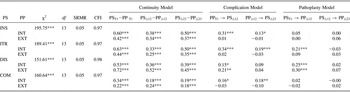
Results of the multivariate LCMs are summarized in Table 1. The data show overall strong support for the continuity model, because change in internalizing and externalizing problems is significantly positively related to change in each of the four maladaptive personality dimensions. Additional analyses were performed to compare the strength of the continuity associations for internalizing versus externalizing problems. More specifically, we used the z statistic to compare the mean latent change correlation (i.e., averaged across change from T1 to T2 and from T2 to T3) between each of the maladaptive personality dimensions and internalizing versus externalizing problems, respectively. As expected, emotional instability (z = 1.8, p ≤ .05) and introversion (z = 2.61, p ≤ .01) demonstrate stronger continuity associations with internalizing pathology than with externalizing pathology, whereas disagreeableness (z = –2.32, p ≤ .01) demonstrates stronger continuity associations with externalizing than with internalizing pathology. The continuity association for compulsivity and internalizing versus externalizing pathology did not significantly differ (z = –0.39, p > .05).
Fit indices for the latent change models and completely standardized parameter estimates for the structural paths estimated in the total sample (N = 717)

Note: PS, personality symptom dimension; PP, psychopathology dimension; SRMR, standardized root mean square residual; CFI, comparative fit index; INS, emotional Instability; INT, internalizing problems; EXT, externalizing problems; ITR, introversion; DIS, disagreeableness; COM, compulsivity.
*p < .05. **p < .01. ***p < .001.
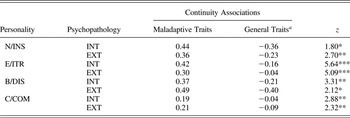
Likewise, the strength of the continuity associations from a maladaptive versus general trait perspective was examined, by comparing the results of the present study with those of De Bolle et al. (Reference De Bolle, Beyers, De Clercq and De Fruyt2012). As expected, the results in Table 2 illustrate that stronger absolute continuity associations were found between maladaptive traits and psychopathology than between general traits and psychopathology.
Personality–psychopathology continuity associations from a maladaptive versus general trait perspective

Note: N, Neuroticism; INS, emotional instability; INT, internalizing problems; EXT, externalizing problems; E, extraversion; ITR, introversion; B, benevolence; DIS, disagreeableness; C, conscientiousness; COM, compulsivity.
a Mean continuity associations were obtained by taking the average change correlations (i.e., from Time 1 to Time 2 and from Time 2 to Time 3) from table 1 in De Bolle, Beyers, De Clercq, and De Fruyt (Reference De Bolle, Beyers, De Clercq and De Fruyt2012).
*p < .05. **p < .01. ***p < .001.
Next to these substantial continuity associations, the results in Table 1 also show more specific complication and pathoplasty effects. Complication effects are observed from internalizing pathology to all four maladaptive personality dimensions, and from externalizing pathology to disagreeableness. More specifically, when children display or develop more severe internalizing problems, they subsequently become more introverted (i.e., they become more shy, suspicious, and display more withdrawn behavior), disagreeable (i.e., they become more impatient, aggressive, and egocentric), compulsive (i.e., they develop an extreme sense of achievement orientation, perfectionism, and order), and emotionally unstable (i.e., they become more dependent from others and cling more to others, ruminate more, and become more prone to feelings of anxiety), whereas the development or persistence of externally oriented behavior problems uniquely leads to subsequent higher scores on disagreeable traits.
When considering the pathoplasty effects, the results indicate that disagreeableness affects both the course of internalizing and externalizing pathology and that introversion affects the course of internalizing pathology. More specifically, children with higher scores on disagreeableness develop more (severe) internalizing and externalizing problems. In addition, as children score higher on introversion, they tend to develop more (severe) internalizing problems. The link between introversion and internalizing pathology is characterized by an exacerbating pattern: initial levels of introversion are predictive of subsequent increase in internalizing problems, which in turn results in an increasing level of introversion.
IRT analyses
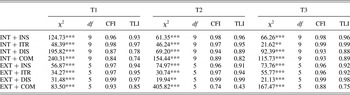
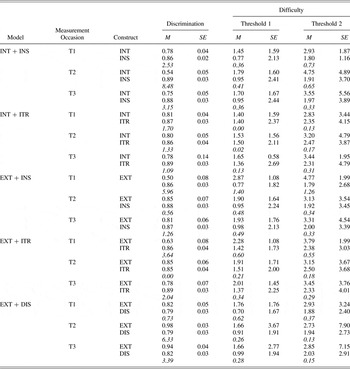
The results in Table 3 show that the assumption of unidimensionality holds at all three measurement occasions for the models with internalizing problems in relation with emotional instability and introversion, and for the models with externalizing problems in relation with emotional instability, introversion, and disagreeableness. For these models, the discrimination and difficulty parameters are calculated and displayed in Table 4. The discrimination parameters reflect how much information the DIPSI facets and CBCL syndromes, which are included in the model, provide on average about the underlying latent factor. Most relevant to the continuity hypothesis, however, are the difficulty parameters, because these index the location along the latent factor where the DIPSI or CBCL indicators are on average most informative from a psychometric point of view. The difficulty parameters for Threshold 1 reflect the level of the latent factor at which the likelihood of responding “a little or sometimes true” becomes higher than that of responding “not at all true.” The difficulty parameters for Threshold 2 indicate the latent factor level at which the likelihood of responding “frequently to very often true” becomes higher than that of responding “a little or sometimes true.” The results in Table 4 show that the difficulty parameters for Thresholds 1 and 2 are consistently higher for the CBCL indicators than for the DIPSI indicators, meaning that internalizing and externalizing problems are located at more extreme levels on the underlying latent variable than the maladaptive personality traits, consistent with the continuity hypothesis. Table 4 also displays Cohen (Reference Cohen1988) d effect sizes to compare the relative magnitude of the discrimination and difficulty parameters between the DIPSI and CBCL constructs of interest.
Fit indices for confirmatory factor analysis models for T1, T2, and T3

Note: T1, Time 1 first measurement; T2, Time 2 second measurement; T3, Time 3 measurement; CFI, comparative fit index; TLI, Tucker–Lewis index; INT, internalizing problems; INS, emotional instability; ITR, introversion; DIS, disagreeableness; COM, compulsivity; EXT, externalizing problems.
Item response theory model parameter estimates for T1, T2, and T3
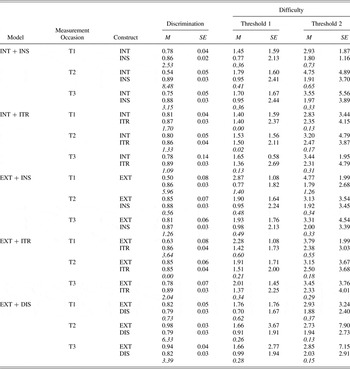
Note: Two-tailed effect sizes for Student t tests (Sloper, Reference Verhulst, Van der Ende and Koot2014) are in italic type. T1, Time 1 first measurement; T2, Time 2 second measurement; T3, Time 3 measurement; INT, internalizing problems; INS, emotional instability; EXT, externalizing problems; ITR, introversion; DIS, disagreeableness.
Discussion
The present study is the first to present a joint investigation of the continuity, pathoplasty, and complication models to explain the personality–psychopathology relations in children and adolescents from a maladaptive trait perspective, taking into account dimensional and age-specific childhood conceptualizations of maladaptive personality and psychopathology. The current work corroborates previous work of De Bolle et al. (Reference De Bolle, Beyers, De Clercq and De Fruyt2012) that focused on the applicability of each of these etiological models to explain personality–psychopathology relations in children and adolescents from a general trait perspective. By linking the present findings to those presented by De Bolle et al. (Reference De Bolle, Beyers, De Clercq and De Fruyt2012), we obtain a more comprehensive understanding of the nomological network of general personality, personality symptoms, and clinical psychopathology at young age.
In line with De Bolle et al. (Reference De Bolle, Beyers, De Clercq and De Fruyt2012), the current study found compelling evidence for the continuity model to explain the nature of personality–psychopathology relations, because change in each of the four personality symptom dimensions was substantially associated with change in internalizing and externalizing problem behavior. As hypothesized, the continuity associations were more robust for those personality–psychopathology associations that are conceptually closer, such as the emotional instability/introversion–internalizing problems association and the disagreeableness–externalizing problems association; and were stronger when personality was considered from a maladaptive rather than from a general trait perspective. These findings indicate that personality pathology and general mental health symptoms have common underlying factors that affect their development and course, and that link their etiology and symptom expression in complex ways (Krueger, Reference Krueger2005). The IRT results further support this notion, because they illustrated that these particular personality symptom–psychopathology combinations reflect the same underlying variable with internalizing and externalizing psychopathology assessing more extreme levels of this latent variable. In all, these results show the existence of two distinct internalizing and externalizing spectra that influence the strength of the specific trait–psychopathology associations, depending on whether they unfold from the same internalizing versus externalizing construct (Achenbach, Reference Achenbach1991; Krueger & Tackett, Reference Krueger and Tackett2003). The findings are also consistent with those of De Clercq et al. (Reference De Clercq, Van Leeuwen, Van den Noortgate, De Bolle and De Fruyt2009), who illustrated that childhood maladaptive traits and general internalizing and externalizing psychopathology dimensions generally show similar longitudinal patterns in terms of shape and change over time.
Although the findings demonstrate that maladaptive traits and psychopathology are mainly connected across time via nonspecific continuity associations, they also appear to have a specific reciprocal influence from a more causally oriented pathway (i.e., complication and pathoplasty effects). Overall, it can be concluded that similar etiological relations with constructs of psychopathology exist across the spectrum of general and maladaptive trait variance. More specifically, De Bolle et al. (Reference De Bolle, Beyers, De Clercq and De Fruyt2012) observed complication effects from externalizing behavior toward benevolence, and from internalizing behavior toward the general traits of emotional stability, conscientiousness. In the present study, we found similar complication effects from internalizing and externalizing behavior toward the more maladaptive counterparts of these traits. In addition, the present study found that internalizing behavior positively affects the developmental course of emotional instability, introversion, and compulsivity, whereas externalizing behavior appears to positively influence only the development of disagreeableness. Likewise, De Bolle et al. (Reference De Bolle, Beyers, De Clercq and De Fruyt2012) found pathoplasty effects from agreeableness toward both internalizing and externalizing problem behavior, whereas the present study found that disagreeableness influenced the course of both internalizing and externalizing problem behavior. The current study also found a pathoplasty effect from introversion to internalizing behavior.
Several limitations should be taken into account when interpreting the findings. First, the current study used a single-informant perspective (i.e., both maladaptive personality and psychopathology were rated by the mothers), which can artificially inflate the continuity associations found in the current study. Future research should adopt a multiple-informant perspective to avoid inflation of parameter estimates due to shared method variance. Future studies should use alternative methods to assess the constructs of interests (e.g., observation studies) and alternative designs to pronounce upon causality (e.g., experimental designs). Second, personality and psychopathology were conceptualized at a broad level. Taking into account more fine-grained personality and psychopathology operationalizations (i.e., personality facets and psychopathology subscales, respectively) may offer additional and more specific information on the nature of the personality–psychopathology associations in children and adolescents. Third, future studies should also incorporate personality measures long before the onset of psychopathology, such that vulnerability effects can be unequivocally examined, apart from continuity, pathoplasty, and complication effects.
From a clinical viewpoint, the current paper illustrates that maladaptive personality traits and psychopathology are closely interwoven and should therefore be considered in conjunction in clinical assessment practice. In addition, because the existence and persistence of behavioral problems may cause changes in personality at the trait level (i.e., complication effects), clinical programs should target a timely identification and treatment of behavioral problems to prevent that they evolve into anchored personality traits. In a similar vein, the existence of complication effects suggests that personality symptoms can be reduced through the treatment of behavioral problems. Conversely, because it has been demonstrated that personality is more amenable to change than was previously thought (Martin, Oades, & Caputi, Reference Martin, Oades and Caputi2014), it might be interesting to target treatment at personality symptoms change, because this may in turn have beneficial side effects for co-occurring behavioral problems (i.e., through pathoplasty effects). Before formulating specific recommendations for the treatment of personality symptoms or behavioral problems, however, the current findings should be replicated in future research that takes into account the issues outlined above.