Plasma concentrations of glucose on one side and non-esterified fatty acids (NEFA) and β-hydroxybutyrate (BHBA) on the other side are well-established measures of the glucogenic and ketogenic status of periparturient cows. However, frequent blood sampling is unsuitable for on-farm assessment of glucogenic status as compared to the automated milk sampling devices for both robots and parlours now available (e.g. Herd Navigator from DeLaval). Thus, it is of great interest for the dairy industry to establish reliable milk-based indicators for assessing the glucogenic status of the cow. The rationale for using milk indicators is that the glucogenic status of the cow is reflected in the intermediary metabolism of the mammary gland, which in turn affects the composition of the milk (Peaker & Faulkner, Reference Peaker and Faulkner1983; Garnsworthy et al. Reference Garnsworthy, Masson, Lock and Mottram2006). Indeed, cow-side tests for ketosis measuring the level of ketone bodies in milk have been available for several years (Enjalbert et al. Reference Enjalbert, Nicot, Bayourthe and Moncoulon2001; Carrier et al. Reference Carrier, Stewart, Godden, Fetrow and Rapnicki2004). These tests are based on measuring the level of BHBA, because BHBA is the most stable metabolite of the ketone bodies (Enjalbert et al. Reference Enjalbert, Nicot, Bayourthe and Moncoulon2001), although rumen fermentation also contribute to the circulating concentration and thereby to the milk BHBA concentration. Recently, milk concentrations of isocitrate (Larsen, Reference Larsen2014), free glucose and glucose-6-phosphate (Larsen & Moyes, Reference Larsen and Moyes2015) have been suggested to reflect the nutrient availability and metabolic turnover in the mammary gland. Therefore, it may be beneficial to combine a range of milk metabolites into an index to better reflect nutrient availability and mammary metabolic turnover.
Excessive mobilisation of adipose tissue in postpartum dairy cows may result in hepatic lipidosis and subsequent ketosis (Grummer, Reference Grummer1993; Ingvartsen, Reference Ingvartsen2006). Treatment of ketosis by oral dosing with propylene glycol (PG) has been used since the 1950s (Nielsen & Ingvartsen, Reference Nielsen and Ingvartsen2004). Typically, plasma concentrations of glucose have been observed to increase and concentrations of BHBA and NEFA to decrease with PG supplementation in periparturient dairy cows (Nielsen & Ingvartsen, Reference Nielsen and Ingvartsen2004; Lien et al. Reference Lien, Chang, Horng and Wu2010). Especially the reduction in plasma NEFA concentrations to PG supplementation suggests a decreased adipose tissue mobilisation and thereby presumably a lower risk of lipid-related metabolic diseases in these cows.
The hypothesis was that the increased glucogenic status in postpartum cows induced by allocation of PG would be reflected in milk metabolites. The objective was consequently to investigate potential milk metabolites as biomarkers to evaluate the glucogenic status in over-conditioned postpartum dairy cows. Furthermore, within day variations of milk metabolites were examined to elucidate potential confounding aspects of diurnal sampling and analyses of milk samples for their usefulness as biomarkers.
Material and methods
Animal experimental procedures were approved by the Danish Animal Experiments Inspectorate.
Animals and experimental design
The experiment has been described in detail by Bjerre-Harpøth et al. (Reference Bjerre-Harpøth, Storm, Eslamizad, Kuhla and Larsen2015). Briefly, ten ruminally cannulated and intercostal arterially catheterised over-conditioned multiparous Danish Holstein cows were used in a complete randomised design with repeated measurements. The cannulas and catheters were implanted in the preceding dry period. The experiment was subdivided into three periods: (1) prepartum period: last 4 weeks prepartum, (2) treatment period: week 1–4 postpartum, and (3) follow-up period: week 5–8 postpartum. Cows were randomly assigned to daily intra-ruminal dosing of 500 g/d of tap water (CON; n = 5) or 500 g/d of PG (Propylenglycol pcow aroma, Brenntag Nordic A/S, Hellerup, Denmark; PPG; n = 5) at the morning feeding by a permanent infusion device secured to the ruminal cannula. Treatments were initiated at the day of calving (designated as +1 d relative to calving; DRTC) until +29 DRTC.
The ten over-conditioned cows were selected at dry off from a group of 16 cows, conditioned during the last 3 months of the preceding lactation as described by Bjerre-Harpøth et al. (Reference Bjerre-Harpøth, Larsen, Friggens, Larsen, Weisbjerg and Damgaard2014; Reference Bjerre-Harpøth, Storm, Eslamizad, Kuhla and Larsen2015). A priori selection criteria were body condition score (BCS) greater than 3·5 (1–5 scale; Ferguson et al. Reference Ferguson, Galligan and Thomsen1994) and at least a BCS increase of 0·5 during the conditioning period. From dry off, cows were housed in tie stalls and fed ad libitum (aiming at 10% refusals) with the same pre- and postpartum total mixed rations. During the dry period, cows were fed to maintain BCS and 2 weeks prepartum the BCS were (mean ± se) 3·9 ± 0·18 for CON and 3·8 ± 0·13 for PPG. Cows were milked and fed with precisely 8 h intervals beginning at 0515 and 0800 h, respectively.
Data collection
Milk samples. Milk was subsampled from the continuous flow sample (TruTest HI, Tru-Test Scandinavia, Præstø, Denmark) at each milking (morning, afternoon and evening) in the treatment period (week 1–4 postpartum). In the follow-up period (week 5–8 postpartum) milk was sampled at morning milking. Milk samples were refrigerated (~4°C) and analysed fresh within 3 d after sampling.
Blood samples
Weekly blood samples were obtained between 1000 and 1100 h from the coccygeal vein by venipuncture into sodium heparin vacutainers (Vacuette®, Greiner Bio-One GmbH, Kremsmünster, Austria). Daily blood samples at day –7 to +7 DRTC were obtained from the arterial catheter. All samples were kept on ice until plasma was harvested by centrifugation (2000×g for 20 min at 4°C) and stored at –20°C until analysis.
Laboratory analyses
Milk samples
Milk BHBA concentrations were analysed by fluorometry (Larsen & Nielsen, Reference Larsen and Nielsen2005). Likewise, the concentrations of triacylglycerol (TAG), cholesterol and isocitrate in milk were determined by enzymatic-fluorometric methods (Larsen et al. Reference Larsen, Larsen and Friggens2011; Larsen, Reference Larsen2012; Reference Larsen2014, respectively). Concentrations of milk uric acid and free glucose and glucose-6-phosphate (G6P) were analysed following procedures described by Larsen & Moyes (Reference Larsen and Moyes2010) and Larsen (Reference Larsen2015), respectively. Milk free galactose was measured by a method analogue to free glucose in milk using galactose dehydrogenase instead of glucose-6-phosphatase and glucose-6-phosphate dehydrogenase (T. Larsen, personal communication).
Plasma samples
Weekly and daily plasma samples were analysed using an autoanalyser (ADVIA 1650® Chemistry System, Siemens Medical Solution, Tarrytown, NY, USA). The plasma concentration of glucose was determined according to standard procedures (Siemens Diagnostics® Clinical Methods for ADVIA 1650). Fructosamine concentration was determined by a colorimetric assay (reduction of nitrotetrazolium-blue; Roche Diagnostics GmbH, D-68298 Mannheim, Germany), NEFA were determined using the Wako, NEFA C ACS-ACOD assay (Wako Chemicals GmbH, Germany), and BHBA according to Harano et al. (Reference Harano, Ohtsuki, Ida, Kojima, Harada, Okanishi, Kashiwagi, Ochi, Uno and Shigeta1985).
Statistical procedures
Data on plasma and milk metabolites were analysed using the MIXED procedure of SAS (SAS Institute Inc., Cary, NC, USA). The model included fixed effects of treatment, period, time within period, and all possible interactions. Cow was considered as a random effect and time as a repeated measurement allowing covariance to vary by period thereby accounting for heterogeneity among periods. Within period, time was defined as week 1–4 for weekly plasma samples, as day 1–7 for daily plasma samples, and as day 1–28 for milk components.
Within day variation of milk metabolites was analysed using all milking times (morning, afternoon, and evening) in the treatment period with a mixed model including the fixed effects of treatment, DRTC, milking time, and all possible interactions. Milk samples within cow were defined as sample 1–84 and considered as a repeated measurement.
Covariance structure used for the repeated measures was autoregressive order 1. Denominator degrees of freedom were estimated by the Kenward–Roger method. Lest significant means ± standard error of the mean (sem) are presented due to missing observations (one cow within the CON group was excluded from the experiment due to severe ketosis). It was not possible to analyse TAG and cholesterol in milk samples obtained +1 DRTC; consequently, +1 DRTC was excluded in the statistical analyses for these metabolites. Treatment means were separated using protected Fisher's least significant difference test. Significance was declared at P ≤ 0·05 and tendencies were considered at 0·05 < P ≤ 0·10. Pearson's correlation analysis was conducted among milk metabolites from postpartum morning milkings using the CORR procedure of SAS.
Results and discussion
The allocation of PG in the current experiment induced a marked enhancement of postpartum glucogenic status as interpreted from elevated plasma glucose and fructosamine concentrations and very low plasma BHBA concentrations during the treatment period compared to allocation of tap water. Somewhat surprisingly and in contrast to the general belief, limited effects of PG were observed on quantitative fat mobilisation and qualitative indicators of fat mobilisation (Bjerre-Harpøth et al. Reference Bjerre-Harpøth, Storm, Eslamizad, Kuhla and Larsen2015). Therefore, these observations taken together indicate that the postpartum allocation of PG affects glucose metabolism relatively more than fat mobilisation during the first few weeks of lactation. Hence, milk samples from the current experiment were analysed for several metabolites to identify novel biomarkers and test their potential to predict the glucogenic status of the cow.
Effect of PG allocation on milk metabolites
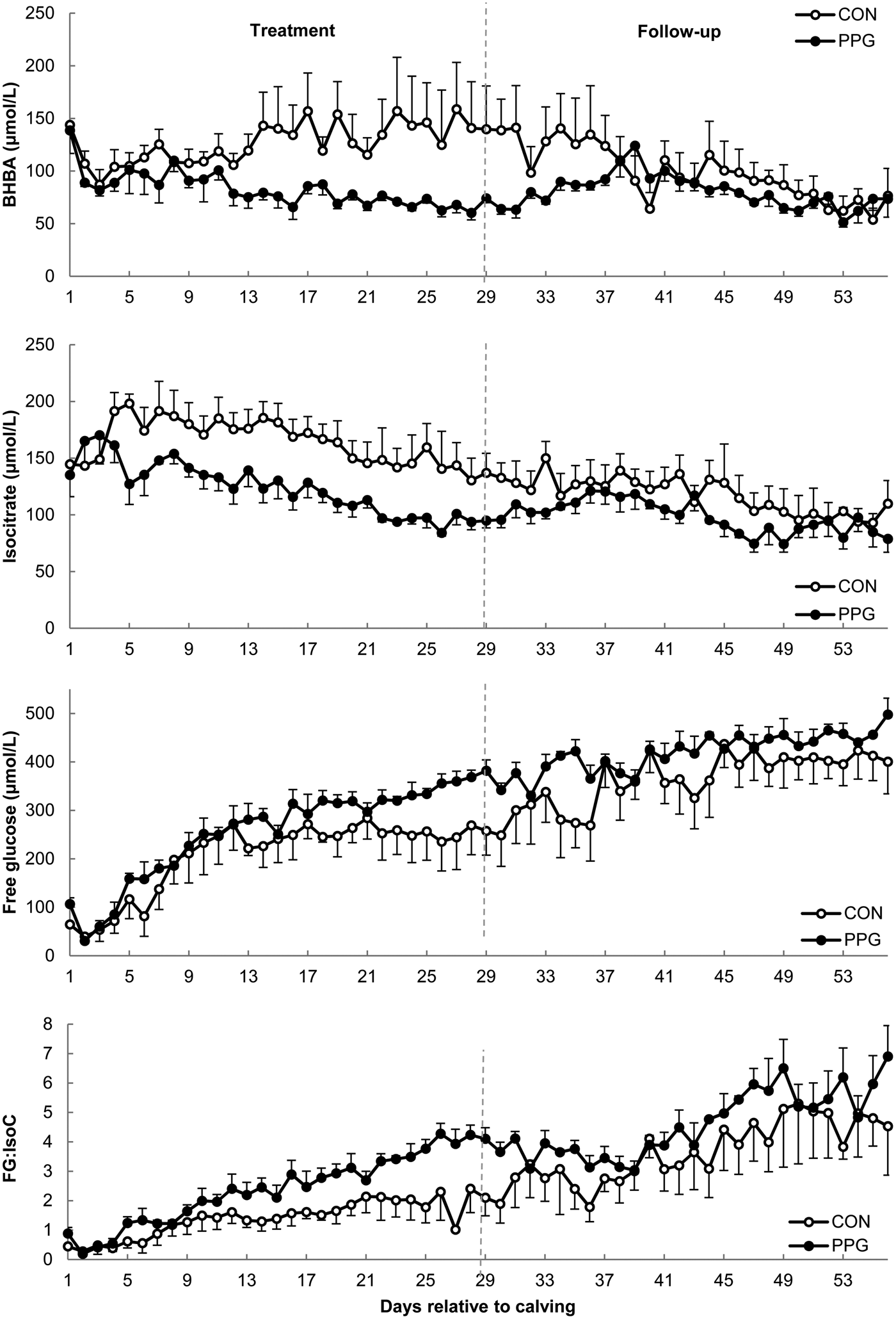
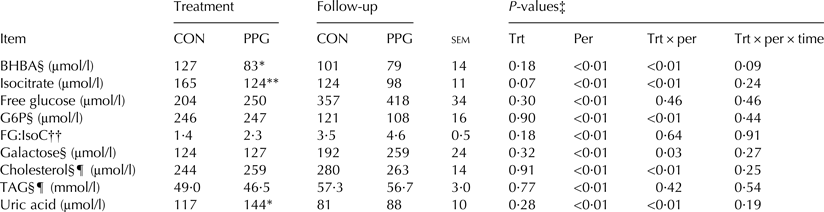
Milk BHBA concentrations began to increase approximately 2 weeks after calving with CON whereas milk BHBA remained low for PPG until the cessation of PG allocation where after the difference between treatments disappeared during the follow-up period (P Trt × Per × Time < 0·09; Table 1 and Fig. 1). It is well established that BHBA in the mammary gland is a precursor for de novo fatty acids synthesis (Palmquist et al. Reference Palmquist, Beulieu and Barbano1993; Bauman & Griinari, Reference Bauman and Griinari2003). Even though only a fraction of the BHBA taken up by the mammary gland is incorporated into milk fatty acid, the concentration of BHBA in milk is still most likely a reflection of the plasma concentration of BHBA (Enjalbert et al. Reference Enjalbert, Nicot, Bayourthe and Moncoulon2001; Denis-Robichaud et al. Reference Denis-Robichaud, Dubuc, Lefebvre and DesCôteaux2014). A linear relation between arterial BHBA in plasma and arterio-venous differences across the mammary gland have been established in goats (Madsen et al. Reference Madsen, Nielsen and Nielsen2005). Also in the present experiment there was a strong correlation between plasma BHBA and milk BHBA (r = 0·73; P < 0·001).
Milk concentration of β-hydroxybutyrate (BHBA), isocitrate, free glucose and free glucose:isocitrate (FG:IsoC) ratio (mean ± se) in dairy cows treated with 500 g/d tap water (CON; n = 4) or 500 g/d propylene glycol (PPG; n = 5) during the first 4 weeks after calving. The stippled line indicates cease of PG treatment.

Milk metabolites in the treatment and the follow-up period in control and propylene glycol allocated cows†
† Treatments were control (CON; n = 4) allocated 500 g/d tap water and propylene glycol (PPG; n = 5) allocated 500 g/d propylene glycol once a day in the first 4 weeks after calving
‡ Trt: treatment, Per: period, Time: represent within each period (treatment and follow-up) day 1–28
§ P-values are from ln transformed data; BHBA, β-hydroxybutyrate; G6P, Glucose-6-phosphate; TAG, triacylglycerol
¶ First day in each period is not included in the analysis, see Statistical procedures
†† FG:IsoC: free glucose to isocitrate ratio
**P ≤ 0·05 and *0·05 < P ≤ 0·10: symbols signify difference between treatment means within period
The concentration of isocitrate in milk was lower for PPG compared with CON in the treatment period; the difference between treatments diminished during the follow-up period (P Trt × Per < 0·01; Table 1 and Fig. 1). Increased concentration of isocitrate in milk has been associated with increased concentration of NEFA in plasma (Chaiyabutr et al. Reference Chaiyabutr, Faulkner and Peaker1981; Farrell et al. Reference Farrell, Wickham and Reeves1995). Isocitrate takes part in the de novo synthesis of fatty acids by means of the isocitrate cycle, where the oxidation of isocitrate produces NADPH required for reduction during chain elongation of fatty acids (Bauman et al. Reference Bauman, Brown and Davis1970). Considering the expected effect of PG previously described (postpartum PG allocation will decrease adipose tissue mobilisation and thereby decrease the plasma concentration of NEFA) the difference between PPG and CON in concentration of isocitrate in milk seems to be logical: a higher availability of NEFA in the mammary gland in CON reduces the need for de novo synthesis of fatty acids in the mammary gland (Faulkner & Pollock, Reference Faulkner and Pollock1989; Palmquist et al. Reference Palmquist, Beulieu and Barbano1993). As a consequence, less isocitrate is degraded and the concentration of isocitrate in mammary cells and thereby in milk is increased. However, the association between NEFA uptake in the mammary gland and isocitrate level in milk was not supported by the present experiment as the difference in plasma NEFA concentrations between treatments was limited (Bjerre-Harpøth et al. Reference Bjerre-Harpøth, Storm, Eslamizad, Kuhla and Larsen2015).
The milk free glucose concentration was generally increasing during the 8 weeks after calving (P Per < 0·01; Table 1 and Fig. 1). The PG supplemented group revealed a numerically higher level than the control group. Milk G6P concentration did not differ between treatments in the treatment period but was lowest with PPG in the follow-up period (P Trt × Per < 0·01; Table 1). The presently observed concentration levels of both free glucose and G6P in milk were comparable to previous observations by Larsen & Moyes (Reference Larsen and Moyes2015). The present experiment showed a strong negative correlation (r = –0 58; Table 2) between these two metabolites. This is also comparable with the previous study involving 3233 observations (Larsen & Moyes, Reference Larsen and Moyes2015). The hypotheses behind testing free glucose and G6P as potential indicators for energy status in the mammary gland were that (1) their milk levels span over a greater range compared to that of lactose (Larsen & Moyes, Reference Larsen and Moyes2015), (2) studies have shown increased G6P and decreased free glucose concentrations during periods of energy deficit and starvation (Chaiyabutr et al. Reference Chaiyabutr, Faulkner and Peaker1981; T. Larsen unpublished data), and (3) previous studies have shown that milk glucose concentration reflects the mammary intracellular glucose concentration (Faulkner et al. Reference Faulkner, Chaiyabutr, Peaker, Carrick and Kuhn1981). The first observation clearly enables for a much more sensitive description of the various facets of mammary energy status in early lactation. Glucose taken up by the mammary gland will be converted to G6P and either used for lactose synthesis, or relocated to other fates in the mammary gland (Larsen & Moyes, Reference Larsen and Moyes2015). Other studies showed that the milk concentration of G6P increased due to duodenal glucose infusion (Rigout et al. Reference Rigout, Lemosquet, Bach, Blum and Rulquin2002). In an in vitro study, Liu et al. (Reference Liu, Zhao and Liu2013) observed that a higher concentration of glucose in mammary epithelial cells stimulates lactose synthesis but also an increase in glucose metabolism by glycolysis and by pentose-phosphate pathway turnover.
Pearson's correlation coefficients between milk metabolites in daily morning milk samples (n = 451–489)
BHBA, β-hydroxybutyrate; G6P, glucose-6-phosphate; TAG, triacylglycerol
**P ≤ 0·0001; *P ≤ 0·001
Due to the circumstance that milk free glucose and isocitrate react differently to energy status in the mammary gland as indicated by the negative (r = –0·49; Table 2) and positive (r = 0·63) correlations to BHBA in milk, respectively, it could be considered to use the free glucose:isocitrate (FG:IsoC) ratio as an index of glucogenic status in postpartum cows. Isocitrate increases and free glucose decreased during periods of energy deficit and starvation (Chaiyabutr et al. Reference Chaiyabutr, Faulkner and Peaker1981; T. Larsen unpublished data). The FG:IsoC ratio may therefore identify cows at risk of metabolic diseases related to adipose tissue mobilisation. In morning milk, the difference in FG:IsoC ratio was numerically different between treatments (P Trt = 0·18; Table 1 and Fig. 1). However, considering a larger variation among animals in the CON group compared with the PPG group and the potential value of the FG:IsoC ratio as an indicator of glucogenic status, this consideration is more distinctively discussed in the following section on animal variation.
The milk galactose concentration did not differ between treatments during the treatment period, whereas the concentration increased more for PPG compared with CON in the follow-up period (P Trt × Per = 0·03; Table 1). This pattern correlated strongly to the milk free glucose concentration (r = 0·68; Table 2), and it could be speculated that the changes in glucogenic status of the cows induced a change in mammary glucose metabolism which in turn was reflected in milk concentrations of both free glucose and galactose (Liu et al. Reference Liu, Zhao and Liu2013).
The milk TAG concentration increased from the treatment period to the follow-up period (P Per < 0·01; Table 1). For both treatments, high milk cholesterol concentrations in the first few days of lactation revealed an interaction between treatment and week of lactation (P Trt × Per < 0·01). Because of the strong correlations between milk fat concentration and milk concentrations of TAG and cholesterol observed by Larsen et al. (Reference Larsen, Larsen and Friggens2011) and Larsen (Reference Larsen2012), the difference between treatments in milk TAG and milk cholesterol could be expected to resemble those of milk fat content. However, in the present experiment there was no effect of PG treatment on concentrations of milk TAG and cholesterol.
Milk concentration of uric acid tended to be lower in CON compared with PPG in the treatment period, whereas the difference between treatments disappeared in the follow-up period (P Trt × Per < 0·01; Table 1). The energy boost from PG might have stimulated the microbial turnover in the rumen, thereby more uric acid is formed by degradation of microbial purines in DNA and RNA (Chibisa et al. Reference Chibisa, Gozho and Mutsvangwa2009; Stentoft et al. Reference Stentoft, Røjen, Jensen, Kristensen, Vestergaard and Larsen2015). A comparable situation was seen when high density energy rations were tested against low energy density rations (Larsen et al. Reference Larsen, Alstrup and Weisbjerg2016). In contrast, it has been hypothesised that PG allocation would reduce ruminal microbial protein production (Chibisa et al. Reference Chibisa, Gozho and Mutsvangwa2009). However, urinary measurements of uric acid did not confirm this speculation. Still, it cannot be ruled out that increased milk uric acid to some extent could be linked to altered purine metabolism in the liver induced by PG, which will be partially metabolised in the liver.
Animal variations
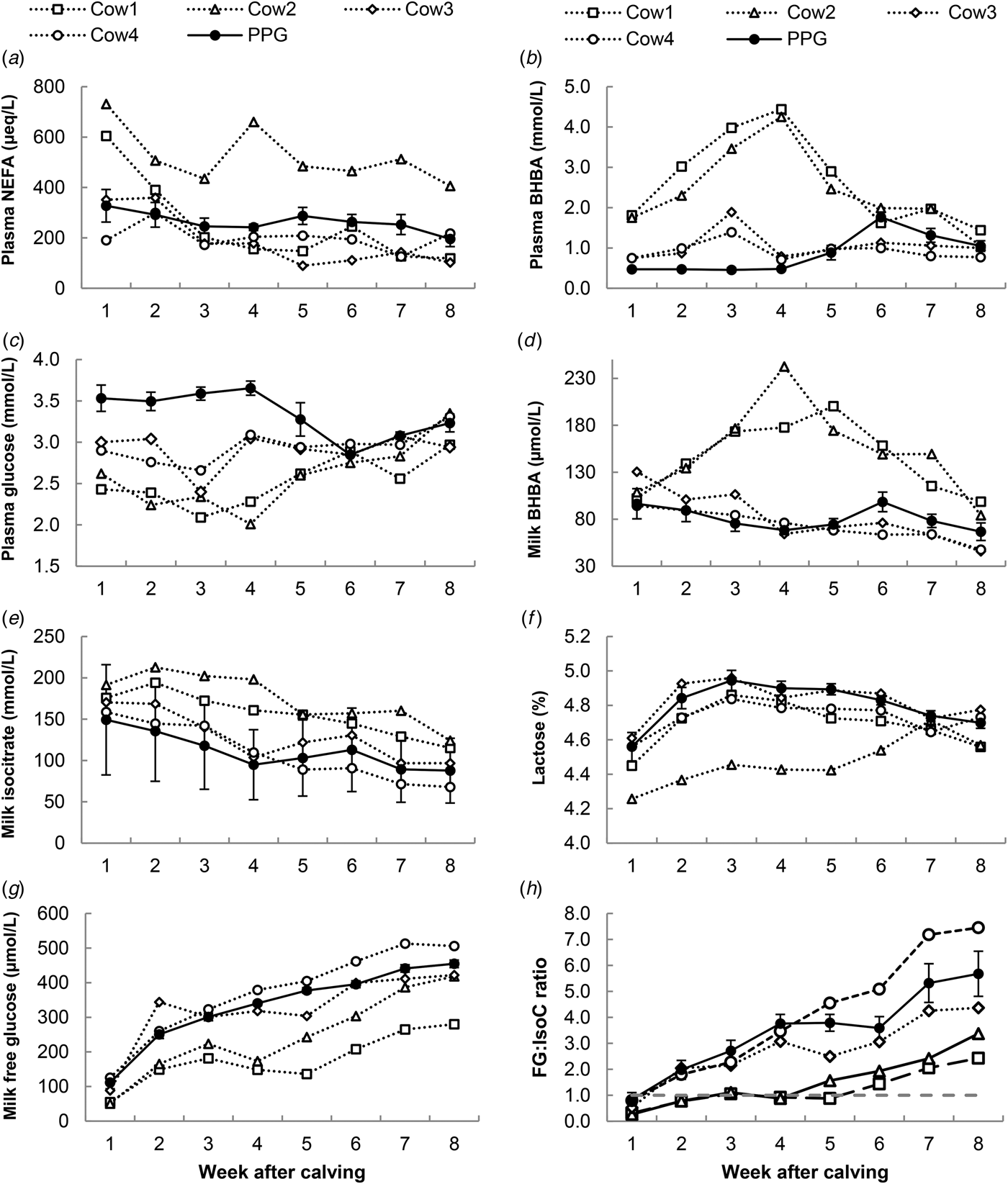
Interestingly, there appeared to be greater variation among cows with CON compared with PPG as interpreted from se's illustrated in Fig. 1. The association between changes in metabolism and milk metabolites was therefore considered for individual cows. Individual observations for cows with CON are shown in Fig. 2 for a number of plasma samples (Bjerre-Harpøth et al. Reference Bjerre-Harpøth, Storm, Eslamizad, Kuhla and Larsen2015) and milk metabolites along with mean ± se for PPG cows. The data indicate that initiation of lactation caused greater responses in plasma concentrations of NEFA and especially BHBA in two control cows (Cow1 and Cow2) compared with the other two (Cow3 and Cow4; Fig. 2a, b). In contrast, plasma glucose concentrations seemed less variable, although, Cow1 and Cow2 generally had the lowest values during week 1–4 (Fig. 2c).
Plasma concentration of non-esterified fatty acids (NEFA), β-hydroxybutyrate (BHBA) and glucose, and milk concentrations of BHBA, isocitrate, lactose and free glucose and free glucose:isocitrate (FG:IsoC) ratio. Individual cows are shown for CON treatment and the average (means ± se) are shown for the PPG treatment (PG allocated week 1–4 after calving). The dashed gray line in Fig. 2h indicate a hypothesised critical ratio.
The aforementioned association between milk isocitrate and plasma NEFA was clearer when considering individual CON cows, as Cow1 and Cow2 had higher milk isocitrate concentration compared with Cow3 and Cow4 (Fig. 2e). Additionally, milk isocitrate concentrations seemed to increase before milk BHBA concentration increased, especially in Cow1 and Cow2. Inversely, the milk free glucose concentration was lower with Cow1 and Cow2 compared to Cow3 and Cow4 (Fig. 2g). This is seen even more clearly when calculating the FG:IsoC ratio (Fig. 2h) as a potential indicator of glucogenic status. Based on the limited observations from these four CON cows, it could be hypothesised, that cows experiencing a prolonged period with low FG:IsoC ratio (i.e. <1, indicated by dashed gray line) are at greater risk for establishing ketosis.
Within day variations in milk metabolites
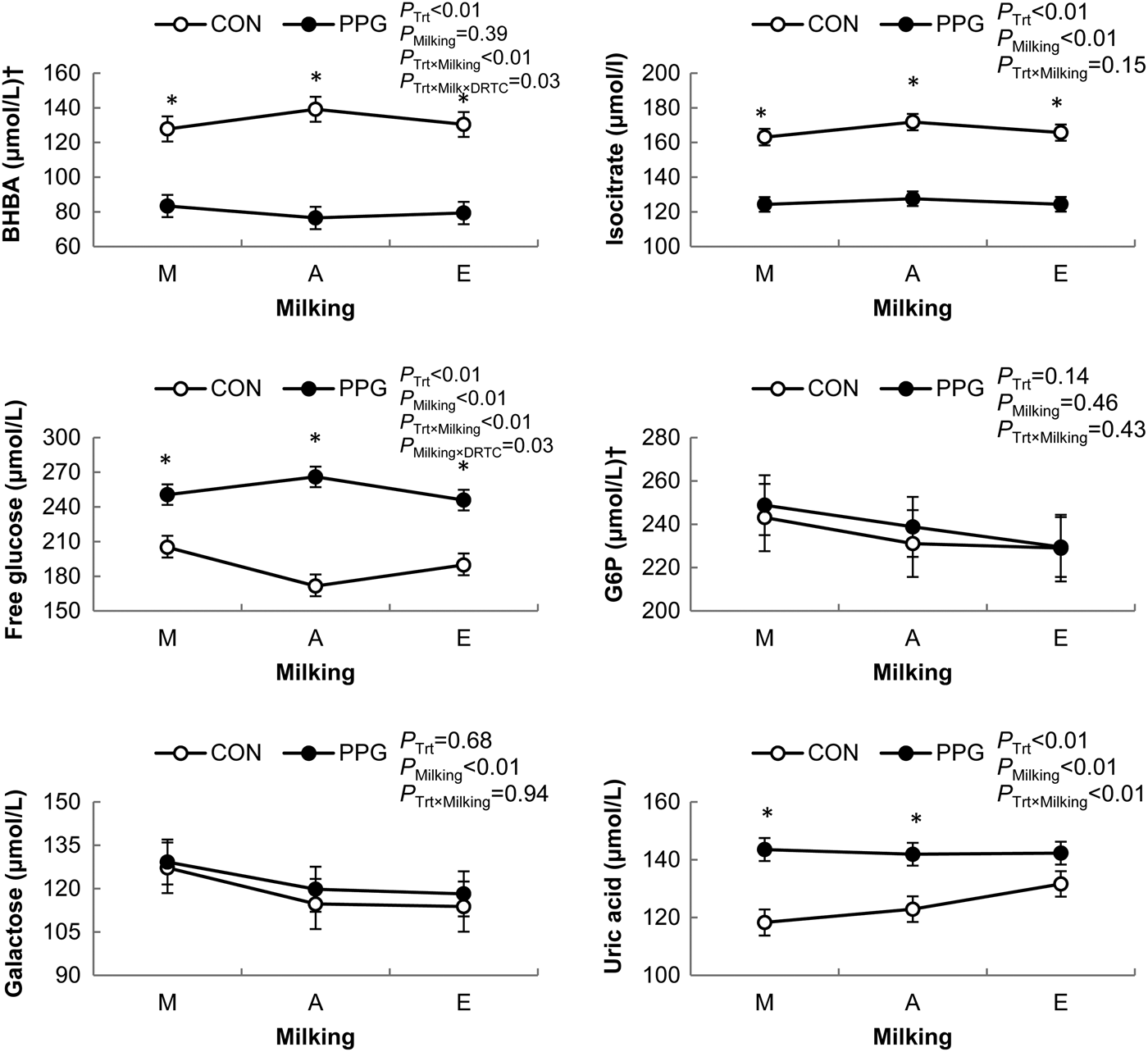
Morning milk samples had higher milk BHBA concentrations compared with afternoon samples and tended to be higher than evening samples for PPG cows; whereas there were no difference among milkings for CON cows (P Trt × Milking < 0·01; Fig. 3). The isocitrate concentrations in afternoon milk samples were higher than morning and evening samples for CON and tended to be higher for PPG cows (P Trt < 0·01; P Milking < 0·01). For PPG, free glucose concentrations were higher in afternoon milk samples compared with morning and evening samples, whereas for CON, afternoon samples were lower than for morning and evening samples (P Trt × Milking < 0·01; P Milking × DRTC = 0·03). The G6P concentrations in milk samples were not different between treatments and did not differ among milkings.
Within day variation in milk metabolites (means ± se) for dairy cows treated with 500 g/d tap water (CON; n = 4) or 500 g/d propylene glycol (PPG; n = 5) for the first 4 weeks after calving. Milking times (Milking) were morning (M; 0515 h), afternoon (A; 1315 h), and evening (E; 2115 h), Trt, treatment. †Denotes that P-values are from ln transformed data; *denotes difference between treatments within milking time at P ≤ 0·05.
Evaluation of the effect of treatment on milk metabolites (Table 1) is based on morning milkings. As indicated above, the choice of milking time for sampling might influence the statistical results for some of the milk metabolites of particular interest (e.g. BHBA, isocitrate, and free glucose). Thus, the difference between treatments would probably have been greater for free glucose and BHBA if afternoon milk had been considered. This observation supports the view that metabolite concentrations in a milk sample are a snapshot of the nutrient availability and metabolic turnover in the mammary gland since the last milking. It has been shown that the distance between milkings may affect the composition of milk fat (Larsen et al. Reference Larsen, Weisbjerg, Kristensen and Mortensen2012). However, cows were precisely fed and milked with 8 h intervals in the present experiment. Nevertheless, it should be acknowledged that the observed within day variations could be caused by eating behaviour during the day in addition to the PG allocation in connection with the morning feeding. Eating behaviour is subjected to diurnal variation (low feed intake during the night) and by the management of the cows during the day, i.e. cows have a tendency to eat when there is commotion in the barn during times of milking and feed administration (Nocek & Braund, Reference Nocek and Braund1985; DeVries et al. Reference DeVries, von Keyserlingk and Beauchemin2003). Still, the within day variation for free glucose and BHBA in milk in the present experiment corresponds well with the PG post-allocation pattern seen in plasma glucose and plasma BHBA (Grummer et al. Reference Grummer, Winkler, Bertics and Studer1994), and to the timeframe for PG metabolism measured in plasma (Kristensen & Raun, Reference Kristensen and Raun2007) in other studies. Grummer et al. (Reference Grummer, Winkler, Bertics and Studer1994) showed that PG allocation caused an increased plasma glucose concentration and a decreased plasma BHBA concentration that lasted 6 h. These observations are in agreement with the hourly blood samplings data from +4, +15, and +29 DRTC in the present experiment (Bjerre-Harpøth et al. Reference Bjerre-Harpøth, Storm, Eslamizad, Kuhla and Larsen2015). In Kristensen & Raun (Reference Kristensen and Raun2007), an intra-ruminal pulse dosing of PG, as used in the present experiment, resulted in immediate increase of PG concentration in plasma that lasted 5 h (>5 mmol/l) where after plasma PG concentration decreased to about 0·05 mmol/l after 12 h. The present results of within day variations suggest that for future intensive studies, time of milk sampling should be considered in relation to larger bouts of feed ingestion.
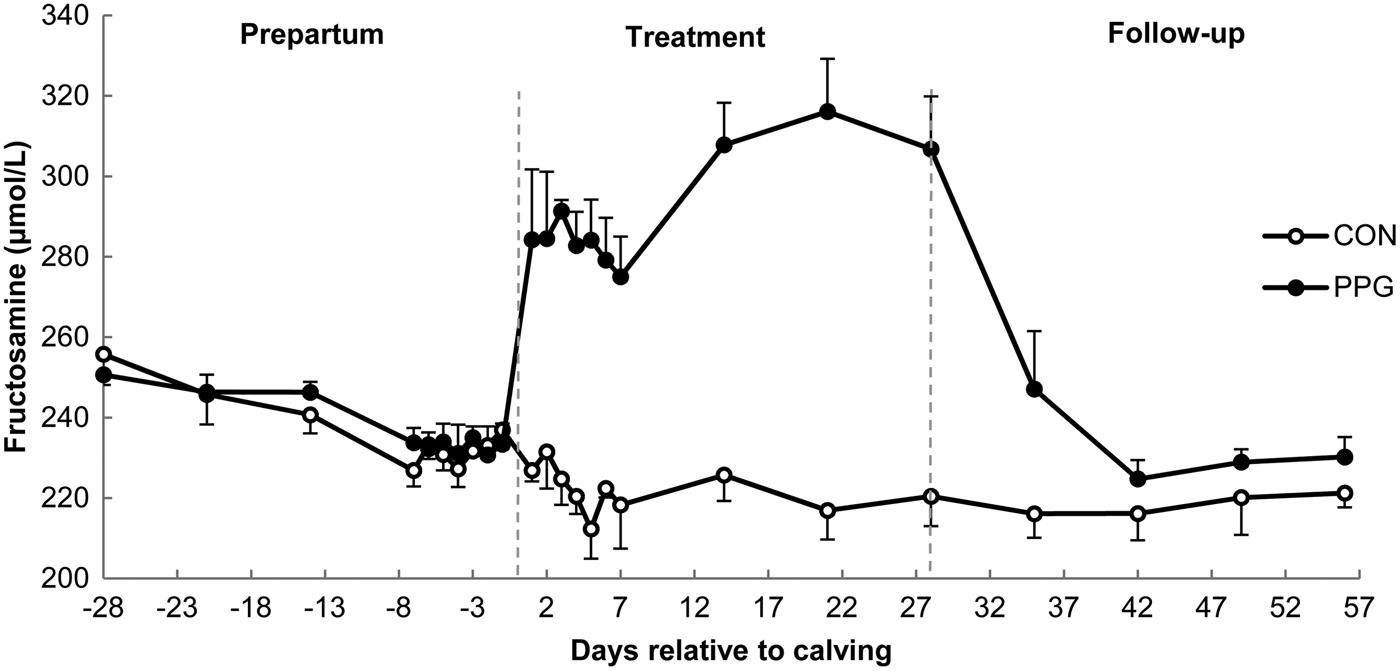
Plasma fructosamine
The concentration of fructosamine in daily plasma samples increased rapidly after calving for PPG cows as compared with CON cows (P Trt × Per < 0·01; Fig. 4). The difference between treatments disappeared during the follow-up period, as the plasma fructosamine concentration decreased for PPG after cessation of the PG allocation (P Trt × Per < 0·01).
Weekly and daily plasma concentrations of fructosamine (mean ± se) in dairy cows treated with 500 g/d tap water (CON; n = 4) or 500 g/d propylene glycol (PPG; n = 5) during the first 4 weeks after calving. The stippled lines indicate initiation and cease of PG treatment.
In humans, fructosamine concentration is used to describe the mean plasma glucose level for the preceding 2–3 weeks as plasma fructosamine is formed proportionately to glucose concentrations by glycation of circulating plasma proteins, mostly albumin, and albumin has a half-life of about 14–21 d (Armbruster, Reference Armbruster1987). Bovine albumin has a similar half-life as human albumin (Cornelius et al. Reference Cornelius, Baker, Kaneko and Douglas1962). Such a supposed time delay of response in fructosamine concentration to glucose concentrations would imply a weak but positive correlation between plasma glucose and fructosamine concentrations, which has been observed previously (Ropstad, Reference Ropstad1987; Stengärde et al. Reference Stengärde, Tråvén, Emanuelson, Holtenius, Hultgren and Niskanen2008). However, the present experiment showed a strong correlation between concentrations of plasma glucose and fructosamine postpartum (r = 0·81, P < 0·001). Therefore, the observed immediate response in fructosamine concentrations to initiation of postpartum PG allocation somewhat questions the use of fructosamine concentration as an indicator of historic glucogenic status in ruminants, at least when supplemented with PG. The present study has not been able to establish a physiological mechanism explaining the observed effect on fructosamine. Indeed, the current data cannot distinguish if the effect on fructosamine was an effect of increased plasma glucose concentration or an effect of PG treatment per se.
Conclusions
In conclusion, PG allocation improved the glucogenic status of cows and this was reflected in changes in milk metabolites associated with the glucogenic status of cows. It is proposed that a ratio between milk concentrations of free glucose and isocitrate may be a potential index for glucogenic status in postpartum dairy cows, however, further investigations are needed to confirm this.
Funding was provided by The Danish AgriFish Agency (Copenhagen, Denmark; no.3412–10–02814), Danish Cattle Federation (Aarhus, Denmark), and Ministry of Food, Agriculture, and Fisheries (Copenhagen, Denmark).V. Bjerre-Harpøth held a PhD Scholarship co-financed by the Faculty of Science and Technology, Aarhus University (Tjele, Denmark).