Introduction
Although several definitions exist, in its broadest sense faecal incontinence (FI) is the involuntary uncontrolled passage of gas, liquid or formed stools. It has a devastating impact on quality of life. Several less severe but related conditions involving defective anatomy or function of the anal sphincter and resulting in the sporadic or periodic soiling of underwear (passive incontinence) or an urgent need to defecate (urge incontinence) caused by an idiopathic dysfunction induced by age-related fibrosis of the internal anal sphincter,Reference Klosterhalfen, Jego and Gloc1 also negatively affect many aspects of a person's life. Although such disorders are also seen in subjects who have undergone different forms of anal surgery, they are not considered incontinence in the strict sense.
Faecal incontinence is perhaps one of the most alienating conditions that a person may experience. Besides its obvious impact on social behaviour and quality of life, the elderly person with FI is likely to suffer from a long list of related problems, including depression, anxiety, embarrassment and lack of self esteem. Many individuals with FI are unwilling to admit they suffer from this problem.Reference Johanson and Lafferty2 There is also often reluctance of the physician to obtain detailed information from the patient and so exact prevalence of FI is uncertain. Notwithstanding, estimates indicate that FI affects 2–8% of people in generalReference Shah, Chokhavatia and Rose3–Reference Parés, Vial and Bohle7 and a much larger number of elderly subjects: 3–27% in the community setting, 17–50% in the nursing home setting, and 60–80% of patients admitted to hospital.Reference Nelson, Norton, Cantley and Furner5, Reference Chassagne, Landrin and Neveu8–Reference Grover, Busby-Whitehead and Palmer11 These proportions are also directly linked to age.Reference Witehead, Borrud and Goode12, Reference Townsend, Matthews, Whitehead and Grodstein13 The large ranges cited may be attributed to the different assessment procedures and definitions of FI used, along with a varying interest in identifying the condition. The prevalence of FI is similar in both sexes, although it has received more attention in women owing to the special characteristics of obstetric trauma.
Double incontinence (DI) of faeces and urine should also be considered. The prevalence of DI varies according to the assessment method used and has been reported at 8–29%.Reference Townsend, Matthews, Whitehead and Grodstein13–Reference Tariq, Morley and Prather17 It is among the most frequent causes of hospitalization of elderly people, mostly women, with devastating effects on quality of life.Reference Bano and Barrington18, Reference Yip, Dick and McPencow19
The embarrassing nature of FI and DI makes it difficult for most patients to discuss their problem and the prevalences reported are likely to be much below the real figures. However, greater appreciation of the socioeconomic and psychological impact of FI means that its importance is much better recognized today than some years ago.Reference Landefeld, Bowers and Feld20
When FI affects an elderly person, its impacts are often aggravated due to concurrent co-morbidities and these may influence the choice of treatment. This needs to be selected on an individual basis and the general health and symptoms of the patient need to be rigorously assessed and taken into consideration when deciding best management. Emphasis should be placed on determining the nature and frequency of incontinence and the severity of impact on the patient's quality of life. The aetiology of incontinence and the results of diagnostic tests will complete the set of data on which to base selection of the most appropriate treatment.
Search methods
PubMed, MEDLINE and EMBASE were searched using the keywords ‘faecal incontinence’, ‘sphincteroplasty’, ‘sacral nerve stimulation’, ‘sacral neuromodulation’, ‘posterior tibial nerve stimulation’ and ‘artificial anal sphincter’ for English-language articles published from January 1990 to September 2013. Selected embedded references were also reviewed.
Anatomo-physiology of faecal incontinence
Continence is the outcome of a breakdown in the barrier effect of one of the body's most perfect system of sphincters. The efficiency of this system depends on both anatomical and physiological factors, whose relative contributions remain unclear.
The main anatomical structures that contribute to continence are:
(1) The internal anal sphincter (IAS). Innervated by the autonomic nervous system, the IAS contributes to 75–80% of the resting pressure, or tone, of the anal canal. The response to rectal distension is relaxation of the IAS.
(2) The external anal sphincter (EAS). This sphincter's exclusive contribution to resting pressure is 20–25%, but it is responsible for voluntary contraction, which it can maintain for up to 50 s, doubling the resting pressure. It is innervated by the pudendal nerve.
(3) The levator ani muscle, especially the puborectalis muscle that is its most anteromedial part, the deepest portion of the EAS, longitudinal muscle and the adjacent part of the IAS, together constitute the anorectal ring. Innervated directly by the sacral nerve branches S3 and S4, this muscle directly contributes to the continence mechanism through its constant tonic contraction and role in maintaining the anorectal angle.
The sphincter mechanism controls the act of defaecation. The arrival of faeces at the rectum causes its distension and this triggers the process of adaptation and perception of the feeling of fullness on one hand, and discrimination of the nature of the contents on the other. If the rectal distension produced is sufficient, the IAS relaxes via the rectoanal inhibitory reflex, favouring the exit of the rectal contents. If the subject is willing, defaecation will take place via relaxation of the EAS, associated with an increased intra-abdominal pressure and lowering of the pelvic floor by relaxation of the pelvic musculature. In the opposite case, defaecation will be prevented through the sphincter contraction mechanism until a more convenient time.
The process of continence and defaecation is not only achieved through this complex anatomical and physiological mechanism. Numerous other factors play an important role such as mental function, volume and consistency of the stools, gut motility and transit, rectal compliance and sensitivity and anorectal reflexes, along with the autonomic nervous system and sensory and motor nerve pathways. An alteration in any of these factors may induce incontinence of a lesser or greater intensity.
Aetiology
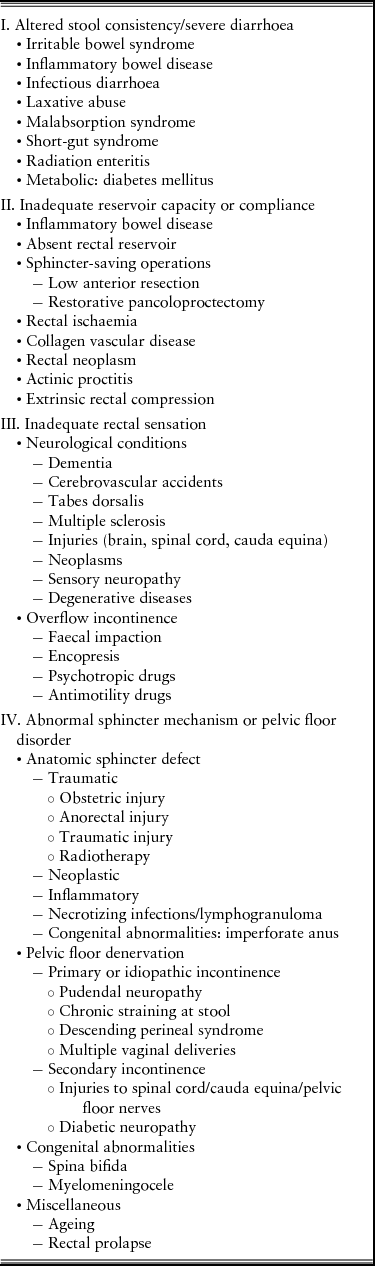
Faecal incontinence is the result of an abnormal continence and defaecation mechanism. The causes are multiple. There are numerous classification schemes although no scheme has been able to avoid repeating causes of FI in the different categories. Table 1 illustrates one of these schemes, based on the continence factor that is affected. In most cases, incontinence is the indirect consequence of the basic problem, whether functional, inflammatory, neurological, neoplastic, metabolic or attributable to a congenital disorder. Determining the incidence of each of these causes is practically impossible because specialists will record with a higher frequency the processes they normally deal with.
Aetiology of anal incontinence

Among elderly subjects in good physical condition, the causes of FI are similar to those affecting the general population,Reference Shah, Chokhavatia and Rose3, Reference Nelson, Norton, Cantley and Furner5, Reference Wald, Rato and Doglietto10, Reference Leung and Rao21–Reference Mitchell, Kiff and Brown23 although FI manifests with much more frequency in people of advanced age. The reasons for this are the anatomical and functional changes produced by ageing, which translate into reductions in resting pressure, the maximum voluntary contraction and the sensitivity of the anal canal, along with rectal compliance.Reference Shah, Chokhavatia and Rose3, Reference Fox, Fletcher and Zinsmeister24 It is also in this later stage of life when disorders arising from an inadequate intestinal rhythm, essentially constipation, or from pelvic floor disease manifest.Reference Fox, Fletcher and Zinsmeister24, Reference Boyle, Knowles and Murphy25
Aside from sphincter alterations due to obstetric trauma, an accident or anal surgery, the remaining factors are more frequently observed in institutionalized or hospitalized individuals including: lack of motivation related to cognitive or behavioural dysfunction, dementia, faecal impaction, lack of mobility, altered vision, inadequate bathroom access, the use of clothes that are difficult to handle, or restraining measures. These factors add to a lack of rectal sensitivity to perceive distension and a need for a larger stool volume to induce the contraction of the IAS.Reference Shah, Chokhavatia and Rose3, Reference Grover, Busby-Whitehead and Palmer11, Reference Leung and Rao21, Reference Potter and Wagg26–Reference Price29
Of all these factors, some acquire special significance in elderly people such as constipation, diarrhoea and past obstetric trauma. Constipation is a common causal factor, especially in institutionalized subjects and promotes the appearance of faecalomas, overflow incontinence and an exaggerated use of laxatives leading to more episodes of FI. This situation, or cycle, of constipation–faecal impaction–faecal incontinence is a problem that merits attention.Reference Leung and Rao21, Reference Schnelle, Simmons, Beuscher, Peterson, Habermann and Leung28, Reference Schnelle, Simmons and Beuscher30 Diarrhoea, also common in the aged person, gives rise to FI in a high proportion of cases because of modified sphincter function, reduced sensitivity and a displacement incapacity. In many instances, however, the cause of diarrhoea is an overuse of laxatives to overcome constipation, a situation that should be avoided.
Obstetric traumas, such as a history of heavy birthweight newborns, forceps-assisted delivery or a long second stage of labour, have also been identified as risk factors for FI. In many women, the impact of these risk factors will not be noticed until many years after the traumatic event and have been attributed to a debilitated sphincter and the additional presence of factors such as rectocele, rectal prolapse, diabetes, overweight or irritable bowel syndrome (IBS), among others.Reference Bharucha, Zinsmeister and Schleck31
Besides these predisposing factors for FI in elderly subjects, other predictive variables have been proposed, including a high body mass index, a low level of physical activity, smoking, diabetes type 2, high blood pressure and several neurological disorders.Reference Townsend, Matthews, Whitehead and Grodstein13 Although not all these factors have been indisputably linked to FI in the literature, the high prevalence of FI among older people warrants their further investigation to accurately identify risk factors on which to base preventive strategies.Reference Halland, Koloski and Jones32 In addition, when managing a patient with FI, all these possible risk factors need to be carefully assessed.
Clinical assessment
Symptoms
There are two objectives when evaluating an elderly patient with FI: (a) identification of the cause of FI and (b) establishing the FI type as accurately as possible.Reference Menees, Smith, Xu, Chey, Saad and Fenner33, Reference Tjandra, Dykes and Kumar34
When trying to define the FI type, the questions asked by the physician should be targeted at three basic aspects:
(1) Quality. The physician should find out whether the patient's lack of control refers to gases, liquid or solid stools.
(2) Frequency. This refers to whether losses are produced daily, weekly, monthly or less often than monthly.
(3) Social repercussions. These will differ according to the patient's lifestyle or occupation.
To obtain this information, it is useful to provide the patient or relative with an incontinence diary in which to record all bowel movements, events or information related to FI over a period of 21–28 days. The detailed analysis of all the information provided by the patient will serve to determine the severity of incontinence, which is essential to select and guide the best treatment option.
The many classifications or scoring systems of incontinenceReference Tjandra, Dykes and Kumar34–Reference Sansoni, Hawthorne, Fleming and Marosszeky40 suggest that no given scheme is truly satisfactory. Moreover, the existence of many different systems has hindered the assessment and comparison of data from the different studies. One of the most popular scales is that proposed by Jorge and WexnerReference Jorge and Wexner37 designed to evaluate the incontinence type, frequency, use of pads and impacts on quality of life by assigning the patient a score from zero (complete continence) to 20 (complete incontinence with significant repercussions on quality of life).
Recent improvements in this area include the introduction of detailed quality of life questionnaires, which enable the physician to determine the real effects of FI as well as the response to a given treatment.Reference Parés, Vial and Bohle7, Reference Cotterill, Norton, Avery, Abrams and Donovan41–Reference Smith, Menees, Saad, Chey and Fenner46 However, such classification schemes are useful only for elderly patients who are normally active. In hospitalized subjects with complete incontinence this type of assessment is futile.
Physical examination
The clinical examination includes inspection of the anus and perineum to check for abnormalities: scars, retractions, congenital defects, rectal or mucosal prolapse, mucosal ectropion, keyhole deformity, or other anal pathology. Further visible signs produced by FI include redness, dermatitis and other skin lesions. If the patient is instructed to strain, in some cases the typical bulge produced by a descending perineum may be observed.
Rectal digital exam serves to rule out faecal impaction or detect tumours or stenosis/fibrosis of the anal canal that could explain a functional defect, as well as allowing for the assessment of sphincter tone, both resting (IAS) and following voluntary contraction (EAS/puborectal muscle). Also usually evaluated are the rectal–anal angle, puborectal muscle tone and mobility and the presence of rectocele. In cases of sphincter surgery, the lack of the sphincter and extent of muscle separation can be assessed. An anocutaneous reflex or sphincter contraction accompanied by any type of increased intra-abdominal pressure will raise the suspicion of a neurogenic lesion.
Other appropriate steps include anoscopy or rectoscopy to rule out irritable bowel syndrome, actinic proctitis, tumours of the distal rectum and anal canal, or prolapse of the internal mucosa, all of which could affect continence mechanisms.
Diagnostic tests
Numerous tests have been proposed to assess the anatomical-functional status of the incontinent patient. However, there are no clinical guidelines to indicate the most appropriate tests.Reference Shah, Chokhavatia and Rose3, Reference Tjandra, Dykes and Kumar34 In a high proportion of patients, a detailed history and a thorough examination are sufficient to establish the best treatment option.Reference Wald47 However, when the cause of FI is unclear or if surgical treatment is indicated, the patient may be subjected to an anorectal physiology study.
To assess the anatomical situation, the key test is endoanal ultrasound, which aims to determine the presence of both IAS and EAS defects. Depending on the presentation, a magnetic resonance imaging (MRI) scan may be appropriate to obtain satisfactory images of the sphincter complex. The technique of 3-D transperineal ultrasound is still under evaluation, though initial results indicate its high sensitivity to detect puborectal muscle lesions.Reference Oom, West, Schouten and Steensma48, Reference Thomas, Etienney and Atienza49
Anorectal manometry can be used to determine IAS-dependent resting pressure, EAS-dependent maximum voluntary contraction, and the length of the anal canal, whose pressure zone corresponds to both sphincters. Combined with intrarectal balloon distension, manometry can also be used to assess the rectoanal inhibitory reflex, which also provides the clinician with important functional information. In general, there is good correlation between clinical data and manometry findings, though paradoxical results are not exceptional, reflecting the difficulty in evaluating FI. Given that both tests are non-invasive, painless and easy to perform, along with the physical examination they form the basis for assessing functional anal alterations.Reference Vaizey, Carapeti, Cahillo and Kamm38
Other diagnostic tests, such as pudendal nerve terminal motor latency (PNTML), electromyography (EMG) or anal sensitivity, are selectively used in isolated cases, or to complete investigation studies.
Treatment
The therapeutic management of FI is among the most complex endeavours of coloproctology and geriatrics for the following reasons:
(1) Despite its benign nature, FI hugely affects the quality of life of the afflicted subject.
(2) The multiplicity and variety of factors that contribute to this disease dictate the need for an exhaustive analysis and yet the triggering cause is not always detected. (3) Complete resolution of the problem is extremely difficult and treatment strives to achieve the most significant improvement possible.
Below we examine the basic concepts and indications for the numerous existing therapeutic options,Reference Shah, Chokhavatia and Rose3, Reference Brown and Brown51–Reference Wilson54 paying special attention to the management of the older patient.
Conservative treatment
Medical/dietary interventions
When FI is secondary to a medical problem, specific treatment of the disease in question is the initial step. Two important symptoms merit special attention: faecal impaction and diarrhoea.
Once faecal impaction has been resolved by means of enemas or manual removal, retraining in dietary and bowel habits is necessary. It is recommended that the patient establish a specific time for evacuation, making use of any triggering of the gastrocolic reflex. To restore regular bowel habits, glycerine suppositories or micro-enemas may be used, or otherwise recurrence is likely.Reference Chassagne, Jego and Gloc55, Reference Christensen, Krogh and Buntzen56 The approach for constipated patients with FI is similarReference Schnelle, Simmons, Beuscher, Peterson, Habermann and Leung28 and laxatives are sometimes prescribed.
In patients with diarrhoea, dietary regulation and adequate medication are also essential and most incontinence problems are resolved despite some type of sphincter defect. Anti-diarrhoea agents, such as loperamide, codeine and atropine diphenoxylate, which increase the faecal bolus and stool consistency or slow down gut peristalsis, are recommended.
Biofeedback
Like any feedback procedure, biofeedback strives to improve sphincter function by providing the patient with oral or visual information, or doubling of the exercise performed, in this case contraction of the anal sphincter. The goal is to increase muscle strength, improve the perception threshold of rectal occupation and provoke rapid effective sphincter contraction in response to a minimal sensation of rectal distension.Reference Markland, Greer and Vogt43
Satisfactory results of feedback training range from 65 to 92%, depending on the aetiology of the incontinence. It may be used on its own or as adjuvant and is recommended to continue for 6–12 months. The improvement noted seems to be correlated more with an increased rectal sensation than muscle strengthening. Some intellectual capacity is needed to follow instructions, some rectal sensitivity, an ability to voluntarily contract the EAS and, most importantly, patient motivation and an availability for training sessions.Reference Jodorkovsky, Dunbar, Gearhart, Stein and Clarke60 It is evident that in the older patient all these conditioning factors may be deteriorated to a greater or lesser extent. Depending on this deterioration, biofeedback will be possible or not.Reference Whitehead, Burgio and Engel61, Reference Byrne, Solomon and Young62 The exact role of the rehabilitator or trainer has not yet been well defined.Reference Wald, Rato and Doglietto10
Electrical stimulation
This is delivered via an endoanal electrostimulator at a frequency of 20–30 Hz for 10 s, to complete 30 min per day over 10 days, though these parameters may vary. The procedure is not widely used, but may help in given cases, although published results regarding the benefits of electrical stimulation have been contradictory.Reference Scheuer, Kuijpers and Bleijenberg63
Surgical treatment
When conservative treatment fails, there are several surgical options. The success of any of these options will depend on a well thought out choice based on the characteristics of each case: incontinence type, anatomical defect and repercussions on quality of life.
The most important aspects of each procedure are the following:
Sphincteroplasty
This sphincter repair procedure consists of dissecting, isolating and suturing the overlapping ends of the sectioned external sphincter. We also recommend suturing the internal sphincter whenever possible. In women, a puborectal sling procedure is employed. The intervention is not aggressive and associated with a low morbidity. Good outcomes have been reported in 75% of casesReference Gleason, Markland, Greer, Szychowski, Gerten and Richter64 and, although extensive reports of outcomes specifically in older patients are lacking, those that do exist, fail to observe differences with results obtained at earlier ages.Reference El-Gazzaz, Zutshi, Hannaway, Gurland and Hull65 Some patients benefit from repeat sphincteroplasty surgery, despite worse long-term outcomes reported for elderly subjects.Reference Warner, Jones, Lindsey, Cunningham and Mortensen66, Reference Vaizey, Norton and Thornton67
Muscle sling procedures (postanal repair, anterior and/or posterior sling and total pelvic floor repair), muscle transpositions and free muscle grafts are now rarely performed but may be of use in very selected cases.Reference Tan, Chan and Tjandra53, Reference Pinho, Yoshioka and Keighley68–Reference Belyaev, Muller and Uhl71
Neurostimulation
Sacral nerve. Following its use in patients with urinary dysfunction by Tanagho et al. in 1989,Reference Tanagho, Schmidt and Orvis72 Matzel et al. employed this procedure in 1995 to treat faecal incontinence via the implant of an electrode in the sacral nerve branch S3 or S4, accessed under local anaesthesia through the sacral foramens.Reference Matzel, Stadelmaier, Hohenfellner and Gall73 While the exact mechanism remains unclear, it seems that rather than direct stimulation, reflex stimuli are produced and this lowers the excitation threshold of muscle fibres; the reappearance of lost muscle excitation pathways is induced by stimulating spinal nerve centre afferents and brain stem structures. Following a trial period of 2–3 weeks, during which the electrode is connected to a temporary external stimulator (peripheral nerve evaluation, PNE stage), if incontinence episodes are reduced by 50%, a permanent stimulator is implanted in the subcutaneous tissue under local anaesthesia as an ambulatory procedure. The risk of complications is low and successful outcomes are produced in 65–75% of cases, with effects lasting for more than 5 years after implant.Reference Mellgren, Wexner and Coller42, Reference Wexner, Coller and Devroede44, Reference Matzel, Lux, Heuer, Besendeorfer and Zhang74–Reference Damon, Barth, Roman and Mion76
Initially the procedure was recommended in patients with an intact EAS, or following its surgical repair, but given the good results, indications have been widened to even include cases of sphincter injuryReference Chan and Tjandra77–Reference Ratto, Litta, Parello, Donisi and Dopglietto79 or involvement of the IAS.Reference Dudding, Parés, Vaizey and Kamm80 There is still a need, however, to weigh up costs, monitoring needs and possible complications compared with those offered by sphincteroplasty.Reference Tanagho, Schmidt and Orvis72, Reference Matzel, Lux, Heuer, Besendeorfer and Zhang74, Reference George, Kalmar, Goncalves, Nicholls and Vaizey81–Reference Altomare, Fazio, Giuliani, Catalano and Cuccia84 Despite its apparent good results, concerns have been expressed regarding need for careful assessment and need for rigorous trials to gain more objective insight into the true benefits of this therapeutic option.Reference Price29, Reference Monson85, Reference Maeda and Laurberg86 Such trials should assess not only complications that may even prompt reinterventions, but also suboptimal responses, which are sometimes omitted.Reference Maeda, Phil, Matzel, Lundby, Buntzen and Laurberg87
Data on the use of this technique in older patients are meagre. However, in our experience and according to studies performed in independent, motivated and intellectually capable subjects, results have been comparable to those observed in younger patients.Reference Mellgren, Wexner and Coller42, Reference George, Kalmar, Goncalves, Nicholls and Vaizey81 Its use in doubly incontinent patients has provided similarly good results.Reference Caremel, Damon and Ruffion88 Although a high-cost procedure, given the high economic burden of FI, its cost effectiveness may be favourable and it is today a first-line treatment in patients showing a refractory response to conservative measures.
Posterior tibial nerve. Neurostimulation of the sacral plexus has also been attempted via the posterior tibial nerve, which contains sensory, motor and autonomic nerve fibres derived from L4 to S3. This involves percutaneous or transcutaneous (TENS) puncture of the nerve in the posterior tibial canal. The procedure has so far been attempted in only small patient series employing varying methodologiesReference Eléouet89–Reference George, Kalmar and Sala92 and results have not been overly satisfactory in controlled studies, especially in the long term. However, it could be a good procedure to attempt in older subjects who are not suitable for more invasive strategies.Reference Leroi, Siproudhis and Etienney93 Recently, Thomas et al.Reference Thomas, Dudding, Nicholls and Vaizey94 reported good outcomes in 20 patients undergoing bilateral transcutaneous stimulation. The true performance of this treatment is yet to be revealed in larger patient samples subjected to longer follow-up. Experience in neurostimulation of the pudendal nerve is still at too early a stage to draw any valid conclusions on its efficacy.Reference Matzel, Lux, Heuer, Besendeorfer and Zhang74
Artificial sphincter
This is a modification of the procedure initially used to treat urinary incontinence.Reference Scott, Bradley and Timm96 It consists of a hollow tubular device, made of a solid silicon elastomere filled with liquid, which is implanted around the anal canal. This increases pressure and acts as a sphincter. The device is connected to a pressure-regulating balloon, which is implanted in the prevesical space to control the pressure exerted by the occlusive device. For stool evacuation or gas expulsion, the patient transfers the liquid in the device to the regulating balloon using a pump implanted in the labia majora or scrotum. The patient controls this pressure by repeatedly pressing and releasing a button several times. After defaecation, the liquid automatically returns to the device provoking closure of the anal canal in 3–8 minutes, providing continence via a pressure of around 60–70 mmHg.
Treatment has been linked to a high rate of complications. Major complications are those arising from infection of the perianal wound, requiring removal of the artificial sphincter in some 50% of cases.Reference Darnis, Faucheron, Damon and Barth97 Good outcomes in terms of continence (complete continence to solid and liquid stools) have been recorded in 50% of cases.Reference Lehur, Roig and Duinslaeger98 The procedure is nevertheless reserved for extreme cases; that is, patients who have proved refractory to multiple interventions and are unsuitable for surgical repair of their sphincter mechanism, or when there is a neurogenic cause. They are thus patients faced with the prospect of a lifetime of permanent incontinence or a permanent colostomy. Bearing this in mind, for strictly selected patients and with a good surgical technique and adequate post-surgery follow-up, treatment may offer satisfactory outcomes in the long term.Reference Wong, Meurette, Wyart, Glemain and Lehur99
However, because the artificial sphincter requires a good mental and handling capacity, it is not really suitable for older people, albeit with rare exceptions. Half way between the suture and artificial bowel sphincter options, is the magnetic anal sphincter designed to add volume to the native sphincter and improve its performance.Reference Lehur, McNevin, Buntzen, Mellgren, Laurberg and Madoff100 This option is still at the experimental stage, although results have been promising even when compared with sacral nerve stimulation.Reference Wong, Meurette, Wyart and Lehur101, Reference Mantoo, Meurette, Podevin and Lehur102
Bulking agents
Candidates for this measure are patients with idiopathic or passive FI induced by an injured IAS. It consists of the submucosal injection, or injection in the intersphincter space, of various biocompatible materials (silicon, collagen, polytetrafluoroethylene, or autologous fat) to increase volume in the anal canal and thus induce its closure.Reference Luo, Samaranavake, Plank and Bissett103–Reference Maslekar, Smith, Harji, Griffiths and Sagar105 Results to date have been inconclusive and short term and, although rare, complications can be serious.Reference Vaizey and Kamm106–Reference Siproudhis, Morcet and Lainé108 It is therefore reserved for selected cases only.Reference Maeda, Laurberg and Norton109 At the experimental level, attempts have been made to repair a disrupted sphincter through the injection of mesenchymal stem cells, with apparently satisfactory results.Reference Salcedo, Mayorga and Damaer110 This procedure could thus be a future option for the treatment of FI.
Thiersch procedure and modifications
This anal encirclement procedure involves the insertion of a thin wire or nylon band under the skin of the anus to narrow the anal opening. The method has today been largely abandoned, though it may be used in ‘desperate’ cases.
Colostomy or ileostomy
In a patient who has suffered multiple unsuccessful operations, or when no effective treatment can be offered, a well-controlled colostomy can provide a high degree of satisfaction and improve quality of life.Reference Brown and Brown51, Reference Norton, Burch and Kamm111 Colostomy irrigation in tolerant subjects is easy to perform for relatives or nursing home staff and avoids the complications of the permanent loss of faeces and leads to a much more hygienic situation.Reference Cerdán, Díez, Campo, Barbero and Balibrea112, Reference Gillibrand113
Conclusion
FI is a serious problem in elderly people that is becoming more common due to increasing life expectancy. It has a major impact on quality of life, is demanding on the family and represents an economic burden for society.Reference Borrie and Davidson27, Reference Xu, Menees, Zochowski and Fenner114 There is a clear need to adopt prophylactic measures and make optimal use of the treatments we have available.
The elderly patient with symptoms of FI should undergo a thorough accurate evaluation in which risk factors are assessed and therapeutic measures recommended at an early stage,Reference Shah, Chokhavatia and Rose3, Reference Burgio, Goode and Halli22 starting with conservative measures aimed at improving quality of life.Reference Grover, Busby-Whitehead and Palmer11, Reference Leung and Rao21, Reference Corcoran and Woodward115 Special attention needs to be paid to frail patients with dementia or a poor general health state.Reference Tariq, Morley and Prather17, Reference Price29
There is currently a wide array of therapeutic options available for the older person with FI. The aggressiveness of treatment will depend on patient characteristics but, rather than facing the prospect of a lifetime of incontinence pads, the patient who seeks help will almost certainly benefit from a substantially improved quality of life.
Conflicts of interest
None declared.