Introduction
Most species of bark beetles are considered “secondary” species because they only attack dead or dying trees with compromised defences (Wood Reference Wood1982). The mountain pine beetle (MPB) Dendroctonus ponderosae Hopkins (Coleoptera: Curculionidae) is one of only a few species of “primary” bark beetles native to North America capable of killing healthy trees (Wood Reference Wood1982). Tree tissues proximate to attacking and developing MPB must die for successful reproduction (Raffa and Berryman Reference Raffa and Berryman1983). Below a certain attack density threshold, trees are able to resist and fend off attack with their constitutive and induced resin defences: low or endemic MPB populations behave like secondary beetles and attack stressed trees (Berryman Reference Berryman1972; Raffa and Berryman Reference Raffa and Berryman1983; Boone et al. Reference Boone, Aukema, Bohlmann, Carroll and Raffa2011). Above a critical population density, MPB is able to overwhelm tree defences through pheromone-mediated mass attack. The density and rate of beetle attacks needed to overcome a tree's “threshold of resistance” is positively correlated with host vigour – that is, more beetles are needed to overcome the defences of a healthy tree compared with a stressed tree (Raffa and Berryman Reference Raffa and Berryman1983).
Mountain pine beetle has four population phases – endemic, incipient, epidemic (i.e., outbreak), and postepidemic or collapse – that are defined by the insect-tree defence interaction (Safranyik and Carroll Reference Safranyik and Carroll2006). Very low or endemic populations of MPBs are maintained in host trees with compromised defences. Attacks made by such populations are difficult to locate because they are rare and the essentially defenceless attacked trees lack the visible, tell-tale pitch tubes (small globs of pitch) on the outer bark that are produced by vigorous trees when constitutive resin ducts are severed by attacking insects. Trees attacked by beetles from endemic populations are usually suppressed, stressed, small-diameter trees, which may already be attacked by secondary bark beetles because of their lack of resistance (Amman Reference Amman1978; Rankin and Borden Reference Rankin and Borden1991; Carroll et al. Reference Carroll, Aukema, Raffa, Smith and Lindgren2006; Smith et al. Reference Smith, Carroll and Lindgren2011). As MPB populations increase, beetles can successfully colonise larger, more vigorous trees, and beetle reproductive success is greatest in large diameter healthy hosts because they have thick phloem (reviewed in Amman Reference Amman1978; Safranyik and Carroll Reference Safranyik and Carroll2006). This results in positive feedback because as beetle density increases in the forest, the defences of larger, healthier host trees can be successfully overwhelmed through coordinated mass attacks and higher numbers of beetles are produced in large, healthy hosts (Raffa and Berryman Reference Raffa and Berryman1983). Once a certain beetle density is reached in a stand, tree defences become inconsequential and no longer regulate populations (Raffa et al. Reference Raffa, Aukema, Bentz, Carroll, Hicke and Turner2008; Boone et al. Reference Boone, Aukema, Bohlmann, Carroll and Raffa2011). Such positive density dependence leads to eruptive population dynamics and epidemics that occur at the landscape level. Widespread epidemics only decline due to depletion of large-diameter hosts or extremely unfavourable weather that causes catastrophic levels of insect mortality (Safranyik and Carroll Reference Safranyik and Carroll2006).
Research has focused on epidemic bark beetle populations as a result of their significant impacts on forests. A recent epidemic in British Columbia, Canada affected over 17 000 000 ha of forested land, resulted in the loss of ∼53% of the mature pine between 1999 and 2011, and led to a significant expansion in the range of MPB in Canada (Safranyik et al. Reference Safranyik, Carroll, Régnière, Langor, Riel and Peter2010; Walton Reference Walton2012). Large numbers of beetles from the British Columbia epidemic were carried on upper atmospheric winds across the geo-climatic barrier of the Rocky Mountains and deposited in north-eastern British Columbia and north-western Alberta, Canada, resulting in a significant expansion of the beetle's range in Canada (Jackson et al. Reference Jackson, Straussfogel, Lindgren, Mitchell and Murphy2008; Safranyik et al. Reference Safranyik, Carroll, Régnière, Langor, Riel and Peter2010). Outbreaks may not be imminent or ongoing in recently invaded habitats, especially in areas that are only marginally climatically suitable; however, if populations can persist in these areas at endemic levels then there is the risk of outbreaks in the future as climate becomes more favourable.
The need to determine and understand factors that trigger the endemic-incipient transition has long been recognised and has recently been reemphasised in the literature (e.g., Craighead Reference Craighead1925; Beal Reference Beal1943; Amman Reference Amman1978, Reference Amman1984; Boone et al. Reference Boone, Aukema, Bohlmann, Carroll and Raffa2011). Mountain pine beetle populations exist in the endemic phase most of the time when populations are too low to overcome the defences of healthy trees, yet this phase is the least understood. Little is known about attacks by endemic populations at the tree level in terms of the number of attacks on a tree or beetle productivity. Although trees attacked by endemic populations offer little resistance (Boone et al. Reference Boone, Aukema, Bohlmann, Carroll and Raffa2011), they may be poor quality hosts for MPB due to their thin, dry phloem and the potential for competition with secondary bark beetles (Safranyik and Carroll Reference Safranyik and Carroll2006). In addition to host quality challenges, endemic populations of MPB may suffer from an Allee effect associated with mate location. Such positive density dependence could serve to regulate populations at low levels or lead to local extinctions.
The objective of this study was to describe the characteristics of attacks made by beetles from endemic populations or by beetles exhibiting behaviour consistent with the endemic population phase (i.e., attacking weakened trees). Specifically, we aimed to describe such attacks on individual trees in terms of attack density, location on the tree bole and egg gallery length. In addition, we sought to determine the mating and reproductive success of females at low attack densities. We also conducted a bioassay to determine if galleries constructed by mated and unmated females could be differentiated based on their form, so that the mating status of females in galleries without associated larval mines could be determined. Quantification of critical changes in generational mortality that trigger the shift from endemic to epidemic population states is needed to fully understand the dynamics of this eruptive species, but such an effort first requires basic knowledge about the life history of MPB in the endemic population phase.
Methods
Description of MPB system
Adult beetles usually disperse in July and August and colonise new host trees. Females attack first and release aggregation pheromones, which initiate a rapid mass attack given sufficient local beetle density (Raffa and Berryman Reference Raffa and Berryman1983). The aggregation pheromones in combination with host tree terpenes are attractive to both sexes, although beetle response is pheromone dose dependent and may be affected by the condition or chemistry of the host tree (Raffa and Berryman Reference Raffa and Berryman1983; Miller and Borden Reference Miller and Borden2000). Anti-aggregation pheromones and rivalry stridulation by males serve to space attacks and reduce intra-specific competition at high population densities (Rudinsky et al. Reference Rudinsky, Morgan, Libbey and Putnam1974; Ryker and Rudinsky Reference Ryker and Rudinsky1976). Beetles mate under the bark and females deposit eggs along the sides of vertical egg galleries excavated in the phloem and newly hatched larvae mine away from these galleries. Ophiostomatoid fungal symbionts carried by the beetles colonise the phloem and sapwood, interrupting tree function and defences, conditioning tree tissues for beetle brood development, and providing nutrition to developing insects (Paine et al. Reference Paine, Raffa and Harrington1997; Bleiker and Six Reference Bleiker and Six2007, Reference Bleiker and Six2009). Larvae pass through four instars and, in the typical one-year life cycle, overwinter as late instar larvae. Development resumes in the spring and pupation occurs in June or July. For an extensive review of MPB biology see Safranyik and Carroll (Reference Safranyik and Carroll2006).
Field observations
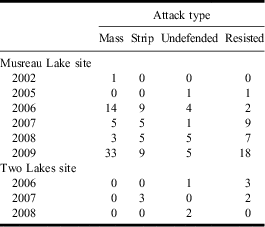
Two sites were established in mid-June 2008 near Grande Prairie, Alberta, Canada, in the beetle's recently expanded range in the lodgepole ×jack pine hybrid zone. The stand sampled at the Musreau Lake site was 9.5 ha (54.5597 N, 118.6634 W; elevation 930 m) and the stand sampled at the Two Lakes site was 6.2 ha (54.6575 N, 119.8077 W; elevation 1130 m). The average diameter of pine >10 cm in diameter at 1.3 m was 30 and 29 cm and the average age was 105 and 120 years at Musreau Lake and Two Lakes sites, respectively (Bleiker et al. Reference Bleiker, Carroll and Smith2011). Less than one tree per ha was successfully mass attacked in 2007 at both sites, indicating that populations were relatively low (Table 1). To facilitate surveys and to georeference attacked trees, a baseline was established along the edge of each stand. Transect lines 25 m apart with stations marked every 50 m along their length were flagged perpendicular to the baseline. With this system all trees were within 25 m of a station and could be easily relocated using the recorded bearing and estimated distance from the nearest station.
The number of attacked trees by year at two sites in northern Alberta, Canada recently-invaded by the mountain pine beetle.
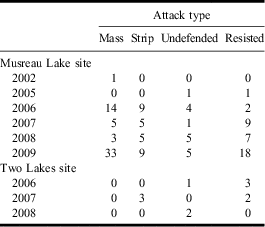
Notes: Attacked trees were classified based on the insect-host tree interaction as follows: (1) resisted (unsuccessful) attack, trees where attacking beetles were killed or repelled by the tree's resin defences or where beetles abandoned the tree after initiating attack, pitch tubes present; (2) mass attack, defended trees successfully attacked and killed by the beetle, pitch present near entrance holes; (3) strip attack, similar to mass attack except attack is limited to a portion of the circumference of the bole and insects only successfully reproduce within the necrotic tissues of the attacked portion of the bole, the tree usually lives; and (4) undefended attack, successful attack and no evidence of tree resistance, no pitch near entrance holes.
Surveys were conducted in June and September in 2008 and 2009, except no survey was conducted in September 2009 at Two Lakes because the stand was harvested unexpectedly in August. Mountain pine beetle attacks on healthy (defended) trees were easily identified by the presence of pitch tubes. Identification of attacks on weakened, essentially undefended trees required the close examination of the lower ∼3 m of the bole of every pine tree in each stand for boring dust caught in bark crevices. The texture and colour of the boring dust was used to differentiate MPB attacks from attacks by other bark beetle species. In addition, small pieces of bark were removed around the start of some galleries to identify the attacking species using gallery morphology. Adults were also collected from some galleries and identified using taxonomic keys (Bright Reference Bright1976; Wood Reference Wood1982). Representative specimens were deposited in the Canadian Forest Service's Reference Collection at the Pacific Forestry Centre in Victoria, British Columbia, Canada. We were able to determine the sequence of MPB attack relative to other bark beetle species using their life cycles in conjunction with gallery development and life stages present (Carroll et al. Reference Carroll, Aukema, Raffa, Smith and Lindgren2006).
Attacked trees were classified based on the insect-host tree interaction as follows: (1) resisted (unsuccessful) attack, trees where attacking beetles were killed or repelled by the tree's resin defences or where beetles abandoned the tree after initiating attack, pitch tubes present; (2) mass attack, defended trees successfully attacked and killed by the beetle, pitch present near entrance holes; (3) strip attack, similar to mass attack except attack is limited to a portion of the circumference of the bole (e.g., 50% or 70%) and insects only successfully reproduce within the necrotic tissues of the attacked portion of the bole, the tree usually lives; and (4) undefended attack, successful attack and no evidence of tree resistance, no pitch near entrance holes. The last class of tree – undefended attack – is the focus of this study as such attacks allow endemic MPB population to persist in an area long-term in between outbreaks. Any putatively vigour-impairing injuries (e.g., broken tops, scars, stem galls, root collar damage) were also recorded.
In September 2009, eight undefended attack trees were randomly selected for intensive sampling at Musreau Lake. Six trees were felled and the heights of the lowest and highest MPB attack were determined by removing bark where necessary to identify the attacked portion of the bole. The attacked portion of the bole was cut into 75 cm long bolts, which were sequentially numbered and the north aspect was marked. The diameter of each bolt at its mid-point was measured. Bolts were transported to the laboratory where they were autoclaved at 110 kPa and 110 °C for 1.5 hours to loosen the remaining bark for removal. We were unable to fall two trees (#30 and #107) safely, so they were sampled in the field using a tree-climbing ladder and a mallet and chisel to chip off the bark. Although sampling was not conducted at the Two Lakes site because it was harvested, we were able to find part of the lower bole of a tree left as slash at the site that was identified during the first survey as a 2006 undefended attack (Table 1). We cut a 25 by 150 cm slab from the attacked portion of the bole and transported it back to the laboratory.
For sample trees from the Musreau Lake site, the height from the base of the tree to each attack start and the total length of each egg gallery was measured. The aspect of each egg gallery was recorded as one of 16 cardinal directions. The status of the female beetle initiating each attack was recorded as being either mated or unmated based on the presence of larval galleries or egg gallery morphology (see below). We took photos of the galleries to confirm our classifications after conducting the bioassay described below. We recorded whether egg galleries had associated larval galleries and pupal chambers to assess brood development for trees attacked before 2009 because development was ongoing in 2009 attacks at the time of sampling. For the slab salvaged from the Two Lakes site, the length of egg galleries, number of attacks starts, and number of pupal chambers on the slab were determined.
Morphology of galleries constructed by mated and unmated females
The only reference we found in the literature indicating a difference between the morphology of egg galleries made by mated/unmated female MPBs was a brief statement in Reid (Reference Reid1958, Reference Reid1962) that unmated females produce a “zig-zag” or “winding” gallery. Therefore, we conducted a behavioural assay to characterise the difference and enable identification of mated/unmated females from their egg galleries alone (in the absence of larval galleries). Beetles used in the bioassay were collected daily upon emergence from infested lodgepole pine bolts cut in late September 2012 near Kelowna, British Columbia, Canada and held in rearing cages at 22 °C. Beetles were separated by sex (Lyon Reference Lyon1958) and stored in a refrigerator at ∼4 °C on moist paper towel for up to 15 days before being used in the bioassay. The bioassay was conducted on bolts ∼55 cm long cut the previous week from a healthy mature lodgepole pine tree near Jordan River, British Columbia, Canada in November 2012. The ends of the bolts were sealed with paraffin wax to prevent excessive drying and bolts were stored at 0 °C until beetles were introduced.
Newly emerged females were considered to be unmated because most females are virgins upon emergence (Bleiker et al. Reference Bleiker, Heron, Braithwaite and Smith2013). To obtain mated females, we introduced male/female pairs into a ∼1.5 cm long hole made under the bark with a 3/16-inch drill bit. The drill hole was constructed horizontally off of a 1.4 cm diameter circular arena where the outer bark and phloem were removed with an arch punch. A piece of mesh was stapled over the entire area to prevent beetles from escaping. Three days following introduction, beetles were excised from under the bark with a chisel and the female selected. These females were presumed to be mated if the male was present in the gallery. For the behavioural bioassay, four mated and four unmated females were placed into each of three bolts using the aforementioned method for a total of 12 mated and 12 unmated females. Beetles were placed systematically in each bolt as follows: two mated and two unmated females were introduced 10 cm from the bottom of the bolt at equal distances apart around the circumference of the bolt. Two mated and two unmated females were similarly introduced approximately half way up the bolt equidistance around the bolt, but with the locations staggered between the introductions below.
After 11 days, before beetles reached the end of the bolts, the phloem and outer bark were removed and the galleries were numbered and traced onto plastic transparencies. The total length of each gallery was measured on the transparency as well as the vertical distance from the start of the gallery to the top of the gallery using ImageJ software (Rasband, W.S., ImageJ, United States National Institutes of Health, Bethesda, Maryland, United States of America, http://imagej.nih.gov/ij/, 1997–2012). The proportion of vertical to total gallery length (cm) was calculated; a value of one indicated a perfectly plumb gallery.
Analysis
We calculated the attack density (number of attacks per square metre of bark surface) for 0.5 m sections of the bole from the base of the tree (0.0 m) up to 5.5 m, which was the highest point of attack on any tree. Simple linear regression was used to estimate the diameter at the mid-point of each 0.5 m section and then the surface area (SA) of each 0.5 m section was calculated using the formula for an open-ended cylinder as follows: SA = l × d × π, where l was the length of the bole section (0.5 m) and d was the diameter at the mid-point of the section. A nonparametric Kruskal–Wallis (K–W) test was used to test for differences in attack density with height on the bole for all trees except trees 112 and 307 because they only contained one and two attacks, respectively. A Nemenyi test, a nonparametric test similar to Tukey's honestly significant difference test, was applied as a multiple comparison post hoc test (Zar Reference Zar1996). To examine the within-tree distribution of attack starts, Morisita's index of aggregation (I M) (Morisita Reference Morisita1962) was calculated for each tree that had three or more attacks. Morisita's index is considered to be a better measure of departure from randomness than the variance:mean ratio for theoretical reasons and has been used in a variety of applications, including assessing the spatial distribution of bark beetle attacks on trees (Raffa and Berryman Reference Raffa and Berryman1983) and analysing the spatial distribution of montane unicorn populations among countries (Hurlbert Reference Hurlbert1990). Morisita's index was calculated using the following formula: I M = n(sum[x 2i] – sum[xi])/(sum[xi]2 – sum[xi]), where xi was the abundance and n was the number of log quadrats. We divided the tree bole into 0.5 m vertical quadrats at each of the 16 cardinal directions. A value of zero indicates a uniform distribution, a value of one indicates a random distribution and higher values tend towards a clustered distribution (Morisita Reference Morisita1962).
Correlation analysis was used to test for an association between mean egg gallery length for a tree and mean attack density for each of the seven trees that had two or more attacks. For the correlation analysis, attack density for the entire attacked section of the bole was calculated similar to the method for calculating the attack density in the 0.5 m bole sections. The diameter of each tree at the mid-point between the highest and lowest attack was estimated using simple linear regression and the surface area of the attacked portion of each tree was calculated using the formula for an open-ended cylinder. The total number of attack starts on each tree was then divided by the surface area of the tree between lowest and highest points of attack.
A visual assessment was made of the tracings of the galleries constructed by mated and unmated females in the bioassay. In addition, a t-test was used to test for a difference in the arc-sine square root transformed proportion of vertical to total gallery length made by mated and unmated females. Statistical analyses were done using Microsoft Excel 2003 (Microsoft. Redmond, Washington, United States of America), R version 2.15.0 (R: A Language and Environment for Statistical Computing, R Development Core Team, Vienna, Austria) or JMP version 10 (SAS Institute Inc., Cary, North Carolina, United States of America).
Results
Musreau Lake site
We located a total of 137 trees that suffered some form of MPB attack between 2002 and 2009 (Table 1). The only evidence of MPB activity in the stand before 2006 was one mass attacked tree from 2002 and one resisted and one undefended attack from 2005. These attacks were presumably the result of long-distance immigration events that occurred in each of those years (Bleiker et al. Reference Bleiker, Carroll and Smith2011). The number of attacked trees increased in 2006, likely due to another long-distance immigration event; similarly, in 2009 the region suffered another larger immigration event with the number of trees attacked being more than four times what was expected based on the within-stand population (Bleiker et al. Reference Bleiker, Carroll and Smith2011). However, even in 2006 and 2009 beetle population densities were relatively low with <1.5 and 3.5 mass attacked trees per ha, respectively. The high proportion of attacked trees each year that were resisted, strip or undefended attacks suggests that populations were relatively low and just reaching a level sufficient for successful aggregation and mass attack. We considered the population to be at endemic or incipient levels throughout the study (Table 1).
We located 16 trees that were classified as undefended attacks between 2005 and 2009 (Table 1). However, the number of undefended attacks before 2008 may be underestimated because the boring dust in bark crevices disappears over time. The eight trees selected for sampling all had signs of potentially impaired vigour, such as basal scars, thin crowns and significant root collar damage from Hylobius warreni Wood. We were able to determine the relative sequence of MPB and secondary bark beetle attack for six of the trees. With the exception of tree 107, MPB attack was always preceded by attack from one or more species of secondary bark beetles, with the most common species being Orthotomicus latidens (LeConte), Dendroctonus murrayanae Hopkins, and Hylurgops LeConte species. The tree that was not attacked by secondary bark beetles prior to MPB attack (tree 107) had a broken top and a portion of the crown was missing.
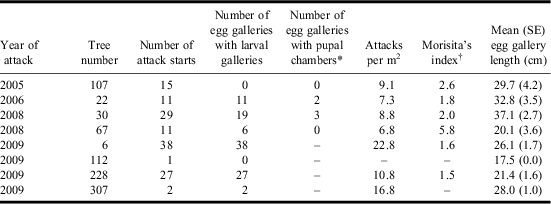
The total number of attacks per tree varied from one to 38 (Table 2). The attack density over the attacked portion of the bole for the seven trees that had more than one attack varied from 6.8 to 22.8 attacks/m2 with a mean (SE) of 11.8 (2.2) attacks/m2. Attack densities were greatest between a height of 1.0 and 2.5 m on the tree. However, the only significant differences in attack densities were between the 1.0–2.0 m sections versus the 0.0–0.5 m and 4.5–5.5 m sections and additionally between the 1.5–2.0 m section versus the 0.0–0.5, 3.5–4.0 and 4.5–5.5 m sections (Fig. 1) (K–W test, P < 0.0001, Nemenyi test at α = 0.05). Morisita's index for the six trees that had more than two attacks ranged from 1.5 to 5.8 indicating that the distribution of attacks tended towards clustered (Table 2). There was no apparent association between attack density and the distribution of attacks (Table 2). In addition, MPB displayed no clear preference for a particular aspect of the bole on which to initiate attack although a portion of each tree's circumference always had a relatively low number of starts or was devoid of starts altogether (Fig. 2).
Characteristics of attacks made by mountain pine beetles from low or endemic populations at the Musreau Lake research site in northern Alberta, Canada.
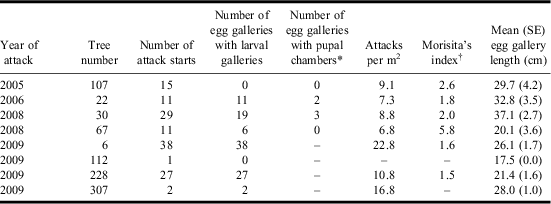
Notes: *Larval development was ongoing for trees attacked in 2009 at the time of sampling, but egg lay and hatch were complete in these trees.
†A value of zero indicates a uniform distribution, a value of one indicates a random distribution and higher values tend towards a clustered distribution (Morisita Reference Morisita1962).
Mean (SE) density of attacks made by mountain pine beetles from low or endemic populations on undefended trees. Data are presented by height interval (m) on the boles of seven sample trees at the Musreau Lake research site in northern Alberta, Canada. Tree 112 was excluded because it only had one attack start. Bars with the same letters indicate no statistical difference (Nemenyi test, α = 0.05).

Location of attacks made by mountain pine beetles around the circumference of undefended trees at the Musreau Lake research site in northern Alberta, Canada. Trees 112 and 307 were excluded because they only contained one and two attacks, respectively.
A total of 134 attack starts were found on the eight trees (Table 2). Individual egg gallery lengths ranged from 2.0 to 82.0 cm long with a mean (SE) of 28.0 (1.1) cm. There was no association between mean egg gallery length for a tree and mean attack density for a tree for the seven trees that had more than one attack start (r = −0.17, P = 0.78) (Table 2).
The laboratory behavioural bioassay found that the ratio of vertical to total gallery length was higher for mated than unmated females (mean (SE) mated = 0.97 (0.01); unmated = 0.82 (0.04); t-test, t = 5.65, df = 13, P = <0.0001). The egg galleries of mated and unmated females were easily differentiated visually based on form once galleries were longer than ∼5 cm (Fig. 3).
Morphology of egg galleries constructed by mated and unmated female mountain pine beetles. (A) Vertical egg gallery constructed by a mated female; and (B) the short “zig-zag” egg gallery produced by an unmated female. The black line highlights the egg gallery, the circle indicates the start of the gallery and the triangle is the gallery terminus.
At least 133 of the 134 egg galleries on our putatively undefended attacks were constructed by mated females. We were unable to determine the status of a female that constructed a 2-cm long gallery, which had no associated larval galleries. Three other galleries were also too short to determine the female's status based on gallery form, but all of these galleries had larval galleries present and were thus classified as being constructed by mated females. Larval galleries were associated with 103 (77%) of the egg galleries, but often only a few larval galleries were present (Fig. 4A) (Table 2). Brood development was complete in the four trees attacked before 2009 at the time of sampling, but pupal chambers were rare. Only three of the 29 galleries on tree 30 and two of the 11 galleries on tree 67 produced pupal chambers. Brood development was ongoing in the four trees attacked in 2009 at the time of sampling.
Mountain pine beetle galleries on undefended trees with varying levels of productivity. (A) Short egg gallery (open arrow) with only six larval galleries (solid arrows) (larvae were still developing at the time of sampling but egg lay and hatch were complete); and (B) partial egg gallery (open arrow) with numerous larval galleries and pupal chambers, a few of which are marked with an “x”.
Two Lakes site
The first sign of MPB activity at this site was in 2006 when four trees were attacked; three of the trees were resisted attacks and one tree was undefended (Table 1). A few trees were attacked in each of 2007 and 2008, but beetle populations were apparently too low for insects to successfully aggregate and mass attack a tree; attacked trees were resisted, strip or undefended attacks (Table 1). All three trees with undefended attacks had putatively vigour-impairing injuries similar to those at the Musreau Lake site; however, the injury to the 2006 undefended attack was severe and noteworthy. The stem had broken at ∼6 m and the entire crown of the tree lay on the ground; this would have severely compromised the tree's defences. Since all of the secondary bark beetle species in the system are early spring attackers, the crown likely broke off in the summer just before MPB attack; if the crown had been lost over the winter, the tree would have been colonised by secondary bark beetles that fly earlier than MPB (explained in Carroll et al. Reference Carroll, Aukema, Raffa, Smith and Lindgren2006). This was likely a rare situation where a high-quality, healthy tree suddenly suffered an acute stress that compromised its defences and the habitat had not degraded substantially through the effects of stress and desiccation at the time of MPB attack. Both the 2008 undefended attacks were infested with secondary bark beetles before MPB attack.
The Two Lakes site was unfortunately harvested before MPB's flight in 2009, thus we were not able to fall and sample the three undefended attacks that were found (Table 1). However, we were able to locate a section of the lower bole from the 2006 undefended attack and salvage a 25 cm wide by 150 cm long slab from the attacked side of the lower bole of the tree. The 0.38 m2 slab contained two complete egg galleries that were 98 and 134 cm long and produced ∼101 and 144 pupal chambers, respectively (Fig. 4B). Portions of two additional egg galleries were contained on the slab, including the start of each gallery, giving an attack density of 10 attacks/m2. Based on the number of pupal chambers on the entire slab and given that two-thirds of offspring are female (Safranyik and Carroll Reference Safranyik and Carroll2006) this small section of tree that contained approximately half of the attacks on this tree, produced ∼660 females/m2. This tree was likely relatively healthy before the entire crown broke off because it had not been attacked by secondary bark beetles.
Discussion
The population phases of MPB are difficult to define in terms of absolute beetle densities because they are characterised by the insect-host tree interaction, which will be influenced by factors that affect tree health and defence. Definitions vary based on the type of attack and density of attacked trees. Endemic MPB populations were classified by Carroll et al. (Reference Carroll, Aukema, Raffa, Smith and Lindgren2006) as having a beetle density below the threshold needed to successfully coordinate a mass attack on at least one tree per hectare (estimated at ∼40 female beetles per hectare). Boone et al. (Reference Boone, Aukema, Bohlmann, Carroll and Raffa2011) considered populations to be endemic if less than five trees of any size per ha showed signs of attack, including resisted attacks and low density attacks on low vigour hosts. However, Amman (Reference Amman1984) considered MPB populations to be in the endemic state if less than one large diameter tree in 40.5 ha was mass attacked. Other studies investigating potential interactions between endemic populations and tree diseases did not provide a definition, but beetle densities were apparently high enough to result in a number of mass attacks within relatively small sample plots (Tkacz and Schmitz Reference Tkacz and Schmitz1986; Bartos and Schmitz Reference Bartos and Schmitz1998). While some of these authors vary in their definition of endemic populations, they all agree that there is a density-dependent shift in host selection behaviour by the beetle. Beetles from low density populations prefer nondefended host trees, while beetles from high density populations prefer well-defended trees (Boone et al. Reference Boone, Aukema, Bohlmann, Carroll and Raffa2011).
For the purpose of our study on the characteristics of attacks made by low or endemic populations, we focused on trees that failed to mount a significant defence response because these are the hosts that MPB persists in when populations are too low to successfully aggregate on healthy, defended trees. Beetle populations never breached the threshold needed to coordinate a successful mass attack at the Two Lakes site during this study. At the Musreau Lake site, attacks on undefended trees occurred every year between 2005 and 2009 inclusive, even though immigration events in 2006 and 2009 contributed enough beetles to mass attack one or more trees per ha in those years. Undefended trees that were attacked in one of the two years where long-distance immigration into the area occurred could have been perpetrated by the resident population if their flight period did not coincide with arrival of the immigrants. Alternatively, some beetles in a population may preferentially attack weakened trees due to genetically based host selection behaviours (Wallin and Raffa Reference Wallin and Raffa2004). Regardless, populations were relatively low at both sites throughout the study.
Impaired vigour of trees with undefended attacks was evidenced by their prior attack by secondary bark beetles, which only inhabit severely weakened trees. Attack by secondary bark beetles further weakens the defences of the already-vulnerable trees (Boone et al. Reference Boone, Aukema, Bohlmann, Carroll and Raffa2011). The two trees that were not attacked by secondary bark beetles before MPB attack had compromised defences because part or all of their crowns had been lost before MPB attack. Mountain pine beetle attack densities were extremely low on undefended attacks. At the Musreau Lake site the maximum attack density over the entire attacked portion of the bole was only 22.8 attacks/m2 and the average attack density for trees with more than one attack was 11.7 attacks/m2. In comparison, at the same site Bleiker et al. (Reference Bleiker, Carroll and Smith2011) reported that the mean attack density for mass attacked trees at 1.4 m ranged from 54–95 attacks/m2 over a three-year study. Raffa and Berryman (Reference Raffa and Berryman1983) reported that the optimal attack density for MPB attacking lodgepole pine in the northwestern United States of America was ∼62 attacks/m2. The authors proposed the trade off between the density required to overwhelm tree defences and minimising intraspecific competition determined this optimal attack density.
Most attacks on undefended trees occurred on the lower 3.0 m of the bole (Fig. 1), which is consistent with mass attacked trees (reviewed in Safranyik and Carroll Reference Safranyik and Carroll2006). This is likely because the main factors that govern attack height are independent of population density. Attack height is largely governed by the high availability of suitable bark niches for beetles to initiate attack on the lower bole (Safranyik and Vithayasai Reference Safranyik and Vithayasai1971); the high landing rate of attacking beetles on the branch-free portion of the bole and how far up the bole beetles that fall to the ground during the attack process walk (L. Safranyik, unpublished data, personal communication). There was no clear association between attack density and aspect for undefended attacks (Fig. 2). This is in contrast to mass attacked trees where attack densities are highest on the north side of the tree, lowest on the south side, and intermediate on the east and west sides of the bole (Reid Reference Reid1963; Shepherd Reference Shepherd1966; Safranyik and Vithayasai Reference Safranyik and Vithayasai1971). Mountain pine beetle's well-known preference for attacking the cooler, shadier side of the bole may be because heat and sunlight stimulate flight and are greatest on the south side of the tree (Shepherd Reference Shepherd1966). If undefended trees tend to be suppressed and shaded this factor would be eliminated and attacks should be uniform around the bole. However, the distribution of attacks tended towards clustered (Table 2) and one side of the bole always appeared to have a relatively low number of attacks or not be attacked at all (Fig. 2). This may be due to a portion of the tree's circumference being rendered unsuitable for MPB because it was already occupied by secondary bark beetles or uninhabitable due to an injury and degraded, dry or necrotic phloem (Reid Reference Reid1961).
The bioassay demonstrated that galleries constructed by mated and unmated females can easily be distinguished by the naked eye once they were more than ∼5 cm long (Fig. 3). The morphology of virtually all of the egg galleries indicated that they were constructed by mated females, so there was no evidence that low or endemic populations of MPB suffer from an Allee effect associated with mate location. Aggregation pheromones facilitate mate location in this system. However, host tree terpenes also play a role in attraction and are likely higher in healthy trees and male response to pheromones is also dose dependent (Raffa and Berryman Reference Raffa and Berryman1983; Miller and Borden Reference Miller and Borden2000). Yet even in the case where only one and two attacks occurred on an individual tree, the females were mated. Preemergence mating rates in MPB are generally low (2–12%; Bleiker et al. Reference Bleiker, Heron, Braithwaite and Smith2013), thus, females were likely mated in the new host tree and not the natal host tree. Males will exit the gallery of a female after mating and enter the gallery of an unmated single female, which would promote mate availability (Safranyik and Carroll Reference Safranyik and Carroll2006). The 31 galleries that did not produce any larvae were concentrated on just a few trees (Table 2). These trees may have been attacked late in the season. Females may have constructed galleries without laying eggs if temperatures were above the threshold required for feeding or mining in the phloem but below the threshold required for oviposition (Reid Reference Reid1962). Any eggs that were laid may have perished during the winter.
The length of egg galleries varied, but the average length of galleries at Musreau Lake (28 cm) was within the 25–30 cm range reported by Safranyik (Reference Safranyik1989). Factors such as time of attack, temperature, tree defences, and phloem quality govern the length of egg galleries (Reid Reference Reid1962; Amman Reference Amman1980). Egg galleries on the 2006 undefended attack from the Two Lakes site were more than three times as long. Females construct short galleries in poor quality phloem and will even abandon poor quality hosts (Amman Reference Amman1980); however beetles will construct very long galleries under favourable conditions (Safranyik and Carroll Reference Safranyik and Carroll2006). This indicates that the tree at Two Lakes likely possessed the characteristics of an ideal host and the exceptional productivity of the tree (123 pupae per female) supports this conclusion. Considering that a female beetle lays on average 60 eggs and may lay as many as 200 eggs under ideal conditions (Reid Reference Reid1962), the tree at Two Lakes had exceptional productivity and survival. High productivity could be a function of the näivety of the trees in the new habitat (sensu Cudmore et al. Reference Cudmore, Björklund, Carroll and Lindgren2010); however, only 76% of egg galleries at the Musreau Lake site produced larvae. Furthermore, for the four trees in which the life cycle was complete at the time of sampling, development only reached the pupal stage in five galleries. This suggests that the Two Lakes tree possessed certain characteristics of an ideal, but rarely available, habitat resource. Trees suffering from long-term stress, such as competition, may be poor quality hosts due to thin phloem, poor nutrition and the presence of secondary bark beetles (Amman Reference Amman1972; Safranyik and Carroll Reference Safranyik and Carroll2006). Berryman (Reference Berryman1976) hypothesised that an acute stress event may allow beetles access to an otherwise inaccessible host and lead to increased beetle production. Indeed, lightning struck trees may serve as refugia and outbreak centres for the southern pine beetle, Dendroctonus frontalis Zimmermann (Coulson et al. Reference Coulson, Flamm, Pulley, Payne, Rykiel and Wagner1986; Flamm et al. Reference Flamm, Pulley and Coulson1993). The tree at Two Lakes was putatively healthy until the sudden removal of the entire crown just before MPB's flight, but presumably after most secondary beetles had dispersed. This would have allowed MPB to access a high-quality habitat with negligible defences and with little intraspecific or interspecific competition.
Attacking living trees en masse allows high density populations of MPB access to high-quality phloem resources in living defended trees. Low or endemic populations are regulated by host resistance (Raffa and Berryman Reference Raffa and Berryman1983) and restricted to weakened trees, where there is likely a trade off between reduced defences and phloem quality for brood development. While low reproductive success may be normative for endemic MPB populations (Safranyik and Carroll Reference Safranyik and Carroll2006), our study demonstrates that they are capable of high population growth rates in good quality hosts that suffer a sudden stress event as hypothesised by Berryman (Reference Berryman1976). However, this conclusion is based on only one such host tree. High quality, suddenly defenceless hosts, may be quite rare or ephemeral in nature, but could play a role in the transition of endemic to incipient population levels under the right circumstances (Berryman Reference Berryman1976). Drought stress has long been linked to MPB outbreaks through its effect on tree defences (e.g., Craighead Reference Craighead1925; Beal Reference Beal1943), but drought has not always resulted in epidemics. The endemic-incipient trigger is significant as it allows MPB to transition from being a culler of weak trees to a primary mortality agent. To fully understand the dynamics of this eruptive species, we need to further elucidate the forces that allow endemic populations to increase and breech the threshold required to coordinate mass attacks on healthy, defended trees.
Acknowledgements
The authors thank L. Safranyik for helpful discussions on endemic MPB population dynamics and feedback on this manuscript. They also thank G. Dalrymple, J. Vallentgoed, and K. Pellow for their help in the field; D. Letourneau for help locating field sites; J. Smith and H. Douglas for their help identifying secondary bark beetle species, and V. Nealis, R. Alfaro, and two anonymous reviewers for reviewing the manuscript. This study was conducted as part of a larger study funded by Foothills Research Institute, Natural Resources Canada, and the provinces of Alberta, Saskatchewan, Manitoba, and Ontario, Canada through Spray Efficacy Research Group International and Forest Protection Limited.