INTRODUCTION
Chamelea gallina (L., 1758) is a well-known bivalve species wide-spread all over the coasts of the Mediterranean and the Black Sea (Fischer et al., Reference Fischer, Bauchot and Schneider1987). According to the official data given 47215 tonnes of C. gallina were produced in Turkey during 2007 (Anonymous, 2008a). Although C. gallina lives in all coastal waters of Turkey, all the current production originates from the Black Sea coasts (Dalgıç & Okumuş, Reference Dalgıç and Okumuş2006). Since there is no domestic consumption the majority of production is exported to EU countries as frozen or canned goods.
Sustainable management of fisheries requires thorough knowledge of the population characteristics (especially annual growth and age at the first sexual maturity) of each aquatic organism. Owing to this the age and the growth of C. gallina living at different areas of the world have been studied with various methods including size–frequency distribution analysis, surface shell rings, shell thin sections and acetate peels (e.g. Ramon & Richardson, Reference Ramon and Richardson1992; Polenta, Reference Polenta1993; Arneri et al., Reference Arneri, Giannetti, Polenta and Antolini1995; Deval, Reference Deval1995; Gaspar et al., Reference Gaspar, Pereira, Vasconcelos and Monteiro2004).
As C. gallina is an infaunal (vagile) species, it has to be studied locally. Although studies have determined the biometrics, age determination, reproduction and the status of the stocks of the commercially fished C. gallina from Turkish coasts (Oray et al., Reference Oray, Cebeci and Deval1992; Cebeci, Reference Cebeci1994; Deval & Oray, Reference Deval and Oray1998; Deval, Reference Deval2001; Tunçer & Erdemir, Reference Tunçer and Erdemir2002; Köseoğlu, Reference Köseoğlu2005), very few of these studies were performed on the Black Sea stocks (Deval, Reference Deval1991; Dalgıç & Karayücel, Reference Dalgıç and Karayücel2007).
Bivalve growth varies with respect to environmental conditions (food availability, type of substratum, depth, light and salinity) and ‘stressful activities’ such as spawning (Gaspar et al., Reference Gaspar, Pereira, Vasconcelos and Monteiro2004). To date no research has been conducted on the possible impact of fishing on growth of C. gallina. However, studies investigating the impacts of fishing on growth rates of other aquatic organisms have increased in recent years, with some authors suggesting that fishing has caused declines in growth and size or age at maturity (Ricker, Reference Ricker1981; Olsen et al., Reference Olsen, Heino, Lilly, Morgan, Brattey, Ernande and Dieckmann2004; Jorgensen et al., Reference Jørgensen, Enberg, Dunlop, Arlinghaus, Boukal, Brander, Ernande, Gårdmark, Johnson, Matsumura, Pardoe, Raab, Silva, Vainikka, Dieckmann, Heino and Rijnsdorp2007; Koeller et al., Reference Koeller, Fuentes-Yaco and Platt2007; Swain et al., Reference Swain, Sinclair and Hanson2007), conversely, others suggest the reverse (Rijnsdorp & van Leeuwen, Reference Rijnsdorp and Van Leeuwen1996; Pastoors et al., Reference Pastoors, Rijnsdorp and Van Beek2000).
In this study we aim to estimate the age and growth of C. gallina from the Black Sea coasts of Turkey and discuss the effect of fishing on the growth of this species.
MATERIALS AND METHODS
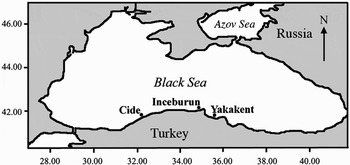
The easternmost station, Yakakent (41°.37′N–35°.32′E), is situated near Samsun, the biggest city of the Black Sea. The area is subjected to uninterrupted hydraulic dredging except seasonal closures have been instigated since 1998; therefore, this station was classified as ‘dredged’. The second station, Inceburun (42°01′N–34°54′E) is located near the city of Sinop. This area of the Black Sea coast was closed for hydraulic dredging for the duration of this study and has never previously experienced dredging, therefore, this site was classified as ‘non-dredged’. Cide, the westernmost station (41°.53′N–32°.56′E), which borders Kastamonu was subjected to hydraulic dredging between 1997 and 2000. However, from 2000 and 2002 it was left to fallow. Samplings were performed during the commercial dredging season; therefore, this station was classified as ‘closed’ (Figure 1).
Sampling stations (non-dredged (Inceburun); dredged (Yakakent); closed area (Cide)).

Sampling stations were relatively close (~220 km). Güneroğlu (Reference Güneroğlu2007) has reported that chlorophyll-a levels, temperature and salinity of these three stations were homogeneous.
Monthly sampling was performed between January and May 2002; when the seawater temperatures were at their lowest, traditional dredge (rake) modified with a small mesh size (3 × 3 mm) on sandy sediments between 5 and 15 m depth was employed to catch specimens.
During the study a total of 2452 specimens were sampled. For each individual, the shell length (maximum distance along the anterior–posterior axis), shell height (maximum distance from umbo to the ventral margin) and width were measured to the nearest 0.01 mm accuracy with a digital Vernier calliper. The weight of each individual was conducted on a top loading digital balance with a precision of 0.01 g. After measuring, both valves were numbered for further processing. In order to compare the length–frequency differences obtained at the three sites a non-parametric (Kolmogorov–Smirnov) test was used.
The left valves of C. gallina from each site were sectioned and emeried according to the technique described by Clark II (Reference Clark II, Rhoads and Lutz1980) and applied by Arneri et al. (Reference Arneri, Froglia, Polenta and Antolini1997). Once prepared, the preparrats were examined under light microscope using objectives of 4X and 10X in order to determine the seasonal growth rings.
For each seasonal growth ring, the distance between the umbo and the ring of 307 specimens (20 shells from each monthly sample obtained from three sampling stations) was marked and measured using a digital Vernier calliper (Gaspar et al., Reference Gaspar, Pereira, Vasconcelos and Monteiro2004). In the investigations y = a + bx regression model was used for height–length variations of C. gallina, as the measurements were relative to shell height. Von Bertalanffy growth (VBG) functions were fitted to each of the three sets of length at age data using non-linear regression (Ford–Walford method), which provides estimates of the parameters in the VBG equation (Ricker, Reference Ricker1975):

where L t = length at age t (mm); L ∞ = theoretical maximum length (mm); K = Von Bertalanffy growth constant; and t0 = theoretical age at zero (years). In order to compare the growth curves, Hotelling's multivariate T2 test was applied as proposed by Cerrato (Reference Cerrato1990).
RESULTS
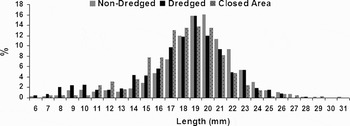
The minimum, maximum and the mean lengths of C. gallina sampled from three stations (closed area (N = 424), non-dredged (N = 1432) and dredged (N = 596)) were 18.48±0.16 (7.4–29.1) mm, 19.56±0.09 (6.3–31.5) mm and 18.45±0.16 (6.5–28.7) mm (±SE), respectively. Significant differences (Kolmogorov–Smirnov, P < 0.05) were found between the length–frequency distribution of the samples from dredged and closed area with non-dredged. No significant differences were detected between the dredged and closed area samples (P > 0.05). The length–frequency distributions are given in Figure 2.
The length–frequency of Chamelea gallina from three stations of the Black Sea.

There was a linear relationship among length, height and width with total weight for C. gallina from all stations. However, the relationship of the dimensional and the weight parameters was exponential. Allometric growth was present between the two length (b ≠ 1) and length/weight (b ≠ 3) variables.
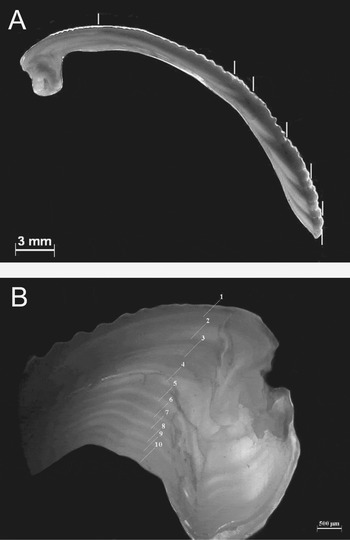
In the shell sections of C. gallina, two growth bands (a narrow opaque and a wide translucent) are seen (Figure 3A). As these bands were deposited parallel to the ventral edge of the shell they could also be seen in the umbonal region in a limited number of specimens (Figure 3B).
Ground and polished shell section (Sinop, 23.2 mm) (A) and umbonal region (B) of different Chamelea gallina specimens.

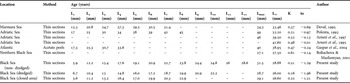
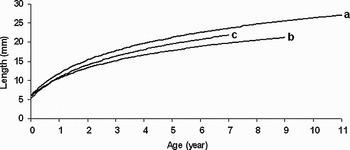
The Von Bertalanffy growth curve parameters, asymptotic length (L∞), growth coefficient (K), theoretical age at length zero (t0) and age-ranges of the specimens are given in Table 1. The oldest specimens came from the non-dredged and dredged sites (11 and 9 years, respectively) but specimens as old as 7 years were found in all stations.
Chamelea gallina length-at-age, L∞, t0 and K values with distinct ageing techniques in different geographical areas.

Growth curves of C. gallina from three sampling sites (Figure 4) indicate that C. gallina grew faster at the non-dredged site than those of closed area and dredged sites. Hotelling's T2 test for the statistical comparison of the Von Bertalanffy growth curves showed significant differences (P<0.001) between non-dredged and both dredged and closed area sites. There was also a significant difference (P < 0.05) between dredged and closed area sites.
Von Bertalanffy growth curves for the three sampling sites: (a) non-dredged; (b) dredged; (c) closed area.

DISCUSSION
Due to the economic importance of C. gallina, many studies have investigated the biometrics of samples from the Mediterranean basin including the Black Sea. Maximum shell length was reported as 38 mm on the Galicia coast (Köseoğlu, Reference Köseoğlu2005), 36.9 mm in southern Marmara Sea (Tunçer & Erdemir, Reference Tunçer and Erdemir2002), 32.2 mm on western Black Sea (Deval, Reference Deval1991) and 30 mm on eastern Black Sea coast (Dalgıç & Karayücel, Reference Dalgıç and Karayücel2007). In the present study, the maximum length was found as 31.5 mm from the non-dredged sites. The differences at mean lengths between dredged and closed area with non-dredged sites stocks would be expected as a result of commercial hydraulic dredging (Rochet, Reference Rochet1998). Similar results were also reported from exploited populations of the Marmara Sea and the Adriatic Sea (Cebeci, Reference Cebeci1994; Arneri et al., Reference Arneri, Froglia, Polenta and Antolini1997). The non-existence of significant differences in shell length between the dredged and closed area is evidence that there was an insufficient duration (two years) of the closure season. However, in 2008 the closure season was extended to four years by the Ministry of Agriculture and Rural Affairs in Turkey and as a result a complete recovery is expected (Anonymous, 2008b).
In terms of the relationships between the weight and dimensional parameters, calculated from regression and correlation analyses, the growth was determined to be allometric. The growth of C. gallina studied in various locations including the Black Sea was also allometric (Deval, Reference Deval2001; Gaspar et al., Reference Gaspar, Santos and Vasconcelos2001; Dalgıç & Karayücel, Reference Dalgıç and Karayücel2007).
Previous studies on C. gallina have reported that the formation of hyaline bands, which associate with a cleft, occur in autumn and winter months, when seawater temperature decreases in the Atlantic (Gaspar et al., Reference Gaspar, Pereira, Vasconcelos and Monteiro2004), Adriatic Sea (Polenta, Reference Polenta1993; Arneri et al., Reference Arneri, Giannetti, Polenta and Antolini1995), Marmara Sea (Deval, Reference Deval2001) and the northern Black Sea (Boltachova & Mazlumyan, Reference Boltachova and Mazlumyan2001). These validations have been assumed to apply to C. gallina from the southern Black Sea. Estimated growth parameters and age of C. gallina using internal growth bands from other studies with present study are given in Table 1. Chamelea gallina in the southern Black Sea has a lower growth rate and attains a smaller size at the same ages in comparison with other areas. The differences reported are probably due to the local environmental conditions of the Black Sea. It is known that temperature, salinity, type of sediment and food availability may affect bivalve growth rates. Surface seawater temperature, salinity and chlorophyll-a values fluctuate in the Black Sea between 5 and 25°C, 17.34 and 17.97‰ and 0.24 and 2.24 mgm−3, respectively (Dalgıç, Reference Dalgıç2006). The values are lower in the Black Sea than those obtained from the Marmara Sea (7–27°C, 21–26.2‰ and 3.42–6.56 mgm−3), Adriatic and Western Mediterranean (33–38‰ and 7–33°C) (Gözler, Reference Gözler1997; Ramon & Richardson, Reference Ramon and Richardson1992; Marano et al., Reference Marano, Casavola, Saracino and Rizzi1982).
In this study, growth curves of C. gallina obtained from dredged, non-dredged and closed area showed significant differences. The growth of C. gallina at non-stressed (non-dredged) site was better than stressed (dredged) and closed area. Recently the environmental conditions of these three stations were reported and similar conclusions drawn by Güneroğlu (Reference Güneroğlu2007). Therefore the major difference between the sampling sites can be assumed to be fishing pressure. Recently a reduced growth rate related with beam trawling has been reported for plaice (Pleuronectes platessa) in the North Sea (Pastoors et al., Reference Pastoors, Rijnsdorp and Van Beek2000). Fishing has three types of effects on fish population dynamics: (i) direct effects on population density and on the mean size of individuals; (ii) short-term environmental effects on growth and reproduction, mediated by phenotypic plasticity and density-dependent mechanisms; and (iii) long-term effects due to the selective pressure imposed by harvesting (Rochet, Reference Rochet1998).
The results of this study indicate that specimens of C. gallina located within a closed area exhibited a reduced growth rate compared to non-dredged stock which may be explained by the shortness of closure season. Nevertheless, in light of these results we suggest that fallowing is the major precaution for the recovery of C. gallina stocks in the Black Sea.
ACKNOWLEDGEMENTS
We thank Dr Enrico Arneri, Dr Kadir Seyhan and two anonymous referees for their valuable suggestions which have improved the manuscript. James Tweedley reviewed the English version of the manuscript. The present study received financial support from Karadeniz Technical University (Trabzon, Turkey).