Introduction
East Anglian English was the first British variety of English to be subject to dialectological scrutiny using sociolinguistic techniques (Trudgill, Reference Trudgill1974, and his subsequent work) and since then has been subject to only sporadic investigation (e.g. Britain, Reference Britain1991, Reference Britain2014a, Reference Britain, Watt and Llamas2014b, Reference Britain and Hickey2015; Kingston, Reference Kingston2000; Straw, Reference Straw2006; Amos, Reference Amos2011; Potter, Reference Potter2012, Reference Potter2018; Butcher, Reference Butcher2015). Recent research has suggested that, in those few locations that have been investigated, East Anglian English is gradually losing some of its traditional dialect features, in favour of forms from the South East more generally. Kingston (Reference Kingston2000), Britain (Reference Britain2014a) and Potter (Reference Potter2018) all found, for example, a rather steep decline in the use of East Anglia's traditional third-person present-tense zero. Furthermore, we are aware of the arrival into East Anglia of linguistic innovations from the South East of England, such as TH fronting (Trudgill, Reference Trudgill1988; Britain, Reference Britain2005; Potter, Reference Potter2012) and /l/ vocalisation (Johnson & Britain, Reference Johnson and Britain2007; Potter, Reference Potter2014), but we only know about their success in a few parts of the region – Norwich, East Suffolk and the Fens. Since Trudgill's investigations across East Anglia in the 1970s, however (e.g. Trudgill & Foxcroft, Reference Trudgill, Foxcroft and Trudgill1978), and despite a few multilocality studies (Britain, Reference Britain1991, Reference Britain2014a; Potter, Reference Potter2018) no research has been able to provide a picture of the state of the traditional dialect across the whole region. We have therefore only a patchy understanding of the extent to which traditional dialect obsolescence, dialect levelling and innovation diffusion have impacted the dialect landscape of this region as a whole.
In order to do just this, however, we report here on the East Anglian results from the English Dialects App (EDA). A smartphone application launched in January 2016 and designed to crowdsource dialect data (see Britain, Kolly & Leemann, Reference Britain, Kolly, Leemann, Macintyre and Price2018, and Leemann, Kolly & Britain, Reference Leemann, Kolly and Britain2018, for an overview of the development, structure and evaluation of the app as well as its impact and reception by the media) enabled us to shed new light on national but also regional dialect distributions of 26 linguistic variables. Since its launch, the EDA has been downloaded 100,000 times, and more than 50,000 people from nearly 5,000 locations around the UK have provided information on their own use of phonological, morphosyntactic and lexical variables, together with important social background information.
A number of the variables tapped by the EDA – phonological and morphosyntactic as well as lexical - are especially relevant to understanding the state of traditional dialect in East Anglia, and we focus on these in this article. These include phonetic and phonological variables such as the choice of vowel in unstressed checked final syllables (as in wanted, bucket and bushes), and the use of so-called ‘intrusive r’ (in words and collocations such as ‘thawing’ and ‘saw under’), morphological variables such as third-person present-tense singular marking, and lexical variation for concepts such as splinter and snail. The app is also able to shed light on the inroads being made into East Anglia by innovations such as TH fronting – the use of [f] for /θ/ and [v] for non–initial /ð/. Because the EDA also collected social background information from users, it enables us also to consider ongoing change by comparing speakers of different ages, following the apparent time model (Labov, Reference Labov1966). Our dataset is able therefore to address whether East Anglia's traditional dialect is undergoing continued attrition. Our report on the EDA results in East Anglia, then, provides an analysis of regional scope but is also able to provide a recent diachronic perspective on traditional dialect use too. We begin by briefly describing the app, and then present results from six linguistic variables, as used by app users across East Anglia.
The English Dialects App
The English Dialects App is a smartphone application that aimed to both engage the public of England about language variation and, at the same time, crowdsource present-day dialect data. It was released in January 2016.Footnote 1 It has two core components – dialect recordings and a dialect quiz. The dialect recordings part of the app enables users to upload recordings of themselves reading a short version of the ‘Boy who cried wolf’ story. They can also listen to recordings, not only those submitted by other users, but also those of speakers from the pioneering nationwide Survey of English Dialects (SED) (Orton et al., Reference Orton1962–1971) from the mid-20th century. For this article, however, we used results gleaned from an analysis of the dialect quiz data.
In the quiz, users are asked to indicate which variant of 26 linguistic variables – phonetic, phonological, morphosyntactic and lexical – they themselves use. Each screen in the quiz (see Figure 1 as an example) prompted users to either answer a question, or complete a fill-the-gap task. The possible answers were listed below the question. For phonetic and phonological variables, users could listen to recordings of the different options. Once users had chosen their own variant, they would be shown a map of where that same variant was traditionally used (we initially compared their choice with data from the mid-20th century SED). Typical phonological questions include ‘Do you pronounce the “r” in ‘arm’?’ and ‘In the word “butter”, I pronounce the letter “u” as . . . ?’ – users could then listen to different possible options and choose the one they thought they used. We also asked some lexical questions, such as ‘What do you call a piece of wood stuck under the skin’ and ‘It belongs to the woman, not the man. It's not his, it's ___’, as well as some morphosyntactic ones, such as ‘If you'd like someone to pass you something, would you say: “give it me”, “give me it” or “give it to me”?’ and ‘Every day on her walk past the lake, she ____ the ducks: do feed, feed, feeds’. Once users had completed the quiz they were asked to complete a short background information questionnaire, so we learnt their age, gender, ethnicity, educational achievement, and level of mobility. The app then also explained our data privacy and ethical code. We now have a database of over 50,000 sets of quiz answers accompanied by users’ social background information with which to analyse linguistic variability across England.
Screenshot of a typical question asked as part of the EDA quiz

We are fully aware, of course, of the problems and drawbacks of collecting dialect data in this way. The sample gathered with the App is, understandably, biased towards digital natives – it is younger and more educated than the population as a whole. But the collection of metadata from speakers means we can nevertheless compare users of different ages, educational levels, mobilities and so on. We are also aware that the recording function records users in a rather formal style – reading an unfamiliar passage – and the quiz is not collecting dialect use, but, ultimately, intuitions about dialect use. We present an honest account of these factors as well as more detail about the app itself elsewhere (Britain, Kolly & Leemann, Reference Britain, Kolly, Leemann, Macintyre and Price2018; Leemann, Kolly & Britain, Reference Leemann, Kolly and Britain2018). We argue that such techniques are useful to provide regional and national distributions of linguistic variability, and can usefully complement, but absolutely not replace traditional sociolinguistically oriented approaches to data collection. For this article we examine what the quiz answers from the app can tell us about linguistic change in East Anglia (broadly defined to include at least Norfolk, Suffolk, Cambridgeshire, Essex – see Trudgill, Reference Trudgill, Fisiak and Trudgill2001, for a definition of linguistic East Anglia).
East Anglian English in the EDA
In considering variation as evidenced in the app quiz results from across the region, we have selected variables for presentation which can address the questions of traditional dialect obsolescence and innovation diffusion, as well as attempt to present evidence from phonological, lexical and morpho-syntactic variables. Quiz answers from over 2400 users across the East Anglian region were used in our analysis. We begin with an examination of lexical variation in East Anglian English. The systematic examination of variation in word choice has long been neglected in more sociolinguistic approaches to dialectology, largely because individual varying lexical items do not occur frequently enough in recorded sociolinguistic ‘interviews’ or conversations. While there have been attempts to find ways around this methodological hurdle (e.g. Llamas, Reference Llamas1999), generally we know much less about lexical variation than about phonological and grammatical. The EDA, however, was able to straightforwardly investigate such variation.
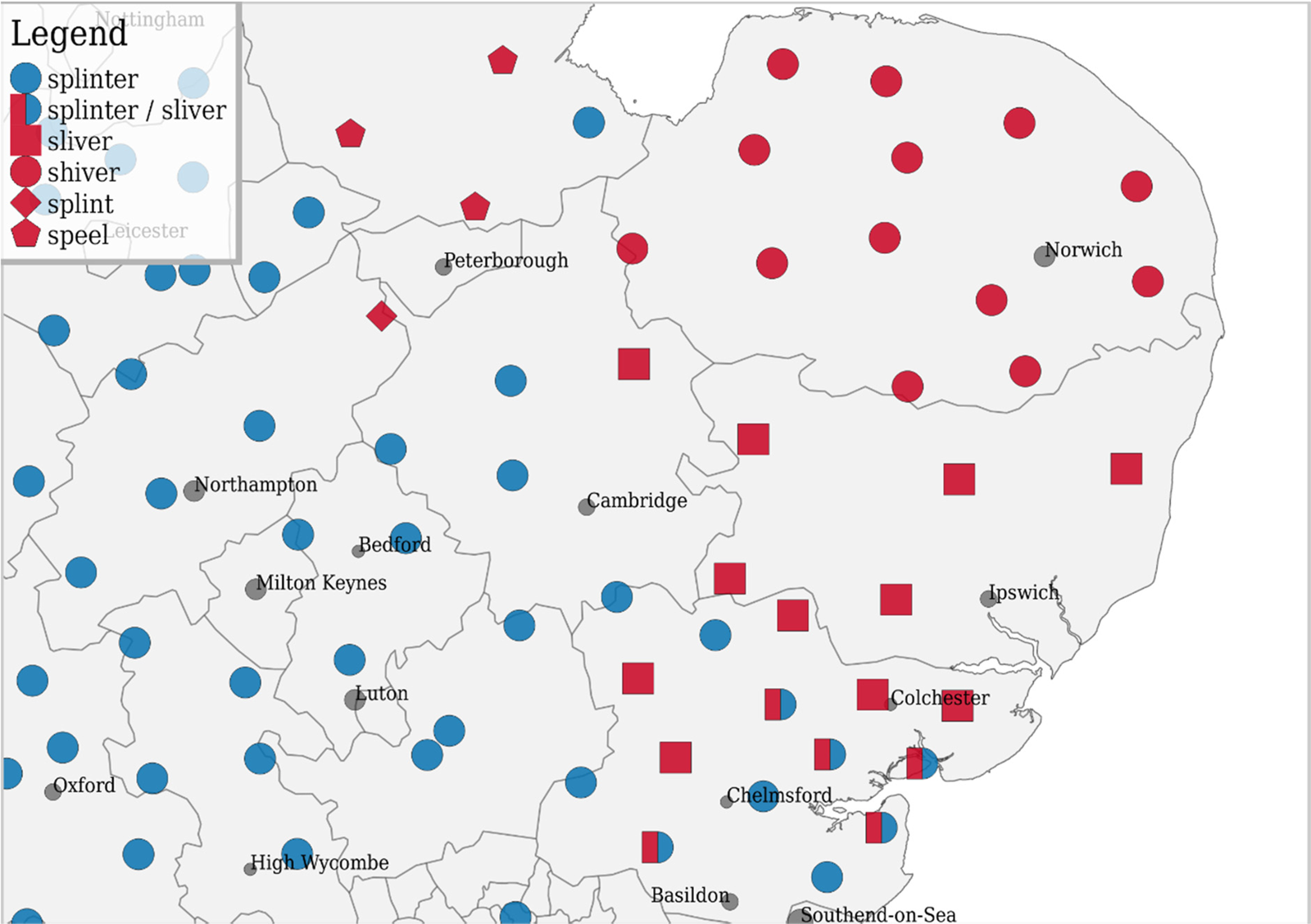
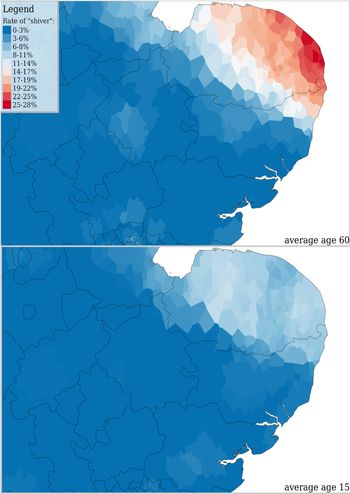
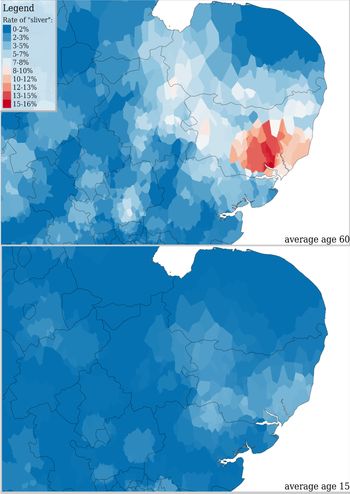
Two investigated word choice variables sought different variants for the words ‘splinter’ and ‘snail’. Both showed considerable regional variation at the time of the Survey of English Dialects (SED). At that time, the two most significant East Anglian variants for splinter were ‘shiver’, mostly found in Norfolk, and ‘sliver’ in Suffolk (see Figure 2a). In the EDA we asked: ‘A small piece of wood stuck under the skin is a . . . ’ As across almost all of the rest of the country (Leemann, Kolly & Britain, Reference Leemann, Kolly and Britain2018), the word ‘splinter’ has been gaining ground in East Anglia to the detriment of both ‘shiver’ and ‘sliver’. Figure 2b shows the results from the EDA for the word ‘shiver’ among older and younger app users, and 2c the same for the word ‘sliver’. While ‘shiver’ remains the variant of choice for over 20% of the older residents of the north and east of Norfolk, and the far north east of Suffolk, among the young few places show levels over 10%. The situation for ‘sliver’ is worse. Among the old, the area around Ipswich retains levels of ‘sliver’ use around 10–15%, but among the young few places exceed 5%.
‘Shiver’ and ‘Sliver’ (for splinter) in the SED in East Anglia (based on material in Orton et al. [1962–71])

‘Shiver’ (for splinter) among older and younger users of the EDA

‘Sliver’ (for splinter) among older and younger users of the EDA

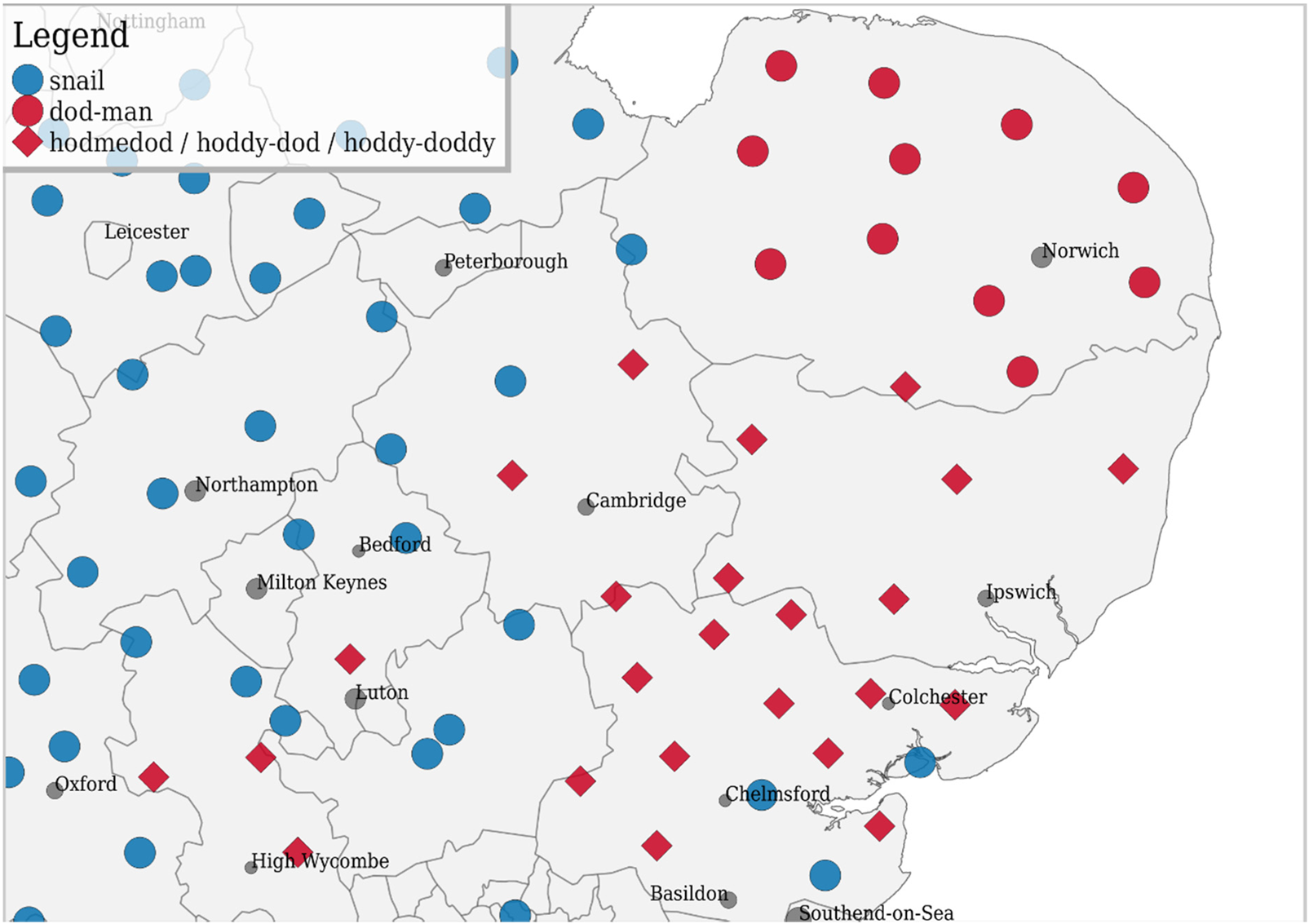
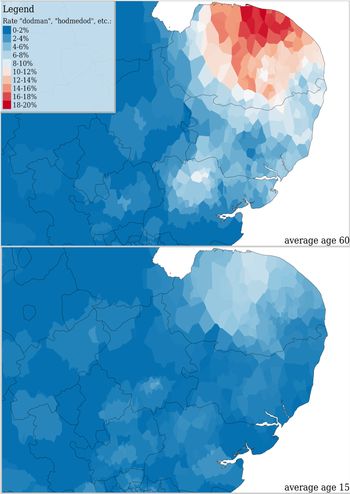
Anecdotal and informal evidence had already shown that the traditional East Anglian dialect words for ‘snail’ were undergoing attrition. These include ‘dodman’ (especially in Norfolk) and various forms of ‘hodmedod’ (in Suffolk and Essex). The latter especially had once enjoyed a wide regional circulation, even well beyond East Anglia, according to Wright's English Dialect Dictionary (Reference Wright1902: 193). A survey carried out in 1993 by the Norwich-based newspaper, the Eastern Daily Press (EDP) showed that while over 90% of adults recognised the meaning of the word ‘dodman’, less than 5% of children did.Footnote 2Figure 3a shows the distribution of ‘dodman’ and ‘hodmedod’ respectively in the SED. ‘Dodman’ was then the dominant form in Norfolk, and ‘hodmedod’ (and its variants) prevailed in Suffolk and much of Essex and Cambridgeshire. Figure 3b combines all the non-snail variants and compares older and younger speakers in the EDA. The question asked was: ‘Animals that carry their house on their back are . . . ’ Once again it is clear that there has been a decline in the use of the traditional dialect word, and once again the Norfolk word appears to have fared better than the Suffolk and Essex one. ‘Dodman’ is claimed to be used by between 15 and 20% of app users in North Norfolk, whereas nowhere in Suffolk and Essex, even for the older speakers, exceeds 10% use of one of the traditional forms. Among the young, neither variant is used by more than 10% anywhere in the region. Traditional lexis is, therefore, if this pair of examples is typical (and the EDP survey suggests it is), undergoing dramatic attrition.
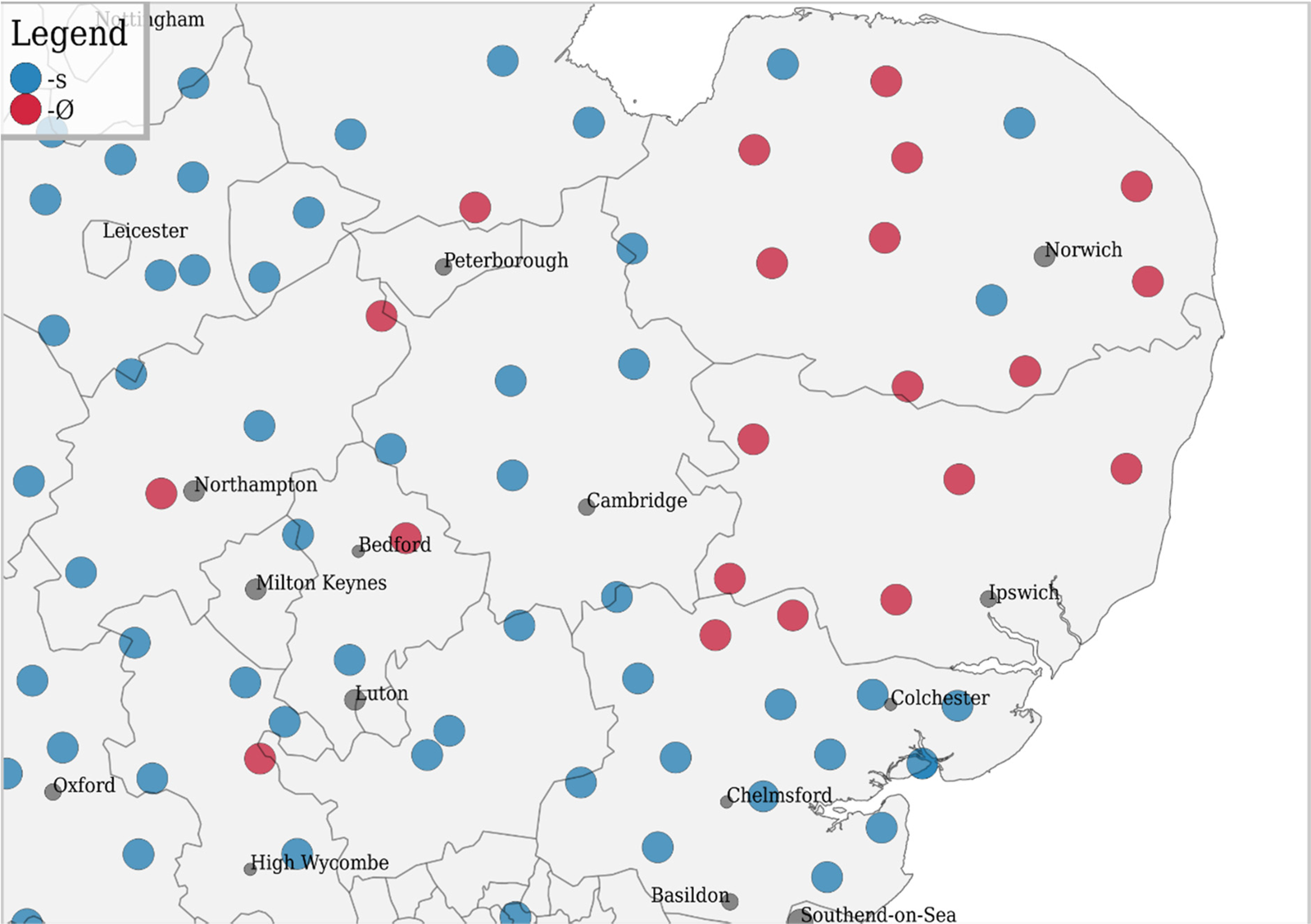
Third-person present-tense zero is a relatively well known traditional dialect feature of East Anglia (for an overview, see Rupp & Britain, Reference Rupp and Britain2019) – ‘she go running every day’, ‘the boy bring me my paper every day’, ‘Stacey sell her jewellery on the market’. Figure 4a shows the distribution of the zero variant in the SED data collected from older rural men in the mid-20th century. It was widespread then across Norfolk, Suffolk, and north Essex. It was one of the variables systematically examined by Trudgill in his Norwich survey (see, for example, Trudgill, Reference Trudgill1974, and Trudgill, Reference Trudgill1998, for an account of why East Anglia developed third-person zero in the first place), and variationist studies of it have since been carried out by Kingston (Reference Kingston2000) in Glemsford in West Suffolk, Spurling (Reference Spurling2004) in Ipswich, and Potter (Reference Potter2018) in Ipswich, Woodbridge and Wickham Market in East Suffolk, as well as by Duffer in Gorleston (Reference Duffer2008) in Norfolk. Trudgill's analysis showed that third-person zero back in the late 1960s was a majority variant for working-class speakers in Norwich, with the Lower Working Class group almost reaching categorical levels of non-standardness. Kingston (Reference Kingston2000) was the first to examine third-person zero across apparent time, and showed a dramatic decline in its use in west Suffolk. Both Spurling and Potter found the same for East Suffolk. All of the Suffolk studies showed levels of zero among young people today at below 10%. Further north in Norfolk, Duffer found that young residents of Gorleston, in the far east of the county, still retained zero more than 40% of the time. In the EDA we asked: ‘Every day on her walk past the lake she ____ the ducks (do feed?/feed?/feeds?)’. Figure 4 shows the distribution of zero in the App quiz data. Higher concentrations of zero are found in Eastern and Central Norfolk and the far north east of Suffolk, and align neatly with recent variationist work on this variable. Even the most zero-using areas, however, are only using it around 10% of the time. The general attrition of the feature reported, for example, by Kingston and Potter appears to be confirmed by the App results. For these three features, then, traditional East Anglian English appears to be faring badly. Britain (Reference Britain, Llamas and Watt2010, Reference Britain, Schreier and Hundt2013, Reference Britain2014a) has argued that this is at least in part due to a range of different types of social and geographical mobility which have affected East Anglia (as well as many other regions) especially since the Second World War. These include: significant levels of counterurbanisation into the region from London and the South East affecting rural areas in particular; increases in general house-moving as home ownership became increasingly seen as an investment to increase personal wealth; increases in university attendance, in longer-distance commuting, and in personal mobility due to car ownership; the expansion of the mobile and flexible tertiary sector of the economy; and reorientations in consumption behaviour, amongst others.
‘Dodman’ and ‘Hodmedod’ (and variants thereof) for ‘snail’ in the the SED (based on material in Orton et al [1962–71])

‘Dodman’ or ‘Hodmedod’ (snail) among older and younger users of the EDA

Third-person present-tense verb-marking in the SED in East Anglia (based on material in Orton et al. [1962–71])

Third-person present-tense zero (‘she feed’) in the EDA

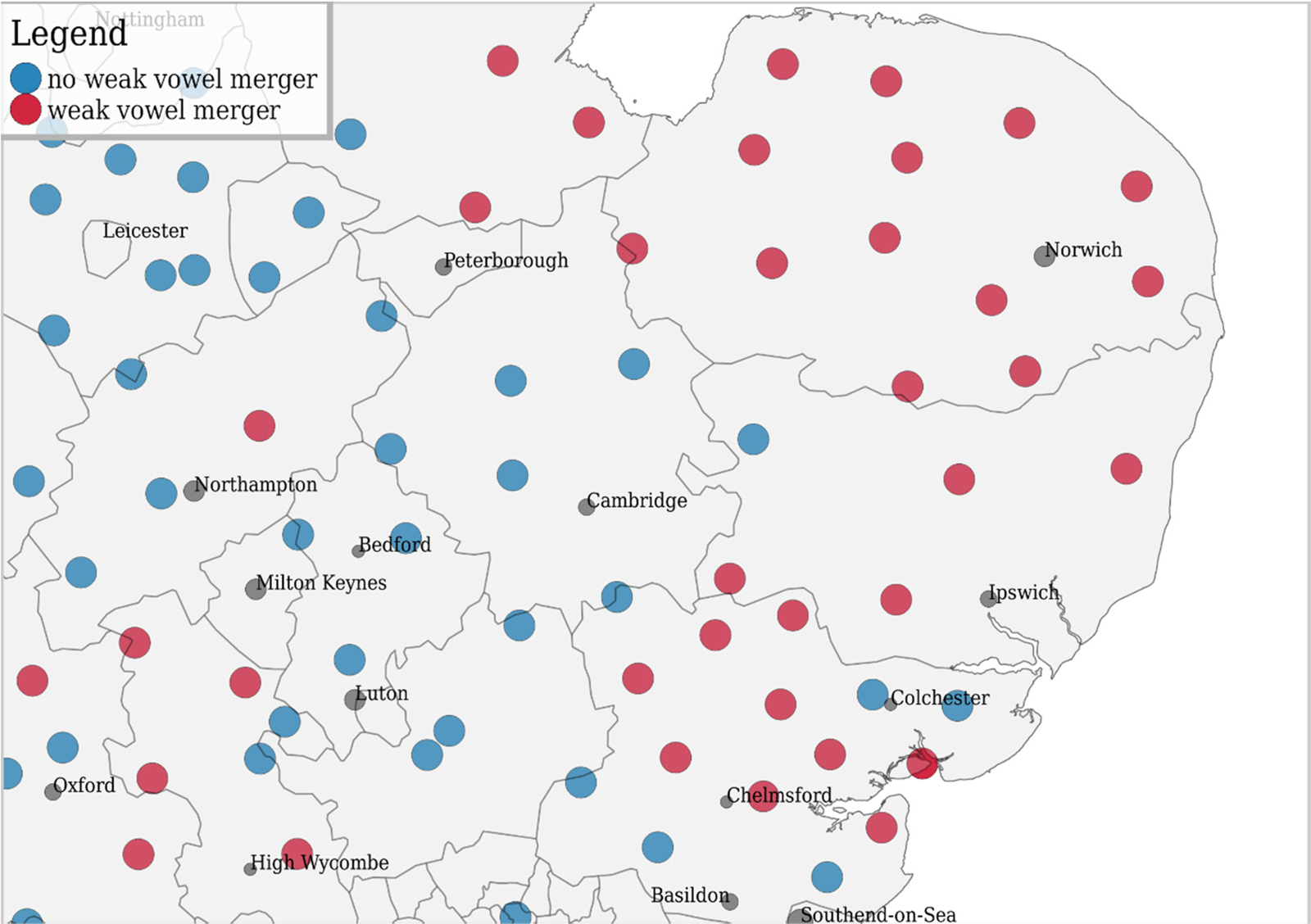
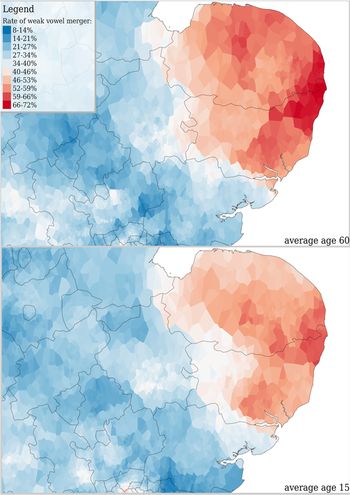
So far we have seen solid evidence of dialect attrition underway – traditional dialect variants giving way to regionally and nationally more widespread forms. Our final example of a traditional East Anglian variant, however, does not depict such a gloomy picture for the survival of older dialect forms. Here we are examining what has come to be known as ‘weak vowel merger’. In London English and, for example, Received Pronunciation, the vowel in many unstressed syllables checked by following consonants (for example, past tense forms (such as ‘wanted’ and ‘ended’), plural forms (e.g. ‘horses’ and ‘buses’), and verbal morphemes (e.g. ‘buzzes’, ‘pushes’, ‘warning’, ‘reading’) as well as in words such as ‘biscuit’, ‘naked’ and ‘bullet’) was /ɪ/ (e.g. [hɔːsɪz], [ɛndɪd]). In these accents, then, there is a contrast with the vowel found word finally in words like ‘comma’, ‘Ella’, ‘bigger’ and ‘water’, which is schwa /ə/ (e.g. [ɛlə], [bɪɡə]). Traditionally in East Anglian English (Trudgill, Reference Trudgill, Schneider, Burridge, Kortmann, Mesthrie and Upton2004: 165-166) only /ə/ was found in any unstressed syllable. Consequently, words such as ‘buzzes’ are [bʌzəz] and ‘ended’ [ɛndəd] – a merger of the weak vowels. Figure 5a shows that weak vowel merger in the SED extended across Norfolk, Suffolk and Essex and also across the Fens into Lincolnshire. There have been relatively few variationist studies of this phenomenon: Research in northern Essex has shown considerable attrition of schwa in checked syllables. Britain (Reference Britain2014a) finds that in the northern Essex village of Silver End, schwa use in checked syllables declined from over 65% among older speakers, to barely 10% among the 18–25 year olds. Kingston (Reference Kingston2000), furthermore, found that in Glemsford in western Suffolk there had been a dramatic decline in the use of schwa in checked unstressed syllables, falling from 80% among older speakers to 30% among her young adult group. Further east, in Suffolk, however, the situation was much more stable. Spurling found very high levels of schwa use in checked syllables in Ipswich, with just a 10% drop between older and younger speakers. Potter (Reference Potter2018), furthermore, in three locations in eastern Suffolk – Ipswich, Woodbridge and Wickham Market – shows no decline at all in the use of schwa in checked syllables, with rates of use around 70%. The variationist evidence suggests, then, some geographical shrinkage of the area with the merger – with schwa in all unstressed syllables – but stability in the core area. Figure 5b shows the results from the EDA for older and younger speakers. It shows that between the time of the SED and the EDA the merger has retreated from both Essex and Lincolnshire, aligning with the findings of Britain (Reference Britain2014a) and (Reference Britain, Watt and Llamas2014b, Reference Britain and Hickey2015) respectively. It also shows that the levels of merger use have declined in western Suffolk, as found by Kingston in her variationist study of Glemsford. But although there has been some decline in central and eastern Norfolk and in eastern Suffolk, it is not as dramatic as it was with the earlier features we examined here and the use of the merger remains robust in and around Ipswich and Lowestoft in Suffolk and Great Yarmouth in Norfolk. Again, these findings align with the variationist work carried out by Spurling (Reference Spurling2004) and Potter (Reference Potter2018).
Weak vowel merger in the SED in East Anglia (based on material in Orton et al. [1962–71])

Weak vowel merger among older and younger users of the EDA

We conclude this paper by examining two linguistic innovations and their diffusion into East Anglia – one is an innovation of some historical depth – the use of intrusive /r/, the other has made a much more recent appearance in East Anglia, namely the fronting of /θ/ and non-initial /ð/.
Intrusive /r/ is the label often given to the insertion of an /r/ where etymologically no /r/ is present. It is inserted, in some accents, between two vowels that straddle word or morpheme boundaries, and where the first vowel is not high – see examples 1-3:
1. She was sawing the log: [sɔːɪŋ] versus [sɔːɹɪŋ]
2. The snow was slowly thawing: [θɔːɪŋ] versus [θɔːɹɪŋ]
3. She saw insects under the cupboard: [sɔːɪnsɛkts] versus [sɔːɹɪnsɛkts]
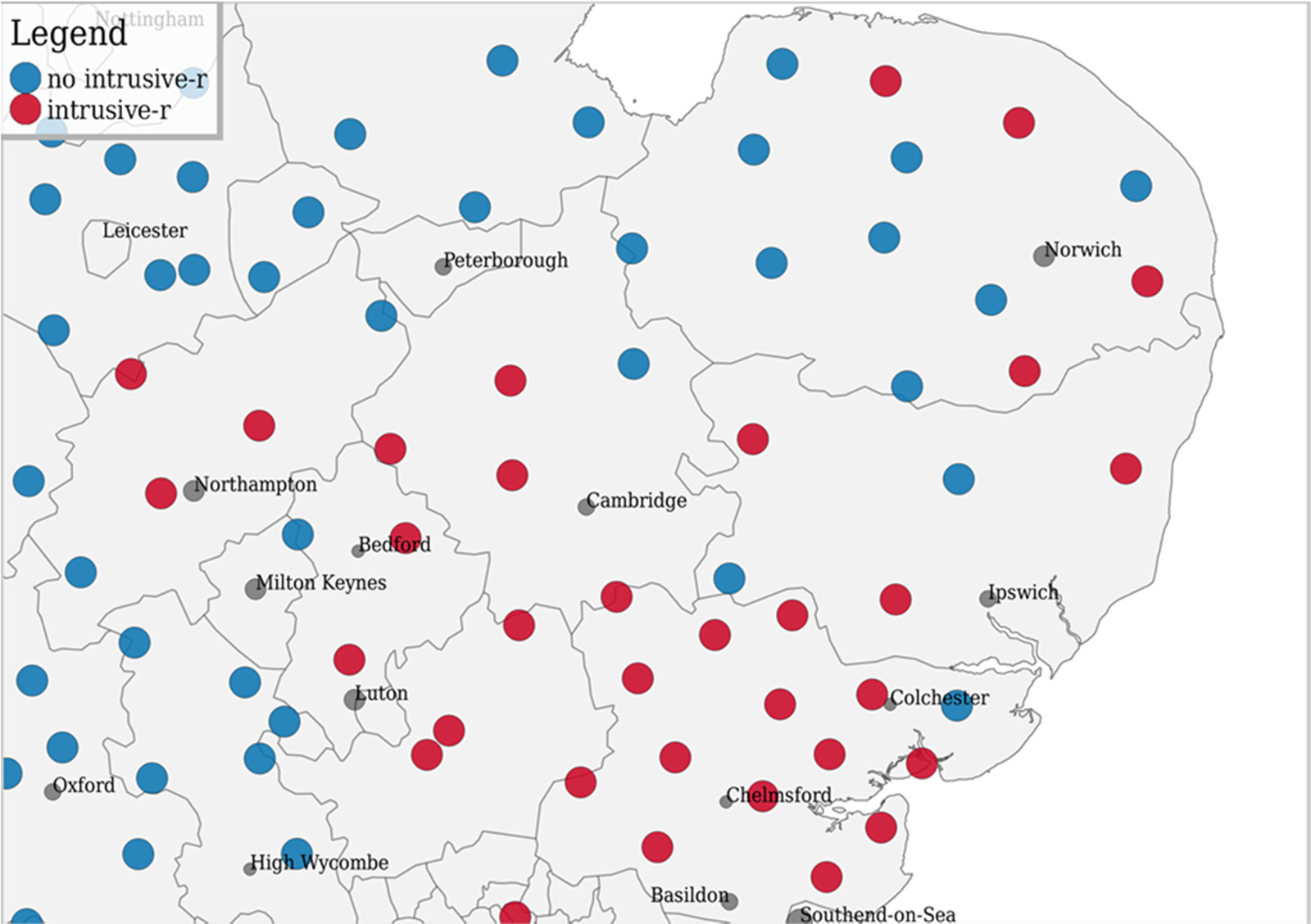
Its appearance is usually associated with the loss of rhoticity – the use of non-prevocalic /r/ (e.g. Trudgill, Reference Trudgill1986). In those dialects which lost this /r/, including East Anglia, many words that formerly had ended in /r/, now came to end in a vowel, such as ‘water’ [wɔːtə] and so phonologically aligned with words that had no historical /r/ at all, like ‘saw’ and ‘thaw’. The reanalysis of linking /r/ – the surfacing of word-final etymological /r/ only in prevocalic contexts – as /r/-insertion rather than the lack of /r/-deletion, led to the spread of the /r/-insertion rule to morphemes which lacked final /r/ etymologically.Footnote 3 Intrusive /r/ occurs, variably, in many but not all non-rhotic varieties of English and competes in some, for example, South African English, with the glottal stop as a hiatus breaker between the two vowels. It is also relatively frowned upon in some circles, in England at least, both in extremely formal speech and in the speech of the upper classes. It has, unfortunately, not been the subject of many variationist analyses (see, however, Foulkes, Reference Foulkes1997, and Hay & Sudbury, Reference Hay and Sudbury2005) because the contexts in which it might (or might not) be inserted are extremely rare in spoken discourse. We know relatively little therefore about its geographical distribution. Figure 6a presents the geographical distribution across the East of England of intrusive /r/ in the SED. At that time, it was largely found in the South and West of the region.
Intrusive [r] in the SED in East Anglia (based on material in Orton et al. [1962–71])

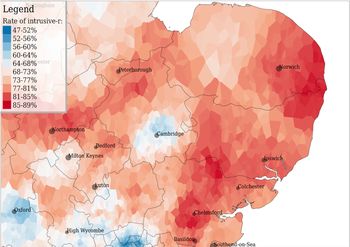
Figure 6b presents the results from the EDA in which we asked the question: Do you pronounce an /r/ between the two syllables of ‘thawing’? – users could then listen to two recordings, one with intrusion, one without, and choose which one they think they say. The results show that intrusive /r/ is now the majority form almost everywhere in the region and is particularly dominant in Essex, Suffolk, Norfolk and across the North Cambridgeshire Fens. As we know from Ellis (Reference Ellis1889), these areas were solidly non-rhotic even in the mid-19th century. One part of East Anglia showing less enthusiasm for intrusive /r/ is the area around Cambridge (and, interestingly, also, Oxford to the west). As far as we are aware, such an apparent ‘Oxbridge effect’ has not been found in English regional dialectology before. We can but speculate why these areas have relatively lower levels of intrusive /r/. One plausible explanation, given the apparent rejection of intrusive /r/ by prescriptivists and some members of the upper social classes, is that affluent and elite university-hosting Cambridge and the surrounding hi-tech ‘Silicon Fen’ house a higher than average population of highly educated, elite, standard-oriented speakers than elsewhere in East Anglia, despite being robustly non-rhotic.
Intrusive [r] among the users of the EDA

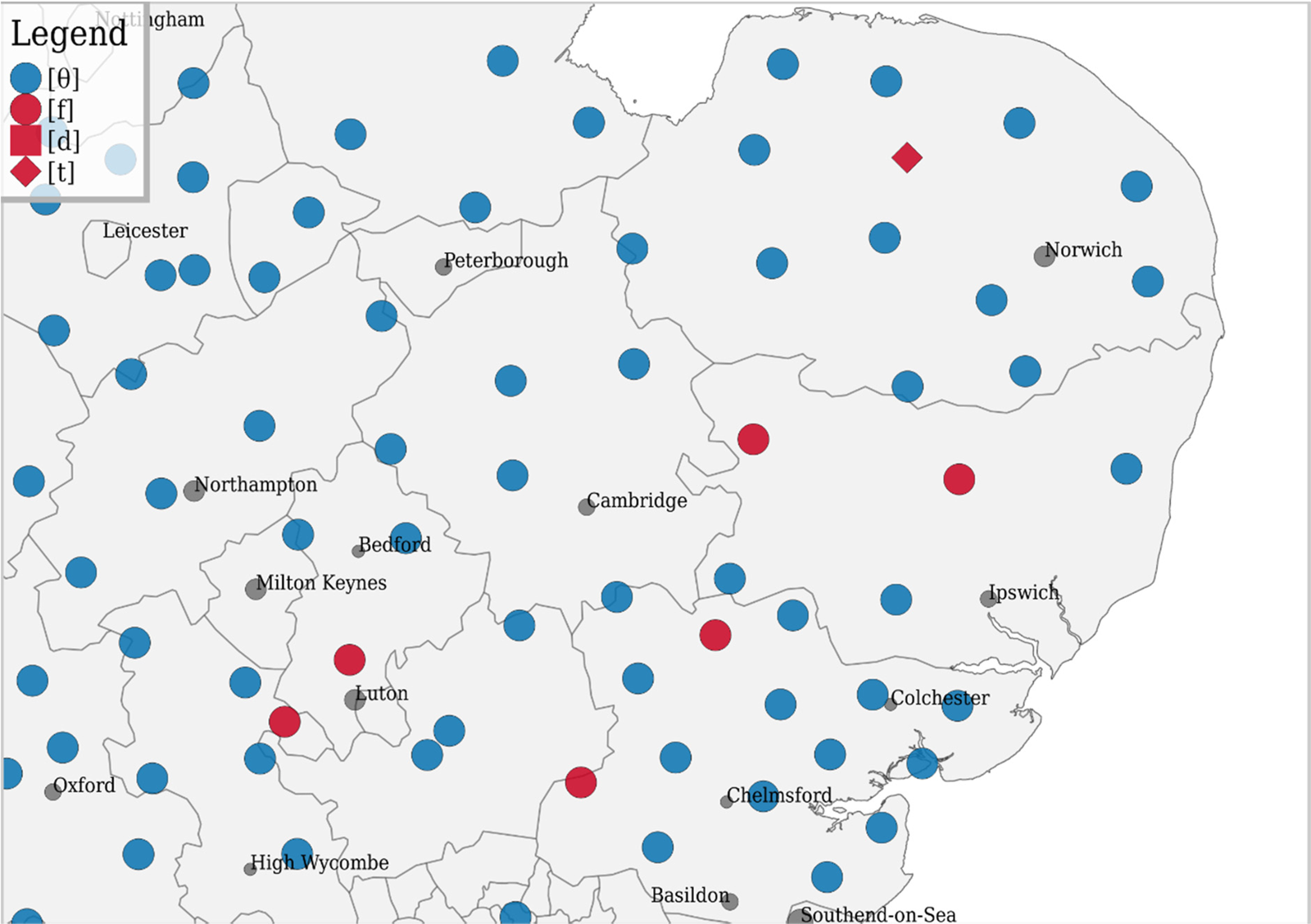
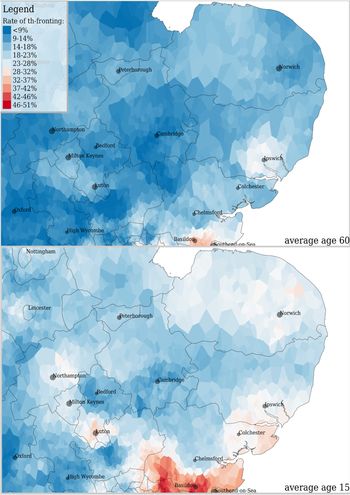
Finally, we examine what has come to be known as TH fronting, whereby /θ/ and non-initial /ð/ are realised as [f] and [v] respectively (e.g., ‘think’ [fɪŋk] and ‘mother’ [mʌvə]). Kerswill (2003) examined the diffusion of this feature across the UK, and found that whilst it had been used in the 19th century in both London and Bristol, it was only in the latter half of the 20th century that it had begun to spread beyond. His study showed that this fronting had even reached the larger urban centres of the North of England and Scotland by the 1970s and 1980s. Rural areas were largely unexplored in his synthesis, however, given a lack of data. Figure 7a shows the extent of TH fronting at the time of the SED. Its use appears sporadic and not convincingly embedded within any particular region, though it is at least incipiently present, as Kerswill (2003) suggests. The first report of TH fronting in East Anglia came from Trudgill's (Reference Trudgill1988) revisit of Norwich for which he recorded 17 younger speakers to compare with his original sample from the late 1960s. He notes that the arrival of TH fronting in Norwich was sudden and in the 1968 study ‘there was no sign of it whatsoever’ (1988: 42). By 1988, 70% of the new sample were at least variably fronting TH. There has been relatively little research on this feature in East Anglia since, however. The one exception is Potter's (Reference Potter2012) variationist study of Ipswich, where he found relatively low levels of fronting – 18% for [f] and 37% for [v], though with somewhat higher levels among younger speakers than older. Figure 7b shows the results from the EDA for both older and younger users. Given the highly innovative status of this feature, it is worth mentioning first of all that, at least at some minimal level, the feature has penetrated the whole of eastern England – even in the areas that are most conservative with respect to TH fronting, e.g. around Cambridge, there is still between 10 and 20% use of it among younger speakers. Among the older speakers, it accounts for a quarter of usage in and around Ipswich in Suffolk and around a third in those parts of South Essex that were the initial destinations for post-war working-class out-migration from London, e.g. Southend and Basildon. The map for the younger speakers shows that the feature has spread both geographically and in intensity. Levels of TH fronting are much higher among the young than the old in Suffolk, Norfolk and north Cambridgeshire. The most dramatic changes appear in Essex, where TH fronting is now almost the majority form across the far south and is increasing in frequency especially in north east Essex, around Colchester and Clacton, again destinations for counterurbanising Londoners in the second half of the 20th century. In general, levels of fronting appear to be on the rise gradually everywhere across the region.
TH fronting in the SED in East Anglia (based on material in Orton et al. [1962–71])

TH fronting among older and younger users of the EDA

Conclusion
We believe our examination of the EDA is useful in two respects (at least). Firstly, it has demonstrated the broad validity of using smartphone-app based methods to provide an overall, general picture of the dialect landscape of a region, in this case East Anglia. Before, we were reliant on the SED and on piecing together the few sporadic variationist studies that had been conducted (at different times, by different people in different ways). The results from the App align in so many cases with what we do know from the smaller variationist studies and what we know from broader regional and national trends – a particularly clear example of this is the split between West and East Suffolk with respect to the attrition of weak vowel merger: Kingston (Reference Kingston2000) found it to be undergoing attrition in the West, but both Spurling (Reference Spurling2004) and Potter (Reference Potter2018) found it robust in the East. The app found the very same geographical division. As we said earlier, we do not wish to claim that such apps should replace traditional and detailed variationist analyses, but they do serve to give us a regional overview that we would otherwise not have and help us to locate particular sites where it may well be appropriate to zoom in for more detailed analysis.
Secondly, it has shed light on ongoing processes of dialect attrition, dialect maintenance and dialect innovation in the region. We demonstrated how some, especially lexical, variants were rather rapidly undergoing decline, but that another traditional East Anglian feature, weak vowel merger, appeared relatively robust in its heartlands of Norfolk and eastern Suffolk. And finally we were able to track the progress of two innovations, one of longer standing, one more recent as they make their way across the East Anglian dialect landscape. Like all dialects, those of East Anglia continue to change – to lose some features, retain old ones, take on new ones. The EDA has provided us with a quick, cheap and insightful method to track this change across the whole region.
 DAVID BRITAIN has been Professor of Modern English Linguistics at the University of Bern in Switzerland since 2010, having previously worked in New Zealand and the UK. His research interests embrace language variation and change, varieties of English (especially in Southern England, the Southern Hemisphere and the Pacific), dialect contact and attrition, dialect ideologies, and the dialectology-human geography interface, especially with respect to space/place, urban/rural and the role of mobilities. He is co-author (with Laura Rupp) of Linguistic Perspectives on a Variable English Morpheme: Let's Talk about -s (Palgrave, 2019), editor of Language in the British Isles (Cambridge University Press, 2007), co-editor (with Jenny Cheshire) of Social Dialectology (Benjamin, 2003), and co-author of Linguistics: An Introduction (with Andrew Radford, Martin Atkinson, Harald Clahsen and Andrew Spencer) (Cambridge University Press, 2nd edn., 2009). David was Associate Editor of the Journal of Sociolinguistics between 2008 and 2017. Email: david.britain@ens.unibe.ch
 TAMSIN BLAXTER did her BA Linguistics at the University of Essex, MPhil General Linguistics and Comparative Philology at the University of Oxford, and her PhD in Linguistics at the University of Cambridge. Her PhD used spatial evidence to explore the role of contact in simplificatory change in the history of Norwegian. She is currently undertaking a Research Fellowship at Gonville & Caius College. Her research interests include spatial aspects of language change and language variation, mathematical models of change, Scandinavian historical linguistics, and English dialectology. Email: ttb26@cam.ac.uk
 ADRIAN LEEMANN did his PhD in 2009 at the University of Bern on the Intonation of Swiss German dialects. As a postdoc, he worked on a number of projects in forensic phonetics and dialectology at the Universities of Zurich and Cambridge. During this time, he - with various teams - developed dialect apps for typologically diverse languages. In 2017 he was appointed Assistant Professor of Sociolinguistics at Lancaster University. Since September 2019 he has his own research group at the University of Bern, investigating language variation and change in German-speaking Switzerland. Email: adrian.leemann@csls.unibe.ch