Traditionally, balloon dilatation of coarctation of aorta has been performed in neonates via femoral artery or carotid artery. There have been reports where femoral arterial access could not be obtained due to non-palpable pulses and vascular cut down was needed by a surgeon to obtain access. Upper limb pulses are mostly well palpable in coarctation of aorta and axillary approach may have advantages in terms of approach and being a non-end artery. We present our experience with five cases of neonatal coarctation of aorta where successful balloon dilatation of coarctation of aorta was performed via axillary approach without adverse events.
Case report
Mean age of presentation was 4 days (range 2–6 days) and mean weight was 2.8 kg (range 2.3–3.2 kg). Four patients presented to us with haemodynamic instability needing inotropic and ventilator support. One patient was haemodynamically stable and was diagnosed due to radiofemoral delay on examination. In all cases, lower limb pulses were non-palpable and all had documented left ventricular dysfunction on echocardiography (left ventricular ejection fraction <30%). Four cases had associated congenital heart disease, two patients had associated bicuspid aortic valve only, and one with atrial septal defect with bicuspid aortic valve and one with ventricular septal defect with bicuspid aortic valve. Palliative balloon dilatation of coarctation of aorta was offered as first line of treatment as a life-saving measure in view of severe left ventricular dysfunction.
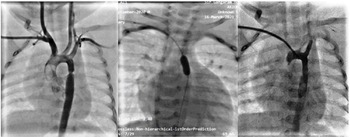
After taking written informed consent, patients were shifted to catheterisation lab for balloon dilatation of coarctation of aorta. Under all aseptic precautions, the right armpit was prepared. For positioning, the head was slightly turned to left side and upper right limb was 100–110° angled away from the chest. After successful axillary artery puncture with 20G needle, a 0.014-inch Hi-Torque guidewire could easily be advanced to the descending aorta under Fluoroscopic guidance and a 2.7 Fr arterial leader cath was launched over the wire within the axillary artery. The position was confirmed by injection of a small amount of contrast medium. Subsequently, 4 Fr Glide-sheath Slender (Terumo Corporation, Tokyo, Japan) was exchanged with leader cath. The invasive blood pressure difference was measured across the coarctation segment (mean 40 mmHg, range 35–50 mmHg). Angiography through the 4 Fr sheath using 5 ml hand injection of contrast medium was used to localise the site of obstruction (Fig 1, left ).
Left: Angiography shot through axillary artery, showing coarction of aorta. Middle: Balloon dilation by TYSHAK balloon untill wedge disapperance. Right: Final angiography shot.

For balloon dilatation of coarctation of aorta segment, Tyshak balloon was advanced over the guide wire. After confirming the correct position, the balloon was inflated till waist disappearance was seen (Fig 1, middle). Post-procedure angiography and pull back measurements were taken as per protocol (Fig 1, Right). The 4 Fr sheath was removed, and the right axillary artery was carefully compressed. Ipsilateral brachial and radial artery was palpable in all cases immediately after procedure. Post-procedure patients were observed in paediatric ICU for procedural complications, but none was noted in any of the patients.
Discussion
In neonates where surgery is contraindicated, percutaneous balloon dilatation of coarctation of aorta is a standard of care to stabilise neonate. In the literature, femoral and carotid arterial access are commonly reported for the balloon dilatation of coarctation of aorta. Very few case reports of axillary artery access are available in the literature. Reference Schranz and Michel-Behnke1–Reference Bouzguenda, Marini and Ou3
Theoretical benefits of axillary access are as follows:
-
Axillary artery is not an end artery; arm and fore arm are perfused by acromion branch and 2nd intercostal branch.
-
Axillary artery is very well palpable as compared to femoral artery in cases of coarctation of aorta and low output state.
-
Femoral access in small infants poses serious possible risk of vascular injury and difficulty in access due to low flow without palpable femoral pulse. Carotid artery access is almost always by surgical cut down method which is associated with risk of carotid occlusion, fatal thromboembolism, and carotid stenosis.
-
Assessment of coarctation of aorta segment relatively easy with axillary approach by hand injection; a guide wire and balloon can be easily passed and manoeuvred through coarctation of aorta segment as we have to pass anterograde.
In our case series, femoral pulses were not palpable in all five cases. We could get 100% success rate to access axillary artery within four attempts without Doppler guidance. No short-term complications were noted after axillary access in our case series. Schranz et al. reported axillary dissection, haematoma formation, and excessive bleeding after axillary access in four out of eight patients but no fatal complications were noted.Reference Schranz and Michel-Behnke4 Proposed theory for the excessive bleeding was due non-availability of any bone against which artery can be compressed. Viswanathan et al. also described loss of ipsilateral axillary pulsation after axillary cut down in long-term follow-up.Reference Viswanathan, Arthur and Evans5 Meliota et al did not find any long-term complication with axillary access in their long-term follow-up (4 years) of eight patients.Reference Meliota, Lombardi and Zaza6 Though we did not do axillary cut down, ipsilateral radial artery was palpable immediately after procedure as well as at follow-up in outpatient department. We did not use pre- and post-procedure Doppler as axillary artery was well palpable and there was no visible swelling/haematoma after procedure and ipsilateral radial artery was palpable in each case. There was no evidence of ipsilateral neurological injury on follow-up examination in our series.
Conclusion
Axillary arterial access may be a safer and better alternative to femoral access in the absence of femoral pulsations. In our short case series, short-term results are favourable to consider this as primary approach. More long-term and mulitcentric data are needed to assess this approach as primary route in coarctation of aorta especially in neonates.
Acknowledgements
None.
Financial support
This research received no specific grant from any funding agency, commercial, or not-for-profit sectors.
Conflicts of interest
None.