Most psychiatric disorders, when examined individually, are associated with a broad range of risk factors that seldom act in isolation. Based on adaptations of a model developed by Kendler and colleagues (Kendler, Gardner, & Prescott, Reference Kendler, Gardner and Prescott2006) for the etiology of major depressive disorder (MDD), we have shown that for several individual disorders, the effects of risk factors experienced earlier in life are mediated by risk factors experienced later in life (Blanco et al., Reference Blanco, Rafful, Wall, Ridenour, Wang and Kendler2014a, Reference Blanco, Rubio, Wall, Wang, Jiu and Kendler2014b, Reference Blanco, Hanania, Petry, Wall, Wang, Jin and Kendler2015, Reference Blanco, Wall, Liu and Olfson2019; García-Rodríguez et al., Reference García-Rodríguez, Blanco, Wall, Wang, Jin and Kendler2014). However, psychiatric disorders often co-occur (Blanco, Wall, Feng, & Olfson, Reference Blanco, Wall, Feng and Olfson2021a; Caspi et al., Reference Caspi, Houts, Belsky, Goldman-Mellor, Harrington, Israel and Moffitt2014; Lahey et al., Reference Lahey, Applegate, Hakes, Zald, Hariri and Rathouz2012) and their co-occurrence is well explained by a limited number of underlying psychopathological dimensions or transdiagnostic factors (Blanco et al., Reference Blanco, Krueger, Hasin, Liu, Wang, Kerridge and Olfson2013; Kim & Eaton, Reference Kim and Eaton2015; Krueger, Reference Krueger1999), which in turn are prospectively associated with a wide range of adverse outcomes (Blanco, Wall, Liu, & Olfson, Reference Blanco, Wall, Liu and Olfson2019; Franco et al., Reference Franco, Olfson, Wall, Wang, Hoertel and Blanco2019).
A natural next step in probing the development of psychiatric disorders is to examine whether risk factors are mediated through broad psychopathological dimensions or operate directly on specific disorders. A better understanding of shared and specific associations of risk factors with psychiatric disorders could help advance our understanding of the structure of disorders and suggest avenues for more effective treatment and preventive interventions. If two disorders share the same risk factors but vary in the strength of the associations, this could help explain why individuals exposed to particular combinations of risk factors are more likely to develop one disorder than another (Blanco, Compton, & Grant, Reference Blanco, Compton and Grant2016). The shared aspects of the risk factors would lead to shared underlying liabilities, while the specific component of the risk factor (e.g. stronger history of MDD in one case v. history of trauma in another) might make one individual more likely to have MDD while the other develops PTSD. These variations in the type and strength of risk factors most strongly associated with specific disorders could also help explain why some interventions have beneficial effects on more than one disorder, but have greater effects on certain disorders than on others. For example, SSRIs are considered first-line medications for the treatment of a MDD, but their effects appear more modest for PTSD (Jakubovski, Varigonda, Freemantle, Taylor, & Bloch, Reference Jakubovski, Varigonda, Freemantle, Taylor and Bloch2016). These variations in the type and strength of risk factors most strongly associated with specific disorders could also help explain why some interventions have beneficial effects on more than one disorder, but have greater effects on certain disorders than on others. For example, SSRIs are considered first-line medications for the treatment of a MDD, but their effect appears more modest for PTSD (Jakubovski et al., Reference Jakubovski, Varigonda, Freemantle, Taylor and Bloch2016).
A few studies have examined the shared and specific effects of individual risk factors, such as genetic risk factors (The Brainstorm Consortium et al., Reference Anttila, Bulik-Sullivan, Finucane, Walters, Bras and Neale2018) or childhood maltreatment (Keyes et al., Reference Keyes, Eaton, Krueger, McLaughlin, Wall, Grant and Hasin2012) on several psychiatric disorders. In a previous study, we examined the effects of several risk factors for anxiety disorders and MDD. Most, but not all, of the effects were exerted through a latent factor underlying all disorders, suggesting that there are shared and specific risk factors for psychiatric disorders. The combination of these effects may be critical to understanding the structure of psychiatric disorders and why an individual develops one disorder but not another (Blanco et al., Reference Blanco, Rafful, Wall, Ridenour, Wang and Kendler2014a, Reference Blanco, Rubio, Wall, Wang, Jiu and Kendler2014b).
One way to examine the shared and specific associations of risk factors with broad psychopathological dimensions and specific disorders is to use a bifactor latent variable approach. This model specifies a general factor that captures the shared liability across all disorders by having each mental disorder load on it. Additional factors in the model represent the residual (i.e. not captured by the general factor) shared liability across groups of disorders, such as externalizing or fear-related disorders. An early study found that several risk factors including a family history of psychopathology and adverse childhood experiences were associated with the general factor but, once the variance associated with the general factor was taken into account, the association of the risk factors with the additional factors was more specific (Lahey et al., Reference Lahey, Applegate, Hakes, Zald, Hariri and Rathouz2012). For example, family history of depression was associated with the distress factor, but not with the fear-related or externalizing factors, whereas family history of antisocial behavior or substance use problems were associated with the externalizing factor, but not with the fear or distress factors. Another study using a bifactor model also found that, after taking into account the associations with the general factor, some correlates such as a family history of antisocial personality disorder or substance dependence were significantly associated with the externalizing but not the internalizing factor, while the opposite was true for other correlates, such as neuroticism (Caspi et al., Reference Caspi, Houts, Belsky, Goldman-Mellor, Harrington, Israel and Moffitt2014). Neither study examined the association of risk factors with individual disorders or applied a developmental framework. We sought to generalize and extend the findings from previous studies by examining the shared and specific associations of a wide range of risk factors for 13 common psychiatric disorders assessed in a large, nationally representative adult sample. Although several approaches can be used to model dimensions underlying psychopathology (Blanco et al., Reference Blanco, Krueger, Hasin, Liu, Wang, Kerridge and Olfson2013; Kim & Eaton, Reference Kim and Eaton2015; Krueger, Reference Krueger1999; Lahey et al., Reference Lahey, Applegate, Hakes, Zald, Hariri and Rathouz2012) and each may be preferable for specific applications (Greene et al., Reference Greene, Eaton, Li, Forbes, Krueger, Markon and Kotov2019), we decided a priori to use bifactor latent variable approach to better disentangle the effects shared by all psychiatric disorders (i.e. general psychopathology), those specific to dimensions of psychopathology (e.g. externalizing dimension) and those specific to individual disorders (e.g. panic disorder). Figure 1 provides a conceptual model guiding the present analyses. Based on this conceptual model and previous findings from prior research, we formulated the following guiding research questions: (1) Does a bifactor latent model provide a good fit to the structure of common psychiatric disorders? (2) Do risk factors act sequentially, so that early risk factors exert part or all of their effect through later risk factors, thus creating a risk cascade? and, (3) Do risk factors exert their effect through broad psychopathological liabilities, directly on a specific disorder or both? If the latter, are there risk factors whose effects are mainly through the broad latent liabilities and others that act only on some of the additional latent liabilities?
Conceptual model relating risk factors across the life course to psychopathology factors underlying past year psychiatric disorders.a aAUD, Alcohol use disorder; NIC, Tobacco use disorder; DUD, Drug use disorder; MDD, Major depressive disorder; DSY, Dysthymia; BD, Bipolar Disorder; PTS, Posttraumatic Stress Disorder; EAT, Eating Disorders; PAN, Panic Disorder; AGO, Agoraphobia; SAD, Social Anxiety Disorder; GAD, Generalized Anxiety Disorder; SPE, Specific Phobia.

Methods
Sample
The National Epidemiological Survey on Alcohol and Related Conditions III (NESARC-III) is a cross-sectional nationally representative in-person interview study of 36 309 adults age 18 and older residing in households and selected group quarters conducted in 2012–2013 (Grant et al., Reference Grant, Chu, Sigman, Amsbary, Kali and Goldstein2015). The screener- and person-level response rates were 72.0 and 84.0%, yielding a total response rate of 60.1% (N = 36 309), comparable to most current U.S. national surveys (Adams, Kirzinger, & Martinez, Reference Adams, Kirzinger and Martinez2013). Data were adjusted for oversampling and nonresponse, then weighted to represent the US civilian population (Bureau of the Census, 2012). Protocols were approved by the National Institutes of Health and Westat Institutional Review Boards. The current study includes participants who were 21 years old and older (n = 34 712) to appropriately accommodate risk factors that are collected up through late adolescence.
Measures
The NESARC used the Alcohol Use Disorder and Associated Disabilities Interview Schedule-5 (AUDADIS-5), a computer-assisted interview that assesses substance use and psychiatric disorders, psychosocial functioning, and selected medical conditions (Hu & Bentler, Reference Hu and Bentler1999).
Age, sex and race/ethnicity were assessed by self-report. Psychiatric disorders were assessed as defined by DSM-5. Participants were assessed for alcohol use disorder (AUD), any drug use disorder (DUD), and tobacco use disorder (TUD); MDD, persistent depressive disorder (dysthymia), bipolar disorder (combining bipolar I and bipolar II); panic disorder, agoraphobia, social anxiety disorder, specific phobia, and generalized anxiety disorder; posttraumatic stress disorder; and eating disorder (bulimia or anorexia nervosa) and schizotypal, borderline, and antisocial personality disorders. Test-retest reliability ranged from fair to good (i.e. from kappa = 0.39 for a dysthymic disorder to kappa = 0.87 for TUD), as did validity when compared to semi-structured clinical assessments (Hasin et al., Reference Hasin, Greenstein, Aivadyan, Stohl, Aharonovich, Saha and Grant2015).
Based on Kendler's original model (Kendler et al., Reference Kendler, Gardner and Prescott2006) and its subsequent adaptations (Blanco et al,. Reference Blanco, Rafful, Wall, Ridenour, Wang and Kendler2014a, Reference Blanco, Rubio, Wall, Wang, Jiu and Kendler2014b, Reference Blanco, Hanania, Petry, Wall, Wang, Jin and Kendler2015, Reference Blanco, Wall, Liu and Olfson2019; Kendler, Gardner, & Prescott, Reference Kendler, Gardner and Prescott2002), we partitioned potential risk factors into four developmental tiers: childhood/early adolescence, late adolescence, adulthood, and past year (see Fig. 1 for an outline of the conceptual model and eMethods for operationalization of variables). All non-dichotomous risk factors were standardized to facilitate interpretation.
Statistical analyses
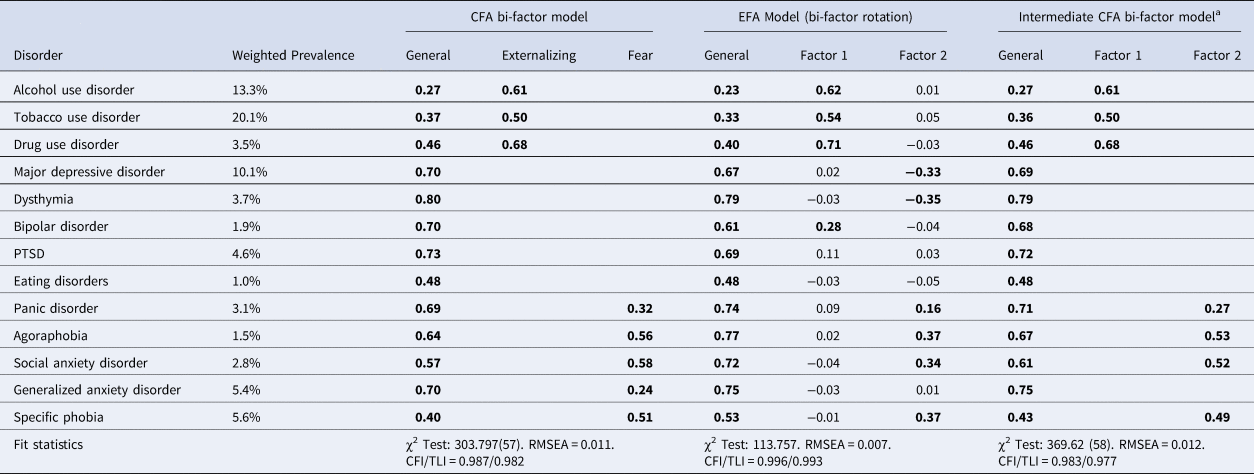
We conducted the analysis in progressive stages to respond to our guiding research questions. First, to investigate whether a bifactor latent model provided a good fit to the structure of common disorders, we used exploratory followed by confirmatory factor analyses (CFA) to examine the latent structure of the past year axis I disorders assessed in NESARC-III. Based on the loadings, fit indices [comparative fit index (CFI), the Tucker–Lewis index (TLI)], and the root mean squared error of approximation (RMSEA) (Hu & Bentler, Reference Hu and Bentler1999), interpretability and previous work on the structure of psychiatric disorders (Caspi et al., Reference Caspi, Houts, Belsky, Goldman-Mellor, Harrington, Israel and Moffitt2014; Kim & Eaton, Reference Kim and Eaton2015; Lahey et al., Reference Lahey, Applegate, Hakes, Zald, Hariri and Rathouz2012), a bifactor CFA model with an overall general factor, a fear factor, and an externalizing factor were selected (see Table 1). Next, we calculated factor scores from the bi-factor model representing each of the three domains. Because using factor scores (Devlieger, Mayer, & Rosseel, Reference Devlieger, Mayer and Rosseel2016; Skrondal & Laake, Reference Skrondal and Laake2001) ensures the operational definition of the latent factors remains the same across the various models, it is preferred over a fully latent approach for multiple sets of predictors (Bakk & Kuha, Reference Bakk and Kuha2018; Wall & Li, Reference Wall and Li2003). Reliability measures for the factor scores are calculated using the factor determinacy for bifactor models (Dueber, Reference Dueber2017) with larger values (closer to 1) indicating the better measurement of the factor by the observed indicators.
Structure of psychiatric disorders among NESARC-III participants 21 years and older (N = 34 712)

Bolded font signifies that the indicator loads on that factor.
a The intermediate CFA model was fit based only on those loadings found >0.30 from the EFA. When that model was fit a Modification Index for GAD suggested it should be added as an indicator for the fear factor so it was in the final model.
Next, we examined the bivariate association of each sociodemographic characteristic (included as covariates) and risk factor with each psychopathology factor score using Pearson or polychoric correlations depending on whether the predictor was continuous or categorical. To examine whether risk factors exerted their effect sequentially, creating a risk factor cascade, we then fit a structural equation model in which each developmental tier predicted all of the subsequent tiers up to the past year and the outcome. Risk factors within the same tier were allowed to be freely correlated, specifically residual errors of the endogenous risk factors were correlated within a tier, resulting in a fully saturated model. This model allowed us to estimate the total effect of each risk factor on past-year psychopathology that was indirect through its effect on all later tiers as well as direct (i.e. not mediated by other variables in the model) while adjusting for contemporaneous and prior tier risk factors. Further, this model can be used to parse specific indirect pathways of interest across the tiers. However, given the extensive number of specific indirect paths, we focus primarily on the total indirect effect in the results, and only illustrate some selected specific indirect paths. While the assumptions necessary for unbiased estimation of any specific indirect effect are mostly untestable, i.e., linearity of associations without interactions, no causal relationships within tiers (VanderWeele & Vansteelandt, Reference VanderWeele and Vansteelandt2014), we purposefully chose and operationalized predictors in each tier that are temporally ordered and expected to cause the next tier. Age at the time of survey, sex, and race/ethnicity were included as covariates in each model. Standardized effects are presented to facilitate the comparison of magnitude across risk factors. To control for multiple testing (25 risk factors related to three psychopathology factors), we used a Bonferroni corrected p value of 0.05/75 (p ⩽ 0.00067, Z test > 3.2) to determine statistical significance.
Finally, to explore if a given risk factor was associated with a specific disorder beyond the association attributable to the psychopathology factors obtained from the bifactor model, an additional model using the latent bifactor as the outcome instead of reducing to factor scores was fit. Modification indices (i.e. χ2 tests with 1 degree of freedom) tested for non-zero direct effects of predictors on any psychiatric disorder and all significant standardized paths found to be greater than 0.20 (in absolute value) were reported. All analyses were estimated using Mplus (Muthén & Muthén, Reference Muthén and Muthén1998) using WLSMV which accounts for the ordered categorical variables where appropriate and adjusts for the sampling design effects of NESARC-III.
Results
A bi-factor model of the 13 axis I psychiatric disorders provided a good fit to the data (CFI = 0.987, TLI = 0.982, and RMSEA = 0.011) including a general psychopathology factor as measured by all 13 disorders and two specific factors, one for externalizing disorders (AUD, TUD, DUD) and one for a subset of internalizing disorders related to fear (GAD, panic disorder, SAD, agoraphobia, specific phobia) (Table 1).
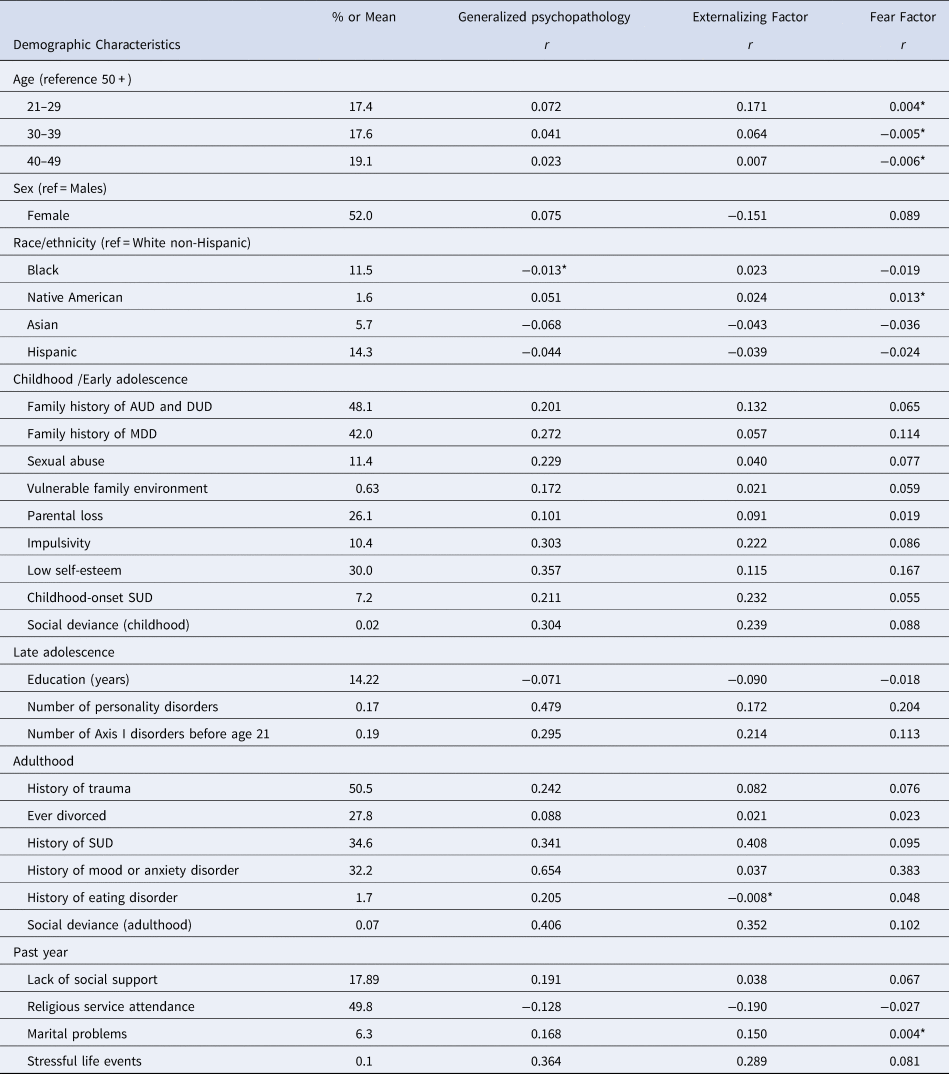
Table 2 presents bivariate correlations between each risk factor and the factor scores. The reliability of the factor scores was high: general factor FD = 0.937, Fear FD = 0.804, externalizing FD = 0.831. With increasing age, there was a strong gradient of decreasing severity in the general and externalizing factors, but not with the fear factor. Racial/ethnic differences were observed, with Native Americans exhibiting higher severity on the general factor than non-Hispanic whites, while Asians and Hispanics exhibited less severity on the general and both externalizing and fear factors. There was no significant difference for Black non-Hispanics compared to white non-Hispanics on the general factor, but higher severity on the externalizing factor and lower severity on the fear factor. Most risk factors across the life course were significantly associated with greater severity on the three factors, the two exceptions being higher education and religious service attendance which had protective associations.
Bivariate associations of demographic characteristics and risk factors with factor scores of the latent factors the structure of psychiatric disorders in NESARC-IIIa

a All correlations are p < 0.05 unless marked with the * sign.
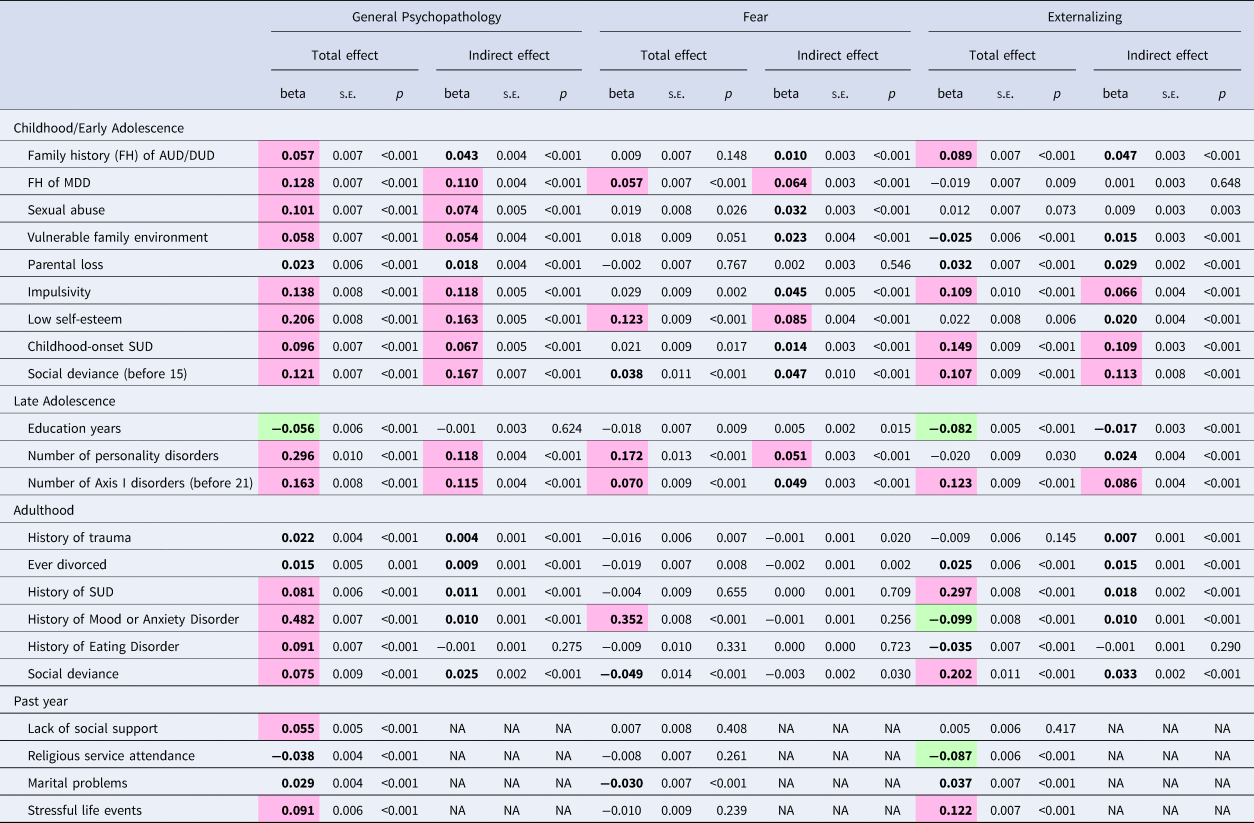
In the s.e.m. that examined all the total, indirect and direct effects adjusted for age, race/ethnicity, and sex, all the risk factors showed a significant total effect on the general psychopathology factor (Table 3, online Supplementary Table S2, Fig. 2). A substantial proportion of the total effects in the childhood tier were indirect through later tiers such that their direct effects were small or non-significant. In late adolescence, about 40% (0.118/0.296) of the total effect of personality disorders on past year general psychopathology was indirect through later tiers, while 70% was indirect for Axis 1 disorders before 21. Interestingly, education, which was protective, had only a direct effect but no indirect effect through later tiers on general psychopathology.
Total. Direct and Indirect Effects of Risk Factors for the General Psychopathology. Fear and Externalizing Factors among NESARC-III participants 21 years and older.

s.e.m. total and indirect effect on the past year psychopathology: general psychopathology, fear and externalizing factors

*All values represent standardized path coefficients. Values >0.05 highlighted in red; Values <−0.05 highlighted in green. All bolded values are statistically significant after Bonferroni correction p < 0.00037 (0.05/132 paths tested).
The majority of the risk factors (15 of 22) showed a significant total effect on the externalizing factor. The effects from the childhood and early adolescent tier were mostly indirect such that the direct effect was non-significant or small. By contrast, in more proximal tiers (i.e. late adolescence and adulthood), the magnitude of the direct effects tended to be larger than the magnitude of indirect effects.
The pattern for the fear factor was slightly different. Less than half of the predictors (eight of 22) showed a significant total effect with only five having a standardized path coefficient larger than 0.05. Of note, six risk factors within the childhood and early adolescence tier had larger indirect effects than their total effects indicating all of their effect is explained by later tiers, albeit small in magnitude and all smaller than those same predictors' indirect effects on the general psychopathology factor. Almost all risk factors in the childhood/early adolescence and late adolescence tiers had significant indirect effects, but only one in the adulthood tier (‘having been ever divorced’) had a significant indirect effect. There were only six significant direct effects in the model: one in the childhood/early adolescence tier (‘low self-esteem’), two in the late adolescence tier (‘number of personality disorders’ and ‘educational attainment’), and three in the adulthood tier (‘history of trauma’, ‘history of mood or anxiety disorders’, ‘social deviance’ and ‘marital problems’).
To illustrate the specific estimates that make up the total, indirect, and direct effects, we considered the relationship between family history of MDD and the general psychopathology factor. We found a significant positive total effect b = 0.129 and an indirect effect b = 0.110 indicating 85% (0.110/0.129) of the total effect that family history of MDD had on past year psychopathology was through its effect on other risks in the later tiers. Examining the direct effects (online Supplementary Table S1), we saw that family history of MDD had a direct effect on a number of personality disorders (b = 0.067), which in turn had a direct effect on the history of mood or anxiety disorder in adulthood (b = 0.172), which in turn had a direct effect on past year stressful life events (b = 0.073), which in turn had a direct effect on the general psychopathology factor (b = 0.091). This specific indirect path went through every tier of the model and was only one of many such indirect paths from a family history of MDD to the general psychopathology factor. For example, there were some specific indirect paths that skipped a tier, for example, from a family history of MDD to personality disorders (b = 0.067) that then went directly to general psychopathology (b = 0.178) without being mediated by the other measured risk factors.
Additional modeling to explore potential direct effects of risk factors on specific disorders that are stronger (or weaker) than their effects through the bi-factors found 13 stronger and 10 weaker direct effects out of the 325 examined (online Supplementary Table S2). Of note, a family history of substance use disorder and history of trauma were both more strongly associated with increased odds of tobacco use and PTSD than that explained by the psychopathology factors. Also of note, the overall protective effect for education on the psychopathology factors was weakened in its association with AUD and eating disorders but further strengthened in its risk for TUD.
Discussion
In a large, nationally representative sample, most risk factors were associated with the three psychopathological dimensions in the bivariate analyses. However, the magnitude of the associations varied by a factor, helping assuage concerns over lack of specificity of risk factors for psychiatric disorders (Boschloo, van Borkulo, Borsboom, & Schoevers, Reference Boschloo, van Borkulo, Borsboom and Schoevers2016). While the risk factors are often shared across disorders, each risk factor increases the risk of each dimension or disorder in a different way. As a result, particular combinations of risk factors differentially increase the risk for specific liabilities and individual disorders, in a manner that is reminiscent of how different combinations of elements yield particular compounds.
We found that a bifactor latent model provided a good fit to the structure of common psychiatric disorders, consistent with earlier studies (Caspi et al., Reference Caspi, Houts, Belsky, Goldman-Mellor, Harrington, Israel and Moffitt2014; Kim & Eaton, Reference Kim and Eaton2015; Lahey et al., Reference Lahey, Applegate, Hakes, Zald, Hariri and Rathouz2012). Our model included a general factor, an externalizing factor, and a fear factor. Although the particular indicators of the factors in bifactor models vary across samples, the models usually have a general factor, an externalizing factor, and one or more internalizing factors that reflect distress or fear (or both). For example, Caspi et al. (Reference Caspi, Houts, Belsky, Goldman-Mellor, Harrington, Israel and Moffitt2014), identified a model that included a general factor as well as an externalizing and an internalizing factor. Lahey et al. (Reference Lahey, Applegate, Hakes, Zald, Hariri and Rathouz2012) identified a model with a general factor, as well as an externalizing, distress, and fear factor. Kim and Eaton (Reference Kim and Eaton2015), using Goldberg bass-ackwards procedure (Goldberg, Reference Goldberg2006) showed that it was possible to obtain a variety of models ranging from one containing only a general factor to others that progressively segregated this factor into more differentiated components. Overall, our model appears consistent with previous studies and allows identification of the shared and specific effects of risk factors on broad dimensions of psychopathology and on specific psychiatric disorders.
Most variables were associated with the three factors in the bivariate analyses, but in the multivariate analyses the effects of distal risk factors tended to be mostly indirect, mediated by more proximal risk factors. Our results are in line with the findings of Kendler and colleagues on the developmental etiology of MDD (Kendler et al., Reference Kendler, Gardner and Prescott2002) and several addictive disorders (Blanco et al., Reference Blanco, Hanania, Petry, Wall, Wang, Jin and Kendler2015; García-Rodríguez et al., Reference García-Rodríguez, Blanco, Wall, Wang, Jin and Kendler2014) and extends these concepts to a broader range of psychiatric disorders. An alternative, complementary interpretation of our findings is that early risk factors set in motion cascades of risk effects that, depending on their specific trajectories, drive different psychiatric disorders. These cascades of risk can be as diverse as the number of combinations of risk factors and help explain how, despite the existence of a limited number of clinical syndromes, the personal history and clinical manifestations of each patient is different. This diversity of etiological trajectories may also contribute to the heterogeneity of the underlying biology of clinical syndromes and the challenge of identifying disorder-specific biomarkers. In accord with previous studies (e.g. Caspi et al., Reference Caspi, Houts, Belsky, Goldman-Mellor, Harrington, Israel and Moffitt2014; Lahey et al., Reference Lahey, Applegate, Hakes, Zald, Hariri and Rathouz2012), certain risk factors, such as childhood sexual abuse or lack of support in the past year had broad effects, as indicated by the fact they were all exerted through the general factors. By contrast, other risk factors retained some specificity such that, after taking into account their effect on the general factor, were only significantly associated with one of the other factors. For example, social deviance and family history of alcohol and DUDs were associated with the general and externalizing factors, but not with the fear factor, whereas history of mood or anxiety disorders was associated with the general and fear factors, but the externalizing factor. Our results suggest that certain risk factors confer a broad, low-specific vulnerability to a range of disorders, whereas other factors determine which specific disorders are manifested in each individual. Future studies should examine whether these findings are mirrored by biomarkers or biosignatures of progressive levels of specificity.
Our models suggest some potential directions for intervention development. Because most of the effects of risk factors are mediated through broad psychopathological dimensions, the findings raise the possibility that transdiagnostic interventions (Barlow et al., Reference Barlow, Farchione, Bullis, Gallagher, Murray-Latin, Sauer-Zavala and Cassiello-Robbins2017) directed at broad psychopathological dimensions, may have more robust effects than those directed at individual disorders. Our results are also consistent with the observations that adverse consequences of psychiatric disorders are mostly mediated by broad psychopathological dimensions, rather than individual disorders and that remission of one disorder decreases the risk of new-onset or relapse of other disorders (Blanco et al., Reference Blanco, Compton and Grant2016; Blanco, Wall, Wang, & Olfson, Reference Blanco, Wall, Wang and Olfson2017), as well as with evidence of shared genetic etiology (Cross-Disorder Group of the Psychiatric Genomics Consortium, 2013) and transdiagnostic biomarkers (Pinto, Moulin, & Amaral, Reference Pinto, Moulin and Amaral2017). The identification of disruptions in neurocircuitry (McTeague et al., Reference McTeague, Rosenberg, Lopez, Carreon, Huemer, Jiang and Etkin2020) associated with broad psychopathology factors is also consistent with our results and may suggest promising targets for therapeutic interventions (Castellanos-Ryan et al., Reference Castellanos-Ryan, Brière, O'Leary-Barrett, Banaschewski, Bokde and Bromberg2016; Goodkind et al., Reference Goodkind, Eickhoff, Oathes, Jiang, Chang, Jones-Hagata and Etkin2015). Interventions that target the general factor may be particularly effective, as the general factor represents shared aspects of internalizing and externalizing disorders. Furthermore, because the effect of earlier tiers is partially mediated by later tiers, intervening in earlier tiers can decrease the risk of future development of psychiatric disorders.
From the public health perspective, our findings suggest that a narrow focus on disorder-specific symptom outcomes may underestimate their effects on broader functional outcomes. Interventions targeted at specific disorders, by targeting specific risk factors, may have spillover effects on other disorders. Trans-diagnostic interventions that target related disorders may have fairly robust effects (Barlow et al., Reference Barlow, Farchione, Bullis, Gallagher, Murray-Latin, Sauer-Zavala and Cassiello-Robbins2017). At the same time, because the etiology of disorders is multifactorial, addressing a single risk factor (or a limited number of them) is likely to have limited effects at the population level (Blanco, Wall, & Olfson, Reference Blanco, Wall and Olfson2021b; Etz, Goldstein, Lopez, & Blanco, Reference Etz, Goldstein, Lopez and Blanco2020). These findings are consistent with the results of universal preventive interventions, which have often detected small effects (Arango et al., Reference Arango, Díaz-Caneja, McGorry, Rapoport, Sommer, Vorstman and Carpenter2018).
Only 23 out of 325 (7%) of direct effects achieved significance, suggesting that while risk factors are strongly associated with broad dimensions of psychopathology, their associations with individual disorders is less specific. This is consistent with findings that dimensions of psychopathology are more reliable and have more predictive power than individual disorders (Kim & Eaton, Reference Kim and Eaton2015), while still suggesting that there is some specificity in the associations of psychopathological dimensions and adverse outcomes.
This study has several limitations. First, although the model included 13 disorders, the NESARC-III did not collect information on several psychiatric disorders, such as schizophrenia obsessive-compulsive disorder, or attention-deficit/hyperactivity disorder. Second, although the it included a broad range of risk factors, to avoid overly complicating the model, it did not include all known or hypothesized risk factors for psychopathology, such as major medical illnesses or loss of employment. Third, certain populations such as people in the military or those in jails and prisons were not included in the NESARC-III. Our results may not generalize to those populations. Fourth, information on the risk factors was collected retrospectively and maybe subject to recall bias. Fifth, although for clarity we organized the risk factors into four discrete developmental periods, there is overlap and considerable between-subject variability across those periods. Nevertheless, developmental periods provide some structure, however imperfect, to organize these diverse risk factors. Furthermore, because the final models included all risk factors, inclusion in one or another tier did not influence their significance in those models.
Conclusion
A modification of Kendler's MDD model provided a foundation for a generalized developmental model of common psychiatric disorders. The model included four developmental tiers in which the effects of earlier developmental tiers were mediated by later tiers. Although most risk factors were associated with the three factors, the magnitude and even direction of associations varied by factor and only a few associations between risk factors and individual psychiatric disorders were not mediated by the factors. We hope these findings will be helpful in advancing our understanding of the etiology of psychiatric disorders and in developing more effective preventive and treatment interventions.
Supplementary material
The supplementary material for this article can be found at https://doi.org/10.1017/S0033291721005468
Disclaimer
The views and opinions expressed in this report are those of the authors and should not be construed to represent the views of any of the National Institute on Drug Abuse, the National Institutes of Health or any US government agency.
Conflict of interest
None.