Introduction
Wireless sensor networks (WSNs) are frequently used in various indoor applications, such as home automation and home security. Powering the indoor WSNs for such applications with a sustainable power source is of particular interest. And since low-power WSNs only consume several milliwatts in the full-active mode, <1 mW in limited action modes, and microwatts in their sleep mode [Reference Vullers, Schaijk, Visser, Penders and Hoof1–Reference Nguyen, Tran, Le, Vu, Nguyen, Nguyen and Le3], they can be supplied with radio-frequency (RF) waves in the ambience. For example, the sensor node in [Reference Nguyen, Nguyen and Le2] consumes at maximum 23.7 mW, and the sensor node in [Reference Nguyen, Tran, Le, Vu, Nguyen, Nguyen and Le3] consumes up to 11 mW. For this purpose, Wi-Fi, consisting of the 2.45 and 5.8 GHz bands, is the ideal candidate due to its predominance in the indoor environment.
Several earlier studies have been dedicated to exploring Wi-Fi rectennas. In [Reference Huang, Shinohara and Toromura4], a wideband rectenna for the 2.45 GHz band is designed by superimposing four auxiliary patches on top of a conventional circular patch antenna, achieving a maximum efficiency of 63% at 0 dBm power. In [Reference Li, Yang and Huang5], another 2.45 GHz rectenna is introduced. Employing a hybrid feeding scheme, with both cooperate and serial feeds, a 4 × 4 antenna array is formed. The final efficiency of this rectenna is 80% at 21 dBm input. Not only single-ended rectenna can be used, in [Reference Reed, Pour and Ha6], differential configuration has been employed. Two patch antennas form a balanced rectenna at 2.45 GHz, with 70% maximum efficiency at 5 dBm input.
Although achieving notable accomplishments, many earlier studies employ directional antennas [Reference Agrawal, Parihar and Kondekar7–Reference Angulo, Navarro, Quinterro M. and Pardo13]. For indoor environments, due to the presence of various obstacles, incident wave is scattered away and arrive at the rectenna from multiple directions. It is thus desirable for the rectenna to be omni-directional. In addition, since Wi-Fi has two bands, it is desirable that the rectenna can harvest from both 2.45 and 5.8 GHz bands simultaneously, while some of the previous studies only deal with one band [Reference Takhedmit, Cirio, Merabet, Allard, Costa, Vollaire and Picon14–Reference Mahfoudi, Takhedmit, Tellache and Boisseau17]. The radiation pattern should also be fairly alike in both bands. Otherwise, the received RF power of the two bands will be very different. For the worst case, at some specific positions, the antenna gain is high at one frequency and very low at the other, and thus for some direction-of-arrival, the rectenna can harvest from only one band. In [Reference Bhatt, Kumar, Kumar and Tripathi18], the sickle-shaped rectenna produces 65% efficiency at 2.4 GHz and 55% efficiency at 5.8 GHz, for 14 dBm input. However, the antenna possesses drastically different radiation patterns between the 2.4 and 5.8 GHz bands.
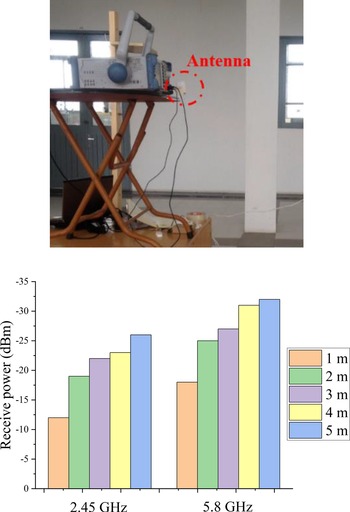
It should be noted that some of the rectennas we mentioned earlier only operate efficiently at very high input power, namely, 21 dBm [Reference Li, Yang and Huang5] or 14 dBm [Reference Bhatt, Kumar, Kumar and Tripathi18]. But in reality, incident power of RF waves is usually very low, <$1\ {\rm \mu }{\rm W}/{\rm cm}^{2}$ in density, or <0 dBm in total [Reference Cansiz, Altinel and Kurt19, Reference Pinuela, Mitcheson and Lucyszyn20]. We also demonstrate, through our own survey, that the input power level of indoor Wi-Fi is only around − 18 dBm, as shown in Fig. 1. Therefore, it is required that the rectenna exhibits as efficient performance as possible at low input level. High efficiency at high input power is a good feature, and can be helpful for wireless power transfer application, in which the transmitted power level is high and controllable. However, for energy harvesting, in which the incident power is low and uncontrollable, that advantage is not necessary.
Experiment set-up to measure RF power at the Hanoi University of Science and Technology campus (top) and the resulted power at different distances from Wi-Fi routers (bottom). We employed a Rohde & Schwarz FSP-13 RF spectrum analyzer and a conventional dipole antenna with gain 6.4 dBi at 2.45 GHz and 6 dBi at 5.8 GHz.

Not only good dual-band performance at low input power is required, but also compactness has to be considered as well. The aforementioned studies employ conventional geometry to design antennas, leading to large size. For wireless sensor nodes, which are usually very small, a compact rectenna is more desirable. For that purpose, in [Reference Shi, Jing, Fan, Yang and Wang21], fractal-shaped patch antenna is used in conjunction with four helical auxiliary patches to achieve compactness. The antenna size is only 0.31λ × 0.31λ (λ is the wavelength in free-space at 2.45 GHz) while the maximum efficiency is 52% at 0 dBm input. This compact antenna is only single-band, however. In [Reference Huang and Chen22], a very compact dual-band rectenna is proposed, with the size of only 0.106λ × 0.196λ at 2.45 GHz. However, this rectenna employs the slot-loop antenna, which is directional and cannot scavenge energy from all directions.
Another crucial part of an energy harvesting system is the power management circuit, which is usually overlooked in most earlier studies. Because of the low input power, the collected power should be stored to obtain sufficient energy. It is also due to the low input power that the output voltage of rectenna is often lower than the required level (around 1.8–5 V). Due to these reasons, the power management circuit has the tasks of storing energy and boosting the output DC voltage to a usable power.
To fulfill the requirements of a Wi-Fi energy harvesting system for indoor self-powered sensor nodes, this paper is dedicated to design a dual-band, omni-directional, compact rectenna, which works efficiently at low input power, and incorporate with a power management circuit. We investigate the design of a compact antenna based on split-ring-resonator metamaterial in Section “Metamaterial-based dual-band antenna design,” the dual-band rectifier in Section “Dual-band rectifier,” the performance of the rectenna as a whole in Section “Rectenna performance,” the power management circuit in Section “Power management circuit,” and finally, the conclusion is drawn in Section “Conclusion.”
Metamaterial-based dual-band antenna design
In 2011, Zhu and Ziolkowski introduced a metamaterial-inspired, near-field resonant monopole antenna with double-cane and split-ring-resonator [Reference Zhu and Ziolkowski23], which possesses single-band resonance and compact size. The keys to compactness, according to Zhu and Ziolkowski, were the electrically small metamaterial ring and the near-field parasitic double-cane. Near-field magnetic coupling mechanism helps deliver power to the ring which then radiates. Magnetic coupling occurs similarly to coil-to-coil coupling. Current running on the double-cane creates an oscillating magnetic field that fluxes through the ring and, in turn, induces current on it. The double-cane does not radiate but instead it operates as an intermediate stage between the source and the radiating element.
Their proposed design shows large potential for energy harvesting in small sensor nodes. However, it is single band. Although only one lowest resonant frequency was investigated, it is certain that the antenna, just like any other antennas, may exhibit higher odd-order harmonic resonances and other resonant frequencies as well. Harmonic resonant frequencies depend totally on the first resonant. And since 5.8 and 2.45 GHz are not odd-order harmonics of each other, it is essential to find other resonant modes which are independent.
We further investigate their structure and show that the antenna can also obtain, not just one, but two different resonant modes. Each mode can be independently tuned to achieve the desired resonant frequencies. Instead of magnetic coupling, we use electric coupling, which is not related to the double-cane, to drive power to the metamaterial ring. The double-cane is used as another radiating element instead of a near-field coupling parasite. The resonant principle and characteristic at each mode will be elaborated.
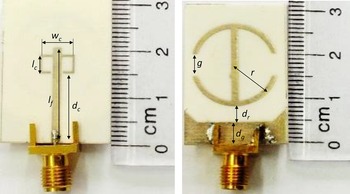
The design of the antenna is shown in Fig. 2. The antenna consists of a feed line loaded with a double-cane on the front, a metamaterial split-ring-resonator and ground on the back. The antenna is placed on a 0.8-mm-thick Roger RO4003C substrate (dielectric constant ɛr = 3.55, loss tangent tanδ = 0.0027).
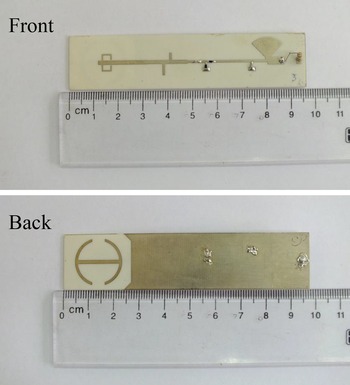
Front (left) and back (right) images of the antenna.

An equivalent circuit representing the antenna is shown in Fig. 3, which is used to qualitatively explain the working principle of the antenna. Just like any other resonant structure, both the double-cane and the metamaterial ring can be modeled into LC circuits. In particular, the double-cane is represented by the capacitor C dc and inductor L dc, while the split-ring-resonator is represented by C srr and L srr. Resistors R rad represents radiation. A transmission line represents the feed line in which waves travel from the input port (represented by the AC source) to either the resonator or the double-cane. Since the ring is not directly connected to the feed line, but instead via near-field coupling, it will be more accurate to represent their connection with a transformer. Each capacitor and inductor determine the resonant frequency of their corresponding component. At the resonant frequency, the corresponding capacitive and inductive reactance cancel each other, giving the corresponding LC circuit a real impedance, which can be matched with the transmission line. Meanwhile, the impedance of the other LC circuit is highly imaginary and mismatched. Most of power is delivered to the corresponding resonating LC circuit, and eventually to R rad (which means waves are radiated into space).
Equivalent circuit of the metamaterial-based antenna.

It is also worth discussing about the coupling between the feed line and the ring resonator. There are two ways power can be delivered to the ring: magnetic coupling mechanism and electric coupling mechanism. Magnetic coupling mechanism has been explained above. For electric coupling, electric field is strongly localized between the feed line and the middle line of the ring due to their close proximity, the field oscillate and creates a current. The first way happens only when the double-cane and the ring have the same resonant frequency since power must first be delivered to the double-cane before being transferred to the ring. It was the magnetic coupling, not electric coupling, that several earlier near-field resonant antennas were based on [Reference Zhu and Ziolkowski23, Reference Lin, Jin and Ziolkowski24]. However, since the antenna in this study is designed to have two different resonant frequencies, the electric coupling will be the primary mechanism.
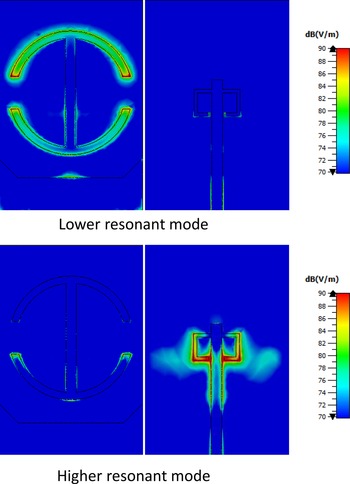
To validate our analysis presented above, we first ran simulation in CST Microwave Studio with a randomly created antenna. The antenna exhibits two resonant frequencies. The electric field strength at these two resonances is displayed in Fig. 4. At the first resonant mode, electric field is distributed primarily on the split-ring-resonator, while the field strength on the double-cane is negligible. The opposite happens at the second mode. This is as predicted since the ring is given a much bigger size compared to the double-cane. Therefore, it is safe to say that each resonant mode belongs to either the ring or the double-cane, and the role of one component on the other's resonance is small. The field distribution also confirms electric coupling as the main mechanism that drives power to the ring.
Simulated electric field strength at the two resonant modes of the metamaterial-based antenna. Incident power density is set as 6.5 W/m2 in the simulation.

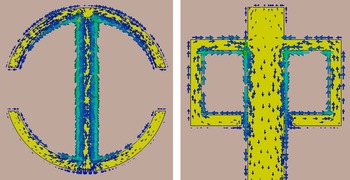
Figure 5 shows the simulated current distribution on the split-ring-resonator and the double-cane at their corresponding resonant frequencies. It is well-known that the traveling path of current in an antenna at resonant frequency roughly equals half-wavelength. In both the ring and the double-cane, currents run in two open loops. The size of the radiating element can thus be significantly reduced while still maintaining a half-wavelength current path. It is therefore the key to compactness.
Current distribution on the split-ring-resonator and the double-cane.

We then optimize the dimensional parameters to achieve desired performance. The ring's radius and gap are first optimized to achieve resonant frequency at 2.45 GHz. The same happens to the length, width, and gap of the double cane to achieve resonant frequency at 5.8 GHz. The size of the ground is arbitrarily chosen. The double-cane is placed near the end of the feed line. Then the length and width of the feed line are optimized to achieve good resonant quality (S 11 at 5.8 GHz is as low as possible). The position of the ring is optimized to achieve good coupling with the feed line (S 11 at 2.45 GHz is as low as possible). The final dimension of the antenna is as follows: w c = 7 mm, l c = 4 mm, l f = 20 mm, d c = 14 mm, d g = 5 mm, d r = 3.5 mm, r = 9 mm, g = 5 mm. The total size of the antenna is 22 mm × 32 mm (or 0.18λ × 0.25λ at 2.45 GHz), which is very compact.
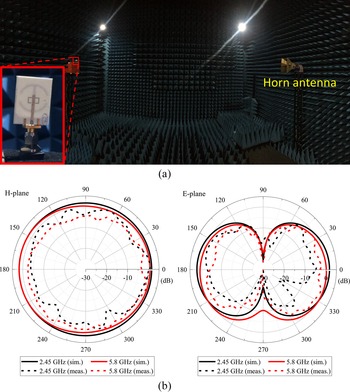
The antenna is simulated in CST, before being fabricated and measured inside an anechoic chamber. Figures 6 and 7 show the simulated and measured S 11 and radiation pattern of the antenna, along with the measurement set-up. In general, the measured and simulated S 11 curves are in good agreement. Two resonances at 2.45 and 5.8 GHz are visible, with the S 11 reaching − 20 dB. Due to some fabrication error, at 3.8 and 4.5 GHz, two other resonances appear. However, they are not important, the S 11 at those two resonances is also higher than − 10 dB. The measured and simulated radiation patterns are also quite similar, there are some small differences because the presence of the connector may affect and deteriorate the antenna's performance. The peak gain at 2.45 and 5.8 GHz are, respectively, 2 and 1.5 dBi. The antenna exhibits omnidirectional radiation patterns in both resonant bands, and thus meets the requirement for omni-directionality.
Measured and simulated S 11 of the metamaterial-based antenna.

Radiation pattern measurement set-up of the metamaterial-based antenna inside the anechoic chamber (a) and result (b). In our measurement, angle 0° corresponds to the normal direction in the front face (double cane) of the antenna.

In summary, the antenna in our study, although looks very similar to the one in [Reference Zhu and Ziolkowski23], has a different working principle. The latter employs magnetic coupling as the main mechanism that drives power to the ring resonator than radiates outward. With magnetic coupling, power must be transferred from the feed line to the double cane, then the current on it induces a magnetic field that fluxes through the ring. That magnetic flux in turn creates another current on the ring. For that to happen, the double cane and the ring must resonate at the same frequency, since power can only be delivered to them significantly at their resonances. Therefore, the antenna has one fundamental resonant frequency, and other resonances are its harmonics. Therefore, to create dual-band resonances, we blue-shift the resonant frequency of the double cane to 5.8 GHz (by changing its perimeter), then change the length of the feed line (thus the position of the double cane) to control the electric coupling between it and the ring, transferring power between them at 2.45 GHz.
Dual-band rectifier
For dual-band rectenna, there are two ways to rectify the received RF power, either by using two single-band rectifiers or using just one dual-band/wide-band rectifier. The first method may result in bulkier size [Reference Dinh and Le12, Reference Le, Tran, Le Le and Minh25, Reference Vu, Minh Dinh, Nguyen and Thuy Le26] and therefore not suitable to use in compact wireless sensor nodes. In this study, a dual-band rectifier will be employed.
Normally, for very low input power, the output voltages of rectifiers are also low. Therefore, the Greinacher circuit is preferred since the output voltage is doubled. The SMS-7630 Schottky diode is employed due to its high performance at low input, ranging between − 20 and − 10 dBm [Reference Hemour, Zhao, Lorenz, Houssameddine, Gui, Hu and Wu27]. The circuit is placed on a 0.8-mm-thick RO4003C substrate.
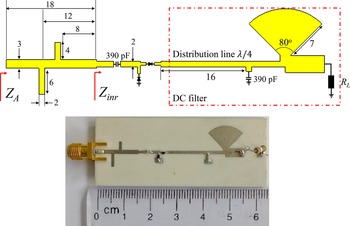
At the end of the rectifier, a DC-pass filter is incorporated to remove the residual AC components. Due to the input being dual-band, the filter must be able to remove both the 2.45 and 5.8 GHz frequencies, along with their higher harmonics. Due to that reason, using only one radial stub is not enough to complete the task. In this case, we use a 390 pF capacitor along with a quarter-wavelength transmission line (λ/4 at 2.45 GHz) to remove the 2.45 GHz and its harmonics. The radial stub operates as another band-stop filter that blocks the 5.8 GHz and its harmonics from entering the resistive load. The load, which represents the power management circuit and the sensor nodes, has the value of 3.9 kΩ.
After designing the DC-pass filter, the input impedance of the unmatched Greinacher circuit Z inr at − 10 dBm is measured in simulation. From that unmatched impedance, we design a dual-band matching circuit. The matching circuit consists of two open stubs. We give the stubs the same fixed width of 2 mm, then optimize their lengths and positions using ADS software to achieve equally good impedance matching at both 2.45 and 5.8 GHz. The final dimension of the rectifier is shown in Fig. 8.
Schematic and image of the dual-band rectifier, the dimensions are in millimeter.

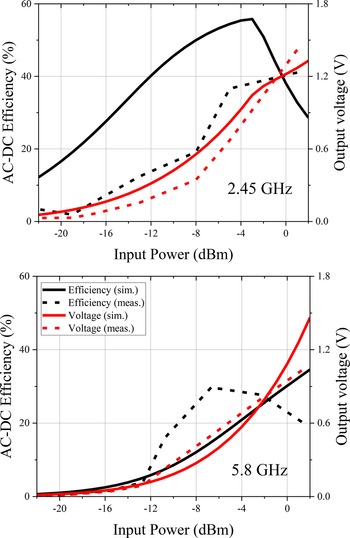
Figure 9 shows the simulated and measured efficiency and output voltage of the rectifier. Due to fabrication error, there are some notable differences between simulation and measurement. In particular, when attaching lumped components to the printed circuit board, the diode was exposed to a lot of heat, deteriorating its performance in the process. At 2.45 GHz, the final efficiency reaches 42% at maximum for 1 dBm input. At 5.8 GHz, the maximum efficiency is 30%, achieved at − 7 dBm input, which is significantly higher than simulation. The rectifier performs poorer at 5.8 GHz is not surprising since the performance of silicon-based semiconductor worsens at higher frequencies.
Simulated and measured performance of the rectifier.

Rectenna performance
After examining both the antenna and the rectifier separately, they are integrated into a monolithic rectenna, as shown in Fig. 10. It is worth mentioning that, by using the same type of substrate for both parts, they are attachable. Otherwise, if the substrates are different in thickness and/or material, they must be connected via the lumped SMA connector, which causes some inevitable loss. The total size of the integrated rectenna is 0.2λ × 0.75λ.
Monolithic rectenna.

The set-up to measure the rectenna performance is shown in Fig. 11(a). Since the rectenna is intended for indoor usage, we measured the rectenna inside our laboratory, without using any anechoic chamber. We used a Wi-Fi router as the power source for the sake of reality. A reference antenna, with gain G t already known, transmitted the power P t to the rectenna, which was placed at a distance r away. The output voltage V dc was monitored in an oscilloscope. The incident power density p in was calculated using the Friis equation as follows:

Then the incident power P r was calculated as:

where G r(λ2/4π) was the effective aperture of the receiving antenna. We also measured P r by using a similar antenna connected to a spectrum analyzer to confirm whether our set-up was correct. Then the conversion efficiency η was calculated as:

Set-up to measure the rectenna efficiency (a) and result (b).

Rectenna efficiency and output voltage are displayed in Fig. 11(b). The RF-DC efficiency at 5.8 GHz does not differ much from the AC-DC efficiency shown in Fig. 10, reaching 29% at − 2 dBm. However, for the 2.45 GHz band, significant difference appears. The maximum efficiency reaches as high as 72% at − 5 dBm input. Fabrication error is once again the reason. Since the rectifier and the antenna are integrated together, new diodes, capacitors, and resistor have to be attached to the new circuit. The integrated rectifier and the separate rectifier presented in Section “Dual-band rectifier” are therefore two different circuits in essence. And since the effect of fabrication error is actually random, it affects the two rectifiers in two different ways. It is thus understandable that two rectifiers perform differently.
Power management circuit
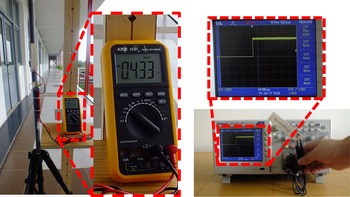
Power management circuit is an inseparable part of any Wi-Fi energy harvesting system. There are at least three reasons why it is needed. First, Wi-Fi signals are intermittent. They only last a few micro-to-milliseconds before disappearing for a while, then re-appear again. The output voltage is therefore not continuous. Instead, it has a pulse-like waveform, as shown in Fig. 12. The power management circuit is tasked with flatten these pulses, creating a stable, continuous output. Second, each sensor node requires a certain voltage level, usually higher than 1.8 V and around 3.3 V. Meanwhile, due to low incident power, the output voltage of the rectenna is often lower than the required level. The power management circuit is thus tasked with boosting up the output to a usable value. Finally, because the harvested power is usually insufficient for wireless sensors which require up to several milliwatts, it is necessary that the power is stored to accumulate the needed amount of energy.
Output voltage of the Wi-Fi rectenna without power management: average value (right) and waveform (left).

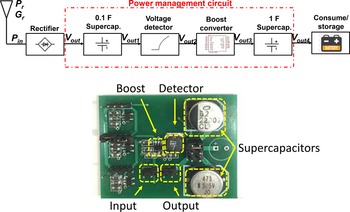
The block diagram of our energy harvesting system with power management circuit is shown in Fig. 13. The power management circuit consists of a 0.1 F supercapacitor, a voltage detector, a boost converter, and a 1 F supercapacitor. The first capacitor and the voltage detector operate as an intermediate stage between the rectenna and the boost converter. When the output voltage is non-zero, the supercapacitor is slowly charged. When the output voltage is zero, the capacitor will discharge toward the rectifier. The discharge is negligible however, due to the small reverse current of the diode. When the voltage on the supercapacitor reaches a certain level, which the voltage detector can detect, it opens and the voltage is boosted to 3.3 V. The power is then delivered to the second supercapacitor for storage purpose. In our circuit, the voltage detector is the NCP302 from ONSemiconductor and the boost converter is the PCC210 from Powercast. It should be mentioned that, due to the limit of current semiconductor technology, the lowest voltage limit that a voltage detector can detect is still quite high. For the NCP302, that limit is 800 mV, which can only be obtained for input power higher than − 6 dBm at 2.45 GHz and − 2 dBm at 5.8 GHz. Therefore, although the concept of power management circuit can be applied, we still have to rely on future development of semiconductors to be able to use it in practical applications, where the input power is much lower than − 6 dBm.
Block diagram of the power management circuit and its image.

We transmitted Wi-Fi signals to the rectenna and recorded the voltage on the intermediate supercapacitor as a function of time. As shown in Fig. 14, it actually took more than 120 min for the voltage to reach a detectable level (1 V, corresponding to 0.05 Joules in energy). Wireless sensors are usually in their sleep mode during most of the time, which does not require much power and energy. They only wake up to collect and transmit data a few times each day, and in a very quick period, usually several micro-to-milliseconds. If the power required for full-active mode is 10 mW, then 0.05 Joules can sustain the sensor node for 5 s, which is more than enough to collect and transmit data. With each charging cycle lasts 2 h, the sensor node supplied by this energy harvesting system can collect and transmit data up to 12 times a day.
Supercapacitor voltage as a function of time.

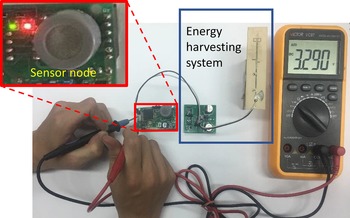
We connected a wireless sensor node to the energy harvesting system, and transmitted Wi-Fi signals from a router to the receiving antenna. The voltage supplied to the node was constantly monitored in a multimeter. As shown in Fig. 15, the supply voltage reached 3.3 V and the sensor nodes could wake up and operate with limited functions.
Wireless sensor node supplied with a Wi-Fi energy harvesting system.

Table 1 compares our study with other Wi-Fi energy harvesting systems. It is apparent that our harvester yields omni-directionality at both 2.45 and 5.8 GHz. The rectenna performs well at low input power. In addition, it has relatively small size, and is incorporated with power management function, which is absent in most related studies. Due to the comprehensiveness of the energy harvesting system, it is suitable to supply indoor wireless sensor nodes.
Comparison between this study and related research

Conclusion
In conclusion, we have investigated a comprehensive Wi-Fi energy harvesting system for indoor wireless sensor nodes. The system consists of a metamaterial-based dual-band antenna, which is compact and omnidirectional, a dual-band rectifier, and a power management circuit. The antenna exhibits similar radiation patterns at both frequencies. The rectenna possesses a maximum efficiency of 72% at 2.45 GHz and − 5 dBm, and 29% at 5.8 GHz and − 2 dBm. The power management circuit, which is absent in most earlier studies, produces stable and usable 3.3 V output voltage after 120 min. The accumulated power after charging is 0.05 Joules, which is enough for wireless sensor nodes to collect and transmit data in a few seconds. The Wi-Fi energy harvesting system in this study is dual-band, compact, omnidirectional, works well at low input power, incorporated with power management function. Therefore, it is suitable to supply indoor wireless sensor nodes.
Acknowledgments
The authors would like to thank Mr. Minh Q. Dinh for helpful discussion and intellectual support. This research is funded by the Hanoi University of Science and Technology under grant number T2021-SAHEP-007.
 Minh Thuy Le was born in Vietnam. She received her engineering (2006) and M.S. (2008) degrees in Electrical Engineering from the Hanoi University of Science and Technology, and her Ph.D. (2013) degree in Optics and Radio Frequency from the Grenoble Institute of Technology, France. She is a lecturer and also a Group leader of Radio Frequency group at the Department of Instrumentation and Industrial Informatics (3I), School of Electrical Engineering (SEE), Hanoi University of Science and Technology (HUST). Her current interests include built-in antennas, antenna arrays, beamforming, metamaterials, indoor localization and RF energy harvesting, wireless power transfer, and autonomous wireless sensors.
 Van Duc Ngo was born in Ha Nam, Vietnam, in 1991. He received his B.Eng. degree and M.S. degree in Electrical Engineering from the Hanoi University of Science and Technology (HUST), Hanoi, Vietnam, in 2014 and 2018, respectively. His research interests include design and analysis of antennas, RF energy harvesting, RF circuits/systems, and metamaterials.
 Thanh Tung Nguyen graduated from the Hanoi University of Science and Technology with B.Eng. degree in the field of Applied Physics. In December 2009, he obtained M.Sc. degree from the Department of Physics, Hanyang University (Seoul, Korea) and then obtained a Ph.D. degree from theDepartment of Physics and Astronomy, Katholieke Universiteit Leuven in 2014. Since August 2015, he has joined Metamaterials Lab of Prof. Takuo Tanaka in RIKEN Wako, Japan as a Japan Society for Promotion of Science (JSPS) postdoctoral fellow. He previously worked on the field of optics, magnetism, and spectroscopic characterizations. His research focused on fundamentals and applications of artificially engineered materials, on one hand, from top-down such as electromagnetic metamaterials, and on the other hand, from bottom-up such as multi-element atomic clusters, including simulations and measurements of microwave, infrared, and optical structures, especially the physics of magnetic materials at the atomic level using the Stern–Gerlach magnetic deflection technique. Recently, his interest is to investigate the use of thermal plasma technology to massively produce nanomaterials for real applications. Currently, he is working as a Principal Researcher at the Institute of Materials Science (IMS) and Associate Professor at Graduate University of Science and Technology (GUST), Vietnam Academy of Science and Technology (VAST).
 Quoc Cuong Nguyen received his engineering (1996) and M.S. (1998) degrees in Electrical Engineering from the Hanoi University of Science and Technology (HUST), Vietnam, and his Ph.D. degree in Signal-Image-Speech-Telecoms from INP Grenoble, France, in 2002. He is a professor at the Department of Instrumentation and Industrial Informatics and also the head of Department of Instrumentation and Industrial Informatics, School of Electrical Engineering (SEE), Hanoi University of Science and Technology (HUST). His research interests include signal processing, speech recognition, beamforming, smart sensors and RF communication.