

Introduction
Lamproite magmas commonly originate in the upper mantle at depths ranging from the sub-continental lithospheric mantle to the asthenospheric mantle. They are commonly enriched in volatiles (Mitchell and Bergman, Reference Mitchell and Bergman1991; Tainton and McKenzie, Reference Tainton and Mckenzie1994; Mitchell, Reference Mitchell1995; Murphy et al., Reference Murphy, Collerson and Kamber2002; Davies et al., Reference Davies, Stolz, Mahotkin, Nowell and Pearson2006; Rapp et al., Reference Rapp, Irifune, Shimizu, Nishiyama, Norman and Inoue2008; Mitchell and Tappe, Reference Mitchell and Tappe2010, Tappe et al., Reference Tappe, Foley, Stracke, Romer, Kjarsgaard, Heaman and Joyce2007, Reference Tappe, Pearson and Prevelic2013). Lamproite rocks are reported from subduction environments and within-plate cratonic regions (Mitchell and Bergman, Reference Mitchell and Bergman1991; Mitchell, Reference Mitchell1995; Nowell et al., Reference Nowell, Pearson, Bell, Carlson, Smith, Kempton and Noble2004; Prelević et al., Reference Prelevic, Foley, Romer and Conticelli2008; Tommasini et al., Reference Tommasini, Avanzinelli and Conticelli2011; Fritschle et al., Reference Fritschle, Prelević, Foley and Jacob2013; Gurmeet Kaur et al., Reference Gurmeet Kaur, Mitchell and Ahmed2018 and references therein).
Lamproites are hybrid rocks which are best characterised by detailed mineralogical studies (Mitchell and Bergman, Reference Mitchell and Bergman1991; Mitchell, Reference Mitchell2006 and references therein). Lamproites contain typomorphic minerals such as: phlogopite (alumina poor phenocrysts, tetraferriphlogopite groundmass); titanian potassium richterite; forsteritic olivine; Al- and Na-poor diopside; leucite; and sanidine. In addition to the major minerals, lamproites are also characterised by the presence of accessory minerals: priderite; wadeite; apatite; perovskite; titanian-magnesiochromite; magnesiochromite; magnesian titaniferous magnetite; jeppeite; armalcolite; shcherbakovite; ilmenite; and enstatite (Mitchell and Bergman, Reference Mitchell and Bergman1991; Mitchell, Reference Mitchell1995; Woolley et al., Reference Woolley, Bergman, Edgar, LeBas, Mitchell, Rock and Scott Smith1996). Mineralogical studies of lamproites are significant as they reflect the nature of the parental magma. Lamproite rocks with priderite, wadeite, jeppeite, armalcolite and shcherbakovite are indicative of derivation of lamproite from magmas enriched in incompatible and large-ion-lithophile elements. The presence of K-Ba titanites and K-Zr silicates also distinguishes lamproites from archetypal (or Group-I) kimberlites. The distinction between lamproites and kimberlites can be made on the basis of the presence of typomorphic minerals (Mitchell and Bergman, Reference Mitchell and Bergman1991; Mitchell, Reference Mitchell1995). Following the mineralogical-genetic classification proposed by Mitchell (Reference Mitchell1995) and Mitchell and Bergman (Reference Mitchell and Bergman1991), we classify the dyke occurring at Gundrapalli in the Ramadugu Lamproite field of Telangana in the Eastern Dharwar Craton as a bona fide lamproite. We also compare the mineralogy of the Gundrapalli dyke with the Kvaløya lamproite from Troms, Norway.
Eastern Dharwar Craton lamproites
The Dharwar Craton of southern India comprises two blocks: The Eastern and the Western Dharwar blocks. The Eastern Dharwar block is known for numerous occurrences of kimberlites and lamproites, whereas there are to date no reports of these rocks from the Western Dharwar block (Fig. 1; Neelkantam, Reference Neelkantam2001; Fareeduddin and Mitchell, Reference Fareeduddin and Mitchell2012 and references therein). The lamproite fields in the Eastern Dharwar block are: (1) the Wajrakarur field with the P2-West, P12, P5, P13, P4, TK1 and TK4 intrusions which were classified formerly as kimberlites, but have been reclassified recently as lamproites (Gurmeet Kaur et al., Reference Gurmeet Kaur, Korakoppa, Fareeduddin, Pruseth, Pearson, Grutter, Harris, Kjarsgaard, O'brien, Chalapathi Rao and Sparks2013; Gurmeet Kaur and Mitchell, Reference Gurmeet Kaur and Mitchell2013; Gurmeet Kaur and Mitchell, Reference Gurmeet Kaur and Mitchell2016; Shaikh et al., Reference Shaikh, Patel, Ravi, Behera and Pruseth2017; Shaikh et al., Reference Shaikh, Kumar, Patel, Thakur, Ravi and Behera2018); (2) the Cuddapah Basin lamproites with the Chelima, Zangamarajupalle, Garledinne, Banganapalle intrusions (Chalapathi Rao et al., Reference Chalapathi Rao, Gibson, Pyle and Dickin2004; Chalapathi Rao et al., Reference Chalapathi Rao, Atiullah, Kumar, Sahoo, Nanda, Chahong, Lehmann and Rao2016 and references therein); (3) the Krishna lamproite field (Chalapathi Rao et al., Reference Chalapathi Rao, Kamde, Kale and Dongre2010 and references therein); and (4) the Ramadugu lamproite field (Chalapathi Rao et al., Reference Chalapathi Rao, Kumar, Sahoo, Dongre and Talukdar2014; Gurmeet Kaur et al., Reference Gurmeet Kaur, Mitchell and Ahmed2016; Gurmeet Kaur and Mitchell, Reference Gurmeet Kaur and Mitchell2017; Gurmeet Kaur et al., Reference Gurmeet Kaur, Mitchell and Ahmed2018 and references therein). The Eastern Dharwar block lamproite emplacement/event preceded the global kimberlite event at 1.1 Ga (Kumar et al., Reference Kumar, Heaman and Manikyamba2007; Tappe et al., Reference Tappe, Smart, Torsvik, Massuyeau and de Wit2018a; Talukdar et al., Reference Talukdar, Pandey, Chalapathi Rao, Kumar, Belyatsky and Lehmann2018 and references therein). The Eastern Dharwar block lamproites range in age from 1.25 to 1.4 Ga (Chalapathi Rao et al. Reference Chalapathi-Rao, Wu, Mitchell, Li and Lehmann2013; Talukdar et al., Reference Talukdar, Pandey, Chalapathi Rao, Kumar, Belyatsky and Lehmann2018 and references therein). The Mesoproterozoic kimberlites and lamproites have a strong bearing on the diamond prospectivity in the global context (Kumar et al., Reference Kumar, Heaman and Manikyamba2007; Farreddudin and Mitchell, Reference Fareeduddin and Mitchell2012; Tappe et al., Reference Tappe, Dongre, Liu and Wu2018b). Talukdar et al. (Reference Talukdar, Pandey, Chalapathi Rao, Kumar, Belyatsky and Lehmann2018) elaborate on the comparable mineralogical, trace element, and isotopic geochemical affinity of the Eastern Dharwar block lamproites and relate their emplacement to dispersal of the Columbia supercontinent during the Mesoproterozoic period.
Distribution of kimberlites and lamproites in the Bundelkhand, Singhbhum, Bastar and Dharwar cratons of the Indian subcontinent. Diamonds (◊), circles (o) and crosses (x) refer to kimberlites, lamproites and deformed alkaline rocks and carbonatites (DARC) locations in the southern Indian sub-continent, respectively. Bu – Bunder lamproites; M – Majhgawan lamproite field; B – Basna kimberlite field; Na – Nawapara lamproite field; Mp – Mainpur kimberlite field; Tk – Tokapal kimberlite field; Ra – Ramadugu lamproite field; N – Narayanpet kimberlite field; R – Raichur kimberlite field; T – Tungabhadra kimberlite field; W – Wajrakarur kimberlite field; Nl – Nallamalai lamproite field; K – Krishna lamproite field; and D – Damodar valley lamproites (Gurmeet Kaur and Mitchell, Reference Gurmeet Kaur and Mitchell2016; Gurmeet Kaur et al., Reference Gurmeet Kaur, Mitchell and Ahmed2018).

Ramadugu lamproite field
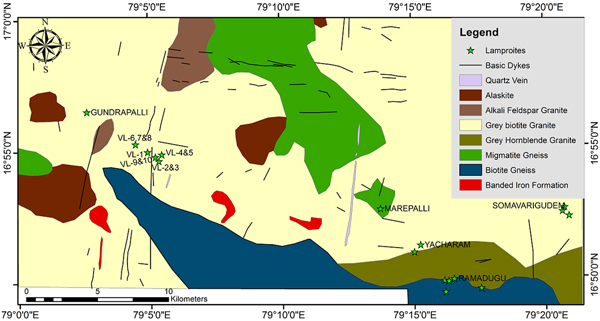
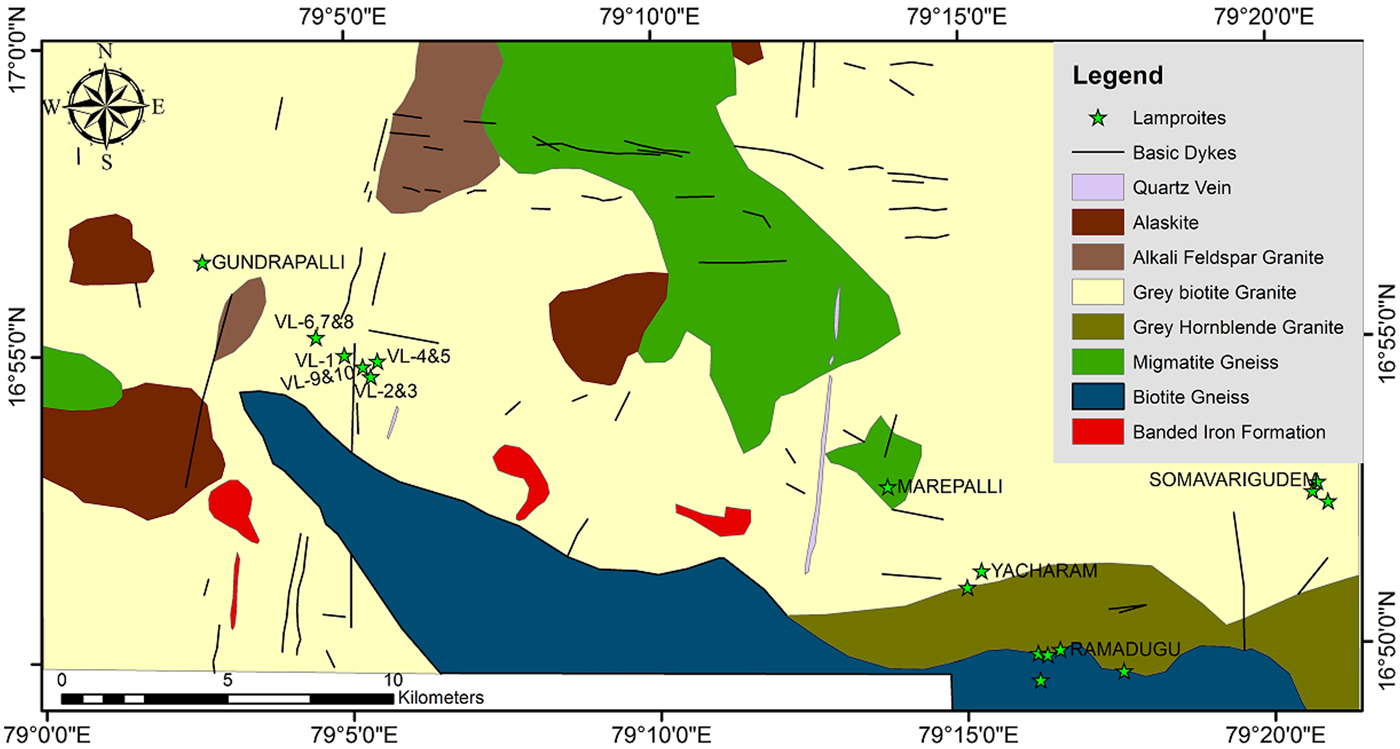
The Ramadugu lamproite field occurs in the Telangana state of India. It lies NNW of the Cuddapah Basin and is located close to the Krishna lamproite field (Fig. 1). The Ramadugu lamproite field consists of dykes located in the villages of Ramadugu, Somavarigudem, Yacharam, Vattikod, Gundrapalli and Marepalli (Fig. 2). The Ramadugu dykes are emplaced in the Peninsular Gneissic Complex of the Eastern Dharwar block (Fig. 2; Sridhar and Rau, Reference Sridhar and Rau2005; Ahmed and Kumar, Reference Ahmed and Kumar2012; Kumar et al., Reference Kumar, Ahmed, Priya and Sridhar2013; Chalapathi Rao et al., Reference Chalapathi Rao, Kumar, Sahoo, Dongre and Talukdar2014; Gurmeet Kaur et al., Reference Gurmeet Kaur, Mitchell and Ahmed2018). The Gundrapalli dyke of the Ramadugu lamproite field was discovered by Ahmed and Kumar (Reference Ahmed and Kumar2012).
Ramadugu lamproite field marked with the Ramadugu, Yacharam, Somavarigudem and Vattikod lamproite dykes, Nalgonda district, Telangana, India. The location of Gundrapalli lamproite and other Ramadugu lamproite dykes are also marked with a star.
Gundrapalli dyke
The Gundrapalli dyke is intrusive into the granite unit of Peninsular Gneissic Complex (Fig. 2). It extends in the NW–SE direction and is traceable up to an approximate length of 93 m with thickness of the dyke varying from 70 to 100 cm. The dyke is not continuous and the outcrops are rarely visible because of concealment of the dyke beneath the soil and vegetation cover (Fig. 3a). The rock in the field appears greyish black in colour and altered (Fig. 3b). The Gundrapalli dyke lies in close proximity to the Vattikod lamproite dyke system (Fig. 2; Kumar et al., Reference Kumar, Ahmed, Priya and Sridhar2013; Gurmeet Kaur et al., Reference Gurmeet Kaur, Mitchell and Ahmed2018). Field records and preliminary work on the Gundrapalli dyke can be found in the Geological Survey of India (GSI) report by Ahmed and Kumar (Reference Ahmed and Kumar2012) available on the GSI website (www.portal.gsi.gov.in). This paper presents a detailed mineralogical study of the Gundrapalli dyke and provides textural and compositional data for major, minor and accessory minerals. These data are used to identify conclusively the Gundrapalli dyke as lamproite.
(a) The Gundrapalli dyke intruding biotite granite of the Peninsular Gneissic Complex. The gneissic complex is concealed beneath the vegetation cover and the dyke outcrop is visible in places. (b) Close-up of an outcrop of the Gundrapalli lamproite dyke.

Analytical techniques
Gundrapalli dyke rock samples were investigated by back-scattered electron (BSE) imagery and quantitative energy dispersive X-ray spectrometry. The compositional data for the minerals were obtained by standard quantitative X-ray energy dispersive spectrometry using a Hitachi SU-70 field emission Scanning Electron Microscope (SEM) and the Oxford Instruments AZtec analysis system at Lakehead University, Thunder Bay, Canada. Acceleration voltage was 20 kV with a beam current of 300 pA. Standards used were those given by Liferovich and Mitchell (Reference Liferovich and Mitchell2005): synthetic pyroxene glass DJ35 (Si, Ca); corundum (Al); jadeite (Na,Al), BaF2 (Ba, F), Mn ‘hortonolite’ (Mg, Fe Si, Mn); apatite (P); SrTiO3 (Sr, Ti), ThNb4O12 (Th, Nb); ilmenite (Ti, Fe), gahnite (Zn) and zircon (Zr). Accuracy for major (> 10 wt.%) elements was typically better than (+/–1%) and for minor elements (from 1 and 10 wt.%) was (+/–2%), and was assessed by replicate analysis of standards against each other. Relative standard deviations for minor and major elements was < +/–3%, +/–2% and < +/–1% for elements occurring at < 1 wt.%, 1–10 wt.% and > 10 wt.% oxide. The small beam size and low beam currents employed ensured accurate analysis of small grains without excitation of adjoining material.
Petrography and mineralogy of Gundrapalli dyke
The Gundrapalli dyke consists of apatite phenocrysts and microphenocrysts set in generally fine grained groundmass. It also contains phenocrysts and microphenocrysts of pseudoleucite. Apatite is the only unaltered phenocryst and microphenocryst phase in addition to being a common groundmass mineral (Figs 4a–b, 5a). The former leucite phenocrysts are pseudomorphed by potassium feldspar, calcite, quartz and cryptocrystalline silica (Fig. 5b). The fine-grained groundmass consists of potassium-rich amphiboles, tetraferriphlogopite, Na- and Al-poor clinopyroxene, potassium-feldspar (pseudoleucite), spinel, apatite, calcite, baryte, titanite, rutile, allanite and baotite (Figs 5a–d and 6a–d). Minor phases are magnetite, pyrite and hydro-zircon (Figs 5c and 6c).
Plane-polarised light images of (a) the inequigranular texture of the Gundrapalli dyke; and (b) greenish-brown prismatic amphiboles and ovoid pseudoleucites in a fine grained matrix (PPL)

Back-scatter electron images of: (a) the inequigranular texture of the dyke with acicular apatite and pseudoleucite; (b) a veinlet of cryptocrystalline silica and chlorite cross-cutting the K-feldspar pseudomorph; (c) amphiboles, titanites, calcite and hydro-zircons in the Gundrapalli lamproite (the upper centre part shows the hydro-zircons and calcite association); and (d) acicular baotite forming together with titanite.

Back-scatter electron images of: (a) wedge-shaped amphibole, titanite and baotite together with euhedral apatite represent the groundmass material; (b) baotite in association with amphiboles, with potassium feldspar pseudomorphs, groundmass amphiboles and a fine-grained baryte veinlet also visible; (c) groundmass phlogopites in the Gundrapalli lamproite; and (d) elongated zoned apatite together with amphibole and potassium feldspar.

Amphibole is the commonest groundmass phase. It mostly occurs as prismatic and wedge-shaped crystals (Figs 5c–d). Commonly associated accessory phases are titanite, rutile, hydro-zircons, calcite, pyroxene, chlorite and baotite (Figs 5b–d). Representative compositions of amphibole are given in Table 1. The amphiboles have low Al2O3 (<0.5 wt.%) contents, and contain (9.04 to 0.70 wt.%) TiO2, (6.66 to 3.87 wt.%) Na2O, (5.55 to 2.25 wt.%) K2O, and (20.20 to 8.64 wt.%) FeOT. The amphiboles are compositionally diverse and include: potassic-richterite, potassic-arfvedsonite, magnesio-riebeckite, Ti-rich potassic-magnesio-arfvedsonite, potassic-magnesio-arfvedsonite, katophorite and potassic-ferri-katophorite. The majority are potassic-richterite typical of lamproite rocks (Table 1). The extremely low Al2O3 contents are characteristic of lamproite amphiboles (Mitchell and Bergman, Reference Mitchell and Bergman1991) and such low contents of alumina are primarily related to the parental peralkaline nature of magma (Wagner and Velde, Reference Wagner and Velde1986; Mitchell and Bergman, Reference Mitchell and Bergman1991).
Representative compositions (wt.%) and calculated mineral formula (in apfu) for Gundrapalli amphiboles.

n.d. – not detected; K – potassic; Mg – magnesio; rct – richterite; arf – arfvedsonite; ktp – katophorite
FeO* – total Fe expressed as FeO; 11, 12 are zoned and associated with baotite.
The second most abundant groundmass mineral is potassium feldspar. The typical habit of the feldspar indicates that it represents pseudomorphs after former leucite (Fig. 5a) and fresh leucite is not observed in the Gundrapalli dyke. The potassium feldspar pseudomorphs also contain calcite, hydro-zircons and quartz, minerals which are also found in leucite pseudomorphs in the Vattikod lamproites (Gurmeet Kaur et al., Reference Gurmeet Kaur, Mitchell and Ahmed2018). The pseudomorphs are also cross-cut by cryptocrystalline silica veinlets (Fig. 5b). Representative compositions of potassium feldspar (Table 2) show that they are relatively poor in Na2O (n.d.–0.24 wt.%) and FeOT (n.d.–0.62 wt.%), and similar to potassium feldspars in other lamproites (Mitchell and Bergman, Reference Mitchell and Bergman1991; Kumar et al., Reference Kumar, Ahmed, Priya and Sridhar2013 and Gurmeet Kaur et al., Reference Gurmeet Kaur, Mitchell and Ahmed2018).
Representative compositions (wt.%) and calculated mineral formulae (in apfu) for Gundrapalli K-feldspars.

n.d. – not detected
FeO* – total Fe expressed as FeO
Phlogopite, a minor groundmass phase, is typically tetraferriphlogopite characteristic of lamproites (Fig. 6c). Representative compositions (Table 3) show that they are poor in Al2O3 (8.66–5.54 wt.%) and enriched in FeOT (19.91–17.63 wt.%) and TiO2 (5.99–4.14 wt.%), with the fluorine contents varying from 1.83–1.11 wt.%. The low Al2O3 contents of Gundrapalli groundmass phlogopites compare well with the range of 5–11 wt.% Al2O3 defined for lamproite phlogopites (Mitchell, Reference Mitchell1989; Mitchell and Bergman, Reference Mitchell and Bergman1991). The BaO contents are <2 wt.%.
Representative compositions (wt.%) and calculated mineral formulae (in apfu) for Gundrapalli phlogopites.

n.d. – not detected
FeO* – total Fe expressed as FeO
Clinopyroxene is not commonly present in the Gundrapalli dyke. It occurs as an accessory phase and commonly is altered to chlorite. Representative compositions (Table 4), show that the clinopyroxene are poor in Al2O3 (0.77–0.66 wt.%) and Na2O (0.77–0.53 wt.%). The pyroxenes from Gundrapalli differ from those in the nearby Vattikod lamproites which are extremely enriched in FeOT up to 17 wt.% (Gurmeet Kaur et al., Reference Gurmeet Kaur, Mitchell and Ahmed2018).
Representative compositions (wt.%) and calculated mineral formulae (in apfu) for Gundrapalli pyroxenes.

n.d. – not detected
FeO* – total Fe expressed as FeO
Apatite occurs as a phenocrystal-to-microphenocrystal and groundmass phase (Fig. 5a). The phenocrystal apatite occurs as euhedral-to-elongated crystals which are zoned compositionally (Fig. 6d). The apatites occur in association with groundmass amphibole, titanite, rutile, calcite, baotite and hydro-zircon. Representative compositions (Table 5), indicate that they are rich in SrO (up to 3.59 wt.%) and fluorine (up to 3.77 wt.%), and can be classified as fluorapatites. The apatites which are zoned are typically impoverished in SrO and F in the core and are enriched in SrO and F at their rims (Table 5).
Representative compositions (wt.%) of Gundrapalli and Kvaløya apatites.

n.d. – not detected; C – Core; R – Rim; 1–8: Gundrapalli apatites; 9–14: Kvaloya apatites
FeO* – total Fe expressed as FeO
Spinel occurs as an accessory groundmass phase forming zoned, euhedral-to-subhedral crystals (<50 μm). Rutile is a late-stage phase associated with titanite. Rutile, although not a common and representative phase of lamproites, has been reported previously from some Indian lamproites (Mitchell and Fareeduddin, Reference Mitchell and Fareeduddin2009; Chalapathi Rao et al., Reference Chalapathi Rao, Kumar, Sahoo, Dongre and Talukdar2014; Gurmeet Kaur et al., Reference Gurmeet Kaur, Mitchell and Ahmed2018). The other accessory groundmass phases are: titanite, allanite, calcite, baryte, hydro-zircon and baotite (Figs 5c–d and 6b–d). Titanite occurs as aggregates and is mainly associated with amphibole, rutile and baotite. Titanites have also been reported from other Indian lamproites (Chalapathi Rao et al., Reference Chalapathi Rao, Kumar, Sahoo, Dongre and Talukdar2014; Gurmeet Kaur et al., Reference Gurmeet Kaur, Mitchell and Ahmed2018). Calcite is commonly present as a late-stage residual groundmass phase. It also occurs as secondary pseudomorphs after earlier-crystallised mineral leucite together with K-feldspar and quartz. Baryte occurs as a late-stage mineral and also commonly seen as small veinlets cross-cutting the rock. Hydro-zircons occur in the cores of pseudomorphed leucite as aggregates of very fine grains. Chlorite forms as a replacement product of groundmass amphibole, pyroxene and phlogopite. Aggregates of quartz are common in pseudomorphed leucite. Cryptocrystalline veins of silica commonly cross-cut the rock as a late-stage phase. The rare mineral baotite forms aggregates with radiating structures and is closely-associated with rutile, amphiboles and titanite (Figs 5d and 6a–b). Baotite compositions are given in Table 6.
Representative compositions (wt.%) and calculated mineral formulae (in apfu) for Gundrapalli and Kvaløya baotites.

n.d. – not detected; FeO* – total Fe expressed as FeO; S.D. – standard deviation
** #7 = average of Kvaløya lamproite from Norway, n = 38
Baotite from peralkaline, alkaline and other associated rocks
Baotite, chlorine bearing Ba-Ti-(Nb) silicate, is a rare mineral commonly reported from peralkaline, alkaline and associated rocks. Generally, baotites from different rock types have compositions varying between the end-members Ba4Ti8Si4O28Cl and Ba4Ti2Fe2+2Nb4Si4O28Cl (Kullerud et al., Reference Kullerud, Zozulya and Ravna2012 and references therein). Baotite was reported for the first time from hydrothermal quartz veins of the Bayan-Obo mine of Mongolia, China (Peng, Reference Peng1959; Semenov et al., Reference Semenov, Khun and Kapitonova1961). Subsequently, baotite has been reported from rocks which mostly belong to the alkaline/peralkaline and carbonatite series. Some of the important world occurrences of baotites from alkaline/peralkaline and carbonatite series rocks are (Kullerud et al., Reference Kullerud, Zozulya and Ravna2012 and references therein): (1) carbonatites and carbonatite veins and dykes from US, Russia, Democratic Republic of Congo and New Zealand (Heinrich et al., Reference Heinrich, Boyer and Crowley1962; Koneva et al., Reference Koneva, Konev, Vladykin and Kogarko2008; Wall et al., Reference Wall, Williams and Woolley1996; Cooper, Reference Cooper1996); (2) alkali-granite pegmatites and hydrothermal rocks from Pakistan; Tajikistan (Obodda and Leavens, Reference Obodda and Leavens2004; Karpenko and Pautov, Reference Karpenko and Pautov2002); (3) lamproites from Russia, Czech Republic, Norway and India (Rudashevsky et al., Reference Rudashevsky, Gorkovetz, Rudashevsky, Popov, Raevskaya and Kogarko2011; Nemec, Reference Nemec1987; Krmíček et al., Reference Krmíček, Cempírek, Havlín, Přichystal, Houzar, Krmíčková and Gadas2011; Kullerud et al., Reference Kullerud, Zozulya and Ravna2012; Gurmeet Kaur and Mitchell, Reference Gurmeet Kaur and Mitchell2017); and (4) alkaline pegmatites from United States (Chakhmouradian and Mitchell, Reference Chakhmouradian and Mitchell2002). Table 7 summarises the wide geographic distribution and compositional range of baotites.
Global occurrence of baotites from alkaline and associated rocks (modified after Kullerud et al., Reference Kullerud, Zozulya and Ravna2012).

The rare occurrence of baotite and few petrographic studies, together with limited knowledge on the nature of late-stage fluids associated with them in particular and alkaline/peralkaline rocks in general precludes a complete understanding of formation of baotite in different rocks from different environments. The common factors in the genesis of baotites in different environments are: (1) baotites are mostly associated with alkaline/peralkaline rocks; and (2) baotites form as a late-phase liquidus mineral in lamproites and carbonatites as a result of auto-metasomatism in these rocks through fluids (Kullerud et al., Reference Kullerud, Zozulya and Ravna2012 and references therein). The baotites from different provenances such as pegmatites, fenitised granites, hydrothermal quartz veins, metasomatites, volcaniclastic breccia etc. demonstrate the intense effects of late-to-post-magmatic processes involving fluids enriched in chlorine and fluorine.
The presence of baotite in the Gundrapalli dyke is the first report of baotite from a lamproite in India. Baotite compositions given in Table 6 have been recalculated on the basis of 16 cations, with the resulting structural formula being close to the ideal Ti-rich end-member Ba4Ti8Si4O28Cl. Representative compositions indicate (40.71–37.89 wt.%) BaO, (40.52–39.32 wt.%) TiO2, (1.28–0.82 wt.%) Nb2O5 and 2.24–1.97 wt.% Cl. Minor amounts of Ca have substituted for Ba and some minor Nb and Fe have substituted for Ti (Table 6).
We have tried to interpret the coupled element exchange mechanisms in the Gundrapalli baotite following Copper (1996) and Kullerud et al. (Reference Kullerud, Zozulya and Ravna2012). The binary Ti–Nb, Ti–Fe, Ti–Ba and Ti–Cl plots of baotites of Gundrapalli lamproites and baotites reported from different alkaline/peralkaline rock types from various global localities are given in Fig. 7 (Supplementary Table S1). In the Ti–Nb diagram the Gundrapalli baotites plot close to the slope –⅔ as is the case for Kvaløya and SW Bohemia (Copper, 1996; Kullerud et al., Reference Kullerud, Zozulya and Ravna2012; Krmíček et al., Reference Krmíček, Cempírek, Havlín, Přichystal, Houzar, Krmíčková and Gadas2011). In the Ti–Fe diagram the data plot close to a line with a slope –⅓. These observations support a coupled Ti–Nb exchange mechanism in baotite in the form of 3Ti4+ = 2Nb5+ + Fe2+, as suggested by Cooper (Reference Cooper1996) and Kullerud et al. (Reference Kullerud, Zozulya and Ravna2012). All Gundrapalli baotites cluster near the Ba4Ti8Si4O28Cl end-member together with Kvaløya and SW Bohemia baotites along the tie line between the Nb-rich end-member Ba4Ti2Fe22+Nb4Si4O28Cl and Nb-free end-member Ba4Ti8Si4O28Cl [Fig. 7; Supplementary Table S1; Cooper (Reference Cooper1996); Kullerud et al. (Reference Kullerud, Zozulya and Ravna2012)].
Binary Nb–Ti, Fe–Ti, Ba–Ti and Cl–Ti plots for baotites of Gundrapalli lamproite and other world-wide localities. Key: 1 – Kvaløya, Norway (Kullerud et al., Reference Kullerud, Zozulya and Ravna2012); 2 – Gundrapalli, India (present work); 3 – Variscan, Bohemia, Czech Republic (Nemec, Reference Nemec1987; Krmíček et al., Reference Krmíček, Cempírek, Havlín, Přichystal, Houzar, Krmíčková and Gadas2011); 4 – Montana, USA (Chakhmouradian and Mitchell, Reference Chakhmouradian and Mitchell2002); 5 – Ontario, Canada (Potter and Mitchell, Reference Potter and Mitchell2005); 6 – Bayan-Obo, Mongolia, China (Peng, Reference Peng1959); 7 – Bayan-Obo, Mongolia, China (Semenov et al., Reference Semenov, Khun and Kapitonova1961); 8 – Haast River, New Zealand (Cooper, Reference Cooper1996).

The role of Cl in baotite is insignificant to balance the structure of the mineral electrostatically (Potter and Mitchell, Reference Potter and Mitchell2005; Kullerud et al., Reference Kullerud, Zozulya and Ravna2012 and references therein). The chlorine contents in baotites have a restricted range varying between 1.3 wt.% to 3.1 wt.% (Nemec Reference Nemec1987; Potter and Mitchell Reference Potter and Mitchell2005; Kullerud et al., Reference Kullerud, Zozulya and Ravna2012 and references therein). Chakhmouradian and Mitchell (Reference Chakhmouradian and Mitchell2002) reported the formation of baotite together with other fluorine-rich minerals such as REE fluorocarbonates, calcite and fluorapatite from alkaline pegmatites in the presence of high-F fluids. Similarly, Krmíček et al. (Reference Krmíček, Cempírek, Havlín, Přichystal, Houzar, Krmíčková and Gadas2011) and Kullerud et al. (Reference Kullerud, Zozulya and Ravna2012) reported late-magmatic crystallisation of baotite together with Sr-rich fluorapatite from lamproite-like dykes in SW Bohemia, Czech Republic and the Kvaløya lamproite, Norway, respectively. These workers inferred that the Cl-rich and F-devoid baotite and F-rich minerals such as fluorapatite, fluorocarbonates, F-rich silicates and calcite can form in equilibrium with a late-stage fluid enriched in F, CO2 and Cl.
Chlorine-bearing minerals are rare in nature due to the strong preference of Cl for late-stage fluids (Kullerud et al., Reference Kullerud, Zozulya and Ravna2012 and references therein). The silicates, i.e. amphiboles and micas (phlogopites, biotites), commonly incorporate fluorine when fluids are enriched both in fluorine and chlorine, whereas they incorporate chlorine if the fluids are enriched in chlorine and poor in fluorine (Kullerud, Reference Kullerud1995, Reference Kullerud1996). The silicate mineral baotite is unique in the sense that it extracts chlorine instead of fluorine from fluids enriched both in fluorine and chlorine (Kullerud et al., Reference Kullerud, Zozulya and Ravna2012 and references therein).
Mineralogy of Gundrapalli vis-à-vis Kvaløya lamproite
The Kvaløya lamproite dyke is intrusive into Paleoproterozoic granite, part of the West Troms Basement Complex, on the island Kvaløya, northern Norway (Kullerud et al., Reference Kullerud, Zozulya, Bergh, Hansen and Ravna2011; Kullerud et al., Reference Kullerud, Zozulya and Ravna2012 and references therein). The Gundrapalli lamproite dyke is also intrusive into granite of Peninsular Gneissic Complex, Eastern Dharwar Craton (Fig. 2). The Kvaløya lamproite contains fluorapatite, phlogopite (enriched in fluorine) and Cl-enriched baotite similar to that of the Gundrapalli lamproite, as discussed above. The major similarity between the two rocks is the presence of zoned, phenocrystal-to-microphenocrystal apatite. The Kvaløya zoned apatites are typically impoverished in SrO in the core and are enriched in SrO at their rims and are quite similar to the Gundrapalli phenocrystal-to-microphenocrystal apatites. The Kvaløya and Gundrapalli apatites are enriched in fluorine (Table 5). There is a striking similarity between the baotite found at Kvaløya and Gundrapalli in that in both it forms aggregates with radiating structures instead of well-defined crystals and is associated closely with rutile, amphiboles and also titanite (at Gundrapalli). Baotites from both the Norwegian and Indian lamproites are almost Nb-free types with the composition Ba4Ti8Si4O28Cl (Table 6). The Kvaløya lamproite contains phlogopite and apatite enriched in fluorine and baotite enriched in chlorine analogous to apatite, phlogopite and baotite of the Gundrapalli lamproite.
Discussion and conclusions
Alkaline/peralkaline magmatism is prevalent in the eastern Dharwar craton of southern India. Numerous new occurrences of lamproite dykes from, and around, the Palaeoproterozoic–Mesoproterozoic Cuddapah Basin provides an opportunity to comprehend the nature of the subcontinental lithospheric mantle in southern India. The mineralogy of a newly discovered dyke at Gundrapalli village in the Ramadugu lamproite field reveals the nature of the parental magma which was responsible for the observed mineral paragenesis: katophorite and potassic-ferri-katophorite; Al-poor pyroxene; phlogopite; K-feldspars (leucite); spinel (chromite-magnesiochromite); apatite (Sr and fluorine-rich), titanite; rutile; calcite; baryte; and baotite. The absence of Ba-Ti-Zr minerals, such as wadeite and priderite from the Gundrapalli dyke have been compensated for by the presence of baotite, rutile, baryte and hydro-zircons. The presence of secondary phases such as allanite, hydro-zircon, chlorite, quartz and cryptocrystalline SiO2, implies that the dyke has undergone varied degrees of deuteric alteration. On the basis of its typomorphic major mineralogy the Gundrapalli dyke is classified as a pseudoleucite-phlogopite-amphibole-lamproite. The presence of baotite in the Gundrapalli dyke (first occurrence reported from India) is similar to the baotite paragenesis from the Kvaløya lamproite dyke in Norway. The high Cl-content of baotite in Gundrapalli, as is also the case at Kvaløya, indicates partitioning of Cl into baotite in the Cl-bearing F-rich hydrous fluid (Kullerud et al., Reference Kullerud, Zozulya and Ravna2012 and references therein). From the investigations of the Kvaløya lamproite we deduce that the Gundrapalli baotite also formed as a late-stage mineral from a fluorine- and chlorine-enriched fluid phase of the lamproite magma. The presence of the Ti- and Ba-rich phases baotite, rutile, baryte, allanite and titanite suggest high a Ti, a Ba, in equilibrium with high F-, Cl-bearing hydrous fluids operational during the formation of Gundrapalli lamproite.
In summary: (1) the Gundrapalli dyke is a pseudoleucite-phlogopite-amphibole lamproite; (2) the typomorphic Ba-Ti-Zr minerals of lamproites in the Gundrapalli lamproite dyke are represented by baotite, rutile, baryte and hydro-zircons; (3) baotite has been identified for the first time from an Indian lamproite; (4) the secondary phases allanite, chlorite, quartz and cryptocrystalline silica, implies deuteric alteration of the Gundrapalli lamproite dyke; (5) the Gundrapalli lamproite mineralogy is comparable with Kvaløya lamproite (Norway); and (6) the presence of the Ti- and Ba- rich phases baotite, rutile, baryte, allanite and titanite suggest high a Ti, a Ba in equilibrium with F- and Cl-bearing hydrous fluids.
Acknowledgements
The Natural Sciences and Engineering Research Council of Canada, Almaz Petrology, and Lakehead University are acknowledged for financial support. G.K. acknowledges Mr. Suhel Ahmed, Officer, Geological Survey of India, Hyderabad and Ms Asifa Kamboj, Mr Sarabjeet Singh, research scholars, Panjab University for their help. The authors thank Prof. Sebastian Tappe and an anonymous reviewer for suggesting revisions to improve the manuscript. G.K. also acknowledges Panjab University, Chandigarh, India for granting leave to pursue research on Indian lamproites at Lakehead University, Canada.
Supplementary material
To view supplementary material for this article, please visit https://doi.org/10.1180/mgm.2018.169