INTRODUCTION
Primary seed dispersal provides the template on which subsequent events and processes like secondary seed dispersal and post-dispersal seed predation can act (Vander Wall & Longland Reference VANDER WALL, LONGLAND, Forget, Lambert, Hulme and Vander2005). Seeds dispersed in faeces can be accidentally incorporated into dung balls carried away and then buried, or directly buried by dung beetles digging tunnels beneath the faeces in order to feed or supply their nest with food (Hanski & Cambefort Reference HANSKI and CAMBEFORT1991). Most often, seeds are buried in an environment more suitable for germination or safer from detection by rodents (Andresen & Levey Reference ANDRESEN and LEVEY2004, Estrada & Coates-Estrada Reference ESTRADA and COATES-ESTRADA1991, Feer Reference FEER1999, Shepherd & Chapman Reference SHEPHERD and CHAPMAN1998). However, deep burial can also prevent seedling emergence (Andresen & Levey Reference ANDRESEN and LEVEY2004). Likewise post-dispersal seed predation is one of the major factors affecting the recruitment of plant species (Hulme Reference HULME, Levey, Silva and Galetti2002) and it can be very high and variable in space and time (Crawley Reference CRAWLEY and Fenner2000).
Primates, constituting 25–40% of the frugivore biomass within the tropical forests they exploit (Chapman Reference CHAPMAN1995), are among the main seed dispersers in these ecosystems. The majority of studies of primate seed dispersal, and particularly on the post-dispersal fate of primate-dispersed seed, focuses on large primates (Andresen Reference ANDRESEN1999, Estrada & Coates-Estrada Reference ESTRADA and COATES-ESTRADA1984, Kaplin & Lambert Reference KAPLIN, LAMBERT, Levey, Silva and Galetti2002, Kunz & Linsenmair Reference KUNZ and LINSENMAIR2007, Stevenson et al. Reference STEVENSON, CASTELLANOS, PIZARRO and GARAVITO2002, Wrangham et al. Reference WRANGHAM, CHAPMAN and CHAPMAN1994). Lack of information on the fate of seeds dispersed by small primates may partly be due to the difficulty of finding and following the fate of seeds in small defecations, but it is also related to the frequent assumption that larger primates are more effective seed dispersers because they produce large defecations with many seeds. However, this pattern has been considered disadvantageous to seed survival as clumped seeds are removed more rapidly than scattered seeds (Feer & Forget Reference FEER and FORGET2002). Effective seed dispersal depends on the quantity but also on the quality of dispersal, i.e. the probability that a dispersed seed will produce a new reproductive adult (Schupp Reference SCHUPP1993). Differences in defecation patterns between small and large primates (Stoner et al. Reference STONER, RIBA-HERNANDEZ, VULINEC and LAMBERT2007) will probably influence the results of secondary events, and hence the seed fate.
In this study we focused on two small-primate species, the saddleback tamarin (Saguinus fuscicollis Spix, body mass: 240–440 g, Soini & Coppula Reference SOINI and COPPULA1981) and the moustached tamarin (Saguinus mystax Spix, body mass: 380–650 g, Soini & Soini Reference SOINI and SOINI1982). In contrast to Africa (Chapman & Chapman Reference CHAPMAN and CHAPMAN1999), many neotropical primate species use secondary forest (Vulinec et al. Reference VULINEC, LAMBERT and MELLOW2006). Thanks to their low body mass, tamarins can enter into relatively young degraded areas (trees of 3–10 m height; Oliveira & Ferrari Reference OLIVEIRA and FERRARI2000) where pioneer species established after having been dispersed, usually by birds and bats (Da Silva et al. Reference DA SILVA, UHL and MURRAY1996, Gorchov et al. Reference GORCHOV, CORNEJO, ASCORRA and JARAMILLO1993, Medellín & Gaona Reference MEDELLÍN and GAONA1999). Tamarins could be of special interest for regeneration of degraded lands where the lack of seed dispersal constitutes a major obstacle to forest regeneration (Howe Reference HOWE1984, Nepstad et al. Reference NEPSTAD, UHL, PEREIRA and DA SILVA1996, Terborgh et al. Reference TERBORGH, PITMAN, SILMAN, SCHICHTER, NÚÑEZ, Levey, Silva and Galetti2002). Both have a diet rich in fruit and disperse the seeds of a large proportion of them (Knogge & Heymann Reference KNOGGE and HEYMANN2003, Peres Reference PERES1993). They produce small defecations with a small quantity of faecal matter and a small number of seeds (Knogge & Heymann Reference KNOGGE and HEYMANN2003). Saddleback tamarin faeces have a stronger smell than moustached tamarin faeces probably due to higher proportion of prey (vertebrates as lizards or frogs, and invertebrates as grasshoppers or spiders) and gum in their diet (Nadjafzadeh & Heymann Reference NADJAFZADEH and HEYMANN2008).
The aim of this study was to determine how the short-term post-dispersal seed fate is affected by tamarin species, quantity of faecal matter, time of defecation and number of seeds in faeces. In view of the small amount of faecal matter and the low number of seeds in tamarin faces, we hypothesized that dung beetles and predators would be less attracted to tamarin faeces than has been reported for faeces of larger primates. We predicted lower secondary seed dispersal and predation percentages than those usually found on faeces of larger primates. We also predicted that dung beetles would be more attracted to saddleback tamarin faeces due to its stronger smell which would lead to a higher seed percentage of burial. Therefore, we (1) examine the activity of dung beetles attracted to tamarin faeces, (2) assess the short-term post-dispersal fate (2–4 d after primary seed dispersal) of seeds defecated by the tamarins, and (3) determine the effects of tamarin species, time of day, seed number, and amount of dung on short-term seed fate.
STUDY SITE
Field experiments and behavioural observations were carried out at the Estación Biológica Quebrada Blanco (EBQB) in north-eastern Peru (4°21′S, 73°09′W) on the right bank of the Quebrada Blanco, an affluent of the Río Tahuayo. The 100-ha study area is dominated by primary terra firme rain forest on a slightly undulating terrain interspersed with small swampy areas (Encarnacion Reference ENCARNACION1985, Heymann Reference HEYMANN1995). The study area also includes c. 4 ha of an abandoned pasture, regenerating since c. 1999. Annual rainfall, measured at the nearest meteorological station (Tamshiyacu, about 40 km north-west of the EBQB) was 2958 mm in 2006 and averaged 3000 mm (1980–1989; Heymann Reference HEYMANN1995). Monthly minimum and maximum temperatures averaged 18.8 °C and 30.1 °C for the study period. Six species of primate are permanently present in our study area (Aotus nancymaae Hershkovitz, Callicebus cupreus Spix, Pithecia monachus Saint-Hilaire, Saimiri sciureus Linnaeus, Saguinus fuscicollis, Saguinus mystax) while six others are sporadically observed (Ateles chamek Humboldt, Cacajao calvus Saint-Hilaire, Callithrix pygmaea Lönnberg, Cebus albifrons Humboldt, Cebus apella Linnaeus, Lagothrix lagotricha Humboldt). Population densities of moustached and saddleback tamarins are estimated at 15–20 individuals km−2 for both species. We studied a mixed-species group of 11–15 tamarins consisting of 7–10 moustached tamarins and 3–6 saddleback tamarins.
METHODS
Data were collected during five missions: May–July 2004 (mission one, M1), January–March 2005 (M2), September 2005–February 2006 (M3), June–November 2006 (M4), and March–August 2007 (M5). M1 was dedicated to the observation of dung beetle activity while secondary-dispersal and predation experiments were made during the other missions.
In contrast to larger primates, tamarin faeces can only be found through direct observation of defecating individuals while following the troop. Due to their small size, faeces dry rapidly and cannot be conserved for later experiments. Each faecal sample observed in the field was characterized by (1) tamarin species (TS), (2) time of defecation (TD) (with five 2-h periods, TD1–TD5, from 06h00 to 16h00), (3) amount of dung (AD1 = traces of faecal matter on the seeds, AD2 = little faecal matter and seeds clearly visible, AD3 = medium amount of faecal matter and only outlines of seeds visible, AD4 = much faecal matter, seeds almost undetectable), (4) number of seeds contained (NS), and (5) substrate of deposition (on a leaf of the understorey or on the litter).
Diurnal dung beetle activity
While following the tamarin group 5 d wk−1, during M1, we observed 49 freshly fallen faeces until their burial by dung beetles, but for a maximum of 30 min to keep the tamarin group in sight; if no dung beetle arrived after 5 min, faeces were considered as not visited. We noted time of arrival and approximate size of dung beetles, and activity (rolling, displacement and burial of faeces with or without seed).
Secondary seed dispersal by dung beetles
We measured secondary seed dispersal by dung beetles using a semi-controlled experiment that allowed for dispersal by dung beetles while preventing predation by vertebrates. Once a week, in fresh defecations detected in the field, we marked in situ all the seeds larger than 0.4 cm, which represents more than 80% of species consumed (Garber Reference GARBER1986), by attaching a 25-cm white nylon thread with a 5-cm piece of coloured and numbered raffia attached to the other end. The thread was knotted using a small twig to lift the seed up, then pass a slipknot around it, and finally retighten the knot without removing any faecal matter. We covered the seed-containing defecation with a metallic cage (20 cm × 20 cm × 10 cm, mesh = 1.2 cm × 1.2 cm as dung beetles attracted to tamarin faeces rarely exceed 0.8 cm width (Culot Reference CULOT2005) and larger mesh would allow the passage of small rodents) allowing the entry of dung beetles and movement of seeds, while preventing the access of vertebrates. In this manner, 458 seeds in 268 defecations were checked for burial after 2 d and vertical movement measured to the nearest centimetre. As seeds were naturally found in the faeces, our samples contained a large number of species (83) and a wide range of sizes (0.75–2.45 cm length and 0.5–1.12 cm width). Seeds could move in and out of the cage, although the passage of seeds out of the cage could be difficult for some species due their larger size. However, as horizontal displacement does not often exceed 15 cm (Andresen Reference ANDRESEN2001), most of the seeds were buried inside the perimeter of the cage. As predation by insects was still possible, seeds showing traces of predation or removed or with the thread broken were considered as not buried by dung beetles. We did not consider the horizontal movements as secondary seed dispersal events because displacements are generally very short and we could not attribute them to dung beetles with certainty as other animals (e.g. crickets) or rain could also cause such a movement.
Seed predation
Once a week, we measured seed predation with another semi-controlled experiment that allowed seed removal by seed predators while preventing seed dispersal by dung beetles. In this case, 398 seeds of 83 species were marked as described above in 257 fresh defecations, and then placed, with the faecal material inside a plastic bowl (16 cm diameter, 10 cm high) that had drainage holes at the bottom. Four pieces of string fixed the bowl to sticks pushed into the ground. Dung beetles were able to reach the dung and seeds but could not bury or remove either from the bowl. After 4 d we recorded seed predation when a seed had been completely or partially eaten, or when it had disappeared. Predation was attributed to vertebrates (rodents or terrestrial birds) when the seeds were either absent, or partially consumed and wear tooth marks. Predation was attributed to insects when the seeds were partially eaten without tooth marks. The same experiment without using bowls was conducted at the same time in a different study and results of predation on unburied marked seeds were compared with those of the predation experiment of this study. There was not significant difference (χ2 = 0.79, df = 1, P > 0.1) between the two experiments. Bowls were thus considered as not influencing predator behaviour.
Statistical analyses
Statistical analyses were made using STATISTICA 7.1 software, with α level set at 0.05. Means are given with standard deviation (mean ± 1 SD). Due to the small sample size of observations on dung beetle activity, we organized the categories of the variables ‘time of defecation’ and ‘amount of dung’ in order to obtain binary variables. We tested the effect of time of defecation (morning: TD1 to TD3 versus afternoon: TD4 and TD5), amount of dung (little faecal matter: AD1 and AD2 versus much faecal matter: AD3 and AD4) and tamarin species (S. fuscicollis versus S. mystax) on the number of dung beetles attracted to each defecation using a logistic regression with backward selection including the additive effects of these binary variables without interaction.
In the case of the semi-controlled experiments, the larger sample sizes allowed us to use all the categories of the independent variables as originally defined. We used a multivariate analysis to test the effects of time of defecation (TD1–TD5), tamarin species, amount of dung (AD1–AD4) and quantity of seeds in faeces (1, 2, 3, 4 and 5+ seeds per faeces) on seed burial and seed predation using a logistic regression with the backward selection of the predictor variables. To analyse the effects of these same variables on the depth of burial we used a generalized linear model, only considering depths > 0 cm. The error structure was defined as having a Poisson distribution, the logarithmic link function was used, and the Wald test was used to test for significant effects of the explicatory variables in the model.
RESULTS
Diurnal dung beetle activity
We observed 49 freshly dropped faeces of which 41 (87%) contained seeds. The number of seeds ranged from zero to seven with an average of 1.9 ± 1.3 seeds per faeces. Most of the faeces reached the ground and were thus observed on the litter (94%) while the others remained on a leaf of the understorey. Within 10 min of deposition, 17 faecal samples were visited by an average of 1.5 ± 1.1 beetles. Thirty-two defecations were not visited by dung beetles while 13 were visited by only one dung beetle and on only four at least one additional dung beetle arrived. A maximum of five beetles was observed once, on an AD4 defecation (large amount of faecal material). We observed three morphospecies of dung beetles on tamarin faeces (one Canthon sp. and two Canthidium spp.), with an average size of 6.5 ± 2.6 mm. Logistic regression led us to keep only the variable ‘amount of dung’ to explain the presence of dung beetles on tamarin faeces (Wald = 12.6, P < 0.001) with a percentage of correct classification of 80% (39/49). The amount of dung was thus the main predictor of the arrival of dung beetles on tamarin faeces. As expected, tamarin defecations containing a larger amount of faecal matter (AD3 and AD4) were more likely to attract dung beetles than AD1 and AD2 faeces (mean of 1.1 versus 0.2 dung beetles). Twelve defecations out of 17 visited by dung beetles were moved horizontally as dung balls or as fragment (pellet) over an average distance of 7 ± 9.5 cm, with a maximum observed of 25 cm. Among these defecations, 10 were entirely or partially buried in a way that 13 out of the 15 seeds they contained were buried as well. The secondary dispersal percentage observed thus corresponds to 15.5% (13 seeds buried out of a total of 84).
Secondary seed dispersal
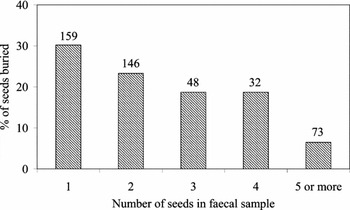
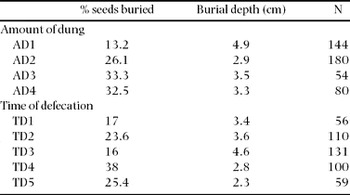
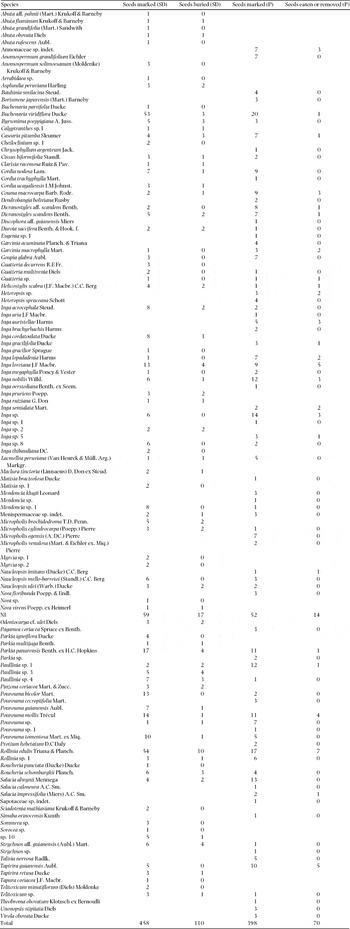
After 2 d, 24.0% (110/458) of the seeds had been buried at a mean depth of 3.5 ± 3.0 cm (range: 0.5–11 cm) (Appendix 1). Time of defecation, amount of dung, and number of seeds, but not tamarin species, showed significant effects on seed burial (TD: Wald = 18.9, P < 0.001; AD: Wald = 29.3, P < 0.00001; NS: Wald = 13.8, P < 0.001) with a correct classification of 79%. Seeds in higher number (NS = 5+, Figure 1), and seeds surrounded by only traces of faecal matter (AD1, Table 1) were less likely to be buried. Seeds dispersed between 12h00 and 13h59 (TD4) were more likely to be buried (Table 1). Depth of burial only depended on the amount of dung (Wald = 13.5, P < 0.01) and on time of defecation (Wald = 16.2, P < 0.01): seeds deposited with only traces of faecal matter (AD1), and seeds dispersed between 10h00 and 11h59 (TD = 3) were buried more deeply (Table 1).
Secondary seed dispersal experiment: percentage of seeds buried by dung beetles according to the number of seeds found in tamarin faeces. Numbers above the bars correspond to the sample size (number of seeds marked).

Secondary seed dispersal experiment: percentage of seeds buried and mean burial depth of seeds deposited in tamarin defecations with different amounts of faecal matter (AD1 = traces of faecal matter, AD2 = little faecal matter, seeds well visible, AD3 = medium amount of faecal matter, outlines of seeds visible, AD4 = much faecal matter, seeds almost undetectable), and at different time of defecation (TD1 = 06h00–07h59, TD2 = 08h00–09h59, TD3 = 10h00–11h59, TD4 = 12h00–13h59, TD5 = 14h00–15h59).

Seed predation experiment
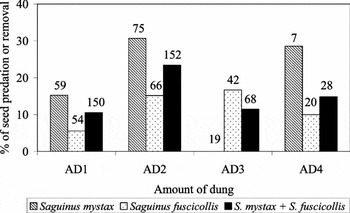
After 4 d of exposure, 17.6% (70/398) of seeds had been preyed on or removed. Percentages of seed predation varied highly with species (Appendix 1). More predation was attributed to vertebrates (61.4%) than to insects (38.6%). Multivariate analysis only kept tamarin species as a significant explanatory variable in the model (Wald = 4.35, P < 0.05) while the effect of the amount of dung only approached significance (Wald = 7.73, P = 0.05). Seeds deposited in moustached tamarin faeces were more likely to be preyed than those in saddleback tamarin faeces (21.2% versus 12.1%). Figure 2 shows that seed predation was higher in moustached tamarin faeces for any given dung amount, except in AD3.
Predation experiment: percentage of seeds preyed on or removed in an increasing amount of dung (see Table 1 for definition of AD codes) in moustached tamarin (Saguinus mystax), saddleback tamarin (Saguinus fuscicollis) and both species together (S. mystax + S. fuscicollis). We could not determine the tamarin species for 56 defecations. Numbers above the bars correspond to the sample size (number of seeds marked).

DISCUSSION
Dung beetle activity and secondary seed dispersal
Despite their small size, tamarin faeces regularly attract dung beetles capable of burying dispersed seeds. As amount of dung and number of dung beetles are directly correlated (Andresen Reference ANDRESEN2002a), it is not surprising that tamarin faeces (mean 1.4 g of faecal matter, Müller Reference MÜLLER2007) attracted only a small number of beetles. The beetles we found on tamarin faeces were small (4–8 mm, only one of 15 mm) but their mean size (6.5 ± 2.6 mm) did not differ from those found on faeces of larger primates such as howler monkeys, which supports the conclusions of Andresen (Reference ANDRESEN2002a). However, a relationship between dung beetle size and dung quantity can exist as has been demonstrated in a study using a larger range of dung amounts (Peck & Howden Reference PECK and HOWDEN1984).
A lower percentage of seeds are buried from tamarin faeces than from larger primate faeces (Andresen Reference ANDRESEN1999, Reference ANDRESEN2002b; Estrada & Coates-Estrada Reference ESTRADA and COATES-ESTRADA1991, Shepherd & Chapman Reference SHEPHERD and CHAPMAN1998). The smaller amount of faecal matter produced by tamarins makes their faeces less attractive. However, seeds in small amounts of faecal matter are also less likely to be attacked by fungi (Jones Reference JONES1994, Passos & Oliveira Reference PASSOS and OLIVEIRA2003, Vander Wall & Longland Reference VANDER WALL and LONGLAND2004). Seeds in tamarin faeces are buried at a similar mean depth as mentioned in studies on larger primate faeces (Andresen Reference ANDRESEN2002b, Estrada & Coates-Estrada Reference ESTRADA and COATES-ESTRADA1991, Shepherd & Chapman Reference SHEPHERD and CHAPMAN1998, Vander Wall & Longland Reference VANDER WALL and LONGLAND2004), but the range is smaller and seeds were never buried at extreme depths (>20 cm, Feer Reference FEER1999). This can be advantageous for the seeds since burying may protect seeds from predators (Andresen & Levey Reference ANDRESEN and LEVEY2004, Feer Reference FEER1999, Shepherd & Chapman Reference SHEPHERD and CHAPMAN1998), but it may also prevent seedling emergence when the depth is too great (Andresen & Levey Reference ANDRESEN and LEVEY2004, Chambers & MacMahon Reference CHAMBERS and MACMAHON1994). The attractiveness of tamarin faeces and the probability of seed burial increase with the amount of faecal matter, as for faeces of larger primates, but not the depth of burial. The low number of dung beetles on tamarin faeces, their quick arrival, short horizontal and vertical displacement and fast work suggest competition mainly for first access to the faecal resource rather than for spatial monopolization of a nesting place by deep burial, which is more prevalent in large defecations where many dung beetles are involved (Andresen Reference ANDRESEN2002b).
Most seed burial occurs soon (<30 min) after defecation, like in a study using howler monkey dung (Estrada & Coates-Estrada Reference ESTRADA and COATES-ESTRADA1991). Although dung beetles can form dung balls, the usual transport of faeces as pellets, probably in a way to optimize the little dung present, might accelerate the transport in tamarin faeces. Moreover, tamarin faeces are generally coherent, which makes their transport easier. This characteristic can explain why seeds deposited with almost no faecal matter (AD1) were buried significantly more deeply, contrary to results found for faeces of larger primates. When a seed is defecated in a large amount of faecal matter, tamarin faeces have an elongated shape, whereas single-seed defecations bearing only traces of faecal matter are lighter, less elongated, and perhaps easier to bury deeper. Transporting faeces as a pellet may increase probability for seed transport while they would be at risk of being discarded during the shaping of balls.
It has been previously proposed that the timing of defecation influences secondary seed dispersal and depth of burial because faeces deposited later dry slower and are visited by larger dung beetles, capable of burying seeds deeper (Andresen Reference ANDRESEN2002a). Although not significant, our results show a tendency for more secondary dispersal but a lower depth of burial in the afternoon (12h00–16h00), which is partly contrary to what is found in larger primates. This discrepancy might be explained by the specific activity profiles of tamarins. Unlike most larger primates, tamarins stop their activity well before the beginning of activity of nocturnal dung beetles. The very small quantity of faecal matter is less likely to attract the large nocturnal beetles capable of burying seeds to more extreme depths.
Seed predation
Seeds in tamarin faeces are subject to low predation pressure in comparison to those in faeces of larger primates. Most studies report number of seeds remaining after one or several months but, the percentage of seeds removed is usually already high after 3 d even if it keeps increasing with time. After 5 d, 40–70% of seeds were removed in spider monkey dung, 63–97% after 30 d (Andresen Reference ANDRESEN1999), and 97.9% after 70 d (Chapman Reference CHAPMAN1989). Our results are closer to the 8–38% of vertebrate seed removal after 27 d in a medium-sized primate, Cebus capucinus (Wehncke & Dalling Reference WEHNCKE and DALLING2005). However, comparisons of results of different studies on seed predation usually suffer from the problem that seeds of different species and/or different numbers of species are involved, and seed predation is highly dependent on the specific identity of the seeds (Crawley Reference CRAWLEY and Fenner2000, Lambert Reference LAMBERT, Levey, Silva and Galetti2002, Notman & Gorchov Reference NOTMAN and GORCHOV2001).
An interesting result of our study is the relatively high seed predation by insects. Indeed, large insects are significant seed predators in many habitats (Crawley Reference CRAWLEY and Fenner2000). However, many studies identify vertebrates as the main predators of seeds (Hulme Reference HULME, Levey, Silva and Galetti2002, Notman & Gorchov Reference NOTMAN and GORCHOV2001) while the impact of invertebrates is often underestimated (Hulme Reference HULME1998). Differences in defecation pattern and seed species composition between large primates and tamarins could be reasons for the differences observed as vertebrates and invertebrates respond differently to seed distribution (Notman & Villegas Reference NOTMAN, VILLEGAS, Forget, Lambert, Hulme and Vander Wall2005) and characteristics (size, secondary compounds; Davidson Reference DAVIDSON1993). In a study using a loosely scattered distribution of seeds, only 3% of predation could be attributed to rodents (Forget & Cuijpers Reference FORGET and CUIJPERS2008). As most of the time tamarins disperse one or two seeds per faeces (Knogge & Heymann Reference KNOGGE and HEYMANN2003), their defecation pattern is closer to the loosely scattered distribution type than to the higher concentration type of large-primate dispersers. Likewise, we hypothesize that most of the time, seeds deposited in tamarin faeces will not be submitted to a high predation pressure as some studies have shown that seed removal increases with density (Hulme Reference HULME, Levey, Silva and Galetti2002). Moreover, low seed density will decrease competition among seedlings. The absence of significant effect of the number of seeds and the amount of dung on seed predation might be due to the narrow range of these factors in our study in contrast to other studies where a wider range was used (e.g. 0 and 10 g of dung, Andresen Reference ANDRESEN2002b; one, five and 30 seeds, Lambert Reference LAMBERT, Levey, Silva and Galetti2002) and where a significant effect was thus more likely to be obtained.
Our study demonstrates a clear effect of tamarin species on seed predation. Higher predation pressure on seeds deposited by the moustached tamarin can be attributed to the less odorous faeces of this species than those of the saddleback tamarin. If faecal matter acts as a repellent for predators (Villagra et al. Reference VILLAGRA, MARONE and CONY2002), seeds deposited in less odorous faecal matter are more likely to be preyed on.
The absence of a relation between the time of the defecation and seed predation can be explained by the activity pattern of tamarins. As seeds deposited at the end of the activity period of tamarins are most of the time defecated before 16h00, they would not be submitted to conditions very different from those deposited earlier in the day.
CONCLUSIONS
Seeds dispersed by small primates are deposited in small defecations and are subject to post-dispersal events of similar process but of different intensity than those observed for seeds deposited by larger primates in larger faeces. The overall effect of characteristics of tamarin faeces on the short-term post-dispersal seed fate is generally positive as consequences of these events (e.g. low predation pressure, moderate depth of seed burial) are likely to increase seedling emergence and survival. It would be interesting to complete the present data by testing the influence of seasonality on secondary dispersal and predation, as previous studies provided evidence of an influence of the peak of fruiting season on seed predation pressure (Feer & Forget Reference FEER and FORGET2002, Forget et al. Reference FORGET, HAMMOND, MILLERON, THOMAS, Levey, Silva and Galetti2002, Notman & Villegas Reference NOTMAN, VILLEGAS, Forget, Lambert, Hulme and Vander Wall2005). The nature of the dispersion site (primary and secondary forests) is another factor to take into account as predation pressure and the predator species can vary between habitats (Forget & Cuijpers Reference FORGET and CUIJPERS2008, Notman & Gorchov Reference NOTMAN and GORCHOV2001, Notman & Villegas Reference NOTMAN, VILLEGAS, Forget, Lambert, Hulme and Vander Wall2005). Furthermore, additional variables such as seed size, volume, mass, shape and species affecting secondary dispersal and predation percentages would be necessary to better understand our results. This study thus shows the importance of understanding the effects of all kinds of seed dispersers on the post-dispersal seed fate as the less conspicuous ones can prove very effective and must be taken in consideration in conservation and forest management plans.
ACKNOWLEDGEMENTS
This study was made possible by the support of Foundations Alice Seghers and Docquier (Ulg) and thanks to a grant from FRIA (Fonds pour la formation à la recherche dans l'industrie et dans l'agriculture) and FNRS (Fonds National de la Recherche Scientifique), Belgium, to Laurence Culot. We thank INRENA (Peru), for permission to carry out research at the Estación Biológica Quebrada Blanco (authorizations 011-2005-INRENA-IFFS-DCB, 071-2005- INRENA-IFFS-DCB, 059-2006-INRENA-IFFS-DCB and 114-2007-INRENA-IFFS-DCB). We are grateful to our field assistant, Jeisen Shahuano Tello, for his help on the field.
Species dispersed by tamarins with the number of seeds marked and buried in the secondary dispersal experiment (SD) and the number of seeds marked and eaten or removed in the predation experiment (P) (NI = not identified).