1 Introduction
The so-called invariant tags or response elicitors (Biber et al. Reference Biber, Johansson, Leech, Conrad and Finegan1999: 1089),Footnote 2 such as eh, okay, right, yeah, huh, you get me, you know and you know what I mean, are extremely frequent in spoken English and have been studied extensively in recent years (Algeo Reference Algeo, Ricks and Michaels1990; Bertland Reference Bertland1997; Andersen Reference Andersen2001; Stenström, Andersen & Hasund Reference Stenström, Andersen and Hasund2002; Pichler Reference Pichler2008, Reference Pichler2013; Columbus Reference Columbus2009, Reference Columbus2010; Torgersen et al. Reference Torgersen, Gabrielatos, Hoffmann and Fox2011). The speech of adolescents and teenagers has been of particular interest here, since these tags are very common in teen language, to the extent that this feature is considered to be one of the general features of teentalk across languages (Stenström, Andersen & Hasund Reference Stenström, Andersen and Hasund2002; Stenström Reference Stenström2014).Footnote 3 Invariant tags share with tag questions several grammatical properties: they are typical of the oral medium of expression; they are appended to a statement in order to seek verification, agreement or corroboration; and they are generally intended to involve the interlocutor in the conversation. However, they differ from general question tags in that they remain constant, that is, they do not observe the general rules of polarity reversal with respect to the main clause, and their subjects are not always closely related to the subject of the host clause.
In this article I focus in particular on innit, as in She love her chocolate innit?, It was good innit? and I better get my jacket innit, a relatively common non-canonical invariant tag in British English, especially in London English. The first part of this study opens with a number of introductory remarks, after which I present some results and a brief review of the literature. In the second part I provide additional information on innit by analysing and discussing data drawn from two corpora of teen speech: the Bergen Corpus of London Teenage Language (COLT) and the Linguistic Innovators Corpus (LI). In the analysis I deal with syntactic, semantic and pragmatic features of this form. Apart from characterising this tag, my main aims are, firstly, to see whether innit has remained stable in terms of its frequency and function over time, and secondly to ask whether it has preserved its original grammatical features or has undergone any notable changes. Comparisons are also drawn between adults’ and teenagers’ data, to see whether this tag is a characteristic trait of the language of British teenagers or is equally present in the language of adults. Special emphasis is placed on the pragmatic functions of the tag, given that this aspect has not been addressed so much in the literature, especially with recent data.Footnote 4 Findings indicate that innit has not declined in use over the last ten years or so, and confirm that it is a pervasive feature in the language of London teenagers. Furthermore, two new discourse functions of innit have been identified: as an emphatic marker and text organiser.
2 Preliminary assumptions and previous research
Although innit is relatively frequent in British English, it can also be heard in varieties of English spoken in Papua New Guinea, Singapore, India and South Africa.Footnote 5 It has even been contended by some linguists that the common use of this tag in present-day British English could be explained by the influence of certain groups of immigrant speakers in London on the rest of the population, particularly those of West Indian and Jamaican origin (Hewitt Reference Hewitt1986; Andersen Reference Andersen2001; Stenström, Hasund & Andersen Reference Stenström, Andersen and Hasund2002). In parallel to this theory, the OED online edition (1989) dates the form to 1959, as first used by Michael Gilbert (1912–2006) in his work Blood and Judgment: ‘That's right, innit?’ although in this case innit is not clearly an example of an invariant tag. At present the origin of the form remains unclear, with evidence from recent studies, such as Torgersen et al. (Reference Torgersen, Gabrielatos, Hoffmann and Fox2011), proving inconclusive.
As is the case with the negative ain’t (Cheshire Reference Cheshire, Trudgill and Chambers1991; Palacios Martínez Reference Palacios Martínez2010, Reference Palacios Martínez2011a), innit is very rarely discussed in modern general reference grammars. Thus Biber et al. (Reference Biber, Johansson, Leech, Conrad and Finegan1999: 211) only include four examples of it, to illustrate that in some cases it is independent of the structure of the main clause. Quirk et al. (Reference Quirk, Greenbaum, Leech and Svartvik1985) and Huddleston & Pullum et al. (Reference Huddleston and Pullum2002) do not even mention it in their detailed account of tags, and in her study on negation in non-standard British English, Anderwald (Reference Anderwald2002) also fails to deal with it. This could be explained by the fact that it may be regarded as one of the multiple forms falling outside the scope of negation itself. Something similar can be seen in book-length publications on negation, such as Tieken-Boon van Ostade et al. (Reference Tieken-Boon van Ostade, Tottie and van derWurff1999), Tottie (Reference Tottie1991), Mazzon (Reference Mazzon2004), Iyeiri (Reference Iyeiri2005) and Horn (Reference Horn2011), to mention just a few.
In a preliminary analysis of the form, I find that the British National Corpus (BNC) contains a total of 1,270 matches for innit in spoken English (from 10 million words), compared to 4,577 examples of the standard isn't it. These data also indicate that innit occurs most frequently among the speakers of the age groups 15–24 and 25–34, and is more strongly favoured by women than men (397.9 versus 227.28 instances per million words). By contrast, in the Corpus of Contemporary American English (COCA) and the American English Google Books Corpus, containing 450 million and 155 billion words respectively, only 13 and 61 tokens of this form were recorded. This tendency is in stark contrast to COLT, compiled in London in the early 1990s and containing about half a million words, which registers a significant number of instances (353). The form is also attested with some regularity in current popular British newspapers, especially when discussing features of the language of teenagers or issues related to teenagers. Thus the Daily Mail records a total of 170 uses in the same number of articles between 1990 and 2011, and the Daily Mirror registers 100 uses between 2006 and 2010. In the case of the Guardian, the count is 935 between 1999 and January 2014; the figures are quite consistent for recent years: 81 tokens in 2011, 86 in 2010, 85 in 2009, 93 in 2008, declining to 35 in 2001, 48 in 2000 and 43 in 1999. Many of the examples used by the British press are found in articles related to sports and on blogs, followed by the media and music sections, and the form is frequently used to imitate spoken vernacular speech. In contrast, the presence of innit in American newspapers and journals is merely anecdotal. Time magazine records only 16 examples between 1997 and 2012, while the New York Times lists one occurrence in December 2013, two for the whole year 2013 and 268 in the period from 1945 to 2013. Hence, given that innit is more closely associated with spoken language, the nature of the corpus, whether written or spoken or both, has to be borne in mind in the interpretation of data.
From the above data, our tentative conclusions are that: (i) innit is quite a recent development in the English language, only 50 or 60 years old at most, according to the OED; (ii) it is typical of British English, particularly of the varieties spoken in the south of England, Wales and London (Kortmann & Schneider Reference Kortmann, Schneider, Burridge, Mesthrie and Upton2004; Kortmann & Lunkenheimer Reference Kortmann and Lunkenheimer2013), being found only rarely in other well-established native English varieties, such as American English and Australian English, although it is recorded in varieties of English spoken in Papua New Guinea, Asia and South Africa; (iii) it stands out as especially common in the discourse of British teenagers, more particularly those living in certain districts of London; (iv) when used in the language of the press, it occurs mainly in the sports and blogs sections, and where journalists want to emulate spoken English and, more particularly, in the language of teenagers; and finally, (v) while it functions as an invariant question tag to check or confirm comprehension, or to keep the interlocutors’ attention, on many occasions it may also perform certain other functions.
Innit in the speech of adolescents has been closely studied by Stenström & Andersen (Reference Stenström, Andersen, Percy, Meyer and Lancashire1996), Erman (Reference Erman and Haukioja1998), Andersen (Reference Andersen2001) and Stenström, Andersen & Hasund (Reference Stenström, Andersen and Hasund2002); in general English, we find similar studies by Algeo (Reference Algeo1988, Reference Algeo, Ricks and Michaels1990), Krug (Reference Krug1998) and Pichler (Reference Pichler2013). Such investigations have drawn attention to its grammaticalised nature, given that it emerged first as a standard tag and subsequently became invariant, with multiple pragmatic functions. While Erman (Reference Erman and Haukioja1998: 88) describes a ‘change of category membership from that of a tag question to an emphasiser’, Krug (Reference Krug1998: 151) refers to a process of lexicalisation and to the change from a tag question to a new discourse particle. This change of category, according to Krug, should not be regarded as an abrupt one, but proceeds through a series of gradual steps, some of these taking place simultaneously, such as the presence in the host sentence of non-third-person singular forms of the primary verb be in the present tense, and the occurrence of other auxiliaries and main verbs related to be (look, seem) and other lexical verbs. Furthermore, grammarians have drawn our attention to the influence of linguistic and sociological variables on the use of innit. Thus its frequent use is clearly associated with early and middle adolescence, female and working-class speakers, as well as with members of ethnic minority groups (Stenström, Andersen & Hasund Reference Stenström, Andersen and Hasund2002), although in a more recent study Torgersen et al. (Reference Torgersen, Gabrielatos, Hoffmann and Fox2011: 107) conclude that ‘no differences were established for speaker residence, spread is almost identical in terms of sex and ethnicity, and frequency differences in terms of either sex or ethnicity are rather low’.Footnote 6 This finding would eventually lead to the reconsideration of the issue of the origin of the tag as the result of the influence of immigrant speakers on the London population. It could be argued that these speakers show reduced grammatical complexity in their speech, and this could well support the development of innit as the result of long-term dialect contact between speakers from different language backgrounds in urban areas. Among the linguistic factors that play a major role in the form's grammatical behaviour are tense, polarity, the verb of the main or host sentence and subject pronoun and gender (Krug Reference Krug1998), as we will see below.
3 Method
An analysis of innit in the COLT and the LI corpora will now be described. The COLT corpus, part of the British National Corpus (BNC), was compiled in 1993 and consists of 431,528 words from a total of 377 spontaneous conversations produced by teenagers aged between 13 and 17 in the London area. These interactions together represent roughly 100 hours of recorded speech. The Linguistic Innovators Corpus (LI) was transcribed and collected by Cheshire and members of her research team in the area of London in 2004 and 2005, more particularly in the boroughs of Hackney (inner London) and Havering (outer London). It was compiled as part of the project Analysing London English using corpus tools (e.g. Gabrielatos et al. Reference Gabrielatos, Torgersen, Hoffmann and Fox2010 and Torgensen et al. Reference Torgersen, Gabrielatos, Hoffmann and Fox2011), and contains around 1,300,000 words, part of this total being samples of adult speakers in their seventies from the two districts. The two corpora present some differences. COLT speakers are slightly younger, with an age range from 13 to 19, compared with 16 to 19 years in LI; while in the case of the former the teenagers belong to both working- and middle-class social groups, in the latter the speakers are all of a working-class origin. The collection instruments used in the two corpora also differ slightly. While in COLT the recruits recorded themselves in interaction with their peers in spontaneous conversations, data in LI are mainly taken from sociolinguistic interviews with minimal field-worker involvement. Although these minor differences should not be ignored, the two corpora can nevertheless be regarded as fairly comparable (Torgersen et al. Reference Torgersen, Gabrielatos, Hoffmann and Fox2011) if one wants to study the possible changes and development of particular items over time, considering that there is over a decade between them and that they both contain teenagers data from roughly the same age, geographical area and social background. Whereas it is true that a ten- or eleven-year period is not usually enough to come to firm conclusions regarding language change, we are at least able to point to possible future tendencies and development. Hence, differences in the two corpora, as well as the ongoing variation of the tag itself, should certainly not be overlooked in considering findings here.
For the retrieval of the data, the Concapp V4 application was used, helping in the generation of an initial list of examples containing tokens of innit; however, it was necessary to filter the preliminary data manually and supplement them with more detailed analysis, given that on many occasions contextual factors were seen to be at work. In both COLT and LI, access to the audio documents was not always possible, hence prosody and intonation could not be considered here; such extra information would certainly have been useful.
4 Results
4.1 Frequency and main syntactic features
In COLT a total of 353 examples of innit were recorded, although 48 of these were discarded, some 13.5 per cent of the whole, because the corpus transcription conventions and the spontaneity and interactive nature typical of the spoken language made them impossible to interpret. Consider the following example:
(1) A: Come on get out the fucking way. <nv>laugh</nv> <unclear> them you know <unclear>Move. Can't defy you have to move <unclear>
B: <unclear>
A: Get out the fucking way mae. . . <unclear> four innit? (COB134803/471)Footnote 7
It is here very difficult to guess what the speaker actually means by innit as the utterances are unclear and the context provided is not sufficient to interpret the speakers’ words.
Once these 48 unclear and ambiguous examples were disregarded, 305 tokens remained for assessment. As regards function, it seems that in principle innit is mainly equivalent to isn't it, isn it or even ain't it, being used as a typical question tag expression, that is, a structure containing an operator followed by a pronoun in co-reference with the subject of the main clause, or anchor.Footnote 8 Apart from this, innit can also function as an invariant follow-up. These are reduced forms which serve to register a reaction of surprise or confirmation to a claim made by another speaker (Andersen Reference Andersen2001), as in the following example:
(2) A: Your school is quite near.
B: Innit? You have to go miles! (COB132707/287)
Thus it can function both as an invariant tag or an invariant follow-up. Furthermore, what is special about innit is that it presents a number of characteristic syntactic features and may express a wide range of pragmatic meanings.
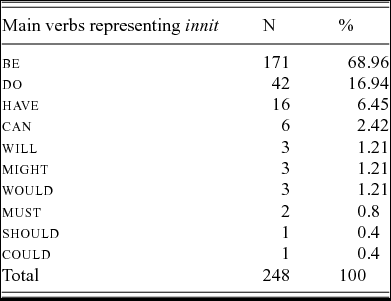
As suggested above, it can be used to stand for operators occurring earlier in the sequence other than be, such as have and do,Footnote 9 and even modal verbs, such as will, would, should, can, could, must and might. However, as table 1 shows, be is by far the most common (171 cases), followed by do (42 tokens) and have (16). Of the modal verbs, can is the most common (6 tokens) while will, might and would all obtain 3 examples each. The rest of the modal verbs, such as must, should and could can be regarded as marginal.
Verbs representing innit in the COLT corpus

Looking at the data on be, we notice that innit stands for isn't it on 150 occasions, that is, 87.7 per cent of the total number of tokens for this group, while it stands for isn't he? and aren't you? in just 9 and 12 cases, respectively. We record a similar number of examples representing doesn't it? and don't you?, 9 cases for each; we even find occurrences of innit as equivalent to tags with did, either in the positive form (only 2 cases) or in the negative (11 cases). Here are some examples:
(3) [oh my god] I would just die, innit? (COB140802/46)
(4) should be in all day innit? (COB138301/20)
(5) you can have it for Friday, innit? (COB138301/332)
(6) Oh, she got A levels innit? (COB133203/385)
(7) they must have the wrong place, innit? (COB135205/15)
(8) told, you told mum [yesterday innit?] (COB139610/9)
(9) could have got a bigger size innit Dawn? (COB134901/297)
(10) if as long as her clothes look alright underneath then it's not too bad innit? She might wear her shorts thing innit? (COB135201/67)
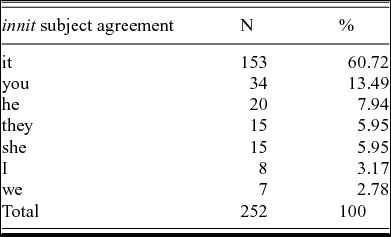
One distinctive feature of innit is that it does not necessarily come after the subject of the main sentence in person, gender or number, although it most frequently occurs with the third-person singular it (153 cases), and less often with you (34 cases) and he (20 cases), as shown in table 2.
Subject agreement of innit in the host sentence
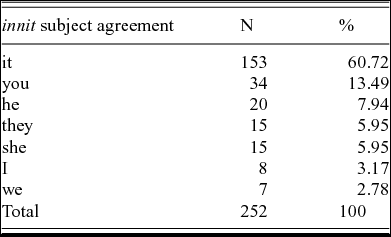
Such a tendency seems to indicate that innit may have originated as a form derived from isn't it, although Cheshire (Reference Cheshire1982), Stenström & Andersen (Reference Stenström, Andersen, Percy, Meyer and Lancashire1996) and Andersen (Reference Andersen2001: 106) also contend that the negative ain’t may have led to it. However, Andersen (Reference Andersen2001: 197, 201), after considering factors such as the use of ain’t and isn’t by different speakers in different contexts, concludes that its derivation from isn't it seems to be more credible, as in the following:
isn't it [iznt it] → isn’ it [izn it] → in it [ind] → innit [init]
Furthermore, innit does not necessarily occur in accordance with the tense of the verb of the main sentence, but does show a tendency to favour the simple present tense; only 18 cases are recorded with the past. For example:
(11) You forgot your book, innit? (COB138102/133)
Regarding polarity, although it normally follows a positive clause, this is not necessarily so, with 7 cases in which it follows a negative clause. Of these 7 tokens, in 3 of them the main verb is be (see 12), in 2 it is do (13), in 1 auxiliary have (14), and in 1 would (15):
(12) it's not too bad innit? (COB135201/67)
(13) didn't have a hair cut then innit? (COB134803/141)
(14) A: No, don't give anyone else the work then.
B: No, that you haven't marked, that you haven't marked innit? (COB134401/311)
(15) You wouldn't think so innit? (COB132707/149)
Finally, as expected, innit usually occurs at the end of the speaker's turn (16) but may also appear at the beginning (17) or in the middle (18):
(16) It's too cold innit? (COB136903/8)
(17) A: I’ve never, I’ve never heard Jim's voice before.
B: Innit?
A: Never! Cos (unclear) every time Jim talks (COB132707/16-18)
(18) And here's me, I’m looking at him, she's going you’re cool you beat your dog, innit? <laughing> I don't (COB132708/7)
Its situation in the various turns of the interaction, however, should not be seen as random since in most cases it is directly connected with the discourse dimension. In this respect the distinction made above between innit as a question tag and innit as a follow-up seems to be necessary. Thus in (16) and (18) above it functions as a tag, since the speaker introduces it at the end of the turn, quite possibly as a means of asking for verification, as in (16), or even to challenge the interlocutor, as in (18). In (17), however, when it is a follow-up, it is pronounced by another speaker as a reaction to a previous statement, on this occasion as an expression of surprise or incredulity. So, pragmatically speaking, innit is quite a complex form whose expressive values extend well beyond those typical of a tag to those of a pragmatic marker (Krug Reference Krug1998). The discourse functions of innit will be considered in detail in the final section, below.
Along with the study of innit, I also conducted a search for the canonical tag isn't it to see the extent to which it was used by the same adolescent speakers, and if so, how it was used (looking firstly at the data in COLT). I also intended to draw a comparison with the sample of innit just considered.
In a preliminary analysis I identified a total of 141 tokens, in contrast to the total number of tokens found for innit, 353. Out of these 141 examples, 4 were excluded because they were cases of canonical negative polarity questions, as in the following:
(19) Hello Sabrina. Isn't it a fine morning? (COB140810/26)
A sample of 137 units remained. Of these, isn't it did not behave syntactically as a canonical tag in only 4 cases. Consider the following:
(20) It was really massive, isn't it? (COB135207/397)
(21) It looks sick though isn't it Patrick? (COB139303/50)
(22) You can't laugh at yourself isn't it? (COB141201/168)
(23) they expel anyone else though isn't it? (COB142706/252)
In (20) the expected tag would be wasn't it? so there is a change in tense from past to present; in (21) the change refers to the auxiliary as the expected form would be doesn't it?; in (22) the modal verb can is substituted by is, and apart from this the polarity reversal rule is not observed; finally, in (23) is replaces do.
Such findings do not provide clear and conclusive evidence of a possible and gradual evolution of isn't it to innit, which in some ways would have been logical to hypothesise; moreover, the same is true for the form ain't it, which only occurs once as a normal question rather than as a tag. Isn't it and innit coexist in COLT although the speakers in general opt for the latter over the former. In addition to this, their function seems to be on some occasions different; isn't it plays more the role of a canonical question tag, while innit adopts other additional discourse functions. However, there are also cases in which the two forms are completely equivalent.
As part of the second stage of this study, I conducted an analysis of the data extracted from the LI corpus. My aim here was to ask whether the data from LI confirmed the previous findings. I also sought to identify possible differences as regards the frequency, syntax and pragmatics of this expression. The fact that LI also contains comparable adult data allows for comparisons to be made between teenagers and adults regarding the use of this tag.
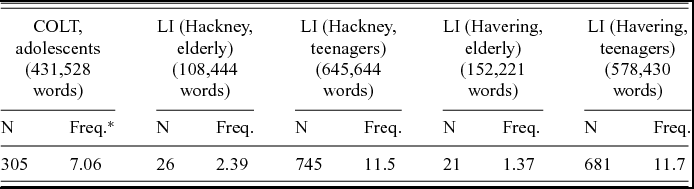
The analysis of the data clearly supports the hypothesis that after eleven or twelve years (COLT was compiled in 1993 and LI between 2004 and 2005), innit is increasing in use, and is particularly frequent in the language of adolescents and teenagers of the London area, as can be seen clearly in table 3. To cope with differences in the size of the data samples analysed, normalised frequencies to 10,000 words were calculated. However, findings here should be taken with caution because although the two corpora are fairly comparable, they also show some differences, as discussed in section 3 above. In fact, we expected to find a more notable influence of data collection methods across the two corpora, in that the sociolinguistic interviews used for LI do not generally favour the production of tags to as great an extent as with the self-recording and spontaneous interactions used in COLT.
Frequency of use of innit in the corpora analysed

*Frequency per 10,000 words
As can be observed, the frequency per 10,000 words of innit in COLT is 7.06; in the case of LI, for Hackney adolescents this frequency rises to 11.5, and for Havering teens it is even slightly higher, at 11.7. The differences between the COLT and LI figures are statistically significant (x2 = 61.67, df.1, p <.0001). These results clearly show that innit is still in high use among London teenagers, and that its use has increased overall during the last eleven years or so. However, these figures do not reflect entirely those in Torgersen et al. (Reference Torgersen, Gabrielatos, Hoffmann and Fox2011), where the high use of the tag is reported but its stability is also noted, with only a slight increase over time. The differences between these findings and my own may have to do with the fact that Torgersen et al. did not use the whole LI corpora, but rather selected parts of it, in an attempt to find samples with maximum consistency regarding the speakers’ social background, ethnicity and gender, as a means of controlling for these factors in the data, in that they were less concerned with the frequency of this item. In my case it was not necessary to make these adjustments since my focus was not primarily on the sociological variables but on the frequency, grammatical and pragmatic features and evolution over time of the form in question. For my purposes, the only useful distinction was between teen and adult speakers.
In analysing the adult data, we observe the low frequency of innit, especially compared to teen speech. Thus, the frequency for the group of elderly Hackney speakers is 2.39 and 1.37 for the adult Havering group. Hence, differences between the samples of the adults and teenagers are in both cases statistically significant: for the Hackney sample the chi-square value (x2) is 74.97, df 1, p>.0001 and for the Havering groups, x2 is 134.37, df 1, p>.0001.
Furthermore, in the case of the adult speakers of Havering and Hackney, innit shows a more paradigmatic behaviour in terms of grammar; that is, it functions more typically as a standard question tag representing be in 78.7 per cent of all instances, with the pronoun it as the subject in most cases (76.6 per cent).
(24) It's more than that innit. (LIEL)
(25) That's how luck goes innit. (LIEL)
In accordance with this, innit very rarely adopts the role of a pragmatic marker here. This contrasts with what happens in the samples of the younger speakers from the same two areas, where innit behaves much more like it does in COLT, occurring not only with be (26) when it is a tag or a follow-up, but also with many other verbs, such as can (27), have (28), do (29), might (30), will (31) and would and will (32) and, even occasionally, with verbs in the imperative (33). The polarity reversal rule typical of canonical tasks is also not observed, as we can see in (27):
(26) It's for them to say innit. (LIYO)
(27) It just can't can't be done innit. (LIYO)
(28) We got two separate rooms innit? (LIYO)
(29) You like Coronation street innit? (LIYO)
(30) You might as well stand a good side of the fence innit? (LIYO)
(31) We’ll try that one innit? (LIYO)
(32) If a gram would be twenty innit? We’ll try that one innit? (LIYO)
(33) Oh go back to your yard then innit after this. (LIYO)
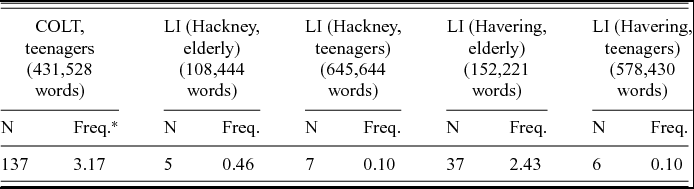
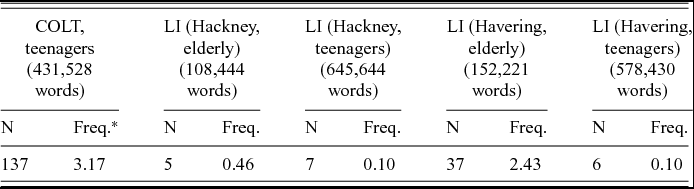
As before, we also looked at the presence of the form isn't it in the teen and adult data to see the extent to which speakers opted for one or the other, and in order to have a complete overview of the question (see table 4).
Frequency of use of isn't it in the corpora analysed
*Frequency per 10,000 words
On a close analysis of the data, we discarded those cases of isn’ it? that had been produced by the two field workers in the LI project, on many occasions as an attempt to draw respondents into the conversation. Nine tokens were thus excluded in the case of the Hackney adults, and 19 for the elderly subjects in the Havering group. For teenagers the numbers of discarded tokens were far higher, at 80 and 63 tokens, respectively, for Hackney and Havering. Clearly, the inclusion of these examples in the overall count would have distorted the general picture for this tag.
These findings are quite revealing when we compare them to table 3, since they clearly indicate the preference of the subjects of all the subcorpora considered for the innit tag. The sample of the Havering elderly is an exception to this general tendency, as these speakers are more inclined to use isn't it than innit (frequency value per 10,000 words of 1.37 for innit versus 2.43 for isn't it). When comparing the figures from COLT and LI, we also find that they are higher for the teens in COLT than in LI, a tendency that may be explained by the increase in use of the innit form by the LI subjects. Our findings, then, confirm that the tag innit prevails over isn't it in the language of British teenagers; this tendency, however, is not so obviously attested in the case of elderly speakers, more particularly in the group of Havering adults, whose speech tends to accommodate more to the standard.
4.2 Pragmatic functions of innit
The linguistically interesting behaviour of innit in the language of teenagers in both COLT and LI leads us to consider its pragmatic functions in detail. Its multifunctional nature clearly stands out. On the one hand, innit shares features typical of question tags since it seems to be originally derived from one of them, either ain’t or isn't it; on the other hand, it also shows some properties which are more typical of other categories, such as pragmatic markers. This means that in the analysis we will have to consider both sides of the question. Tags have been studied extensively, with some scholars recently classifying them according to their pragmatic function on the basis of empirical data. Algeo (Reference Algeo, Ricks and Michaels1990), Holmes (Reference Holmes1983) and Tottie & Hoffmann (Reference Tottie and Hoffmann2006) are the most relevant for our purposes here. Although all of these studies share a common general framework, some differences are observed. Algeo divides the tags into informational, confirmatory, punctuational and peremptory, whereas Holmes makes a preliminary distinction between three main groups: epistemic, modal and affective, with the latter itself consisting of three main categories: facilitative, softening and challenging. Finally, Tottie & Hoffmann (Reference Tottie and Hoffmann2006: 301) adapt the previous taxonomies to suit their purposes in a study of the differences between question tags in British and American English, and group them into the following pragmatic types: informational, confirmatory, facilitating, attitudinal, peremptory and aggressive. As regards the pragmatic values of innit in particular, Andersen (Reference Andersen2001: 127–38), on the basis of his analysis of COLT data, accounts for the following: epistemic (asking for the speaker's verification), facilitative (asking for the speaker's corroboration), softening (the speaker tries to convince or remind the interlocutor of their statement), peremptory (the speaker reminds the interlocutor of what is being said with an authoritative tone), aggressive (the speaker believes that their interlocutor does not share their view on what is being said) and imagination appealing. Fox & Pichler (Reference Fox and Pichler2012) refer to three main discourse functions of innit: that it signals a shift in topic in the conversation, that it foregrounds new information, and that it serves to involve listeners and favour solidarity. Finally, Pichler (Reference Pichler2013: 198–204) has also considered it within her global analysis of negative tags in the northern British town of Berwick. She comes to the conclusion that innit is strongly associated with non-conducive functions, in particular for emphasising speakers’ attitudinal stance towards their propositions (Pichler Reference Pichler2013: 206).
My analysis confirms the usefulness of Andersen's values, but in addition indicates that a comprehensive account of the pragmatic functions of innit should also incorporate some new discourse functions in light of more recent data. The first of these has to do with the speakers’ response to the content of the message or to the opinion expressed by another speaker, by making the speaker's position on an issue clear; innit thus serves to strengthen their point, and hence is labelled emphatic. The second function is more closely related to the organisation of the message, although it also helps to convey a particular meaning of shared knowledge between the speakers and their interlocutors. These two functions of innit – emphatic and text organiser – are closely associated with those typical of pragmatic markers in that they mark a transition in the development of the interaction, they assist in turn-taking and also signal a relationship between the speaker, the interlocutor and the content of the message (Brinton Reference Brinton1996; Biber et al. Reference Biber, Johansson, Leech, Conrad and Finegan1999: 1086; Fraser Reference Fraser1999). Furthermore, the meaning of innit in these contexts is procedural rather than conceptual in the sense that it does not denote a particular set of defining semantic features but specifies how the segment it introduces has to be interpreted with regard to the previous one (Fraser Reference Fraser1999: 944).
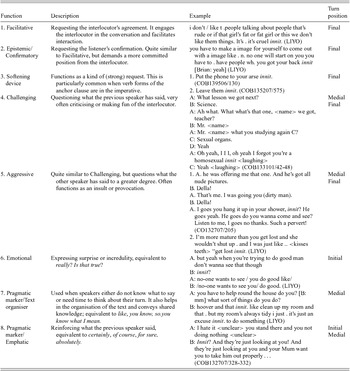
Table 5 includes some examples of the categories established, together with a brief description of each. For the identification of these pragmatic functions it was necessary to analyse this tag in the whole exchange of the conversation where it was found, rather than in isolation or simply within its own turn. Thus the following factors were considered as a means of identifying the functions in each case: (i) the speaker's intended meaning; (ii) the context in which the utterance takes place; (iii) the interlocutor's response and reaction to the speaker's use of the tag (expression of corroboration, laughter, indifference, surprise, exclamation, sarcastic comment or observation, etc.); (iv) discourse features such as hedges, vague words and other tags that occur with it; (v) the verbal form of the matrix or anchor clause; and, finally, (vi) the turn position in which each of these pragmatic types are regularly found. Note that for some pragmatic types innit can be attested not only in one place but in different places. Intonation might also have helped us to classify some of these uses of innit, but like Tottie & Hoffmann (Reference Tottie and Hoffmann2006), we had no access to the audio recordings.
Pragmatic functions of innit in the language of British teenagers
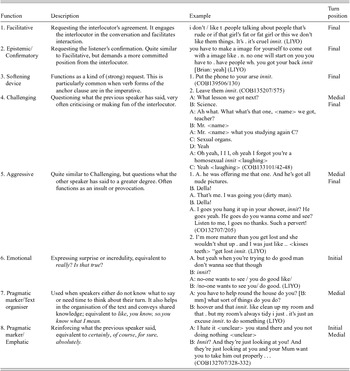
However, the labels associated with the pragmatic functions of innit should not be regarded as clear-cut categories, since there are cases of overlapping. For example, it was sometimes difficult to distinguish between facilitative and epistemic functions and between challenging and aggressive ones. In both the facilitative and epistemic functions there is a clear intention of the speaker to involve their interlocutor(s) in the conversation, whereas in the challenging and aggressive functions the speaker's negative attitude towards their interlocutor or towards the content of the message entails a more prominent and indeed domineering role. Although all of these functions are discourse-oriented to some degree, the final two in table 5 seem to play more clearly a role traditionally reserved for pragmatic markers.
Next I will consider those discourse functions which are, in my view, more typical of teenagers’ spoken discourse and which add new pragmatic meanings to innit. As discussed above, one meaning is that of ‘emphatic’ (what Algeo and Tottie & Hoffmann call ‘punctuational’ and ‘attitudinal’ respectively when analysing question tags in general English), although in teentalk this gains more prominence in that it becomes relatively frequent and adopts the role of a pragmatic marker. The second meaning is that of text organiser, while conveying at the same time shared knowledge between the participants in the conversation.
4.2.1 Pragmatic marker: emphatic function
In the following extract, JosieFootnote 10 is talking with one of her closest friends, Truno, about her dog, Dempsey. She is telling him about the disruptive behaviour of the dog, which is both funny and terrible. Truno cannot understand why Josie does not stop Dempsey from doing this, and in response to his expression of incredulity Josie uses innit as a reinforcement of her position, meaning ‘of course I am not going to do anything about it’ although she justifies herself by blaming her mum. Note also how she repeats what comes next ‘they are looking at you’ to strengthen the meaning of what she is saying:
(34) Josie:. . . Oh that's good, cos Dempsey, oh, cos Dempsey’ll stay in there for ages now if she pisses all over there. Dempsey, oh, poos by the wall, right, and you know how he digs up the floor.
Truno: Yeah.
Josie: when he's finished? I walked past, mouthful of dirt! Where Dempsey's kicking dirt up in my face so I go, what’re you doing? Looks at me and he goes. . . I hate him so much!
Truno: I hate it <unclear> you stand there and you not doing nothing <unclear>
Josie: Innit? And they’re just looking at you! And they’re just looking at you and your Mum want you to take him out properly walk him down the street. . . (COB132707/328-332)
Innit here occupies initial position. It functions as a response to a previous statement, and in this respect it is very similar to a backchannel. However, innit in these cases not only gives feedback to the speaker, it also adopts the role of an emphasiser equivalent to for sure or certainly since it serves to reinforce the speaker's attitude to the propositional content of the utterance. This particular use has been noted in previous studies (Erman Reference Erman and Haukioja1998; Pichler Reference Pichler2013) and can also be observed very clearly in the following exchange between Adam and Amjad, two youngsters from the Hackney area in the LI corpus, in which Adam is talking about all his new responsibilities at home, such as taking care of his sister and fixing things in the house, with Amjad then providing a good reason for this, and Adam confirming it with innit:
(35) Adam: have to take care I have to take care of my sister I have to- I’ve got a lot of resp- I work now. I got responsibilities to do at home I have to- anything that goes wrong in the house I have to fix it I’ve got a lot of responsibilities.
Amjad: You are the man in the house.
Adam: yeah innit. (LIYO)
In these emphatic uses, which may also be found in medial position (see (36)), it is very common to find innit together with repetitions of words or other reinforcing particles such as yeah or so that serve to convey further the intensifying value of the utterance.
(36) She thinks of you guys innit she thinks of you guys. (LIYO)
4.2.2 Pragmatic marker: text organiser
As noted above, in teentalk innit quite often adopts the role of a text organiser that enables the speaker to keep the conversation going. It does not contribute to any great extent to the factual content of the utterance, but helps to give coherence to the narrative by fulfilling a role typical of a pragmatic marker. Even more importantly, this particular function goes beyond the linguistic sphere and acquires a social function. On the one hand, it helps to characterise the particular language used by teenagers, which shows great spontaneity and informality, in line with other features typical of this kind of expression, such as the speaker wanting to be or sound vague and laid-back. On the other hand, innit becomes a distinctive in-group marker of this particular community, a way to create and foster an identity and to sound different, especially from adults. Most of the time innit in these situations occurs together with other pragmatic markers and backchannels such as like, you know, hedges (e.g. sort of, kind of) and even general extenders or set markers such as and stuff, and all that and or something.Footnote 11 The occurrence of innit with this particular value is common when the speakers are narrating an event or an experience in the past in which they themselves are the main protagonists. Innit also helps to engage the listeners with the conversation because it contributes to creating shared knowledge between the participants in the verbal exchange.
In the following account our speaker, Brian, explains how a fight arose between two rival gangs. Notice how the account is scattered with the use of innit together with like, and all that, yeah, so and and that, all of which help to create an atmosphere of comradeship, solidarity and community. These features all form part of a code teenagers feel comfortable with and identified with, since it is part of their normal mode of expression and also a reflection of their personality.
(37) Brian: all was in there like people was putting on their screw faces like and acting hard and all that and when they was like when they was outside like they was calling their olders yeah so we was calling our olders then they they start erm trying to move to us innit like beat us up and that but they didn't know that we had guns innit and so the olders start busting at them . . . (LIYO)
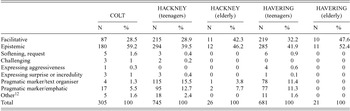
The analysis of the previous conversational extracts clearly reveals that innit can no longer be regarded simply as a question tag used to corroborate what somebody has just said or to verify and confirm a particular statement. Neither can it be considered as a simple follow-up. Evidently it has adopted new discourse functions in keeping with the context, the speakers’ attitude to the content of the proposition of the utterance, and the type of relationship existing between the conversation participants. However, a pressing research question now is to what extent these new functions are really important in terms of their frequency. Is the phenomenon attested merely sporadically, of only marginal significance, or is it gaining importance? Moreover, it will be interesting to look at whether there have been any changes in the evolution of this form over time, given that we are in a position to draw comparisons between the data collected in the 1990s (COLT) and those compiled more than a decade later (LI). Table 6 charts the use of pragmatic types of innit in the different corpora used here, showing also the main differences between adults and teenagers. A total of 1,778 tokens of innit were analysed in detail.
Distribution of pragmatic types of innit in COLT and LI
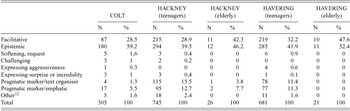
12Under the ‘other’ category we classified examples which did not fit under any of the labels distinguished or were unclear and hence impossible to analyse. These amounted to 34 cases, that is, 1.91 per cent of the total.
These data clearly show that the facilitative and epistemic functions are the most relevant in all corpora, amounting to a total of 87.7 per cent in COLT, 68.4 per cent in the group of Hackney teenagers, 88.5 per cent for Hackney adults, 74.1 per cent for Havering youths and, finally, 100 per cent for Havering adults.
In contrast with this, we can also see here a clear evolution of innit towards its function as a pragmatic marker. The data in COLT already show a slight tendency in that direction: 5.5 per cent of the examples recorded correspond to the emphatic value, while only 1.3 per cent of them can be classified under the text organiser category; however, this is seen more noticeably in LI. In data for both Havering and Hackney teenagers, innit serves not only to express meanings traditionally associated with (canonical) question tags, such as those of asking for the interlocutor's confirmation (epistemic meaning) or agreement (facilitative), but gradually adopts new roles in the spoken interactions; whereas in Hackney teentalk innit as discourse organiser prevails over the emphatic function (15.5 vs 12.7 per cent), in Havering these two functions obtain very similar figures (11.4 and 11.3 per cent). In very clear contrast to this, data from the adult counterparts in both cases remain completely alien to this tendency, with innit in adult speech tending to behave in general terms as a standard question tag. Indeed, only three examples are recorded as pragmatic markers among the Hackney adults, while in the case of Havering no instances of this type were found.
5 Conclusions
Innit is a frequent invariant and follow-up tag in modern British English, more particularly in the language of teenagers and young speakers in the London area. Our findings confirm that it has not gone out of use; on the contrary, data from the LI corpus, compiled in 2004–5, strongly suggest that its frequency has increased significantly over the last few years.
Innit presents syntactic features of its own and does not follow the regular question tag formation rules. This is most evident in teentalk, whereas in the speech of adults the form tends to behave in a more traditional way.
Innit may represent not only the verb be but also do, have (either as an auxiliary or as a lexical verb) and most of the modal verbs. Furthermore, it does not always observe the polarity reversal rule typical of question tags, and is characterised by its flexibility, occurring in initial, medial or final position according to the pragmatic meanings associated with it. The increasing lexicalisation process of innit may be considered as confirmation of the reduction of the current question tag and follow-up systems in modern English, as anticipated by Krug (Reference Krug1998).
Hence innit should not be regarded as a simple non-canonical question and follow-up tag, in that it has come to perform more (and new) textual functions characteristic of pragmatic markers, particularly in the language of teenagers. These functions contribute to the propositional value of the sentence by expressing the speaker's attitude to the content of the utterance (expressing emphasis, incredulity, surprise) or reflecting aspects related to the relationship between the participants in the interaction (aggressiveness, softening device).
In spite of these findings, a number of questions remain for future research, such as the sociolinguistic factors that condition the use of this form (gender, social class, ethnic minority, geographical area, speaker's background, speaker's role and position, etc.) and the very grammaticalisation process which the form is going through. It would also be interesting to investigate the behaviour of this tag with respect to other forms of the same class, not only in London and in British English but across other varieties of the language, and how particular usages help to construct identity, taking the group of teenagers as a good case in point. Moreover, if we consider that the LI data were collected in 2004–5, we may assume that there has been ongoing change and variation within the last decade.