INTRODUCING CLASSIC MAYA FEASTING
This paper addresses the problem of feasting among the ruling families of Classic Maya polities and how practices such as sharing exquisite foods and drinks and exchanging gifts might have played out in the establishment of regional networks centered on individual political actors and entire royal dynasties. The discussion considers two kinds of data—textual references on monuments and other media and pictorial scenes, which are primarily known from painted pottery but are also occasionally found on monuments and painted murals. It begins with outlining the challenges in identifying feasting references in Classic Maya texts and images. The diacritical nature of feasting events is linked to certain properties of food containers and their contents. Finally, possible political networks generated by shared consumption of diacritically significant ingestibles are traced through the spatial distribution of royal eating and drinking utensils originating from the archaeological sites of Naranjo and Motul de San José in Guatemala.
A discussion of feasting necessitates a brief clarification of the term itself. The definition adopted here largely follows a comparative approach to feasting behavior as outlined by Hayden (Reference Hayden, Dietler and Hayden2001:27–28) with an emphasis on form and function rather than on any particular emic system of categories and symbolic explanations. From this perspective, feasting is always commensal (involving two or more participants) and is distinguished from other forms of food consumption by its extraordinary nature which may include special food and special timing or purpose. With respect to the political dimension of feasting behavior, I borrow a functional classification of feasts suggested by Dietler (Reference Dietler, Dietler and Hayden2001:75–88) who distinguishes between three modes of commensal politics—empowering, patron-client, and diacritical, the latter two differing in that the focus of diacritical feasting shifts from reasserting the asymmetrical relationship between the sponsor of the feast and its participants to reification of group's social rank through the use of special foods and wares. As we shall see, the diacritical mode offers the most productive theoretical framework for understanding Classic Maya elite feasting representations.
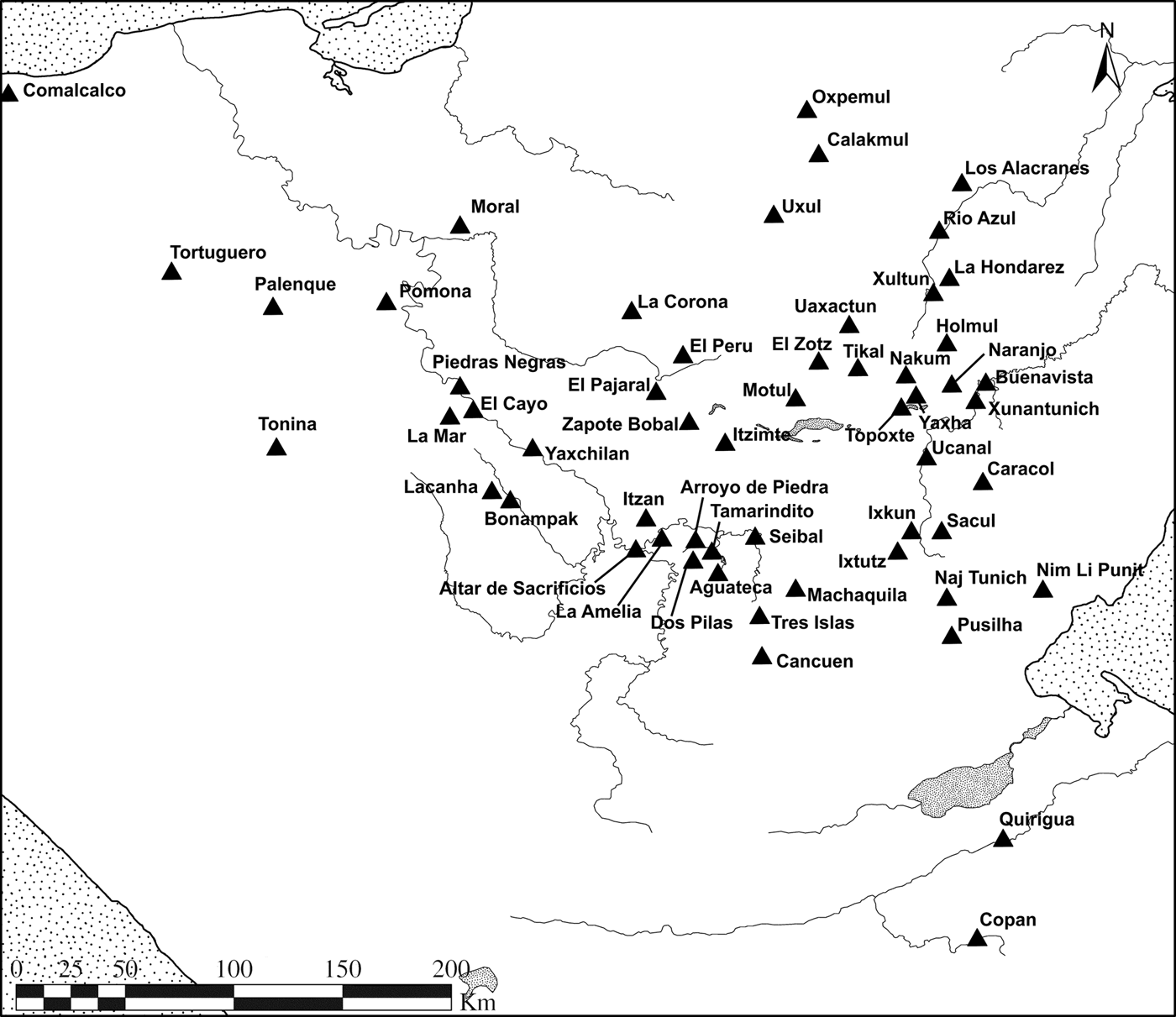
The Classic Maya culture is usually placed in the region of southern and northern Maya Lowlands (the present-day Mexico, Guatemala, Belize, and Honduras) between fourth and ninth centuries a.d. (Figure 1). The most distinguishing feature of the Classic Maya culture is the use of hieroglyphic writing and the underlying lingua franca known as Epigraphic Mayan, Hieroglyphic Mayan, or Classic Ch'olti'an (Houston et al. Reference Houston, Robertson and Stuart2000; Kaufman Reference Kaufman2002:28–34). There is still some disagreement between several groups of epigraphers and linguists on the precise identification of the language in relation to the Ch'olan family and on the degree of diglossia in different scribal communities (Law et al. Reference Law, Robertson, Houston, Haertel, Metz, McNeil and Hull2009; Mora-Marín et al. Reference Mora-Marín, Hopkins, Josserand, Metz, McNeil and Hull2009; Wichmann Reference Wichmann2006). The relative abundance of surviving textual records on monuments and various personal items from this time period sets Classic Maya apart from all other pre-Columbian indigenous cultures because Mayanists sometimes have direct access to the precontact emic representations of time, landscape, history, and sociopolitical organization, which are not affected by the sociopolitical and cultural contexts of the contact with the Spaniards and the colonial transformations.
Major Classic Maya archaeological sites with inscriptions (drawing by the author).

Classic Maya feasting practices are well-attested in the archaeological record. Different approaches and methodologies have produced evidence of feasting events and enabled scholars to discern the modes of commensal politics discussed above. Studies of soil chemistry were used to successively identify potential areas of large-scale food consumption (Bair and Terry Reference Bair, Terry, Foias and Emery2012; Dahlin et al. Reference Dahlin, Bair, Beach, Moriarty, Terry, Staller and Carrasco2009). The analysis of ceramic assemblages was employed to distinguish feasting deposits from the discards of everyday cooking and eating (Clayton et al. Reference Clayton, Driver and Kosakowsky2005; Moriarty Reference Moriarty, Foias and Emery2012) or to discern the prevailing modes of feasting at different social levels within a given community (LeCount Reference LeCount2001). Similar research questions have been addressed by looking at faunal (Emery Reference Emery2003) and botanical (Goldstein and Hageman Reference Goldstein, Hageman, Staller and Carrasco2009) remains.
Compared to other fields of research, the contribution of epigraphy and iconography to our understanding of Classic Maya feasting has been modest and its engagement with other kinds of data remains limited. Many archaeological studies including the crucial contributions by LeCount (Reference LeCount1999, Reference LeCount2001, Reference LeCount and Yaeger2010) rely on selected ethnohistoric and iconographic sources in building a broader view of Classic Maya feasting practices, and yet there are no comparable epigraphic surveys which also consider archaeological data. For example, LeCount argues that Late and Terminal Classic Xunantunich lords had no inscribed serving vessels despite epigraphic evidence of their political dependence upon the rulers of Naranjo during the eighth century (Helmke et al. Reference Helmke, Awe, Grube, LeCount and Yaeger2010; LeCount and Yaeger Reference LeCount, Yaeger, LeCount and Yaeger2010), which is marked by the presence of such ceramics at nearby subordinate centers like Buenavista del Cayo (Reents-Budet et al. Reference Reents-Budet, Ball, Taschek and Bishop2000). The absence of Late Classic fine drinking cups at Xunantunich is particularly enigmatic given the discovery of sixth century inscribed serving vessel fragments in the royal palace construction fill including two sherds with a possible Naranjo emblem glyph (LeCount and Yaeger Reference LeCount, Yaeger, LeCount and Yaeger2010:340). It appears that if the diacritical feasting was present at Xunantunich, its Late and Terminal Classic material record was more restricted in comparison to other local modes of commensal politics, perhaps due to the site's subordinate political status as a small provincial capital of Naranjo (LeCount Reference LeCount2001). It is also possible that the royal midden corresponding to that time period was not found, but given the fact that the site has sustained major excavations since the 1960s, it is likely that large middens will not be found. According to LeCount (LeCount and Yaeger Reference LeCount, Yaeger, LeCount and Yaeger2010:353), the lack of fine pottery at Xunantunich indicates that rulers had few interregional relations with Peten overlords other than Naranjo, a relationship which underwent considerable and rapid change throughout the Early to Terminal Classic periods. Archaeological investigations also tend to concentrate on the role of feasting within a given political community (usually identified as a major archaeological site and its hinterland). Classic Maya elites clearly operated on a much larger spatial scale as revealed in the written and visual records of visits, marriages, warfare, as well as the spatial distribution of inscribed personal possessions. The success or failure of a given ruling family depended not only on its ability to engage with the local political community, but on its skills in dealing with countless other ruling families. Evidence of political interactions at that scale is provided mostly by epigraphic studies. The present paper attempts to address some of these questions and points to potential zones of engagement between archaeological and textual approaches.
Political Context of Classic Maya Feasting
After the last three decades of advancements in the reading and translation of the inscriptions, there is a consensus among scholars that the Classic Maya political landscape consisted of multiple small polities or city-states, as some would prefer to call them, which were connected by webs of alliances, allegiances, marriages, and mutual interests, as well as a notion of the common prestige culture and language, which set the ruling nobility of royal and non-royal descent apart from the commoners (Houston Reference Houston, Danien and Sharer1992, Reference Houston1993, Reference Houston2000; Houston and Inomata Reference Houston and Inomata2009; Marcus Reference Marcus2003; Martin and Grube Reference Martin and Grube1995, Reference Martin and Grube2008[2000]; Mathews Reference Mathews and Culbert1991; Stuart Reference Stuart, Sabloff and Henderson1993; Wichmann Reference Wichmann2006). Several polities and the royal dynasties in charge consistently played a greater role in shaping the Classic-period political landscape, but in the end, no dynasty prevailed in extending its patronage over the entire region. Instead, there is strong evidence of increasing political balkanization before the collapse of the whole system in the early ninth century.
The transformations of the Classic Maya political landscape constitute one of the most pressing and fascinating research questions, but the present paper considers only one significant aspect. Most potential references to feasting in texts and imagery appear no earlier than the second half of the seventh century, about the same time as the decline in the explicit statements of subordination between rulers of different polities and the surge in the visibility of non-royal members of the court on monuments and other media.
The meaning of “statements of subordination” has to be clarified here. For example, recent study by Munson and Macri (Reference Munson and Macri2009) suggests that subordination statements peaked in the Early Classic period, reached the lowest frequencies in the early eighth century and were once again on the rise in the Terminal Classic. However, the authors do not distinguish between interpolity and intrapolity statements, therefore ignoring differences in spatial and social distances involved. It seems more reasonable to consider relations between “holy lords” (k'uhul ajawtaak) of different city-states and relations between a “holy lord” and holders of various courtly titles such as ajk'uhuun “priests” or “keepers” (Jackson and Stuart Reference Jackson and Stuart2001; Zender Reference Zender2004), sajal governors (Jackson Reference Jackson2005), and lakam officials (Lacadena García-Gallo Reference Lacadena García-Gallo2008) as two separate cases. Holders of courtly titles never appointed themselves and were subordinate by default unless they claimed the ajaw rank (Houston and Stuart Reference Houston, Stuart, Inomata and Houston2001:61–64; Tokovinine Reference Tokovinine, Pillsbury, Doutriaux, Ishihara and Tokovinine2012:65–67). The increased presence of non-ajaw individuals in the monumental record in the last decades of the eighth century may just as well point to a weakening authority of the old royal dynasties.
Munson and Macri also make no distinction between explicit references to one's subordinate status and potentially ambiguous expressions of one's agency and authoritative presence. Events happening in the “sight area” (ichnal) of a lord or a deity may imply patronage and superior, central status of the witness (Houston et al. Reference Houston, Stuart and Taube2006:173–175; Stone and Zender Reference Stone and Zender2011:58–59), but do not entail a continuous (future) state of political subordination of everyone within the ichnal. The enigmatic expression ukabij/ukabjiiy, which is usually translated as “on the orders of X,” highlights one's agency, but the range of its contexts is not restricted to reports of a ruler acceding to kingship through the agency of his patron from another polity and its actual translation is closer to “toiling” (Houston et al. Reference Houston, Stuart and Taube2006:225). The ambiguous nature of such statements could be intentional. The narrative on Stela 4 at Moral-Reforma, for instance, reports three accessions of a local king: once on his own, in the ichnal of the Calakmul ruler one year later, and in the ichnal of the Palenque king nearly thirty years after the original accession (Martin Reference Martin2003). These sequential investitures imply shifts in the status of the Moral-Reforma lord, but the narrative does not clarify if he was still subordinate to the Palenque dynasty when the monument was dedicated.
The possessed form of ajaw (yajaw, “her/his lord”) constitutes the only explicit statement of subordination of one ruler by another that implies a continuous status: one lord is owed fealty by the other lord even after death. Such statements often appear in the narratives on monuments dedicated by subordinate rulers or by their own vassals. It is unclear if these public declarations of loyalty are forced acknowledgements of political subjugation or a strategy aimed at boosting one's prestige by claiming patronage of a powerful royal house. References to the rulers' overlords in subordinates' narratives as in the inscriptions on the Stendahl and K'an Xook panels (Biró Reference Biró2004:8–11; Tokovinine Reference Tokovinine, Rivera and Fort2006a:Figures 1, 2) point to the second explanation. Why else would a sajal of a Piedras Negras king emphasize the latter's ties to Calakmul or why would a sajal of a Lacanha ruler mention Sak Tz'i’ patrons of his king?
Whatever the motives might have been, there is a clear decline in self-reported vassals in the eighth century inscriptions. The last known yajaw of Tikal rulers was Yeh Te’ K'inich I of Motul de San José whose subordinate status was mentioned in the inscription on Motul de San José Stela 1 dedicated in a.d. 711 (Tokovinine and Zender Reference Tokovinine, Zender, Foias and Emery2012:Figure 2.2, Table 2.1). The last vassal of Tikal's arch-enemies at Calakmul was K'ahk’ Tiliw Chan Chahk of Naranjo whose last statement of subordination was on Naranjo Stela 1 (Graham Reference Graham1975:12; Martin and Grube Reference Martin and Grube2008[2000]:75–76) placed into the ground in a.d. 702. The last reference to K'ahk’ Tiliw's own vassals is on Naranjo Stela 2 dated to a.d. 713 (Graham Reference Graham1975:15; Martin and Grube Reference Martin and Grube2008[2000]:77). An inscription on Tonina Monument 65 (Graham and Mathews Reference Graham and Mathews1996:102) mentions the last known royal subordinate of Palenque rulers in a.d. 699. The last vassal of Tonina lords themselves is cited on the hieroglyphic column, now in the collection of the Saint Louis Art Museum, in a.d. 715 (Miller and Martin Reference Miller and Martin2004:141, Plate 72). The Stendahl panel dedicated in a.d. 726 records the last vassal of the Sak Tz'i’ lords (Biró Reference Biró2004:10–11). The inscription on Arroyo de Piedra Stela 2 states that the local king owed his fealty to the then-dead Dos Pilas ruler in a.d. 731 (Houston Reference Houston1993:114; Houston and Mathews Reference Houston and Mathews1985:Figure 11). It appears, therefore, that the vassal-liege bonds between Classic Maya rulers were largely gone by the mid-eighth century. Even highly successful kings such as Yik'in Chan K'awiil of Tikal and K'awiil Chan K'inich of Dos Pilas had no royal vassals even though they clearly extended their influence over other dynasties.
Those changes coincided with or directly encouraged new kinds of visual and textual narratives in which the inner workings of Classic Maya courts were exposed. Just as the plural made appearance in the inscriptions with references to groups of “lords”, ajawtaak (Tokovinine Reference Tokovinine2013:113–115), the imagery and narratives began to shift from individual rulers to scenes of courtly life with multiple participants (Houston and Stuart Reference Houston, Stuart, Inomata and Houston2001:73–76). The thematic range also expanded. For example, scenes on the Late Classic vessels painted by the prolific artists of Motul de San José showed royal dressing, presentation of tribute and payments, dancing, drinking, playing ball, and visiting other courts (Just Reference Just2012; Reents-Budet Reference Reents-Budet, Inomata and Houston2000a; Tokovinine and Zender Reference Tokovinine, Zender, Foias and Emery2012).
Some of these new references involve food and drinks, but there have been rather divergent interpretations of these representations of Classic Maya food consumption practices. One trend exemplified in the publications by Reents-Budet (Reference Reents-Budet, Inomata and Houston2000a, Reference Reents-Budet, Kerr and Kerr2000b) effectively classifies nearly every courtly scene with food as feasting. The other, somewhat more skeptical line of argument questions our knowledge of the social and political contexts of food consumption events, number of participants, and function (Houston et al. Reference Houston, Stuart and Taube2006:127–130). As I argue below, the small scale of the potential feasting events depicted in Classic Maya art in terms of the amount of food on the display and the number of actors poses the greatest challenge for the classification of such events as feasts.
Classic Maya Elite Feasting as Diacritical Feasting
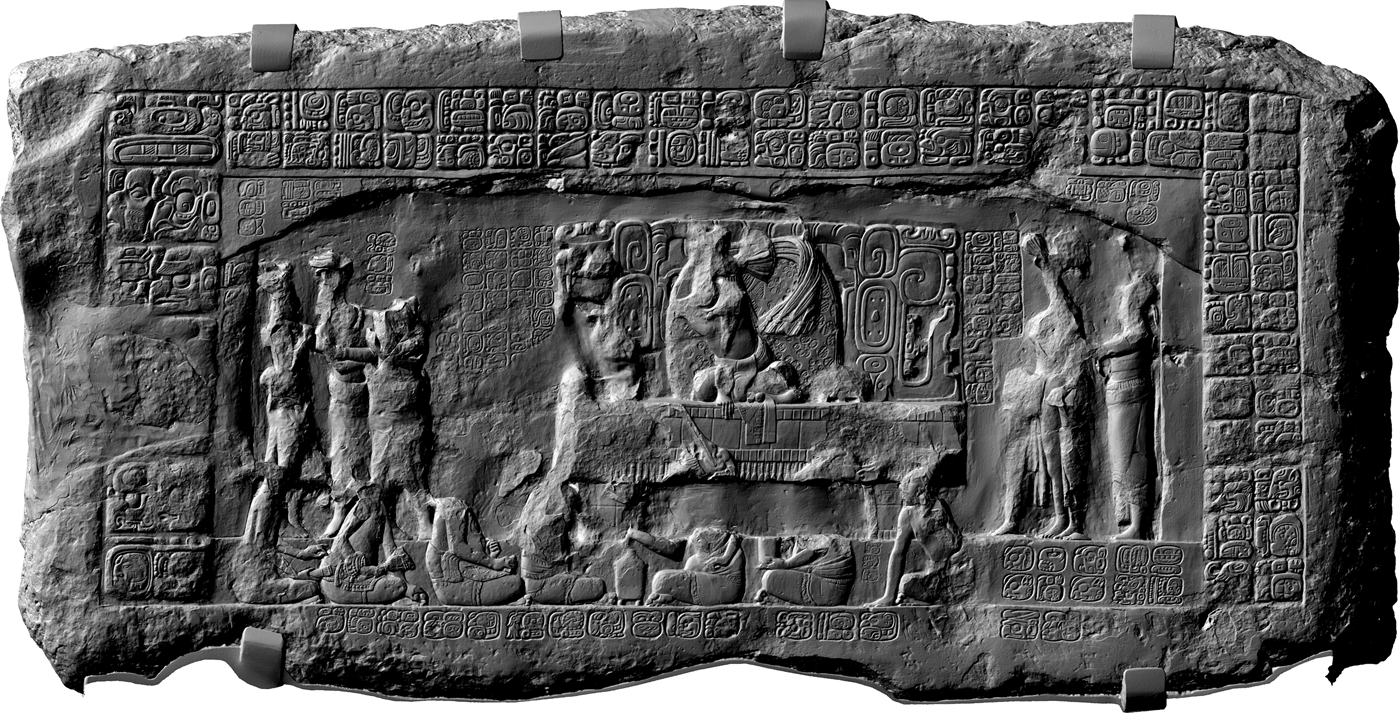
One of the most unequivocal textual and visual references to feasting on Classic Maya monuments comes from Panel 3 at Piedras Negras in Guatemala (Figure 2). This monument, discussed in great detail by Houston and Stuart (Reference Houston, Stuart, Inomata and Houston2001:69–73) and Martin and Grube (Reference Martin and Grube2008[2000]:149), was carved in a.d. 782, but its narrative centered on the life of the grandfather of the current ruler, particularly a.d. 749 when he celebrated the completion of the first twenty years of his reign. The anniversary took place in the presence of the former archrivals from the site of Yaxchilan (Martin and Grube Reference Martin and Grube2008[2000]:127, 149). According to the panel's main text, two days after the anniversary, the ruler of Piedras Negras danced at midnight and then drank “hot” or “inebriating” cacao. The spelling UK’-ni ti-ka-la ka2-wa allows two alternative readings: uk'uun ti kal kakaw (“he drank with inebriating cacao”) and uk'uun tikal kakaw (“he hot-chocolate-drank”). Both reading are grammatically possible with the antipassive form of the verb “to drink” (Lacadena García-Gallo Reference Lacadena García-Gallo2000). The comparable glosses for “inebriating” and “hot” may be found in Ch'olti’ (Robertson et al. Reference Robertson, Law and Haertel2010:305, 320). This example, however, remains the only reference to this type of drink in the entire corpus, so it is clearly a very special beverage.
Panel 3, Piedras Negras (3D scan rendering by the author).
The scene on the panel shows the enthroned ruler lecturing his Yaxchilan guests standing to the left (the speech text is poorly understood, but it evokes the accession of the guest's ancestor as a vassal of Piedras Negras rulers). A group of local princes, relatives, and their overseers witness the speech behind the throne on the right. A lager assembly of seated nobles occupies the area one step below the royalty. There are several sajal governors, a ti’ sak huun crown-keeper or speaker, a “banded bird” official, and an anaab (a common courtly title of unclear significance). One of them proclaims his loyalty to the ruler (a-wi-na-ke-na yo-?ki-CHANawinakeen yook chan, “I am your man, Support of the Sky”). The vessels in the scene suggest that it corresponds to the midnight drinking mentioned in the main inscription. One large (and virtually invisible because of the damage to the panel) lidded vase sits directly on the throne between the ruler and the visitors. A plate might have been once depicted at its side, but it is also largely gone. A slightly smaller lidded vessel is placed on the step below among the seated Piedras Negras nobles. One of them is holding an even smaller cup.
The event depicted and described on Panel 3 conforms to the definition of a feast as suggested by Dietler (Reference Dietler, Dietler and Hayden2001) and Hayden (Reference Hayden, Dietler and Hayden2001). It includes consumption of a special drink. It is part of a larger set of rituals including dancing. Its timing at “midnight” (yihk'in) or the time when the new tzolk'in divinatory day has seated but the new haab solar day is yet to arrive (Martin and Skidmore Reference Martin and Skidmore2012; Mathews Reference Mathews, Houston, Stuart and Mazariegos2001[1977]; Stuart Reference Stuart2004; Tokovinine Reference Tokovinine2010) also implies its ritual nature. The political context involves attempts to restore ties with former enemies and vassals at Yaxchilan (a point made in the ruler's speech in the scene) and to ensure political cohesion within the kingdom. The male-only gender of participants also points to the special character of the event. The retrospective nature of the narrative implies that all presences and absences and all the words and titles have some measure of correspondence to the political realities of a.d. 782. As it has been suggested before, the true protagonists of the scene are the young prince T'ul Chiik and his son's future strongman, Ahk’ Mo’ Chahk of La Mar (Beliaev and Safronov Reference Beliaev, Safronov and Avdeev2013). That makes the choice of the special cacao drinking scene even more significant in terms of our understanding of the role of feasting in the fabric of the Classic Maya political life.
The scene, nevertheless, reveals problems with identifying feasting in Classic Maya texts and images. As viewers of the panel, we assume the role of witnesses placed outside the palace structure where the event took place. Houston (Reference Houston and Houston1998:345–347; see also Jackson Reference Jackson2009) argues that this is a typical way of presenting scenes of courtly life. But were there any actual witnesses and did they also participate in one way or another? The text mentions drinking, but there is no ingestion going on in the actual scene. The drinks are just displayed and held. The main narrative only mentions the ruler and his equally regal witness from Yaxchilan but not the other participants in the scene. The only person shown holding the cup is one of the subordinates. The quantity of the beverage on display is rather small.
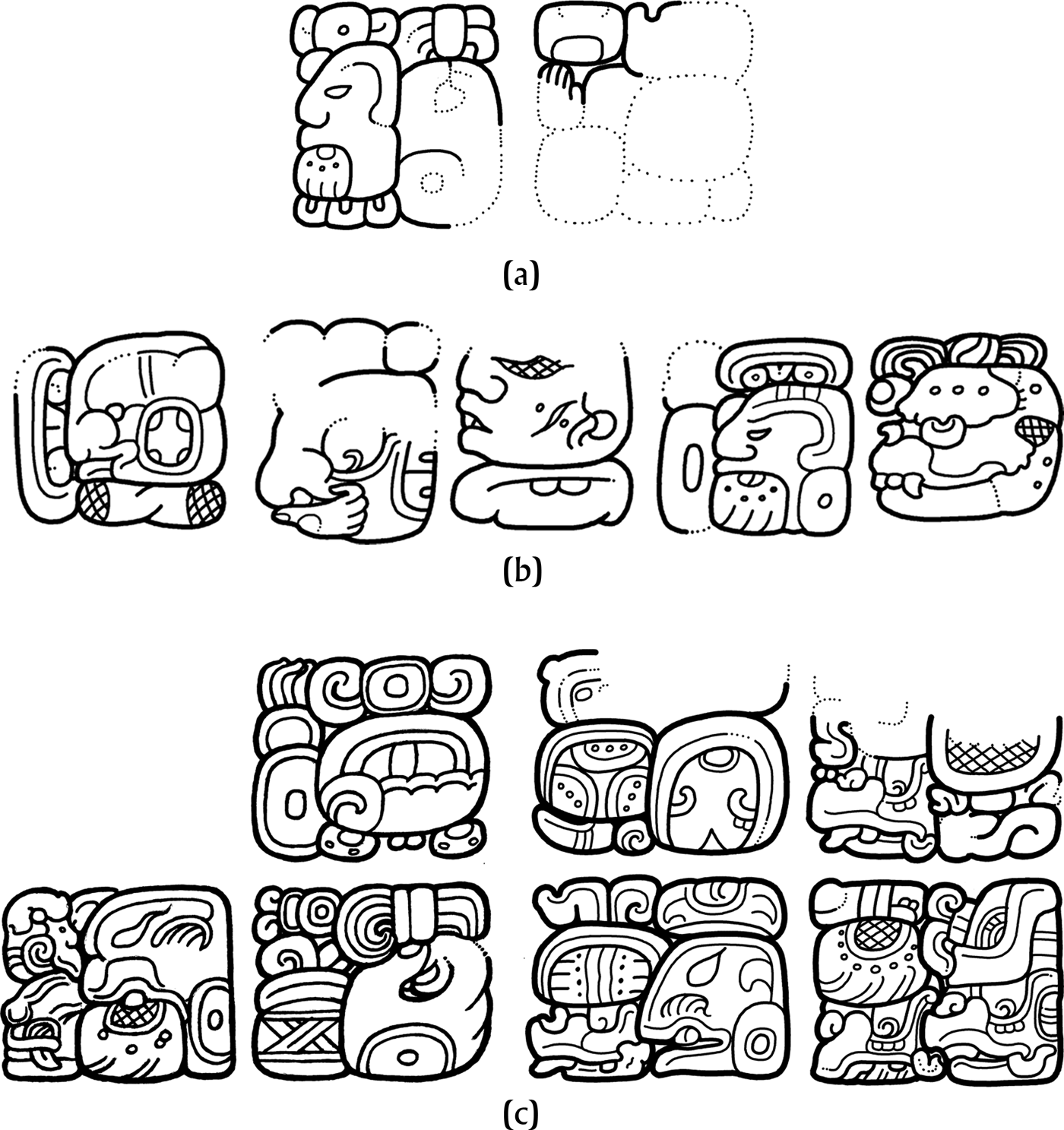
In the absence of visual clues and wider context, the other four references to drinking in the corpus of Classic Maya inscriptions are even harder to interpret. The ingestible is pulque (fermented sap of the agave plant), a potentially exotic drink for the southern lowlands, although, such interpretation may be due to the lack of paleobotanical evidence (Houston et al. Reference Houston, Stuart and Taube2006:116–117). Two such texts are carved on the altars at the archaeological site of Copan in Honduras (Houston et al. Reference Houston, Stuart and Taube2006:120–122). One simply states that the penultimate ruler of the site, Yax Pahsaj Chan Yopaat, “drank pulque” (Figure 3a): yu-UK’-ji chi-hiyuk'ij chih. The other inscription (Altar U) mentions that the same lord impersonated the god of drinking, Akan, in the act of drinking pulque (Figure 3b): u-BAAH-AAN-nu AKAN-na ti u-UK’ chi-hiubaah[il] aan Akan ti uk’-chih (Grube Reference Grube, Behrens, Grube, Praeger, Sachse, Teufel and Wagner2004:62–63). The third example, also a Copan altar (Altar K, Figure 3c), reports pulque-drinking by the twelfth king of Copan, K'ahk’ Uti’ Witz’ K'awiil, that followed the dedication of a building by a high-level courtly official and a pronouncement by “four youths,” possibly patron gods in this case because the four guardian deities of Copan were sometimes called “four lords” (chante’ ajawtaak) and “four youths” (chante’ ch'oktaak) (Beliaev et al. Reference Beliaev, Davletshin, Tokovinine, Staller and Carrasco2009:266–267; Biró Reference Biró2010). While these three instances of pulque consumption are clearly rituals of some kind, it is not clear if they had participants other than the king, although the text on Altar K implies some human and divine audience.
Drinking events at Copan: a) detail of the unnamed altar, b) detail of Altar U, c) detail of Altar K (drawings by the author).
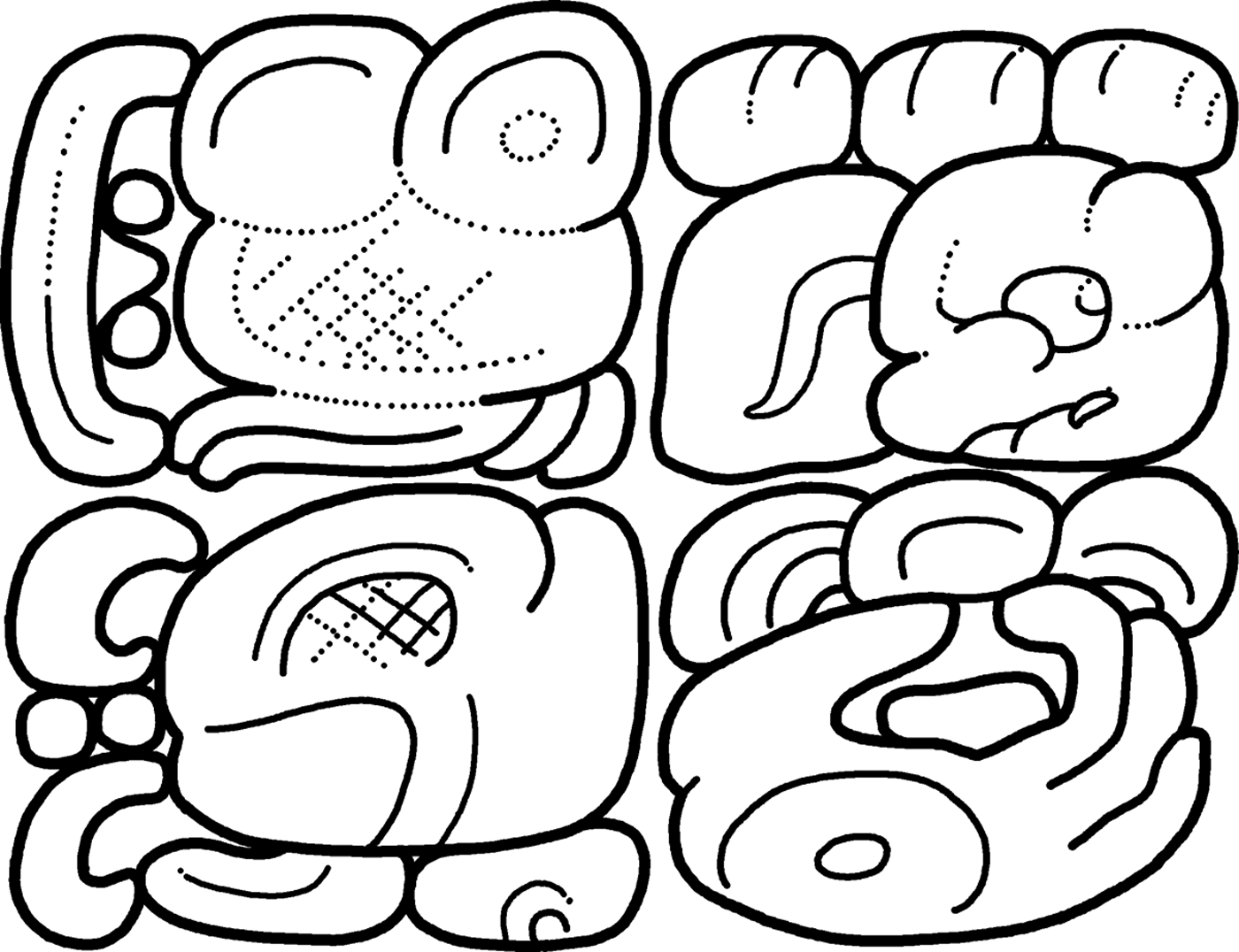
In this respect, the last textual reference on the recently recovered stairway blocks detailing the life of Yook Akan from the site of La Corona in Guatemala (Martin Reference Martin and Grube2008; Stuart Reference Stuart2008; Stuart and Martin Reference Stuart and Martin2009:30) is potentially more informative (Figure 4). The drinking takes place seventeen days after an unknown event at the court of the protagonist's overlord, the ruler of Calakmul, so it is unclear if it also happened at Calakmul or after Yook Akan's return home. According to the text, “Yook Akan drank; he gave pulque” (u-k'u-ni yo-OOK-?AKAN ya-k'a-wa chi-hiuk'uun Yook Akan yak'aw chih). The latter sentence implies some sharing or gifting as well as the presence of other participants (human or divine) who received the gift of pulque. Archaeological evidence from La Coronitas Group at La Corona (Baron Reference Baron2013:241, 323, 341, 354–355) suggests that this inscribed block might have originated from the stairway in front of the local elite residence and that different kinds of feasting events took place there and before the temples of the ruler's patron gods in La Coronitas, so the inscription might refer to one of such occasions.
Hieroglyphic Stairway fragment, La Corona (drawing by the author).
With the exception of one Copan inscription, all textual references to drinking discussed so far employ the antipassive form of the verb “to drink” (uk’), intransitivizing it and moving the focus from the object (the drink) to the agent who is usually the king. Such use of antipassive is uncommon but where it is present, the sentences with the antipassive highlight the principal event such as the acts of seeing and conjuring deities by the king in the narratives on Copan Stela E and Stela 6 (Lacadena García-Gallo Reference Lacadena García-Gallo2000:169–170, 174–175). The implication is that drinking rituals are special, focal points of the narratives.
Other representations of potential food consumption in the palace setting are equally ambiguous. The scene on a cup from the area of Motul de San José in Guatemala, now in the collection of the Dumbarton Oaks Museum (Figure 5), shows a ruler of La Florida or Itzimte in the presence of visitors, several courtiers, and servants (Houston Reference Houston, Pillsbury, Doutriaux, Ishihara and Tokovinine2012b; Tokovinine and Zender Reference Tokovinine, Zender, Foias and Emery2012:50). One of them is offering a small plate to the ruler. An official seemingly passes a cup of something, probably cacao, to a visiting Ahkul lord. However, the main caption classifies the scene as the ruler's “image in seating” ([u]baah ti chum)—a clause that may be interpreted as a reference to an accession event or a mundane execution of one's official duties.
Rollout drawing of a courtly scene on a Late Classic vessel, Dumbarton Oaks Research Library and Collection (PC.B.564/K2784) (drawing by the author).
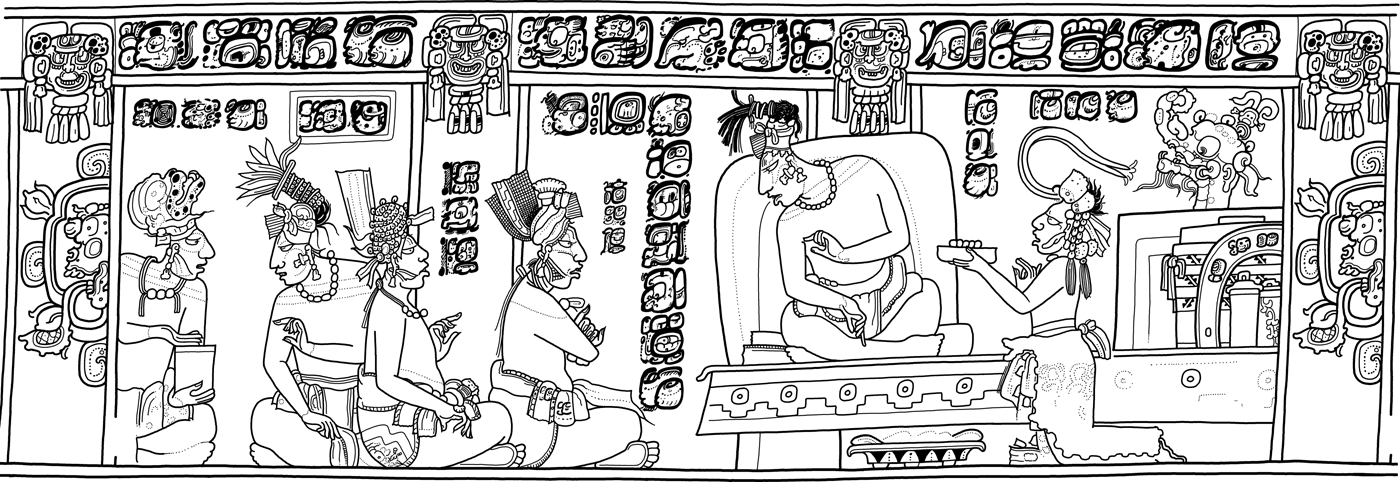
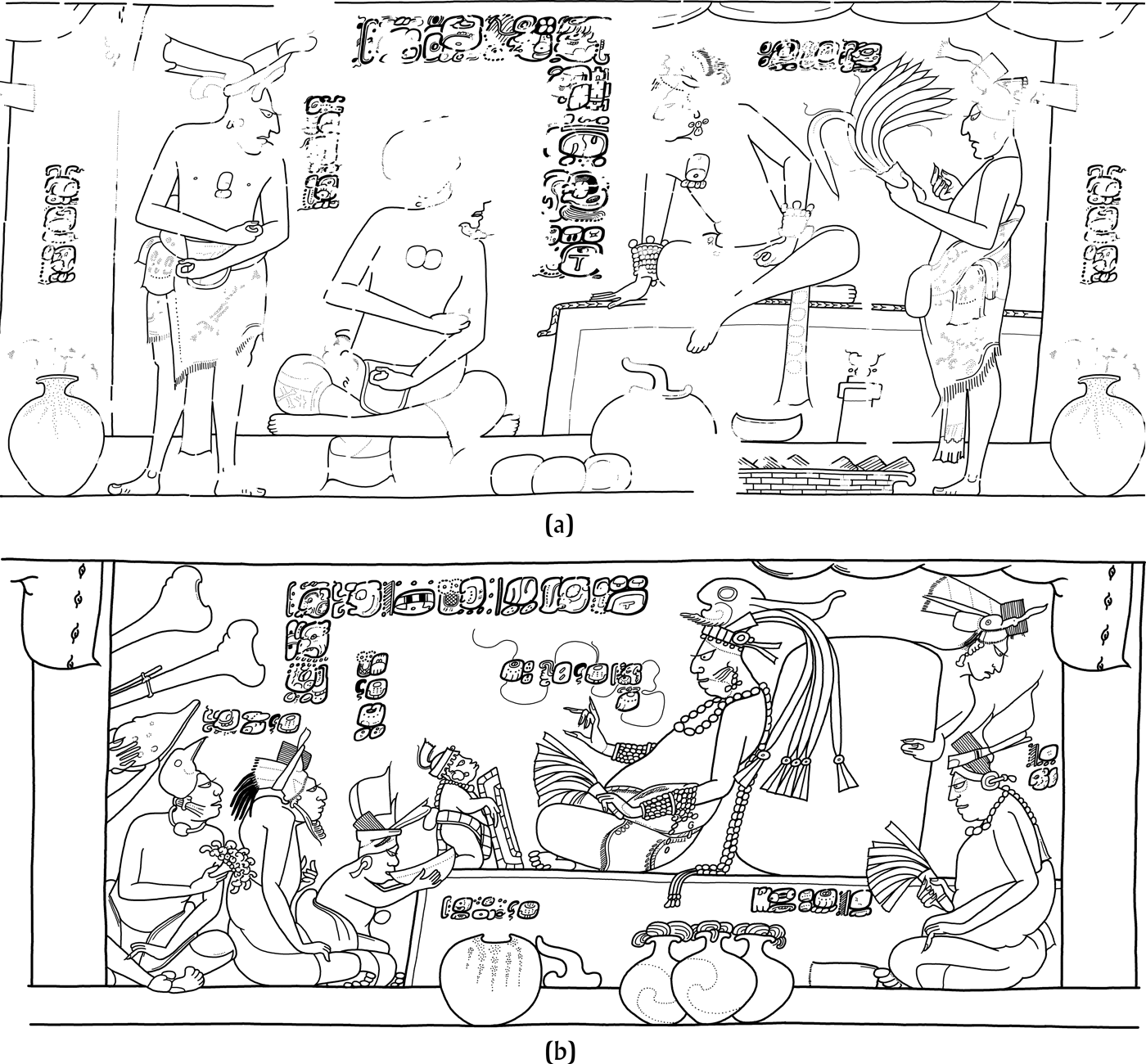
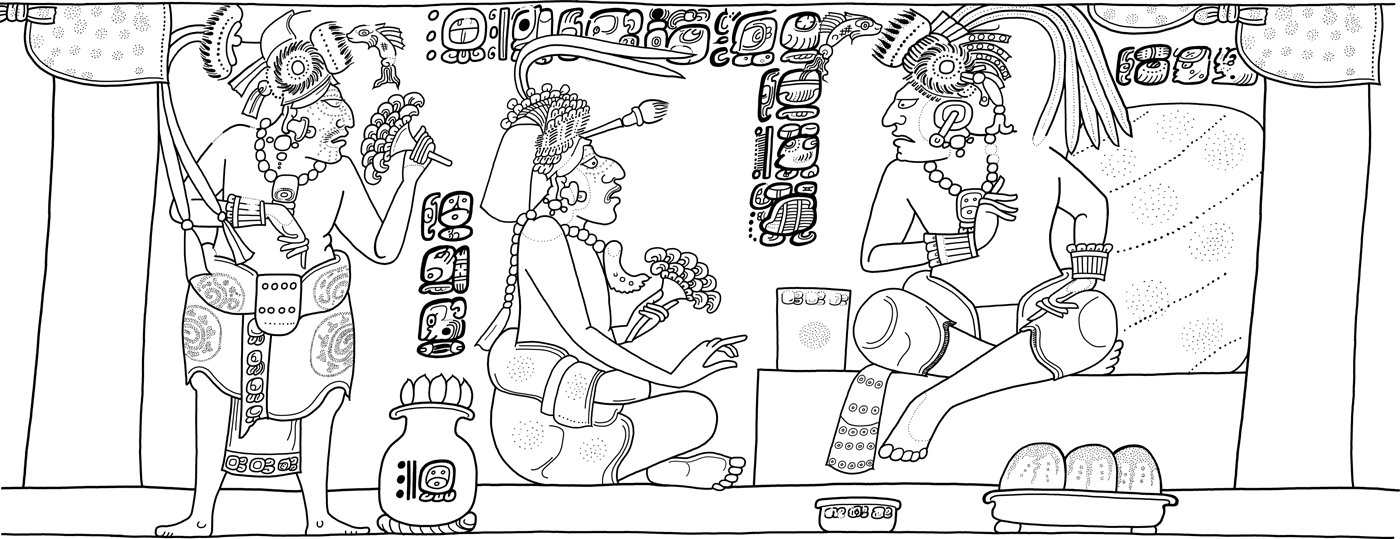
Three somewhat more straightforward painted pottery scenes show Motul de San José lords Tayel Chan K'inich and Sihyaj K'awiil (Figure 6) and K'awiil Chan K'inich of Dos Pilas (Figure 7) in the presence of courtiers as well as jars of pulque and other food containers. According to the captions, each scene is the “image with pulque” (ubaah ti/ta chih) of the royal protagonist. Yet nobody is ingesting except for a dwarf jester (Figure 6b) (Just Reference Just2012:172–174, Figures 112–116), a possible inversion of the normative behavior in such context. Fragrances and music are hinted by the presence of flowers and musicians, but the nature of the events remains ambiguous. It seems as if the emphasis is on the possession and display of special foods and drinks, rather than on their actual consumption.
Ik'a’ lords “with pulque”: (a) rollout drawing of the Late Classic vessel, Tamarindito (TA 32A-1-3/K30177); (b) rollout drawing of the Late Classic vessel, National Gallery of Australia, Canberra (82.2292/K1453) (drawings by the author).
Dos Pilas ruler “with pulque” in the scene on a Late Classic vessel, Los Angeles County Museum of Art (M.2010.115.12/K1599) (drawing by the author).
Are we witnessing a form of communal consumption or a mere diacritical display of exquisite items including special foods and drinks? Despite archaeological evidence of feasting at Motul de San José and nearby Trinidad de Nosotros, which likely served as a port and a market for the Motul polity, the connection between these images and archaeological data is far from clear. The indoor setting of the scenes implies that they did not represent the food consumption events in Plaza II at Motul de San José as hinted by the soil chemistry analysis (Bair and Terry Reference Bair, Terry, Foias and Emery2012). The extensive feasting deposits associated with the ball court and the nearby plaza at Trinidad de Nosotros suggested large and lavish events and the presence of non-local wares implied visitors and gift exchange (Moriarty Reference Moriarty, Foias and Emery2012:219–220). Yet despite the abundance of polychrome serving vessels, the deposit did not contain fragments of fine inscribed plates and vessels of the kind shown in the painted scenes which belonged to Motul de San José rulers and were found in the royal middens (Foias and Halperin Reference Foias, Halperin, Foias and Emery2012; Halperin and Foias Reference Halperin and Foias2010). Therefore, although it seems very likely that the ruling dynasty of Motul might have sponsored feasts at Trinidad de Nosotros (which probably included ball game and other kinds of performances in the plazas), this is not what we see in the scenes on the vessels.
The “images with pulque” of Motul de San José lords (Figure 6) only feature members of their royal court who observe and maybe even get a taste of royal drinks and food. Yet at least one of these vessels was given away to an ajaw of Tamarindito, so the scene was probably meant to be seen by non-local nobles. The Dumbarton Oaks vessel (Figure 5) reveals one regal or princely guest (a nameless “Ahkul lord”). The Dos Pilas courtly scene (Figure 7) shows K'awiil Chan K'inich as a king-to-be in the company of another prince. It is unclear if the caption “K'inich, youth” refers to one of the two individuals before the throne or both. The person immediately to the left of the royal protagonist in the scene of the La Florida/Itzimte court (Figure 5) remains anonymous despite his privileged position next to the throne. One can speculate that he was the prince-owner of the vase mentioned in the dedicatory text (Tokovinine and Zender Reference Tokovinine, Zender, Foias and Emery2012:40). These special witnesses or guests are clearly not shown as equals to royal protagonists, and yet their participation was clearly important to the artist or the patron, not unlike the case of Piedras Negras Panel 3. It seems as if “images with pulque” functioned to highlight the exquisite nature of eating and drinking at a certain royal court to be appreciated by nobles of other courts (particularly, royal “youths”) who happened to hold and/or view the drinking cup with such scenes in the context of similar events.
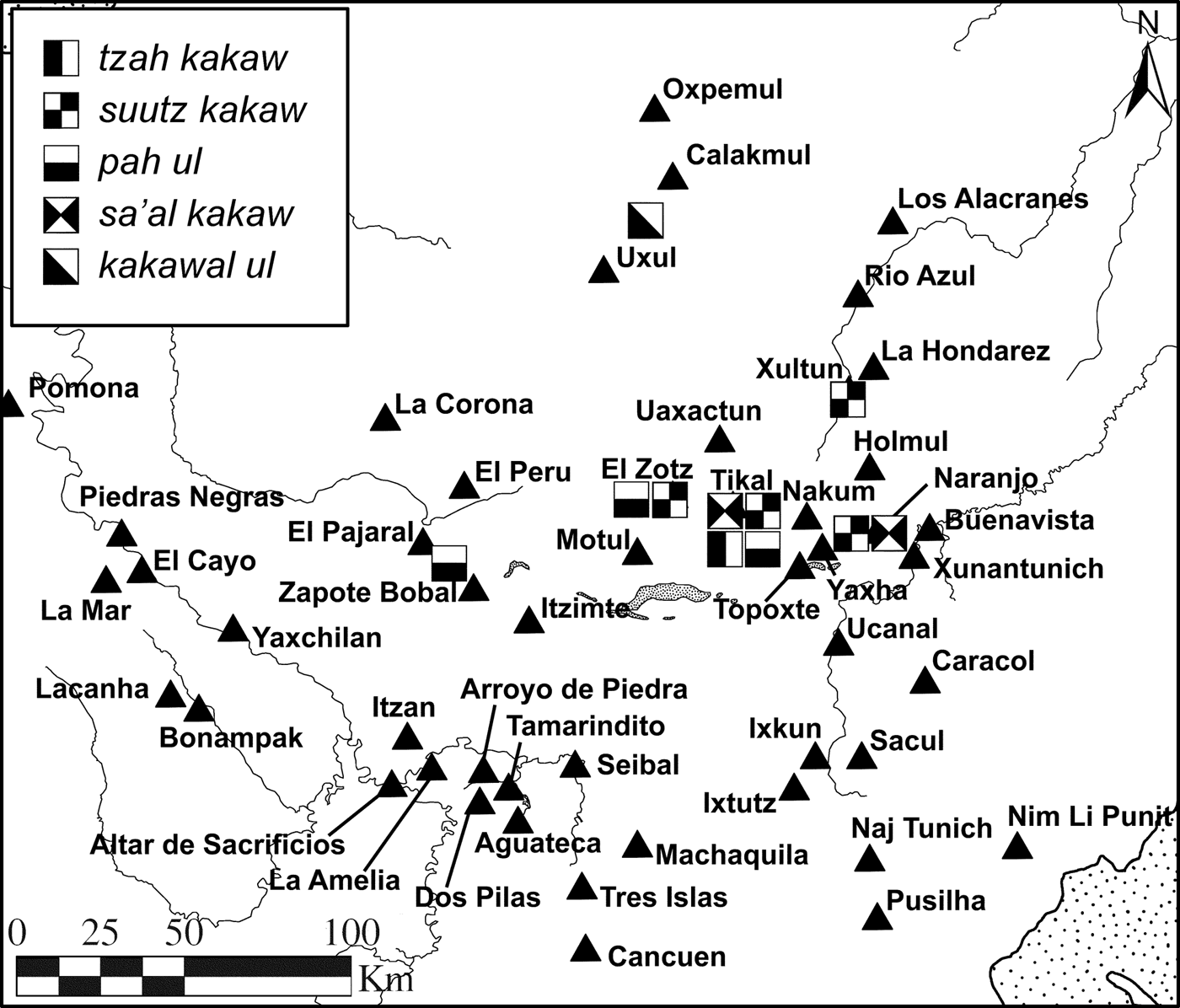
The diacritical function of the food and drinks in the courtly scenes is revealed in the dedicatory captions on the surviving food containers as well as by the restricted distribution of inscribed plates, bowls and vessels (Beliaev et al. Reference Beliaev, Davletshin, Tokovinine, Staller and Carrasco2009). Most inscribed drink serving vessels (uk'ib) identify the intended contents as a particular kind of “fruity cacao” (yutal kakaw) with several kinds of flavors. Bowls may also be used for atole, but not of the common kind: the fresh maize seems to be the choice ingredient of the special drink (ul). The term for a generic maize gruel (sa’) is found only in the names of mixed beverages. The texts on known inscribed food serving vessels (we'ib) only mention tamales (waah). It has been argued previously by the author (Beliaev et al. Reference Beliaev, Davletshin, Tokovinine, Staller and Carrasco2009) that there is some limited evidence of regional preferences in tastes or in the notion of the acceptable or ideal drinks (Figure 8). For example, “gruel cacao” (sa'al kakaw) was apparently popular at Naranjo, but “cacao gruel” (kakawal ul) occurred only in the Calakmul and Nakbe area. Nodes of greater variation or innovation, perhaps unsurprisingly, coincided with major geopolitical centers like Early Classic Tikal.
Regional variation in special drinks: tzah kakaw “sweet cacao”; suutz kakaw “cherry cacao”; pah ul “sour atole”; sa'al kakaw “gruel cacao”; kakawal ul “cacao atole” (drawing by the author).
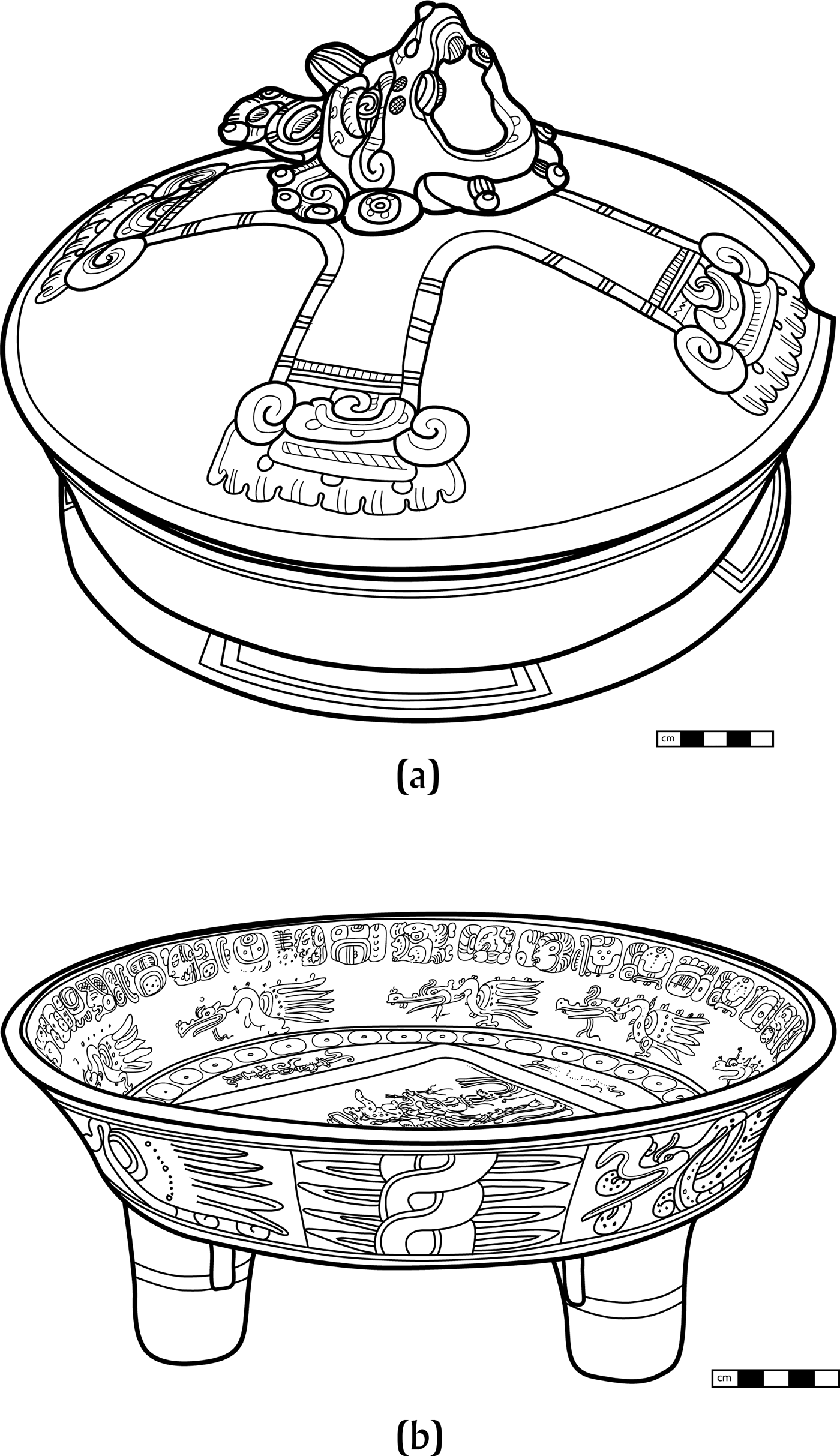
As markers of elevated social status, inscribed food containers were subject to imitation and counter-innovation. It is particularly apparent when fake texts are added to the surface decoration. Late Classic period saw a sharp rise in these so-called ‘pseudoglyphs’ on fine serving vessels (Calvin Reference Calvin2006) implying that a large section of mid-level nobility had aspirations for but no access to certain attributes of higher social rank. It is potentially impossible to assess to what extent the contents of the serving vessels were subject to the same processes, but there are some potentially significant trends in food presentation modes. A common Early Classic serving vessel for solid foods was a large lidded dish. Elaborate lidded dishes in the funeral assemblages in Building B of Group 2 at Holmul in Guatemala (Merwin and Vaillant Reference Merwin and Vaillant1932:20–41, Figure 12, Plates 10–11, 21–26) are a perfect example of this vessel form (Figure 9a). The corresponding Late Classic form at Holmul was a large flat painted plate on tall supports (Figure 9b) such as those found in the burial of Building F in Group 1 (Merwin and Vaillant Reference Merwin and Vaillant1932:13–15, Figure 7, Plates 2, 29, 31). Despite elaborate exterior decoration, the Early Classic lidded dishes were not inscribed in contrast to cylinder vessels and bowls for cacao. Dedicatory texts on plates and dishes become common only on Late Classic serving vessels, so we know that the plates and dishes were called “plates” (lak), “eating utensils” (we'ib), and “containers” (otoot). The large flat plates on tall supports were also termed jawte’, which still evades secure translation (Houston et al. Reference Houston, Stuart and Taube1989). It is significant that there are no references to jawte’ until the seventh century. The emergence of jawte’ plates likely reflects an innovation in food consumption, and several authors have previously noticed an increased prominence of plates in Late Classic deposits. Fierer-Donaldson (Reference Fierer-Donaldson2012:254–264), recently documented the trend in the serving vessels in Copan royal tombs. Houston makes a similar observation on the relative frequency of vessels forms at Piedras Negras (Houston Reference Houston, Miller and Martin2004:275). These authors interpret the increased presence of plates as evidence of more food sharing and larger portions.
Early Classic dish (a) and Late Classic plate (b) at Holmul (drawings by the author).
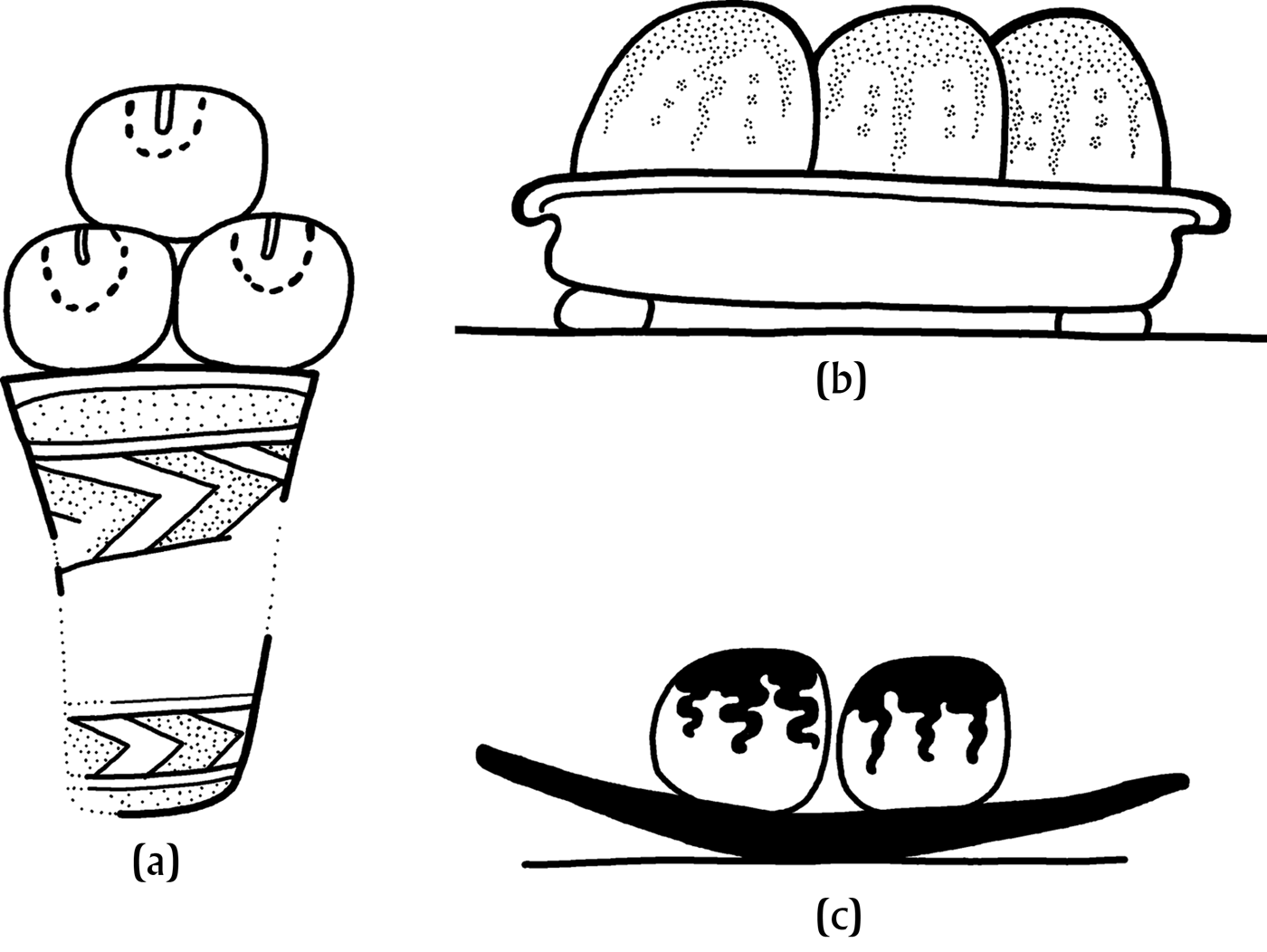
At Holmul, however, Early Classic lidded dishes in Building B of Group 2 were not much smaller in diameter than later plates in the burial of Building F in Group 1 and could probably contain even larger portions in terms of their overall volume (compare Figures 9a and 9b). Therefore, the change in food consumption practices was not necessarily about the overall quantities of food and numbers of participants, but about a concern with the display of the food itself and not just the container. It may also imply changes in the serving temperature and the amount of time the food could stay edible. Late Classic images show plates loaded with large tamale-like objects sprinkled with sauce. However, to my knowledge, there are no images of tamales on plates before the Late Classic period even in Taube's extensive discussion of tamale iconography (Taube Reference Taube1989). In the earliest (Late Preclassic) Maya representation of tamales on the murals at San Bartolo (Figure 10a), a stack of tamales is placed upon a cylinder vessel (Saturno et al. Reference Saturno, Taube, Stuart and Hurst2005:31, Figure 5).
Maya images of tamale-like food: (a) detail of the North Wall mural, Structure 1, San Bartolo; (b) detail of Late Classic vessel (K1599), (c) detail of Late Classic vessel (K6059) (drawings by the author).
Archaeological data also offer some evidence of a connection between plates and diacritical foods. Baron's recent investigation of successive feasting deposits in a temple compound at La Corona (Structures 13R-1 to 13R-5 in the Coronitas Group) reveals relative continuity in vessel rim sizes, but a significant contrast in vessel forms between the sixth and the seventh century deposits (Baron Reference Baron2013:292, 311–314, Figure 6.35, Table 6.1). The difference in plates' frequency—from 55% of the earlier assemblage to 15% in later deposits despite the faunal evidence of solid foods—is particularly striking. The researcher attributes these changes to a shift in temples' function from ancestral veneration to the cult of the local patron deities accompanied by a shift from exclusive, diacritical mode of feasting to a more inclusive, patron-client mode, in which the ruling lineage of La Corona offered food and drinks to the commoners (Baron Reference Baron2013:315–316, 352–355, 374–377). In contrast to the temple middens, the contemporaneous deposits associated with a possible elite residence in the same architectural group (Structures 13R-9 and 13R-10) were characterized by the heavy presence of the fragments of fine serving vessels with dedicatory inscriptions consistent with the diacritical mode of feasting (Baron Reference Baron2013:296–298, Figures 6.24–6.25).
Similar observations have been previously made with respect to transformations of cacao serving vessels during the Middle Preclassic period (Joyce and Henderson Reference Joyce and Henderson2007) and particularly at the Terminal Preclassic–Early Classic transition (Callaghan Reference Callaghan2008:49–64). The emergence of diacritical feasting markers in the archaeological record coincides with the formation of the Classic period political institutions as we know them from the textual and visual sources. The renewed emphasis on banquets in the Late Classic leads to an expansion of diacritically significant foods and corresponding changes in the frequency of certain types of serving vessels.
An increased concern with food display could be part of a larger process of constant renegotiation of the markers of royal exclusivity in the context of diacritical feasts. Just as the food containers were subject to the constant process of innovation and imitation evidenced in the abundance of pseudo-glyphs on Late Classic serving vessels, the food itself was probably undergoing similar transformations with an increased emphasis on the visibility of royal food items in contrast to “pseudo-foods” of subroyal imitators. The grave goods in the Late Classic burial in Building F in Group 1at Holmul included not only an inscribed plate from the royal court of Naranjo, but two Holmul-style cylinder vessels—one with crude imitation of glyphs, and the other with only partially intelligible text implicating limited command of the conventions of Classic Maya writing (Tokovinine Reference Tokovinine and Belli2006b:360–361, Figures 19, 24). The social value of those vessels had to be comparable to that of the Naranjo plate. If they were gifts from some important neighbors or subordinates of Holmul rulers, it is significant that these powerful individuals had aspirations to possess and yet no real access to serving vessels with hieroglyphic writing. Although the presence of Late Classic high cuisine imitations at the sub-royal level has never been investigated archaeologically, it is worth noting that some vessels with mostly legible texts also feature depictions of food displays, which resemble those on royal vessels. A representation of tamales and a plate in the scene of the Dos Pilas court mentioned above (Figure 7, 10b) may be contrasted to a much less sophisticated depiction of the same set on a vessel with a mythical scene with comments which combine legible characters and imitation of writing (Figure 10c). It is remarkable that either image of tamales has a similar pattern of dark sauce flavoring, although the overall execution of the second representation (Figure 10c) is clearly inferior.
Serving Vessels as Gifts: Classic Maya Feasting Networks
Evidence on the sociopolitical function of Classic Maya banquets comes from the inscribed serving vessels themselves. Their spatial distribution potentially reflects the extent of political networks created through the exchange of gifts and sharing of food. Such networks did not constitute the only means by which Classic Maya polities interacted with each other, yet their presence highlights the alternatives to the more widely cited modes of military conquest and bride exchange. It is worth mentioning here that there is no direct textual or visual reference to serving vessels being given away in relation to food consumption events, although the presence of such practices at Classic Maya courts is widely assumed (Foias Reference Foias, Wells and Davis-Salazar2007; Halperin and Foias Reference Halperin and Foias2010; LeCount Reference LeCount2001). The first textual reference of this kind comes from the sixteenth century Yucatan: Bishop Diego de Landa mentions that the host of a banquet for the Maya nobles was also expected to “give a manta to each to wear, and a little stand and vessel, as beautiful as possible” (Tozzer Reference Tozzer1941:92). Yet we know that Classic Period serving vessels somehow changed hands and moved away from the original owner. The text on the La Corona stairway block that has been discussed above mentions the act of giving drinks in the context of protagonist's drinking, so some containers for the drinks must have been involved. As the narrative and imagery on Piedras Negras Panel 3 suggest, diacritical feasts were part of larger sets of events during the gatherings of the nobility, so it is reasonable to hypothesize, albeit tentatively, that serving vessels and other gifts were offered on such occasions.
The discussion of gifts should also include the notion of ownership. We know preciously little about Classic Maya concepts of ownership, although some objects and entities were owned by named individuals, whereas others belonged to collectivities of various kinds: members of a given dynasty or people from a certain place. Demons of the night (wahyob), for instance, were possessed by royal dynasties, but not by named individuals (Grube and Nahm Reference Grube, Nahm, Kerr and Kerr1994; Houston and Stuart Reference Houston and Stuart1989). On the other end of the spectrum were ownership statements like the one on a Late Classic plate from Holmul (Figure 9b): according to the text, the plate belonged to the king or prince of Naranjo when he impersonated a particular form of the Sun God (Tokovinine Reference Tokovinine and Belli2006b:359–360).
The tags on serving vessels imply personal ownership, although some could be sufficiently generic to allow multiple owners of the same office or rank as in the case of many cups from Eastern Peten which were owned by unspecified “youths” (chak ch'ok keleem) (Houston Reference Houston2009:165). The tags were never modified. Consequently, the original owner remained (at least nominally) in possession of the object even when it changed hands if it was meant to circulate at all (Houston Reference Houston, Pillsbury, Doutriaux, Ishihara and Tokovinine2012a:96–98). Receiving somebody's inscribed food container as a gift presumably did not entail a full transfer of ownership, but rather a sharing of some kind, just like food and drink were shared during the feast. It seems that not all Maya nobles would willingly engage in this kind of self-sharing (or self-extension if we accept the interpretation that possessed objects were extensions of one's self for the Maya). That potentially explains why networks of royal gifts associated with food consumption were not as common as one might expect.
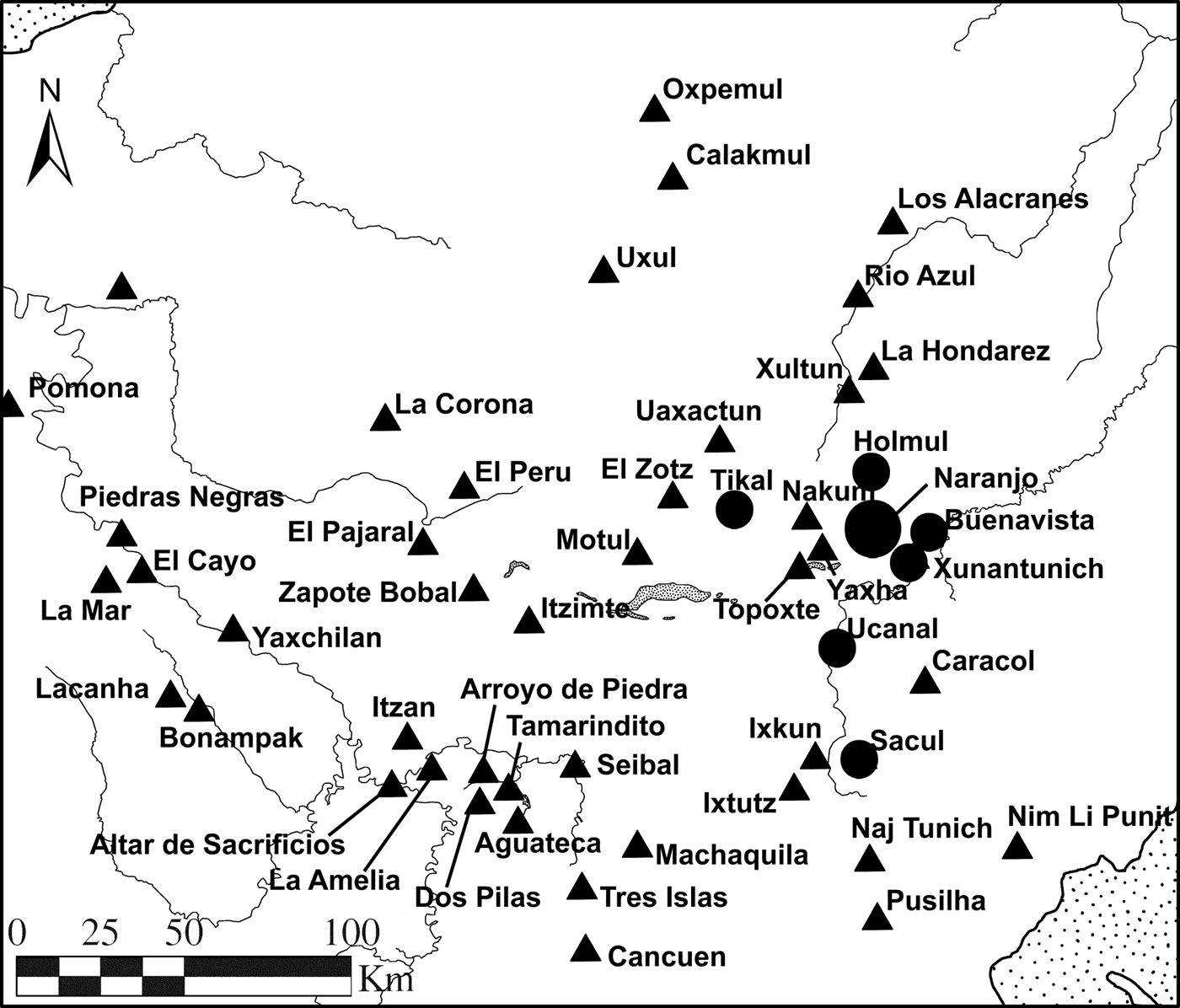
One such network was centered on the eighth century royal dynasty at the site of Naranjo in Guatemala (Figure 11). The earliest evidence of the practice of giving away drinking utensils as gifts dates to the reign of “Aj Wosal” Chan K'inich (a.d. 546–615), the first truly visible ruler at the site, whose tenure was marked by a switch in allegiances from Mutal lords of Tikal to Kanu'l lords of Dzibanche and Calakmul (Martin and Grube Reference Martin and Grube2008[2000]:71–72). Despite the fact that “Aj Wosal” Chan K'inich acknowledged subordination to the Dzibanche dynasty, one of his vessels ended up as the only grave good in a female Burial 72 in a small residential group at Tikal (Coggins Reference Coggins1975:329–334; Culbert Reference Culbert1993:Figure 42c). Either that kakaw drinking cup was initially given to one of Tikal rulers and subsequently re-gifted to a subordinate, or it attests to gift networks at the level below the royal families of either site. Naranjo's political clients also received drinking cups as gifts: two fragments of “Aj Wosal” Chan K'inich's vessels were found in the Late Classic construction fill of the main palace at Xunantunich (LeCount and Yaeger Reference LeCount, Yaeger, LeCount and Yaeger2010:340). The sheer abundance of vessels with dedicatory texts mentioning “Aj Wosal” Chan K'inich in private collections around the world suggests that the gift network was much wider, but we may never know its true extent because of looting.
Geographical distribution of Naranjo serving vessels (drawing by the author).
From the early 690s on, Naranjo rulers initiated a series of successful military campaigns, first as vassals of powerful Calakmul rulers, but then likely acting independently after Calakmul's defeat by Tikal in a.d. 695 (Houston Reference Houston1983; Martin and Grube Reference Martin and Grube2008[2000]:74–77). The conquest of Yaxa’ and Tubal put them in control of the eastern part of the Lakes region extending their dominion within one day's trip to Tikal and in the vicinity of the Ik'a’ rulers of Motul de San José. The conquests of Yootz (an unknown location to the north of Naranjo) and K'an Witz Nal (Ucanal) extended the hegemony further north and south. According to Naranjo Stela 2 (Graham Reference Graham1975:15; Martin and Grube Reference Martin and Grube2008[2000]:77), K'ahk’ Tiliw Chan Chahk oversaw the accession of new K'an Witz Nal and Yootz lords in a.d. 712 and 713. The increasing geopolitical prominence of Naranjo rulers was reflected in the large scale ceremony detailed on Stela 30 (Graham and Von Euw Reference Graham and Von Euw1978:79–80) with a night-time headband-binding and a dance attended by the members of major regional political groups—Seven Divisions (Huk Tzuk), Thirteen Divisions (Huxlajuun Tzuk), and Jo’ T544.501-ni (Tokovinine Reference Tokovinine2013:104–105).
The narratives on Stela 30 and other contemporaneous Naranjo monuments do not mention feasting, but this period sees Naranjo royal vessels ending up in the hands of subordinate lords. K'ahk’ Tiliw Chan Chahk's drinking cup was excavated in a rich burial at the site of Buenavista del Cayo 14 km to the east of Naranjo (Houston et al. Reference Houston, Taube, Stuart, Kerr and Kerr1992; Reents-Budet et al. Reference Reents-Budet, Ball, Bishop, Fields and MacLeod1994:303–305). Buenavista del Cayo probably corresponds to Kokom that was “burned” by Naranjo in a.d. 696 and 697 (Houston et al. Reference Houston, Taube, Stuart, Kerr and Kerr1992:Figures 14, 16). The dedicatory text on a Late Classic vessel (Kerr Reference Kerr2013:Kerr Maya Vase Database No. K2730) places Kokom lords to the east of Naranjo in Eastern Seven Divisions (Tokovinine Reference Tokovinine2013:99, Figure 54h). There are also drinking cups, which seem to be painted by Naranjo artists but intended as gifts to subordinate or allied lords. The owner of one of them (K8622) is from Thirteen Divisions, a regional group to the west of Naranjo (Tokovinine Reference Tokovinine and Belli2006b:361–362).
Naranjo's geopolitical rise was brought to an end when it was defeated and sacked by Tikal in a.d. 744–748 (Martin Reference Martin, Macri and McHargue1996; Martin and Grube Reference Martin and Grube2008[2000]:78–81). However, by the end of the reign of K'ahk’ Tiliw Chan Chahk's son, K'ahk’ Kalaw Chan Chahk, Tikal lords were no longer powerful and Naranjo rulers regained some regional prominence. The resurgence was marked by another major period–ending ceremony dedicated to the middle of a k'atun in a.d. 780. The inscription on Naranjo Stela 13 reports that there was dancing in the presence of visiting lords, although the list consists of only Seven Divisions and Jo’ T544.501-ni. K'ahk’ Kalaw Chan Chahk took the title of “Eastern Twenty Eight” reflecting his geopolitical ambitions in southeastern Peten (Tokovinine Reference Tokovinine2013:113).
The political resurgence was accompanied by a new round of gift-giving. Fragments of vessels which may have originally belonged to K'ahk’ Kalaw Chan Chahk and an unidentified Naranjo lord were discovered in the Buenavista del Cayo palace midden (Houston et al. Reference Houston, Taube, Stuart, Kerr and Kerr1992:Figure 10; Reents-Budet et al. Reference Reents-Budet, Ball, Taschek and Bishop2000:Figure 6b). Another royal Naranjo vessel (PSPA 708) was found in a burial in Group 26 at Sacul (Laporte and Mejía Reference Laporte and Mejía2006:192–198; Laporte et al. Reference Laporte, Ramos, Aguirre, Archiva, Barrera, Rojas, Silvestre, López, Quezada, Alvarado and Laporte1998:357; Mayer Reference Mayer2003; Tokovinine Reference Tokovinine, Laporte and Mejía2006c:376–377). Although the name of the owner happens to be in the eroded section of the dedicatory text, the preserved titles of “holy Sa'aal lord” (k'uh[ul] sa’[aal] ajaw), sak chuwen, and wak kab [nal winik] leave no doubt that he was the king of Naranjo. The style of the text and of the imagery on this cup is nearly identical to a cylinder vessel of unknown provenance tagged as the possession of K'ahk’ Tiliw Chan Chahk of Naranjo (Patterson Reference Patterson1992:70–73). The painting and text of the Sacul pot appear to be somewhat later in style, so it seems reasonable to assign it to the same scribal workshop, but a generation after K'ahk’ Tiliw Chan Chahk. It is also, perhaps, significant that these two vessels do not look like anything else painted for Naranjo rulers. So, either we are dealing with a completely different royal workshop at Naranjo, or the Sacul vessel and its unprovenanced counterpart were painted elsewhere and were intended as gifts to Naranjo lords, who received them and subsequently gave at least one of them away.
Sacul Stela 1 reports a local event in a.d. 760 that was overseen by the Ucanal ruler “Principal Bird Deity” Bahlam (Escobedo Reference Escobedo, Laporte, Escobedo and de Brady1993:15). The latter or his earlier namesake was mentioned as the owner of a drinking cup (K1698) that was likely painted by Naranjo artists as a gift to that lord (Houston Reference Houston1983:Figure 8; Houston et al. Reference Houston, Taube, Stuart, Kerr and Kerr1992; Tokovinine Reference Tokovinine, Laporte and Mejía2006c:379). Other recipients of inscribed Naranjo-style pottery included the lord of K'inchil. He was mentioned in a tag on a vessel (K633) that may be attributed to the Naranjo workshop because of a highly similar drinking cup signed by a local artist (Reents-Budet et al. Reference Reents-Budet, Ball, Bishop, Fields and MacLeod1994:319). K'inchil was conquered by Naranjo in a.d. 698 (Martin and Grube Reference Martin and Grube2008[2000]:76). The dedicatory text on a roughly contemporaneous atole bowl (K2358) painted in a similar style possibly mentions a chak tok wayaab of Holmul (Tokovinine Reference Tokovinine and Belli2006b:362). Moreover, the tag on the abovementioned plate from the burial in Building F in Group 1 at Holmul (Figure 9b) features an otherwise unknown Naranjo ruler, the son of K'ahk’ Kalaw Chan Chahk (Tokovinine Reference Tokovinine and Belli2006b:359–360), indicating that Holmul nobles received even more personal gifts from Naranjo.
There is some tentative evidence of other bilateral gift links within the Naranjo sphere of influence. Buenavista del Cayo midden contained fragments of a vessel (Maya Ceramics Project No. MSBX76 [Reents-Budet et al. Reference Reents-Budet, Ball, Taschek and Bishop2000:Figure 6a]) that probably belonged to the Ixtutz ruler who dedicated Stela 4 in a.d. 780 and was also mentioned on a sculptured fragment from Structure 1 at the site (Escobedo Reference Escobedo, Laporte, Escobedo and de Brady1993:13; Houston et al. Reference Houston, Taube, Stuart, Kerr and Kerr1992; Laporte and Escobedo Reference Laporte and Escobedo1992:95–96, Figure 8). One of the Late Classic burials in Group 1 at Sacul (Laporte and Mejía Reference Laporte and Mejía2006:151–153) contained a ‘Holmul-dancer’ cylinder vessel (PSPA 681). Its style is different from the examples associated with Naranjo and Holmul, but it is remarkably similar to ‘Holmul-dancer’ vessels made at Buenavista del Cayo (Reents-Budet et al. Reference Reents-Budet, Ball, Taschek and Bishop2000:108–110, Figure 10; Reents-Budet et al. Reference Reents-Budet, Ball, Bishop, Fields and MacLeod1994:Figures 7.6, 7.12; Tokovinine Reference Tokovinine, Laporte and Mejía2006c:372–375). This last observation, of course, remains speculative without the chemical analysis of the Sacul vessel. It seems plausible, however, that some form of political subordination to the royal court of Naranjo and participation in public events sponsored by Naranjo patrons encouraged interactions between lesser royal families and that such interactions included feasting and gift exchange.
The inscriptions on Naranjo monuments also mention its kings receiving precious loads of fine jade jewelry called ikitz or ikaatz from conquered rulers and subordinates (Stuart Reference Stuart and Houston1998:409–417, Reference Stuart, Guernsey and Reilly2006:128–137). The historical contexts of such events, however, were different from taking or giving drinking cups. The narrative on Naranjo Stela 12 mentions the “presentation” (nahwaj) of the ikaatz of the defeated Yaxha ruler (Stuart Reference Stuart and Houston1998:414–416). The text on Stela 30 details quantities of ikaatz “given” (yak'aw) by K'uk’ Bahlam, probably a subordinate of Naranjo kings (Stuart Reference Stuart, Guernsey and Reilly2006:133). The context is unclear, but it could be a palanquin ceremony, because it is the focal event in the narrative on the monument. Even though neither transaction featured “tribute” (patan) or “payment” (tojool), it seems unlikely that Stela 12 referred to a voluntary contribution. The socio-political function of Naranjo rulers' gifts to their subordinates was clearly different from the ikaatz of the vassals.
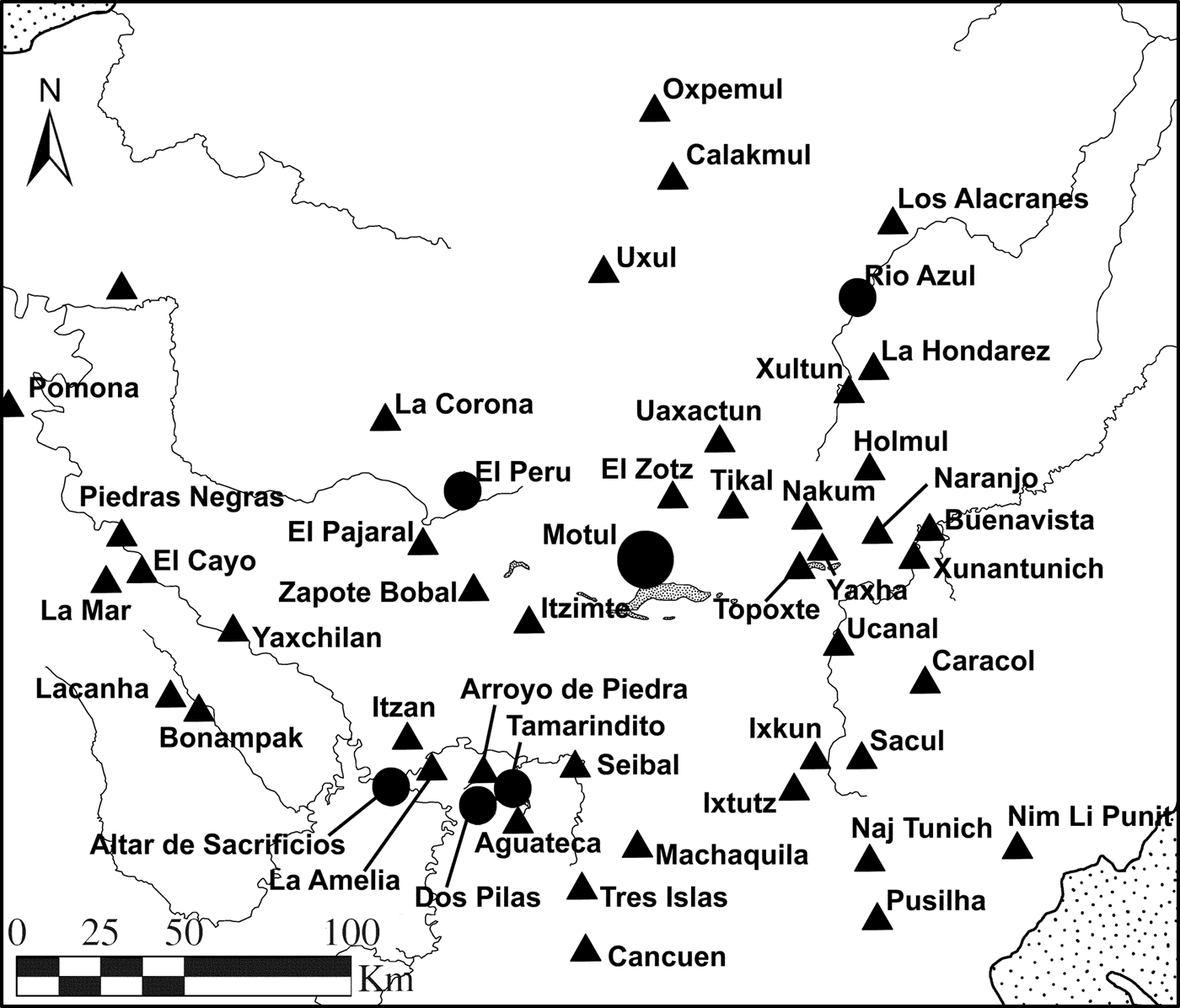
The other roughly contemporaneous network of potential feasting gifts was centered on the archaeological site of Motul de San José (Figure 12). Recent archaeological and epigraphic research at the site confirmed that it was the location where spectacular painted vessels of Ik'a’ lords were produced (Foias and Halperin Reference Foias, Halperin, Foias and Emery2012; Halperin and Foias Reference Halperin and Foias2010). In contrast to Naranjo, the rise of Motul de San José dynasty was not based on warfare against its neighbors. The increased prominence of this royal family in the eighth century inscriptions may rather be explained by its successful diplomacy in the context of an intense competition between more powerful regional rivals including the rulers of Tikal, Dos Pilas, Naranjo, and Yaxchilan (Tokovinine and Zender Reference Tokovinine, Zender, Foias and Emery2012:49–56). Motul de San José kings took wives from the royal families of Xultun, Tikal, and possibly Dos Pilas (Tokovinine and Zender Reference Tokovinine, Zender, Foias and Emery2012:50). Ik'a’ princesses married Yaxchilan rulers (Tokovinine and Zender Reference Tokovinine, Zender, Foias and Emery2012:52). Vessels and monuments made by Motul de San José artists show Ik'a’ lords visiting the courts of their neighbors and local performances attended by rulers of nearby polities (Tokovinine and Zender Reference Tokovinine, Zender, Foias and Emery2012:49–55).
Geographical distribution of Motul de San José serving vessels (drawing by the author).
One of the most successful Ik'a’ lords, Tayel Chan K'inich, whose reign may be dated to 720–30s (Tokovinine and Zender Reference Tokovinine, Zender, Foias and Emery2012:41–43), commissioned several vessels with the scenes of the life at his court, which were then apparently given away to other royal families. The drinking cups showing Tayel Chan K'inich (identifiable by the captions) were found in the burials at El Peru (Eppich Reference Eppich2007:8, Figures 7, 8, 10; Just Reference Just2012:118–20, Figures 50–51), Dos Pilas (Just Reference Just2012:122–115, Figures 44–47; Tokovinine and Zender Reference Tokovinine, Zender, Foias and Emery2012:42–43, Figure 2.5d), and Tamarindito (Just Reference Just2012:115–117, Figures 47–48; Tokovinine and Zender Reference Tokovinine, Zender, Foias and Emery2012:42–43, Figure 2.5b; Valdés Reference Valdés1997). A plate with him mentioned as the owner in the dedicatory text was discovered in another royal burial at Dos Pilas (Tokovinine and Zender Reference Tokovinine, Zender, Foias and Emery2012:42–43, Figure 2.5a).
In addition to the vessels of known provenance, the texts and images on two drinking cups suggest that Motul de San José artists painted them as gifts to lords from other polities. The dedicatory text on one late classic vase depicting Tayel Chan K'inich's court (K4996) identifies the owner as a princess from Xultun (Just Reference Just2012:109–111, Figures 41–43; Prager et al. Reference Prager, Wagner, Matteo and Krempel2010; Tokovinine and Zender Reference Tokovinine, Zender, Foias and Emery2012:50, Figure 2.9b). The other Late Classic drinking cup (K2295) intended for a lord from the area of Rio Azul (judging by his titles) bears the signature of an artist from Motul de San José (Tokovinine Reference Tokovinine2013:17–18; Tokovinine and Zender Reference Tokovinine, Zender, Foias and Emery2012:50, Figure 2.9c). Two more vessels—one recently described by Boot (Reference Boot2008) and a vase in the collection of the Boston Museum of Fine Arts (K1485)—were signed by Ik'a’ painters but their dedicatory texts mention “youths” who were likely not from Motul de San José. Both (unless it is the same individual) carry titles, which are often found in the names from northeastern Peten including Xultun (e.g., K1547, K4572). According to Houston, such vessels may have been intended as special gifts for certain age-grade rituals (Houston Reference Houston2009:165).
Fewer gifts from later Motul de San José rulers are known. A cylinder vessel with a scene of the court of the Dos Pilas ruler K'awiil Chan K'inich, now in the collection of the Los Angeles County Museum of Art (M.2010.115.1:Figure 7) is usually attributed to the artists at Motul de San José and the date of the depicted event implies that it could not have been painted before a.d. 735 (Just Reference Just2012:174–177, Figures 117–120). A vessel commissioned by Yajawte’ K'inich in a.d. 754 that was found in Mound A-III of Altar de Sacrificios (Adams Reference Adams1963; Tokovinine and Zender Reference Tokovinine, Zender, Foias and Emery2012:54) also indicates that the practice continued. A later vase fragment with a caption identifying Yeh Te’ K'inich II was found in a midden at Dos Pilas (Foias Reference Foias1996:555, Figure 6.51; Tokovinine and Zender Reference Tokovinine, Zender, Foias and Emery2012:55). Unfortunately, the vast majority of vessels commissioned by the later lords of Motul de San José were discovered not by archaeologists but by looters, so it remains unknown if these objects remained at the site or were given away.
No visiting dignitaries are depicted in the two surviving local pulque drinking scenes on Motul de San José vessels (Figure 6). The choice event for foreign visitors is dancing (K533, K1439), but as we have seen in the case of the imagery and narrative on Piedras Negras Panel 3, dancing and feasting may be part of the same set of ceremonies. The circumstances of gifting Motul de San José pottery were probably different from those in the Naranjo network. Of all ceramic gifts with secure archaeological contexts, only one plate has a dedicatory text confirming that it belonged to Tayel Chan K'inich. All drinking vessels found at other archaeological sites show scenes of Motul de San José courtly life, but feature no dedicatory texts and no ownership statements. It looks as if the intended content and the original owner of these vessels were intentionally omitted in order to enable multiple uses and transferable ownership. In other words, these objects were made to be given. Finally, several vessels were signed by Motul artists but were tagged as the property of non-local lords. Once again, these were probably gifts from the start, but with a more restricted range of uses (the intended functions and contents were stated in the dedicatory inscriptions) and with a single original owner. It is perhaps significant, that the link to Motul de San José would be clearly stated in the form of a signature that highlights the origins of the artist (aj-ik'a’ “man of Ik'a’”, ik'a’ itz'aat “Ik'a’ wiseman”) or of the object (tahn ha’ Ik'a’ “at the waters of Ik'a’”). The implication is that the signature was not just about the identity of the artist, but about the place where the vessel was made or the royal court that commissioned the work.
The issue of sub-royal gift networks centered on Motul de San José is harder to address based on epigraphic data. Archaeological evidence of feasting at Trinidad de Nosotros does indicate some exchange of serving vessels at the sub-royal level (Moriarty Reference Moriarty, Foias and Emery2012:219–220). It is also worth noting that fine-painted and inscribed vessels of the “pink glyph” workshop, some of which are signed by the artist named Tubal Ajaw (Just Reference Just2012:177–189; Reents-Budet et al. Reference Reents-Budet, Ball, Bishop, Fields and MacLeod1994:175), coincide with a large amount of drinking cups painted in a similar style yet of inferior quality and with pseudoglyphs instead of actual texts (Just Reference Just2012:189–194; Reents-Budet et al. Reference Reents-Budet, Ball, Bishop, Fields and MacLeod1994:178). Archaeological data from Motul de San José middens provide indications that at least some “pink glyph” ceramics could have been produced locally (Halperin and Foias Reference Halperin and Foias2010:400–405). Consequently, variants with pseudoglyphs may potentially constitute subroyal imitations aimed at appropriating at least part of the prestige associated with the royal ware. The presence of whole pseudo-“pink glyph” vessels in the burials at other archaeological sites may, therefore, indicate that there were parallel networks in which nonroyal members of the Motul de San José court or subordinate courts were involved. The author is aware of at least one such case. The painted cylinder vessel (PSPA 886) that was found at in a burial in one of large residential groups at the periphery of Ixkun (Laporte and Mejía Reference Laporte and Mejía2005:141) is a perfect example of the pseudo-“pink glyph” style. The dance theme, the composition and some details of the painted scene are remarkably similar to the finest examples of the “pink glyph” workshop and other Ik'a’ styles (Tokovinine Reference Tokovinine, Laporte and Mejía2006c:367–372). The protagonist, however, is a female impersonator of Goddess O, so far the only such image in Classic Maya art. The inscription is made entirely of pseudoglyphs. No royal Ik'a’ vessels were found at Ixkun.
There are some similarities between the Naranjo and Motul de San José gifting networks. Both correspond to periods of political activity. Both combine rulers' personal items with items produced as gifts by their artists. Dances are implicated as a class of events when gatherings of nobles and the exchange of gifts could have occurred. It is plausible that the nature of the gifts—drinking cups and plates—implies that food consumption also took place. However, there are important differences. With the exception of the first round of gift-giving during “Aj Wosal's” tenure, the recipients of Naranjo rulers' presents were their political clients and subordinates, who probably travelled to Naranjo for the events. For example, there is no evidence that eighth century Naranjo kings ever shared drinks and cups with Tikal lords. Motul de San José rulers gave their drinking cups to allies and peers of equal or greater standing in the geopolitical landscape. It is not clear if the recipients ever travelled to Motul de San José. It is just as plausible that Ik'a’ rulers travelled to the other courts where they shared the drinks and gave the cups. The scale of the network does not reflect a political hegemony, but represents the focal points of diplomacy. Rather than solidifying conquest, the objective seems to be to avoid a potentially devastating conflict. There is also no evidence that the other rulers reciprocated with similar gifts hinting at some sort of negative reciprocity between Motul de San José and its more powerful neighbors. I am not aware of any royal Ik'a’ vessels found at the sites of Yaxchilan, La Florida, Zapote Bobal, and La Joyanca, which were ruled by royal dynasties with the closest ties to Motul de San José rulers, although that lack of evidence may be due to insufficient archaeological investigation and the sites and question and, unfortunately, to extensive looting at some of them.
The gift networks of Naranjo and Motul de San José royal families are also potentially significant in light of the recent discovery of regional identities in the Classic Maya political landscape (Beliaev Reference Beliaev and Robert-Colas2000; Tokovinine Reference Tokovinine2013:98–115). With one exception, the recipients of drinking cups of Naranjo rulers were either from Seven Divisions (huk tzuk) or Twenty Eight Lords (waxak winik ajawtaak). Naranjo lords indeed claimed membership in either group. The Thirteen Gods (huxlajuun k'uh) title of Motul de San José rulers potentially suggests membership in the Thirteen Divisions (huxlajuun tzuk) group, although at least one artist from Ik'a’ identified himself with western Seven Divisions (Tokovinine and Zender Reference Tokovinine, Zender, Foias and Emery2012:61–64). It is unclear if Petexbatun royal families belonged to Thirteen Divisions, but the recipients of Motul gifts to the north and northeast likely did (Tokovinine Reference Tokovinine2013:Figure 53). Importantly, there is no evidence of vessels given as gifts between the members of the Naranjo and Motul de San José networks and yet there is also no hint of an open confrontation between the two political centers. There is no evidence of any kind of contact between the two despite the fact that these networks were contemporary and right next to each other. The fact that the first early eighth-century Motul de San José ruler, Yeh Te K'nich I, was a vassal of Tikal lords, whereas his Naranjo counterpart, K'ahk’ Tiliw Chan Chahk, was a vassal of Tikal's enemies at Calakmul, also fails to explain this boundary, because later Motul de San José kings had no problem with giving their vessels to Calakmul's former vassals at Dos Pilas. It is possible that this regional boundary was not a product of specific historical circumstances, but was caused by some deeper underlying social and maybe even economic factors. The gift recipients of Motul de San José rulers would provide access to potential trade routes along the Rio San Pedro, Rio Pasión, and Rio Hondo basins. Naranjo's network, on the other hand, provided access to the Belize River route.
CONCLUSIONS
The formal display and consumption of drinks and food by members of Classic Maya royalty and nobles is not a frequent subject of visual and written narratives, yet the available evidence suggest that some of these events could be described as feasts or banquets. Their function conforms to Dietler's notion of diacritical feasts with the emphasis on the exclusive nature of the comestibles and their containers to be seen, appreciated and maybe even tasted by a select few. Archaeological data, on the other hand, indicate that such diacritical banquets for the eyes were one of several modes of commensal politics practiced at Classic Maya courts. The exclusive diacritical mode, therefore, must have pursued a very specific set of political goals such as establishing links between the dynasties of different polities or between the ruler and some key noblemen at the court, which may be contrasted to more community-oriented feasting events centered on local patron deities or ball games sponsored by the ruler or other high-ranking members of the court. As we have seen above, the increased emphasis on diacritical feasting coincides with a decline in explicit statements of patronage in Classic Maya regional politics and potentially reflects the less formal and more horizontal nature of interpolity ties in the eighth century.
The diacritical nature of some Classic Maya feasting practices is of direct relevance to understanding the restricted range of contents mentioned in the dedicatory texts on serving vessels. However, it does not mean that the actual recipes of the ingestibles stayed constant. On the contrary, the increased preoccupation with the visibility of food evidenced in the Late Classic plates as the preferred vessel form for solid foods implies not only the diacritical function of such food displays, but also potential challenges to and imitations of the high-status ingestibles. It is tempting to speculate that such imitations went hand-in-hand with the imitation of the food containers revealed by the Late Classic serving vessels with illegible or semi-legible inscriptions.
Late Classic feasting references imply an increased role of food display and sharing as a way of making a statement about one's political and social rank and also of establishing or maintaining one's social and political networks. Significantly, the same time period sees the rise in the practice of giving serving vessels as gifts to one's allies and political clients. It is likely that this form of gift-giving was directly linked to diacritical feasting, although the evidence in support of such link is still conjectural. It appears that in an increasingly fractious and fluid political landscape of the eighth century when an outright conquest and a long-lasting patronage were no longer a viable option, there was a comparable rise of attempts at conflict resolution and figuring out common interest through feasting and gift-giving among the ruling families.
The distribution of serving vessels from the sites of Naranjo and Motul de San José implies that such gifts and feasts when they might have been offered could have specific political goals, although the two networks in question clearly differed in spatial extent and underlying geopolitical contexts. The key question here is whether the actions of Naranjo and Motul de San José rulers represented unique strategies or whether they were visible manifestations of more widespread practices. Some hints of movement of personal serving vessels between sites within Naranjo and Motul spheres of influence suggest that such gift networks were common. That said, it is significant that there is no evidence that Tikal or Calakmul rulers shared their meals and drinking cups with vassals or peers. Therefore, feasts and gifts probably represented a strategic alternative to more straightforward models of hierarchical control associated with major political centers. Such practices simultaneously attest to the crisis of the traditional power networks and reveal that the Classic Maya political landscape as whole evolved new strategies aimed at avoiding conflicts and fragmentation.
RESUMEN
Aunque la noción que las fiestas tuvieron un papel importante en el mantenimiento de los reinos mayas clásicos fue aceptada por la mayoría de investigadores, el fenómeno del consumo comensal de las comidas y bebidas en las representaciones visuales y textuales permanece indefinido y poco entendido. El presente artículo revisa los datos epigráficos hacia una interpretación más clara de las fiestas de los reyes y nobles mayas. También examina la evidencia de las redes políticas y sociales mantenidas por los dones de vasijas que posiblemente ocurrieron en el contexto de las fiestas.
La discusión comienza con la definición de varios modos políticos de fiestas según la tipología propuesta por Hayden. Las fiestas diacríticas se introducen como el concepto más adecuado para describir el consumo y presentación de bebidas y comidas exclusivas en las escenas de la vida de los cortes reales mayas. También se nota que la aparición de las representaciones de fiestas en el arte maya coincide con el decaimiento de las redes de patronazgo político directo asociadas con las ciudades mayores como Tikal y Calakmul.
El análisis de las representaciones del consumo de bebidas o comidas comentadas como tales en los textos acompañantes en el contexto del corte real sobre las vasijas pintadas y los monumentos sugiere que corresponden a solo uno de los modos de fiestas atestiguados en los datos arqueológicos. El énfasis principal de las fiestas diacríticas de los nobles mayas era no en cantidad sino en el carácter exclusivo de los ingestibles y sus contenedores. Esa observación conforme bien a la clasificación de bebidas en los textos dedicatorios sobre los vasos y a los cambios en la frecuencia de ciertos tipos de cerámica que posiblemente reflejan una preocupación con la exhibición extendida de la comida hacia los finales del periodo clásico tardío.
Finalmente, el artículo ofrece una comparación de las redes de fiestas y dones asociadas de las ciudades de Naranjo y Motul de San Jose. La extensión geográfica de estas redes se revela por la distribución espacial de los vasos exclusivos que, según sus inscripciones, originalmente pertenecían a los gobernantes de Motul o Naranjo o fueron pintados por los artesanos de estos sitios. Aunque la mayor parte de los recipientes de los regalos de los reyes de Naranjo eran sus vasallos y clientes políticos, los gobernantes de Motul de San Jose regalaban los vasos a unas dinastías reales más poderosas de la región. Estas diferencias corresponden bien al contraste entre el ascenso de Naranjo basado en las conquistas militares y el éxito de los gobernantes de Motul de San Jose de aumentar su influencia regional por medio de los esfuerzos diplomáticos. Las diferencias entre Motul de San Jose y Naranjo muestran que habían unos modos distintos de las relaciones mantenidas por las fiestas y regalos especiales.
ACKNOWLEDGMENTS
The original version of this manuscript was presented at the session The “Networked” Feast organized by Janling Fu and Jeffrey Dobereiner at the 77th Annual Meeting of the Society of American Archaeology in Memphis, April 19, 2012. I would like to thank the organizers and other participants of the session for the kind invitation and an opportunity to share my ideas and receive feedback from many colleagues interested in the same questions or working with comparable datasets. I also want to express my gratitude to Juan Pedro Laporte and his team of the Atlas project for offering me an opportunity to study the project collections. My special thanks go to Antonia Foias and Brian Just for their collaboration on my study of Motul de San José vessels. Some of my findings were informed by research for the Naranjo and Holmul projects and I would like to thank the project directors Vilma Fialko and Francisco Estrada Belli for their support and assistance. The present manuscript also benefited enormously from suggestions and comments by Michael Callaghan, Lisa LeCount, Cameron McNeil, Charles Golden, Dmitri Beliaev, and Stephen Houston. I want to express my deep appreciation of their help and advice. The manuscript reviewers—Simon Martin and Nicholas P. Carter—have contributed greatly to the improvement of the draft text. Of course, I remain solely responsible for any errors and omissions.