Methicillin-resistant Staphylococcus aureus (MRSA) and vancomycin-resistant enterococci (VRE) are endemic in hospital settings and long-term care facilities, and the prevalence of colonization is increasing.Reference David, Medvedev, Hohmann, Ewigman and Daum 1 , Reference Jarvis, Jarvis and Chinn 2 When admitted to hospitals, it is recommended that patients with a MRSA/VRE designation be placed in either a single-occupancy room or cohorted with another patient with the same designation in a double-occupancy room.Reference Siegel, Rhinehart, Jackson and Chiarello 3 , Reference Siegel, Rhinehart, Jackson and Chiarello 4 Few studies estimate the operational impact of MRSA/VRE designation, though limited studies based on either survey data or small retrospective studies suggest that the MRSA/VRE label may affect patient movement in the hospital through delays in bed assignmentsReference Shenoy, Walensky, Lee, Orcutt and Hooper 5 , Reference McLemore, Bearman and Edmond 6 and within-hospital transfersReference Johnson, Schmidt, Bittner, Christensen, Levi and Pino 7 as well as disposition through delayed discharge to post-acute care facilities.Reference Bryce, Tiffin, Isaac-Renton and Wright 8 , Reference Reynolds, Kim and Kaplan 9 In hospitals with double-occupancy accommodations, the additional requirement to match patients with MRSA/VRE designation can introduce inefficiencies when ready matches are not available and patients must queue. In institutions with uniformly single-occupancy accommodations, the impact of MRSA/VRE designation remains relevant through discharge disposition and costs of implementing contact precautions. We assembled a large data repository to examine the association between MRSA/VRE designation and time to bed arrival, acuity-unrelated within-hospital transfers, and length of stay. We hypothesized that these measures of operational efficiency would be adversely affected by the MRSA/VRE designation.
METHODS
Data Sources and Variables
In this study, we utilized a novel data warehouse created by merging several clinical and administrative databases to generate complete records for inpatient admissions to the Massachusetts General Hospital (MGH) during 2010–2011, including MRSA/VRE flag status on admission, age, gender, residence, recent hospitalizations, admitting clinical service, discharge destination, and length of stay in each patient location.
Hospital Structure
Between January 2010 and September 2011, MGH had 782 adult licensed beds (excluding obstetrics and psychiatry). Overall, 6 adult intensive care units (ICUs) accounted for 98 single-occupancy beds (64 surgical, 34 medical); 2 step-down units accounted for 57 beds; 23 general care units accounted for 613 beds (294 surgical, 319 medical); and an observation unit accounted for 14 beds. All ICUs feature only single-occupancy rooms. Outside of ICUs, 31% of beds were single occupancy and the remainder were double occupancy. In September 2011, a new inpatient building opened, increasing the number of adult licensed beds by 26 to 808 (excluding obstetrics and psychiatry). The overall proportion of double-occupancy rooms decreased from 60% to 50% for the final 4 months of the study; thus, overall hospital occupancy remained stable. MGH operates at occupancy levels well above national esimates 10 and those of other academic teaching hospitals. 11
Study Sample
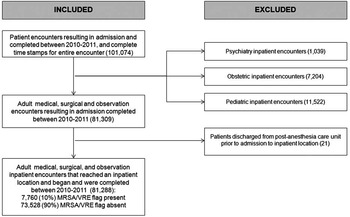
The study sample was restricted to adult medical, surgical, and observation inpatient encounters completed during the 2010–2011 study period (N=81,288; Figure 1).
Flow diagram of patient inclusion for analyses. The data warehouse includes all patient encounters at the Massachusetts General Hospital between 2010 and 2011. A subset of the cohort, inclusive of all patient encounters resulting in admissions completed between January 1, 2010, and December 31, 2011, for which complete time stamps were available documenting patient movement, were included in the analyses. The final sample excluded patients admitted to inpatient psychiatry, obstetric, and pediatric services as well as patients who were discharged to home directly from a post-anesthesia care unit.

MRSA/VRE Flags
Patients with a MRSA/VRE flag on admission were identified (or “flagged”) within the hospital’s electronic health record (EHR). Flag status was defined by an absent or present flag within 48 hours of admission. Patients flagged after 48 hours were considered to be in the no-flag category. The institutional policy for active surveillance included culture-based surveillance on admission for MRSA and VRE for ICU patients and those admitted to specific high-risk units. Although a hospital protocol was in place for screening and deflagging both MRSA- and VRE-flagged patients, both were implemented infrequently.Reference Shenoy, Kim and Rosenberg 12
Study Outcomes
We assessed 3 statistical outcomes of interest: (1) mean time to bed arrival, (2) the likelihood of experiencing acuity-unrelated within-hospital transfers, and (3) mean length of stay. The adjusted geometric means were reported to reflect the non-normal distribution for time to bed arrival and length of stay.
Time to Bed Arrival
Time to bed arrival was defined as the time (in hours) until a patient reached his or her first inpatient bed. The first stamp recorded for patients entering the bed queue was considered to represent the beginning of this process. For emergency department (ED) patients, postoperative patients, direct admission, and transfer patients, these times corresponded to registration in the ED, time of admission to the post-anesthesia care unit, arrival in the admissions office, and registration and initiation of bed placement prior to physical transfer, respectively. The statistical summary outcome for this variable was mean time to bed arrival in hours.
Within-Hospital Transfers
Within-hospital transfers were defined as a physical move from one inpatient hospital location to another. Acuity-unrelated transfers were identified as 2 consecutive inpatient beds matching in acuity level (ie, a transfer not resulting from a change in acuity level). Transfers were defined as a binary variable, categorizing each patient encounter as having experienced or not having experienced any acuity-unrelated transfer. Acuity-related transfers were not included in this analysis because the odds of experiencing such moves are dominated by acuity on admission (data not shown). In this analysis, we focused on acuity-unrelated transfers because this phenomenon encompasses efforts to optimize the use of single- and double-occupancy accommodations. The statistical summary outcome presented was likelihood of experiencing any acuity-unrelated transfer.
Patient Length of Stay
Length of stay is number of days a patient remains in the hospital from arrival in his or her initial bed to discharge. The statistical summary outcome for this variable was mean length of stay in days.
Study Predictors
The primary predictor of interest was MRSA/VRE flag status. Patients were categorized having a MRSA/VRE flag on admission or no flag for MRSA/VRE on admission. A flag for MRSA, VRE, or both, were grouped together as having a MRSA/VRE flag. Covariates, many of which were included in multivariate models to account for patient severity of illness during the hospitalization, included age, gender, severity of illness (acuity) on admission, admission day of week, residence, hospitalization at the same institution within previous 30 days, admitting clinical service, and discharge destination. Acuity on admission was inferred from the patient’s initial admission location: observation unit, general care unit, step-down unit, or intensive care unit (ICU). This proxy measure of patient severity of illness was utilized because it corresponded most readily to staffing levels and available support services that are considered indicators of patient acuity. Residence was noted as either home or facility. Prior hospitalization in the preceding 30 days was included as well as a proxy for patient severity of illness. Admitting clinical service was defined as either surgical or medical. Discharge destination was categorized as home, a facility, or deceased and was considered an additional proxy measure of patient severity of illness.
Statistical Analysis
Baseline characteristics of the cohort were summarized using counts and proportions, mean ± standard deviation, or median with lower and upper quartiles, as appropriate. Univariate models were initially fit to describe the unadjusted associations between MRSA/VRE flag status and each of the study outcomes, and these associations were adjusted, by multivariate models, for the impacts of the covariates. For the adjusted analyses, associations of MRSA/VRE status with the likelihoods of transfer was modeled using multivariate logistic models, and those with length of stay and time to bed arrival were modeled using exponential models for time-to-event outcomes, and least-squares means (LSMEANS) were reported.Reference Searle, Speed and Milliken 13
RESULTS
Patient and Admission Characteristics
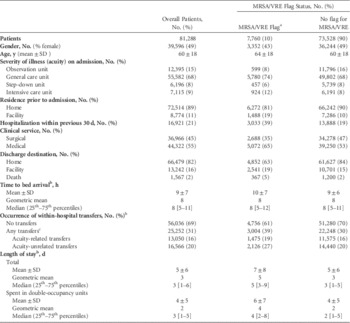
Of 81,288 patient admissions included in the analysis, 7,760 (10%) were admitted with a flag and 73,528 (90%) were admitted with no flag (Table 1). The majority of admissions were through the ED (65%), followed by PACU (25%), direct admissions (6%), and transfers (4%). The route of admission did not influence the study outcomes (data not shown). Patients with a flag at admission were less often female (43% vs 49%) and were older (64 vs 60 years) than patients without a flag. Compared with patients without flags, a larger proportion of flagged patients were admitted to an ICU (12% vs 8%), were admitted from a facility (19% vs 10%), were hospitalized at the same institution within the previous 30 days (39% vs 19%), were admitted to a medical rather than surgical service (65% vs 53%), were discharged to a facility (19% vs 15%), or died during their hospitalization (5% vs 2%). Patients with flags had a longer mean time to bed arrival (10±7 vs 9±6 hours) compared with patients without flags. A larger proportion of flagged patients experienced any within-hospital transfer (39% vs 30%). Flagged patients had more of both acuity-related within-hospital transfers (19% vs 16%) and acuity-unrelated transfers (27% vs 20%) compared with those without a flag. Patients with a flag had a longer total mean length of stay (7±8 days vs 5±6 days) and length of stay spent in mixed-occupancy units (6±7 days vs 4±5 days).
Patient Cohort Characteristics (N=81,288)

NOTE. MRSA, methicillin-resistant Staphylococcus aureus; vancomycin-resistant Enterococcus; SD, standard deviation.
a Of the 7,760 patients (10%) with an MRSA/VRE flag, 2,949 (38%) had a history of MRSA, 3,181 (41%) had a history of VRE, and 1,630 (21%) had a history of both MRSA and VRE.
b There was no significant difference in time to bed arrival, occurrence of within-hospital transfers or length of stay during the study period prior to the new inpatient building opening (January 1, 2010 through September 7, 2011) and afterward (September 8, 2011 through December 31, 2011).
c Patients contributing to the frequency of “Any transfers” may contribute to either OR both of the “Acuity-related transfers” or “Acuity-unrelated transfers” categories.
Factors Influencing Time to Bed Arrival
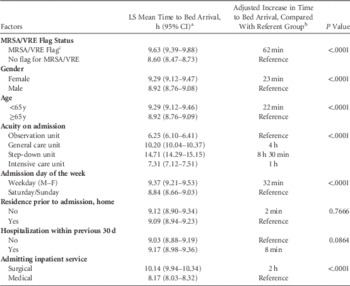
In the unadjusted model, patients with a flag on admission experienced an excess mean time to bed arrival of 47 minutes (10.14 hours [95% CI, 9.92–10.37] vs 9.36 hours [95% CI, 9.29–9.43]). In the multivariate model, flagged patients had an excess mean time to bed arrival of 62 minutes (9.63 hours [95% CI, 9.39–9.88] vs 8.60 hours [95% CI, 8.47–8.73]) compared with patients with no flag for MRSA/VRE (Table 2). This effect exceeded the estimated impact of gender, age, day of week of admission, residence prior to admission, and recent hospitalization. Patient severity of illness on admission, and admitting clinic service were associated with significant and substantial effects on time to bed arrival. Among acuity levels, the time to bed arrival for step-down unit beds was the longest, at 14.71 hours. Patients requiring surgical beds experienced close to a 2-hour delay in bed arrival compared with patients awaiting medical beds.
Factors Influencing Time to Bed Arrival

NOTE. LS, Least-Squares; MRSA, methicillin-resistant Staphylococcus aureus; vancomycin-resistant Enterococcus;
a LS mean time to bed arrival: the multivariate model based on predicted mean, the average of predicted marginal mean over the classes of the simultaneously controlled covariates. Unadjusted observed means for MRSA/VRE flag status were 10.14 hours [95% CI, 9.92–10.37] for patients with a flag and 9.36 hours [95% CI, 9.29–9.43] for patients with no flag, which is an adjusted increase of 47 minutes for patients with a flag on admission (data not shown).
b Length of delay was rounded to the nearest integer.
c MRSA flag, VRE flag, and both MRSA and VRE flag were associated with an excess mean time to bed arrival of 55 min, 51 min, and 95 min, compared with patients with no flag, respectively.
Factors Influencing Within-Hospital Transfers
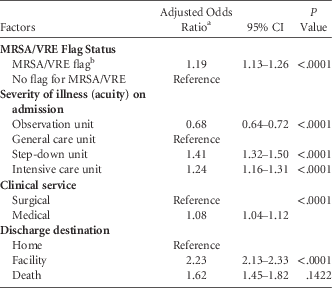
Patients with a MRSA/VRE flag on admission had odds of 1.55 (95% CI, 1.47–1.36) for experiencing an acuity-unrelated transfer compared with patients without the flag in the unadjusted model. In the multivariate model, flagged patients had odds of 1.19 (95% CI, 1.13–1.26) for experiencing an acuity-unrelated transfer compared with patients with no flag for MRSA/VRE (Table 3). Considering patients admitted to general care units as the referent population, the odds of experiencing such transfers were similar to that of patients admitted to ICUs (1.24 [95% CI, 1.16–1.31]), although these odds were less than those attributable to admission to a step-down unit (1.41 [95% CI, 1.32–1.5]). Clinical service had minimal influence on acuity-unrelated transfers. Considering patients discharged to home as the referent population, the odds of experiencing an acuity-unrelated transfer were 2.23 (95% CI, 2.13–2.33) for patients ultimately discharged to a facility. Because patients with longer lengths of stay are expected to have a greater likelihood of experiencing an acuity-unrelated transfer, we stratified the analysis by encounters with length of stay in double-occupancy units (ie, the time during which patients are at risk for experiencing acuity-unrelated transfers). For encounters of <24 hours, flagged patients had 0.754 times the odds (95% CI, 0.587–0.970) of experiencing acuity-unrelated within-hospital transfers compared with patients with no flag for MRSA/VRE. However, for encounters with ≥24 hours in double-occupancy units, flagged patients had 1.19 times the odds (95% CI, 1.12–1.26) of experiencing acuity-unrelated transfers compared with patients with no flag for MRSA/VRE.
Factors Influencing Acuity-Unrelated Within-Hospital Transfers

NOTE. MRSA, methicillin-resistant Staphylococcus aureus; vancomycin-resistant Enterococcus; OR, odds ratio; CI, confidenc interval.
a Adjusted ORs were also controlled for gender, age, admission day of week, residence prior to admission and hospitalization within the previous 30 days (data not shown). Unadjusted OR for MRSA/VRE flag status of flag vs no flag was 1.55 [95% CI: 1.47–1.63] (data not shown).
b The odds of experiencing acuity-unrelated transfers for patients with a MRSA flag, VRE flag, and both MRSA and VRE flag were 1.24, 1.27, and 0.98, compared with patients with no flag, respectively.
Factors Influencing Length of Stay
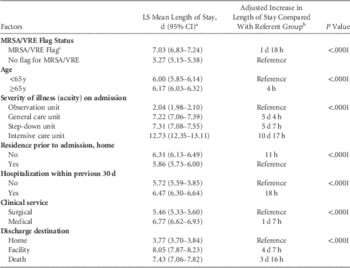
In the unadjusted model, patients with a flag on admission experienced an excess length of stay of 2 days and 22 hours (2.86 days; 6.99 days [95% CI, 6.84–7.15] vs 4.13 days [95% CI, 4.10–4.16]). In the multivariate model, flagged patients had an excess mean length of stay 1 day and 18 hours longer (1.76 days, 7.03 days [95% CI, 6.82–7.24] vs 5.27 days [95% CI, 5.15–5.38]) compared with patients with no flag for MRSA/VRE after (Table 4). This excess attributable length of stay was greater than that attributable to age, residence, prior hospitalization, and clinical service. The greatest impacts were patient severity of illness on admission and discharge destination. Considering observation unit patients as the referent population, patients requiring a general care unit, step-down unit, or ICU level care on admission had extended hospitalizations of 5 days 4 hours, 5 days 7 hours, and 10 days 17 hours, respectively. Similarly, considering discharge to home as the referent category, patients discharged to facilities or who died during the admission had excess length of stay of 4 days 7 hours and 3 days 16 hours, respectively.
Factors Influencing Length of Stay

NOTE. LS, Least-Square; MRSA, methicillin-resistant Staphylococcus aureus; vancomycin-resistant Enterococcus; CI, confidence interval.
a LS mean length of stay: multivariate model based predicted mean, the average of predicted marginal mean over the classes of the simultaneously controlled covariates. The multivariate model also controlled for gender and admission day of week. Unadjusted observed means for MRSA/VRE flag status were 6.99 days [95% CI, 6.84–7.15] for patients with a flag and 4.13 days [95% CI, 4.10–4.16] for patients with no flag, which is an adjusted increase of 2 days and 21 hours for patients with a flag on admission (data not shown).
b Length of increase in length of stay was rounded to the nearest integer.
c MRSA flag, VRE flag, and both MRSA and VRE flag were associated with an excess length of stay of 17 hours, 2 days and 3 hours, and 1 day and 14 hours, respectively, compared with patients with no flag.
DISCUSSION
We used a large retrospective cohort of admissions to examine the relationship between MRSA/VRE designation and selected operational outcomes and found that patients admitted with MRSA/VRE flag compared with those without a MRSA/VRE flag experienced a longer time to bed arrival, increased likelihood of acuity-unrelated within-hospital transfers, and extended length of stay. These analyses quantify what clinicians and hospital administrators have understood intuitively: MRSA/VRE designation affects operational efficiency.
The excess time to bed arrival of 1 hour associated with the MRSA/VRE flag is operationally notable and potentially clinically significant. This delay may be explained by the additional time required to match such patients based on colonization statusReference Shenoy, Walensky, Lee, Orcutt and Hooper 5 and is consistent with the results of at least 1 other study.Reference McLemore, Bearman and Edmond 6 Some studies have demonstrated an association between length of emergency department boarding of patients and mortality, increased overall length of stay,Reference Singer, Thode, Viccellio and Pines 14 medication delays, and adverse events.Reference Sri-On, Chang and Curley 15 , Reference Liu, Chang and Weissman 16
The nearly 20% increase in odds for MRSA/VRE flagged patients experiencing an acuity-unrelated within-hospital transfer may be the result of the practice of “bed moves,” or transfers of patients to optimize use of available beds, particularly for double-occupancy accommodations. Because such transfers are attributed only to the patient who experienced the event and not to the patient triggering the transfer or series of transfers, it is possible that this finding underestimates the impact of the flag designation. Within-hospital transfers are burdensome to both patients and staff and may represent an inefficient use of resources and potentially may contribute to patient harmReference Detsky and Etchells 17 and excess costs.Reference Bobrow and Thomas 18 At times during which hospitals are operating at very high occupancy, such potentially avoidable transfers may further affect the flow of patients. The frequency and operational impact of acuity-unrelated transfers, however, will depend on the specific combination of bedding arrangements across varying levels of acuity and services, an analysis that is beyond the scope of this study and that is better suited to simulation approaches.
Our findings regarding length of stay highlight the need for mechanisms to mitigate the impact of the MRSA/VRE designation to improve patient flow in the hospital. The factors that result in this extended length of stay are not known with certainty, but it is possible that the flag, through delays in delivery of care, adverse events, or other sequellae, results in less efficient care overall. Over the past several decades, length of stay for large nonfederal community hospitals has declined from 9.1 to 5.7 days. 10 To the extent that a substantial portion of a patient’s length of stay is associated with MRSA/VRE flag status, this represents a need for focused efforts to limit the operational impact of the flag, such as programs to document clearance of colonization and removal of the MRSA/VRE designation. We have previously demonstrated the efficacyReference Shenoy, Kim and Rosenberg 12 and effectivenessReference Shenoy, Lee and Cotter 19 of this approach for MRSA. Assuming that half of the cohort had cleared colonization at the time of admissionReference Shenoy, Paras, Noubary, Walensky and Hooper 20 and the excess length of stay predicted by the model, a substantial increase in available patient days could be realized. Furthermore, it is possible that administrative delays due to lack of single-occupancy accomodations at post-acute care facilities contribute to observed length of stay among flagged patients.
A growing body of evidence demonstrates that the duration of colonization with MRSA and VRE is not life-long,Reference Ellis, Hospenthal, Dooley, Gray and Murray 21 – Reference Yoon, Lee and Lee 26 and is possibly much shorter than previously believed, even in the setting of recent infection. Reference Shenoy, Paras, Noubary, Walensky and Hooper 20 , Reference Cluzet, Gerber and Nachamkin 27 – Reference Rogers, Sharma and Rimland 29 There are no consensus guidelines to inform the appropriate time interval to wait prior to screening, the anatomical sites to screen, specific screening assay, number of screens, and interpretation of the results in the presence of antibiotics with activity against MRSA or VRE.Reference Siegel, Rhinehart, Jackson and Chiarello 30 In the absence of clear guidance, we have previously demonstrated widespread variation in contact precautions discontinuation protocols, although the majority rely on passive surveillance, effectively resulting in a persistent MRSA/VRE designation for patients previously identified as infected or colonized with MRSA or VRE.Reference Shenoy, Walensky, Lee, Orcutt and Hooper 5 Thus, the persistence of the MRSA/VRE flag represents a potential target to reduce barriers to patient flow throughout the hospital. In fact, de-flagged patients have been associated with fewer idle beds.Reference Shenoy, Lee and Cotter 19
This study was conducted at a large tertiary care medical center with long-standing use of the EHR to document MRSA/VRE flag status. Thus, in settings in which MRSA/VRE flag status is not as prominently displayed or is not displayed at all, our findings may not be as compelling. Our institution additionally includes flags for multidrug-resistant Gram-negative organisms and Clostridium difficile infection, which were not evaluated in the current study. Patients with these flags were grouped in the no-flag group, which would be expected to bias findings toward the null. The outcomes addressed—time to bed arrival, acuity-unrelated within hospital transfers, and length of stay—are influenced by hospital structure, including the number, acuity levels, and types of beds, as well as the proportions of beds with specific characteristics. Despite a lack of consensus in the literature regarding the economic, operational, and clinical tradeoffs between single- and double-occupancy accommodations,Reference Detsky and Etchells 17 , Reference van de Glind, de Roode and Goossensen 31 , Reference Chaudhury, Mahmood and Valente 32 there is no doubt that double-occupancy accommodations introduce inefficiencies through matching requirements, ie, inefficiencies that may manifest in delays to bed assignment, patient transfers, and prolonged hospital stays. The findings reported here are not immediately transferrable to any individual hospital. In addition to hospital structure, the patient population analyzed likely influenced our findings. Although this factor may limit generalizability of the findings, the proportion of patients identified as MRSA/VRE on admission is within the range of prevalence reported previously.Reference Jarvis, Jarvis and Chinn 2 , Reference Furuno, Perencevich and Johnson 33 , Reference Morgan, Day and Furuno 34 MGH operates at a consistently high patient census; thus, the impact of flag prevalence, combined with hospital structure, may be more pronounced. This study relied on a proxy measures for patient acuity, which are likely to incompletely characterize patient severity of illness. These data are, however, often those most readily available in administrative sources used for large cohort analyses.
We found that MRSA/VRE designation was associated with operational consequences and that additional mechanisms to efficiently identify patients no longer colonized with MRSA/VRE are warranted. This need is especially important as EHRs begin to improve the exchange of administrative and clinical information across the care continuum, thus raising the stakes for ensuring the validity of that information.
ACKNOWLEDGMENTS
The authors would like to thank Kathryn M. Turcotte, MBA, and Benjamin Orcutt of the Massachusetts General Hospital Admitting Services Department; Victor Grishkan, Kirill Boyarin and Joy Boulware of Information Systems and eMAR and Aaron Sacco of the MGH Pharmacy Department for their assistance in identifying antibiotic data; William Driscoll, MA and Milcho Nikolov, MSEE of the Department of Anesthesia, Critical Care and Pain Medicine; Jessica Cotter, MPH, and Lauren R. West, MPH, of the Massachusetts General Hospital Infection Control Unit; and Joseph Newhouse, PhD, of the Harvard University Division of Health Policy Research and Education.
Financial support: This work was supported by the National Institute of Allergy and Infectious Diseases of the National Institutes of Health (grant no. K01AI110524 to E.S.S.). This work was conducted with support from Harvard Catalyst/The Harvard Clinical and Translational Science Center (National Center for Research Resources and the National Center for Advancing Translational Sciences, National Institutes of Health Award UL1 TR001102) and financial contributions from Harvard University and its affiliated academic healthcare centers. The content is solely the responsibility of the authors and does not necessarily represent the official views of Harvard Catalyst, Harvard University and its affiliated academic healthcare centers, or the National Institutes of Health.
Potential conflicts of interest: All authors report no conflicts of interest related to this article.