In the field of rock-art studies, the ‘ontological turn’ has helped to shape the development of this field (Jones Reference Jones2017). The application of ontological approaches in archaeology has followed two trends (Alberti Reference Alberti2016). The first is ‘metaphysical’ archaeology, which follows the Western intellectual tradition drawing inspiration from Heidegger (Reference Heidegger1962) and Latour (Reference Latour1993) to reconsider the relation between nature and society.Footnote 1 The second approach is inspired by Amazonian anthropologists such as Viveiros de Castro (Reference Viveiros de Castro1998; Reference Viveiros de Castro2004) and others (Descola Reference Descola, Descola and Pálsson1996; Reference Descola2013a,Reference Descolab; Vilaça Reference Vilaҫa2005) who propose an animist perspective as an alternative to the mainstream. Both theories are anti-Cartesian and relational, challenging Western anthropological and archaeological traditions rooted in a nature/culture dichotomy.
While some archaeologists engage in metaphysical debates (Olsen Reference Olsen2010; Reference Olsen and Hodder2012: Shanks Reference Shanks2007; Thomas Reference Thomas1996; Reference Thomas2015; Witmore Reference Witmore2007), ontological archaeologists in studies of rock art and other artistic expressions explore indigenous theory (Armstrong Oma Reference Armstrong Oma2010; Betts et al. Reference Betts, Blair and Black2012; Reference Betts, Hardenberg and Stirling2015; Boric Reference Boric2005; Reference Boric, Renfrew and Morley2007; Conneller Reference Conneller2004; Creese Reference Creese2011; Dowson Reference Dowson2009; Hill Reference Hill2011; Reference Hill2013; VanPool & Newsome Reference Vanpool and Newsome2012; Wallis Reference Wallis2009; Reference Wallis and Harvey2013; Watts Reference Watts2013; Weismantel Reference Weismantel2015). Deploying concepts such as ‘Amerindian perspectivism’ (Viveiros de Castro Reference Viveiros de Castro1998; Reference Viveiros de Castro2004), ‘domains of entanglement’ (Ingold Reference Ingold2006) and ‘ecology of relationships’ (Descola Reference Descola2013a,Reference Descolab), they create a new dynamic concept of human–non-human relations in which the relational and inter-subjective approach comes to the fore rather than viewing humans as dominant while animals/things are subordinate.
Through revisiting rock-art sites in Europe and Africa, Wallis (Reference Wallis2009; Reference Wallis and Harvey2013), for example, provides a relational approach which treats rock art as agentive, associated with diverse actors, including both humans and other-than-human persons. Using Viveiros de Castro's (Reference Viveiros de Castro1998) terms such as ‘multi-naturalism’ and ‘multiculturalism’, Wallis argues that all these persons are multi-natured, but of one culture. Dowson (Reference Dowson2009) questions the shamanistic interpretation of Southern African hunter-gatherer rock art and Palaeolithic cave art in which animals are considered passive in terms of Western distinctions between culture and nature. Drawing on ethnographies, he suggests that a hunter-gatherer way of perceiving the world, namely, a non-Western perspective on the relation between nature and culture, was relevant to prehistoric arts.
Explorations of the human–animal relation have also played a prominent role in recent ontological debates. Twentieth-century archaeology treated animals based on a rigid distinction between culture and nature, segregating humans from the rest of the natural world, and thus viewed animals merely as an exploitable resource. The utilitarian mode presents animals as a source of food and raw materials, as well as functioning with humans as beasts of burden for farming or transport and companionship, as for example in human–canine relationships (Dincauze Reference Dincauze2000, 506). While underlining the utility and value, this theory also marginalizes animals, failing to acknowledge their agency and intentionality and consciousness (Hill Reference Hill2011, 408). The world is thus structured as a hierarchical system, in which humans are the ascendant species dominating animals by virtue of their cognitive and linguistic abilities (Hill Reference Hill2011, 409). Indigenous ethnographies reveal, however, that animals in the environment are frequently perceived as sentient agents just as capable of subjectivity, intentionality, intelligence, affect and consciousness as humans (Fausto Reference Fausto2007, 497).
This perspective greatly challenges the well-established nature/culture distinction because nature, animals, materials and artifacts are no longer seen as inert or passive objects, but are treated as active subjects. Therefore, culture and nature, humans and non-humans, and subjects and objects are fluid and permeable relationships, rather than rigid categories or distinctions. Interaction is therefore seen as an on-going exchange that defines both parties and their worldviews (Betts et al. Reference Betts, Hardenberg and Stirling2015, 92), shaped by two-way interchange, experience, and discourse (Hill Reference Hill2011, 408). These relationships have been envisaged by Ingold (Reference Ingold2006, 14) as the ‘domain of entanglement’, with which various beings inhabit the world ‘in threading their own paths through the meshwork’.
In order to understand the significance of interactions among humans and non-humans within environmental, biological and social contexts, Descola (Reference Descola2013a,b) proposes ‘an ecology of relationships’, or a ‘relational ecology’ model in Betts’ rephrasing (Betts et al. Reference Betts, Hardenberg and Stirling2015). From this relational perspective, we understand that symbolic interpretations of animal images are always emergent from relationships between the natural and social worlds in indigenous cosmologies. That is to say, animals and other things in nature are considered social agents within the ecology of relationships, rather than as mere subsistence and economic resources.
Drawing on animist ontologies and the relational ecology model, the case study in this article consists of rice-crop images engraved on rocks in the Neolithic Jiangjunya site, China. In this discussion, I develop two points that contrast with existing animist approaches. First, previous works primarily focus on animal persons (Armstrong Oma Reference Armstrong Oma2010; Betts et al. Reference Betts, Blair and Black2012; Reference Betts, Hardenberg and Stirling2015; Bird-David Reference Bird-David1999; Dowson Reference Dowson2009; Fausto Reference Fausto2007; Hill Reference Hill2011; Reference Hill2013; Ingold Reference Ingold, Seppälä, Vanhala and Weintraub1998; Reference Ingold2006; Wallis Reference Wallis2009; Reference Wallis and Harvey2013; Willerslev Reference Willerslev2004; Willerslev & Ulturgasheva Reference Willerslev, Ulturgasheva, Brightman, Grotti and Ulturgasheva2012), rather than plant persons. Second, scholars have drawn attention to perspectivism in foraging communities, but have ignored animist ontologies in agricultural societies. Descola (Reference Descola2013a, 123) has stated that such relational ontologies only appear to be found in small-scale foraging societies in South and North America, Siberia, and parts of southern Asia. However, Hill (Reference Hill2013) argues that diverse forms of human–non-human interaction have emerged within diverse economic modes such as pastoralism, agriculture, and even urbanism and industrialism in the world. Through the analysis of rock art in the Jiangjunya site, this article highlights human–crop engagement influenced by (and also shaping) human and non-human perspectives and identities in prehistory on China's east coast.
Ontological approaches and indigenous theory
Ontological archaeology inspired by indigenous studies is largely credited to three celebrated anthropologists: Viveiros de Castro, Ingold and Descola. Using notions of ‘cosmological deixis’ and ‘Amerindian perspectivism’ and relying on American ethnographies, Viveiros de Castro's animist approaches have brought attention to relational perspectives to facilitate a shift from the classic distinction between nature and culture (Viveiros de Castro Reference Viveiros de Castro1998; Reference Viveiros de Castro2004). This perspectivist cosmology imagines, in his words, ‘a universe peopled by different types of subjective agencies, human as well as nonhuman, each endowed with the same generic type of soul, that is, the same set of cognitive and volitional capacities’ (Viveiros de Castro Reference Viveiros de Castro2004, 6). This insight led Viveiros de Castro to propose conceptions of ‘multiculturalism’ and ‘multinaturalism’. As he puts it,
(Multi)cultural relativism supposes a diversity of subjective and partial representations, each striving to grasp an external and unified nature, which remains perfectly indifferent to those representations. Amerindian thought proposes the opposite: a presentational or phenomenological unity which is purely pronominal or deictic, indifferently applied to a radically objective diversity. One single ‘culture’, multiple ‘natures’—perspectivism is multinaturalist, for a perspective is not a representation. (Viveiros de Castro Reference Viveiros de Castro1998, 478)
Following this multinaturalist model, we may realize that all beings share one single culture or one subject. However, if personhood is attributed not only to humans, but also to animals, plants and things, the question is, how can we distinguish non-humans from humans? According to Amazonian anthropologists (Fausto Reference Fausto2007; Vilaҫa Reference Vilaҫa2005; Viveiros de Castro Reference Viveiros de Castro1998), each non-human person envelops an internal human form, which is called the ‘soul’ or ‘spirit’ of the species. Not all animals, plants and objects are persons, but those perceived as humans possess intentionality, subjectivity and perspectives which are identical to human consciousness. Therefore, humans are differentiated from non-humans, or non-humans are differentiated from other non-humans, not through the soul, but through their bodies. In Viveiros de Castro's words, ‘the spirit or soul … integrates, while the body … differentiates’ (Reference Viveiros de Castro1998, 479).
However, the ‘body’ in Viveiros de Castro's argument does not imply ‘distinctive substance or fixed shape’, but is ‘an assemblage of affects or ways of being that constitute a habitus’ (Reference Viveiros de Castro1998, 478). For Descola (Reference Descola2013a, 142), while humans and non-humans interact by means of their identical interiorities, they distinguish one another not only by their outward physical forms, but also ‘by the behavior patterns that are determined by the biological equipment peculiar to each species, habits that persist in their bodies’. In this way, the animist ontologies are actually built on the continuity of interiorities and the discontinuity of physical forms.
The relation between humans and non-humans is thus interactional and interpersonal, rather than oppositional. An idea of relation is thus heavily emphasized by Ingold (Reference Ingold and Ingold1994; Reference Ingold, Ellen and Fukui1996). Inspired by Merleau-Ponty's (Reference Merleau-Ponty and Edie1964) view that the relation is one of ‘continued birth’, Ingold (Reference Ingold2006, 10) argues that animacy ‘is the dynamic, transformative potential of the entire field of relations’ and beings of all kinds ‘continually and reciprocally bring one another into existence’. In animist ontologies, these relations among beings constitute ‘a domain of entanglement’, in which the lines of growth and movement of beings that inhabit the world are woven into textures (Ingold Reference Ingold2006, 14).
It must be noted that ontological approaches have attracted considerable criticism (Laugrand & Oosten Reference Laugrand and Oosten2015; Lind Reference Lind2014; Londoño Sulkin Reference Londoño Sulkin2005; Rival Reference Rival2005; Turner Reference Turner2009; Weismantel Reference Weismantel2015). First, ontological anthropologists simply define humanity in contradistinction to animality and are inclined to obliterate the difference between humans and animals through conceptualizations of uni-culturalism (Rival Reference Rival2005, 4). Laugrand and Oosten's ethnographic analysis of Inuit data shows that, although Inuit peoples envision animals as sentient beings like humans, they do not hold that animals are completely human (Reference Rival2015, 12). Turner (Reference Turner2009, 20–21) argues further that perspectivist interpretation is not really supported by Amazonian mythological data which vary regionally. Viveiros de Castro's ideas heavily rely on his analysis of myths. However, in Turner's argument, there is no evidence in the mythical narrative to demonstrate that ancestral animals subjectively identified themselves as humans, as Viveiros de Castro has stated. In these mythological accounts, whilst animals and humans possessed linguistic abilities and cultural traits, both were also characterized by some animal traits.
Second, both Viveiros de Castro's perspectivism and Descola's animism, provide a broad schema in which the whole world is viewed as universally homogeneous. Lind (Reference Lind2014, 148) points out that ‘the Amazonian region is not homogenous but has a multitude of different cultures’. Using the term ‘moral’, Londoño Sulkin (Reference Londoño Sulkin2005) argues that, in Muinane society, many animals fail to relate in moral ways to their own kind like ‘real people’. This suggests an ontological and moral inequality between humans and non-humans, and also between some non-humans and other non-humans, challenging Viveiros de Castro's universal humanity model. Weismantel (Reference Weismantel2015) also points out that large-scale societal change over time is dismissed by followers of most perspectivist approaches. Amerindian perspectivism is thus essentially ahistorical.
At the same time, numerous other researchers argue that animist ontologies exist not only in Amazonia, but also in the Arctic and subarctic regions as well as other parts of the world (Anderson Reference Anderson2017; Brightman et al. Reference Brightman, Grotti and Ulturgasheva2012; Fienup-Riordan Reference Fienup-Riordan1994; Hallowell Reference Hallowell and Diamond1960; Harvey Reference Harvey2006; Lind Reference Lind2014; Pedersen Reference Pedersen2001; Reference Pedersen, Henare, Holbraad and Wastell2007; Watts Reference Watts2013; Willerslev Reference Willerslev2004; Reference Willerslev2007). I agree with Lind (Reference Lind2014, 148) that these criticisms do not invalidate ontological theory, but rather add ‘an extra dimension to it’. What we need to understand is that there may not be homogenous ‘culture’ or ‘humanity’ in any region because animist ontologies are always situated in social and historical contexts and composed of heterogeneous factors.
In this paper, I emphasize the importance of ecological, economic and environmental contexts of human–non-human interaction (Descola's ‘ecology of relationships’ (Reference Descola2013b: 5)). Betts et al. argue that such a relational ecology ‘assumes continuity between the natural and social worlds and thus considers environmental and biological contexts to be a critical component of human-animal spiritual relationships’ (Betts et al. Reference Betts, Hardenberg and Stirling2015, 92). However, relational ecology does not overemphasize economic, environmental or biological relationships between human and non-human persons, but prioritizes the linkage of ‘the natural and material contexts of human-animal interaction’ with ‘social, cosmological, and symbolic contexts’ (Betts et al. Reference Betts, Hardenberg and Stirling2015, 93).
Following this animist trend, I contend that a recognition of the natural and economic contexts of human–non-human interactions is key to exploring the meaning of human face and crop images in Jiangjunya rock art. Without a scrutiny of animist ontologies and relational ecology in prehistoric China, archaeologists will be unable successfully to reconstruct ancient cosmology and spirituality.
Jiangjunya rock art and nearby archaeological sites
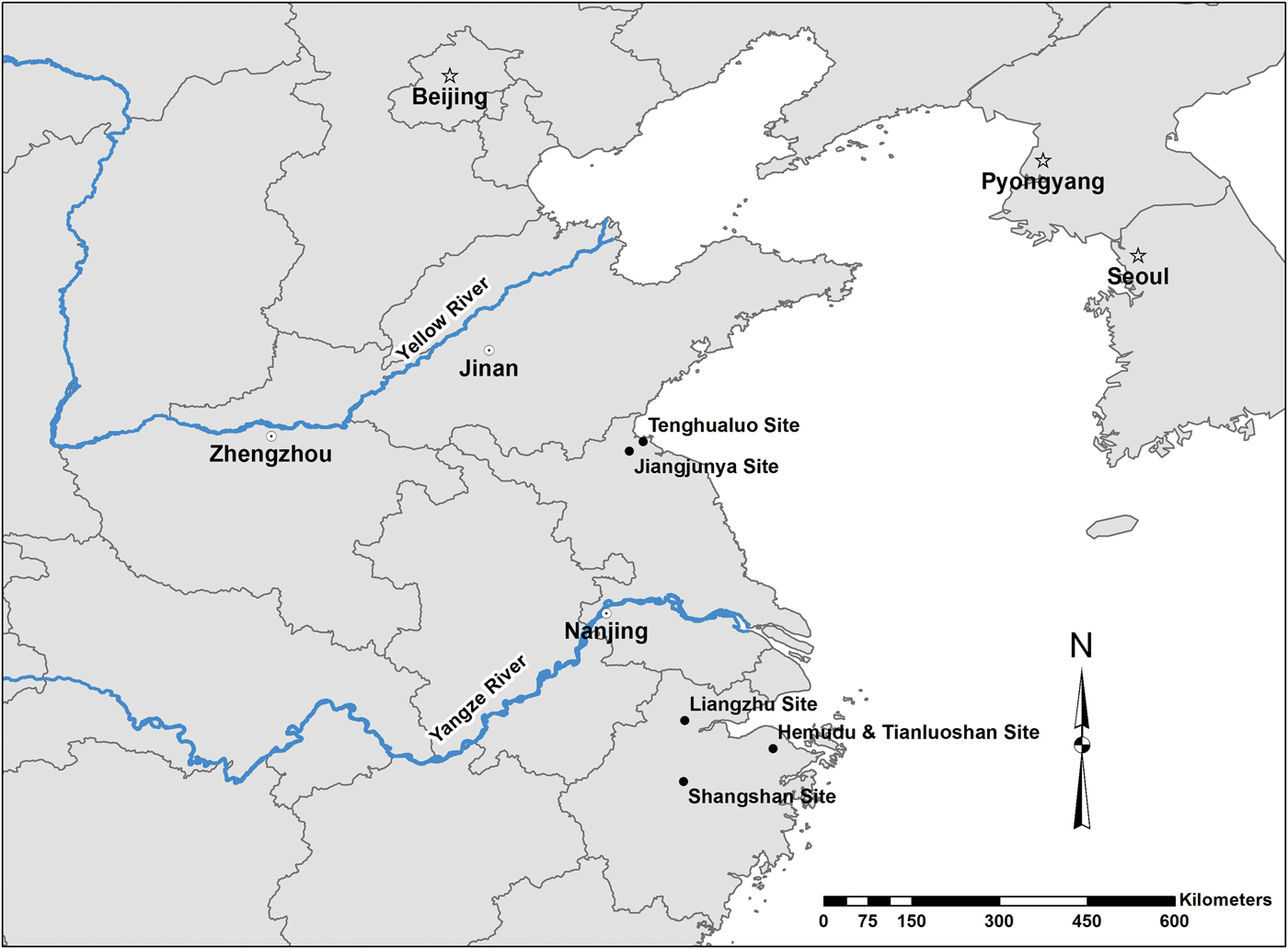
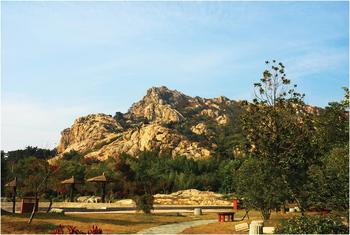
The Jiangjunya rock-art site was found on a rocky hill on the southern side of Jinping Mountain in the vicinity of Lianyungang City (Jiangsu Province, China), in 1979. The hill is about 20 m above sea level, located 20 km west of the sea (Figs 1 & 2).
Key archaeological sites on China's east coast. (Map: Yan Liu.)

Jiangjunya Hill in Lianyungang City, Jiangsu Province, China. (Photograph: Author.)

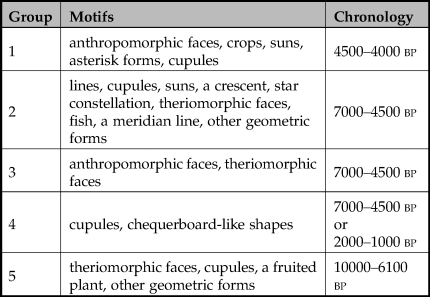
Five groups of petroglyphs are distributed on the hill. Motifs include iconic images such as anthropomorphic and zoomorphic faces, fish, crops, the sun and stars, and non-iconic forms such as cupules, concentric circles and other geometric forms (Lianyungangshi Zhongdian Wenwu Baohu Yanjiusuo Reference Lianyungangshi2013, 6–10).
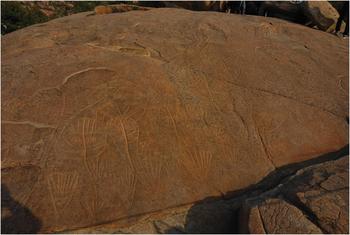
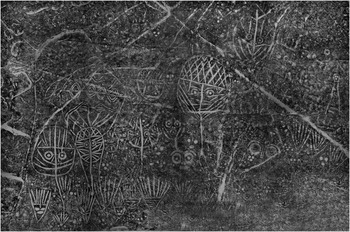
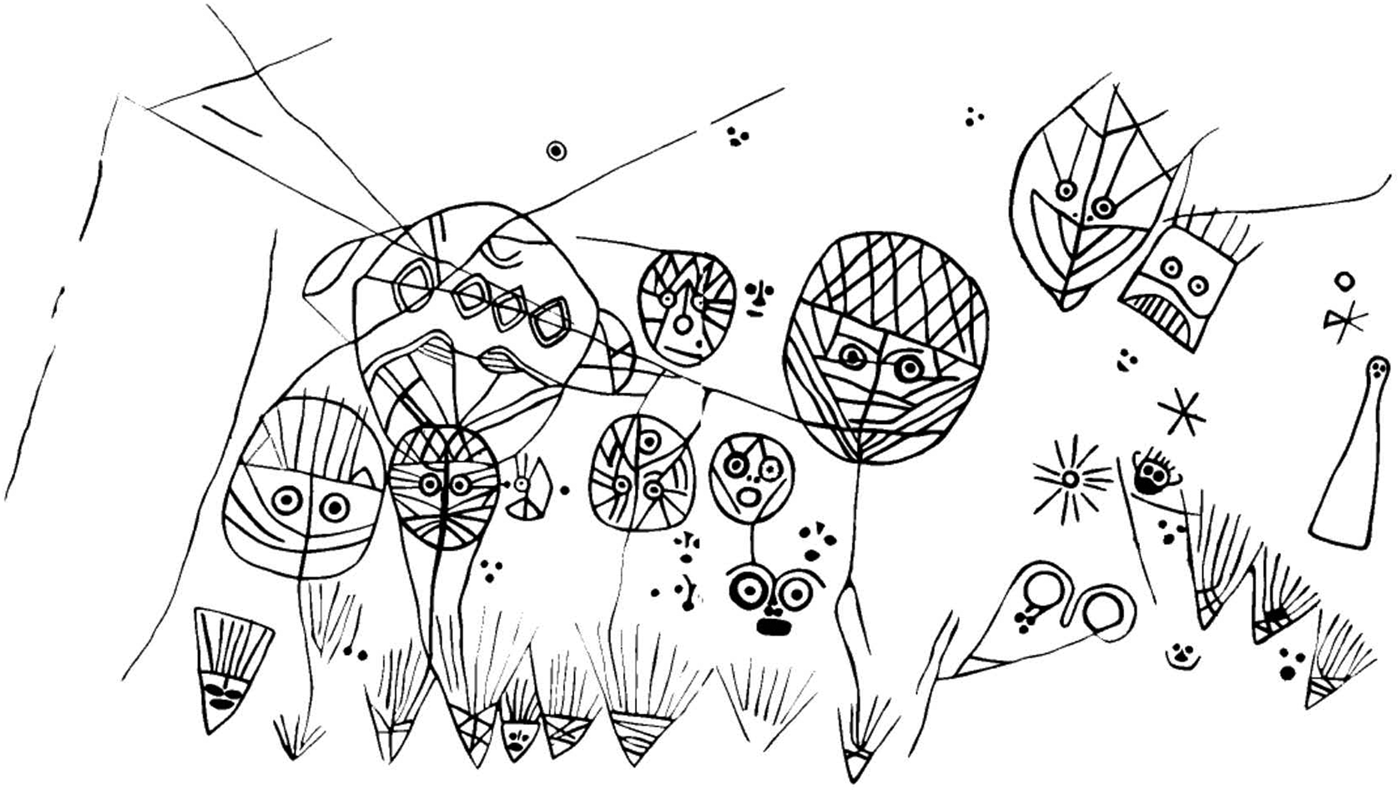
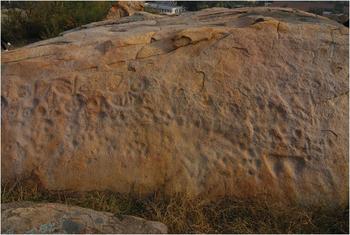
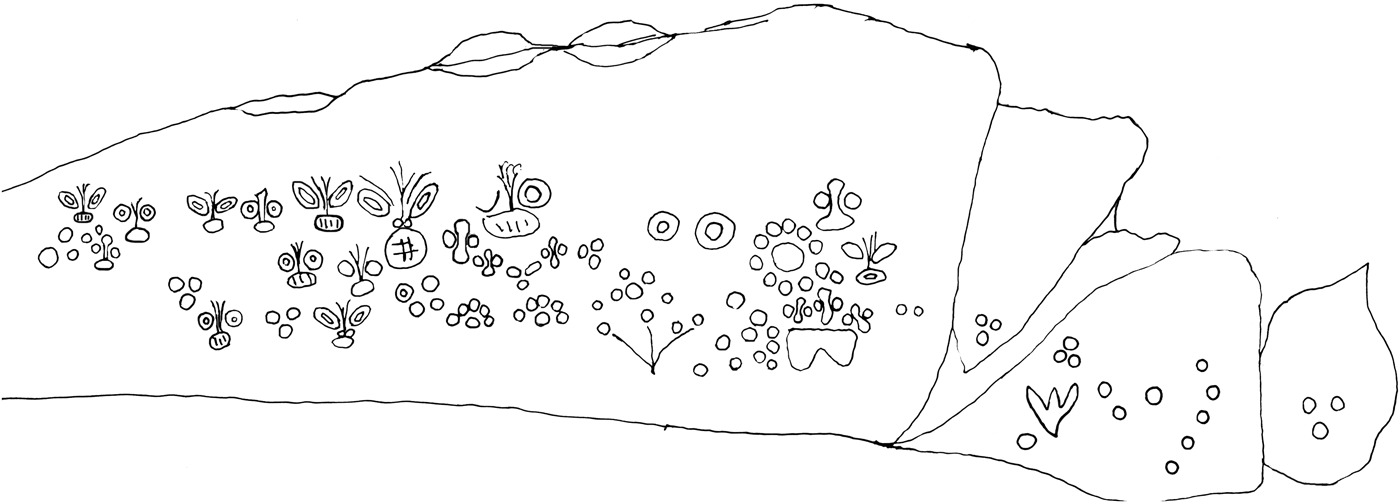
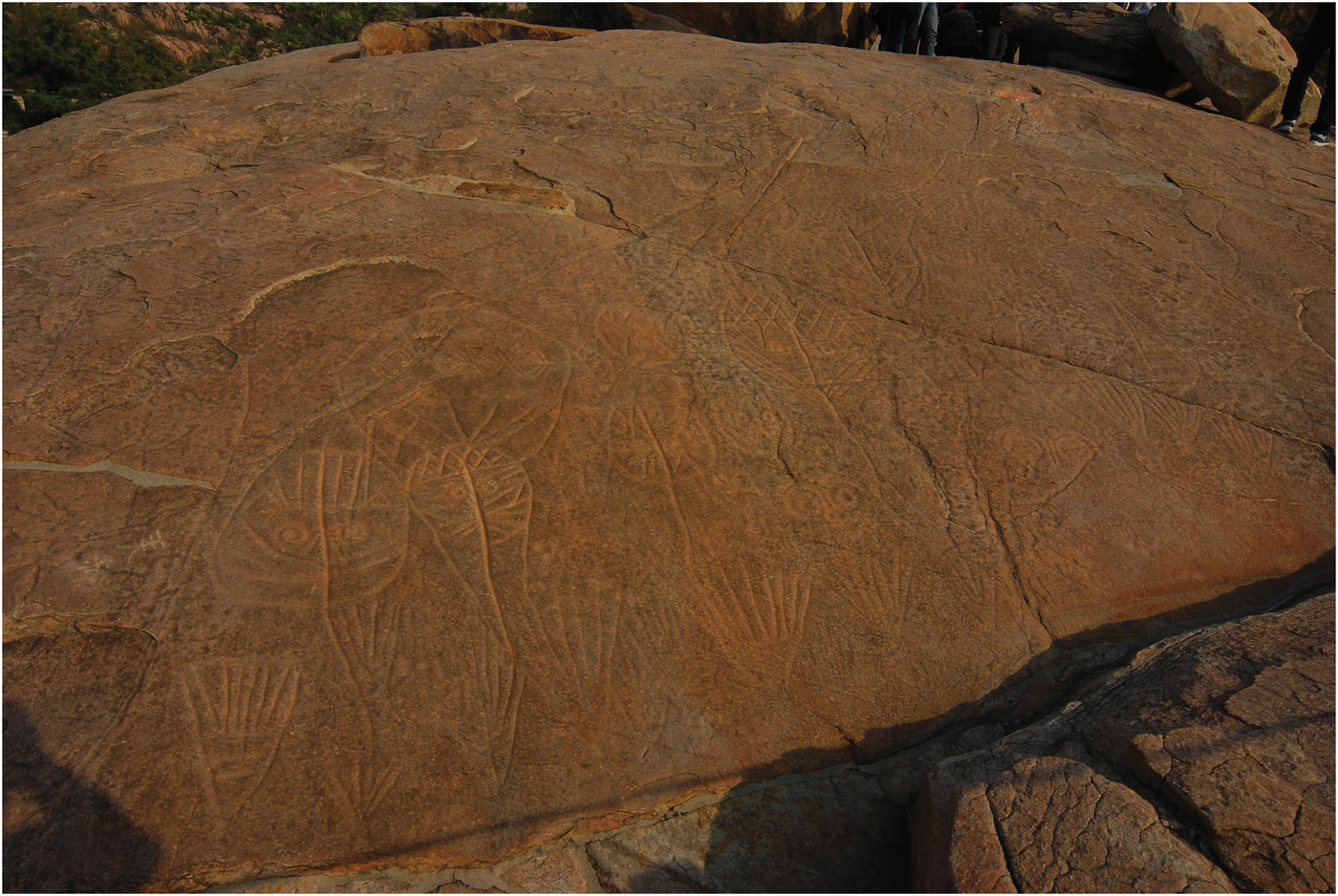
Group 1 is located on the west side of the hill. The rock panel, measuring 4.2 m wide and 2.8 m tall, is engraved with 15 human faces, associated with 14 crop images below. Additional sun-like images, asterisk forms and some cupules are indicated. Most masks are engraved with paired concentric circles as eyes, and some are decorated with rhomboid lattices, while others have lines radiating outwards. Among the large masks, four are directly linked to the crop-like images; a line runs from each mask, situated at the top of the grouping, to a crop, situated at the bottom, indicating an inherent relationship between human and crops. It is striking that two of the crop-like images are indicated with eyes and mouths to resemble human faces (Lianyungangshi Zhongdian Wenwu Baohu Yanjiusuo Reference Lianyungangshi2013, 6–8; Figs 3–5).
Group 1 of Jiangjunya petroglyphs. (Photograph: Author.)
Tracing of Group 1 of Jiangjunya petroglyphs. (Courtesy of Wei Gao, Lianyungang City Institute of Cultural Relics.)

Drawing of Group 1 of Jiangjunya petroglyphs. (Courtesy of Wei Gao, Lianyungang City Institute of Cultural Relics.)

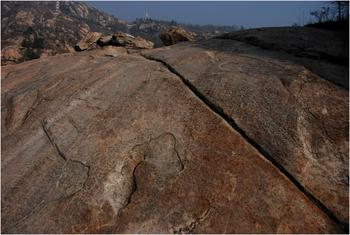
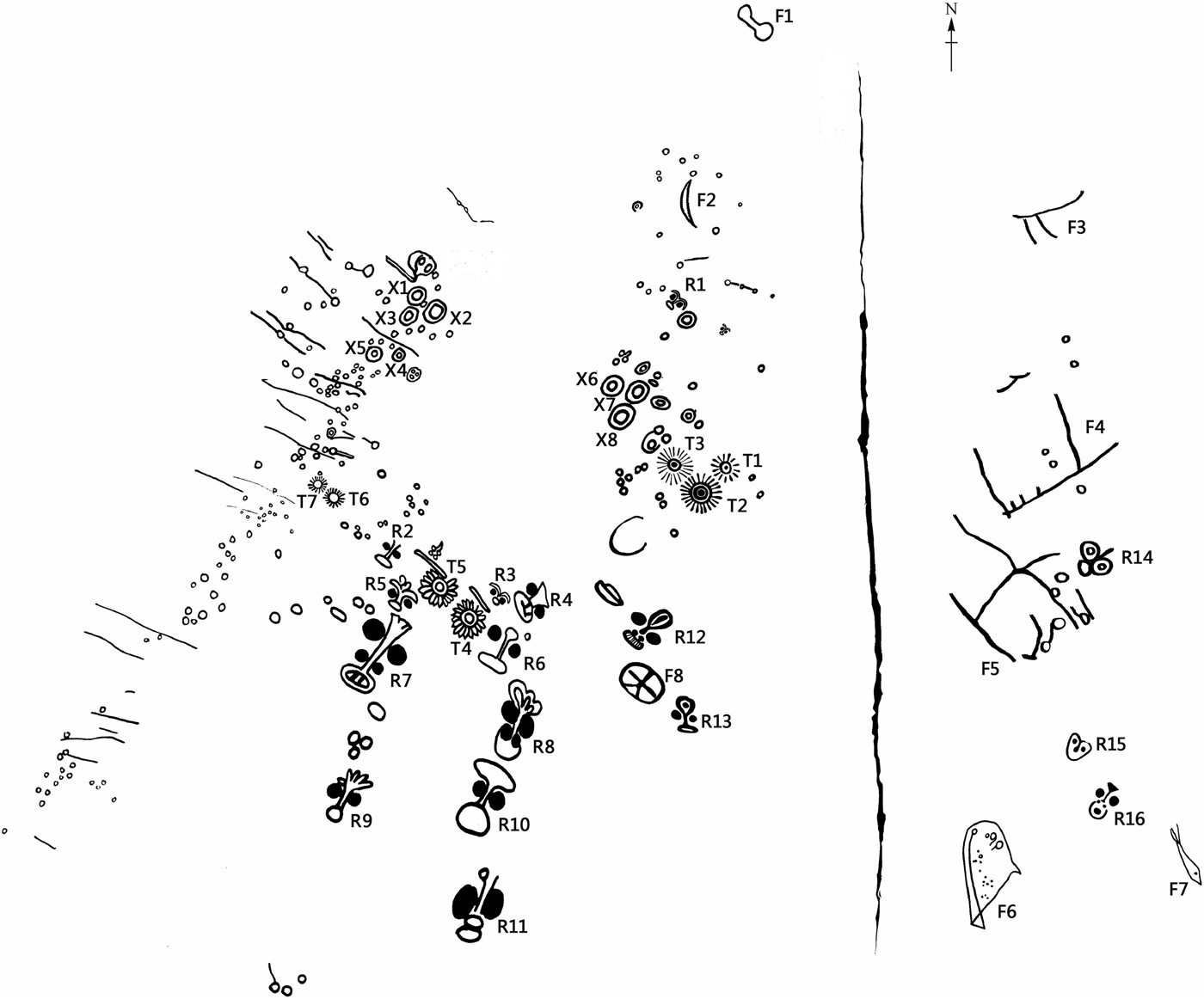
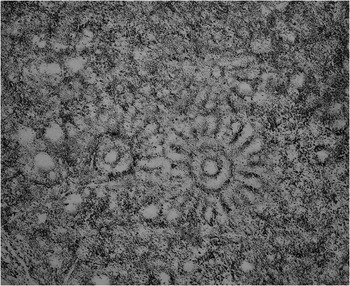
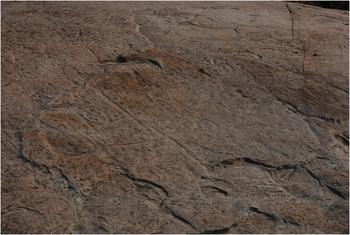
Group 2 lies on the south side of the hill and measures 9×9 m, consisting of left, middle, and right sections. A natural crack crosses the panel. The left section comprises numerous lines and cupules. The middle section includes seven sun-like forms, a crescent, Big Dipper-like star constellation and 15 beast faces characterized with paired circles as eyes, a large mouth and headgear. The right section includes several uneven geometric forms, three beast faces and two fish. Between the middle section and the right section is a long line which likely represents a meridian because it only has 4 degrees of error from the meridian line (Lianyungangshi Zhongdian Wenwu Baohu Yanjiusuo Reference Lianyungangshi2013, 8–9; Figs 6–8).
Group 2 of Jiangjunya petroglyphs. (Photograph courtesy of Wei Gao, Lianyungang City Institute of Cultural Relics.)

Drawing of Group 2 of Jiangjunya petroglyphs. (Courtesy of Wei Gao, Lianyungang City Institute of Cultural Relics.)

Tracing of the sun image of Group 2 of Jiangjunya petroglypsh. (Courtesy of Wei Gao, Lianyungang City Institute of Cultural Relics.)

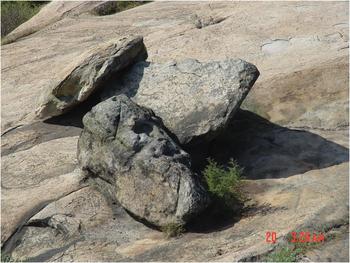
Group 3 is on the panel of the hilltop, measuring 2.2 m wide and 2 m tall and including 15 human and beast faces (Figs 9–10). Group 4 is located between Groups 2 and 3. It includes several rectangular chequerboard-like shapes on the floor and three rocks engraved with numerous cupules (Figs 11–12). Group 5 is on the top of the hill, 100 m above Group 1. The panel measures 9.7 m wide and 0.55–1.7 m tall and includes around 20 beast faces, numerous cupules, a fruited plant and other geometric forms (Figs 13–14) (Lianyungangshi Zhongdian Wenwu Baohu Yanjiusuo Reference Lianyungangshi2013, 9–10; Zhang Reference Zhang2017).
Group 3 of Jiangjunya petroglyphs. (Photograph courtesy of Wei Gao, Lianyungang City Institute of Cultural Relics.)

Drawing of Group 3 of Jiangjunya petroglyphs. (Courtesy of Wei Gao, Lianyungang City Institute of Cultural Relics.)

Group 4 of Jiangjunya petroglyphs. (Photograph courtesy of Wei Gao, Lianyungang City Institute of Cultural Relics.)

Chequerboard-like shapes in Group 4 of Jiangjunya petroglyphs. (Photograph: Author.)

Group 5 of Jiangjunya petroglyphs. (Photograph: Author.)

Drawing of Group 5 of Jiangjunya petroglyphs. (Courtesy of Wei Gao, Lianyungang City Institute of Cultural Relics.)

According to the microerosion dating project conducted by Tang Huisheng and colleagues (Tang & Mei Reference Tang and Yawen2008; Tang et al. Reference Tang, Kumar, Wuyi, Bo, Huiling, Jiaxin, Xiaohong, Jianhua, Yingnian, Wei and Bednarik2017) in 2005 and 2014, these petroglyphs were created in different dates. The earliest engravings are several cupules on bedrock to the west of Group 1, which are not categorized in the five groups. These cupules on bedrock can be roughly dated to around 11,000 bp. The engraved cup marks on the rock in Group 4 are dated to around 6000 bp. Group 1 belongs chronologically to the late Neolithic period, dated to 4500–4300 bp.
In 2015, Zhang Jiaxin, a PhD student at Minzu University of China, conducted a dating project on the Jiangjunya petroglyphs, following Tang's microerosion method. Her analyses of data collected from all five groups show that even single groups of petroglyphs were created across time depth. According to her report, Group 5 was dated to 10,000–6100 bp, the cupules on the rocks in Group 4 are contemporary with Groups 2 and 3, dating to 7000–4500 bp, and Group 1 was dated to 4500–4000 bp. The chequerboard shapes of Group 4 are likely later engravings, dating to 2000–1000 bp (Zhang Reference Zhang2018). The motifs and chronology of the Jiangjunya petroglyphs are seen in Table 1.
The motifs and chronology of the five groups of Jiangjunya rock art.

The dating of rock-art archaeological sites has always been a challenge. Previous scientific methods include radiocarbon analysis, lichenometry and luminescence. However, all these methods are unreliable. The radiocarbon analysis produces no calendar years, while the lichenometry technique has great variability in the indices and thus provides no accepted results (Bednarik Reference Bednarik2002). Since the 1990s, the microerosion dating method has been improved and has been widely used to date petroglyphs by Bednarik and other archaeologists. This method, according to Bednarik (Reference Bednarik1992), is based on measurement of the formation and age-relatedness of macroscopic wanes which refers to ‘the phenomenon of progressive rounding of a rock edge through weathering processes’. So far, it is ‘the only petroglyph dating method that seeks to date the event of petroglyph manufacture’. However, because calibration curves for microerosion are often inadequate, the accuracy of this dating method is actually limited (Bednarik Reference Bednarik2002, 8). In China, archaeologists have improved the microerosion dating method by using stones with known ages as reference points when they conduct microerosion analysis of petroglyphs with unknown ages, so that they may obtain relatively reliable age estimates (Tang Reference Tang2002; Tang & Gao Reference Tang and Zhiwei2004; Tang & Mei Reference Tang and Yawen2008; Zhang Reference Zhang2018). Tang's microerosion dating results of Jiangjunya petroglyphs are referenced with calibration from a Buddhist inscription at nearby Kongwang Hill with an age of April 61 ad (Tang & Mei Reference Tang and Yawen2008; Tang et al. Reference Tang, Kumar, Wuyi, Bo, Huiling, Jiaxin, Xiaohong, Jianhua, Yingnian, Wei and Bednarik2017), while Zhang's dating analyses are referenced with calibration from two rock inscriptions bearing ages relatively from the Tang and Ming Dynasties (Zhang Reference Zhang2018).
Potential associations between the Jiangjunya rock art and local prehistoric cultures have been proposed by Chinese archaeologists (Li Reference Li1981; Reference Li1983; Tang & Mei Reference Tang and Yawen2008). In the 1970s and ’80s, microlithic tools were collected at the West Jiangjunya, Taohuajian, Jiudian, Kongwangshan, Jiashan and Yabashan sites (Fang et al. Reference Fang, Qiang, Jianyun, Lin and Suoqiang2008; Li Reference Li1981; Reference Li1983; Lianyungangshi Bowuguan Reference Lianyungangshi1981). There are two Late Palaeolithic sites around the Jiangjunya Hill: West Jiangjunya at the foot of the hill and Taohuajian to the east of the hill. Archaeologists conducted excavations at both sites from 2004 to 2006 and unearthed around 1500 lithic tools including cores, flakes, scrapers, arrow points, burins, bodkins and choppers. Microblades were also found mainly from the late layers. According to excavators, the early deposit in the two sites may belong to the early stage of the Late Pleistocene and the late assemblages were likely produced at the end of the late Pleistocene (Fang et al. Reference Fang, Qiang, Jianyun, Lin and Suoqiang2008). The occupants of the two sites around the Jiangjunya Hill were possibly artisans of the Group 5 petroglyphs (Tang & Mei Reference Tang and Yawen2008, 17).
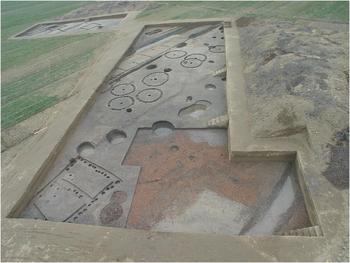
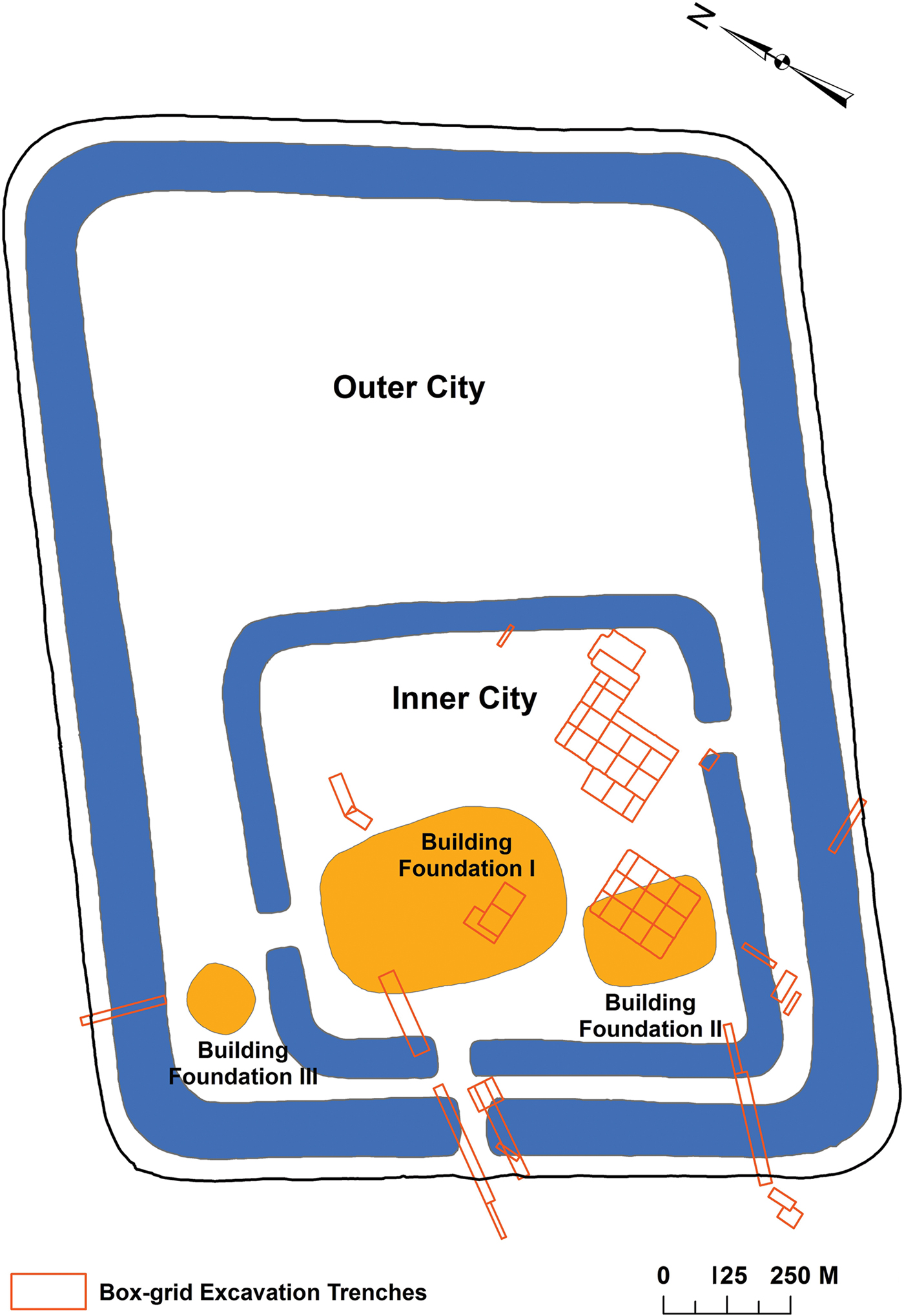
Intensive Neolithic settlements and cemeteries have been discovered in the Lianyungan region (Jiangsusheng Wenwu Gongzuodui Reference Jiangsusheng1962; Li Reference Li1981; Reference Li1983). Early deposits of Dawenkou culture (6500–5500 bp) have been found at the Erjianchun site, including ground lithic tools such as axes, adzes and knives, bone artifacts and pottery pieces. Many pottery pieces are decorated with various geometric forms, demonstrating ancestors’ artistic enthusiasm (Jiangsusheng Wenwu Gongzuodui Reference Jiangsusheng1962). Among numerous Late Neolithic Longshan cultural settlements (4500–4000 bp) in the Lianyungang region, the Tenghualuo city is of most importance (Fig. 15). The site is the only urbanized settlement in the region during the Longshan period; the inner and outer city walls seem to suggest that it appeared as the political and cultural centre of the Lianyungang region (Fig. 16). Excavations of the site also yielded pottery and ground lithic tools. Pottery is largely decorated with printed geometric forms. Lithic implements include axes, adzes, knives and arrowheads. More importantly, rice fields and rice grains were discovered in the excavations, suggesting rice agriculture as the major economy for Tenghualuo people. However, animal bones such as deer, boar, ox and fish, as well as lithic arrow points indicate hunting-gathering as a supplementary subsistence strategy (Nanjing Bowuyuan & Lianyungangshi Bowuguan Reference Nanjing and Bowuguan2015). The archaeological records thus provide great potential to set up associations between the Jiangjunya rock art and local prehistoric cultures.
Excavation of the Tenghualuo site. (Photograph: Liugen Lin. Courtesy of Jiangsu Provincial Institute of Cultural Relics and Archaeology.)

Map of the Tenghualuo city. (Map: Yan Liu, after Nanjing Bowuyuan & Lianyungangshi Bowuguan Reference Nanjing and Bowuguan2015, 15.)

The mask and crop images
Chinese scholars have realized the significance of the human–crop connection embodied in these engravings (Chen Reference Chen1991; Reference Chen2002; Ge Reference Ge1983; Reference Ge1995; Reference Ge1996; Li Reference Li1981; Reference Li1983; Reference Li1988; Reference Li1997; Song Reference Song1992; Tong Reference Tong2011; Xiao Reference Xiao1983). However, both their identification and interpretation continue to be debated. While the signs below the human faces are diagnosed as crops by most interpreters (Chen Reference Chen1991; Reference Chen2002; Li Reference Li1981; Reference Li1983; Reference Li1988; Reference Li1997; Lianyunganshi Bowuguan Reference Lianyungangshi1981; Tong Reference Tong2011; Xiao Reference Xiao1983), it is argued by Ge and Song that these V-shaped images are no more than depictions of human heads (Ge Reference Ge1983; Reference Ge1995; Reference Ge1996; Song Reference Song1992). For Ge Shanlin, those lines within the V-form, which are seen as characteristics of crops by other scholars, are actually sun rays. He thus interprets these V-forms as sun gods and treats the human faces above as related celestial gods. These deistic entities with stars and the sun alongside constitute a heavenly pantheon worshiped by the ancient community (Ge Reference Ge1983; Reference Ge1995, 74–6; Reference Ge1996, 197). Likely inspired by Ge, Song Yaoliang argues that, in accordance with the ‘ten suns’ myth recorded in ancient Chinese literature such as Shanhaijin山海经, the 10 human face engravings likely represent ancestral leaders of 10 ancient sun-worshipping tribes and the V-shaped images depict common tribal inhabitants decorated with feathers (Song Reference Song1992, 107, 269). I argue that Ge's and Song's conclusions are based primarily on assumptions, rather than on legitimate analyses.
Through morphological analyses of the iconic characters and integrative considerations of the regional economy during the Neolithic period, both Chen Zhaofu (Reference Chen2002, 143–4) and Tong Yongsheng (Reference Tong2011) have identified the crop as rice plants. In my view, this is a more persuasive intrepretation. First, according to Chen (Reference Chen2002, 143), the upper part of the image consists of radiating lines and the lower part is in the form of a triangle, vividly depicting the image of a rice plant. Second, historical records contain evidence that the Lianyungang region relied on rice agriculture, both historically and traditionally (Tong Reference Tong2011, 130). Third, rice fields and rice remains were largely found in the Tenghualuo city site, which was contemporary to the Group 1 petroglyph of the Jiangjunya rock-art site (Nanjing Bowuyuan & Lianyungangshi Bowuguan Reference Nanjing and Bowuguan2015), demonstrating that these crops are likely rice plants. Given these observations, the most important question involves the connection between rice plants and human facial characteristics. What ontological and metaphysical meanings are expressed in, or suggested by, these engravings?
Using mythological theories, Xiao Bing (Reference Xiao1983) attempted to connect the petroglyph with the Creation Myth to argue that the masks and crops depict a mythic ideology: humans originated from plants. He further points out that both humans and crops represent human desires for fecundity and fertility. His theory appears to derive from a mixture of various sources. His emphasis on ‘birth’ and maternal natures of the earth and plants and connection with the Sumerian goddess Ishtar show an obvious influence from the Western Goddess theory. He also sees the round shape of human masks as the sun, possibly providing inspiration for Ge's analysis (Reference Ge1983; Reference Ge1995, 74–6; Reference Ge1996, 197) and that of Song (Reference Song1992).
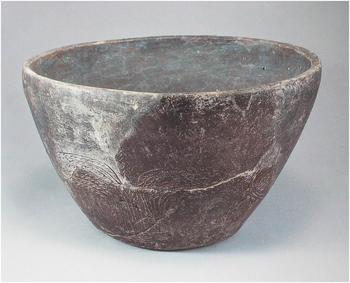
Chen (Reference Chen1991; Reference Chen2002) is one of the few scholars to have realized the relevance of animism for studies of the Jiangjunya petroglyphs. First, he has found similarities in design and style between the Jiangjunya plants and rice crops engraved on pottery of the Hemudu Neolithic culture in the Lower Yangtze River region (Fig. 17), and hence has determined that the Jiangjunya images are rice plants. Second, he has revealed the animist ontology reflected by the engravings. As he writes,
The close combination of human faces and crops is to personalize those plants. … In the view of the primitive people, plants had similar attributes to humans, having life and thought and having parents and children. They grow continually from generation to generation. Contrasting with humans, plants have much stronger reproductive performance and longer life than humans. Humans also wanted to have such capacities but this was hard to achieve. Therefore, they desired to possess similar power to that the plants. They begged the gods to offer more blessings and more food. This is the reason why the primitive people worshipped the plant gods. (Chen Reference Chen2002, 143–4, author's translation)
Rice image on a Hemudu Neolithic pot, from the Tianluoshan site. (Courtesy of Bin Liu, Zhejiang Provincial Institute of Cultural Relics and Archaeology.)

However, the application of terms like ‘primitive’ and ‘plant gods’ shows that his model is still defined by the old anthropological framework of evolutionary animism. He seems to emphasize that ‘primitive’ people believed that the inanimate plants were enlivened or ‘personalized’ due to their ‘primitive’ animist ontologies. His model, which has itself primitivized prehistoric people, evidently overlooks ‘worlds of engaged being, relational ways of knowing and other-oriented valuing’ (Morrison Reference Morrison and Harvey2013, 52), although he is correct to have noted the personhood of the crops.
In animist ontologies or Amerindian perspectivism, personhood is attributed not only to humans, but also to animals, plants and things. Each non-human person envelops an internal human form, which is called ‘soul’ or ‘spirit’ of the species (Viveiros de Castro Reference Viveiros de Castro1998). Among many Arctic and Subarctic societies, a being ‘is comprised both of some immutable soul-like awareness and of a malleable body that is constituted through performance’ (Hill Reference Hill2013: 121). Transformations or metamorphoses are thus produced by the availability of body change. Two sorts of transformations are attested in ethnographic data. First, certain humans such as shamans or ritual specialists often use non-human adornments, such as feathers, skin, fur, colours, designs and masks to abandon their human physicality in order to communicate with other species, ‘to move freely within the world of interior forms’ (Descola Reference Descola2013a, 138) and to take up ‘the point of view of the other’ (Ingold Reference Ingold, Seppälä, Vanhala and Weintraub1998, 185). Second, animals and other non-humans, according to Descola (Reference Descola2013a: 138), ‘reveal their interiority by taking on the form of human physicality’. The first case can be seen in shamanic rituals in which shamans are elaborately disguised in non-human forms of skin, fur and feathers. The second context is often expressed in the indigenous art of circumpolar peoples.
Ingold (Reference Ingold, Seppälä, Vanhala and Weintraub1998) has noted that the face-depicting mask among Alaskan Eskimos is the look of non-humans, rather than humans. Such art ontologically reveals manifestations of the soul, the interiority, or the inner being of the non-human. Therefore, such kinds of artwork do not represent realistic beings, but reveal the essence of beings. The purpose of these depictions, from Ingold's perspective, ‘is not to represent but to reveal’ (Reference Ingold, Seppälä, Vanhala and Weintraub1998, 204). Following this idea, I conceptualize depictions of inner forms of animals, plants and things as a ‘revelatory art style’ in this paper.
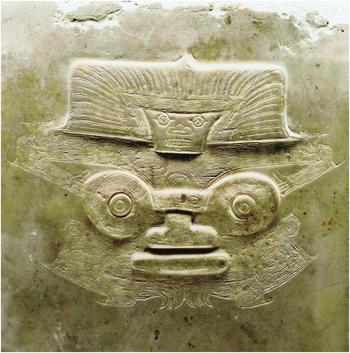
The revelatory art style can be seen on jade carvings of the Liangzhu Neolithic culture in the Lower Yangtze River region in China. A semi-human design, present on many jade artifacts, depicts a human face with a feather headdress, arms and hands above a creature with large round eyes, fangs and sharp claws. The human image likely reveals the essential personhood of the beast-spirit in Neolithic Liangzhu society (Qu Reference Qu2014; Fig. 18).
The human-creature design on a jade work found at Fanshan Neolithic Cemetery, Zhejiang Province. (Courtesy of Bin Liu, Zhejiang Provincial Institute of Cultural Relics and Archaeology.)

To return to the human faces and plants carved on the Jiangjunya rocks, we may easily recognize the revelatory style used for the petroglyphs. Although the lines connecting human faces and crops indeed indicate an intimate relationship between the two motifs, the faces are not essentially personalized plants, as Chen has argued (Reference Chen2002, 143). Rather, this petroglyph design reveals the personhood, the soul, the interiority or the inner being of the rice crops. A simple face is portrayed on the ‘root’ of two rice plant images, located at the bottom left and bottom centre of the design, possibly expressing the same ontological idea. Most large masks are round, and eyes are indicated with paired circle-dot forms. One face in the top right area is in a rhombic shape and beside it is a face in a square form. These obscure depictions do not seem to resemble the real human visage. Rather, they might aim ‘to capture the underlying character and personal idiosyncrasies attributed to the spirit that has assumed its form’ (Ingold Reference Ingold, Seppälä, Vanhala and Weintraub1998, 197).
The revelatory art style in the Jiangjunya site demonstrates that the ontologies of the Neolithic Lianyungang societies can be considered perspectivist or animist. However, we must keep in mind that personhood in the Neolithic Lianyungang region was evidently attributed to plants such as rice. This is different from many Amazonian and Arctic societies, which commonly conceive animals as non-human persons. While the human–non-human interactions were associated with the hunting-gathering subsistence economy in the circumpolar north and the Amazon, animist ontologies were associated with human reliance upon an agricultural economy on the Chinese east coast.
The personhood of plants is also revealed in visual art of Mayan and Andean agricultural societies, according to the archaeological record. The Moche culture in north Peru (100–700 ad), for example, has large numbers of ceramic jars which depict maize with an anthropomorphic face. Archaeologists usually understand the maize-human images in a way which emphasizes the symbolic or religious dimensions, but ignore any exploration of potential animist ontologies (Dunn Reference Dunn1979). The use of revelatory style in Moche art demonstrates that plants such as maize may have been conceived as persons endowed with intentionality and consciousness.
More broadly, I suggest that plants, rather than animals, probably played important roles to constitute an interactional relation with humans among agricultural societies. Human–plant engagement, as revealed by the Jiangjunya petroglyphs, implies significant variations in animist ontologies given contextual differences in ecologies, economies, and cultures.
Rice ecology and ecological relations
Neolithic China is generally divided into two contrasting agricultural zones by archaeologists. Northern China along the Yellow River areas relied on dry-land cultivation of millet, while rice agriculture was practiced in the middle and lower Yangtze River regions (Zhang Reference Zhang2004, 16–19). Evidence of the earliest rice consumption in the Lower Yangtze River was found at the Shangshan site in the centre of Zhejiang Province, dated to about 10,000 cal. bp (Sheng et al. Reference Sheng, Yunfei and Leping2006), although whether the rice was domesticated or wild still remains unclear (Zhao Reference Zhao2010). Probable early rice farming occurred in the Hemudu culture (7000–5500 bp), evidence of which was found at both the Hemudu site and Tianluoshan site on the south bank of Hangzhou Bay (Zhao Reference Zhao2010; Zhejiangsheng Wenwu Kaogu Yanjiusuo Reference Zhejiangsheng2003). However, analysis of the Hemudu economy shows that rice cultivation played only a minor part in a mode of subsistence dominated by hunting and gathering. Nevertheless, rice agriculture appeared to become the predominant mode of subsistence during the Liangzhu period (5200–4300 cal. bp), a late Neolithic culture in the Lower Yangtze River region (Zhao Reference Zhao2010; Fig. 1).
The Lianyungang region belongs to North Jiangsu Province, the most northern part of the Yangtze River delta. Facing the Pacific Ocean, it includes mountains to the northwest and coastal plains to the southeast. Rivers, humidity, alluvial plains and a warm climate formed an environmental foundation for rice farming. Chinese historical writings bear numerous records about rice farming in this region (Chen Reference Chen2002, 144; Tong Reference Tong2011). Agriculturalists have discovered wild rice plants in 29 different areas on the mountains in Lianyungang since 1982 (Tong Reference Tong2011, 130), proving the availability of rice domestication in prehistory.
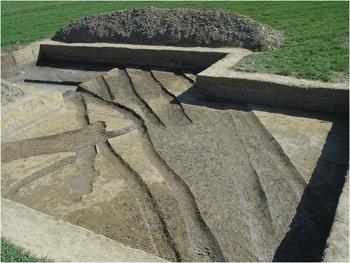
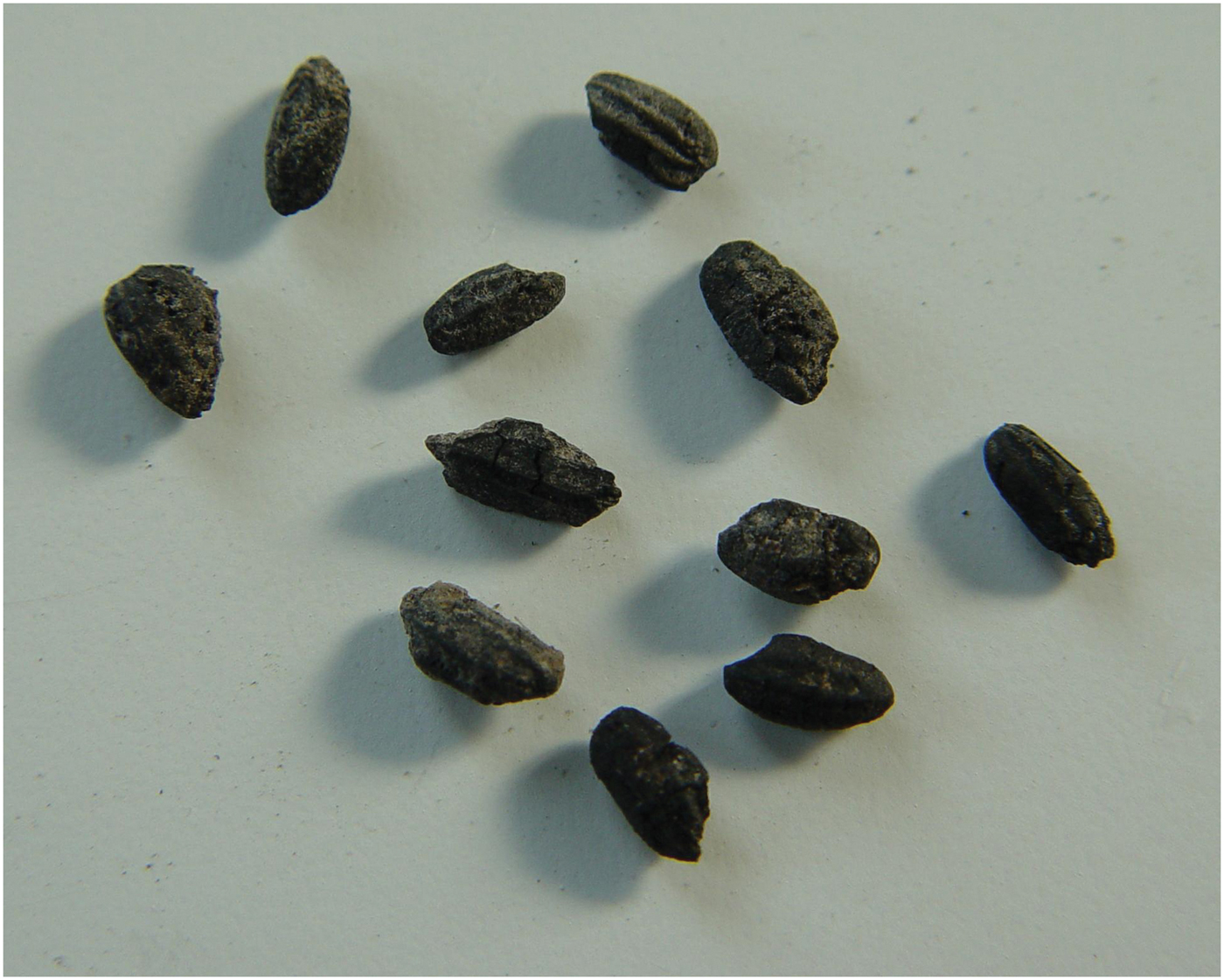
The most striking discovery in the archaeology of rice in the Lianyungang region is from the excavations of the Tenghualuo site. From excavations beginning in 1994, an ancient city of the Longshan culture (4500–4000 bp) with inner and outer structures has been revealed. The outer structure was designed as a rectangular city composed of walls, trenches and gates. The inner structure, designed in the shape of a square with rounded corners and equipped with walls, gates and sentry-posts, is positioned in the southern area of the outer city. In addition to a number of preserved rice fields, archaeological sampling and analyses have revealed concentrations of carbonized rice (100 grain examples) and rice phytoliths from both the inner and outer areas of the city, as well as between the outer and inner walls in the northern part of the city (Nanjing Bowuyuan & Lianyungangshi Bowuguan Reference Nanjing and Bowuguan2015). The combination of archaeobotanical samples of both carbonized grains and phytoliths of rice coupled with preserved cultivation fields underlines the central role of rice agriculture as a subsistence resource for Tenghualuo society (Figs 19–20).
Excavation of the rice field at the Tenghualuo site. (Photograph: Liugen Lin. Courtesy of Jiangsu Provincial Institute of Cultural Relics and Archaeology.)

Carbonized rice grains found at the Tenghualuo site. (Photograph: Liugen Lin. Courtesy of Jiangsu Provincial Institute of Cultural Relics and Archaeology.)

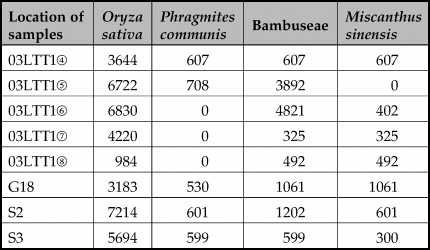
The phytolith soil analysis samples taken from the Tenghualuo site (excavation unit 03LTT1) produced high levels of phytoliths in the three samples. The high density in the samples, each of which contains over 5000 rice (Oryza sativa) grains per sample (each weighing one gramme) is highly suggestive of rice cultivation. This conclusion is supported by low levels of wild ‘plant opal’ (phytoliths) such as in reed (Phragmites communis), bamboo (Bambuseae) and Chinese silver grass (Miscanthus sinensis), other native flora found in the samples (Tang Reference Tang, Bowuyuan and Bowuguan2014; Table 2).
Number of ‘plant opals’. (After Tang Reference Tang, Bowuyuan and Bowuguan2014.)

The masks and crops in the Jiangjunya rock art are dated to 4300–4000 bp (Tang & Mei Reference Tang and Yawen2008), contemporary with the late Neolithic Longshan culture in the Tenghualuo site and the late Neolithic Liangzhu culture in South Jiangsu, Zhejiang and Shanghai areas. Accordingly, a potential relation between the Jiangjunya petroglyph and the culmination of rice farming should be considered, although we do not know whether the rice images were carved directly by the Tenghualuo craftsmen. Nevertheless, these masks and crop images were likely related to local rice planters, including those residents of the Tenghualuo city and inhabitants dwelling in villages around the city.
Without doubt, the discovery of the Tenghualuo city implies that in the late Neolithic Lianyungang region, there existed a state-level, complex society, possibly with a hierarchical social system. The successful rice economy was an integral part of the wider social context and thus benefited from a well-defined social organization on a state level. However, we must be aware that social structures, rice cultivation and the interactions between state administrators and farmers were all focused around increasing reliance on the rice economy. Therefore, as pointed out by Descola (Reference Descola2013b, 87), humans and non-humans had an identical sociability, and thus there may have been a continuity from ‘natural objects to social taxonomies’. In this way, the Jiangjunya rice engravings may have been seen as representing an interaction between the environment and society, so that the rock art and the Tenghualuo rice farming together constituted an essential relationship that was part of the wider economic, social, cosmological and historical context.
From an animist perspective, it is critical to understand that non-human rice persons played a potentially vital role in the ontologies of the Neolithic Lianyungang societies. Thus, rice farming, and associated technologies, skills, ecologies, and strategies, should not be considered only as subsistence activities. Rather, rice farming was also part of a social action that maintained interactions with rice persons. Hence, the planting, harvesting, processing and consumption of rice is ‘far more than mere provisioning’ (Ingold Reference Ingold, Seppälä, Vanhala and Weintraub1998, 184). Through these activities, human persons and rice persons adopted perspectives and abilities from one other; they not only established collaborative and intimate interactions, but actually united to share life experience, environmental context and social process. The large rice fields found inside and beside the Tenghualuo city indicate that rice plants were perceived as agential and sentient, like human inhabitants, and they most likely shared urban life together with human persons. In this way, ‘their lives were inexorably linked, as closely as if they were both the same species’ (Betts et al. Reference Betts, Hardenberg and Stirling2015, 106).
Natural catastrophes frequently occurred historically, including inland floods, typhoons and transgressions, on the Chinese east coast.(Li et al. Reference Li, Cheng, Fengqing, Quanhong and Liugeng2008). Tenghualuo city was abandoned at the end of Longshan period, most likely due to coastal flooding (Xu Reference Xu2006) or inland floods (Li et al. Reference Li, Cheng, Fengqing, Quanhong and Liugeng2008) caused by climate changes. Thus, humans and non-humans in Tenghualuo society shared the same concerns for protection from catastrophic events. The city walls became defences for both humans and non-humans on a daily basis. According to the Tenghualuo archaeological report (Nanjing Bowuyuan & Lianyungangshi Bowuguan Reference Nanjing and Bowuguan2015, 438), the rice fields are primarily located in the inner city. To protect rice plants from potential flooding appears to have been one of the most important concerns of both human and non-human inhabitants in the city.
Viveiros de Castro (Reference Viveiros de Castro1998; Reference Viveiros de Castro2004) has noted that, among indigenous groups in the Amazon, non-humans possess their own habitus, cultures, institutions and social systems. By contrast, in the late Neolithic Lianyungang, human and rice persons created a shared culture and society through collaborative interactions. Humans might have adopted the rice persons’ power, intelligence and knowledge to combine these traits with their own in order to construct the political institutions which maintained order an agricultural complex society. The social system was not only organized by humans, but also by non-humans. Rice persons were not witnesses, but active participants in the social dynamics of the late Neolithic Lianyungang society. When humans became farmers, non-human rice persons became farmers too; when humans became urbanized residents in the Tenghualuo city, non-human rice persons were urban residents too; when humans became the state bureaucrats, non-humans too became bureaucrats.
Conclusion
Drawing on relational ecology to consider the human–rice dynamics in Neolithic Lianyungang societies, I contend here that the Jiangjunya rock art and possible associated rituals were used to maintain human intersubjective and interpersonal relationships with other-than-human rice persons. Through the engravings, humans attempted to reveal subjective and agential roles played by non-humans in social processes. Furthermore, they expressed their spiritual connection to and respect for plant persons and a desire to adopt non-human powers and perspectives. In this way, the symbolic nature of the Jiangjunya petroglyph is neither supernatural nor religious, as proposed by previous scholars (Ge Reference Ge1983; Reference Ge1995; Reference Ge1996; Song Reference Song1992; Tong Reference Tong2011; Xiao Reference Xiao1983), but social. Possibly, the images were treated as ‘mnemonics’ with which humans and non-humans shared a way of perceiving and acting in the world (Betts et al. Reference Betts, Hardenberg and Stirling2015, 106). Thus, these engravings seem to encompass ‘knowledge systems’ that emphasize ‘the intentional, relational and interpersonal character of reality as both locally grounded and socially emergent’, rather than ‘belief systems’ (Morrison Reference Morrison and Harvey2013, 48).
Furthermore, the Jaingjunya rock art might have represented the materialization of the human–non-human relationship and prehistoric animist ontologies. Because the landscape was animate, humans perceived the rock and the hill as active, subjective and agential, capable of intentionality and sentience. Wallis (Reference Wallis2009, 54) has correctly pointed out that ‘[l]andscape and rock art do not depend on human inscription for agency but can be understood animically as intentional themselves’. Not every location could be chosen for rock-art, and not all hills were treated as a ‘sacred’ place like Jiangjunya. Rock-art locales are therefore potentially important as ‘indicators of places’ where non-human entities were dwelling (Wallis Reference Wallis2009, 55). Humans recognized these places through their interactions with non-humans and the rock-art site provided a special setting for social interactions between humans and non-humans. As Wallis continues, ‘After the initial production of rock art, human people continue to visit the site for various reasons, probably involving the maintenance of day-to-day social actions and relations’ (Reference Wallis2009, 55).
Ritual practices, organized by specialists, potentially took place at the Tenhualuo city, the political centre of the Late Neolithic Lianyungang region. The ritual likely created spaces for social life as a shared experience for both humans and non-humans, just as much as the social gatherings organized for humans. Cartesian anthropology has long been engaged with the secular/religion dichotomy in understanding human daily life and rituals. However, to conclude this ontological analysis of the Jiangjunya art and the Neolithic Lianyungang societies, I argue that, whether on a daily basis or in rituals, both humans and non-humans as social members actively performed what Armstrong Oma has called ‘social contract’ (Reference Armstrong Oma2010). In this way, the Jiangjunya rock-art site should be considered as what Hill has called ‘social media’ (Reference Hill2011, 421), rather than as religious or a sacred setting.
The micro-erosion dating project conducted by Tang and colleagues (Tang & Mei Reference Tang and Yawen2008; Tang et al. Reference Tang, Kumar, Wuyi, Bo, Huiling, Jiaxin, Xiaohong, Jianhua, Yingnian, Wei and Bednarik2017; Zhang Reference Zhang2018) has demonstrated that the Jiangjunya rock art has a history spanning thousands of years. Xiao Bing (Reference Xiao1983) has argued that the anthropomorphic and theriomorphic faces on the other rock panels represent human and animal sacrifices to gods associated with the panel depicting human and crop images (Figs 9, 10, 11). His interpretation is problematic for two reasons. First, the engravings on different rock panels were produced in different periods. The earliest petroglyph can be traced back to 11,000 bp (Tang & Mei Reference Tang and Yawen2008). The theriomorphic faces as well as anthropomorphic faces are more likely associated with hunter-gatherers in late Palaeolithic and early Neolithic cultures, while the crop images are associated with the Late Neolithic rice farmers. Second, these faces do not depict any attributes of morphology, but show ‘the underlying character and personal idiosyncrasies attributed to the spirit that has assumed its form’ (Ingold Reference Ingold, Seppälä, Vanhala and Weintraub1998, 197). The faces more likely reveal the personhood of various non-human people, rather than representing realistic entities. Thus, the Jiangjunya site continued to be recognized and used as a particular space for the encounter of human persons and various non-human persons during several thousand years. The site actually witnessed what Hill (Reference Hill2013, 120) has called ‘ontological shifts’.
The history of the Jiangjunya rock-art site corresponds with the history of the local human communities. Ontological shifts can be measured by both the rock art's history and the historical changes in subsistence. Rice subsistence in the Lower Yangtze River delta transitioned from the early domestication of wild rice in a hunting-gathering ecology to a fully established rice agriculture in the Late Neolithic period (Zhao Reference Zhao2010). The relational ontologies might have likewise transitioned gradually from human–animal interactions (in the context of a hunting-gathering ecology) gradually to human–plant interactions in more complex, urbanized societies. Human–non-human interactions, ecology–cosmology relations, and engagements with the natural and social worlds jointly contributed to an unfolding historical process across thousands of years in Lianyungang's prehistory. Human history was created not only by humans, but also actively produced and maintained by non-human beings including animals, plants, deities, spirits and animalized landscapes.
Acknowledgements
The author thanks Huisheng Tang, Bin Liu, Minchang Li, Liugen Lin, Wei Gao and Jiaxin Zhang for their generosity in providing documents, drawings and photos for this research; Erica Hill for reading the original draft of this article and providing critical suggestions; Paul Montgomery for his excellent editing; Yan Liu for his map making; and four anonymous reviewers for their constructive comments. The author also appreciates the Lianyungang International Rock Art Conference held in November 2017 in Lianyungang City, which provided participants an opportunity to observe the Jiangjunya rock art on site.