INTRODUCTION
Recent research indicates that pottery was developed independently in four regions around the world. The earliest known pottery is from East Asia: South China (ca. 18,500–17,700 cal BP), the Japanese Islands (ca. 17,400–14,000 cal BP), and the Russian Far East (ca. 16,800–14,100 cal BP) (Kuzmin Reference Kuzmin2013). In addition, pottery development in the Near East and Northern Africa is dated to about 10,000 cal BP as well as the Amazon River basin in the New World, which is dated to about 7700 cal BP (Rice Reference Rice2015). Early pottery from South China, the Japanese Islands, and the Russian Far East is mostly plant-fiber-tempered and tends to be discovered alongside relics from chronological sequences of Palaeolithic-to-Neolithic ages (Keally et al. Reference Keally, Taniguchi and Kuzmin2003, Reference Keally, Taniguchi, Kuzmin and Shewkomud2004; Kuzmin Reference Kuzmin2013). In Korea, plant-fiber-tempered pottery has only been found in the Early Neolithic sites on Jeju Island. This pottery is termed “Gosan-ri-type pottery” (GTP) in reference to the Gosan-ri site at which it was first discovered (Kang Reference Kang2006; Go Reference Go and Cho2014).
Despite the archaeological importance of the Gosan-ri site, the lack of sufficient charcoal samples from excavations has led to the absence of radiocarbon (14C) dates (Kuzmin Reference Kuzmin2006; MB Bang, pers. comm. 2014). To date, only six GTP samples have been 14C dated (Choe and Bale Reference Choe and Bale2002; Bae and Kim Reference Bae and Kim2003), as summarized in Table 1. In contrast, thermoluminescence (TL) dating was carried out for one GTP sample (Go Reference Go and Cho2014). However, these absolute ages for GTP samples are unreliable because their archaeological context remains unclear (JW Go, personal communication Reference Go and Cho2014). Further, the measurement information for these 14C ages is limited and the differences between them are too large. Indeed, most 14C ages generated for GTP samples are much younger than the late Pleistocene or early Holocene, the likely age of the Gosan-ri site (Kuzmin Reference Kuzmin2006; Kuzmin et al. Reference Kuzmin, Jull and Burr2009).
Previous studies on the absolute dating of GTP.

In 2012, excavations at the Gosan-ri site yielded a number of very important structures and features, including dwelling pits and large hearths, and so on, containing many GTPs (Go et al. Reference Go, Kim and Bang2014). These new discoveries are very significant and have great potential to provide reliable dates based on the accurate archaeological context of the Gosan-ri site. In this study, we carried out 14C dating for GTP itself and charcoal samples collected from these newly discovered structures and features in an attempt to determine the absolute chronology of GTP. Finally, we estimated the period in which GTP was produced and used based on the resulting 14C ages.
Study Area
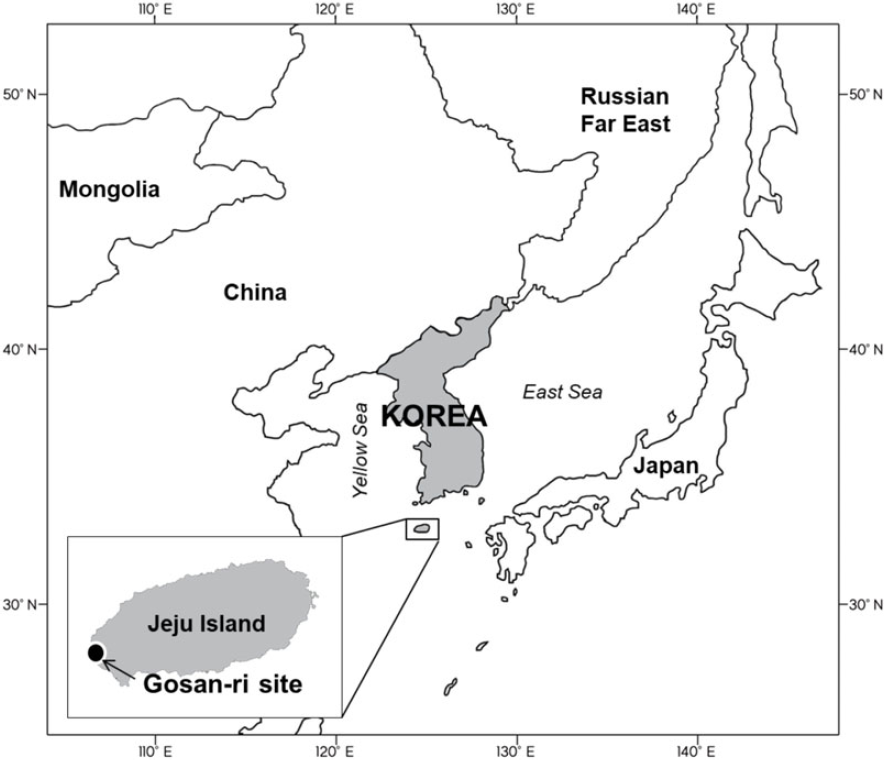
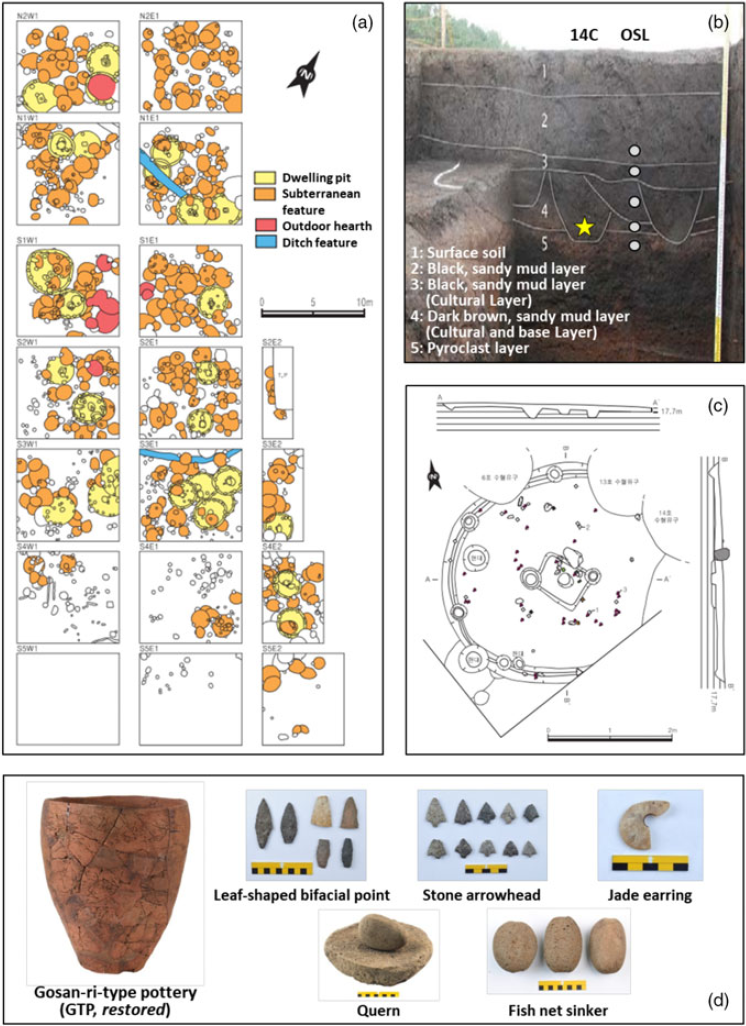
The Gosan-ri site (Historic site No. 412) is located in Jeju Province, Korea (N33°30′55″, E126°16′54″) (Figure 1). During excavations in 2012, as shown in Figure 2a, a total of 341 Early Neolithic remains were uncovered at this site, including dwelling pits, outdoor hearths, and pits as well as 87 pottery pieces and 278 stone artifacts (Go et al. Reference Go, Kim and Bang2014). In addition, the Gosan-ri site was deposited with five soil layers in stratigraphic order. Cultural structures and features were identified during the digging of the soil layers 4 and 5 (Figure 2b and 2c). In particular, GTP was found inside these structures and features. The style of GTP is characteristic: with a height of less than 30 cm, the shape basically resembles a deep bowl with a flat bottom. Surface decoration is mostly plain, and water trim marks are often discovered (Figure 2d). We know that the raw material for GTP is sandy clay and that the herbaceous plant used for tempering was Miscanthus sinensis (Lee et al. Reference Lee, Jang, Ko and Bang2019). While GTP is a unique pottery type in Korea attributed to the Early Neolithic period, it nevertheless shares the use of plant fibers as tempering material with other pottery from the Russian Far East, Japan, and China (Go Reference Go and Cho2014). Stone artifacts such as leaf-shaped bifacial points, stone arrowheads, querns, and net weights associated with GTP are all characteristic of the transition from the Upper Palaeolithic to Early Neolithic period (Figure 2d). Hunting, fishing, and food processing tools comprise more than 70% of the artifacts recovered from this site, suggesting that the occupants of Gosan-ri was mainly subsisted on hunting and gathering (Go et al. Reference Go, Kim and Bang2014).
Location of the Gosan-ri archaeological site on Jeju Island, Korea.

Archaeological excavation of the Gosan-ri site: distribution map of all cultural structures and features (a), photograph of the standard stratigraphic cross-section (b), a typical dwelling pit in which the charcoal or GTP sample was collected (N2W1-DW01) (c) and GTP and the related stone artifacts (d).

14C Dating
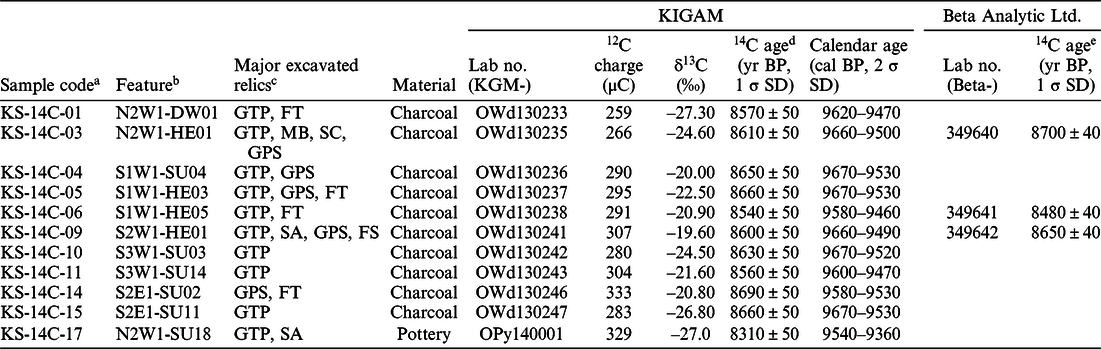
In order to evaluate the absolute date of GTP, we first selected one GTP sample (sample code: KS–14C–17), the length-to-width dimensions of which are approximately 3 × 4 cm, as it contains plant-fiber-temper. We also selected 10 charcoal samples collected from the dwelling pit (DW), hearth (HE), and subterranean feature (SU), in which GTP can be identified. Each sample was directly located on the bottom surface of the cultural structure or feature (Figure 2b); therefore, we assumed that the resulting 14C date would be representative of the time at which GTP was manufactured and used. Three of the charcoal samples (sample code: KS-14C-03, 06 and 09) were divided into two parts for the reliability test. Details of the samples used for 14C dating are listed in Table 2.
14C dates of GTP and their related charcoal samples collected from the Gosan-ri archaeological site.

a Three charcoal samples (sample code: KS-14C-03, 06 and 09) were divided into two parts for the reliability test.
b The abbreviations SU, DI, DW, CL, and HE refer to subterranean features, ditches, dwellings, cultural layers, and hearths, respectively.
c The abbreviations GTP, SA, PST, FT, MB, SC, GPS, and FS refer to Gosan-ri-type pottery, stone arrowhead, pointed stone tool, flake tool, microblade, scraper, grinding pestle and slab, and fish net sinker, respectively.
d All 14C dates were satisfied with the internal quality assurance test using IAEA reference materials (C-7 and C-8).
e These dates were previously reported in Kim (Reference Kim2016).
For 14C dating, the GTP sample was crushed after first removing the surface exposed to the neighboring environment. Chemical pretreatment was carried out using a humic acid extraction method similar to that of a general soil sample because the GTP sample contains a high proportion of organic matter, as Miscanthus sinensis was utilized as the tempering material. In addition, the charcoal samples were chemically treated using the conventional ABA method. The samples were then combusted in an elemental analyzer at over 900°C and converted to graphite using an Fe catalyst and hydrogen gas at 620°C (Hong et al. Reference Hong, Park, Kim, Woo, Kim, Choi and Kim2010a). The 14C age of the samples was measured using 1 MV AMS at KIGAM (Hong et al. Reference Hong, Park, Sung, Woo, Kim, Choi and Kim2010b). Calendar dates for GTP and charcoal samples were calculated using the IntCal13 calibration curve (Reimer et al. Reference Reimer, Bard, Bayliss, Beck, Blackwell, Bronk Ramsey, Buck, Cheng, Edwards, Friedrich, Grootes, Guilderson, Haflidason, Hajdas, Hatt, Heaton, Hogg, Hughen, Kaiser, Kromer, Manning, Niu, Reimer, Richards, Scott, Southon, Turney and van der Plicht2013) in the OxCal program (ver. 4.3) (Bronk Ramsey Reference Bronk Ramsey2009). For the internal quality assurance test, each analytic procedure was monitored using IAEA reference materials (C-7 and C-8). Meanwhile, to ensure the reliability of the resulting 14C ages, the other parts of the three charcoal samples (sample code: KS-14C-03, 06 and 09) were analyzed by Beta Analytic Ltd. (USA).
RESULTS AND DISCUSSION
In order to determine the manufacturing age of GTP, which is considered to be the oldest pottery in Korea, we carried out 14C dating for one GTP sample and 10 related charcoal samples. The results of 14C dating are summarized in Table 2, with the information of the samples and measurement parameters. The values of the 12C charge current, δ13C and 14C date error were distributed within the range of those characteristic values, respectively. In addition, the internal quality assurance test was satisfied with no difference between the reference values of the IAEA materials and the measured values. In addition, the 14C data of three charcoal samples (sample code: KS-14C-03, 06 and 09) used for the reliability test agreed with each other within the error range, comparing our results with those of Beta Analytic Ltd. (USA). Therefore, we concluded that each resulting 14C date itself is very reliable.
In this study, all 14C dates of the 10 charcoal samples matched well with each other. Meanwhile, the 14C date of the GTP sample was evaluated as slightly younger than those of two charcoal samples (sample code: KS-14C-01 and 03) located in the same area as well as all charcoal samples excavated together with GTP (Table 2). This might be due to contamination from younger humic acids in the GTP sample during the chemical pretreatment because the GTP sample was totally crushed in order to conduct humic acid extraction after the physical treatment. Therefore, the 14C dates of the charcoal samples were more suitable than that of the GTP sample for determining the absolute chronology of GTP.
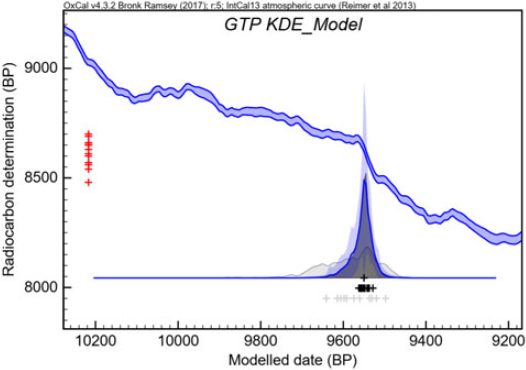
In order to establish the absolute chronology of GTP, we summarized the 14C dates of the charcoal samples using the KDE model in the OxCal program (Bronk Ramsey Reference Bronk Ramsey2017). As shown in Figure 3, the modelled age was distributed within 9610–9490 cal BP (7670–7550 BC) with a 95.4% confidence level under the agreement index Amodel = 150.6%. In addition to 14C dating and TL dating (this study and Table 1), tephra identification and optically stimulated luminescence (OSL) dating were also carried out at the Gosan-ri site. Bae and Kim (Reference Bae and Kim2003) reported that tephra from a huge explosion of the Kikai-Akahoya (K-Ah) volcano in southern Kyushu, Japan dated to ca. 6750 BP was detected above the cultural layer at the Gosan-ri site. Kim (Reference Kim2016) carried out OSL dating to five stratigraphic soil samples (Figure 2b) and evaluated that the Gosan-ri site settled after 9.28 ± 0.94 ka BC (1σ SD) from the OSL date measured from soil layer 4 and was discarded before 4.37 ± 0.42 ka BC (1σ SD) from the soil sample located between soil layers 3 and 4, burying the cultural structures and features, respectively. With these independent dates, we found that our new modelled age is in chronological and stratigraphic order because it is older than the age of the K-Ah tephra and located between the formation and discarding of the Gosan-ri site. Therefore, we concluded that GTP was manufactured and utilized throughout the period of 9610–9490 cal BP (7670–7550 BC) with a 95.4% confidence level.
Summarization of all radiocarbon dates of the charcoal samples related to GTP using the KDE model in OxCal program.

Although GTP is unique to Korea, it has been found widely across Jeju Island, not only the Gosan-ri site but also at Gimnyeong-ri, Gangjeong-dong, Odeung-dong, Oedo-dong, Samyang-dong, and so on (Go Reference Go and Cho2014). In addition, they share a similar culture of stone tools, indicating a transition from the Upper Palaeolithic to Early Neolithic period (Figure 2d). Although the absolute ages have thus far only been measured in the Gosan-ri site, it can be concluded that GTP is the oldest Neolithic pottery in Korea and represents early Korean Neolithic culture, based on the new absolute chronology for GTP and the archaeological contexts between Jeju Island and the Korean peninsula. The absolute age of GTP is over 1500 years earlier than the 14C dates measured from other Early Neolithic sites in the Korean peninsula, such as Amsa-dong, Osan-ri, Bibongri, and so on (Choe and Bale Reference Choe and Bale2002; Bae and Kim Reference Bae and Kim2010).
Because GTP is the oldest pottery used in Korea, it has been assumed that manufacturing skills were imported to Jeju Island through the Korean peninsula from the Russian Far East (Kang CH. Reference Kang2006). However, it is hard to accept that plant-fiber-tempered pottery appeared 4,000 years later in Jeju Island than in the Russian Far East and no plant-fiber-tempered pottery similar to GTP has been observed in the Korean peninsula, considering the long-distance exchange of obsidian raw materials during the Korean Upper Palaeolithic (Lee and Kim. Reference Lee and Kim2015; Kuzmin Reference Kuzmin2019). Recently, Lee et al. (Reference Lee, Jang, Ko and Bang2019) made a more reasonable suggestion that GTP can be regarded as a unique archaeological cultural trait that was established as a local tradition: the use of plant material for tempering GTP was chosen to compensate for the shortcomings of the local clay and high specific gravity minerals under the environmental conditions of the isolated Jeju Island after the early Holocene. Although the absolute chronology of GTP has been well-established as the period within 9610–9490 cal BP (7670–7550 BC) with a 95.4% confidence level, the origin of the manufacturing process of this type pottery is still a controversial issue.
CONCLUSION
GTP is a unique Korean plant-fiber-tempered pottery and has only been found in Early Neolithic sites on Jeju Island. Although most researchers agree that GTP is the oldest pottery from the Korean Neolithic period, its exact manufactured age remained unclear until recently. In this study, to determine the absolute chronology of GTP, we carried out 14C dating for one GTP sample and 10 charcoal samples collected from archaeological structures in which GTP was found in 2012. The measurement conditions, the internal quality assurance test, and the reliability test indicated that each resulting 14C date is very reliable. However, the 14C dates of the charcoal samples were more accurate than that of the GTP sample due to contamination from younger humic acids. From the summary of all 14C dates of charcoal samples using the KDE model, we concluded that GTP was manufactured and utilized throughout the period within 9610–9490 cal BP (7670–7550 BC) with a 95.4% confidence level. This age corroborates the archaeological inference that GTP is the oldest known Korean Neolithic pottery. Although the absolute chronology of GTP has been well-established, the origin of its manufacturing process is still a controversial issue.
ACKNOWLEDGMENTS
This work was financially supported by the Jeju Cultural Heritage Institute, Korea. We are grateful for the detailed comments and suggestions of Yaroslav V. Kuzmin that significantly improved the manuscript.