

Introduction
Retail sales of organic food in the USA grew from $3.6 billion in 1997 to $18.9 billion in 20071. As sales soared, organic foods began appearing in nearly all supermarkets and other mainstream venues like Wal-Mart, Target and Costco. The combination of the widening array of venues selling organic food and growth in consumer demand has placed pressure on retailers, intermediaries and farmers to increase the supply of organic food products. Retailers and intermediaries have felt the effects of farm-level shortfalls of organic products, with the most recent examples being milk, feed and grains. Because of the requirement that land be farmed in accordance with a certifier-approved farming plan for 3 years before its yield can be sold as organic, there is a lengthy lag associated with increasing the total market supply of organic food. Adding to this, historic growth of organic acreage in the USA has been slow, especially when compared to the European Union (EU), which along with the USA makes up about 90% of the worldwide market for organic products.
The natural solution to fill gaps between domestic supply and demand is to import organic products and ingredients, although international trade of organic food is hindered by the lack of harmonization of organic standards across the world. Estimates suggest the USA is a net importer of organic products, but the lack of accounting codes recording the flow of organic food prohibits precise measurement of the value of organic imports2. Beyond these difficulties, the idea of importing organic food is controversial because where and how food is produced matters to a significant portion of organic consumersReference Richter and Lampkin3. The discussion about importing organic foods peaked when Wal-Mart announced plans to increase their organic product line and become a mass-market provider of organic food. Industry spectators questioned whether the presence of a large company such as Wal-Mart might necessitate a growing reliance on organic imports, since domestic production of organic food would likely be unable to respond quickly enough to the dramatic increase in demand for organic food products.
Organic intermediaries, called handlers, have a central role in the industry, through their purchasing of ingredients, and packing, shipping, manufacturing, processing and distributing organic products. Handlers work downstream with farmers and upstream with retailers, and like the canary descending into the mine, are the first to detect problems with the supply of organic products and ingredients. Because they have knowledge of demand at the retail level, handlers can transmit crucial information to suppliers about marketplace needs. By developing personal business relationships with farmers and other suppliers, in times of tight supply, handlers can increase the quantity of organic products available to their firms as well as increase overall market supply by assisting suppliers with the conversion to organic production or undertaking other direct activities with suppliers.
This paper focuses on how relationships between organic handlers and their suppliers, most often farmers or farmer cooperatives, are used for procuring organic products. Using data from a nationwide survey of US organic handlers, conducted by USDA's Economic Research Service, we examine how handlers work to increase the supply of organic products or access to existing organic supply by using various activities with suppliers. To this end, a series of logistic regressions is estimated to identify which characteristics make it more likely that an organic handler will undertake activities with suppliers to affect the supply of organic products.
Background
Similar to their conventional counterparts, organic handlers add value to organic products as they move through the supply chain, plus face the additional requirement of maintaining organic integrity of the goods. Handling of organic products is regulated by the US national organic standards, which specify that the practices include mechanical or biological methods (such as cooking, baking, curing, heating or drying) or otherwise manufacturing, and the packaging, canning, jarring, or otherwise enclosing food in a container that may be used to process an organically produced agricultural product for the purpose of retarding spoilage, or otherwise preparing the agricultural product for market. Entities that handle organic products are exempt from organic certification if they have gross organic sales under $5000.
While opportunities for certified organic handlers have expanded along with retail sales, expansion has not always been easy in the face of numerous constraints to growth. The best available historical information, obtained via industry surveys of processors, indicates that handlers have long faced a lack of reliable supplies of organic raw materials and high transportation and distribution costs, both of which have limited growth of the sector4–6. They have also reported difficulty procuring large enough quantities of organic products to distribute to retailers, locating organic producers to buy from, and gaining access to shelf space in supermarketsReference Dimitri and Richman7.
Newer problems have confronted handlers as increasing numbers of conventional corporations began entering the organic sector, particularly after the implementation of the National Organic Standards in 2002. With their growing presence in the organic sector, these large firms quickly increased market demand for organic ingredients, further burdening already constrained ingredient markets. Access to shelf space for their organic products is less of a problem for large conventional companies than for small organic firms, which have been able to gain shelf space by tapping into their extensive distribution networks. Dean Foods, for example, used their existing distribution arrangement to place Horizon organic milk and Silk organic soymilk in conventional supermarkets across the USA, a feat that Horizon, as an independent organic company, was unable to accomplish. That said, during 2005 and 2006, Horizon and conventional supermarkets experienced shortages of organic milk at current market prices, along with other firms in the marketReference Oliver8.
Plans of the quintessential American store, Wal-Mart, to increase their organic product line and become a ‘mass-market provider of organic food’Reference Edmonds9 heighten old tensions, and signal the prospect of new transformations in the sector. While some in the organic industry see Wal-Mart's presence as an opportunity for growth, others are apprehensive about the possible impactsReference Gogoi10, 11. The benefits of a large player entering the sector are that many people will have access to organic food and that more land will be farmed organically. On the other hand, some argue that, in order to meet the supply needs of Wal-Mart, there will be a shift towards larger organic farms and firms, greater dependence on organic imports, pressure to weaken the USDA organic standards and a downward pressure on prices that will affect domestic producers’ profitsReference Gogoi10, 11.
Regardless of Wal-Mart's success in the organic market, industry forecasters suggest that demand for organic products will continue growing. In order to meet demand in this rapidly increasing market without relying exclusively on imports, the supply of domestically produced organic food must expand. Data indicate that, historically, domestic supply has not grown as fast as demand. In the absence of a direct measure of supply (that is, quantity of production of organic products), an indirect measure (certified organic farmland) is used to indicate farm level changes in the sector. Statistics on organic farmland in the USA, available from 1992 until 200512, indicate that organic acreage increased to slightly more than 4 million acres by 2005 from roughly 935,000 acres in 1992. Growth of organic farmland in the USA increased from 1995 until 2001, and then took a small dip, with growth accelerating after 2002 (Fig. 1)1, 12. Sales data are not available for the years before 1997; from 1997 until 2005, retail sales steadily increased, and the growth rate in retail sales was faster than the growth rate in certified organic acreage until 2004.
The US organic sector: certified organic farmland and retail sales, 1992–2005. Note: Consistent retail sales data are not available for 1992–1996. Certified organic acreage is not available for years after 2005. Acreage data are not available for 1996, 1998 and 1999; those included here are estimated numbers based on trends.

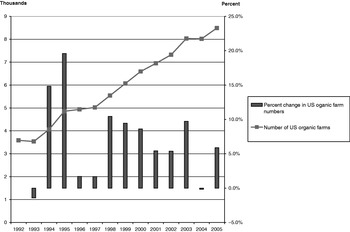
The number of organic farms in the USA has increased at a relatively slow rate, in comparison to the growth in retail sales, from 3587 in 1992 to 8445 in 2005, for an average annual growth rate of 7% (Fig. 2)12. The average certified organic farm was 261 acres in 1992, which decreased to 226 acres per farm in 1997. Organic farms remained roughly the same size from 1997 on, with the average farm having 227 acres in 2005. Translating the increase in acreage and farm numbers into increases in production is not possible: no direct measures of organic farm productivity, either current or historical, are available. The only available indirect measure is that organic farming yields are good, and can come close to or match conventional yieldsReference Liebhardt13.
Number and percent change in US organic farms, 1992–2005. Note: Organic Farm numbers for 1996, 1998 and 1999 were not available. Those included here are estimated numbers based on trends.

Government policies concerning organic production partially account for the slow growth of organic farmland, particularly when viewed in light of increases in European organic farmland; the US government takes a ‘hands-off’ approach towards the conversion from conventional to organic production, while the EU subsidizes the conversion to organic productionReference Dimitri and Oberholtzer14. Other factors are also important. For example, in the USA, many farmers are reluctant to switch to organic production methods. Farmers face a large financial risk as they learn a new way of doing business. During the transition years they face lower yields for crops, which are sold at the lower conventional prices until conversion is completeReference Wolf15, and, practically speaking, farmers do not reach their top organic production level for approximately 5 years of farming organicallyReference Siemon16. Social pressures also influence the decision to convert, in that farmers converting to organic may be criticized by their neighborsReference Wolf15, Reference Siemon16. Additionally, recent high prices for conventional corn and soybeans have made it difficult for industry members to get farmers to convert to organic productionReference Brasher17.
While anecdotal evidence indicates that intermediaries work directly with farmers to increase organic supply, a systematic look at how intermediaries and suppliers work together to increase supply has not taken place until now. The nationwide survey of US organic handlers provides new data that allow an examination of the degree of vertical coordination between these two levels of the organic supply chain. At one extreme, anonymous transactions between handlers and suppliers, or spot market sales, represent the least amount of coordination, in that control on the supplier is completely absent. The other extreme is where goods are produced in a vertically integrated firm, and control over the supplier is complete. In between is a range of different levels of coordination. Handlers and suppliers can form strategic alliances, in which a handler passes specific requirements down the supply chain to farmers without entering a formal contractReference Sporleder18. Alternatively, formal contracts dictate the terms of the transaction between handlers and farmers.
These types of vertically coordinated relationships are common in the conventional food sector. Fresh produce shippers, for example, use coordinated relationships to control quality, to lock in a supply of high quality produce or to make certain commodities such as tomatoes and lettuce available year-roundReference Dimitri19; in order to maintain year-round supplies of lettuce, production shifts from Salinas, California to Huron, California to Yuma, Arizona throughout the yearReference Wilson, Thompson and Cook20. Most fresh market lettuce and carrots, and virtually all processed vegetables, are grown under contracts, which specify seed type, variety of plant, fertilizer and other chemical inputs to use. Contracts for processing vegetables have stringent quality standards and sophisticated quality measurement techniques specifiedReference Hueth, Ligon, Wolf and Wu21.
The organic sector conducts a large portion of its business within the framework of vertically coordinated relationships. Findings of the handler survey indicate that nearly three-quarters of all volume is procured through a coordinated relationship, with half of the volume of organic products bought by organic handlers obtained using written, negotiated purchase arrangements while another 24% was procured through informal contracts or handshake agreements. Thirty-six percent of organic volume is procured in the spot market; in contrast, spot markets for all agricultural commodities (including both conventional and organic commodities) govern approximately 60% of all agricultural transactionsReference MacDonald, Perry, Ahearn, Banker, Chambers, Dimitri, Key, Nelson and Southard22. These results reveal that the organic sector is highly coordinated in regard to the use of formal and informal contracts when compared to the conventional sector. The remainder of this paper focuses on how vertical coordination is used to increase the supply of organic products.
Data and Methods
Data collected from a nationwide survey of organic processors, manufacturers and distributors (called organic handlers) of 2004 practices are used to investigate the handler–supplier relationship. The survey, drafted with input from stakeholders in the organic sector, including certifiers, farmers, processors, academics and representatives from nonprofit organic organizations, was funded by USDA's Risk Management Agency. The final survey instrument was developed in consultation with Washington State University's Social and Economic Science's Research Center (SESRC), and consisted of 59 questions, covering (1) operational and business practices (e.g., facility function, products produced, labels used); (2) basic characteristics of handling facilities (e.g., gross sales, size of facility, years certified organic); (3) relationships with customers (e.g., marketing outlets used, distance to markets); and (4) relationships with suppliers, including types of suppliers, purchase arrangements (contract versus spot market), as well as assistance provided to suppliers and attributes and requirements of suppliers. The questions were designed so that specific research questions—such as which firm characteristics influenced the likelihood of that a handler would assist farmers with the transition to organic production—could be addressed.
The survey was sent to the population of all certified organic handling facilities in 2004, which numbered approximately 2790. SESRC administered the survey in late 2005 and early 2006, using the Tailored Design MethodReference Dillman23. All firms were pre-notified by postcard of the survey. The survey was sent by first class mail, with a $5 incentive, and was followed by multiple carefully timed contacts, including two postcards, a subsequent questionnaire mailing, and phone contacts. Of the total population, 1393 organic handlers completed a 16-page mail survey.
The subsample of interest for this study consists of organic handlers who procure organic products or ingredients through suppliers. Of those handlers returning the survey, 962 reported using certified organic suppliers for procurement purposes in 2004. On average, these handlers purchased organic products or ingredients from 12 individual growers in 2004. To a lesser extent, handlers used marketing or growers’ cooperatives, manufacturers and processors, and wholesalers, distributors or brokers for procurementReference Liebhardt13.
The survey findings confirmed anecdotal evidence that organic firms faced supply problems, including difficulty meeting market demand. Thirteen percent of all handlers experienced critical shortages of at least one of their organic products at some time during 2004, while another 16% reported insignificant shortages as well. Problems in specific sectors are clear: 26% of milk handlers, 22% of feed and grain suppliers, and 16% of fruit and vegetable handlers had critical shortages that year. These product shortages are mirrored by handlers’ difficulties procuring ingredients; 44% found needed ingredients or products in short supply at some point during 2004. The main products in limited supply were coffee, soybeans, milk, seeds, corn and nuts.
The presence of shortages of certified organic products provides firms with an incentive to proactively work to increase the market supply of organic products or their access to organic products. Increasing market supply includes assisting producers to transition to organic methods and working with existing suppliers to increase their supply of organic products, while increasing access to organic products includes developing relationships with suppliers. We posit the likelihood of the following five activities:
1. assist producers in the transition to organic,
2. work with suppliers to increase their production,
3. work with suppliers that have been certified for less than a year,
4. provide technical advice on organic standards or production methods and
5. make smaller (or less than carload) shipment arrangements with suppliers depends on specific firm characteristics, which are classified as handler firm characteristics, buying behavior of the handler and how a handler chooses its suppliers:
• Firm characteristics: Length of time certified organic, the types of suppliers they purchase from, handler function and whether the firm was unable to meet market demand in 2004.
• Handler buying behavior: Whether the firm procures from growers and cooperatives, manufacturers or distributors; whether the firm prefers to buy from local suppliers.
• Supplier characteristics preferred by firms: Supplier knowledge of organic products, whether supplier offers a diverse range of products, length of time the supplier has been certified or product price.
Ex ante, when considering firm characteristics, those that have been certified longer and those with a larger proportion of organic sales are expected to be more likely to work with their suppliers. The rationale underlying this expectation is that these firms that have been certified for a longer period of time ‘know the ropes,’ and understand how to procure organic products. Firms that sell a larger share of organic products have a greater need for organic ingredients, and thus are likely to work to secure needed inputs in advance. Firms that were unable to meet market demand in 2004 are less likely to have close working relationships with their suppliers during the year.
When considering the variables that represent handler buying behavior, we hypothesize that firms that procure from growers and cooperatives (rather than manufacturers or distributors) are more likely to assist their suppliers in the transition to organic. Handlers who prefer to buy from local suppliers are expected to work closely with their suppliers, given that the proximity of the supplier and handler facilitates building working relationships between the two entities.
The final set of variables represents the characteristics firms seek in their suppliers. Handlers who are willing to purchase from suppliers new to the sector or from suppliers who possess a small knowledge of organic products most likely will have to work closely with their suppliers, by providing assistance with the technical aspects of organic products or assisting with the transition to organic. Thus, those who work with new or inexperienced firms are likely to work with their suppliers. The effect of price is hard to predict. Handlers who consider price as one of the most important factors when procuring ingredients may be purchasing ingredients that are, relatively speaking, in abundant supply and thus do not need to develop close relationships with their suppliers. Handlers who are competing for an especially scarce, needed product, such as feed grain, may be less interested in price, and more apt to work with suppliers.
To examine these questions, a series of logistic models was estimated, to independently evaluate the influence of the 14 characteristics on the odds of a handler taking specific measures to affect the supply of organic products. Two categories of activities are considered: activities that handlers engage in to increase market supply and those that increase the flow of products to their firm. A dummy variable for each one of these activities is used as the dependent variable in the models estimated (assists with transition, works to increase supply, works with new suppliers, provides technical assistance and makes less than carload arrangements). Each activity was used by approximately one-third of the handlers who procured organic ingredients in 2004. Whether a handler uses contracts was also specified as a dependent variable, but the model did not predict contract use, and thus was omitted from the paper.
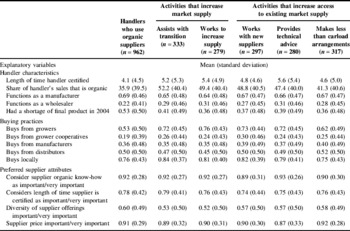
Summary statistics for the independent variables used in the study are in Table 1. The first set of independent variables describes handler characteristics. Continuous variables are the length of time a handler is certified organic and the share of a handler's sales that is organic. Discrete variables represent whether the handler is a wholesaler or a manufacturer, and whether the handler was unable to meet market demand at some point during 2004. Buying practices are discrete variables, and identify handlers who buy from growers, cooperatives, manufacturers or distributors. The final group includes discrete variables capturing four features a handler might view as important when choosing a supplier: supplier knowledge about organic products, offering a diverse range of products, length of time the supplier has been certified or product price.
Descriptive statistics of variables used in the logistic regression series.

Results and Discussion of Research Findings
The decision to undertake specific activities with suppliers can be modeled as a discrete choice where the dependent variable, yi, takes on the value of 1 if the intermediary engages in the particular activity, and takes on the value of 0 if it does not engage in that activity. We assume the logistic form for F(.), resulting in the logit model. Based on the logistic distribution, the probability of engaging in a specific activity is
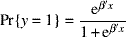
for j=1, while the probability for not working with the supplier is
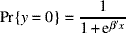
Either probabilities (P) or the odds ratio, P/(1−P), can be estimated in the logistic model. We chose to estimate the odds ratio rather than probabilities for ease of exposition. The odds ratios reported in the results are the ratios of the likelihood of undertaking the activity by a handler with a specific characteristic (such as a wholesaler) to one without that characteristic (is not a wholesaler). If the estimated odds ratio is 1, then the likelihood of engaging in the activity is equally likely for the two cases, for example, firms that are wholesalers as compared to firms that are not wholesalers. If the estimated odds ratio is greater than 1, then wholesalers are more likely to engage in the activity, when compared to handlers who are not wholesalers; an estimated odds ratio less than 1 indicates that wholesalers are less likely to engage in the activity.
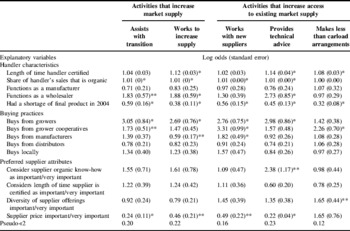
The characteristics that influence the likelihood that a handler will work to increase market supply or to increase access to existing market supply are relatively uniform across the activities (Table 2). Handlers who are wholesalers are more likely to work with suppliers to increase both market supply and supply of products flowing to their firm, when compared to handlers who are distributors, brokers or manufacturers. Handlers who have been in business longer are more likely to engage in activities with suppliers (with the exception of assisting suppliers with conversion to organic), as are those with a higher percentage of organic sales.
Logistic regression results: likelihood of handlers undertaking different activities with suppliers.

* Significant at 95% level.
** Significant at 90% level.
Note: An odds ratio of 1 indicates that the variable is equally likely in both groups. An odds ratio greater than 1 indicates that the variable is more likely in the group undertaking the activity than the overall population, while an odds ratio of less than 1 indicates that the variable is less likely in the group undertaking the activity.
With regard to handler buying behavior, handlers who buy from growers or grower cooperatives are more likely to engage in the various activities (both market supply and supply of products flowing to their firm). The effect of preferring to buy from local suppliers did not have a statistically significant impact on whether a handler worked with their suppliers.
In general, handlers do not seek suppliers with specific attributes, including organic knowledge or having a wide range of products available, nor do they consider the length of time a supplier has been certified. However, price did matter: handlers who find product price important are less likely to work with their suppliers, in comparison to handlers who reported that price was not one of the most important parts of the transaction. While these handlers may be purchasing products that are in abundant supply, another possible explanation is that handlers who find price important are willing to risk not being able to find their needed ingredients rather than locking in supplies in advance, suggesting that handlers may pay a premium when working with their suppliers.
The most interesting finding is that handlers who were unable to supply enough of their product to the market in 2004 are less likely to engage in activities with suppliers to increase market supply or shore up their access to needed ingredients. This finding may be due to the cross-sectional nature of the data, where handlers who experienced shortages in 2004 were not working with their suppliers in 2004. Clearly handlers with shortages of product would have an incentive to undertake efforts to shore up supplies of needed ingredients, and additional data examining the behavior of handlers over time would be useful in this case, where we could test to see if handlers ‘learned’ from the past; in other words, did the handlers who experienced shortages in 2004 begin working with their suppliers and largely erase their shortages?
Conclusion
The supply chain for organic products has been affected by rapid growth in consumer demand, which has increased the quantity of organic products flowing from farms to retail outlets. Periodic shortages of some organic products, such as milk, feed and grains, have accompanied growth in the market. The profits of handlers—who procure, add value and then sell their products—are affected by these shortages, suggesting that firms that wish to remain viable have an incentive to develop close working relationships with their suppliers. This paper indicates that some firms are more likely to work with their suppliers: wholesalers, firms that buy from producers or grower cooperatives, firms who have been in business longer and those with a larger share of sales coming from organic products. One surprising finding is that a relatively small share of handlers assists farmers with the transition to organic; growth in this aspect of the handler–supplier relationship would benefit the organic sector as a whole.
The findings further suggest that handlers face a trade-off, in that working closely with suppliers may require handlers to focus less on the price of the product and more on the relationship with their suppliers. Further research into this aspect of the supplier–handler relationship would provide insight into how prices are determined in the organic market; that is, whether handlers pay higher prices in order to secure needed products, whether producers accept lower prices in order to conduct business with a reliable company and how handlers select suppliers.
One important question that remains unanswered is how the growing presence of conventional firms in the organic market affects the supply chain for organic products. If handlers who have been acquired by large agribusiness firms and those who are independent organic firms could be identified, tests could be conducted on differences in strategies for sourcing products. On the one hand, independent firms likely have ongoing relationships with suppliers, and should have at least part of their sourcing needs covered. These firms presumably have an extensive knowledge of organic products. In contrast, large agribusiness firms are more experienced with securing large quantities of supply, yet possess less knowledge of organic products. Understanding how these two groups adapt to growing demand may provide insight into long-term strategies for prospering in a competitive environment.