Introduction
Social welfare entitlements in the UK are subject to heated public debate and increasingly restrictionist policy initiatives. As the UK is continuing to experience high net migration (ONS, 2014), the link between migration and welfare remains troublesome for some sections of the native population, which is reflected in political and media discourses. In Europe, cross-national studies show that migrants are being singled out by the general public as the least deserving of welfare when compared with older people, people with disabilities and the unemployed (van Oorschot, Reference van Oorschot2006, Reference van Oorschot2008). It is important therefore to consider the principles which influence people's judgements of welfare deservingness.
Although there is a wealth of empirical data gauging the general public's attitudes to welfare (e.g., Baumberg, Reference Baumberg, Park, Bryson and Curtice2014; Dwyer, Reference Dwyer2000; Reeskens and van Oorschot, Reference Reeskens and van Oorschot2013), so far we know very little about migrants’ own views on welfare. Based on a qualitative study, this paper explores the interplay between desert, identity and need principles in welfare deservingness judgements expressed by Polish migrants residing in London at the end of the 2000s.
In the aftermath of the 2004 EU enlargement, the UK experienced a large wave of Polish migration. Looking at the post-war UK censuses, one can note an increase in Polish-born UK residents from 58,000 in 2001 to 676,000 in 2011 (Okólski and Salt, Reference Okólski and Salt2014: 12). Okólski and Salt point out a coincidence of circumstances such as an oversupply of a well-educated, young workforce in Poland at the time, opportunities offered by the UK labour market and the opening of the UK labour market to citizens of the new EU member states which facilitated this unprecedented migration flow. Others emphasise the complexity of individual motivations, including non-economic ones, which underpin Polish migration to the UK (Eade et al., Reference Eade, Drinkwater and Garapich2006; White, Reference White2011).
This paper begins with a discussion of the literature on perceptions of migrants’ (un)deservingness to welfare, and then proceeds to review what we know about migrants’ own views in this respect. The gathered empirical material is then put into the context of immigration and welfare policies at the time of the fieldwork and key policy developments since. The findings section is structured around the normative framework centred on the notion of desert and its interactions with notions of identity and need. The article concludes with implications for policy and research.
Reconciling welfare deservingness with mobility
In the classic Marshallian framework underpinning Western European welfare capitalism, social rights play an essential role in paving the way to full substantive citizenship. This is achieved by guaranteeing a decent standard of living and welfare to all citizens regardless of their market value (Marshall, Reference Marshall1950). Apart from the political and sociological dimensions, citizenship also has a crucial moral grounding exemplified by social norms (Dwyer, Reference Dwyer2004). Such norms may or may not correspond with the legal framework of citizenship but they play a crucial role in legitimating a social contract between the individual and the state. The most commonly invoked norms concerning the allocation of scarce public resources, known as the criteria of social justice, are equality, need and merit (Miller, Reference Miller and van Parijs2003). The notions of merit, desert and equity are closely related, and all convey the principle of proportionality between outputs and inputs. The difficulty in specifying which criteria are ‘appropriate’ in given circumstances makes the process of distribution of welfare a contentious subject. In particular, scholars have diverging views on the feasibility of reconciling welfare provision with ethnic diversity in modern societies.
Some authors are strongly attached to the idea of common nationality as the necessary foundation for a successful welfare state (Miller, Reference Miller and van Parijs2003, Reference Miller2008; Putnam, Reference Putnam2007). One line of argument links an increase in the ethnic diversity of societies with a decrease in the societal trust necessary for redistribution to function (Putnam, Reference Putnam2007; Miller, Reference Miller2008). Furthermore, Miller (Reference Miller and van Parijs2003) argues that people's sense of justice is derived from the culture of the group to which they belong, and subsequently we cannot assume that principles of social justice will converge across groups or that cultural groups will be willing to practise social justice towards outsiders.
On the other hand, multiculturalists generally do not find any links between the growth of ethnic diversity and a decrease in social solidarity, rejecting the claim that the majority withdraws its support for the welfare state because of the presence of ‘strangers’ amongst them (Banting, Reference Banting2005; Banting and Kymlicka, Reference Banting, Kymlicka, Banting and Kymlicka2006). Conceptually, this position is rooted in a liberal defence of multiculturalism as an ideology, a set of policies and a characteristic of modern societies that has a value in itself (Kymlicka, Reference Kymlicka1996: 121). For Kymlicka (Reference Kymlicka1996: 83), freedom of choice and individual autonomy, the key tenets of liberalism, are enabled by culture, rooted in one's language and tradition.
Another diverse set of theoretical literature explores the phenomenon of decoupling the constitutive elements of ‘traditional’ national citizenship – formal status, rights/practice and identity. Such scholars challenge the exclusivity of a nation as the primary and only referent of a citizen's identity and emphasise a multiplicity of identities (e.g., Bauböck, Reference Bauböck2009; Benhabib, Reference Benhabib2004). This signals a possibility of conveying citizenship, and thus also social citizenship, beyond national identity. Yet this literature does not deal sufficiently with the contested nature of social rights. In the case of access to welfare, it assumes that citizens would democratically endorse redistribution regardless of ethnic and cultural bonds. Yet hosts may not view migrants’ contributions and social engagement in their society as positive as they may lead to job competition and social dumping of employment conditions, e.g., standards and wages (Thomas, Reference Thomas2002). In short, established citizens may deny newcomers recognition of their social rights in the host society.
Arguably the tension between welfare and mobility is heightened in the neoliberal social order which makes economic activity, regardless of pay and conditions, a prime duty of any individual (Bauman, Reference Bauman1998; Jordan and Brown, Reference Jordan and Brown2007). Such a model labels those unable or unwilling to participate in the labour market as failing to rise up to the ‘good citizen’ ideal. Such exclusionary processes increasingly affect the disadvantaged sections of the settled population. They may also fuel resentment towards immigrants.
Popular perceptions of welfare deservingness
Studies show that public perceptions of deservingness, ‘who should get what and why’, are a key factor legitimating the welfare system (van Oorschot, Reference van Oorschot2000: 34). People may favour different principles of social justice depending on the type of welfare provision in question. Based on an analysis of the 2008 European Social Survey, Reeskens and van Oorschot (2013) found that most Europeans favour the principle of equality for unemployment benefits and are split between equality and equity for pension provision. Other cross-national studies suggest that it is the principle of desert that enjoys the greatest public support, a premise that rewards ought to be linked proportionally to contributions (Marshall et al., Reference Marshall, Swift, Routh and Burgoyne1999). The reasons behind such attitudes are complex and unclear. For instance, some studies find that individual preferences are driven both by self-interest and political ideology with lower socio-economic groups more often endorsing the principle of need, whilst higher groups prioritise equity (Reeskens and van Oorschot, Reference Reeskens and van Oorschot2013). Yet others find no correlation between class and attitudes to welfare (van Oorschot, Reference van Oorschot2000; Kumlin, Reference Kumlin, Dalton and Klingemann2007).
Alongside debates about the ‘appropriate’ criteria of social justice, there is some evidence of shared ranking on a welfare deservingness scale of different societal groups across European societies. In such rankings, migrants are seen as those least deserving of welfare assistance compared to older people, people with disabilities and the unemployed (van Oorschot Reference van Oorschot2006; Reference van Oorschot2008). Van Oorschot (Reference van Oorschot2000) argues that deservingness perceptions are affected by the lack or presence of shared identity alongside such factors as level of need, control over one's situation, docility and potential for reciprocity. However, if it was purely down to shared identity, we would expect to see an almost complete refusal by the host population to recognise migrants’ social rights. Yet this is not the case. It has been shown that the majority of Europeans are prepared to grant social rights to migrants if certain conditions are fulfilled such as acquiring formal citizenship status (35%) or making contributions through taxation for at least a year (41%) (Reeskens and van Oorschot, Reference Reeskens and van Oorschot2012: 126). Only a small proportion of Europeans (around 7.5%) wants a full exclusion of migrants from access to the host welfare states and a similarly small proportion (16.5%) opt for unconditional access. Notwithstanding migrants’ lowest ranking of deservingness, over time culturally and ethnically distinct migrant groups become included in the boundaries of host welfare communities (Bommes and Geddes, Reference Bommes, Geddes, Bommes and Geddes2000). Arguably, the perceived contributions of migrants play a crucial role in redrawing the boundaries between excluded and included.
Several qualitative studies conducted in the UK, gauging the host population's attitudes to migrants in the context of welfare provision, suggest that the issues around desert are at the core of people's anxieties (Cook et al., Reference Cook, Dwyer and Waite2012; Dench et al., Reference Dench, Gavron and Young2006). Cook et al. (Reference Cook, Dwyer and Waite2012) argue that hostility towards A8Footnote 1 migrants expressed by some residents of one northern English city was not down to xenophobic attitudes. The established residents stressed that prior contributions to the community are necessary before a sense of collective entitlement is validated.
A recent review of UK survey evidence linked public concerns about migrants’ access to welfare with a decline in support for the welfare system in general and with declining confidence in the government's ability to handle redistribution in a fair way (Duffy and Frere-Smith, Reference Duffy and Frere-Smith2014). The authors argue that such disillusionment stems from the diminishing role of the principle of desert in favour of need in redistributive policies in the UK (Duffy and Frere-Smith Reference Duffy and Frere-Smith2014; see also Baumberg, Reference Baumberg2012). The review also found that a record of contributions through taxation is key for endorsing migrants’ deservingness to host welfare by the majority. Yet the polls show that migrants’ contributions are perceived as low. Moreover migrants are perceived as getting unfair priority in accessing public goods and services on the basis of their greater needs. In addition, the general public is concerned that immigration puts pressure on the supply of health care, schools and housing which is deemed to have low elasticity (Duffy and Frere-Smith, Reference Duffy and Frere-Smith2014). This suggests that perceived imbalances in the normative principles of deservingness are at the heart of public concerns.
Migrants’ views on welfare deservingness
The literature examining migrants’ own views on deservingness in the context of host welfare states is sparse. Existing studies show a strong attachment to a conditional view of welfare, favouring the principle of desert (Dench et al., Reference Dench, Gavron and Young2006; Dwyer, Reference Dwyer2000; Timonen and Doyle, Reference Timonen and Doyle2009; Willen, Reference Willen2012). Migrants voice their attachment to reciprocal or contributory mechanisms of accessing public goods and are usually against charitable hand-outs based on need (Dench et al., Reference Dench, Gavron and Young2006; Dwyer, Reference Dwyer2000). This view holds even in the case of access to health care by resource-deprived, undocumented migrants facing exclusion from the host public health care system (Willen, Reference Willen2012). Willen (Reference Willen2012: 819) describes such attitudes as a ‘fundamental desire to participate in the generalized relations of reciprocity that define social personhood and inclusion within a broader moral community’. This complexity of attitudes, which often expose a lack of self-interest, stresses the importance of the distinction between legal entitlements and ‘vernacular moral arguments about deservingness’ (Willen, Reference Willen2012: 812; see also Feather, Reference Feather2003).
Timonen and Doyle (Reference Timonen and Doyle2009: 172) described their migrant respondents as ‘highly “commodified”’ because they made limited use of welfare benefits in Ireland and tended to link their well being and aspirations with their performance in the labour market. Similarly, Jordan and Brown (Reference Jordan and Brown2007) found that migrants perceived work as a central tenet, legitimating their presence in the UK. Thus, although the authors did not set out to explore migrants’ attitudes to welfare, they effectively arrived at similar conclusions. They found that migrants embraced the commodified realities of neoliberal labour markets. The authors noted that migrants’ views reflected New Labour's rhetoric about the economic benefits of migrant workers and chimed with the government's endorsed labels of ‘good migrant’ and ‘good citizen’.
Data in the policy context
The data presented in this paper were gathered during fieldwork conducted in London in 2007 and 2008. Polish migrants’ views on welfare deservingness were elicited as part of a study exploring migrants’ engagement with the British welfare benefit system, social housing and public health care services (Osipovič, Reference Osipovič2010). The participants comprised twenty-nine men and thirty-three women whose ages ranged from twenty-three to seventy years old. At the time of interview, the overwhelming majority had resided in the UK for less than five years.
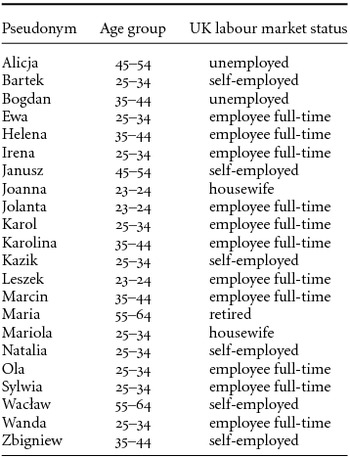
The intention was for the sample to reflect the diversity of the socioeconomic circumstances of Polish migrants. It was assumed, following the grounded theory method (Strauss and Corbin, Reference Strauss and Corbin1998 [1990]), that such differential positioning may impact on respondents’ engagement with British public services and potentially their normative views. Participants were differentiated by labour market status, receipt of welfare benefits, family circumstances and other variables. They resided throughout London and were recruited at various institutions such as Polish churches, playgroups, day centres for homeless migrants and job fairs. Informed consent was obtained before each interview. Table 1 presents selected characteristics of the participants quoted in the paper.
Selected characteristics of participants quoted in the paper

Source: Social citizenship practices of Polish migrants in London (Osipovic, 2010).
The fieldwork was conducted in a particular policy context. At the time of the 2004 EU enlargement, the New Labour government decided to open the UK labour market to A8 country nationals. It introduced a requirement for workers to register their employment with the Workers Registration Scheme (WRS) which was in place until 2011. The WRS was a transitory measure requiring workers to pay a registration fee and accrue twelve months of continuous employment before being granted the full rights of an EU citizen in the UK. Effectively the scheme, combined with other legislation, acted as a barrier to accessing the welfare system for economically inactive A8 migrants and those who failed to register their employment (Currie, Reference Currie2009). At the time of the fieldwork, participants faced a complex system of multiple benefits, including means-tested tax credits and Housing Benefit. At the same time, the government was keen to increase labour market participation by benefit recipients. It introduced a number of ‘welfare-to-work’ schemes whereby claimants had to take up an offer of employment or training in order to retain access to certain out-of-work benefits (Lupton et al., Reference Lupton, Hills, Stewart and Vizard2013).
There has been a number of important policy developments and labour market changes since the fieldwork was conducted. The global financial crisis further worsened terms and conditions of employment in the UK labour market sectors where migrants traditionally filled labour shortages. Welfare policy moved in a more punitive direction with greater conditionality and sanctioning. The Welfare Reform Act 2012, passed by the Conservative and Liberal Democrat Coalition government, paved the way for a major reform of the welfare system. Some of the facets of the reform include combining a number of different benefits under one Universal Credit, introducing an ‘under-occupancy penalty’ for Housing Benefit and caps on the overall amount of money that can be claimed by a household (Bell, Reference Bell2012). The workfare element of the system has been strengthened by compelling certain groups of claimants to undertake unpaid work placements in exchange for continuing access to out-of-work benefits (Groom, Reference Groom2013).
Further restrictions were imposed on unemployed EU migrants’ access to UK welfare benefits (Kennedy, Reference Kennedy2014). These included a three-month threshold before a jobseeker is entitled to claim unemployment benefit, putting a time limit on unemployment benefit for jobseekers unable to provide evidence of a prospect of finding work, introducing a minimum earnings threshold for employment to be taken into account by welfare authorities and removing access to Housing Benefit for EU jobseekers. Withdrawing family benefits from EU workers whose children reside abroad, and other restrictions, are being considered (Kennedy, Reference Kennedy2014).
One can argue that these measures were introduced in response to hostile public opinion towards immigration and the rise of political support for the anti-EU and anti-immigration United Kingdom Independence Party (UKIP) in the run up to the 2015 UK general elections. A key assertion in the rhetoric deployed by politicians lists access to benefits as a strong motive of EU migration to the UK. The UK Prime Minister described it as a ‘magnetic pull of Britain's benefits system’ (Cameron, Reference Cameron2014). Hence there is an assumption that EU migrants are a burden on the UK welfare system and an expectation that the scale of EU immigration will be curtailed by restricting access to benefits. Such claims remain unfounded as it has been shown that migrants from new EU countries have made a positive fiscal contribution to the UK budget (Dustmann and Frattini, Reference Dustmann and Frattini2014). The main motives of Polish migrants coming to the UK are employment related (Okólski and Salt, Reference Okólski and Salt2014) and thus unlikely to be impacted by changes to welfare eligibility rules.
Arguably, the changed policy landscape has not diminished the relevance of the empirical material gathered in 2007 and 2008. This is because normative views are not just a simple reflection of policy. Participants were asked mainly about their general, abstract views on welfare which are likely to be independent of fast-changing policy context. Furthermore, as the majority of participants were newcomers to the UK, and a substantial number had no or only basic knowledge of English, their views were insulated from UK policy discourse. Finally, participants were mainly critical of welfare, which indicates that it is policy that has caught up with public attitudes rather than the other way round. Arguably, normative views of participants presented in this paper are an outcome of their biographical experiences and thus warrant attention in their own right. At the very least, these data could provide a useful baseline for a repeat study.
During the interviews, participants were asked about their general views on welfare deservingness through questions about the duties of Polish migrants in the UK, conditioning access to welfare, perceptions of equal treatment and the concept of a ‘good citizen’. Participants were also asked about three policy areas – helping Polish homeless migrants, claiming UK family benefits when family members reside in Poland and conditions imposed by the WRS. Perceptions of the author-researcher, who is a native speaker, as being ‘from Poland’ resulted in participants’ wariness in disclosing details about their situation in Poland. In contrast, they seemed to be at ease talking at length about their experiences and principles of engagement with London welfare institutions.
The analysis evolved side by side with data collection, as migrants with differential experiences in the UK such as workers, housewives, single parents, homeless and older people were targeted in the course of the fieldwork. The interviews were conducted in Polish by the author, recorded, transcribed and analysed using multi-stage coding with the help of Atlas.ti software. In order to preserve the original meaning, the initial stage of coding was done in Polish, with the latter stages in English. The translation from Polish to English at the coding stage, rather than at the raw data stage, allowed the author to stay as close as possible to the expressed meaning, whilst at the same utilising the mainly Anglo-Saxon analytical categories of social citizenship and social justice theories when interpreting participants’ narratives. Nevertheless, juggling two languages during analysis made the pursuit of an elusive relationship between language and meaning more challenging (Temple and Young, Reference Temple and Young2004).
Dimensions of desert – work and law abidance
Interviewees embedded legitimisations of their claims towards the British welfare state in a multifaceted notion of desert. Work and law abidance were the two core contributions which, in the eyes of participants, paved the way to Polish migrants’ unequivocal belonging to the British welfare community. Social rights were viewed as a ‘pay off’ for the contributions migrants made to British society.
I think it's not fair to come here and make use of public services without working. But to come here, to work, to see how things are, then [using public services] is a sort of a pay off, I think. A pay off, because you reside here; you are entitled because you work legally, pay all the taxes. It is the same as it would have been in Poland, we pay [taxes] here and someone is making use of [benefits and services] which are funded also from our money. (Natalia)
Participants emphasised mainly current contributions. Yet in a few cases the long-view perspective was evoked by mentioning past collective contributions of Polish soldiers fighting for Britain during World War II and potential future contributions of children born to Polish migrants in the UK.
Work was perceived as the ultimate way to advance up the social ladder. Similar to findings by Timonen and Doyle (Reference Timonen and Doyle2009) and Jordan and Brown (Reference Jordan and Brown2007), participants were entirely focused on looking for better opportunities in the labour market, rather than ‘benefits or a dole’ (Jolanta), as a way to achieve desired living standards. They had clear ambitions of gradual upward mobility. Even working at levels below their qualifications was valued and seen as a springboard to a better job. For example, Leszek who worked as a shelf stacker in one of the big supermarkets felt that ‘it is not stunning work but I do something, I can say that I am not idle, and this means a lot’. Encouraged by positive feedback from British employers, participants emphasised that ‘Poles simply respect work’ (Karol). This suggests that paid work was perceived as having not only monetary but also moral value.
Yet work was not seen as a goal in itself. It served as a basis for raising claims to other rights. The moral justification for accessing welfare was stronger in the case of people experiencing in-work poverty, especially when juxtaposed with the high costs of living in London. For instance, Maria maintained that people who contribute to society through paid work should be given priority in accessing limited public resources such as social housing.
First and foremost, in my modest opinion . . . help should be available to those who work. One ought to help them if there is a need, because they work, they do something. (Maria)
Furthermore, there was a perception, perhaps in contrast to participants’ experiences in Poland, of an abundance of jobs in the UK at the time of the fieldwork. Not taking advantage of available jobs was seen as piggybacking on other members of society:
I work hard, pay taxes, whilst someone else doesn't work and claims various benefits. Why? There is work. If we can find work, then so can an English person, true? Or other Polish person who comes here. (Natalia)
Those who were perceived as not able to work due to circumstances beyond their control, such as illness or disability, were exempt from the strict contributory criterion. Some other types of work, such as housework and caring responsibilities, were recognised by some female participants as productive activities, ultimately benefiting the wider society and thus should be counted as contributory.
It would be difficult to say for example to some woman ‘you are not entitled [to benefits] because you have never worked or you haven't worked sufficient number of years.’ Because she worked her due at home, looking after children. Because as I said, this is also work; it is called domestic work, but it is also work. (Wanda)
In contrast, those who were perceived as able to work, but ‘choosing’ not to, received outright condemnation. Participants were particularly harsh in assessing the deservingness of fellow Polish migrants who found themselves jobless and homeless in Britain. They were seen as shying away from work and were labelled as leading life on the streets ‘out of their own wish’ (Maria, Kazik). As this was considered incompatible with a worldview upholding the centrality of work as having a moral value and a passport to other rights, such ‘young, healthy’ (Ola) individuals were encouraged to ‘look in the mirror, go home and get to work, today’ (Maria). Furthermore, in line with van Oorschot's (Reference van Oorschot2000; Reference Banting, Kymlicka, Banting and Kymlicka2006) findings about the importance of docility and compliance in welfare deservingness judgements, homeless Polish migrants were seen as reluctant to accept help to change their situation, further lowering their deservingness to welfare in the eyes of participants.
Desert as the main normative principle of welfare deservingness was endorsed equally by participants facing different socioeconomic circumstances in the UK. For instance, participants who had experienced homelessness in London also agreed that contributions are essential for accruing the right to access public goods, even if they had not been able to adhere to this normative principle in practice.
It can't be that you are a complete scoundrel and you come here to trip, drink and do nothing. ‘Give me benefits and a flat’. Well, no, that's stretching it too far. (Bogdan)
They offered a nuanced assessment of the causes and consequences of their situation, signalling the role of structural factors such as lack of affordable housing and precarious terms of employment, which made them vulnerable to homelessness. In addition, some were battling addictions and serious health problems, circumstances which diminished their control over whether and when they could work.
The salience of work-based desert applied equally to other migrant groups. Many participants found the rationale of ‘migration as seeking asylum’ difficult to comprehend, especially if it was decoupled from work. Thus asylum seekers were perceived as those who do not want, rather than cannot, work. This resulted in views that they get an ‘unfair’ priority in access to social housing in the UK. Participants were unaware of the UK government-imposed work restrictions that asylum seekers faced (Jordan and Brown, Reference Jordan and Brown2007).
A grown man comes, you know, claims asylum and (says): give me the flat, give me the food, give me the clothes. Give me. And what does he do himself? What does he do here for this country? This is shame. This is shame, in my opinion, I would be ashamed . . . I know for sure that they don't work, my dear. They get flats and they get them furnished. (Maria)
Alongside work-based deservingness, participants also emphasised their law-abiding nature and a moral duty to obey the law of the host country. In particular, payment of taxes was seen as an essential contribution, opening up access to rights. This was related to work as it distinguished between the deservingness of workers doing documented and undocumented work. Many participants noted that the British welfare system has no responsibility to help Polish undocumented workers in Britain when they experience an accident or injury. Bartek noted that only those persons who made some effort, as he put it, to ‘activate’ themselves in Britain should be allowed access to public goods. Others stated that operating in the black economy is tantamount to showing a lack of ‘loyalty’ (Karolina) to the system and free riding:
When you don't want to pay taxes, you keep working illegally or something like that, in the black economy, then automatically regardless whether you live in England or Poland or somewhere else it would be difficult for me to say that someone like this has a right to public services. (Karolina)
On the other hand, some participants acknowledged that often migrants have no other choice but to do undocumented work and bear all the risks associated with illness, accident or unemployment. Janusz and Helena, an older married couple with some experience of undocumented work, remarked that the responsibility to help such workers should rest partly with employers as they directly benefit from undocumented workers. They linked it with the principle of desert, albeit directed at a different benefiting group, in this case employers:
During the time when you are not registered, your employer should help . . . because you work for him and he does not pay any taxes for the worker, I mean he pockets it and afterwards if accident happens or something then . . . he washes his hands of it. (Helena)
Equally important was adhering to laws which are designed to protect the welfare system from abuse. Participants generally endorsed the premise of the WRS. The requirement to register employment was seen as preventing a ‘pathological situation . . . of coming for benefits’ (Jolanta). Thus, some participants perceived the twelve-months continuous work condition as a sensible and fair ‘safeguard for the British’ (Sylwia) and a ‘trial period’ during which, as Joanna put it, ‘they have to check whether you are a potential future citizen.’
In general, participants maintained that one should observe a sequence of settling in, paying some taxes before taking something out of the system. Participants stated that Poles would ‘rebel against’ (Irena) and ‘would feel bad about’ (Kazik) the situation if, for instance, Ukrainian or Russian newcomers to Poland had access to Polish benefits straight away. Zbigniew noted that such rights are acquired upon fulfilment of some duties. He considered applying for benefits in the first few months after arrival as morally dubious.
They are here two, three months and they already take benefits. They haven't yet got their hands dirty working and already they take benefits. If you want to take something from this state, first you have to give something to this state. You have to identify somehow with this country. (Zbigniew)
All in all, participants felt that social rights have to be earned or ‘worked through’ (Wacław, Leszek) and that it was ‘logical that one has to work for the right to benefits’ (Marcin). They agreed that there should be a ‘limit’ (Ola), a condition in order to protect the system from abuse by mobile individuals jumping from country to country. This suggests the salience of not only present but also prior contributions in participants’ normative framework of welfare deservingness.
In the light of an overwhelming support for a vesting period, only a minority expressed some concerns about the arbitrary cut-off points which such policies create. For instance Bogdan, who had experienced periods of homelessness and intermittent work, reflected that the contributions of those who accrued just eleven months work may be dismissed on a technicality. However he immediately qualified his view:
I do not judge, they have such a system . . . it cannot be that some scum comes, works for a couple of days on the building site, receives three payslips, sleeps in the park and goes to the council ‘give me a flat because I am entitled to’. It cannot be like this. But on the other hand, it is so inflexible . . . Well, ‘dura lex sed lex’Footnote 2 (Bogdan)
Whilst emphasising a duty to obey the law, participants did not always agree with the moral premises on which the laws were based (Feather, Reference Feather2003), even if the law was designed to benefit them directly. A number of participants linked their entitlement to British social rights to their status as EU citizens. Yet other participants perceived some of the rights conferred by the EU as normatively dubious. In particular, there was a negative view of the possibility of Polish migrant workers, whose family members resided in Poland, claiming certain British family benefits.
My brother's friend after a few weeks here asked for children's birth certificates to be sent to him in order to take benefits, despite the fact that his wife and children are in Poland . . . To be honest, I do not entirely approve of such cases. I treat it as some kind of abuse. (Ewa)
The reluctance to endorse the EU law on claiming benefits by transnational workers was a surprising finding. Even though as Cook et al. (Reference Cook, Dwyer and Waite2012) found, Eastern European migrants ‘proactively engage’ their EU citizenship, it seems that the moral validation of that engagement is rooted in their contributions to the British society and not merely in the legal framework of the EU. Perhaps participants perceived EU citizenship as a rather weak basis on which to build their claims. The dominance of market mechanisms combined with democratic deficits and lack of common identity make the EU, as Mariola put it, more about ‘economy than society’.
Discussion
The participants offered a complex understanding of the role of national identity in deservingness judgements. On the one hand, participants did not apply any identity ‘credit’ when judging Polish nationals’ rights to British welfare. This is despite participants’ strong attachment to Polish culture and language, prevailing sense of Polish national identity and a reluctance to naturalise. On the other hand, identity played some mediating role in judging the deservingness of the host population. Native residents were seen as having a greater moral stake in accessing welfare provisions. Kazik stressed that ‘we shouldn't compare ourselves fully with English as we are guests here’. A few participants acknowledged the negative aspects of the newcomers’ presence on the native British, such as pressure on wages and public services. For instance, Ewa admitted that her English work colleague ‘is somewhat right’ to feel resentful if newcomers with greater needs are given priority in access to social housing. Yet arguably, the greater stakes of the hosts do not stem from their identity per se, but from recognition of their greater multigenerational contributions which cannot be matched easily by newcomers. This exposed a complex and nuanced relationship between identity and desert. Furthermore, participants also sensed that although identity may be largely spurious when they make deservingness judgements, it may be important to others, especially native residents, and feared that in a ‘welfare crunch’ non-native residents will lose out first on their welfare protection.
The issues of belonging were thoroughly explored in this research but are beyond the scope of this paper to outline fully (see Osipovič, Reference Osipovič2010). However, it is important to mention that, aside from showing strong attachment to Polish national identity, participants enthusiastically embraced local identifications in their communities of residence in London. The narratives also show that participants had a clear ideal of a ‘good citizen’, which had a distinctly humanistic and non-national character akin to ‘being a better . . . man’ (Wanda). It described someone who cared about the common good and not just about personal interests and possessions. Taking part in the life of the local community and respecting public resources was deemed an important element of being a ‘good citizen’. Yet, unlike in the case of work and law abidance, participants did not link directly and unequivocally their claims to British social rights with strengthening British local ties or the ideal of a ‘good citizen’. Nevertheless, this may change in future and would benefit from further research.
Finally, despite work being a core element of desert-based claims to welfare, labour market participation was absent from the characteristics of being a ‘good citizen’ voiced by participants. Although, as this and other studies suggest (Gilmartin and Migge, Reference Gilmartin and Migge2011; Jordan and Brown, Reference Jordan and Brown2007; Timonen and Doyle, Reference Timonen and Doyle2009), migrants comply behaviourally with the UK government-endorsed doctrine of centrality of work, normatively they may not view economic activity, understood in a strict sense of labour market participation, as a necessary element of a ‘good citizen’ ideal. Moreover, the normative endorsement of a flexible worker's persona, in its ideal type, does not fit easily with the premises of (social) citizenship. This is because citizenhood presupposes a sense of social obligation which is absent from a pure market player's logic (see Osipovič, Reference Osipovič2010: 127–152). Thus, one needs to remain mindful about potential differences between the top-down and bottom-up conceptualisations of a ‘good citizen’, as well as between normative and cognitive levels of analysis. Overall, the complexity of interplay between desert and identity requires further exploration.
Need, as a principle of welfare deservingness, was seen as problematic because of its subjective nature and a tendency to undermine the importance of contributions. Participants were torn between the moral imperative of ensuring the basic minimum needs of fellow human beings and the problem of tending to potentially limitless human desires. It has been shown that criterion of desert does not apply beyond a certain level of ‘social minimum’ (see e.g. Gatskova, Reference Gatskova2013). Even participants who disapproved of helping Polish homeless migrants were prepared to grant financial help if a person would otherwise experience hunger. However, at the same time Jolanta warned ‘needs can be understood differently . . . one person may need only food and another person may need luxuries’.
Furthermore, unconditional welfare was seen as contentious because it depreciated the monetary and moral value of work and decreased working incentives. However, a minority of respondents were at the same time concerned about the high conditionality of access to social welfare in England. Alicja, who was grappling with a difficult housing situation, described it as ‘odd, inhumane’ especially when contrasted with the image of UK as a ‘rich state’ having sufficient resources to offer such help.
A minority of respondents considered that, although some individual cases fail on the contributory principle, they should not be denied help on humanitarian grounds and supported the work of charities trying to help such individuals. Several participants reflected on systemic causes of hardship. Ola remarked that ‘system is system but people are people’ and it is difficult to make clear-cut judgements when one looks at individual cases. This signals potential complex links between the notion of desert and need.
Conclusion
The findings point to the supremacy of desert-based criteria of welfare deservingness but, at the same time, show nuanced linkages with both identity and need. Interviewed Polish migrants paid close attention to effort cues when judging other people's welfare deservingness. Conditioning access to welfare on working, payment of taxes and obeying the law was applied to both in-group and out-group members. Even when identity seemed to have influenced deservingness judgements, as in the case of native British people, participants emphasised the greater contributions of native residents from the long-term perspective. The supremacy of the desert criterion was qualified by acknowledgement of the principle of need when experienced needs were grave or arose as a result of conditions beyond individual control. Yet in other instances the principle of desert was built into the needs narrative. For example, there has been a suggestion that employers have a moral duty to help their undocumented workers in times of need because they benefit directly from undocumented workers’ contributions.
This study has some limitations. The use of qualitative interviews allowed the capture of a nuanced interplay between the different criteria that people apply when judging welfare deservingness. Yet the open nature of questions prevented the researcher from testing any regularities in patterns of opinions. In particular, the findings suggest a rather weak role of identity in deservingness judgements, but it remains unclear how identity interacts with other factors influencing the judgements. Therefore, the study would benefit from a systematic follow-up in order to gauge whether or not the findings were generally applicable as well as to note any potential attitudinal changes.
The study also provides some pointers for research and policy. If, as this and other studies suggest, people look for effort cues before passing deservingness judgements (Petersen, Reference Petersen2012), researchers ought to include more multidimensional categories in surveys when seeking to rate the deservingness of different societal groups. Migrants are not a homogenous group. It seems inappropriate to use a generic migrant label as a proxy for describing a ‘needy’ group as is common practice in social surveys (see e.g. van Oorschot, Reference van Oorschot2006: 23). Arguably, migrants may have greater needs because they are older, ill, single parents or unemployed and not because they are migrants per se. Since we already know that people rank deservingness of such groups differently, it is important to provide such information alongside migration status. Likewise, some information about migrants’ contributions ought to be provided to aid (or rather in this case to complicate) popular judgements. Finally, views of migrants on welfare deservingness ought to be publicised. Policy makers are responsible for eliminating the barriers that prevent some migrant groups from contributing and participating fully in the host society. Media ought to offer balanced information about migrants’ contributions. Even if there is not much appetite for recognition of migrants’ inputs, their normative views on welfare ought to be understood to allow for any potential similarities between migrants and hosts to emerge. This is a necessary step in the complex task of examining the causes of social anxiety about welfare.
Acknowledgement
This paper draws on findings from the doctoral research project Social citizenship practices of Polish migrants in London. The research was supported by the UK CEELBAS/ESRC doctoral studentship, which I gratefully acknowledge. I would like to thank the participants for their time and willingness to share their views. Last but not least, thank you to the two anonymous reviewers for their thorough and constructive comments which were immensely helpful.