Introduction
When we use speech to communicate our emotional states, we typically rely, amongst other things, on both linguistic cues (the semantics of the words) and paralinguistic cues (how we express the words) in order to convey the message (e.g., Hall & Schmid Mast, Reference Hall and Schmid Mast2007; Kruger, Epley, Parker & Ng, Reference Kruger, Epley, Parker and Ng2005). This provides our interlocutors with multiple sources of information to help them understand how we feel. For most adults, it is obvious that the words an interlocutor utters may bear completely different meanings depending on how and in which context they are uttered. For instance, the exclamation “What a day!” bears two completely different meanings if said with a positive tone of voice compared to a negative tone of voice. In such a case, the semantics of the utterance alone does not provide enough information for an interlocutor to interpret the emotional state of the speaker. However, by interpreting the tone of voice with which the exclamation is uttered, for instance positively or negatively, the interlocutor can understand that the speaker had either a good day or a bad day. In other cases, such as when one says “I am glad!”, semantics will bear emotional information on its own. The linguistic and paralinguistic emotional information of utterances will at times be consistent and have the same valence (e.g., in the example above, “I am glad!” would be expressed with a positive tone of voice), which facilitates the interpretation of the speaker's emotional state. However, the linguistic and paralinguistic messages can also be discrepant (e.g., in the example above, “I am glad!” expressed with a negative tone of voice such as sadness), which makes utterances sound inconsistent and makes correct interpretation of the true emotional state more difficult.
The ability to perceive and interpret paralinguistic cues and combine their meaning with the meaning of other cues such as semantics (especially when the paralinguistic cues are inconsistent with the semantics) is an essential social skill to function in society (e.g., Schroeder, Kardas & Epley, Reference Schroeder, Kardas and Epley2017). When an utterance lacks linguistic emotional meaning, it is essential to understand other cues, such as the emotional paralinguistic cues of an utterance or the context into which it is expressed, to determine a speaker's emotional state. Furthermore, in cases when the emotional linguistic and paralinguistic cues are discrepant, understanding that meaning can be found beyond semantics is essential in order to detect lies, understand jokes and sarcasm, for instance. However, this ability to appraise the meaning of linguistic and paralinguistic cues simultaneously when determining an interlocutor's feelings is not innate. Rather, it is a skill that is acquired during childhood and an adult-like ability is reached only around the age of eight to ten years (e.g., Friend, Reference Friend2000; Friend & Bryant, Reference Friend and Bryant2000; Solomon & Ali, Reference Solomon and Ali1972). Typically developing children before this age can understand feelings in others, but when linguistic and paralinguistic cues are discrepant, younger children tend to show a semantic bias (e.g., Bugental, Kaswan & Love, Reference Bugental, Kaswan and Love1970; Bugental, Kaswan, Love & Fox, Reference Bugental, Kaswan, Love and Fox1970, Morton & Trehub, Reference Morton and Trehub2001). Namely, when the spoken words and, for instance, the tone of voice used to express an emotional message are discrepant, younger children will rely mainly on the semantics to determine their interlocutor's feelings (e.g., Bugental et al., Reference Bugental, Kaswan and Love1970; Friend, Reference Friend2000; Friend & Bryant, Reference Friend and Bryant2000; Morton & Trehub, Reference Morton and Trehub2001; Solomon & Ali, Reference Solomon and Ali1972). Thus, regardless of whether an interlocutor utters “I am so happy for you!” with a consistent (e.g., happy) or with a discrepant (e.g., envious) tone of voice, younger children will most likely interpret that their interlocutor is happy for them.
When it comes to bilingual children, it is unclear how their language profile may influence how they interpret linguistic and paralinguistic cues. Indeed, bilingual children have been shown to outperform monolingual peers on other social tasks such as theory of mind (e.g., Goetz, Reference Goetz2003; Kovács, Reference Kovács2009; Nguyen & Astington, Reference Nguyen and Astington2014; Rubio-Fernández & Glucksberg, Reference Rubio-Fernández and Glucksberg2012), perspective-taking (e.g., Fan, Lieberman, Keysar & Kinzler, Reference Fan, Liberman, Keysar and Kinzler2016; Genesee, Tucker & Lambert, Reference Genesee, Tucker and Lambert1975; Greenberg, Bellana & Bialystok, Reference Greenberg, Bellana and Bialystok2013; Hsin & Snow, Reference Hsin and Snow2017), and various social tasks using non-verbal referential cues (e.g., Verhagen, Grassmann & Küntay, Reference Verhagen, Grassmann and Küntay2017; Yow, Reference Yow2015; Yow & Markman, Reference Yow and Markman2011a; Yow, Li, Lam, Gliga, Chong, Kwek & Broekman, Reference Yow, Li, Lam, Gliga, Chong, Kwek and Broekman2017). Yet, little is known regarding their developmental course when it comes to combining semantics and prosodic cues to understand other people's emotional state.
One notable exception is a study by Yow and Markman (Reference Yow and Markman2011b). In their study, the authors investigated the use of paralinguistic cues by 4-year-old monolinguals and bilinguals and found that bilingual children were better than their monolingual peers at using tone of voice to identify emotion in sentences when the semantics and tone of voice were discrepant. Thus, it appears that bilinguals show an advantage in this social task as well. However, in Yow and Markman's study, an important premise was that when adults process discrepant semantical and prosodic cues, they will base their judgement on the prosody. For that reason, the correct answer in their study was the emotion expressed in the tone of voice, but never the emotional message that was carried in the semantics of utterances. Consequently, the participants were not instructed to identify either the valence of the sentences or the valence of the tone of voice specifically. Rather, they were asked to judge the talker's emotional state without stipulating on what basis the judgement should be done. Yet, a study by Misono, Mazuka, Kondo and Kiritani (Reference Misono, Mazuka, Kondo and Kiritani1997) showed that when the semantics of an utterance is discrepant with the tone of voice, adults will show a bias towards the prosody in less than 35% of the cases. Thus, assuming that adults ultimately base their judgement on tone of voice when the semantics of the utterance is not consistent might not be completely accurate, at least when it comes to adult monolinguals. Although Yow and Markman's results show that participants typically prefer to base their judgement on prosody when they are not instructed to focus on a specific cue (e.g., either word content or tone of voice), it is unclear what the advantage that they found in bilinguals was driven by. Yow and Markman interpreted bilinguals’ superior identification of emotional tone of voice (even when the message was discrepant) as a sign of a quicker developmental course regarding the decline of the semantic bias. However, in light of Misono et al.’s (Reference Misono, Mazuka, Kondo and Kiritani1997) results, a different explanation may be possible. It could be the case that the bilinguals in Markman and Yow's study were better at interpreting prosody in discrepant trials because they relied more heavily on the emotional prosody overall, or in other words, because they were prosodically biased, and consequently (due to the design of the study) performed in a way that revealed itself as an advantage.
In order to explore this possibility, the current study asked children with different levels of bilingualism to identify the linguistic and paralinguistic emotionality of spoken words using a design that would allow us to investigate whether they were typically biased towards a type of cue (semantics or prosody). Our design was an adaptation of the one used in Min and Schirmer (Reference Min and Schirmer2011) where positive, negative or neutral words were all expressed in a positive, negative and neutral manner to create consistent and discrepant trials. Importantly, in half the trials, the task was to identify the valence of the word itself (semantics), and in others, the task was to identify the valence of the tone of voice (emotional prosody). Since a bias occurs when an answer is based on the distractor rather than on the target (e.g., answering “positive” when the task is to identify the tone of voice for the word “happy” expressed with a negative tone of voice), this design not only allowed to investigate if children showed a semantic bias, but also if they showed a prosodic bias (e.g., answering “positive” when the task is to identify the word content for the word “angry” expressed with a positive tone of voice). Thus, with the current design, we could investigate both types of bias by determining how often the participants would base their answer on the distractor in discrepant trials (i.e., a bias towards prosody is reflected by a prosody-based answer when the task is to identify the semantics of an utterance, and a bias towards semantics is reflected by a semantics-based answer when the task is to identify the prosody of an utterance). This aspect was particularly important in order to determine if bilinguals’ superior performance on discrepant prosodic trials was due to an understanding of emotional prosody earlier during development, or if it was driven by a bias towards prosody. In the same manner that a bias towards semantics occurs when participants base their answer on the semantics of an utterance even though they are instructed to identify the prosody of the utterance, a bias towards prosody occurs when participants base their answer on the prosody of an utterance even though they are instructed to identify the semantics of the utterance. Because the critical time period around which the semantic bias begins to change is across a large age span, participants in this study were aged from six to eight years old to cover the ages at around which the semantic bias has been found to begin to disappear in earlier studies (e.g., Friend, Reference Friend2000; Friend & Bryant, Reference Friend and Bryant2000; Solomon & Ali, Reference Solomon and Ali1972).
Bilingualism is a complex concept that consists of many different aspects (Luk, Reference Luk2015; Luk & Bialystok, Reference Luk and Bialystok2013), and both exposure to languages (e.g., Fan et al., Reference Fan, Liberman, Keysar and Kinzler2016; Poulin-Dubois, Blaye, Coutya & Bialystok, Reference Poulin-Dubois, Blaye, Coutya and Bialystok2011) and use of languages (e.g., Iluz-Cohen & Armon-Lotem, Reference Iluz-Cohen and Armon-Lotem2013; Vega & Fernandez, Reference Vega and Fernandez2011; Yow & Li, Reference Yow and Li2015) seem to be important when investigating the performance of bilinguals. Therefore, in the current study, the children's linguistic profile was based on both their level of exposure to and on their use of an additional language. Moreover, instead of dividing the participants into distinct groups of monolinguals and bilinguals, we chose to treat their language profile as a continuous variable. Indeed, it is increasingly argued that bilingualism should not be treated as a dichotomous variable (e.g., Luk & Bialystok, Reference Luk and Bialystok2013) since dichotomizing bilingualism does not reflect the reality of bilingualism and decreases its ecological validity. Defining bilingualism or a bilingual individual is rarely a straightforward dichotomous classification. Instead, most people are more or less bilingual, more or less exposed to another language, and use another language more or less frequently.
Based on the study by Yow and Markman (Reference Yow and Markman2011b) and on studies exploring the performance of bilinguals on social tasks, we hypothesized that children would become more accurate at identifying the emotional prosody of utterances as a function of their age and of their language profile. Namely, we predicted that the performance of participants in the discrepant condition where the task was to identify the tone of voice would improve as the participant became older and had a higher level of bilingualism. Furthermore, the design of the task allowed to explore two types of biases: a prosodic bias and a semantic bias. By being able to explore whether a prosodic bias existed, we also expected to be able to explain whether the better performance on discrepant prosodic trials was due to an advantage per se, or whether a prosodic bias laid behind the participants’ superior performance. Finally, based on previous research on the semantic bias, we predicted that the semantic bias of the participants would decrease as a function of their age. More precisely, we predicted that the number of semantically biased answers they would provide would decrease as they became older (Bugental et al., Reference Bugental, Kaswan and Love1970; Friend, Reference Friend2000; Friend & Bryant, Reference Friend and Bryant2000; Morton & Trehub, Reference Morton and Trehub2001; Solomon & Ali, Reference Solomon and Ali1972).
Method
Participants
Seventy-four participants originally participated in the study. However, due to a technical problem, one participant was excluded, resulting in a sample of 73 participants aged 6.01 to 8.92 years (M = 7.54, SD = .77, 38 girls). The study was approved by the regional ethics committee and legal guardians provided informed written consent prior to data collection. The Language and Social Background Questionnaire (LSBQ: Luk & Bialystok, Reference Luk and Bialystok2013) was used to gather information on the participants’ language profile. All participants were reported to have Swedish as their first or one of their first languages, but the other languages varied (see Table S1 in Supplementary Materials for a list of the participants’ various additional languages). A score of bilingual experience was calculated for each participant based on the questions on exposure to and use of languages in section C of LSBQ. These 31 questions cover a wide range of situations (at home, in the community, when watching television, when reading, etc.) and people the child interacts with (with parents, siblings, maternal grand-parents, paternal grand-parents, neighbours, friends, etc.). The questions cover both the language used by the child when s/he interacts with specific persons as well as the language specific people use when addressing the child in these various situations, and also which language these people interact in together when the child is not directly addressed. Answers are provided on a scale ranging from 1 to 7 where 1 means that only Swedish is used for communication, 4 means that both Swedish and another language are used equally, and 7 means that only another language than Swedish is used. To build the bilingualism score in this study, a mean value was calculated from the questions for each child (scores above 4 were inverted). This score ranged from 1.03 to 4 (M = 2.09, SD = 0.89) and reflected the participant's level of bilingualism. A score of 1 meant that the participant was exposed to and used only one language, while a score of 4 represented an equal exposure to and use of two languages equally. The bilingualism score did not correlate with age (r(71) = .037, p = .755) or with socioeconomic status based on the parents’ highest completed education level (M = 3.36 on a range from 1 to 5, SD = 0.75; rs(71) = .011, p = .465).
Stimuli
The stimuli words were selected from lists created during a pilot study where words had been produced by 127 children aged 8 to 11 years based on various emotional and neutral categories. In a first step, the 20 most frequently produced words for the categories positive, negative, and neutral were selected (for a total of 60 words). Secondly, they were rated by 26 independent adult raters on a valence and arousal scale using the Self-Assessment Manikin Scale (SAM; Bradley & Lang, Reference Bradley and Lang1994). The SAM scale consists of three different scales (valence, arousal, dominance) using non-verbal pictorial answer alternatives to rate a given stimulus. For our purposes, only the valence and arousal scales were used with five answer alternatives. Then, six words from each category were selected based on their rated valence, and were matched on their rated arousal, frequency, and number of letters. The different categories differed in term of valence (F(2, 17) = 367.08, p < .001), but did not differ in terms of frequency (F < 1) or number of letters (F < 1). The negative category differed significantly from the positive and neutral categories in term of arousal (F(2, 17) = 10.32, p = .002), which is unavoidable given the nature of the categories themselves (Fossati, Hevenor, Graham, Grady, Keightley, Craik & Mayberg, Reference Fossati, Hevenor, Graham, Grady, Keightley, Craik and Mayberg2003).
The 18 words were then recorded while uttered in a positive (happy), negative (angry) and neutral tone of voice by one female and one male speaker. Recordings were made with the software Audacity (version 2.1.2) with a Blue Yeti microphone on cardioid mode at a recording rate of 16bit/48kH in a recording booth. Noise was reduced in Audacity, and files were cropped to remove silence before or after the word. All files were evened out to the same decibel level. The prosody of the words was validated using 6 adult raters. After listening to the word, raters were asked if they thought that the prosody sounded happy, angry, or neutral. A score of 1 was given when the rater answered in accordance with the intended prosody, and a score of 0 was given if the rater did not answer according to the type of prosody that the stimuli was supposed to represent. An average of these scores was calculated for each stimulus and all words that had an inter-rater agreement lower than .8 were recorded again. The new recordings were validated by 5 new raters and all reached inter-rater agreement of at least .8. The final set of stimuli consisted of 108 utterances based on the 18 selected words.
Design
The 108 recordings were divided into four blocks with valence of word content, valence of tone of voice, congruence between word content and tone of voice, and gender of speaker balanced across the blocks. For two of the blocks, the task was to identify the valence of the word content while ignoring the tone of voice, and for the other two blocks the task was to identify the valence of the tone of voice while ignoring the word content. The tasks were presented in a counterbalanced order. This resulted in four versions of the experiment to which participants were randomly assigned. The experiment was programmed and presented in SuperLab (version 5) and presented on a MacBook Air.
Procedure
Participants were met individually in an interview room on campus, at their school, or in a quiet area of their home. The experimenter explained the task and discussed with the child how valence can be interpreted based on various cues by demonstrating with different utterances. Congruent and discrepant utterances with different valences were expressed by the experimenter, following which the experimenter discussed with the child how valence can be expressed in either words themselves or in the way in which they are uttered. When the child showed that s/he understood the concept, s/he started with six practice trials (three trials for the word content task and tone of voice task each). During the practice trials, the experiment continued the discussion with the child in order to control that s/he understood the task and the difference between determining valence based on the word and on the tone of voice. The words used in the practice trials were not used for the experimental trials. After the practice trials, participants continued with the 108 experimental trials. The participants responded by pressing cartoonish faces representing a happy (positive), neutral or angry (negative) face placed on the keyboard. The placement of the positive and negative faces were counterbalanced between participants while the neutral face was always in the middle. The child was rewarded with a small gift upon completion.
Results
In order to determine if age and bilingual experience could predict a better performance on tone of voice trials in general, a multiple regression analysis with age and bilingual experience as predictors was performed on accuracy for the tone of voice trials. The regression model was significant (R2adj = .16, F(2, 70) = 7.69, p = .001) where age (β = .3, p = .007), and bilingual experience (β = .29, p = .01) significantly predicted accuracy on the tone of voice trials. However, since consistent and discrepant trials pose different demands on the participants, the consistent and discrepant tone of voice trials were analysed separately to explore whether the effect of age and bilingual experience were the same on both types of trials. A multiple regression analysis with age and bilingual experience as predictors showed that the regression model for the consistent tone of voice trials was significant (R2adj = .12, F(2, 70) = 5.71, p = .005) with age (β = .3, p = .009) significantly predicting accuracy, and bilingual experience approaching significance (β = .22, p = .056). As for the regression model for the discrepant tone of voice trials where age and bilingual experiences were used as predictors, it also was significant (R2adj = .1, F(2, 70) = 4.94, p = .01) with age (β = .24, p = .038), and bilingual experience (β = .25, p = .028) significantly predicting accuracy on the discrepant tone of voice trials.
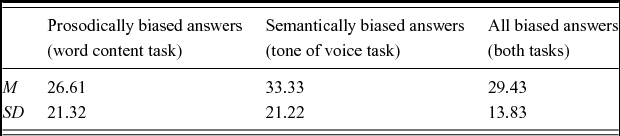
Next, we investigated whether the prosodic and semantic biases could be predicted by age and bilingual experience. However, a bias is reflected not by accuracy per se, but rather by the mistakes that are biased by the distractor. For instance, a prosodic bias would be said to occur in discrepant trials if a participant mistakenly answers based on the tone of voice when the task is to identify the word content. Conversely, a semantic bias can be said to occur if a participants answers according to a discrepant word content when the task is to identify the tone of voice. These types of biased mistakes are the interesting and relevant mistakes for an analysis of biases, and non-biased mistakes where participants wrongly answered based on neither the word content nor the tone of voice in discrepant trials were thus counted as irrelevant errors and excluded from the analyses where we explored biases (e.g., if the provided answer was “negative” for a trial where the word content was neutral and expressed with a positive tone of voice). Since the number of non-biased mistakes varied, the total number of trials that were included for each participant also varied. Thus, in order to make the scores of the different participants directly comparable, accurate answers and biased answer were converted into percentages of total trials per participant (see Table 1 for averages and standard deviations).
Averages (in percent) and standard deviations across all participants for the proportion of biased mistakes for each task (identification of word content or of tone of voice) and for both tasks together (non-biased mistakes are not included).

To begin with, biased mistakes made on both word content and tone of voice trials were analysed together with a multiple regression analysis where age and bilingual experience were the predictors in order to understand the general performance of participants on discrepant trials. The regression model was significant (R2adj = .09, F(2, 70) = 4.36, p = .016) where age did predict (β = −.33, p = .005), but bilingual experience (β = .08, p = .492) did not significantly predict, the proportion of biased mistakes in general. Since the design allowed for two different types of biases to occur and that we aimed to explore them individually, the trials for each task (identify the word content or the tone of voice) were analysed separately with multiple regression analysis, also using age and bilingual experience as predictors. The regression model for the proportion of biased mistakes made on the word content trials (a mistake thus reflecting a prosodic bias) was significant (R2adj = .11, F(2, 70) = 5.23, p = .008) where age did not (β = −.21, p = .061), but bilingual experience did (β = .3, p = .009) predict a higher percentage of prosodically biased mistakes. The regression model for the proportion of biased mistakes made on the tone of voice trials (a mistake thus reflecting a semantic bias) was also significant (R2adj = .07, F(2, 70) = 3.52, p = .035) where the independent variables individually did not significantly predict the proportion of semantically biased mistakes (age: β = −.22, p = .063; bilingual experience: β = −.2, p = .077).
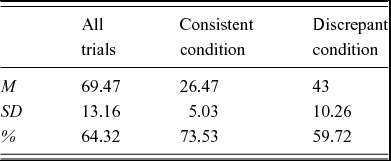
Since the task that the participants completed measured their ability to extract information from semantics or emotional prosody while ignoring a distractor, it implies that not only was their capacity to accurately identify emotional valence of stimuli tapped into, but also that their executive functions were recruited during the task. Several studies have shown that bilinguals have an advantage in tasks which employ executive functions, especially when an element of conflict is present (e.g., Bialystok, Reference Bialystok2015; Costa, Hernández, Costa-Faidella & Sebastián-Gallés, Reference Costa, Hernández, Costa-Faidella and Sebastián-Gallés2009; Esposito, Baker-Ward & Mueller, Reference Esposito, Baker-Ward and Mueller2013; Incera & McLennan, Reference Incera and McLennan2016; see Barac, Bialystok, Castro & Sanchez, Reference Barac, Bialystok, Castro and Sanchez2014 for a review). In order to control that our results did not simply reflect the participants’ executive functions, which were necessarily recruited during the task, we conducted a multiple regression analysis with age and bilingual experience as predictors on the accuracy of participants on all trials regardless of condition (consistent, discrepant) and of task (word content, tone of voice), on consistent trials regardless of task, and on discrepant trials regardless of task (see Table 2 for averages, standard deviations, and percentage of correct answers). Since the aim of these analysis was to explore the participants’ executive functions and not biases in particular, the tasks (word content, tone of voice) were not analysed separately and all types of mistakes were included. A general advantage in executive function should be reflected by higher accuracy in general and an advantage in executive function where conflicting information is presented should be reflected by better performance in the discrepant condition.
Averages, standard deviations, and percentage for correct answers for all trials (possible score range: 0–108), for trials in the consistent condition (possible score range: 0–36), and for trials in the discrepant condition (possible score range: 0–72) across tasks.

The regression model for accuracy on all trials was significant (R2adj = .18, F(2, 70) = 8.75, p < .000) where age predicted accuracy (β = .44, p < .000), but bilingual experience did not (β = .04, p = .686). The multiple regression for all consistent trials was significant (R2adj = .11, F(2, 70) = 5.36, p = .007) where age (β = .35, p = .003), but not bilingual experience (β = .1, p = .396) predicted accuracy. Finally, the multiple regression for all discrepant trials was also significant (R2adj = .14, F(2, 70) = 6.61, p = .002) where age (β = .4, p = .001), but not bilingual experience (β = .01, p = .934) predicted accuracy. In other words, an overall bilingual advantage was not found when combining both the word content and the prosody tasks presented in the discrepant condition.
Discussion
The current study investigated how children's level of bilingual experience affects emotional processing in semantics and prosody by exploring semantic and prosodic biases. First, we replicated the bilingual advantage found by Yow and Markman (2010b) even when using a different procedure. More specifically, the level of bilingualism, along with age, predicted accuracy on trials where the task was to identify the prosody of the utterance. However, the effect of bilingual experience was statistically significant for discrepant trials only, but age was significant for both consistent and discrepant trials. This is in line with previous studies showing a bilingual advantage only in conditions where an element of conflict is present (e.g., Bialystok, Reference Bialystok2015; Costa et al., Reference Costa, Hernández, Costa-Faidella and Sebastián-Gallés2009; Esposito et al., Reference Esposito, Baker-Ward and Mueller2013; Incera & McLennan, Reference Incera and McLennan2016). The age and bilingual advantage found in prosody was explored further by taking a closer look at the two biases that could be explored with our study. We found that bilingual experience, but not age, predicted a larger prosodic bias as a child's bilingual experience score was higher. Surprisingly, our results did not find that the semantic bias decreased as a function of age only, but as a function of increased age and bilingual experience together. However, this may be due to our participants all being younger than nine years, and some studies have found that the bias disappears only by age 10 (e.g., Friend, Reference Friend2000).
Put together, our results suggests that while participants became more accurate at identifying prosody as a function of their age and bilingual experience (at least for the discrepant trials), the advantage that was found for increased bilingual experience is at least in part due to a tendency to use prosody to identify valence regardless of the task, which can be interpreted as a prosodic bias. Indeed, whereas the prosodic bias did not increase as a function of age, it increased as a function of bilingual experience. Furthermore, our findings are unlikely to reflect an advantage in executive functions (which is often found in bilinguals), as accuracy increased with age in the discrepant conditions, but did not increase as a function of bilingual experience. Additionally, bilingualism could not predict a smaller bias for both types of targets (word content and tone of voice), which would have been expected if the results had reflected enhanced executive functions.
Our results are interesting as they suggest that rather than having a bilingual advantage, bilingual children show a different developmental course. More specifically, our study suggests that the more a child is exposed to and uses an additional language, the more s/he will rely on prosody to interpret the emotional state of an interlocutor and will have more difficulty in ignoring it. Our results are nonetheless in line with the study by Yow and Markman (Reference Yow and Markman2011b) as we also found that bilingualism predicted better accuracy when identifying emotional prosody, even though we used a slightly different design. Additionally, our findings clarify why a bilingual advantage can be found when using prosody to identify the valence of utterances where word content and tone of voice are discrepant. Namely, we suggest that the level of exposure to and use of an additional language will lead children to use a different type of cues to identify the emotion of an interlocutor. Given that interpreting prosody is a social task (Schroeder et al., Reference Schroeder, Kardas and Epley2017), our results are also in line with studies showing that bilingual children are better at social tasks such as perspective taking (e.g., Fan et al., Reference Fan, Liberman, Keysar and Kinzler2016; Genesee et al., Reference Genesee, Tucker and Lambert1975; Greenberg et al., Reference Greenberg, Bellana and Bialystok2013; Hsin & Snow, Reference Hsin and Snow2017) and theory of mind (e.g., Goetz, Reference Goetz2003; Kovács, Reference Kovács2009; Nguyen & Astington, Reference Nguyen and Astington2014; Rubio-Fernández & Glucksberg, Reference Rubio-Fernández and Glucksberg2012).
A possible confound behind our findings is that degree of bilingualism correlated with poorer vocabulary understanding. If this is the case, it could be that the more a child is exposed to and uses another language, the less s/he understands the semantics of words. In our study, this would imply that children with a higher degree of bilingualism were not as distracted by the word content during the tone of voice tasks and relied on tone of voice during the word content tasks due to poorer word understanding. Although it is a possibility that we cannot completely rule out, it is unlikely that children with a higher degree of bilingualism had a poorer understanding of the words used for the stimuli in our study. The words that we used were previously generated by another group of children that were around the same age as our participants. The group of children that generated the words that we used came from a heterogeneous background with similar social and economic conditions where both monolinguals and bilinguals were represented. Furthermore, all words that were selected came from the top 20 most frequently produced words for each emotional category. Also, degree of bilingualism on its own was not sufficient to predict a smaller semantic bias, suggesting that the children, regardless of their bilingual experience, understood the words and were also biased towards them. Nonetheless, while it is unlikely that these common words were not understood by children with a higher degree of bilingualism in the current study, the theoretical possibility remains, and will need to be examined more closely in future studies.
In our study, we asked participants to specifically identify the emotional valence of the word content or of the tone of voice when they were inconsistent. This task recruits not only the participants’ sensitivity to emotional cues, but also their executive functions. However, by analysing their biased answers specifically, we found that bilingualism on its own could predict prosodically biased mistakes but not semantically biased mistakes. Furthermore, while bilinguals tend to show an advantage in tasks with an element of conflict (e.g., Bialystok, Reference Bialystok2015; Costa et al., Reference Costa, Hernández, Costa-Faidella and Sebastián-Gallés2009; Esposito et al., Reference Esposito, Baker-Ward and Mueller2013; Incera & McLennan, Reference Incera and McLennan2016), we could not find this advantage in discrepant trials in general, or in discrepant trials for each individual task. If a bilingual advantage in executive functions had influenced performance on this task, it should have been found at least in one of the discrepant conditions. However, only age predicted better performance in the discrepant condition, as would be expected.
The prosodic bias found in participants with a higher degree of bilingualism suggests that different levels of bilingualism will lead to different strategies to understand an interlocutor's emotional state. It may be that relying on prosody to identify an interlocutor's feeling is a more efficient strategy that demands less efforts for bilinguals. Although emotional prosody varies somewhat across languages and cultures, emotional prosodies uttered in different languages also share many similarities. Even though people tend to be more accurate when identifying prosody in their native language, they are also reasonably accurate when identifying emotional prosody in a foreign language (e.g., Laukka, Elfenbein, Thinkgujam & Rockstuhl, Reference Laukka, Elfenbein, Thingujam and Rockstuhl2016; Thompson & Balkwill, Reference Thompson and Balkwill2006). As for semantics however, there is arguably more cross-language variance. For someone who does not understand French or any other language that is similar to French for instance, it is difficult to identify the emotional valence of words such as “heureux”, “triste” or “fâché” based on semantics only. Put simply, since the cross-language emotional prosodic differences are arguably smaller than the cross-language emotional semantic differences, prosody may be a more stable, efficient, and reliable cue for bilinguals. Although this cannot be determined with this study, this and other possible explanations will need to be investigated more closely in future studies in order to understand our results better. For now, we expand the findings of Yow and Markman (Reference Yow and Markman2011b) by revealing the other side of the coin, namely that the prosodic advantage in bilingual children's identification of emotional prosody may simultaneously be a prosodic bias.
Supplementary Material
To view supplementary material for this article, please visit https://doi.org/10.1017/S1366728918000640