Introduction
Tonsillectomy is one of the most common otolaryngological procedures performed.Reference Bergler, Huber, Hammerschmitt and Hormann1–Reference Metcalfe, Muzaffar, Daultrey and Coulson3 Traditionally, tonsillectomies were performed using cold dissection with a knife, scissors or snare. With technological advancement, several alternative techniques have been developed to refine the method of tonsil removal, thereby improving efficacy and lowering morbidity.Reference Bergler, Huber, Hammerschmitt and Hormann1,Reference Wilson, Merer and Moscatello4 However, there is no universally approved ‘gold standard’, as each technique has its own advantages and disadvantages. Often, the surgeon's expertise and training influence the decision to operate using a particular technique.Reference Metcalfe, Muzaffar, Daultrey and Coulson3 The National Prospective Tonsillectomy Audit demonstrated, based on data collected in 2003 and 2004, that the most popular technique in the UK was cold steel dissection with bipolar diathermy haemostasis.Reference Metcalfe, Muzaffar, Daultrey and Coulson3 In Australia, monopolar diathermy was the commonest technique employed.Reference Kwok, Subramaniyan, Rimmer and Karahalios2
Despite tonsillectomy being a relatively safe procedure, there are complications of which patients or their legal guardians should be made aware. Notably, post-operative pain and haemorrhage are the main concerns following the procedure.Reference Bergler, Huber, Hammerschmitt and Hormann1,Reference Metcalfe, Muzaffar, Daultrey and Coulson3 Post-operative pain is not only pertinent to patients’ comfort, but may impede a return to normal oral intake, especially in children. This can result in dehydration and an increased risk of post-operative haemorrhage.Reference Metcalfe, Muzaffar, Daultrey and Coulson3,Reference Mösges, Hellmich, Allekotte, Albrecht and Böhm5 Post-operative haemorrhage has a potentially fatal outcome, with an incidence ranging from 0.1 per cent to 9.3 per cent.Reference Metcalfe, Muzaffar, Daultrey and Coulson3,Reference Wei, Beatty and Gustafson6 It is classified as primary (within the first 24 hours of surgery) or secondary (after 24 hours of surgery). Primary bleeding is related to surgical technique, likely secondary to insufficient intra-operative haemostasis. Secondary haemorrhage is postulated to be related to the rejection of wound surface and fibrinogen degeneration during wound healing determined by the surgical technique used. However, other articles have claimed secondary bleeding to be unrelated to the surgical technique.Reference Mösges, Hellmich, Allekotte, Albrecht and Böhm5,Reference Windfuhr, Chen and Remmert7,Reference Windfuhr, Schloendorff, Baburi and Kremer8
Coblation tonsillectomy is a fairly recent technique, introduced in 1997. It involves passing a radiofrequency electrical current through a conducting medium, usually normal saline, to produce a plasma field that breaks intercellular bonds and disintegrates tissue at a low temperature (typically 40–70°C).Reference Metcalfe, Muzaffar, Daultrey and Coulson3,Reference Rakesh, Anand, Payal and Pranjal9 This has been hypothesised to reduce post-operative pain and haemorrhage by preventing thermal damage to surrounding tissue.Reference Metcalfe, Muzaffar, Daultrey and Coulson3
Similarly, argon plasma coagulation is a new technique for tonsillectomy, first described by Bergler et al. in 2000.Reference Bergler, Huber, Hammerschmitt, Hölzl and Hörmann10 It is a non-contact electrosurgical technique that transmits a high-frequency current through ionised argon gas, creating uniform zones of desiccation and coagulation.Reference Skinner, Colreavy, Lang, O'Hare, Charles and Timon11 As the argon plasma beam is diverted away from areas already coagulated, it ensures preferential treatment of bleeding tissue, thus providing effective haemostasis and limited depth of penetration of the coagulation beam.Reference Skinner, Colreavy, Lang, O'Hare, Charles and Timon11,Reference Ferri, Armato and Capuzzo12
To date, the use of argon plasma coagulation and coblation has not been extensively examined. There is a paucity of large, comparative studies on the use of either technique, with most studies comparing them with conventional cold dissection. To our knowledge, this is the first study comparing argon plasma coagulation and coblation techniques in tonsillectomy. The aim was to compare the safety and efficacy of argon plasma coagulation and coblation in tonsillectomy based on the following outcome measures: operative time, intra-operative blood loss, post-operative pain and post-operative haemorrhage.
Materials and methods
Patients
This study involved a multi-institutional, retrospective analysis of information attained from a prospectively collected database, conducted in Adelaide, Australia. Approval from the local Human Research Ethics Committee was obtained.
We identified all patients who underwent elective bilateral tonsillectomies performed by the senior author (CKLS) over a period of three years, between 2014 and 2017. Patients were excluded if they: had known bleeding diathesis; had taken anticoagulants or non-steroidal anti-inflammatory drugs (NSAIDs) within 10 days of the operation; or had undergone other oral or oropharyngeal procedures concurrently.
All patients received standard counselling during pre-operative consultation with their surgeon (CKLS). The choice between argon plasma coagulation and coblation for tonsillectomy was based on the availability of argon plasma coagulation equipment at the time of the operation.
Equipment
For the argon plasma coagulation surgical technique, the ExplorAr ST700-311EI electrode (ConMed Linvatec, Sydney, Australia), comprising a 10 mm medium tungsten needle and a 5 mm extension with insulation, was used. In contrast to Bergler's dissector, used in other argon plasma coagulation studies,Reference Bergler, Huber, Hammerschmitt and Hormann1,Reference Skinner, Colreavy, Lang, O'Hare, Charles and Timon11–Reference Ferri and Armato13 this was a single-use disposable electrode with fine dissection tip. In our experience, this fine electrode tip allows increased precision and control during dissection. The electrode was attached to a System 7550 generator unit and a ‘size D’ argon supply tank (ConMed Linvatec). The generator and argon gas flow rate were set at 20 W and 4.0 standard litres per minute respectively.
For the coblation surgical technique, tonsillectomies were performed using a Coblator II surgery system (ArthroCare; Smith & Nephew, London, UK), with Coblation Procise EZ view wands. The ablate setting was 7, and the coagulation (‘Coag’) setting was 3 for coblation-assisted tonsillectomy.
Operative technique
Standard peri-operative care was provided to all patients who underwent tonsillectomy. All procedures were performed under general anaesthesia with endotracheal intubation. A Boyle–Davis gag was used to visualise the oropharynx and stabilise the endotracheal tube. An intra-operative dose of intravenous dexamethasone was given. No prophylactic antibiotic was administered. A single surgeon (CKLS) performed all tonsillectomies, to ensure standardisation and uniformity of the argon plasma coagulation and coblation techniques.
Argon plasma coagulation tonsillectomy was performed as follows. The superior pole of the tonsil was grasped with forceps, and the anterior pillar was dissected under continuous activation of the argon plasma coagulation electrode. This was a one-step coagulation and dissection process, performed with a non-contact approach. The tonsil was dissected from the tonsillar fossa, until the lower pole of the tonsil was reached and removed. When extensive vascularisation was observed, the dissection speed was reduced, to allow time for adequate coagulation. In cases of brisk bleeding or a large visible vessel, bipolar coagulation was used.
Coblation tonsillectomy was performed as follows. The superior pole of the tonsil was grasped with forceps, and the anterior pillar was dissected and ablated under continuous activation of the coblation wand (in the ablate mode). This was a one-step coagulation and dissection process, performed with a non-contact approach. The tonsil was dissected from the tonsillar fossa, until the lower pole of the tonsil was reached and removed. Brisk haemorrhage was controlled by direct contact of the bleeding areas and concurrent activation of the coagulation mode.
Post-operative management
Patients were discharged on day 1 post-surgery, with follow up arranged at 3 weeks in the out-patient clinic. All patients were prescribed a standard regimen of regular paracetamol for 7 days, with or without benzydamine gargle and opioid analgesia. They were instructed to refrain from taking NSAIDs. Patients were also encouraged to complete a pain score chart for the first 14 days post-operatively and to return this upon follow up.
Outcomes
Four outcome measures were identified in this study: operative time, intra-operative blood loss, post-operative pain and post-operative haemorrhage.
Operative time was defined as the time (minutes) from the insertion of a Boyle–Davis gag to the time at complete haemostasis after gag release, as measured by a timer.
Intra-operative blood loss was evaluated using a classification system for assessing blood loss severity, as shown in Table 1. A grade was assigned to each case intra-operatively by the surgeon, taking into consideration the number of soaked gauze swabs, the amount of blood loss (in millilitres) collected in the suction canister, and any additional measures used to maintain or achieve haemodynamic stability. A simple previous experiment determined that one standard 7.5 cm by 7.5 cm gauze swab was able to soak up approximately 5 ml of blood (Zhen and Shaw, unpublished data, 2008). Corresponding volumes (in millilitres) were calculated for each grade so that this classification would be comparable to other studies.
Classification of intra-operative blood loss in tonsillectomy

*An experiment conducted by Zhen and Shaw (unpublished data, 2008) revealed that 5 ml of blood is required to soak one standard size gauze swab of 7.5 cm by 7.5 cm. †Rounded to the nearest whole number of soaked swabs.
Post-operative pain was evaluated on a 10-point visual analogue scale (VAS), with 0 representing ‘no pain’ and 10 reflecting the ‘worst pain possible’, over a period of 14 days. The VAS is a validated method for the subjective assessment of pain in older children and adults.14–Reference Breivik, Borchgrevink, Allen, Rosseland, Romundstad and Hals16 Pain scores from patients aged under five years were not included in this study, based on evidence that children in this age group are less likely to self-report pain scores, and that the administration of rescue analgesics is affected by parental assessment and anxiety.Reference Boelen-van der Loo, Scheffer, Haan and Groot17–Reference Chambers, Finley, McGrath and Walsh19
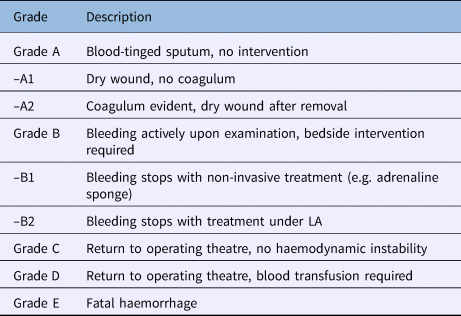
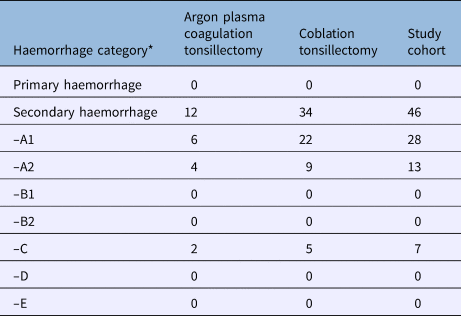
Post-operative haemorrhage was defined as either primary, where bleeding occurred within 24 hours of surgery, or secondary, where bleeding occurred after the first 24 hours of surgery. The number of post-operative haemorrhage events in each group was recorded. The severity of each event was then stratified based on a seven-grade classification of post-tonsillectomy haemorrhage, adapted from Sarny et al. (Table 2).Reference Sarny, Ossimitz, Habermann and Stammberger20
Classification of post-operative haemorrhage in tonsillectomy*

* Based on Sarny and colleagues’ classification of post-operative bleeding episodes.Reference Sarny, Ossimitz, Habermann and Stammberger20 (Adapted with permission.) LA = local anaesthesia
Statistical analysis
Data were statistically analysed using GraphPad Prism software, version 7.00 (GraphPad Software, La Jolla, California, USA). Operative time, and post-operative mean individual and mean daily pain scores (days 1–14) were analysed using the unpaired student's t-test. Intra-operative and post-operative haemorrhage grades were analysed using the chi-square test. A p-value of less than 0.05 was considered statistically significant.
Results
A total of 283 patients were included in this study (age range of 1–50 years, mean age of 13.7 years; male to female ratio of 0.69). There were two surgical groups: argon plasma coagulation (n = 129) and coblation (n = 154). Patient demographics between the two groups were comparable, as shown in Table 3.
Patients’ demographic factors categorised by surgical technique

*n = 129; †n = 154; ‡n = 283
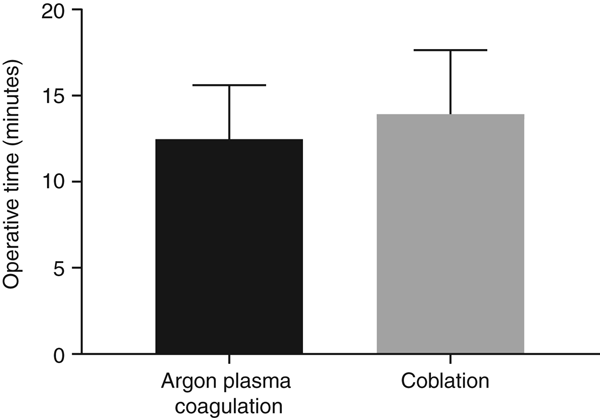
Operative time was compared between the two groups, as shown in Figure 1. The mean duration of surgery was 12.47 minutes (standard deviation = 3.14) in the argon plasma coagulation group and 13.93 minutes (standard deviation = 3.72) in the coblation group. This difference in operative time was statistically significant (p = 0.0006); argon plasma coagulation was associated with a shorter operation time, with a mean difference of 1.46 minutes.
Comparison of operative time between argon plasma coagulation tonsillectomy and coblation tonsillectomy groups. Statistical analysis was performed using the unpaired student's t-test. Mean operative time is plotted with a 95 per cent confidence interval. The argon plasma coagulation group had a significantly shorter operative time (p = 0.0006). The difference between the means was 1.46 minutes (95 per cent confidence interval = 0.64–2.28).

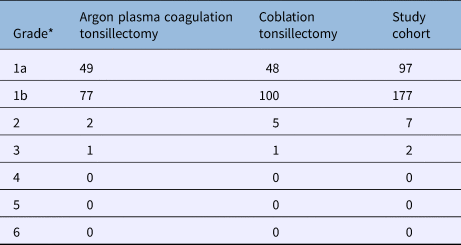
Intra-operative blood loss was classified into five grades (Table 1) to assess blood loss severity. The numbers of patients with each grade of bleeding are shown in Table 4. The majority of patients experienced no or minimal bleeding (grade 1) intra-operatively: 126 patients in the argon plasma coagulation group and 148 patients in the coblation group had grade 1 intra-operative haemorrhage. There were two and five cases of grade 2 intra-operative bleeding (mild bleeding) in the argon plasma coagulation and coblation groups respectively. Both groups also had a single case of grade 3 intra-operative bleeding (moderate bleeding). We were unable to demonstrate statistical differences in the incidence or severity of intra-operative blood loss between the argon plasma coagulation and coblation groups because of inadequate sample size (p = 0.553).
Intra-operative haemorrhage categorised by surgical technique

Data represent numbers of patients. *Refer to Table 1 for the estimated volumes of blood loss for each grade.
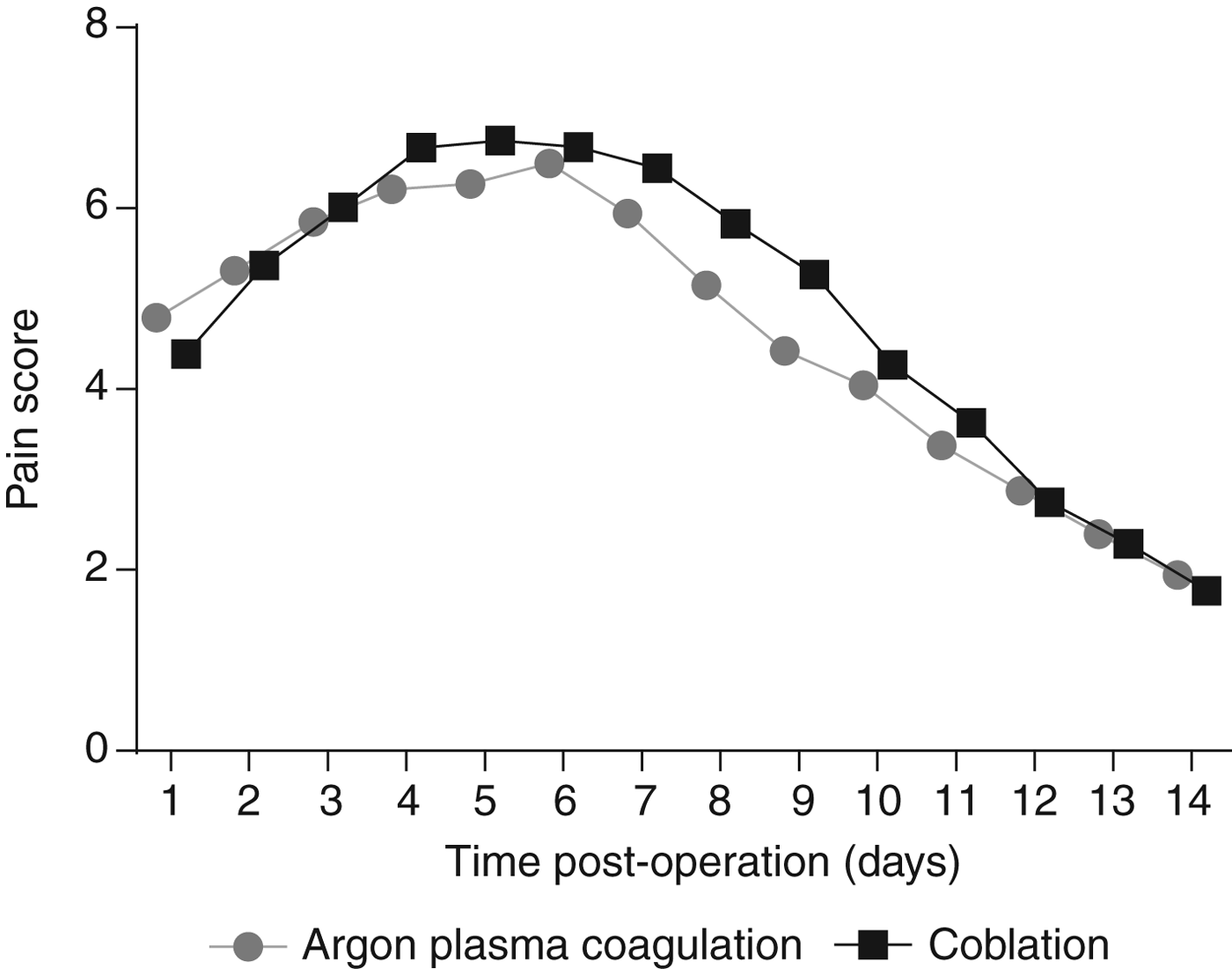
Post-operative pain was evaluated on a 10-point VAS over a period of 14 days. Post-operative pain score charts for 48 patients in the argon plasma coagulation group and 75 patients in the coblation group were available for analysis. The remaining 160 patients either did not return their pain score charts on follow up or were excluded from the analysis as they were below the age of five years. As mentioned earlier, it is difficult to interpret pain scores from children in this age group. We compared the mean daily pain scores and mean individual pain scores between the argon plasma coagulation and coblation groups. There were no statistically significant differences in mean daily and mean individual pain scores between the two groups, with p-values of 0.441 and 0.439 respectively. The trend in mean daily pain scores was similar in both surgical groups, with a peak in pain score on days 5 and 6 post-operatively, as demonstrated in Figure 2.
Comparison of mean daily pain score between argon plasma coagulation tonsillectomy and coblation tonsillectomy groups. Statistical analysis was performed using the unpaired student's t-test. No statistically significant difference was found between the groups (p = 0.441); there was a similar trend in mean daily pain score for both groups, with a peak in pain score on days 5 and 6 post-operatively.

There were no cases of primary post-operative haemorrhage in this study (Table 5). There were 46 secondary haemorrhage events, 12 in the argon plasma coagulation group and 34 in the coblation group. There was a significantly lower rate of post-operative secondary haemorrhage in the argon plasma coagulation group compared to the coblation group (p = 0.003).
Post-operative haemorrhage categorised by surgical technique

Data represent numbers of patients. *Refer to Table 2 for descriptions of each grade of post-operative haemorrhage in tonsillectomy.
Further analysis was performed to evaluate the difference in severity of post-operative bleeding between the argon plasma coagulation and coblation groups, but no statistically significant difference was found (p = 0.791). As shown in Table 5, the grades of secondary haemorrhage found in the argon plasma coagulation and coblation groups were similar. The majority of secondary haemorrhage events were minor bleeds with blood-tinged sputum, requiring no intervention. There were 6 grade A1 and 4 grade A2 secondary haemorrhage events in the argon plasma coagulation group, and 22 grade A1 and 9 grade A2 secondary haemorrhage events in the coblation group. Seven patients had grade C secondary haemorrhage that required a return to the operating theatre for surgical intervention to stop the bleeding: two patients were from the argon plasma coagulation group and five were from the coblation group. There were no grade B, D or E secondary haemorrhage events.
The majority of procedures (79.8 per cent) were performed for obstructive sleep apnoea (OSA) (37.2 per cent) and recurrent tonsillitis (42.6 per cent). The numbers of post-operative haemorrhage events for each surgical indication were recorded. There was a significant difference in secondary haemorrhage rates between the argon plasma coagulation and coblation groups in patients who underwent tonsillectomy for OSA (p = 0.017). There was a lower rate of secondary haemorrhage in the argon plasma coagulation group compared to the coblation group (3 patients and 10 patients with OSA had secondary haemorrhage respectively). There was no statistically significant difference in secondary haemorrhage rates between the argon plasma coagulation and coblation groups for the other surgical indications, including recurrent tonsillitis, chronic tonsillitis and asymmetrical tonsils (p-values were 0.168, 0.318 and 0.157 respectively). No analysis could be performed in the group with concurrent OSA and recurrent tonsillitis because of inadequate sample size.
Discussion
There was a significantly lower post-operative secondary haemorrhage rate in the argon plasma coagulation group as compared to the coblation group. However, we were unable to demonstrate a statistical difference between the two groups in the severity of post-operative bleeding, reflected by the grade of bleed.
The incidence of post-operative haemorrhage in our study was 9.30 per cent (12 out of 129 patients) in the argon plasma coagulation group and 22.1 per cent (34 out of 154 patients) in the coblation group. The frequency of post-operative haemorrhage in our argon plasma coagulation group is similar to that reported in previous studies, which reported rates ranging from 1.1 per cent to 9.7 per cent.Reference Bergler, Huber, Hammerschmitt and Hormann1,Reference Ferri, Armato and Capuzzo12,Reference Ferri and Armato13,Reference Bowling21 A meta-analysis by Mösges et al., published in 2011, which included 24 randomised controlled trials, showed that coblation had an overall post-operative haemorrhage rate of 4.1 per cent.Reference Mösges, Hellmich, Allekotte, Albrecht and Böhm5 This is contrary to the incidence in our study, in which the rate of post-operative haemorrhage was considerably higher. However, a smaller study, with 64 adult patients, conducted by Noon et al., demonstrated an even higher incidence, of 30.6 per cent.Reference Noon and Hargreaves22
A multivariable analysis by Kwok et al. showed that risk factors for post-tonsillectomy haemorrhage included ibuprofen use and increased age.Reference Kwok, Subramaniyan, Rimmer and Karahalios2 This age dependence may be associated with the presence of co-morbidities, recurrent tonsillar infections, and non-compliance with post-operative management recommendations (such as adequate physical rest and dietary intake), which increase between 11 and 40 years of age.Reference Mösges, Hellmich, Allekotte, Albrecht and Böhm5 Thus, age may have been a confounder that influenced the rates of post-operative haemorrhage.
Additionally, the presence of blood-tinged sputum, even in the absence of evidence of active bleeding, was recorded as post-operative haemorrhage. This may present an overestimate of the secondary haemorrhage rates in our study compared to other studies that defined post-operative bleeding haemorrhage as the expectoration of fresh blood.Reference Bowling21 Nevertheless, there was a statistically significant reduction in post-operative secondary haemorrhage rate in the argon plasma coagulation group compared to the coblation group. Our study also found lower secondary haemorrhage rates in the argon plasma coagulation group compared to the coblation group in patients who underwent tonsillectomy for OSA, although it is difficult to determine the reason for this given the small sample size.
Operative time was significantly reduced in the argon plasma coagulation group compared to the coblation group, by an average of 1.46 minutes. This result is relevant to maintaining the cost-effectiveness of healthcare services. As a high-frequency voltage generator is commonly used and is often present in operating theatres, it may only be necessary to purchase an additional argon gas supply unit. The argon plasma coagulation unit is useful for various indications in otorhinolaryngology and gastrointestinal procedures. The argon plasma coagulation technique is also a relatively easy technique to learn and is surgically similar to conventional cold tonsillectomy with a dissector.Reference Bergler, Huber, Hammerschmitt and Hormann1
The single-use disposable ExplorAr ST700-311EI electrode with fine dissection tip (ConMed Linvatec) used in our argon plasma coagulation procedure costs AUD$76.50. There are also argon plasma coagulation dissectors available that can be easily sterilised and used 50–100 times before replacement. The average amount of argon gas used for each tonsillectomy is usually available at a nominal cost, with each tank of argon gas lasting three to six months. In comparison, the Coblation Procise EZ view wand (Smith & Nephew) utilised in our coblation procedure is also for single-use and costs AUD$380. A bag of normal saline is additionally required for each coblation tonsillectomy procedure as a conducting medium, which is readily available at a minimal cost.
The reduced operative time and low cost of disposable equipment discussed makes argon plasma coagulation tonsillectomy an economical option. However, this is a general cost discussion and not a focused cost-analysis study. It is therefore lacking quantitative cost information.
A systematic review by Metcalfe et al. reported seven studies showing favourable pain outcomes with coblation compared to other tonsillectomy techniques.Reference Metcalfe, Muzaffar, Daultrey and Coulson3 This was not our experience with argon plasma coagulation tonsillectomy, given that no significant difference was observed in mean pain scores between our argon plasma coagulation and coblation groups. Because of its limited depth of tissue penetration, the argon plasma coagulation technique minimises tissue injury and local oedema, which avoids the problem of increased post-operative pain that other electrosurgery techniques face.Reference Bergler, Huber, Hammerschmitt and Hormann1,Reference Ferri, Armato and Capuzzo12
Only a few studies have directly compared the outcomes of argon plasma coagulation and conventional cold steel dissection in tonsillectomy. The most recent was a prospective randomised study by Ferri and Armato, published in 2011.Reference Ferri and Armato13 The study included paediatric patients and reported significantly reduced mean operative duration and intra-operative blood loss in the argon plasma coagulation group (p < 0.001). Ferri et al. reported identical findings in a prospective randomised study including only adult patients.Reference Ferri, Armato and Capuzzo12 Two prospective randomised studies by Bergler et al.Reference Bergler, Huber, Hammerschmitt and Hormann1 and Skinner et al.Reference Skinner, Colreavy, Lang, O'Hare, Charles and Timon11 further supported the outcome findings of reduced operation time and intra-operative blood loss. There were no statistically significant differences in the intensity of post-operative pain and secondary haemorrhage rates in these studies.Reference Bergler, Huber, Hammerschmitt and Hormann1,Reference Skinner, Colreavy, Lang, O'Hare, Charles and Timon11–Reference Ferri and Armato13 These authors considered argon plasma coagulation a safe alternative to conventional cold dissection.
• Tonsillectomy is one of the most common otolaryngological procedures performed
• There is no universally approved ‘gold standard’ surgical technique for tonsillectomy
• Operative time and post-operative haemorrhage rate were significantly reduced in the argon plasma coagulation group compared to the coblation group (p = 0.0006 and p = 0.003 respectively)
• Argon plasma coagulation appears to be a favourable alternative to coblation in tonsillectomy
There are several limitations of this study. Firstly, it was not a prospective study, despite a prospectively collected database. There exists a degree of selection bias, given that patients were not randomly assigned to either the argon plasma coagulation group or coblation group, and the technique depended on the location of the arranged surgery. Nevertheless, our demographics analysis demonstrated similar patient characteristics between the two groups. Secondly, intra-operative blood loss was assessed using a categorical system rather than being quantified in millilitres. It would be impractical to use measuring and weighing methods for small volumes lost in the tubing of the suction canister and dried gauze swabs. Nonetheless, small amounts can be significant, especially if there is minimal total blood loss. Therefore, a categorical assessment of intra-operative blood loss was performed, despite the recognition of a degree of inaccuracy using this method. Thirdly, an objective comparison of post-operative pain between the two groups was difficult given the subjectivity of the perception and individualised tolerance to pain. Hence, we excluded patients under the age of five years, to increase the accuracy of the assessment. Fourthly, there were limited data on post-operative pain scores, with fewer than 50 per cent of recruited patients included for data analysis. This was a result of patients not returning their pain score charts on follow up or their exclusion from the analysis (if they were below the age of five years). Lastly, our sample size was relatively small, which may increase the margin of error. Therefore, larger comparative studies on argon plasma coagulation tonsillectomy and coblation tonsillectomy are needed.
Conclusion
We found statistically significantly reductions in operative time and post-operative haemorrhage rate with argon plasma coagulation compared to coblation in tonsillectomy. Previous studies have reported significantly lower operative time and intra-operative blood loss with argon plasma coagulation compared to conventional cold dissection. Argon plasma coagulation tonsillectomy is also economical and relatively easy to learn. It appears to be a favourable alternative to current modalities, such as coblation and conventional cold dissection, in terms of safety, efficacy and cost-effectiveness.
Competing interests
None declared