Introduction
Children born to women who were stressed while pregnant are more susceptible to developing mood disorders including major depressive disorder.Reference Kleinhaus, Harlap and Perrin 1 These behavioral changes can appear not only after maternal exposure to extremely stressful situations (e.g. death of a close family member or exposure to war situations), but when expectant mothers are exposed to milder forms of stress the children may also suffer from increased risk of developing anxiety and mood disorders.Reference Huizink, Robles de Medina, Mulder, Visser and Buitelaar 2
Comparable behavioral changes are seen in rodent offspring exposed to prenatal stress (PS), making them a valuable depression model. For instance, PS increases elements characteristic of depressive-like behavior such as anxiety response and induce behavioral despair in rats.Reference Secoli and Teixeira 3 – Reference Morley-Fletcher, Mairesse and Soumier 7 Sleep and cognitive disturbances are also hallmarks of depression,Reference Duncan, Pettigrew and Gillin 8 , Reference Emens, Lewy, Kinzie, Arntz and Rough 9 and are altered in PS animals.Reference Dugovic, Maccari, Weibel, Turek and van Reeth 10 – Reference Abdul Aziz, Kendall and Pardon 12 Moreover, PS changes circadian activity rhythms.Reference Mairesse, Silletti and Laloux 13 To our knowledge, it is unclear whether PS induces prolonged changes in basic locomotor activity. Finally, increased secretion of corticosterone (CORT) following an acute stressor in PS offspring indicates that PS is associated with dysregulation of the hypothalamus–pituitary–adrenal (HPA) axis.Reference Brunton and Russell 6 , Reference Dugovic, Maccari, Weibel, Turek and van Reeth 10
Most PS studies expose pregnant rodents to the same stressor repeatedly and focus investigations on male offspring. However, animals may habituate when exposed to the same stressor reducing the secretion of stress hormones relative to the amount secreted the first time they are exposed to the same stressor as well as the behavioral consequences.Reference Armario 14 , Reference Daviu, Rabasa, Nadal and Armario 15 Moreover, humans are frequently subjected to prolonged periods of more unpredictable challenges and it is, thus, essential to investigate the consequences of repeated variable PS on depressive-like behavior. Repeated variable stress paradigms during the pregnancy in rodents have shown behavioral changes that may be linked to psychiatric disorders, including depression.Reference Abdul Aziz, Kendall and Pardon 12 , Reference Koenig, Elmer and Shepard 16 , Reference Emack, Kostaki, Walker and Matthews 17 Finally, males and females exhibit distinct physiological and behavioral responses to stressors during baseline conditions and in stressor-induced animal depression models, highlighting the need to investigate both sexes.Reference Zuena, Mairesse and Casolini 5 , Reference Brunton and Russell 6 , Reference Weinstock 18
The objective of the present study was, to investigate the effects of repeated variable PS on locomotor and rearing/climbing activity as well as indicators of a depression-like state at a young adult age in both male and female offspring. Moreover, as PS animals respond differently to a stressful event later in life (in addition to PS),Reference Dugovic, Maccari, Weibel, Turek and van Reeth 10 , Reference Darnaudery and Maccari 19 we analyzed the impact of acute stress in PS offspring animals. To this end, half of the animals were exposed to an acute stressor before behavioral testing. We found that PS induced sex-specific behavioral changes with PS female offspring appearing more vulnerable in a familiar environment, whereas PS male offspring had a blunted behavioral response towards a novel environment.
Methods
Generation of prenatally stressed offspring
Female nulliparous Sprague–Dawley rats weighing ∼225 g and experienced male breeders (Charles River, Sulzfeld, Germany) were used to generate control and PS pups. Thirteen control and 10 PS dams were used. All animal procedures were conducted in accordance with the Danish and EU legislation and were approved by the national animal welfare committee (2012-15-2934-00153). Prior to maternal PS and offspring testing, the animals were housed under constant conditions (12 h of light starting at 6 am, 20°C, 30–70% humidity) in cages with sawdust bedding and environmental enrichment and they had free access to food and water. After arrival, female rats were acclimatized for 5 days while housed in pairs. Subsequently, each female was housed with a male breeder until a positive vaginal smear identified gestational day (GD) 0. During the pregnancy, dams were individually housed, which may be a stressor in rats.Reference Baker and Bielajew 20
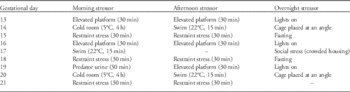
Control rats were left undisturbed (except for cage change and weighing) throughout the pregnancy. PS dams were exposed to a repeated variable stressor paradigm during GD 13–21 as illustrated in Table 1. During the stressor period, control- and stressor-exposed dams were housed in separate rooms to prevent control dams being affected by the stressed dams. Briefly, the stressor pattern consisted of two short-term stressors during the day (e.g. restraint and forced swimming) and one longer-term stressor overnight (e.g. fasting or constant light). Exposure to the morning stressor started at 08:30–10:00 am and afternoon stressor exposure started at 01:30–03:00 pm. Exposure to the overnight stressor began immediately after conclusion of the last daytime stressor exposure. Control- and stressor-exposed dams were weighed twice weekly to follow weight gain during the pregnancy.
Overview of the stressors used to generate prenatally stressed offspring

Schematic overview of the stressors used during gestation. Pregnant rats were exposed to repeated variable stressors during gestational day 13 through 21. In general, rats were exposed to short-term stressors during the day and a long-term stressor during the night.
The day pups were born (usually on GD 22) was designated as postnatal day (PND) 0 and they were left undisturbed to bond with the dam. Pups were weighed on PND 2 and weekly thereafter until weaning on PND 22. After weaning, they were housed in same-sex groups of two or three. Male and female offspring were housed in separate housing units, but in the same room. Control and PS offspring were tested in the first behavioral investigations around PND 50.
Plasma CORT levels
Blood samples for analysis of CORT levels were collected through sublingual venipuncture. Briefly, samples were collected from the unanesthetized rat while it was restrained by hand. Samples were collected within 15–20 s after the rat was picked up from the cage. For the pregnant dams, blood samples were collected on GD 15 and GD 19 at 08:00–08.30 am (i.e. when overnight stressor exposure terminated) and CORT analysis was performed using an enzyme immunoassay kit (AC-15F1, Immunodiagnostics Systems, Frankfurt, Germany) according to the manufacturer’s instructions. Briefly, CORT standards (in the range of 0–20,000 pg/ml), manufacturer controls and the serum samples were added to a buffer and heated at 80°C for 30 min. After cooling to room temperature, the standards, manufacturer’s controls and samples were loaded onto the provided sheep anti-CORT IgG-coated, 96-well plates. Horseradish peroxidase conjugated to CORT was added to the wells and the plate was incubated for 4 h at room temperature. Following three washes, wells were aspirated and tetramethylbenzidine substrate solution was added and incubated for 30 min at room temperature. The reaction was stopped by adding an acidic stop solution and CORT levels were quantified at 450 nm with a ThermoMax microplate reader (Molecular Devices, Sunnyvale, CA, USA) and analyzed with the SoftMax Pro 3.1.1 software (Molecular Devices). CORT levels were calculated from the standard curve prepared for each plate and was expressed as ng/ml serum.
In the offspring (∼PND 60), blood samples were collected at three time points: (I) in the morning between 08:00 and 08:30 am the day before the elevated plus maze (EPM) test, (II) after being exposed to the elevated platform, that is, just before testing in the EPM (i.e. between 08:30 am and 12:00 pm) and (III) 2 h after EPM testing. Blood sampling was performed straight after exposure to the acute platform and the time between the blood sampling and EPM testing was ∼3 min. After the last blood sample had been collected, animals waited ∼
 $2{1 \over 2}$
h before the forced swim pre-test.
Behavioral testing and exposure to an acute stressor
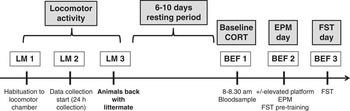
All animals were subjected to three tests at a young adult age (∼PND 50–70): (1) locomotor and rearing/climbing activity was monitored for 24 h in home-like cages to elucidate circadian activity patterning; (2) EPM, in order to investigate anxiety indicators and finally, (3) and the forced swim test (FST), to evaluate despair propensity. The animals were transferred to the behavioral testing room at least 1 day before the test in order to habituate to the surroundings. An overview of the behavioral testing schedule is shown in Fig. 1. In the first part of the behavioral test (locomotor activity monitoring days 1–3, LM 1–3) locomotor as well as rearing/climbing activities were monitored in the animals and they were subsequently left undisturbed for 6–10 days before the last part of the behavioral testing series was initiated. On the 1st day of the blood sample–EPM–FST test day series 1–3 (BEF days 1–3, see Fig. 1), a blood sample was collected in the morning (between 08:00 and 08:30 am) to quantify baseline CORT levels. On BEF 2, half of the animals were placed on an elevated platform (12×12 cm wide, elevated 1 m above the ground) as an acute stressor just before being tested in the EPM. The other half was directly subjected to the EPM test (without elevated platform exposure). A blood sample was collected from a subset of animals before (∼3 min) the EPM test to verify that exposure to the elevated platform did function as a stressor. Additionally, 2 h after the EPM, a blood sample was collected and analyzed for CORT levels. In the other subset of animals, no blood sampling was performed before EPM to evaluate whether blood sampling altered performance in the EPM. In the afternoon of BEF 2 control and PS males and females underwent FST pre-training (i.e. 15 min session, see FST). Finally, on BEF 3, the rats were submitted to the FST (i.e. the 5 min session). It should be mentioned that exposing animals to multiple tests (EPM and FST) in close sequence may impact the behavioral outcome compared with when animals were only tested in one of the tests, however, multiple behavioral tests conducted in the same animal have previously been used without group effects being eliminated.Reference Brocardo, Boehme and Patten 21 , Reference Suo, Zhao and Si 22 In general, two to three pups of each sex from each litter were put into the same behavioral test group to minimize potential litter effects. However, from two of the 23 dams (one control and one PS dam), four pups of each sex were used in each treatment group. Moreover, for the locomotor and rearing studies, four to six males and a similar number of females from each litter were used, because at the time of these investigations, the groups had not been sub-divided by the acute stress exposure factor that takes place on BEF 2 (please see behavioral design in Fig. 1).
Illustration of the behavioral design. In the morning of locomotor day 1 (LM 1), animals were placed in the locomotor recording room in home-like cages and were allowed to habituate overnight. 24 h recordings were initiated on LM 2 and on LM 3 animals were returned to their home cage along with their littermate. Six to ten days of resting period elapsed before the last part of the behavioral studies was conducted. The 1st day after the acclimatization period was denoted blood sampling–EPM–FST (BEF) 1 and on this day blood samples were collected to quantify baseline corticosterone levels. On BEF 2, half of the rats were placed individually on an elevated platform for 30 min just before the EPM. The other half was directly tested in the EPM without exposure to the elevated platform. All rats were monitored in the EPM for 5 min. In the afternoon of BEF 2 pre-training in the FST took place. The actual FST was conducted in the afternoon on BEF 3. EPM, elevated plus maze; FST, forced swim test.

Locomotor and rearing/climbing activity
During this test, animals were single-housed in home-like cages with minimal bedding and gel-water. Males and females were monitored in separate rooms. On LM day 1 (overnight), the rats were placed in new home-like cages (42.5×26×18 cm) and habituated overnight to the environment. Locomotor and rearing/climbing activity levels were automatically registered as infra-red beam-crossing at the bottom (locomotor) or at the top (rearing/climbing) of the cage, respectively. Four beams transversed the cage just above the bottom (∼8 cm apart) and eight beams at the top (∼4 cm apart, horizontally). In approximately half of the animals, data collection was initiated in the morning after the habituation period by an investigator entering the room and activating data collection by pushing a button for each cage. The 1st hour of data collection was not included in the analysis. In the rest of the animals, data collection was initiated already during the habituation period and there was no need to enter the room the day after. Thus, the number of studied rats varies across the data collection period. Data were collected in 5-min bins for a minimum of 24 h. Average locomotor and rearing/climbing activities for the whole recording period as well as for each hour-segment were calculated for each treatment group. After data collection, rats were housed with their respective littermate(s) (that had also been tested) for at least 1 week until the EPM and forced swim behavioral tests were started.
EPM
Rats were tested in the EPM, a behavioral screening device commonly used to test anxiety.Reference Walf and Frye 23 The EPM apparatus consists of a cross-shaped platform with two open arms (50 cm long×10 cm wide) and two closed arms (50 cm long×10 cm wide×39.5 cm tall) elevated 53 cm above the floor. The rats were tested individually at a light intensity of 15 lux above the EPM. Anxious animals typically explore less and spend the majority of their time in the closed arms of the maze.Reference Suo, Zhao and Si 22 Time spent in each arm as well as the number of entries into (scored when at least two paws and half of the body were within the open arm) and distance moved within each arm was monitored during a 5 min period and analyzed using Ethovision 3.0 software. Half of the animals were exposed to an elevated platform as an acute stressor for 30 min just before being tested in the EPM.
FST
A modified version of the rat FST was employed for this study.Reference Detke, Rickels and Lucki 24 In the afternoon (12:30–02:30 pm) on BEF 2, after being tested in the EPM test in the morning, rats were individually placed in glass cylinders (61 cm tall and 18.5 cm inner diameter, filled with tap water (22–23°C) to a depth of 45 cm) for 15 min. This pre-test session offered the animals the opportunity to perceive impossibility of escape from the water.Reference Borsini and Meli 25 On the next day, rats were re-exposed to the FST for a 5 min test, which was videotaped for later analysis. Frequency of swimming with struggle, swimming and immobility, as previously described,Reference Bielajew, Konkle and Kentner 26 were scored from the video record by an investigator blinded to whether the animals had been exposed the elevated platform stressor the previous day. The animal’s behavior was classified as: (1) Swimming with struggle, which was characterized by vigorous movements with all four paws that maintained the rats head and shoulders above the water; (2) Swimming (without struggle), which consisted of active swimming motion subserved by two to four paws that enabled the rat to maintain its head above, and propelled it through, the water; and (3) Immobility, which was scored when the rat floated in the water without struggling, only making slight movements necessary to keep the head or nose above water. The total duration of swimming with struggle, swimming and immobility during the 5 min observation period were averaged for each treatment group.
Statistical analysis
Data were analyzed using SigmaPlot 11 analytical software (Systat Software Inc., San Jose, CA, USA). Gestational weight as well as locomotor and rearing/climbing activities for each sex were analyzed using a Student’s t-test. A three-way analysis of variance (ANOVA) was used to analyze CORT samples collected just before EPM testing. A two-way ANOVA was used to analyze plasma CORT levels in dams and offspring behavior in the FST. A three-way ANOVA with prenatal treatment, sex and acute stressor as factors was used to analyze behavior in the EPM. When main effects or interactions were significant, a Tukey post hoc analysis was performed. Kruskal–Wallis one-way ANOVA on ranks was used to analyze the not normally distributed baseline CORT, CORT samples collected 2 h post EPM testing as well as offspring weight. Results are presented as averages±standard error of the mean (s.e.m.). A p-value of <0.05 was considered to be statistically significant.
Results
Dam and offspring body weight
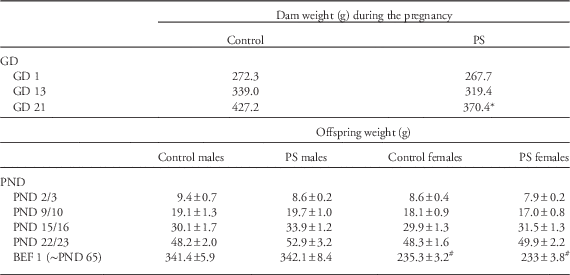
As an indirect measure to evaluate whether the PS paradigm influenced gestational progression, we weighed the dams several times during gestation. Dams exposed to repeated variable stress during the pregnancy gained significantly less weight compared with control dams (P<0.001, Student’s t-test, Table 2). Control and PS dams gave birth to 15.2±0.2 and 13.4±0.6 pups, respectively (P=0.06, Student’s t-test) and we observed no still-births. Analysis of pup weight until weaning revealed that there were no significant effects of prenatal condition or sex (Table 2). As expected, when they reached young adult age males weighed more than females with no further effect of PS within each sex group.
Dam and offspring developmental weight

PND, postnatal day; PS, prenatal stress.
Dams were weighed during the pregnancy and on gestational day (GD) 21 they had gained less weight compared with control dams. Weight gain in the offspring was monitored until weaning and again when they were used for the blood sampling, elevated plus maze, forced swim (BEF) behavioral testing. An asterisk (*) marks statistically significant from controls, P<0.05 and a number sign (#) indicates significant difference from males, P<0.05.
Plasma CORT concentrations
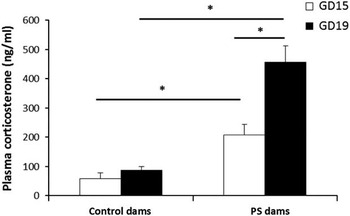
To validate that the PS paradigm actually did stress the pregnant rats, we collected blood samples for CORT analysis. We found significant effects of PS (F (1,37)=42.81, P<0.001) and day of gestation (F (1,37)=12.31, P<0.001, Fig. 2) on plasma CORT levels as well as an interaction between the two (F (1,37)=7.59, P=0.009, two-way ANOVA) in the pregnant dams. Post hoc analysis revealed that CORT levels were significantly greater in PS dams compared with controls on both GD 15 and GD 19 (P=0.014 and P<0.001, respectively, two-way ANOVA).
Plasma corticosterone (CORT) levels were greater in pregnant dams exposed to stressors. Blood samples from control and stressed dams were collected on gestational day (GD) 15 and 19 at 08:00–08:30 am and plasma CORT levels were quantified using an enzyme immuno-assay. Dams exposed to stressors had greater CORT levels on both days relative to controls. Results shown are averages±s.e.m. and statistical differences were determined by a two-way ANOVA with prenatal treatment and gestational day as factors. A P-value of <0.05 was used as significance level. n=10, an asterisk (*) marks that P<0.05.

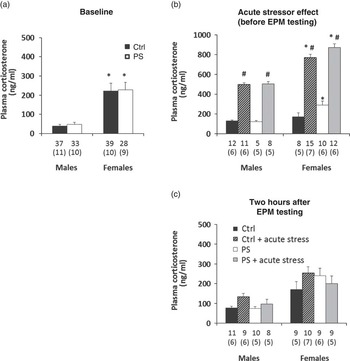
We observed no difference in baseline CORT levels between control and PS offspring in either sex. However, irrespective of prenatal treatment, females had higher CORT concentrations than males (all P<0.05, Kruskal–Wallis with Dunn’s multiple comparisons, Fig. 3a). Interestingly, in control animals the sex-difference was no longer apparent when a blood sample was collected the following day, just before being placed in the EPM (compare Fig. 3a and 3b, black bars).
Plasma corticosterone (CORT) concentrations in control and prenatally stressed (PS) offspring at baseline (a), before exposure to the elevated plus maze test (b) and 2 h after the elevated plus maze test (c). Blood samples from control and PS offspring were collected at 08:00–08:30 am for baseline CORT and the animals had acclimatized at least one night in the room to ensure that they did not have artificial heightened CORT levels. Results shown are averages±s.e.m. and statistical analysis was performed by a Kruskal–Wallis test (baseline CORT and 2 h after EPM) or a three-way ANOVA (samples collected before the EPM). A P-value of <0.05 was used as significance level. The number of animals in each group is indicated below each bar and in parentheses are listed the number of dams used to generate the number of pups. A number sign (#) marks significant difference from same group that was not exposed to the acute stressor and an asterisk (*) marks significant sex difference exposed to similar treatment.

To investigate how an acute stressor impacts an anxiety index, we placed half of the animals on an elevated platform just before being evaluated in the EPM. We found a significant effect of sex (F (1,73)=30.88, P<0.001) and acute stress (F (1,73)=160.29, P<0.001) but not prenatal treatment on CORT levels (F (1,73)=2.03, P=0.16, three-way ANOVA, Fig. 3b) after elevated platform placement in advance of EPM testing. Furthermore, there was an interaction between sex and acute stress (F (1,73)=8.01, P=0.006, Fig. 3b). Post hoc analysis revealed that placement on the elevated platform increased CORT in all groups relative to control animals. Moreover, control females exposed to acute stress had higher plasma CORT than control males. Additionally, both PS females and PS females exposed to an acute stressor had higher plasma CORT concentrations than their PS male counterparts, respectively (Fig. 3b).
Finally, we evaluated whether PS prolonged the increase in plasma CORT after exposure to the EPM. Blood samples were collected 2 h after exposure to the EPM and there were no significant differences in CORT levels between the different groups at this time point (Kruskal–Wallis test, Fig. 3c).
Consequences of PS on locomotor and rearing/climbing activity
Depression-like behavior can include changes in circadian activity patterns and, thus, we set out to explore the long-term consequences of PS on the timing and amount of locomotor as well as rearing/climbing activity in young adult offspring.
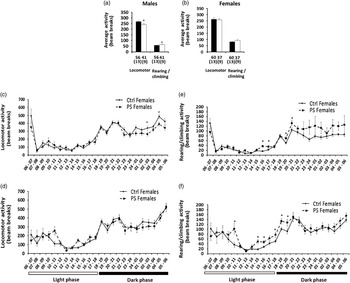
Average locomotor and rearing/climbing activities were affected in PS males but not females. PS males had reduced overall locomotor (i.e. bottom of cage movement, P=0.024) and increased rearing/climbing (i.e. top of cage movement, P=0.029) activities during the recording session relative to control animals (Fig. 4a and 4b). Particularly, at the end of the dark period PS males appear to have reduced locomotor activity relative to control animals (Fig. 4c and 4d). Rearing/climbing activity was significantly increased in PS males in the last hours of the light phase and during the first hours of the dark phase (Fig. 4e). Although overall motor activity measures did not differ significantly between PS and control female rats, our results indicate that females show similar differences between groups in rearing/climbing activity around the shift from the light to the dark phase (Fig. 4f).
Locomotor and rearing/climbing activities were altered in males as a consequence of prenatal stress (PS). Locomotor and rearing/climbing activities were recorded for 24 h after 1 day of habituation while animals were single housed in home-like cages. Locomotor and rearing/climbing activities were automatically registered by infra-red beam-crossing at the bottom (locomotor) or at the top (rearing/climbing) of the cage. Data were collected every 5 min starting on day 2 (after habituation) and continued for 24 h. After data collection, rats were housed with their respective littermate(s). Average locomotor and rearing/climbing activity (a and b) was affected in PS males but not in females. The overall differences in both locomotor (c and d) and rearing/climbing (e and f) activities appear manifest primarily around the switch from light to dark phase. Results shown are averages±s.e.m. and statistically significant differences were determined by a Student’s t-test within each sex. The number of animals in each group is indicated below the bars and in parentheses are listed the number of dams used to generate the number of pups. For the 1-h epochs, n=19–30 for the time period 06.00–09.00 am and n=38–56 for the time period 09.00 am–06.00 am. An asterisk (*) marks P<0.05.

EPM
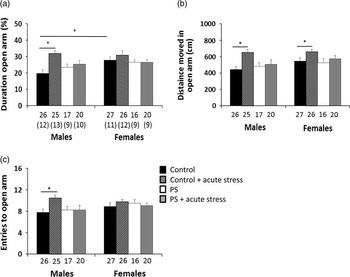
The rats were tested in the EPM at a young adult age (PND 60–75) for anxiety-like behavioral changes based on duration spent in, number of entries into and distance moved within the open arm, during a 5 min period. Furthermore, we evaluated whether collecting a blood sample just before the EPM test had any impact on behavior in the EPM. However, we observed no effect of collecting a blood sample just before EPM testing on the number of entries into (F (1,178)=1.93, P=0.17), distance moved (F (1,178)=2.38, P=0.12) or duration spent (F (1,178)=0.59, P=0.44) in the open arm of the EPM (three-way ANOVA). We, therefore, grouped animals irrespective of whether they had a blood sample collected before the EPM (within same sex and prenatal condition, Fig. 5).
Exposure to an acute stressor affects anxiety-like behavior in the elevated plus maze (EPM) and exposure to prenatal stress blunts this response. Behavior in male and female control and prenatally stressed rats was recorded for 5 min while they were on the EPM. The duration spent in (a), number of entries made into (b) and distance moved in (c) the open arm was automatically quantified using Ethovision software. Results shown are averages±s.e.m. and the number of animals in each group is indicated below each bar. In parentheses in (a) are listed the number of dams used to generate the number of pups. A three-way ANOVA was used to analyze statistical significant differences and an asterisk (*) marks P<0.05.

We found a significant effect of acute stress (i.e. elevated platform placement) before EPM testing (F (1,178)=8.60, P<0.01, three-way ANOVA, Fig. 5a). Additionally, we observed an interaction between prenatal condition and acute stress later in life (F (1,178)=4.91, P=0.03). Acutely stressed control males spent more time in the open arms of the EPM relative to non-stressed counterparts (P<0.001). Moreover, we found an interaction between prenatal condition and acute stress later in life influencing the amount of time spent in the open arms of the EPM (F (1,178)=4.91, P=0.03). Post hoc analysis revealed that control males spent significantly less time in the open arm compared with control females (P=0.008).
Distance moved in the open arm is another EPM variable used to evaluate anxiety levels with shorter distance interpreted as less eagerness to explore, that is, more anxiety. There was no effect of prenatal treatment (F (1,178)=0.42, P=0.52), sex (F (1,178)=2.64, P=0.11) or acute stress (F (1,178)=1.11, P=0.29) in total distance moved in the EPM. Minimum average distance traveled was 2127±73 cm (for the non-stressed control male group) and maximum distance was 2303±50 cm in PS females exposed to acute stress. However, we found a significant effect of sex (F (1,178)=5.65, P=0.019) and acute stress (F (1,178)=14.49, P<0.001) on distance moved in the open arm (three-way ANOVA, Fig. 5b). No interactions between prenatal condition, sex and acute stress were observed. Animals that were placed on the elevated platform before the EPM moved longer distances relative to animals that did not experience this acute stressor (P<0.001). Post hoc analysis showed that both male and female control rats exposed to the acute stressor (i.e. elevated platform) moved longer distances in the open arm compared with their non-stressed counterparts (P<0.001 and P=0.008, respectively).
Finally, we evaluated anxiety-like behavior by the total number of entries and number of entries made into the EPM open arm. There were no significant effects of either factor on total entries made in the EPM (prenatal treatment: F (1,178)=0.36, P=0.55, sex: F (1,178)=1.64, P=0.20, acute stress: F (1,178)=0.02, P=0.90, three-way ANOVA). Moreover, we found no significant effects of prenatal condition (F (1,178)=0.70, P=0.40, Fig. 5c), sex (F (1,178)=1.38, P=0.24) or exposure to the acute stressor (F (1,178)=2.39, P=0.12, three-way ANOVA) on number of entries made into the open arm of the EPM. However, there was an interaction between prenatal condition and exposure to the acute stressor (F (1,178)=6.33, P=0.013) on number of entries made into the open arm of the EPM. Post hoc analysis showed that control males exposed to the elevated platform made significantly more entries to the open arm of the EPM relative to control males not exposed to this acute stressor (P=0.002). This effect was not observed in PS males (P=0.53).
Effects of PS on behavior in the FST
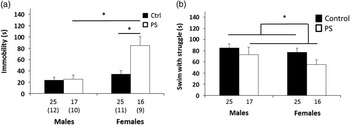
Animals were subjected to the FST on the day after EPM test. There was a significant effect of PS (F (1,81)=5.69, P=0.019) and sex (F(1,81)=10.50, P=0.002, two-way ANOVA) on time spent immobile (Fig. 6a), but no interaction between these two factors (F (1,81)=2.40, P=0.13). Post hoc analysis showed a sex-specific effect of PS with PS females spending more time immobile than PS males (P=0.003). Furthermore, PS females were immobile for longer than controls (P=0.007). Finally, we found a significant effect of prenatal treatment (irrespective of sex) on the time animals spent swimming with struggle (F (1,81)=5.16, P=0.026, Fig. 6b). No interactions between prenatal condition and sex were observed (F (1,81)=0.13, P=0.72).
Prenatal stress increases immobility time in the forced swim test (FST) only in female rats. In the afternoon of BEF 2 (see Fig. 1) animals were placed for 15 min in a plastic cylinder filled with water for the pre-FST. The following day rats were submitted to the FST for 5 min while being recorded for later analysis. The time spent immobile (a), swimming with struggle (b) was quantified. Results are averages±s.e.m. and the number of animals in each group is indicated below each bar. In parentheses in (a) are listed the number of dams used to generate the number of pups. Statistically significant differences were determined by a two-way ANOVA with prenatal treatment and sex as factors. An asterisk (*) marks P<0.05.

Discussion
We examined the behavioral consequences of repeated variable PS as a rodent model for developing affective disorders, including depression, later in life. Exposure to repeated variable PS changed locomotor and rearing/climbing activity specifically in male offspring. Our results indicate that motor activity changes may be related to particular circadian periods. Furthermore, exposure to an acute stressor reduced anxiety-like behavior in control animals and this type of behavioral response was blunted in PS offspring. Finally, classic behavioral indicators of depressive-like symptoms in rodents were altered in a sex-specific manner following PS. Particularly, female offspring showed altered measures of behavioral despair indicative of a depression-like state. The latter conclusion is based on our observation that increased time spent immobile in the FST was only present in female offspring following PS, indicating that this model may be useful for examining the mechanisms that make females more vulnerable to develop depression.
We found that exposure to the repeated variable stressor paradigm during the last part of gestation increased CORT levels and reduced weight gain in the PS dams relative to control dams. These results are consistent with findings of previous rodent studies.Reference Emack, Kostaki, Walker and Matthews 17 , Reference Szuran, Zimmerman, Pliska, Pfister and Welzl 27 , Reference Bourke, Capello and Rogers 28 Reduced weight gain in PS dams during the last part of the pregnancy did, however, not lead to a significant reduction in number of pups born – although a trend was apparent, but this had no significant effect on birth weight. This is in agreement with previous findings,Reference Weller, Glaubman, Yehuda, Caspy and Ben-Uria 29 , Reference Guo, Nappi and Criscuolo 30 and indicates that the PS paradigm had no marked influence on litter viability. However, other PS studies have found reduced weight during development relative to control animals,Reference Berger, Barros, Sarchi, Tarazi and Antonelli 31 , Reference Pereira-Figueiredo, Sancho, Carro, Castellano and López 32 indicating that disparate PS paradigms impact the offspring differentially.
Clock genes and neuroactive peptides involved in circadian rhythms are altered in a large portion of depressed patients,Reference Li, Liu and Xu 33 and may partly explain why a many depressed patients exhibit a shifted motor activity rhythm.Reference Volker, Tulen and Van den Broek 34 Moreover, urinary corticosteroid levels are higher at certain times of day in depressed patients relative to controls.Reference Fullerton, Wenzel, Lohrenz and Fahs 35 To get an indication of whether changes in circadian rhythmicity were present in motor activity patterns in the PS model, we investigated locomotor and rearing/climbing behavior in the rats for 24 h after 1 day of habituation to a home-like cage environment. Specifically, male offspring showed distinct effects on locomotor and rearing/climbing behavior as a consequence of PS both with respect to circadian time and the direction of the locomotor change relative to their respective control groups. Our results show that PS changes male motoric behavior, that is, increased rearing/climbing (i.e. top part of cage) behavior and reduced locomotor (i.e. bottom part of cage) behavior. These differences were particularly manifest around the change from light to dark phase. In a study by Weller et al.,Reference Weller, Glaubman, Yehuda, Caspy and Ben-Uria 29 PS male offspring exhibited large increases in motor activity at the beginning of the dark phase. Caution is warranted when interpreting results of measurements of multiple behavioral elements, however, the clustering of significant alteration of motor activity frequency in multiple time-bins around the onset of the dark phase speaks to the robustness of the finding. This result may have clinical importance as sleep/wake rhythm disturbances including insomnia are commonly reported among depressed patients.Reference Tsuno, Besset and Ritchie 36 , Reference Urrila, Karlsson and Kiviruusu 37
Locomotor activity in rodents has classically been monitored in the open field test without habituation for shorter time spans and these activity changes have typically been utilized and interpreted as measures of fear and escape behavior.Reference Aulich 38 PS has previously been shown to reduce open field locomotor and rearing activity at an adult age.Reference Sun, Jia and Guan 39 , Reference Abe, Hidaka and Kawagoe 40 Other studies report that changes in locomotor behavior after exposure to PS only occurs in males.Reference Emack, Kostaki, Walker and Matthews 17 PS may have dissimilar effects on locomotor activity in familiar v. novel environments because in novel environments (without habituation) fear-motivated explorative behavior may be assayed rather than basic locomotor levels. This reasoning is supported by the findings that PS rats repeatedly exposed to an open field become twice as active as control animals as the test environment becomes less novel and more familiar.Reference Fride, Dan, Feldon, Halevy and Weinstock 41 Moreover, as locomotor activity is subject to pronounced circadian patterning with rats being more active in the dark phase compared with the light phase, and as depression can be associated with changes in biological rhythmicity, motor activity may be selectively altered depending on the time of day. In our behavioral design, the FST was conducted between 12:30 and 02:30 pm when minimal differences in locomotor and rearing/climbing behavior were observed (Fig. 4c–4f). The present study highlights the importance of systematically using same time period for a specific behavioral test in that exposure to PS may induce changes in circadian rhythm, and if animals are tested at a time point where basic locomotor differences exist, this may impact the outcome of a behavioral test. We did not find significant average changes in locomotor or rearing/climbing activity in PS females. It will, however, be important to investigate the period around the change from light to dark phase in more details in future studies, because PS females appear to be more active in rearing climbing behavior in the time period 03:00–09:00 pm.
Exposure to PS is usually associated with changes in the responsiveness of the HPA axis after acute stress later in life, for example, as a higher response just after exposure to the stressor and/or a prolonged stress response.Reference Brunton and Russell 6 , Reference Dugovic, Maccari, Weibel, Turek and van Reeth 10 , Reference Vallee, Mayo and Dellu 42 In both control and PS animals, females had greater CORT levels relative to males at baseline, however, the day after (just before placement in the EPM) the sex difference was only evident in the PS group. The time window for blood sampling before EPM was larger (08:30 am to 12:00 pm) and may partly explain the difference. Second, having a blood sample collected the day before, may impact expectations towards handling the next day differently in male and female offspring. It appears that control females are less stressed when a blood sample is collected before EPM testing and that control males are more stressed (compare control animals in Fig. 3a and 3b). In our study, PS did not increase baseline plasma CORT levels in neither male nor female offspring, which is in agreement with previous findings of comparable baseline CORT levels in control and PS males.Reference Brunton and Russell 6 , Reference Vallee, Mayo and Dellu 42 However, small baseline CORT concentration elevations have been reported in offspring of dams exposed to variable stress throughout the pregnancy,Reference Huang, Chen and Xu 43 indicating that stress responses may be subject to HPA axis dysregulation at least in prolonged PS paradigms. Mendez et al. Reference Mendez, Abarzua-Catalan and Vilches 44 have recently shown that exposure to constant light for 8 days during gestation impacts CORT rhythmicity at the fetal stage. It remains to be established whether 24-h light exposure during the PS paradigm influences HPA axis activity in PS offspring. Blood samples for our baseline CORT measurements were collected at 08:00–08:30 am, a time period when locomotor and rearing/climbing activities were similar in control and PS offspring. While we did not attempt to evaluate the circadian rhythmicity of CORT release in PS rats nor collect plasma samples at the circadian CORT release peak around the onset of the nocturnal, active phase, our findings do suggest that baseline circulating CORT levels are unaltered in PS rats.
Some patients diagnosed with depression also suffer from anxiety, and anxiety is a symptom used in diagnosing depression.Reference Pollack 45 , Reference Moffitt, Harrington and Caspi 46 In rodent PS models of depression increases in anxiety have also been reported.Reference Zuena, Mairesse and Casolini 5 – Reference Morley-Fletcher, Mairesse and Soumier 7 , Reference Sun, Jia and Guan 39 , Reference Vallee, Mayo and Dellu 42 , Reference Wakshlak and Weinstock 47 , Reference Guan, Jia and Zhao 48 In several studies, PS reduced the amount of time spent in the open arm of the EPM by 50%, which is interpretable as increased anxiety.Reference Wakshlak and Weinstock 47 , Reference Vallee, Mayo and Dellu 42 Exploration in a novel environment such as the EPM may be modulated by fear, and therefore a measure of anxiety or alternatively, the information obtained while exploring may serve to reduce fear.Reference Whishaw, Gharbawie, Clark and Lehmann 49 We did not find changes in anxiety behavior in PS rats at the time points we tested them in the EPM and this contrasts with previous reports.Reference Zuena, Mairesse and Casolini 5 , Reference Brunton and Russell 6 , Reference Barros, Rodriguez and Martijena 50 It remains to be examined whether lighting conditions during the EPM, our repeated variable stressor paradigm or environmental enrichment during development may reduce anxiety-like behavior in PS animals. It will be valuable to test if the PS animals have increased anxiety-like behavior in other anxiety tests. We did observe that control males spent less time in the open arm of the EPM than control females and, therefore, appear less motivated to explore the novel environment, which may indicate that male rats are more anxious than female rats. Basic sex differences have previously been reported in fear-motivated and exploratory behavior.Reference Zuena, Mairesse and Casolini 5 , Reference Frye, Petralia and Rhodes 51 , Reference Ravenelle, Neugebauer, Niedzielak and Donaldson 52 However, conflicting findings regarding the sex-dependency of these measures have been reported, and so, it is unclear whether males have increased,Reference Frye, Petralia and Rhodes 51 or reduced,Reference Zuena, Mairesse and Casolini 5 , Reference Ravenelle, Neugebauer, Niedzielak and Donaldson 52 anxiety levels relative to females. Strain differences and the influence of the estrous cycle in females on behavior as well as the testing circumstances may partly explain the differences.Reference Frye, Petralia and Rhodes 51 A limitation of our study is the lack of determination of estrous status as this may influence behavior in the EPM.Reference Brunton and Russell 6
Exposure to an acute stressor markedly increased exploration in the EPM in control males (∼40%) relative to control males not exposed to the acute stressor. This was apparent in both the amount of time spent in, the number of entries made into, and the distance moved within the open arm of the EPM. In control females, exposure to an acute stressor also increased exploration in the EPM, albeit only in distance moved and not as robustly as in males. Increased exploratory behavior in the EPM after exposure to an acute stressor has previously been shownReference Katz, Roth and Carrol 53 and suggested to actually reduce fear.Reference Whishaw, Gharbawie, Clark and Lehmann 49 , Reference Russel 54 Immediately reduced exploratory EPM behavior has been shown in a different rat strain and using restraint stress as the acute stressor,Reference Joshi, Ray and Gulati 55 indicating that different stressors may impact EPM behavior differently. However, it has also been shown that the behavioral anxiety response after exposure to an acute stressful event is time-dependent,Reference Padovan and Guimaraes 56 indicating the complexity of these responses.
Interestingly, we found that PS animals express similar behavior in the EPM irrespective of prior stressor exposure. In line with this observation, Katz et al.Reference Katz, Roth and Carrol 53 reported that repeated variable stress at an adult age, also did not impact behavior in the EPM. In parallel, the acute stressor exposure did increase CORT levels to the same extent in both control and PS offspring, suggesting that the endocrine stress response is unaltered by PS. Together, this may reflect a dissociation of endocrine and behavioral stress responses in our PS rat model.
Behavioral despair, which classically has been evaluated as time spent immobile in the FST,Reference Porsolt, Le and Jalfre 57 is interpreted as depressive-like behavior as antidepressant drugs reliably improve this measure.Reference Kitada, Miyauchi, Satoh and Satoh 58 , Reference Castagne, Moser, Roux and Porsolt 59 In our study, PS induced depressive-like behavior measured as immobility time in the FST only in female offspring at a young adult age. Immobility time was more than doubled relative to control females, confirming a previous finding by Alonso et al. Reference Alonso, Arevalo, Afonso and Rodriguez 60 that also reported increased depression-like behavior specifically in female offspring. However, depression-like behavior has also been shown in males following restraint PS,Reference Morley-Fletcher, Mairesse and Soumier 7 , Reference Abe, Hidaka and Kawagoe 40 yet other investigators – also studying effects of restraint PS – found no differences in immobility time in the FST neither in male nor female offspring.Reference Van den Hove, Kenis and Brass 61 It remains to be established whether EPM testing the day before could affect FST performance, for example, concealing depression-like behavior. Nevertheless, our results may be reflective of the clinical findings of higher propensity for developing depression among females than males.
Conclusions
Our results show that exposure to repeated, variable PS can produce depression-like behavioral alterations in both male and female offspring. However, the type and extent of these alterations is expressed in sex- and circadian phase-specific manners. Specifically, PS female offspring expressed behavioral despair. Moreover, PS-induced behavioral changes appear to be manifest at certain circadian phases with motor activity elements being particularly altered during the active phase. Altogether, these findings indicate the value of the PS rat as a model of depression wherein population segments can be studied, particularly the elevated female vulnerability in developing depression. A deeper understanding of the disease biology underlying specific depression subtypes may in the future contribute to more successful treatment strategies.
Acknowledgments
These studies were supported by grants from the Lundbeck Foundation (R93-A8611) and the Innovation Foundation (J.no. 021-2011-5).