Dictatorships have particular difficulties in securing property rights. A ruler with absolute power may promise not to expropriate his subjects' property, but such promises are unenforceable and, hence, not credible. The subjects in an autocracy face a risk that their capital will be confiscated, their loans repudiated, or their currency debased. Faced with those risks, private individuals reduce the amount of investment and instead hoard liquid assets and engage in capital flight.1
North and Weingast, “Constitutions”; and Olson, Power.
Greif, “Commitment.”
The challenge is even greater for dictators whose hold on power may be insecure. A ruler who expects to remain in power will be able to benefit from future riches and hence will have an incentive to promote economic growth. A “roving bandit,” however, has an incentive only to expropriate. But insecurity affects more than just the incentives of the ruler.
Even if a dictator expects to remain in power, the population may doubt that he will be able to do so. In such circumstances, economic agents may fear that any commitments may not be enforced by a successor political regime. The perceived instability of the dictatorship therefore undermines further its ability to make credible commitments. An increase in the political security of a dictatorial regime will reinforce the perceived security of property rights and thus raise economic agents' expectations and affect their economic behavior.
This article explores how the support of the U.S. administration to the Spanish dictator Francisco Franco may have had such an effect on improving economic confidence within Spain by helping to secure Franco in power. As we will see in more detail, the international standing of the Franco regime saw a significant turnaround from being ostracized at the end of World War II to emerging as a military partner of the United States in the mid-1950s. As press reports put it, the Franco regime had swiftly turned from “U.N. outcast to U.S. partner.”3
World Today, December 1953.
New York Times, 30 August 1953.
Fusi, Franco, p. 146. See also Preston, Franco, p. 624.
In answer to this question the literature has suggested that American support to Franco may have improved business sentiment and economic confidence inside Spain.6
Calvo Gonzalez, “Bienvenido, Mister Marshall.”
A related, but separate, issue may also occur to some readers: whether the increased political stability affected the incentives facing the Franco regime. Increased political stability may have increased the willingness of the regime to experiment with economic policies geared towards long-run growth. In particular, it may have made the regime accept the short-term costs associated with stabilization measures such as those adopted in Spain in 1959. This article does not address that question.
Here the argument is that greater political stability resulted in improved confidence among economic agents, even in the absence of substantial institutional reform or economic policy change. This argument is consistent with the growing literature linking asset prices to geopolitical events.7
Sussman and Yafeh, “Institutions,” show how Japanese bond prices during the Meiji era did not respond to constitutional changes as much as they did to geopolitical events, while in “Institutional Reform” they argue that wars and instability contributed to keeping borrowing costs high and volatile for Britain even long after the Glorious Revolution. Mitchener and Weidenmier, “Empire,” show that the American threat to intervene in Central American countries in arrears resulted in an increase in stability and a dramatic rise in bond prices.
Acemoglu et al., “Institutions.”
THE AMERICAN RAPPROCHEMENT TO FRANCO'S SPAIN
Following the end of World War II, the Franco regime was ostracized and barred from the United Nations by a resolution that also recommended that U.N. member states recall their ambassadors from Madrid. At the time, the American policy was to isolate the regime and hope for its peaceful downfall. Growing Cold War tensions, however, prompted a revision of American policy. American military planners saw in the Iberian Peninsula an excellent location for naval and air bases. Planes based in Spain could reach their targets inside the Soviet Union yet still remain a safe distance away from the main theater of operations in Western Europe, which was expected to fall under enemy control should the Soviet Union launch a ground attack.9
Joint Strategic Survey Committee, 29 April 1947, Foreign Relations of the United States [hereafter FRUS], 1947, 1, p. 747. See also Fernsworth, “Spain.”
The overall objective of American policy toward Spain was first to change. In January 1948 President Harry Truman endorsed the National Security Council “Report on U.S. Policy toward Spain,” which called for a normalization of relations. It should be emphasized, however, that the change in policy was initially limited and had potentially ambiguous effects for the Franco regime. In fact, following the reappraisal of the strategic importance of Spain, the American administration toyed with the idea of sponsoring an uprising against Franco and even consulted with the British on whether they would cooperate in such an operation.10
Liedtke, “International Relations,” p. 40.
Acheson to Embassy in Spain, Washington, 13 April 1949, FRUS, 1949, 4, p. 735.
The outbreak of the Korean War in June 1950 strengthened the position of those within the U.S. administration who sought to reach a deal with Spain in order to set up military bases. As a result, and despite continuing hostility to the Franco regime within the U.S. administration, policy toward Spain was about to turn decisively.12
Truman himself stated at a press conference on 30 March 1950 that “there isn't any difference between the totalitarian Russian government and the Hitler government and the Franco government in Spain,” in Merrill, Documentary History, vol. 25, p. 45.
Draft report by Acheson to the National Security Council, Washington, 15 January 1951, FRUS, 1951, 4, p. 773, and Study by the Joint Chiefs of Staff, Washington, 15 January 1951, FRUS, 1951, 1, p. 66.
Franco and his American interlocutor reached immediately an agreement in principle on the need for closer ties between the two countries. However, details about military bases or economic assistance for Spain were left for later negotiations, which would take more than two years to be completed. For our purposes, it is important to stress that while the negotiations were lengthy, they never appeared to reach the breaking point. In fact there were repeated rumors that the negotiations were close to a successful conclusion. In January 1952, for example, the American press reported that U.S. officials expected the negotiations to be concluded soon.14
New York Times, 16 January 1952. The delay was partly due to Spain's demands—eventually granted—that sensitive issues about the U.S. right to use the bases be dealt with in secret notes, so as to maintain the public appearance that the bases were under full Spanish sovereignty.
THE CREDIBILITY HYPOTHESIS
Why did the American rapprochement help to secure Franco in power? The short answer is because the United States became a stakeholder in the political and economic stability of Spain. In other words, it was now in the American interest to “guarantee [the] internal stability in Spain so that the use of our bases is not jeopardized by civil disorders.”15
Memorandum of the 248th meeting of the National Security Council, Washington, 12 May 1955, in FRUS, 1955–1957, vol. 27, p. 539.
The Economist, 17 April 1954.
But could not have the American support been withdrawn as quickly as it was granted? In answering this question it is crucial to bear in mind that the American rapprochement to Franco was a result of a re-assessment of the geo-strategic value of Spain within the context of the Cold War. Moreover, the Pact of Madrid meant a military alliance in everything but name. As Harold Stassen, Director of the Mutual Security Agency, conceded in his July 1954 testimony before the Senate, “you cannot defend the U.S. air bases without defending Spain.”17
As quoted in Durá, U.S. Policy, p. 344.
It was as if the Franco regime was insured by the United States against possible political and social instability. When Senator J. William Fulbright, Chair of the Senate Foreign Relations Committee, traveled to the American bases in Spain he was appalled to discover that the scenario for the annual joint American-Spanish military maneuvers was “a domestic insurrection in which the American military intervened to save the Spanish government.”18
Woods, Fulbright, p. 511.
The argument that economic confidence improved in Spain as a result of the American support was perhaps most clearly put forward by contemporaneous analysts. A Bank of England staffer who traveled to Spain in early 1954 to gather information on the Spanish economy suggested that
… one important factor underlying the confidence in the future is the psychological reaction to the U.S. agreement. I say “psychological” because it is the potential effects of the Agreement which has made the impact rather than the assistance itself (for this, although welcome, is a mere “drop in the ocean” in the light of Spain's requirements), i.e., the very fact that an agreement of any sort has been concluded with the U.S. as representing an end to Spain's isolation and an indication of [the] U.S. Government confidence in the future stability of the country.19
“Spain,” report by G. J. MacGilivray, 21 May 1954. Bank of England Archive, File OV61/5.
Exploring this argument is important, for so far the literature has failed to explain the rapid economic growth observed during the 1950s in Spain. Whereas real per capita income in Spain in 1949 was barely 4 percent above its 1940 level, it had jumped to 53 percent above its 1940 level by 1958. In fact, tests of structural breaks in the time series of Spanish real GDP suggest an upward shift in its slope in 1951.20
Prados de la Escosura, Progreso, p. 146 and appendix K for real per capita GDP data.
Spain's real per capita GDP as a percentage of the EU-8 (France, Germany, Benelux, Italy, Denmark, United Kingdom) remained around 42–44 percent from 1950 to 1958 (in 1959 it fell as the Stabilization Plan led to a recession). Ireland's dropped from 65 percent in 1950 to 52 percent in 1958, while Portugal's decreased from around 40 percent to 37 percent. Only Greece achieved some catching up during the 1950s. Calculations based on Prados de la Escosura, Progreso; and Maddison, World Economy.
Mitchell, International Historical Statistics.
One hypothesis that has been advanced to account for the acceleration of economic growth is that property rights in Spain became better defined in the 1950s through deregulation and economic policy liberalization and thus contributed to capital accumulation and economic growth.23
González, “Autarquía.”
Gómez-Mendoza and San Román, “Competition”; San Román, Ejército, and Pires, Regulación industrial, on industrial policies; and Martínez, “Sector exterior” on foreign exchange licenses.
The Stabilization Plan aimed to address the recurrent balance of payments concerns by devaluing the peseta and adopting tight fiscal and monetary policies. But the Stabilization Plan also implied a substantial opening up of the Spanish economy to foreign trade and direct investment as well as getting rid off many internal licensing and restrictive state interventions.
Guirao, Spain, pp. 203–05.
The argument I advance here can help to explain this puzzle because it does not rest on substantial change in economic policies, which did not occur until 1959. Rather, my claim is that property rights were perceived to be more secure because of America's geo-strategic interest in Spain and in Spain's stability; in other words, my hypothesis is that the change in America's foreign policy strengthened Franco's position and thereby reinforced the credibility of Spanish property rights.
Gathering evidence to test this argument is, unfortunately, a challenging task. Contemporary commentators often referred to the broader significance of the Pact of Madrid for the Spanish economy. For example, the fortnightly Economía suggested that the “amounts [of aid Spain is to receive] is not in our view the most important, but the influence that it could have on the normal development of our economy.”27
Economía, 30 September 1953.
Memorandum of conversation between Robert Wilson, U.S. Consul in Seville, and Modesto Cañnal, branch manager of the Banco de Vizcaya, Seville, 30 September 1953, Spain-Madrid Embassy, Classified General Records, 1953–1963, Foreign Service Post Files, National Archives at College Park.
Paul Culbertson, American chargé in Spain, to Acheson. Madrid, 20 June 1950, FRUS, 1950, vol. 3, pp. 1564–65. The apathy of investors is also noted in Clinton Pelham, Economic and Commercial Conditions, p. 4.
ASSET PRICE RESPONSE
Because improved expectations affect the pricing of assets, financial markets are an obvious place to look for evidence that American foreign policy bolstered the Spanish regime and thereby reinforced the credibility of Spanish property rights. To ensure that asset prices reflect private agent's expectations, we will focus on markets free of direct intervention from the Spanish government. The first asset we examine is the Spanish peseta. Although the official exchange rate of the peseta was fixed, it traded freely in a number of international markets. Among these markets the most liquid was that of the North African city of Tangiers. The exchange rate in Tangiers was widely cited, even among official circles, when discussing economic conditions and policies. Figure 1 provides the available data on the exchange rate as it traded in Tangiers and in New York, as well as the official exchange rate for transfers.30
In 1949 a multiple exchange rate system was introduced, through which a substantial devaluation was engineered. This led to large differences in the exchange rate applied to different types of flows. For example, in 1950 the exchange rate applied to sales of pesetas linked to trade in goods was 21.81 while transfers were applied the highest rate of 31.14. The latter is more akin to the type of transactions for which the unofficial markets may provide an alternative to the official market and it is therefore the one shown in Figure 1.
Calculated as follows: (exchange rate in Tangiers – PPP exchange rate) / PPP exchange rate. For example, in 1950 the exchange rate that would have satisfied the PPP condition was 32.1 pesetas per U.S. dollar while the peseta was traded at 52.5 per U.S. dollar in Tangiers, 51.9 per U.S. dollar in New York, and the official exchange rate (for transfers) was 30.75 pesetas per U.S. dollar. Therefore, the exchange rate in the free markets was around 60 percent higher than the PPP exchange rate (indicating an undervaluation of the peseta in unofficial markets). In contrast, the official exchange rate was around 5 percent lower than the PPP exchange rate (indicating an overvaluation of the official exchange rate).

FIGURE 1 SPANISH PESETA-U.S. DOLLAR EXCHANGE RATE
To explore the hypothesis I focus on the volatility of the exchange rate, as uncertainty about the security of property rights is likely to increase the volatility of exchange rates. The reason is that insecure property rights make the process of price formation inherently difficult. Much arriving news may convey information about the security of property rights, but some of this information will be difficult to interpret, and, in addition, there may be unfounded rumors. The potential for information asymmetries is also high, as market participants may believe that some players will benefit from inside information. In contrast, if property rights are credibly secured, market participants would no longer need to focus on interpreting the information about the security of property rights. They would still need to factor in the impact of macroeconomic fundamentals, but the security of property rights would be settled. As a result, exchange rate volatility would be reduced.
Following the standard finance literature we will examine the “conditional variance” derived from a generalized autoregressive conditional heteroskedasticity (GARCH) model of exchange rate changes (or returns).
32See Engle, “GARCH 101,” for an introduction to GARCH models as well as references to common applications in the finance literature.
Bollerslev et al., “ARCH Modeling.”

where rt represents the difference of log exchange rates, and the error term, εt, conditional on past values of the error (εt−1, εt−2 …), is distributed as N(0, σt). (Here σt is the variance of returns in period t.) The second equation is a so-called variance equation

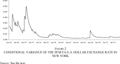
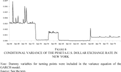
Therefore, the GARCH (1,1) model asserts that the best predictor of the variance in this period (σt) is a weighted average of the long-run average variance (α0), the new information in the most recent period as captured by the most recent squared residual (εt−12), and the variance predicted for the most recent period (σt−1). The conditional variance can thus be interpreted as the expected amplitude of exchange rate movements at a given point in time. Changes in the conditional variance may be caused by a number of factors. For example, macroeconomic news—i.e., unanticipated by the market—would imply larger errors in the mean equation and would hence affect the estimate of the conditional variance. Assuming agents do not improve their forecasting abilities, such unanticipated economic news is likely to remain fairly random as would be its impact on the conditional variance. In contrast, a reduction in the perception of risk would be associated with a reduction in the conditional variance. In particular, a reduction in political uncertainty would be associated with a lower conditional variance. I, therefore, apply the GARCH (1,1) model on the monthly exchange rates of the peseta in New York and obtain its conditional variance, as shown in Figure 2.34
We use New York price data as they cover a longer span at a higher frequency than the Tangiers market data. The two move closely together, with a correlation coefficient of 0.994 from January 1953 to June 1959, the period for which we have monthly data for both markets.

FIGURE 2 CONDITIONAL VARIANCE OF THE PESETA-U.S. DOLLAR EXCHANGE RATE IN NEW YORK
The results suggest that volatility, and hence uncertainty, was high during the late 1940s. Moreover, the spikes in the late 1940s are in line with the view that political uncertainty would be associated with frequent price changes. Following this period of high and changing risk there was a steady decline and, after 1953, relatively low and stable levels.
To cross-check these results I also looked at an alternative measure of confidence. I derive my second proxy for uncertainty from the price of gold in the unofficial market in Madrid. It is likely that the demand for gold, which was legal to own but illegal to trade, was affected by the perception among Spanish economic agents of the risk involved in alternative investments in Spain. Although I have no information on turnover, available commentary suggests that the market seemed to be relatively liquid and prices reflected and sometimes anticipated economic policy changes.35
Pick (Currency Yearbook 1963, p. 562) suggests that “[i]n 1956 gold smuggling into Spain increased substantially and in the first quarter of 1957 ‘imports,’ aided by high officials, soared to about $500,000 a month, as the crowd ‘in the know’ of the coming devaluation coldly commercialized this knowledge.”

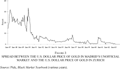
FIGURE 3 SPREAD BETWEEN THE U.S. DOLLAR PRICE OF GOLD IN MADRID'S UNOFFICIAL MARKET AND THE U.S. DOLLAR PRICE OF GOLD IN ZURICH
The overall picture closely resembles the one for the conditional variance of the exchange rate. The price in Madrid was always higher than in Zurich, for two likely reasons: there was probably more demand in Spain for gold as a hedge against insecurity, and a higher price also rewarded the risk borne by the people who carried out the illegal trades in Madrid. But spreads were much higher, and much more volatile, in the late 1940s than thereafter. From mid-1950 onwards there was a substantial decline in the gold premium in Madrid. Changes in the permissiveness of the authorities towards this unofficial market would affect this risk premium, but I have no evidence of any such changes throughout the period. I will therefore interpret this decreasing premium—tentatively—as the manifestation of greater security for other investments and a resulting lower demand for gold as a safe haven. Although the data presented may be suggestive, I now turn to a further statistical analysis of the time series properties of these proxies for economic confidence.
Did the American Rapprochement to Franco Mark a Turning Point?
To explore whether the American rapprochement marks a “turning point” in economic confidence, I analyze breaks in the two proxies of economic confidence: the conditional variance constructed from the exchange rate in the New York market and the premium for gold in the Madrid unofficial market. My strategy is to apply a common four step methodology to search for turning points in time series; roughly speaking, the methodology will help determine whether there were “breaks” in the measure of confidence—that is, changes in its mean that were long lasting and not simply a blip or a random variation in confidence.
36See Frey and Kucher, “History”; and Willard, Guinnane, and Rosen, “Turning Points.”
Results were qualitatively unchanged using 48 month and 72 month windows.


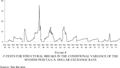
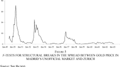
where D1 equals one from the mid-point of the window onwards and zero otherwise. To check for changes in the constant we compute an F-test based on comparing the sum of the standard errors from the equations with and without the dummy variable (equations 3 and 4 for the conditional variance, and similar equations for the gold price premium). The second step consists of estimating the regression again for a window starting one month after the beginning of our data and repeating the procedure until I cover the entire time period. The results from these first and second steps for both the conditional variance of the exchange rate and for the gold price premium are shown in Figures 4 and 5.

FIGURE 4 F-TESTS FOR STRUCTURAL BREAKS IN THE CONDITIONAL VARIANCE OF THE SPANISH PESETA-U.S. DOLLAR EXCHANGE RATE

FIGURE 5 F-TESTS FOR STRUCTURAL BREAKS IN THE SPREAD BETWEEN GOLD PRICE IN MADRID'S UNOFFICIAL MARKET AND ZURICH
The third step of the methodology implies selecting 60 month windows around the dates of the peaks in the series of F-statistics. Whereas the first and second steps allow me to identify the windows in which turning points are most likely, the fourth step is designed to test within each of the windows for structural breaks. To do so, I estimate within each window a random walk augmented by a dummy variable as follows

where s = 6, …, 72 and Dst equals one if date t is on or after date s, and zero otherwise. The estimated coefficient on the dummy variable (γs) measures a change in the mean occurring on date s. I calculate a standard F-statistic to test whether the coefficient on the dummy is different from zero, and the date with the highest F-statistic (showing when the most important mean shift occurs within the window) is designated as a turning point.
38As in Frey and Kucher, “History,” we added six observations to the beginning and to the end of the windows to allow for the sequential break test to detect turning points towards the beginning and the end of the windows. We also generated critical values for the F-test from 10,000 Monte Carlo simulations of random walk equations where the intercept, coefficient and standard errors are those of random walk equations estimated for each of the two time series being examined.
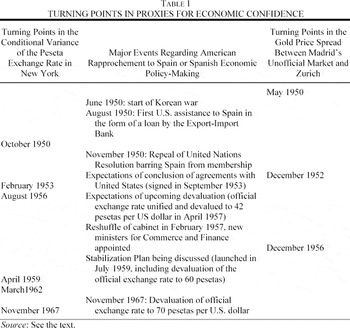
If the true data generating process of the exchange rate embodies the turning points identified in Table 1, the GARCH model should be re-estimated to reflect these turning points.39
I owe this point to an anonymous referee of this Journal.
This is not that surprising given that the turning point associated with October 1950 had the lowest F-statistic of all identified turning points (see Figure 4).


FIGURE 6 CONDITIONAL VARIANCE OF THE PESETA-U.S. DOLLAR EXCHANGE RATE IN NEW YORK
While the results from the conditional variance of the exchange rate suggest that there may have been no turning point in 1950, the analysis of the gold premium does suggest a likely turning point in May of that year, broadly corresponding with the sharp deterioration in the Cold War situation (with the outbreak of the Korean war in June) and with the first official assistance from the U.S. administration to Franco's Spain in August. Significantly, the analysis of both the exchange rate and the gold price suggest a turning point in either December 1952 or February 1953. By late 1952 it was widely expected that the negotiations would be satisfactorily concluded.41
The Fortnightly Review of Business and Economic Conditions of the Bank of London and South America noted on 24 January 1953 the “possibility of the early signature of the Mutual Aid agreement,” vol. 18, no. 426, p. 66.
George Train to MSA, Madrid, 10 December 1952, in Director of Administration, Administrative Services Division, Geographic Files 1948–53, Records of Foreign Assistance Agencies (RG469), entry 236, box 286, National Archives at College Park.
Later turning points uncovered by this method broadly correspond with economic policy changes in Spain, particularly with regard to the exchange rate (which is devalued in 1957, 1959, and 1967). This is to be expected, as uncertainty would have increased when economic policy took a new turn. The results are thus a reminder that we are not only measuring the security of property rights but the effects of economic policies as well. We should therefore consider whether there are any other possible explanations for the earlier turning point observed in 1952–1953, which we associated with the rapprochement between United States and Spain.
Alternative Explanations?
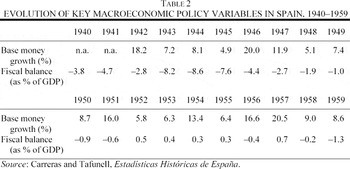
One obvious alternative explanation for the turning point in late 1952-early 1953 would be a change in economic policy. Let us therefore examine monetary, fiscal, exchange, rate, and trade policies during the 1940s and 1950s. Monetary and fiscal policies are summarized in Table 2. In an economy where many official prices were controlled and where the interest rate was not a significant lever of monetary policy, the evolution of the supply of money is a key indicator of the policy stance. We observe that base money growth remained rather volatile throughout the period, with occasional peaks but without a clear trend or turning point.

With regard to exchange rate policy, we already noted when introducing Figure 1 that the official exchange rate does not seem to explain the behavior of the unofficial exchange rate or its volatility. As for fiscal policy, the early 1950s did witness a change in the fiscal balance from deficit to surplus. However, the deficits were already rather small (1 percent of GDP) as early as 1949, and on the whole fiscal policy does not seem to be particularly active throughout the period, except during the years 1943–1946. Thus, it does not seem likely that such small changes in fiscal policy would be the main factor behind the sharp swings in asset price volatility. Finally, trade policy remained focused on an import substitution industrialization strategy, which protected domestic production with high tariffs and subjected imports to licensing.
What about other possible political factors besides the American rapprochement with Spain; could they account for the turning point? One possible candidate is the labor unrest in the spring of 1951. However, neither the unofficial exchange rate nor its volatility shifted noticeably around the time of the strikes. The likely reason is that, although open dissent of this sort was a new phenomenon under the Franco regime, the strikes were short, localized, and did not pose a serious threat to the regime.
Overall, these alternatives seem unlikely to explain the turning point in late 1952-early 1953, a failing that lends indirect support to our claim about American policy. But it would help if we had stronger evidence, such as a “natural experiment” in which only news regarding the American rapprochement to Spain reached financial markets. If we had such an experiment and financial markets reacted in a way that fit our argument, then we could be much more confident about our explanation.43
As Neal (“Shocking View,” p. 326) put it, well-organized financial markets constitute the “most sensitive seismographs” available to the economic historian.
An Event Study of the Pact of Madrid
History in fact makes possible such an experiment if we use an event study to examine how the signature of the Spanish-American agreements on 26 September 1953 affected asset prices. The event study can help reveal whether the shift in economic confidence was indeed related to the American rapprochement to Spain.
The 1953 signature of the Spanish-American agreements of what was the Pact of Madrid culminated the process by which the United States and Spain become security partners. The announcement of the signature is the key for the natural experiment here, for it has a number of ideal characteristics that make it a good candidate for an event study.
First of all, there were rumors in the run up to the signature of the agreements (the Spanish business magazine El Economista suggested two weeks before the agreements were signed that agents were already discounting the event), but the well-publicized announcement on the official event of 26 September 1953 still conveyed new information.44
Following the signature of the agreements Franco was allegedly heard to say in private that “at last I have won the Spanish [Civil] War,” as quoted in Fusi, Franco, p. 143.
Second, the signature of the agreements occurred on a Saturday, so that we know that the news could only be reflected in asset prices when markets re-opened after the weekend. Fortunately, the signature of the Pact of Madrid provides us with an event that can be precisely dated, unlike the granting of the first American loan to Spain in August 1950 which had to be voted in both chambers of Congress and subsequently endorsed by the executive.45
In previous occasions the House of Representatives had passed resolutions to grant Spain official assistance which were subsequently vetoed by the executive.
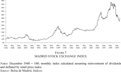
We thus have an ideal event that signals the United States' rapprochement with Spain. What market should be used to examine its impact? Because we need high-frequency data, we chose the Madrid Stock Exchange with its daily prices for stocks trades.46
Whereas government debt could provide an alternative market, the calculation of daily yields is complicated by the lack of a standard benchmark bond.

FIGURE 7 MADRID STOCK EXCHANGE INDEX
The purpose of our event study is to compare the actual returns during the event period with the returns that one would have normally expected to observe. For the estimation of the expected returns we will use the constant-mean model of returns.
47For support for this model, see Campbell, Lo, and MacKinlay, Econometrics, p. 154. Moreover, our event is expected to affect the market as a whole. Controlling for market-wide developments, such as by using the market model, would be controlling for the type of reaction we aim to detect.
MacKinlay, “Event Studies.”
Corrado, “Nonparametric Test.”

where Ait is the abnormal return of stock i on day t (Ai,event being the abnormal return of stock i on the event day), Mi is the number of days on which a stock traded during the entire estimation period and the event window (T), and N represents the number of stocks. Statistical inference is based on the fact that the rank test is asymptotically normally distributed. An important feature of the rank test is that it is well specified under event-date clustering—as in our case—because cross-sectional dependence is taken into account via the aggregation of the individual stock returns.
50Campbell and Wasley, “Measuring Security Price Performance,” p. 88.
A second nonparametric test exploits the sign of the abnormal returns. The sign test, Z, assumes that the number of stocks that have positive abnormal returns on an event date is binomially distributed with probability p, a parameter that captures the proportion of positive abnormal returns during the estimation period, as follows
51Cowan, “Nonparametric Event Study Tests.”

where ϕit is equal to one if Ait is positive and zero otherwise, Ti is the number of days stock i traded, and N the number of stocks in our portfolio. Formally the sign test is given by

where w is the number of stocks displaying positive abnormal returns on the event date. Statistical inference is based on the result that for large samples w will be normally distributed with mean Np and variance Np(1 − p).
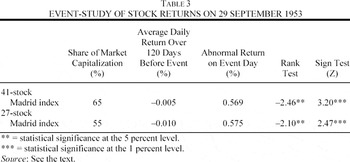
The results from applying these tests suggest that there was a positive and statistically significant increase in stock returns following the signature of the agreements (see Table 3). The conclusion holds when we apply the tests to a broad portfolio of 41 stocks or to a narrower portfolio of 27 stocks that traded on more than 90 percent of days in the estimation period. The natural experiment does suggest that rapprochement with the United States boosted investor confidence.

Link Between Economic Confidence and Investment
Let us now turn to the last link of the chain running from improved confidence in the long-term security of the Franco regime to greater private investment. Exploring this link from improved confidence to investment may help to explain why private investment resumed in the 1950s, even though business profits were lower than they had been in the 1940s, when investment had nonetheless remained minimal.52
Tafunell, “Beneficios.” As directed investment at below-market rates was not a common practice, this increase in private investment is taken as a sign that investors expected future profitability to increase.
There is some qualitative evidence in support of the claim that investment picked up following the American rapprochement to the Franco regime. A report from a Spanish bank noted that “[a]t the end of 1953, and perhaps due to the agreements with the U.S., we have seen a new trend [by the private sector] to build new and important power stations.”53
Banco Urquijo, Economía, p. 30.
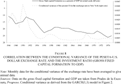
There is also the possibility of further exploring this issue statistically. Granger-causality tests clearly indicate that a proxy for economic confidence, the conditional variance of the exchange rate, affects investment as measured by the ratio of gross fixed capital formation (GFCF) to GDP (see Figure 8). With the standard F-test yielding a statistic of 9.9, we can reject the null hypothesis of no Granger-causality running from the conditional variance to the investment ratio (see estimated parameters in equation 9, where t-statistics are in parentheses) at a level of less than 1 percent. In addition, we cannot find any significant support for Granger causality in the reverse direction, from investment to the conditional variance: the F-test gives a statistic of only 0.78, equivalent to a probability of 39 percent for the null hypothesis (equation 10, with t-statistics in parentheses)


Although Granger-causality measures precedence and information content and does not necessarily indicate causality in a strict sense, the results are nevertheless suggestive.

FIGURE 8 CORRELATION BETWEEN THE CONDITIONAL VARIANCE OF THE PESETA-U.S. DOLLAR EXCHANGE RATE AND THE INVESTMENT RATIO (GROSS FIXED CAPITAL FORMATION TO GDP)
We can also explore the long-term relationship between the conditional variance of the exchange rate and the investment ratio in some further detail. Because both variables appear to contain a unit root, as suggested by the augmented Dickey-Fuller and the Phillips-Perron unit root tests, we search for a cointegrating equation linking the long-run dynamics of the two time series using the standard Johansen procedure. Both the trace and maximum eigenvalue standard tests indicate the existence of one cointegrating equation at the 1 percent confidence level.54
We use two lags and a quadratic deterministic trend in the data (in line with the exponentially declining pattern of the conditional variance), as suggested by both the Akaike and Schwarz information criteria.
The preceding estimates regarding the importance of a reduction in uncertainty for investment should be interpreted with care, not least because the proxy variable used to capture the reduction in uncertainty is necessarily an imperfect one. In addition, the investment ratio used here comprises both public and private investment whereas my argument focuses on the latter. The estimate shows, however, that a reduction in uncertainty stemming from an improvement in the security of property rights can have a nontrivial effect on investment. This is unsurprising given the large body of literature that stresses the impact of insecure property rights and uncertainty in general on investment, especially if it involves large sunk costs that cannot be recouped once incurred.55
Pindyck, “Irreversibility.”
Keefer, “Review,” p. 27.
CONCLUSION
This article demonstrates the importance of political events for expectations and economic performance in Franco's Spain. The Franco regime was not only a dictatorship, but one which in the aftermath of World War II faced an unclear future. As a dictatorship with an uncertain future, property rights were in doubt. As a result, private investment slackened and the economy stagnated.
The worsening of the Cold War altered the situation substantially. Spain's location made it very appealing as a site for American air bases, and the United States therefore sought a deal with Franco that would allow American military bases on Spanish soil. It has long been recognized that this political event marked a crucial turning point in the political history of Spain. Although the Franco regime might have survived without U.S. support, the American endorsement helped reinforce Franco's regime.
The American rapprochement also proved to be a turning point for the Spanish economy. By turning the United States into a stakeholder in the political stability of Spain, the American military interest in Spain had the unintended consequence of stimulating economic activity. Because Franco's regime now seemed to have enhanced long-term viability, economic confidence improved and private investment resumed. Economic growth was still constrained by the policies and institutions of the Franco regime, but uncertainties about the regime's viability diminished. Asset prices confirm that economic confidence improved, and the shift in asset prices can be traced back to the American rapprochement to Spain and then linked to higher investment. That helps to explain why economic growth resumed in Spain in the 1950s despite the fact that most of the distortions stemming from the autarkic economic policies introduced in the 1940s still remained in place.
The author would like to thank Christina Beharry, Albert Carreras, Nick Crafts, Michael Fidora, Fernando Guirao, Philip Hoffman, Arnaud Mehl, Leandro Prados de la Escosura, Albrecht Ritschl, Julio Tascón, Cristina Vespro, and the anonymous referees of this Journal for comments, assistance, and encouragement. Research on which this article is based was largely conducted prior to the author joining the staff of the European Central Bank and was made possible thanks to financial support from the London School of Economics and the University of London Irwin Studentship. Any views expressed in this article are those of the author and should not be attributed to any of the above-mentioned institutions.