Mitral regurgitation is the most common valve condition found in chronic rheumatic cardiac disease in the first and second decades of life.Reference Ravisha, Tullu and Kamat1, Reference Marcus, Sareli, Pocock and Barlow2 Chronic mitral regurgitation has an insidious evolution and causes a volume overload in the left ventricle. Irreversible systolic dysfunction may occur throughout the evolution of the disease if surgical correction is delayed too long.Reference Crawford, Souchek and Oprian3 During the clinical follow-up of patients, a periodic assessment of the systolic function of the left ventricle is necessary so as to identify the critical point of change in myocardial contractility.Reference Enriquez-Sarano, Tajik, Schaff, Orszulak, Bailey and Frye4–Reference Lee, Noh, Bae, Yun, Lee and Kim6 Using the echocardiogram to obtain the ejection fraction and end-systolic diameter of the left ventricle is the currently recommended method for this end.Reference Bonow, Carabello and Chatterjee7–Reference Matsumura, Ohtaki and Tanaka9 However, the ejection fraction in mitral regurgitation is artificially elevated and may be maintained within the lower limits of normality even when some degree of myocardial dysfunction is present.Reference Stewart5, Reference Schuler, Peterson and Johnson10, Reference Agricola, Galderisi and Oppizzi11 Therefore, more precise methods need to be evaluated for the detection of subclinical myocardial dysfunction to obtain a better definition of the time for surgery.
The prohormone pro-brain natriuretic peptide is produced in cardiomyocytes. It undergoes cleavage and is transformed into brain natriuretic peptide, the active hormone and the N-terminal portion of pro-brain natriuretic peptide, an inactive fraction.Reference Rodeheffer12 Both have been used in the assessment of left ventricular dysfunction and have often been studied in valve conditions.Reference Rodeheffer12, Reference Ray13, Reference Detaint, Messika-Zeitoun and Avierinos14 With regard to the use of brain natriuretic peptide as a marker of cardiac failure, in congenital and inflammatory diseases, only one study related to rheumatic cardiac disease was found by the authors.Reference Gölbaþý, Uçar, Yüksel, Gülel, Aydoğdu and Ulusoy15
Thus, the aim of the present study was to assess rheumatic mitral regurgitation in children and adolescents, addressing its clinical, electrocardiographic, and echocardiographic features, correlating these factors to each other and to the natriuretic peptide.
Patients and methods
Sample
Seventy-eight children and adolescents (≤19 years of age, according to the norms of the World Health Organisation) were studied initially. All patients had no previous surgical approach and were out of the acute phase of the disease. No patient had more than mild aortic regurgitation. They were followed up at the Instituto Materno Infantil Professor Fernando Figueira (IMIP) between February and July, 2007. This hospital is located in the state of Pernambuco in Northeastern Brazil and is a reference hospital in the region for paediatric cardiac disease.
To select patients with moderate or severe mitral regurgitation with haemodynamic repercussions, echocardiograms were performed on all cases. Twenty-four patients with mild mitral regurgitation were excluded and one patient was excluded due to grade IV cardiac failure with haemodynamic instability. Thus, 53 patients fulfilled the inclusion criteria. The study received approval from the local Research Ethics Committee and informed consent was obtained from the parents/guardians.
Clinical evaluation
Clinical histories were obtained using a questionnaire administered either directly to the patient or parent/guardian to obtain the following information: disease duration; functional class (based on the New York Heart Association (NYHA)); regular or irregular use of benzathine penicillin; and the number of acute episodes of rheumatic fever. The diagnosis of rheumatic fever was based on the modified Jones criteria or echocardiographic findings compatible with rheumatic valve disease.Reference Marcus, Sareli, Pocock and Barlow2, 16, Reference Ferrieri17, Reference Câmara, Neubauer, Câmara and Lopes18
Complementary examinations
Electrocardiograms and echocardiograms were performed on all patients. Materials from four patients were lost and the N-terminal portion of the pro-brain natriuretic peptide level was rendered impossible to determine; data on these patients were only used in the analysis of variables not related to this hormone.
On the electrocardiogram, cardiac rhythm and the presence of the abnormalities of the left chambers were assessed. Left ventricular hypertrophy/enlargement was considered based on Garson,Reference Garson19 when the “S” wave in V1 or the “R” wave in V6 had an amplitude greater than the 98th percentile for patient age. The values expressed by Sanches and MoffaReference Sanches and Moffa20 were considered for ventricular hypertrophy/enlargement in patients more than 15 years of age and for left atrial abnormality.
The echocardiogram was performed by a single examiner who, at the time, was unaware of the results for the other variables. Measurements represent the mean value of three heartbeats and followed the guidelines of the American Society of Echocardiography developed in conjunction with the European Association of Echocardiography.Reference Lang, Bierig and Devereux21 The left atrial dimension, its volume (using Simpson’s method), and systolic and diastolic diameters of the left ventricle were indexed for body surface area.Reference Kampmann, Wiethoff and Wenzel22 As there was no wall motion abnormality, the ejection fraction was calculated using Teicholtz et al’s method with the measurements in the “M” mode.Reference Teichholz, Kreulen, Herman and Gorlin23
For the quantification of mitral regurgitation, the composition of quantitative variables was used (vena contracta and effective regurgitant orifice, calculated based on the proximal isovelocity surface area method).Reference Zoghbi, Enriquez-Sarano and Foster24, Reference Roberts and Grayburn25 When they were not in agreement, regurgitant volume and regurgitant fraction were included. According to the guidelines of the American Society of Echocardiography for the assessment of the severity of valve regurgitation, moderate mitral regurgitation was determined when the effective regurgitant orifice was ≥0.2 and <0.4 square centimetres; the regurgitant volume was ≥30 and <60 millilitres; the regurgitant fraction was ≥30 and <50%; and the vena contracta was 0.3–0.7 centimetres. Severe mitral regurgitation was determined when the effective regurgitant orifice was ≥0.4 square centimetres; the regurgitant volume was ≥60 millilitres; the regurgitant fraction was ≥50%; and vena contracta was >0.7 centimetres.Reference Zoghbi, Enriquez-Sarano and Foster24
For the brain natriuretic peptide assessment, a 3-millilitre sample of venous blood was collected from the patient at rest and the plasma was stored at −80 degree centigrade. The N-terminal portion of pro-brain natriuretic peptide was determined through an electrochemiluminescence immunoassay, using an immunoassay analyzer (Elecsys 2010 disk chemistry analyzer; Roche Diagnostics), which has minimum and maximum detection limits of 5 and 35,000 picograms per millilitre, respectively.
Statistical analysis
For the numeric variables that exhibited approximately symmetrical distribution, mean and standard deviation were used as descriptive measures of the central value and dispersion, respectively. For variables that exhibited asymmetrical distribution (disease duration, volume of left atrium, and N-terminal portion of pro-brain natriuretic peptide), median and interquartile values were used. The categorical data were summarised by absolute and relative frequencies. The association between the categorical variables was assessed using Fisher’s exact test. Either the Mann–Whitney or Kruskal–Wallis test was used for comparisons of continuous variables between two or more groups. Spearman’s correlation coefficient was used to assess the correlation between continuous variables. Tendency lines adjusted to the graphs were obtained by the “lowess” procedure. The level of significance was set at 0.05. Analysis was done using the Minitab 14.2 and Stata 9.2 software programs.
Results
Demographic and clinical characteristics
Among the 53 patients evaluated, 32 (60.4%) were female. Age ranged from 3 to 19 years, with a mean of 10.6 ± 3.2 years. Mean body surface area (DuBois and DuBois formula)Reference Du Bois and Du Bois26 was 1.19 ± 0.32 square metres. The majority of patients had severe mitral regurgitation (58.5%), with disease duration ranging from 5 to 101 months. The disease lasted for more than 24 months in 70.6% of the patients. Forty-one patients (77.3%) were in the NYHA functional classes I and II (41.5% in functional class I and 35.8% in functional class II). Regular use of benzathine penicillin during the evaluation period was reported in 90.6% and 25.5% had had recurrences of the acute phase of rheumatic fever.
Electrocardiographic, echocardiographic and brain natriuretic peptide characteristics
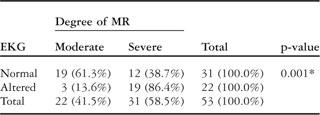
All patients were in normal sinus rhythm, except one patient with atrial fibrillation. Signs of atrial abnormality and/or left ventricular hypertrophy were found on the electrocardiogram in 22 patients (41.5%). There was a significant association between abnormalities on the electrocardiogram and the presence of severe mitral regurgitation (p = 0.001). The occurrence of severe mitral regurgitation was greater in patients with signs of atrial and/or left ventricular volume overload on the electrocardiogram (Table 1).
Association between EKG findings and MR severity.
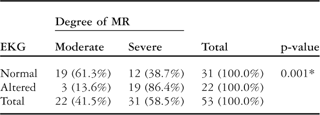
EKG, electrocardiogram; MR, mitral regurgitation
*, Fisher’s exact test
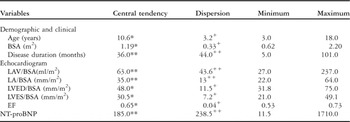
The measurements of the left cavities made on the echocardiogram showed an important degree of heart remodelling (Table 2). The mean ejection fraction fell within the normal range in the majority of the patients. Only three patients (5.7%) had an ejection fraction below 0.60. The plasma value of N-terminal portion of pro-brain natriuretic peptide ranged from 11.5 to 1710.0 picograms per millilitre, with a median value of 185.0 (interquartile distance of 238.5).
Statistical measures of central position and dispersion of the continuous variables: demographic and clinical variables, echocardiogram and NT-proBNP.

*, mean; **, median; +, standard deviation; ++, inter-quartile distance; BSA, body surface area; LAV, left atrium volume; LA, left atrium; LVED, left ventricle end diastolic diameter; LVES, left ventricle end systolic diameter; EF, ejection fraction; NT-proBNP, N-terminal portion of the pro-brain natriuretic peptide
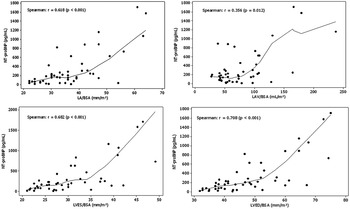
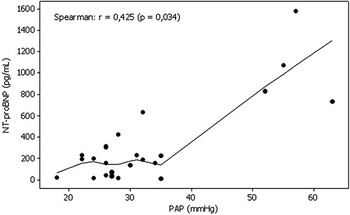
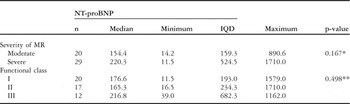
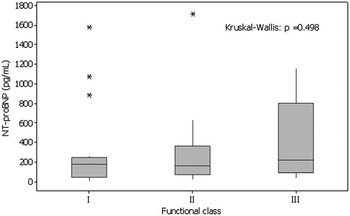
In the univariate analysis, there was a positive correlation between N-terminal portion of pro-brain natriuretic peptide values and the volume of the left atrium/body surface area, diameter of the left atrium/body surface area, final diastolic diameter of the left ventricle/body surface area and the final systolic diameter of the left ventricle/body surface area by the Spearman’s test (Fig 1). In cases that exhibited tricuspid regurgitation, it was possible to calculate the systolic pulmonary arterial pressure value (54.7%) and there was a positive correlation between this value and the plasma levels of the hormone (Fig 2). The majority of patients was in functional classes I and II (77.3%), and there was no significant association between the N-terminal portion of the pro-brain natriuretic peptide and functional class (p = 0.498; Table 3, Fig 3). There was no statistically significant difference in the distribution of the N-terminal portion of the pro-brain natriuretic peptide values between patients with moderate mitral regurgitation and those with severe mitral regurgitation (p = 0.167; Table 3).
Correlation between echocardiogram and N-terminal portion of the pro-brain natriuretic peptide values in 49 patients with moderate or severe mitral regurgitation of rheumatic aetiology.

Correlation between systolic pulmonary arterial pressure and N-terminal portion of the pro-brain natriuretic peptide values in 25 patients with moderate or severe mitral regurgitation of rheumatic aetiology.

Association between the MR severity and the NT-proBNP as well as the functional class and the NT-proBNP.

NT-proBNP, N-terminal portion of the pro-brain natriuretic peptide; *, Mann-Whitney test; **, Kruskal-Wallis test; IQD, inter-quartile distance; MR, mitral regurgitation
Distribution of cases according to functional class (NYHA) and N-terminal portion of the pro-brain natriuretic peptide values in 49 patients with moderate or severe mitral regurgitation of rheumatic aetiology. NYHA, New York Heart Association.

Discussion
Most studies on mitral regurgitation address adult patients. In the present study, half of the sample was made up of young children and minimum age was 3 years. All patients had mitral regurgitation with significant haemodynamic compromise, as generally occurs with rheumatic cardiac disease in developing countries.Reference Marcus, Sareli, Pocock and Barlow2, Reference Terreti, Caldas, Leon, Ultchak and Hilário27, Reference McLaren, Markowitz and Gerber28 This finding is likely due to poor living conditions and inadequate medical care. Hillman et alReference Hillman, Tani and Veasy29 state that children with a better socioeconomic level have less need for surgical treatment after the acute phase of rheumatic fever.
A high percentage of patients in this study reported regular use of antibiotic prophylaxis with benzathine penicillin, which does not normally occur in developing countries. As these data were acquired by means of a questionnaire, there may have been an information bias related to non-adherence to the recommended medication.
On the basis of the electrocardiogram examination, there was a low frequency of arrhythmia when compared to studies on adult populations.Reference Enriquez-Sarano, Tajik, Schaff, Orszulak, Bailey and Frye4, Reference Chauvaud, Fuzellier, Berrebi, Deloche, Fabiani and Carpentier30 Only one patient exhibited atrial fibrillation, despite the accentuated degree of dilation of the left atrium observed in many patients. Chauvaud et alReference Chauvaud, Perier and Touati31 also found a low incidence of arrhythmia among children with rheumatic fever, as 91% of their patients had normal sinus rhythm.
Enriquez-Sarano et alReference Enriquez-Sarano, Tajik, Schaff, Orszulak, Bailey and Frye4 demonstrated that functional class has a predictive value of early or late mortality in mitral regurgitation, such that awaiting symptoms for the indication of surgery were associated with a significant rise in postoperative mortality. Earlier studies carried out on adults have shown a correlation between brain natriuretic peptide and the functional class of mitral regurgitation, with a progressive increase in the hormone levels accompanying an increase in functional class.Reference Detaint, Messika-Zeitoun and Avierinos14, Reference Meneghelo, Magalhães and Ramos32–Reference Yusoff, Clayton, Keevil, Morris and Ray34 This contrasts with the results of this study. A serious rise in brain natriuretic peptide occurs most commonly in patients with functional class III, but the median was just a little higher and not statistically significant. This finding may be due to the subjectivity of the assessment of the symptom in children, as no objective functional class assessment tests were performed.
Clinical follow-up of asymptomatic patients is currently recommended, with a periodic evaluation of myocardial contractibility of the left ventricle, assessed using the echocardiogram for the calculation of the ejection fraction and final systolic diameter of the left ventricle.Reference Bonow, Carabello and Chatterjee7 In children, the recommendation is restricted to the ejection fraction.Reference Bonow, Carabello and Chatterjee7
Due to the haemodynamic conditions of severe mitral regurgitation, calculating the ejection fraction is an imperfect method for the assessment of myocardial contractibility of the left ventricle in this lesion. In a more advanced phase of the disease, even when the reduction in contractile function and anterograde systolic flow has been initiated, the ejection fraction may remain within the lower limits of normality, secondary to a diminished afterload, with a return of the blood to the left atrium, which offers little resistance.Reference Schuler, Peterson and Johnson10
In this study, a high degree of remodelling of the left cavities with the ejection fraction preserved and high N-terminal portion of pro-brain natriuretic peptide values in many of the patients merit attention. This emphasises the question whether it is reliable to follow these asymptomatic patients based only on the ejection fraction.
The N-terminal portion of the pro-brain natriuretic peptide also had a significant positive correlation to the dimensions of the left atrium. This finding is in agreement with that described by Sutton et alReference Sutton, Stewart and Gerber33, who, in assessing patients with varied degrees of mitral regurgitation and preserved ejection fraction, reported that brain natriuretic peptide secretion was related more to the increase in the left atrium than to the remodelling of the left ventricle or the ejection fraction. Although brain natriuretic peptide is principally produced by the ventricle, other findings have also shown its production in the atrium: brain natriuretic peptide is high in pure mitral stenosis, with normalisation following valve surgery; and a study on the brain natriuretic peptide gene expression in the human heart showed the presence of messenger RNA from brain natriuretic peptide in the atrium as well.Reference Ray13, Reference Hosoda, Nakao and Mukoyama35
Brain natriuretic peptide has been used in the prognosis of idiopathic pulmonary arterial hypertension, with high values associated with a greater mortality rate.Reference Nagaya, Nishikimi and Uematsu36 Brain natriuretic peptide is also high in children with a pressure or volume overload in the right cavities.Reference Nir, Bar-Oz, Perles, Brooks, Korach and Rein37 In this study, there was a positive correlation between brain natriuretic peptide and pulmonary arterial pressure values.
It has been shown that brain natriuretic peptide in children has a predictive value for morbidity and mortality from the chronic systolic dysfunction of the left ventricle.Reference Price, Thomas and Grenier38 It has also been shown to be a predictive factor in mitral regurgitation, independent of mortality and the appearance of cardiac failure throughout clinical follow-up.Reference Detaint, Messika-Zeitoun and Avierinos14 By studying brain natriuretic peptide with abnormalities in the treadmill, Yusoff et alReference Yusoff, Clayton, Keevil, Morris and Ray34 suggest that altered brain natriuretic peptide in patients with mitral regurgitation and normal ejection fraction at rest reflect subclinical ventricular dysfunction.
In this study, there was a significant correlation between N-terminal portion of the pro-brain natriuretic peptide and echocardiographic measures that reflect the haemodynamic consequences of mitral regurgitation. The correlation was significant and strong with the diameter of the left atrium/body surface area, the final diastolic diameter of the left ventricle/body surface area and the final systolic diameter of the left ventricle/body surface area, the best marker of cardiac remodelling in mitral regurgitation.Reference Bonow, Carabello and Chatterjee7 Yusoff et alReference Yusoff, Clayton, Keevil, Morris and Ray34 and Detaint et alReference Detaint, Messika-Zeitoun and Chen39 also showed that the brain natriuretic peptide reflects the impact of mitral regurgitation on the heart, regardless of the degree of valve regurgitation.Reference Detaint, Messika-Zeitoun and Avierinos14
Among the echocardiographic variables that were significantly correlated to the plasma level of N-terminal portion of the pro-brain natriuretic peptide, the trend of the curve merits attention. As illustrated in Figs 1 and 2, the N-terminal portion of the pro-brain natriuretic peptide had a relatively stable pattern up to certain cardiac remodelling values and a degree of pulmonary arterial hypertension. At a certain point, it begins to exhibit a significant trend towards increasing values. If such an occurrence determines a critical point of the remodelling of the cavities, it should be assessed in further investigations by prospective studies.
On the basis of the data presented in this study, it was concluded that the cardiac remodelling that occurs in rheumatic mitral regurgitation in children and adolescents leads to the production of the natriuretic peptide. The usefulness of simple methods such as the electrocardiogram in the follow-up of mitral regurgitation in the paediatric group is also emphasised.
Financial support
Kits for N-terminal portion of the pro-brain natriuretic peptide were provided by Roche diagnóstica do Brasil.