In 1867 the Austrian Empire, which had been formed 63 years before, became the Austro-Hungarian Monarchy consisting of two states which had certain common institutions, but were constitutionally and fiscally separated otherwise, although the coordinated fiscal policy amounted to a ‘partial tax union’ between the two states (Eddie Reference Eddie1982, p. 8). Government borrowing was done separately by both states, but in close coordination and to a large extent upon the same conditions offered to the creditors.
For most of the period, Hungarian securities were valuated at a lower price than securities issued in the western part of the Monarchy. The obvious explanation for the spread between Austrian and Hungarian bond prices lies in investors' presumptions about fiscal policy and the respective probability of default. Contemporaries could easily assess the fiscal situation because the state budget, the state final accounts, and the level of the state debt were published annually or twice a year. In addition, a bundle of other factors may have played a substantive role in the Austro-Hungarian case, particularly factors concerning political stability and the cohesion of the Empire. A complete separation between Austria and Hungary, while not an imminent danger even at the most critical times, would have affected matters such as the customs union and the common currency. It is not clear from the beginning how the Hungarian government would have handled its debt under the conditions of a separate Hungarian currency, and how contemporaries assessed this risk.
This article investigates the movements and spreads in bond prices in connection with changes in the fiscal situation of the two states and their economic conditions in general, and with the political order and stability. It is organised as follows: Section i describes the constitutional background and the basis for state borrowing. Section ii provides a characterisation of the investors holding state bonds and gives an outline of the changes in bond prices and the spread between Austrian and Hungarian bonds from 1880 to the Great War. Section iii investigates the relevance of fiscal and monetary factors for investing in these bonds. Section iv discusses the conversion of paper bonds in 1892/3 and its anticipation by investors in the previous years. Section v deals with political events that affected political stability, and discusses their effects on bond prices in the short run. Section vi sums up the results.
I
The two states of the Austro-Hungarian Monarchy were created in 1867, re-establishing Hungary as a separate political entity along the lines of the laws that had been passed by the Hungarian diet in the March revolution of 1848 and signed by the then emperor and king, but had been rescinded by a new emperor in 1849. In 1867 these former constitutional laws were taken up again, Hungary received its own government again, the Hungarian diet was now an Imperial diet once more and Hungary was to decide about its own laws in all domestic matters independently. The lands of the Hungarian crown comprised the kingdom of Hungary (including Transylvania, which had given up its autonomy in 1866), the autonomous kingdom of Croatia-Slavonia and the city of Fiume.
The other state, created in 1867 as well, consisted of the rest of the former Austrian Empire and was officially called ‘The Kingdoms and Lands Represented in the Imperial Assembly’, or, for short, the Imperial Assembly Lands; the name ‘Austria’ was used officially only from 1915 on, although the Monarchy as a whole and the central bank were called ‘Austro-Hungarian’ from the outset (the common silver currency, which had been introduced in 1858, was called the ‘Austrian currency’ even after 1867). For practical reasons, the name ‘Austria’ was used constantly by the public and in the press throughout the period. Like Hungary, the Imperial Assembly Lands received their own constitution in 1867.
The division of the Austrian Empire into two states meant that each of them had its own parliament and its own government. They had, however, the same person as their head of state, the emperor of Austria and king of Hungary, and in addition, they had common military forces, a common ministry of foreign affairs, and a common ministry of finance in addition to the separate ministries of finance of either state. From the Hungarian point of view, all these authorities were supposed to act as coordinative institutions not as the government of a superordinated empire. Therefore, while there was an Austrian prime minister, and a Hungarian one, no common Austro-Hungarian prime minister was ever to be appointed.
The relations between the two states were regulated in a treaty called ‘The Compromise’ (Ausgleich). The Compromise was concluded for ten years in 1867, and was supposed to be renewed every ten years thereafter, which was a guarantee for a major political crisis every few years. The main problem to be solved in every new Compromise was the proportion of the respective contributions to the common budget (Galántai Reference Galántai1990, pp. 49–55). The common expenses consisted almost entirely of military expenses, and military expenses were one of the three heavyweights in the state budgets anyway, comprising about a quarter of overall expenses (the other two important items were the railways and the state debt). Therefore the contributions to the military, and thus to the common budget, were far from negligible. Given the fact that Austria was by far the larger of the two states with close to 60 per cent of the Austro-Hungarian population, and the Austrian GDP per capita was higher than the Hungarian one, it was clear from the beginning that the Austrian share in the common budget would be much larger.
The contributions of the two states to common requirements concerned not only the annual expenses for the common institutions but also for the common debt, which was a relic from the pre-1867 era. The Austrian Empire had been a major borrower and had accumulated a debt of almost 6 billion crowns up to 1867.Footnote 1 About 60 per cent of this debt consisted of various non-redeemable debts, 20 per cent were middle and long-term redeemable debts; the remainder was mostly state money and short-term debts (Püregger Reference Püregger1912; Körner Reference Körner1893; Pammer Reference Pammer2002, pp. 120–34; 2010). In 1868 the non-redeemable debts and part of the redeemable loans were converted into a so-called ‘unified’ debt consisting of two types of perpetual bonds whose interest was to be paid in silver and in notes, respectively, according to the interest conditions of the original securities (Beer Reference Beer1877, pp. 372–85). Altogether, the perpetual bonds comprised about 80 per cent of the common debt. Both Austria and Hungary were liable for the common debt, but their shares in the resulting obligation were a constant source of problems. Technically, the common debt was not part of the common budget and was therefore not administrated by the common minister of finance, and Hungary did not pay a predefined percentage share in the expenses. Instead, the Imperial Assembly Lands paid both the total interest for all loans and the redemption for the redeemable ones, whereas Hungary paid an annual lump sum of close to 60 million crowns to the Austrian government as its contribution to the interest payments (in addition, Hungary paid a negligible contribution to the repayment of redeemable loans).Footnote 2
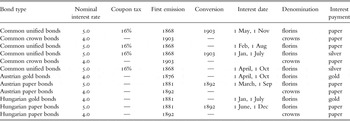
Selected perpetual bonds issued in Austria-Hungary

For a number of years, the common debt was the most important part of the state debt of both states, amounting to 5.9 billion crowns in 1868, rising to a maximum of 6.3 billion up to 1893, and decreasing to 5.1 billion in 1914 (all values are reduced to a uniform interest rate of 5 per cent). Rises were mostly due to the emission of bonds for financing common interest payments and annuities for redeemable loans.
Apart from their liability for the common debt, both states were free to raise their own loans upon their own conditions. In any case, the two states had to decide between amortisable debts and perpetual ones. To a large degree, the growth of both the Austrian and the Hungarian state debt was due to the nationalisation and construction of railways: from the late 1870s on, by and by both states nationalised one railway after the other, which resulted in the state ownership of by far the largest part of the railway system in 1913. Due to the enormous amount of capital needed by the railway sector, about one half of the state debt was essentially railway debts in 1913. Austria and Hungary managed these debts differently: the Imperial Assembly Lands mostly left their railway debts unmodified, shouldering the liability for amortisable loans raised by the railway companies before nationalisation, and converting railway shares into redeemable state railway bonds, whereas Hungary tended to redeem railway debts and financed this operation by issuing perpetual bonds. In addition, Hungary was quick to raise several amortisable loans for other purposes from the early 1870s on, and financed their redemption in the same way within about 15 years. Therefore, eventually a much larger proportion of the Hungarian debt consisted in perpetual bonds in 1913, whereas Austria had still a considerable amount of amortisable (though exceedingly long-term) debts to service.
Both states started to issue perpetual bonds in 1876, first upon different conditions. The Austrian bonds as well as the Hungarian ones were gold bonds, that is, with interest payments to be made in gold florins (Appendix 1). The difference lay in the interest rate, with a nominal interest rate of 6 per cent for the Hungarian bonds, and 4 per cent for the Austrian ones.
From 1881 on, the emission of perpetual bonds happened in close coordination. First, Hungary converted its 6 per cent gold bonds into 4 per cent ones. Second, in 1881 both states simultaneously issued perpetual bonds with a nominal interest rate of 5 per cent, to be paid in notes of the Austrian florin currency. In 1892, following the adoption of the gold standard, the paper bonds of both states were converted into bonds with a nominal interest rate of 4 per cent to be paid in notes of the new crown currency. Several additional parallel emissions of paper bonds (in crowns) followed, a major one as early as 1897. Technically, the emissions were not done at once, but a certain kind of bond was created by a law establishing a debt ceiling and empowering the respective government to emit bonds up to this amount as required; additional emissions of the same bond would be allowed by legal amendments in cases of specific needs such as infrastructure investments or armament programmes. For this reason, the overall circulation of perpetual bonds rose in small steps rather than in great leaps. In each case, the Hungarian and the Austrian varieties offered the same credit conditions, that is, the securities were perpetual bonds with the same monetary base and the same nominal interest rate.
Temporarily a difference in the borrowing conditions resulted from the different taxation of Austrian and Hungarian bonds in the Imperial Assembly Lands from 1898 to 1907. Potentially, interest payments were subject to three kinds of taxation: a coupon tax, a personal income tax and a capital gains tax. The coupon tax concerned the bonds of the common debt only (with a deduction of 16 per cent of the coupon value), whereas both the separate Austrian and Hungarian bonds were by law free of any coupon taxation and fee.
In the income tax law of 1849, capital gains were treated differently from other kinds of income and were taxed at 5 per cent with no distinction between domestic and foreign debt instruments.Footnote 3 In 1896 Austria introduced a new comprehensive law of income taxation including a new personal income tax and a new capital gains tax.Footnote 4 The personal income tax was applied to all kinds of income including income from capital, with a tax-free allowance of 600 florins (1,200 crowns) per year. Concerning income from capital, the law did not distinguish between domestic and foreign securities, so Austrian and Hungarian bonds were subject to the same conditions again.
The capital gains tax, however, had a different effect. It was applied to all kinds of capital gains with several exceptions, among others the unified bonds of the common debt (which were already subject to the coupon tax and therefore exempt from the capital gains tax) and those securities which were declared tax-free by special law. Therefore the Austrian perpetual bonds, having been declared tax-free by law upon emission, remained exempt from the capital gains tax. Hungarian bonds, however, while being declared tax-free by Hungarian law, had never been covered by Austrian legislation. They were therefore subject to the Austrian capital gains tax (likewise, Hungary taxed Austrian securities). The tax amounted to 2 per cent of the interest payments of these bonds. Again, a tax-free allowance for people with less than 600 florins (1,200 crowns) of total income was effective. The law came into effect in 1898, and although there was obviously considerable tax evasion in the first two years, the state final accounts show that the tax was successfully applied on any kind of capital gains, potentially including gains from state bonds. Depending on the share of the bonds traded at the Vienna Stock Exchange which were held by domestic investors, the share of investors with an income of less than 600 florins, and the extent of tax evasion, the effective interest of Hungarian bonds traded in Vienna must be reduced by an unknown factor of maximally 2 per cent in the relevant period. Given the assumption that most Viennese investors were indeed domestic taxpayers, and probably had an income above 600 florins, and given the general success of the capital gains tax, the following calculations use a factor of 2 per cent straightforwardly.
In the years following the 1896 income tax law, journals reported rumours about a coming exemption of Hungarian bonds from the capital gains tax from time to time. In fact, such a reciprocal exemption of both Austrian and Hungarian securities from taxation by the respective partner emerged in the renewal of the Compromise in 1907, and an Austrian law which provided the legal basis for it came into effect on 1 January 1908.Footnote 5
II
Who were the investors that owned government bonds, and who set the price of these bonds in the market? Concerning ownership, we may distinguish between domestic and foreign investors, and between the respective shares of households and banks.
The Austrian and the Hungarian debt differed in the share of domestic investors and investors from various countries in the ownership of bonds (Berend and Ránki Reference Berend and Ránki1974, pp. 93–111; Komlos Reference Komlos1983, pp. 162–206; Köver Reference Kövér1988). Generally, Austrians owned about 80 per cent of the Austrian state debt and of the common debt; they owned practically all of Austrian and common paper bonds, 75 to 80 per cent of the common silver bonds, and between 20 and 40 per cent of Austrian gold bonds. The largest foreign creditor to Austria was Germany, which held 40 to 60 per cent of Austrian gold bonds. The Hungarian share in the Austrian debt was close to zero (Währungsstatistik 1893, 1900–4).
The major part of the Hungarian debt, on the contrary, was held by non-Hungarian creditors. The Hungarian share in the overall debt fluctuated between 25 and 45 per cent, with a low in the 1880s. For most of the time, Germans held between 45 and 55 per cent of Hungarian gold bonds, Austrians held between 20 and 30 per cent, French people between 15 and 30 per cent; Hungarians held less than 5 per cent. Hungarians owned about 60 per cent of Hungarian paper bonds, Austrians owned 25 per cent, Germans 15 per cent (Fellner Reference Fellner1908, 1917; Währungsstatistik 1893, 1900–4).
These numbers were estimated according to where interest coupons were submitted for payment, which yields not perfectly accurate results for a number of reasons but comes reasonably close to reality (Fellner Reference Fellner1908, pp. 61–2). Trading by foreign investors happened at both the Vienna Stock Exchange and foreign stock exchanges; therefore, to some degree, Viennese trading data reflect preferences of foreign investors in addition to Austrian ones. Altogether, foreign investors' assessments mattered mostly for Austrian and Hungarian gold bonds; Austrian investors' assessments mattered for Austrian and Hungarian gold bonds and for Hungarian paper bonds to some degree, for Austrian and common paper bonds exclusively, and for common silver bonds predominantly; Hungarian investors' assessments mattered only for Hungarian paper bonds, though not exclusively.
Domestic investors were mostly private households. The balance sheets of Austrian banks show that the total of all securities and foreign currency (not itemised in detail) were equivalent to 2 to 7 per cent of Austrian and Hungarian state bonds (Banks 1885–1918). For Austrian savings banks, the corresponding numbers are 6 to 15 per cent (Savings banks 1884–1916). The share of state bonds in these securities is unknown; it was probably larger for savings banks. Altogether, the numbers indicate a safe upper limit of the share of Austrian financial institutions in the ownership of these bonds of 8 per cent in 1882, and 22 per cent in 1911, and probably a considerably smaller actual share given that other securities (such as railway and industrial securities) were certainly also in the portfolios of banks.
According to Austrian household wealth data, private domestic investors were mostly larger wealth-holders, business persons and persons living in Vienna or (to a lesser degree) minor urban centres (Pammer Reference Pammer1998). About 35 per cent of the people who held securities of any kind owned Hungarian securities as well. The propensity to hold Hungarian securities, and the amount of these securities in the portfolios, was largely independent of the relative performance of the Hungarian economy. The only exception was investment in railway shares and bonds, which was positively associated with the growth of Hungarian GDP. Investment in state bonds, on the contrary, does not show any meaningful relation to the business cycles.
The small share of banks in the ownership of bonds does not necessarily mean that their influence on bond prices was equally small. As the contemporary literature observed, banks could still set the price because for other investors ‘there are no other factors which can be shown to bring them to the market simultaneously either to buy or to sell’. The other investors, following the banks according to the ‘profitableness of the investment’, ‘give weight to the price movement while the banks tend to give it precision’ (Williams Reference Wiliams1912, p. 391).
Prices and price differences between Austrian and Hungarian bonds moved differently for different kinds of perpetual bonds. Generally the returns were highest in the 1880s, decreasing from 1888 on, arriving at a minimum about 1897/8, and returning to somewhat higher yields in 1901. After a new decrease up to 1903, yields rose again and almost without interruption up to World War I. At the eve of the Great War, the yields were higher than at any time in almost a quarter of a century. This is true for all bonds of the common debt, and for gold bonds and paper bonds of both states.
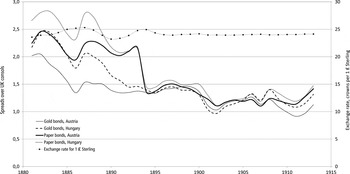
Part of this development reflects price movements in the international bond market; part of it was country-specific effects. The international part may be subtracted out by relating Austrian and Hungarian bonds to United Kingdom consols (see Figure 1).Footnote 6 By contemporary standards, UK consols represent a practically risk-free investment, and the spread over consols can be regarded as the result of country-specific risks. As the yields of UK consols decreased up to the 1890s, and rose again in the last decade before the outbreak of the war, the overall assessment of Austrian and Hungarian bonds must be put accordingly: throughout the period, both states had to pay a premium, which was 2 to 3 per cent in the 1880s, and between 1 and 1.5 per cent after the turn of the century. Up to the 1890s, the premium was much larger for paper bonds, and it was larger for Hungarian bonds: Hungarian gold bonds had a higher yield than Austrian ones, and Hungarian paper bonds had higher yields than Austrian ones as well; Hungarian gold bonds had, however, lower yields than Austrian paper bonds. The data for gold bonds, which were the counterparts of UK consols, reveal that the decrease in the spread was primarily a matter of the Austro-Hungarian Monarchy as a whole because both states had a large spread initially and managed to narrow the gap: in the early 1880s, the spread was about 2 per cent for Austria, and 2.5 per cent for Hungary; 20 years later it was about 1 per cent for both.
Spreads of Austrian and Hungarian bonds over UK consols

From the 1890s on, the Hungarian premium was much smaller, and from 1898 to 1907 there was even an Austrian premium for gold bonds, a result of the capital gains tax applicable to Hungarian bonds; for paper bonds, the Hungarian premium persisted for most of the time even during the years of capital gains taxation. Since in these calculations the maximally possible amount of the capital gains tax is included, the Austrian premium may be somewhat overstated. Calculating gross bond yields (that is, without a capital gains tax), the Austrian premium on gold bonds disappears.
III
In order to explain the prices of state bonds and the spreads between bond yields of different states we begin with the fiscal performance and the risks connected with it. The assumption is that a larger public spending ratio, a larger state deficit and a larger proportion of the state debt (and interest payments) to state revenues or GDP will increase the risk inherent in state securities, and thus the necessary returns on state bonds.
Although such an explanation may seem obvious, findings in the literature on other pre-World War I cases are mixed. In an analysis of ten European and American countries, the government deficit as related to GDP did not have a significant impact on government bond yields (one exception is a barely significant effect on US paper bonds) (Bordo and Rockoff Reference Bordo and Rockoff1996). On the other hand, studies on a major number of European and American countries, or on countries, colonies and self-governing parts of the British Empire, find highly significant effects of the relation between the debt (or debt service) and revenues on bond spreads; the government deficit (as related to revenues) has either a weaker or no significant effect (Flandreau and Zumer Reference Flandreau and Zumer2004; Ferguson and Schularik, Reference Ferguson and Schularik2006; Accominotti et al. Reference Accominotti, Flandreau and Rezzik2011). However, even in those cases where fiscal policy did not display any direct effects on the creditworthiness of states, it may have worked indirectly by way of monetary policy: countries committed to the gold standard faced lower borrowing costs because a credible adherence to the gold standard was perceived as an indicator of the commitment to low budget deficits, stable money growth and low inflation; in this sense, the gold standard worked as the ‘good housekeeping seal of approval’ (Bordo and Rockoff Reference Bordo and Rockoff1996).
Consequently, in the Austro-Hungarian case one would expect a direct reaction of bond prices, and of the spread between Austrian and Hungarian bond yields, to the respective state debt and to state revenues and expenses, that is, a larger spread in these variables might be expected to be related to a larger spread in bond yields. Indirectly, the spread between Austrian and Hungarian bond yields might be expected to have narrowed in the period of the de facto adoption of the gold standard, that is, from 1896 on. In the following, we test the impact of the public spending ratio, the structure of the state budgets, the state budget deficits, the amount of the state debt and interest payments and the monetary regime.
The issue is rather complex because the public spending ratio in both parts of the Austro-Hungarian Monarchy rose during the last decades before the Great War in connection with a thorough change in the structure of the state budgets. This rise happened steadily in Austria, with state expenses rising from about 10 per cent of the GDP around 1870 to about 17 per cent at the end. Hungary had a higher ratio of about 13 per cent from the beginning, with little change up to about 1890. From the 1890s on, the ratio moved between 16 and 19 per cent. Of course, the absolute numbers were much larger in Austria (Pammer Reference Pammer, Cardoso and Lains2010). However, the rise in total state expenses matters only to a certain extent. Expenses rose in the context of state budgets with changing proportions of various budget chapters (Wysocki Reference Wysocki1975; Jobst and Scheiber Reference Jobst and Scheiber2014). Simplifying matters, one may distinguish between three types of state expenses:
-
1. The service of the state debt was a long-term obligation even in the case of most redeemable loans such as those resulting from infrastructure investments of the state. Since the emission of new debt instruments was directly connected with future expenses without corresponding revenues, it makes sense to treat the debt service as a separate part of state expenses.
-
2. Operating expenses for infrastructure, including operating expenses for transport, communication and state enterprises, were the main reason for expanding state budgets. These expenses were a special matter insofar as they were mostly balanced by corresponding revenues. For instance, state railways (the most important budget chapter of this type), or the mail service, normally ran an operating surplus. Therefore, rising expenses of this type did certainly not endanger the credit-worthiness of the state.
-
3. Other expenses were not balanced in a similar way but may be regarded as consumption expenses. They include spending for the military and a number of minor budget chapters such as education, justice, the interior and others.
The proportion of these types of expenses in the state budgets changed rather steadily in Austria, but more erratically in Hungary. Calculated as a proportion of overall expenses, in Austria the debt service was most important before 1870 due to the large Austrian share in the common debt. Up to the early 1880s this share decreased because Austria was slow to raise new loans. A transient surge happened around 1890 in the context of the nationalisation of railways, but generally the share of the debt service in Austrian state expenses declined up to 1914. In Hungary, this share was much lower in 1868 because Hungary had to shoulder only a minor share of the common debt. In the following years, however, the state was very quick in raising major loans, and the debt service accounted for more than a third of Hungarian state expenses in the late 1870s, a level Austria never attained. From 1880 on, this share decreased in Hungary as well; it remained larger than in Austria throughout the period. Austria paid always less than 3 per cent of its GDP for the state debt interest, whereas Hungary had to spend 4 or 5 per cent of its GDP for this purpose for most of the time. At least, the difference decreased.
Considering the credit status of both states, the interest burden may be put in relation to GDP, and to the main sources of regular revenues, that is, taxes, fees and income from state property. These relations changed over time, and differently in both states. Differences in the relation between the state debt and GDP were particularly large in the 1890s and the years up to 1905; in this period the Austrian state debt moved from about 75 per cent of GDP to about 50 per cent of GDP, whereas the Hungarian debt ratio was always about 35 to 40 per cent larger in these years. In Austria, about one-third of those revenues had to be used for interest payments, with lower values in the 1870s and after the turn of the century; there is no linear trend either upward or downward. In Hungary up to 65 per cent of the tax revenues had to be used for interest payments in the 1870s; however, the state managed to lower this proportion throughout the following decades, arriving at about 35 per cent in the last years of the peace period. Some heavy fluctuations in 1903–5 are due to the conversion of a large part of the Hungarian railway debt into perpetual bonds, which necessitated double interest payment for a short time, but lowered the debt burden after.
Concerning infrastructure, the Austrian budgets display a steadily and almost monotonically growing share of expenses for railways and communication from less than 10 per cent in 1868 to about 35 per cent around 1910. These were mostly operating expenses of the state railway system, which grew by nationalisation of existing lines more than by state railway construction. The situation was different in Hungary where the state spent considerable sums on the construction of railways, concentrated in several periods. Therefore, the share of expenses for infrastructure in the Hungarian budget was particularly large in the early 1870s and the late 1890s, and particularly small in the late 1870s. Accordingly, the share of the consumption expenses decreased rather continually from about 65 per cent of the budget to about 50 per cent in Austria, and fluctuated wildly in Hungary, mostly at a lower level.
The budget deficit developed differently in the two states. Matters are somehow obscured by changing habits of including internal flows between different state agencies and accounts in the same manner as real revenues and expenses (there was a rising tendency to include such flows, which tends to inflate state budgets on both the revenue and expense side without real foundation). Correcting the final accounts for these flows, Austrian state budgets display budget surpluses of less than 1 per cent of GDP most of the time, and deficits less than 1 per cent in some years. On the whole, there was a slight tendency towards diminishing surpluses. Hungary, on the contrary, started with deficits of close to 4 per cent of GDP after the Compromise, arrived at a budget surplus around 1890, and had a tendency towards growing deficits up to 1914. Generally, Hungarian budget results fluctuated more heavily than the Austrian ones.
Much of this variance in the financial management of the two states could be observed by contemporaries, and certainly by professional investors such as bank managers. The numbers of the state debt were published in standardised form twice a year, annual state budgets were published in the law gazettes and annual final accounts were published by the Court of Audit. Thus, the structure of public spending, and the debt burden, could easily be determined by anyone who wanted to invest in government securities. The relation of the state interest service to the state revenues, a variable relevant in recent studies of interest spreads, could be observed constantly. As in other contemporary cases, there were no regular contemporary estimates of Austrian and Hungarian GDP. However, this does not necessarily exclude the use of GDP in an explanation, as has been suggested (Ferguson and Schularik Reference Ferguson and Schularik2006, p. 291). The concept of GDP was well known in the literature on methodology (Losch Reference Losch1887) as well as on selected countries (on Austria and Hungary, Fellner Reference Fellner1917). The very statistics upon which recent estimates of Austrian and Hungarian GDP are based were easily accessible for contemporaries as well: statistics concerning agricultural production and railways were published in great detail every year, and industrial statistics every five years; service production, however, was hard to assess and is still the weakest point in modern estimates of Austro-Hungarian GDP. On the whole, contemporaries could easily get an idea of changes in the production level in major parts of the economy. In addition to the production numbers, everyone could look up the current numbers of state revenues including income and consumption taxes and get an idea of the tax base.
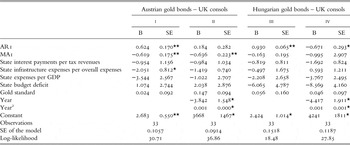
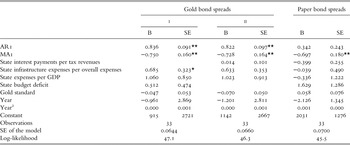
Therefore, it is remarkable that the key variables of the state finances show no consistent and robust impact on the yields of state bonds. Leaving out any fiscal and monetary covariates, both the Austrian and the Hungarian gold bond yields follow a highly significant quadratic time trend, with a decrease of yields up to 1906 (Austria) and 1905 (Hungary) and appreciating yields thereafter (not shown in the tables). Due to the strong correlation between the Austrian and Hungarian price movements, there is no time trend in the spread between the bonds of the two states. The fiscal variables have no robust effect, whether they are employed as single covariates (not shown in the tables) or in combination (Tables 2 and 3). Tests included various numbers of the state debt and state interest payments (put in relation either to the state revenues or the tax base), budget deficits in relation to state revenues or GDP and state expenses in relation to GDP. In some models of the Austrian case, the share of infrastructure expenses in overall state expenses is negatively related to the yield of Austrian gold bonds, or, conversely, a larger proportion of consumption expenditures leads to a higher yield of these bonds (Table 2). This is plausible because infrastructure expenses went along with corresponding (or even larger) infrastructure revenues, whereas higher consumption expenditures would simply increase the budget deficit. The effect is not particularly robust and disappears in slightly varied models. In an analysis of the spread of Hungarian over Austrian bonds, the fiscal variables have mostly insignificant effects both in models including the time trend and those disregarding the trend. This is true for the spread of Hungarian gold bonds over Austrian gold bonds and for the spread of Hungarian paper bonds over Austrian ones (Table 3).
Factors for Austrian and Hungarian gold bond yields

Sources: Compass (1868–1918); Debt, common (1868–79); Debt, common (1879–87); Debt, common, short-term (1868–87); Debt, Austria (1879–87); Debt, Austria (1887–1903); Debt, Austria (1904–18); Final accounts, Austrian Empire (1860–7); Final accounts, common (1868–1913); Final accounts, Austria (1869–1914); Final accounts, Hungary (1869–1914); Vienna Stock Exchange, official list (1881–1914); Harley Reference Harley1976; Homer and Sylla Reference Homer and Sylla2005.
Notes: Austrian gold bonds – UK consols: spread of Austrian gold bonds over UK consols, fiscal variables for Austria. Hungarian gold bonds – UK consols: spread of Hungarian gold bonds over UK consols, fiscal variables for Hungary. Gold standard: 0 for years up to 1895, 1 for 1896 and after. *, ** = significant at the 5 per cent and 1 per cent level, respectively.
Factors for Austro-Hungarian bond spreads

Sources: Compass (1868–1918); Debt, common (1868–79); Debt, common (1879–87); Debt, common, short-term (1868–87); Debt, Austria (1879–87); Debt, Austria (1887–1903); Debt, Austria (1904–18); Final accounts, Austrian Empire (1860–7); Final accounts, common (1868–1913); Final accounts, Austria (1869–1914); Final accounts, Hungary (1869–1914); Vienna Stock Exchange, official list (1881–1914); Harley Reference Harley1976; Homer and Sylla Reference Homer and Sylla2005.
Notes: Dependent variables are spreads of Hungarian bonds over Austrian ones, fiscal variables are spreads of Hungarian values over corresponding Austrian values. Gold standard: 0 for years up to 1895, 1 for 1896 and after. *, ** = significant at the 5 per cent and 1 per cent level, respectively.
In addition to the fiscal variables, the effect of the monetary regime has been tested. An outright default on the government debt was certainly perceived as improbable in both the Austrian and the Hungarian cases. However, the two governments had several other opportunities to lower their obligations from the state debt. One of them was seigniorage, which could have been excluded by the formal and faithful commitment to the gold standard. Analyses for the pre-World War I period suggest that such a policy would probably have resulted in interest rates not far above risk-free investments regardless of fiscal performance (Bordo and Rockoff Reference Bordo and Rockoff1996; Obstfeld and Taylor Reference Obstfeld and Taylor2003). Although Austria–Hungary introduced the gold currency in 1892, gold convertibility remained suspended permanently. Nevertheless, from 1896 on, the Austro-Hungarian Bank was successful in maintaining an exchange rate close to mint up to World War I and established thus a de facto gold standard (Flandreau Reference Flandreau, Capie and Wood2003; Jobst and Scheiber Reference Jobst and Scheiber2014, p. 59). In addition, there was no sign of one of the two states leaving the monetary union soon, and abandoning the de facto commitment to gold. Only a possible break-up of the monetary union could have created a difference in the respective risk caused by seigniorage. Thus, it might be expected that both states, and Hungary in particular, profited from the adherence to the gold standard. The effect would be visible in lower bond yields of both states and in a narrower spread of Hungarian over Austrian bonds from about 1896 on. In fact, the yield of both Austrian and Hungarian bonds was lower in the period after 1896, but in the context of an ARMA model (with or without fiscal variables) the gold period shows neither a significant effect on the spreads over UK consols, nor on the spreads of Hungarian over Austrian gold bonds or paper bonds (Tables 2 and 3). This is true for gold bonds as well as for paper bonds, and for models including a time trend and models without such a trend.
To sum up, the Austro-Hungarian case does not support the notion of fiscal or monetary policy effects on borrowing costs as suggested in the literature. Neither the state debt and the debt service nor the budget results had an appreciable impact on bond yields and the spread between the two states. The monetary union and the policy of the Austro-Hungarian Bank had no significant effect either: Austrian and Hungarian bond yields and the spread between them were not significantly different after the de facto introduction of the gold standard. The ‘good housekeeping seal of approval’ (Bordo and Rockoff Reference Bordo and Rockoff1996) did not apply to Austria–Hungary, and the supposed fiscal reputation gained through a strong central bank (Flandreau Reference Flandreau, Capie and Wood2003) is not discernible in the bond market data.
IV
Apart from outright default and seigniorage, an opportunity to lower a government's obligations resulting from the state debt was a conversion of the debt. Even if a credible monetary policy had raised the trustworthiness of both governments from 1892 on, the threat of a conversion of the government debt could never be excluded a priori because the Austrian and Hungarian laws did not prohibit conversion. In fact, such a conversion was widely expected in the 1880s for the 5 per cent paper bonds of both states. Daily newspapers reported about the matter as early as 1886 when the quotation of the Austrian paper bonds exceeded par value for a lengthy period (Hungarian paper bonds exceeded par value for the first time in 1890).
For the government, the primary aim of a conversion is the reduction of the interest burden. The conversion became possible when yields in the market fell below the nominal interest rate of a bond. In such a case new bonds with a lower nominal interest rate could be emitted to replace high interest bonds. Ideally, the new bonds would offer the same yield as the old ones, but if under the expectation of conversion the old bonds were underpriced, new bonds could be offered at a realistic price and, thus, somewhat lower yield.
From the point of view of investors, a conversion causes either a loss in yields or a loss in the value of the bond. If conversion is expected, the market price will stay close to the par value (with accordingly high yields) because conversion is done at par; in this case, investors' losses will be losses in yields. If conversion happens unexpectedly, yields prior to conversion will be in accordance with the market yields, and the bond price will be above par; in this case, investors' losses are losses of capital equal to the difference between the bond price and the par value.
The effects of this depreciation depend only on the price of the old bonds (that is, its deviation from par) and on timing. If information is sufficient, the price of the old bonds in the period before conversion can be discounted in order to distinguish between ‘real’ bond yields and anticipated capital losses due to conversion; in other words, the difference between the market price and par can be regarded as a capital expense to be amortised until the date of conversion, and the annuity must be deducted from the observed bond yields in order to calculate the ‘real’ yields (see Appendix 2).
In the Austro-Hungarian case of 1892, information about timing was far from perfect. The Austrian Imperial Assembly decided about conversion in principle in August 1892.Footnote 7 The timing and the emission price of the new bond to be offered to the investors were up to the ministry of finance and remained uncertain for months. The actual conversion of the Austrian bonds was done in February 1893, at two weeks' notice and at a price of 93.5, which would have amounted to a yield of the new bond of 4.28 per cent; this was almost exactly the current yield of unified paper or silver bonds. Simultaneously, the Hungarian bonds were converted at a price of 92.5, equivalent to a yield of 4.32 per cent. Of course, the emission of new bonds had to exceed the amount of old ones by about 7 to 8 per cent. Eventually, for the Austrian government, the conversion reduced interest payments for paper bonds by about 14 per cent; for the Hungarian government, interest payments decreased by about 13 per cent.
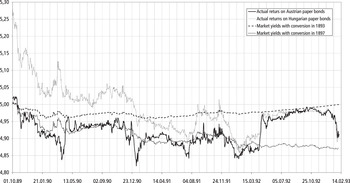
The quotation of the paper bonds at the Stock Exchange reflects the uncertainty about the date of a possible conversion. If we assume that under normal circumstances (that is, without the danger of conversion) the bonds would have had the same effective yield as similar bonds such as unified paper bonds, we may calculate a market-compliant bond yield when conversion looms.Footnote 8 Of course, this bond yield must include conversion losses. The result depends on the assumption about the conversion date. Figure 2 shows that until late April 1892, investors behaved as if they did in fact expect a conversion, but not in the near future: bond yields calculated under the assumption of a conversion as late as February 1897 are more or less equal to the actual yields of Austrian paper bonds (Hungarian bonds always had higher yields). From the end of April on, however, this assumption did not hold any more; now actual yields equalled more or less the yields calculated under the assumption of the correct historical conversion date (February 1893); clearly, under this assumption, yields had to be higher because the period of the amortisation of conversion losses was shorter than previously expected. Although it is not possible to determine exactly the degree of information available to the public, it is quite plausible that investors following political decision making realised in late April 1892 that a conversion law would be effective within a few months, and that they disposed accordingly.
Effects of the 1892/3 conversion of paper bonds

In the last days before the actual conversion, the yields of both bonds decreased again. This was an anticipation of a general and long-term appreciation of bond prices in the following years – the quotation of the new paper bonds was to stay above the emission price for about 15 years.
V
In addition to purely financial factors, we have to consider the possible impact of political expectations and single events on the price of government debt instruments. These events do not necessarily impair the creditworthiness of states in the sense that states would be more likely to default on their debt. Political shocks may, however, create a climate in which the demand for liquidity rises. In such a case, banks must be prepared to meet their customers' demand for ready money and will therefore curtail their purchases of state bonds (Williams Reference Wiliams1912, pp. 391–2). As soon as the crisis is over, the demand for state bonds may return to the previous level. Although those political shocks have an effect by creating expectations about financial matters, these expectations need not necessarily coincide with the actual economic performance of the states, and they need not even reflect a realistic assessment of political processes.
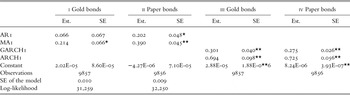
Political shocks may be detected in unexpected movements in day-to-day series of bond yields. For this part of the analysis, the spreads of Hungarian over Austrian bond yields were calculated on a daily basis, and the results were used to estimate time series models for both gold bonds and paper bonds. Generally, the two series (gold and paper) can be described equally well using ARIMA models of various types, or various ARCH or GARCH models (Table 4). When applied to the same series, the error terms resulting from the various models correlate almost perfectly. As might be expected from the results presented in Section iii, fiscal and monetary covariates have no significant effect on these results (not shown in the tables).
Estimates for spreads of Hungarian bonds over Austrian bonds

Sources: Vienna Stock Exchange, official list (1881–1914).
Notes: Spread = Hungarian bonds – Austrian bonds. *, ** = significant at the 1 per cent and 0.001 per cent level, respectively.
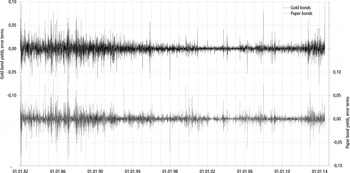
Figure 3 displays the error terms of ARIMA (1,1,1) models for both the gold and the paper series. An upward error means that the spread between Hungarian and Austrian bonds was larger than predicted by the model, that is, Hungarian yields were higher than expected under the estimated ARIMA process. Correspondingly, a downward error means that Austrian bond prices were atypically low. The two series show that the spreads fluctuated wildly in the 1880s and early 1890s as well as in the last year before the Great War, and less so in the period between. Generally, an error in one direction was followed by an error in the opposite direction soon, as might be expected in a stochastic process.
Short-term fluctuations in the Hungarian premium

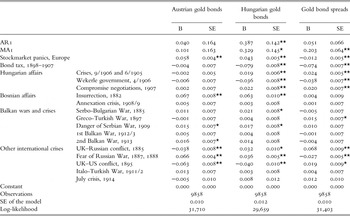
A number of these errors can easily be associated with exogenous political events and economic incidents. These events may be modelled as covariates in ARIMA (1,1,1) models of bond yields of both states, and of the spread of Hungarian gold bonds over Austrian ones. Political factors of different kinds were tested in this way (Table 5): capital gains taxation; wars and other foreign policy crises; political events concerning Bosnia; and political events in Hungary concerning the unity of the Austro-Hungarian Monarchy.
Factors for Austro-Hungarian bond yields and spreads

Sources: Vienna Stock Exchange, official list (1881–1914).
Notes: Austrian gold bonds = daily yields of Austrian gold bonds; Hungarian gold bonds = daily yields of Hungarian gold bonds; gold bond spreads = spreads of Hungarian bonds over Austrian ones. Events: see text. *, ** = significant at the 5 per cent and 1 per cent level, respectively.
As may be expected, the capital gains tax on Hungarian bonds which was in effect from 1898 to 1907 had a highly significant effect on the spreads. On 3 January 1898, both the gold series and the paper series show a strong downward error, the reverse effect is visible on 2 January 1908; both the onset of taxation and its end may be modelled as separate highly significant effects (not shown in the table). Alternatively, the whole period 1898–1907 may be modelled as a covariate with a highly significant negative effect on the yields of Hungarian bonds, and consequently on the spreads (Table 5).
Wars, danger of war and crises in international relations had mixed effects. Wars and crises of long duration such as the Greco-Turkish War (1897), the Italo-Turkish War (1911/2), or the First Balkan War (1912/3), which lasted for months, had no lasting impact on bond prices of either state, nor on spreads. The short Serbo-Bulgarian War (1885) led to a depreciation of Hungarian bonds only, whereas the equally short Second Balkan War (1913) raised Austrian bond yields only, but did not significantly lower the spread. The danger of war with Serbia after the end of the Bosnian annexation crisis (March 1909) hit both states equally. The July crisis (1914) had no impact on the spreads.
The Bosnian affairs had no effect on bond spreads, either. The very short insurrection in occupied Bosnia in January 1882, which coincided with a panic at the Paris Stock Exchange, led to a highly significant increase in the yields of both Hungarian and Austrian bonds, but had no effect on the spread. The Bosnian annexation crisis (1908/9), which lasted for three months, was a period of heavy price fluctuations, but had altogether no significant impact on either yields or spreads.
Events that concerned the political unity and stability of the Monarchy had significant and robust effects on the spreads of paper (not shown in the tables) as well as gold bond yields. This is true for short-term and very short-term events as well as for a lengthy period of insecurity. In any case, these events influenced Hungarian bond prices only, whereas Austrian bond yields remained unchanged. An explanation must reflect the potential effects of major changes in the constitutional framework of the Monarchy. An actual breakup of the Monarchy would have happened by way of ending the customs union, a separation of hitherto common matters (notably, the military), and the introduction of a Hungarian currency. The question is how contemporaries perceived the imminence of such a development, and how it may have influenced the credit of both states.
Around 1900, the Austro-Hungarian Monarchy already had a history of attempted or successful secession of various parts. The Italian provinces of Lombardy and Venetia were lost in the wars of 1859 and 1866, respectively, and the Hungarian quest for independence was solved by way of the Compromise in 1867. Negotiations of a renewal of the Compromise were unsuccessful in 1897, and the common debt, the customs union and the central bank were the subject of constant discussion (Pressburger Reference Pressburger1966; Paulinyi Reference Paulinyi and Brusatti1973; Eddie Reference Eddie1989; Köver Reference Kövér, Kövér and Pogány2002).
Throughout the period, the Hungarian Independence Party, founded in 1874 in the tradition of the 1848 National Party, continued to pursue a policy of complete separation, and gained a majority in the Hungarian diet in January 1905. The king did not appoint an Independence Party government but first kept the former liberal prime minister, and then governed by a non-party government until April 1906, when Alexander Wekerle became prime minister. The Wekerle government included leading members of the Independence Party, but agreed to a policy of a continuation of the Austro-Hungarian Monarchy (Nemes Reference Nemes1975; Péter Reference Péter, Rumpler and Urbanitsch2000, pp. 409–11). The newly found stabilisation manifested itself in the renewal of the Compromise in 1907.
According to assumptions in the literature, a breakup of the Monarchy would probably have had limited effects on the Hungarian fiscal and monetary situation (Hertz Reference Hertz1947, pp. 51–2; Flandreau Reference Flandreau2006, pp. 14–19). Provided that a separate Hungarian currency was a gold currency, a separation of the currency should hardly have affected the Hungarian state credit. A conversion of gold bonds into paper bonds would certainly not have happened. Most holders of gold bonds were located in Germany anyway, whereas Austrians held only a minor fraction of these securities; even if Austrians had tried to get rid of Hungarian gold bonds, western European investors would have been able to absorb them. A conversion of paper bonds into gold bonds would have been an option in an effort to keep favourable borrowing conditions (Flandreau Reference Flandreau2006, pp. 17). However, even such a measure would have been unnecessary under the conditions of the last years of the Monarchy: While Austrian investors owned more than 40 per cent of Hungarian paper bonds in 1890, this share fell to 25 per cent within ten years. Accordingly, around 1900 the Hungarian share in Hungarian paper bonds was already more than 60 per cent (the remainder was held mostly in Germany). Altogether, the Hungarian share in the Hungarian state debt rose continually from the early 1900s on.
Although this reasoning in the literature may seem plausible, Austrian contemporaries seem to have perceived the situation differently, as may be seen in press reports and in investors' behaviour. In the press, even disintegrative measures short of a complete breakup of the Monarchy were assumed to affect Hungary severely, and leave the Austrian economy untouched. According to comments in the Austrian press, the dissolution of the customs union would have hit the Hungarian trade balance more severely than the Austrian one. The common currency was perceived to be the reason for the relatively small spread of Hungarian bonds over Austrian ones. The establishment of an independent Hungarian bank of issue would lead to a complete monetary separation, with a strong (and convertible) Austrian currency, a weak (and not convertible) Hungarian one, and high interest rates in Hungary. The price of Hungarian state bonds would deteriorate. Hungary was seen as completely dependent on Austrian capital investments.Footnote 9
Investors seem to have arrived at similar conclusions. In the stock market, two single events in 1903 and 1905 had an immediate and significant impact on Hungarian bond prices: the fiercely negative Hungarian reactions to the emperor's army field order of 16 September 1903, which had underlined the integrative role of the army and its importance for the unity of the Empire, and was understood as treating the Hungarians not as a separate nation but just as one of several ethnicities of the Monarchy; and the crisis of June 1905, following the victory of the Independence Party, when the Hungarian contributions to the common expenses of the Monarchy seemed in danger. In both cases the spread between Hungarian and Austrian bonds widened due to a deterioration of Hungarian bond prices (Austrian bonds were not affected in either sense). In 1903, the contemporary press speculated that calls for non-compliance with the tax laws, which were raised in Hungary after the army field order, might be perceived as endangering the fulfilment of Hungarian debt obligations, and wrote about an ‘abyss threatening to devour the Compromise of 1867’.Footnote 10 Similarly, the 1905 events led to speculations that Hungary might fail to fulfil its financial obligations resulting from the Compromise.Footnote 11
The same is true for the whole period of negotiations about the renewal of the Compromise due in 1907. The negotiations lasted for more than nine months, and their success was not perceived as guaranteed. In this period Hungarian bond prices were atypically low, and the spread atypically wide (Austrian bonds were not affected in this case, either).
The opposite effect is visible in spring 1906 in the run-up to Wekerle's return to government. When Wekerle entered office again, yields of all kinds of Hungarian government bonds fell immediately. Again, Austrian bonds remained stable, and consequently, the Wekerle episode led to a decreasing spread in bond prices.
Altogether, these effects of shocks in the sphere of Austro-Hungarian internal policy suggest that investors perceived Hungary to be the state more at risk in case of a severe crisis or even separation. This is not to say that these effects were particularly strong, and that they lasted for long. They are, however, robust and significant, in the context of an environment where crucial fiscal and monetary factors show little impact.
VI
Apart from a few years in which special tax laws created atypical conditions, the debt of the two states of the Austro-Hungarian Monarchy was characterised by a premium on Hungarian perpetual bonds, which decreased in the course of time, but remained still positive until World War I. Although such a premium is supposed to be the price for a higher risk inherent in Hungarian bonds, an explanation of this risk is hard to find. Fiscal and monetary factors display little impact on movements in government bond prices and the spread between Hungarian and Austrian securities. The only fiscal factor that has a significant but not particularly robust effect on investors' preferences is the proportion of government investments (as opposed to government consumption) in Austria. Otherwise, investors in the Viennese market remained mostly unaffected by changes in the fiscal data, and by the economic conditions in either part of the Monarchy. Political events, particularly those that concerned the unity of the dual Monarchy, would show an impact on Hungarian (not Austrian) bond prices, but this effect tended to fade out soon. The price series follow mostly stochastic trends, whether they are price series of Austrian and Hungarian gold bonds, paper bonds of different type, or series of spreads between Austrian and Hungarian securities of the same type. However, the constant term in these models, if significant, is always positive – Hungarian bonds were valued at a lower price.
Lacking any hard evidence for an economic reason for the spread between Hungarian and Austrian bonds, the data from the Vienna Stock Exchange leave the impression that Austrian investors simply preferred Austrian bonds. Similar to the German market where ‘a higher rate of return was required to induce investors to hold foreign securities than to hold domestic ones' (Tilly Reference Tilly and Good1994, p. 209), the Austrian market may be just another example of a domestic ‘bias’ in investment behaviour.
APPENDIX 1: CURRENCY
The currency used in the Austrian Empire up to 1858 was the silver florin as agreed upon in the Austro-Bavarian monetary convention of 1753. In 1858 it was replaced by the Austrian florin according to the Vienna Monetary Treaty of 1857. Legally, one old florin equalled 1.05 Austrian florins, which conforms roughly to the respective silver content.Footnote 12
The introduction of the gold standard was announced by law in 1867 but did not materialise for a quarter of a century.Footnote 13 In 1870 a law introduced new trade coins at 4 and 8 florins in gold (already in 1857 the government had introduced other trade coins in gold which were called ‘crowns’).Footnote 14 One gold florin equalled exactly 2.5 francs. Since these coins were created as trade coins not as a new currency, their relation to the silver florin was not legally determined but depended on the market price. A major part of the state debt and some company loans were bonds denominated in gold florins.
In 1892 Austria–Hungary introduced the gold standard through a monetary treaty between the two states (Wysocki Reference Wysocki and Schremmer1993). The new currency was the crown, which had a gold content of 0.3049 grams and equalled about 0.85 marks or 1.05 francs. Its relation to the Austrian florin was legally established to be 2 crowns for 1 florin.Footnote 15 The relation to the gold florin was legally determined to be 42 crowns to 100 gold florins, and debts denominated in gold florins could be paid in gold florins or in gold coins of the new currency upon free choice of the debtors.Footnote 16 The market value of gold remained relatively stable from 1896 to 1914, deviating from the legal exchange rate by less than 0.25 per cent on average, except for a short period of a gold agio in 1900.
Interest payments for the gold bonds were done actually in gold unless bondholders chose otherwise, with gold florins and francs interchangeable. From 1904 on, the government paid the interest using gold coins of the crown currency at the legal exchange rate. Considering the gold content of the gold florins and the crown, this amounted to a minimal depreciation of those debts, which was, however, within the tolerated deviation in coin weight. In fact, the measure reduced the Austrian gold bond debt by about 91,000 crowns, and the Hungarian one by about 109,000 crowns. In 1915 an Imperial Order allowed interest payment in means of payment of all kinds at a rate to be determined by the minister of finance.Footnote 17 Due to the high inflation in World War I, this measure reduced the returns of gold bonds considerably.
For the exchange rates with UK pounds, see Figure 1.
APPENDIX 2: CONSOL PRICES AND EFFECTS OF CONVERSION
In this article, prices of UK consols, which may be regarded as a risk-free investment in that period, are used as a benchmark for Austro-Hungarian bonds. Following Harley, consol yields have to be calculated taking account of the fact that their interest rate was set at 2.75 per cent for the period from 1889 to 1903, and 2.5 per cent after. Therefore the consols may be regarded as perpetual bonds as far as the 2.5 interest rate is concerned, and as amortisable capital as far as the remaining 0.25 per cent are concerned. Thus, 0.25 pounds for a 100 pound bond may be regarded as an annuity of a capital to be amortised until 1903 (Harley Reference Harley1976). The remaining value of this capital in every given year may be calculated following
 $${\rm C}_{\rm t} {\rm = a} \left[ {\left( {{\rm 1 + r}} \right)^{\rm y} {\rm - 1}} \right]{\rm /} \left[ {{\rm r} \left( {{\rm 1 + r}} \right)^{\rm y}} \right]$$
where C t is the capital remaining in year t, a is the annuity (in this case, 0.25 pounds), r is the nominal interest rate (in this case, for instance, 2.5 per cent), and y is the number of years from t until clearance (in this case, until 1903). C t is deducted from the market price of the bond, and the yield of the perpetual bond is then calculated based on this reduced price and at 2.5 per cent. Because the resulting yield does not include redemption payments, it is lower than the result of a straightforward calculation using the market price of the bond and an interest rate of 2.75 per cent.
Second, Harley calculates the effect of a possible conversion of the same bonds in the future. The consols were guaranteed until 1923, that is, they could be redeemed in 1923 without notice. Since redemption happens at par, it will cause costs to bondholders, when the bond price is above par. Thus, whenever the price is above par, the present value of a later conversion may be included in the estimate of the yield, following
 $${\rm m}_{\rm t} {\rm = C}_{\rm t} {\rm r /} \left[ {\left( {{\rm 1 + r}} \right)^{{\rm y + 1}} {\rm - 1}} \right]$$
where m t is conversion costs in year t (equal to the amortisation part of an annuity), C t is the difference between the market price and par in year t, r is the interest rate, and y is the number of years from t to conversion. Harley deducts m t from bond yields only in those years when the market price of consols was above par, which results in a drop in bond yields by up to 0.29 in 1895 to 1899.
When calculating the yield on consols we did not consider m t . Although investors in the 1890s doubtless were aware of the fact that consols could be redeemed 28 years later, it is hardly plausible that their investment decisions were influenced by such a possibility. Investors knew that the bond price could easily return to a level below par, which was actually the case in 1900; the consols did not appreciate to a level above par again until 1923.
When investors expected a conversion of bonds such as the Austrian or Hungarian 5 per cent paper bonds at a certain date they could try to achieve a yield equal to the yield of similar bonds (such as unified paper bonds). Doing so, they had to price in the losses due to the difference between any bond price above par and the par price. The resulting bond price may be calculated using the formula
 $${\rm P}_{\rm d} =\Big [{-\rm y}_{\rm d} +100 \,{\rm r}_{\rm a} {\rm / r}_{\rm c} + \left[ {\left( {{\rm y}_{\rm d} -100 \,{\rm r}_{\rm a} {\rm / r}_{\rm c}} \right)^2 + 40000 \ {\rm r}_{\rm a} ^2 / {\rm r}_{\rm c}} \right]^{{0\comma5}}\Big]/ \left( {2\,{\rm r}_{\rm a} {\rm / r}_{\rm c}} \right)$$
where P d is the price of the bond on day d, y d is the market yield on day d (that is, the yield of bonds of similar type which are not to be converted), r a is the interest rate per year, and r c is the interest rate for the period from d to the day of conversion. If y d is below the nominal interest rate of the bond, P d is above par. In this case the yield of a bond at a price of P d is higher than y m because it is the sum of y m and the conversion loss (calculated like an annuity for the amortisation of the difference between P d and par).
APPENDIX 3: DATA
Bond prices, silver prices and gold prices used in this article are daily quotations at the Vienna Stock Exchange. The data are drawn from the Amtliches Kursblatt der Wiener Börse (Vienna Stock Exchange, official list 1876–1914). The Kursblatt lists closing prices in florins or crowns for a face value of 100 of any denomination (florins in silver or paper, gold florins, or crowns). This article uses spot prices, and among these, bid prices.
The interest of gold bonds was payable in gold florins. Returns of gold bonds were calculated in Austrian florins or crowns, respectively, using the daily prices of 20 franc gold coins, which are equal to 8 gold florin coins. The legal gold price (enacted in 1892) was not used.Footnote 18 An agio for gold remained in existence up to 1896, and afterwards the market price was almost never exactly the legal price although differences were small.
The data for the common debt were taken from the official parliamentary reports (Debt, common 1868–79; Debt, common 1879–87; Debt, common, short-term 1868–87). Likewise, the data for the Austrian debt were taken from the respective parliamentary reports (Debt, Austria 1879–87; Debt, Austria 1887–1903; Debt, Austria 1904–18). These data are semestral data.
The data for the Hungarian debt were taken from financial yearbooks and general statistical yearbooks (Compass; Statistical yearbook 1885–1911). These data are annual data.
State revenues and expenses including tax revenues were taken from the official final accounts for pre-1867 Austria (Final accounts, Austrian Empire 1860–7), the Imperial Assembly Lands (Final accounts, Austria 1869–1914), Hungary (Final accounts, Hungary 1869–1914) and the common sphere after 1867 (Final accounts, common 1868–1913). These are annual data.
Population figures were taken from the decennial censuses (Census 1882; Census 1892–4; Census 1903; Census 1914–15).
GDP estimates were taken from Schulze (Reference Schulze2000), in part also from Katus (Reference Katus and Pemlényi1970) and Kausel (Reference Kausel1979).