In the United Kingdom, it is estimated that up to 12 percent of hospital admission costs are diabetes related (Reference Morgan, Peters and Currie14) and that glucose-lowering and monitoring prescription costs constitute 7 percent of the UK National Health Service (NHS) prescription budget (Reference Currie, Peters and Evans3). With the advent of NHS Health Checks (Reference Davies5), more people are being identified with diabetes and prediabetes at earlier stages in their condition. Lifestyle interventions to prevent type 2 diabetes (T2DM) are generally considered to be effective (Reference Lindstrom, Louheranta and Mannelin12), providing long-term benefits such as increased life expectancy and improvements in quality of life. However, less consensus exists as to whether such interventions are cost-effective (Reference Vijgen, Hoogendoorn and Baan20). Possible ways to make interventions affordable include group sessions and the use of volunteers. This study describes a trial-based cost-utility analysis (the quality-adjusted life-year (QALY) was used to measure benefits) of a diabetes prevention program (“UEA-IFG”, University of East Anglia Impaired Fasting Glucose, program) which was offered to people at higher risk of developing diabetes, as identified through a screening program for impaired fasting glucose (IFG) (defined here as a Fasting Plasma Glucose, FPG, level of 6.1 to 7.0 mmol/L).
METHODS
Participants and Study Design
The trial aimed to screen 6,000 at-risk individuals over a 12-month period to identify 660 subjects with screen detected IFG. Participants were eligible for screening if they were aged 45–70 years and had at least on the following: body mass index (BMI) ≥25 kg/m2, first degree relative with T2DM, waist circumference >94 cm for men or >80 cm for women, history of coronary heart disease, gestational diabetes, or IFG. Patients were excluded if they were pregnant or lactating, not willing or able to provide their general practitioner (GP) details (for contact purposes), unable to give informed consent, or had self-reported conditions that could adversely affect the study results or patient well-being. A formal sample size calculation was not performed as this was a feasibility study that sought information on aspects such as adherence, retention, and recruitment (which could then be modified within a subsequent more definitive trial). In line with previous studies (Reference Dumville, Hahn, Miles and Torgerson8), we recruited in favor of the experimental group to obtain more information about the intervention, for example, with regard to participant perception of the program. Participants were randomized 2:1 in favor of the intervention, using randomized permuted blocks of 3 and 6 (a telephone randomization system was used to ensure the person taking consent could not know the allocation before recruitment). Blinding of the participants and intervention giver was not undertaken due to the nature of the intervention. The rolling recruitment and limited time span of this feasibility study meant that participants were followed up for varying lengths of time, but all were offered at least 3 months of intervention activity. The study end-point for all participants was March 2010 (hereafter described as “exit” point). Data were requested from all participants at this time point, as well as at recruitment (baseline) and the half way point between each participant's baseline and exit point (referred to as “mid” point). The trial was conducted in Norfolk, United Kingdom, and recruitment ran from February to December 2009, ethical approval was granted by the UK Essex 1 Research Ethics Committee.
Intervention
A self-referral screening program was set up and four recruitment strategies were undertaken: general practitioners wrote to specific patients on their list and left materials in their practice, Type 2 diabetes retinal screening patients were asked to discuss the screening program with relatives and friends, local press, and media initiatives were undertaken and 20 of the largest employers within Norfolk were asked to promote the study. Participants identified through the screening program as having FPG levels ≥6.1 mmol/L were eligible to be either randomized to the UEA-IFG program (intervention group) or usual care (control group), this included both IFG (FPG 6.1 to 7.0 mmol/L) and T2DM (FPG >7.0 mmol/L) participants. Control group participants were offered a 2-hour session of diet and exercise advice, this was considered to be equivalent to usual care for newly identified IFG patients in the UK National Health Service. Additionally, this group were given pedometers to record step count, which allowed comparison with the intervention arm. Inclusion of a “do nothing” arm was deemed inappropriate as it was considered to be usual practice to provide some diet and exercise advice.
The UEA-IFG program was delivered by “Diabetes Prevention Facilitators” (DPF) – a new NHS role created for this study, and based on a previous diabetes prevention program (19) which is described in detail at: http://www.bsc.gwu.edu/dpp/manuals.htmlvdoc. The primary aim was to promote a 7 percent weight loss within 6 months using both diet and exercise interventions. All participants were offered four “core” group education sessions in the first 3 months and physiotherapist-led exercise group sessions. Peer support group (“after core” maintenance phase) sessions, where participants were encouraged to exchange ideas and opinions in relation to their targets (a DPF was in attendance), were also arranged. Additionally, diet diaries and pedometer records were distributed. These were returned during sessions and analyzed by a DPF to aid individualized target setting. Finally, intervention participants received telephone peer-support from volunteers (referred to as T2Trainers), who themselves had been diagnosed with T2DM for at least 2 years. These T2Trainers were recruited through the local hospital's diabetes center, and trained by UEA-IFG staff.
Measuring Costs
Costs were estimated from the perspective of the UK NHS and personal social services (PSS), as recommended by the UK National Institute for Health and Clinical Excellence (NICE) (15). As described below, UEA-IFG Intervention costs were specifically monitored as part of this study. Additionally, all participants were asked to report NHS and PSS levels of resource use by means of self-reported questionnaires. All costs were estimated in UK sterling (£) at 2008/9 financial year levels. As the intervention period did not exceed 1 year costs were not discounted.
Healthcare Resource Use Questionnaires
Participants were asked to record all contacts with health professionals (excluding UEA-IFG staff), any hospitalizations, and prescription-based medications. Data were requested at each participant's baseline, mid, and exit point, where resource use data were requested for the previous 12 months at baseline, since baseline for the mid-point questionnaire and since the mid-point for the exit questionnaire. Unit costs for health professional visits were derived from Curtis (Reference Curtis4), outpatient appointments and inpatient stays from NHS Reference Costs (6), and medication costs from the British National Formulary (1).
Intervention Costs
UEA-IFG program. Levels of resource use for the intervention were monitored prospectively using a bottom-up procedure (Reference Wordsworth, Ludbrook, Caskey and Macleod22). To assign a unit cost to DPF time, we aligned this to the closest NHS role (Community Physiotherapist) and used previously reported unit costs (including overheads and cost of staff training) (Reference Curtis4). Study costs pertaining solely to research and not part of clinical practice (e.g., mid- and exit-blood tests) were excluded. The printing costs of exercise diaries and leaflets were relatively small, and were not included.
Control group. Costs associated with the advice provided to the control group were not included within our analysis as we considered that these costs would not have been incurred by the NHS, within the time-frame of our analysis, had this trial not occurred. The screening aspect of our study meant they were detected earlier than would otherwise have been the case (indeed some participants may never have been detected without the study).
T2Trainer costs
All contact time between T2Trainers, participants, and study staff was monitored, including training, and the calls themselves. Training consisted of seven seminars (led by T2Trainer co-ordinator), with a diabetes consultant (2 sessions), physiotherapist (2 sessions), nutritionist (2 sessions), and counselor (1 session) attending certain seminars. An equivalent financial value for the work of the T2Trainers was estimated using UK national minimum wage rates (£5.93/hr), and applied to both training and call time. The time associated with each telephone call was monitored and costed accordingly.
Per Participant Costs
Attendance at all group sessions was recorded, as was the frequency and duration of telephone contact with lay trainers. It was, therefore, possible to assign a more accurate intervention cost to each participant, based on the number of sessions they attended (the cost of each session was equally divided across those who attended), and intensity of telephone peer support (call time). Costs associated with the seminars for the T2Trainers were equally apportioned across all participants in the intervention arm.
Measuring QALYs
For this economic evaluation, the primary endpoint was generic health-related quality of life, as measured through EuroQol EQ-5D (Reference Brooks2). The EQ-5D questionnaire measures health status across five dimensions (mobility, self-care, usual activities, pain/discomfort, and anxiety/depression) with three possible responses (no problems, moderate problems, or severe problems) for each dimension. Participants were requested to complete the EQ-5D at baseline, mid-, and exit-points. The York A1 tariff (Reference Dolan, Gudex, Kind and Williams7) was used to assign a utility score to each of the EQ-5D health state descriptions, where one is equivalent to perfect health and zero is equivalent to death. To measure changes in utility over time, area under the curve (AUC) methodology, with baseline adjustment (Reference Manca, Hawkins and Sculpher13), was used to estimate, for each participant, the quality-adjusted life-year (QALY) gain/loss accruing over the trial period.
Imputation of Missing Data
To maximize the use of available data, and in accordance with intention to treat principles, we imputed missing EQ-5D and health resource use data. STATA 10 multiple imputation methods were applied (Reference Rubin and Schenker17), imputing baseline, midpoint, and exit EQ-5D and health resource use costs based on the following “key” data: randomization group, age, sex, FPG levels, BMI, EQ-5D, and Health Resource Use at each of the three reported time points.
Incremental Cost-Effectiveness Ratio (ICER)
After imputing missing data, we estimated the mean difference in both costs and QALYs between the groups (incremental cost and incremental QALY gain, respectively). Associated 95 percent confidence intervals were also estimated. To estimate the cost-effectiveness of the intervention compared with usual care, the incremental cost-effectiveness ratio (ICER) (ratio of the incremental cost and incremental QALY gain) was reported.
To assess the level of uncertainty around the results sensitivity analysis was performed (as outlined below), and cost-effectiveness acceptability curves (CEACs) were computed for each study arm (Reference Fenwick, Claxton and Sculpher9). The CEAC gives information on the probability that the intervention is cost-effective, given a certain limit for how much society is willing to spend per QALY. In the UK, NICE has recommended a “cost-effectiveness threshold” (λ) of between £20,000 and £30,000 per QALY (15).
Sensitivity analyses
1. Including the cost of screening to recruit participants: these were costed on the basis of the screening undertaken as part of this study and the cost per identified participant was subsequently calculated. In line with previous analysis (Reference Irvine, Conroy and Sach10), we apportioned these per participant costs only to those in the intervention arm to reflect the fact that such screening does not currently constitute part of usual care, and that these costs would not have been wholly incurred by the NHS had this trial not occurred. Such costs were excluded from the base-case analysis on the assumption that several at risk individuals would be detected through everyday practice—many GP practices already have some systematic screening for vascular risk and diabetes in place and this is likely to increase given that a national vascular risk management program has been recommended for introduction by the UK National Screening Committee (Reference Davies5).
2. Subgroup analysis for IFG participants only: if the intervention was only offered to people not yet diagnosed with diabetes.
3. Subgroup analysis for T2DM participants only: if the intervention was only offered to people newly diagnosed with diabetes.
4. Per-protocol analysis—only include intervention participants with >4 months follow-up, which included all four core sessions, plus at least one after-core, physiotherapy and T2Trainer call. Due to the limited time frame of this study some latterly recruited participants had <4 months follow-up.
5. Complete case results only—that is, cost and EQ-5D questionnaire data returned at all three time points (baseline, mid, exit).
6. Excluding T2Trainer training costs—as skills may be used over many years these costs could be minimal.
RESULTS
Participants
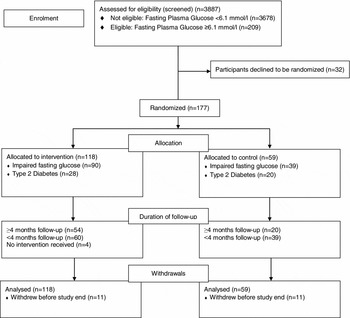
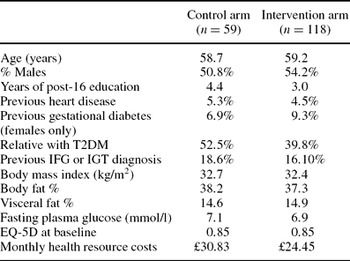
Figure 1 shows the flow of participants throughout the trial. From screening 3,887 high-risk individuals in our diabetes screening study, we identified 209 people with impaired fasting glucose or newly diagnosed T2DM (5.38 percent detection). Of these, 177 entered the lifestyle intervention trial (84.7 percent uptake), their characteristics are summarized in Table 1.
Flow diagram of participants throughout the study.

Participant Characteristics at Baseline

Mean scores are presented unless denoted otherwise; n = number of participants.
The trial ran from February 16, 2009 to March 1, 2010. Mean duration of follow-up (baseline to exit point) was 7.28 months for intervention arm and 6.69 months in control arm. Twenty-two participants (eleven in each arm, see Figure 1) withdrew from the program before study end (the reasons for which are summarized in Supplementary Table 1, which can be viewed online at www.journals.cambridge.org/thc2011018). A comparison of those who withdrew to those who did not highlighted differences between groups (Supplementary Table 2, which can be viewed online at www.journals.cambridge.org/thc2011018), providing further justification for the imputation of EQ-5D scores and resource use data.
Intervention Costs
Attendance rates at the core and peer support sessions were high (97 percent and 80 percent, respectively, though four participants did not attend any sessions). However attendance rates at the physiotherapist-led exercise groups were considerably lower (56 percent). Lower attendance led to higher costs being assigned to participants who attended that session (group sizes ranged from an exercise session with only one attendee to a core session group of 13).
T2Trainer Costs
The seven training seminars took a total of 17.5 hours to deliver and each was delivered on three occasions (to cater for T2Trainers recruited at different stages and T2Trainer availability). The total cost of the T2Trainer training programme was £6,745 (including volunteer time) (£57 per participant in the intervention arm), twenty-six volunteers were fully trained. The mean participant costs associated with the training program exceeded those costs associated with the calls to participants: over the 11-month period, 172 peer support calls were made, an average of 21 minutes per participant.
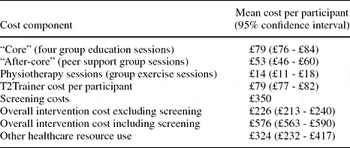
Combining core, after core (peer support), physiotherapy and T2Trainer costs the average cost of the UEA-IFG intervention was £226 (£213-£240) per participant (see Table 2). Additional information regarding unit costs and T2Trainer costs are provided in Supplementary Tables 3 and 4, respectively, which can be viewed online at www.journals.cambridge.org/thc2011018.
Estimated Costs for Participants in the Intervention Arm

Healthcare Resource Use
Health resource use questionnaires were returned by 74.1 percent of intervention participants and 58.1 percent of participants in the control arm, though 15 of 370 returned questionnaires (4.1 percent) were entirely blank. Healthcare costs were imputed for non-responders. Additionally, mean respondent dosages were applied to the 46 (5.63 percent) who did not report medication dosage. Mean healthcare costs were very similar between control and intervention arms (£324.89 and £324.26, respectively), in both arms medication costs constituted approximately 45 percent of these costs. When coupled with the aforementioned intervention costs (£226) this gave a mean overall cost of £550.73 for those in the intervention arm, an incremental cost of £225.84 (95 percent confidence interval £109 to £342) compared with the control arm.
Quality Adjusted Life-Years (QALYs)
Utility scores were available for between 112 (95 percent) (Baseline) and 85 (72 percent) (Exit) participants in the intervention arm, compared with 55 (93 percent) (Baseline) and 38 (64 percent) (Exit) in the control arm.
After imputation, the baseline mean EQ-5D scores are presented in Table 1. Over the follow-up period, the diet and exercise intervention was associated with a mean QALY loss of –0.001 (95 percent confidence interval –0.011, 0.009), compared with –0.004 (95 percent confidence interval –0.159, 0.007) in the control arm. Although both arms experienced a mean loss, the mean loss was lower in the intervention arm—the intervention was estimated to be associated with an incremental QALY gain of 0.003.
ICER
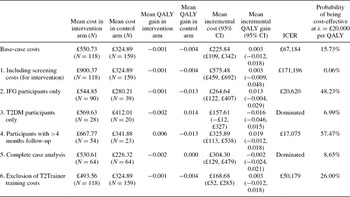
The UEA-IFG intervention was estimated to have an ICER of £67,163 per QALY, compared with usual care. At a threshold of £20,000/QALY according to the CEAC, there was a 16 percent probability that the intervention was cost-effective. Therefore, on the basis of this trial, the intervention is unlikely to be considered cost-effective.
The results of our base case and all six sensitivity analyses are presented in Table 3 and Supplementary Figure 1, which can be viewed online at www.journals.cambridge.org/thc2011018 (CEACs are only presented for the intervention arm). The mean cost of screening participants was estimated to be £350 per participant, when applied to intervention arm participants the overall intervention cost increased and the ICER became less favorable. Only offering the program to newly diagnosed T2DM patients also resulted in a less favorable ICER, as did the complete case analysis. However, there is some indication that with longer follow-up (minimum 4 months), an improvement in quality of life may be more apparent, at little additional cost. Provision of the intervention to IFG participants only was also estimated to be more cost-effective. Additionally, estimates improved, though to a lesser extent, when training costs for T2Trainers were not included.
Estimated Costs, QALY Gain, Level, and Probability of Cost-Effectiveness for the Base-Case Analysis and 6 Sensitivity Analyses

N, number of participants in study arm; QALY, quality-adjusted life-year; 95% CI, 95% confidence interval; ICER, incremental cost-effectiveness ratio; λ, level of willingness to pay; IFG, impaired fasting glucose; T2DM, Type 2 diabetes; T2Trainer, volunteers diagnosed with T2DM.
DISCUSSION
This study tested a multifactorial lifestyle intervention to prevent diabetes in an at-risk population. The cost of delivering the program was estimated to be £226 per person. The prevention program led to marginally better quality of life outcomes (as measured in QALYs, compared with controls), however differences in effectiveness were not significant. The incremental cost per QALY was £67,184, which is unlikely to be cost-effective at usual levels of willingness to pay.
The sensitivity analyses highlighted how the current strategy could be made more cost-effective. Most notably, the program incremental cost per QALY was £17,075 for the subgroup of participants with longer follow-up. High costs were also associated with the screening of participants and training of T2Trainers, where sensitivity analysis demonstrated that rates of cost-effectiveness improved once these were removed (see Table 3). This is consistent with previous research (Reference Lindgren, Lindstrom and Tuomilehto11) which suggests that diabetes prevention studies are more likely to be cost-effective when a longer-term perspective is taken.
For participants recruited early to the study, multifaceted interventions (physiotherapy, peer support, and T2Trainer calls) were available, in addition to the core sessions offered to all intervention participants. QALY gains were more apparent in these participants, whilst costs did not increase significantly (see sensitivity analysis 4). We are thereby undertaking further work to assess the long-term costs and benefits of the intervention, where we will also compare the effects of lifestyle intervention with and without T2Trainer input (further details available from author).
A recent systematic review of economic evaluations of preventive interventions in T2DM (Reference Vijgen, Hoogendoorn and Baan20) found lifestyle interventions to be a cost-effective alternative to prescribing medication, however only two studies (Reference Palmer, Roze and Valentine16;Reference Segal, Dalton and Richardson18) fitted their inclusion criteria. More commonly, modeling studies are used to predict longer-term outcomes associated with early prevention. Within-trial analyses such as this contributes to knowledge of diabetes prevention, and provides useful data to inform decision analytic models over a longer time horizon.
Methodological challenges with regard to the economic evaluation of public health interventions have been outlined previously (Reference Weatherly, Drummond and Claxton21). One issue with regard to measuring and valuing outcomes was whether the outcomes relevant to some public health programs would be fully captured by means of the QALY framework. The creation of an informed public and education were given as examples of outcomes which it may not be possible to incorporate in the QALY framework, outcomes that would be consistent with the aims of our intervention. We found that, on average, individuals in both groups tended to have lower QALY scores postintervention, compared to at baseline. Drawing on previous work (Reference Weatherly, Drummond and Claxton21), one possible reason for these negative results could be that the QALY does not capture all the benefits associated with public health interventions.
CONCLUSION
In conclusion, our economic analysis does not support the UEA-IFG diabetes prevention program over the relatively short time frame possible in this trial. However, as shown in our sensitivity analysis, cost-effectiveness results after 4 months of follow-up are more promising. More research is needed on longer-term outcomes associated with this intervention and the additive benefits of different component parts.
SUPPLEMENTARY MATERIAL
Supplementary Table 1
Supplementary Table 2
Supplementary Table 3
Supplementary Table 4
Supplementary Figure 1
CONTACT INFORMATION
Lisa Irvine, MSc (l.irvine@uea.ac.uk), Garry R. Barton, PhD (g.barton@uea.ac.uk), Health Economics Group, Norwich Medical School, Chancellor's Drive, University of East Anglia, NR4 7TJ Norwich, UK
Amy V. Gasper, PhD (avg4@leicester.ac.uk), College of Medicine, Biological Sciences and Psychology, University of Leicester Medical School, Maurice Shock Building, P.O. Box 138, University Road, LE1 9HN Leicester, UK
Nikki Murray, MSc (nikki.murray@nnuh.nhs.uk), Norfolk and Norwich University Hospitals Foundation Trust–NHS Clinical Research & Trials Unit, Chancellor's Drive, University of East Anglia, NR4 7TJ Norwich, UK
Allan Clark, PhD (allan.clark@uea.ac.uk), Norwich Medical School, Chancellor's Drive, University of East Anglia, NR4 7TJ Norwich, UK
Tracey Scarpello, MSc (tracey.scarpello@nnuh.nhs.uk), Norfolk and Norwich University Hospitals Foundation Trust–NHS Clinical Research & Trials Unit, Chancellor's Drive, University of East Anglia, NR4 7TJ Norwich, UK
Mike Sampson, MD (mike.sampson@nnuh.nhs.uk), Elsie Bertram Diabetes Centre, Norfolk and Norwich University Hospitals Foundation Trust, Colney Lane, NR4 7UY Norwich, UK
CONFLICT OF INTEREST
All authors inform their institution has received a grant from the UK National Institute for Health research (NIHR) for this work.