
Introduction
Magnetic refrigeration is an environmentally friendly and energy efficient technology based on the magnetocaloric effect (MCE) which aims to replace gas compression-based refrigeration.[Reference Yuan, Wu, Tong, Zhang, Wang, Liu, Ma, Suo and Lu1–Reference Franco, Blázquez, Ipus, Law, Moreno-Ramírez and Conde3] La(Fe,Si)13-based compounds have the advantages of large magnetic entropy change (–ΔS M), low-cost, non-toxicity, and continuously adjustable Curie temperature near room temperature (T C).[Reference Zhang, Liu, Zhang, Shao, Li and Yan4] Considerable research has been carried out to improve the MCE of La(Fe, Si)13-based alloys, e.g., optimizing the heat treatment conditions[Reference Fu, Long, Sun and Hu5, Reference Bao, Long, Fu, Wang, Ye, Chang, Zhao and Shen6] and compositions.[Reference Shao, Zhang, Luo, Yan and Liu7, Reference Yen, Thanh and Dan8] A near-room temperature T C value is a key requirement, elevating T C by the substitution of Co for Fe atoms[Reference Hu, Gao, Qian, Ilyn, Tishin, Sun and Shen9] or by adding interstitial atoms such as H[Reference Chen, Wang, Shen, Hu, Sun, Wang and Cheng10] and B[Reference Zhang, Long, Cao, Mudryk, Zou, Gschneidner and Pecharsky11] has been studied. Among these methods, doping H atom increases T C significantly without reducing the MCE.
High thermal conductivity and good mechanical properties are also important for practical applications.[Reference Liu, Moore, Skokov, Krautz, Löwe, Barcza, Katter and Gutfleisch12] However, the intrinsic brittleness of La(Fe,Si)13-based compounds makes it so difficult to directly machine. Hence, processing technologies of powder metallurgy such as epoxy bonding[Reference Zhang, Sun, Niu, Hu, Sun and Shen13] and hot pressing (HP) with amorphous particles[Reference Krautz, Funk, Skokov, Gottschall, Eckert, Gutfleisch and Waske14] or low melting point metal[Reference Zhang, Liu, Zhang, Shao, Li and Yan4, Reference Dong, Zhong, Peng, Huang, Zhang, Jiao, Liu and Ramanujan15], have been adopted to prepare bulk La(Fe,Si)13-based composites.
Epoxy-bonded La(Fe,Si)13-based composites[Reference Zhang, Sun, Niu, Hu, Sun and Shen13, Reference Skokov, Yu Karpenkov, Kuz'min, Radulov, Gottschall, Kaeswurm, Fries and Gutfleisch16, Reference Xia, Huang, Sun, Liu, Ou and Song17] exhibit a higher compressive strength than cast bulk material, which makes it possible to machine the composites into thin plates.[Reference Skokov, Yu Karpenkov, Kuz'min, Radulov, Gottschall, Kaeswurm, Fries and Gutfleisch16] For example, Zhang et al.[Reference Zhang, Sun, Niu, Hu, Sun and Shen13] reported that LaFe11.7Si1.3C0.2H1.8 with a small amount of epoxy resin (3 wt%) exhibits a compressive strength of 162 MPa, 35% higher than that of bulk compound. The maximum isothermal magnetic entropy change (−ΔS M)max remains almost unchanged. Interestingly, the bonded La0.9Ce0.1Fe11.7Si1.3H1.8 and La0.9Ce0.1Fe11.41Mn0.29Si1.3H1.8 samples with about 1.8 wt% epoxy resin show a very good compressive strength of 320 and 332 MPa, which are about 10% and 14% larger than that of bulk LaFe10.99Co0.91Si1.1B0.2 compound. Compared with LaFe10.99Co0.91Si1.1B0.2 compound, the (−ΔS M)max of the bonded samples slightly reduces.[Reference Xia, Huang, Sun, Liu, Ou and Song17] However, the poor thermal conductivity of the epoxy resin is a drawback.[Reference Pulko, Tušek, Moore, Weise, Skokov, Mityashkin, Kitanovski, Favero, Fajfar, Gutfleisch, Waske and Poredoš18]
To improve both the mechanical properties and the thermal conductivity simultaneously, materials with high thermal conductivity and low softening/melting point are very desirable. Metal-based La(Fe,Si)13-based composites processed by HP have shown a balance between good mechanical properties and high thermal conductivity[Reference Zhang, Liu, Zhang, Shao, Li and Yan4, Reference Krautz, Funk, Skokov, Gottschall, Eckert, Gutfleisch and Waske14, Reference Dong, Zhong, Peng, Huang, Zhang, Jiao, Liu and Ramanujan15, Reference Liu, Zhang, Shao and Yan19]. For Cu-bonded La(Fe,Si)13-based bulk composites, when the HP temperature was 1073 K (800 °C), a new intermetallic phase, (Fe4Cu3, formed by high-temperature interdiffusion) as well as pressing induced particle cracking leads to reduction of MCE.[Reference Xia, Huang, Sun, Liu, Ou and Song17] Both Pd-based amorphous matrix at its glass transition temperature (T g~573 K) and Sn at its melting point (T m = 505 K) do become softer, leading to less fracture of La(Fe,Si)13-based particles during compaction, however, the T g of Pd-based amorphous matrix and T m of Sn are too high for the magnetocaloric materials (MCMs) to store hydrogen.[Reference Krautz, Funk, Skokov, Gottschall, Eckert, Gutfleisch and Waske14] The hydrides are usually chemically unstable above 423 K (150 °C).[Reference Shen, Sun, Hu, Zhang and Cheng20] Pd is very expensive and Sn gets pulverized below 259.8 K (−13.2 °C). Hence, the optimized HP temperature is vital to achieve both high strength and large MCE in these composites. Due to the fact that Sn–Bi eutectic alloy (Sn42Bi58) possesses high wettability and a low melting point (412 K). Dong et al.[Reference Dong, Zhong, Peng, Huang, Zhang, Jiao, Liu and Ramanujan15] used Sn–Bi eutectic alloy as a binder to prepare La0.8Ce0.2(Fe0.95Co0.05)11.8Si1.2/Sn42Bi58 bulk composites by low-temperature HP. The results showed that by controlling the processing conditions, a series of La0.8Ce0.2(Fe0.95Co0.05)11.8Si1.2/Sn42Bi58 bulk composites with large compressive strength of 189–303 MPa, high thermal conductivity of 10.72–19.64 W/(m K), and relative large entropy change of 5.57–6.70 J/(kg K) (Δμ 0H = 2 T) were obtained.[Reference Dong, Zhong, Peng, Huang, Zhang, Jiao, Liu and Ramanujan15]
Pure Cu has high thermal conductivity [401 W/(m K) at 300 K][Reference Martienssen and Warlimont21] and will become soft when the temperature is higher than 423 K (150 °C).[Reference Cao22] However, the amount of secondary phase α-Fe would also increase considerably at high temperatures, adversely affecting the MCE.[Reference Liu, Krautz, Skokov, Woodcock and Gutfleisch23] Hence, low hot-pressing temperatures are needed. In this work, micron-sized Cu powders were used as a binder in the preparation of La0.8Ce0.2(Fe0.95Co0.05)11.8Si1.2/Cu composites by low-temperature HP. The microstructure, thermal conductivity, mechanical properties, and MCE of these composites were investigated.
Experimental section
La0.8Ce0.2(Fe0.95Co0.05)11.8Si1.2 compounds were prepared by melting the mixture of pure La, Ce (≥99.5 wt%), and Fe, Co, Si (≥99.9 wt%) in a medium-frequency induction furnace under argon atmosphere. The La0.8Ce0.2(Fe0.95Co0.05)11.8Si1.2 alloy flakes, with 0.5 mm in thickness and 50 mm in width, were prepared by strip casting. The flakes were annealed at an optimized temperature of 1323 K (1050 °C) for 12 h in quartz tubes under 400 mbar Ar and then quenched into ice water. The annealed flakes were ground into small particles with size <46 µm, and then homogeneously mixed with a different mass of Cu powders (>99.85 wt% purity) possessing particle size of 5–25 µm. Cylindrical Φ 8 mm × 4 mm La0.8Ce0.2(Fe0.95Co0.05)11.8Si1.2/Cu composites with different Cu content (5, 10, 15, and 20 wt%) were prepared by HP under a pressure of 1 GPa at 423 K (150 °C) for 90 s. The crystal structures were identified by a DX-2600 X-ray diffractometer with Cu-Kα radiation. The microstructure was observed by a NOVA NANOSEM 430 scanning electron microscope (SEM). Compressive strength testing was carried out using a SHIMADZU AG-100NX testing machine. Magnetic measurements were performed through a physical property measurement system (PPMS-9) of Quantum Design, USA. The thermal conductivity of the bulk composites was obtained by the steady-state heat flow method using the PPMS-9 equipment. The specific heat capacity of the sample was measured by the heat capacity accessory of PPMS-9 equipment. The density of samples was determined by the Archimedes method.
Results and discussion
X-ray powder diffraction (XRD) analysis
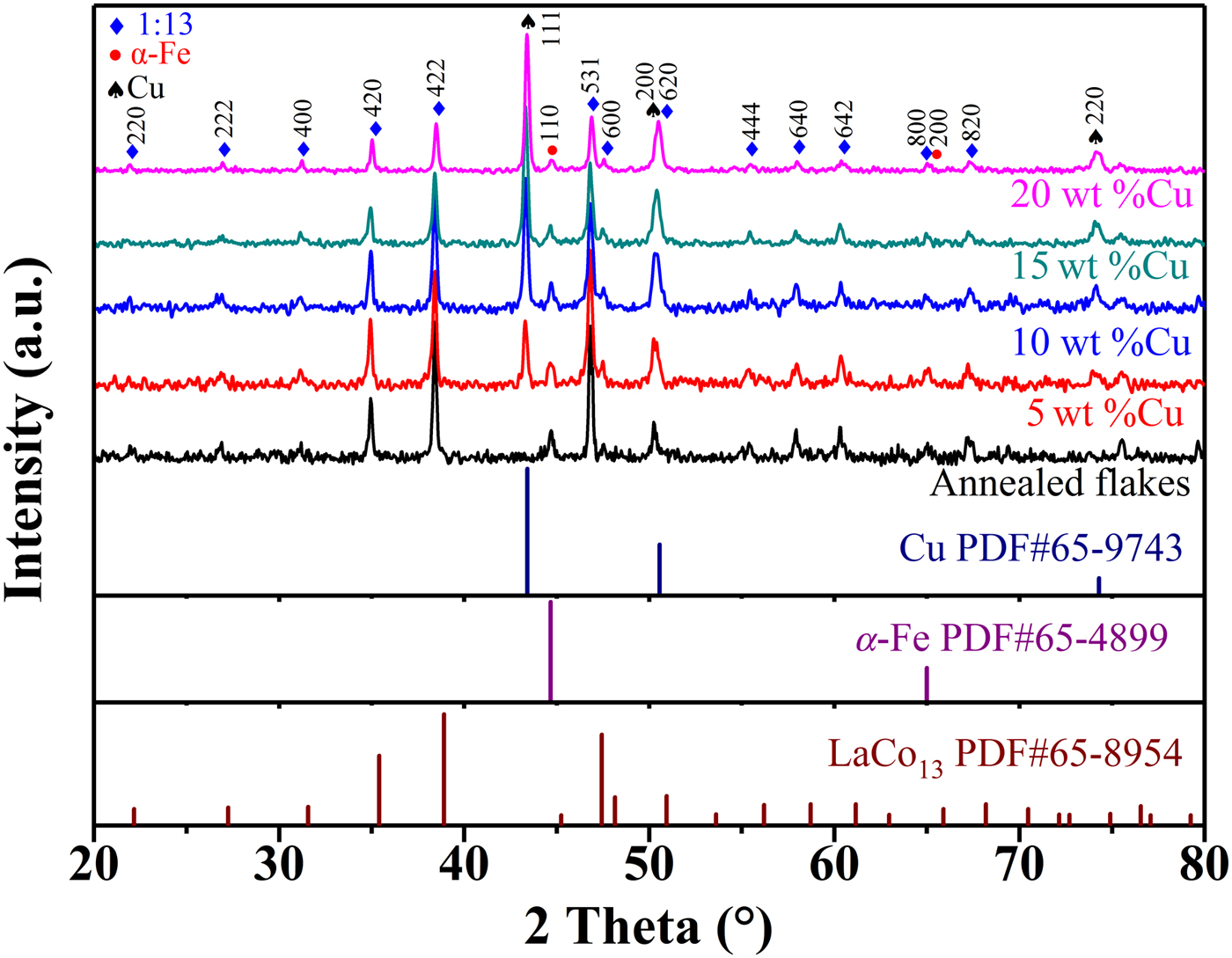
The XRD patterns of the annealed La0.8Ce0.2(Fe0.95Co0.05)11.8Si1.2 flakes and La0.8Ce0.2(Fe0.95Co0.05)11.8Si1.2/Cu bulk composites with different Cu contents are shown in Fig. 1. The majority phase, which is a NaZn13-type 1:13 phase, has formed when the La0.8Ce0.2(Fe0.95Co0.05)11.8Si1.2 flakes were annealed at 1323 K for 12 h. There is also a small amount of the α-Fe phase, which will weaken the MCE, but enhance the mechanical properties[Reference Löwe, Liu, Skokov, Moore, Sepehri-Amin, Hono, Katter and Gutfleisch24] and the thermal conductivity.[Reference Shao, Zhang, Luo, Yan and Liu7]
XRD patterns of La0.8Ce0.2(Fe0.95Co0.05)11.8Si1.2 flakes annealed at 1323 K for 12 h and La0.8Ce0.2(Fe0.95Co0.05)11.8Si1.2/Cu bulk composites with different Cu content.
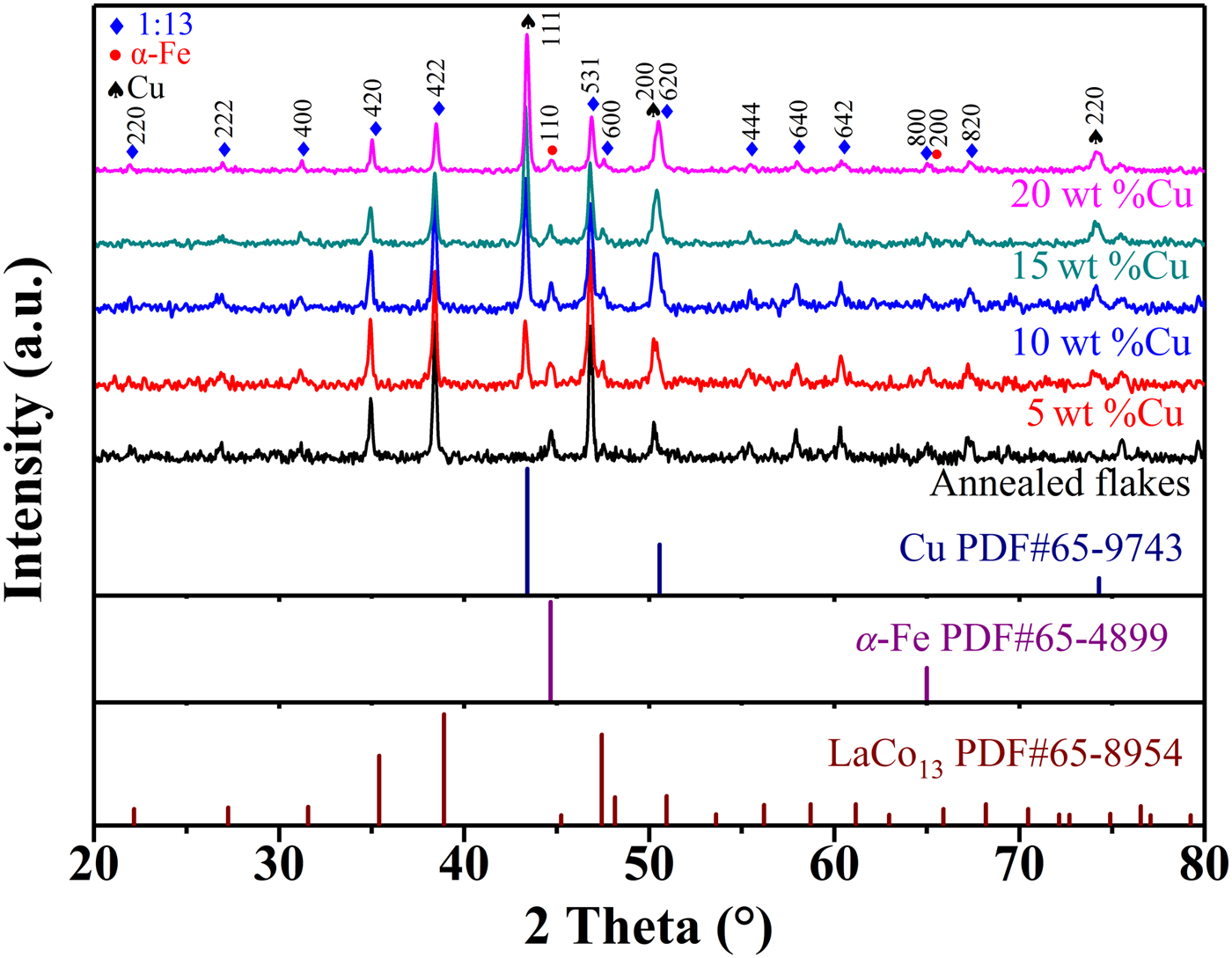
For the La0.8Ce0.2(Fe0.95Co0.05)11.8Si1.2/Cu bulk composites with different Cu content, the diffraction peaks could be indexed to the same NaZn13-type 1:13 majority phase, metallic Cu, and α-Fe phase. Therefore, there is no chemical reaction between the Cu and the annealed La0.8Ce0.2(Fe0.95Co0.05)11.8Si1.2 powder during HP at 423 K. Compared with the recent work of Liu et al.,[Reference Liu, Zhang, Shao and Yan19] there is no atomic interdiffusion between Cu and Fe to form a new phase such as Fe4Cu3,[Reference Liu, Zhang, Shao and Yan19] which means the MCE of the composite obtained by low-temperature HP will not deteriorate.
SEM analysis
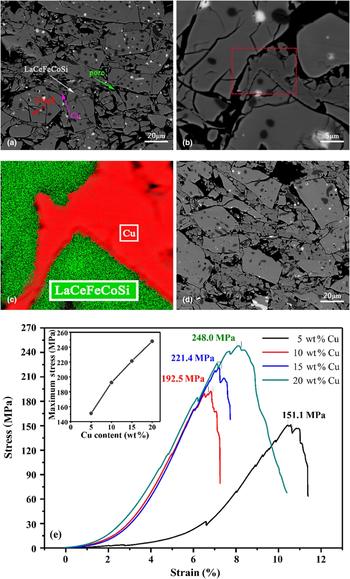
The microstructure of La0.8Ce0.2(Fe0.95Co0.05)11.8Si1.2/Cu bulk composites with different Cu content is shown in Fig. 2 (a)–2(d). The Cu powder particles tend to accumulate between the large La0.8Ce0.2(Fe0.95Co0.05)11.8Si1.2 particles. Many pores are present in the HP samples, forming a porous structure [Fig. 2(a)]. Some of the pores are artifacts due to loss of particles on the surface during the polishing process. The content of Cu powder is insufficient to buffer the mechanical stresses applied by HP; hence, numerous cracks were observed in the La0.8Ce0.2(Fe0.95Co0.05)11.8Si1.2 particles [Fig. 2(a)]. With increasing Cu content, the porosity decreased, the cracks induced by HP significantly reduced in the La0.8Ce0.2(Fe0.95Co0.05)11.8Si1.2 particles [Fig. 2(d)]. The results show that Cu can prevent La0.8Ce0.2(Fe0.95Co0.05)11.8Si1.2 particles from cracking during HP. The mechanical stress applied during compaction is absorbed by the ductile Cu, which results in mostly intact La0.8Ce0.2(Fe0.95Co0.05)11.8Si1.2 particles and greater density of composites after HP.
Backscattered electron images and compressive stress–strain curves of La0.8Ce0.2(Fe0.95Co0.05)11.8Si1.2/Cu bulk composites with different Cu content. (a) Image for the bulk composite with 10 wt% Cu; (b) Enlarged micrograph of the bulk composite with 15 wt% Cu; (c) SEM–EDS elemental mapping image for the dashed frame in (b); (d) Image of the bulk composite with 20 wt% Cu. (e) Compressive stress–strain curves of La0.8Ce0.2(Fe0.95Co0.05)11.8Si1.2/Cu bulk composites with different Cu content.
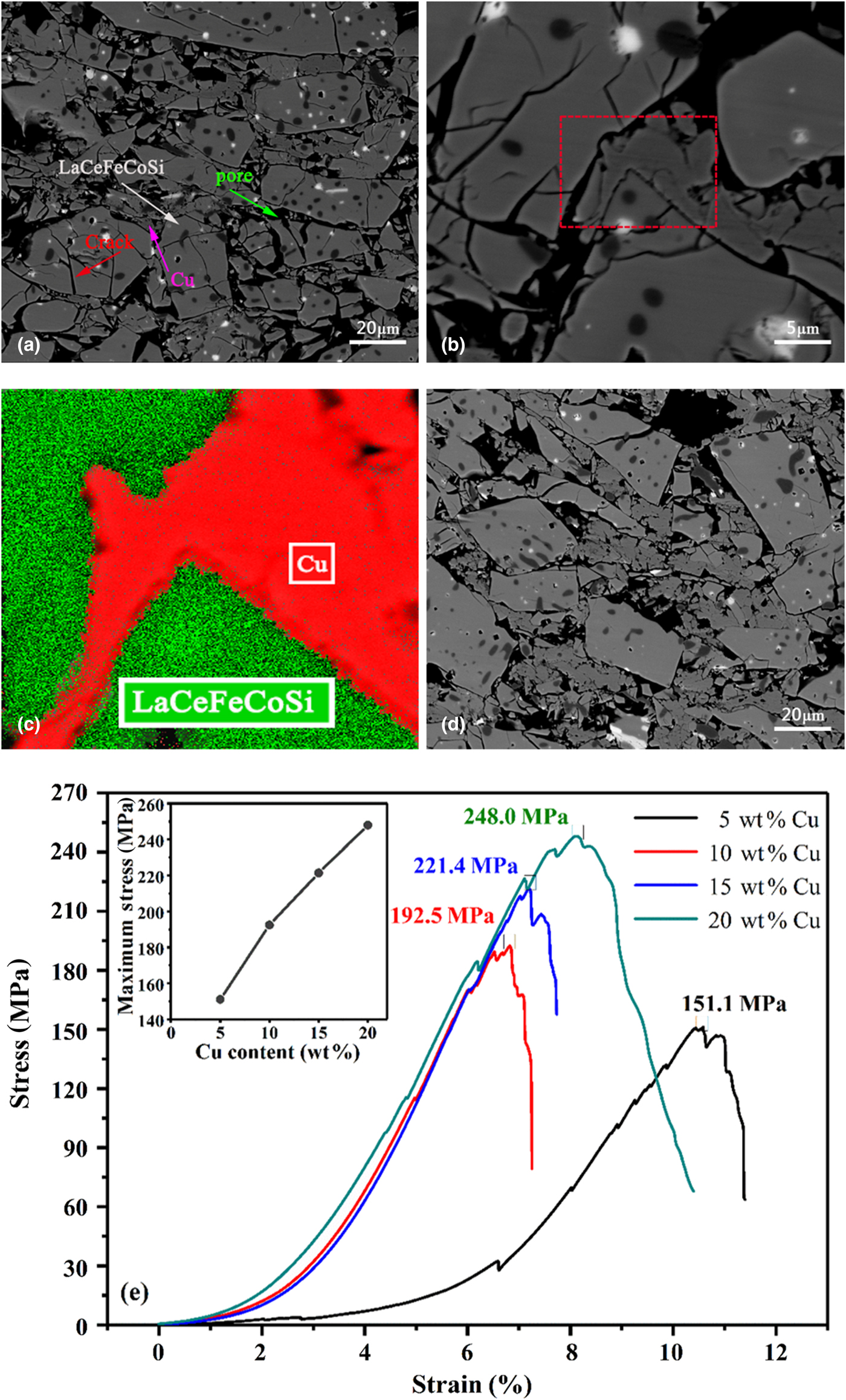
The density of the bulk composites was determined by the Archimedes method (Table I). The density of the bulk composites increased and the porosity decreased with increasing Cu content, which is consistent with the SEM results. An appropriate level of porosity can eliminate pulverization and fracture during the magnetic transition, but it also reduces thermal conductivity to some extent.[Reference Lyubina, Schafer, Martin, Schultz and Gutfleisch25] Good balance of mechanical properties and thermal conductivity can be obtained by tuning the relative amount of Cu and La0.8Ce0.2(Fe0.95Co0.05)11.8Si1.2 particles. From the SEM images [Fig. 2(b)] and the energy-dispersive X-ray spectroscopy (EDS) elemental mapping [Fig. 2(c)] for the composite with 15 wt% Cu, it is observed that the Cu particles are sandwiched between large MCM particles, indicating Cu flow at 423 K.
Density (ρ), thermal conductivity (λ), and the maximum compressive strength (σ bc)max of La0.8Ce0.2(Fe0.95Co0.05)11.8Si1.2/Cu bulk composites with different Cu content.

Mechanical properties and thermal conductivity
The La0.8Ce0.2(Fe0.95Co0.05)11.8Si1.2 hot-pressed material without Cu addition is not strong enough to absorb pressure in the compression test, so there is no compression data of La0.8Ce0.2(Fe0.95Co0.05)11.8Si1.2 hot-pressed bulk alloy. Compressive stress–strain curves for La0.8Ce0.2(Fe0.95Co0.05)11.8Si1.2/Cu bulk composites with different Cu content are shown in Fig. 2(e). The maximum compressive strength (σ bc)max increases approximately linearly with increasing Cu content [inset of Fig. 2(e)]. When the Cu content increases from 5 to 20 wt%, the (σ bc)max of the La0.8Ce0.2(Fe0.95Co0.05)11.8Si1.2/Cu bulk composites increases from 151.1 to 248.0 MPa. The enhanced mechanical properties indicate that a more intact structure can be obtained with increasing Cu content, which is in reasonable agreement with the SEM results. For the bulk composites, the composites with 5 wt% Cu exhibits much larger maximum strain (10.6%) and lower compressive strength (151.1 MPa) than composites with 10–20 wt% Cu. This is because the bulk composites are porous, thus large strain could be observed due to densification under stress.[Reference Zhang, Sun, Niu, Hu, Sun and Shen13] When the Cu content is 5 wt%, some pores and boundaries are not yet filled, providing space for particles to move during the pressurizing process. Thus large strain could be observed due to densification, as in the case of bonded La(Fe,Si)13-based composite with 1 wt% epoxy resin.[Reference Zhang, Sun, Niu, Hu, Sun and Shen13] Such a microstructure also leads to poor mechanical properties.[Reference Zhang, Sun, Niu, Hu, Sun and Shen13] With increasing content of Cu, more pores and boundaries are filled by Cu, which would improve the mechanical properties by enhancing binding among the particles. The bulk composite with 20 wt% Cu exhibits a compressive strength of 248 MPa with a maximum strain of 8.2%, the strength is 64.1% higher than that of the bulk composite with 5 wt% Cu but the maximum strain is 22.6% lower. The (σ bc)max of the composite with 20 wt% Cu is higher than the epoxy-bonded La(Fe,Si)13-based composites (162 MPa).[Reference Zhang, Sun, Niu, Hu, Sun and Shen13] However, which is comparable with that of the bulk composites composed of La0.8Ce0.2(Fe0.95Co0.05)11.8Si1.2 particles in the size range of 76–105 µm and 10 wt% Sn42Bi58 alloy (243 MPa), but lower than that of the bulk composites composed of La0.8Ce0.2(Fe0.95Co0.05)11.8Si1.2 particles and 15 wt% Sn42Bi58 alloy (303 MPa).[Reference Dong, Zhong, Peng, Huang, Zhang, Jiao, Liu and Ramanujan15] During the ferromagnetic–paramagnetic (FM–PM) transition around T C, the MCM undergoes thermal and mechanical stresses due to the giant magnetovolume effect, which leads to aging and fatigue and results in gradual degradation of thermal conductivity and mechanical stability.[Reference Lyubina, Schafer, Martin, Schultz and Gutfleisch25] Besides, the MCM must be machined into a heat exchanger to provide a large contact surface for the heat-exchange medium; hence good mechanical properties are crucial. The composite developed in this study exhibits good mechanical properties suggesting longer service time.
Pores, being poor conductors of heat, have a negative impact on the magnetocaloric performance since they reduce thermal contact between the particles. As listed in Table I, with increasing Cu content from 5 to 20 wt%, the porosity of the bulk composites gradually decreases from 18.43% to 12.47%. The composites display a high room-temperature thermal conductivity of 7.51, 8.19, 10.05, and 15.55 W/(m·K) for different Cu contents from 5 to 20 wt%, which are comparable with or much higher than those of La(Fe,Si)13-based composites with binders such as Sn [7.9 W/(m·K)],[Reference Zhang, Liu, Zhang, Shao, Li and Yan4] Ag [2.5 W/(m·K)][Reference Turcaud, Morrison, Berenov, Alford, Sandeman and Cohen26] and epoxy resin [2.7 W/(m·K)].[Reference Pulko, Tušek, Moore, Weise, Skokov, Mityashkin, Kitanovski, Favero, Fajfar, Gutfleisch, Waske and Poredoš18] These values are far higher than those of porous LaFe11.6Si1.4/Cu composites with different coated Cu [0.9–2.9 W/(m·K) at 300 K].[Reference Lyubina, Hannemann, Cohen and Ryan27] Obviously, when Cu content increases up to 15 wt%, the thermal conductivity of the studied bulk composites is higher than that of the pure LaFe11.6Si1.4 bulk material [9.7 W/(m·K) at 300 K].[Reference Lyubina, Hannemann, Cohen and Ryan27] However, these values are lower than those of La(Fe,Si)13-based composites with binders such as Sn42Bi58 [19.64 W/(m·K)].[Reference Dong, Zhong, Peng, Huang, Zhang, Jiao, Liu and Ramanujan15] The increase of the thermal conductivity of the La0.8Ce0.2(Fe0.95Co0.05)11.8Si1.2/Cu bulk composites can be ascribed to the Cu binder and the higher structural integrity of the bulk composites.[Reference Krautz, Funk, Skokov, Gottschall, Eckert, Gutfleisch and Waske14]
Magnetic properties
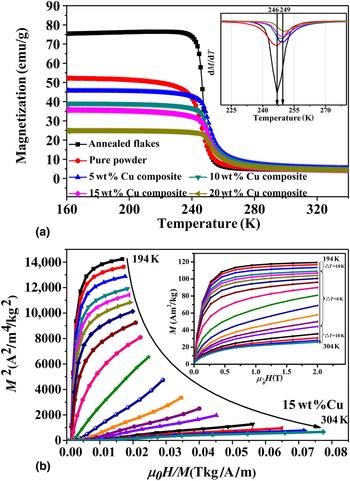
The magnetic properties of the La0.8Ce0.2(Fe0.95Co0.05)11.8Si1.2/Cu bulk composites are closely related to phase coexistence and microstructure. Based on the earlier results of microstructure and mechanical properties, we further investigated the magnetic and magnetocaloric properties of the bulk composites. Figure 3(a) presents the temperature dependence of magnetization for the parent alloy and the composites, measured during heating under an applied field of 0.05 T. Obviously, the level of magnetization for the parent alloy and the bulk composite sample is very different. With increasing Cu content, the magnetization of the bulk composites decreased, which is ascribed to the magnetic dilution effect. When the temperature is higher than T C, the magnetization values do not approach zero owing to the presence of α-Fe in these alloys. The curves in the inset of Fig. 3(a) show that the FM–PM transition for all bulk composites occurs at about 249 K. The T C of the La0.8Ce0.2(Fe0.95Co0.05)11.8Si1.2 annealed flake and powder is ~3 K lower than that of the La0.8Ce0.2(Fe0.95Co0.05)11.8Si1.2/Cu bulk composites. The specimens are flake, powder and bulk composites, respectively, so thermal contact among these specimens are certainly different. In the process of heating, there is “thermal relaxation” in these bulk composites with certain amount of porosity, the temperature is slightly different between the interior and surface. So, the bulk composites are less susceptible to heat than the flake specimen, and thus attain a higher T C value in the M–T measurement.
(a) M−T curves of the parent alloy and the bulk composites. The inset shows the derivative of magnetization versus temperature of these specimens; (b) Arrott plots of the La0.8Ce0.2(Fe0.95Co0.05)11.8Si1.2/Cu bulk composite with 15 wt% Cu. The inset shows the M–H curves of the composite measured in an applied field of 0–2 T.
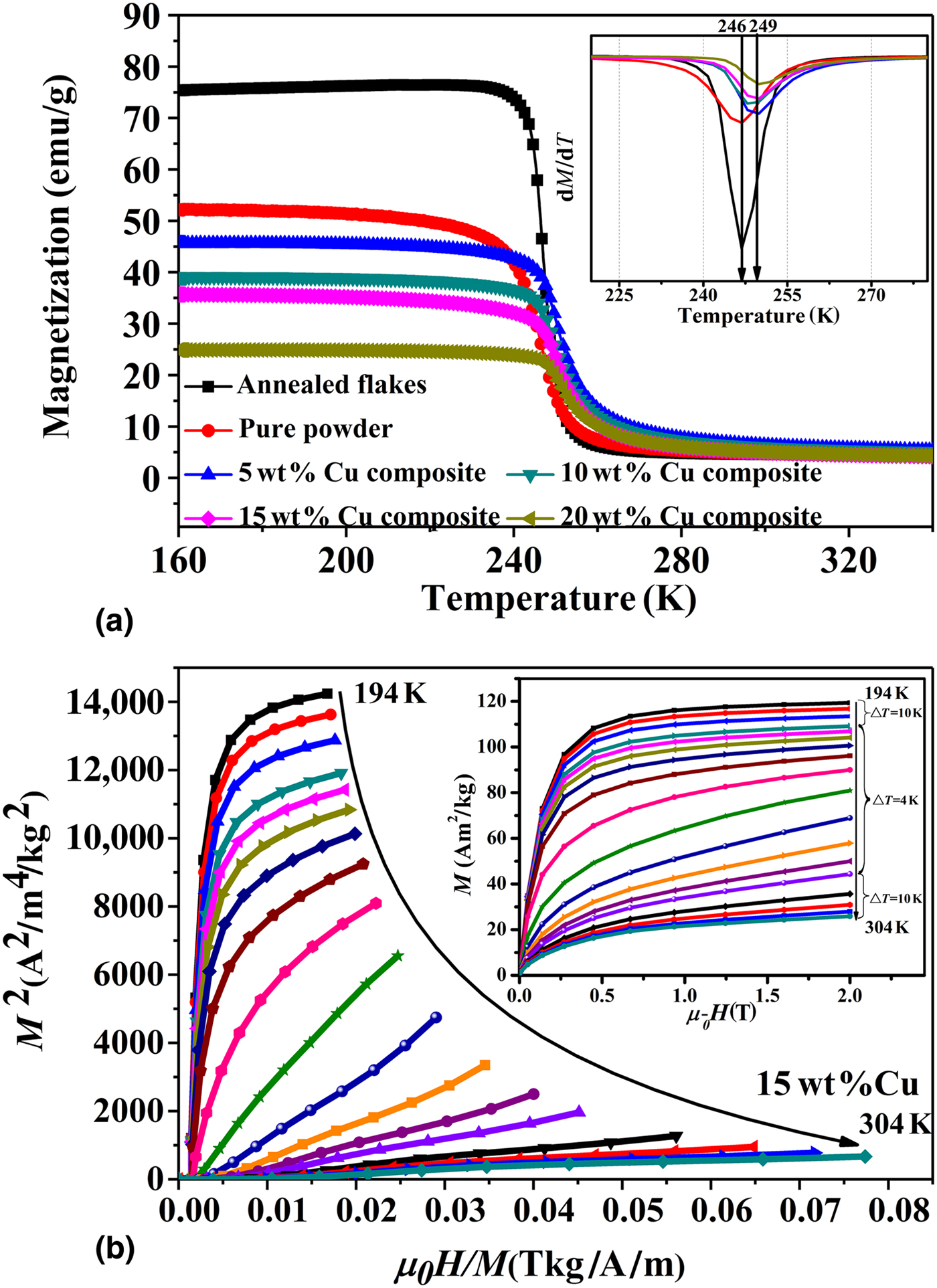
As an example, the Arrott plots of the La0.8Ce0.2(Fe0.95Co0.05)11.8Si1.2/Cu bulk composite with 15 wt% Cu are presented in Fig. 3(b). The inset of Fig. 3(b) shows the isothermal magnetization curves measured in a temperature range of 194–304 K under a magnetic field up to 2 T. According to the Banerjee criterion,[Reference Banerjee28] the Arrott plot of a first-order magnetic transition exhibits negative slope or inflection point; otherwise, it is expected to be second-order when the slope is positive. Neither inflection nor negative slope above T C is observed in Fig. 3(b), which indicates that the magnetic transition for the La0.8Ce0.2(Fe0.95Co0.05)11.8Si1.2/Cu bulk composites is second order. This is in accordance with the results of previous studies.[Reference Liu and Altounian29] Co-doping will weaken the itinerant-electron metamagnetic (IEM) transition from paramagnetic to ferromagnetic state above T C and cause the widening of the (–ΔS M)−T curves, and a second-order magnetic transition behavior is observed.[Reference Hu, Gao, Qian, Ilyn, Tishin, Sun and Shen9] A reduction of the elastic energy change with Co-doping may be a possible reason for the gradual weakness of the IEM transition.[Reference Hu, Gao, Qian, Ilyn, Tishin, Sun and Shen9]
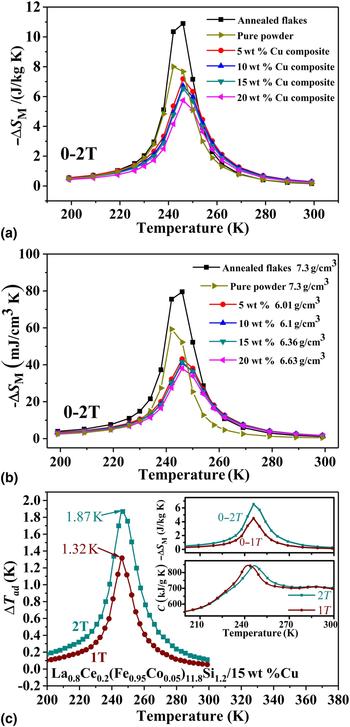
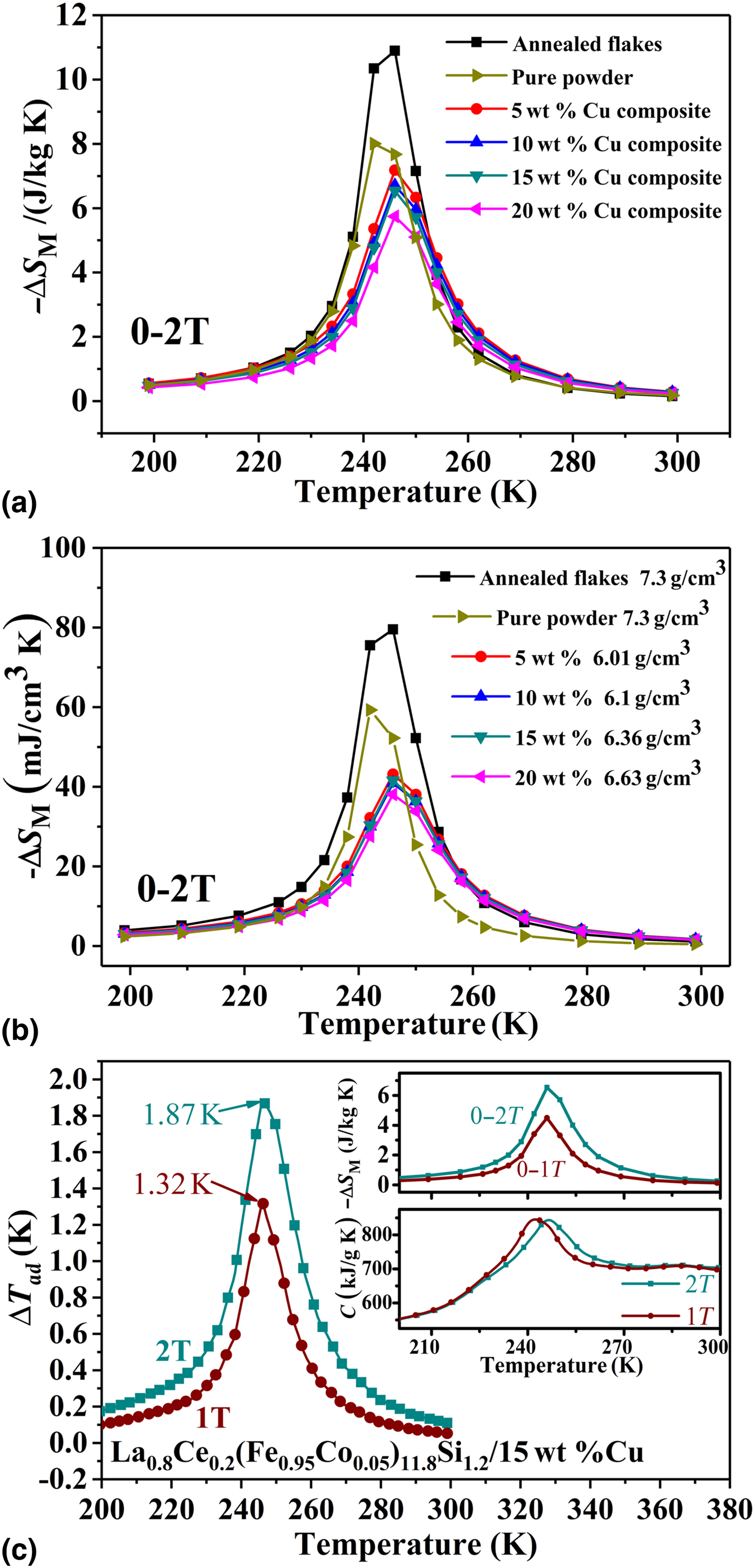
The magnetic entropy change (–ΔS M) was calculated by using the Maxwell relation 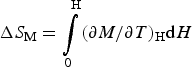 $\Delta S_{\rm M} = \mathop \int \limits_{0}^{\rm H} (\partial M{\rm /}\partial T)_{\rm H} {\rm d}H$.[Reference Franco, Blázquez, Ipus, Law, Moreno-Ramírez and Conde3, Reference Zhang, Liu, Zhang, Shao, Li and Yan4, Reference Hu, Gao, Qian, Ilyn, Tishin, Sun and Shen9, Reference Liu, Moore, Skokov, Krautz, Löwe, Barcza, Katter and Gutfleisch12] Figure 4(a) shows the temperature dependence of –ΔS M for the annealed La0.8Ce0.2(Fe0.95Co0.05)11.8Si1.2 alloy and La0.8Ce0.2(Fe0.95Co0.05)11.8Si1.2/Cu bulk composites under a magnetic field change of 0–2 T. As shown in Fig. 4(a), the value of (–ΔS M)max for the La0.8Ce0.2(Fe0.95Co0.05)11.8Si1.2 annealed flake reaches 10.9 J/(kg K), while the (–ΔS M)max decreases to 8.01 J/(kg K) for the La0.8Ce0.2(Fe0.95Co0.05)11.8Si1.2 powder. The grinding process induces the removal of constraints imposed by grain boundaries, which can significantly reduce the (–ΔS M)max.[Reference Radulov, Skokov, Karpenkov, Gottschall and Gutfleisch30] Furthermore, the (–ΔS M)max decreases to 7.19, 6.71, 6.54, and 5.74 J/(kg K) for the La0.8Ce0.2(Fe0.95Co0.05)11.8Si1.2/Cu bulk composites with 5, 10, 15, and 20 wt% Cu, respectively. Obviously, this change trend of (–ΔS M)max is different from our previous work.[Reference Dong, Zhong, Peng, Huang, Zhang, Jiao, Liu and Ramanujan15] The values of (–ΔS M)max in the bulk composites composed of La0.8Ce0.2(Fe0.95Co0.05)11.8Si1.2 particles in the size range of 76–105 µm with 10 and 15 wt% Sn42Bi58 alloy binder powder are 5.96 and 6.79 J/(kg K), respectively.[Reference Dong, Zhong, Peng, Huang, Zhang, Jiao, Liu and Ramanujan15] On the one hand, the decline of (–ΔS M)max in the La0.8Ce0.2(Fe0.95Co0.05)11.8Si1.2/Cu bulk composites is due to the fact that some of the La0.8Ce0.2(Fe0.95Co0.05)11.8Si1.2 particles have been cracked and become finer powder in the process of HP. On the other hand, the introduction of nonmagnetic element Cu as binder results in the magnetic dilution effect. The reduction of particle size resulting from the 1:13 grain refinement led to a slight decrease of (–ΔS M)max but improved heat transfer and removal of extrinsic hysteresis.[Reference Hu, Chen, Wang, Bao, Sun and Shen31] Zeng et al.[Reference Zeng, Baker, McCreary and Yan32] disclosed the relation between particle size and entropy change. The H C is affected by the shape or dimension of the particles, which changes the mechanism of domain formation so as to influence the magnetization process and (–ΔS M). However, the decrease speed of (–ΔS M)max slows down with the increase of Cu content from 5 to 15 wt%. The results are in good agreement with the SEM analysis. The deformable Cu particles reduce the cracking during the HP process so that it will improve the integrity of the 1:13 phase particles and prevent it from being crushed into smaller particles. We calculated the volumetric ΔS M using the experimental density listed in Table I. Under an applied field of 0–2 T, the volumetric ΔS M of the bulk composites with 5, 10, 15, and 20 wt% Cu are 43.17, 40.95, 41.59, 38.10 mJ/(cm3 K), respectively. The density of the La0.8Ce0.2(Fe0.95Co0.05)11.8Si1.2 annealed flakes and pure powder (~7.30 g/cm3) was determined by Rietveld refinement based on XRD patterns. Figure 4(b) shows that under a magnetic field change of 2 T, the volumetric ΔS M decreases from 79.50 mJ/(cm3 K) for the La0.8Ce0.2(Fe0.95Co0.05)11.8Si1.2 annealed flake to 59.30 mJ/(cm3 K) for the pure powder and to 38.10–43.17 mJ/(cm3 K) for the bulk composites. However, even these decreased values are much larger than the values reported for a number of MCMs which have comparable T C, such as TbCo2 [26 mJ/(cm3 K) at 236 K],[Reference Gschneidner, Pecharsky and Tsokol33] Gd4Sb3 [29 mJ/(cm3 K) at 265 K],[Reference Niu, Gschneidner, Pecharsky and Pecharsky34] (Mn1.82V0.18)Sb [39 mJ/(cm3 K) at 242 K under 0–5 T],[Reference Zhang and Zhang35] La(Fe10.4Si2.6) [~23.3 mJ/(cm3 K) at 243 K].[Reference Hu, Shen, Sun, Cheng, Rao and Zhang36] The Cu particles will first fill pores and boundaries [Fig. 2(d)], which resulted in smearing of the magnetic transition and slightly reduced MCE. Therefore, it can be expected that the volumetric ΔS M will not change much until all the pores and boundaries are filled. When the Cu content reach 20 wt%, the pores and boundaries have been filled to a great extent and most 1:13 phase particles remained intact, so volumetric ΔS M declined faster due to the decreased amount of La0.8Ce0.2(Fe0.95Co0.05)11.8Si1.2. Therefore, an optimum content of Cu can improve the thermal conductivity and mechanical properties of the bulk composites, while retaining relatively good magnetocaloric properties.
(a, b) (–ΔS M)−T curves of the annealed La0.8Ce0.2(Fe0.95Co0.05)11.8Si1.2 alloy and bulk composites with different Cu contents under a magnetic field change of 0−2 T. (c) ΔT ad−T curves of La0.8Ce0.2(Fe0.95Co0.05)11.8Si1.2/15 wt%Cu bulk composite. The insets show the (–ΔS M)−T curves in an applied field of 0–1 and 0–2 T and the C–T curves measured in an applied field of 1 and 2 T.
The adiabatic temperature change (ΔT ad) is another important parameter to evaluate the MCE performance of the refrigeration material. At constant pressure, ΔT ad can be calculated by the following equation,[Reference Bingham, Phan, Srikanth, Torija and Leighton37]
 $$\Delta T_{{\rm ad}} (T_0, H_0 ) \cong - \Delta S_{\rm M} (T_0, H_0 )\displaystyle{{T_0} \over {C(T_0, H_0 )}}.$$
As an example, specific heat capacity under 1 and 2 T was measured for the La0.8Ce0.2(Fe0.95Co0.05)11.8Si1.2/15 wt% Cu bulk composite. Figure 4(c) shows that the maximum value of ΔT ad reaches 1.32 and 1.87 K under an applied field of 1 and 2 T, respectively, which demonstrates good MCE of these composites. However, the maximum value of ΔT ad is smaller than those of LaFe14.3Co0.8Si1.2 bulk alloy (2.0 K under 1.5 T near 270 K),[Reference Shao, Zhang, Luo, Yan and Liu7] Gd50Co48Zn2 (1.49 K under 1 T, 2.54 K under 2 T near 260 K) and Gd48Co50Zn2 (1.46 K under 1 T, 2.49 K under 2 T near 265 K) amorphous ribbons.[Reference Yu, Zhang, Cui, Wu, Wen, Zeng and Xia38] This is because the sample has 15 wt% Cu binder and is not fully dense.
Conclusions
A novel route to prepare La(Fe,Si)13-based bulk composites by low-temperature HP was developed. The composite consists of the MCM La0.8Ce0.2(Fe0.95Co0.05)11.8Si1.2 and a moderate content of high thermal conductivity Cu, these bulk composites exhibited a good balance of properties. La0.8Ce0.2(Fe0.95Co0.05)11.8Si1.2/Cu bulk composites with 10–15 wt% Cu have large values of (–ΔS M)max~ 6.54–6.71 J/(kg K) under 2 T at T C (249 K), combined with high thermal conductivity of 8.19–10.02 W/(m·K) and compressive strength of 192.5–221.4 MPa. This suggests the promising potential of applying Cu as a binder to prepare La(Fe,Si)13-based magnetocaloric bulk composites with a good combination of properties by low-temperature HP.
Acknowledgments
This work was partly supported by the National Key R&D Plan of China (Materials genome project) (Grant No. 2017YFB0702703), the National Natural Science Foundation of China (Grant Nos. 51261001, 51671022, 51564037), the Natural Science Foundation of Guangdong Province (Grant Nos. 2017A030313317, 2014A030313239), the Beijing Natural Science Foundation (Grant No. 2162022), and the Fundamental Research Fund for the Central Universities, (Grant No. x2cl/D2170630). This research is partially supported by grants from the National Research Foundation, Prime Minister's Office, Singapore under its Campus of Research Excellence and Technological Enterprise (CREATE) program. Dr. Zhong Xichun also thanks the China Scholarship Council ([2017]3059, No.201706155021) for financial support to visit Nanyang Technological University, Singapore.