The economic impact of immigrants remains an active area of both scholarly and public debate. In recent years, much of the economic analysis of immigration has focused on the impact of low-skilled immigrants on native workers through labor market competition, or the effects that very high-skilled immigrants may have as entrepreneurs or inventors.Footnote 1 Yet there is another group of immigrants, the skilled craftworkers, that typically receive less attention from economists.
The fact that skilled craftworkers are often ignored in economic analysis is somewhat surprising given that historians have documented the important role that skilled immigrants played in the development of American industry. Ronald Lewis and coauthors, for example, describe the role that skilled Welsh workers played in early tinplate manufacturing.Footnote 2 Recent work by Ken Fones-Wolf on Belgian glass workers provides a second case.Footnote 3 While studies of this type are insightful, they are limited by their focus on relatively small and somewhat obscure industries as well as the difficulty in quantifying the effects that they describe.
This article augments and extends previous research on skilled immigrants by documenting the role they played in the development of modern industrial shipbuilding in the United States in the late-nineteenth century. The analysis focuses mainly on one shipyard, Newport News Shipbuilding (NNS), which grew from its founding in the late 1880s to become the most important American shipbuilder. Today it continues to be the nation's preeminent shipyard, and the only yard capable of producing the largest classes of Navy ships.
Shipbuilding is an ideal setting in which to examine the importance of immigrant workers. This is clearly an industry of great importance in U.S. history, starting in the colonial era. It is also a sector where access to skilled workers was important. In addition, as I discuss below, the fact that shipyards were often located in smaller towns allows me to take a novel approach to understanding how a new shipyard like NNS assembled the skilled workforce necessary to build large metal ships.
The shipbuilding industry has had a long and volatile history in the United States. Early in the country's history, New England shipyards drew on the continent's vast untapped timber resources to supply wooden sailing ships to buyers around the world. However, after 1850 the industry began to decline. The rise of metal shipbuilding shifted production toward Britain, which enjoyed the advantage of initially cheaper iron inputs and more workers with engineering experience.Footnote 4 This early lead allowed Britain to build up a pool of skilled metal shipbuilders that made British shipyards the most productive in the world.Footnote 5
Toward the end of the nineteenth century, the development of the United States as a major iron and steel producer lowered the cost of metal inputs, opening up the possibility that U.S. shipyards could begin competing in metal ship production.Footnote 6 However, young American shipyards still faced important challenges. Chief among these was a lack of workers with the unique and vital skills necessary to fabricate large metal ships.
How did NNS assemble, virtually from scratch and over a relatively short period of time, the skilled workforce necessary to successfully produce large metal ships? In studying this topic, the paucity of available corporate records during these early stages of the firm's life presents a challenge. While firm records give us information about the senior level of managers, they provide little information about the main body of the workforce, the men who actually built the ships.
To overcome this challenge, this article applies a somewhat novel approach that takes advantage of the fact that Newport News was essentially a company town during the first two decades of the firm's existence. As a result, anyone residing in Newport News and holding a shipbuilding or related occupation was almost certainly working for NNS during these years. This means that the population census can be used as a unique window into the firm's workforce. The Census provides details about workers’ backgrounds that are typically not included in corporate records. For example, the census provides each resident's occupation as well as background information such as birthplace, what year immigrant workers came to the United States, race, marital status, and household composition. These details can help us understand the origin and composition of the workforce that NNS assembled.
This approach differs from the methods commonly used to study the impact of immigration. Most of the existing work focuses on “mass migration” in the tradition of Timothy Hatton and Jeffrey Williamson.Footnote 7 Studies of this type rely on aggregated statistics or, more recently, digitized full-count census records.Footnote 8 While much can be learned from this data, the role of skilled craftworkers is often swamped by the impact of more numerous less-skilled immigrants. This may lead to an underestimation of the role that skilled workers played in important sectors like shipbuilding. A second important strand of literature focuses instead on the very top group of “elite” workers. The experiences of these notable migrants can be traced out in firm records, media reports, or other sources. These workers feature prominently in work on international technology transfer, such as the studies collected by David Jeremy or the work of Petra Moser, Alessandra Voena, and Fabian Waldinger.Footnote 9 However, this approach also tends to overlook the larger set of skilled workers that I study, a group that brought craft skills rather than technical knowledge. Thus, this study fills in a missing piece in our understanding, by illuminating the impact of skilled craftworkers that fall in between the notable elite and the mass body of migrants.
Previewing the results, I present evidence highlighting the vital role that skilled immigrants played at NNS. Immigrants from Britain, the world's leading shipbuilding nation, filled key skilled positions, particularly early in the firm's life. These skilled immigrant workers, together with skilled Americans hailing mainly from the mid-Atlantic region, were employed together with a large pool of unskilled workers, mainly African Americans, drawn from Virginia and neighboring states. Over time, local (white) workers were trained to take up skilled positions. Thus, my analysis highlights the importance of access to skilled foreign workers for the early development of NNS, as well as how, over time, local workers were trained to fulfill the firm's expanding need for skilled labor.
Industry Background
The shipbuilding industry has attracted a substantial amount of interest from historians and economists. One topic of study has been the factors behind the rise of British shipbuilding to dominance in the mid-nineteenth century, and the subsequent decline of the industry in the mid-twentieth century.Footnote 10 Other research focuses on why the United States struggled to compete with British shipbuilders, particularly after U.S. iron and steel prices fell to comparable levels around the turn of the century. Knick Harley, for example, examines the persistent survival in wood shipbuilding in the United States and concludes that it continued because of the existence of locked-in skills specific to wood ship construction.Footnote 11 However, even as wood shipbuilding survived, U.S. firms were beginning to move into modern metal ship construction. Protectionism certainly played a role in this process; U.S. shipyards were protected from British competition for ships operating directly between U.S. ports, which provided a small market that was reserved entirely for vessels of U.S. construction.Footnote 12 While this protection propelled the growth of U.S. shipyards, they still faced important challenges in moving into large-scale iron and steel shipbuilding.
Chief among these challenges was the scarcity of skilled metal shipbuilders in the United States.Footnote 13 The building of large iron or steel-hulled ships required a wide variety of skilled workers, ranging from boilermakers, platers, and riveters to ship carpenters, chippers and caulkers, and mechanics.Footnote 14 While many of these skills were also used in other industries, or in wood shipbuilding, other vital skills were specific to metal shipbuilding. For example, the shaping of large metal plates and beams into various irregular shapes was an operation that was central to metal shipbuilding but of limited importance in most other sectors. How fast beams and plates could be formed into the desired shape determined the speed with which a ship could be built, while errors in the process contributed to delays and waste.Footnote 15 Skills of this type, those unique to the industry, were gained through on-the-job experience, often as part of a formal apprenticeship. In Britain, where training systems were firmly established, apprenticeships typically lasted five to seven years. Unions, a strong force in British shipbuilding but absent in American yards like NNS, played an important role in this training process. Only a few elite positions, such as naval architects, marine engineers, and draftsmen required more formal education.Footnote 16
Several features of the shipbuilding industry contributed to firms’ reliance on skilled labor. One important factor during the period covered by this study is that most ships were unique bespoke orders. Occasionally yards would produce two or three of the same design, but typically shipyards worked on a wide range of different ship designs, often at the same time. This variation made standardization difficult and increased the importance of workers with skills that gave them the flexibility to work on very different types of ships.Footnote 17
Also, shipbuilders faced volatile demand and a highly competitive market. Shipbuilding was a fragmented industry where many small and medium-sized shipyards competed for orders. As a result, John Hutchins described shipbuilding in the late nineteenth and early twentieth centuries as, “a market which, except for the influence of national laws and policies, is naturally one of the most highly competitive of all markets.”Footnote 18 This competition, together with highly volatile demand, meant that large investments in durable capital were dangerous for shipbuilders and came with the risk of bankruptcy during downturns. As a result, “The principal task of the shipbuilders was to minimize total overhead expenses while maintaining the ability to build large and complex ships at prices that were competitive on the world market.”Footnote 19 Having access to skilled workers helped shipyards manage this volatility, by avoiding heavy fixed capital expenditures. In British metal shipyards in the late nineteenth and early twentieth centuries, skilled workers made up 70 to 80 percent of the workforce.Footnote 20 Newer metal shipyards in places like the United States and Germany, lacking similar access to large pools of skilled workers, were forced to substitute by making heavier capital expenditures, which put them at risk of bankruptcy during the inevitable cyclical downturns in the industry.Footnote 21
The importance of skilled workers, together with the fact that skills were mainly gained through apprenticeships and on-the-job experience meant that locations with a longer history of metal shipbuilding maintained a distinct advantage. This led to regional concentrations of ship production in locations where low iron prices had allowed the metal shipbuilding industry to gain an early start, particularly in the areas around Glasgow in Scotland, Newcastle-upon-Tyne and Sunderland in Northern England, and Belfast in Ireland.
We know from research by Rowland Berthoff and others that at least some skilled British shipbuilders migrated to the United States.Footnote 22 However, assessing the magnitude of these flows and their importance for American shipyards has proven difficult. Most of what we know come from anecdotal sources which, while informative, are difficult to quantify. One aim of this study is to provide a better idea of the quantitative importance of these skilled immigrant shipbuilders.
Origins of Newport News Shipbuilding
Any discussion of the origins of NNS has to start with the company's founder, Collis P. Huntington. Huntington, born in Connecticut in 1821, made his fortune selling supplies to the California gold miners in the 1850s. By the 1860s, he had become involved in railroad construction. Together with Leland Stanford, Mark Hopkins, and Charles Crocker, he was one of the “Big Four” promoters of the transcontinental railroad. By the 1880s, Huntington was a very wealthy man, with ownership stakes in several railroads—including the Central Pacific and Southern Pacific—shipping companies, land companies, and a variety of other businesses. In the late 1860s, Huntington had become involved in resuscitating the Chesapeake and Ohio Railroad (C&O) in Virginia after the Civil War. He became the president of the C&O in 1869. Soon after, he began extending the railroad from Richmond to the Ohio River valley in West Virginia, which gave access to West Virginia's coal country. Next, the railroad turned east for a connection to the sea.
Huntington considered several possible locations for the port connection. These included established cities such as Norfolk and Yorktown as well as rural areas along the Virginia Peninsula, a strip of land stretching southeast from Richmond to where Chesapeake Bay meets the mouth of the James River at Hampton Roads. While each location had something to recommend it, Huntington eventually settled on Newport News.
Newport News offered several advantages as a sea terminus for the C&O. First, it possessed an excellent deep natural harbor. Second, the area was almost completely undeveloped, consisting mainly of farmland and a small fishing village. This made it easy for Huntington to buy up the land in order to take advantage of the increase in value that the railroad would bring, which he did through his Old Dominion Land Company. Another advantage of this location was that there were no competing railroad lines on the Peninsula. On the other hand, Huntington had to build the city of Newport News virtually from scratch, provide it with roads, water lines, etc.Footnote 23
Newport News did not have a history of commercial shipbuilding nor did the area have a substantial base of engineering or metalworking firms. These are important features for this study. The fact that Newport News was essentially a company town means that it is possible to relate occupations observed in the Census directly to the firm's labor force.
By the early 1880s Huntington's Old Dominion Land Company owned seventeen thousand acres on the Virginia Peninsula. The C&O rail connection to Newport News opened in 1882. The Chesapeake Dry Dock and Construction Company, which would eventually become Newport News Shipyard and Dry Dock Company, was chartered in 1886. The land for the shipyard was purchased from Huntington's Old Dominion Land Company and construction of the dry dock, piers, and other facilities began in 1887. The initial equipment for the yard was purchased from a defunct New York shipyard, Newburgh Iron Shipbuilding Company, and moved to Virginia. The shipyard began operation in 1888, a year that will play an important role in my analysis.
Data
A central challenge in understanding the early workforce of NNS is the paucity of direct information from corporate records. While some records have survived, mainly as part of the extensive Huntington papers, these contain mainly personal correspondence. Among these records, the more concrete challenges faced by the management in Virginia make only an occasional appearance.Footnote 24 Newspaper articles also offer some information, but reporters paid relatively little attention to the common workers at the yard. Thus, if we want to understand how the firm assembled a workforce it is necessary to look for other, less traditional, sources of information.
The main source of information this article draws on is a set of hand-collected data from the U.S. Population Census of 1900.Footnote 25 I focus on data from the 1900 Census in part out of necessity. Records for the 1890 Census, the first one taken after the founding of NNS, have been lost to a fire. However, as we will see, the details contained in the 1900 Census can help shed light on the firm's workforce, even going back to the firm's founding in 1888.
To collect these data, I reviewed all of the original census manuscripts for the town of Newport News as well as nearby areas in Hampton and Warwick County, and digitized the information on individuals where the data explicitly mention working at the shipyard (as most did) or where their occupations made it likely that they did. This review identified 3,564 individuals employed at the shipyard, nearly all of them men.
As a point of comparison, Edward Smith suggests that employment at the yard was at 6,000 in December, 1899, while a letter from Mr. Smith, the shipyard Superintendent, to Mr. Orcutt, the President, indicates that in January 1898 the yard employed 3,316 workers (1,259 mechanics and 2,057 laborers).Footnote 26 This range should not be surprising given that employment at shipyards could fluctuate rapidly depending on market conditions. Given this, my data appear to be in line with the range indicated by contemporary evidence.
For the majority of shipyard workers, the occupation information in the Census specifically references shipyard work. Even for common laborers, the enumerators in Newport News distinguished shipyard laborers from other laborers. I also include among shipyard workers those in jobs, such as draftsman or mechanic, where it is likely that most of the people holding the occupation were working at the shipyard.
It is worth noting that my listing of shipyard workers is likely to miss a relatively small number of shipyard workers in occupations that were also common outside of the shipyard, such as blacksmiths, masons, cooks, etc., which I do not include in my list of shipyard workers. In addition, the many day laborers, stevedores, and longshoremen listed in the Census returns for Newport News are not included in my accounting. While a few of these must have been employed at the shipyard, most of them worked at the C&O's port facility.
There are just under one hundred unique occupations associated with NNS in the data (after some basic standardization has been done). For analysis, it is useful to divide these into a smaller set of occupation groups. I use the following categorizations: laborers, including assistants; apprentices; office workers, such as clerks, bookkeepers, and accountants; skilled craftsmen, a broad category including riveters, iron workers, carpenters, joiners, chippers and caulkers, etc.; managers; and specialists, high-skilled workers with skills specific to shipbuilding, such as naval architects, marine engineers, and draftsmen.Footnote 27 The population census also includes background information on each worker including the worker's age, location of birth, whether they were an immigrant, and their year of arrival.
For comparison purposes I also collected data on all foreign-born male workers in Newport News with occupations that signal that they were unlikely to have worked at the shipyard.Footnote 28 There were 393 residents who fit this description. A glance at these data reveal that by 1900 the city was incredibly diverse, with residents from twenty-three different countries: Irish longshoremen, Greek carpenters, Russian grocers, Chinese laundrymen, German brewers, English bartenders, a French hotel proprietor, a Turkish fruit seller, and even an Italian ice cream maker.
To provide a point of comparison, I also construct similar data for three other major American shipbuilding centers. One of these, the Groton-Noank area of Connecticut, remained entirely focused on wood shipbuilding. Thus, as a comparison case this can be used to illustrate the different challenges, and responses, involved in moving into metal shipbuilding. A second comparison case is provided by Bath Iron Works (BIW) in Bath, Maine. BIW differed from NNS in important ways. It was located in the heart of the traditional U.S. (wood) shipbuilding areas, and, because it originated from a producer of metal machinery (thus the name), it had access to a pool of skilled metalworkers. The third comparison location, Lorain, Ohio, was the site of an important Great Lakes metal shipyard owned by the American Ship Building Company. That company had opened a yard in Cleveland in 1888 and then expanded to the Lorain site in 1898. My review of manuscripts for Bath identified 1,204 workers with shipbuilding or related occupations in the seven wards of the city. In Lorain, I identify 1,073 shipyard workers or workers with related occupations.Footnote 29 In Groton and Noank, I identified 501 men with occupations related to shipbuilding.
It is worth noting that an analysis of the census data for these comparison locations faces limitations relative to what is possible for Newport News. For example, in Bath and Groton-Noank the census enumerators did not separately identify unskilled shipyard laborers from other local unskilled workers. In addition, in Bath, some enumerators wrote “Bath Iron Works” as the occupation for a number of individuals without describing exactly what their occupation was. Also, there were multiple shipyards in both Bath and Groton-Noank, so my analysis does not allow me to separately identify the labor force of any particular shipyard.Footnote 30 Another issue faced when analyzing Bath is that the town also had a well-developed iron products industry. In Lorain this is even more of an issue, since that town had a steel plant. Thus, in these locations it is difficult to separately identify shipyard metalworkers from metalworkers employed in other sectors except in occupations, such as boilermakers and riveters, which were primarily associated with ship production.
Composition of the Newport News Shipyard Labor Force
Operations at NNS really began in late 1888, with the dry dock ready for use in 1889. The first payroll made by the yard was in December 1888.Footnote 31 By April 1889, there were 98 workers employed at the yard and by 1900 employment had grown to several thousand.Footnote 32 But where had these workers come from?
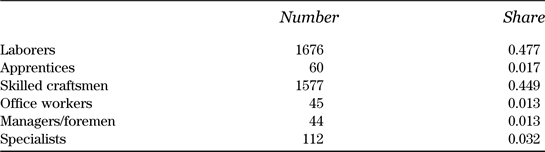
As a starting point for understanding how NNS assembled a labor force, Table 1 describes the breakdown of workers across broad occupation categories in 1900. By far the two largest occupation groups were unskilled laborers, which made up about 43 percent of the workforce, and skilled craftsmen, which accounted for about 49 percent.Footnote 33 The very elite worker groups—managers and specialists—were much smaller. NNS also employed a number of apprentices who were learning a variety of skilled trades.Footnote 34 The data in Table 1 suggest that NNS was using a substantially higher share of unskilled workers than the share used in other foreign yards. For comparison, data from Sidney Pollard and Paul Robertson show that in 1892 unskilled workers made up just 29 and 22 percent of the labor force in English and Scottish shipyards, respectively.Footnote 35 In Scotland in 1911 the share was 18 percent; in Northeast England in 1913 it was 25 percent. This is much lower than the 47.7 percent of unskilled workers shown in Table 1. This pattern is consistent work by historians suggesting that U.S. shipyards used a greater share of capital and unskilled workers to overcome a shortage of skilled workers.Footnote 36 However, we should be careful about drawing strong conclusions from the unskilled shares reported in Table 1 because the location of NNS may have given the yard better access to unskilled workers than other American yards. In particular, my data show that the yard relied heavily on African-American workers to fill unskilled positions. More than 1,400 of the laborers employed at Newport News in 1900 were black while whites accounted for just over 200, only 40 of whom were foreign born. This is very different from conditions in other American metal shipyards at this time. In Lorain, unskilled laborers were predominantly white immigrants, mainly from Germany, Poland, Austria, and Hungary, which accounted for 45 percent of unskilled laborers. The need to attract unskilled workers from abroad may explain why the unskilled share in Lorain, which I estimate to be around 26 percent, is substantially below the share in Newport News, though still higher than in most British yards.
Number of Workers by Type

Source: Author's calculations based on data from original manuscripts of the United States Census Bureau, 1900 Census of Population accessed through Ancestry.com. Data for workers holding shipbuilding-related occupations residing in Newport News, Virginia, and nearby areas.
The more intensive use of unskilled labor and advanced machinery does not appear to have made Newport News more productive than British yards. In July, 1897, for example, Mr. Smith, the NNS Shipyard Superintendent, reported that the labor costs required to produce a tramp steamer in Newport News was 40 percent higher than in England.Footnote 37 This higher labor cost reflected the scarcity of skills faced by the shipyard relative to their competitors on the other side of the Atlantic.
The data show stark differences in the origins of NNS workers fitting into the different occupational categories. Among unskilled laborers working at NNS in 1900, 95 percent were born in Virginia or one of the neighboring states (Kentucky, Maryland, North Carolina, and West Virginia), while men born in these states made up just 54 percent of skilled craftsmen, 39 percent of managers, and 29 percent of specialists. Among more skilled groups, foreign-born workers from Britain or other parts of Europe made up a substantial fraction of the workforce: 21 percent of craftsmen, 13 percent of specialists, and 20 percent of managers. British-born workers, for example, made up 15 percent of skilled craftsmen at NNS and 88 percent of British workers were in one of the skilled craft occupations, while only 7 percent were in low-skilled work. The importance of foreign-born workers is even larger if we focus on more experienced workers, such as those over 30 years of age. Among this group, British workers made up 22 percent of skilled craftsmen and 16 percent of specialists. Internal migrants were also important. Migrants from the mid-Atlantic states accounted for one-third of managers and specialists as well as 16 percent of skilled craftsmen. Those from New England, the region with the longest history of (wood) ship production, were particularly important in the specialist positions such as draftsman. These findings enrich and quantify available narrative evidence from historians such as Cerinda Evans who writes, “At the beginning of ship construction and repair in the Newport News plant, skilled mechanics and engineers had to be brought from other sections of the country and from abroad.”Footnote 38
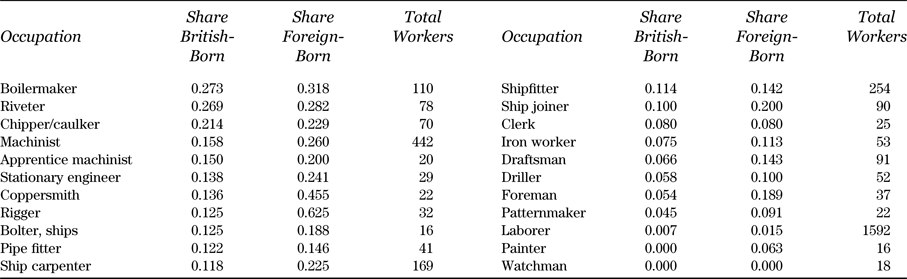
To gain more insight into the importance of skilled immigrant workers it is useful to look at their shares in the major shipbuilding occupations present in Newport News. This is done for British-born workers and all foreign-born workers in Table 2 for all occupations with more than fifteen workers. These data show that the occupations that were most dependent on British immigrants were riveter and boilermaker. These are the two quintessential skilled occupations of metal shipbuilding. British workers also formed a substantial share of machinists and chippers/caulkers.
Share of British-born and Foreign-born Workers by Occupation, 1900

Source: Author's calculations based on data from original manuscripts of the United States Census Bureau, 1900 Census of Population, accessed through Ancestry.com. Data for residents of Newport News, Virginia, and nearby areas. Table includes all shipyard occupations with more than fifteen workers.
The occupations where most workers were native-born include low-skilled occupations like watchman and laborer and those requiring skills that were not specific to shipbuilding, such as clerks and painters. It is worth noting that this table includes workers of all ages. If we instead focus only on workers over age 30, immigrants are relatively even more important. For workers over 30, for example, British-born immigrants make up over half of the chippers and caulkers, 46 percent of riveters, and 37 percent of boilermakers, as well as more than a fifth of all machinists, shipfitters, and draftsmen.
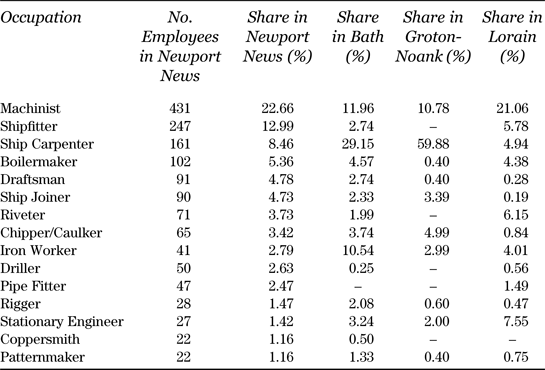
Table 3 looks at the fifteen most important skilled occupations in Newport News and compares occupation shares there to the shares in Bath, Lorain, and Groton-Noank. Note that the comparison to Groton-Noank is particularly useful here, since it can help us identify those occupations that were specific to metal shipbuilding. Based on this comparison, occupations can be divided into several types. Some, such as machinists, ship joiners, and stationary engineers (engine operators), appear to have been important regardless of the type of shipbuilding.Footnote 39 Other occupations were concentrated only in metal shipbuilding centers. These include shipfitter, boilermaker, riveter, and pipe fitter. Many of these occupations were small or completely absent in Groton-Noank. Referring back to Table 2, it is notable that these occupations tended to have high shares of foreign workers. Moreover, of the foreign workers in these occupations, a large share came from Britain. For example, 86 percent of the foreign-born boilermakers were British as were all of the foreign-born riveters in Newport News.
There are also some occupations that were clearly associated with wood shipbuilding only. This is mainly true of ship carpenter, an occupation that made up almost 60 percent of the skilled workforce in Groton-Noank but only 8.5 percent in Newport News and 4.9 percent in Lorain. It is also worth noting the large share of iron workers and stationary engineers in Bath and Lorain compared to the other locations. This likely reflects the fact that, in addition to shipbuilding, these locations also had other metal-goods firms.Footnote 40
Comparing Important Skilled Occupations in Different Locations

Source: Author's calculations based on data from original manuscripts of the United States Census Bureau, 1900 Census of Population, accessed through Ancestry.com.
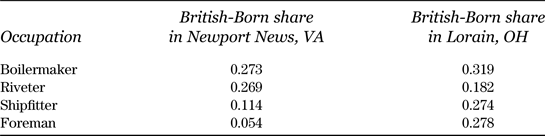
To see whether the importance of British-born workers observed in Newport News was also found in other new American metal shipyards, it is useful to compare data from NNS to the data from Lorain. This comparison, in Table 4, suggests that British-born workers were just as important in key shipbuilding occupations in Lorain as they were in Newport News.
Comparing British-Born Shares in Key Shipbuilding Occupations, 1900

Source: Author's calculations based on data from original manuscripts of the United States Census Bureau, 1900 Census of Population, accessed through Ancestry.com.
Thus far the results show that foreign-born, and particularly British-born workers, made up an important part of the skilled labor force in Newport News in 1900, particularly in those occupations specific to metal shipbuilding like riveter and boilermaker. While these findings are important, we are particularly interested in the impact of skilled workers earlier in the shipyard's life. It is possible to gain additional insight into this by using information on how long immigrant workers had been in the country in 1900.
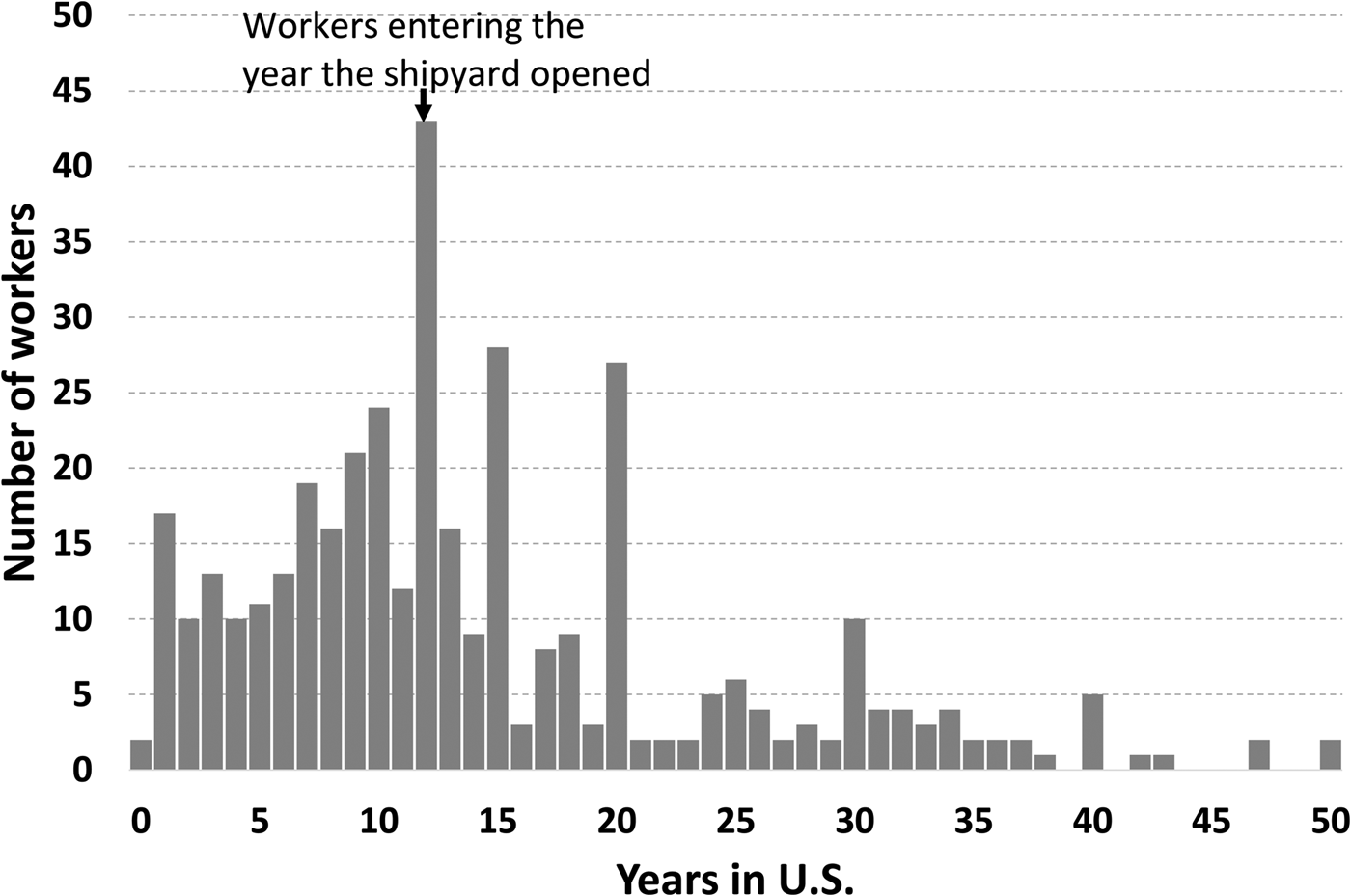
Figure 1 provides a histogram of immigrant workers at NNS sorted by the number of years that they had been in the United States in 1900. The key feature in this graph is that there was a large spike in shipyard workers who entered the country twelve years before 1900. This corresponds exactly with the opening of NNS. It is difficult to explain this distinctive spike in year 12 other than as a result of the opening of the Newport News Shipyard. Thus, this pattern indicates that these foreign workers either came to the United States specifically to work at NNS, or that many of the foreigners with shipbuilding skills coming to the United States in that year opted to go to Newport News. It is worth noting that the figure also shows spikes in years 15, 20 and 30, consistent with recall bias, however this cannot explain the spike at year 12.
Number of foreign Newport News Shipyard workers by years in the United States. Census data for foreign-born residents of Newport News, Virginia, holding shipbuilding occupations. (Source: Author's calculations based on data from original manuscripts of the United States Census Bureau, 1900 Census of Population, accessed through Ancestry.com).

The spike in year 12 in Figure 1 suggests that around twenty to thirty more NNS shipyard workers entered the United States in that year than we would expect given the levels in other nearby years. The occupations of the immigrant workers that arrived in the United States in 1888–1889 essentially covered the range of skills needed for metal shipbuilding: 9 machinists, 6 riveters, 2 boilermakers, 4 shipfitters, 2 ship joiners, 2 draftsmen, 2 chipper and caulkers, a coppersmith, a millwright, a rigger, etc. Compare these to employment in the yard in April of 1889 given by Smith based on firm records: out of 98 workers the yard employed 17 workers with skills specific to metal shipbuilding (boilermakers, machinists, platers, and caulkers) and 23 other skilled workers, foremen or managers, and 58 laborers.Footnote 41 These facts suggest that NNS likely drew a substantial portion of its initial skilled workforce from abroad.
Another sign of the importance of the 1888–1889 immigrant cohort can be found by looking up individuals listed as “foreman” at the shipyard in 1900 from a list given by the Newport News Daily Press.Footnote 42 The three foremen overseeing the key metal shipbuilding trades at his time were Arch Shankland, the Foreman Riveter, William McCallum, the Foreman of Plumbers and Pipefitters, and Charles White, the Foreman Anglesmith. Looking these up in the Census shows that all three were born in Scotland. Shankland immigrated to the United States in 1888 at age 28; McCallum came in 1887 at age 31; White came in 1886 at age 24. All of them would have been old enough to have completed an apprenticeship before coming to the United States. This pattern is particularly striking given that most of the other foremen on the list, who oversaw tasks that were less unique to metal shipbuilding, were born in the United States or had immigrated at a young age. Interestingly, we see the same pattern in Lorain: the shipyard superintendent William W. Watterson was also born in England where he worked as a shipbuilder before coming to the United States at age 23.
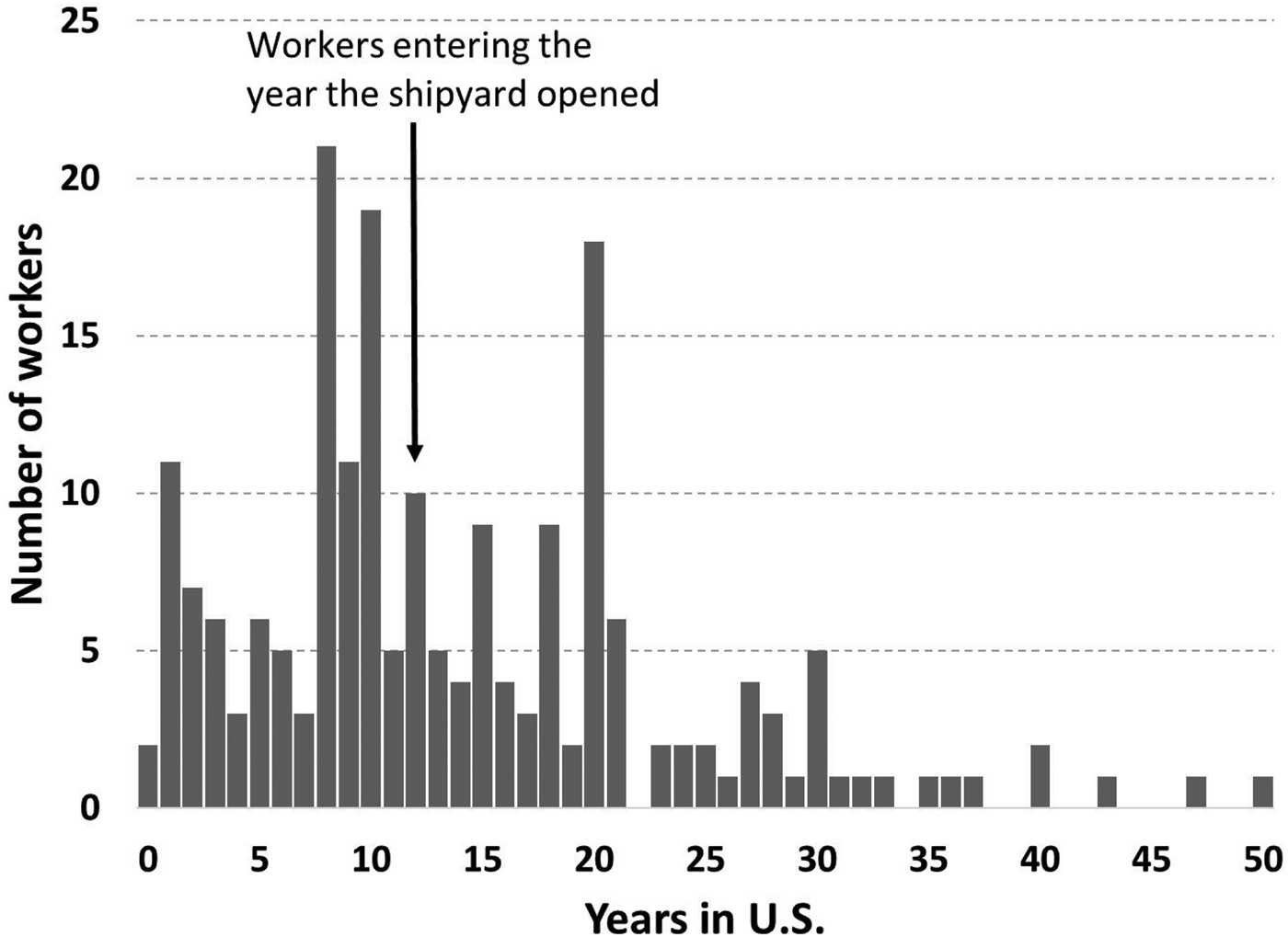
The timing of immigration of shipyard workers in Figure 1 can be compared to the timing of entry for foreign-born residents of Newport News working in other (nonshipyard) occupations. Figure 2 plots number of years in the United States for these other foreign workers. Comparing this graph to Figure 1 we can see that, unlike shipyard workers, there is no concentration of foreign nonshipyard workers who arrived in the United States in the previous twelve years. This suggests that the pattern displayed by foreign workers in Figure 1 is driven by the opening of the shipyard and not simply a result of overall migration patterns.
Years since migration for foreign-born nonshipyard workers. Census data for foreign-born residents of Newport News, Virginia, holding nonshipbuilding occupations. (Source: Author's calculations based on data from original manuscripts of the United States Census Bureau, 1900 Census of Population, accessed through Ancestry.com).

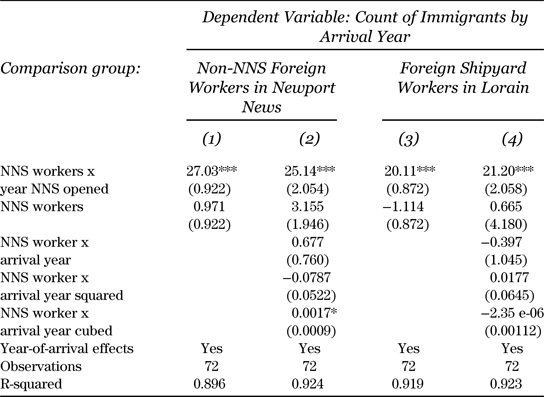
To quantify the number of excess shipyard workers that arrived in the United States in 1888 compared to the pattern observed for nonshipyard workers resident in Newport News, I run some simple linear regressions. Specifically, using a data set containing both foreign shipyard and foreign nonshipyard workers, I aggregate workers based on their number of years in the United States and then run regressions looking at whether there was an increase in workers who came to the United States in the previous twelve years, the year that work began at NNS. The results of this exercise are presented in Table 5. All regressions in Table 5 include fixed effects by arrival year and a fixed effect for shipyard workers. Thus the immigration timing for NNS shipyard workers is being compared to the timing observed for the relevant comparison group.
Testing the Difference in Immigrants in the Year Newport News Shipyard (NNS) Opened

Source: Author's calculations based on data from original manuscripts of the United States Census Bureau, 1900 Census of Population, accessed through Ancestry.com. Data set used in Columns 1–2 includes all foreign-born NNS shipyard workers who arrived in the United States in the 35 years before the census and all male foreign-born head-of-household residents of Newport News who arrived in the United States in the 35 years before. Data in Columns 3–4 include all foreign-born shipyard workers at NNS or in Lorain who arrived in the United States in the 35 years prior to 1900. ***p < 0.01, **p < 0.05, *p < 0.1. Robust standard errors in parentheses.
Columns 1–2 of Table 5 compare the number of shipyard workers present in Newport News in 1900 that arrived in the United States the year the shipyard opened compared to other foreign-born workers in Newport News. These results indicate that there was an excess of 25 to 27 arrivals of immigrant shipyard workers in 1888, compared to what would have been expected given the immigration pattern observed for nonshipyard workers. Given that there were 98 workers on the NNS payroll in April of 1889, this tells us that roughly one quarter of the total shipyard workers at that point were likely to have been immigrants. Since only around half of the shipyard workers were skilled, as many as half of the skilled workers in the shipyard early on were likely to have been foreign. Moreover, even among skilled workers, only a subset, about 17 workers, had skills in the metal shipbuilding industry. Thus, it is reasonable to conclude that in the early days of the shipyard the majority, and perhaps the entirety, of workers with skills specific to metal shipbuilding were recent immigrants. Columns 3–4 show that roughly similar results are obtained if we instead compare the arrival time of foreign shipyard workers at NNS to the foreign shipyard workers employed at Lorain, which had not yet opened in 1888.
Even for those foreigners who came to the United States before the shipyard opened, the Census supplies some interesting clues about their path to Newport News. Earl Simon, for example, was a 36-year-old ship joiner in the 1900 Census. From the Census we can see that he was in Scotland at age 23, where he had a son, and then he moved to the United States at age 24. He had a second son at age 26 while living in Pennsylvania, before coming to Newport News. This type of trajectory appears to be typical. Another example is Alfred Bull. Born in England in 1854, Bull moved to the United States at age 18 and had children in Pennsylvania in 1888 and 1891 before coming to Newport News, where he worked as boilermaker. Given that Pennsylvania was the most important metal shipbuilding state in the United States in the 1880s and 1890s, the patterns suggest that these workers may have moved to the United States to work at the Pennsylvania shipyards, and then relocated to work at the new NNS shipyard.
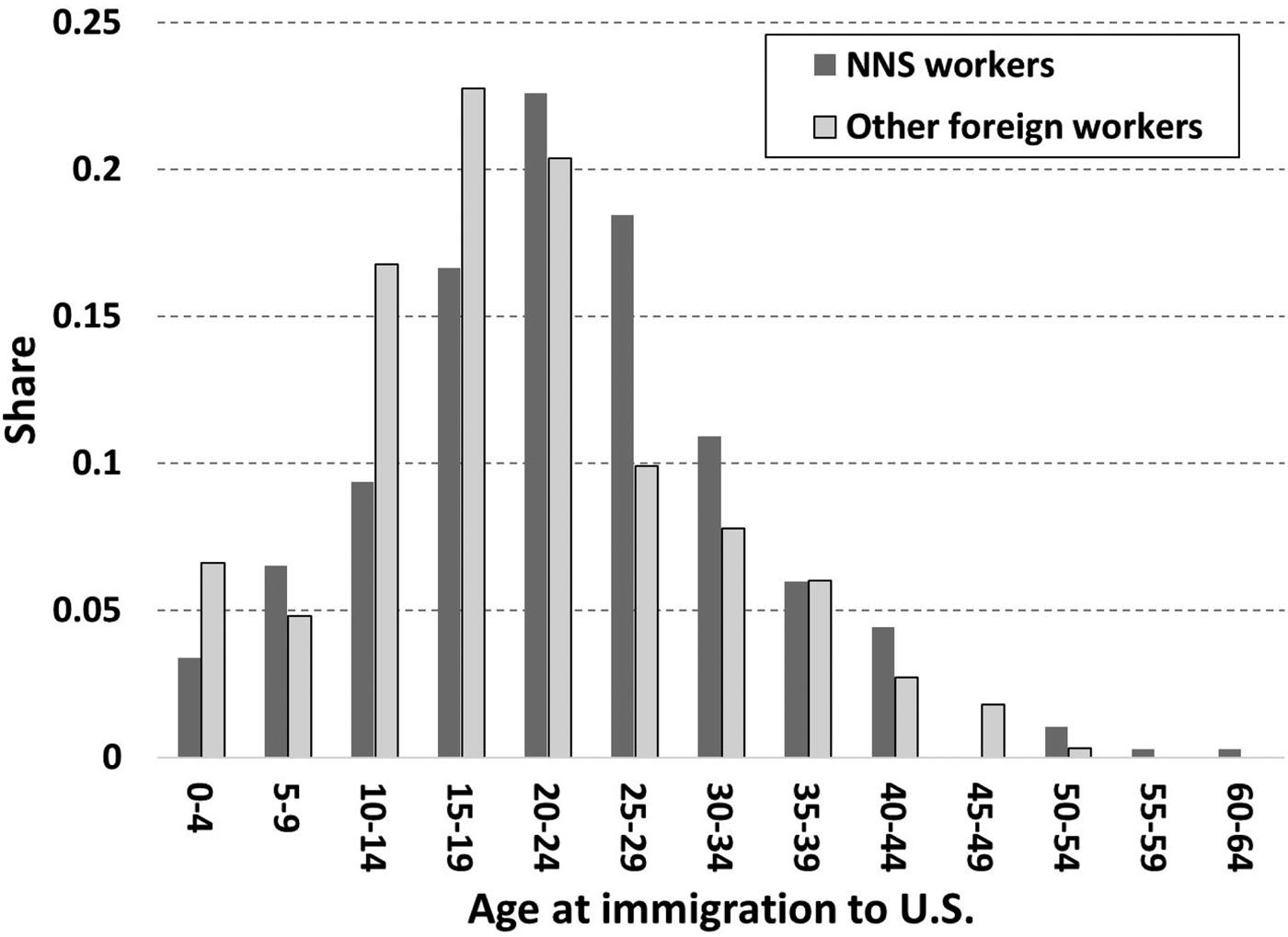
Immigrant shipyard workers were more experienced when they arrived than other immigrant workers in Newport News. This can be seen in Figure 3, which plots the age at migration for immigrant shipyard workers in Newport News and other nonshipyard immigrant workers. These data show that those foreigners who worked at NNS were much more likely to have migrated in their late 20s or early 30s than foreign workers outside of NNS.
Age of migration for Newport News Shipyard workers and other foreign workers in Newport News. This figure plots the share of workers falling into each age group based on when they immigrated to the United States. The first series covers immigrant workers in Newport News with shipbuilding occupations. The second series covers all other immigrant male household heads in Newport News with nonshipyard occupations. (Source: Author's calculations based on data from original manuscripts of the United States Census Bureau, 1900 Census of Population, accessed through Ancestry.com).

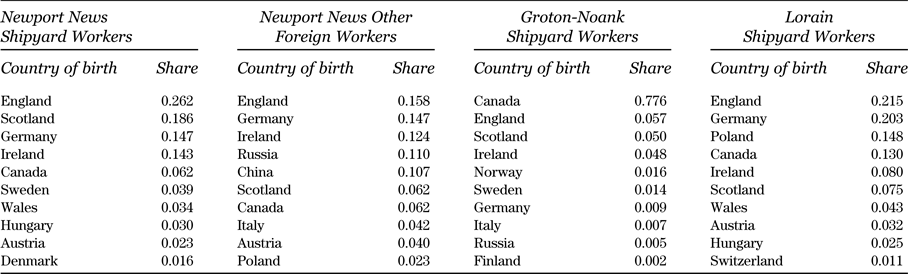
Immigrant shipyard workers in Newport News, as well as in Lorain, were much more likely to hail from major European metal shipbuilding nations than other immigrant workers during this period. This fact is illustrated by the comparison in Table 6, which shows the top fifteen countries of origin for different groups of immigrants. We can see that immigrants working in shipyard occupations in Newport News hailed primarily from just a few locations—England, Scotland, Ireland, and Germany—the major European metal shipbuilding centers. Together, these four locations of birth make up almost three-quarters of all of the immigrant shipyard workers. As a point of comparison, Britain (England, Scotland, and Wales), Ireland, and Germany accounted for, respectively, 14 percent, 13 percent, and 23 percent of all migrants to the United States from 1870–1900.Footnote 43 Thus, relative to national immigration trends, English and Scottish workers were substantially overrepresented among the shipyard workers in Newport News. A similar pattern is visible in Lorain, shown in the right-hand column, where English and Scottish workers together made up 29 percent of all foreign workers. We also see many immigrants from Germany and Poland in Lorain. Many of these, particularly the Poles, were unskilled laborers. Note that relative to national rates, German workers were not overrepresented in either Newport News or Lorain.
Top Ten Countries of Origin for Different Groups of Workers

Source: Author's calculations based on data from original manuscripts of the United States Census Bureau, 1900 Census of Population, accessed through Ancestry.com.
The origins of the shipyard workers contrast with the origins of the foreign residents of Newport News working in nonshipyard occupations, shown in the second column of Table 6. While England, Ireland, and Germany are also important among this group, the shares are spread much more evenly across origin countries. The differences are particularly stark for England and Scotland. Overall, the pattern for nonshipyard workers is much closer to the patterns exhibited at the national level.Footnote 44 A further contrast is provided by comparing immigrants in Newport News to immigrants in Groton-Noank. In that area, as in many wood shipbuilding centers, the foreign population was dominated by Canadians. Many of these had immigrated fairly recently from the declining wood shipbuilding towns in Nova Scotia and New Brunswick to the wood shipbuilding centers of the United States. These U.S. wood shipyards were partially protected from competition from British metal ship producers thanks to government regulations banning the use of foreign-built ships to transport between U.S. ports. In contrast, as part of the British Empire, Canada could not offer similar protections to its local shipbuilders, resulting in a far steeper decline in that industry in Canada than in the United States.Footnote 45
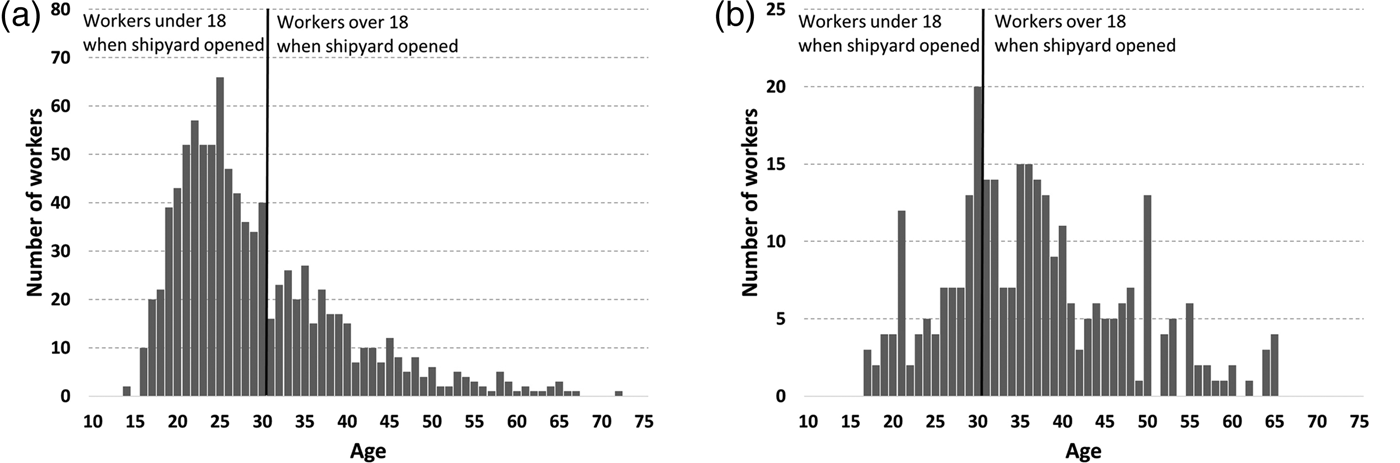
The census data also provide evidence that, while NNS initially drew heavily on foreign workers, it soon began training local workers to move into higher-skilled positions. Evidence for this can be seen in Figure 4, which describes the age distribution of local workers (from Virginia or nearby states) and foreign workers in skilled shipbuilding occupations in Newport News. For native-born workers, in the left panel, we see that in 1900 there were many more shipyard workers just below the age of 30 than just above age 30. This is exactly the age that would have been moving into the labor force at the time that the shipyard opened. This suggests that local workers who had not yet entered the labor force when the shipyard opened were substantially more likely to take up shipyard work than those who were already of working age.
This pattern contrasts sharply with what we see for European-born workers, in the right panel. The most important feature in this figure is the high level of European-born workers in their late 30s. Workers in this age category would have finished their apprenticeship period—typically five to seven years in British yards—around the time that NNS was opening. There are also relatively few European-born workers under age 29 but many more from 29 to 32. Workers in the range of 29–32 would have been moving into the labor force around the time that NNS opened. This suggests that the shipyard may have attracted Europeans who were just moving into the labor force when the shipyard opened, but that the yard did not continue to attract similar workers in later years. It is worth noting that the double-peaked age pattern shown for foreign shipyard workers in Figure 4 does not appear in the age distribution of other foreign residents of Newport News, nor does it appear for the wood shipbuilding workers of Groton and Noank.
(a) Age distribution of local-born skilled Newport News Shipyard workers. Census data for residents of Newport News, Virginia, and nearby areas holding shipbuilding occupations. (Source: Author's calculations based on data from original manuscripts of the United States Census Bureau, 1900 Census of Population, accessed through Ancestry.com). (b) Age distribution of European-born skilled Newport News Shipyard workers. Census data for residents of Newport News, Virginia, and nearby areas holding shipbuilding occupations. (Source: Author's calculations based on data from original manuscripts of the United States Census Bureau, 1900 Census of Population, accessed through Ancestry.com).

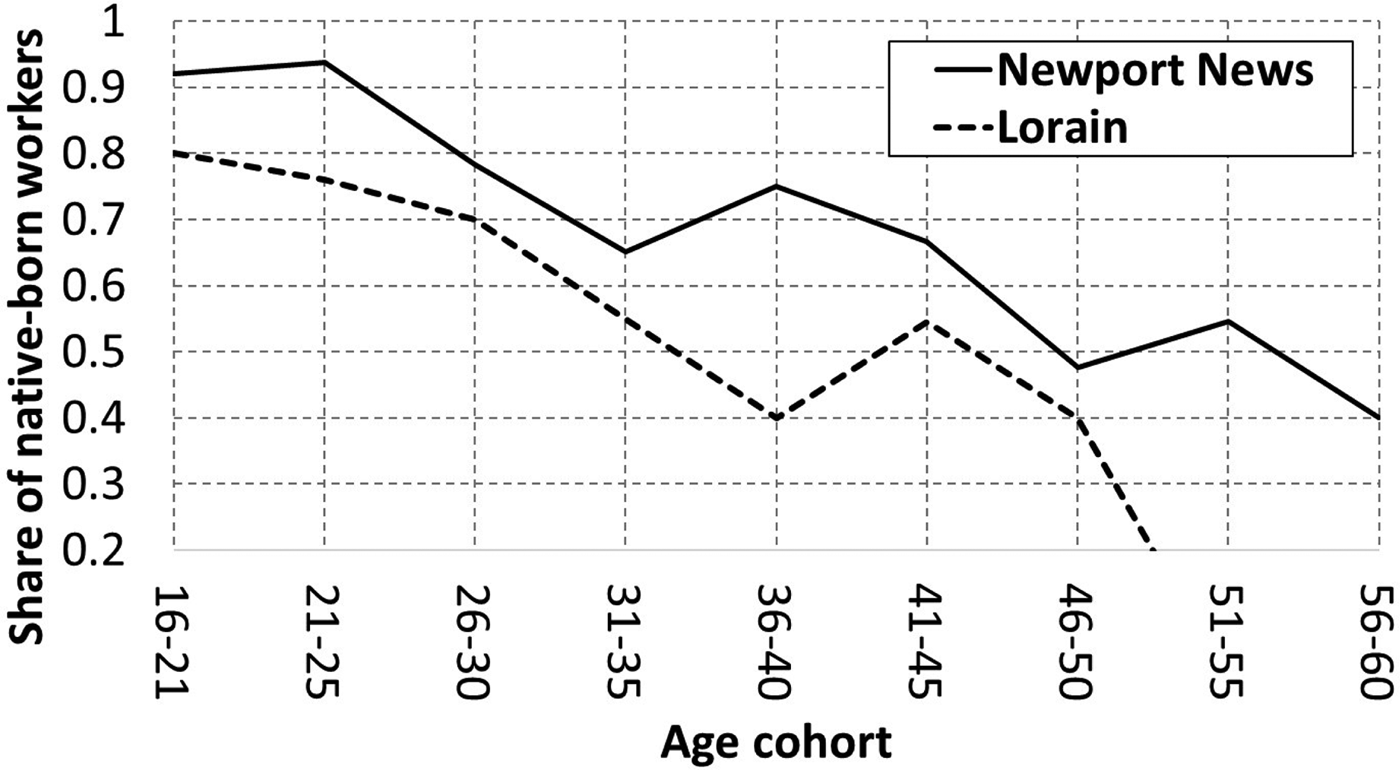
A more direct way to look at this effect is to study how the share of native-born workers in skilled occupations varied across age cohorts. Figure 5 does this for those occupations most closely associated with metal shipbuilding: boilermakers, riveters, coppersmiths, and shipfitters (including apprentices). This figure shows that in Newport News, native-born workers made up almost all of the workers in their early 20s in these occupations but that for older age cohorts a substantial fraction of the occupations were filled by foreign workers. This pattern suggests that immigrant workers were initially important in these occupations but that over time they were being replaced by native-born workers.Footnote 46 For comparison purposes I have also included the same data for Lorain in this graph. The same patterns appear there, which suggests that foreign workers were playing an equally important role in the Great Lakes shipyards during this period.
Share of native-born workers in key metal shipbuilding occupations. This figure plots the share of native-born workers in the occupations most closely associated with metal shipbuilding: boilermakers, riveters, coppersmiths, and shipfitters, including apprentices in each of these occupations. (Source: Author's calculations based on data from original manuscripts of the United States Census Bureau, 1900 Census of Population, accessed through Ancestry.com).

The data in these figures augment historical evidence showing that NNS began training local workers to fill skilled positions soon after the yard opened. For example, we know that the first apprenticeship at NNS began in 1889 and the first completion certificate was issued to Norwood Jones in 1894 after a four-year program.Footnote 47 In the 1900 Census data, 60 workers are listed as apprentices in skilled occupations. Out of this group, 55 (91 percent) were native-born Americans, with most born in Virginia or Pennsylvania. The few foreign-born apprentices were the sons of shipyard workers.
To summarize, the census data tell us a number of useful facts about how NNS assembled a workforce despite the scarcity of skilled local workers. In particular, we have seen that the shipyard depended heavily on attracting skilled workers from abroad, particularly from Britain, the world's leading shipbuilding country. There is evidence that these skilled foreign workers were particularly important early in the firm's life, and particularly in those occupations most closely associated with metal shipbuilding, while over time native-born workers were trained to fill these positions. This suggests that early access to foreign workers may have eventually led to increases in both unskilled and skilled employment among native-born workers. There is also evidence that the shipyard substituted toward unskilled workers, relative to British yards, consistent with facing a scarcity of skilled workers.
Conclusion
This study shows that immigrant workers made a substantial contribution to the emergence of Newport News Shipbuilding, the most important new industrial shipyard to emerge in the United States during the late-nineteenth century. Immigrants, hailing primarily from Britain, provided key skills early in the firm's life, while over time there is evidence that native-born workers were trained to fill skilled occupations.
Why did these skilled immigrants leave British shipyards that were near the peak of their dominance? The answer must be the higher wages offered by American yards. These were regularly remarked upon by contemporary sources, such W. I. Babcock of the Chicago Shipbuilding Company who wrote in the Marine Review (2 September 1897) that wages on the Clyde were just 55.5 percent of the wages paid in U.S. yards but that U.S. yards might still compete with the British due to their “much greater use of labor-saving machinery,” “larger and more modern yards,” as well as the absence of unions in U.S. shipyards. These wage differentials attest to the shortage of skilled workers in American yards, a feature further confirmed by the relatively greater reliance on labor-saving machinery.
A second natural question is, how did American shipyards like NNS go about attracting British workers? Answering this question turns out to be difficult. Almost no company records on recruiting practices have survived from this period. I also failed to find evidence that the firm advertised through the media. One way workers may have found out about higher wages in the United States is through British newspaper reports. The Glasgow Herald (14 September 1899), for example, described piece rate earnings for skilled artisans of $2.00–$2.50 per day at NNS. These would have looked attractive to workers in Britain where, according to data from Pollard and Robertson, skilled piece rate earnings were typically around $1.70 per day.Footnote 48 Informal networks and private communications were likely to have also been quite important. While direct evidence on these channels is difficult to find, such networks have been shown to influence migration patterns in a variety of contexts.
Of course, there remains the counterfactual question of whether the modern shipbuilding industry would have developed in the United States during this period in the absence of access to skilled immigrant workers. This article should not be interpreted as claiming that, without access to foreign workers, metal shipbuilding would not have emerged. However, the higher wages in U.S. shipyards, and the fact that American yards substituted toward laborsaving machinery and unskilled workers, compared to leading British yards, tells us that U.S. firms faced a relative scarcity of skilled workers even when access to skilled immigrant workers was possible. Given the number of skilled immigrant workers employed by firms like NNS, had U.S. firms not had access to immigrant workers the shortage of skills would have been even more acute. Surely, then, the ability to attract foreign skilled workers likely lowered the firms cost early in their development, though it is impossible to know by exactly how much.
Finally, what can we say about how these migrant flows affected native-born workers? In the short run, the impact of the availability of skilled immigrant workers on employment of skilled native-born workers is ambiguous; though over time there is evidence that native-born workers were trained to fill skilled positions. While skilled foreign workers may have taken some jobs from American workers in the short run, it is also possible that, by allowing shipbuilding to grow, they expanded overall skilled and unskilled employment. In any case the effect of immigrant labor was not strong enough to eliminate the substantial wage premium that skilled workers in America enjoyed. In the end, the greatest threat to skilled wages was not immigration, but rather the constant introduction of new laborsaving machinery induced by the high wages faced by American shipyards.