Exposure to family violence during childhood is widely recognized as a significant public health problem, both in terms of the implications for the child's health and development, and the high prevalence of exposure (National Institutes of Health, 2003). Recent studies estimate that between 10% and 20% of all children within the United States live in homes where they are exposed to violence (e.g., Moore, Probst, Tompkins, Cuffe, & Martin, Reference Moore, Probst, Tompkins, Cuffe and Martin2007), with a disproportionate number of families having children under the age of 5 years (Fantuzzo et al., Reference Fantuzzo, DePaola, Lambert, Martino, Anderson and Sutton1991). Approximately 75% of children in violent homes are physically present at the time of a violent interaction (Ernst, Weiss, & Enright-Smith, Reference Ernst, Weiss and Enright-Smith2006), witnessing a range of behaviors from insults and hitting, to fatal assaults with guns and knives (Jaffe, Wolfe, & Wilson, Reference Jaffe, Wolfe and Wilson1990). It is important that violence is not a single event occurrence in these families, and children are likely to be exposed to frequent intense conflict (Repetti, Taylor, & Seeman, Reference Repetti, Taylor and Seeman2002) and chronic background anger (Cummings, Ballard, & El-Sheikh, Reference Cummings, Ballard and El-Sheikh1991). Ultimately, exposure to family violence is thought to provide a “training ground” for violence in later family life, perpetuating the cycle of violence (Dodge, Bates, & Pettit, Reference Dodge, Bates and Pettit1990; Gelles, Reference Gelles1974; Patterson, Reference Patterson1984).
Children from violent families are four times more likely to exhibit clinical levels of problem behavior compared to nonexposed children (Holden, Reference Holden, Geffner, Holden and Jouriles1998). Specifically, infants and young children exposed to violence may experience changes in irritability, sleep disturbances, emotional distress, somatic complaints, fears of being alone, and regression in toileting behavior and language (DeJonghe, Bogat, Levendosky, von Eye, & Davidson, Reference Dejonghe, Bogat, Levendosky, von Eye and Davidson2005; Osofsky, Reference Osofsky1999; Zeanah, Boris, & Scheeringa, Reference Zeanah, Boris and Scheeringa1997). Children surrounded by family violence have more conflict with their peers (McCloskey & Stuewig, Reference McCloskey and Stuewig2001) and use aggression, manipulation, and coercion as strategies during interpeer conflict (Cummings, Iannotti, & Zahn-Waxler, Reference Cummings, Iannotti and Zahn-Waxler1985; Dodge et al., Reference Dodge, Bates and Pettit1990; Jouriles, Murphy, & O'Leary, Reference Jouriles, Murphy and O'Leary1989; Jouriles & Norwood, Reference Jouriles and Norwood1995). Furthermore, the child's stage of development may determine the developmental milestone disrupted by abuse and violence. For example, exposure to violence during infancy can interfere with the development of trust, jeopardizing secure attachment relationships (Janoff-Bulman, Reference Janoff-Bulman1992; Owens & Cox, Reference Owen and Cox1997), whereas exposure during toddlerhood may impact social competence (Cicchetti, Cummings, Greenberg, & Marvin, Reference Cicchetti, Cummings, Greenberg, Marvin, Greenberg, Cicchetti and Cummings1990). However, surprisingly few studies have tracked violence-exposed children longitudinally across these early milestones. Thus, prospective longitudinal studies identifying prepathological physiological markers may be critical in furthering our understanding of disease process and increasing the efficacy of early interventions (e.g., Cicchetti & Gunnar, Reference Cicchetti and Gunnar2008).
Families that use violence and have cold and unsupportive relationships are called “risky families” (Repetti et al., Reference Repetti, Taylor and Seeman2002). Risky families are theorized to present a dual risk to children reared in these homes, potentiating the development of maladaptive behavior. First, children living with conflicted families are chronically exposed to stressors resulting in hyperemotional and physiological arousal (e.g., Cummings, Reference Cummings1987; Cummings et al., Reference Cummings, Ballard and El-Sheikh1991; Cummings, Vogel, Cummings, & El-Sheikh, Reference Cummings, Vogel, Cummings and El-Sheikh1989; Davies, Sturge-Apple, Cicchetti, & Cummings, Reference Davies, Sturge-Apple, Cicchetti and Cummings2007; El-Sheikh, Reference El-Sheikh2005). Constant conflict does not allow the child to sufficiently recover or recuperate from the heightened arousal, sensitizing them to subsequent conflict, and taxing emotional and physiological resources (Davies & Cummings, Reference Davies and Cummings1998; Davies, Myers, Cummings, & Heindel, Reference Davies, Myers, Cummings and Heindel1999). Second, neglectful and cold parental behaviors do not provide the structure and support necessary for the development of appropriate self-regulatory behaviors or socioemotional competencies to deal with these stressors (e.g., van den Boom, Reference van den Boom1994), jeopardizing the child's ability to cope within the context of family conflict and in the face of subsequent challenge (Davies & Cummings, Reference Davies and Cummings1994). Given these findings, a central tenant of our assumptions is that both hyperarousal from conflict and deficient support from parents have the potential to dysregulate stress physiology (Repetti et al., Reference Repetti, Taylor and Seeman2002).
When a child is faced with a stressor, stress responsive physiological systems activate to prepare the individual to successfully respond to, and overcome a challenge. A major component of the psychobiology of the stress response involves activation of the hypothalamic–pituitary–adrenal (HPA) axis (e.g., Chrousos & Gold, Reference Chrousos and Gold1992). Physical or psychological stressors inducing behavioral withdrawal, avoidance, or loss of control activate the HPA axis (Dickerson & Kemeny, Reference Dickerson and Kemeny2004; Henry, Reference Henry1992). This begins with the secretion of corticotropin-releasing hormone (CRH) from the hypothalamus. CRH then initiates the release of adrenocorticotropin hormone into the bloodstream from the pituitary, which in turn stimulates cortisol, a glucocorticoid, to be secreted from the adrenal glands (Chrousos & Gold, Reference Chrousos and Gold1992). Infants are born with a fully functioning HPA axis; however, the diurnal rhythm of cortisol does not solidify until the second half of the first year when consistent sleep–wake cycles are established (for a review, see Gunnar & Donzella, Reference Gunnar and Donzella2002). Furthermore, studies reveal a dampening in cortisol reactivity over the first 12 months of life (e.g., Gunnar, Brodersen, Krueger, & Rigatuso, 1996; Lewis & Ramsay, Reference Lewis and Ramsay1995).
Stress physiology is extremely sensitive to social influence and the set point and trajectory of the stress response is shaped by early familial and parent–child interactions (Adam, Klimes-Dougan, & Gunnar, Reference Adam, Klimes-Dougan, Gunnar, Coch, Dawson and Fischer2007; Flinn, Reference Flinn, Panter-Brick and Worthman1999; Gunnar & Quevedo, Reference Gunnar and Quevedo2007). Individual differences in physiological reactivity and recovery from stress are thought to mediate the relationship between early adversity and the development of pathology (e.g., Loman, Gunnar & The Early Experience, Stress, and Neurobehavioral Development Center, Reference Loman and Gunnar2009). Specifically, studies have revealed maternal depression (Lupien, King, Meaney, & McEwen, Reference Lupien, King, Meaney and McEwen2001), parental expression of aggression and hostility (Granger et al., Reference Granger, Serbin, Schwartzman, Lehoux, Cooperman and Ikeda1998), marital functioning (Pendry & Adam, Reference Pendry and Adam2007), parenting quality (Gunnar et al., Reference Gunnar, Brodersen, Nachmias, Buss and Rigatuso1996), and severe maternal deprivation (Gunnar, Morison, Chisholm, & Schuder, Reference Gunnar, Morison, Chisholm and Schuder2001) are related to heightened cortisol levels or reactivity during early childhood. Furthermore, these physiological dysregulations have been associated with the development of internalizing and externalizing behavior problems (e.g., Kestler & Lewis, Reference Kestler and Lewis2009; Lopez-Duran, Olson, Hajal, Felt, & Vazquez, Reference Lopez-Duran, Olson, Hajal, Felt and Vazquez2009; Shirtcliff & Essex, Reference Shirtcliff and Essex2008).
Family conflict has been found to be one of the most physiologically arousing stressors in the life of a child (Flinn, Reference Flinn, Panter-Brick and Worthman1999). Specifically, children overhearing conflict between two adults in a laboratory setting have changes in heart rate (El-Sheikh, Cummings, & Goetsch, Reference El-Sheikh, Cummings and Goetsch1989), skin conductance, and blood pressure (El-Sheikh & Cummings, Reference El-Sheikh and Cummings1992). Sympathetic nervous system reactivity, parasympathetic nervous system reactivity, and the coordination of these two systems, have been shown to be related to the long-term development of internalizing and externalizing behavior problems in children exposed to high marital conflict (El-Sheikh, 2005; El-Sheikh, Keller, & Erath, Reference El-Sheikh, Keller and Erath2007; El-Sheikh et al., Reference El-Sheikh, Kouros, Erath, Cummings, Keller and Staton2009; El-Sheikh & Whitson, Reference El-Sheikh and Whitson2006). Similarly, emerging evidence suggests marital conflict and violence may also dysregulate adrenocortical functioning. Specifically, differences in cortisol levels (Saltzman, Holden, & Holahan, Reference Saltzman, Holden and Holahan2005) and reactivity (Davies et al., Reference Davies, Sturge-Apple, Cicchetti and Cummings2007; Davies, Sturge-Apple, Cicchetti, & Cummings, Reference Davies, Sturge-Apple, Cicchetti and Cummings2008) have been related to exposure to marital violence and interparental conflict, respectively. Although these studies have not consistently found implications across indices (e.g., levels, reactivity) or valence (e.g., hypercortisolism, hypocortisolism) of HPA activity, it is clear that family conflict is a powerful disruptor of stress physiology.
As proposed in the risky family model, conflict between romantic partners most often negatively influences parenting behaviors (e.g., Krishnakumar & Buehler, Reference Krishnakumar and Buehler2000) and therefore has the potential to indirectly impact child physiological regulation. Early caregiver interactions profoundly influence the child's biobehavioral responses to challenge and stress (e.g., Gunnar & Davis, Reference Gunnar and Davis2003). When faced with a stressor, infants and young toddlers rely on their immediate caregivers to help them cope with the stressor (e.g., Hofer, Reference Hofer2006). Thus, sensitive caregiving and higher maternal caregiving quality are associated with overall lower levels of adrenocortical arousal (Kaplan, Evans, & Monk, Reference Kaplan, Evans and Monk2008; Pendry & Adam, Reference Pendry and Adam2007) and reactivity (Morelius, Nelson, & Gustafsson, Reference Morelius, Nelson and Gustafsson2007; Spangler, Schieche, Ilg, Maier, & Ackerman, 1994), and greater cortisol recovery and heart rate regulation when the mother is interacting with the child (Albers, Riksen-Walraven, Sweep, & de Weerth, Reference Albers, Riksen-Walraven, Sweep and de Weerth2008; Haley & Stansbury, Reference Haley and Stansbury2003). When mothers are not available to assist in soothing and regulating their children, however, some studies have found children of sensitive mothers to exhibit heightened reactivity (e.g., Blair et al., Reference Blair, Granger, Kivlighan, Mills-Koonce, Willoughby and Greenberg2008), although this has not been consistently found (Ahnert, Gunnar, Lamb, & Barthel, Reference Ahnert, Gunnar, Lamb and Barthel2004; Gunnar et al., Reference Gunnar, Brodersen, Nachmias, Buss and Rigatuso1996).
Hostility between parents has been related to angry, aggressive, and power-asserting parenting techniques (e.g., Easterbrooks & Emde, Reference Easterbrooks, Emde, Hinde and Stevenson-Hinde1988; Levendosky & Graham-Bermann, Reference Levendosky and Graham-Bermann2000; Margolin, Gordis, & Oliver, Reference Margolin, Gordis and Oliver2004). Parents that are consumed by conflict, the anticipation of it, or the uncertainty that surrounds its occurrence have decreased time and emotional availability for their children (Sturge-Apple, Davies, & Cummings, Reference Sturge-Apple, Davies and Cummings2006), which jeopardizes their ability to appropriately respond to their children's emotional needs and signals (Stevenson-Hinde, Reference Stevenson-Hinde1990). As expected, these harsh, insensitive, or unresponsive caregiving behaviors are related to heightened cortisol reactivity (Gunnar, Larson, Hertsgaard, Harris, & Brodersen, Reference Gunnar, Larson, Hertsgaard, Harris and Brodersen1992; Lisonbee, Mize, Payne, & Granger, Reference Lisonbee, Mize, Payne and Granger2008; Spangler et al., Reference Spangler, Schieche, Ilg, Maier and Ackermann1994) and compromise the development of self-regulation (e.g., Egeland, Pianta, & O'Brien, Reference Egeland, Pianta and Obrien1993). However, within the context of negative marital interactions, positive parent–child relationships have been shown to buffer children from maladaptive behaviors (e.g., El-Sheikh & Elmore Staton, Reference El-Sheikh and Elmore-Staton2004; Frosch & Mangelsdorf, Reference Frosch and Mangelsdorf2001; Osofsky, Reference Osofsky1999). Thus, although intimate partner violence (IPV) is likely to result in negative parenting strategies that facilitate pathology in the child, positive caregiving may serve as an important buffer of the physiological consequences to violence exposure.
Family Life Project (FLP)
The current study is a secondary data analysis of a population-based longitudinal project of families in nonurban contexts. As part of the larger study, home visits were conducted during which family members responded to questionnaires and semistructured interviews, engaged in interaction tasks, and the children participated in stressful “challenge tasks” that were designed to induce fear and frustration. Three saliva samples were collected from the children around the tasks (pretask, posttask1, and posttask2). This project has lead to a series of papers systematically examining the individual and family level characteristics influencing the development of physiological and emotional regulation in the child. The first examination during early infancy (7 months) revealed that maternal sensitivity is related to lower levels of infant pretask cortisol and higher reactivity to and regulation of emotional arousal (Blair, Granger, Willoughby, Kivlighan, & The FLP Investigators, Reference Blair, Granger, Willoughby and Kivlighan2006). Next, the child and parental contributions to cortisol levels, reactivity, and regulation during early (7 months) and later infancy (15 months) were investigated. It was reported that maternal characteristics influence adrenocortical activity in early and later infancy, although temperamental characteristics were primarily important in determining adrenocortical activity during later infancy (Blair et al., Reference Blair, Granger, Kivlighan, Mills-Koonce, Willoughby and Greenberg2008). Most recently, the influence of marital violence on maternal and infant adrenocortical responses to early infant (7 month) emotional arousal was examined. Mothers with violent partners had cortisol responses that were correlated to their infant's cortisol response, whereas mother–infant cortisol responses were unrelated when the mother was not in a violent relationship (Hibel, Granger, Blair, Cox, & the FLP Key Investigators, Reference Hibel, Granger, Blair and Cox2009).
The Present Study
Here we extend the previous analyses by examining the influence of IPV on cortisol levels, reactivity, and regulation across early infancy, later infancy, and toddlerhood. We determine if children exposed to IPV exhibit divergent patterns of cortisol reactivity and recovery across early childhood. If exposed and nonexposed children do have different patterns, we will then determine the time point (7, 15, or 24 months) at which the cortisol profiles diverge. Our previous examination of partner violence revealed no association with infant (7 month) cortisol reactivity or regulation (Hibel et al., Reference Hibel, Granger, Blair and Cox2009); however, previous studies indicate dysregulated cortisol in children exposed to adversity. Thus, we expect differences to emerge by the later infant (15 months) or toddler (24 month) assessment. We will next explore the concurrent, accumulated, and multiplicative effects of violence exposure on child cortisol. Furthermore, we will examine the mediating and moderating roles of maternal sensitivity, negativity, and harshness.
Method
Participants
The NICHD FLP (P01HD39667) was designed to study families in two areas of high child poverty: the rural South (North Carolina) and northern Appalachia (Pennsylvania). Complex sampling procedures were used to recruit a representative sample of 1,292 families at the time that mothers gave birth to a child, oversampling low-income families in both states, and African American families in North Carolina. African American families were not oversampled in Pennsylvania, as the target communities were more than 95% Caucasian. Further details on the FLP sampling plan and recruitment procedures are available in Burchinal, Vernon-Feagans, Cox, and the FLP Investigators (Reference Burchinal, Vernon-Feagans and Cox2008).
Data for this analysis came from the larger project's home interview and assessments at three time points across early childhood: when the child was approximately 7 months (range = 5.0–13.4 months, M = 7.7 months), 15 months (range = 13.5–22.3 months, M = 15.7), and 24 months of age (range = 22.2–35.4 months, M = 24.9). From the total of 1,292 dyads eligible, 1,102 participated in all three home visits and are thus included in the analyses. Based on the mother's race and income/needs ratio, this subsample was 59.5% White and 40.3% African American, with 54% of the dyads 200% below the poverty line at all three assessments Many (40.6%) of the mothers were unmarried at all three assessments; however, the majority of mothers reported having a romantic partner (73.1%–78.1%) at each assessment. Most of these partners were living with the mother and child (57.2%–61.9%) at each assessment.
Procedures
Overview
Home visits lasted approximately 2–3 hr and included self-report measures, semistructured interviews, and mother–child interaction tasks. Self-report questionnaires included those assessing family conflict and violence as well as demographic information. For the mother–child interactions, mothers were given a set of toys and were instructed as follows: “We would like for you to play with [child's name] as you normally would if you had a little free time during the day” (Cox, Paley, Burchinal, & Payne, Reference Cox, Paley, Burchinal and Payne1999). Physiological data from the toddler was collected surrounding the challenge tasks (taken from the Laboratory Temperament Assessment Battery [Lab-TAB]; Goldsmith & Rothbart, Reference Goldsmith and Rothbart1988) designed to elicit frustration and fear in the infants and toddlers (Gunnar, Talge, & Herrera, Reference Gunnar, Talge and Herrera2009).
IPV
To assess violence between partners, the Conflict Tactics Scale—Couple Form Revised (CTS-CF-R; Straus, Hamby, Boney-McCoy, & Sugaman, Reference Straus, Hamby, Boney-McCoy and Sugarman1996) was administered to all mothers, regardless of whether or not the mother's spouse/partner lived in the household with the infant. Mothers indicating they currently did not have a romantic partner did not fill out the CTS and their values were imputed.Footnote 1 Mothers completed the scale twice, reporting on both her and her partner's conflict style. The CTS-CF-R consists of 19 items exploring conflict and violence between the partner and the mother in the past 12 months. The CTS-CF-R contains three subscales: verbal discussion, verbal aggression, and physical aggression. The physical violence subscale was used to assess family violence. Subscales from maternal report of her violence toward her partner were summed with maternal report of her partner's violence toward her, resulting in one overall scale of mother-to-partner and partner-to-mother physical aggression at each of the three assessments to create an assessment of concurrent violence exposure. Accumulated and multiplicative accounts of violence were also calculated by adding and by multiplying the exposure scores at the 7, 15, and 24 months assessments, respectively
Maternal behaviors
Mother–child interactions during the free play interaction were video recorded and later coded to assess levels of parent's sensitivity, detachment, intrusiveness, stimulation, positive regard, negative regard, and animation in interacting with the child (see NICHD Early Child Care Research Network, 1999). Ratings for each code were made on a scale ranging from 1 (not at all characteristic) to 5 (highly characteristic) at the infancy assessment and ranging from 1 to 7 at the toddlerhood assessment (scores from the toddlerhood observations were rescaled to a 1 to 5 range for the current analyses). To do this, toddler scores of 3 were recoded to 2, 4 was recoded to 3, 5 and 6 were recoded to 4, and 7 was recoded to 5. These rescaling procedures preserved the extremes (1s and 7s becoming 1s and 5s) and allowed the previous mean score of 4 to remain the mean on the new distribution (i.e., 3). On the basis of the results of factor analyses conducted with an oblique rotation (i.e., Promax), two broad-based parenting factors emerged: sensitivity and negative–intrusiveness. Sensitivity included five parental ratings: sensitivity (level of responsiveness to child's needs, gestures, and expressions), detachment (emotional unavailability), positive regard (positive feelings expressed toward child), animation (level of energy), and stimulation of development (appropriate level of scaffolding of activities with child). The respective factor loadings for maternal sensitivity were 0.78, −0.88, 0.86, 0.87, and 0.78 at early infancy (7 months); 0.83, −0.89, 0.82, 0.85, and 0.81 at later infancy (15 months); and 0.82, −0.82, 0.84, 0.81, and 0.77 at toddlerhood (24 months). Adequate internal consistency was displayed at each time point (α = 0.89 at early infancy, α = 0.90 at later infancy, α = 0.87 at toddlerhood). Negative–intrusiveness included two parental characteristics: intrusiveness (the level at which the parent's agenda dominated that of the child) and negative regard (the level of harsh, negative feelings expressed toward child). The factor loadings for maternal negative–intrusiveness were 0.83 and 0.88 (at infancy), 0.83 and 0.84 (at later infancy), and 0.88 and 0.87 (at toddlerhood) and displayed adequate internal consistency at each time point (α = 0.89 at early infancy; α = 0.90 at later infancy; α = 0.87 at toddlerhood). Reliability was determined by calculating the intraclass correlation coefficients for ratings made by pairs of trained coders. A minimum of 30% of all observations were double coded; any discrepant codings were resolved by conferencing. All coding pairs maintain reliability estimates above r = .80 for both sensitivity and negative intrusiveness.
In addition, the Home Observation for Measurement of the Environment inventory (Bradley & Caldwell, Reference Bradley and Caldwell1984) was employed to assess harsh parenting styles. The Home Observation for Measurement of the Environment revealed 93% interrater agreement using raw percentage agreement with high internal consistency (α = 0.89) for the total scale. Items included “caregiver shouts at the infant,” “caregiver is hostile to the infant,” “caregiver used more than one physical punishment in the last week,” “caregiver scolds the infant during the visit,” “caregiver physically restricts the infant,” and “caregiver slaps or spanks the infant during the visit.” These items were completed by the home visitors based on conversations with the mother and observations of maternal behavior throughout the interviews.
Lab-TAB
Challenge tasks designed to elicit emotional reactivity were administered to the child. The tasks are from the Lab-TAB (Goldsmith & Rothbart, Reference Goldsmith and Rothbart1988), and procedures have been previously validated (e.g., Buss & Goldsmith, Reference Buss and Goldsmith1998; Kochanska, Tjebkes, & Forman, Reference Kochanska, Tjebkes and Forman1998; Stifter & Braungart, Reference Stifter and Braungart1995). As such, the tasks are only briefly mentioned here. At the early infancy visit, three tasks were presented to the child: the barrier task, the mask task, and the arm restraint task. First, for the barrier task, children were presented with an attractive toy and encouraged to play with it for 30 s. The experimenter then placed the toy behind a clear plastic barrier just beyond the child's reach for 30 s. The toy was then returned to the child, and the procedure was repeated twice more for a total of three cycles. For the second task, the mask presentation, the child was presented with four unusual masks, one at a time. The experimenter wore each mask for 10 s while calling the child's name and moving from side to side in front of the child. Finally, for the arm restraint task at the infant assessment, the experimenter crouched behind the child and gently restrained his or her arms for 2 min or until 20 s of hard crying ensued. Mothers watched the infant during the task from a vantage point out of the infant's line of sight. Mothers were asked not to intervene in the protocol but were told they could stop the task at any time. At the later infancy and toddlerhood visits, two tasks were presented to the child: the toy removal task and then the mask task. For the first task, the toy removal task, mothers were asked to show their child a standardized toy provided by the home visitor. The mother demonstrated the toy and played with the toy and the child. Mothers were then asked to take the toy away and cease interacting with the child for 2 min (at the toddler assessment the toy was placed in a clear container with a tightened lid and the child was allowed to hold the container). After 2 min, mothers returned the toy to the child and played with, and soothed him/her as necessary, for 1 min. The second task, the mask presentation, was carried out using the same protocol as the early infancy visit. After the completion of the tasks, children were given 1 min to self-soothe, after which the mother was allowed to soothe the child.
Psychobiological reactivity to the challenge tasks
To assess changes in cortisol indicative of the child's adrenocortical response to the emotion challenge tasks, three saliva samples were collected: a pretask sample collected prior to administration of the challenge tasks, a sample 20 min after the final task was completed (or prior, if the child reached “peak emotional arousal”), and then a final sample 20 min later. The child was considered to have reached peak arousal if he or she produced 20 s of hard crying at which point the tasks were terminated. Unstimulated whole saliva was collected using hydrocellulose absorbent material and expressing sample into 2-ml cryogenic storage vials by centrifugation. After collection, samples were immediately placed on ice, then stored frozen (−20°C) until shipped on dry ice overnight to the Behavioral Endocrinology Laboratory at the Pennsylvania State University. Samples were then stored frozen at −80°C until assayed. All samples were assayed for salivary cortisol using a highly sensitive enzyme immunoassay (Salimetrics, State College, PA). The test used 25 µl of saliva, had a range of sensitivity from 0.007 to 3.0 µg/dl, and average intra- and interassay coefficients of variation less than 10% and 15%, respectively. All samples were assayed in duplicate and the average of the duplicates was used in all analyses. Cortisol levels were natural log transformed to correct for skewed distributions. All analyses used transformed values; for ease of interpretation, raw levels are reported.
Analytical strategy
Preliminary mixed-model analyses of covariance (ANCOVAs) are used to determine the most appropriate error structure of the cortisol measures (i.e., reactivity and regulation) across the three assessments (i.e., early infancy, late infancy, and toddlerhood). Reactivity is operationalized as the change in cortisol from pretask to the first posttask sample. Regulation is defined as the change in cortisol from the first posttask to the second posttask sample. Trajectories of these indices were modeled from the 7-, 15-, and 24-month cortisol data. Next, incidence rates and demographic characteristics associated with IPV are presented. Finally, the main analyses employ a series of mixed-model repeated-measures ANCOVAs determining the relationship between violence exposure and physiology across early infancy, later infancy, and toddlerhood. First, we will determine the point at which IPV-exposed and IPV-nonexposed children's cortisol trajectories diverge, and the best predictor of child cortisol: concurrent, accumulated, or multiplicative accounts of violence. Follow-up analyses will determine how maternal behavior contributes to the relationship between violence and cortisol. SAS PROC MIXED and SAS PROC GLM (SAS Version 9.1.3, SAS Institute, Cary, NC) are used for all main analyses. To avoid bias in estimates associated with listwise deletion, full-information maximum likelihood or multiple imputation (Schafer & Graham, Reference Schafer and Graham2002) was used to replace missing values. Five data sets were imputed using the “impute module” of Imputation and Variance Estimation Software (Raghunathan, Lepkowski, Van Hoewyk, & Solenberger, Reference Raghunathan, Lepkowski, Van Hoewyk and Solenberg2001) launched from SAS.
Results
Preliminary and descriptive analyses
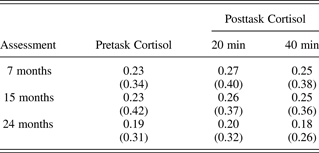
At the early infancy and the later infancy assessments, children exhibited significant cortisol reactivity; early infancy: pretask to posttask1, F (1, 1,133) = 7.09, p < .01, posttask1 to posttask2, F (1, 1,067) = 25.0, p < .0001; later infancy: pretask to posttask1, F (1, 1,047) = 47.18, p < .0001, no change from posttask1 to posttask2, F (1, 1,009) = 1.47, ns (see also Blair et al., Reference Blair, Granger, Kivlighan, Mills-Koonce, Willoughby and Greenberg2008). Overall, at the toddler assessment (24 months) cortisol reactivity was not exhibited; cortisol levels were constant from pretask to posttask1, F (1, 969) = 0.05, p = ns, and decreased from posttask1 to posttask2, F (958) = 7.13, p < .01 (Table 1). All analyses controlled for significant covariates (e.g., infant race, time of day, maternal education, infant age, and infant sex).
Descriptives for child cortisol (μg/dl) before and after participation in the challenge task at 7, 15, and 24 months of age: Mean levels (standard deviations)
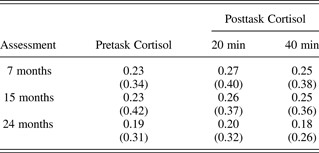
Preliminary mixed models revealed an unstructured error pattern to result in the lowest Akaike information criterion (AIC) and Bayesian information criterion (BIC) model fit parameters for modeling the trajectory of cortisol reactivity and recovery across the three assessments (7, 15, and 24 months). The amount of cortisol reactivity to the challenge did not change from the 7-month assessment (M = 47.4% increase over pretask, SD = 149.8) to the 15-month assessment (M = 50.2%, SD = 146.4), F (1, 1,152) = .17, p = ns. However, cortisol reactivity decreased from the 15-month visit to the 24-month visit (M = 35.3%, SD = 152.0), F (1, 1,092) = 11.31, p < .001, controlling for pretask cortisol levels and the time of day the collections were completed.
Main analyses
Violence across the first 2 years
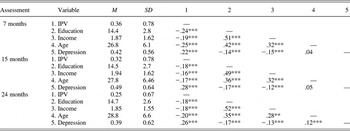
Of the families seen at all three visits, 595 reported at least one instance of violence, with 233 families reporting violence at all three visits. Levels of violence decreased from early infancy (7 months) to later infancy (15 months), t (1,095) = 4.11, p < .0001, but stayed constant from later infancy to toddlerhood (24 months), t (1,095) = 1.39, p = ns (Table 2). Families exhibiting high levels of violence across all three assessments had mothers that were more likely to be African American, t (689.1) = 9.34, p < .0001; single, t (676.3) = 8.22, p < .0001; and have income/needs ratios 200% below the poverty line at all three assessments, t (1,066.4) = 6.34, p < .0001. High violence across the three assessments was negatively related to maternal age r (1,096) = −.22, p < .0001, and maternal education r (1,096) = −.23, p < .0001, and positively related to maternal depression (rs > .21, ps < .0001) and anxiety (rs > .21, ps < .0001) at all three visits. Initial models contained these variables as control variables; final models only included variables significantly related to the dependent variable (i.e., race and partner residential status).
Means, standard deviations, and intercorrelations of partner violence and social/psychological variables within each assessment

Note: IPV, intimate partner violence.
**p < .01. ***p < .001.
IPV exposure and cortisol trajectories
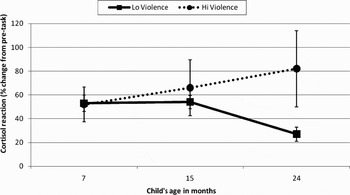
A mixed-model ANCOVA was used to examine maternal report of physical aggression across the three visits and the trajectory of cortisol reactivity and regulation across the three visits. Separate models were run with cortisol reactivity and recovery as dependent variables. There was no evidence of a main effect of violence exposure on cortisol reactivity, F (1, 1,125) = 0.70, ns, or recovery, F (1, 1,117) = 0.02, ns. However, IPV interacted with assessment to predict cortisol reactivity, F (2, 1,125) = 5.64, p < .05, indicating children exposed to violence exhibit divergent trajectories of cortisol reactivity from infancy to toddlerhood (Figure 1). No difference in trajectory was found for regulation from infancy to toddlerhood.
Children exposed to higher intimate partner violence exhibit an upward trajectory of cortisol reactivity, whereas those with little or no exposure exhibit a downward trajectory. Follow-up analyses reveal significant divergence at 24 months of age. Lines represent children exposed to violence 1 SD above the mean (Hi) and 1 SD below the mean (Lo).

Examination of cortisol reactivity within each assessment
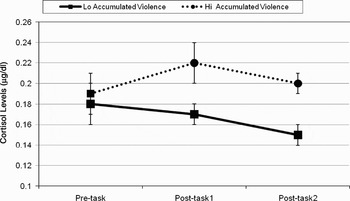
To determine at what point exposed and nonexposed children begin to exhibit different cortisol reactivity profiles, we concurrently examined maternal report of violence and early infant, later infant, and toddler cortisol reactivity to the challenge tasks. At the 7 month visit, there was no evidence of a main effect of violence exposure on cortisol levels, F (1, 1,139) = 0.00, ns, or cortisol change across the task (i.e., reactivity or regulation), F (2, 1,139) = 0.39, ns. Similarly, report of IPV at the 15-month assessment was not related to cortisol levels, F (1, 1,070) = 0.38, ns, or change across the task, F (2, 1,070) = 0.53, ns. However, children that were exposed to IPV at the toddler assessment exhibited a significantly different response to the tasks than those not exposed, F (2, 1,089) = 4.45, p < .01. The interaction was probed using criteria outlined by Aiken and West (Reference Aiken and West1991) with high and low violence groups specified as 1 standard deviation above and below the mean, respectively (Figure 2). This interaction revealed children exposed to higher levels of physical violence at 24 months had higher cortisol reactivity from pretask to posttask 1 at the 24-month visit. Specifically, generalized linear mixed model within the high violence exposure group revealed significant reactivity from pretask to posttask (M = 82.3% increase over pretask, SD = 261.7), F (1, 99) = 4.45, p < .05. In contrast, children in the low violence exposure group did not show cortisol reactivity to the task, F (1, 621) = 2.02, ns (M = 27% increase, SD = 137.4).
Children exposed to higher accumulated levels of intimate partner violence across their first 2 years of life had higher cortisol reactivity to the challenge task at 24 months than those with little or no exposure. Lines represent children exposed to violence 1 SD above the mean (Hi) and 1 SD below the mean (Lo).

Concurrent, accumulating, or multiplicative effects of violence exposure
We then examined if exposure to violence was most potent concurrently, accumulating across the first 2 years, or multiplicatively across the first 2 years. To do this, exposure to violence at the 24-month assessment was first used as a predictor of 24-month cortisol reactivity. Model fit indices (the AIC and BIC) were then compared to models adding the total levels of exposure across all three assessments (accumulating) to predict 24-month cortisol, or multiplying the levels of exposure across all three assessments (multiplicative) to predict 24-month cortisol reactivity. For the multiplicative examination, a linear transformation was applied adding 0.1 to all data points so that a report of “no violence” (i.e., 0) at a single assessment would not counter all other reports of violence. Concurrent reports of violence at the 24-month assessment, F (2, 1,089) = 4.45, p < .01, and accumulating reports of violence across the first 2 years of life, F (2, 997) = 5.06, p < .01, predicted toddler cortisol reactivity. However, comparing the AICs (5,398.6 vs. 5,389.2) and BICs (5,428.0 vs. 5,418.0) of concurrent compared to accumulative violence exposure, respectively, revealed the accumulative exposure model to be the best fitting model. Although not an overwhelming difference, accumulative violence exposure is a slightly better predictor of 24-month cortisol reactivity to the task than concurrent or multiplicative reports of violence.
We then wanted to ensure children exposed to high accumulating levels of violence across their first 2 years of life did not originally have higher cortisol reactivity at the 7- and 15-month assessments. To do this, maternal report of accumulating IPV across the 7-, 15-, and 24-month visits was used to predict cortisol levels, reactivity, and recovery across the emotion eliciting task at the 7- and 15-month assessments. There was no evidence of a main effect of accumulated violence exposure on 7-month, F (1, 1,146) = 0.06, ns, or 15-month cortisol levels, F (1, 1,070) = 0.72, ns. Similarly, violence exposure did not interact with cortisol across the task to predict 7-month reactivity, F (2, 1,146) = 0.94, ns, or 15-month reactivity F (2, 1,070) = 0.65, ns. This finding provides evidence suggesting prolonged violence exposure causes physiological dysregulations in children from risky families.
The role of maternal behavior
Maternal behavior was examined as a potential mediator or moderator of the relationship between cortisol reactivity and accumulated IPV exposure. To test for mediation, the indirect effects were calculated by taking the difference in coefficients of the relationship between violence exposure and cortisol reactivity with and without maternal caregiving in the model. Significance was tested by dividing the difference by the standard error of the difference and comparing the ratio to a standard normal distribution (MacKinnon & Dwyer, Reference MacKinnon and Dwyer1993; Sobel, Reference Sobel and Leinhardt1982). Using this method, maternal sensitivity, maternal negative intrusion, or maternal harshness at any time point (or accumulated) did not significantly mediate the relationship between violence exposure and cortisol reactivity at 24 months. However, both accumulated maternal sensitivity, F (2, 983) = 4.45, p < .01, and early (7-month) maternal sensitivity, F (2, 983) = 4.73, p < .01, interacted with accumulated violence exposure to predict cortisol reactivity at 24 months. Using the method outlined by Aiken and West (Reference Aiken and West1991), these interactions revealed high accumulated maternal sensitivity (M = 16% decrease from pretask, SD = 40) F (2, 983) = 4.45, p < .01 and early sensitivity (M = 5% decrease from pretask, SD = 37) t (30) = 0.61, ns, to buffer the children exposed to high accumulated violence from high reactivity. Specifically, only the children exposed to the confluence of violence and low early sensitivity (M = 91.8% increase from pretask, SD = 220.6) t (85) = 3.48, p = .001 or low accumulated sensitivity (M = 90% increase from pretask, SD = 218.2) exhibited cortisol reactivity to the task at 24 months. Early sensitivity (AIC = 5,503, BIC = 5,532) was a slightly better moderator than accumulated sensitivity (AIC = 5,517, BIC = 5,547; Figure 3).
Children exposed to higher accumulated levels of intimate partner violence and lower levels of early (7-month) maternal sensitivity had higher cortisol reactivity to the challenge task at 24 months than those exposed to violence but with higher levels of early maternal sensitivity. Lines represent children exposed to violence 1 SD above the mean (Hi) and 1 SD below the mean (Lo).

Comments and Conclusions
The analyses presented examined the contributions of IPV on adrenocortical levels, reactivity, and recovery to a set of emotion eliciting challenge tasks when the child was 7, 15, and 24 months of age. Adrenocortical dysregulations first appeared at 24 months, revealing toddlers exposed to high accumulated levels of IPV across their first 2 years had higher cortisol reactivity than those with little to no violence exposure. The relationship between IPV exposure and cortisol reactivity did not seem to be mediated by maternal behavior, but early maternal sensitivity did provide a buffer for IPV exposed children. Specifically, the combination of low maternal sensitivity and high accumulated violence predicted greater adrenocortical reactivity to the challenge task at 24 months of age.
Developmental theorists highlight the emotional and cognitive responses surrounding conflict as possible mechanisms accounting for the association between interparental conflict and child psychosocial adjustment (Crockenberg & Langrock, Reference Crockenberg and Langrock2001; Grych & Fincham, Reference Grych and Fincham1990; Rhoades, Reference Rhoades2008). Specifically, repeated fearful or angry responses to interparental conflict are thought to lead to behavioral maladjustment (Crockenberg & Langrock, Reference Crockenberg and Langrock2001). Constant adaptations to negative interactions, such as those found in response to interparental conflict, are thought to result in chronic physiological dysregulation (Fries, Shirtcliff, & Pollak, Reference Fries, Shirtcliff and Pollak2008; McEwen & Seeman, Reference McEwen and Seeman1999; Repetti et al., Reference Repetti, Taylor and Seeman2002; Seeman, Singer, Rowe, Horwitz, & McEwen, Reference Seeman, Singer, Rowe, Horwitz and McEwen1997). In support of this framework, individual differences in cortisol reactivity have been related to interparental violence exposure (Saltzman et al., Reference Saltzman, Holden and Holahan2005), behavioral distress during parental conflict (Davies et al., Reference Davies, Sturge-Apple, Cicchetti and Cummings2008), and externalizing symptoms in conflict exposed children (Davies et al., Reference Davies, Sturge-Apple, Cicchetti and Cummings2007). Similarly, in the current set of analyses, toddlers that had been exposed to high levels of accumulated IPV across their first 2 years of life had higher cortisol reactivity than those with little to no exposure to violence. On the whole, this sample did not show a cortisol reaction to the task; it was only those that had been exposed to high accumulated IPV that reacted. Thus, it seems that repeated adaptations to threatening family environments may facilitate adrenocortical dysregulations resulting in heightened cortisol reactivity to emotional arousal. This may explain why differences in cortisol reactivity profiles did not emerge until the children were 24 months old. It could be that there had not been significant wear and tear on the infant's HPA axis at either the 7- or the 15-month visit to produce heightened reactivity, whereas by the time the children were 24 months, the stress of repeated adaptations to family conflict had begun to take a physiological toll.
The HPA axis is a stress responsive system; however, recurrent stressors may lead to habituation and reduced reactivity to the stressor (e.g., Gunnar, Connors, & Isensee, Reference Gunnar, Connors and Isensee1989; Kirschbaum et al., Reference Kirschbaum, Prüssner, Stone, Federenko, Gaab and Lintz1995). Thus, a potential explanation for the divergent reactivity pathways may also be that the nonviolence-exposed children physiologically habituated to the challenge tasks (hence, they did not show HPA reactivity), whereas the violence-exposed children did not habituate. Failure to habituate to recurrent stressors has been related to individual differences in depression and exhaustion (Kudielka et al., Reference Kudielka, Von Känel, Preckel, Zgraggen, Mischler and Fischer2006; Reus, Peeke, & Miner, Reference Reus, Peeke and Miner1985). Therefore, the exposed children's failure to habituate to the challenge tasks may be a predisease physiological marker of psychopathology and disease susceptibility (Seeman, McEwen, Rowe, & Singer, Reference Seeman, McEwen, Rowe and Singer2001). Compounding this problem, the negative emotions children express in response to family conflict are known to sensitize the child, setting the stage for more extreme emotional reactivity (e.g., extreme fear, distress, and/or anger) in the face of subsequent conflict (Davies & Cummings, Reference Davies and Cummings1994; Davies et al., Reference Davies, Myers, Cummings and Heindel1999). Post hoc comparisons of cortisol reactivity in the violence exposed group at 24 months compared to 15 months revealed an increase. Thus, not only are the children not habituating, they are actually increasing in reactivity. Past exposures to violence may have sensitized the children to perceive this task as a greater threat than those not exposed. Even though the challenge tasks were administered the same to all children, exposure to violence may have changed the child's perception of the task.
Heightened awareness and cognitive ability at the toddler assessment compared to infancy may also play a role in the age of onset (Grych & Fincham, Reference Grych and Fincham1990). As children mature from infancy to toddlerhood, they develop a greater understanding of other people's emotions, and consequences of actions, and increases in attention and executive cognitive abilities that allow for greater perspective taking (e.g., Carlson, Mandell, & Williams, Reference Carlson, Mandell and Williams2004; Lewis, Reference Lewis, Crozier and Alden2001). Together, acquisition of these developmental processes may help explain why the repercussions of exposure to IPV were not exhibited until the children were 24 months old. At 7 months the infants may not have had the comprehension to perceive the violence as a physical or emotional threat. Compounding the problem, toddlers may be particularly susceptible to the negative implications of IPV because of their greater understanding of conflict compared to infants; however, compared to preschool aged children they have relatively immature coping abilities (Cummings, Reference Cummings1987).
A somewhat different explanation for the finding of an effect for IPV on cortisol levels in response to the emotion challenge tasks at 24 months relates more to emotional reactivity than to cognitive and perspective taking abilities per se. Here the effect at 24 but not at 7 and 15 months is perhaps best interpreted considering that the sample overall did not demonstrate an increase in cortisol at this age but did at the 7- and 15-month assessments. It may be that this pattern of results indicates that children exposed to IPV are more sensitive to emotionally arousing stimuli such as the mask task procedure designed to elicit fear reactivity and the toy removal procedure designed to elicit anger reactivity. The idea that exposure to IPV would increase sensitivity to emotionally arousing stimuli would be consistent with the idea that IPV increases risk for later developing psychopathology. Increased sensitivity to emotionally arousing stimuli and an accompanying cortisol rise as early as 24 months of age could signal the start of a developmental process through which higher levels of fear and/or anger reactivity begin to bias the development of stress physiology in ways that are ultimately injurious to the organism. Early high levels of reactivity could influence interaction with others as well, particularly caregivers who shape the development of the self, leading to maladaptive behavior and later psychopathology (Cicchetti & Tucker, Reference Cicchetti and Tucker1994).
Despite exposure to risk, some children emerge largely unscathed. Thus, developmental researchers continue to strive to understand the individual, familial, and extra-familial characteristics or conditions that suppress or neutralize the detrimental outcomes associated with risk exposure (e.g., Richman & Fraser, Reference Richman and Fraser2001). Caregivers have been shown to be critical in facilitating resilience by structuring the infant's early environment in such a way that appropriate socioemotional skills are developed (e.g., Bowlby; Reference Bowlby1979; Jahromi, Putnam, & Stifter, Reference Jahromi, Putnam and Stifter2004; Sroufe, Reference Sroufe2000). Particularly important may be the caregiver's role in programming the degree to which the HPA axis responds to stressors, and how efficiently this response is deactivated (Gunnar et al., Reference Gunnar, Morison, Chisholm and Schuder2001; Szyf, Weaver, & Meaney, Reference Szyf, Weaver and Meaney2007), thus buffering the physiological burden of exposure to risk. In support of these ideas, sensitive maternal behaviors within the first year of life completely ameliorated the heightened reactivity exhibited by toddlers cumulatively exposed to high levels of violence across their first 2 years. Despite exposure to high levels of violence, toddlers raised with early sensitive maternal caregiving were physiologically indistinguishable from those not exposed to violence. Maternal influence may be particularly important in the current set of analyses given the context of the stress task; the mother was present for the tasks and was the one that removed the toy from the child during the frustration task. It could be that, although exposure to violence initially sensitized the children to the challenge task, the presence of a sensitive and supportive mother during the stressful episode was critical in buffering the child from overreactivity. Conversely, the combination of undergoing a challenging task delivered by an insensitive mother and previous exposures to IPV may result in a physiological stressor beyond the child's coping abilities. Differences in cortisol reactivity patterns were only related to early sensitivity, however, such that high maternal sensitivity during later infancy or toddlerhood did not buffer the toddler from adrenocortical over reactivity. Thus, sensitive caretaking behaviors particularly during periods such as early infancy may be critical in setting a normative threshold of adrenocortical reactivity to stress and fostering the regulatory abilities needed to successfully cope with chronic stress. These findings fit within a growing literature linking early caregiving and long-term physiological activity (e.g., Fries et al., Reference Fries, Shirtcliff and Pollak2008; Rutter & O'Connor, Reference Rutter and O'Connor2004).
It may be misleading to only view the adrenocortical reactivity exhibited by violence exposed children as maladaptive and potentiating negative mental and physical health outcomes. By definition, an adaptation is an environmentally induced change in anatomy, physiology, or behavior contributing to an individual's ability to survive and reproduce (Williams, Reference Williams1966). Thus, to assess whether heightened reactivity truly is maladaptive it must be determined if this response confers a disadvantage over lower reactivity profiles, specifically in the context of violence (e.g., Hofer, Reference Hofer2006). In other words, although overactivity of the HPA axis may be related to poor mental and physical health outcomes longitudinally, within the immediate context of violence it may be adaptive and necessary for survival. Adrenocortical reactivity functions to prepare and aid in the organism's response to challenge. These children may be inundated with stressors requiring a higher level of resources to behaviorally, mentally, and physically cope. Thus, heightened reactivity in the violence exposed children may be an adaptive response, necessary for successfully navigating the extreme stressors of their day-to-day lives. Recently, Hofer (Reference Hofer2006) has discussed this issue and its implications for intervention. In sum, viewing these response profiles as adaptive does not diminish the need to intervene on behalf of the child, but underscores the necessity of intervening at the family level. Teaching a child more positive coping styles may be futile if these responses to stress are ineffective in helping the child deal with aversive family situations. Only after within-family stressors are at least partially alleviated will child-oriented intervention efforts be successful (e.g., Field, Reference Field1998).
Limitations and future directions
Researchers emphasize the importance of using multiple measures to assess the psychobiology of stress (e.g. Bauer, Quas, & Boyce, Reference Bauer, Quas and Boyce2002). Past studies have found the interaction of stress systems (e.g., the sympathetic and parasympathetic nervous systems) may be more indicative of risk and resilience than assessing one system on its own (El-Sheikh et al., Reference El-Sheikh, Kouros, Erath, Cummings, Keller and Staton2009). Thus, the integration of markers from multiple stress systems may give researchers a more complete view of the physiological repercussions of IPV exposure, and the mechanisms leading to maladjustment. Furthermore, this set of analyses is preliminary in determining the influence of conflict and violence exposure on child adjustment. The next step is to examine the mediating or moderating role of stress physiology in the development of mental and physical health problems. Once accomplished, physiological markers could be incorporated into intervention studies as a prepathological marker of disease. The current findings indicate that physiological reactivity may diverge around the child's second birthday. Therefore, future studies could determine whether physiological reactivity at 2 years is a marker of socioemotional adjustment problems later in life. Finally, the sample for this analysis is an epidemiologically valid representation of children and families living in the areas from which it is drawn. Previous research has shown the socioeconomic and demographic features of these communities to be a significant source of family stress, and therefore may indirectly influence the developing child through changes in parent–parent and parent–child interactions (Conger, Ge, Elder, Lorenz, & Simons, Reference Conger, Ge, Elder, Lorenz and Simons1994). Future research should attempt to disentangle how the larger socioeconomic and demographic factors related to this population mediate or moderate the relationships described. Specifically, although measures of maternal harshness may serve as a proxy for maltreatment from the mother, future studies should also assess paternal behaviors and potential maltreatment from the father (Edleson, Reference Edleson1999). Given the diurnal secretion of cortisol, researchers should make every attempt possible to conduct all assessments during the afternoon nadir. However, within this rural, low-income population collecting the saliva samples at a standardized time was not possible; this is a limitation.