1 Introduction
We call
 ${\mathbb {Z}}[i] = \{x +yi: x, y \in {\mathbb {Z}}, i^2 = -1 \}$
the Gaussian integers because Gauss showed the domain has unique factorization. Due to Dirichlet’s realization that Euclidean rings have unique factorization, we say the Gaussian integers form a unique factorization domain because they are Euclidean for the algebraic (or field) norm,
 ${\mathrm {Nm}}(x +yi) = x^2 +y^2$
. The standard proof that
 ${\mathbb {Z}}[i]$
is Euclidean uses a division algorithm that, given
 $a, b \in {\mathbb {Z}}[i] \setminus \{0\}$
, provides
 $q, r \in {\mathbb {Z}}[i]$
such that
 $a =qb +r$
and
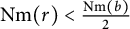 ${\mathrm {Nm}}(r) < \frac {{\mathrm {Nm}}(b)}{2}$
(see Equation (2.2)). Accordingly, we call r the Gauss remainder for a and b.
Inspired by Zariski, Motzkin [Reference Motzkin3] broadened the study of Euclidean domains via Euclidean functions. A domain R is Euclidean if there exists a Euclidean function
 $f: R \setminus \{ 0 \} \rightarrow W$
, where W is a well-ordered set with
 ${\mathbb {N}}$
as an initial segment, such that for all
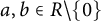 $a, b \in R \setminus \{0\}$
, there exist some
 $q, r \in R$
such that
 $a = qb +r$
, where either
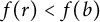 $f(r) < f(b)$
or
 $r =0$
. Using this modern terminology, the algebraic norm is a Euclidean function for
 ${\mathbb {Z}}[i]$
.
Motzkin [Reference Motzkin3] further showed that if F is the set of all Euclidean functions on
 $R \setminus \{0\}$
, then
 $\phi _R(x) = \min _{f \in F} f(x)$
is itself a Euclidean function. For obvious reasons, we call
 $\phi _R$
the minimal Euclidean function on R. In particular, he showed
 $\phi _{{\mathbb {Z}}}(x) = \lfloor \log _2 |x| \rfloor $
. Until 2023, this was the only formula the author knew of to compute the minimal Euclidean function for any number field.
Just as every integer has a binary expansion, every Gaussian integer has
 $(1+i)$
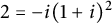
-ary expansions. This is fitting, as
 $2 =-i(1+i)^2$
and the quotient
 ${\mathbb {Z}}[i]/ \langle 1+i \rangle $
has size
 $2$
. We use
 $(1+i)$
-expansions of the form
 $x +yi = \sum _{j=0}^n u_j (1+i)^j$
for some n, where
 $u_j \in \{\pm 1, \pm i, 0\}$
and
 $u_n \neq 0$
. These expressions are not unique, as
 $$ \begin{align} 2 +i = -i(1+i)^2 +i = (1+i) +1. \end{align} $$
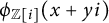
Lenstra, Jr. [Reference Lenstra2, Section 11] showed that
 $\phi _{{\mathbb {Z}}[i]}(x+yi)$
is the minimal degree of all
 $(1+i)$
-ary expansions of
 $x+yi$
, e.g.,
 $\phi _{{\mathbb {Z}}[i]}(2 +i) =\text {deg}_{1+i} ((1+i) +1) =1$
. Therefore, if
 $x +yi \in {\mathbb {Z}}[i] \setminus \{0\}$
, then
 $\phi _{{\mathbb {Z}}[i]}((1+i)^n x) = \phi _{{\mathbb {Z}}[i]}(x) +n$
and
 $\phi _{{\mathbb {Z}}[i]}(ux) = \phi _{{\mathbb {Z}}[i]}(x)$
for all u in
 ${\mathbb {Z}}[i]$
’s group of multiplicative units,
 ${\mathbb {Z}}[i]^{\times } = \{ \pm 1, \pm i\}$
. He did not, however, provide methods to calculate
 $\phi _{{\mathbb {Z}}[i]}$
for a generic
 $x+yi \in {\mathbb {Z}}[i]\setminus \{0\}$
; Equation (1.1) shows computing
 $\phi _{{\mathbb {Z}}[i]}$
is not straightforward.
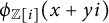
The author’s recent research gives an explicit formula for
 $\phi _{{\mathbb {Z}}[i]}(x+yi)$
, using valuations and the sequence
 $\{w_m\}$
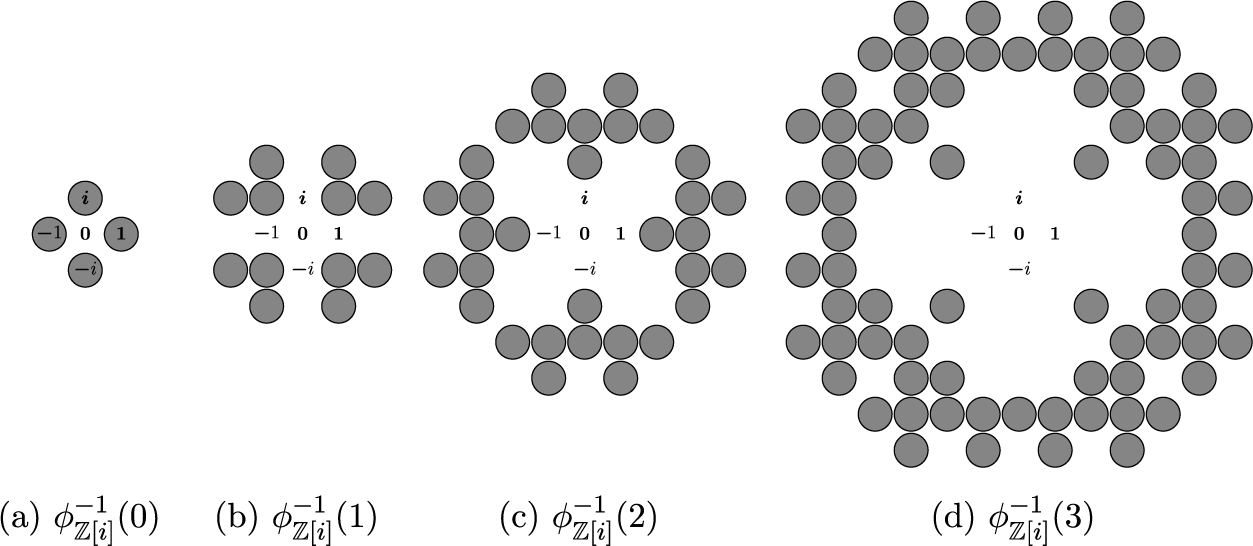
[Reference Graves1]. Figure 1 shows which Gaussian integers map to
 $\{0, 1,2,3\}$
under
 $\phi _{{\mathbb {Z}}[i]}$
. An explanation of this work requires a great deal of notation.
Pre-images of
 $\phi _{{\mathbb {Z}}[i]}$
.

Figure 1 Long description
Panel a at far left shows five points in a cross centered on a grid labeled minus one, zero, one horizontally and minus i, i vertically. Panel b adds a ring of eight points around the central five. Panel c adds a larger ring of sixteen points. Panel d at far right adds an even larger ring of twenty-four points. In all panels, the central grid remains fixed and labeled with minus one, zero, one on the horizontal axis and minus i, i on the vertical axis. The number of points in each ring increases with each panel, illustrating the pre-images of phi sub Z bracket i inverse for values zero through three.
1.1 Notations and definitions
1.1.1 Notation
-
• Every complex number has a real and imaginary part, denoted by
 ${\text {Re}}(x+yi) = x$
and
${\text {Im}}(x +yi) = y$
.
-
• The complex conjugate of z is
$\overline {z} = {\text {Re}}(z) - {\text {Im}}(z)i$
. -
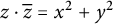
• The algebraic norm of
$z = x +yi \in {\mathbb {Q}}(i)$
is
$z \cdot \overline {z} = x^2 +y^2$
. -
• If a divides b, we write
$a|b$
. Otherwise,
$a \nmid b$
. -
• When
$a^c |b$
but
$a^{c+1} \nmid b$
, we say c is the a-valuation of b, or
$v_a(b) =c$
([Reference Graves1], p 25). -
• We use
$\gcd (x,y)$
to denote the greatest common divisor of x and y. -
• For
$x \in \mathbb {R}$
,
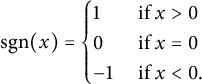
$\text {sgn}(x) = \begin {cases} 1 & \text { if } x>0 \\ 0 & \text { if } x =0 \\ -1 & \text { if } x <0. \end {cases}$
-
• The
$\ell _1$
-norm is
$\ell _1(x +yi) = |x| + |y|$
and the
$\ell _{\infty }$
-norm is
$\ell _{\infty }(x +yi) = \max (|x|, |y|)$
. -
• The multiplicative units of
${\mathbb {Z}}[i]$
are
${\mathbb {Z}}[i]^{\times } = \{ \pm 1, \pm i\}$
. -
• If x is a real number and n is the integer such that
$n \leq x < n+1$
, we write
$\lfloor x \rfloor =n$
and
$\lceil x \rceil = n+1$
. We also use the nearest integer function, given by
$$\begin{align*}\lfloor x \rceil = \begin{cases} \lfloor x \rfloor & \text{ if } 0 \leq x - \lfloor x \rfloor \leq 1/2 \\ \lceil x \rceil & \text{ otherwise}. \end{cases}\end{align*}$$
-
• The minimal Euclidean function on a domain R is
$\phi _R$
. We calculate
$\phi _{{\mathbb {Z}}[i]}$
using the formula in Theorem 1.5;
$\phi _{{\mathbb {Z}}[i]}(x)$
computes the length of x’s
$(1+i)$
-ary expansion.















1.1.2 Definitions
Definition 1.1 We define the sequence
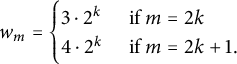 $ w_m = \begin {cases} 3 \cdot 2^k & \text { if } m = 2k \\ 4 \cdot 2^k & \text { if } m = 2k+1. \end {cases}$
We repeatedly use that
 $w_{m+2} = 2 w_m$
and that if
 $2^l < w_n$
, then
 $2^l |w_m$
for all
 $m>n$
. Note that if
 $2^l < w_n$
and
 $2^l \nmid w_n$
, then
 $w_n = 3 \cdot 2^{l-1}$
.
Example 1.1 The sequence begins with
 $w_0 = 3$
,
 $w_1 =4$
,
 $w_2 = 6$
,
 $w_3 = 8$
,
 $w_4 =12$
,
 $w_5 =16$
, etc.
Definition 1.2 The function
 $m(z) = \ell _1(z) - \ell _{\infty }(z)$
is the minimum of the absolute values of the real and imaginary parts of z.
Example 1.2 We see
 $m(7 -2i) =2$
,
 $m(1+i) =1$
, and
 $m(7) = m(7i) =0$
.
Definition 1.3 If
 $z \in {\mathbb {C}} \setminus {\mathbb {Z}} \{1 \pm i\}$
, denote the unique unit such that
 ${\text {Re}}(u_{z} z) = \ell _{\infty }(z)$
by
 $u_{z}$
. If
 $z \in {\mathbb {Z}} \{1 \pm i\}\setminus \{0 \}$
,
 $u_z$
is the unique unit such that
 $u_{z} z = \ell _{\infty } (z) (1 +i)$
.
Example 1.3 Note
 $u_{2 +i} = 1$
,
 $u_{1-i} = i$
, and
 $u_{-3 +5i} = -i$
.
Definition 1.4 For
 $r \in \mathbb {C}$
, we define
 $s(r) = \text {sgn} ({\text {Im}}(u_r r))$
.
Example 1.4 If
 $r = -3 +5i$
,
 $s(r) = \text {sgn} ({\text {Im}} (-i (-3 +5i))) =\text {sgn}({\text {Im}}(5 + 3i)) = \text {sgn}(3) = 1$
.
1.1.3 Background
Complex conjugation is multiplicative, so that
 $\overline {xy} = \overline {x} \cdot \overline {y}$
, and hence the norm is also multiplicative. In other words, if
 $a, b \in {\mathbb {Q}}(i)$
, then
 ${\mathrm {Nm}}(ab) = {\mathrm {Nm}}(a) {\mathrm {Nm}}(b)$
. The Gaussians’ multiplicative units,
 ${\mathbb {Z}}[i]^{\times } = \{ \pm 1, \pm i\}$
, have norm one and the set is closed under complex conjugation, so both the norm and
 $\phi _{{\mathbb {Z}}[i]}$
are invariant under complex conjugation and multiplication by units. If
 $u \in {\mathbb {Z}}[i]^{\times }$
and
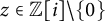 $z \in {\mathbb {Z}}[i] \setminus \{0\}$
, then
 ${\mathrm {Nm}}(z) = {\mathrm {Nm}}(\overline {z}) ={\mathrm {Nm}}(uz)$
and
 $\phi _{{\mathbb {Z}}[i]}(z) = \phi _{{\mathbb {Z}}[i]}(\overline {z}) =\phi _{{\mathbb {Z}}[i]}(uz)$
.
1.2 Using the minimal Euclidean function on
${\mathbb {Z}}[i]$

Here, we present the formula for
 $\phi _{{\mathbb {Z}}[i]}$
, and a division algorithm on
 ${\mathbb {Z}}[i]$
using
 $\phi _{{\mathbb {Z}}[i]}$
.
Theorem 1.5 (Graves [Reference Graves1])
Given
 $x +yi \in {\mathbb {Z}}[i] \setminus \{0\}$
, let
 $j = v_2(\gcd (x,y))$
and n be the smallest integer such that
 $\max \left ( \frac {|x|}{2^j}, \frac {|y|}{2^j} \right ) \leq w_n -2$
. If
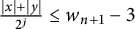 $\frac {|x| + |y|}{2^j} \leq w_{n+1} -3$
, then
 $\phi _{Z[i]}(x+yi) = n+2j$
. Otherwise,
 $\phi _{{\mathbb {Z}}[i]}(x+yi) = n+2j+1$
.
Thus, if x and y are N-bit integers, we can compute both
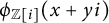 $\phi _{{\mathbb {Z}}[i]}(x+yi)$
and one of
 $x+yi$
’s minimal
 $(1+i)$
-ary expansions in
 $O(\log N)$
time, as shown in Section 4 of [Reference Graves1].
Corollary 1.6 (of Theorem 1.5)
If
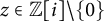 $z \in {\mathbb {Z}}[i] \setminus \{0\}$
, if
 $\ell _{\infty }(z) \leq w_n - 2^{v_2(z) +1}$
, and if
 $\ell _1(z) \leq w_{n+1} - 3 \cdot 2^{v_2(z)}$
, then
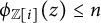 $\phi _{{\mathbb {Z}}[i]}(z) \leq n$
. Note
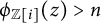 $\phi _{{\mathbb {Z}}[i]}(z)> n$
if and only if either
 $\ell _{\infty }(z)> w_{n} - 2^{v_2(z) +1}$
or
 $\ell _1(z)> w_{n+1} - 3 \cdot 2^{v_2(z)}.$
Given
 $a, b \in {\mathbb {Z}}[i] \setminus \{0\}$
, Theorem 1.7 below shows how to adjust the Gauss quotient and the Gauss remainder of a and b to find new quotients and remainders
 $q, r \in {\mathbb {Z}}[i]$
such that
 $a = qb +r$
, where either
 $r =0$
or
 $\phi _{{\mathbb {Z}}[i]}(r) < \phi _{{\mathbb {Z}}[i]}(b)$
. Interestingly, there are times we do not have to compute the Gauss remainder to know whether we need to adapt it for
 $\phi _{{\mathbb {Z}}[i]}$
.
Theorem 1.7 Suppose
 $a,b \in {\mathbb {Z}}[i] \setminus \{0\}$
have Gauss remainder
 $r\neq 0$
with
 $\phi _{{\mathbb {Z}}[i]}(r) \geq \phi _{{\mathbb {Z}}[i]}(b ) =n$
and
 $a = qb +r$
. Consider the following conditions:
-
(1)
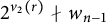
$2^{v_2(r)} \nmid w_{n-1}$
. -
(2)
${\mathrm{Im}}(u_b b) {\mathrm{Im}} (u_r r) \geq 0.$
-
(3)
$m(r) + m(b) \leq \ell _{\infty }(r).$
-
(4)
$m(b) < \ell _{\infty }(r) < m(b) + m(r)$
and
$\ell _{\infty }(b) - m(r)> w_{n-1} - 2^{v_2(b) +1.}$




If any of the conditions hold, then
 $a = \left (q + \frac {u_b}{u_r} \right ) b + \left ( r - \frac {u_b}{u_r} b \right )$
, with
 $\phi _{{\mathbb {Z}}[i]} \left ( r - \frac {u_b}{u_r} b \right ) < \phi _{{\mathbb {Z}}[i]} (b)$
. If none hold, then
 $a = \left ( q + \frac {iu_b}{s(r) u_r} \right )b + \left ( r - \frac {i u_b}{s(r) u_r} b \right )$
, with
 $\phi _{{\mathbb {Z}}[i]} \left ( r - \frac {i u_b}{s(r) u_r} b \right ) < \phi _{{\mathbb {Z}}[i]} (b)$
.
The rest of the article builds the machinery to prove Theorem 1.7. Section 2 presents the standard division algorithm.
Note that while Theorem 1.7 gives an algorithm to find a quotient and remainder using the minimal Euclidean function, the quotient and remainder are not necessarily unique. The two expansions in Equation (1.1) give two different quotient and remainder pairs with respect to the Gaussian’s minimal Euclidean function for
 $2+i$
and
 $1+i$
,
 $(2, -i)$
and
 $(1,1)$
.
It also constructs and presents properties of the ensuing (Gauss) remainder for
 $a,b \in {\mathbb {Z}}[i]$
. Section 3 shows that if
 $v_2(r) \leq v_2(b)$
, then
 $\phi _{{\mathbb {Z}}[i]}(r) < \phi _{{\mathbb {Z}}[i]}(b)$
. Section 4 presents two possible alternate remainders for when
 $\phi _{{\mathbb {Z}}[i]}(r) \geq \phi _{{\mathbb {Z}}[i]}(b)$
:
 $r - \frac {u_b}{u_r} b$
and
 $r - \frac {i u_b}{s(r) u_r}b$
. Both sections introduce properties of r and b when
 $\phi _{{\mathbb {Z}}[i]}(r) \geq \phi _{{\mathbb {Z}}[i]}(b)$
. Lemma 5.1 shows the absolute values of the real and imaginary parts of the alternate remainders are, respectively, elements of
 $$ \begin{align} \{|\ell_{\infty}(b) - \ell_{\infty}(r)|, m(b) + m(r) \} \text{ and } \{\ell_{\infty}(b) - m(r), |\ell_{\infty}(r) - m(b)|\}. \end{align} $$
We therefore use the bounds on
 $\ell _{\infty }(r)$
,
 $\ell _1(r)$
,
 $m(r),$
and
 $\ell _{\infty }(b) - \ell _{\infty }(r)$
calculated in Section 4 to bound the sums and differences in (1.2). Lemma 4.6, Proposition 4.12, and Section 5’s lemmas each assume one of the conditions in Theorem 1.7. They appropriately bound a subset of Equation (1.2)’s terms to prove which alternative remainder x satisfies
 $\phi _{{\mathbb {Z}}[i]}(x) < \phi _{{\mathbb {Z}}[i]}(b)$
. Every proposition and lemma cited in Theorem 1.7’s proof is followed by an example illustrating our division algorithm in the corresponding scenario.
2 The standard division algorithm
Suppose
 $a,b \in {\mathbb {Z}}[i] \setminus \{0\}$
, with
 $a = x +yi$
and
 $b = c +di$
. Then,
 $\frac {a}{b}$
equals
 $$ \begin{align*} \frac{a \overline{b}}{b \overline{b}} = \frac{a \overline{b}}{{\mathrm{Nm}}(b)} = \frac{(xc +yd) + (yc -xd)i}{{\mathrm{Nm}}(b)}. \end{align*} $$
If
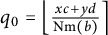 $q_0 = \left \lfloor \frac {xc +yd}{{\mathrm {Nm}}(b)} \right \rceil $
,
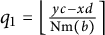 $q_1 = \left \lfloor \frac {yc-xd}{{\mathrm {Nm}}(b)} \right \rceil $
,
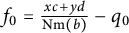 $f_0 = \frac {xc+yd}{{\mathrm {Nm}}(b)} -q_0$
, and
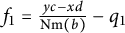 $f_1 = \frac {yc-xd}{{\mathrm {Nm}}(b)} -q_1$
, then
 $$ \begin{align*} \frac{a\overline{b}}{{\mathrm{Nm}}(b)} = (q_0 + q_1 i) + (f_0 + f_1 i), \text{ where } |f_0|, |f_1| \leq \frac{1}{2}. \end{align*} $$
Multiplying through by b shows
 $$ \begin{align} a = (q_0 + q_1 i)b + (f_0 + f_1 i) b, \end{align} $$
where
 $q_0 + q_1 i, (f_0 + f_1 i)b \in {\mathbb {Z}}[i]$
. The norm is multiplicative, so
 $$ \begin{align} {\mathrm{Nm}}(r) ={\mathrm{Nm}}((f_0 + f_1i)b) = {\mathrm{Nm}}(f_0 + f_1 i) {\mathrm{Nm}}(b) \leq \left ( \left (\frac{1}{2} \right )^2 + \left (\frac{1}{2} \right )^2 \right ) {\mathrm{Nm}}(b) \leq \frac{{\mathrm{Nm}}(b)}{2}. \end{align} $$
We call
 $f_0 + f_1 i$
the Gauss fractional remainder of a and b and
 $(f_0 + f_1i)b$
the Gauss remainder of a and b.
Example 2.1 When
 $a = 7+5i$
and
 $b = 5+3i$
,
 $$ \begin{align*} \frac{a \overline{b}}{{\mathrm{Nm}}(b)} = \frac{(7+5i)(5-3i)}{5^2 + 3^2} = \frac{50 +4i}{34} = 1 + \frac{8 +2i}{17}, \end{align*} $$
so the Gauss fractional remainder of a and b is
 $\frac {8 +2i}{17}$
. We see
 $a = 1 \cdot b +r$
, where
 $$ \begin{align*} r = \left ( \frac{8 +2i}{17} \right ) (5 +3i) = 2 +2i. \end{align*} $$
Lemma 2.2 Suppose
 $a,b, z \in {\mathbb {Z}}[i] \setminus \{0\}$
. The pair a and b have Gauss remainder r if and only if
 $za$
and
 $zb$
have Gauss remainder
 $zr$
.
Proof The fraction
 $\frac {za}{zb} \cdot \frac {\overline {zb}}{\overline {zb}}$
simplifies to
 $\frac {a}{b}$
, so
 $za$
and
 $zb$
have the same Gauss fractional remainder as a and b. This means that the Gauss remainder of
 $za$
and
 $zb$
is
 $za-qzb =zr$
, or z times the Gauss remainder of a and b.
Example 2.3 Continuing Example 2.1,
 $2+12i = (7+5i)(1+i)$
and
 $2+8i = (5+3i)(1+i)$
have Gauss remainder
 $4i = (2+2i)(1+i)$
.
Lemma 2.4 If
 $a, b \in {\mathbb {Z}}[i] \setminus \{0\}$
have Gauss remainder
 $r\neq 0$
and if
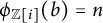 $\phi _{{\mathbb {Z}}[i]}(b) =n$
, then
 $\ell _1(r) \leq \ell _{\infty }(b) < w_{n}$
and
 $\ell _{\infty }(r) \leq \frac {\ell _1(b)}{2}< w_{n-1}$
. Equality occurs only if
 $\frac {r}{b} \in \left \{ \pm \frac {1}{2}, \pm \frac {i}{2}, \pm \frac {1}{2} \pm \frac {i}{2} \right \}.$
Proof For expositional ease, let
 $b = x +yi$
and denote the Gauss fractional remainder by
 $f_0 + f_1 i$
. Equation (2.1) shows
 $r = (xf_0 -yf_1) + (xf_1 + yf_0)i$
, so
 $$ \begin{align} \ell_{\infty}(r) = \max(|xf_0 - yf_1|, |xf_1 + y f_0|) \leq \frac{\ell_1(b)}{2} < \frac{w_{n+1}}{2} = w_{n-1} \end{align} $$
and
 $$ \begin{align} \ell_1(r) &= \max(|xf_0 - yf_1 + xf_1 + y f_0|,| yf_1 - xf_0 + x f_1 +yf_0|) \nonumber\\ &= \max (|f_0(x+y) + f_1(x-y)|,| f_0(y-x) +f_1(x+y)|)\\ &\leq \frac{\ell_1(b)}{2} + \frac{\ell_{\infty}(b) - m(b)}{2} = \ell_{\infty}(b) < w_n.\nonumber \end{align} $$
Inequalities (2.3) and (2.4) are strict, unless
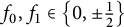 $f_0, f_1 \in \left \{0, \pm \frac {1}{2} \right \}$
.
Corollary 2.5 If
 $a,b \in {\mathbb {Z}}[i] \setminus \{0\}$
have Gauss remainder
 $r\neq 0$
and
 $\phi _{{\mathbb {Z}}[i]}(r) \geq \phi _{{\mathbb {Z}}[i]}(b)$
, then
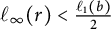 $\ell _{\infty }(r) < \frac {\ell _1(b)}{2}$
and
 $\ell _1(r) < \ell _{\infty }(b)$
.
Proof If
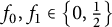 $f_0, f_1 \in \left \{0, \frac {1}{2} \right \}$
, then
 $\frac {r}{b} \in \left ({\mathbb {Z}}[i]^{\times } \right ) \{(1+i)^{-1}, (1+i)^{-2} \}$
and
 $\phi _{{\mathbb {Z}}[i]}(r) \in \{ \phi _{{\mathbb {Z}}[i]}(b) -1, \phi _{{\mathbb {Z}}[i]}(b) -2 \}$
. Thus,
 $\phi _{{\mathbb {Z}}[i]}(r) \geq \phi _{{\mathbb {Z}}[i]}(b)$
, our inequalities are strict.
Example 2.6 Staying with Example 2.1, note
 $\phi _{{\mathbb {Z}}[i]}(b) = \phi _{{\mathbb {Z}}[i]}(r) =3$
,
 $\ell _1(r) = 4 <5 = \ell _{\infty }(b) <8 = w_3$
, and
 $\ell _{\infty }(r) = 2 < \frac {\ell _1(b)}{2} = \frac {8}{2} =4< 6 = w_2$
.
3 Gauss remainders and the minimal Euclidean function
Lemma 2.4 shows that if a and b have Gauss remainder r,
 $\phi _{{\mathbb {Z}}[i]}(r)$
is often less than
 $\phi _{{\mathbb {Z}}[i]}(b)$
. Sometimes, we can determine whether
 $\phi _{{\mathbb {Z}}[i]}(r) <\phi _{{\mathbb {Z}}[i]}(b)$
without computing r.
Lemma 3.1 If
 $a,b \in {\mathbb {Z}}[i] \setminus \{0\}$
have Gauss remainder
 $r\neq 0$
and
 $v_2(r) \leq v_2(b)$
, then
 $\phi _{{\mathbb {Z}}[i]}(r) < \phi _{{\mathbb {Z}}[i]}(b)=n$
.
Proof If we assume either
 $\ell _1(r) = \ell _{\infty }(b)$
or
 $2 \ell _{\infty }(r) = \ell _1(b)$
, then Lemma 2.4 shows
 $\frac {r}{b} \in \pm \frac {1}{2} \{1, i, 1 \pm i \}$
, and hence
 $\phi _{{\mathbb {Z}}[i]}(r) < \phi _{{\mathbb {Z}}[i]}(b)$
. We therefore assume neither equality holds. Our hypothesis therefore implies
 $$ \begin{align*} 2^{v_2(r)} \leq \ell_1(r) < \ell_{\infty}(b) \leq w_n - 2^{v_2(b) +1} \leq w_n - 2^{v_2(r) +1}, \end{align*} $$
which leads to the observation
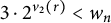 $3 \cdot 2^{v_2(r)} < w_n$
. Since
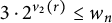 $3 \cdot 2^{v_2(r)} \leq w_{n}$
,
 $2^{v_2(r)} | w_m$
for all
 $m \geq n$
and
 $$ \begin{align*} \ell_1(r) \leq w_n - 3 \cdot 2^{v_2(r)}. \end{align*} $$
Our hypothesis also implies
 $$ \begin{align*} \ell_{\infty}(r) < \frac{\ell_1(b)}{2} \leq \frac{ w_{n+1} - 3 \cdot 2^{v_2(r)}} {2}, \end{align*} $$
so
 $\ell _{\infty }(r) \leq w_{n-1} - 2^{v_2(r) +1}$
and
 $\phi _{{\mathbb {Z}}[i]}(r) \leq n-1 < \phi _{{\mathbb {Z}}[i]}(b)$
.
Corollary 3.2 If
 $a,b \in {\mathbb {Z}}[i] \setminus \{0\}$
have Gauss remainder
 $r\neq 0$
and
 $v_2(a) \leq v_2(b)$
, then
 $\phi _{{\mathbb {Z}}[i]}(r) < \phi _{{\mathbb {Z}}[i]}(b)$
.
Example 3.3 The Gauss remainder r of
 $a = 9 +4i$
and
 $b = 3+5i$
satisfies
 $\phi _{{\mathbb {Z}}[i]}(r) < \phi _{{\mathbb {Z}}[i]}(b)$
because
 $2$
divides neither a nor b.
Corollary 3.4 If
 $a,b \in {\mathbb {Z}}[i] \setminus \{0\}$
have Gauss remainder
 $r\neq 0$
with
 $\phi _{{\mathbb {Z}}[i]}(r) \geq \phi _{{\mathbb {Z}}[i]}(b)=n$
, then
 $2^{v_2(b) +1} | w_n$
.
Proof We prove the contrapositive and assume
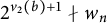 $2^{v_2(b) +1} \nmid w_n$
. Jointly, our hypotheses and
 $2^{v_2(b)} \leq \ell _{\infty }(b) \leq w_n - 2^{v_2(b)+1}$
demonstrate
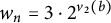 $w_n = 3 \cdot 2^{v_2(b)}$
. By Lemma 2.4,
 $2^{v_2(r)} \leq \ell _1(r) < \ell _{\infty }(b) = 2^{v_2(b)}$
. Lemma 3.1 then shows
 $\phi _{{\mathbb {Z}}[i]}(r) < \phi _{{\mathbb {Z}}[i]}(b)$
.
Example 3.5 Suppose
 $k = v_2(b)$
and
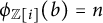 $\phi _{{\mathbb {Z}}[i]}(b) =n$
. The condition
 $2^{k +1} \nmid w_n$
holds if and only if
 $\ell _{\infty }(b) = 2^{k}$
,
 $n = 2 k$
, and
 $m(b)=0$
. For all
 $a \in {\mathbb {Z}}[i]$
, the Gauss remainder r of a and
 $2^k$
satisfies
 $\phi _{{\mathbb {Z}}[i]}(r) < \phi _{{\mathbb {Z}}[i]}(b)$
.
4 Constructing alternate remainders
Example 4.1 shows that, unlike in Corollary 3.2, computing a remainder for
 $a,b \in {\mathbb {Z}}[i] \setminus \{0\}$
and
 $\phi _{{\mathbb {Z}}[i]}$
is not so simple when
 $v_2(r)>v_2(b)$
. In this section, we construct alternate remainders, for when
 $\phi _{{\mathbb {Z}}[i]}(r) \geq \phi _{{\mathbb {Z}}[i]}(b)$
. The new remainder determines the new quotient. If R is the new remainder, then the associated quotient is the integer
 $\frac {a-R}{b}$
.
Example 4.1 Observe
 $v_{2}(4+i) =0$
,
 $\phi _{{\mathbb {Z}}[i]}(2i) = 2 = \phi _{{\mathbb {Z}}[i]}(4+i)$
, and that the Gauss remainder of
 $9$
and
 $4+i$
is
 $2i$
, so
 $2i$
is not the pair’s remainder for
 $\phi _{{\mathbb {Z}}[i]}$
.
4.1 Valuations and preliminaries
Lemma 4.2 If
 $\phi _{{\mathbb {Z}}[i]}(b) = n>0$
, then
 $m(b) \leq w_{n-1} - 2^{v_2(b) +1}$
.
Proof Since
 $2^{v_2(b)} \leq w_n - 2^{v_2(b) +1}$
,
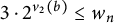 $3 \cdot 2^{v_2(b)} \leq w_n$
, and
 $2^{v_2(b) +1} | w_m $
for all
 $m \geq n+1$
. The bound
 $$ \begin{align*} 2 m(b) \leq \ell_1(b) \leq w_{n+1} - 3 \cdot 2^{v_2(b)} \end{align*} $$
therefore implies
 $$ \begin{align*} 2 m(b) \leq w_{n+1} - 4 \cdot 2^{v_2(b)}. \end{align*} $$
Dividing by two finishes the proof.
Example 4.3 If
 $b = 5+3i$
,
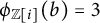 $\phi _{{\mathbb {Z}}[i]}(b) =3$
,
 $v_2(b) =0$
,
 $w_2 = 6,$
and
 $m(b) = 3 < 6-2=4$
.
Lemma 4.4 If
 $a,b \in {\mathbb {Z}}[i] \setminus \{0\}$
have Gauss remainder
 $r\neq 0$
and
 $\phi _{{\mathbb {Z}}[i]}(r) \geq \phi _{{\mathbb {Z}}[i]}(b)=n$
, then
 $\ell _{\infty }(b) - m(b) \leq w_n - 3 \cdot 2^{v_2(b)}$
.
Proof If
 $m(b)>0$
, then
 $$ \begin{align*} \ell_{\infty}(b) - m(b) \leq w_n - 2^{v_2(b) +1} - 2^{v_2(b)} = w_n - 3\cdot 2^{v_2(b)} \end{align*} $$
by Theorem 1.5. Corollary 3.4 states
 $2^{v_2(b) +1} | w_n$
, so
 $2^{v_2(b) +1} | (w_n - 2^{v_2(b) +1})$
. When
 $m(b) =0$
, we see
 $2^{v_2(b) +1} \nmid \ell _{\infty }(b)$
. Theorem 1.5 therefore implies
 $$ \begin{align} \ell_{\infty}(b) - m(b) = \ell_{\infty}(b) < w_n - 2^{v_2(b) +1}. \end{align} $$
Since
 $2^{v_2(b)}$
divides all terms in Equation (4.1), our claim follows.
Example 4.5 The pair
 $a =21 +8i$
and
 $b = 13 +8i$
have Gauss remainder
 $r =8$
, and
 $\phi _{{\mathbb {Z}}[i]} (8) = 6> 5 = \phi _{{\mathbb {Z}}[i]}(13 +8i)$
. Observe
 $2^{v_2(b)} =2$
,
 $w_5 =16$
, and
 $$\begin{align*}\ell_{\infty}(b) - m(b) = 13-8 =5 < 16 -3.\end{align*}$$
Lemma 4.6 Suppose
 $a, b \in {\mathbb {Z}}[i] \setminus \{0\}$
have Gauss remainder
 $r \neq 0$
with
 $\phi _{{\mathbb {Z}}[i]}(r) \geq \phi _{{\mathbb {Z}}[i]}(b) =n$
. If
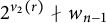 $2^{v_2(r)} \nmid w_{n-1}$
, then
 $m(r) =0$
. Furthermore,
 $\phi _{{\mathbb {Z}}[i]} \left ( r - \frac {u_b}{u_r} b \right ) < \phi _{{\mathbb {Z}}[i]}(b)$
.
Proof Since Lemma 2.4 shows
 $2^{v_2(r)} \leq \ell _{\infty }(r) \leq \frac {\ell _1(b)}{2} <w_{n-1}$
, our hypothesis implies
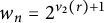 $w_n = 2^{v_2(r) +1}$
and thus
 $$ \begin{align*} 2^{v_2(r)} \leq \ell_{\infty}(r) \leq \ell_1(r) < \ell_{\infty}(b) < w_n = 2^{v_2(r) +1}. \end{align*} $$
We infer
 $ \ell _{\infty }(r) = \ell _1(r)$
,
 $m(r) =0$
, and
 $u_b b - u_r r \in \{ (\ell _{\infty }(b) - \ell _{\infty }(r)) \pm m(b) i\}.$
Lemma 4.2 shows
 $$ \begin{align*} \ell_{\infty}(u_b b - u_r r) &\leq \max (\ell_{\infty}(b) - \ell_{\infty}(r), m(b))\\ &\leq ( w_n - 2^{v_2(b) + 1} - 2^{v_2(r)}, w_{n-1} - 2^{v_2(b) +1})\\ &\leq w_{n-1} - 2^{v_2(b) +1};\end{align*} $$
we observe
 $$ \begin{align*} \ell_1(u_b b - u_r r) &= \ell_1(b) - \ell_{\infty}(r)\\ &\leq w_{n+1} - 3 \cdot 2^{v_2(b)} - 2^{v_2(r)}\\ &= w_n - 3 \cdot 2^{v_2(b)}. \end{align*} $$
As
 $v_2(u_b b - u_r r) = v_2(b)$
,
 $\phi _{{\mathbb {Z}}[i]} \left ( r - \frac {u_b}{u_r} b \right ) = \phi _{{\mathbb {Z}}[i]}( u_b b - u_r r) < \phi _{{\mathbb {Z}}[i]} (b)$
.
Example 4.7 Continuing Example 4.5, recall
 $\phi _{{\mathbb {Z}}[i]}(b) = 5 <6 = \phi _{{\mathbb {Z}}[i]}(r)$
. We see
 $u_b b - u_r r = (13 +8i) -8 = 5+8i$
and
 $\phi _{{\mathbb {Z}}[i]}(5+8i) =4<5 = \phi _{{\mathbb {Z}}[i]}(b)$
.
Since we understand what happens when
 $\phi _{{\mathbb {Z}}[i]}(r) \geq \phi _{{\mathbb {Z}}[i]}(b)$
and
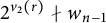 $2^{v_2(r)} \nmid w_{n-1}$
, we study when
 $2^{v_2(r)} | w_{n-1}$
.
Lemma 4.8 Suppose
 $a, b \in {\mathbb {Z}}[i] \setminus \{0 \}$
have Gauss remainder
 $r \neq 0$
, where
 $\phi _{{\mathbb {Z}}[i]}(r) \geq \phi _{{\mathbb {Z}}[i]}(b) =n$
. If
 $2^{v_2(r)} | w_{n-1}$
, then
 $2^{v_2(r)}| w_m$
for all
 $m \geq n-1$
and either
 $$ \begin{align*} \ell_{\infty}(r) = w_{n-1} - 2^{v_2(r)} \text{ or } \ell_1(r) \geq w_n - 2^{v_2(r) +1}. \end{align*} $$
In both cases,
 $$ \begin{align*} \ell_{\infty}(r) \geq w_n - w_{n-1} \text{ and } \ell_1(r) \geq w_{n-1} - 2^{v_2(r)}. \end{align*} $$
If
 $\ell _{\infty }(r) \neq w_{n-1} - 2^{v_2(r)}$
, then
 $m(r) \geq w_n - w_{n-1}$
.
Proof The first line of Lemma 4.6’s proof shows
 $2^{v_2(r)} \leq \ell _{\infty }(r) < w_{n-1}$
, so
 $\ell _{\infty }(r) \leq w_{n-1} - 2^{v_2(r)}$
. Since
 $2^{v_2(r) +1} \leq w_{n-1}$
, Definition 1.1 shows
 $2^{v_2(r)} | w_m$
for all
 $m \geq n-1$
. Our assumption that
 $\phi _{{\mathbb {Z}}[i]}(r)> n-1$
and Corollary 1.6 show either
 $\ell _{\infty }(r) = w_{n-1} - 2^{v_2(r) }$
or
 $\ell _1(r) \geq w_n -2^{v_2(r) +1}$
. Since
 $\ell _1(r) \geq \ell _{\infty }(r)$
and
 $w_n - 2^{v_2(r) +1} \geq w_{n-1} - 2^{v_2(r)}$
, we see that in both cases,
 $\ell _1(r) \geq w_{n-1} - 2^{v_2(r)}$
.
If
 $\ell _{\infty (r)} \leq w_{n-1} - 2^{v_2(r) +1}$
, then
 $\ell _1(r) =\ell _{\infty }(r) + m(r) \geq w_n - 2^{v_2(r) +1}$
implies
 $$ \begin{align*} m(r) \geq w_n - 2^{v_2(r) + 1} - (w_{n-1} -2^{v_2(r)+1}) = w_n - w_{n-1}. \end{align*} $$
In both cases,
 $\ell _{\infty }(r) \geq w_n - w_{n-1}$
, as
 $\ell _{\infty }(r) \geq \min (m(r), w_{n-1} - 2^{v_2(r)})$
and
 $$ \begin{align*} 2(w_{n-1}) - 2^{v_2(r)} = w_{n+1} -2^{v_2(r)} \geq w_n.\\[-34pt] \end{align*} $$
Example 4.9 In Example 2.1,
 $\phi _{{\mathbb {Z}}[i]}(r) = \phi _{{\mathbb {Z}}[i]}(b) =3$
. Note
 $2^{v_2(r)} =2$
divides
 $w_2 =6$
and all
 $w_m$
,
 $m\geq 2$
. We see
 $\ell _{\infty }(r) =2 = w_2 - 2^{v_2(r)} $
and
 $\ell _1(r) = 4> w_3 - 2^{v_2(r) +1} = 8-8 =0$
, so our example is in both of Lemma 4.8’s (non-exclusive) scenarios. We see
 $\ell _{\infty }(r) = m(r) =2 = w_3 - w_2$
and
 $\ell _1(r) = 4> w_2 - 2^{v_2(r)} = 6-4 =2$
.
Corollary 4.10 Suppose
 $a, b \in {\mathbb {Z}}[i] \setminus \{0 \}$
have Gauss remainder
 $r \neq 0$
, with
 $\phi _{{\mathbb {Z}}[i]}(r) \geq \phi _{{\mathbb {Z}}[i]}(b) =n$
. If
 $2^{v_2(r)} | w_{n-1}$
, then
 $m(r)$
,
 $\ell _{\infty }(r)$
, and
 $\ell _{\infty }(b) - \ell _{\infty }(r) \leq w_{n-1} - 2^{v_2(b) +1}$
.
Proof Lemma 3.1 shows
 $v_2(r)> v_2(b)$
, so
 $$ \begin{align*} m(r)\leq \ell_{\infty}(r) \leq w_{n-1} - 2^{v_2(r)} \leq w_{n-1} - 2^{v_2(b)+1}. \end{align*} $$
By Lemma 4.8,
 $$ \begin{align*} \ell_{\infty}(b) - \ell_{\infty}(r) \leq (w_n - 2^{v_2(b) +1}) - (w_n - w_{n-1}) = w_{n-1} - 2^{v_2(b)+1}.\\[-34pt] \end{align*} $$
Example 4.11 Continuing Example 2.1, we see
 $m(r) = \ell _{\infty }(r) =2$
and
 $\ell _{\infty }(b) - \ell _{\infty }(r) = 5-2=3$
are both less than
 $w_2 - 2^{v_2(b) +1} = 6-2 =4$
.
4.2 When imaginary parts align
Determining an alternate remainder is fairly straightforward when
 ${\text {Im}}(u_b b) {\text {Im}}(u_r r) \geq 0$
, i.e., when
 $u_b b$
and
 $u_r r$
lie in the same quadrant. They lie in the same quadrant, and not just the same half-plane, because Definition 1.3 ensures
 ${\text {Re}}(u_b b), {\text {Re}}(u_r r) \geq 0$
. The next section shows things become much more complicated when
 $u_b b$
and
 $u_r r$
lie in different quadrants.
Proposition 4.12 Suppose
 $a, b \in {\mathbb {Z}}[i] \setminus \{0\}$
have Gauss remainder
 $r \neq 0$
with
 $\phi _{{\mathbb {Z}}[i]}(r) \geq \phi _{{\mathbb {Z}}[i]}(b)=n$
. If
 ${\mathrm {Im}}(u_b b) {\mathrm {Im}} (u_r r) \geq 0,$
then
 $\phi _{{\mathbb {Z}}[i]} \left ( r - \frac {u_b}{u_r} b \right ) < \phi _{{\mathbb {Z}}[i]}(b)$
.
Proof Lemma 4.6 lets us assume that
 $2^{v_2(r)} |w_m$
for all
 $m \geq n-1$
. Since
 $$ \begin{align*} u_b b - u_r r \in \{(\ell_{\infty}(b) - \ell_{\infty}(r)) \pm (m(b) - m(r))i \}, \end{align*} $$
Corollary 4.10 shows
 $$ \begin{align*} \ell_{\infty}(u_b b - u_r r) \leq \max (\ell_{\infty}(b) - \ell_{\infty}(r), m(b), m(r)) \leq w_{n-1} -2^{v_2(b) +1}. \end{align*} $$
Observe that, due to Lemmas 4.4 and 4.8,
 $$ \begin{align*} \ell_1(u_b b - u_r r) &= \max(\ell_1(b) - \ell_1(r), \ell_{\infty}(b) - m(b) + m(r) - \ell_{\infty}(r))\\ &\leq \max(w_{n+1} - 3 \cdot 2^{v_2(b)} - (w_{n-1} - 2^{v_2(r)}), \ell_{\infty}(b) - m(b))\\ &\leq \max(w_{n-1} +2^{v_2(r)} -3\cdot 2^{v_2(b)} , w_n -3\cdot 2^{v_2(b)}) \\ &\leq w_n -3\cdot 2^{v_2(b)}. \end{align*} $$
Lemma 3.1 shows
 $v_2(u_b b - u_r r) = v_2(b)$
and thus
 $\phi _{{\mathbb {Z}}[i]} \left ( r - \frac {u_b}{u_r} b \right ) = \phi _{{\mathbb {Z}}[i]} (u_b b - u_r r) < \phi _{{\mathbb {Z}}[i]}(b)$
.
Example 4.13 Continuing Example 2.1, note
 ${\text {Im}}(u_b b) {\text {Im}} (u_r r) = 3 \cdot 2 = 6>0$
and
 $\phi _{{\mathbb {Z}}[i]}(u_b b - u_r r) = \phi _{{\mathbb {Z}}[i]}(3 +i) = 2 < 3 = \phi _{{\mathbb {Z}}[i]}(b) = \phi _{{\mathbb {Z}}[i]}(r).$
5 Proving our main result
When
 ${\text {Im}}(u_b b)$
and
 ${\text {Im}}(u_r r)$
have opposite signs, finding alternate remainders becomes more complicated. It only partially depends on how r relates to
 $m(b)$
. In this section, we construct alternate remainders for when
 $\phi _{{\mathbb {Z}}[i]}(r) \geq \phi _{{\mathbb {Z}}[i]}(b)$
and
 ${\text {Im}}(u_b b) {\text {Im}}(u_r r) <0$
, allowing us to prove Theorem 1.7.
Lemma 5.1 Suppose
 $a,b \in {\mathbb {Z}}[i] \setminus \{0\}$
have Gauss remainder
 $r \neq 0$
with
 $\phi _{{\mathbb {Z}}[i]}(r) \geq \phi _{{\mathbb {Z}}[i]}(b) =n$
. If
 ${\mathrm {Im}}(u_b b) {\mathrm {Im}}(u_r r) <0$
, then
 $$ \begin{align*} u_b b -u_r r \in \{ (\ell_{\infty}(b) - \ell_{\infty}(r)) \pm (m(b) + m(r))i \} \end{align*} $$
and
 $$ \begin{align*} u_b b + s(r) iu_r r \in \{ (\ell_{\infty}(b) - m(r) ) \pm (m(b) - \ell_{\infty}(r)) i \}. \end{align*} $$
Proof The first equation follows from the definitions. The assumption
 ${\text {Im}}(u_b b) {\text {Im}}(u_r r) <0$
implies that if
 $u_b b = \ell _{\infty }(b) \pm m(b) i$
, then
 $u_r r = \ell _{\infty }(r) \mp m(r) i$
and
 $iu_r r = \pm m(r) + \ell _{\infty }(r) i$
. Since
 $s(r) = \text {sgn}({\text {Im}}(u_r r))$
,
 $s(r)iu_r r = - m(r) \mp \ell _{\infty }(r) i$
. We conclude that
 $u_b b + s(r) i u_r r = (\ell _{\infty }(b) -m(r)) \pm (m(b) -\ell _{\infty }(r))i$
.
Example 5.2 The Gauss remainder of
 $a=16+i$
and
 $b = 10+3i$
is
 $r =6-2i$
, with
 $\phi _{{\mathbb {Z}}[i]}(b) = \phi _{{\mathbb {Z}}[i]}(r) =4$
and
 ${\text {Im}}(b) {\text {Im}}(r)= -6 <0$
. We see
 $$ \begin{align*} u_b b -u_r r = (10+3i) -(6-2i)=4+5i = (\ell_{\infty}(b) - \ell_{\infty}(r)) + (m(b) + m(r))i \end{align*} $$
and
 $$ \begin{align*} u_b b + s(r) iu_r r = (10+3i) -i(6-2i) =8 -3i = (\ell_{\infty}(b) - m(r)) + (m(b) - \ell_{\infty}(r))i. \end{align*} $$
Lemma 5.3 Suppose
 $a,b \in {\mathbb {Z}}[i]\setminus \{0\}$
have Gauss remainder
 $r \neq 0$
with
 $\phi _{{\mathbb {Z}}[i]}(r) \geq \phi _{{\mathbb {Z}}[i]}(b) =n$
. If
 ${\mathrm {Im}}(u_b b) {\mathrm {Im}}(u_r r) <0$
and
 $m(b) \geq \ell _{\infty }(r)$
, then
 $\phi _{{\mathbb {Z}}[i]}\left ( r - \frac {u_b i}{s(r) u_r} b \right ) < \phi _{{\mathbb {Z}}[i]}(b)$
.
Proof Harken back to Lemma 3.1 and observe
 $v_2(b) = v_2(u_b b + s(r) iu_r r)$
. Since
 $m(b) \geq \ell _{\infty }(r)$
, Lemma 5.1 shows
 $$ \begin{align} \ell_1(u_b b + s(r) iu_r r) = \ell_1(b) - \ell_1(r). \end{align} $$
Our assumption
 ${\text {Im}}(u_b b) {\text {Im}}(u_r r) <0$
implies
 $m(r) \neq 0$
. If
 $\ell _{\infty }(r) = w_{n-1} - 2^{v_2(r)}$
, then
 $$ \begin{align*} \ell_1(r) = \ell_{\infty}(r) + m(r) \geq (w_{n-1} - 2^{v_2(r)}) + 2^{v_2(r)}=w_{n-1}. \end{align*} $$
Equation (5.1) then shows
 $$ \begin{align*} \ell_1(u_b b + s(r) iu_r r) \leq w_{n+1} - 3 \cdot 2^{v_2(b)} - w_{n-1} = w_{n-1} - 3\cdot 2^{v_2(b)}, \end{align*} $$
demonstrating
 $\phi _{{\mathbb {Z}}[i]}(u_b b + s(r) iu_r r) \leq n-1$
.
If
 $\ell _{\infty }(r) \neq w_{n-1} - 2^{v_2(r)}$
, Lemmas 4.6 and 4.8 show
 $\ell _1(r) \geq w_n - 2^{v_2(r) +1}$
and
 $2^{v_2(r) +1}$
divides both
 $w_{n+1}$
and
 $w_{n+2}$
. This means
 $2^{v_2(r) +1} \leq w_{n+2} - w_{n+1}$
, so
 $\ell _1(r) \geq w_{n+1} - w_n$
. We deduce from Equation (5.1) that
 $$ \begin{align*} \ell_1(u_b b + s(r) iu_r r) \leq ( w_{n+1} - 3 \cdot 2^{v_2(b)} ) - (w_{n+1} - w_{n}) = w_n - 3 \cdot 2^{v_2(b)}. \end{align*} $$
Corollary 4.10 and Lemma 5.1 show
 $$ \begin{align*} \ell_{\infty}(u_b b + s(r) iu_r r) \leq \max(\ell_{\infty}(b) - m(r), m(b) , \ell_{\infty}(r)) \leq w_{n-1} - 2^{v_2(b) +1}, \end{align*} $$
proving
 $\phi _{{\mathbb {Z}}[i]} \left ( r - \frac {i u_b}{s(r) u_r} b \right ) = \phi _{{\mathbb {Z}}[i]} ( u_b b + s(r) i u_r r) < \phi _{{\mathbb {Z}}[i]}(b)$
.
Example 5.4 The Gauss remainder of
 $a = 8+8i$
and
 $b = 30-9i$
is
 $r =8+8i$
, and thus
 $u_b b {\kern-1pt}+{\kern-1pt} s(r) iu_r r {\kern-1pt}={\kern-1pt} (30-9i) +i(8+8i) {\kern-1pt}={\kern-1pt}22-i.$
Note
 ${\phi _{{\mathbb {Z}}[i]}(b){\kern-1pt} ={\kern-1pt} \phi _{{\mathbb {Z}}[i]}(r) {\kern-1pt}={\kern-1pt}7}$
,
 ${\text {Im}}(u_b b){\text {Im}}(u_r r) = -72 <0$
, and
 $\phi _{{\mathbb {Z}}[i]}(22-i) = 6< \phi _{{\mathbb {Z}}[i]}(b)$
.
Lemma 5.5 Suppose
 $a,b \in {\mathbb {Z}}[i] \setminus \{0\}$
have Gauss remainder
 $r \neq 0$
with
 $\phi _{{\mathbb {Z}}[i]}(r) \geq \phi _{{\mathbb {Z}}[i]}(b) =n $
. If
 ${\mathrm {Im}} (u_b b){\mathrm {Im}}(u_r r) <0$
and
 $m(r) + m(b) \leq \ell _{\infty }(r)$
, then
 $\phi _{{\mathbb {Z}}[i]}\left ( r - \frac {u_b}{u_r} b\right ) < \phi _{{\mathbb {Z}}[i]}(b)$
.
Proof Lemmas 3.1 and 4.8 show
 $v_2(r)> v_2(b)= v_2(u_b b - u_r r)$
and
 $2^{v_2(b) +1}$
divides
 $w_m$
for all
 $m \geq n +1$
. By Lemma 5.1 and Corollary 4.10,
 $$ \begin{align*} \ell_{\infty}(u_b b - u_r r)&\leq \max (\ell_{\infty}(b) - \ell_{\infty}(r), m(b) + m(r))\\ &\leq \max(\ell_{\infty}(b) - \ell_{\infty}(r), \ell_{\infty}(r))\\ &\leq w_{n-1} -2^{v_2(b) +1} \end{align*} $$
and
 $$ \begin{align*} \ell_1(u_b b - u_r r) =\ell_{\infty}(b) - \ell_{\infty}(r) + m(b) + m(r). \end{align*} $$
If
 $\ell _{\infty }(r)> m(b) + m(r)$
,
 $$ \begin{align*} \ell_1(u_b b - u_r r) \leq \ell_{\infty}(b) - 2^{v_2(r)} \leq w_n - 3 \cdot 2^{v_2(r)}. \end{align*} $$
When
 $\ell _{\infty }(r) = m(r) + m(b)$
,
 $2^{v_2(r)}| m(b)$
and thus
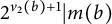 $2^{v_2(b)+1} | m(b)$
. Hence,
 $2^{v_2(b)+1} \nmid \ell _{\infty }(b)$
and, as
 $2^{v_2(b) + 1} | (w_n - 2^{v_2(b) +1})$
,
 $\ell _1(u_b b - u_r r)= \ell _{\infty }(b) \leq w_n -3\cdot 2^{v_2(b) } $
. We conclude
 $\phi _{{\mathbb {Z}}[i]} \left ( r - \frac {u_b}{u_r} b \right ) = \phi _{{\mathbb {Z}}[i]}(u_b b - u_r r) < \phi _{{\mathbb {Z}}[i]}(b)$
.
Example 5.6 In Example 5.2, we see
 $m(r) + m(b) = 5 <6 = \ell _{\infty }(r)$
, so
 $$\begin{align*}\phi_{{\mathbb{Z}}[i]}(u_b b - u_r r) = \phi_{{\mathbb{Z}}[i]}(4 +5i) =3 < \phi_{{\mathbb{Z}}[i]}(b) =4.\end{align*}$$
We found alternate remainders when
 $\ell _{\infty }(r) \leq m(b)$
and when
 $\ell _{\infty }(r) \geq m(b) +m(r)$
, so we examine when
 $m(b) + m(r)> \ell _{\infty }(r) > m(b)$
.
Lemma 5.7 Suppose
 $a,b \in {\mathbb {Z}}[i] \setminus \{0 \}$
have Gauss remainder
 $r \neq 0$
with
 $\phi _{{\mathbb {Z}}[i]}(r) \geq \phi _{{\mathbb {Z}}[i]}(b) =n$
. If
-
(1)
${\mathrm {Im}}(u_b b) {\mathrm {Im}} (u_r r) <0$
, -
(2)
$m(b) < \ell _{\infty }(r) < m(b) + m(r)$
, and -
(3)
$\ell _{\infty }(b) - m(r) \leq w_{n-1} - 2^{v_2(b) +1}$
,



then
 $\phi _{{\mathbb {Z}}[i]} \left ( r - \frac {i u_b}{s(r) u_r} b \right ) < \phi _{{\mathbb {Z}}[i]} (b)$
.
Proof Lemma 3.1 shows
 $v_2(r)> v_2(b)=v_2(u_b b + s(r)i u_r r)$
. By Lemma 5.1 and Corollary 4.10, we see
 $$ \begin{align*} \ell_{\infty}(u_b b + s(r) i u_r r) \leq \max (\ell_{\infty}(b) - m(r), \ell_{\infty}(r)) \leq w_{n-1} - 2^{v_2(b) +1} \end{align*} $$
and
 $$ \begin{align*} \ell_1(u_b b + s(r) i u_r r) = \ell_{\infty}(b) + \left ( \ell_{\infty}(r) - (m(b) + m(r)) \right ) < w_n - 2^{v_2(b) +1}. \end{align*} $$
Lemma 4.8 shows
 $2^{v_2(b)} | w_n$
, so
 $\ell _1(u_b b + s(r) i u_r r) \leq w_n - 3\cdot 2^{v_2(b)}$
. We conclude that
 $\phi _{{\mathbb {Z}}[i]}\left ( r - \frac {i u_b}{s(r) u_r} b \right ) = \phi _{{\mathbb {Z}}[i]} (u_b b +s(r) i u_r r) < \phi _{{\mathbb {Z}}[i]}(b)$
.
Example 5.8 The Gauss remainder of
 $a =16-8i$
and
 $b = 30+15i$
is
 $r=a$
. Observe that
 $\phi _{{\mathbb {Z}}[i]}(16-8i) = \phi _{{\mathbb {Z}}[i]}(30+15i) =7$
, that
 ${\text {Im}}(16-8i){\text {Im}}(30+15i) <0$
, that
 $15<16< 8+15$
, and that
 $30-8 = 22 = w_6 -2$
. As expected,
 $$\begin{align*}\phi_{{\mathbb{Z}}[i]}(u_b b + s(r) iu_r r) = \phi_{{\mathbb{Z}}[i]}(30+15 i - (8 +16 i)) = \phi_{{\mathbb{Z}}[i]}(22 -i) = 6 <7.\end{align*}$$
Lemma 5.9 Suppose
 $a,b \in {\mathbb {Z}}[i] \setminus \{0\}$
have Gauss remainder
 $r \neq 0$
with
 $\phi _{{\mathbb {Z}}[i]}(r) \geq \phi _{{\mathbb {Z}}[i]}(b) =n$
. If
-
(1)
${\mathrm {Im}}(u_b b) {\mathrm {Im}} (u_r r) <0$
, -
(2)
$m(b) < \ell _{\infty }(r) < m(r) + m(b)$
, and -
(3)
$\ell _{\infty }(b) - m(r)> w_{n-1} - 2^{v_2(b) +1}$
,



then
 $\phi _{{\mathbb {Z}}[i]} \left (r - \frac {u_b}{u_r} b \right ) < \phi _{{\mathbb {Z}}[i]}(b)$
.
Proof For the last time, Lemmas 3.1 and 4.8 show that
 $2^{v_2(r)} | w_m$
for all
 $m \geq n-1$
and
 $v_2(r)> v_{2}(b) =v_2(u_b b - u_r r)$
. Condition
 $(3)$
is equivalent to
 $$ \begin{align} \ell_{\infty}(b) -w_{n-1} + 2^{v_2(b) +1}>m(r). \end{align} $$
Using
 $w_n - 2^{v_2(b) +1} \geq \ell _{\infty }(b)$
yields
 $$ \begin{align} w_n - w_{n-1} - 2^{v_2(r)} \geq m(r). \end{align} $$
Adding
 $m(b)$
to both sides of Equation (5.2) and recalling
 $w_{n+1} - 3 \cdot 2^{v_2(b)} \geq \ell _1(b)$
, we realize
 $$ \begin{align} w_{n-1} - 2^{v_2(b) +1} \geq m(b) + m(r). \end{align} $$
Together, Equation (5.3) and Lemma 4.8 show that, as
 $m(r) < w_n - w_{n-1}$
,
 $\ell _{\infty }(r) = w_{n-1} - 2^{v_2(r)}$
. This equality, along with Lemma 5.1, Corollary 4.10, and Equations (5.3) and (5.4), demonstrates
 $$ \begin{align*} \ell_{\infty}(u_b b - u_r r) \leq \max (\ell_{\infty}(b) - \ell_{\infty}(r), m(b) + m(r)) \leq w_{n-1} - 2^{v_2(b) +1} \end{align*} $$
and
 $$ \begin{align*} \ell_1(u_b b -u_r r) &= \ell_{\infty}(b) + m(b) - \ell_{\infty}(r)+ m(r) \\ &\leq (w_{n+1} - 3 \cdot 2^{v_2(b)} )- (w_{n-1} - 2^{v_2(r)}) + ( w_n - w_{n-1} - 2^{v_2(r)} )\\ &= w_n - 3 \cdot 2^{v_2(b)}. \end{align*} $$
In summary,
 $\phi _{{\mathbb {Z}}[i]} \left ( r - \frac {u_b}{u_r} b \right ) = \phi _{{\mathbb {Z}}[i]} (u_b b - u_r r) < \phi _{{\mathbb {Z}}[i]}(b)$
.
Example 5.10 The Gauss remainder of
 $a=20 - 4i$
and
 $b = 28 +17i$
is
 $r=a$
. We see
 $\phi _{{\mathbb {Z}}[i]}(20-4i) = \phi _{{\mathbb {Z}}[i]}(28+17i) =7$
,
 ${\text {Im}}(20-4i){\text {Im}}(28 +17i) <0$
,
 $17 < 20 < 17 +4$
, and
 $28 -4 = 24> w_6 -2$
. As claimed,
 $$\begin{align*}\phi_{{\mathbb{Z}}[i]}(u_b b - u_r r) = \phi_{{\mathbb{Z}}[i]}(28 +17i - (20-4i)) = \phi_{{\mathbb{Z}}[i]}(8 + 21i) = 6 <7.\end{align*}$$
We now assemble our lemmas to prove Theorem 1.7.
Proof Proposition 4.12 proves our claim when condition 1 holds, Lemma 5.5 proves it when condition 2 holds, and Lemma 5.9 proves it when condition 3 holds.
If
 ${\text {Im}}(u_b b) {\text {Im}}(u_r r) <0$
and neither condition 2 nor condition 3 hold, then either
 $m(b) \geq \ell _{\infty }(r)$
or
 $m(b) < \ell _{\infty }(r) < m(b) +m(r)$
and
 $\ell _{\infty }(b) - m(r) \leq w_{n-1} -2^{v_2(b) +1}$
. Lemmas 5.3 proves our theorem in the first situation, and Lemma 5.7 proves it in the second.
Acknowledgments
I thank my family for their patience with me when I had the key insight on our vacation, and Jon Grantham and Tad White for our fruitful discussions. Harold Conn and the article’s referees provided valuable advice.