

In Australia, the federal Disability Discrimination Act (Commonwealth of Australia, 1992) and associated Disability Standards for Education (Commonwealth of Australia, 2006) mandate that students with disabilities (SWD) participate in educational courses or programs on the same basis as students without disabilities. This is inclusive of content from the Australian Curriculum (AC). The AC was designed to support equitable access to the general curriculum, and its recent mandate has focused on academic content and rigour for all students, including SWD. However, educators continue to debate the extent to which the AC is accessible for all students, including SWD with complex and highly individualised support needs. Some states have moved towards the development of their own curriculum (incorporating the AC), which has resulted in state-specific guidelines relating to teaching SWD. Given the relatively recent introduction of the AC, there is limited research on its implementation for SWD, from the perspective of practising educators. Understanding how educators of SWD interpret and apply the general framework of the AC in their daily work, as well as their relevant professional learning (PL) experiences and priorities, is important for policymakers and educational leaders in supporting the implementation of a truly inclusive national curriculum.
In this paper, we report on a subset of the findings from a larger national survey in which we explored the perceptions and practices of educators of students with disabilities (SWD) in specialist settings (special schools, disability units co-located at mainstream schools, special classes within mainstream schools) in relation to the AC. Although the first part of the survey related to educators’ use of the AC in planning for, teaching, and assessing SWD (Walker et al., Reference Walker, Carson, Jarvis, McMillan, Noble, Armstrong and Palmer2018), this paper relates specifically to educators’ reported PL experiences and preferences related to the AC and their advice to policymakers. It should be noted that ‘disability’ is a very broad category, and the term ‘SWD’ refers to a diverse group of students ranging from those who require very little additional support to engage with education to those with multiple and complex needs that significantly impact on many domains of their education-related functioning. In this research, our participants were educators in specialist educational settings, with the majority from special schools or units. The large majority of their students were diagnosed with intellectual disability or global developmental delay, often co-occurring with other disability types such as autism spectrum disorder or physical disabilities. Hence, this research reflects the experiences of educators working with a specific subset of SWD.
Commentary on the introduction of the AC has reflected a tension for educators of SWD between in-principle support for a curriculum that is inclusive of all students and the challenge of translating a general framework into relevant, individualised learning experiences appropriate for all SWD (Garner & Forbes, Reference Garner and Forbes2015). When designing individualised education programs, educators must make decisions about the extent to which the age-equivalent general curriculum will be addressed while considering the individual learning needs of the student (Dymond et al., Reference Dymond, Rosenstein, Renzaglia, Zanton, Slagor and Kim2015; Petersen, Reference Petersen2016; Ryndak, Jackson, & White, Reference Ryndak, Jackson and White2013; Ryndak, Moore, Orlando, & Delano, Reference Ryndak, Moore, Orlando and Delano2008). Some educators argue that curriculum should go beyond general subject matter and address the needs of the student to provide them with skills and experiences to prepare them for participation within their communities (Dempsey, Reference Dempsey2012; Dymond et al., Reference Dymond, Rosenstein, Renzaglia, Zanton, Slagor and Kim2015) and have suggested that the general curriculum may have questionable relevance to some SWD, particularly those with multiple and complex needs (Karvonen, Wakeman, Flowers, & Browder, Reference Karvonen, Wakeman, Flowers and Browder2007). This sentiment was expressed by a minority of educators in Part 1 of our larger research project (Walker et al., Reference Walker, Carson, Jarvis, McMillan, Noble, Armstrong and Palmer2018). Rather than debating contrasting views, with emphasis on one curriculum over another (e.g., academic content vs. life skills), Dymond et al. (Reference Dymond, Rosenstein, Renzaglia, Zanton, Slagor and Kim2015) argued that ‘for students with disabilities to achieve access to and make progress in the general education curriculum, there needs to be a clear understanding among practitioners about what constitutes the scope of the general education curriculum’ (p. 285). International literature advocates a combined core academic curriculum and individualised skill development delivered within general education contexts (Dymond et al., Reference Dymond, Rosenstein, Renzaglia, Zanton, Slagor and Kim2015; Ryndak et al., Reference Ryndak, Jackson and White2013). Educators must address individual needs while challenging students’ learning with equitable access to the age-equivalent AC, which can result in tensions between a ‘top down’ general framework and the need for ‘bottom up’ planning for individual student needs. There is overwhelming agreement for the need to build teacher competence in curriculum design and implementation that addresses access to and progress in the AC while considering the long-term individual learning needs of SWD (Karvonen et al., Reference Karvonen, Wakeman, Flowers and Browder2007; Australian Curriculum, Assessment and Reporting Authority [ACARA], 2012).
The Influence of Teacher Qualification
Curriculum planning, assessment, and reporting for individual SWD require complex decision-making and skill in the synthesis of multiple information sources (Sullivan, Clarke, Clarke, Farrell, & Gerrard, Reference Sullivan, Clarke, Clarke, Farrell and Gerrard2013). Given these complexities, specialist educators may maintain practices with which they are confident, particularly where they lack formal qualifications in personalised curriculum design, drawing upon the AC while meeting the specialised needs of their SWD. This may be evidenced by the finding in Part 1 of this project that 50% of educators use the Early Years Learning Framework (EYLF; Australian Government Department of Education and Training, 2009) to supplement the AC in defining learning experiences for SWD in primary and secondary settings (Walker et al., Reference Walker, Carson, Jarvis, McMillan, Noble, Armstrong and Palmer2018). Traditionally, early childhood education curricula were considered a logical, developmental framework to draw upon for SWD whose ‘mental age’ was considered below the foundation years. However, this approach has not been advocated in the special education literature since the 1970s and is not considered developmentally appropriate (Browder, Spooner, & Meier, Reference Browder, Spooner, Meier, Browder and Spooner2011). Such a substantial proportion of educators drawing upon the EYLF as an approach to personalising curriculum is of concern and may indicate a lack of formal qualifications among teachers of SWD or a lack of access to contemporary PL in curriculum design and adaptation for SWD.
In Australia, all educators are responsible for adjusting the curriculum to address the needs of individual learners regardless of their professional preparation (ACARA, 2012). However, there are no specific professional standards for curriculum modification available to specialist teachers in Australia to guide this work (Dempsey & Dally, Reference Dempsey and Dally2014). Findings from Part 1 of this study (Walker et al., Reference Walker, Carson, Jarvis, McMillan, Noble, Armstrong and Palmer2018) suggested that a majority of educators were not confident in using the AC (80%) and a substantial percentage (39%) reported that they rarely consulted the AC to support assessment and reporting for SWD in specialised settings. Such variation in reported practices and inconsistencies in the implementation of the AC may be due to a lack of PL and/or preparation for teachers of SWD (Browder et al., Reference Browder, Jimenez, Mims, Knight, Spooner, Lee and Flowers2012). The lack of research evidence to guide the design of PL experiences for this cohort represents a challenge for educational authorities charged with developing teacher competence and confidence in teaching grade level content (Browder et al., Reference Browder, Jimenez, Mims, Knight, Spooner, Lee and Flowers2012; Petersen, Reference Petersen2016) and engaging in appropriate assessment and reporting practices for SWD (ACARA, 2012; Karvonen et al., Reference Karvonen, Wakeman, Flowers and Browder2007; Walker et al., Reference Walker, Carson, Jarvis, McMillan, Noble, Armstrong and Palmer2018).
Teacher Professional Learning
ACARA and the Australian Professional Standards for Teachers and Leaders (Australian Institute for Teaching and School Leadership [AITSL], 2011, 2015) have promulgated PL for educators to promote access to and progress through the AC for SWD. However, effective teacher learning must reflect adult learning principles and the characteristics of effective models of PL (Bissaker et al., Reference Bissaker, McMillan, Ellison, Davies, Cray, Clark and Papatraianou2013). Much of the research on PL has demonstrated the greatest effect on teacher learning (knowledge), less on teacher practice (skill), and limited influence on student learning (achievement; Hattie, Reference Hattie2009). It is acknowledged that student learning is influenced by multiple factors including student characteristics, educator beliefs, ecological, and policy influences; however, as the field has embraced evidence-based practice, there is an increasing demand for PL practices that have a demonstrable impact on student learning outcomes (Yoon, Duncan, Lee, Scarloss, & Shapley, Reference Yoon, Duncan, Lee, Scarloss and Shapley2007). Learning cannot be demonstrated when teachers lack the confidence to assess and report on outcomes for SWD within the AC framework. Acknowledging the challenges associated with connecting student learning outcomes with teacher PL, recent research has identified the following characteristics of high-quality PL (Brown, Reference Brown2008; Desimone, Reference Desimone2009; Hattie, Reference Hattie2009; Leko & Brownell, Reference Leko and Brownell2009; McLeskey & Waldron, Reference McLeskey and Waldron2004; Yoon et al., Reference Yoon, Duncan, Lee, Scarloss and Shapley2007) with demonstrated effect on student outcomes (Hattie, Reference Hattie2009; Yoon et al., Reference Yoon, Duncan, Lee, Scarloss and Shapley2007):
1. Learning for teachers occurs over extended periods of time (duration)
2. Specific and practical content
3. Involvement of experts in the learning (expertise of knowledge and content clarity)
4. Sufficiently engages teachers in the learning process (active learning)
5. A function of the teacher learning includes effects on student learning (e.g., teaching curriculum more effectively/linked to curriculum and pedagogy)
6. Teachers learning together (e.g., communities of practice and collective participation)
7. Support of school leadership for PL and access to relevant expertise.
Contemporary research on teacher PL has begun to focus on measuring specific practices and their impact on student learning (Fishman et al., Reference Fishman, Konstantopoulos, Kubitskey, Vath, Park, Johnson and Edelson2013). The result in recent years has been clear identification of the types of PL that lead to change in pedagogy and learning outcomes. However, fragmented methods such as standalone workshops and conference presentations outside of classroom contexts prevail as preferred forms of PL despite limited evidence of impact on teacher practice (Brock, Huber, Carter, Juarez, & Warren, Reference Brock, Huber, Carter, Juarez and Warren2014; Fixsen, Naoom, Blase, Friedman, & Wallace, Reference Fixsen, Naoom, Blase, Friedman and Wallace2005). Although such workshops and presentations make contributions to knowledge development, without in-school mentoring (coaching) support, this knowledge is often not transferred to change in practice (Joyce & Showers, Reference Joyce and Showers2002).
Teacher Professional Learning and the Australian Curriculum
Criticisms of prevalent teacher PL practices include fragmentation and lack of connection with curriculum and learning, even though high-quality teacher PL should promote effective curricula and instructional models (Yoon et al., Reference Yoon, Duncan, Lee, Scarloss and Shapley2007). In other words, if teacher PL is of high quality, links should be made to curriculum and pedagogy; without this, teacher knowledge and skill is unlikely to be applied to classroom teaching. This phenomenon is apparent for educators of some SWD, where teachers consistently voice their struggle with planning and teaching age-equivalent content, and, even more so, assessment and reporting against grade-level achievement standards (Browder et al., Reference Browder, Jimenez, Mims, Knight, Spooner, Lee and Flowers2012; Karvonen, Wakeman, Browder, Rogers, & Flowers, Reference Karvonen, Wakeman, Browder, Rogers and Flowers2011; Petersen, Reference Petersen2016). Teachers of SWD continue to question the relevance of the AC as they are required to align grade-equivalent content while planning personalised curriculum that meets the long-term individual needs of the student; in addition to measuring student progress towards their individual learning goals, they must report on progress within the general curriculum (Petersen, Reference Petersen2016). Teachers continue to report a lack of access to high-quality PL and resources related to curriculum access, including (a) teaching across multiple grade levels, (b) assessing achievement standards across multiple grade levels, (c) balancing ecologically assessed individual learning needs with academic learning areas while (d) planning, assessing, and monitoring of individualised education program objectives (Petersen, Reference Petersen2016).
In the United States (US), teachers of students with significant intellectual disability are guided by state-developed alternate achievement standards based on the Alternate Achievement Standards for Students with the Most Significant Cognitive Disabilities: Non-Regulatory Guidelines (US Department of Education, 2005) and the Common Core State Standards, ‘a set of high-quality academic standards in mathematics and English language arts/literacy (ELA)’ (http://www.corestandards.org/about-the-standards/). In Australia, the AC provides teachers with a consistent set of national content standards in English and mathematics as well as literacy and numeracy. However, no such assessment guidelines for reporting against achievement standards exist for teachers of students with intellectual disability, and it remains challenging for teachers to assess and report on achievement in the AC. This potentially explains the focus of a substantial proportion of teachers on the literacy and numeracy general capabilities at the expense of other curriculum components (Walker et al., Reference Walker, Carson, Jarvis, McMillan, Noble, Armstrong and Palmer2018). In Australia, the AC provides national content across learning areas and associated achievement standards, but without specific guidance or alternate performance standards available for teachers to report yearly adequate progress for SWD.
In the absence of explicit guidance, the burden remains on teachers to determine the essential or key elements of the curriculum for their SWD, the nature of assessment, and the extent to which they are required to assess or report on grade-level achievement (e.g., alternate assessment). Overall, there is limited rigorous research on PL focused on preparing teachers of SWD to plan and teach grade-equivalent content, design and conduct assessment, and report on the extent to which students are achieving the essential elements of that content (Browder et al., Reference Browder, Jimenez, Mims, Knight, Spooner, Lee and Flowers2012; Ryndak et al., Reference Ryndak, Jackson and White2013; Petersen, Reference Petersen2016). Given the difficulties expressed by educators internationally with addressing the individual needs of SWD within a mandated general curriculum (Browder et al., Reference Browder, Jimenez, Mims, Knight, Spooner, Lee and Flowers2012; Dymond et al., Reference Dymond, Rosenstein, Renzaglia, Zanton, Slagor and Kim2015; Karvonen et al., Reference Karvonen, Wakeman, Flowers and Browder2007; Petersen, Reference Petersen2016; Ryndak et al., Reference Ryndak, Jackson and White2013), there is a need to carefully consider PL for educators that is likely to influence practice and in turn student learning. Guidance in teacher education and PL in Australia is needed given the unique context of a national curriculum and teacher professional standards that provide limited guidance for educators of SWD (Dempsey & Dally, Reference Dempsey and Dally2014). The aim of this study was to investigate the PL provided and valued by educators on how to draw upon the AC when planning, assessing, and reporting learning outcomes for SWD in specialised settings. This was investigated through the following research questions:
1. What supports and experiences do educators in specialised settings identify as being valuable to help them understand and implement the AC for SWD?
2. What PL and support needs do educators in specialised settings recommend as they continue to develop their knowledge, understanding, and skills in working with the AC for SWD?
3. What are the recommendations of specialist educators for improving the use of the AC when planning, assessing, and reporting on learning for SWD?
Method
Participants
One hundred and fifty-one educators (124 female, 27 male) working in the special education sector across Australia participated in the RISE Australian Curriculum Survey. This included 59% from special schools, 25% from special education/disability units co-located on mainstream school campuses, 6% from special classes in mainstream schools, and 10% from ‘other’ settings. Detailed demographic information is reported in a separate paper (see Walker et al., Reference Walker, Carson, Jarvis, McMillan, Noble, Armstrong and Palmer2018) and is summarised here. Twenty-eight percent of participants were from South Australia, 20% from Victoria, 16.67% from New South Wales, 25.33% from Western Australia, 5.33% from Queensland, 2.67% from the Australian Capital Territory, 1.33% from the Northern Territory, and 0.67% from Tasmania. Over two thirds of participants were from metropolitan areas compared to just under one third who were located outside of metropolitan areas.
The majority of participants were classroom teachers (45.03%), followed by special education coordinators/lead teachers (19.21%), directors and/or principals (19.21%), assistant principals (11.26%), and those who had other school support roles (10.60%). Participants were spread across a range of year levels including junior primary (9.33%), primary (24%), primary/middle school (4.67%), middle school only (4%), middle school/secondary (9.33%), secondary only (26%), and foundation to Year 12 (40%).
Qualifications varied from graduate certificates and bachelor qualifications to PhDs, a large majority of which included a focus on special education (72.18%). Participants taught students with a range of disability types, with the most prominent being intellectual disability/global developmental delay (92.05%), autism spectrum disorder (91.39%), physical disability (64.24%), attention-deficit/hyperactivity disorder (63.58%), and speech and/or language impairments (62.91%). Therefore, the sample can be considered most representative of educators working with students with intellectual disabilities, often co-occurring with other disability types.
Procedure
The anonymous RISE Australian Curriculum Survey was designed, piloted, refined, and then distributed as an email link to principals and directors of all known special education schools and special units within each sector — public, Catholic, and independent — across Australia (see Walker et al., Reference Walker, Carson, Jarvis, McMillan, Noble, Armstrong and Palmer2018, for full details). Principals and directors were asked to distribute the link to the electronic survey, developed using Qualtrics Software (Qualtrics, 2016), to their staff teaching in special education schools, specialised units, and special classes. Additional methods of encouraging anonymous survey completion included advertisement of the survey on the Australian Association for Special Education (AASE) website. It was difficult to establish an exact response rate given that the distribution of an electronic link is beyond the researchers’ control once received by principals and directors. The total number of completed surveys was 151.
Materials
The RISE Australian Curriculum Survey evaluated educators’ use of the AC for SWD in specialised settings across four key areas, three of which have been previously discussed in Part 1 of this research (Walker et al., Reference Walker, Carson, Jarvis, McMillan, Noble, Armstrong and Palmer2018). The fourth area, relevant to this paper, focused on PL and support for educators when using the AC for SWD. Three key questions, formatted as multiple choice, Likert scale, and open-ended, were presented to participants:
1. Indicate the forms of professional learning you have engaged in and your perception of its value in developing your knowledge and use of the Australian Curriculum.
2. What type of professional learning or resources would increase your use of the Australian Curriculum?
3. What top three pieces of advice would you provide to ACARA regarding the relevance and value of the Australian Curriculum for students with disabilities?
Exact content for each of the aforementioned questions can be found in the Appendix.
Ethics
This research was approved by the Flinders University Social and Behavioural Research Ethics Committee and all state and local education jurisdictions who participated. Informed consent was required prior to participant access to the online survey.
Data Analysis
Survey responses were analysed using a mixed-methods approach. Quantitative analysis involved the use of descriptive statistics (i.e., percentages and frequency of responses) for scaled and demographic questions. Qualitative analysis involved the use of nomination frequencies, using Maykut and Morehouse's (Reference Maykut and Morehouse1994) expression of the constant comparative method. NVivo Version 10 (QSR International, 2012) was used to conduct the analysis of open-ended responses to survey questions. The first step of the constant comparative method was open coding of responses. The codes were then organised into categories, which were then organised into themes. Next, nomination frequencies were calculated to determine the percentages of which the themes were represented across all responses. Coder agreement was checked via consensus among authors at all stages of coding (open, categorisation, and themes). The results from these analyses are profiled as follows in relation to the three key survey questions.
Results
Professional Learning and Perceived Value
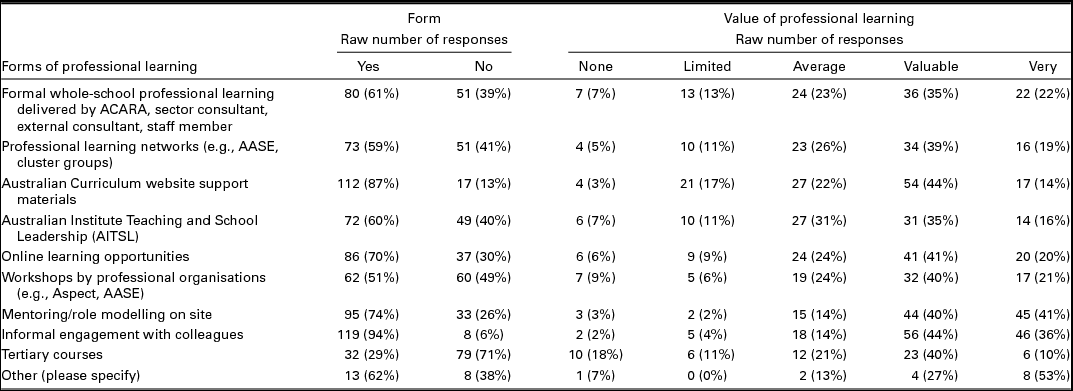
Participants were asked to indicate which forms of PL they had engaged with to support their knowledge and use of the AC for SWD, as well as the perceived value of this learning experience. The most utilised method of PL was informal engagement with colleagues (94%). A large number of participants also consulted the AC website support materials (87%), engaged with mentoring/role-modelling opportunities on site (74%), or took advantage of online learning opportunities (70%). Approximately one half to two thirds of participants engaged with formal whole-school PL delivered by ACARA, sector consultants, external consultants, or a staff member (61%), PL networks (59%), opportunities available from the AITSL (60%), workshops by professional organisations (51%), or other opportunities (62%) such as conferences, key teacher support, self-learning, teaching preservice teachers how to use the curriculum, and working with professionals such as speech-language pathologists and occupational therapists.
In terms of value, it was notable that the forms of PL that were most frequently rated as most valuable or very valuable were (a) mentoring/role modelling on site (81%), and (b) informal engagement with colleagues (80%). These items both represent learning experiences that took place on site, delivered in a format that was embedded in the participants’ daily work. The ‘other’ category (80%) included forms of PL such as self-teaching and practice, engagement with ACARA and advisory committees, statewide department-led professional development, and conferences. Other items with between 50 and 62% of responses in the most valuable or very valuable categories included (a) workshops by professional organisations (61%), (b) online learning opportunities (61%), (c) PL networks (58%), (d) AC website support materials (58%), and (e) formal whole-school PL delivered by ACARA, sector consultants, external consultants, or staff members (57%). PL through tertiary courses or the AITSL was considered valuable to very valuable by about half of the participants. It is important to note that although 50% of participants identified tertiary courses as valuable to very valuable, and 21% indicated tertiary courses were of none to limited value, only 21% of participants were currently engaged in tertiary education. Hence, it is plausible that these data reflect ‘perceived value’ of tertiary education as opposed to current experienced value. Table 1 profiles both the forms of PL and their associated value as rated by the participants.
Forms and Value of Professional Learning to Support Use of the Australian Curriculum

Note. % is calculated as a proportion of the number of responses to each question.
Professional Learning to Increase Use of the Australian Curriculum
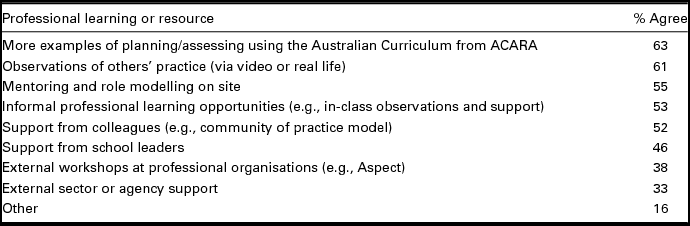
Participants were asked to indicate which forms of PL or resources would increase their use of the AC for SWD. Approximately two thirds of participants indicated that more examples of planning and assessing using the AC from ACARA would support their use of the AC (63%). A similar number of participants also indicated that observations of others’ practice either in ‘real life’ or via video recordings (61%) would increase their use of the AC. Approximately half of participants indicated that more support from school leaders (46%), informal PL opportunities (e.g., in-class observations; 53%), support from colleagues (52%), and mentoring or role modelling on site (55%) would increase their use of the AC for SWD. This is consistent with the results related to which forms of PL were considered most valuable, whereby onsite mentoring, role modelling, and informal support from colleagues, and access to high-quality resources and examples using the AC for SWD were ranked highly. Approximately one third of participants indicated that external sector or agency support (33%) or external workshops at professional organisations (38%) would increase use of the AC. Other types of PL opportunities or resources suggested by participants included access to workshops using the AC specifically tailored to special education, materials that reflect best practice in special education, and development of a curriculum more relevant to students with highly complex needs. Table 2 illustrates the types of PL and resources that would have an influence on increasing use of the AC for SWD as perceived by special educators in specialised settings.
Professional Learning or Resources That Support Increased Use of the Australian Curriculum for Students With Disabilities

Note. % agree is of total sample size of 151 participants.
Advice for ACARA on the Value of the Australian Curriculum
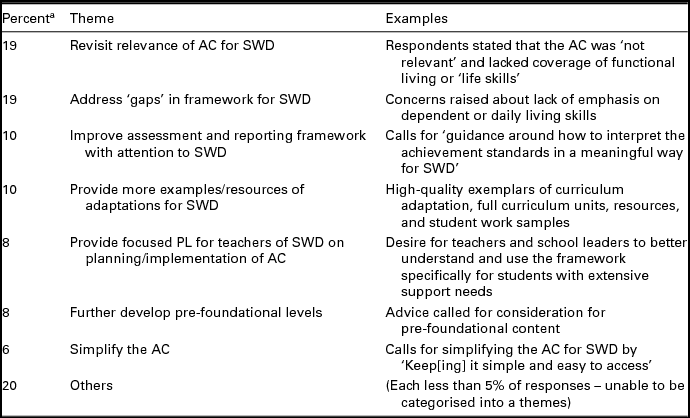
Participants were invited to offer their three top pieces of advice to ACARA regarding the value of the AC framework for SWD. Responses were grouped qualitatively by similarity of theme using nomination frequencies as described previously. Table 3 profiles these themes in descending order as a percentage of all responses, in addition to examples.
Advice for ACARA Regarding Relevance/Value of the Australian Curriculum for Students With Disabilities

a % frequency is of total sample size of 151 participants.
Discussion
Educator-Valued Professional Learning
In this research we examined the types of PL with which participants engaged, as well as their perceived value when working with the AC framework for SWD. Results indicated that participants engaged in a range of PL from formal whole-school PL provided by educational authorities to informal day-to-day engagement with colleagues. The types of PL perceived as very valuable were those that were encountered on site with colleagues (41% for mentoring/role modelling and 36% for informal engagement with colleagues), whereas formal types of PL were still considered of value, albeit not to the same extent (22% for whole school and 21% for workshops). Despite widespread engagement with PL opportunities, the majority of participants in Part 1 of the study identified that they did not feel confident implementing the AC for SWD in specialised settings (Walker et al., Reference Walker, Carson, Jarvis, McMillan, Noble, Armstrong and Palmer2018). This suggests that PL may need to be examined to ensure provision of coordinated, high-quality adult learning principles to improve teacher confidence and implementation of the AC for SWD; engagement in PL may not necessarily lead to change in practice (Fishman et al., Reference Fishman, Konstantopoulos, Kubitskey, Vath, Park, Johnson and Edelson2013), particularly if it is not perceived as relevant for teachers’ own settings and students. In this study, educators expressed a clear preference for PL provided on site, with colleagues, and including a component of mentoring/role modelling. Such collaborative practices are characteristic of active learning and collective participation in high-quality PL. However, fragmentation and lack of connection with curriculum for SWD is unlikely to lead to application in the classroom (Yoon et al., Reference Yoon, Duncan, Lee, Scarloss and Shapley2007).
Many of the types of PL reported were fragmented learning experiences, inconsistent with accepted principles of sustained, high-quality adult learning. A substantial proportion of participants engaged with one-off workshops, online materials, and informal day-to-day or isolated forms of PL; by contrast, the literature emphasised the need for ongoing, coordinated approaches (Desimone, Reference Desimone2009). The research on effective PL highlights the importance of sustained opportunities for learning in practice-based contexts (Leko & Brownell, Reference Leko and Brownell2009). For educators working with SWD in specialised settings, this means PL should occur within special education contexts, linked with curriculum and pedagogy relevant to the learners, and supported by leadership (Brown, Reference Brown2008; Desimone, Reference Desimone2009; Hattie, Reference Hattie2009; Leko & Brownell, Reference Leko and Brownell2009). Participants of this study consistently indicated their preference for PL to be delivered by experts with knowledge in special education, who can provide examples and demonstrate application of the AC in meaningful ways, relevant to the needs of their students. Coordinated approaches to high-quality PL for special educators may address their concerns with relevance of the AC to the needs of the full range of SWD as well as the desire for guidance and specific examples on assessment and reporting against achievement standards.
Educator-Preferred Professional Learning
Approximately two thirds of participants recommended specific examples of planning and assessment to support their use of the AC. In addition, a preference for PL that involved the observations of other educators’ real-life or videoed pedagogical practice was noted. These findings are perhaps not surprising given the lack of guidance for assessment and reporting of progress within the AC for SWD. Educators are clearly challenged by reporting progress and demonstrating achievement of standards alongside the need to address students’ individual learning needs (Petersen, Reference Petersen2016). This may explain the use of supplementary materials as well as advice to address the gaps in the AC voiced by special educators in this study. Without guidance and PL specific to these challenges, educators may continue to question the relevance of the AC and rely on alternate curricula they perceive to be more relevant (Walker et al., Reference Walker, Carson, Jarvis, McMillan, Noble, Armstrong and Palmer2018). The teachers surveyed expressed a desire for specific examples to guide them in curriculum design that balances planning, assessment, and reporting progress through the AC with highly individualised skill development for SWD.
Although the majority valued contextualised PL, participants also specified that external sector/agency or off-site workshops would increase their use of the AC for SWD. This might suggest that such forms of PL alone are not perceived to be as relevant or valued in working with the AC on a daily basis. Workshops and online resources tend to represent learning with predetermined end points and resources (Koellner & Jacobs, Reference Koellner and Jacobs2015); their usefulness beyond the original intention (developing knowledge) may limit skill transference in practice. Workshops and online resources may increase knowledge (Joyce & Showers, Reference Joyce and Showers2002), but are least likely to lead to changes in teacher practice (Joyce & Showers, Reference Joyce and Showers2002; McMillan, Reference McMillan2008; Yoon et al., Reference Yoon, Duncan, Lee, Scarloss and Shapley2007). Workshops and conference presentations must be specific in addressing teachers’ context-specific demands in order to affect teacher confidence and, ultimately, changes in practice.
Similar to their reported PL experiences, more than half of the participants recommended role modelling and mentoring as advantageous PL practices to increase their knowledge and use of the AC. Such practices are consistent with components of high-quality adult learning principles. Demonstration, feedback, and mentoring (i.e., coaching) over sustained periods have a demonstrated effect on teacher practice (Desimone, Reference Desimone2009) and student achievement (Joyce & Showers, Reference Joyce and Showers2002; Yoon et al., Reference Yoon, Duncan, Lee, Scarloss and Shapley2007). The varied forms recommended by educators provided elements of high-quality PL, although may not afford the development of necessary specific content (McLeskey & Waldron, Reference McLeskey and Waldron2004) or the use of evidence-based pedagogy necessary for student achievement. Future research will need to address the question of whether sustained PL models, tailored to school context (SWD) and delivered in situ, are effective in supporting improvement in teacher confidence and use of the AC, particularly in relation to assessment and reporting. This is a priority for future research.
Limitations
Although the findings of this research support teachers’ preference for sustained, coordinated, quality PL in the context of their daily practice, there are limitations to this study that should be considered when interpreting the results. Survey responses were not entirely representative of the demographic and geographic composition of special educators across Australia. This study was exploratory, and as such, conclusions drawn are intended to inform future research in AC implementation and PL models that are more likely to lead to change for teachers of SWD. In addition, differences in experiences and advice between educators who taught in special schools compared to special classes situated within general schools, or between those in primary and secondary settings, were not investigated. There may be differences in perceptions and experiences between these groups, although this was not the focus of this study, and the relatively small number of participants from special classes did not allow for these comparisons. Research is needed to explore the differing PL needs of educators of SWD who work in specialist settings and those in general education settings whose students might present with less complex needs, and who are likely to face a different (albeit related) set of challenges. It is also acknowledged that the one third of participants who expressed concern about the relevance of the AC to SWD may represent a subset of educators working with students whose needs are highly complex and require very individualised responses. Although not reflective of all educators of SWD, however, this finding indicates a need for further investigation of this smaller group.
Conclusion
This research highlighted that although Australian educators of SWD working in specialised settings have participated in a range of PL activities related to the AC, some of these experiences are valued more highly than others. In particular, this research indicates that educators of SWD (a) perceive onsite role modelling, mentoring, and collegial support to be highly valuable; (b) report that PL specific to planning, assessment, and reporting with examples is most likely to increase their use of the AC; (c) have experienced a lack of specific guidance, examples, and targeted PL to assist their implementation of the AC; and (d) in some cases believe that the AC does not sufficiently reflect the learning needs of SWD who have very complex needs. It seems clear that investment in relevant examples and resources that explicitly guide educators of SWD in the implementation of the AC would be valuable. Limited formal preparation in curriculum design for SWD and the current fragmented types of PL reported by educators of SWD may have contributed to the reported lack of confidence and inconsistent approaches in implementing the AC. This implies that educational authorities may need to invest in PL that incorporates expert knowledge and skill, specific applicable content, and sustained, active communities of practice supported by leadership. This may require a coordinated, systemic, and localised school-level approach; the extent to which this occurs is likely to vary between states. Furthermore, research is needed to measure the extent to which the suggested PL model affects implementation of the AC in terms of planning and teaching age-equivalent content, and, to a greater extent, assessment and reporting against grade-level achievement standards for SWD.
Appendix
Survey Questions Regarding Professional Learning and the Australian Curriculum
a. Indicate the forms of professional learning you have engaged in and your perception of its value in developing your knowledge and use of the Australian Curriculum

b. What type of professional learning or resources would increase your use of the Australian Curriculum? Please check the box(es) that apply.

c. What top three pieces of advice would you provide to ACARA regarding the relevance of the Australian Curriculum for students with disabilities?
No. 1:
No. 2:
No. 3: