The first half of the nineteenth century saw the visual arts emerge as a profoundly significant arena in the strained efforts both to construct and to express a coherent and stable national American identity. The “cluster of visual practices and attractions”Footnote 1 that shaped the antebellum city included fine art painting and sculpture; a burgeoning culture of exhibition; a ubiquity of advertisements and signs; popular entertainments such as the minstrel show; the public demonstration of new “sciences” such as mesmerism, phrenology, and the daguerreotype; and ever more cheaply available prints, pictures, and cartoons.Footnote 2 This visual unruliness was mirrored by the heteroglot voices of popular fiction and literature that, taken together, represented the city as a place of disorder and was reflective of broader anxieties that perceived the urban world as one in which, according to Edward Chapin in 1842, “young men” would “throw themselves away in a tide of dissipation.”Footnote 3 This aversion to the city is not of course unique to nineteenth-century America; but in response to, amongst other things, the development of a national market, growing industrialization, and the first waves of large-scale European immigration and internal migration, the American city became an increasingly significant symbolic site of social and cultural tension.
This is not to suggest that cities in the first half of the nineteenth century were not unruly spaces in a real sense. Callithumpian riots, involving gangs of young men “dressed in everything and anything … [making] … ‘night hideous’ with their drums, whistles, horns, pots, pans, and kettles, taunting both their social superiors and inferiors” were a recurrent presence on the antebellum urban scene.Footnote 4 Indeed, Michael Feldberg argues that the antebellum period witnessed more urban disorder than any other point in American history, stating that in the 1830s and 1840s “there seem to have been few, if any, causes, issues, disagreements, or rivalries that could not incite a riot, and few social or political factions that would not resort to violence to further their aims or express their emotions.”Footnote 5 Erupting, then, for a multitude of reasons and in a multitude of contexts, the ubiquity and intensity of collective urban violence seemed to indicate to an increasingly anxious middle class that, as Edward Beecher put it, the United States had “no ruler but the demon of anarchy; and no Lord but that bloody, thousand-headed demon, the mob.”Footnote 6
Pragmatic institutional responses to the chaos of the city, including urban reform, the temperance movement, and the development of the modern prison and asylum, supported a broader cultural project “directed at consolidating a middle-class social identity utterly bound up with the civilizing mission.”Footnote 7 This mission to define white bourgeois subjectivity as the core of any legitimate American identity was structurally dependent on the anxious projection of a “culture of the Other,”Footnote 8 populated by blacks, Indians, and the lower orders, that was unceasingly constructed through carnivalesque tropes of abjection, deformity, and the grotesque.
These carnivalesque tropes assumed ever-increasing symbolic potency throughout the nineteenth century, at precisely the historical moment that carnival-as-practice was being suppressed.Footnote 9 As the social ritual of carnival disappeared, its fragmented elements, what Peter Stallybrass and Allon White call the “disjecta membra of the grotesque body,”Footnote 10 were displaced throughout all discursive domains, not as images of joyful indulgence but more often as “morbid symptoms of private terror.”Footnote 11 Emerging in a variety of forms, and a multitude of arenas, across antebellum culture,Footnote 12 this narrative displacement of the Other formed a discourse of disorder that “encoded all that which the proper bourgeois must strive not to be in order to preserve a stable and ‘correct’ sense of self.”Footnote 13 In short, the carnivalesque became the default setting for all representations of the “low Other.” Articulated most powerfully through the categories of the “classical” and “grotesque” as they are mapped across the “intensifying grid of the body,”Footnote 14 this narrative displacement embraced the classificatory regime of high–low structuring all cultural formations and relationships. Thus the classical (or bourgeois) body, in its politeness, closure, privacy, silence, and self-containment, “denotes the inherent form of the high official culture.”Footnote 15 Indeed, in its internalization of the systemic regimes of republican virtue, self-control, democracy, and market capitalism, the classical body comes to “mark out the identity of progressive rationalism itself.”Footnote 16 Its mutually constitutive extreme, the grotesque body – impolite, always in motion, multiple, open, gaping, public, noisy, libidinous, deformed, and disproportionate – denotes the low, abject, rejected, and marginal.
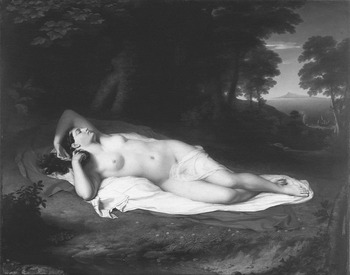
David Lubin's assessment of John Vanderlyn's Ariadne Asleep on the Isle of Naxos (Figure 1) as the “foundation of nineteenth-century American landscape painting” illustrates the significance of that classificatory regime in structuring the convergent discourses of body and landscape.Footnote 17 Functioning metonymically and metaphorically, Ariadne's classical form presents both the freely available body of the land as well as the perfectly proportioned and self-contained body of the republic. However, her occupation of a middle space between the twin corrupting influences of wilderness and civilization suggests an ideological trajectory which gestures just as surely towards William Sidney Mount's genre scenes as it does towards the grand canvases of Thomas Cole. The benign pastoral midpoint mapped out by Vanderlyn's Ariadne ultimately becomes Mount's controlled, middle-class, republican space, situated safely between the menacing carnivalesque disorder of the city and the destabilizing threat of the frontier. His anxious need to mark out this middle space as the site of “order, accessibility, and moral rectitude”Footnote 18 is given its most overt expression in The Painter's Triumph (1838), where the artist assumes a complete social and cultural authority. The painting's democratizing claim for the “reforming power of art”Footnote 19 elides the determinant logic of a bourgeois ideology that, in the process of ordering all cultural value through the categorical registers of high–low, links art intimately and inevitably to broader hierarchies of race, taste, the market, and the body.
John Vanderlyn, Ariadne Asleep on the Isle of Naxos (1809–14). Courtesy of the Pennsylvania Academy of the Fine Arts, Philadelphia. Gift of Mrs. Sarah Harrison (The Joseph Harrison, Jr. Collection)

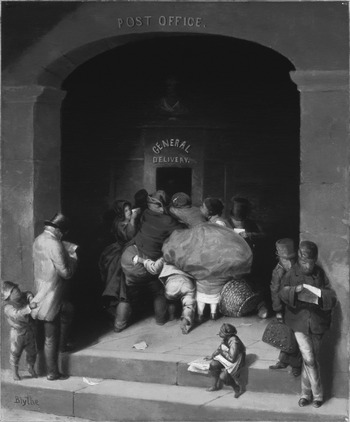
The constitutive Other to Mount's “expressions of regional and national harmony”Footnote 20 is to be found in the eruptive canvases of David Gilmour Blythe, with their excessive and disordering representations of the urban scene. The unsettling figures that stalk Blythe's putrid antebellum city might be read as the phobic return of those repressed, abject bodies that are all too obviously absent from the decorous topography of Mount's bucolic republicanism. It would be difficult to imagine a less ordered and decorous scene than that of Blythe's Post Office (Figure 2), with its violent and unruly low mob wrestling viciously beneath the classical archway and its accompanying statuary. The low invading the high in this way clearly speaks to a whole set of anxieties over the racial and social topography of Blythe's Pittsburgh and is a corollary to his “viciously worded diatribes against urban immigrants, blacks, and politicians.”Footnote 21 But the picture expresses something more than simply a series of visceral prejudices. In its overwhelming movement this crowding, imbalanced, disproportionate “carnival body” presents “an image of impure corporeal bulk with its orifices (mouth, flared nostrils, anus) yawning wide and its lower regions (belly, legs, feet, buttocks and genitals) given priority over its upper regions (head, ‘spirit’, reason).”Footnote 22
David Gilmour Blythe, Post Office (c.1859–63). Carnegie Museum of Art, Pittsburgh; Purchase.

The dominant visual element of Post Office is the woman in the center whose enormous pink skirt, emphasized by its size and colour, gives the impression of a disproportionate and exaggerated arse. Indeed, the painting is a catalogue of arses, with the central pyramid of characters all thrusting their backsides outwards, and the majority of the figures turned wholly, or in part, away from the viewer. The figure in the centre-left is even having his buttocks figuratively pulled apart by the struggling body forcing its way between him and the pink-skirted woman. In Rabelais and His World, Mikhail Bakhtin emphasizes the importance and prominence of the buttocks in grotesque imagery, not only because they are such a powerful symbol of degradation, but also because the anus represents the essential permeability of the body. And, with the exception of the strange monkey-like creature in the foreground, all bodies here are permeable. As the “grotesque ignores the impenetrable surface that closes and limits the body as a separate and completed phenomenon,”Footnote 23 so we are confronted with a swarming, rapacious mass made up of bodies that insistently intrude upon, invade, and penetrate each other's physicality. They push and pull, pick pockets, lean over shoulders, read each other's letters. The key signifiers of bourgeois existence associated with the “upper regions” – privacy, reason, order, rationality, and self-possession – have all but disappeared.
Bakhtin states further that the mouth is “the most important of all human features for the grotesque,”Footnote 24 its symbolic power resting in the act of swallowing as “an ancient symbol of death.”Footnote 25 The framing archway of Post Office turns the entire canvas into an enormous mouth, but, in the context of what Ronald Takaki calls the bourgeois “rage for order, tidiness, and uniformity,”Footnote 26 we might then read the gulping hole of the building's entrance representing less a fear of death than a deep anxiety over the loss of selfhood. As the classificatory boundaries of culture and identity collapse into the tangled, multiple mass that is being sucked into the dark abyss, this gigantic gaping maw seems to threaten to swallow up bourgeois subjectivity itself.
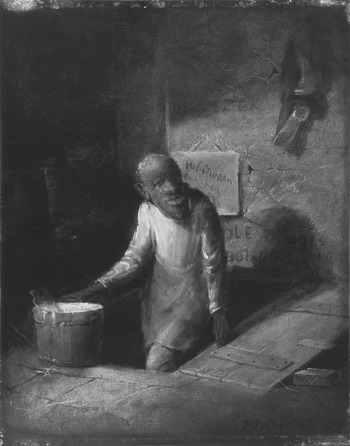
No less unsettling a vision comes in Blythe's Ole Cezer (Figure 3), with its deformed and misshapen grotesque emerging from the murky darkness of a cellar in an equally murky alleyway. Situated as he is in the mouth of the cellar's entrance, it is difficult to judge whether Ole Cezer is being swallowed up by the earth or vomited out. Reading it as a metaphor for the subject position of blacks in antebellum America, we might conclude that it is both. But there is also an overtly excremental tone to this painting. It is not merely that the canvas is a study in fecal browns, but that the shape and colour of Ole Cezer's head is, unmistakably and without putting too fine a point on it, that of shit. As the “hierarchy of the body is transcoded through the hierarchy of the city,”Footnote 27 Blythe locates his abject low racial Other within the literal and symbolic sewers of the city and, in doing so, projects the racial Other as excrement. Emphasizing the contrast between the purity of the white bourgeois subject and the filth of the low Other, Ole Cezer offers a whitewashing service, as evidenced by the bucket that stands before him and the sign that hangs behind. In this sense, as Sarah Burns rightly points out, the image is a version of a “morbid visual pun”Footnote 28 that was replete throughout nineteenth-century popular visual culture, designed to highlight the supposed immutability of race. Conforming to the “corpulent excess”Footnote 29 of the grotesque, Cezer's head is disproportionately large and mask-like. Its obscenely swollen and distorted features are not only oversized, but smudged and smeared almost to the point of erasure, as though this low Other possesses no subjectivity to record. What Burns calls the “veiled expression of racial fear,”Footnote 30 then, we might read as an element of that more fundamental fear of the obliteration of white subjectivity. This anxiety appears throughout Blythe's work. From the stretched and distorted faces of The Hideout (c.1860–63) and Man Putting on Boots (1860) to the “boneless and bloated forms” of Street Urchins (1856–58),Footnote 31 the bourgeois subject is confronted ceaselessly with what Burns refers to as the “domain of nothingness.”Footnote 32
David Gilmour Blythe, Ole Cezer (c.1858–60). Carnegie Museum of Art, Pittsburgh; Gift of Mrs. Mary D. Barnes and Laurence Dilworth in memory of their mother Mrs. Helen Thompson Dilworth.

A similar appropriation of the tropes of carnival appears throughout the literature of the day. In Nathaniel Hawthorne's “My Kinsman, Major Molineaux,”Footnote 33 Robin Molineaux's search for his uncle ends in, at once, both farce and tragedy as he witnesses his esteemed kinsman tarred, feathered, and paraded through the streets subject to the mockery and scorn of the townsfolk. While the appearance of his uncle should have signaled a return of stability and order, in fact it is the main element in the triumph of misrule and disorder. Along with the roiling mass of people is a complementary noise made up of “bursts from many instruments of discord, and a wild and confused laughter” (120). Robin hears the crowd long before he sees it, with the “shouts, the laughter, and the tuneless bray, the antipodes of music, com[ing] onwards with an increasing din” (120), until, at last, the mob appears along with “a band of fearful wind-instruments” (121) whose trumpets “vomited a horrid breath” (122). As his tarred-and-feathered kinsman is paraded past, Robin loses his self-control and is overcome by “a sort of mental inebriety” (122). Hawthorne writes, “the contagion was spreading among the multitude, when all at once it seized upon Robin, and he sent forth a shout of laughter that echoed through the street – every man shook his sides, every man emptied his lungs, but Robin's shout was the loudest there” (123). The chaotic urban world in which Robin finds himself is one of ritual inversion, replete with all those elements of Rabelaisian carnival that, as Bakhtin puts it, “celebrate temporary liberation from the prevailing truth of the established order, [marking] the suspension of all hierarchical rank, privileges, norms and prohibitions.”Footnote 34 Major Molineaux is degraded, made both literally and symbolically low, and order is disrupted as the body of the people mobs its way through the streets. The discordant noise of shouting and screaming, and of those “vomiting” trumpets, is surpassed only by the howling laughter that accompanies the scene.
David Reynolds sees this appropriation of carnival by writers such as Nathaniel Hawthorne, Walt Whitman, Edgar Allen Poe, and George Lippard as driven by an essentially democratizing impulse. George C. Foster particularly, in consistently invoking the image of the rampant, unruly mob by way of emphasizing the chaos of the city, is evidence of writers being “more free than ever to put aside restrictive conventions and to revel in the sights, sounds, and smells of the world around [them].”Footnote 35 Remarking upon the “clatter and confusion” of the city as it “discharges its thousands,”Footnote 36 Foster takes us to late-night dance halls where “the dancers begin contorting their bodies and accelerating their movements, accompanied with shouts of laughter and yells of encouragement and applause until all observance … is forgotten and everyone leaps, stamps, screams and hurras on his or her own hook” (143); we visit theatres characterized by the “loud and threatening noise from the pit, which heaves continually in wild and sullen tumult” competing with the “yells and screams, the shuddering oaths and obscene songs, tumbling down from the third tier,” all mingling with “the convulsive howls and spasmodic bellowings of the actors on the stage” (155); and we witness a “Cyprianic ball” where “all restraint was … laid aside”:
the reckless Cyprians and their excited cavaliers gave loose reins to their prurient tastes and manners; and amid noisy riot and confusion, drunkenness and profanity, the scene toward morning degenerated into a mere orgy … [They] stalked forth in all their naked and disgusting deformity. The inevitable, irresistible tendency of unchasteness, as well as all other forms of dissipation, is to degenerate the creature made in God's image to the likeness of a brute. (156)
In Foster's descriptions we again see the dominant tropes of the carnivalesque – deformity, disproportion, oaths and obscenity, and mocking laughter – invoked in order to situate the unruly lower orders irredeemably beyond the margins of civilized life. Just as Bakhtin asserts that the medieval carnival was “free from all religious and ecclesiastical dogmatism, from all mysticism and piety,” and, in fact, belonged to “an entirely different sphere” of social experience,Footnote 37 so Foster positions his threatening mobs unleashed from the bourgeois piety of restraint, politeness, and self-control. As what Bakhtin would describe as a “world inside out,”Footnote 38 in Foster's New York “one is incessantly struck with the ghastly resemblances to the forms of virtue and purity, everywhere starting out before him” (124). It is a “fetid” (78) world “knee-deep in filth” (77), filled with “human swine” (75), “bleary-eyed, idiotic, beastly wretches” (81), and “abandoned women of the lowest grade” (142). The social and geographical formation of the city, then, becomes the spatial embodiment of the individual physical body of the low Other, both of which are discursively structured as “grotesque.” Like the vulgar intemperate bodies of the prostitutes, drunks, immigrants, Negroes, and Jews, the city too “swallows” and “vomits” (73), for, taken together, the social body of the city and the physical bodies of the lower orders threaten the collapse of the categorical imperatives of bourgeois ideology.
What Reynolds identifies as Foster's freedom to depict the “reality” of the antebellum city in all its depravity, then, is simply another element in the narrativization of the grotesque as a constitutive feature of bourgeois subject formation. All representations of the city are striated by value, and especially so those that invoke the symbolically laden categories of “sights, sounds, and smells.” As much as Foster's urban sensationalism might have “yoked together the high and low in an atmosphere of jolly relativity,”Footnote 39 it served also to construct and maintain those structural distinctions, precisely as it was revelling in the “grimy details” of city life,Footnote 40 details that were vital in shoring up concepts of cleanliness and refinement. Allowing for a symbolic embracing of the unclean through discursive strategies that demanded its simultaneous presence and absence, representations of a city now wholly synonymous with grime and filth returned repeatedly to the “bourgeois study and drawing room, to be read as objects of horror, contempt, pity, and fascination.”Footnote 41 The filth, dirt, and grime of the city, then, could be safely surveyed and consumed through Foster's urban exposés and Blythe's paintings, but also via texts such as reform tracts, temperance fiction, newspapers stories, crime reports, or, indeed, narratives of carnival.
That carnivalesque symbolic formations center around anxious constructions of class and race is made nowhere more explicit than in official responses to the popularity of Negro Election Days and Pinkster celebrations. Beginning in the mid-eighteenth century and characterized by “African-influenced festivity,”Footnote 42 Negro Election Days were the parodic adjunct to official white elections, when blacks, accompanying voting whites to town or city, began to hold elections for their own “governors” and “officials.”Footnote 43 Also rooted in a white, European tradition, Pinkster celebrations were an African American appropriation and transformation of a Dutch spring festival and, similarly, involved the ritual elevation of a reigning individual, in this instance the crowning of a black king.Footnote 44
Replete with the iconography of European carnival, Negro Election Days and Pinkster celebrations both involved parades, feasting, indulgence, ritual inversion, and masking. These “periodic periods of dissipation,” claimed a contemporary observer, dragged together “blacks and a certain class of whites … with children of all countries and colors,” thus forming a “motley group of thousands and presenting to the eye of a moral observer, a kind of chaos of sin and folly, of misery and fun.”Footnote 45 Framing the event in terms of a “dissipation” of order, and invoking a supposedly transcendent, universal discourse of morality, the focus is on the chaotic embodiment of apparently contradictory episodes of misery and fun. This worried observer concentrates on the collapse of the literal and symbolic boundaries between high and low, anxiously projected onto the free co-mingling of not only rural and urban populations, but also and especially black and white workers.
Just as the disorder of the crowd in Hawthorne's and Foster's narratives is discursively constructed through the language of the carnivalesque, so these celebrations were constituted narratively as the embodiment of all that threatened the stability of bourgeois existence. Shane White's argument that Pinkster was the direct American “descendant” of “the [European] activities associated with the festivals of misrule, or the world turned upside down,”Footnote 46 merely serves to underscore the importance of the discourse of carnival in understanding American bourgeois responses to unruly, collective activity.
In the symbolic realm of bourgeois consciousness, carnivalesque images of the distorted and exaggerated grotesque body always appear as the terrifying racial and social Other to the classical self-containment of the bourgeois body. In institutionalizing the freak show as one of the most popular spectacles of the period, P. T. Barnum not only made the distorted and exaggerated body of the “human oddity” available for public entertainment, but displaying “cultural oddities” such as his “Wild Men of Borneo” turned racial distinction into a marker of abjection. This profoundly urban visual spectacle was orchestrated through Barnum's American Museum, which, having first opened in 1841, became by 1850 “the premier attraction of New York City.”Footnote 47 Rooted in the tradition of rational and scientific study, the exhibition of human oddities, or “freaks,” had originally been conceived for the purpose of objective scientific assessment. Indeed, as Robert Bogdan points out, Charles Wilson Peale, having established “America's first museum of indigenous artifacts and natural history” in Philadelphia in 1784, felt some discomfort at the exhibiting of “albinos and other ‘human curiosities’ … [believing] that they attracted too much frivolous attention.”Footnote 48 Though Peale's museum was maintained by his sons after his retirement in 1810, it gradually moved from the impetus to instruct and towards the compulsion to make profitable entertainment, and by the 1830s was displaying “Negro bands, Yankee impersonators, Hungarian minstrels, and musical ladies.”Footnote 49 But it was not until Barnum harnessed the whirling vortex of exhibitionism that came to characterize mid-nineteenth-century urban America that the shift in the registers of display, one in which “freaks were the major attraction,”Footnote 50 was complete:
By the mid-1840s, Barnum's American Museum was in full swing, attracting audiences who were able to view freaks of all sorts. From the Bearded Lady to the “Nova Scotia Giantess,” from the Leopard-Skinned Boy to Zalumma Agra, the famous “Circassian Girl,” and from the Chinese family to the Albino family – if they were deformed, exotic, disproportioned in any way, or simply inclined to be transformed into one of Barnum's freaks … the great showman would put them on the stage of his “Lecture Room” for the inspection of the masses.Footnote 51
The institutionalization of the freak show emerged just as the social experience of carnival was being eliminated and “criminal penitentiaries and insane asylums – institutional homes for humans with ‘aberrational’ tendencies – were becoming an integral part of the American reform culture.”Footnote 52 However, as the unruly body of the low Other – the drunk, the criminal, the insane, and so on – was made increasingly subject to physical removal, it re-emerged symbolically in a wide variety of antebellum discourses. While discourses such as urban sensationalism, temperance fiction, and anti-immigrant propaganda provided fertile terrain, the freak show was a particularly dynamic arena for the staging of this narrative return, not least because of the unavoidable confrontation with the physical actuality of the “aberrational” subject.
While Barnum's exhibits have been traditionally understood as offering largely working-class entertainment, the audience for Barnum's extravagant displays was actually, as James Cook points out, marked by an astonishing heterogeneity. Indeed, Cook argues that exhibits of liminal “nondescripts” such as the Feejee Mermaid and What Is It? that were “patronized by an audience of surprising socioeconomic breadth, from manual laborers with a bit of disposable income to the city's social elite,”Footnote 53 played an especially crucial role in structuring bourgeois subjectivity. All the while, these narratives of freakery allowed the playing out of racial and social difference as part of the very process that saw those differences ever more rigidly invoked. The middle-class fascination with the freak show might have signaled an implicitly democratic embracing of difference; in reality it formed a crucial element in the institutionalization of racial and social identities as part of the wider process of what Lawrence Levine calls the “extensive bifurcations” of culture.Footnote 54 So at the very moment that we can identify the audience for the freak show as characterized by its social diversity, we see also the processes whereby an emergent bourgeoisie was demanding increasing distinctions between those different classes. As James Cook suggests, “it seems safe to say that the contemporaneous emergence of the new middle class and Barnum's living curiosities was hardly coincidental.”Footnote 55
At once both “enticing and sickening,”Footnote 56 the bodies of these “living curiosities” emitted a powerful charge. Insistently refusing the compelling logic of somatic norms, in its profound ambiguity the so-called freak “imperil[s] the very definitions we rely on to classify humans, identities, and sexes.”Footnote 57 And, as the freak body, in its disproportion, hybridity, and excess, transgresses the somatic boundaries of individuated bourgeois subjectivity, it both attacks and reinforces the validity of those boundaries. Situated on the “cusp of this watershed in middle-class identity formation”Footnote 58 the freak served to simultaneously codify the rigid boundaries of the bourgeois subject and yet declare that codification to be “equivocal, perpetual, subject to endless discussion and revision.”Footnote 59
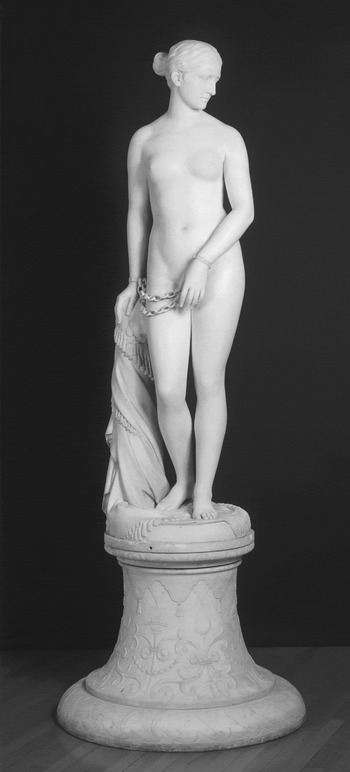
But it was not only narratives of the grotesque that provided the arena for the articulation of these ambiguities and anxieties. Hiram Powers's The Greek Slave (Figure 4), a statue “viewed by more people than any other piece of work in nineteenth-century America,”Footnote 60 is a powerful example of the way that the high includes the low within it, “symbolically, as a primary eroticized constituent of its own fantasy life.”Footnote 61 Designed to embody the highest expression of Christian purity, Powers's statue is a perfect expression of the ideal classical body: “static and monumental … the radiant centre of a transcendent individualism, ‘put on a pedestal’, raised above the viewer and the commonality and anticipating passive admiration from below.”Footnote 62 This image of a young, nude Greek woman, enslaved and enchained by her Turkish captors, was meant, as Powers put it, to “awaken the highest emotions of the soul for the pure and beautiful.”Footnote 63 And yet, for all her modesty and “dignified defiance,”Footnote 64 her nudity and sexual availability present a highly eroticized figure.
Hiram Powers, The Greek Slave (1851, after original 1844). Yale University Art Gallery. Olive Louise Dann Fund.

Anticipating potential criticism over the sexually explicit nature of his figure, Powers developed narratives, both visual and written, that he believed would deflect any suggestion of immorality. As part of the visual narrative, Powers made sure to include among the slave's few possessions both a crucifix and a locket, thus locating the figure within recognizable registers of domestic and Christian virtue. Similarly, the written narrative in pamphlet form that accompanied the figure on its travels around the museums and galleries of the United States was designed to give audiences “access to a story that encased the nude figure in a protective web of explanation.”Footnote 65 This tale of Turkish enslavement legitimated the figure's nudity and validated the voyeuristic consumption of the white sexualized female body. In this way, not only was the Greek slave “absolved from responsibility for her own downfall,”Footnote 66 but the audience too was relieved of any responsibility, or guilt, for its own erotic pleasure.
In this compelling melange of chastity and abandonment, Powers's Greek Slave replicates the discursive strategies seen so often in that most popular of contemporary literary forms, the captivity narrative. Initially emerging in the seventeenth century as a discursive framework for the contextualization of Puritan theology, by the nineteenth century the captivity narrative had become a crucial arena for the articulation and consolidation of anxieties over the complicated and dynamic nature of white, bourgeois subjectivity.Footnote 67 And from the first publication in 1682 of Mary Rowlandson's Sovereignty and Goodness of God, the fundamental structure of the captivity narrative remained largely consistent, following a narrative trajectory of what June Namias has identified as capture, liminality, and redemption.Footnote 68 R. W. B. Stratton's Captivity of the Oatman Girls, one of the most widely read narratives of the mid-nineteenth century, is representative in that almost all of the narrative tension rests in the constant threat of imminent sexual contact between Olive Oatman and her Indian captors. As all cultural domains are “continually structured, legitimated, and dissolved”Footnote 69 in reference to each other, any sexual encounter between Olive and the Indian would imply not only a transgression of sexual codes, but a disruption of the broad categorical structures of antebellum culture. In this way, the threat is not so much of an assault upon Christian morality, but of an act of violence upon the unstable framework of bourgeois subjectivity. The sexual transgression, ultimately and inevitably, never takes place, and at the conclusion of the story Olive Oatman is keen to state, “to the honor of these savages let it be said, they never offered the least unchaste abuse to me.”Footnote 70 Having teased the reader continuously with the simultaneously horrifying and fascinating threat of a miscegenistic sexual encounter, Olive remains pure and returns to civilization. The structures of bourgeois subjectivity remain unchallenged.
The Greek Slave is a captivity narrative in sculpted form and, broadly constructed as victim and virgin, her hybridized body – like that of Olive Oatman – simultaneously offers a vision of white, ordered, chaste bourgeois subjectivity, and a dynamic and intoxicating vision of transgressive sexual license and violence. She is at one and the same time in a state of both capture and redemption. Though naked and in chains, she is nevertheless present within the symbolic arena of the high of the gallery and museum, and draped in the mantle of Christian piety. But it is her occupation of that liminal space between the two subject positions that provides the opportunity for, and offers a window onto, the fantasy of sexual transgression and abandonment. That the hybrid figure expresses the “essential principle” of Bakhtin's grotesque realism of degradation and “the lowering of all that is high, spiritual, ideal, abstract”Footnote 71 explains why Powers's accompanying sanitizing narratives so insistently focus on the spiritual. Though The Greek Slave is reliant for its symbolic power on the complementary and disordering axes of disgust and desire, Powers attempts to neutralize any destabilizing erotic implications by emphasizing the figure's transcendent spirituality, claiming that “it is not her person but her spirit that stands exposed.”Footnote 72 But, mutually constitutive as they are, access to the high is structurally dependent on the presence of the low. Indeed, it is only in the body's proximity to the low and its expression of such earthy and lustful carnality that the potential for such spiritual transcendence might even be possible. Consequently, any efforts to displace the focus from the degraded to the high are doomed, for, as Robert Hughes says, it is her “unwilling nakedness” itself that embodies “the purest form of the Ideal, the triumph of Christian virtue over sin.”Footnote 73
Straddling the classificatory boundary between high and low, and between purity and degradation, the hybrid figure of Powers's Greek slave offers a series of conflicting significations and presents the troubling possibility of “new combinations and strange instabilities”Footnote 74 within the dominant structures of antebellum bourgeois ideology. There is no more potent a signification in the context of antebellum culture than that of slavery and, indeed, a significant element of the statue's transgressive erotic charge is that it is so clearly a white woman who is being made sexually available as an object of purchase and consumption. Just as Joy Kasson suggests that the statue “served viewers as a focus for their intensely ambivalent interest in the human body and female sexuality in particular,”Footnote 75 we can see that her identity as a slave speaks similarly to deep ambivalences over race.
Throughout antebellum America, masking and blackface had been ubiquitous features of all crowd-directed social disorder, from battling fire crews, to race riots, to anti-rent protests. And, as it became institutionalized through the form of the staged minstrel show, blackface minstrel performance became increasingly, for its white audiences, the central component in the complex development of racial and social identity. Foregrounding the dialogic nature of subjectivity by revealing the reliance of a dominant discourse of “whiteness” upon its constitutive Other of “blackness,” the hybrid body of the blackface did not offer a turning of the world upside down so much as a point of entry for the interrogation of the categories that structured those constitutive extremes. Never an issue merely of racism, the complexity of white assumptions, distortions, and constructions of “blackness” allowed for a multiplicity of possible subject positions that might be negotiated between the white audience and the blackface performer. That the “manifest crux of blackface”Footnote 76was race does not deny its simultaneous use as, for example, a vehicle for emotional release, the nostalgic longing for a preindustrial past, or a resistant critique of emerging patterns of social discipline.Footnote 77 From the 1830s onwards, as the minstrel body made its way from the stage to cross into the broad arena of nineteenth-century visual culture, “blackface stereotyping became more crude and vicious.”Footnote 78 The complex work of black stereotypes such as Jim Crow, Zip Coon, and Sambo, with their hybrid origins in minstrelsy, continued to play a crucial role in the “mobile, conflictual fusion of power, fear and desire”Footnote 79 at the core of white American identity. But regardless of the multivalent readings on offer, race clearly was the determinant subject position, and there was a consistency to the representation of the minstrel body itself – contorted, distorted, caricatured, and, of course, black – that, as in other discursive arenas, structured the body of the racial Other as grotesque.
The complex social and cultural diversity of the minstrel show was reflective of not only the contemporary theater but of antebellum culture generally. The boundaries that, by the end of the nineteenth century, mapped out sharp distinctions between class-specific forms of entertainment had been, prior to these middling decades, profoundly blurred. All forms of “expressive culture” existed as part of a characteristic heteroglot diversity of expression in which, for instance, minstrel shows, the opera, freak shows, painting, and sculpture would be “experienced in the midst of a broad range of other cultural genres by a catholic audience that cut through class and social lines.”Footnote 80
Landscape painting, too, formed a significant element of this visual experience and, indeed, was promoted by the American Art Union as a “therapeutic antidote to urbanization.”Footnote 81 This not only indicates its importance in structuring discursive distinctions between “country” and “city,” but also underlines its crucial importance in the articulation of an ideologically cohesive subject position in which the white bourgeois gaze could be structured to understand itself in terms of rights of order, possession, and representation. Though scholarly analysis of landscape painting may have shifted in recent decades, “from celebration to interrogation,” as Sarah Burns puts it,Footnote 82 the genre has maintained its dominant presence at the center of critical attention. It is accepted that landscape images, most notably those of the Hudson River School, attempted to map out a representational field that laid claim to a shared and consensual American identity rooted in the land, that was not only ordered and unique, but clearly separate from Europe. But any sense of a shared and consensual identity was constantly subject to contestation, dissent, and deep ambivalences through the forms discussed above. Alternative subject positions elided by those representations of landscape that validated a normative American identity as white, male, bourgeois, and republican subsequently found themselves expressed in multiple and complicated ways, most especially through representations of an unruly and chaotic urban landscape. Considering the significance of images of landscape, it should come as no surprise, then, to see the figure of the grotesque Other cavorting with such frequency across the diverse alternative visual and verbal landscapes of antebellum America.
Arguing that the “political imperative to reject and eliminate the debasing ‘low’ conflicts powerfully and unpredictably with a desire for this Other,”Footnote 83 Stallybrass and White suggest that a profound combination of both abhorrence and enthralment will inevitably shape the social and cultural discourses in which the low Other features. Those grotesque bodies – the blackface minstrel, Blythe's urchins, Hawthorne's mob, Foster's Cyprianic prostitutes, Barnum's freaks – literally embody the antithesis of the acceptable bourgeois subject. At the same time their ubiquitous narrative presence reveals the mutually constitutive and structural dependence of bourgeois subjectivity upon those “Others” being marginalized, excluded, and rejected. Their presence indicates, further, not only the shared cultural labor performed by the broad sweep of antebellum visual and written forms but also, as a most fundamental element of that labor, the compelling utility of the carnivalesque in making “the grotesque visible while keeping it at an untouchable distance.”Footnote 84