Introduction
In recent years, human resource management (HRM) departments in Chinese firms have shifted from a focus on traditional administrative tasks relating to labor and personnel to strategic HRM functions (Cai, Morris, & Chen, Reference Cai, Morris and Chen2011; Xian, Atkinson, & Meng-Lewis, Reference Xian, Atkinson and Meng-Lewis2019). Therefore, as an increasingly important instrument for achieving organizational strategic goals (Wang, Baba, Hackett, & Hong, Reference Wang, Baba, Hackett and Hong2019), high-performance work system (HPWS) has received considerable critical attention in both HRM literature and practice.
Although most previous HRM studies focus on the relationship between HPWS and organizational performance (Combs, Liu, Hall, & Ketchen, Reference Combs, Liu, Hall and Ketchen2006; Wright, Gardner, Moynihan, & Allen, Reference Wright, Gardner, Moynihan and Allen2005; Wu, Hoque, Bacon, & Bou Llusar, Reference Wu, Hoque, Bacon and Bou Llusar2015), scholars have pointed out that HPWS affects organizational performance through individual employees (Jiang, Lepak, Hu, & Baer, Reference Jiang, Lepak, Hu and Baer2012). Moreover, employees’ accurate perceptions of HPWS have a significant influence on the ultimate effect of HPWS (De Reuver, Van de Voorde, & Kilroy, Reference De Reuver, Van de Voorde and Kilroy2019; Harley, Sargent, & Allen, Reference Harley, Sargent and Allen2010; Xi, Chen, & Zhao, Reference Xi, Chen and Zhao2019). To date, there have been mixed findings regarding the effect of HPWS on employees. Some studies report that the implementation of HPWS results in positive employee outcomes (Alfes, Veld, & Fürstenberg, Reference Alfes, Veld and Fürstenberg2021; Behravesh, Tanova, & Abubakar, Reference Behravesh, Tanova and Abubakar2020; Fan, Cui, Zhang, Zhu, Charmine, & Nyland, Reference Fan, Cui, Zhang, Zhu, Charmine and Nyland2014; Miao, Bozionelos, Zhou, & Newman, Reference Miao, Bozionelos, Zhou and Newman2021; Song, Yu, & Qu, Reference Song, Yu and Qu2021; Wu & Chaturvedi, Reference Wu and Chaturvedi2009; Yan, Hu, & Xu, Reference Yan, Hu and Xu2016). These evidences indicate that HPWS creates a beneficial exchange relationship between organizations and employees because resources offered through HPWS enhance employees’ abilities, motivations and opportunities to work (Behravesh, Tanova, & Abubakar, Reference Behravesh, Tanova and Abubakar2020). However, despite some positive findings, scholars also note that HPWS can result in negative consequences. For instance, some recognize that HPWS is a management tool used to achieve organizational strategic goals (Kroon, Van de Voorde, & Van Veldhoven, Reference Kroon, Van de Voorde and Van Veldhoven2009) and that high job demands inevitably coexist with job resources in HPWS because of the profit orientation of enterprises (Qi, Enhua, Jiandong, & Hongmei, Reference Qi, Enhua, Jiandong and Hongmei2021). Therefore, organizations may focus on their performance but ignore employees’ well-being when implementing HPWS. Ultimately, job demands may accelerate job resource consumption, leading to increased work stress that negatively impacts employees (Jensen, Patel, & Messersmith, Reference Jensen, Patel and Messersmith2013; Wang, Xing, & Zhang, Reference Wang, Xing and Zhang2021; Xu & Lv, Reference Xu and Lv2018).
Because of these opposing perspectives, many scholars have called for further research on HPWS to develop a comprehensive understanding of its effect (Han, Sun, & Wang, Reference Han, Sun and Wang2020; Jiang et al., Reference Jiang, Lepak, Hu and Baer2012). Considering that job satisfaction is one of the pivotal variables that determines employees’ behaviors (Viseu, Pinto, Borralha, & de Jesus, Reference Viseu, Pinto, Borralha and de Jesus2020) and that the relationship between HPWS and job satisfaction is particularly ambiguous (García-Chas, Neira-Fontela, & Varela-Neira, Reference García-Chas, Neira-Fontela and Varela-Neira2016; Heffernan & Dundon, Reference Heffernan and Dundon2016; Xian, Atkinson, & Meng-Lewis, Reference Xian, Atkinson and Meng-Lewis2019), this study is designed to explore the double-edged sword effects of employees’ perceived HPWS on job satisfaction.
As mentioned above, HPWS is not always a panacea. It can also be a ‘wolf in sheep’s clothing’ (Kroon, Van de Voorde, & Van Veldhoven, Reference Kroon, Van de Voorde and Van Veldhoven2009), as exemplified by empirical evidence demonstrating that HPWS is negatively associated with job satisfaction (Heffernan & Dundon, Reference Heffernan and Dundon2016). When viewing HPWS through the Job Demands-Resources (JD-R) model, it is a combination of job resources and job demands (Demerouti, Baaker, Nachreiner, & Schaufeli, Reference Demerouti, Baaker, Nachreiner and Schaufeli2001; Jensen, Patel, & Messersmith, Reference Jensen, Patel and Messersmith2013; Qi et al., Reference Qi, Enhua, Jiandong and Hongmei2021). Therefore, the influence that HPWS has on job satisfaction is complicated and not fully understood. As job resources that encourage employees to better accomplish their assignments and job demands that create stressful situations are combined into HPWS simultaneously (Han, Sun, & Wang, Reference Han, Sun and Wang2020; Qi et al., Reference Qi, Enhua, Jiandong and Hongmei2021), we provide new insights into an inverted U-shaped relationship between HPWS (a combination of job resources and job demands) and job satisfaction by adopting the ‘too much of a good thing’ (TMGT) theory (Pierce & Aguinis, Reference Pierce and Aguinis2011). The theoretical model presented in this paper challenges existing literature that shows a linear effect of HPWS and extends our understanding of the influence that HPWS has on job satisfaction.
Scholars who call for more investigation on HPWS argue that previous studies primarily pay attention to the job resources provided by HPWS but neglect the high demands and overwhelming assignments resulting from HPWS (Han, Sun, & Wang, Reference Han, Sun and Wang2020). In support of this argument, several studies suggest that HPWS may lead to strain and work overload (Van de Voorde, Paauwe, & Van Veldhoven, Reference Van de Voorde, Paauwe and Van Veldhoven2011), work intensification, higher work demands and more stress (García-Chas, Neira-Fontela, & Varela-Neira, Reference García-Chas, Neira-Fontela and Varela-Neira2016). Further, Jensen, Patel, and Messersmith (Reference Jensen, Patel and Messersmith2013) found that role overload ,an indicator reflecting work overload, plays a mediating role in the HPWS–job satisfaction relationship. Based on these perspectives, we deem that employees’ job satisfaction can be impeded by strong perceptions of work pressure. Therefore, we infer that work overload may, in itself, play a mediating role in the relationship between HPWS and job satisfaction and we seek to further understand this relationship.
Furthermore, inconclusive evidences suggest that the relationship between HPWS and job satisfaction may depend on moderating variables, and previous studies have called for exploration of the moderating role of person–organization fit (P–O fit) in the complex influencing mechanisms of HPWS (Boon, Den Hartog, Boselie, & Paauwe, Reference Boon, Den Hartog, Boselie and Paauwe2011). According to the P–O fit theory, employees who have a good fit with their organization will better understand the organization’s objectives and values. Therefore P–O fit, as a condition describing the compatibility between individuals and organizations (Muchinsky & Monahan, Reference Muchinsky and Monahan1987), is argued to be a crucial moderating factor (Alniaçik, Alniaçik, Erat, & Akçin, Reference Alniaçik, Alniaçik, Erat and Akçin2013; Boon et al., Reference Boon, Den Hartog, Boselie and Paauwe2011; Jehanzeb & Mohanty, Reference Jehanzeb and Mohanty2018) and should be taken into consideration when studying the effects of HPWS. This indicates that it is necessary to explore how P–O fit moderates the relationship between HPWS and job satisfaction.
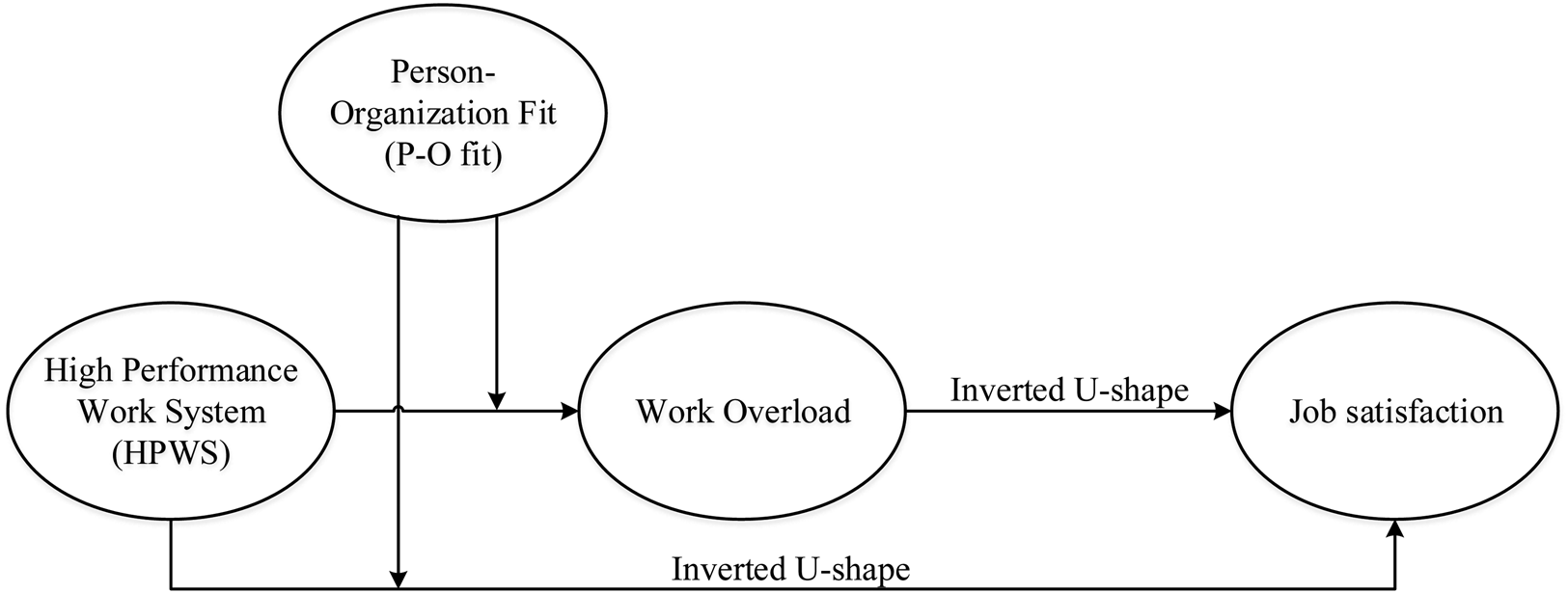
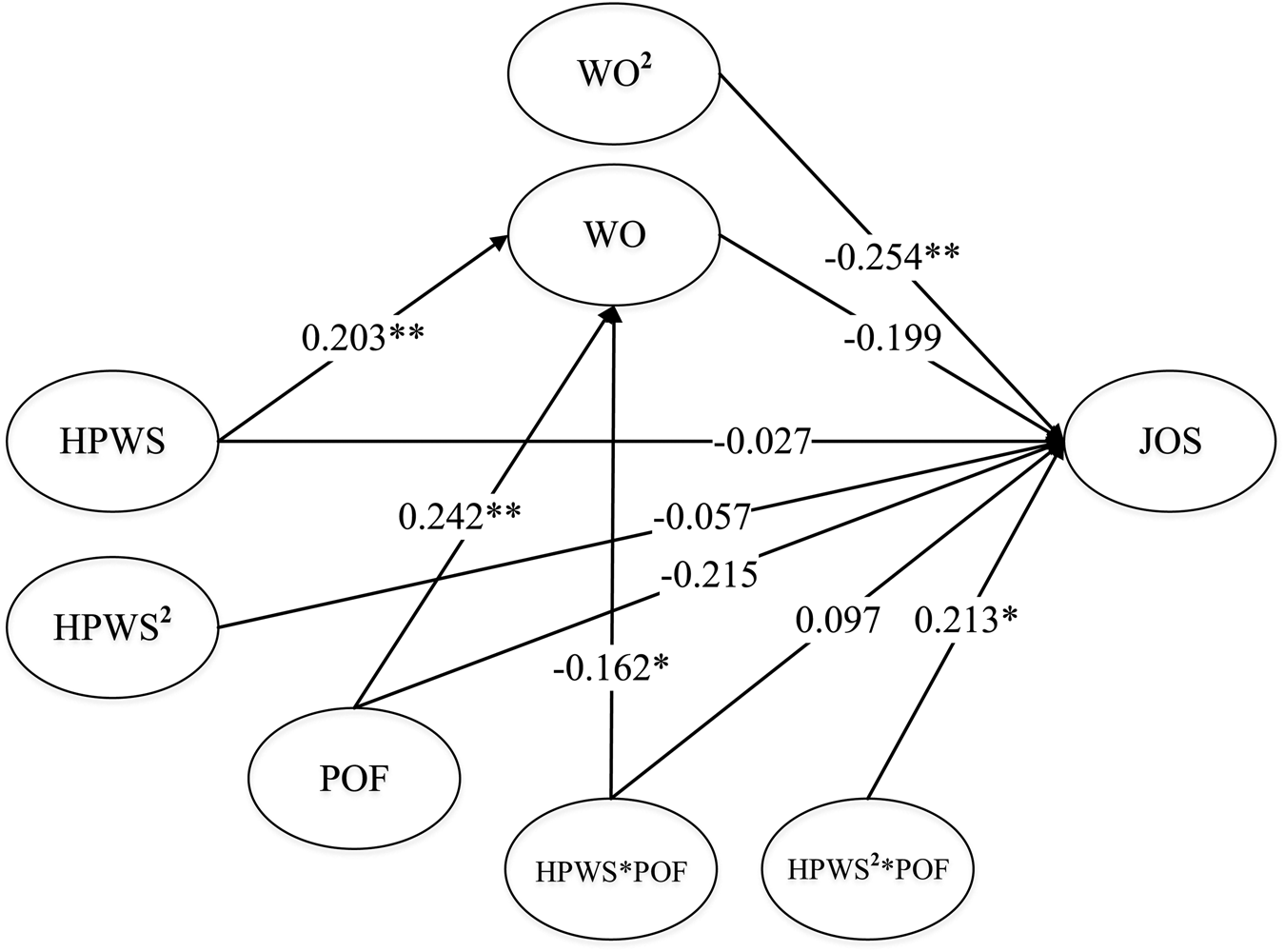
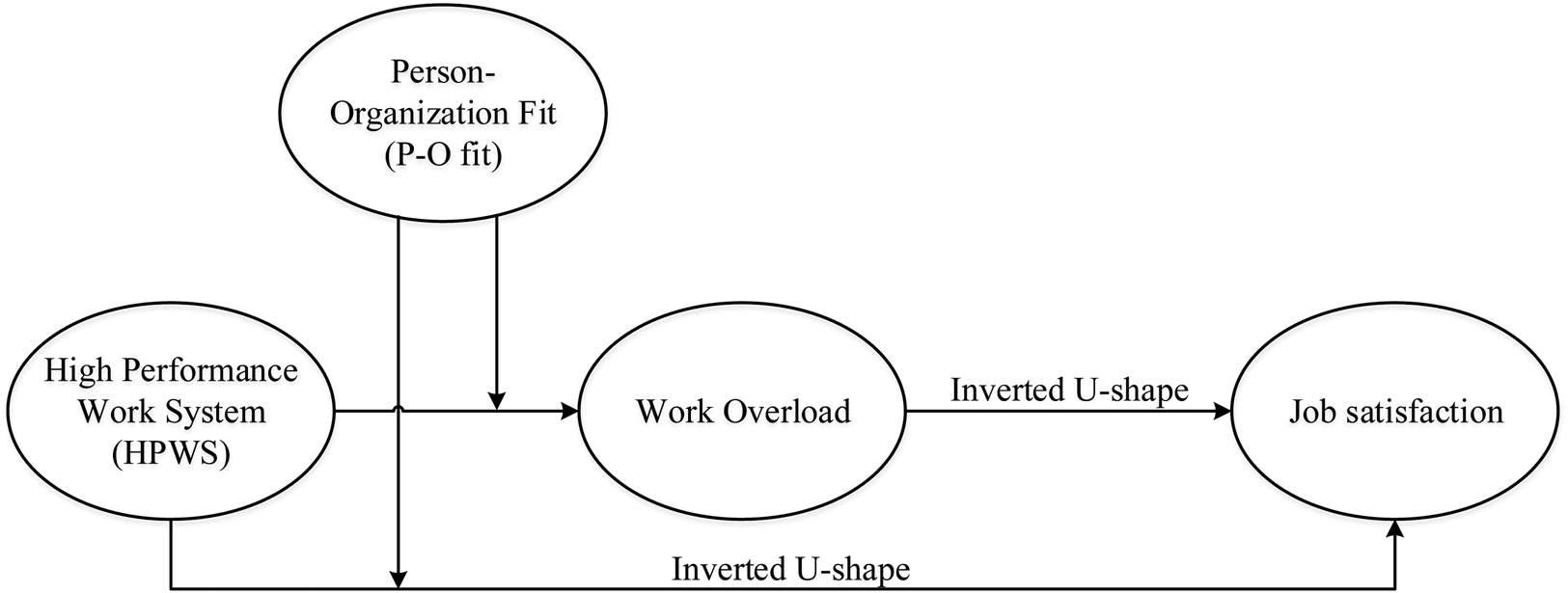
Overall, this study aims to contribute to the literature by (a) examining the nonlinear relationship between HPWS and job satisfaction; (b) exploring the mediating role of work overload in the relationship between HPWS and job satisfaction; and (c) investigating how P–O fit moderates the effect of HPWS on job satisfaction. Ultimately, this paper attempts to advance the theoretical development of HPWS and the understanding of its practical implications. The theoretical model is presented in Figure 1.
Theoretical model.
Theoretical development and hypotheses
HPWS and job satisfaction
HPWS, defined as a series of integrated and systematic HRM practices (Han, Sun, & Wang, Reference Han, Sun and Wang2020; Macky & Boxall, Reference Macky and Boxall2007), can positively influence employees’ attitudes and behaviors and improve both individual and organizational performance (Takeuchi, Chen, & Lepak, Reference Takeuchi, Chen and Lepak2009; Wang et al., Reference Wang, Baba, Hackett and Hong2019). Regarding the dimension of HPWS, there is a consensus among scholars that recruitment and selection, training systems, job design, performance management, information sharing, performance-based incentives, and welfare protection are relatively important components (Behravesh, Tanova, & Abubakar, Reference Behravesh, Tanova and Abubakar2020; Macky & Boxall, Reference Macky and Boxall2007; Miao, Lu, Cao, & Du, Reference Miao, Lu, Cao and Du2020). Recently, employee experienced HPWS has received more attention because scholars and practitioners recognize that employees have different perceptions of management practices and employees’ perceived HPWS has the most immediate impact on their attitudes and behaviors (Cai, Morris, & Chen, Reference Cai, Morris and Chen2011; Xu & Lv, Reference Xu and Lv2018). Therefore, this paper uses the employees’ perceptions of HPWS when exploring the relationship between HPWS and job satisfaction.
Job satisfaction, as a form of affective well-being, refers to ‘a pleasure or positive emotional state resulting from the appraisal of one’s job or work experiences’ (Locke, Reference Locke1976: 1300). A considerable amount of literature supports the positive effect of HPWS on job satisfaction (Fabi, Lacoursière, & Raymond, Reference Fabi, Lacoursière and Raymond2015; García-Chas, Neira-Fontela, & Castro-Casal, Reference García-Chas, Neira-Fontela and Castro-Casal2014; García-Chas, Neira-Fontela, & Varela-Neira, Reference García-Chas, Neira-Fontela and Varela-Neira2016; Messersmith, Patel, Lepak, & Gould-Williams, Reference Messersmith, Patel, Lepak and Gould-Williams2011). However, Heffernan and Dundon (Reference Heffernan and Dundon2016) have also provided evidence of a negative association between HPWS and job satisfaction. Overall, HPWS not only provides employees with job resources, but simultaneously puts higher job demands on them (Han, Sun, & Wang, Reference Han, Sun and Wang2020; Kroon, Van de Voorde, & Van Veldhoven, Reference Kroon, Van de Voorde and Van Veldhoven2009). The effect of HPWS on job satisfaction is thus jointly influenced by job resources and job demands.
According to the TMGT theory, the TMGT effect occurs when ordinarily beneficial antecedents (i.e., HPWS) reach inflection points after which their relations with desired outcomes (i.e., job satisfaction) cease to be linear and positive (Grant & Schwartz, Reference Grant and Schwartz2011). Exceeding the inflection point is always undesirable because it leads either to waste (no additional benefit) or, worse, to undesirable outcomes (i.e., decreased job satisfaction), which can account for an apparent paradox in organizational life (Pierce & Aguinis, Reference Pierce and Aguinis2011). Scholars also suggested that the potential exploratory mechanism behind the TMGT effect is that the influencing process of the antecedent contains mutually independent or interrelated antagonistic relationships, which are combined as a ‘net effect’ in the relationship between the antecedent and the outcomes (Pierce & Aguinis, Reference Pierce and Aguinis2011; Xing, Sun, Yin, & Wang, Reference Xing, Sun, Yin and Wang2018).
For the linkage of HPWS and job satisfaction, when the level of HPWS is low, employees are more susceptible to job resources (Doane, Schumm, & Hobfoll, Reference Doane, Schumm, Hobfoll, Törnblom and Kazemi2012) such as performance feedback and autonomy. But shortages of those resources lead to maladaptive coping and a reduction of job satisfaction (Alarcon, Reference Alarcon2011; Demerouti et al., Reference Demerouti, Baaker, Nachreiner and Schaufeli2001). As HPWS becomes more robust, the satisfaction utility of job resources increases gradually and the beneficial effect of job resources outweighs the detrimental effect of job demands. In this case, the higher the level of HPWS, the more satisfied employees will be with their job (García-Chas, Neira-Fontela, & Varela-Neira, Reference García-Chas, Neira-Fontela and Varela-Neira2016; Zhang, Akhtar, Bal, Zhang, & Talat, Reference Zhang, Akhtar, Bal, Zhang and Talat2018). When HPWS is at a moderate level, the marginal beneficial effect of job resources provided by HPWS is equivalent to the marginal detrimental effect of job demands. Therefore, a moderate level of HPWS gives the highest level of job satisfaction.
According to the TMGT effect (Pierce & Aguinis, Reference Pierce and Aguinis2011; Xing et al., Reference Xing, Sun, Yin and Wang2018), when HPWS exceeds a moderate level, and escalates further, the marginal loss of HPWS exceeds its marginal increase. HPWS is initially designed to optimize organizational performance and often requires that employees devote extra effort to enhance their skills and abilities. As skills and abilities increase, employees are subjected to additional tasks and higher work demands (Kroon, Van de Voorde, & Van Veldhoven, Reference Kroon, Van de Voorde and Van Veldhoven2009). In order to meet the increased job demands, employees must maintain existing job resources and acquire new job resources (see Conservation of Resources Theory [Hobfoll, Reference Hobfoll1989]). However, the increased job demands come at the expense of greater individual resources such as time and energy. What’s more, job demands induce the process of potential individual resource loss (Han, Sun, & Wang, Reference Han, Sun and Wang2020). Under high levels of HPWS, the resources employees invest are insufficient, making it difficult to meet higher job demands. Employees become more sensitive to resource loss and their perceptions of demands, leading to a resource-loss spiral that increases work stress (Halbesleben, Neveu, Paustian-Underdahl, & Westman, Reference Halbesleben, Neveu, Paustian-Underdahl and Westman2014; Huang, Fan, Su, & Wu, Reference Huang, Fan, Su and Wu2018). In this case, HPWS has adverse consequences for employees and organizations, including decreased job satisfaction (Heffernan & Dundon, Reference Heffernan and Dundon2016; Jamal, Reference Jamal1999; Qi et al., Reference Qi, Enhua, Jiandong and Hongmei2021). Additionally, chronic high demands make employees think that their organizations do not provide them with corresponding support to accomplish the work, leading to disappointment and other bad experiences (Hakanen, Schaufeli, & Ahola, Reference Hakanen, Schaufeli and Ahola2008). Therefore, we propose that increasing HPWS has a positive impact on job satisfaction up to a point, but around this inflection point the effect approaches zero and then becomes negative.
Hypothesis 1: There is an inverted U-shaped relationship between HPWS and job satisfaction, that is, HPWS is positively related to job satisfaction to a point, and beyond this point the relationship between HPWS and job satisfaction becomes negative.
Mediating role of work overload
Work overload refers to experiencing intense work levels while handling many different demands of one’s occupation and everyday life (Schlotz, Hellhammer, Schulz, & Stone, Reference Schlotz, Hellhammer, Schulz and Stone2004). It is a prevalent stressor and has a strong link with HPWS and job satisfaction (Van de Voorde, Paauwe, & Van Veldhoven, Reference Van de Voorde, Paauwe and Van Veldhoven2011). However, few studies have examined work overload’s role as a mediator in the relationship between HPWS and job satisfaction.
Some scholars suggest that HPWS aims to create organizational competitive advantages and excellent performance but does so at the expense of individual employees (Jensen & van de Voorde, Reference Jensen, van de Voorde, Ashkanasy, Bennet and Martinko2016; Jensen, Patel, & Messersmith, Reference Jensen, Patel and Messersmith2013). Thus, it engenders increasing work demands and chronic work-related stressors, and consequently results in work overload (Heffernan & Dundon, Reference Heffernan and Dundon2016; Van de Voorde, Paauwe, & Van Veldhoven, Reference Van de Voorde, Paauwe and Van Veldhoven2011). We posit that very high levels of HPWS are accompanied by excessive job demands, resulting in overwhelming work assignments, long, difficult working hours, and thus heavy work overload. Therefore, we hypothesize that high levels of HPWS are associated with more work overload.
Hypothesis 2a: HPWS is positively related to work overload.
Extensive research has found that job-related stressors like work overload can cause employee burnout and job dissatisfaction (Altaf & Wan, Reference Altaf and Wan2011; De Beer, Pienaar, & Rothmann, Reference De Beer, Pienaar and Rothmann2016; Nirel, Shirom, & Ismail, Reference Nirel, Shirom and Ismail2004). However, scholars have already drawn attention to the paradox in stressors, indicating that stressors may have a non-monotonic impact on well-being (Anderson, Reference Anderson1976). When the level of work overload is too low, employees have sufficient time to finish tasks. They are unmotivated and feel that their work is easy and can be accomplished without difficulty, leading to low levels of work engagement, performance, and job satisfaction. From this level, with increasing work overload, employees’ work motivation, work engagement, and performance rise gradually (Westman & Eden, Reference Westman and Eden1996). When work overload is at a moderate level, employees find that their work is challenging and that they are competent to complete it, which maximizes job satisfaction (Feng, Li, Liang, & Wang, Reference Feng, Li, Liang and Wang2017). However, when work overload surpasses this moderate level and increases further, employees may feel that they have to sacrifice their extra time and energy to complete the difficult or overwhelming work, causing anxiety, emotional exhaustion, and decreased job satisfaction (Altaf & Wan, Reference Altaf and Wan2011; Nirel, Shirom, & Ismail, Reference Nirel, Shirom and Ismail2004). Therefore, we argue that employees’ job satisfaction is lower at low and high levels of work overload rather than at an intermediate level of work overload.
Hypothesis 2b: There is an inverted U-shaped relationship between work overload and job satisfaction.
In summary, when the level of HPWS is low, employees have relatively sufficient job resources to deal with their work, leading to low levels of work overload. However, they are also unmotivated and don’t feel fulfilled as their work can be accomplished without difficulty, leading to low levels of job satisfaction. With increasing levels of HPWS, employees must invest more working hours to accomplish work assignments, consequently resulting in increasing work overload (Van de Voorde & Beijer, Reference Van de Voorde and Beijer2015; Van de Voorde, Paauwe, & Van Veldhoven, Reference Van de Voorde, Paauwe and Van Veldhoven2011). When work overload increases to a moderate level, employees find their work challenging and they feel a sense of achievement and competence to complete it, maximizing job satisfaction (Feng et al., Reference Feng, Li, Liang and Wang2017). But when work overload increases further, employees sacrifice their extra time and energy to get the overwhelming work done, causing exhaustion and decreased job satisfaction (Altaf & Wan, Reference Altaf and Wan2011; Nirel, Shirom, & Ismail, Reference Nirel, Shirom and Ismail2004). Thus, we infer that work overload may play a mediating role in the relationship between HPWS and job satisfaction.
Hypothesis 2c: Work overload mediates the relationship between HPWS and job satisfaction.
Moderating role of P–O Fit
It has been acknowledged that the effect of HPWS on individual outcomes also depends on some boundary conditions (García-Chas, Neira-Fontela, & Varela-Neira, Reference García-Chas, Neira-Fontela and Varela-Neira2016; Han, Sun, & Wang, Reference Han, Sun and Wang2020; Zhang, Zhu, Dowling, & Bartram, Reference Zhang, Zhu, Dowling and Bartram2013). P–O fit, a condition defined as the congruence between the norms and values of an organization and the values of its employees (Alniaçik et al., Reference Alniaçik, Alniaçik, Erat and Akçin2013; Chatman, Reference Chatman1989), has a significant impact on employees’ screening and attribution of organizational information, which may influence the effects of HPWS on both work overload and job satisfaction.
Previous studies have suggested that employees with higher P–O fit are more likely to identify with organizational values and policies (Erdogan & Bauer, Reference Erdogan and Bauer2005) and that their work attitudes and behaviors are more consistent with what the organization desires and more in line with organizational values (Hamstra, Van Vianen, & Koen, Reference Hamstra, Van Vianen and Koen2019). Besides, employees with higher P–O fit are more intrinsically and autonomously motivated (Saether, Reference Saether2019). The motivation resulting from P–O fit is considered as a resource that can be interchangeable with other resources, such as HPWS (Hobfoll, Reference Hobfoll1989, Reference Hobfoll2001). According to the resource replacement hypothesis (a crucial component of Conservation of Resources Theory [Hobfoll, Reference Hobfoll1989]), when employees’ resources are insufficient (e.g., job resources provided by HPWS are at a low level), they may employ other resources (e.g., motivation resulting from high P–O fit) to protect their job satisfaction, which means P–O fit offsets partial effects of HPWS on job satisfaction (Hobfoll, Reference Hobfoll1989). Therefore, employees with high P–O fit, as they find work assignments interesting and inspiring (Afsar, Badir, & Khan, Reference Afsar, Badir and Khan2015), may have adequate motivation to compensate for deficient resources at low levels of HPWS. Additionally, these employees will better manage the demands of high HPWS and will be prone to experience job satisfaction (Downes, Kristof-Brown, Judge, & Darnold, Reference Downes, Kristof-Brown, Judge and Darnold2017; García-Chas, Neira-Fontela, & Varela-Neira, Reference García-Chas, Neira-Fontela and Varela-Neira2016; Hayati & Caniago, Reference Hayati and Caniago2012). Thus, we suggest that employees’ P–O fit can moderate the influence of HPWS on job satisfaction: the effect of HPWS on job satisfaction is weaker for employees with high P–O fit when compared to employees with low P–O fit.
Hypothesis 3a: P–O fit moderates the relationship between HPWS and job satisfaction, specifically, P–O fit buffers the relationship between HPWS and job satisfaction.
Based on P–O fit theory and previous studies, we also theorize that P–O fit moderates the relationship between HPWS and work overload. Employees who have a greater degree of P–O fit are more likely to perform in ways that the organization values and have a better understanding of what the organization needs and wants (Bretz & Judge, Reference Bretz and Judge1994; Erdogan & Bauer, Reference Erdogan and Bauer2005; Gregory, Albritton, & Osmonbekov, Reference Gregory, Albritton and Osmonbekov2010). Overall, it is reasonable to infer that P–O fit creates conditions conducive to employees better identifying with and understanding the HPWS implemented by their organization (Fernandes, Rezaee, & Appio, Reference Fernandes, Rezaee and Appio2019; Hamstra, Van Vianen, & Koen, Reference Hamstra, Van Vianen and Koen2019). Employees with higher P–O fit are expected to perceive higher job demands and overwhelming assignments generated by an HPWS as challenges rather than as chronic and intensive pressure, which leads to less work overload. Thus, we anticipate that P–O fit can buffer the effect of HPWS on work overload.
Hypothesis 3b: P–O fit negatively moderates the relationship between HPWS and work overload.
Method
Study 1
Sample and procedure
The sampling took place during the coronavirus disease 2019 (COVID-19) pandemic, making face-to-face interactions an unsuitable method of data collection. Therefore, we used WJX, a professional online survey, assessment and voting platform to collect data from employees. The research design, sampling method and research scales were reviewed and supported by the university ethics committee. The questionnaire contains items measuring HPWS, job satisfaction, work overload, and P–O fit, and we asked respondents to self-evaluate based on their perceptions. In an effort to increase response accuracy, all of the participants were informed in the survey instructions that their responses would be treated confidentially and they received corresponding rewards after answering the questions. Data for 306 participants were subsequently dropped for careless responses. The final sample consisted of 220 valid responses. The individual response rate was 71.9 percent. SPSS 23 and MPLUS 7.4 were used to analyze the samples. Sample characteristics are shown in Table 1.
Sample characteristics for study 1

Measures
All survey questions were derived from existing empirical research, and the back-translation procedure was used for English-language scales, as the survey was conducted in Chinese (Brislin, Reference Brislin1970). A five-point Likert response scale was utilized in the survey (1 = ‘strongly disagree’ to 5 = ‘strongly agree’).
HPWS
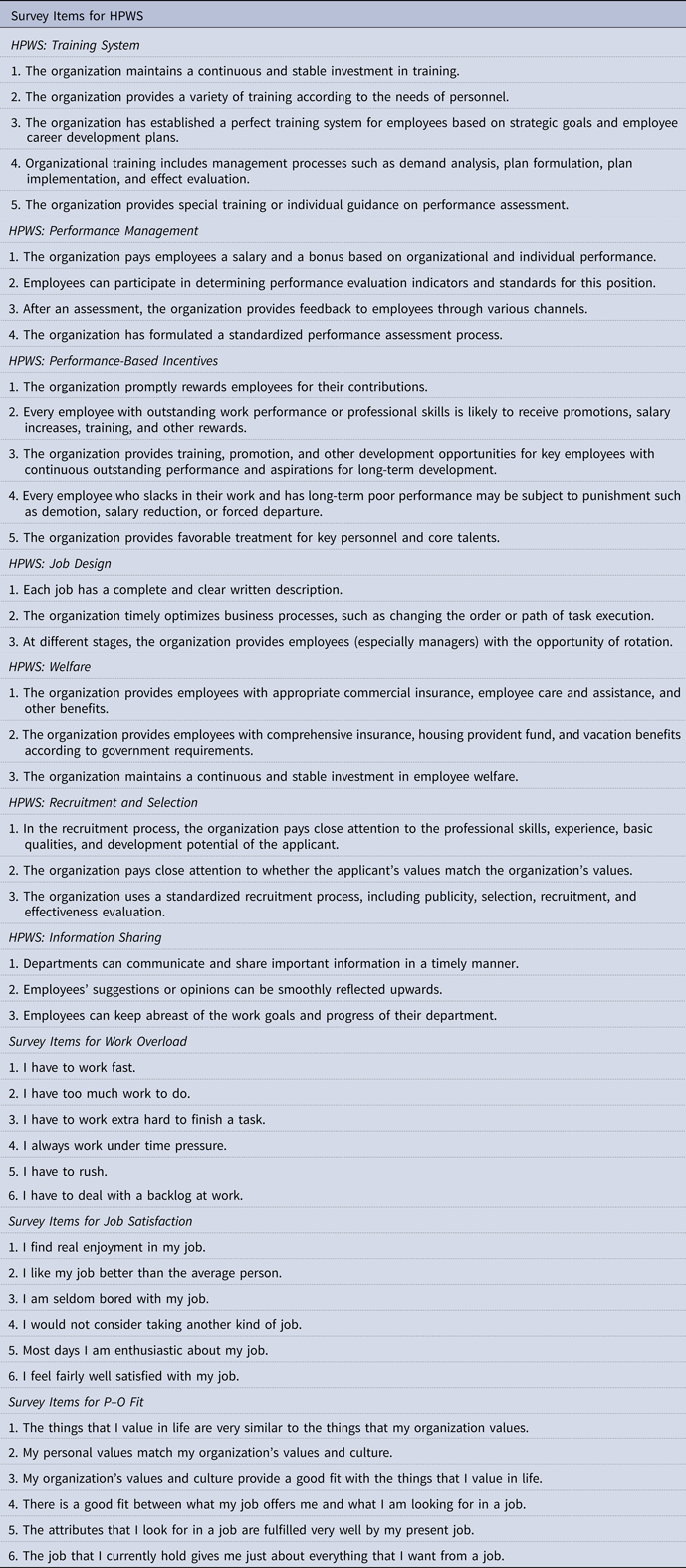
We used the high-performance work system scale developed by Zhang, He, Li, and Yao (Reference Zhang, He, Li and Yao2013). The scale uses 26 items to measure seven components of HPWS: recruitment and selection, training system, job design, performance management, information sharing, performance-based incentives, and welfare protection. A complete list of items is provided in the Appendix. The internal consistency reliability coefficient of the entire scale is .928 in the study by Zhang et al., (Reference Zhang, He, Li and Yao2013)., which is very reliable. The internal consistency coefficient of the scale used in this study is .983.
Job satisfaction
The job satisfaction scale uses six items derived from the 18-item index developed by Brayfield and Rothe (Reference Brayfield and Rothe1951) and as used in the study of Agho, Price, and Mueller (Reference Agho, Price and Mueller1992). An example of a question is ‘I feel fairly well satisfied with my job’. The scale achieved an acceptable reliability level with a Cronbach’s alpha of .90 in the study by Agho, Price, and Mueller (Reference Agho, Price and Mueller1992). The internal consistency coefficient of the scale used in this study is .896.
Work overload
We modified the work overload scale from Van Yperen and Hagedoorn (Reference Van Yperen and Hagedoorn2003), which contains 6 items. An example question is ‘I have too much work to do’. The Cronbach’s alpha was high at .90 in the original study by Van Yperen and Hagedoorn (Reference Van Yperen and Hagedoorn2003). The internal consistency coefficient of the scale used in this study is .942.
P–O fit
We referred to Cable and Derue (Reference Cable and Derue2002) for questions about P–O fit. Our research scale contains six items, including, ‘The things that I value in life are very similar to the things that my organization values’. The reliability coefficient of the scale is .91 in the original study (Cable & Derue, Reference Cable and Derue2002). The internal consistency coefficient of the scale used in this study is .945.
Data analysis and results
Descriptive statistics
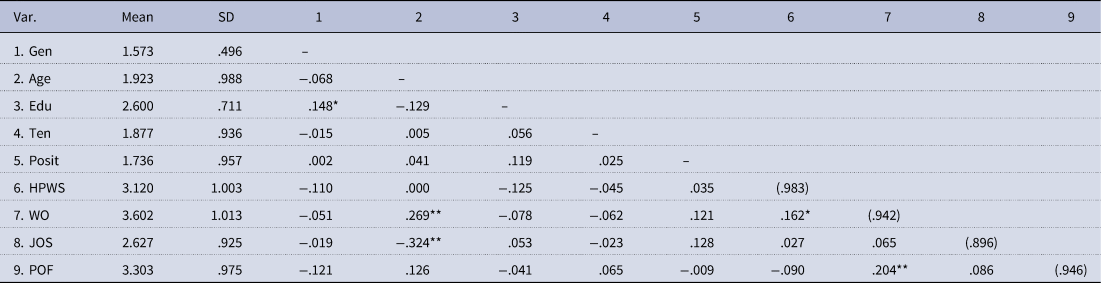
The mean, standard deviation, and correlation coefficients of variables are shown in Table 2. Results indicate that HPWS has a positive and statistically significant relationship with work overload. Additionally, work overload is positively related to P–O fit. Interestingly, job satisfaction is not significantly correlated with HPWS, work overload, or P–O fit.
Reliability, mean, standard deviation, and correlations for study 1
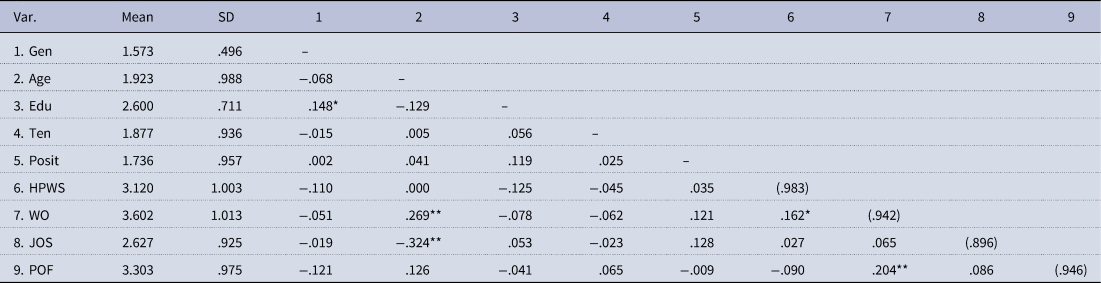
Note: Gen, gender; Edu, education; Ten, tenure; Posit, position; HPWS, high performance work system; WO, work overload; JOS, job satisfaction; POF, P–O fit.
*p < .05; **p < .01. Reliabilities are along the diagonal in parentheses; N = 220.
Validity test
We conduct confirmatory factor analysis (CFA) to test construct validity. Regarding convergent validity, the model fitting indexes of the four-factor measurement model (See Table 3) are: χ2 = 481.746, df = 269, χ2/df = 1.791, RMSEA = .061, CFI = .964, TLI = .960. Moreover, the loading of each item ranged from .697 and .963 and all were statistically significant at the 1% level. Therefore, these results indicate that the four-factor measurement model fits well, indicating good convergent validity (Bentler, Reference Bentler1990).
Fitting indexes of CFA models for study 1

Note: ‘ + ’ indicates that the two factors are combined into one factor.
The model comparisons method is used to test discriminant validity. According to the comparison results shown in Table 3, the fit index of the four-factor model is better than other models and the χ2 difference test results support this conclusion. Therefore, the results indicate the good discriminant validity of the research constructs.
Common method bias test
To test common method bias, several testing methods suggested by Podsakoff, MacKenzie, and Podsakoff (Reference Podsakoff, MacKenzie and Podsakoff2012) were used. First, the results of Harman’s single-factor test show that the single-factor model is poorly fitted (χ2 = 3452.603, df = 276, χ2/df = 12.509, RMSEA = .229, CFI = .462, TLI = .415). Compared with this model, the four-factor model is better fitting, indicating that the common method bias is not serious. Second, the fitting index of the model adding the common method factor to the four-factor measurement model is χ2 = 406.708, df = 245, χ2/df = 1.660, RMSEA = .055, CFI = .973, TLI = .966. Although the χ2 of this model is significantly reduced compared to the five-factor model (△χ2 = 75.038, △df = 24, p < .01), the RMSEA, TLI, and CFI of the model are not greatly improved (the improvement in each is less than .01). The analysis shows that adding the common method variation factor does not meaningfully improve the model. Therefore, the common method deviation problem does not have a serious impact on the study.
Hypothesis testing
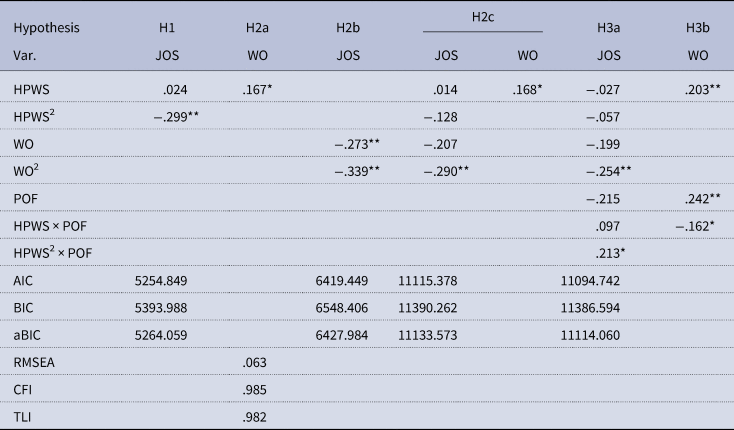
To test the research hypotheses, we used the Latent Moderated Structural Equations (LMS) approach based on the CFA measurement results. The estimator we used in MPLUS was Maximum Likelihood (ML). For the relationship between HPWS and job satisfaction, reported in Table 4, the coefficient of HPWS on job satisfaction is .024 (p > .05). However, the quadratic coefficient is −.299 (p < .01). The results support H1: the relationship between HPWS and job satisfaction is an inverted U-shaped.
Hypothesis testing for study 1
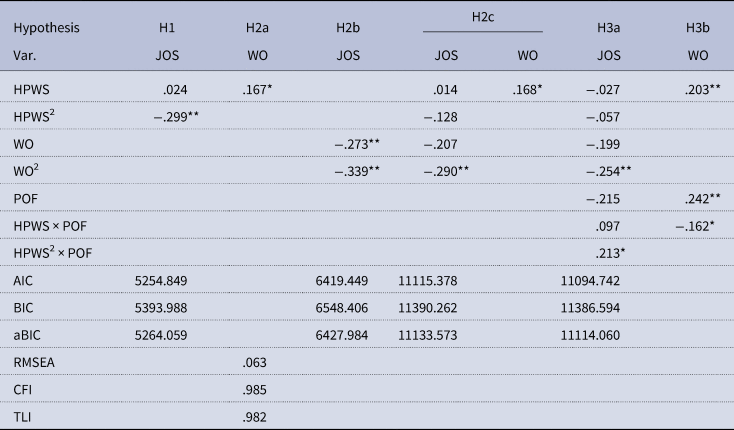
Note: *p < .05; **p < .01; N = 220.
For the relationship between HPWS and work overload, also reported in Table 4, the coefficient of HPWS on work overload is .167 (p < .05). Therefore, H2a is supported.
Similar to the result for HPWS, the relationship between work overload and job satisfaction is an inverted U-shaped (H2b), as demonstrated by the coefficients of work overload and its square on job satisfaction, which are −.273 (p < .01) and −.339 (p < .01) respectively. For H2c, the coefficients of HPWS and its square on job satisfaction are .014 (p > .05) and −.128 (p > .05) respectively. However, the coefficient of HPWS on work overload is .168 (p < .05) and the coefficients of work overload and its square on job satisfaction are −.207 (p > .05) and −.290 (p < .01). This analysis provides support for H2c. It is important to note that the relationship between HPWS2 and job satisfaction is significant, but when adding work overload, the relationship between HPWS2 and job satisfaction is nonsignificant. Meanwhile, the relationships of HPWS-work overload and work overload2-job satisfaction are significant. Therefore, we can conclude that work overload fully mediates the effect of HPWS on job satisfaction (Edwards & Lambert, Reference Edwards and Lambert2007).
The coefficient of the interaction term of HPWS2 and P–O fit on job satisfaction (as reported in Table 4) is .213 (p < .05). It supports the moderating effect of P–O fit on the inverted U-shaped relationship between HPWS and job satisfaction. In addition, it presents the opposite sign with the coefficient of HPWS2 on job satisfaction (−.299). Therefore, it can be inferred that the moderating effect is negative (Cliff & Earleywine, Reference Cliff and Earleywine1994; Li & Yuan, Reference Li and Yuan2017; Shrout & Bolger, Reference Shrout and Bolger2002; Tzelgov & Henik, Reference Tzelgov and Henik1991). Thus, H3a is supported. Moreover, the coefficient of the interaction term of HPWS and P–O fit on work overload (as shown in Table 4) is −.162 (p < .05). Based on the positive linear correlation between HPWS and work overload, these results support H3b, that is, P–O fit buffers the relationship between HPWS and work overload.
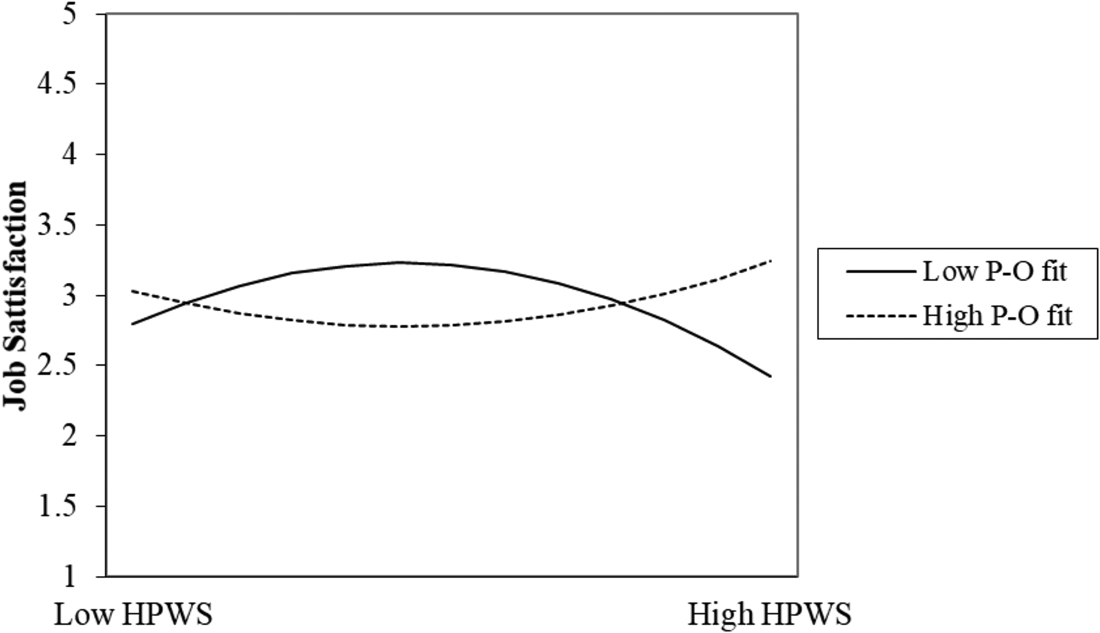
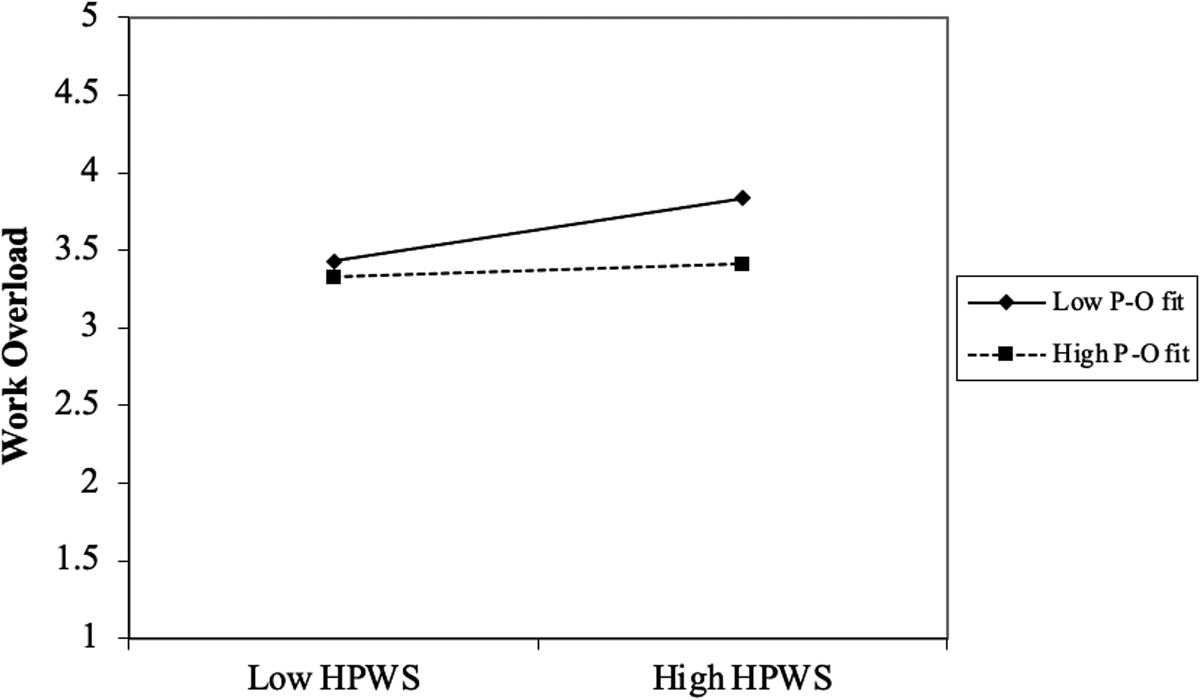
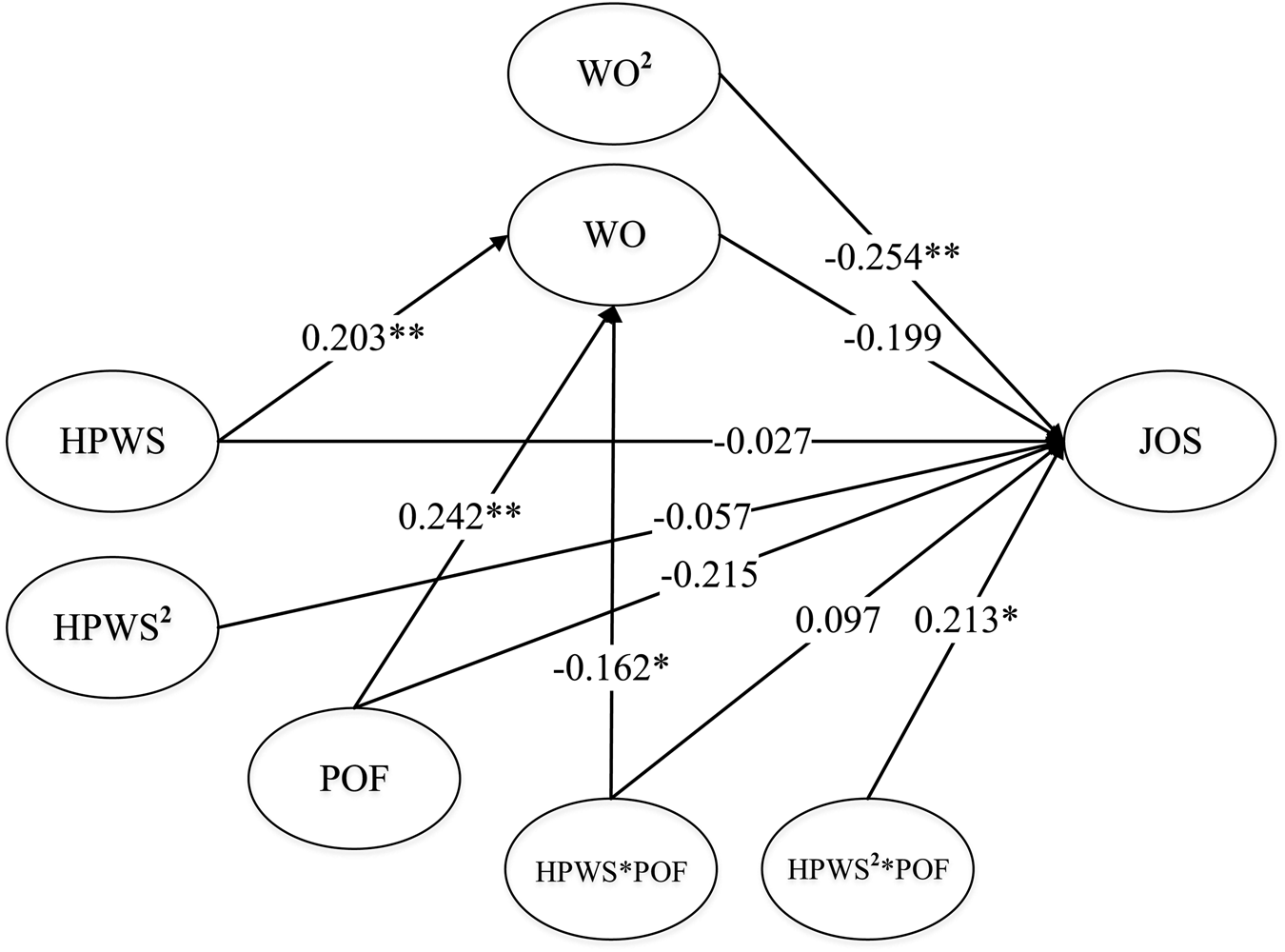
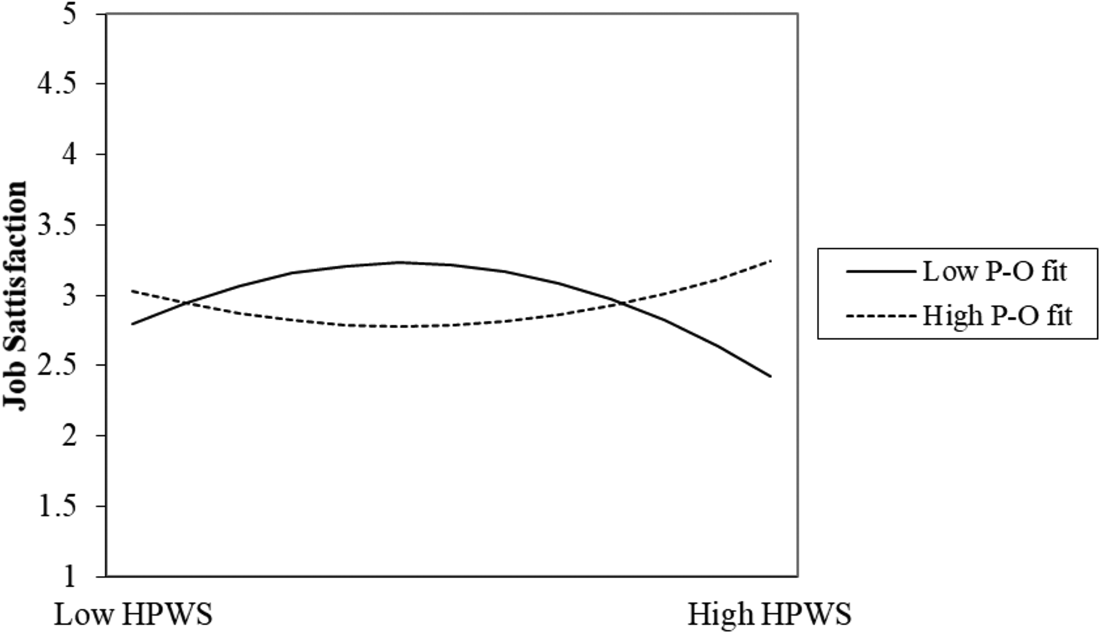
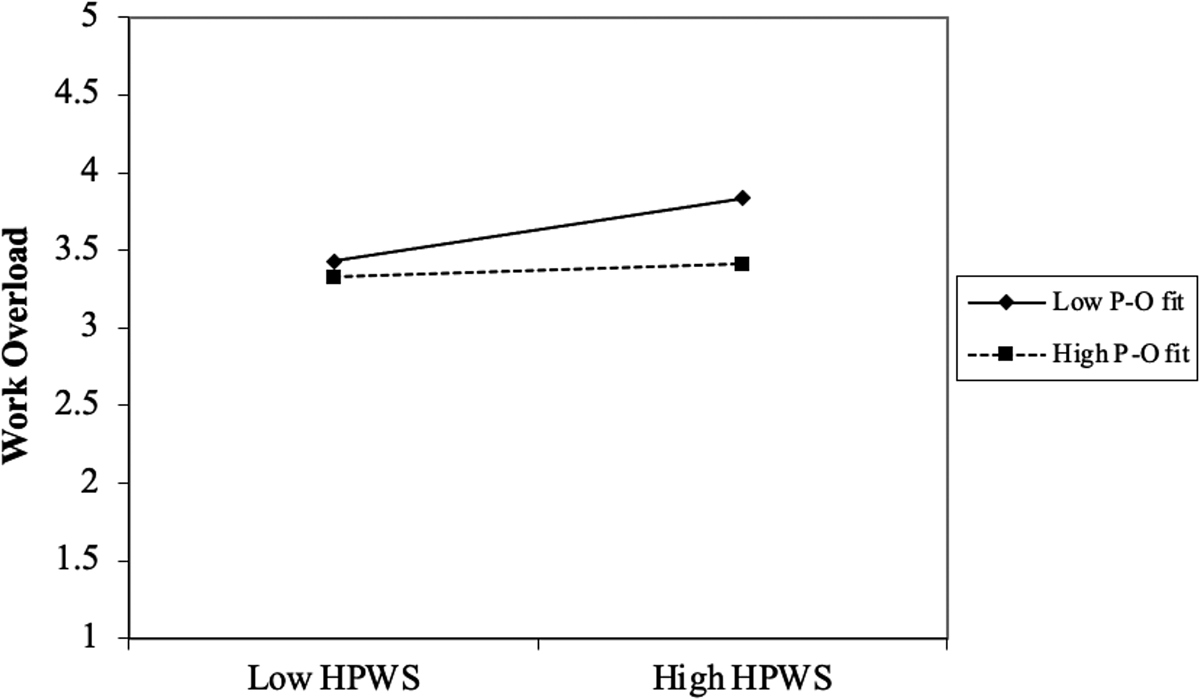
Additionally, to better clarify the moderating effect of P–O fit, we mapped the latent moderated structure model and the moderating effect plots, which are presented in Figures 2–4. As Figure 3, the relationship between HPWS2 and job satisfaction is an inverted U-shaped when P–O fit is low. With increasing levels of P–O fit, the relationship between HPWS2 and job satisfaction flattens out and tends to be a straight line and then to be U-shaped when P–O fit is higher. That is, P–O fit buffers the relationship between HPWS2 and job satisfaction, again verifying H3a. As Figure 4, when the P–O fit is low, HPWS has a positive linear relationship with work overload. When P–O fit is higher, the relationship is less positive, which indicates that P–O fit negatively moderates the relationship between HPWS and work overload, again verifying H3b.
Latent Moderated Structural Model (Study 1).
Moderating Effect of P–O Fit (H3a) in Study 1.
Moderating Effect of P–O Fit (H3b) in Study 1.
Study 2
Sample and procedure
To make up for the methodological shortcomings of cross-sectional study 1 and further investigate the causal relationship between HPWS and employees’ job satisfaction, we added a longitudinal study with sampling taking place in early 2022. We used an online questionnaire survey site named Credamo to collect data from employees because it has more than 2.8 million online subject databases and its multi-stage tracking function can achieve a longitudinal study. We collected HPWS at the first stage in early January 2022 and work overload, job satisfaction and P–O fit a month later.
Data was collected from 630 participants, and after eliminating incomplete responses, the sample consisted of 463 valid responses at stage one, and 373 valid responses at stage two. The final individual response rate was 59.2 percent. The identical items as Study 1 were measured on seven-point Likert scale. Moreover, the same data analysis methods are used as in Study 1. Sample characteristics are shown in Table 5.
Sample characteristics for study 2

Data analysis and results
Descriptive statistics
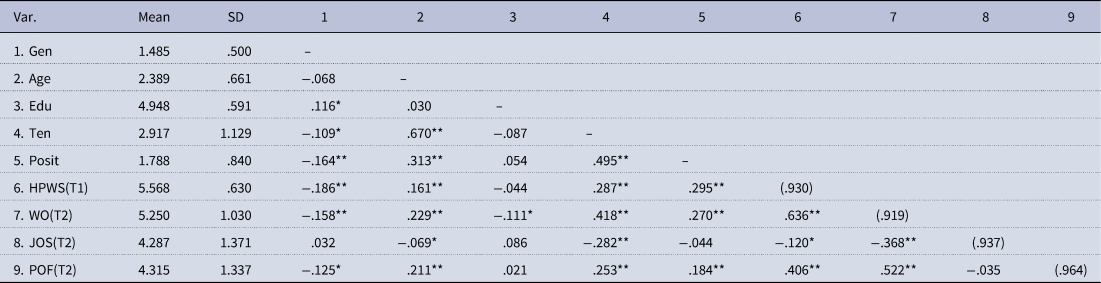
The mean, standard deviation, and correlation coefficients of variables are shown in Table 6. Results indicate that HPWS has a positive and statistically significant relationship with work overload. Additionally, work overload is positively related to P–O fit. Job satisfaction is significantly correlated with HPWS, work overload.
Reliability, mean, standard deviation, and correlations for study 2
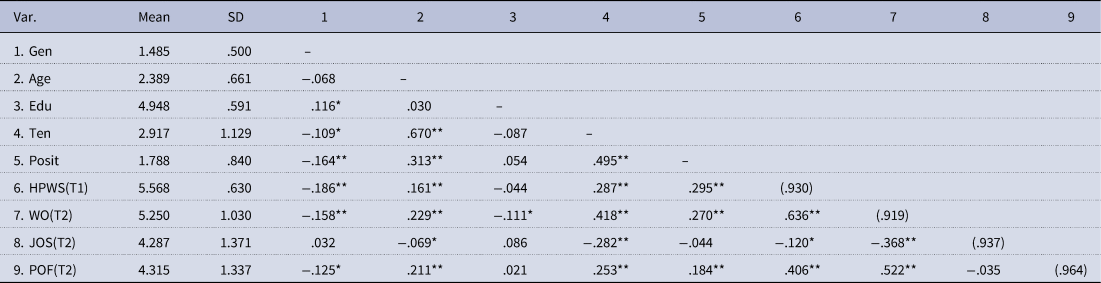
Note: Gen, gender; Edu, education; Ten, tenure; Posit, position; HPWS, high-performance work system; WO, work overload; JOS, job satisfaction; POF, P–O fit.
*p < .05; **p < .01. Reliabilities are along the diagonal in parentheses; N = 373.
Validity test
We conduct CFA to test construct validity. Regarding convergent validity, the model fitting indexes of the four-factor measurement model (See Table 7) are: χ2 = 718.481, df = 269, χ2/df = 2.671, RMSEA = .067, CFI = .946, TLI = .940. Therefore, these results indicate that the four-factor measurement model fits well, indicating good convergent validity (Bentler, Reference Bentler1990).
Fitting indexes of CFA models for study 2

Note: ‘ + ’ indicates that the two factors are combined into one factor.
The model comparison method is used to test discriminant validity. According to the comparison results shown in Table 7, the fit index of the four-factor model is better than other models and the χ2 difference test results support this conclusion. Therefore, the results indicate the good discriminant validity of the research constructs.
Common method bias test
To test common method bias, several testing methods suggested by Podsakoff, MacKenzie, and Podsakoff (Reference Podsakoff, MacKenzie and Podsakoff2012) were used. First, the results of Harman’s single-factor test show that the single-factor model is poorly fit (χ2 = 5011.435, df = 275, χ2/df = 18.223, RMSEA = .215, CFI = .432, TLI = .381). Compared with this model, the four-factor model is better fitting, indicating that the common method bias is not serious. Second, the fitting index of the model adding the common method factor to the four-factor measurement model is χ2 = 542.057, df = 245, χ2/df = 2.212, RMSEA = .057, CFI = .964, TLI = .956. Although the χ2 of this model is significantly reduced compared to the five-factor model (△χ2 = 176.424, △df = 24, p < .01), the RMSEA, TLI, and CFI of the model are not greatly improved (the improvement in each is less than .02). The analysis shows that adding the common method variation factor does not meaningfully improve the model. Therefore, the common method deviation problem does not have a serious impact on the study.
Hypothesis testing
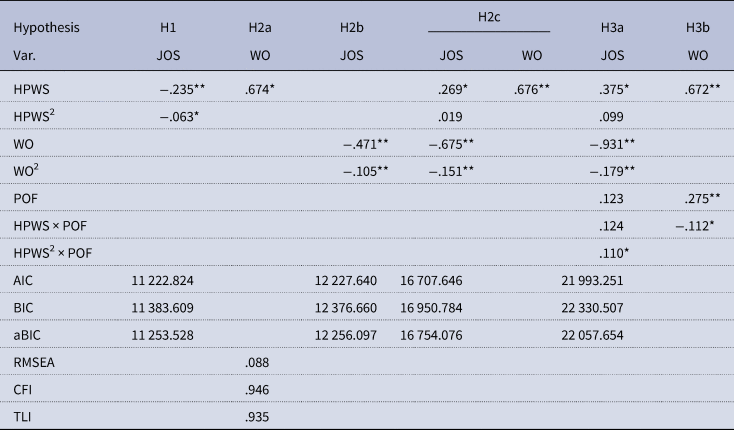
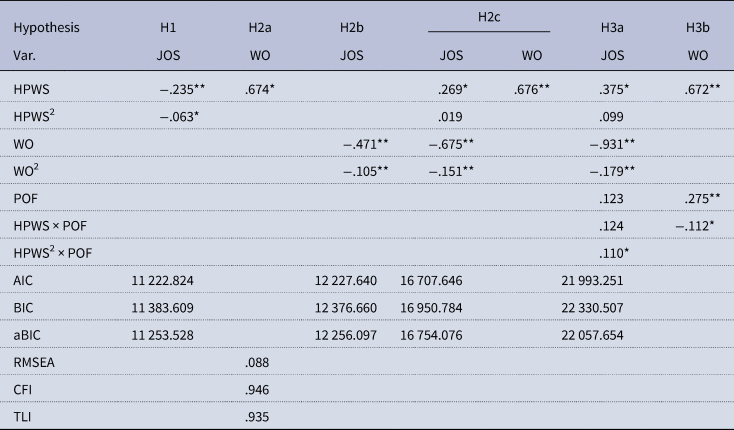
To test the research hypotheses, we used the same LMS approach as study 1. For the relationship between HPWS and job satisfaction, reported in Table 8, the coefficient of HPWS on job satisfaction is −.235 (p < .01). Additionally, the quadratic coefficient is −.063 (p < .05). The results support H1: the relationship between HPWS and job satisfaction is inverted U-shaped.
Hypothesis testing for study 2
Note: *p < .05; **p < .01. N = 373.
For the relationship between HPWS and work overload, also reported in Table 8, the coefficient of HPWS on WO is .674 (p < .05). Therefore, H2a is supported.
Similar to the result for HPWS, the relationship between work overload and job satisfaction is inverted U-shaped (H2b), as demonstrated by the coefficients of work overload and its square on job satisfaction, which are −.471 (p < .01) and −.105 (p < .01) respectively. For H2c, the coefficients of HPWS and its square on job satisfaction are .269 (p < .05) and .019 (p > .05) respectively. However, the coefficient of HPWS on work overload is .676 (p < .01) and the coefficients of work overload and its square on job satisfaction are −.675 (p < .01) and −.151 (p < .01). This provides support for H2c. It is still worth to note that the relationship between HPWS2 and job satisfaction is significant, but when adding work overload, the relationship between HPWS2 and job satisfaction is nonsignificant. Meanwhile, the relationships of HPWS-work overload and work overload2-job satisfaction are significant. Therefore, we can get the same conclusion that work overload fully mediates the effect of HPWS on job satisfaction as Study 1 (Edwards & Lambert, Reference Edwards and Lambert2007).
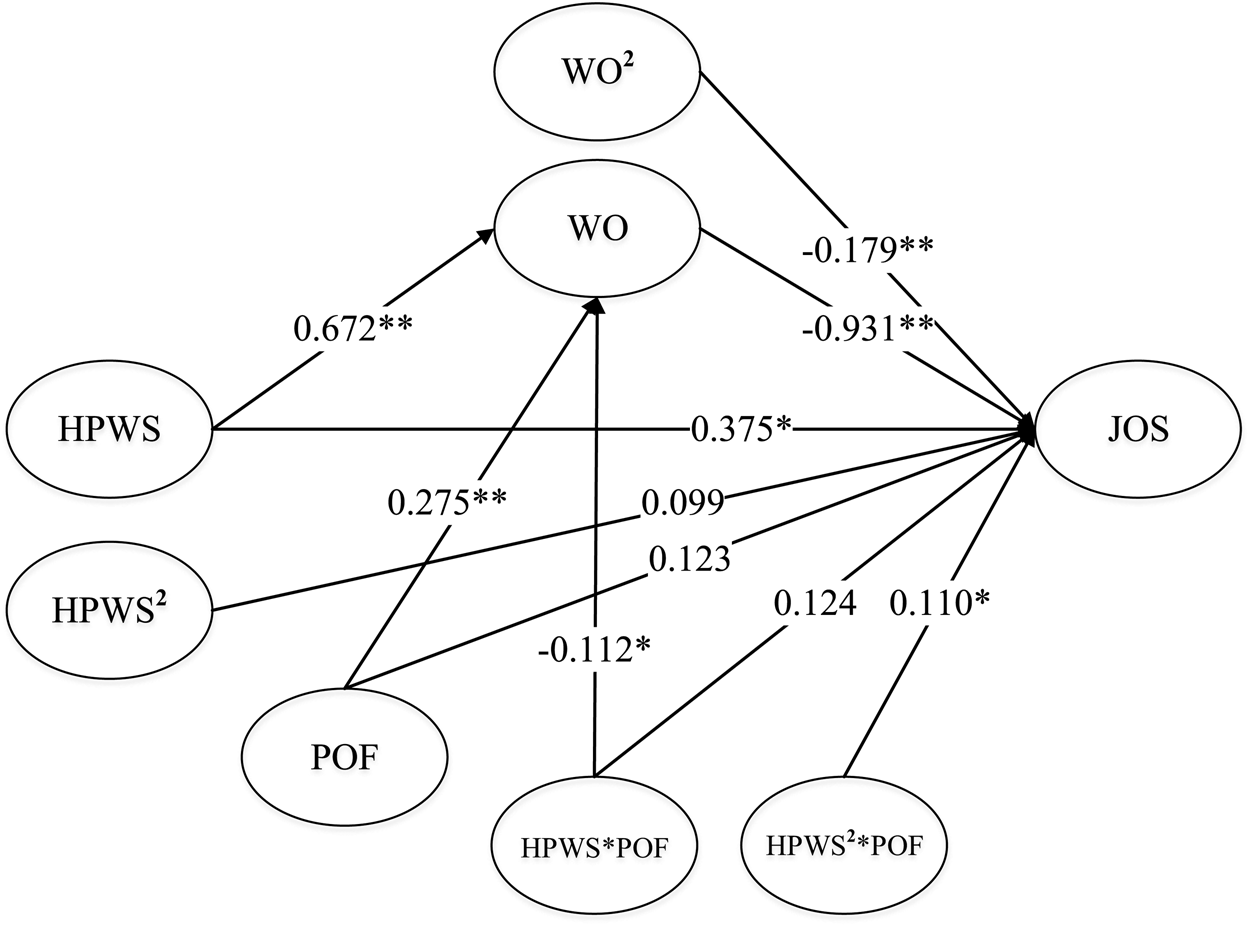
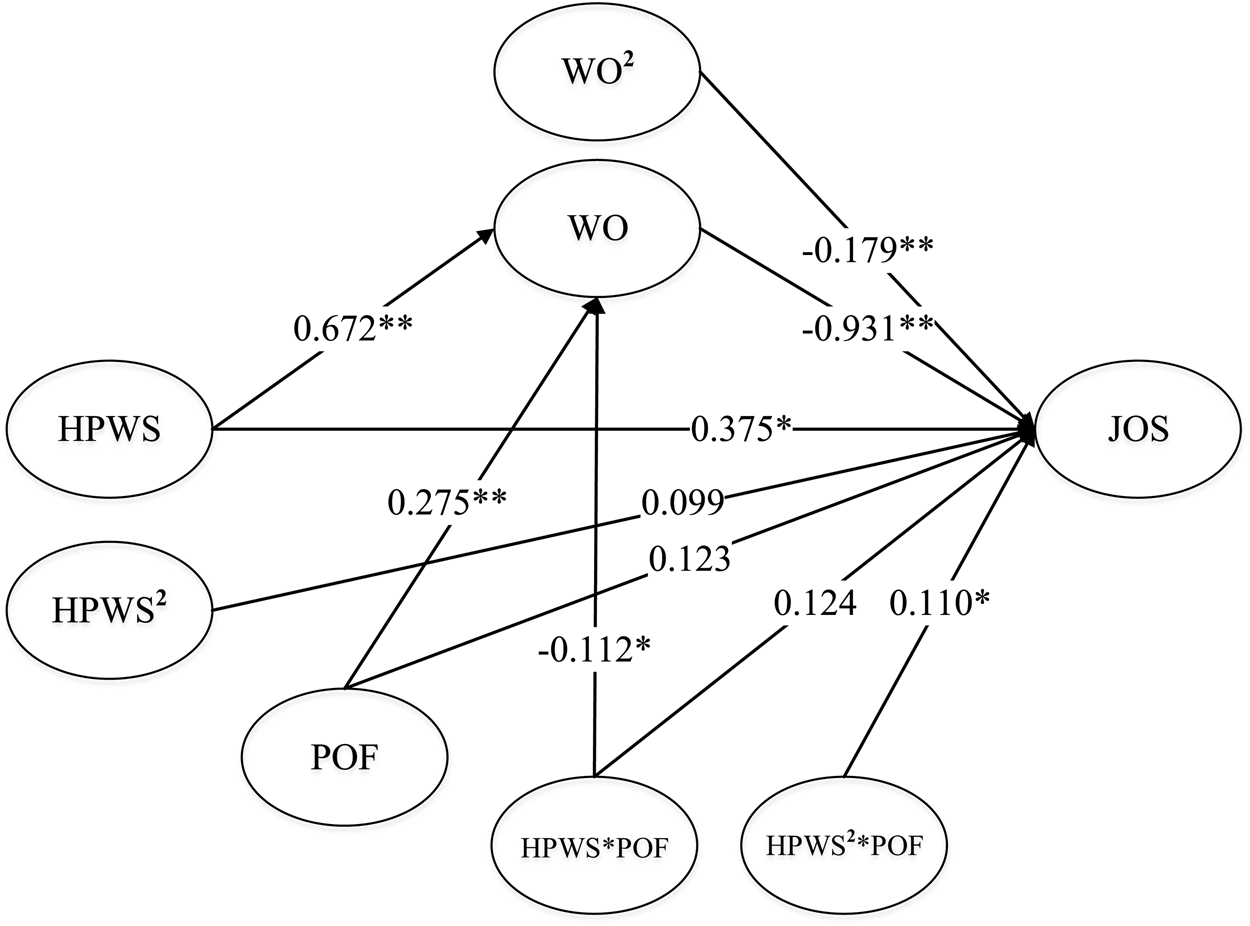
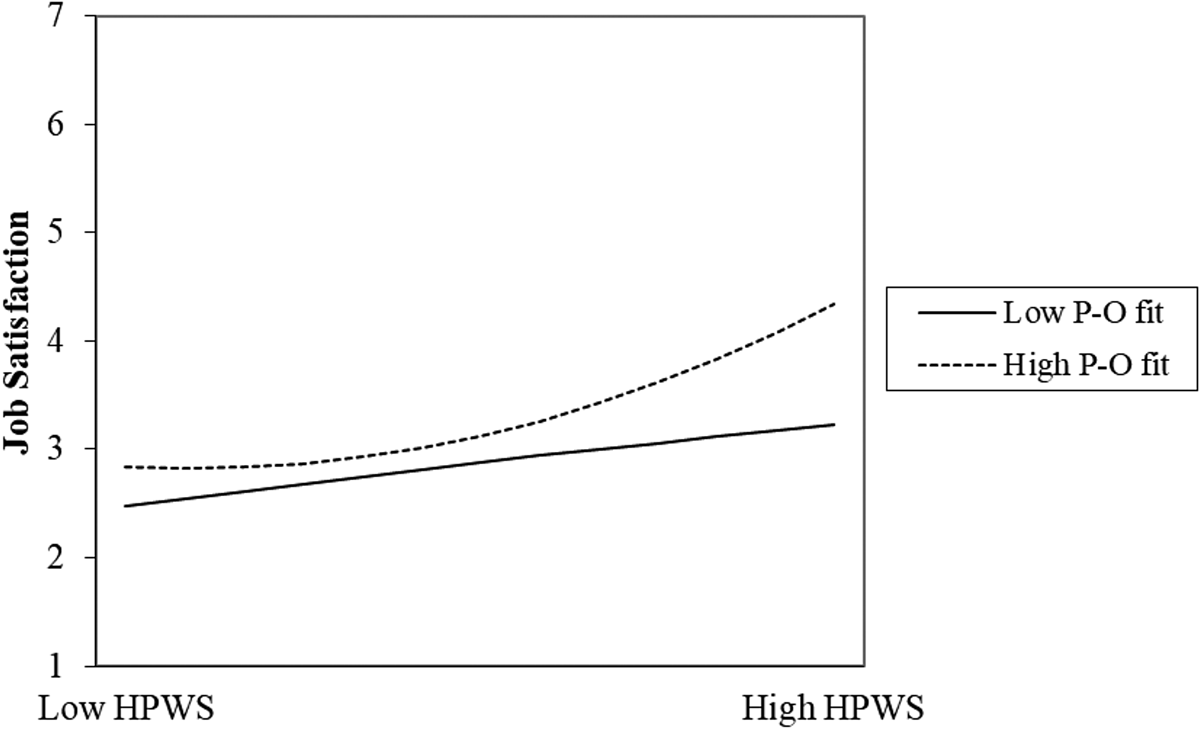
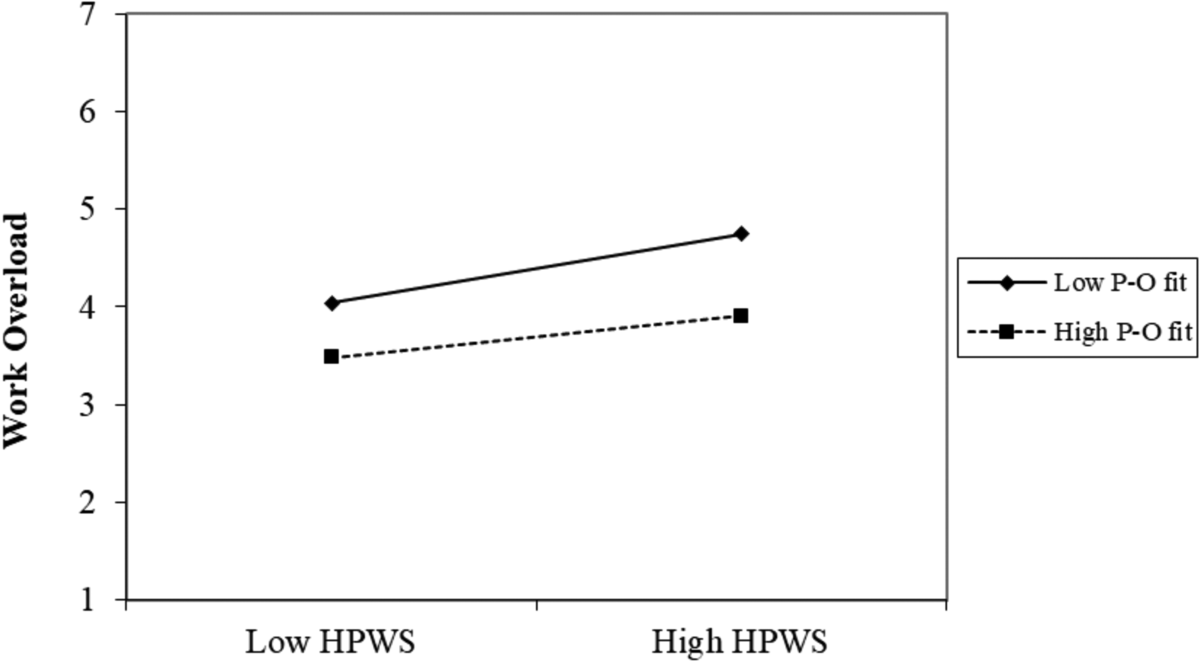
The coefficient of the interaction term of HPWS2 and P–O fit on job satisfaction (as reported in Table 8) is .110 (p < .05). It supports the moderating effect of P–O fit on the inverted U-shaped relationship between HPWS and job satisfaction. In addition, it presents the opposite sign with the coefficient of HPWS2 on job satisfaction (−.063). Therefore, it still shows the negative moderating effect of P–O fit (Cliff & Earleywine, Reference Cliff and Earleywine1994; Li & Yuan, Reference Li and Yuan2017; Shrout & Bolger, Reference Shrout and Bolger2002; Tzelgov & Henik, Reference Tzelgov and Henik1991). Thus, H3a is supported. Moreover, the coefficient of the interaction term of HPWS and P–O fit on work overload (as shown in Table 8) is −.112 (p < .05). Based on the positive linear correlation between HPWS and work overload, these results support H3b, that is, P–O fit negatively moderates the relationship between HPWS and work overload.
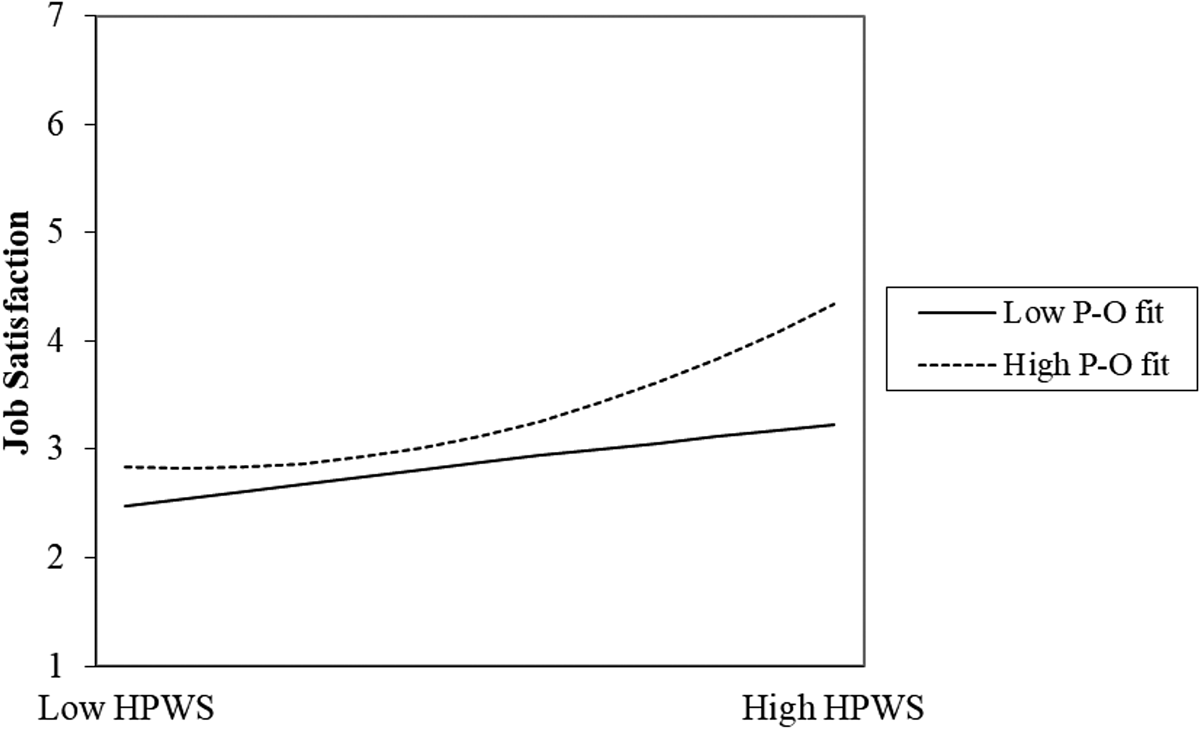
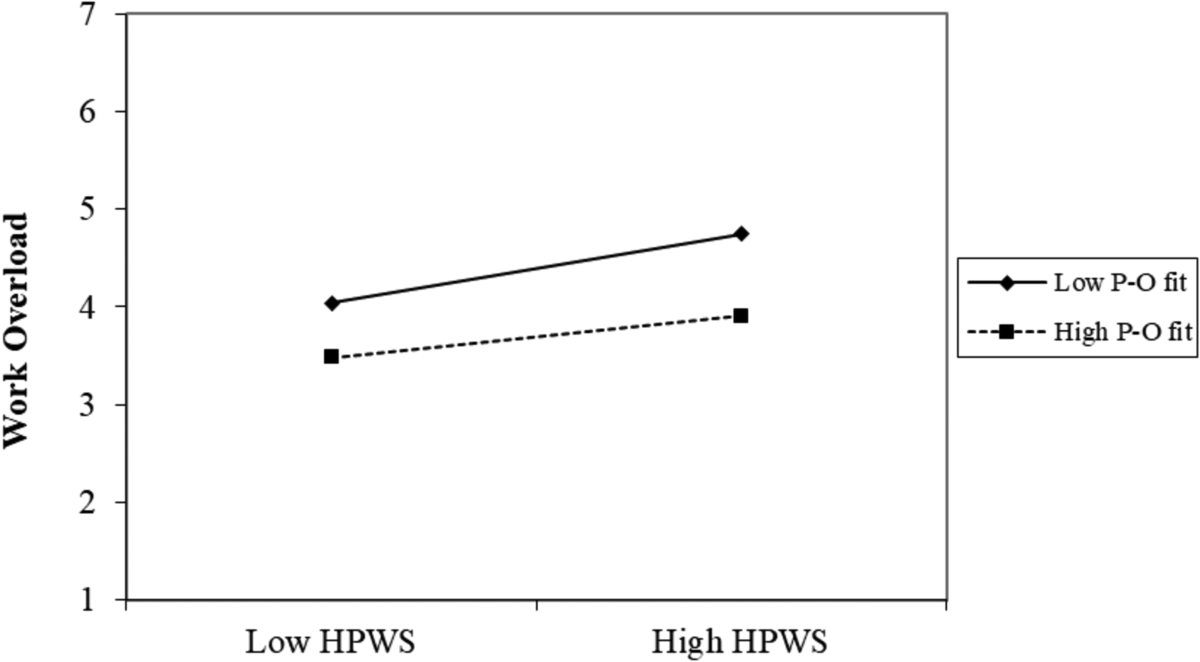
Additionally, we still mapped the LMS model and the moderating effect plots, which are presented in Figures 5–7 to better clarify the moderating effect of P–O fit. As Figure 6, the relationship between HPWS and job satisfaction is an inverted U-shaped when P–O fit is low. With increasing levels of P–O fit, the relationship between HPWS and job satisfaction flattens out and tends to be a straight line and then to be U-shaped when P–O fit is higher. That is, P–O fit buffers the relationship between HPWS and job satisfaction, again verifying H3a. As Figure 7, when the P–O fit is low, HPWS has a positive linear relationship with work overload. When P–O fit is higher, the relationship is less positive, which indicates that the P–O fit negatively moderates the relationship between HPWS and work overload, again verifying H3b.
Latent Moderated Structural Model (Study 2).
Moderating Effect of P–O Fit (H3a) in Study 2.
Moderating Effect of P–O Fit (H3b) in Study 2.
Discussion
Drawing on prior research, the TMGT theory, and the JD-R model, the primary goal of this study is to examine the non-linear relationship between HPWS and job satisfaction. Furthermore, we extended the literature by integrating work overload as a mediator and P–O fit as a moderator in our research framework. The results reveal that: (a) HPWS has an inverted U-shaped relationship with employees’ job satisfaction; (b) work overload plays a fully mediating role in the HPWS-job satisfaction relationship; and (c) P–O fit negatively moderates both the HPWS-job satisfaction relationship and the HPWS-work overload relationship. Therefore, the proposed model is supported.
Theoretical implications
This paper makes contributions to three areas of the literature. First, we found that HPWS exhibits a curvilinear, inverted U-shaped relationship with job satisfaction, such that levels of job satisfaction are the highest at an intermediate level of HPWS. The vast majority of previous research has generally shown a positive linear relationship between HPWS and job satisfaction (Fabi, Lacoursière, & Raymond, Reference Fabi, Lacoursière and Raymond2015; García-Chas, Neira-Fontela, & Castro-Casal, Reference García-Chas, Neira-Fontela and Castro-Casal2014; Messersmith et al., Reference Messersmith, Patel, Lepak and Gould-Williams2011), and a few studies have shown a negative linear relationship (Heffernan & Dundon, Reference Heffernan and Dundon2016). Based on contradictory findings of HPWS and job satisfaction, and built on an in-depth understanding of the TMGT theory, this study verified the ‘promotion-inflexion-destruction’ trajectory of the TMGT effect, thus providing a comprehensive account of the mechanism underlying HPWS and job satisfaction. Our results suggest that at low levels of HPWS, the beneficial effect of job resources contained in HPWS is not sufficient to satisfy employees, and as HPWS increases to a moderate level, employees are more satisfied due to the increasing beneficial effect of increased job resources. However, at a high level of HPWS, job satisfaction is diminished because the negative effect of job demands exceeds the beneficial effect of job resources. In sum, identification of this curvilinear relationship is a noteworthy development, which not only enriches the research on the JD-R model from different perspectives (i.e., marginal increases and marginal loss effect) but also casts light on the exploration of the TMGT effect of HPWS.
Second, this paper expands our understanding of the relationship between HPWS and job satisfaction by empirically showing that work overload fully mediates the relationship; the effect of HPWS on job satisfaction is fully transferred by work overload. Additionally, HPWS is shown to be positively related to work overload, which expands our understanding of the dark side of HPWS. Perhaps most interesting is that increasing levels of work overload trigger the ‘promotion-inflexion-destruction’ trajectory of job satisfaction. This finding enriches previous studies that showed that employees who are under significant stress and work overload are more likely to feel anxious and dissatisfied (Farooq Abbasi, Reference Farooq Abbasi2015; Mittal & Bhakar, Reference Mittal and Bhakar2018; Wang et al., Reference Wang, Baba, Hackett and Hong2019). Perhaps at low levels of work overload, employees’ job satisfaction is low because they are unmotivated, and as work overload increases to a moderate level, their work becomes more challenging, making employees more motivated (Westman & Eden, Reference Westman and Eden1996). Nevertheless, employees’ job satisfaction diminishes with the increase in work overload because they must accomplish their work at the expense of their extra time and energy. To sum up, the mediating role of work overload not only helps to open the ‘black box’ behind the effect of HPWS on employee outcomes, but also enriches and advances the field of work overload.
Third, this paper highlights an important theoretical aspect of P–O fit, which is neglected in much HRM research and may be important for future studies. Our findings on the moderating effects of P–O fit reveal that P–O fit can buffer the relationships between HPWS, job satisfaction and work overload. Employees with high P–O fit may utilize other resources, such as motivation, provided by their P–O fit, to compensate for deficient job resources at low levels of HPWS. Additionally, they may be better at dealing with high demands stemming from high HPWS and be prone to experience job satisfaction. In these situations, it seems that P–O fit buffers the relationship between HPWS and job satisfaction. Moreover, it is unexpected that the relationship between HPWS and job satisfaction becomes U-shaped when P–O fit is at a high level. We infer that it is because that high P–O fit influences employees’ perceived HPWS (Boon et al., Reference Boon, Den Hartog, Boselie and Paauwe2011), which may, in turn, affect the relationship between HPWS and job satisfaction through certain influencing mechanisms. Previous studies have shown that P–O fit has a considerable impact on the effectiveness of organizational policies. Employees with higher P–O fit better identify with and understand HPWS (Lee, Reference Lee2012), so the overwhelming work or high demands caused by HPWS are viewed as challenges rather than excessive pressure, leading to less work overload. Thus, P–O fit helps us better understand the relationship between HPWS, work overload, and job satisfaction. Above all, we contribute to the literature by shedding light on a mechanism by which P–O fit influences employees in their behavioral and attitudinal responses to HPWS.
Managerial implications
From a practical perspective, this study’s findings have several managerial implications. First, our identification of the inverted U-shaped relationships between HPWS and job satisfaction and between work overload and job satisfaction suggests that managers should recognize that both HPWS and work overload are double-edged swords. We acknowledge that there may be value in enhancing levels of HPWS and work overload, but managers should also be keenly aware of situations when HPWS and work overload are too high. When they surpass a moderate level, employees may feel stressed, leading to adverse outcomes. Therefore, managers should be aware of the TMGT effect.
Second, we focus on employees’ perceived HPWS in this study because employees’ perceptions shape their attitudes and behaviors more than ‘actual’ implemented HPWS (Cai, Morris, & Chen, Reference Cai, Morris and Chen2011; De Reuver, Van de Voorde, & Kilroy, Reference De Reuver, Van de Voorde and Kilroy2019; Den Hartog, Boon, Verburg, & Croon, Reference Den Hartog, Boon, Verburg and Croon2012; Kehoe & Wright, Reference Kehoe and Wright2013). Employees’ interpretations of identical organizational policies are so varied that employees may act contrary to the organization’s wishes. Thus, organizations should take notice of different reactions when implementing a policy that affects diverse individuals (Yu, Zhang, & Liu, Reference Yu, Zhang and Liu2012). Additionally, managers should communicate with employees in a timely and frequent manner to ensure employees understand the precise intention of the organizational policies.
Third, based on the study’s findings, it is reasonable to infer that P–O fit is also crucial for the functioning and effectiveness of organizational policies such as HPWS. Organizations should recruit and select employees with higher P–O fit and focus on displaying the organizational culture and goals. Additionally, managers should devote specific attention to communicating the organization’s values so that they can be actively involved in the employees’ socialization and cultivation of P–O fit (Hamstra, Van Vianen, & Koen, Reference Hamstra, Van Vianen and Koen2019).
Limitations and future research
The present study has several limitations that should be addressed in future research. First, the proposed model in our research mainly focuses on the employee. Therefore, it only considers how employees experience HPWS and ignores (1) how policy is implemented and (2) the impact of the difference between ‘implemented HPWS’ and ‘perceived HPWS’ on employee attitudes and potential outcomes. Therefore, we expect future studies to adopt multi-level data methodologies to further the model building on the present study.
Second, although we support the moderating effect of P–O fit, it’s unexpected that the relationship between HPWS and job satisfaction changes from an inverted U-shaped to U-shaped with increasing levels of P–O fit. We infer that it may be because high levels of P–O fit have a considerable effect on employees’ perceived HPWS (Boon et al., Reference Boon, Den Hartog, Boselie and Paauwe2011), which may in turn influence HPWS-job satisfaction relationship through certain influencing mechanisms. Future research should further explore whether there is such an influencing mechanism that affects the changing process of the relationship.
Third, although this study uncovers explanatory mechanisms for the effects of HPWS on work overload and job satisfaction, further investigation is needed to unpack the ‘black box’ of HPWS by exploring other potential mediators and moderators such as psychological ownership and job control (Jensen, Patel, & Messersmith, Reference Jensen, Patel and Messersmith2013; Xu & Lv, Reference Xu and Lv2018). Future research should not only focus on non-monotonic relationships to further reveal the double-edged sword effects of HPWS but also explore the location of the inflection points corresponding to these effects. That is, future research should investigate when the marginal benefits of HPWS will be equal to the marginal detriments of HPWS in specific situations.
Acknowledgements
The authors would like to thank the participants for their support and assistance in the data collection. This research was supported by the National Social Science Fund Project of China (No. 19BGL125).
Conflict of interest
The authors declare that they have no known competing financial interests or personal relationships that could have appeared to influence the work reported in this paper.
Appendix