INTRODUCTION
It has been well documented that input frequency plays a prominent role in child language development (Cameron-Faulkner, Lieven & Tomasello, Reference Cameron-Faulkner, Lieven and Tomasello2003, Reference Cameron-Faulkner, Lieven and Theakston2007; Goldfield, Reference Goldfield1993; Guerriero, Cooper, Ohima-Takane & Kuriyama, Reference Guerriero, Cooper, Ohima-Takane and Kuriyama2006; Kirjavainen, Theakston & Lieven, Reference Kirjavainen, Theakston and Lieven2009; Huttenlocher, Haight, Bryk, Seltzer & Lyons, Reference Huttenlocher, Haight, Bryk, Seltzer and Lyons1991; Huttenlocher, Vasilyeva, Cymerman & Levine, Reference Huttenlocher, Vasilyeva, Cymerman and Levine2002; Ozeki & Shirai, Reference Ozeki and Shirai2010; Shirai & Andersen, Reference Shirai and Andersen1995; Theakston, Lieven & Tomasello, Reference Theakston, Lieven and Tomasello2003; Tomasello, Reference Tomasello2000, Reference Tomasello2003). There is also accumulated evidence that children show individual differences in the course of language development, and the differences observed can be accounted for by the parental input (Huttenlocher et al., Reference Huttenlocher, Haight, Bryk, Seltzer and Lyons1991, Reference Huttenlocher, Vasilyeva, Cymerman and Levine2002; Lieven, Reference Lieven, Waterson and Snow1978; Sandhofer, Smith & Luo, Reference Sandhofer, Smith and Luo2000; Shirai, Reference Shirai1994; Tardif, Shatz & Naigles, Reference Tardif, Shatz and Naigles1997).
Previous studies have convincingly shown that child as well as adult grammar is discourse-pragmatically motivated, and the role of discourse needs to be taken into account in developmental explanations as much as in descriptions of usage (Allen, Reference Allen2000; Chafe, Reference Chafe and Tomlin1987; Clancy, Reference Clancy and Clark1993, Reference Clancy, Sohn and Haig1997; Du Bois, Reference Du Bois1987; Givón, Reference Givón, Greenberg, Givón and Givón1983; Guerriero et al., Reference Guerriero, Cooper, Ohima-Takane and Kuriyama2006; Gundel, Hedberg & Zacharski, Reference Gundel, Hedberg and Zacharski1993; Huang, Reference Huang2011; Serratrice, Reference Serratrice2005; Skarabela, Reference Skarabela2007; Skarabela, Allen & Scott-Phillips, Reference Skarabela, Allen and Scott-Phillips2013). Unlike syntax-oriented approaches, which propose the separation of grammar, on the one hand, and discourse and pragmatics, on the other (Chomsky, Reference Chomsky1986), the discourse-pragmatic approach to explaining reference suggests that speakers' choices of referring expressions are dependent on the speakers' assumed knowledge of how the listeners understand the information status of a given referent in their mind (Chafe, Reference Chafe and Tomlin1987; Du Bois, Reference Du Bois1987; Gundel et al., Reference Gundel, Hedberg and Zacharski1993).
The present study investigates the acquisition of Japanese case markers wa and ga, by taking a usage-based, constructionist framework (Tomasello, Reference Tomasello2000) and blending it with the discourse-pragmatic approach. Of interest is to ascertain whether children assign particular discourse-pragmatic functions to each case marker from early on, and if so, whether the emergent functions of those case markers are influenced by the input to which they are exposed. Although the present study does not consider non-linguistic pragmatic means such as joint attention that affect the information structure of Japanese children's utterances, studies have shown that those factors also play an important role in child language development (Skarabela, Reference Skarabela2007; Skarabela et al., Reference Skarabela, Allen and Scott-Phillips2013).
Japanese subject markers wa and ga
Wa and ga are frequently discussed contrastively in Japanese linguistic literature (cf. Kuno, Reference Kuno1973; Maynard, Reference Maynard1981; Shibatani, Reference Shibatani1990), since both of them mark subjects of sentences. The primary discourse-pragmatic functions of these Japanese subject markers have been well documented: wa marks an argument whose referent is given/presupposed (topic/theme) (Hinds & Hinds, Reference Hinds and Hinds1979; Kuno, Reference Kuno1973; Ono, Thompson & Suzuki, Reference Ono, Thompson and Suzuki2000; Shibatani, Reference Shibatani1990). Thus, in example (1) the subject marked by wa (watashi ‘I’) is already known to the listener. In contrast, ga marks an argument whose referent is the focus of new information. Thus, in example (2) the listener is newly informed as to who (in this case watashi ‘I’) is going to be the trustee in the organization (Hinds & Hinds, Reference Hinds and Hinds1979; Kuno, Reference Kuno1973; Ono et al., Reference Ono, Thompson and Suzuki2000; Shibatani, Reference Shibatani1990; Tsutsui, Reference Tsutsui1983; Watanabe, Reference Watanabe1986) (examples from Shibatani, Reference Shibatani1990, p. 268):
(1) watashi wa hon-kai no rizidesu.
‘I am a trustee of this organization.’
(2) watashi ga hon-kai no rizidesu.
‘I am the trustee of this organization/the trustee of this organization is I.’
However, more recent studies have shown that ga not only expresses new information, but is also associated with a range of other pragmatic functions. Suzuki and Ono (Reference Suzuki and Ono1991) analyzed the use of ga in actual discourse data and showed that ga was often used regardless of the given/new discourse information status of the referent in order to highlight particular information in a discourse context, a discourse-pragmatic function that these authors call “spotlighting” (p. 149). This function is also noted by Kuno (Reference Kuno1973), who categorized the spotlighting function of ga as “exhaustive listing” (Kuno, Reference Kuno1973, p. 38). In example (3) (from Ono et al., Reference Ono, Thompson and Suzuki2000, p. 70), the ga-marked argument, onna ‘women’, is highlighted in the discourse context:
(3) uchi tte hora onna ga minna dekai ja nai?
house top see woman ga all big cop not
‘My family, see, women are all big, aren't they?’
Furthermore, in addition to highlighting, previous studies have shown that ga frequently occurs in intransitive constructions (Kondo, Reference Kondo1997; Mayes & Ono, Reference Mayes, Ono and Clancy1993; Ono et al., Reference Ono, Thompson and Suzuki2000; Suzuki & Ono, Reference Suzuki and Ono1991) involving a range of predicates. These include constructions describing motion (e.g. taro ga hashiru ‘Taro runs'); existential situation (e.g. taro ga iru ‘Taro is present’); and constructions with stative adjectival predicates expressing speakers' feeling toward referents (as in example (4), from Ono et al. Reference Ono, Thompson and Suzuki2000, p. 65), or his/her ability (Clancy, Reference Clancy and Slobin1985; Kondo, Reference Kondo1997; Kuno, Reference Kuno1973; Morikawa, Reference Morikawa1997; Ono et al., Reference Ono, Thompson and Suzuki2000; Shibatani, Reference Shibatani1990; Sugamoto, Reference Sugamoto, Hopper and Thompson1982):
(4) (discussing why photos come out well in California)
koosengaii
light GA good
‘The sunlight is good.’
The use of ga with stative adjectival predicates, in particular, has been shown to be relatively frequent in Japanese adult–adult conversational data (Ono et al., Reference Ono, Thompson and Suzuki2000). In this study, and given the variety of discourse-pragmatic functions that are possible for the subject particle ga and which make the particle participate in a wide number of predicate constructions, I analyze seven semantic classes of stative and dynamic predicates occurring with ga in children's spoken Japanese so as to provide fine-grained evidence of semantic and pragmatic functions that may be associated with children's early use of this particle.
Previous studies in the acquisition of subject case markers wa and ga
Experimental studies have suggested that it is only after around the fourth or fifth birthday that children start to use wa and ga according to the discourse context. Hatano (Reference Hatano1979) conducted an experiment where she asked children learning Japanese whose age ranged from 3;0 to 7;5 to imitate sentences with wa or ga. Children older than four showed the use of ga when a referent of a ga-marked argument introduced new information in a discourse context. In contrast, a successful use of wa as a marker of given information did not occur until children reached preschool. Tahara and Ito (Reference Tahara and Ito1985) collected data from Japanese subjects whose age ranged from four to fourteen years who completed a pictorial narrative task. Their results showed that subjects younger than five consistently used ga regardless of the discourse context. Nakamura (Reference Nakamura1993), who analyzed the use of wa and ga in a story narrated by six age groups of participants (three-, four-, five-, seven-, nine-year-olds, and adults), showed that children as young as three and four years old used ga in a context where the use of wa would normally be preferred. Functionally, children's use of ga and wa according to the given–new information status of a referent occurred gradually. Ga was also often used to mark a participant salient in a given discourse context (Nakamura, Reference Nakamura1993), a function reminiscent of Suzuki and Ono's (Reference Suzuki and Ono1991) spotlighting.
Analysis of longitudinal corpus data gleaned by naturalistic studies has suggested that Japanese children tend to associate a particular function with the subject markers wa and ga from early on, and certainly before age four or five. Kurumada (Reference Kurumada and Corrigan2009) analyzed the early use of wa in spontaneous speech data collected from three Japanese children named Aki, Ryo, and Tai, whose age ranged from 1;0 to 3;1, available in the CHILDES database (Miyata, Reference Miyata2004a, Reference Miyata2004b, Reference Miyata2004c). Kurumada (Reference Kurumada and Corrigan2009, p. 351) showed that many instances of wa used by these children occurred in the form of ‘NP-wa?’, expressing wh-questions. The occurrence of wa denoting questions in child Japanese has been also noted in Clancy (Reference Clancy and Slobin1985) and Miyata (Reference Miyata1992). Clancy (Reference Clancy and Slobin1985) showed that the early ga was used to express three different functions: ga marks subjects of intransitive constructions; agents of transitive constructions; and objects of stative verbs. She also found many examples of omissions and overgeneralizations of ga in child Japanese, suggesting that children were making one-to-one form–meaning mapping in which the early ga encoded a particular meaning.
Previous studies have also suggested a role for input frequency in the early emergence and development of ga, although not all researchers have reached the same conclusions. Mayes and Ono (Reference Mayes, Ono and Clancy1993) examined the production of ga in the longitudinal spontaneous speech data of a child between the ages of 1;11 and 2;5 (Noji, Reference Noji1973–1977). They found that the early ga, which often marked subjects of intransitive constructions in the child's speech, was highly correlated with similar uses in the parental input. Morikawa (Reference Morikawa1997) examined the acquisition of ga and wa, among other case markers, in spontaneous speech data (Noji, Reference Noji1973–1977). Her subject, Sumi, seemed to use each marker with a particular verb that he had heard his parents use.
However, Miyata (Reference Miyata2008), who investigated the early acquisition of case markers in longitudinal speech data collected from a Japanese child named Tai (1;10–3;1; Miyata, Reference Miyata2004c), showed a discrepancy between the child and his mother with regard to the use of ga in relation to verb predicates. Miyata argued that not only input frequency but also other factors such as discourse-pragmatics might motivate the early use of case markers.
THE PRESENT RESEARCH
In sum, many previous studies have investigated the emergence and development of wa and ga, but few have investigated the role of input frequency. Even fewer have done so by simultaneously addressing the emergent discourse-pragmatic function of Japanese subject markers wa and ga in longitudinal data. Although Kurumada (Reference Kurumada and Corrigan2009, p. 351) did investigate and document the role of input frequency in the development of wa in longitudinal data, the focus of her study was to investigate the role of input frequency in the early use of wa as a wh-question marker ‘NP-wa?’, and the study did not systematically investigate the main discourse-pragmatic function that can be associated with the subject marker wa, namely the use of wa for given information. A question also remains as to how the function associated with wa emerges in early Japanese child language gradually and is contrasted with the variety of discourse-pragmatic functions of the other subject marker, ga, including its participation in stative and dynamic predicates.
Also, previous disagreements with regard to the role of input frequency in the early use of ga come from studies looking in each case at a single child acquiring Japanese (Mayes & Ono, Reference Mayes, Ono and Clancy1993; Miyata, Reference Miyata2008; Morikawa, Reference Morikawa1997). Needless to say, we need to investigate more than one child to address the question of whether emergent use of the marker is influenced by parental input, or children use the marker primarily to fulfill their communicative goals, with input playing only a secondary role, as argued by researchers such as Miyata (Reference Miyata2008).
The present research was designed to address these issues by using longitudinal corpus data available in the CHILDES database (Miyata Reference Miyata2004a, Reference Miyata2004b, Reference Miyata2004c; Noji, Reference Noji1973–1977). The present study investigated whether Japanese children's use of wa and ga respectively developed into adult-like use over the three-year observation period. Specifically, it investigated whether four children acquiring Japanese use the Japanese subject markers ga and wa according to discourse given/new information status that has been traditionally considered to be the central meanings and functions of these two particles in L1 adult Japanese grammar (cf. Kuno, Reference Kuno1973; Shibatani, Reference Shibatani1990). In addition, the predicates of ga were analyzed in these children's Japanese with respect to stativity and dynamicity in order to examine the complex semantic and pragmatic functions of ga (cf. Kuno, Reference Kuno1973; Ono et al., Reference Ono, Thompson and Suzuki2000). The following research questions are formulated:
1. Is the early use of wa in reference to given information more often than to new information (cf. Kuno, Reference Kuno1973; Shibatani, Reference Shibatani1990), and/or also in the form of ‘NP-wa?’ (Kurumada, Reference Kurumada and Corrigan2009, p. 351) as a wh-question marker (cf. Kurumada, Reference Kurumada and Corrigan2009)?
2. Is the early use of ga in reference to new information more often than to given information (cf. Hinds & Hinds, Reference Hinds and Hinds1979; Kuno, Reference Kuno1973; Shibatani, Reference Shibatani1990)?
3. Is the early use of ga associated with particular predicate types (cf. Kondo, Reference Kondo1997; Mayes & Ono, Reference Mayes, Ono and Clancy1993; Ono et al., Reference Ono, Thompson and Suzuki2000)?
An analysis of parental input data in the same corpora was undertaken in order to ascertain whether children's early use of each case marker was influenced by the input to which they had been exposed.
METHODOLOGY
Data
The data come from spontaneous speech corpora from four children acquiring Japanese as a first language: Aki, Ryo, Tai (Miyata, Reference Miyata2004a, Reference Miyata2004b, Reference Miyata2004c), and Sumi (Noji, Reference Noji1973–1977), available in the CHILDES database (MacWhinney, Reference MacWhinney2000; Oshima-Takane & MacWhinney, Reference Oshima-Takane and MacWhinney1998). The four children were born into a middle-class family in Japan. Names and age ranges of the children investigated, as well as the number of files, are presented in Table 1.
Age of children and number of files investigated

note: a Although Sumi's corpus up to his third birthday was searched for the purpose of Studies 1 & 2, Sumi did not use either wa nor ga until his first birthday.
The data from Aki, Ryo, and Tai are from a compiled corpus of longitudinal spontaneous speech data recorded by Miyata (Reference Miyata2004a, Reference Miyata2004b, Reference Miyata2004c) while each child was interacting with his mother. The data from Sumi come from his spontaneously produced speech recorded by his parents in a diary (Noji, Reference Noji1973–1977). The parents recorded almost all utterances that the child produced from birth up to his seventh birthday, and rich contextual notes supplement these data.
Every file on Aki, Ryo, and Tai was coded for their parents' use of wa and ga. Sumi's corpus up to 3;0 was also coded for his parents' use of each marker. It should be noted here that Sumi's corpus did not report all of his parents' utterances, and was likely to have missed much input to which he might have been exposed. Acknowledging this limitation, I extracted 728 uses of ga and 600 uses of wa by his parents.
Data are grouped in the present study into three different developmental stages in order to examine the developmental changes in patterns of use for each case marker over the two-year period. Stage 1 corresponds to children's speech data from 1;0 to 1;11. At stage 1, children did not produce many utterances containing the target case markers, wa and ga. From their second birthday until their third birthday, their use of the case markers increased exponentially, and thus the period of observation was divided into two stages: stage 2 corresponds to data from 2;0 to 2;5; and stage 3 corresponds to data from 2;6 to 3;0.
Coding
CLAN was used to search utterances containing the target case markers ga and wa. Only productive use of those markers by children was considered. The use of each marker in songs or phrases from books was excluded from the analysis.
After the initial screening of the retrieved utterances, the remaining utterances containing wa and ga were included in this analysis, and were coded in the following way: in order to test the research questions 1 and 2, I coded a referent of each ga-/wa-marked argument as (a) Given when the referent was mentioned in the preceding twenty utterances, and as (b) New when it had not been mentioned during the preceding twenty utterances (Guerriero et al., Reference Guerriero, Cooper, Ohima-Takane and Kuriyama2006; Nomura, Reference Nomura, Caunt-Nulton, Kulatilake and Woo2007). The window of twenty utterances to detect the given/new information status of referents under investigation was chosen based on previous child language studies investigating the role of discourse-pragmatics in argument omission (Guerriero et al., Reference Guerriero, Cooper, Ohima-Takane and Kuriyama2006; Huang, Reference Huang2011) and postposing in Japanese (Nomura, Reference Nomura, Caunt-Nulton, Kulatilake and Woo2007). In addition, (c) each ga-/wa-marked argument appearing in a wh-question clause was coded as Wh-Question (e.g. dore-ga? ‘Which one?’, kore-wa nani/doko? ‘What/Where is this one?’). Also coded as Wh-Question was each ga-/wa-marked argument appearing without a predicate and accompanied by a rising intonation (e.g. kore wa? ‘What's/How about this?’) (cf. Kurumada, Reference Kurumada and Corrigan2009; Miyata, Reference Miyata1992). Ga-/wa-marked arguments coded as Wh-Question were not coded for their given/new information status, since the referents could not be determined (cf. Guerriero et al., Reference Guerriero, Cooper, Ohima-Takane and Kuriyama2006). Since Sumi's corpus came from his parents' diary data, sometimes there were time durations given between each utterance. In coding the given/new information status of each ga-/wa-marked argument in his corpus, in addition to considering the preceding twenty utterances, only utterances that had been produced during the preceding 20 minutes were considered. In other words, ga-/wa-marked arguments were coded as New when the referents had not been mentioned during the preceding 20 minutes, even when the referents had been mentioned during the preceding twenty utterances in the data. Alternatively, the ga-/wa-marked argument was coded as New when it had not been mentioned during the preceding twenty utterances, even when the referents had been mentioned during the preceding 20 minutes.
All demonstratives (e.g. kore ‘this/this one’), anaphoric references (e.g. tsugi ‘next’), and first person pronouns (e.g. boku ‘I’) used with each marker were coded as Given (cf. Guerriero et al., Reference Guerriero, Cooper, Ohima-Takane and Kuriyama2006; Gundel et al., Reference Gundel, Hedberg and Zacharski1993).
In order to avoid overestimating the number of arguments coded as Given, ga-/wa-marked arguments in the following utterances were not coded for given/new information status: (a) immediate self-repetitions; and (b) immediate repetitions of the parents' utterances. Relative clauses and sentential clauses appearing with ga/wa (e.g. kotchi ni itta ho ga ii ’You'd better come here’) were not coded for given/new information status, since it was difficult to identify the referent (cf. Guerriero et al., Reference Guerriero, Cooper, Ohima-Takane and Kuriyama2006).
In order to test research question 3, predicate types that appeared with ga and wa respectively were coded. Specifically:
(a) Tense–aspect markers (the present tense form -ru, the past tense form -ta, and the durative form -teiru) occurring with ga were coded.
(b) Stativity and dynamicity of predicates used with ga were coded in order to examine whether ga was used to describe states (kore ga suki ‘I like this one’) or dynamic events (biru ga dekita ‘The building was built’) (cf. Kuno, Reference Kuno1973; Ono et al., Reference Ono, Thompson and Suzuki2000;Shibatani, Reference Shibatani1990).
Stativity of predicates was tested by following an operational test developed by Shirai and Kurono (Reference Shirai and Kurono1998, p. 277) quoted here:
Can it refer to present state in simple present tense without having habitual or vivid-present interpretation?
If yes → State (e.g. Tsukue no ue ni hon ga aru ‘There is a book on the table’)
If no → Non-state (e.g. Boku wa gohan wo taberu ‘I will eat rice’ or ‘I [often/usually] eat rice’)
Since Japanese has two types of adjectives, which are inflected for tense (e.g. atsui ‘is hot’ vs. atsukatta ‘was hot’), and both adjectives pass the test for stativity, adjectives are included in the category of stative verbs.
Intra-rater reliability
Six months after the initial coding, 10% of the total tokens were randomly selected from both children's data and parental input data and coded again by the same coder by following the same procedure as described in the coding section. The intra-rater reliability for the discourse information of referents of ga-/wa-marked arguments reached 98% (Kappa value = ·988, p = ·000) and that for stativity and dynamicity of predicates and tense–aspect markers associated with ga reached 99% (Kappa value = ·986, p = ·000).
Analysis
In order to answer Research Questions 1 and 2, separate chi-square tests were run for each child's use of wa and ga at each of the three stages. Specifically, for wa, each child's use in four discourse information categories i.e. Given versus New versus Wh-Question versus Unclassified at the three different stages was compared. The Unclassified category included wa-/ga-marked arguments appearing in repeated utterances, relative clauses, and sentential clauses, which were not considered for the analysis of discourse information denoted by wa-/ga-marked arguments (see ‘Coding’). The same analysis was done for ga. The chi-square tests were run for a given child and stage to compare a category which showed the highest use rate of the target case marker with a category which showed the second-highest use rate of the target case marker (e.g. a pairwise comparison between the use of wa in a Given category and that in a New category). In so doing, the statistical tests investigated whether the use rate of the target case marker in the particular discourse information category was significantly higher than that in the rest of the categories.
For the analysis of both wa and ga, in order to reduce Type 1 errors, the initial conventional alpha (p < ·05) was divided by six (p < 0·008), which is the number of chi-square tests run for each child (i.e. chi-squares tests run for the use of wa and ga separately at three different stages).
In order to investigate Research Question 3 regarding which predicate type ga was often used with, chi-squire tests were run to compare the use of ga across seven different predicate categories: (a) stative predicates inflected with the present tense form; (b) stative predicates inflected with the past tense form; (c) stative predicates inflected with the durative form; (d) dynamic predicates inflected with the present tense form; (e) dynamic predicates inflected with the past tense form; (f) dynamic predicates inflected with the durative form; (g) other predicate types not considered for any of the six categories from (a) to (f) at three stages. Category (g) includes predicates without tense–aspect morphology (e.g. atte … ‘exist-CONJUNCTIVE-te’) and imperatives (e.g. yatte! ‘do it!’). Chi-square tests were run to compare a predicate type which showed the highest use rate of the target case marker with a predicate type which showed the second-highest use rate of the target case marker.
In order to reduce Type 1 errors, I divided the initial conventional alpha (p < ·05) by three (p < 0·016). This is the number of chi-square tests that were run for each child for the analysis of ga-marked predicates at three different stages.
RESULTS
The use of wa and ga in children's speech
In total, 3,308 tokens of wa were extracted for analysis. Figure 1 shows the percentages of arguments used with wa for Given, New, Wh-Question, or Unclassified functions, calculated as a function of the total uses of wa-marked arguments by each child.
Children's and the parents' use of wa.

It was found that wa was initially used as a wh-question marker by all four children, a tendency also observed in previous studies investigating Japanese case markers in children (Clancy, Reference Clancy and Slobin1985; Kurumada, Reference Kurumada and Corrigan2009; Miyata, Reference Miyata1992; Takagi, Reference Takagi2001). Wa was also used to encode given information. However, the tendency seemed to be observed at relatively later stages.
Chi-square tests showed that at stage 2, Aki's use of wa for given information was already significantly higher than that for new information (χ 2 (1, N = 102) = 75·92, p = ·000, φ = ·86) but not significantly different from that for wh-questions (χ 2 (1, N = 188) = ·021, p = ·884, φ=.01). At stage 3 this changed, and his use of wa for wh-questions was significantly higher than that for given information (1, N = 748) = 94·59, p = ·000, φ = ·35). Ryo's use of wa for wh-questions was significantly higher than that for given information at stage 2 and stage 3 (stage 2: χ 2 (1, N = 148) = 75·91, p = ·000, φ = ·71; stage 3: χ 2 (1, N = 233) = 72·84, p = ·000, φ = ·56). At stage 1, Tai's use of wa for wh-questions was significantly higher than that for new information (χ 2 (1, N = 172) = 89·39, p = ·000, φ = ·72), but not significantly different than that for given information (χ 2 (1, N = 258) = 5·59, p = ·018, φ = ·15). Tai's use of wa for given information at stage 2, in contrast, changed and was significantly higher than that for wh-questions (χ 2 (1, N = 533) = 46·24, p = ·000, φ = ·29), and this difference continued to be true at stage 3 (χ 2 (1, N = 501) = 69·79, p = ·000, φ = ·37). Also, at stage 1, Sumi's use of wa for wh-questions was significantly higher than that for the unclassified category (χ 2 (1, N = 28) = 17·28, p = ·000, φ = ·78). At stage 2, his use of wa for wh-questions was significantly higher than that for given information (χ 2 (1, N = 239) = 57·27, p = ·000, φ = ·49). At stage 3, his use of wa for given information was significantly higher than that for new information (χ 2 (1, N = 128) = 39·07, p = ·000, φ = ·55), whereas his use of wa for wh-questions was not significantly different from that for given information (χ 2 (1, N = 182) = 1·78, p = ·182, φ = ·1).
In total, 2,821 tokens of ga were extracted for analysis. Figure 2 shows the percentages of arguments used with ga for Given, New, Wh-Question, or Unclassified functions, calculated as a function of the total uses of ga-marked arguments by each child.
Children's and parents' use of ga.
As shown in Figure 2, high percentages of ga produced by Sumi were used in reference to new information, as is observed in mature adult discourse (Kuno, Reference Kuno1973; Shibatani, Reference Shibatani1990). A chi-square test showed that Sumi's use of ga for new information was significantly higher than that for given information at all three stages examined (stage 1: χ 2 (1, N = 22) = 18·18, p = ·000, φ = ·9; stage 2: χ 2 (1, N = 600) = 158·1, p = ·000, ϕ = ·51; stage 3: χ 2 (1, N = 878) = 298·5, p = ·000, φ = ·58).
In contrast, Aki, Ryo, and Tai used ga for given as well as for new information about a referent (see Figure 2). Chi-square tests showed that at stage 2 Aki's use of ga for given information showed no statistically significant difference from uses involving new information (χ 2 (1, N = 17) = 4·765, p = ·029, φ = ·53), while it was significantly different from unclassified uses (χ 2 (1, N = 15) = 8·067, p = ·005, φ = ·73). At stage 3, his use of ga for given information was not significantly different from that for wh-questions (χ 2 (1, N = 202) = 0·178, p = ·673, φ = ·03), or for new information either (χ 2 (1, N = 186) = 2·602, p = ·107, φ = ·12). Ryo's use of ga for given information was statistically significantly higher than that for new information at stage 2 (χ 2 (1, N = 60) = 20·76, p = ·000, φ = ·59). This changed slightly in the direction of more mature language use at stage 3, when the frequency gap of ga uses for given and new information narrowed and became statistically not significantly different (χ 2 (1, N = 85) = 6·224, p = ·013, φ = ·27). His use of ga for given information was significantly higher than that for the unclassified category at stage 3 (χ 2 (1, N = 71) = 19·28, p = ·000, φ = ·52). Tai's use of ga for given information was not significantly different from that for new information at stage 1 (χ 2 (1, N = 32) = 4·5, p = ·034, φ = ·37), yet grew significantly higher than that for new information at stage 2 and stage 3 (stage 2: χ 2 (1, N = 136) = 24·73, p = ·000, φ = ·43; stage 3: χ 2 (1, N = 353) = 16·79, p = ·000, φ = ·22).
I next turn to Research Question 3 and report on the use of ga with predicates and tense–aspect markers. The results are presented in Figure 3, where great variation across the four children can be seen.
Children's and parents' use of ga-marked predicates.
Let us first examine the results for Sumi in depth, particularly since he behaved markedly differently from the other three children and used ga for new information significantly more frequently than for given information at all three stages in the three years examined. As it turned out, Sumi tended to use ga with dynamic predicates in the past tense. The tendency was particularly apparent at the earliest, emergent use of the marker at stage 1. Indeed, his use of ga with past-inflected dynamic predicates was significantly higher than that with past-inflected stative predicates at stage 1 (χ 2 (1, N = 13) = 9·308, p = ·002, φ = ·85), than that with present-inflected dynamic predicates at stage 2 (χ 2 (1, N = 365) = 56·02, p = ·000, φ = ·39), and than that with present-inflected stative predicates at stage 3 (χ 2 (1, N = 586) = 69·63, p = ·000, φ = ·34).
Analysis of specific past-inflected dynamic predicates that Sumi used with ga showed that he appeared to associate ga with a variety of past-inflected dynamic predicates: kita ‘came’, yutta/itta ‘said’, itta ‘went’, and shita ‘did’. These four verbs alone accounted for 10%, 6%, 3%, and 2%, respectively, of all the past-inflected dynamic predicates occurring with ga in his speech. Sumi seemed to use ga to report various dynamic events that he had just experienced or witnessed. To illustrate, in example (5) Sumi said to his mother that a fisherman had just come around the corner, and told her that she should go over there and take a look:
(5) Footnote 1kaachan taitai no oichan ga choko i kita yo. (Sumi 2;6)
Mother fish-gen man-nom there come-pas yo-final-assersion
‘Mom, a fisherman (man selling fish) came there.’
itte minchai.
Go-imp
‘Go over there.’
In this example, Sumi produced a sentence with ga to report a new event he had just witnessed (i.e. a fisherman came) to his mother.
If we next turn to Aki, Ryo, and Tai's use of ga in relation to predicates, the picture is quite different from Sumi's uses. For these three children, the use rate of ga with present-inflected stative predicates was higher than that with other predicate types.
Chi-square tests showed that at stage 2 Aki's use of ga with present-inflected stative predicates was not significantly different from that with present-inflected dynamic predicates, or that with past-inflected dynamic predicates (χ 2 (1, N = 7) = 3·571, p = ·059, φ = ·71). At stage 3 his use of ga with present-inflected stative predicates was significantly higher than that with present-inflected dynamic predicates (χ 2 (1, N = 119) = 29·25, p = ·000, φ = ·50). Ryo's use of ga with present-inflected stative predicates was significantly higher than that with present-inflected dynamic predicates at stage 2 (χ 2 (1, N = 43) = 28·48, p = ·000, φ = ·81), and than that with past-inflected dynamic predicates at stage 3 (χ 2 (1, N = 60) = 11·26, p = ·001, φ = ·43). Tai's use of ga with present-inflected stative predicates was not significantly different from that with past-inflected stative predicates at stage 1 (χ 2 (1, N = 14) = 2·571, p = ·109, φ = ·43), but it became significantly higher than that with present-inflected dynamic predicates at both stage 2 (χ 2 (1, N = 108) = 21·33, p = ·000, φ = ·44), and stage 3 (χ 2 (1, N = 210) = 6·171, p = ·013, φ = ·17).
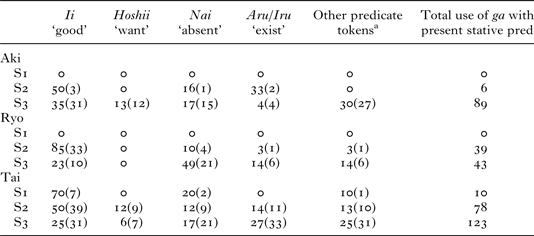
Analysis of specific present-inflected stative predicates used with ga by the three children showed that a particular predicate type (ii ‘good’), which expresses the speaker's internal feeling toward referents, accounted for a large number of present-inflected stative predicates used with ga in their early stage of development (see Table 2). Aki was less productive until 2;6, and when he used ga it tended to be used with ii. At around their third birthdays, the three children started to expand the use of ga to describe the existential status of the referents as well (e.g. kawa ga arimasu karane ‘There is a river’; Tai 2;11).
Percentages of four stative predicates in the present tense form used most frequently with ga by Aki, Ryo, and Tai
notes: Raw number in parenthesis; a Other predicate tokens represent the sum of other present-inflected stative predicate tokens that occurred less frequently in the present stative category.
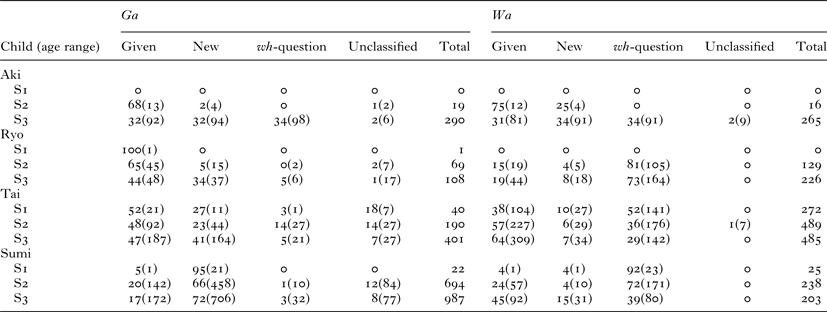
The present study coded an argument as New when the referent had not been mentioned during the preceding twenty utterances or 20 minutes. One might argue that twenty utterances or 20 minutes might be a little too much for detecting newness of the referent in child language data. Therefore, a follow-up analysis using a narrower window of five utterances was conducted. In the analysis, I coded a referent of each ga-/wa-marked argument as (a) Given when the referent was mentioned during the preceding five utterances, and as (b) New when it had not been mentioned during the preceding five utterances. In the case of Sumi's corpus, in addition to considering the preceding five utterances, only utterances that had been produced during the preceding 5 minutes were considered. The results are shown in Table 3. It is shown that the reanalysis did not change the overall results. Sumi frequently used ga to encode new information, while Aki, Ryo, and Tai used the marker for given as well as new information about a referent. The present study therefore bolsters the contention by Guerriero et al. (Reference Guerriero, Cooper, Ohima-Takane and Kuriyama2006), Huang (Reference Huang2011), and Nomura (Reference Nomura, Caunt-Nulton, Kulatilake and Woo2007) that a twenty-utterance window is reliable for the purpose of detecting the discourse given/new information status of referents in Japanese child language research.
Frequency percentages of wa-/ga-marked arguments in reference to given/new information and wh-questions for four children: 5-utterance-window
note: Unclassified includes wa-/ga-marked arguments appearing in repeated utterances, relative clauses, and sentential clauses not considered for this analysis (see coding procedure in ‘Coding’).
To summarize, it is shown that, with regard to the use of wa, all four children initially used the marker to denote wh-questions directing listener attention to a particular referent. They then gradually used it in reference to given information. As for the use of ga, Sumi tended to use ga in reference to new information, and this was stable for the 2 years of study. He also used ga with dynamic verbs inflected with the past-tense form, typically in order to report dynamic events that he had just witnessed or experienced. In contrast, Aki, Ryo, and Tai often used ga for given information as well as for new information. They also tended to use it with a specific stative adjectival, expressing speaker's preference toward a particular referent.
A likely explanation for the variations observed in the four Japanese children's use of ga would be the input to which each child had been exposed. In order to address this question, I conducted an analysis of the use of each marker in the parental input to the four children.
The use of wa and ga in parents' speech
In total, 3,736 tokens of wa and 3,707 tokens of ga in the parental input were extracted for analysis. Analysis of the input data showed that the use of wa and ga in the parents' speech mirrored that in the children's speech.
As was seen in children's speech, wa in parents' speech was initially used to encode wh-questions (see Figure 1). The frequent use of wa encoding wh-questions has also been reported in a previous study analyzing parental input data (Kurumada, Reference Kurumada and Corrigan2009). Wa then gradually started to be used to encode the proposition of given information.
Chi-square tests showed that Aki's mother's use of wa for wh-questions was significantly higher than that for given information at both stage 1 (χ 2 (1, N = 64) = 25, p = ·000, φ = ·62), and stage 2 (χ 2 (1, N = 362) = 7·47, p = ·006, φ = ·14), whereas her use of wa for given information became significantly higher than that for wh-questions at stage 3 (χ 2 (1, N = 538) = 61·56, p = ·000, φ = ·34). Ryo's parents' use of wa for wh-questions was significantly higher than that for given information at stage 1 and stage 2 (stage 1: χ 2 (1, N = 151) = 110·2, p = ·000, φ = ·85; stage 2: χ 2 (1, N = 121) = 62·55, p = ·000, φ = ·72), but this use diminished in frequency by stage 3, when it was not significantly different from that for given information (χ 2 (1, N = 78) = 6·205, p = ·013, φ = ·28). Likewise, Tai's mother's use of wa for wh-questions was significantly higher than that for given information at stage 1 (χ 2 (1, N = 442) = 28·38, p = ·000, φ=.25), but the frequency of the two uses were not significantly different at stage 2 or at stage 3 (stage 2: χ 2 (1, N = 585) = ·207, p = ·649, φ = ·01; stage 3, χ 2 (1, N = 523) = 1·608, p = ·205, φ = ·05). However, her use of wa for wh-questions was significantly higher than that for new information at stage 2 (χ 2 (1, N = 344) = 184·6, p = ·000, φ = ·73). Her use of wa for given information was significantly higher than that for new information at stage 3 (χ 2 (1, N = 305) = 200, p = ·000, φ = ·81). Sumi's parents' use of wa for wh-questions was significantly higher than that for given information at stage 1 (χ 2 (1, N = 67) = 9·328, p = ·002, φ = ·37), but at stages 2 and 3 it was their use of wa for given information that became significantly higher than that for wh-questions (stage 2: χ 2 (1, N = 211) = 29·57, p = ·000, φ = ·37; stage 3: χ 2 (1, N = 240) = 93·75, p = ·000, φ = ·63).
The results show that, as expected of adult Japanese grammars, Sumi's parents used ga to mark an argument whose referent had been newly introduced into the discourse (Figure 2). Chi-square test showed that Sumi's parents' use of ga for new information was significantly higher than that for given information at stage 1, stage 2, and stage 3 (stage 1: χ 2 (1, N = 39) = 16·02, p = ·000, φ = ·64; stage 2: χ 2 (1, N = 277) = 88·98, p = ·000, φ = ·56; stage 3: χ 2 (1, N = 284) = 42·6, p = ·000, φ = ·39). Since the high rate of use of ga in reference to new information was also observed in Sumi's speech, it is reasonable to suggest that the parental input was the source of his early emergent function of ga to mark new information.
In contrast, it can be seen in Figure 2 that the mothers of Aki, Ryo, and Tai did not always encode the proposition of new information with ga. As was observed in their respective children's speech, Aki, Ryo, and Tai's parents seemed to use ga in order to fulfill a range of discourse-pragmatic functions other than marking new information.
Chi-square tests showed that at stage 1 Aki's mother's use of ga for wh-questions was not significantly different from that for new information (stage 1: χ 2 (1, N = 21) = 2·333, p = ·127, φ = ·33), nor was her use of ga for wh-questions significantly different from that for given information (χ 2 (1, N = 18) = 5·556, p = ·018, φ = ·55); her use of ga for given information was not significantly different from that for new information at stage 2 (χ 2 (1, N = 267) = 5·127, p = ·024, φ = ·14), or stage 3 (χ 2 (1, N = 496) = ·516, p = ·472, φ = ·03). In contrast, her use of ga for given information was significantly higher than that for wh-questions at stage 2 (χ 2 (1, N = 212) = 39·92, p = ·000, φ = ·43) and stage 3 (χ 2 (1, N = 375) = 50·05, p = ·000, φ = ·37). Ryo's parents' use of ga for wh-questions at stage 1 was not significantly different from that for new information (χ 2 (1, N = 23) = 1·087, p = ·297, φ = ·22), or from that for given information (χ 2 (1, N = 19) = 4·263, p = ·039, φ = ·47). At stage 2 or stage 3 their use of ga for wh-questions was not significantly different from that for given information (stage 2: χ 2 (1, N = 60) = 2·051, p = ·152, φ = ·18; stage 3: χ 2 (1, N = 58) = ·621, p = ·431, φ = ·1), but their use of ga for wh-questions was significantly higher than that for new information at stage 2 (χ 2 (1, N = 48) = 10·08, p = ·001, φ = ·46), whereas their use of ga for given information was significantly higher than that for new information at stage 3 (χ 2 (1, N = 45) = 8·022, p = ·005, φ = ·42). Tai's mother's use of ga for given information was not significantly different from that for new information at stage 1 (χ 2 (1, N = 294) = ·577, p = ·448, φ = ·04), stage 2 (χ 2 (1, N = 404) = ·01, p = ·921, φ = ·05), or stage 3 (χ 2 (1, N = 476) = 3·361, p = ·067, φ = ·08). Her use of ga for given information was significantly higher than that for wh-questions at stages 1 and 3 (stage 1: χ 2 (1, N = 262) = 7·389, p = ·007, φ = ·17; stage 3: χ 2 (1, N = 446) = 10·98, p = ·001, φ = ·16). Tai's mother's use of ga for new information was not significantly different from that for wh-questions at stage 2 (χ 2 (1, N = 386) = 1·640, p = ·2, φ = ·06).
Sumi's parents tended to use ga with dynamic predicates in the past tense more often than with other predicate types (see Figure 3). The tendency of using ga with dynamic predicates inflected with the past tense form is also observed in Sumi's speech (see Figure 3).
Sumi's parents' use of ga with past-inflected dynamic predicates was not significantly different from that with present-inflected dynamic predicates at stage 1 (χ 2 (1, N = 26) = 5·538, p = ·019, φ = ·46). It approached significance, however. Their use of ga with past-inflected dynamic predicates was not significantly different from that with present-inflected stative predicates, or from that with present-inflected dynamic predicates (χ 2 (1, N = 167) = ·054, p = ·816, φ = ·01, and χ 2 (1, N = 155) = ·947, p = ·330, φ = ·07, respectively) at stage 2. Finally, their use of ga with past-inflected dynamic predicates was significantly higher than that with present-inflected stative predicates at stage 3 (χ 2 (1, N = 192) = 6·75, p = ·009, φ = ·19).
Analysis of specific past-inflected dynamic predicates that Sumi's parents used with ga showed that, as was observed in their child's speech, ga appeared with a variety of past-inflected dynamic predicates to report events the parents had witnessed/experienced (e.g. otsume ga nobita-ne ‘Your nail has grown’; Sumi 1;5): kita ‘came’, the most frequently used past-inflected dynamic verb in Sumi's speech, accounted for only 13% of all past-inflected dynamic predicates that occurred with ga in his parents' speech.
Aki, Ryo, and Tai's parents often used ga with stative predicates in the present tense form (see Figure 3). The tendency of using ga with stative predicates in the present tense form is observed in the speech of their respective children.
Chi-square tests showed that Aki's mother's use of ga with present-inflected stative predicates was not significantly different from that with present-inflected dynamic predicates at stage 1 (χ 2 (1, N = 17) = 4·765, p = ·029, φ = ·53), although a large effect was shown. However, her use of ga with present-inflected stative predicates was significantly higher than that with durative-inflected dynamic predicates (χ 2 (1, N = 16) = 6·25, p = ·012, φ = ·63). Aki's mother's use of ga with present-inflected stative predicates at stage 2 and stage 3 was significantly higher than that with past-inflected dynamic predicates (stage 2: χ 2 (1, N = 212) = 18·13, p = ·000, φ = ·29; stage 3: χ 2 (1, N = 433) = 75·66, p = ·000, φ = ·42). Ryo's parents' use of ga with present-inflected stative predicates was significantly higher than that with past-inflected dynamic predicates at stage 1 and stage 3 (stage 1: χ 2 (1, N = 21) = 8·048, p = ·005, φ = ·62; stage 3: χ 2 (1, N = 40) = 6·4, p = ·011, φ = ·4). Their use of ga with present-inflected stative predicates was not significantly different from that with past-inflected dynamic predicates at stage 2 (χ 2 (1, N = 47) = 0·191, p = ·662, φ = ·06). However, Ryo's parents' use of ga with present-inflected stative predicates was significantly higher than that with past-inflected stative predicates at stage 2 (χ 2 (1, N = 31) = 11·64, p = ·001, φ = ·61). Tai's mother's use of ga with present-inflected stative predicates was not significantly different from that with past-inflected dynamic predicates at stage 1 (χ 2 (1, N = 242) = 5·355, p = ·021, φ = ·15). However, her use of ga with present-inflected stative predicates was significantly higher than that with present-inflected dynamic predicates at stage 1 (χ 2 (1, N = 201) = 29·49, p = ·000, φ = ·38). Tai's parents' use of ga with present-inflected stative predicates was significantly higher than that with past-inflected dynamic predicates at stage 2 and stage 3 (stage 2: χ 2 (1, N = 364) = 63·47, p = ·000, φ = ·42; stage 3: χ 2 (1, N = 386) = 47·91, p = ·000, φ = ·35).
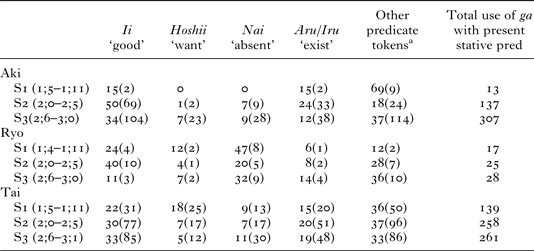
Analysis of specific present-inflected stative predicates used with ga by the parents of Aki, Ryo, and Tai showed that, as was observed in their children's speech, a predicate expressing the speaker's internal feeling, ii ‘good’, was used relatively frequently with ga in an early stage of development (see Table 4), suggesting that input frequency was the source of the emergent function associated with ga in the speech of Aki, Ryo, and Tai.
Percentages of four stative predicate types most frequently used with ga by the parents of Aki, Ryo, and Tai
notes: Raw number in parenthesis; a Other predicate tokens represent the sum of other present-inflected stative predicate tokens that occurred less frequently in the present stative category.
DISCUSSION
This study is a first systematic attempt to longitudinally investigate discourse-pragmatic functions associated with the emergent use of Japanese subject markers wa and ga in spontaneously produced speech data. It uncovered several key findings.
First, it was found that the particle wa was initially used by all four children as a wh-question marker (e.g, kore wa? ‘What's this one?/How about this one?’). This tendency has also been reported by Clancy (Reference Clancy and Slobin1985), Kurumada (Reference Kurumada and Corrigan2009), Miyata (Reference Miyata1992), and Takagi (Reference Takagi2001). The present study went beyond this previous body of work, however, by systematically analyzing how this and other functions of wa developed longitudinally in the relevant discourse contexts. This discourse-pragmatic lens revealed how wa gradually shifted its function from wh-question marker to topic marker, gradually more frequently encoding the proposition of given/presupposed information. Functionally, children used wa initially as a wh-question marker in order to seek the listener's attention, or direct attention to a particular referent (Kurumada, Reference Kurumada and Corrigan2009). The referent, in turn, became the shared topic of the subsequent conversation in which wa was used to signal the given topic (Kurumada, Reference Kurumada and Corrigan2009; Takagi, Reference Takagi2001; Tanaka, Reference Tanaka1999). The very same tendency was observed in the parents' speech. This suggests that children develop early functions of wa based on the input to which they are exposed.
While the uses of wa exhibited clear uniformity across the four child corpora, the uses of ga turned up differences across the children, with one child's usages (Sumi's) departing from the rest. The variation seems to have been driven by the input to which each child was exposed. Sumi and his parents used ga in reference to new information, reporting dynamic new events they had just witnessed/experienced. In contrast, the other three children and their respective parents used ga for given information as well as for new information. It might be that, functionally, rather than using ga to mark newness of a referent in a discourse context, Aki, Ryo, and Tai and their respective parents used ga to highlight or single out the particular referent in the discourse context (Kuno, Reference Kuno1973; Nakamura, Reference Nakamura1993; Ono et al., Reference Ono, Thompson and Suzuki2000; Suzuki & Ono, Reference Suzuki and Ono1991) and express their preference towards it. The following examples showed that Ryo (2;4) used ga to single out the referent bubu ‘car’, and then expressed his preference towards it by using ii ‘want’.
(6) mother:ja mamagoto shite irasshai!
Then, mamagoto-do-imp-pol
‘Then, please do “play-housekeeping”!’
ryo:buubu ga ii.
Car-nom good-pres
‘I want (to play with) a car.’
In example (6), Ryo's mother suggested something different from a car game (housekeeping-game). But Ryo insisted that he wanted to play with a car. Ryo used ga here with a noun, buubu ‘car’, that had been mentioned during the preceding twenty utterances. Thus, the referent of the noun was considered as given information in the discourse context. It seems that Ryo used ga here to highlight what he really wanted to do.
The highlighting function of ga was also found in the parental input:
(7) amo:ringo choodai.
apple give-me-imp.
‘Give me an apple.’
ryo:hai.
yes.
‘Here you go.’
amo:are?
that?
‘Uh?’
amo:ringo ga ii naa.
ringo-nom good
‘I want to have an apple.’
In example (7), Aki's mother (AMO) asked Aki (2;7) to give her an apple. But Aki mistakenly gave her a grape. Then his mother used ga with an apple to emphasize that she wanted him to give her an apple not a grape. The ga-marked noun, ringo ‘apple’, had been mentioned during the immediately preceding utterances. Thus, rather than encoding a referent newly introduced to a discourse context, she used ga here to highlight the particular referent for Aki and then expressed preference towards it by using ii ‘want’.
The present study has demonstrated that not only does input explain the process of language development, it also accounts for the differences observed in individual children (e.g. Guerriero et al., Reference Guerriero, Cooper, Ohima-Takane and Kuriyama2006; Huttenlocher et al., Reference Huttenlocher, Haight, Bryk, Seltzer and Lyons1991, Reference Huttenlocher, Vasilyeva, Cymerman and Levine2002; Lieven, Reference Lieven, Waterson and Snow1978; Sandhofer et al., Reference Sandhofer, Smith and Luo2000; Shirai, Reference Shirai1994; Tardif et al., Reference Tardif, Shatz and Naigles1997). It is suggested that children in this study might have adopted different styles of using ga possibly because they had formulated different hypothesis concerning how ga was used, based on how their parents used the marker in speech addressed to them.
The use of ga by Aki, Ryo, and Tai also showed a tendency to be lexical-specific. It co-occurred frequently with a particular type of stative verbs, ii, which was also frequent in the parental input. It might be that the use of ga by the three children was still in the stage of item-based usage (Lieven, Pine & Baldwin, Reference Lieven, Pine and Baldwin1997; Pine, Conti-Ramsden, Joseph, Lieven & Serratrice, Reference Pine, Conti-Ramsden, Joseph, Lieven and Serratrice2008; Tomasello, Reference Tomasello2000, Reference Tomasello2003), using ga with the specific predicate they had frequently heard in the input.
A concern when explaining the variation observed across the four children might be that it is attributable to the type of longitudinal corpus data included in this analysis. Namely, Sumi's corpus comes from diary data in which his mother and his father, an educational psychologist, wrote down almost all of his utterances produced from birth up to his seventh birthday (Noji, Reference Noji1973–1977). The corpora for Aki, Ryo, and Tai, by contrast, come from parent–child interactions that were tape-recorded and transcribed for analysis (Miyata, Reference Miyata2004a, Reference Miyata2004b, Reference Miyata2004c). However, this alternative explanation is weakened by the fact that the differences between Sumi and the other children were observed only in the early functions of ga. The uses of wa did not show any individual differences in terms of functions associated with it; all four sets of both child and parental data turned up uniform patterns. Similarly, a previous study analyzing the same data showed that the four children behaved similarly, and no difference was found between Sumi and the other three children in the early semantics and pragmatics of relative clauses (Ozeki & Shirai, Reference Ozeki and Shirai2010). Thus, the individual differences in these data have so far been found only in the present study and only in the early functions associated with ga. Furthermore, the parental input showed individual differences that patterned with the child data in a similar way. All these facts combined suggest that the individual differences observed in this study are very likely attributable to the input to which each child was exposed, and probably not imputable to possible methodological noise. It might be that the parents of each child adopted different parent–child interaction styles, resulting in the observed individual variations in the use of ga in children's Japanese. Future research should address in a more systematic way the question of individual differences.
The study shows that the acquisition of Japanese case markers is constrained by discourse-pragmatic forces that modulate their usage by the children. It is, therefore, advantageous for usage-based studies of child acquisition to incorporate analyses that go beyond a narrow definition of ‘construction’ and incorporate discourse views of usage. The crucial role of discourse-pragmatics in early constructions has been suggested in previous child language acquisition studies (Allen, Reference Allen2000; Clancy, Reference Clancy, Sohn and Haig1997; Guerriero et al., Reference Guerriero, Cooper, Ohima-Takane and Kuriyama2006; Huang, Reference Huang2011; Narasimhan, Budwig & Murty, Reference Narasimhan, Budwig and Murty2005; Serratrice, Reference Serratrice2005). The present study has provided another piece of evidence demonstrating that early syntactic construction is constrained by discourse-pragmatics and that constructivist researchers would do well in heeding previous calls by Allen (Reference Allen2000), Clancy (Reference Clancy, Sohn and Haig1997), Guerriero et al. (Reference Guerriero, Cooper, Ohima-Takane and Kuriyama2006), Huang, (Reference Huang2011), Narasimhan et al. (Reference Narasimhan, Budwig and Murty2005), and Serratrice (Reference Serratrice2005) to infuse developmental investigations of constructions with discourse views of usage.
In sum, the present study has shown that the learning of Japanese case markers is function-oriented and input-driven (Tomasello, Reference Tomasello2000, Reference Tomasello2003). Importantly, it has also demonstrated that individual differences are substantial in child language development and that input frequency in child-directed speech can help explain them (Furrow & Nelson, Reference Furrow and Nelson1984; Goldfield, Reference Goldfield1993; Huttenlocher et al., Reference Huttenlocher, Haight, Bryk, Seltzer and Lyons1991, Reference Huttenlocher, Vasilyeva, Cymerman and Levine2002; Lieven, Reference Lieven, Waterson and Snow1978; Nelson, Reference Nelson1981; Sandhofer et al., Reference Sandhofer, Smith and Luo2000; Shirai, Reference Shirai1994). The study extended these insights to early form–function mapping in child Japanese.