During the last decade or so, the Scholarship of Teaching and Learning (SoTL) has increasingly gained recognition as a scholarly field of inquiry. The Carnegie Foundation for the Advancement of Teaching has been a strong proponent of the SoTL movement, and several publications advocating that teaching be taken seriously and calling for a critical and public evaluation of teaching have been issued under the auspices of the Carnegie Foundation (e.g., Boyer Reference Boyer1990; Glassick, Huber, and Maeroff Reference Glassick, Huber and Maeroff1997). The Scholarship of Teaching and Learning is not confined to the U.S.; in fact, SoTL is gaining relevance internationally. For example, in the UK, the Research Assessment Exercise (an assessment of universities' research activities that is a crucial component for university ranking and funding) states that for the 2008 assessment round, “higher education pedagogic research will be judged by the standards applied to all forms of research output” while “teaching materials and subject-related pedagogy … will be treated in the same way as textbooks” (RAE 2008). Thus, in some countries SoTL work is officially gaining equal status to that of other substantive disciplinary research.
A significant share of SoTL studies is published in journals in the field of education.Footnote 1 In addition, many academic fields disseminate inquiries into teaching and learning in disciplinary journals or feature journals focusing exclusively on issues of teaching and learning in their discipline. Political science, as an academic field, is a relative newcomer to the Scholarship of Teaching and Learning compared to other social sciences, such as history and sociology (Clarke Reference Clarke2002a, 223). Yet, a growing number of political scientists are investigating their own teaching effectiveness and student-learning outcomes, as evidenced, for example, by the participants in the annual APSA Teaching and Learning Conference and panels and roundtables at APSA's annual meeting, as well as at the conferences of regional, state, or international political science associations. Yet, despite the evidence for the growing interest of political scientists in this area, only a few journals in the discipline provide publication outlets for SoTL research, perhaps because SoTL is still a relatively young field of political science research.
Here, we evaluate questions related to the publication of SoTL articles in political science. We focus on two aspects: First, in which political science journals are SoTL articles in our field published? And second, who are the authors of these SoTL articles? These questions are motivated by the recognition that as a new field of inquiry, we know little about the patterns of publication in SoTL. Academics engaged in SoTL work might face several problems. One is the relative dearth of disciplinary outlets for their scholarly activities in this field; another one is the fact that as a new area focusing on research in the teaching area, SoTL research might potentially not be of equal interest to all college professors, and might take place in certain types of higher-education institutions more so than in others. Thus, we look here into the primary disciplinary outlets for SoTL publications as well as the types of scholars and institutions that engage in SoTL and compare our findings with comparable publication data in the discipline as a whole where possible. These factors provide important information about the way SoTL is unfolding in the discipline. We proceed as follows: In the second section, we define the Scholarship of Teaching and Learning and briefly discuss its relevance in higher education. The third section addresses questions of research methodology. Fourth, we present the results of our data analysis. We conclude with some thoughts regarding the position of SoTL in political science.
WHAT IS SoTL, AND WHY DOES IT MATTER?
The Scholarship of Teaching and Learning can be defined as “problem posing about an issue of teaching or learning, study of the problem through methods appropriate to the disciplinary epistemologies, applications of results to practice, communication of results, self-reflection, and peer review” (Cambridge Reference Cambridge, Lieberman and Wehlburg2001, 8; for similar definitions, see also Witman and Richlin Reference Witman and Richlin2007; Clarke Reference Clarke2002b).Footnote 2 SoTL is thus different from articles about teaching that report professors' personal experiences and impressions, or that relay anecdotes and impressionistic evidence about teaching effectiveness that have not been systematically assessed; it also differs from reports on interesting or innovative teaching techniques that are relayed without evaluating their effectiveness on learning. Furthermore, SoTL is distinct from scholarly teaching, which refers to teaching that is informed by scholarly research but lacks the evaluation component and has not been disseminated through a peer-review publication process (see, e.g., Clarke Reference Clarke2002b). Thus, SoTL resembles other scholarly endeavors in that it involves peer-reviewed publication of research. It is distinct from other disciplinary research, however, in that the focus of the inquiry is teaching and learning.
Discussion also concerns the divide between teaching and research in institutions of higher education (e.g., Lueddeke Reference Lueddeke2008) as well as the definition of scholarship (e.g., Albers Reference Albers2007). The Carnegie Academy for Teaching and Learning has pushed for an expansion of the concept of scholarship in such a way that it would also extend to teaching and learning issues (e.g., Boyer Reference Boyer1990; Glassick, Huber, and Maeroff Reference Glassick, Huber and Maeroff1997). These discussions bear importance for higher education as they contribute to the definition of scholarship, which in turn is instrumental for providing incentives for academics' career paths. In other words, if SoTL is not widely recognized and accepted as scholarship that makes a valuable contribution, it is also unlikely to be considered as making a serious contribution to faculty members' promotion and tenure files, for instance. If, on the other hand, it is widely accepted as a valuable field of scholarly research, college professors might be incentivized to pursue research into issues of teaching and learning as a line of scholarly endeavor.
Given public discussions concerning the quality of college education and the preparedness of college graduates, SoTL has the potential to make a meaningful and significant contribution to higher education as it systematically explores issues of teaching effectiveness and learning within the disciplines. This is particularly important because most new faculty members joining the profession, while experts in their disciplinary fields, have overall received little training in teaching. This is true even though many graduate students have gained some teaching experience by the time they begin their first full-time jobs, and despite the Preparing Future Faculty Program (see http://www.preparing-faculty.org/) as well as the growing services of teaching and learning centers on many campuses across the country. Oftentimes, it is still assumed that faculty members know how to teach once they have completed graduate school, and if they do not know how to teach effectively, they can learn it over the years by trial and error, with the help of senior colleagues and mentors, department chairs, or teaching and learning centers on their campuses (see, e.g., Hutchings Reference Hutchings2002). Without much doubt, a systematic evaluation of teaching and learning outcomes might be a useful tool for improving one's teaching, and making the results of research into teaching effectiveness and student learning public will potentially make a contribution to improving others' teaching.
The question of who the academics are that engage in SoTL research matters as it may reveal important lines of division in the profession and also allows for initial insights into whether SoTL as a subfield is different from other substantive fields in political science. Analyzing the characteristics of the faculty members who publish SoTL work with respect to gender, rank, and institutional backgrounds may provide us with some hints as to who is pursuing this new field of inquiry and in what types of institutions this new line of research is housed, indicative of changes in the discipline.
DATA, METHODOLOGY, AND RESEARCH QUESTIONS
To construct our database, we first had to decide which journals to include—whether our focus should be on political science journals or whether we should broaden our data collection to include political science SoTL published in journals devoted to pedagogy regardless of academic field. We decided to include only disciplinary journals in political science rather than also identifying SoTL work published in multidisciplinary education journals. On the one hand, being more inclusive in our journal selection would have expanded our database. Yet, we are particularly interested here in exploring how SoTL is promoted or facilitated within the discipline rather than in a more general non-disciplinary context. Furthermore, disciplinary journals appear singularly suited to address issues of teaching and learning in political science, employing the tools and methodologies used within the discipline (see the definition by Cambridge Reference Cambridge, Lieberman and Wehlburg2001, above). Lastly, it has been recognized that SoTL work is most valuable when it is clearly linked to the discipline. For example, Pat Hutchings, vice president of the Carnegie Foundation for the Advancement of Teaching, observes that the “scholarship of teaching and learning is deeply embedded in the discipline; its questions arise from the character of the field and what it means to know it deeply” (Hutchings Reference Hutchings and Hutchings2000, 7) and states that SoTL “starts with questions and methods that come out of and are valued by the discipline” (Hutchings Reference Hutchings2002, 224). Clarke (Reference Clarke2002b, 229) also claims that SoTL is “decidedly discipline specific” while Witman and Richlin (Reference Witman and Richlin2007, 1) posit that “scholarly recognition comes from the discipline,” including for SoTL work. Similarly, guidelines and suggestions for the inclusion of SoTL work for the purpose of tenure and promotion proposed by a group of universities forming the AAHC/CASTL SoTL cluster posit that “evaluation is based on the standards of qualitative and/or quantitative traditions in the discipline” (AAHC/CASTL 2004).Footnote 3 If SoTL is generally (albeit not universally) understood to be anchored in the disciplines and if recognition for SoTL work starts with departments, then it makes sense to focus our research on SoTL published in journals within the discipline.
We collected data on political science teaching and learning scholarship from the three main journals publishing in this field: PS: Political Science & Politics, the Journal of Political Science Education (JPSE), and International Studies Perspectives (ISP).Footnote 4 PS's section the Teacher regularly publishes several articles on teaching and learning, including SoTL articles. PS is distributed to APSA members and serves as one of the main journals for the profession. A second journal, JPSE, first published in 2005, concentrates exclusively on publications related to teaching and learning across all subfields in the discipline. The final journal under consideration, ISP, was first issued in 2000. ISP regularly features articles on teaching with a focus on international relations.Footnote 5 Our data include all the articles published in the Teacher section in PS from 1998 until 2008. We chose the 10-year span because it broadly captures the period of time in which SoTL work first appeared in political science;Footnote 6 for example, Kehl (Reference Kehl2002, 230) finds a “dramatic increase” of SoTL in the discipline between 1998 and 2001, the final year of her database. We included all the issues of JPSE and ISP since their inception in 2005 and 2000, respectively, until 2008.Footnote 7
We are interested in the following questions. First, we want to find out to what extent the major disciplinary journals that regularly publish on teaching and learning issues include SoTL articles rather than other types of teaching-related articles. That is, are SoTL articles fairly evenly distributed across the three major outlets for teaching-related articles in the discipline? And related, has the last decade or so witnessed a change in the proportion of SoTL articles compared to all articles on teaching and learning?
Second, we are interested in the demographics of scholars publishing on teaching and learning and in particular in the SoTL area. This will also allow for some initial comparison with trends in the discipline at large—are there indicators to suggest that SoTL scholarship follows trends existing in other subfields, or are there distinctive characteristics? Here, we look at four factors. First and second, we identify to what extent SoTL publications in political science journals mirror trends in the discipline with respect to authorship—in particular, single versus co-authorship and gender. Third, we evaluate the rank of the faculty publishing in this area. Are SoTL publications more prominent among a younger cohort of political scientists, maybe reflecting a trend towards attuning graduate students better to the demands of quality teaching, or among older cohorts, who maybe find a renewed interest in evaluating their own teaching and their students' learning? Fourth, we are curious as to whether authors of SoTL articles tend to work in specific types of institutions of higher education—perhaps they are clustered in teaching-intensive BA departments, or maybe they tend to be housed in research-intensive Ph.D. departments and extend their research in substantive areas to the classroom? This question is in part motivated by observations such as “it does appear that most research-intensive universities across the globe still have not fully realized the harmonisation of the research-teaching relationship” (Lueddeke Reference Lueddeke2008, 2). Thus, we expect that the institutional context in which a faculty member works might encourage or discourage involvement in SoTL work. For these four questions, we compare SoTL articles to other articles on teaching and learning and also with general trends in the discipline where possible.
RESULTS
Profile of Articles on Teaching and Learning
Our data set contains information on 347 articles, 134 of which are SoTL (38.6%) and 213 of which are not (61.4%). Figure 1 displays the percentage of SoTL articles appearing in the Teacher section of PS (1998–2008), ISP (2000–2008), and JPSE (2005–2008). Though scarce in the early years—11.8% of PS articles in 1998 and 16.7% in 1999—the percentage of SoTL entries increased to 40.0% by 2000, which is close to the overall average of 38.6%. Between 1998 and 2004 (the last year before the launch of JPSE), PS increased its percentage of SoTL articles by more than 4 percentage points per year, on average. Publication year 2006 is clearly the peak of the data stream: 63.2% of PS articles, 72.2% of JPSE articles, and 30.0% of ISP pedagogy articles were devoted to SoTL research. While the JPSE numbers remained high, the PS percentages dropped off substantially in 2007 and 2008, perhaps reflecting a diverging specialization of the two outlets. The ISP numbers fluctuate considerably but, overall, average 20.2%. In any event, the data show general growth in SoTL research. Regressing the SoTL percentage on year (and ignoring journal type) returns a significant coefficient of 3.0, which suggests a positive trend in the percentage of SoTL articles appearing in these political science journals.
Percentage of SoTL Articles, by Journal and Year

What is the general profile of a SoTL article? Does SoTL research attract the same sort of academic as non-SoTL research? Using the individual article as the unit of analysis, we can draw authorship profiles of the two sorts of articles—comparing the number and gender composition of authors, their academic ranks, and the sorts of departments where authors hold their positions.
Number of Authors
Figure 2 displays (rather stark) differences in single versus multiple authorship. Whereas over 80% (81.2%) of non-SoTL articles are single authored, only half (50.0%) of SoTL articles fall into this category; the remaining half feature two (39.6%) or more than two authors (10.4%). Clearly, collaboration is more typical of SoTL research than of non-SoTL research. Overall, compared to non-SoTL articles, the trend towards co-authorship of SoTL articles is much closer to that of publication in major political science journals in other subfields, where 40% were co-authored in the decade between 1996 and 2005 (Kanchan et al. Reference Kanchan, Gandhi, King, Lupia and Mansfield2006, 2), roughly equivalent to the timeframe of our database; among APSA journals, collaborative articles comprised 60% of all articles between 1997 and 2007 (Biggs Reference Biggs2008, 246).Footnote 8 Maybe it is because most college classes are taught by a single professor that articles reporting on teaching experiences and techniques tend to be single authored, whereas the research aspect of SoTL work lends itself to collaboration. Because of this prominent SoTL/non-SoTL distinction, we further coded each article by single/multiple authorship, resulting in four categories: SoTL single (67 articles, 19.5% of the total); non-SoTL single (171 articles, 49.9%); SoTL multiple (66 articles, 19.2%); and non-SoTL multiple (39 articles, 11.4%). This categorization permits interesting insights into patterns of authorship and co-authorship across other dimensions of difference. One such difference concerns the gender of authors and the gender composition of collaborations, to which we now turn.Footnote 9
Number of Authors, SoTL and Non-SoTL Compared
Chi-square = 37.773
Significance = .000
Lambda = .201

Anatomy of Authorship: Gender
One can frame a number of interesting questions about the provenance of SoTL (and non-SoTL) research articles. Is the typical SoTL article written by a male or female? Do co-authored pieces—a prominent attribute of SoTL research—display inter-gender collaboration? Table 1 reports the gender composition of authorship for the four article types. Notice the prevalence of males in the non-SoTL single-author category: 72.2%. However, single-authored SoTL publications are just slightly less likely to be written by a female (44.8%) than a male (55.2%). This is remarkable given that in 2001 only slightly more than one-fifth of all full-time faculty members were female (APSA 2005, iii), and just over one-quarter (26%) in 2006 (Sedowski and Brintnall Reference Sedowski and Brintnalln.d.). Evidence of female-male collaboration is more mixed. Inter-gender collaboration is clearly the dominant pattern for non-SoTL research: 58.9% of multi-authored non-SoTL articles show this form of collaboration. This stands in contrast to discipline-wide findings reporting that female faculty members are overall less likely to collaborate and publish with male colleagues (APSA 2005, 12). In the SoTL area, female-male collaboration is less pronounced (39.4%) but still runs a close second to all-male collaboration (42.4%). And all-female collaborations were much more likely for SoTL articles (18.2%) than for non-SoTL articles (10.3%). Overall, females comprised over two-thirds (69.2%) of non-SoTL co-authorships, compared with 57.6% of SoTL collaborations. On balance, one could conclude that, compared with men, women are well represented in single-authored SoTL work, and also compared to women's representation in other fields of political science publications. Collaborative SoTL work—which, as we have seen, is very common—has a fairly equitable representation of females.
Article and Authorship Type, by Gender Composition

Anatomy of Authorship: Faculty Rank
Another set of questions involves the faculty-rank composition of the different article types. Are SoTL articles written primarily by seasoned teachers, securely settled in their academic positions, perhaps developing a mid- or late-career interest in assessing their own teaching and their students' learning? Or does a dissection of SoTL scholarship reveal a different mix—with a tilt toward researchers who are relatively new to the profession, attempting to teach effectively from the beginning of their careers by evaluating their own teaching and their students' learning through research, perhaps inspired by programs such as Preparing Future Faculty or teaching and learning centers in their Ph.D. institutions that have reached out to graduate students?
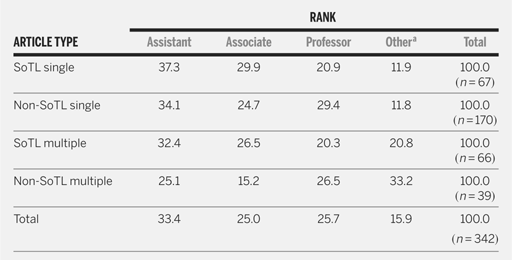
Because our unit of analysis is the individual article, not the individual author, we deploy our classification of article type—SoTL single, non-SoTL single, SoTL multiple, non-SoTL multiple—as the independent variable. Compositional characteristics, such as the faculty ranks or institutional backgrounds of authors, are dependent variables. For example, if a single-authored article was written by an assistant professor, then the article contains 100% of the assistant-professor attribute. If a multi-authored article was co-authored by an assistant professor and two associate professors, then the article contains 33.3% of the assistant-professor attribute and 66.7% of the associate-professor attribute. By calculating the means of these attributes for each article type, we can look for compositional patterns related to faculty rank. Table 2 displays the results.
Mean Percentage of Authorship for Different Faculty Ranks, by Article Type

a Includes instructors, students, and professional staff.
First consider the relative prevalence of the faculty-rank attributes. All articles, except non-SoTL multiple-authored ones, are more likely to have been authored or co-authored by an assistant professor than by faculty of other ranks. The assistant-professor attribute was present in 37.3% of single-authored SoTL and 34.1% of single-authored non-SoTL publications—in other words, 37.3% of the former and 34.1% of the latter were written by assistant professors. Inter-rank differences are particularly pronounced for single-authored SoTL pieces: over a 7-point mean difference between assistants and associates, and a more than 16-point difference between assistants and full professors. These differences are less salient for single-authored non-SoTL articles, in which full professors play a larger authorship role, and less pronounced still for multi-authored articles, in which the ranks show greater parity, though a 12-point difference between assistant and full professors is maintained for SoTL articles. Not surprisingly, solo-authored pieces are quite unlikely to have been written by faculty members in non-tenure-track ranks: 11.9% of SoTL single and 11.8% of non-SoTL single have this compositional trait. Even so, one-fifth (20.8%) of multi-authored SoTL articles and a third (33.2%) of multi-authored non-SoTL articles have authorships shared in part by instructors, visitors, professional staff, and graduate students. In any event, assistant professors have clearly taken the lead in publishing in the relatively new area of SoTL research in political science journals.Footnote 10
Anatomy of Authorship: Program Type
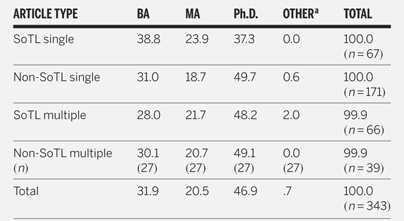
Lastly, we are interested in the institutional makeup of SoTL and non-SoTL articles. Perhaps SoTL work displays a stronger liberal-arts-college component. These institutions may be more likely to reward a commitment to high-quality teaching of undergraduates, and the institutional environment may encourage investigation into teaching effectiveness. Or perhaps SoTL and non-SoTL articles reflect similar institutional origins: Ph.D. departments, in which the culture of publishing and research extends to issues of teaching and learning. Our data provide insight into institutional patterns as we can make similar determinations for institutional context (BA, MA, or Ph.D.-granting departments) as we did for faculty rank. Again, by calculating the means of these attributes for each article type, we can look for patterns related to institutional setting.
As shown in Table 3, with one noteworthy exception—solo-authored SoTL articles—every article type has a prominent Ph.D.-granting pedigree. Looking only at single-authored publications, SoTL pieces are much more likely to have been written by Ph.D. faculty than are non-SoTL pieces: 49.7% versus 37.3%. In the SoTL area, faculty in Ph.D. settings are more likely to turn up in collaborations (48.2%) than in solo-authored articles (37.3%); Ph.D. faculty are also more likely to engage in multi-authored SoTL work than faculty from either MA or BA departments—but authors from BA departments (38.8%) are slightly more common in the single-author SoTL category than Ph.D. faculty. Interestingly, MA faculty, though marginally more likely to contribute to SoTL articles, are fairly equally represented in all categories. Faculty from other types of departments, such as community colleges or JD departments, make few contributions to teaching publications in political science journals. But the main finding is not too surprising: faculty from Ph.D. programs publish in all categories, and comprise the largest group in all categories of publications on teaching and learning with the exception of single-authored SoTL articles. Faculty from BA departments also contribute significantly to all categories of pedagogical articles, and provide the largest share of lone-authored SoTL articles. MA department faculty are less active in publishing in teaching and learning in political science.
Mean Percentage of Authorship for Different Department Degrees, by Article Type

a Includes JD and AA departments.
CONCLUSION
Our analysis has produced several interesting and important insights into the dynamics of publishing in the area of teaching and learning, and more specifically, the Scholarship of Teaching and Learning, in political science. Analyzing the articles published in the Teacher section in PS: Political Science & Politics (1998–2008), the Journal of Political Science Education (2005–2008), and International Studies Perspectives (2000–2008), we find that the proportion of SoTL articles of all teaching and learning articles has been steadily increasing. This finding demonstrates that this new area of research is rapidly gaining hold in the discipline and produces a growing number of publications. Analyzing the authorship of SoTL articles, several aspects are especially remarkable. We find that SoTL articles follow a similar pattern to that of other publications in political science with respect to single vs. co-authorship, while non-SoTL articles tend to be single authored at a higher rate. Furthermore, women seem to be particularly likely to publish in this new field of inquiry, compared to the proportion of women in the discipline and their share of publications overall in the discipline. Second, it appears that multi-authored SoTL and all non-SoTL articles are more likely to be authored by faculty housed in Ph.D. departments, but authors from BA departments are slightly more likely to publish single-authored SoTL research. We also find that assistant professors are particularly likely to publish in the SoTL area. It is possible that the relatively high proportion of SoTL articles authored by women and by assistant professors is related to the fact that female faculty are better represented among the assistant professors than among higher ranks. However, even among the assistant professors, women constituted just 35% of all faculty in 1997–2004 (APSA 2005, iii; Sarkees and McGlen Reference Sarkees and McGlen1999, 103). This is less than the 45% of solo-authored SoTL articles authored by women, indicating that the trend we observed is not entirely driven by the composition of the political science professoriate.
This raises important questions concerning the motivation for junior faculty members to engage in this line of research. Are they primarily motivated by their desire to improve their teaching, and their students' learning, through rigorously evaluating what is going on in their classrooms, thus reflecting an attitude that emphasizes a commitment to excellence in teaching? Or do they respond to institutional incentives to pursue this line of research that value SoTL for the purposes of promotion and tenure? To answer this question, further research should look at the incentives or rewards offered by different types of departments, such as counting SoTL publications for promotion and/or tenure, or allowing space for non-SoTL and SoTL articles to be included in teaching portfolios that may be used for teaching awards or annual review purposes. Currently, little is known about the extent to which departmental and institutional credit is allocated for SoTL comparable to research in substantive areas in political science. This is especially important since our data indicate that SoTL articles are primarily authored by assistant professors, who are particularly vulnerable to publication pressures. It is also important in light of our findings that women are disproportionately active in this field while generally underrepresented in many areas of the discipline (APSA 2005). Neither are data available about the number of political scientists who identify SoTL as one of their research specializations. These issues are significant for the development of the profession as it is younger scholars who will shape the future of the discipline, and as the proportion of SoTL publications compared to all publications on teaching and learning in disciplinary journals has been rising steadily over the last decade.