Introduction
Despite a considerable growth of interest in researching bilingualism, there are still reservations as to whether or not it leads to any cognitive or linguistic advantages, with empirical evidence yielding largely contradictory results (e.g., Lehtonen, Soveri, Laine, Järvenpää, de Bruin, & Antfolk, Reference Lehtonen, Soveri, Laine, Järvenpää, de Bruin and Antfolk2018; Paap, Reference Paap and Schwieter2019). Some have cast doubt on the existence of a bilingual advantage (see Paap, Reference Paap and Schwieter2019 for a review). Even pioneers of the bilingual advantage (BA) camp have admitted that bilinguals are slower than their monolingual peers in a range of lexical tasks (e.g., Bialystok, Reference Bialystok2009; Kaushanskaya & Marian, Reference Kaushanskaya and Marian2007). However, several studies suggest that bilinguals outperform monolinguals in certain aspects. The benefits constitute a bilingual advantage (BA), defined as the “skill areas in which bilinguals outperform monolinguals” (de Bot, Reference de Bot, Pfenninger and Navracsics2017, p. 15). BA has been found mainly in nonlinguistic domains that require ignoring irrelevant information including creativity, logic, flexibility, thinking and metalinguistic awareness (de Bot, Reference de Bot, Pfenninger and Navracsics2017). Research on BA has indicated that most of these advantages are cognitive in nature. For instance, it has been demonstrated that bilinguals are faster than monolinguals in conflict resolution tasks (Costa, Hernández, Costa-Faidella, & Sebastián-Gallés, Reference Costa, Hernández, Costa-Faidella and Sebastián-Gallés2009), enjoy a higher attentional capacity (Comishen, Bialystok, & Adler, Reference Comishen, Bialystok and Adler2019), and have enhanced cognitive reserve that could delay dementia up to four years (Bialystok, Craik, & Freedman, Reference Bialystok, Craik and Freedman2007).
It has also been suggested that the cognitive ability to inhibit irrelevant information including nontarget language information, purportedly associated with bilingualism (de Bot, Reference de Bot, Pfenninger and Navracsics2017), could directly affect metaphor comprehension (Mercier, Pivneva, & Titone, Reference Mercier, Pivneva and Titone2014). This is worth investigating since the past few decades have witnessed the recognition of the importance of metaphoricity in language. It is now widely accepted that metaphors are ubiquitous and versatile and that they permeate both linguistic and nonlinguistic domains and several aspects of everyday speech (Gibbs, Reference Gibbs2019). The idea was initially put forth about four decades ago when Lakoff and Johnson (Reference Lakoff and Johnson1980) argued that the nature of our conceptual system is, to a very large extent, metaphorical.
A related issue concerns the comprehension of metaphors by children, with two prevailing views. The traditional view, put forth by Piaget, posits that children can only begin to understand metaphors toward the end of the concrete-operational period, approximately at age 11 (e.g., Cacciari & Padovani, Reference Cacciari, Padovani, Spivey, Joanisse and McRae2012; Gibbs, Reference Gibbs1994). On the other hand, a number of researchers (e.g., Gentner, Reference Gentner1977; Stites & Özçalişkan, Reference Stites and Özçalişkan2013) have taken issue with this idea, arguing that the adoption of adequate methods in metaphor studies shows that children can indeed understand metaphors much sooner. Drawing on the latter view, most metaphor studies have taken into account variables such as the elicitation method used, the type of metaphorical expression in question (see Stites & Özçalişkan, Reference Stites and Özçalişkan2013, for spatial, hence frequent and more familiar, metaphors; and Gentner, Reference Gentner1977, for analogical links concerned with perceptual similarity, as examples) and the age and background of the participants (Gibbs, Reference Gibbs, Low, Tod, Deignan and Cameron2010), with most of them looking at monolingual children.
Metaphors, thus, present an optimal context in which to examine the contributions of cognitive capacity and linguistic repertoire to language performance in early bilingual children (Johnson, Reference Johnson1989) with a view to the idea that they are contingent on the existence of prior knowledge (Keil, Reference Keil1986), involve cross-domain mappings (Gibbs, Reference Gibbs2019) and demand additional cognitive effort (Gibbs & Tendahl, Reference Gibbs and Tendahl2006). It follows, then, that the more languages a person actively and regularly uses, the better they would probably be at dealing with metaphors of a new language. In the present study, it was hypothesized that enjoying better cognitive functioning and a higher level of metalinguistic awareness (Bialystok, Reference Bialystok2009), L3 learners should find the cross-domain mappings involved in understanding metaphors less demanding than L2 learners.
The relationship between metalinguistic awareness and bilingualism has long been a topic of interest. Toward the late 70s of the last century, it was argued that in order to avoid mutual interferences across languages, the bilingual child tends to develop particular coping strategies which enhance cognitive development (Ben-Zeev, Reference Ben-Zeev and Hornby1977). More specifically, bilinguals were shown to be more adept at processing verbal material and better at finding structure in perceptual situations and reorganizing perceptions.
There are two main assumptions about language development and cognition (Bialystok, Martin, & Viswanathan, Reference Bialystok, Martin and Viswanathan2005). The first postulates that cognition is involved in central processing skills rather than modular components, so there is room for experiences in one domain to permeate processing in another. The second assumption is that cognitive organization is plastic, thus responsive to experience. Based on these assumptions, the mechanism underpinning BA on cognitive tasks should lie in the automatic activation of two language repertoires, reflecting a domain-general, rather than a domain-specific enhancement (Bialystok et al., Reference Bialystok, Martin and Viswanathan2005). A case in point concerns metalinguistic knowledge, which is assumed to hinge on two underlying skill components – namely, analysis of knowledge, “the ability to construct explicit representations of linguistic knowledge” and control of processes, “the ability to control linguistic processes by intentionally selecting and applying knowledge to arrive at a solution” (Bialystok, Reference Bialystok1987, p. 155). It follows that bilingual children have an advantage only in the latter and are hypothesized to outperform monolinguals only on tasks requiring high levels of control.
The present study aimed to compare school-aged early bilingual and monolingual English-as-a-foreign-language (EFL) learners in terms of understanding figurative meaning in a somewhat real-life context. A second aim was to examine the relationship between cognitive capacity and understanding metaphors on recall, multiple-choice, and reasoning measures.
Metaphors in bilingualism research and third language acquisition (TLA)
Bilingualism and TLA
It is commonly believed that bilinguals, particularly simultaneous bilinguals (2L1), are better off in learning a new language than monolinguals due to the fact that they have two linguistic resources to draw on and are also more experienced, i.e., they have developed certain skills and strategies that they can use in the new language learning experience (Cenoz, Reference Cenoz2013). Research mostly shows that bilinguals reach higher levels of general proficiency in the third language in a bilingual context (e.g., Aronin & Hufeisen, Reference Aronin and Hufeisen2009; Lasagabaster, Reference Lasagabaster, Cenoz and Jessner2000; Safont-Jordà, Reference Safont-Jordà, Cenoz, Gorter and May2017; Sanz, Reference Sanz2000). However, this advantage has not been reported for the speakers of heritage languages in immigration contexts (e.g., Sanders & Meijers, Reference Sanders and Meijers1995; Schoonen, Geldern, Glopper, Hulstijin, Snellings, Simis, & Stevenson, Reference Schoonen, Geldern, Glopper, Hulstijin, Snellings, Simis, Stevenson, Ransdell and Barbier2002).
Similarly, with respect to specific aspects of a third language, research has shown mainly positive results for early bilinguals. For example, it has been suggested that such third-language (L3) learners outperform L2 learners in the acquisition of prepositional verbs (Gibson, Hufeisen, & Libben, Reference Gibson, Hufeisen, Libben, Cenoz, Hufeisen and Jessner2001), particular phonemes (Enomoto, Reference Enomoto1994), writing systems (Okita & Gue, Reference Okita, Gue, Cenoz, Hufeisen and Jessner2001), verbal morphology (Griessler, Reference Griessler2001), and pragmatic competence (Safont-Jordà, Reference Safont-Jordà2005). It should, of course, be noted that many of these advantages may be associated with cross-linguistic influence, i.e., the relative impact of the languages on one another, rather than bilingualism effects per se (see Cenoz, Reference Cenoz2013, for a review).
A research lacuna in the studies on the effects of bilingualism on L3 acquisition concerns metaphors. The significance of the role of metaphors in language comprehension and production is undeniable as they occupy a central place in language pedagogy and pedagogical lexicography (Philip, Reference Philip, Low, Tod, Deignan and Cameron2010).
Understanding metaphors
Although a number of views have been put forth as to how metaphors are understood, there are two main views which stand out: the pragmatic approach and the cognitive approach. Advocates of the former view (e.g., Carston & Wearing, Reference Carston and Wearing2011) posit that irrespective of the theoretical position one adopts on the nature of metaphors, the interpretation of metaphorical language relies thoroughly on context.
The Conceptual Metaphor Theory, on the other hand, considers metaphors as essential cogs in the ability to understand various experiences, with words belonging to particular domains. We use a concrete concept to understand an abstract concept, and so, to understand a metaphor, a cognitive mapping must occur across the two domains (Lakoff, Reference Lakoff and Ortony1993). The utterance We’re at a crossroads, for example, entails one such conceptual mapping in which our knowledge of the concrete domain of experience (i.e., journeys) comes to bear on the task of understanding the abstract concept of love. In this view, therefore, metaphors are defined as cross-domain mappings from the source domain, which provides the language and imagery, to the target domain, supplying the actual topic in question (Kövecses, Reference Kövecses2002).
Cognitive linguistics acknowledges that while patterns of conceptualization related to metaphors are largely universal, the surface realizations of their underlying conceptual processes could vary cross-linguistically and cross-culturally (Jarvis, Reference Jarvis2007; Jarvis & Pavlenko, Reference Jarvis and Pavlenko2008). In the same vein, Lakoff (Reference Lakoff and Ortony1993) maintains that “the locus of metaphor is not in language at all, but in the way we conceptualize one mental domain in terms of another” (p. 203). Therefore, a distinction between lexical knowledge and conceptual knowledge is in order: while lexical knowledge refers to the linguistic form given to an underlying concept, conceptual knowledge refers to nonlinguistic knowledge comprising perceptual, inferential and subjective experience in constructing semantic meaning (Bylund & Jarvis, Reference Bylund and Jarvis2011). L2 learners seemingly make sense of the metaphorical expressions in a new language by accessing their underlying conceptual knowledge (Buckingham, Reference Buckingham2006). Similarly, it has been suggested that the most determining variable for dealing with metaphors is not language knowledge but domain-general reasoning abilities (Beaty & Silvia, Reference Beaty and Silvia2013).
Notwithstanding the differences between the pragmatic and the cognitive approaches, both seem to subscribe to the idea that metaphor comprehension employs cognitive processes and mechanisms, which are, by nature, independently motivated, i.e., they are unique to metaphors.
Research on understanding metaphors
Studies on understanding metaphors have been few and far between and mostly of a monolingual nature. Of the many factors involved, age has been argued to play a major role in the comprehension of metaphors, with the ability beginning in early childhood and gradually improving throughout the school years, adolescence and adulthood (e.g., Cacciari & Padovani, Reference Cacciari, Padovani, Spivey, Joanisse and McRae2012) and with moderate improvements occurring between 19 and 55 years of age (Nippold & Duthie, Reference Nippold and Duthie2003). From a psycholinguistic point of view, a number of variables, alone or in combination, impact metaphor comprehension. The factors include relevant content knowledge (Keil, Reference Keil1986; Özçalişkan, Reference Özçalişkan2005a, Reference Özçalişkan2005b; Rubio-Fernández & Grassmann, Reference Rubio-Fernández and Grassmann2016), linguistic proficiency (Pouscoulous & Tomasello, Reference Pouscoulous and Tomasello2020), executive memory (Lü, Liang, & Chen, Reference Lü, Liang and Chen2017), and cognitive capacity (Johnson, Reference Johnson1989). More recently, it has been suggested that metaphor comprehension and general inferential abilities develop in a mutually supportive interrelated manner (Del Sette, Bambini, Bischetti, & Lecce, Reference Del Sette, Bambini, Bischetti and Lecce2020; Lecce, Ronchi, Del Sette, Bischettl, & Bambini, Reference Lecce, Ronchi, Del Sette, Bischettl and Bambini2019).
Whereas native speakers understand metaphors effortlessly, L2 learners often find them challenging (Buckingham, Reference Buckingham2006; Littlemore, Chen, Koester, & Barnden, Reference Littlemore, Chen, Koester and Barnden2011). This difference could be attributed to the sociocultural grounding of figurative language for the native speakers, providing them with a highly accessible interpretation (Kecskes, Reference Kecskes2006). It could also possibly be due to the different dominant hemispheres and the different types of processing involved, with an L1 left hemisphere processing advantage presenting a fine coding approach and an L2 right hemisphere advantage with a coarse semantic coding approach (Mashal, Borodkin, Maliniak, & Faust, Reference Mashal, Borodkin, Maliniak and Faust2015). Furthermore, metaphor saliency could conceivably play a role such that L1 speakers tend to view metaphors as holistic units and consider the figurative meaning as primary, whereas L2 learners typically adopt an analytic approach, taking the literal meaning as salient (Kecskes, Reference Kecskes2006).
To date, the studies on L2 metaphor comprehension have found that as age, L2 proficiency, general experience, and L1–L2 vocabularies increase, so does the level of metaphor comprehension (Lü et al., Reference Lü, Liang and Chen2017). Furthermore, a number of cognitive factors have drawn the attention of researchers. For example, Johnson and Rosano (Reference Johnson and Rosano1993) examined the effects of the cognitive style of field independence, the tendency to separate details from the surrounding context, on the comprehension of metaphors by English native speakers and L2 learners. They found that being field independent may inhibit the interpretation of metaphors and that L2 proficiency contributes to metaphoric comprehension in L2 learners. Furthermore, Littlemore (Reference Littlemore2001) put forth the notion of metaphoric intelligence, underscoring individual differences in understanding and producing figurative language. However, it is not clear whether monolinguals and early bilinguals show different degrees of cognitive capacity and whether cognitive capacity is correlated with understanding metaphors.
Although a handful of studies have looked at the differences between bilinguals and monolinguals when dealing with metaphors (e.g., Harris, Tebbe, Leka, Garcia, & Erramouspe, Reference Harris, Tebbe, Leka, Garcia and Erramouspe1999; Hessel & Murphy, Reference Hessel and Murphy2018; Johnson, Reference Johnson1989, Reference Johnson1991), the focus has mostly been on the extent to which bilinguals make sense of metaphors in their two languages, or on certain lexically disadvantaged immigrant children, and the issue has not been explored in a third language acquisition (TLA) research context. Furthermore, as aptly couched in the words of Ortega (Reference Ortega2019), the same argument holds true for second language acquisition (SLA) contexts: “grassroots multilingualism and the multilingualism of marginalized and minoritized communities rarely makes it into SLA pages” (p. 32). One such marginalized community comprises the Iranian bilinguals who are witnessing a threat to their languages and dialects, e.g., Kurdish and Turkish, given the existence of top-down policies exclusively endorsing the country’s official language, i.e., Persian (e.g., Hassanpour, Sheyholislami, & Skutnabb-Kangas, Reference Hassanpour, Sheyholislami and Skutnabb-Kangas2012; Mirvahedi & Jafari, Reference Mirvahedi and Jafari2018). It is noteworthy that Iran enjoys a rich societal multilingualism. However, despite the Constitution’s official recognition of the linguistic rights of the 68 regional and minority languages (Sadeghi, Reference Sadeghi2001), granting ethnic languages institutional support in education and the mass media, Persian has cast a shadow over the other languages.
In the present paper, we build on two studies: Johnson (Reference Johnson1989) and Hessel and Murphy (Reference Hessel and Murphy2018). Johnson (Reference Johnson1989) examined metaphor comprehension in bilingual Spanish–English children. The participants in the study were Spanish–English children between 7 and 12 years of age. Having been measured on verbal-conceptual repertoire, linguistic proficiency in English, nonverbal mental capacity and metaphor interpretation, the participants’ interpretations of metaphors were rated for cognitive complexity. The results of correlational analyses indicated that metaphor interpretation was strongly correlated with cognitive developmental variables and less strongly with language proficiency. However, this quantitative study made no comparisons with monolinguals and used a decontextualized, hence a domain-specific task. A problem with the use of such decontextualized tasks, as aptly pointed out by de Bot (Reference de Bot, Pfenninger and Navracsics2017), is that, in this kind of research, it is not clear whether the cognitive function the participants draw on can exist independently of the cognitive content it is tested in. Thus, there is a need to contextualize the cognitive function being measured in such studies.
Hessel and Murphy (Reference Hessel and Murphy2018) compared English as an additional language (EAL) learners of five to seven years of age in years one and two of a UK primary school with their English monolingual counterparts in terms of vocabulary and metaphor comprehension. The EAL learners had a diverse range of home languages and were tested in English. Results showed that children in year two outperformed their younger peers, and that monolingual peers fared better than children with EAL, particularly on the reasoning task. However, Hessel and Murphy (Reference Hessel and Murphy2018) looked at monolingual children, as compared with their less linguistically equipped immigrant peers. These learners may be at a disadvantage due to their socioeconomic status and a wide range of social and cultural factors (Cenoz, Reference Cenoz2013), thus lagging behind their monolingual peers in terms of lexical resource. By contrast, the present study attempted to delve into monolingual and bilingual EFL children’s understanding of figurative meaning in a partially real-life context (understanding short stories). To that end, the following research questions were formulated:
-
1. Do Persian–Turkish L3 learners of English outperform Persian-speaking L2 learners of English in terms of understanding figurative meaning on recall, multiple-choice and reasoning tasks?
-
2. Is there a link between cognitive capacity and understanding metaphors on recall, multiple-choice and reasoning measures?
Method
Participants
Two hundred and fifty two participants took part in the study. They were EFL learners of a preintermediate level. Based on a Language and Social Background Questionnaire completed by the parents, the participants were divided into two groups, with 130 Turkish-Persian L3 learners of English (72 males and 58 females) in the first group and 122 Persian monolinguals in the second group (68 males and 54 females). To ensure that bilingualism effects would be separated from cultural and socioeconomic factors (Barac & Bialystok, Reference Barac and Bialystok2012), we recruited the sample of monolingual and bilingual children from the same school catchment area, i.e., Shahrekord, thus the sample could be assumed to share similar socioeconomic background and comparable education. This was also confirmed by participants’ responses on the questionnaire. Furthermore, it was ensured that the L3 learners of English children were all proficient in the same languages (Persian and Turkish). They all reported the use of both Persian and Turkish within the home domain and Persian mostly within the school domain.
The L3 learners of English had learned the two languages simultaneously from birth in a natural harmonious context, hence 2L1s (De Houwer, Reference De Houwer, Fletcher and MacWhinney1995; Kupisch & Rothman, Reference Kupisch and Rothman2016) and had been born and raised in the bilingual towns of Saman, Shahre Kian, Ben, and Harchegan, all in the proximity of the same school catchment area, i.e., Shahrekord, Iran, and were learning English as an L3. They had a mean age of 13.4 (SD = 1.62). The mean score on a Persian proficiency test was 88.60 (SD = 2.83) with the maximum score of 100.
The monolingual group, from Shahrekord, a nearby city, reported no mastery of any other language but Persian. The average age for this group was 13.6 (SD = 1.73). The mean score on a Persian proficiency test was 88.95 (SD = 3.97). A Man-Whitney U-test showed no significant differences between the two groups in Persian proficiency: U = 7116.50, z = –1.42, p = .15.
All the participants sat the Oxford Placement Test (OPT; Allan, Reference Allan1992), with the results confirming the institute’s placement test with a mean English language proficiency of 34 (SD = 11.2), which indicated a preintermediate proficiency level (U = 7200.40, z = -1.49, p = .14). As the participants came from an EFL context, none had had firsthand experience with the English culture. Also, none had stayed in an English-speaking country.
To ensure that the students knew the words used in the prompts and the conventional meaning of the words in the metaphors, prior to administering the tests, we checked the presence of the words in the textbooks they had already passed and consulted with their English teachers as to whether they had covered the words. There were only six unfamiliar words – namely, eager, cross, drag, flash, drip, and shiver. Having obtained the language institute and teachers’ consent, we incorporated the six items into the syllabus four weeks before the outset of the study to ensure that the participants knew the meaning of all the lexical items within the stories and the metaphors.
Materials
The Language and Social Background Questionnaire
This instrument was developed, based on a model questionnaire by Anderson, Mak, Chahi, and Bialystok (Reference Anderson, Mak, Chahi and Bialystok2018). The model was translated into Persian by a certified translator and adapted to gather demographic information and to quantify language experience. It was piloted on 20 individuals, with an internal consistency of .94. Also, test-retest reliability of the instrument was obtained with a six-week interval and reported to be r = .74, p < .05. It was intended to provide background information about the participants such as age, gender, education level, ethnic group, L1, L2, context and age of learning each language, frequency of usage of the languages, and length of stay in Iran.
The Figural Intersections Test (FIT)
This paper and pencil group-administered task was used to tap into the participants’ mental capacity, a kind of mental-attentional energy corresponding to the number of separate pieces of information – not directly activated by the input – that a person can actively keep in mind at any one time (Johnson, Reference Johnson1989). The rationale for the use of this measure was that it is a nonverbal task that shares neither content nor method variance with tests of metaphor (de Ribaupierre & Pascual-Leone, Reference de Ribaupierre and Pascual-Leone1979). This aspect made it particularly suitable as a measure of mental capacity in this study. There are 36 test items and 8 introductory items on the test. For each item, there are two sets of geometric shapes, one on the right, called the presentation set, and one on the left, called the test set. The presentation set contains a number of geometric shapes that are physically separate on the right-hand side of the page, and the test set shows the same shapes in an overlapping configuration, hence an intersection which is simultaneously inside all of the shapes. The task is to indicate this overlapping intersection (see appendix A). The number of shapes ranged from 2 to 8, with the number specifying the class of an item. The highest class that a subject passed reliably counted as the FIT score (i.e., 75% correct), provided that they displayed a similar performance on lower classes. Given the participants’ age, the items on class 8 were omitted. The participants were briefed in Persian on the executive strategy required to solve the test prior to testing.
Contextualized metaphor tasks
Different aspects of metaphor comprehension can be targeted by different tasks. Therefore, to measure the comprehension of metaphors, we used several tasks, as recommended by previous research (Hessel & Murphy, Reference Hessel and Murphy2018; Oakhill, Cain, & Nesi, Reference Oakhill, Cain and Nesi2016; Özçalişkan, Reference Özçalişkan2007). The reason for the use of three types of tasks was that metaphor comprehension could be measured at different levels of difficulty. Thus, recall, multiple-choice and reasoning questions were used to tap into different facets of metaphor comprehension. Whereas recall requires merely the memory of the phrase and the ability to reproduce it, multiple-choice questions and reasoning tasks require the participants to make sense of the metaphor in the context of the story.
The new test of metaphor comprehension developed by Hessel and Murphy (Reference Hessel and Murphy2018) was adapted, simplified, and used to assess both nominal metaphors (to feel like a sinking ship) and verbal metaphors (hours fly by) which had been sampled from previous studies (e.g., Özçalişkan, Reference Özçalişkan2007) and Cambridge Idioms Dictionary (2006). The reason for the use of this test was that all the metaphors are presented in a story context and could, therefore, be assumed to, to some extent, meet the real-life naturalness criterion. Also, the metaphors had all been checked in the Oxford Children’s Corpus (OCC) and the test included novel, though interpretable, items, thus allowing the measurement of different degrees of understanding metaphorical language, from recalling meanings to drawing analogies. The metaphors required different skills and included those which combine words and ideas systematically. An example would be time flies or a novel adaptation thereof such as minutes crawled by. The verbal metaphors originated from the domain mapping of ‘time as movement in space’ and ‘ideas as moving objects’, whereas the nominal metaphors described affective states and physical objects or situations (to be on top of the world).
Procedure
First, FIT was administered to the subjects. The session was conducted by a Persian-speaking tester for both L2 and L3 learners of English. Then, following Hessel and Murphy (Reference Hessel and Murphy2018), 12 short stories containing 24 metaphors were presented to the participants (range = 67–104 words of length). The reason for the use of stories was that they are more appropriate for young listeners, given that the frequency of the words in stories had been checked through Web Vocabprofile (Hessel & Murphy, Reference Hessel and Murphy2018). There was a metaphor related to the final action of each story which was central to understanding the plot, with the story being open-ended until the metaphor was introduced. Understanding the stories required the performance of various higher-level tasks. For example, for nominal metaphors, the children needed to grasp the main character’s emotional state and infer what had happened to them by understanding the metaphor. For verbal metaphors, they had to understand the underlying reason for a certain behavior and make a causal link.
Two metaphors were presented in each story to increase comparability across studies. Metaphors were all presented towards the end of stories, with the two metaphors appearing immediately or shortly after each other (range = 0–8 words distance between metaphors). The same stories were presented to all the children, and the spacing was kept similar between metaphor types (M = 3.4, SD = 3.6 for verbal, and M = 1.5, SD = 0.9 for nominal metaphors, n.s.), so it was assumed that any potential differences in spacing could have similarly affected both groups. The two metaphors within each story came from the same underlying domain mapping. For example, hours flash by and minutes hurry along both rely on the mapping of the passage of time as fast movement in space.
The following procedure was used in administering the metaphor test: the participants were briefed on the three tasks at the beginning of each session, followed by a warm-up task. A multiple-choice question, for instance, was presented in the following way: the children and the puppets were presented with squares of three different colors, and the puppets were asked to name the color. The children were then asked to choose the puppet who correctly provided the name of the color. After this warm-up phase, the children’s performance was video-recorded for later analysis. The test was administered individually and involved the children listening to a recording of a reading of the story by an adult native speaker of British English. While listening, the children were presented with a picture displaying all the events in the story with the exception of the action couched via the metaphor. The inclusion of pictures in the study was intended to help the children focus on the story and recall. Counterbalancing of the order of the stories, answer options, and the order of correct and incorrect answers was done to ensure that the results would not be systematically influenced.
Having listened to the story, the children’s recall of the metaphors was measured by the question “What did X do?”, with X being the character in the story. The recall was further scaffolded by the follow-up question “And then?” to get the children to help their memory. This was followed by a forced-choice question which referred to the action expressed metaphorically. Then, the two puppets (Sheep and Bear) provided their answers and the child was asked to identify the puppet who gave the correct answer. Having made a choice, the child was asked “How did you know that Sheep/ Bear was right?” to tap into their reasoning. To give the students more leeway to express themselves and so as not to allow a limited English proficiency to act as a hindrance, we told them that they could use Persian, alongside English, in responding to the reasoning questions. Examples of the prompts for verbal and nominal metaphors can be found in Appendix B. What follows is a sample administration of one of the prompts used in the study:

2. This is Armia. He wants to play with his friend in the yard. He asks his mother “Mom, can I invite Mehrad over to our house?” His mom says “Ok, but play only for an hour until lunch is ready.” His friend comes quickly, and they start playing. Armia’s mom puts the lunch in the oven. Time flies away very quickly. Armia doesn’t know how many hours pass by. When he finally comes home, his mom is really angry with him.
Why didn’t Armia come back from the yard after an hour?
*A: Armia plays for a long time and forgets to go home for lunch.
B: His mom forgot to tell him to come back after one hour passed.
Researcher: What did Armia want to do?
(Child encouraged to recall story. When child stops – Researcher scaffolds recall: And then? / What happened then?)
Researcher: Why didn’t Armia come back from the yard after an hour? – Sheep, Bear?
(Researcher pretends to be asking puppets Sheep and Bear, and then pretends the puppets are each providing an answer, as below.)
Sheep (i.e., the researcher): Armia played for a long time and forgot to go home for lunch.
Bear (i.e., the researcher): His mom forgot to tell him to come back after an hour passed.
Researcher: Which one is right?
(Child chooses one of the puppets, thereby answering the multiple-choice question.)
Researcher: How did you know that Sheep/ Bear was right?
(Child provides explanation for their choice, indicating their reasoning.)
Being modeled after previous studies (Hessel & Murphy, Reference Hessel and Murphy2018; Özçalişkan, Reference Özçalişkan2005b, Reference Özçalişkan2007), the two answer options showed the same sentence structure and were similar in terms of syllable length for each question (range = 0–4 syllables difference). Counterbalancing of the puppets’ answers was also done to ensure that each puppet would provide an equal number of correct and incorrect answers. It was also ensured that different puppets could be associated with the correct answers for different stimuli.
In scoring multiple-choice questions, a score of 1 was given for choosing the correct answer. For recall questions, a score of 1 was awarded if the child reproduced the metaphor from the story (e.g., “hours flash by”, a plausible variant of it – e.g., “because hours fly quickly” for “hours flash by”), or a plausible literal equivalent of the metaphor meaning (e.g., “because time was so short” for “hours flash by”). As for reasoning, a score of 1 required the child to justify their choice for the multiple-choice question by referring to the metaphor, again either by reproducing it, producing a plausible figurative variant, or a literal equivalent. A second rater did ten percent of the scoring. Inter-rater reliability was ensured with a high agreement of 85% and a Cohen’s kappa of .67. Where there was disagreement, discussion of the questionable items led to a resolution. The three measures also showed good internal consistency with the Cronbach’s alphas of .70, .74, and .76 for the recall, multiple-choice and reasoning tasks, respectively.
It should be noted that Hessel and Murphy (Reference Hessel and Murphy2018) found low alpha values for the multiple-choice question, which they attributed to ceiling effect, with monolingual children scoring near to the maximum on the multiple-choice task (M = 86.08, SD = 11.84), which indicates that the multiple-choice task possibly fails to efficiently distinguish between low and high achievers in the monolingual group. However, in the current study, no ceiling effect was found, possibly indicating that our sample was at lower ability levels and possibly better suited to a multiple-choice measure.
Results
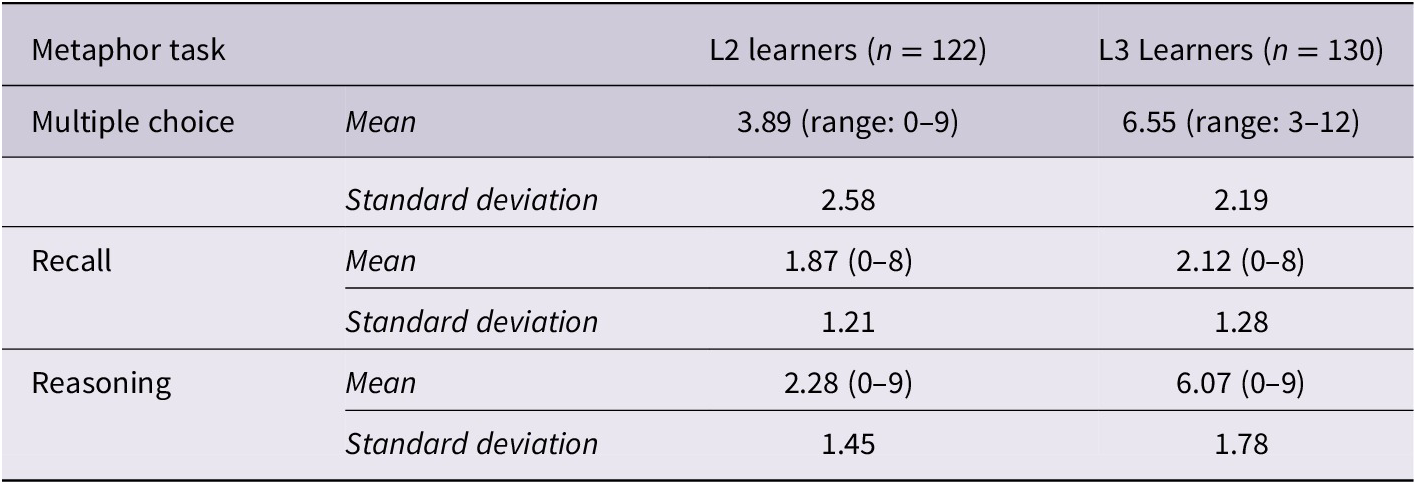
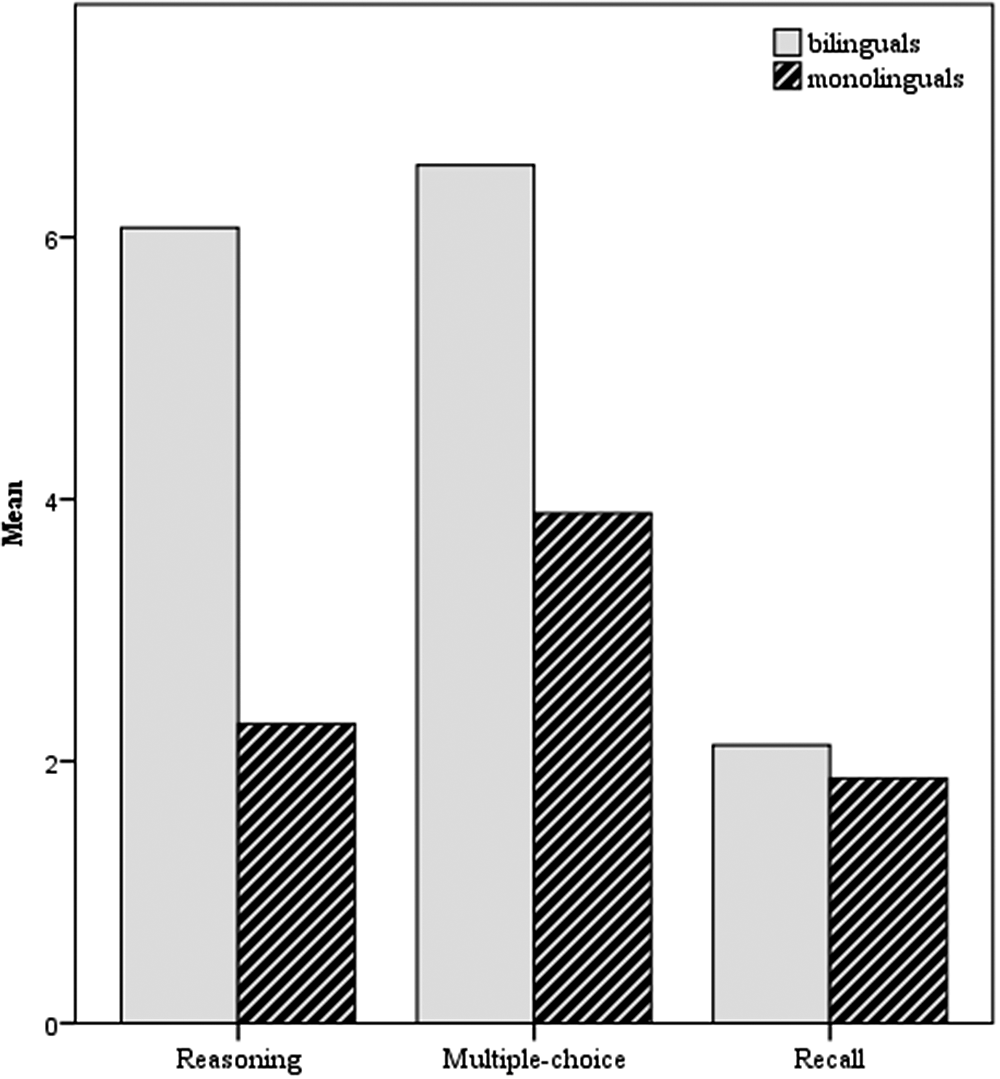
A one-way between-groups multivariate analysis of variance (MANOVA) was conducted to explore the effects of differences in linguistic repertoire on metaphor comprehension, as measured by the three dependent variables – namely, the scores on the recall, multiple-choice and reasoning tests. The independent variable was linguistic repertoire, operationalized by the number of languages that a person actively uses, as indicated on the questionnaire. Preliminary assumption testing for normality, linearity, univariate and multivariate outliers, homogeneity of variance-covariance matrices, and multicollinearity was conducted, with no serious violations noted. There was a statistically significant difference between L2 and L3 learners on the combined dependent variables with a medium effect size, F(3, 248) = 135.94, p < .05; Wilks’ Lambda = .37; ƞp2 = .62. Separate analysis of the dependent variables, using a Bonferroni adjusted alpha level of .57, showed a significant difference for the multiple-choice test, F(1, 250) = 76.98, p < .05, ƞp2 = .23 and the reasoning task, F(1, 250) = 341.86, p < .05, ƞp2 = .57. As shown in Table 1 and Figure 1, the L3 learners’ mean scores on the multiple-choice task (M = 6.55, SD = 2.19, range = 3-12) indicated that they outperformed the L2 learners (M = 3.89, SD = 2.58, range: 0-9). It was also indicated that the L3 learners (M = 6.07, SD = 1.78, range: 0-9) significantly outperformed the L2 leaners on the reasoning task (M = 2.28, SD = 1.45, range: 0-9). No significant difference was found between the two groups on the recall task (range: 0-8).
Performance of L2 and L3 learners on the three metaphor tasks

Performance of L2 and L3 learners on metaphor comprehension tests.

As for FIT, tests of normality on the performance of the L2 learners (M = 2.30, SD = 1.19) and L3 learners (M = 3.10, SD = 1.48) showed a non-normal distribution, hence the use of non-parametric statistical tests. To address the second research question, i.e., the relationship between cognitive capacity and understanding metaphors on recall, multiple-choice and reasoning measures, the following analyses were conducted: a Spearman rank correlational analysis between cognitive capacity, as measured by FIT, and the scores on the recall test showed no significant relationship (ρ = .11, n = 252, p > .05). However, a Spearman rank correlational analysis between cognitive capacity and the scores on the multiple-choice test showed a significant relationship (ρ = .13, n = 252, p = .05). Also, a Spearman rank correlational analysis between cognitive capacity and the scores on the reasoning test yielded a significant relationship (ρ = .12, n = 252, p < .05). Note that the values of the strength of the relationships are small (Cohen, Reference Cohen1988).
Discussion
The current study was an answer to de Bot’s call to measure the effects of BA in more real-life tasks that involve the employment of the cognitive function. The answer to the first research question concerning the existence of a BA for understanding metaphors was in the affirmative for the combined dependent variables with a medium effect size (Cohen, Reference Cohen1988), and separate analyses indicated a significant difference between the two groups on the multiple-choice and reasoning tasks with small effect sizes, but not on the recall task. This superior metaphorical understanding conferred to bilinguals lends further evidence to the idea that bilingualism seems to be conducive to cognitive benefits as understanding metaphors is, by nature, a cognitive task (Johnson, Reference Johnson1989).
The cognitive advantage in understanding metaphors could mean that due to repeated switching between languages and the act of inhibiting one of the languages (Bialystok et al., Reference Bialystok, Martin and Viswanathan2005), bilinguals become better at cross-domain mappings from the source domain to the target domain and are possibly conferred a higher level of conceptual knowledge associated with such mappings, which is part and parcel of metaphor comprehension (Keil, Reference Keil1986).
Based on the results of this study, it is possible that bilingualism compensates the verbal cost it causes in lexical access (e.g., Bialystok, Reference Bialystok2009), by conferring a benefit in the more in-depth understanding of the extension of lexemes, i.e., figurative meaning, under the conditions where a high level of control is required. This high level of control could explain why bilingual children are also better than monolinguals in novel word learning which has, incidentally, been considered to be akin to the bilinguals’ advantage in nonverbal tasks (Kaushanskaya & Marian, Reference Kaushanskaya and Marian2009).
It should be noted that the reasoning task in this study was more complex than the other two tasks and possibly provided a clearer picture of the differences in understanding metaphors by the monolinguals and bilinguals. In the current study, the bilinguals outperformed monolinguals only on the multiple-choice and reasoning tasks, and did not show a significantly better performance on the recall task. This could be attributable to the idea that recall would have required the retrieval of the lexical items within the metaphors (Smith & Murphy, Reference Smith and Murphy2015), which would have required efficient lexical access, a task that bilinguals have difficulty with (Bialystok, Reference Bialystok2009). The reason the bilinguals did not show a weaker performance on retrieving the lexical items in metaphors, on the other hand, may have to do with the methodological differences between this study and previous ones (e.g., Kaushanskaya & Marian, Reference Kaushanskaya and Marian2007) or the idiosyncratic characteristics of the underrepresented population in our study which does not, unlike psycholinguistic studies on bilinguals, represent speakers of heritage languages in immigration contexts.
It could be that the positive correlation between the FIT scores and performance on the reasoning task, and to a lesser extent the multiple-choice task for reasons referred to above, had something to do with the ability to carry out cross-domain mappings and the ability to make inferences about meanings and build plausible interpretations by drawing on analogies (Oakhill et al., Reference Oakhill, Cain and Nesi2016), a task which is more demanding for children compared to recalling metaphors (e.g., Johnson, Reference Johnson1991; Özçalişkan, Reference Özçalişkan2007). It should be noted that the reasoning task in the current study, a higher-order task, required receptive memory, reasoning, and free production, and it remains to be investigated which of these three components was benefiting more from bilingualism.
From a TLA perspective, it can be argued that bilinguals bring to bear on the task of understanding figurative language a larger prior repertoire (Cenoz, Reference Cenoz2013). The findings of the current study substantiate the idea that a bilingual learner has a rich and dynamic trajectory and has acquired linguistic and semiotic resources when using different languages (Cenoz & Gorter, Reference Cenoz and Gorter2019). It is, therefore, possible that bilinguals gain a higher level of metalinguistic awareness, and can think about language in a more abstract way (Jessner, Reference Jessner2008), so they get a freebie in learning an additional language when it comes to understanding metaphors.
An implication of the findings of this study would be that maintaining such languages as Turkish and Kurdish, contrary to what is being practiced in Iran (Hassanpour et al., Reference Hassanpour, Sheyholislami and Skutnabb-Kangas2012), could potentially enrich bilinguals’ cognitive ability. A limitation of the current study was that we did not have a Turkish-monolingual group available, which would have lent more certainty to the comparisons between monolingual and bilingual participants. Also, the participants in the current study were 2L1s, and it remains to be seen whether other types of bilinguals (e.g., sequential bilinguals or speakers of heritage languages in immigration contexts) or multilingual learners would understand metaphors of a new language similarly or differently and why. Furthermore, the restriction of the metaphors to two main types could have potentially influenced the results. The verbal metaphors, for instance, were mainly involved with the particularly frequent domain of space. It should be noted that the distinction was made, based on Hessel and Murphy (Reference Hessel and Murphy2018), to allow additional analyses in the future. As well, future studies could employ a more systematic comparison with other less frequent metaphorical mappings as a more powerful elicitation method. Furthermore, the process, rather than the product, of understanding metaphorical language by monolinguals and bilinguals could be explored. The findings of this study provide support for a domain-general mechanism being impacted by early bilingual experiences in understanding metaphors, so it remains to be investigated whether bilinguals can carry their supposedly colorful metaphor-laden spectacles all the way into adulthood or even later down the road, possibly exhibiting a better metaphorical competence across the lifespan.
To recap, this study was an answer to de Bot’s (Reference de Bot, Pfenninger and Navracsics2017) call to use more ecologically sound methodologies, i.e., authentic real-life tasks, to investigate BA. Persian–Turkish L3 learners of English and Persian-speaking L2 learners of English were administered tests of metaphor understanding and cognitive capacity. The findings suggest that bilingualism could potentially be conducive to a more in-depth understanding of metaphors, supporting evidence for the transferability of specific training and showing domain-general applicability. It should be noted, however, that the effects cannot be overestimated as there are many other factors involved (see Bambini, Van Looy, Demiddele, & Schaeken, Reference Bambini, Van Looy, Demiddele and Schaeken2021). Therefore, we argue that the use of language seems to be inextricably bound with general cognitive processes and make the case for a novel hypothesis regarding BA, i.e., bilinguals’ superior metaphorical competence, and a fuller treatment thereof in future bilingualism research.
Conflicts of interest
The authors hereby declare no conflicts of interest.
Appendix A: A sample item from FIT

Appendix B:
Sample prompts for verbal metaphors:

1. This is Arman. He is doing his music training so he can play with his friends later. Arman doesn’t like music lessons and doesn’t know what to do. His older brother, Bardia, is good at it. He says that he can help him. He teaches him how to use his fingers. Arman is eager to learn, but a joke crosses his mind. Then funny things keep passing through his mind. When Bardia asks him to try it, he can’t remember anything.
Why couldn’t Arman understand what Bardia told him?
A: Because Arman could not understand what his brother was telling him.
*B: Because Arman was thinking about other things, not listening to Bardia.
2. This is Armia. He wants to play with his friend in the yard. He asks his mother “Mom, can I invite Mehrad over to our house?”. His mom says “Ok, but play only for an hour until lunch is ready”. His friend comes quickly, and they start playing. Armia’s mom puts the lunch in the oven. Time flies away very quickly. Armia doesn’t know how many hours pass by. When he finally comes home, his mom is really angry with him.
Why didn’t Armia come back from the yard after an hour?
*A: Armia plays for a long time and forgets to go home for lunch.
B: His mom forgot to tell him to come back after one hour passed.

3. This is Parsa. He’s going to a soccer pitch to play with his friends. It is a very sunny day, and a good day for playing soccer. Parsa can’t wait for the soccer game to start. He likes to be the winner today. His friends said they would be there in a few minutes. He starts jogging around the soccer pitch to warm up until his friends would arrive. The minutes drag on. Hours crawl by. He starts looking at his wrist watch.
Why does Parsa start looking at his wrist watch?
A: Because he wanted to see if he had warmed up long enough.
*B: Because Parsa had waited for his friends for a very long time.
Sample prompts for nominal metaphors:

1. This is Armia. He loves animal figures. One day, he and his dad are passing a toy store when he sees a bear figure. He asks his dad to buy it for him. His dad says ‘Ok’. At the store, Armia sees a big stuffed fox and asks his dad to buy that one for him too. His dad says no. A few days later, his dad comes home with a box in his hands. When Armia opens the box and sees the fox in it, he is on top of the world. He is on cloud nine.
How did Armia feel after he opened the box?
*A: Armia was happy.
B: Armia was sad.

2. This is Aria. He is a really good soccer player. His team is playing against a really strong team. Aria has promised his mom to win this game. There are only a few minutes left. If Aria’s team can score only one more goal, they will win. A few seconds later, Aria has a really good chance to score a goal. He would be sad if he missed the goal. He would be happy if he scored a goal. When he sees what happened, he is a big smile. He feels like a colourful rainbow.
How did Aria feel after he had kicked the ball?
A: Aria was sad.
*B: Aria was happy.