In October 1934, agents from the Chinese Maritime Customs Service received a hot tip that an otherwise unremarkable village off the coast of Shandong was hiding valuable contraband. A search party dispatched to investigate verified the claim after raiding several homes and uncovering sixty-nine bags of sugar. Seeking to add to this already sizeable haul, agents then scaled the walls of another home and discovered ten more bags hidden in the backyard. This time, however, they were met by incensed homeowner Yu Guangbo, who charged at the intruders with a pitchfork and seriously injured an officer when he tried to seize a handgun. His resistance was fierce but, ultimately, futile. Outnumbered, Yu was quickly subdued, beaten, and bound. Left alone in the village temple, he untied himself the next day before reporting his harsh treatment to a local court and inaugurating a lawsuit that would last almost a decade.Footnote 1
The raid on the Shandong village was violent but far from unique. During the Nanjing decade (1928–37), the Nationalist government launched a militarized antismuggling campaign to protect its revenues and assert its authority as China's new central government.Footnote 2 Up and down the coast in the name of fighting illicit trade, state agents raided homes and businesses, intercepted vessels on land and sea, battled armed gangs, and subjected travelers to invasive searches. These efforts did more than bring the central state and communities into direct conflict; they ultimately extended state control both horizontally across the vast Chinese littoral and vertically into the everyday lives of individuals such as Yu Guangbo, of whom more will be said later. Scholars examining state–society relations before the fall of the Qing dynasty (1644–1912) and the first years of the Republic (1912–1949) have often focused on state-building projects rationalizing administration and redeveloping local economies.Footnote 3 However, comparatively less attention has been paid to the war on smuggling, despite its widespread and intrusive impact.Footnote 4 If Frederic Wakeman is correct that the rise of the police state is a defining feature of modern Chinese history, then the fight against smuggling—how the country's commercial intercourse with the world was regulated—must also figure prominently in this history of expanding state power.Footnote 5 Nationalist China's war on smuggling affords scholars an opportunity to rethink the developmental trajectory of the modern state and reassess the shifting scope of state power.
Addressing this scholarly lacuna comes at an opportune moment. An emerging consensus in recent scholarship is that smuggling was not a marginal crime but a driving force behind many macrohistorical processes, including the evolution of state authority, expansion of global exchange, and changing patterns of territorialization.Footnote 6 This article expands the burgeoning research on illicit trade by exploring the symbiotic relationship between the defiance and reification of state authority. Fighting smuggling required Nationalist China to define and enforce its sovereign claims to regulate, tax, and police trade, thereby reinforcing its primacy as the country's central government. Meanwhile, as it delineated new boundaries of legal trade and sought to exercise exclusive prerogative to prosecute offenders within those boundaries, Nationalist China was also challenging the legacies of nineteenth century legal imperialism that continued to fracture domestic jurisdiction over foreign nationals and enclaves.Footnote 7 This article argues that the fight against smuggling helped move semicolonial China closer to realizing the features of the modern nation-state such as greater territorialized sovereignty and legal centralization, even before the formal abolition of extraterritorial privileges and foreign concessions.Footnote 8
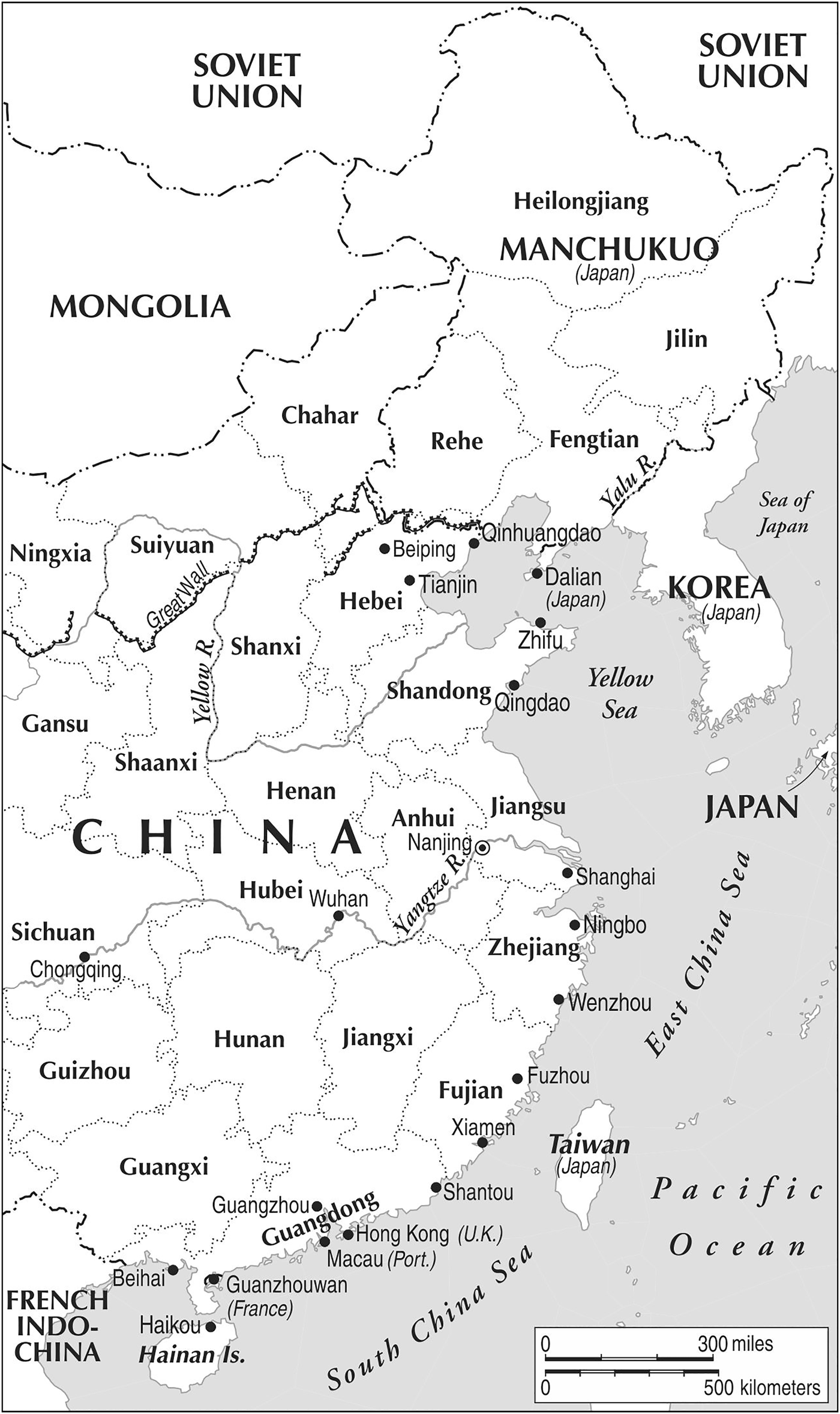
Coastal China, ca. mid-1930s. Map produced by Philip Schwartzberg.

Furthermore, an examination of the war on smuggling uncovers varied responses to creeping regulatory encroachment in everyday life. As Eric Tagliacozzo rightly notes, smuggling has no ontology; it is whatever the state says it is at any given time.Footnote 9 As an increasingly assertive state introduced new regulations and prosecuted offenders, it simultaneously created more expansive definitions of “smuggling.” Such new categories of malum prohibitum offenses clashed with popular, longtime understandings of legitimate commerce. The friction produced by bottom-up reactions to top-down redefinitions of legal trade mirrored the resistance produced by the clash of two “grids”—existent customary practices and expanding state authority—that scholars have identified in other contexts.Footnote 10 Imposing and enforcing new restrictions reaffirmed authority at the top, but also provoked litigation from the bottom, contesting the state's prerogative to regulate commerce. Challenges in the courtroom dialectically shaped the contours of an emerging legal regime, as authorities had to constantly affirm, enforce, or adjust their definitions of legality in the course of adjudication. The legal conflicts generated by the war on smuggling, therefore, offer insights not only into official imperatives but also into ways that litigants conceived popular norms of justice, mobilized the law to seek redress for grievances, and ultimately mediated the enforcement of new regulations.
Drawing from sources such as legal records, customs archives, and popular press reports, this article examines how Nationalist China's war on smuggling facilitated the expansion of central authority across the coastal frontier and how local actors coped with increasing number of state strictures and wider definitions of criminality. It begins with an overview of economic drivers behind the growth and suppression of illicit trade during the Nanjing decade. It then focuses on three mutually reinforcing initiatives of the antismuggling campaign: expanding enforcement, contesting extraterritoriality, and policing maritime borders. Throughout the discussion I consult a wide range of diplomatic correspondences—Chinese, Japanese, British, and American—to situate the war on smuggling at the heart of Nationalist efforts to untangle the enduring legacies of legal imperialism. A final section examines the intended and unintended consequences of escalating enforcement and harsher punishments. In concluding, I evaluate the ways that Nationalist China's war on smuggling paralleled yet differed from state-building initiatives in other contexts.
New Incentives and Old Laws
The Nationalists' victory in the Northern Expedition (1926–28) nominally united China under a central government for the first time since the collapse of the Qing dynasty in 1912. From its new capital in Nanjing, the new regime charted a very ambitious agenda to continue late Qing and early Republican “self-strengthening” policies by enhancing central state capacity, modernizing the economy, and building a nation capable of resisting foreign pressures. However, the new regime was also besieged, meeting varying degrees of resistance from domestic warlords exercising de facto control over various regions of China as well as foreign powers guarding their remaining “spheres of influence.” Fortunately for the Nationalists, they were able to tap one important resource unavailable to their domestic rivals: China's tariff revenues. The “unequal treaties” of the mid-nineteenth century originally compelled the Qing court to surrender its tariff autonomy and fix duties on foreign goods at the low rate of 5%.Footnote 11 In addition to its humiliating symbolism, this concession also had practical consequences: it limited revenues that could be collected, and thereby constrained fiscal policy options. Both the Qing court and successor Republican governments repeatedly sought to abolish this arrangement through diplomatic negotiations, but it was not until 1928 when the Nationalists and the United States concluded the Sino-American Tariff Treaty that China finally recovered its tariff autonomy to set duties on imports.Footnote 12
For the new regime, higher tariffs proved to be a financial boon. Successive tariff revisions raised average duties from 3.8% in 1928 (the last full year before tariff autonomy) to 27.3% in 1937, and yielded substantial revenues. Total duties jumped threefold from Ch.$128 million in 1928 to Ch.$385 million in 1931 before settling down to Ch.$343 million in 1937. Import duties grew even more rapidly, rising fourfold during the same period from Ch.$72 million to Ch.$315 million before settling down to Ch.$261 million in 1937.Footnote 13 Tariffs soon represented the largest and most dependable source of central government income, averaging roughly half of annual revenues throughout the Nanjing decade. Greater stability in finances enabled the Nationalist government to become a more modern fiscal state by tapping capital markets and issuing substantial public debt. As one economic historian concluded, “It would certainly be no exaggeration to say that the Nationalist government's finances critically depended on the customs revenue.”Footnote 14
In addition to recovering tariff autonomy, the Nationalists also asserted tighter control over the Chinese Maritime Customs Service, the agency responsible for collecting duties and enforcing trade regulations.Footnote 15 Although staffed by foreigners at senior levels, the Customs Service had operated as a bureaucratic arm of successive central-level Chinese governments since its founding in 1854. Originally limited to assessing duties on international maritime trade at a handful of treaty ports, the agency had a presence in almost fifty ports throughout China by the 1930s, monitoring, policing, and taxing both international and domestic trade. To harness the agency's organizational cohesion and geographical reach, the Nationalists introduced a series of reforms from 1928 that further subordinated the agency as an organ of the central state, and accorded it more operational responsibilities. Starting in 1930, the Nationalists authorized the Customs Service to police China's entire coastline, assume control of various tax bureaus, assert maritime borders, and effect seizures and arrests. The agency thus came to have an increasingly pervasive presence in everyday life during the Nanjing decade, and it was no coincidence that the projection of central-level authority into Chinese society and economy occurred as the Customs Service enlarged its jurisdictional reach and expanded its responsibilities. Drawing from the findings of Charles Tilly, Hans van de Ven observes that the Nationalists' appropriation of semicolonial institutions such as the Maritime Customs Service was not unique; it foreshadowed postcolonial polities' appropriation of colonial institutions “to further their own self-interest and entrench their hold on power.”Footnote 16 State-building for both the Nationalists and other postcolonial polities, in other words, did not occur de novo, but used existing colonial institutions as a foundation.
Nationalist China's assertive policies, however, came at a stiff cost. For consumers, higher tariffs dramatically raised prices for imported goods ranging from luxury products to daily necessities. For merchants, new regulations restricted the freedom to truck, barter, and exchange. Well before the twentieth century, smuggling along the Chinese seaboard always bedeviled authorities trying to tax and control trade.Footnote 17 However, until tariff autonomy was realized, the financial incentives for both smuggling and fighting smuggling were weak when duties were at a low 5%. For smugglers, one report noted, trafficking prior to tariff autonomy was profitable mostly with respect to contraband such as arms and narcotics or government monopolies such as salt.Footnote 18 An article from the Bank of China Monthly echoed such sentiments, observing that in the past, “while the risks taken by smugglers were great, the gains were often insufficient to compensate for potential losses.”Footnote 19 For the state, the cost in time and resources prosecuting petty smuggling often exceeded the 5% tariff that theoretically went uncollected.Footnote 20
New tariffs radically changed this calculus for everyone. Whereas average tariffs never rose above 30% during the Nanjing decade, individual tariffs for imports rose much higher. Commodities such as rayon, sugar, and kerosene—which enjoyed strong, inelastic demand—were slapped with high double-digit and even triple-digit tariffs. Merchants soon realized that they stood to reap handsome profits if they could avoid paying crushing duties and undercut competitors who did not (or could not) do so. Not surprisingly, the most heavily taxed commodities quickly became the most frequently smuggled, and their trafficking soon eclipsed the trafficking of traditional contraband. A smuggler trafficking rayon, one official calculated, could still clear a profit of 30% even if he lost his cargo to seizure one out of every three times.Footnote 21 He concluded: “The incentive to smugglers to discard other forms of smuggling and engage in evading Customs duty is [now] very strong.”Footnote 22 For the state, revenues lost from smuggling were far greater after tariff autonomy and far more damaging to a regime that had few sources of financing.
New tariffs and regulations transformed smuggling from a chronic problem into a serious threat that undermined the Nationalists' authority and finances. Officials and media across China reported an alarming upsurge in illicit trade. At major ports, officials uncovered increasingly sophisticated tactics by petty smugglers, runners, and peddlers trying to disguise cargoes onboard steamships and railroads. Ruses ranged from women feigning pregnancy by strapping bags around their bellies to sailors stashing goods inside every conceivable crevice inside ships. Along the coast, junks and motorboats—known colloquially as “snake boats” or “puff-puffs”—surreptitiously shuttled back and forth between China, foreign concessions, and foreign colonies trying to evade detection and ultimately taxation. The illicit goods would be unloaded, transported via roads and rivers, and eventually sold in markets where they were virtually indistinguishable from legally imported (and hence higher-priced) goods. In the face of this widespread smuggling, an official issued an ominous warning: “[I]t is no longer possible to check the tendency of this illicit trade to grow, and it shows every sign of swelling eventually to very serious proportions.”Footnote 23 Smuggling quickly overwhelmed existing law enforcement capacity and threatened to deprive the state of important revenues.
An inadequate legal framework, which defined smuggling too narrowly, compounded the problems created by new incentives to smuggle and the resulting urgency to crack down. Both the 1928 and 1935 editions of the Republican Criminal Code, for example, expressly prohibited the manufacture, transport, sale, and consumption of opium and other narcotics including morphine, heroin, and cocaine.Footnote 24 Other statutes were also commodity specific in their proscription by prohibiting the private trade of government-regulated articles such as salt or weapons, or restricting the movement of strategic commodities such as silver and tungsten.Footnote 25 This limited range of goods classified as contraband was a product of late Qing legal reforms that sought to streamline broad restrictions on maritime commerce and private trade outside of imperial monopolies.Footnote 26 The restrictions—introduced throughout the Ming dynasty (1368–1644) and expanded during the early Qing dynasty—had long been lifted by the late nineteenth century. However, they remained on the books because of the Chinese legal tradition of demonstrating filial deference to dynastic founders by leaving unchanged laws promulgated under their reign.Footnote 27 The late Qing jurist Xue Yunsheng constantly railed at the problems created by lingering obsolete laws, and maritime regulations did not escape his ire. “These unchanging rules,” he scorned, “have all turned into dead letters.”Footnote 28
Early Republican laws further narrowed Qing prohibitions on smuggling specific goods; however, they contained no prohibitions on evading customs duties or smuggling noncontraband. This legal ambiguity often created confusion in determining whether trafficking innocuous, ordinary consumer products actually constituted a crime. For example, a customs officer speaking with a local magistrate and military commander during an investigation trip noted: “Their chief concern about passing junks is to see that no prohibited articles and arms are carried. The question of smuggling never bothered them and they have no exact idea of how to distinguish between smuggled goods and duty-paid commodities.”Footnote 29 Prior to tariff autonomy, individuals caught transporting contraband such as narcotics or weapons were often handed to local officials for prosecution, but general duty evasion was usually punished with a simple fine or confiscation at the customs house. After tariff autonomy, customs officials throughout China who sought to hand over smugglers trafficking consumer goods to local officials for prosecution encountered many obstacles. When one customs commissioner in the southeast, for example, sought to remand two arrested smugglers to local officials, the prosecutor balked, stating that “there were no laws by which he could deal with these so-called offenders.” They were then transferred to another local official who accepted—but would not prosecute—them. Local officials left many such suspected smugglers languishing behind bars, “clearly at a loss as to how to deal with the offenders.”Footnote 30 In the northeast, an official reported that the local police released a smuggler shortly after arrest on the pretext that they had no authority to inflict penalties, because no special regulations punishing smuggling existed.Footnote 31 Absent explicit laws, questions of how to deal with duty evasion—or whether it even constituted a crime—remained difficult to answer and created widespread confusion.
Waging the Legal War on Smuggling
Expanding Enforcement
With existing laws proving increasingly inadequate for coping with the dramatic increase in smuggling, the Nationalists introduced new regulations empowering customs agents to conduct more expansive and invasive searches as well as restrict and monitor the movement of vessels. As early as 1931, the Ministry of Finance ordered the Maritime Customs Service to prepare a uniform set of antismuggling regulations for implementation across China. Two years later, the government passed a resolution calling for more authority—“as soon as possible”—to be invested in the agency to effect confiscations, levy fines, and fight duty evasion by “treacherous merchants” (jianshang).Footnote 32 Officials often stressed the importance of an effective legal framework, declaring that adequate resources for interdiction and clear laws defining punishments “go together” (xiangfu erxing) in the fight against smuggling.Footnote 33 The need for stronger laws to adequately deter would-be offenders was another widely shared opinion. New regulations punishing smuggling would, a newspaper reported, “remedy the defects of ordinary laws and protect national revenue.”Footnote 34
An important product of these legal reform efforts was the Customs Preventive Law (Haiguan jisi tiaoli). Promulgated by the National Assembly in 1934, the new administrative law focused on enforcement by escalating the financial penalties for smuggling and clarifying the authority of the Maritime Customs Service to operate in areas beyond its traditional jurisdiction at treaty ports. To punish would-be smugglers, customs officials could now levy a “double penalty”: fines to mark infractions, and confiscations of illicit cargo or even of the vessel of transport itself. More importantly, the law introduced new procedural changes by expanding the time frame for and geography of enforcement. Customs agents were no longer limited to on-the-spot interventions at ports and their immediate vicinities. Instead, they were now authorized to search homes and businesses suspected of harboring smuggled goods, investigate records for evidence of past duty evasion, and levy penalties well after the initial incidence of smuggling. Agents were also authorized to interrogate suspects, witnesses, and other persons of interest in the course of investigations and building cases for prosecution.Footnote 35 Empowered by new legal sanction, customs search teams fanned out along the Chinese seaboard to raid villages, effect seizures, and monitor riverine choke points.Footnote 36 Although strictly targeting smuggling, the new law helped the central state extend its reach over many more individuals and communities, and ultimately become a more intrusive presence in everyday life.
Promulgation of the Preventive Law dovetailed with ongoing legal reforms by the Nationalists, who sought to renew late Qing and early Republican efforts to expand the coverage of national laws and ensure that interpretation and execution were consistent with central prerogatives.Footnote 37 New antismuggling measures contributed to legal centralization by reinforcing the primacy of central authority. They also helped the regime extend its reach into areas where Nationalist control was weak or nonexistent by piggybacking on the Maritime Customs Service's extensive presence throughout China. The Preventive Law, for example, explicitly stipulated that local authorities—magistrates, policemen, and soldiers—had to assist customs agents in any search and seizure operation. Such requirements, as instructions to customs officials explained, marked a change in operational principle: “The Customs can now quote the Law and demand the presence of the representatives of the local police and other officials, whereas formerly we were entirely dependent on the goodwill and whim of local authorities for such cooperation as they might care to extend.”Footnote 38 The new law thus clarified the chain of command by subordinating local state agents to central state agents. More generally, it formalized and affirmed the principle that the central government possessed the authority to demand compliance from local governments.
Nanjing intended the Preventive Law to facilitate and legitimate antismuggling operations led by central state agents. Although some local official did evince greater willingness to cooperate shortly after the law's passage, many others remained ambivalent.Footnote 39 The latter, with much justification, feared that stronger central authority was a concomitant of the war on smuggling. Shandong warlord Han Fuju reflected this attitude in a response to a 1936 request from Nanjing to help fight Japanese smuggling in his province: “[P]ast experience shows that foreign aggression has been made use of [by the central government] as the means for crushing political rivals. With such experience fresh in memory, [we] cannot but view the present request for assistance of the local military and police in the suppression of smugglers with grave suspicion.” Nanjing eventually overcame Han's reluctance only when it assured the general that the central government would protect his province from Japanese pressures. Han subsequently pledged his support and coordinated his army with customs agents on interdicting smuggling in Shandong.Footnote 40 Nanjing reached similar accords with other recalcitrant local officials through tough negotiations and frequent invocation of the new Preventive Law.Footnote 41
Still, the invasive and aggressive crackdown on smuggling faced other bottom-up resistance. Whole communities persisted in their refusal to recognize the Nationalists as China's central government. Some local magistrates hesitated or even declined to help interdict smuggled goods. A raid on one rural town, for example, was foiled when the local magistrate failed to cooperate, even though the Preventive Law obligated him to do so. Hostile villagers threatened and pelted the search party before the magistrate finally relented hours later and offered some assistance. By then it was too late; the smuggled goods in question had disappeared.Footnote 42 Meanwhile, securing cooperation from local officials proved difficult in remote areas where formal state presence was virtually nonexistent. A commissioner of one frontier station, for example, reported that law enforcement authorities were rarely available in his locale and that he often had to approach village leaders for assistance.Footnote 43 However, because these leaders were nominated by the villagers themselves, another official noted, “they desire to maintain good relations…[and] it is natural that they do not wish to do anything detrimental to the interest of the villagers.”Footnote 44 Not surprisingly, when village leaders declined to cooperate, heated—and sometimes violent—resistance often ensued. As one report describes an operation conducted without the participation of a village leader: “The search commenced with three houses, quantities of smuggled goods were discovered, but the attempt to seize the goods failed, as a mob of the villagers attacked the searching party with poles and pelted our men with tins of pineapple. The party had to retreat in haste with only a few small packages taken as evidence.”Footnote 45
That resistance persisted despite new regulations clarifying lines of authority and mandating cooperation should not be surprising. The loyalties of local officials to the communities in which they were embedded were stronger than their loyalties to a distant national government. In urging researchers to “discard the assumption that there is a clear line between illicitness and the laws of states,” Willem van Schendel and Itty Abraham observe that illicit activities are actually “forms of social practice that intersect two or more regulatory spaces and violate at least one normative or legal rule.”Footnote 46 Such descriptions are very applicable to smuggling. Whereas many individuals, communities, and organizations willfully flouted the prerogative of the central government, new efforts by the state to collect taxes and enforce restrictions on movement also criminalized existing patterns of commerce and other behaviors. Also, by regulating and policing trade, the central state was effectively expanding and enforcing its regulatory spaces. In some instances, these regulatory spaces encroached on the regulatory spaces of local governments and thus created conflicts over jurisdictions. These instances of conflict, therefore, did not necessarily signify the failure of the new regulations but represented byproducts of a more assertive central state projecting its authority in new ways and venues.
Contesting Extraterritoriality
Fighting smuggling also helped the Nationalists better realize territorialized sovereignty, an essential feature of modern nation-states denied to China by extraterritoriality. Introduced through the many “unequal treaties” from the nineteenth century, extraterritoriality continued to constrain the jurisdictional reach of the Nationalists by preventing their agents from entering foreign concessions and prosecuting foreign nationals. Reversing this legacy of legal imperialism had been a long-standing goal of Republican officials and remained central to the emergence of Chinese nationalism during the early twentieth century.Footnote 47 Writing in the American journal Foreign Affairs, diplomat Ch'ao-shu Wu argued that China being a “mistress in her own house is substantially the same policy that every independent and sovereign state has adopted.”Footnote 48 The vision of civilized nations as sovereign equals on the world stage, scholars have noted, was partly a construction of nineteenth century legal positivism, international law, and colonial encounters.Footnote 49 Wu's invocation of this vision highlights how thinkers in China (and elsewhere) had implicitly accepted the ideal of territorialized sovereignty despite the contingency of its origins. For the Nationalist regime, realizing unrestricted authority within national boundaries moved China closer to becoming a normal nation and thereby extirpate another shameful vestige of foreign imperialism.
Moreover, eliminating extraterritoriality held another important practical value beyond restoring national honor. Effecting a shift from jurisdiction over persons to jurisdiction over territory was urgent because ever-growing numbers of smugglers were exploiting China's fragmented sovereignty by evading arrest and punishment. By the 1930s, extraterritoriality had been abolished in other semicolonial polities but not in China; legal protections for foreign nationals, in fact, remained formidable. The most sensational cases of smuggling involved Japanese nationals and colonial citizens—Koreans and Taiwanese sekimin (“registered people”)—whose consuls frequently and aggressively intervened to protect them from prosecution.Footnote 50 Many Japanese colonial citizens, one historian notes, “were engaging in illicit activities under the umbrella of extraterritoriality.”Footnote 51 As many press reports and governmental correspondences attested, however, extraterritorial privileges were exploited by would-be smugglers of all nationalities, foreign and Chinese. Even Chinese merchants who dealt in smuggled goods exploited extraterritoriality to gain favorable access to supplies and minimize the risk of prosecution: claiming multiple nationalities, moving their businesses to foreign concessions, or partnering with foreign nationals.Footnote 52 Not surprisingly, Chinese officials often complained that Chinese authorities enforcing domestic antismuggling regulations were being prevented from operating within foreign concessions.Footnote 53
Fighting smuggling, then, meant also fighting extraterritoriality. Although extraterritoriality in China would not be fully abolished until 1943, the war on smuggling helped the Nationalists chip away at the panoply of foreign privileges in the meantime. The Nationalists would dispatch their agents into foreign concessions and assert exclusive jurisdiction over smuggling-related cases in China regardless of the individual participants' nationality. More importantly, the government reformed its laws dealing with smugglers with an eye toward winning foreign acceptance. As Lauren Benton notes, semicolonial polities seeking to reverse extraterritorial arrangements often sought to reform their legal institutions in response to “inherently contradictory” claims by powerful outsiders that “militated for legal immunity and jurisdictional protections for their subjects while at the same time basing their claims on a critique of the failings of local justice and the weaknesses of local state sovereignty.”Footnote 54 In the case of China, foreigners had justified the necessity of extraterritoriality on the perceived “barbarity” of its legal system or “instability” of its government.Footnote 55 To counter this discourse of deficiency, the Nationalists followed the lead of other semicolonial polities by pursuing a dual strategy of formalizing and monopolizing domestic channels of legal authority.
At one intersection in the fight against smuggling and the fight against extraterritorially were the so-called “Joint Investigation Rules” (Huixun zhangcheng), which stipulated how foreign nationals accused of smuggling were to be adjudicated and penalized. Originally introduced in 1864 and formally adopted by the Qing court in 1868, the rules were products of a diplomatic compromise. Qing authorities had consistently maintained their prerogative to “adopt the means they may judge most proper to prevent the Revenue suffering from fraud or smuggling” in accordance with the Treaty of Tianjin.Footnote 56 British authorities conceded that their Qing counterparts were within their treaty rights to unilaterally effect confiscations, but they asserted that British nationals could only be fined by their consuls in accordance with the principles of extraterritoriality. The Joint Investigation Rules embodied such principles by splitting jurisdiction over smuggling cases. In cases involving confiscations, a Qing official served as judge while the foreign consul served as assessor. In cases involving fines, the roles were reversed. Both sides had to agree on the findings before any penalty—fine or confiscation—could be imposed. If either side disagreed, the dispute moved up diplomatic channels to the Zongli Yamen (the Qing foreign ministry) and the plenipotentiary in Beijing for resolution.Footnote 57
The Joint Investigation Rules were adopted in the wake of Qing defeat from the Second Opium War (1856–60), but they were not necessarily imposed upon an unwilling recipient. As Pär Cassel rightly notes, practices such as consular jurisdiction embodied in the rules were consistent with Qing legal traditions such as joint trials and personal jurisdiction. Like its counterparts around the world, the multiethnic and legally pluralistic Qing Empire had long subjected different ethnic, social, and professional groups to different laws and courts. Extraterritorial concessions to Western powers were initially viewed as acceptable accommodations within this legally pluralistic order. Foreigners had to abide by domestic laws but could be punished by officials of their own nationality if necessary.Footnote 58 In an 1878 exchange with the Marquees of Salisbury, Qing Ambassador Guo Songtao reiterated this principle: “What has been conceded in the Treaties…is merely that offenders shall be punished by their own national officials, in accordance with their own national laws.”Footnote 59 In an exchange with United States Secretary of State Thomas F. Bayard a decade later, Qing Minister Xu Shoupeng explained his government's position on joint jurisdiction over smuggling cases: “[T]he jurisdiction to try and punish American citizens in China rests with the consul and the right to confiscate contraband goods under seizure rests with the [Chinese] customs authorities. If there be any case wherein some doubt and difficulty exist and which can not [sic] be decided without an investigation, then the rules of joint investigation should be appealed to[.]”Footnote 60 From the perspective of Qing officials, China maintained the exclusive prerogative to determine when a smuggling infraction occurred, but outsourced the responsibility of punishment to the offender's consul in accordance with both treaty and tradition.
In the face of Qing weakness and eventual collapse, however, foreign powers would assert interpretations of extraterritoriality more favorable to their interests and demand more exclusive consular jurisdiction over their nationals. The Joint Investigation Rules had been infrequently invoked, because foreign merchants often preferred paying a fine over incurring the expenses of appealing a penalty.Footnote 61 However, what was once an acceptable accommodation within the nineteenth century Qing Empire's legal order became an unacceptable violation of the twentieth century Chinese nation-state's sovereignty. With the recovery of tariff autonomy in 1928, the Nationalist government steadily asserted its exclusive claim not only to police China's foreign trade but also adjudicate potential infractions. In August 1931, the Maritime Customs Service notified its officials that “[p]ractically speaking, the Joint Investigation procedure may be said to be now in the discard.”Footnote 62 A year later in response to a query from the American legation, the Nationalist government formally and unilaterally renounced the rules.Footnote 63 The Nationalists justified their actions through an expansive interpretation of the Sino-American Tariff Treaty, which restored Chinese autonomy over tariffs and “any related matters.”Footnote 64 As Chinese Foreign Minister Wang Jingwei later explained, “complete autonomy” encompassed not just the right to fix tariffs and collect revenue but also the right to fight smuggling by levying fines and confiscations. “Otherwise, if joint action with foreign countries in cases of confiscation and fine were still necessary,” Wang asked rhetorically, “how could it be called complete autonomy?”Footnote 65
In addition to monopolizing the legal authority to prosecute smuggling, the Nationalist government also sought to expand its territorial jurisdiction to cover remaining foreign concessions.Footnote 66 Effectively “asserting sovereignty through policing,” the Nationalists continued late Qing law enforcement initiatives by “vigorously and aggressively” pursuing opportunities to supplant the jurisdiction of extraterritorial authorities with their own police force.Footnote 67 Following the Nationalists' lead, the Maritime Customs Service also sought to extend the agency's reach by creating a legal framework that would facilitate operations within foreign concessions. Shanghai was an important battleground in the fight against extraterritoriality, because the city registered the highest levels of smuggling and was much compromised by the fragmented sovereignties of foreign concessions, such as the International Settlement and the French Concession. During the early 1930s, officials debated ways to effect interdiction in these extraterritorial enclaves before exploiting a technicality in existing import regulations that gave the agency the right to inspect firm records and ensure that duties were properly paid.Footnote 68 Invoking this legal justification, the Customs Service concluded an unofficial agreement with the foreign-dominated Shanghai Municipal Council in 1932 that, upon notifying the Council, agents could raid businesses within the International Settlement suspected of harboring smuggled goods.Footnote 69
Opposition to the Nationalists' assertive antismuggling policing came from many quarters, foreign and domestic. Foreign powers balked when Nationalist China unilaterally abrogated the Joint Investigation Rules. The United States rejected the Nationalists' expansive interpretation of “tariff autonomy” in the Sino-American Tariff Treaty and insisted that the United States Court for China continue to exercise jurisdiction over American nationals accused of smuggling.Footnote 70 Great Britain clung to the original interpretation of the Treaty of Tianjin, which recognized Chinese prerogative to confiscate smuggled goods but not to fine British nationals.Footnote 71 Japan complained that Chinese actions violated both the spirit and letter of existing treaty agreements.Footnote 72 Meanwhile, a number of well-publicized raids within the International Settlement led foreign consuls to assert their nationals' extraterritorial privileges and object to antismuggling operations within foreign enclaves.Footnote 73 Articulating their complaints through the colonial discourse of deficiency, foreign consuls declined to assist the Chinese government in any antismuggling operation, on the basis that China lacked an official law to deal with smuggling. Finally, local Chinese merchants proved equally vehement in their opposition. In a series of petitions publicized in newspapers and forwarded to national government organs, the Shanghai Chamber of Commerce objected to customs-led interdiction on behalf of its members. One petition complained of the raids' disruptive impact on business: “As soon as a store is searched, business immediately comes to a halt and [customers] are frightened.”Footnote 74 Other petitions complained of the discrimination against Chinese firms without extraterritorial protection, demanded the right of merchants to appeal penalties, and accused the Maritime Customs Service of “exceeding its authority.”Footnote 75
Despite the chorus of protests, the Nationalists moved forward with their plans. To replace the defunct Joint Investigation Rules, the Nationalist government required companies or merchants who sought to appeal their penalties to deal directly with a new institution, the Customs Penalty Board of Inquiry and Appeal (Haiguan faze pingyi hui). Established in November of 1934 under the Preventive Law, the Board provided merchants a legal forum to appeal penalties levied by the customs. Consisting of senior-level officials from the Ministry of Finance and the Maritime Customs, the Board reviewed appeals and issued one of three rulings to uphold, modify, or reverse the original penalty. Appellants dissatisfied with the Board's rulings could take their cases to the Administrative Court (Xingzheng fayuan), the Nationalists' highest legal body to hear cases regarding administrative agencies' rulings. At least one senior customs official praised the Board's efficiency and fairness, noting that its members are “always willing to see the Customs point of view but at the same time they require to be convinced of the justice of the Customs case.”Footnote 76
Raids on businesses inside foreign concessions also resumed, albeit not without resistance. Customs agents initially pulled back operations in the face of criticisms, but their actions received support from the highest echelons within the Nationalist government. The Ministry of Finance, for example, publicly reaffirmed the right of the Maritime Customs Service to examine firm records, noting that such tactics stopped fraudulent practices, safeguarded national revenue, and protected “legitimate merchants.”Footnote 77 With the promulgation of the Preventive Law in 1934, the Customs Service again negotiated with the Shanghai Municipal Council and foreign consuls to allow its agents to operate within the International Settlement. The agency eventually secured an unofficial agreement that permitted customs officials to raid homes and businesses upon the issuance of a search warrant from the Shanghai No. 1 Special District Court. Customs officials found the agreement “eminently unsatisfactory,” because agents could only search shops of Chinese and foreigners who did not enjoy extraterritoriality. Nonetheless, they acknowledged that it was similar to arrangements that other government agencies had reached with the Council, and was the best deal that could be secured under the circumstances.Footnote 78
Customs officials made similar arrangements elsewhere, with mixed results. In Guangzhou, for example, customs agents raided a British-owned business in the foreign concession of Shamian (Shameen) Island suspected of evading duties on foreign alcohol, but they were unable to do anything other than levy a nominal fine on the firm's owner.Footnote 79 In Tianjin, unrestricted entry into foreign concessions by customs agents would not be fully realized until after extraterritoriality was formally abolished.Footnote 80 In the meantime, agents maintained close surveillance on various smuggling concerns operating in the city's foreign concessions.Footnote 81 Such problems did not stop agents from executing raids and thereby projecting Nationalist authority into foreign concessions when possible. Looking back at interdiction operations at the end of 1936, the Shanghai commissioner reported intermittent difficulties.Footnote 82 However, the agency continued to enforce the Preventive Law in both the International Settlement and French Concession even without the assistance of the Municipal Council or French authorities.Footnote 83
Antismuggling legal reforms helped consolidate the Nationalists' legal authority. New institutions such as the Customs Penalty Board of Inquiry and Appeal, with their formalized procedures of adjudication, helped China yet again showcase itself as a “modern” nation worthy of exercising full territorial sovereignty. As Li Chen notes, “attempts to abolish foreign extraterritoriality continued to be a most powerful rallying call among the Chinese to ‘modernize’/'Westernize’ their legal and political systems to regain sovereignty and international respectability.”Footnote 84 One senior Nationalist official made this link explicit when he proclaimed that China now had a dedicated court for its citizens to challenge decisions rendered by the Customs Service, just as citizens in Europe and the United States could with their own customs offices.Footnote 85 Foreign Minister Wang Jingwei reinforced this point in a conversation with a British diplomat, noting that the new antismuggling regulations were promulgated “with the aim of bringing the provisions of Chinese law in this matter more into line with modern requirements, such as are adopted in other countries.”Footnote 86 Creating Western-style institutions and procedures on par with their foreign counterparts was an important strategy for the Nationalists to deflect the colonial discourse of deficiency that maintained that China could not effectively deal with smuggling because it lacked positive laws, “modern” laws, or a competent central government.Footnote 87 Finally, the mandate that smuggling-related disputes had to be processed through new legal channels and institutions signaled the Nationalists' intention to limit jurisdictional shopping by appellants. Smuggling, in the minds of Nationalist officials, would henceforth be a routine, domestic law-enforcement issue adjudicated exclusively by the Chinese central government, rather than a diplomatic issue subjected to external interference.
Again, such reforms and discourse paralleled those in other semicolonial polities that sought to reverse the extraterritorial privileges of foreigners through legal reform.Footnote 88 Measured against the Westphalian ideal of full territorial sovereignty, the Nationalists' accomplishments in contesting extraterritoriality through aggressive policing appear modest, even unimpressive. However, if we recognize that sovereignty has always been variegated, layered, and tenuous, then the progress made by the Nationalists in effecting the transition from jurisdiction over persons to jurisdiction over territory appears quite remarkable.Footnote 89 This transition was never fully realized during the Nanjing decade, but suppressing smuggling provided ample, consistent opportunities for the Nationalists to contest the legacies of legal imperialism and project their authority into foreign-controlled enclaves in ways that their predecessors were unable to do.
Policing Maritime Borders
Another important agenda on the Nationalists' antismuggling campaign was control of China's maritime borders, which required regulating, monitoring, or even prohibiting the movement of vessels along the seaboard. Policing the littoral was another important expression of national sovereignty, because foreign powers in the past dispatched their own navies to suppress piracy and smuggling in China when domestic authorities were ostensibly unable to do so.Footnote 90 Maritime smuggling generally occurred through two vectors: large vessels such as steamships, and small vessels such as junks and motorboats. Progress at fighting smuggling on board the former was slow but steady, because authorities could identify owners and hold them accountable through financial sanctions. The same, by contrast, could not be said for fighting smuggling on board the latter; ownership was difficult to trace and the number of vessels were too numerous to monitor. To remedy this problem, the Nationalists from the late 1920s onward authorized the Maritime Customs Service to modernize its technical assets. A construction program was initiated in 1931 to expand the agency's fleet from seven obsolete pre-World War I steamers to eighty-six vessels of various sizes, speeds, and levels of maneuverability by 1937.Footnote 91 A scheme to divide the coast into “spheres of action” was instituted.Footnote 92 Ships were outfitted with radios, and communication between vessels and customs stations improved considerably when a network of wireless stations stretching along the coast became operational in 1934. To ensure that customs agents and ships could defend themselves against armed smugglers, patrol teams were formed, and weapons were upgraded and standardized.
The Nationalists paired these tangible tools of border control with a new regulatory framework to secure China's maritime borders. By the 1930s, China had already been deeply engaged in ongoing global debates and conferences defining the status of territorial waters in international law. However, these discussions produced no firm consensus, because most countries recognized 3 miles (4.8 km) from the coast as the minimum zone of control but differed in designating their own maximum zone of control.Footnote 93 Such ambiguity afforded China some interpretative latitude in deciding which international norm to use as justification for its own claims. In 1931, in the midst of ongoing disputes with Japan over coastal fishing rights, the National Assembly announced that it recognized the 3-mile limit as the extent of China's maritime territorial claim but simultaneously designated a contiguous 12-mile (19.3 km) antismuggling zone.Footnote 94 Moreover, it charged the Maritime Customs Service with the responsibility to patrol China's entire coastline, and conferred upon the agency “the right of exercising any preventive measures it may consider necessary for the protection of its revenue” within the antismuggling zone. New regulations also urged the agency to follow the “internationally accepted practice of ‘hot pursuit,’” whereby vessels suspected of violating Chinese laws along the coast could be pursued into the open seas.Footnote 95 The 12-mile maritime antismuggling zone was codified three years later upon the promulgation of the Preventive Law.Footnote 96
To bolster the Chinese position, senior officials from the Ministry of Foreign Affairs prepared an extensive research report that canvassed a wide corpus of international laws and treaties. Citing seminal jurists of international law (including Henry Wagner Halleck, Francis Taylor Piggott, and Lassa Oppenheim), the report first emphasized that all maritime countries have historically claimed the right to police their shores in the name of fighting smuggling. It then surveyed the relevant tariff and maritime customs laws of other countries and found wide variations in the size of maritime antismuggling zones, ranging anywhere from 3 to 12 miles. In light of such evidence, officials concluded: “It is obvious that our country's designation of a twelve-mile anti-smuggling zone is truly not unprecedented.”Footnote 97 Rebecca Karl observes that Chinese intellectuals and policy makers from the early twentieth century onwards increasingly read their nation's situation in a global context.Footnote 98 In justifying China's maritime claims, officials clearly read their nation's right to delineate its borders and exercise its prerogative to fight smuggling within a global legal context. This assertion of territorialized sovereignty is another example of Nationalist China mobilizing prevailing understandings of international law for domestic benefit.
Unlike the abrogation of the Joint Investigation Rules, China's assertion of its 12-mile maritime antismuggling zone did not meet with uniform resistance. Great Britain maintained its recognition of 3 miles as the maximum extent of Chinese maritime territorial jurisdiction.Footnote 99 Japan, which had been monitoring Chinese intentions as early as 1930, protested what it viewed as China's selective interpretation of international norms, and later dispatched its navy to discourage Chinese preventive vessels from venturing beyond the 3-mile limit.Footnote 100 The United States, by contrast, did not explicitly endorse China's claim but implicitly accepted it. When the American legation wanted to issue a protest to the Chinese Ministry of Foreign Affairs, it was overruled by the State Department, which discovered that the United States itself claimed a similar 12-mile antismuggling zone along its coasts.Footnote 101
Meanwhile, other new rules sought to regulate domestic maritime activities and render movement more legible to the central state, an imperative scholars such as James Scott have identified for many modernizing states.Footnote 102 The Customs Regulations for the Control of Sea-going Junks (Haiguan guanli hanghai minchuan hangyun zhangcheng), for example, required small vessels and junks to register with their local customs house, carry licenses and passbooks, and report to specified stations.Footnote 103 Owners also had to brand their vessels with their registration number and a single Chinese character signifying the port of registration. Violation resulted in a fine or confiscation of cargo or even of the vessel itself. From 1932 to 1937, more than 37,000 vessels up and down the coast submitted to this process and registered with their local customs station.Footnote 104
Violation of the new regulations on maritime movement was a frequently contested issue in cases adjudicated by the Customs Penalty Board of Inquiry and Appeal. In December 1934 off the coast of Guangdong, for example, a customs patrol boarded the junk De'anli (Tehanlee) after it had made some suspicious and evasive maneuvers. Agents searched the junk and uncovered discrepancies between its manifest and cargo. Cross-referencing the junk's logs with customs records, they discovered that the vessel had been at sea for two weeks: a suspiciously long time given the short distance between its origin and destination. The junk-master, confronted with the evidence, admitted that the vessel had docked at the French concession of Guangzhouwan, discharged part of the original cargo, and taken onboard foreign goods: all violations of Article 11 of the Revised Junk Regulations that prohibited trade with “foreign territories” (guowai difang) without authorization. As a result, the junk and its entire cargo were confiscated.
Two months afterwards, Huang Yousan and fellow cargo owners appealed the penalty. In addition to questioning whether the entire cargo could be legitimately confiscated, they also protested the junk's seizure. The boat had been sailing a long-standing route, their plaint argued, one that everyone had used for decades: “Ask any navigator or local persons and without exception they will acknowledge this.”Footnote 105 Their argument, in essence, was that the artificial boundaries delineated and enforced by the state did not accord with local practices. How, then, could they have been “smuggling”? The Board carefully reviewed Huang's protest but ultimately dismissed it, given that there was no question that the De'anli traversed foreign waters as defined by regulations. In so doing, the Board not only upheld the original penalty but also reaffirmed the principle that national regulations took precedence over local practices.Footnote 106
This case—and others along the Chinese seaboardFootnote 107—is an example of conflicts created from official efforts since early modern times to territorialize the sea and commercial interests that resist this territorialization.Footnote 108 Such efforts at “marking water” required more than new technologies projecting state reach; they also required a new regulatory framework that defined appropriate venues for commercial activity. New laws, furthermore, compelled the master of the De'anli to collect, maintain, and report the junk's movements; the very evidence upon which state agents ultimately relied to determine the extent of violations and levy the appropriate penalties. Greater state legibility enhanced the state's capacity to enforce its prerogatives in the courtroom, thereby routinizing its authority.
Contests over new legally defined arenas of commerce also illustrate how enduring ties within regional economies were disrupted—but not severed—by new restrictions. Merchants often challenged regulations marking water by pointing out that the boundaries drawn on maps and enforced by the government did not accord with local economic realities. These incidents highlight the divergence between two competing understandings of trade: one “legitimate” (defined by customary practices), and one “legal” (defined by state fiat). Although backed by formidable state power, the latter did not descend untrammeled on the former but was frequently contested both inside and outside the courtroom. Finally, cases adjudicated by the Board underscore how boundaries were difficult to delineate and recognize, given the many foreign concessions and colonies that dotted the Chinese seaboard. As Janice Thomson reminds scholars, boundaries—far from being “given, permanent, or even natural”—are actually “arbitrary, contested, and ever-changing” and intricately intertwined with the sovereign claims of modern nation-states.Footnote 109 The Nationalists' attempts to define and enforce China's maritime borders highlight this malleable quality of boundaries. The proliferation of new laws gradually, even abruptly, restricted ongoing practices and patterns of exchange. Such changes bred resentment, certainly, but they also bred confusion. Authorities were certainly aware of this problem. One official opined that whereas some individuals were motivated by the desire to evade duties, many others were “not smugglers in the true sense of the word, but rather seem[ed] to be ignorant of the new procedure, and [were] carrying on as they did before.”Footnote 110 It is clear that one unintended consequence of the war on smuggling was—ironically enough—more “smuggling.”
Consequences: Intended and Unintended
How effective was the war on smuggling? One tangible measure comes from the total value of fines and confiscations. From approximately Ch.$2.6 million in 1930, fines and confiscations rose threefold to Ch.$7.9 million in 1934 before declining in the years leading up to the Second Sino-Japanese War.Footnote 111 Many of the penalties were collected at larger ports, but reflecting the expanding geography of interdiction, fines and confiscations collected at smaller ports were also considerable.Footnote 112 Officials celebrated rising fines and confiscations as definitive signs of progress. One senior customs official, for example, boasted that the increases demonstrated the agency's success and efficacy in preventive work.Footnote 113 The Ministry of Finance and other senior Nationalist officials echoed such commendations.Footnote 114
As criminologists and historians of crime have warned, however, it is difficult to untangle the relationship between illicit activities and official enforcement in official statistics on crime.Footnote 115 Are the data, such scholars ask, driven by crime waves or enforcement waves? “Smuggling” certainly increased with higher tariffs incentivizing duty evasion as well as more regulations restricting many behaviors once deemed legal. It would increase further still with rising geopolitical tensions and more punitive laws. In mid-1936, Nationalists promulgated a set of emergency measures in response to the upsurge of Japanese-backed smuggling in North China.Footnote 116 Smuggling remained an administrative violation, but the government formally criminalized it by making transacting smuggled goods akin to transacting stolen goods.Footnote 117 It prescribed longer prison terms and heavier fines for individuals committing, attempting, or even assisting in smuggling. Under certain conditions, smuggling could even be punished as a capital offense.Footnote 118 Nationalist China's campaign in one sense conforms to what legal scholars have termed “overcriminalization,” the phenomenon whereby criminal law is increasingly applied to regulatory offenses.Footnote 119
In addition to questions of accuracy and causality, however, these figures also obscure serious social conflicts and other unintended consequences created by ramped-up enforcement. Nowhere was this more evident than in the uneven application of justice. Again, new regulations permitted officials to inflict significant fines on suspected smugglers and confiscate not just the smuggled goods but also the vessel of transport. The Customs Service also instructed officials to negotiate with the offender or pursue fines in civil court if payment was not forthcoming. In theory, heavier punishments discouraged smuggling by raising the financial stakes involved. This was certainly the view of officials who saw smuggling as a “business” with its own economic logic.Footnote 120 Certainly such penalties had serious and painful financial repercussions, even for individuals or firms that could absorb such losses. In practice, however, punishments were often meted out disproportionately. In some cases, fines levied or duties evaded actually exceeded the market value of the confiscated goods. The offender, therefore, had an incentive to simply abandon the goods, write off the associated expenses, and cease further dealings with the Customs Service.Footnote 121
The efficacy of heavier fines as a form of deterrence was also mixed. Unlike some merchants accused of smuggling who could afford to contest their penalties, small-time smugglers who made a precarious living shuttling small amounts of goods between ports simply had no means to pay the financial penalties. Many smugglers were women who expertly leveraged prevailing social taboos and notions of feminine weakness to their advantage. As one commissioner reported, it was “futile” to sue these petty runners, given that they could not afford to pay fines of any kind.Footnote 122 Those who could not or would not pay had their cargoes or even their means of livelihood confiscated. To cite but one example, sampan owners in Xiamen caught collecting smuggled goods tossed from steamships prior to docking were fined anywhere from Ch.$15 to Ch.$30. Those unable to pay usually had their vessels destroyed.Footnote 123 Officials were certainly aware of this tiered system of justice. In a confidential letter to his superior, one commissioner admitted that whereas the small operators who were paid to transport illicit goods were often caught and punished, the actual owners of the cargo remained beyond the reach of the law.Footnote 124 Even popular literature captured this prevailing sentiment. In a play by the noted dramatist Hong Shen, for example, outraged villagers resent seeing their brethren thrown in jail for petty trafficking while two local merchants enjoy impunity and profits from smuggling on a far larger scale. Seething at the injustice, they exclaim: “The gentry get rich while we get prosecuted!”Footnote 125
Incarceration was the fate for many petty smugglers, although its administration was not always uniform. In some cases, local courts meted out harsher penalties in accordance with new putative measures introduced after mid-1936. Along the coast, customs agents and the press reported suspected smugglers being tried, convicted, and sentenced to penal servitude.Footnote 126 In other cases, prosecution moved very slowly. Prosecuting smugglers remained a low priority for many local courts, because duty evasion threatened the revenues of the central government rather than those of the local government. In one southern port, for example, a commissioner lamented the backlog of more than 800 smuggling cases in the local court: “The possibilities of grave injustice to the accused—whose offenses may not warrant an imprisonment term as long as the period which elapses between being handed over for trial and actual trial—are evident[.]”Footnote 127 Moreover, other practical constraints compounded administrative indifference. Many cash-strapped local governments, as Xiaoqun Xu points out, faced mutually reinforcing incentives to avoid formal and lengthy prosecutions, because jailing and feeding defendants was a significant financial burden.Footnote 128 Prosecuting the growing volume of smugglers in local courts, in essence, represented an unfunded central mandate that local magistrates understandably wanted to avoid.
Not surprisingly, local authorities sometimes found more expedient ways to deal with suspected smugglers. Some officials simply released prisoners after a short stay in jail. At one port, the local police informed customs officials that smugglers remanded to its custody had to be released, “on the plea of lack of space to keep them and lack of funds to feed them.” As one commissioner observed, scarce resources encouraged local officials to dispense such “quick justice”: “In such cases there is no alternative but to treat the short [jail] term as a punishment in lieu of fine and to let offenders go.”Footnote 129 Some magistrates avoided accepting suspects altogether. After the passage of the Preventive Law, a commissioner and a magistrate in south China instituted a pilot program to prosecute captured smugglers. The scheme, however, was quickly suspended when the volume of suspects transferred from the former overwhelmed the resources of the latter. As the commissioner reported, the magistrate was initially cooperative in accepting the first batches of suspects, but he later declined to accept more: “Once he accept[ed] [the suspects], he must charge them, a course which [took] three days and he [had] no room in his prison to keep them for so long.”Footnote 130 Another unintended consequence of the war on smuggling and its concomitant legal reforms, therefore, was the uneven administration of justice, which highlighted the lingering incongruence between uniform regulations from the center and varied realities at the local.
Perhaps no case better encapsulated the legal tensions created by Nationalist China's war on smuggling than that of Yu Guangbo, the villager introduced at the beginning of this article arrested during a raid unearthing contraband sugar. After fleeing his captors, Yu embarked on a long legal journey to seek redress. The district court hearing Yu's complaint ruled that customs agents violated Chapter 23 of the Republican Criminal Code for inflicting bodily injury (shanghai zui)Footnote 131—a decision subsequently upheld by other provincial courts. The Customs Service, for its part, charged Yu with smuggling under the Preventive Law, confiscated the sugar, and imposed the maximum fine of Ch.$1,000. Agents identified labels on the bags of sugar that bore the names of a company in Dalian and a fishing vessel as ipso facto evidence of smuggling; regulations permitted neither imports from Japanese-occupied Dalian nor goods shipped by fishing trawlers. Agents also produced signed statements from two village elders affirming that smuggled sugar had been unearthed from homes. In light of the evidence, the Customs Penalty Board of Inquiry and Appeal affirmed the penalties and rejected Yu's appeal.Footnote 132
A tenacious Yu, however, appealed yet again, this time taking his case all the way to the Administrative Court. In reviewing the case, the court noted that despite the bags' foreign labels, agents failed to offer sufficient evidence countering Yu's claim that he purchased the sugar at an auction of confiscated goods. (Judges, it turned out, proved no better than customs agents in discerning between ordinary consumer goods legally imported from those illegally imported.) The court also threw out other evidence attesting to Yu's guilt after village elders confessed that they signed their statements under duress. Eight years after the original incident, the court overturned the Customs Service's original ruling and penalties.Footnote 133
The case of Yu Guangbo—and those of many others—must be viewed in the context of expanding central state power. On the one hand, litigants such as Yu could and did skillfully use new regulations and institutions to challenge state authority. On the other hand, Yu's “crime” was a product of newly promulgated laws that defined his purchase and possession of foreign sugar as illegal. New drivers of interdiction compounded his ordeal. Sanctioned by a new institutional mission, empowered by new laws, and incentivized by financial rewards, state agents brought the war on smuggling into ever more private venues. More fundamentally, Yu also inadvertently helped legitimize the new laws and institutions he was challenging by participating in the legal process. Unsuccessful challenges certainly reinforced state prerogative to impose official definitions of legal behavior; however, even successful challenges reified state authority. Whatever his actual attitude towards Nanjing, Yu had to submit to its procedures and institutions if he were to find redress. That is, he had to play by the new rules. The fight against illicit trade, therefore, not only serves as an example of the state creating the very crime it was combatting; it also serves as an example of the state being able to compel compliance from otherwise reluctant individuals by constructing a pervasive legal system. State coercion, in other words, came through the force of arms and the authority of law—both of which were greatly enhanced by the war on smuggling.
Conclusion
During the decade from 1928 to 1937, the Nationalist regime embarked on an aggressive campaign to assert and broadcast the authority of the central state, which had progressively attenuated since the late nineteenth century. Fighting illicit trade was but one initiative in the Nationalists' larger state-building agenda; however, its significance cannot be overstated. In protecting critical revenues, enforcing new definitions of permissible commerce, and formalizing authority with a new legal system, the war on smuggling carved out a more intrusive presence for the state in the economy and helped reverse the extraterritorial privileges of foreign powers. Expanding jurisdiction and asserting sovereignty through policing trade provoked foreign and domestic opposition, but they all helped the Nationalists untangle the enduring legacies of nineteenth century imperialism and realize greater legal centralism.
Scholars are undoubtedly correct in challenging the universality of the European state formation experience.Footnote 134 State-building in late imperial China, just to cite one example, did unfold along a different developmental trajectory. However, the same cannot be said of twentieth century China, whose policy makers consciously appropriated the institutions and policies of other modern states. Nationalist China's state-building program, war on smuggling, and reliance on tariff revenues, in particular, echo those of other states during their formative years. An important imperative that united Nationalist China with other polities was the jealous defense of fiscal resources. Prior to the introduction of the income tax in the early twentieth century, many modernizing states—including eighteenth century Great Britain and France and nineteenth century United States and Germany—fiscalized consumption and relied heavily on indirect taxes such as customs duties for their finances.Footnote 135 As was the case in Nationalist China, high tariffs encouraged widespread evasion, which in turn encouraged these modernizing states to wage violent, protracted wars against smuggling in order to protect threatened revenues and enforce official definitions of “legal” trade.Footnote 136 Antismuggling efforts are examples of what Nicholas Parrillo terms “alien impositions”: directives enforced by a sovereign external to local communities to protect the interests of the former rather than those of the latter. The proliferation of alien imposition went hand in hand with the expansion of both state authority and the category of malum prohibitum offenses such as smuggling.Footnote 137
More generally, we can link the fight against illicit trade with the emergence of the modern state in other ways. As states and their agents invested considerable efforts in mapping boundaries, enforcing regulations, and policing trade, they also effectively reified state authority, even as tighter global economic connections made such endeavors more difficult. Moreover, modern regimes such as the Nationalists enjoyed distinct advantages over their early modern counterparts by employing new technologies in transportation, communication, and warfare to project their authority across vast distances within shorter times. Citing Michael Mann, Peter Andreas notes that modern states harnessed these technologies to translate despotic powers (“the capacity to make autonomous decisions”) into infrastructural power (“the capacity to penetrate and influence society and implement decisions”), thereby bringing stronger regulatory authority to the margins.Footnote 138 Full and uncontested state control within well-defined territorial boundaries remained elusive; however, official efforts at coercion through policing and regulation ultimately made the ideal of territorialized sovereignty less imagined and more real. Seen in this light, suppressing smuggling satisfied several aspirations of the modern state that Christopher Bayly has identified: tighter control of borders, greater uniformity in regulations, and better protection of revenues.Footnote 139 If Charles Tilly is correct in positing that endeavors such as taxation and conscription were “difficult, costly, and often unwanted by large parts of the population [but] essential to the creation of strong states,” the same can certainly be said of efforts to curb illicit trade.Footnote 140
Law was instrumental in this process. In surveying the history of Western European states, James Sheehan notes that law has been intricately bound with the making of sovereign claims.Footnote 141 The proliferation of laws and efforts to enforce them represented attempts by the Nationalists to expand their claims to regulate, tax, and police trade. The new regulations were all created to combat smuggling, but they also reaffirmed the legitimacy of the Nationalists as China's central government and compelled compliance from a wide range of social and political actors. Such efforts paralleled the extension of legal authority and the transition from personal jurisdiction to territorial jurisdiction that scholars have shown to be intimately connected to projects of state-building, even if this assertion of sovereignty was not uniform and faced continual challenges.Footnote 142
However, important differences remained. One was timing. Unlike state-building in Western Europe, state-building in modern China proceeded in what Hendrik Spyrut might call a “highly compressed chronology” of decades rather than centuries.Footnote 143 Another was context. State-building in China unfolded under severe semicolonial constraints and international pressures. Historians have observed that Nationalist officials often opted for abrogation or revision in challenging the “unequal treaties.”Footnote 144 In fighting smuggling, Nationalist China deployed other tactics. It expertly exploited ambiguities in international law to reinterpret existing treaties in its favor. It aggressively enforced domestic laws to force foreign powers to confront new “facts on the ground” and thereby accept de facto rollback of extraterritorial privileges. During this particular interwar moment, the geopolitical environment created an opening for the Nationalists to implement their agenda, even in the face of persistent opposition. Great Britain and the United States, more committed to maintaining political stability than to defending vestigial treaty port interests, accommodated the new assertive regime. (“[A]lbeit with no small amount of foot-dragging,” one historian observed.)Footnote 145 Japan, possessing the largest spheres of influence on the Chinese mainland and threatened by what it viewed as the rising tide of anti-Japanese sentiment, stubbornly resisted Nationalist demands. Not infrequently, it resorted to force in defending its rarified position atop the treaty port order. The war on smuggling thus helped Nationalist China move closer to becoming a nation-state, but it also exacerbated geopolitical tensions that later erupted in war.
The legal edifice constructed during the Nanjing decade to fight smuggling and project central authority came under tremendous stress in subsequent years from the Second Sino-Japanese War (1937–45), through the Chinese Civil War (1946–50), and finally to the Communist Revolution of 1949. However, it did not entirely disappear. Even in postliberation China, where the political discourse repeatedly emphasized the total break from preliberation China, many Communist institutions and practices traced their roots to Nationalist predecessors. The Provisional Customs Law of the People's Republic of China, promulgated in 1951 and replaced only in 1987, governed the administration and responsibilities of the new Maritime Customs Service for more than three decades, and owed many of its features to the pre-1949 regulatory framework.Footnote 146 Even as it celebrated China's liberation from the baleful influence of imperialism, an editorial in People's Daily highlighted the “useful, professional experience” (you yong de ye wu jing yan) of the old Maritime Customs Service in crafting the new Provisional Customs Law.Footnote 147 Like other reforms introduced during the Nanjing decade, the consequences of the war on smuggling were far from ephemeral: through war and revolution they enjoyed a long, unacknowledged afterlife on the mainland.