Introduction
There are very few records of invertebrate trace fossils in Paleozoic paleosols compared with those of Mesozoic and Cenozoic deposits. Even fewer are those from Indian paleosols of all ages, and the whole record of Asia is relatively scarce compared with other continents (Genise et al., Reference Genise, Bedatou, Bellosi, Sarzetti, Sánchez, Krause, Buatois and Mángano2016). Moreover, the fossil record of millipedes, which is very extensive in the Paleozoic, almost lacks any evidence for the Permian (Sierwald and Bond, Reference Sierwald and Bond2007; Golovatch and Kime, Reference Golovatch and Kime2009; Shear and Edgecombe, Reference Shear and Edgecombe2010). In this context, the brief report of an insect burrow from the upper Permian Bijori Formation of India (Srivastava et al., Reference Srivastava, Saxena and Agnihotri2009), herein reinterpreted as being produced by a millipede, is very significant.
The Satpura Gondwana Basin is unique among all Indian Gondwana basins for its almost complete stratigraphic record spanning from the Permian to the Cretaceous. The lower Gondwana section of the Satpura Gondwana Basin includes the Talchir, Barakar, Motur, and Bijori formations, whereas the upper Gondwana section is represented by the Pachmarhi, Denwa, Bagra, Jabalpur, and Lameta formations. Palliedaphichnium gondwanicum n. igen. n. isp. came from the Bijori Formation, which was named after the village Bijori (22°22′N; 78°30′E) in the Chhindwara District, Madhya Pradesh (Medlicott, Reference Medlicott1873). Facies analysis of the Bijori Formation shows a transition from fluvial environments in the lower part to lacustrine environments in the upper part (Chakraborty and Sarkar, Reference Chakraborty and Sarkar2005). Bijori plant fossils have been known for almost a century (Crookshank, Reference Crookshank1936), but detailed descriptions were provided only recently by Srivastava and Agnihotri (Reference Srivastava and Agnihotri2010). This paleobotanical study indicates that the Bijori Formation represents a transitional phase between the Permian and Triassic periods (Pal et al., Reference Pal, Srivastava and Ghosh2010; Srivastava and Agnihotri, Reference Srivastava and Agnihotri2010). The trace fossil record from the Satpura Gondwana Basin is meager. Palaeophycus tubularis Hall, Reference Hall1847 and Planolites beverleyensis Billings, Reference Billings1862 were described from the early Permian Barakar Formation of Pench Valley and Mohpani coalfields of the Satpura Gondwana Basin (Srivastava et al., Reference Srivastava, Saxena and Agnihotri2009, Reference Srivastava, Saxena and Agnihotri2010). Chakraborty and Sarkar (Reference Chakraborty and Sarkar2005) mentioned root traces and undetermined trace fossils from different levels while doing the facies analysis of the Bijori Formation.
The objectives of this contribution are to: (1) describe and name a new invertebrate trace fossil from Permian paleosols of India, (2) support the interpretation of a millipede trace maker, and (3) provide new evidence for the paleoenvironmental interpretation of the Bijori Formation and for the evolutionary history of millipedes.
Geologic setting
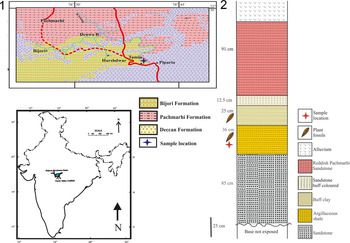
The lower Gondwana deposits are well exposed in the Damodar–Koel, Wardha–Godavari, Son–Mahanadi, and Satpura basins of peninsular India. The rhomb shaped Satpura Gondwana Basin is located at the heart of the Indian peninsula along the southern flank of the Narmada Valley and covers an area of 12,000 km2, situated 22°06′–22°28′N; 77°48′–78°53′E. It extends to the south of the Narmada plains of Hoshangabad and includes the hilly region of southern Hoshangabad, northern Chhindwara, and northeastern Betul (Raja Rao, Reference Raja Rao1983). This master basin includes four major coalfields: Pench, Kanhan, Pathakhera, and Mohpani. The Gondwana interval of the Satpura Basin is 5,000 m thick. The Bijori Formation (late Permian) is well exposed in Pench Valley Coalfield (Fig. 1.1). The thickness of the Bijori Formation ranges from 180 m to 250 m, although Pascoe (Reference Pascoe1959) estimated its thickness at about 600 m in the southeastern part of the basin. The relationship of this formation with the overlying Pachmarhi and the underlying Motur beds was discussed in detail by Crookshank (Reference Crookshank1936). Detailed descriptions of plant fossils from the Bijori Formation show a variety of plant species (Srivastava and Agnihotri, Reference Srivastava and Agnihotri2010). This record comprises Santhalea bansloiensis Maithy, Reference Maithy1977, Neomariopteris sp., Trizygia speciosa Royle, Reference Royle1839, 20 species of Glossopteris, Vertebraria indica Royle, Reference Royle1839, dispersed seeds of Cordaicarpus type, and equisetalean axes with or without nodes and internodes.
(1) Geological map of study area showing the sample location (modified after Raja Rao, Reference Raja Rao1983) and map of India showing the location of Satpura Gondwana Basin and Pench Valley Coalfield. (2) Stratigraphic log showing the level with the trace and the plant fossils.

The Bijori Formation shows facies variations in the type area exposed in the Denwa River section, near the village of Bijori. In the type locality, it contains thick bands of carbonaceous sandstone, red clay, and fine carbonaceous shale, whereas in the middle part near Tamia it is represented by buff clays and argillaceous shale that alternate with sandstone and streaks of carbonaceous shale. In the eastern part of the basin and other places, the argillaceous facies shows an absence of carbonaceous shale. The slab containing P. gondwanicum n. igen. n. isp. has been collected from the section exposed on the Parasia-Matkuli Road section near Tamia village (22°18′N; 78°40′E) (Fig. 1.1). A well-developed section that shows the contact of the Bijori and Pachmarhi sandstones is exposed about 1.5 km past the Tamia village (Fig. 1.1). The Bijori beds are represented by alternating brown to yellow micaceous sandstone with argillaceous shale and buff-colored clay beds containing well-preserved plant fossils. The pink-colored Pachmarhi sandstone is unconformably overlying the sandstones of Bijori Formation (Fig. 1.2). The slab, as part and counterpart, which contains specimens of P. gondwanicum, n. igen. n. isp. has been collected from the argillaceous shales included in the M2 facies of the shallow lake shoreline deposits frequently affected by seasonal flooding (FA2), according to Chakraborty and Sarkar (Reference Chakraborty and Sarkar2005). The M2 facies are represented by greenish-gray bioturbated carbonaceous shales, which show desiccation cracks, plant roots, plant remains, and hydromorphic paleosols (Chakraborty and Sarkar, Reference Chakraborty and Sarkar2005). Slickensides attest for repeated expansion and contraction processes in soils, whereas the greenish-gray color indicates a reduced environment. Ferruginous nodules or layers and carbonized remains are also present.
Materials
The studied material has been deposited in the following repository.
Repository and institutional abbreviation
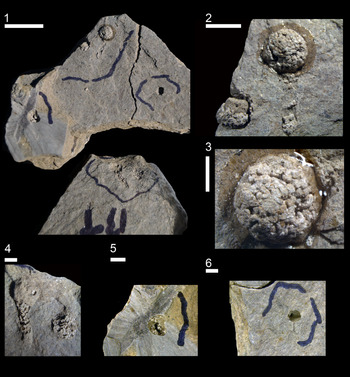
The four specimens, which show part and counterpart (Fig. 2.1), have been deposited in the museum (repository) of the Birbal Sahni Institute of Palaeosciences (BSIP), Lucknow vide statement no. 1545 under the BSIP Museum specimen numbers 41926a and b, 41927a and b, 41928, and 41929.
(1) Part and counterpart of the slab containing Palliedaphichnium gondwanicum n. igen. n. isp. On top, from left to right, BSIP 41928, BSIP 41927a, BSIP 41926a, and BSIP 41929. In the counterpart below, BSIP 41926b on left and BSIP 41927b on right. (2) Close-up of BSIP 41926a, the holotype, on right and BSIP 41927a left. (3) Close-up of the chamber showing the pellets. (4) Close-up of the counterpart illustrated in (1). (5) BSIP 41928. (6) BSIP 41929. (1) Scale bar = 1 cm; (2, 5, 6) scale bars = 2 mm; (3, 4) scale bars = 1 mm.

Systematic ichnopaleontology
Ichnofamily Pallichnidae Genise, Reference Genise2004
Ichnogenus Palliedaphichnium Genise, new ichnogenus
Type ichnospecies
Palliedaphichnium gondwanicum n. igen. n. isp.
Diagnosis
Spheroidal chambers connected to tunnels, both filled mostly with elliptical to rounded pellets that may coalesce in some parts, looking more unshaped. Pellets show no particular arrangement. Walls show no particular lining to the naked eye, and pellets protrude in some sectors.
Etymology
Derived from the Greek palla meaning ball, and from Edaphichnium, an ichnogenus characterized by tunnel fillings composed of pellets.
Remarks
Compared with the more similar ichnogenera of chambered trace fossils from paleosols, the difference with Castrichnus is that, in the latter, the chamber wall is lined with pellets, and the pellets inside the chambers are large, discoidal, and arranged in sinuous rows (Verde et al., Reference Verde, Ubilla, Jimenez and Genise2007). Pallisphaera shows pelletal walls, and the interior of chambers is devoid of pellets (Genise et al., Reference Genise2020). The new ichnogenus Palliedaphichnium is included in the ichnofamily Pallichnidae because of the absence of a discrete wall to the naked eye.
Holotype
The part and counterpart of the most complete specimen (BSIP 41926a and b), upper Permian, Bijori Formation, Satpura Gondwana Basin, Madhya Pradesh, India.
Line drawing of holotype BSIP 41926a.

Diagnosis
Specimens of Palliedaphichnium showing spheroidal chambers and elliptical to rounded pellets without no particular arrangement.
Description
The holotype (BSPI 41926) is the most complete specimen and is composed of a short horizontal tunnel 6 mm long and 1 mm wide, circular in cross section, that ends in a spheroidal chamber 3.2 mm in diameter. Both tunnel and chamber are filled with subrounded to subcylindrical pellets 0.2–0.4 mm in diameter (n = 17), similar in aspect and color to the rock matrix. Inside the chamber, some of the pellets are very tight and their boundaries are blurred, and all of them form a spheroidal mass (Fig. 2.2 right, 2.3, 2.4 left). Some empty spaces among pellets are interpreted as missing pellets resulting from weathering or accidental losses. In addition, some amorphous masses in the fillings may represent pellet coalescence, or more amorphous fecal material (Fig. 3). Most pellets of the tunnel and the chamber are preserved in one of the parts of the slab, whereas in the other the burrows are mostly empty. The remaining specimens are represented only by the chambers. Specimen BSIP 41927 is represented by a chamber 2.7 mm in diameter, showing pellets 0.2–04 mm in diameter (n = 15), mostly preserved in one part of the slab (Fig. 2.2 left, 2.4 right). The third specimen, BSIP 41928, is represented only in one part of the slab and shows a chamber 3 mm in diameter that preserves a few distinguishable pellets 0.3–0.4 mm in diameter (n = 4) and a small mass of undistinguishable ones (Fig. 2.5). The fourth specimen, BSIP 41929, is also represented in one part of the slab with an empty chamber 2 mm in diameter (Fig. 2.6).
Etymology
After the location in the Satpura Gondwana Basin.
Materials
Another specimen, with part and counterpart (BSIP 41927a and b) and two other specimens that preserve a half (BSIP 41928 and 41929).
Remarks
There is no other known ichnospecies to compare with. Possible ichnospecific diversity may involve the shape of chambers and pellets and/or the arrangement of them.
Discussion
Edaphichnium lumbricatum Bown and Kraus, Reference Bown and Kraus1983, described originally from the Eocene Willwood Formation of the USA, includes simple burrows filled with elliptical fecal pellets that were attributed to earthworms because those organisms were known to fill some of their burrows with fecal pellets (Bown and Kraus, Reference Bown and Kraus1983). Other earthworm trace fossils, Castrichnus incolumis Verde et al., Reference Verde, Ubilla, Jimenez and Genise2007, interpreted as aestivation chambers, also show fecal pellets that fill some chambers and burrows (Verde et al., Reference Verde, Ubilla, Jimenez and Genise2007). After the creation of Edaphichnium, the presence of burrows filled with fecal pellets in soils was also recorded for rhizophagous beetles (Scarabaeoidae), which extended the list of possible trace makers to beetles (Sánchez and Genise, Reference Sánchez and Genise2009). Extant and fossil millipede burrows that end in chambers and are filled with pellets have been described recently in detail by Hembree (Reference Hembree2009) and Bowen and Hembree (Reference Bowen and Hembree2014).
Which would then be the most probable trace maker of Palliedaphichnium gondwanicum n. igen. n. isp.? The chambers made by earthworms show walls constructed with rounded small pellets, but inside them the pellets left by the earthworm when leaving the chamber are large and discoidal, mostly arranged in sinuous rows (Verde et al., Reference Verde, Ubilla, Jimenez and Genise2007), very different from those of P. gondwanicum n. igen. n. isp. In addition, the body fossil record of earthworms represented by clitellate cocoons extends only to the Late Triassic (Harris and Rest, Reference Harris and Rest1966; Manum et al., Reference Manum, Bose and Sawyer1991), and their oldest supposed trace fossils to the Early Triassic (Retallack, Reference Retallack1976). Although the rhizophagous beetles produce both burrows filled with pellets and pupation chambers, there is no record of these chambers being filled with fecal pellets (Genise, Reference Genise2016). The oldest scarab beetles came from the Jurassic (Bai et al., Reference Bai, Arhens, Xing-Ke and Ren2012), and it is unknown whether they had fossorial habits. Thus, these two groups are discarded as the possible trace makers of P. gondwanicum n. igen. n. isp.
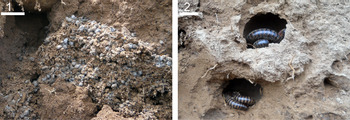
By contrast, millipedes fulfill all the requirements to be considered the trace makers of P. gondwanicum n. igen. n. isp.: they produce similar traces (Fig. 4), and their body and ichnofossil record is extensive during the Paleozoic. Millipedes construct aestivation, molting, and egg chambers. In some cases, they are simple excavations in soils, whereas others are constructed with fecal pellets and silk (Karamaouna, Reference Karamaouna1992; Golovatch and Kime, Reference Golovatch and Kime2009; Hembree, Reference Hembree2009; Bowen and Hembree, Reference Bowen and Hembree2014; Youngsteadt and McAllister, Reference Youngsteadt and McAllister2014; Reboleira and Enghoff, Reference Reboleira and Enghoff2016). Among these cases, the simply excavated, circular to elliptical, terminal molting chambers of Orthoporus ornatus Girard, Reference Girard and Marcy1853 (Hembree, Reference Hembree2009), Floridobolus penneri Causey, Reference Causey1957, and Narceus americanus Palisot de Beauvois, Reference Palisot de Beauvois1805 (Bowen and Hembree, Reference Bowen and Hembree2014) are the most similar to P. gondwanicum n. igen. n. isp. The presence of elliptical fecal pellets in millipede burrows and chambers has also been reported (Bonkowski et al., Reference Bonkowski, Scheu and Schaefer1998; Hembree, Reference Hembree2009; Bowen and Hembree, Reference Bowen and Hembree2014). These authors found in their neoichnological experiments that burrows and chambers may contain few pellets randomly dispersed or arranged in a straight line in new burrows; whereas those occupied for long periods of time showed more fecal pellets. In addition, chambers were more frequent in older burrows. Fecal pellets are utilized as food by the same millipedes and by earthworms (Dangerfield, Reference Dangerfield1994; Bonkowski et al., Reference Bonkowski, Scheu and Schaefer1998; Mwabvu, Reference Mwabvu1998, Reference Mwabvu2017a, Reference Mwabvub; Bowen and Hembree, Reference Bowen and Hembree2014). The pellets contain about 50%–60% of soil material (Hembree, Reference Hembree2009; Mwabvu, Reference Mwabvu2017a), which probably gives them their high preservation potential as seen in P. gondwanicum n. igen. n. isp. It was proposed that such ingestion may be critical for digesting organic material and for constructing egg chambers (David, Reference David2014; Mwabvu, Reference Mwabvu2017b and references therein). Bowen and Hembree (Reference Bowen and Hembree2014) suggested that the accumulations of fecal pellets inside the burrows may be used to “cultivate” fungi and bacteria to feed adults and young specimens during prolonged periods below surface.
(1) Section of soil showing burrows filled with pellets produced by Anadenobolus sp. (Diplopoda, Spirobolidea) in Tafí del Valle, Tucuman, Argentina. (2) Molting chambers of the same millipede. There were still others nearby. Scale bars = 1 cm.

In addition to the similar morphology, the fossil record supports the attribution of P. gondwanicum n. igen. n. isp. to millipedes. The oldest millipedes date to the Early Devonian, and since the Carboniferous, the records increased in numbers (Sierwald and Bond, Reference Sierwald and Bond2007; Golovatch and Kime, Reference Golovatch and Kime2009; Shear and Edgecombe, Reference Shear and Edgecombe2010). It has been highlighted that there are almost no records of Permian millipedes, thus P. gondwanicum n. igen. n. isp. is a remarkable contribution of ichnology to the evolutionary history of this group. Several Paleozoic trace fossils have been attributed to myriapods: Ordovician Scoyenia (Retallack, Reference Retallack2001), Early Devonian coprolites (Edwards et al., Reference Edwards, Selden and Axe2012), Taenidium barrettii Bradshaw, Reference Bradshaw1981 (Morrissey and Braddy, Reference Morrissey and Braddy2004), and Pennsylvanian to Permian undetermined burrows (Hembree, Reference Hembree2019 and references therein). Burrows with chambers had been described from the late Carboniferous–Permian deposits of Germany and formerly attributed to insects by Voigt (Reference Voigt2007). However, the same burrows were later reinterpreted as produced by millipedes (Hembree, Reference Hembree2009; Voigt et al., Reference Voigt, Niedźwiedzki, Raczyński, Mastalerz and Ptaszyński2012). Palliedaphichnium gondwanicum n. igen. n. isp. reinforces the emerging scenario that paleosols of the Paleozoic are dominated by millipede trace fossils, the Mesozoic by crayfishes and earthworms, and the Cenozoic by insects (Genise et al., Reference Genise, Bedatou, Bellosi, Sarzetti, Sánchez, Krause, Buatois and Mángano2016), which is explained by the successive appearance and diversification of these different groups of fossorial invertebrates.
The small size of chambers of P. gondwanicum n. igen. n. isp. and the proximity of the four specimens may indicate that they belong to juveniles that may be originated from a single oviposition, or that a juvenile swarm burrowed together to molt (Bellairs et al., Reference Bellairs, Bellairs and Goel1983) and later emerged, filling the molting chambers and burrows with fecal pellets as they left. In millipedes, the presence of chambers and burrows filled with pellets would indicate the necessity to stay below the ground for long periods as a result of adverse surface conditions (Bowen and Hembree, Reference Bowen and Hembree2014). As such, the presence of P. gondwanicum n. igen. n. isp. in the upper Permian Bijori Formation would indicate unfavorable conditions, at least seasonally. Paleobotanical evidence for the Permo–Triassic transition in India indicates a change from a warm and humid seasonal climate to dry conditions (Lele, Reference Lele1976). For the Bijori Formation in particular, it is assumed that drier conditions were already established because of the declination of the Glossopteris flora (Srivastava and Agnihotri, Reference Srivastava and Agnihotri2010). Such evidence is congruent with the unfavorable conditions suggested by chambers and pellets of P. gondwanicum n. igen. n. isp. since millipedes depend on humidity (Golovatch and Kime, Reference Golovatch and Kime2009). The presence of P. gondwanicum n. igen. n. isp. in shallow shoreline deposits (FA2) and M2 facies showing features of hydromorphic paleosols but with seasonal periods of subaerial exposure and dryness, and abundant plant remains (Chakraborty and Sarkar, Reference Chakraborty and Sarkar2005), which suppose abundant leaf litter, is compatible with environments inhabited by extant and fossil millipedes. Some of the most typical habitats for millipedes are the leaf litter and the litter/soil interface, and it is assumed that early Diplopoda were detritivores living on the forest floor (Sierwald and Bond, Reference Sierwald and Bond2007; Golovatch and Kime, Reference Golovatch and Kime2009).
Conclusions
Palliedaphichnium gondwanicum n. igen. n. isp. is a new invertebrate trace fossil from paleosols of the Permian Bijori Formation of India composed of burrows and chambers filled with pellets. It is attributed to millipedes due to its morphology, and this attribution is supported by the body fossil record of the possible trace makers. This new evidence significantly contributes to the meager records of invertebrate trace fossils from Permian paleosols, Indian paleosols, and Permian millipedes. The presence of chambers and abundant pellets in burrows indicates that the paleoclimate showed adverse conditions, at least seasonally. The co-occurrence of abundant plant remains in the same levels attests to the probable consumption of leaf litter by the producers, as known for fossil and extant millipedes. This record also contributes to an emerging scenario for the invertebrate trace fossils in paleosols, which points to a successive dominance of millipedes during the Paleozoic, crayfishes and earthworms from the Mesozoic, and insects from the Cenozoic.
Acknowledgments
We are thankful to V. Prasad, Director, Birbal Sahni Institute of Palaeosciences, Lucknow, India, for the necessary facilities to carry out this research work and for granting permission to publish this paper (permission no. BSIP/RDCC/publication no. 42/2020−2021). AKS is indebted to M. Robledo, from the Centro de Ecologia Aplicada del Litoral Corrientes, Argentina, for his friendly gesture to introduce JFG. Research of J.F. Genise is supported by grant PICT 17/0779 from the Agencia Nacional de Promoción Científica y Tecnológica of Argentina. We thank N. Garrido for reviewing the language. We thank P. Verma for drawing the text figure. The editor B. Hunda, the associate editor G. Mángano, M. Verde, and an anonymous reviewer improved the manuscript.