Health systems across the globe are increasingly recognizing that in ensuring the efficient delivery of care, it is crucial to complement judicious investment in new healthcare technologies with strategies to reduce the use of ineffective and inefficient interventions. These strategies, commonly referred to as disinvestment initiatives, are a growing priority for international health policy in maximizing value and improving quality of care (Reference Elshaug, Hiller and Moss1). However, removing resources from a health system is more difficult than adding new resources with many existing technologies having been diffused into service delivery before evidence-based clinical and cost-effectiveness criteria were applied. Furthermore, as new health interventions come along, the older ones may no longer offer comparable values. In addition, the lack of consistent and transparent systems to identify these technologies contributes to a degree of clinical and cost-effectiveness uncertainty (Reference Ibargoyen-Roteta, Gutierrez-Ibarluzea and Asua2).
Numerous studies on disinvestment initiatives and health technology reassessment (HTR) have been published, describing processes at various levels. However, the success of the initiatives such as “Choosing Wisely” campaigns, the National Institute for Health and Care Excellence (NICE) “Do Not Do” list in England and the US Preventive Services Task Force has been mixed, with less than half of identified studies reporting a reduction in the utilization of these low-value services (Reference Chambers, Salem and D’Cruz3). Additionally, the global COVID-19 outbreak has forced many countries to devote a significant portion of their resources to combating the pandemic. Early estimates in twenty-two countries, mostly high-income economies, show that healthcare spending rose significantly in 2020, more than in previous years (4). Therefore, promoting active disinvestment in this current climate is timely to help restrategize value-based priority setting and resource reallocation to aid economic recovery.
We undertook a scoping review of existing reviews to comprehensively synthesize the large body of information from published studies on disinvestment in healthcare. The aim of this scoping review was to describe the approaches and methods used in disinvestment processes of health technologies. We also identified the facilitators and barriers with regards to carrying out disinvestment and explore the role of stakeholders particularly among clinicians who act as a bridge between policy makers and patients.
Methods
The Scoping Review Protocol
A priori protocol was developed following established scoping review frameworks from the Joanna Briggs Institute (JBI) Manual for Evidence Synthesis (Reference Peters, Godfrey, McInerney, Aromataris and Munn5). The reporting of this study conforms to the PRISMA statement for scoping review standards or PRISMA-ScR (Reference Tricco, Lillie and Zarin6).
Purpose Statement of the Scoping Review
The purpose of this scoping review is to clarify the concepts and definitions of disinvestment in the published literature and identify key characteristics of existing disinvestment initiatives that had been implemented. In achieving these, we intended to map the data from the retrieved studies based on five categories: (i) concepts and terms used in disinvestment in healthcare; (ii) purpose of disinvestment; (iii) methods and processes in disinvestment; (iv) stakeholder involvement in disinvestment; and (v) facilitators and challenges in disinvestment implementation.
Systematic Search Strategy
Identification
The main electronic bibliographic databases used for evidence searching: MEDLINE (Ovid), Embase, Web of Science, and Scopus. Other sources used were NIHR Journals Library, Centre for Reviews and Dissemination as well as health technology assessment (HTA) Web sites and databases (INAHTA and HTAi). Based on a scoping review by Niven et al. (Reference Niven, Mrklas and Holodinsky7) on deadoption in healthcare, forty-three terms on “disinvestment” were identified, including “HTR,” “delisting,” and “deimplementation” (Supplementary Table 1). Focusing on healthcare disinvestment, our search strategy was confined to fourteen synonyms of “disinvestment” and combined with “healthcare” or “health care” (see Supplementary Tables 2 and 3). The initial search was conducted on 4 Feb 2021 and repeated on 3 Jan 2022 to identify any additional publications. Literature was also identified from the references of the retrieved articles using citation tracking, snowballing method and recommendation by experts’ in conferences or forums.
Inclusion and Exclusion Criteria
Specific inclusion and exclusion criteria were established to include all review types containing terms and concepts, descriptions or methods relating to disinvestment in healthcare (see Supplementary Table 4). These criteria were applied using automatic sorting function in the databases and manually. A publication period was determined to ensure that we included the papers that are contemporary and relevant to current practice, without jeopardizing the concept of “research field maturity” (Reference Okoli8). For practicality, we only include articles published between year 2001 and 2021 which considered as acceptable to perform a representative review on disinvestment in healthcare. Additional automatic screening filters were applied for English only and types of research (“review articles” or “reviews”).
Screening and Eligibility
The titles and abstracts of the articles were checked to ensure that the studies matched the predetermined inclusion criteria. A paper was considered eligible if it was secondary research on disinvestment initiatives, such as systematic reviews, scoping reviews, pragmatic reviews, overviews, interpretative reviews, and critical interpretative synthesis. An article was included when the study covered any of the components outlined in the inclusion criteria. The lead author carried out the initial screening and the results were presented to the coauthors for checking.
Data Extraction, Synthesis, and Analysis
Data were extracted using a predesigned data extraction table and synthesized narratively to identify similarities and differences across the approaches. The general description and findings from each article included in the review were summarized according to the following characteristics: publication year, type of reviews, country, organization or agency in charge of the program, scope of health technologies, methods used and description on disinvestment initiatives including the process, stakeholder involvement, as well as facilitators and barriers in its implementation.
Content analysis was employed to identify the pattern of data, and the findings were organized into the stated categories using shared similarities or relationships of the information (Reference Khalil, McInerney and Pollock9). Descriptive data analyses were performed to report the frequencies and quantitative findings from the included reviews.
Results
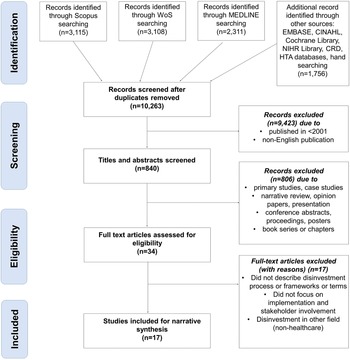
Seventeen reviews on disinvestment initiatives were included for synthesis and analysis, as shown in PRISMA flow diagram (Figure 1). Eight reviews described international disinvestment initiatives with descriptions on countries that already implemented disinvestment programs (Reference Chambers, Salem and D’Cruz3;Reference Niven, Mrklas and Holodinsky7;Reference Maloney, Schwartz, O’Reilly and Levine11–Reference Leggett, Noseworthy and Zarrabi16). Two of the included studies discussed regional disinvestment initiatives, in European HTA agencies (Reference Calabro, La Torre and de Waure17) and in Latin American countries (Reference Agirrezabal, Burgon, Stewart and Gutierrez-Ibarluzea18).
PRISMA flow diagram of the scoping review (Reference Moher, Liberati, Tetzlaff, Altman and Group10).

Whilst the majority (n = 13) of the included reviews described disinvestment for health technologies and services in general (Reference Chambers, Salem and D’Cruz3;Reference Niven, Mrklas and Holodinsky7;Reference Orso, de Waure and Abraha12–Reference Polisena, Clifford and Elshaug15;Reference Calabro, La Torre and de Waure17–Reference Garner, Docherty and Somner23), two reviews focused on disinvestment strategies in pharmaceuticals (Reference Maloney, Schwartz, O’Reilly and Levine11;Reference Parkinson, Sermet and Clement24) and two studies on nonpharmaceuticals (Reference Leggett, Noseworthy and Zarrabi16;Reference Mitchell, Bowles, O’Brien, Bardoel and Haines25). Four of the reviews proposed methods or frameworks for disinvestment or HTR (Reference Niven, Mrklas and Holodinsky7;Reference Seo, Park and Lee13;Reference Esandi, Gutiérrez-Ibarluzea, Ibargoyen-Roteta and Godman21;Reference Soril, Niven, Esmail, Noseworthy and Clement22), mainly for identification and prioritization processes. One review specifically explored the related terms and definitions in disinvestment using “deadoption” as the key term (Reference Niven, Mrklas and Holodinsky7), and one review focused solely on stakeholders’ involvement in disinvestment, specifically healthcare professionals (Reference Mitchell, Bowles, O’Brien, Bardoel and Haines25).
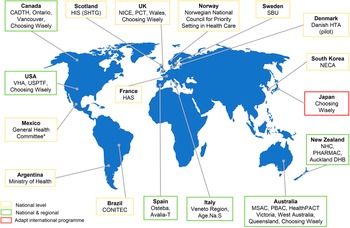
We identified thirty-four disinvestment initiatives across sixteen countries, operating at various levels by different types of agencies responsible for carrying out the activities (Figure 2). Among the programs implemented internationally, the most quoted is the Choosing Wisely campaign launched in 2012 by the American Board of Internal Medicine and adapted by many countries and agencies. The majority of national level initiatives fall under the responsibility of the HTA agencies in that country (Reference Orso, de Waure and Abraha12). Uniquely, Canada and Spain initially started with regional-based disinvestment initiatives before expanding to a national program (Reference Seo, Park and Lee13).
. Countries with identified disinvestment initiatives and the agencies involved. Agencies acronyms: Age.Na.S, Agency for Regional Healthcare; CADTH, Canadian Agency for Drugs and Technologies in Health; CONITEC, Brazilian National Committee for Technology Incorporation; DHB, District Health Board; HAS, Haute Autorité de Santé Compréhensive Drug Review; HealthPACT, Health Policy Advisory Committee for Technology; MSAC, Medical Services Advisory Committee; NECA, National Evidence-based healthcare Collaborating Agency; NHC, National Health Committee; NICE, National Institute for Health and Care Excellence; PBAC, Pharmaceutical Benefits Advisory Committee; PCT, Primary Care Trusts Programmes; PHARMAC, Pharmaceutical Management Agency; SBU, The Swedish Council on Health Technology Assessment; SHTG, Scottish Health Technologies Group; USPTF, US Preventive Services Task Force (grade D recommendations); VHA, Veterans Health Administration Comprehensive Review. *General Health Committee agreed on eight types of drug exclusions. No information was provided.

There are several information gaps on some of the implemented programs. For example, from the review in Latin American countries (Reference Agirrezabal, Burgon, Stewart and Gutierrez-Ibarluzea18), there are only few documented records of disinvestment activities despite various programs that have been carried out in the region based on survey responses conducted. Another example is the Danish Centre for Health Technology Assessment’s (DACEHTA) pilot on disinvestment, in which the only source of information on this project was a 2005 conference abstract on the improper utilization of imaging technologies in Denmark (Reference Leggett, Noseworthy and Zarrabi16).
Supplementary Table 5 summarized the details of the included studies and description of disinvestment initiatives based on the predefined categories.
Clarifying Concepts and Terms in Disinvestment
Six reviews highlighted the need to clarify the concepts and terms used in disinvestment (Reference Niven, Mrklas and Holodinsky7;Reference Maloney, Schwartz, O’Reilly and Levine11;Reference Mayer and Nachtnebel14;Reference Leggett, Noseworthy and Zarrabi16;Reference Embrett, Randall, Lavis and Dion20;Reference Soril, Niven, Esmail, Noseworthy and Clement22). Among the reasons given are to provide a clearer vision regarding managing existing technologies in the system (Reference Soril, Niven, Esmail, Noseworthy and Clement22), to enhance communication (Reference Embrett, Randall, Lavis and Dion20) and to improve engagement among the stakeholders (Reference Maloney, Schwartz, O’Reilly and Levine11).
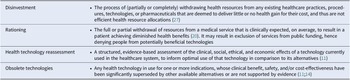
Due to overlapping concepts, stakeholders involved in managing healthcare resources tend to use disinvestment interchangeably with the following terms; rationing (Reference Rooshenas, Owen-Smith and Hollingworth26), HTR (Reference Seo, Park and Lee13) and obsolete technologies (Reference Maloney, Schwartz, O’Reilly and Levine11;Reference Mayer and Nachtnebel14) (Table 1). The earliest definition of disinvestment by Elshaug et al. (Reference Elshaug, Hiller, Tunis and Moss27) focused on the withdrawal of resources in reducing ineffective, harmful or low-value medical services with the aim of improving health of patients. Rationing has, instead, the underlying premise of scarce resources; meaning the prioritization of resources will result in certain services being excluded from funding, thus denying people from potentially beneficial services (Reference Embrett, Randall, Lavis and Dion20). HTR is the process of identifying low value practices that may or may not lead to disinvestment decision. It is more acceptable to stakeholders as it does not assume the removal of funding (Reference Maloney, Schwartz, O’Reilly and Levine11) and is not meant as a rationing tool.
Definitions of Terms

Understanding the Purpose of Disinvestment
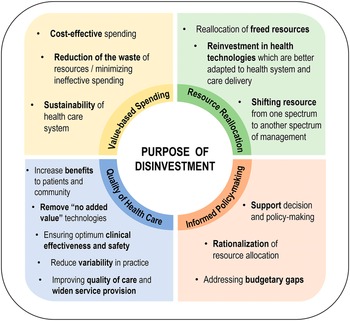
Although disinvestment is frequently associated with budgetary concerns and affordability, it can also be prompted to enhance efficiency and quality of care through reformation of service provision (Reference Rooshenas, Owen-Smith and Hollingworth26). Based on our analysis (see Supplementary Tables 5 and 6), the purpose of disinvestment initiatives can be grouped into four themes (Figure 3): (i) enhance value-based spending (Reference Seo, Park and Lee13;Reference Mayer and Nachtnebel14;Reference Leggett, Noseworthy and Zarrabi16–Reference Walsh-Bailey, Tsai and Tabak19;Reference Mitchell, Bowles, O’Brien, Bardoel and Haines25); (ii) resource reallocation (Reference Chambers, Salem and D’Cruz3;Reference Orso, de Waure and Abraha12;Reference Mayer and Nachtnebel14–Reference Esandi, Gutiérrez-Ibarluzea, Ibargoyen-Roteta and Godman21;Reference Parkinson, Sermet and Clement24;Reference Mitchell, Bowles, O’Brien, Bardoel and Haines25); (iii) improving quality of health care (Reference Chambers, Salem and D’Cruz3;Reference Niven, Mrklas and Holodinsky7;Reference Maloney, Schwartz, O’Reilly and Levine11–Reference Mayer and Nachtnebel14;Reference Leggett, Noseworthy and Zarrabi16;Reference Walsh-Bailey, Tsai and Tabak19;Reference Esandi, Gutiérrez-Ibarluzea, Ibargoyen-Roteta and Godman21;Reference Soril, Niven, Esmail, Noseworthy and Clement22;Reference Mitchell, Bowles, O’Brien, Bardoel and Haines25); and (iv) informed policy making (Reference Orso, de Waure and Abraha12;Reference Calabro, La Torre and de Waure17). Clarifying the goals of disinvestment would help people understand that it is a tool for improving access to effective solutions, not for eliminating technologies and withdrawing resources on a large scale.
Rationale and purpose of disinvestment.

Methods and Processes in Disinvestment
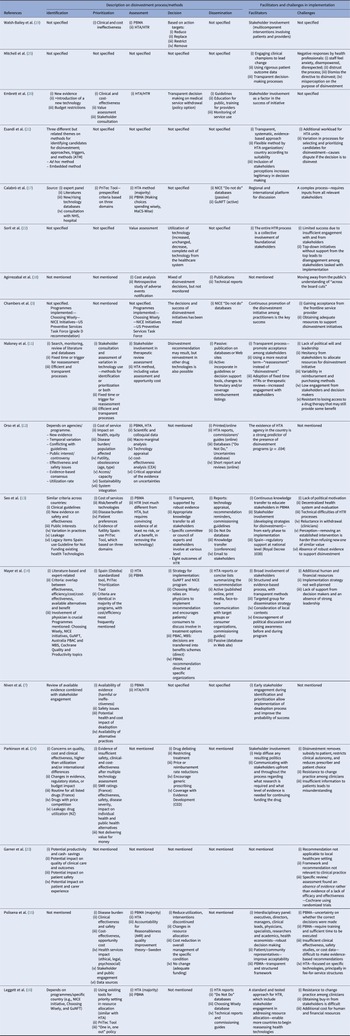
Most of the reviews (n = 15) described processes and methods of disinvestment. Generally, the disinvestment process includes identification, prioritization, assessment or reassessment, decision, and dissemination (Table 2). In some reviews, implementation and monitoring of the decision were also included in the process. Identification and prioritization were the least standardized in terms of methods, criteria and evidence used across HTA agencies. In certain contexts, there is overlap in these processes, which potentially lead to some confusion in the roles and criteria.
Summary of Disinvestment Methods/Processes, Facilitators, and Challenges

HTA, health technology assessment; HTR, health technology reassessment; PBMA, Programme Budgeting and Marginal Analysis.
Identification Process
Three components related to identifying candidates for disinvestment were triggers for identification, source of identification and implementation of the process (Supplementary Table 7). Identification can be done through established methods such as Horizon Scanning or based on the input from clinical experts and program managers. It can also be linked with the HTA process that assumes a “one-in-one-out” policy in which, for each new technology considered, the current technology is also taken into consideration for reassessment (Reference Leggett, Noseworthy and Zarrabi16).
Identifying candidates for disinvestment can be performed in two ways, “ad hoc methods” and “embedded methods.” Ad hoc methods are specifically devised and implemented to find suitable technologies for disinvestment and usually are not carried out on a regular basis (Reference Esandi, Gutiérrez-Ibarluzea, Ibargoyen-Roteta and Godman21). For embedded methods, the identification process is performed routinely alongside other organizational activities (Reference Esandi, Gutiérrez-Ibarluzea, Ibargoyen-Roteta and Godman21).
Prioritization Process
Eleven reviews outlined common prioritization criteria such as the evidence on efficiency or effectiveness, cost-effectiveness and safety of the technology, existence of available alternatives, the total cost, and disease burden. These criteria are usually aligned with the purpose of disinvestment, for example, the rationale for inclusion of “cost of inefficient drugs” from a budgetary planning is to allow for investment in technologies with higher value (Reference Maloney, Schwartz, O’Reilly and Levine11).
A specific tool for prioritization, the PriTec Prioritization Tool develop by Galician Agency for Health Technology Assessment was mentioned in three included reviews (Reference Maloney, Schwartz, O’Reilly and Levine11;Reference Seo, Park and Lee13;Reference Calabro, La Torre and de Waure17) (Supplementary Table 8). It is a three-domain weighted prioritization exercise with a score system that allows for the ranking of health technologies according to a set of specified criteria (Reference Calabro, La Torre and de Waure17). Additional criteria for prioritization process include evidence of futility (Reference Orso, de Waure and Abraha12;Reference Seo, Park and Lee13), strength of supporting evidence on lack of efficacy (Reference Niven, Mrklas and Holodinsky7;Reference Parkinson, Sermet and Clement24), cost (Reference Orso, de Waure and Abraha12–Reference Mayer and Nachtnebel14) and opportunity cost (Reference Polisena, Clifford and Elshaug15).
Assessment Process
There is little information from the retrieved articles on technical assessment for disinvestment. Twelve articles included methods similar to the components used in HTA for investment: disease burden, safety, clinical and cost-effectiveness, and overall value including ethical, legal, and social aspects (Table 2). It was highlighted that an assessment should also evaluate the feasibility of implementation and analysis of consequences, both intended and unintended (Reference Maloney, Schwartz, O’Reilly and Levine11).
We identified two commonly used frameworks to facilitate disinvestment decisions, namely Program Budgeting and Marginal Analysis (PBMA) and HTA. It is argued that PBMA is usually used to assess the distribution of resources for health services within a fixed budget plan, while HTA is mainly focused on single technology appraisals for public and social healthcare system and is not a framework specifically intended for disinvestment (Reference Seo, Park and Lee13). Other method is Accountability for Reasonableness (A4R) which was applied in Sweden’s healthcare priority setting to address the concepts of rationing, rationalization, ranking priority setting, and structured quality improvement (Reference Polisena, Clifford and Elshaug15). However, the information on A4R as method for disinvestment is scarce and limited to Swedish healthcare setting.
Type of Disinvestment Decisions
The outcomes of disinvestment decisions were mixed. Some reviews highlighted the requirement of making decisions (i.e., binding judgments) (Reference Seo, Park and Lee13;Reference Mayer and Nachtnebel14;Reference Embrett, Randall, Lavis and Dion20), while some outlined the resulting outcomes that may occur following the assessment (i.e., nonbinding information) (Reference Chambers, Salem and D’Cruz3;Reference Maloney, Schwartz, O’Reilly and Levine11;Reference Polisena, Clifford and Elshaug15;Reference Agirrezabal, Burgon, Stewart and Gutierrez-Ibarluzea18;Reference Soril, Niven, Esmail, Noseworthy and Clement22;Reference Parkinson, Sermet and Clement24). According to Mayer and Nachtnebel (Reference Mayer and Nachtnebel14), the implementation of disinvestment decisions may result in one of these four conditions: (i) a change in application or scope of use; (ii) full or partial resource withdrawal; (iii) complete removal from practice, or (iv) no change to the practice. However, the impact of these decisions on resource withdrawal must be judicially evaluated for their influence on patients’ health based on the clinical effectiveness and on the availability of a suitable alternative (Reference Embrett, Randall, Lavis and Dion20).
Dissemination Process
Active dissemination through online or printed recommendation reminders, HTA reports, commissioners’ guides, clinical guidelines, and journal publications were the most common means (Reference Maloney, Schwartz, O’Reilly and Levine11–Reference Mayer and Nachtnebel14). It can also be done through conferences and knowledge transfer programs (Reference Seo, Park and Lee13), face-to-face communications with target groups (Reference Mayer and Nachtnebel14), and making direct changes to formulary or reimbursement listings (Reference Maloney, Schwartz, O’Reilly and Levine11). In Spain, a software was embedded with the Guideline for Not Funding existing health Technologies in the health system whereby progress and reports are emailed to the stakeholders once the evaluation is completed (Reference Seo, Park and Lee13;Reference Calabro, La Torre and de Waure17). More passive dissemination include publishing the recommendation lists on Web sites such as “Do Not Do” and Choosing Wisely, in online uncertainties databases and short reports (Reference Orso, de Waure and Abraha12).
Stakeholders Involvement in Disinvestment Initiative
Only one systematic review by Mitchell et al. (Reference Mitchell, Bowles, O’Brien, Bardoel and Haines25) focused on capturing healthcare staff perspectives and reactions toward disinvestment initiatives. In other reviews, the roles of stakeholders were described and discussed mainly in the context of the processes, facilitators, and barriers of disinvestment programs (see Table 2).
Stakeholders usually involved are clinicians and other first-line responders in care provision, clinical and political decision makers, patients or their representatives, researchers, health economists and academics, as well as citizens representing the public (Reference Orso, de Waure and Abraha12). They may be involved as members of a special committee, for instance, members of the Technology Appraisal Committee under NICE are drawn from the National Health Service, patient organizations, academia, and pharmaceutical or medical device industries (Reference Seo, Park and Lee13).
Facilitators and Challenges to Disinvestment Initiatives
We identified several facilitating factors. First, the participation of a diverse range of stakeholders with varying roles and expertise is a critical factor in increasing program acceptance (Reference Chambers, Salem and D’Cruz3;Reference Niven, Mrklas and Holodinsky7;Reference Seo, Park and Lee13;Reference Mayer and Nachtnebel14;Reference Embrett, Randall, Lavis and Dion20;Reference Mitchell, Bowles, O’Brien, Bardoel and Haines25). This, combined with an evidence-based strategy and transparent process, further enhanced the acceptance (Reference Niven, Mrklas and Holodinsky7;Reference Maloney, Schwartz, O’Reilly and Levine11;Reference Seo, Park and Lee13;Reference Mayer and Nachtnebel14;Reference Esandi, Gutiérrez-Ibarluzea, Ibargoyen-Roteta and Godman21;Reference Soril, Niven, Esmail, Noseworthy and Clement22;Reference Mitchell, Bowles, O’Brien, Bardoel and Haines25). Thirdly, the consideration on local context when evaluating the candidates for disinvestment and in formulating recommendations facilitates implementation (Reference Niven, Mrklas and Holodinsky7;Reference Mayer and Nachtnebel14;Reference Agirrezabal, Burgon, Stewart and Gutierrez-Ibarluzea18;Reference Esandi, Gutiérrez-Ibarluzea, Ibargoyen-Roteta and Godman21). Various dissemination strategies were also customized to relevant target groups, making the information more acceptable and comprehensible (Reference Maloney, Schwartz, O’Reilly and Levine11;Reference Orso, de Waure and Abraha12;Reference Mayer and Nachtnebel14;Reference Embrett, Randall, Lavis and Dion20).
Several main challenges and barriers were identified and grouped into three categories, namely perception barriers, technical or scientific barriers, and organizational barriers.
Perception Barriers
Healthcare professionals often perceive that removing an existing health technology is of greater disadvantage than refusing to embrace a new health technology of comparable value (Reference Seo, Park and Lee13). Removing or changing existing technology or practise may not be favorable since trained doctors view technology as an integral element of their job (Reference Chambers, Salem and D’Cruz3;Reference Seo, Park and Lee13;Reference Mitchell, Bowles, O’Brien, Bardoel and Haines25). For fear of being questioned by patients, some healthcare workers are reluctant to discontinue legacy therapies, such as older drugs, which have never been evaluated for cost-effectiveness (Reference Mitchell, Bowles, O’Brien, Bardoel and Haines25). The assumption that disinvestment reduces prescriber and patient choice, and by reducing patient subsidies is also a main motivation for refusal (Reference Parkinson, Sermet and Clement24).
Technical/Scientific Barriers
It is vital to convince stakeholders that withdrawing the technology would be harmless and that keeping it would be counterproductive (Reference Seo, Park and Lee13). In some circumstances, the absence of robust evidence to support withdrawal decisions hinder the acceptance of disinvestment (Reference Niven, Mrklas and Holodinsky7). A joint NICE-Cochrane pilot project found that specific review methods such as Cochrane systematic reviews were more likely to establish an absence of evidence rather than evidence of a lack of efficacy or effectiveness (Reference Garner, Docherty and Somner23).
Technical challenges include variation in selecting and prioritizing health technologies for disinvestment (Reference Esandi, Gutiérrez-Ibarluzea, Ibargoyen-Roteta and Godman21). Failure to translate the suggested recommendations into binding guidelines and link them to adjustment in coverage decisions may result in stakeholder dissatisfaction (Reference Mayer and Nachtnebel14).
Organizational Barriers
Stakeholders frequently lack the political, administrative, and clinical will to support disinvestment initiatives (Reference Maloney, Schwartz, O’Reilly and Levine11). Therefore, there is often a reluctance to devote appropriate resources to disinvestment programmes, such as educating specialists and HTA reviewers, providing incentives for implementation, and financing for related research to cover information and data shortages (Reference Maloney, Schwartz, O’Reilly and Levine11;Reference Leggett, Noseworthy and Zarrabi16). Hence, having enough resources to support disinvestment programs is critical to ensure its sustainability (Reference Chambers, Salem and D’Cruz3).
Among the solutions proposed are the provision of international platforms for collaboration and development of transparent, adaptable disinvestment models, which can be achieved through multistakeholder engagement (Reference Maloney, Schwartz, O’Reilly and Levine11). Furthermore, the presence of strong leadership may also expedite acceptance and facilitate implementation by emphasizing the need of constructive disinvestment activities through better resource allocation (Reference Mayer and Nachtnebel14).
Discussion
Disinvestment is a complex process of decision making influenced by systemic linkages between value-based spending, resource reallocation and quality of healthcare delivery. Despite the favorable outcomes behind the ideas, in practice, the process seems to be notoriously challenging in terms of scientific, political and ethical aspects (Reference Ibargoyen-Roteta, Gutierrez-Ibarluzea and Asua2). Our scoping review aimed to summarize the findings of a growing body of evidence on healthcare disinvestment. We undertook a comprehensive systematic search of disinvestment initiatives globally using a broad lexicon of terms to identify all relevant programs on disinvestment including HTR and assessment of low-value technologies.
In England in the UK, disinvestment initiatives have been carried out implicitly through NICE’s current projects, with various outputs available on its Web site (Reference Garner and Littlejohns28). The established processes employed by NICE are conducted through technology appraisals, recommendation reminders, and commissioning guidelines for clinical practice. The procedures are comparable to those used in its HTA projects for investment and reimbursement, in which a systematic and thorough approach to evidence appraisal, as well as multistakeholder participation, is required to reach a conclusion on technology disinvestment (29). Because HTR activities are carried out alongside other existing initiatives, there is no specific disinvestment framework or process formally created by NICE. Although frequently cited in the included reviews, the “Do Not Do” database had been removed from the NICE Web site in November 2017 (NICE Communications Coordinator of Enquiries, pers. commun., 16 Aug 2021) and any recommendations that were potentially cost saving have since been assessed using the cost saving and resource planning guidance under NICE activities (30).
The current plethora of terms and concepts in describing this process creates substantial confusion. Indirectly, it may influence stakeholders’ engagement as well as the acceptance of the initiative, hence, a more neutral term such as HTR has been proposed to improve understanding (Reference Maloney, Schwartz, O’Reilly and Levine11;Reference Leggett, Noseworthy and Zarrabi16;Reference Esandi, Gutiérrez-Ibarluzea, Ibargoyen-Roteta and Godman21). Whilst there are arguments raised by researchers on making a distinction between disinvestment and HTR, we believe that the differences are very subtle with some overlapping concepts, and it does not change the rationale of disinvestment. However, it is noteworthy that this process does not happen in a vacuum. Those involved in disinvestment are always aware of costs, even if cost reduction or reallocation of funds is not the primary motivation. Although they do not consider themselves to be rationing, HTR followed by disinvestment coupled with resource reallocation can appear very similar to rationing.
Analyzing the spectrum of disinvestment activities, stakeholder involvement would appear to be one of the most important aspects that needs to be addressed, allowing for higher acceptability, applicability, comprehension and political will. Early and continued stakeholder participation throughout the HTR activity, transparency in methodologies and processes, and ongoing knowledge transfer can all help to foster meaningful engagement (Reference Soril, Niven, Esmail, Noseworthy and Clement22). This is pivotal given their involvement in the provision of care and to avoid misperception in the purpose and process of disinvestment (Reference Mitchell, Bowles, O’Brien, Bardoel and Haines25).
Barriers and challenges involving stakeholders’ engagement are particularly profound during the implementation phase. Disinvestment efforts that lack of support from top level can lead to disengagement among frontline stakeholders tasked with implementation, particularly when the program’s resources are limited (Reference Soril, Niven, Esmail, Noseworthy and Clement22). Some ideas for improving active engagement from these key stakeholders include incentivizing them to conduct more research to fill data gaps and contextualize critical data for reassessment purposes (Reference Maloney, Schwartz, O’Reilly and Levine11). In this instance, short-term resource allocation for disinvestment efforts is almost always unavoidable in order to realize long-term efficiency improvements (Reference Mayer and Nachtnebel14).
Even though PBMA and standard HTA processes have been identified as the most used methods from our findings, there are differing views on their use in the context of disinvestment and resource reallocation. PBMA has had some difficulties in achieving disinvestment choices, and the outcomes in terms of permitting resource release are not always satisfactory (Reference Mortimer31). On the other hand, HTA was established with reimbursement rather than disinvestment in mind, as it is a valuable instrument for generating evidence in decision making and not a specially designed framework for disinvestment (Reference Mitton, Seixas, Peacock, Burgess and Bryan32). There is a need to revisit disinvestment methods to capture policy-beneficial outputs beyond or within PBMA and HTA, particularly in terms of technical analysis and what constitutes acceptable evidence. Common methods which can be applied within both these frameworks include the use of economic evaluation and multicriteria decision analysis (MCDA). Furthermore, the growing importance of real-world evidence in the context of disinvestment may be highlighted more explicitly to accelerate and broaden its use in disinvestment.
A robust HTR, on the other hand, is part of the trajectory of health technology management, which also includes continues reassessment of technologies for improved health care. Future research could shift the emphasis away from disinvesting, and more on the appropriateness and scope of technology utilization, including resource reallocation to technologies with higher value to the patients.
Strengths and Limitations of This Scoping Review
The comprehensive search strategy and thorough analysis of the literature on this topic are the key strengths of this scoping review. Due to substantial number of publications in this area, we focused on synthesizing the evidence from the existing reviews to systematically summarize their findings in issues related to disinvestment. We covered aspects on clarifying the concepts, the methods and processes of disinvestment, the types of evidence used in the evaluations, and stakeholder involvement in the implementation of disinvestment initiatives. Other studies have tended to focus only on specific aspects of disinvestment in healthcare, such as the identification and prioritization processes (Reference Esandi, Gutiérrez-Ibarluzea, Ibargoyen-Roteta and Godman21), initiatives in specific regions, countries or within HTA agencies (Reference Seo, Park and Lee13;Reference Calabro, La Torre and de Waure17;Reference Agirrezabal, Burgon, Stewart and Gutierrez-Ibarluzea18), and specific health technologies such as pharmaceuticals (Reference Maloney, Schwartz, O’Reilly and Levine11;Reference Parkinson, Sermet and Clement24) or nonpharmaceuticals only (Reference Leggett, Noseworthy and Zarrabi16;Reference Mitchell, Bowles, O’Brien, Bardoel and Haines25). This review also highlighted the facilitators and barriers in disinvestment, which we consider as critical components in implementing the initiatives.
We also acknowledge some limitations in this review. Most of the included publications only discussed disinvestment initiatives in high-income countries. It is possible that we overlooked unpublished, informal, or small-scale initiatives in low-and-middle-income countries, which equally grapple with resource reallocation and value-based healthcare spending. Furthermore, small studies on disinvestment from regional areas may be classified or published as quality improvement and thus escape the scope of this review. Another limitation in this review is the lack of details on additional dimensions of using HTA in disinvestment process as it is not well-expanded in the included articles. We also recognize that there is limited information on the impacts of the proposed initiatives reported in the included articles. These can be improved by focusing the research on a specific disinvestment program or agency that has already implemented disinvestment initiatives, which could be conducted through case studies on the evaluation and monitoring of related policy.
Conclusion
With the growing emphasis for transparent and systematic processes of resource allocation, disinvestment initiatives have been a priority in countries and agencies worldwide despite the complexity of its implementation. There are plethora of terms and concepts in disinvestment in healthcare, but the purposes are consistent—toward value-based decision making and wise spending of resources to achieve maximum benefits for population health and improvement in the quality of care. Disinvestment programs have been implemented at various levels in many countries, but the success of these initiatives has been mixed. This scoping review also highlights the critical role of stakeholder involvement in disinvestment. The most used tools for assessing candidates for disinvestment are PBMA and HTA; nevertheless, there is a lack of clarity on the additional dimensions of technical analysis related to these tools. Further research could focus on technology optimization in healthcare, which includes continuous reassessment of health technologies as part of overall health technology management and resource reallocation to higher value technologies.
Supplementary Material
To view supplementary material for this article, please visit https://doi.org/10.1017/S0266462322000514.
Conflicts of Interest
The authors declare that they have no conflict of interest.
Financial Support
This research received no specific funding from any agency, commercial, or not-for-profit sectors. H.F.K. receives scholarship for her PhD in University of Glasgow from Ministry of Health Malaysia.
Author Contributions
We, the authors listed above, attest that (i) each author contributed to the conception and design or analysis and interpretation of data and the writing of the article; (ii) each has approved the version being submitted; and (iii) the content has not been published nor is being considered for publication elsewhere.