Introduction
Porpidia Körb., one of the largest genera segregated from Lecidea (Hertel Reference Hertel1975), has been well studied in different parts of the world (Hertel Reference Hertel1975; Gowan Reference Gowan1989; Fryday Reference Fryday2005). Previously only seven species have been reported from China (Wei Reference Wei1991), with most being discovered by Hertel (Reference Hertel1977). Since Hertel's work no further research has been carried out on the genus in China.
Our study was mainly focused on the western part of China, which covers nine provinces, Gansu, Guizhou, Ningxia, Qinghai, Shaanxi, Sichuan, Tibet, Yunnan, and Xinjiang, and one municipality, Chongqing. It is a region of sunken basins, rolling plateaux, and towering massifs at altitudes varying from less than 500 m to more than 4000 m. The area includes five main mountain ranges: Tianshan, Kunlun, Qilian, Hengduan and Himalaya Mountains; the highest tableland on Earth is also located in this region.
Porpidia specimens were mainly collected from the mountainous regions at an altitude of more than 1000 m. The first two authors carried out the field survey, in the most part from the mountainous region in south-western China. We also identified many previously unexamined specimens of Porpidia lodged in various herbaria in China [HMAS, KUN, SDNU]; these specimens were collected from the western part of China. Our studies led to the discovery of two new species, described here in detail, and three new records for the Chinese lichen mycota.
Materials and Methods
We examined a total of 319 specimens, which are deposited in HMAS, KUN, SDNU and the Korean Lichen Research Institute, Sunchon National University, South Korea (KoLRI).
The specimens were examined using standard microscopic techniques and hand-sectioned under a NIKON SMZ 645 dissecting microscope. All measurements were made on material mounted in water and stained with lactophenol cotton blue (LCB). Anatomical descriptions are based on observations of these preparations under a NIKON Eclipse E 200 microscope. For the size of the thallus and apothecia, and the thickness of the epihymenium, hymenium and subhymenium, we recorded five measurements for each specimen. Ten measurements per specimen were recorded for ascospore dimensions. The dimensions of ascospores are presented as smallest single value recorded – largest single value recorded. Secondary metabolites of all the specimens were identified by TLC as described by Elix et al. (Reference Elix, Johnston and Parker1987), White & James (Reference White and James1985) and Orange et al. (Reference Orange, James and White2001). Medullae were tested with IKI (10% aqueous potassium iodide) for identification.
Provisional key to the species of Porpidia occurring in China
-
1 Thallus sorediate ... P. soredizodes
Thallus esorediate ... 2
-
2(1) Thallus orange or brownish yellow ... 3
Thallus greyish or whitish ... 4
-
3(2) Thallus orange, rimose-areolate, usually contains confluentic acid. ... P. flavicunda
Thallus brownish yellow, subsquamulose, lacking secondary products ... P. squamosa
-
4(2) Containing confluentic acid; apothecia innate ... P. cinereoatra
Confluentic acid absent; stictic acid or no compounds; apothecia innate or sessile ... 5
-
5(4) Apothecia heavily pruinose, excipular cells 2–4 µm ... P. albocaerulescens
Apothecia non-pruinose, excipular cells 4–9 µm ... 6
-
6(5) Thallus white, on calcareous rocks ... 7
Thallus not whitish, on non-calcareous rocks ... 8
-
7(6) Thallus endolithic, apothecia directly on rock, epihymenium greenish ... P. shangrila
Thallus areolate, apothecia between the areolae, epihymenium brown ... P. superba
-
8(6) Hymenium 60–90 µm; ascospores 10–17 µm ... P. crustulata
Hymenium 80–120 µm; ascospores 15–24 µm ... 9
-
9(8) Epihymenium blue (cinereorufa-green) ... P. hydrophila
Epihymenium olive-brown ... 10
-
10(9) Apothecia usually less than 1mm diam., arctic distribution ... P. thomsonii
Apothecia up to 3 mm diam., temperate to boreal distribution ... P. macrocarpa
New Species
Porpidia shangrila Xin Y. Wang & Lu L. Zhang sp. nov.
MycoBank No.: MB800028
Similis P. zeoroides, sed thallo endolithico, epihymenio smaragdino acido norstictico minus continens differt.
Typus: China, Yunnan Prov., Shangri-La Co., Mt. Shika alt. 3650 m, on rock, 2 November 2008, Hai Ying Wang 20081939 (SDNU—holotypus; KUN—isotypus).
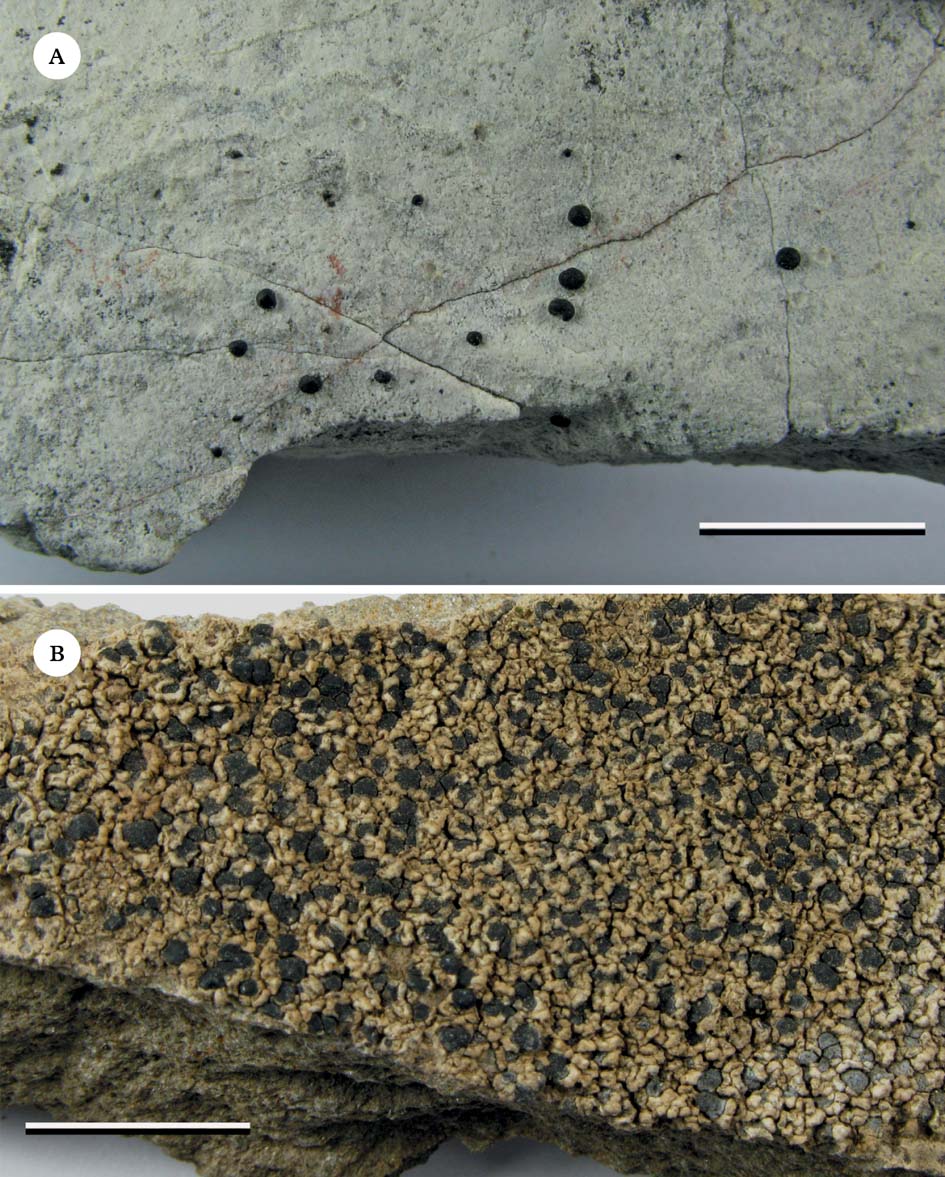
(Fig. 1A)
A, Porpidia shangrila, habit (Hai Ying Wang 20081939); B, Porpidia squamosa, habit (Yuan Da Du 20070991). Scales: A & B=1 cm. In colour online.

Thallus endolithic, growing on chalky white rock, so that it appears to have a white thallus; medulla IKI−. Prothallus absent. Soredia absent. Photobiont green alga (Trebouxia).
Apothecia sparsely dispersed, sessile, round; disc black, epruinose to slightly pruinose, 0·4–1·0 mm diam., convex; margin indistinct, smooth and bare, or sometimes incised. Epihymenium dark bluish green (cinereorufa-green, K−, N+ rose pink). Hymenium hyaline or slightly bluish in thick sections, 80–100 µm high; paraphyses usually indistinct, conglutinate, moderately anastomosed, branched or furcated at the tips; subhymenium brownish, 18–25 µm high. Hypothecium dark brown to black. Exciple bluish black in the marginal part, dark brown in the inner part; excipular hyphae 6–8 µm broad. Ascus Porpidia-type, clavate, 50–70×10–20 µm; ascospores ellipsoid, clearly halonate, 13–15–18×5–7 µm.
Pycnidia not seen.
Chemistry. Spot tests all negative, trace of norstictic acid by TLC.
Etymology. The specific epithet ‘shangrila’ refers to the place where this species has been found: Shangri–La County of Yunnan province.
Ecology and distribution. Growing on whitish calcareous rocks. This species is associated with Staurothele sp. and found in the alpine region of Shika Snow Mountain, Yunnan Province, south-western China, at an altitude of 4300 m. The region is covered with snow for most of the year.
Notes. This species is similar to P. zeoroides (Anzi) Knoph & Hertel, (CANL 50178), as both species occur in alpine zones on calcareous rocks. However, P. shangrila has an endolithic thallus, bluish green epihymenium and containing traces of norstictic acid, whereas P. zeoroides has a white and continuous thallus, olive-brown epihymenium, and contains stictic acid and cryptostictic acid as major compounds. Porpidia superba (Körb.) Hertel & Knoph (CANL 31699), another Chinese species growing on calcareous rocks, should not be confused with this new taxon because it differs by having a contiguous bullate areolate thallus, brown apothecial discs and larger ascospores. The nature of the substratum (i.e. whether calcareous or non-calcareous) is an important character to distinguish Porpidia species in China. So far only two species of this genus (P. shangrila and P. superba) are found growing over calcareous rocks in China.
Additional specimen examined. China: Yunnan Prov.: Shangri–La Co., Mt. Shika, alt. 4300 m, on rock, 2008, Zhao Jie Ren 20083339 (SDNU).
Porpidia squamosa Xin Y. Wang & Lu L. Zhang sp. nov.
MycoBank No.: MB800029
Similis P. cinereoatra, sed thallo squamuloso, epihymenio smaragdino, et substantis absentibus differt.
Typus: China, Qinghai Prov., Menyuan Co., Lenglongling, alt. 3650 m, on rock, 7 August 2007, Yuan Da Du 20070991 (SDNU—holotypus; KUN—isotypus).
(Fig. 1B)
Thallus orange-brown to yellowish brown, closely adnate, epilithic, rimose to areolate when young, subsquamulose at maturity, squamules irregular or crenate, curving upwards or decumbent 0·5–1·2 mm in diam., 0·2–0·5 mm thick; medulla IKI−. Soredia and prothallus absent. Photobiont green algae (Trebouxia).
Apothecia abundant, round, usually growing between the squamules; disc black, flat to slightly convex, sometimes covered with white pruina, 0·4–1·5 mm diam., margin concolorous with disc, clear and smooth, c. 0·1 mm thick. Epihymenium cinereorufa-green (K−, N+ rose pink). Hymenium 75–110 µm high, hyaline to light bluish in thick sections; paraphyses conglutinate, strongly anastomosed, simple or 1–2 times branched in the upper part; subhymenium hyaline, 20–25 µm thick. Hypothecium dark brown. Exciple dark pigmented, dark brown to black, excipular cells broad, 5–9 µm wide. Ascus Porpidia-type, clavate, 40–60×10–18 µm; ascospores ellipsoid, halonate, 13–15–17×5–6 µm.
Pycnidia often present on the thallus, black, c. 0·1 mm diam.; conidia cylindrical, 3–4×0·8–1·0 µm.
Chemistry. No compounds detected by TLC.
Etymology. The specific epithet ‘squamosa’ refers to the subsquamulose morphology of the thallus.
Ecology and distribution. This species is associated with Verrucaria sp. and found in the alpine regions of Qinghai and Xinjiang Provinces, north-western China, at elevations of 3600–4000 m on siliceous rock. Both Qinghai and Xinjiang are semi-arid regions with an annual rainfall of c. 500 mm and 300 mm, respectively.
Notes. This species is similar to P. cinereoatra (Ach.) Hertel & Knoph (CANL 99647, CANL121225) in having a dark exciple, similar spore size and sunken apothecia but differs in having an orange-brown subsquamulose thallus, bluish green epihymenium, lacking secondary metabolites and occurring in an alpine region. Porpidia cinereoatra, on the other hand, has an olive-brown epihymenium, contains confluentic acid and is distributed in oceanic areas (Gowan Reference Gowan1989). Porpidia lowiana Gowan, which has a grey to white thallus, might be confused with this new taxon but it contains confluentic acid as the major compound, has a continuous to areolate thallus, and broadly sessile apothecia. Porpidia flavicunda, which has an orange-yellow thallus and pruinose apothecia, might also be confused but it has a rimose thallus, olive-brown epihymenium and lightly pigmented exciple. Amygdalaria aeolotera (Vain.) Hertel & Brodo is similar to the new species in having a yellow or brownish thallus, but it can be distinguished by having cephalodia, brownish apothecia, a higher hymenium (up to 170 µm) and large ascospores (up to 40 µm).
Additional specimens examined. China: Qinghai Prov.: Menyuan Co. Lenglongling, alt. 3650 m, on rock, 2007, Yuan Da Du 20108474, 20108475 (SDNU). Xinjiang Prov.: Mt. Tianshan Tiemier Feng, alt. 4000 m, on rock, 1977, Xian Ye Wang X022002, X022003 (HMAS).
New Records
Porpidia flavicunda (Ach.) Gowan
This species is characterized by a distinct orange to orange-yellow, continuous and rimose thallus, 0·3–1·0 mm thick; abundant black apothecia with usually lightly pruinose discs 0·5–2·0 mm diam., olive-brown epihymenium, hyaline hymenium, 80–110 µm tall, exciple light brown; and ascospores 13–20(–22)×6–8 µm. Two chemotypes have been detected in Chinese specimens with: 1) no substances, 2) confluentic acid. It might be confused with some orange specimens of P. macrocarpa (DC.) Hertel & A. J. Schwab, but the latter species has a very thin thallus (usually less than 0·5 mm), and the thallus is patchily oxidized orange, often turning grey in the marginal part, and contains stictic acid and some related compounds.
Additional specimens examined. China: Yunnan Prov.: Luquan Co., Mt. Jiaozixueshan, alt. 3800 m, on rock, 2008, Li S. Wang 08-29689 (KUN); Dali Co., Mt. Cangshan, alt. 4000 m, on rock, 2009, Li S. Wang 09-30363 (KUN)). Sichuan Prov.: Wolong Co., alt. 3200 m, on rock, 1996, Li S. Wang 96-16020 (KUN)). Xizang (Tibet) Prov.: Zham Co., alt. 3375 m, on rock, 1966, J. C. Wei X006881 (HMAS).—Canada: British Columbia: Tsuga mertensiana forest and lake shore, 1988, I. M. Brodo 106343 (CANL). Quebec: Parc de la Gaspésie, Mont-Albert, 1971, I.M. Brodo 37634 (CANL).
Porpidia soredizodes (Lamy) J. R. Laundon
This species is characterized by a grey, subcontinuous, 0·2–0·4 mm thick thallus; punctiform soralia (0·2–0·5 mm diam.) with pale green to white soredia; sessile black apothecia, with discs 0·5–1·0 (–1·2) mm diam. and without pruina; brown epihymenium, hyaline hymenium, 80–100 µm tall, dark brown exciple in the margin and light brown inside; ascospores 14–17×5–7 µm; and presence of stictic acid as the main compound. The species is quite similar to P. crustulata (Ach.) Hertel & Knoph. (CANL 107034, 107039), but differs in having soralia. This species can be separated from all the known Chinese species by the presence of soredia.
Additional specimens examined. China: Guizhou Prov.: Kaili Co., Mt. Leigongshan, alt. 700 m, 2010, Dai Feng Jiang 20103220 (SDNU); Mt. Leigongshan, alt. 1217 m, 2009, Qiong Tian 20103036 (SDNU).—Canada: British Columbia: Mt. Moresby, alt. 670 m, 1988, I. M. Brodo 106968 (CANL).
Porpidia thomsonii Gowan
This species is characterized by a rather thin (greenish grey to brownish grey), 0·1–0·2 mm thick, or more often endolithic thallus; numerous, sessile black apothecia without pruina, disc 0·5–1·5 mm diam. with a thick and smooth margin, c. 0·1 mm wide; greenish epihymenium, hyaline hymenium, 80–100 µm tall; dark brown exciple; ascospores 15–22×6–8 µm; and thallus containing traces of stictic acid as main compound. This species might be confused with P. macrocarpa, but differs in having smaller apothecia, greenish epihymenium, smaller spores and an alpine distribution.
Additional specimens examined. China: Sichuan Prov.: Xiangcheng Co., Mt. Daxueshan, alt. 4300 m, 2002, Li S. Wang 02-21412 (KUN). Yunnan Prov.: Deqin Co., Mt. Baima, alt. 4200 m, 2009, Hur CH090457 (KoLRI); Lijiang Co., Mt. Laojunshan, alt. 3800 m, 2009, Hai Ying Wang 20100308-2 (SDNU); Weixi Co., Mt. Biluoxueshan, alt. 3250 m, 1981, Xian Ye Wang X021949 (HMAS).—Canada: British Columbia: Kunghit Island, on forested slopes and exposed terraced summit of ridge, 1971, I. M. Brodo (106971) & W. B. Schofield (CANL); Graham Island, west shore of inlet, 1967, I. M. Brodo (107037), M. J. Shchepanek & W. B. Schofield (CANL); Moresby Island, Mt. Moresby, 1968, I. M. Brodo (106983) & W. B. Schofield (CANL).
The authors thank Professor Jiang Chun Wei (HMAS) and Mr Li Song Wang (KUN) for providing specimens and great help during the study. We also thank the curator of CANL for providing specimens. This work was supported by a grant from Korea National Research Resource Center Program, Korean Forest Service Program through Korea National Arboretum in 2011, and the National Natural Science Foundation of China (No. 31170187, 31070010 and No. 31170023 & KSCX 2-EW-Z-9).