For purple mountain majesties
Above the fruited plain.
—Katharine Lee Bates, “America the Beautiful”. . . the American imagination demands the real thing and, to attain it, must fabricate the absolute fake.
—Umberto Eco, Faith in Fakes: Travels in HyperrealityIssues of mystifications and fakes have increasingly informed contemporary debates about the nature of truth and falsity, art and crime, fiction and identity, cultural values, artistic originality, alternative histories, post-truth, Trumpism, the so-called age of euphemism, and national mythologies. According to one critic, “forgery, like any form of imitation, embodies a creative impulse, and that is reason enough for taking its products seriously” (Barker 27). In Telling It Like It Wasn't: The Counterfactual Imagination in History and Fiction, Catherine Gallagher suggests that counterfactual narrative forms (particularly in national mythmaking) are “meaningful primarily as plausible offshoots of some phase of our world, some version of what it nearly became.” She writes that these alternative realities “deepen our perception of actuality by shadowing and estranging it” and “strip our own [world] of its neutral, inert givenness and open it to our judgment” (15). In this capacity, they should be understood as “real things” and as means of cultural criticism.
In this essay I consider the case of American exceptionalism (a belief in American historical uniqueness and superiority, which entertains and legitimizes various practices of universal rescue, appropriation, and quite often extraterritorial violence) as a wishful ultimate fake, constantly reproduced by the American cultural imagination. In doing so, I explore the secret history of one of the modern world's most influential messianic utopias, tracing its origins to the United States in the 1920s. This utopia was forged and promoted by a group of inventive and mystically inclined Russian émigrés, and it was propagated through the so-called yellow press, the empire of sensationalistic and tawdry journalism led by William Randolph Hearst. The utopia in question is the story of the discovery of an enigmatic isolated land of philosophers and mystics hidden for centuries in the heart of Asia and visited only by a very select group of men. I consider this story as part of, in Ian Tyrrell's words, “the peculiar tale of American Exceptionalism” (11) and try to demonstrate that a contextualized reconstruction of this orientalist myth's origins allows us to explore how (and by whom) American exceptionalism was narrativized and symbolized in the popular imagination from the mid-1920s to the early 1940s.Footnote 1 I also pose the question of the paradoxical relationship between American exceptionalism and American gullibility, which is rooted in wishful thinking on a national scale.
A Hidden Valley
In November 1924, the famous Russian artist and theosophist Nikolai Roerich (1874–1947) returned to the United States after a year in Tibet and Mongolia. He was about to embark on his great missionary work in those countries, once again relying on an enormous sum of money provided by a wealthy benefactor. Newspapers published numerous accounts of his ambitious plans and the sensational discoveries that he discussed in lectures and interviews, including claims that Christ had visited Tibet during his lifetime, that Asia was on the eve of a great spiritual revolution, and that the mission of Western Buddhists to Tibet, led by Roerich, would contribute to the spiritual revival of the entire world.Footnote 2
The Tuesday issue of Hearst's papers on 18 November 1924 presented Roerich's mission as a possible realization of “the strange, mystical prophecy accredited to the late Leo Tolstoy many years ago,” about a Mongolian Slav who would save the world. Echoing this prophecy, Roerich declared that “a new teacher will come from the Mongolian country who will blend all existing religions into one” (“Merger”). On 7 December 1924 The New York American and other Hearst newspapers quoted Roerich's words that the Dalai Lama, as most of his disciples thought, had gone to “Shambalin, the mysterious land which figures so prominently in the Chinese and Hindoo legends.” The papers also reported that in Tibet Roerich visited “the ruins of an old temple, where Lao-Tse studied astrology and where the handwriting of Christ is preserved.” According to Roerich, “Thibet is a land teeming with ancient mysteries” and is waiting to welcome the expected “King of the World”: “People there live more by intuition and telepathy than reading and senses” (“Mystery”).
In the spring of 1925, Roerich left for Asia on his holy mission. In a diary entry dated 6 January 1926, he mentions an article by the Chinese scholar Dr. Lao Tsin (also known as Lao Chin) published in the Shanghai Times in the spring of 1925 (Altai-Himalaya). In this article, this mysterious doctor relates the story of his journey with a Nepalese yogi to Shambhala—a hidden colony of the greatest sages and scholars of the world who reside in the Temple of Life and are engaged in discovering the deepest secrets of life and death. In his book Heart of Asia, Roerich again mentions Lao Chin's article, noting that it is one of the most important proofs for the existence of Shambhala, “the Land of gods” (85).
According to his account, Lao Chin and his companion, while wandering in a desolate mountainous region, discovered a hidden valley protected from severe northern winds and enjoying a much warmer climate than the surrounding territory. There they found the Tower of Shambhala and laboratories that aroused their wonder. They also witnessed great scientific achievements and feats of telepathy conducted over great distances. The Chinese doctor could have told much more about his stay in the valley if it were not for a promise he had given its inhabitants not to reveal all.Footnote 3
In May 1925, Elena Ivanovna Roerich, Roerich's wife and spiritual guide, wrote in her diary about the publication of a part of Lao Chin's article about the land of gods in the Shanghai Times. She mentioned Lao's account several times in her letters to her husband's adepts (102). In 1938, a Russian writer from Harbin named Pavel Severny wrote a story about the venerable Chinese sage and scholar Liao Chin, who narrated a tale about the mysterious Temple of Life hidden in Tibet. One must suppose that Severny had either read the article published in the Shanghai Times or heard about it from Roerich himself (they knew each other, and Severny portrayed Roerich in one his tales). In 1939, Rikhard Rudzitis, the president of the Latvian Theosophical Society, retold the story about Lao Chin in his magnum opus Братство Грааля (Bratstvo Graalia; The Brotherhood of the Grail; 51–53, 65). For some reason, in her letter to Rudzitis, Elena Roerich asked him not to trust Lao Chin's account, since it seemed to be a compilation from other sources, primarily from Franz Hartmann's The Temple of Wisdom (E. Roerich 102).
Lao Chin's article about his stay in Shambhala has been mentioned by many other authors—theosophists and historians alike—but the details of its publication have never been precisely identified. Where and when exactly was it published for the first time—in the English-language newspaper Shanghai Times or the Russian émigré newspaper Шанхайское новое время (Shankhaiskoe novoe vremia; The Shanghai New Times)? Who was its author? What else do we know about him? Can we trust his account?
The search for an answer to these interrelated questions leads us not to Tibet or to China but to the United States. Lao Chin's travelogue was first published on 25 January 1925 (that is, before Roerich's departure for China and Mongolia) in the Sunday supplement of the popular newspaper The New York American (which had a daily circulation of 300,000 [Barbas 83]) and other Hearst newspapers under the title “Strange Secrets of Thibet's Temple of Life: Surprising Facts about This Long-Hidden Colony of Mystics Revealed by Dr. Lao Chin, the Mongolian Explorer Who Finally Found His Way to the Curious Mountain Valley Where They Ponder the Soul's Mysteries.” The article, immediately reprinted by other newspapers of the Hearst syndicate, was accompanied by a number of illustrations depicting
the Entrance to the mysterious “Temple of Life,” in the mountains of Chinese Thibet which Dr. Lao Chin was permitted to visit after promising not to reveal the route he followed to reach there; another entrance of the ancient temple where men of many different races and religions hide themselves away from the rest of the world to try to solve the problems of earth and heaven: the mummified body of a long-dead devotee which the temple's traditions say often behaves in a very miraculous way, and finally, the Yogi from Nepal who secured permission for Dr. Lao Chin to accompany him on a two month journey through the forbidding mountains of Thibet to the “Temple of Life.” (“Strange Secrets”)
There is no doubt that Roerich and his followers borrowed their information about Lao Chin's trip from this article. But who was the author of this sensational travelogue?
Ivan of the American People
The “subtle and wise Chinese philosopher” and explorer Dr. Lao Chin was first mentioned in 1922 by an eccentric Russian expatriate in New York City who went by the name of Ivan Narodny (literally “John of the People”)—an ethnic Estonian with a colorful past (“Amazing Imagery”). Narodny (1869–1953), who was born Jaan Sibul, came to New York from England in February 1906 at the age of thirty-five and two months (as he stated). In the customs declaration he filled out upon his arrival, he indicated that he was Russian, a doctor by profession, and that he lived in Saint Petersburg, was a bachelor, had paid for his own trip to America, had never been in prison, had never been treated in a psychiatric clinic, and did not harbor anarchist beliefs (Stevenson 128).
His answers were provocatively far from the truth. Narodny was not an ethnic Russian (and he made mistakes when writing in Russian). He had not lived in Saint Petersburg. He was descended from peasants. He did not even have any secondary education. He traveled to America on funds collected for him by English and American socialists. He had abandoned his wife and two sons in Estonia. He spent several years in a psychiatric institution, where he had ended up after being arrested for counterfeiting three-ruble notes (he had come to believe that he was the Buddha and needed money for his great mission—the establishment of an Estonian colony in Chile). After his release, he spent some time working for periodicals (he published a radical Estonian newspaper in Berlin), participated in the Narva uprising, and was a delegate for the Narva Social Democrats at the first party conference in Tammerfors in December 1905, where he met Lenin and Stalin. The address for a “Miss E. G. Smith” that he listed on the declaration turns out to be the address of the famous American anarchist Emma Goldman, also an émigré from the Russian Empire (she used the name Smith as an alias). One of Narodny's friends, the young journalist Ernest Poole, would later recall that upon his arrival in New York Narodny introduced himself as “John D. Rockefeller,” the “wealthiest” of the American names he knew (Bridge 174).
Narodny was brought to America by a group of American journalists from the Society of Friends of Russian Freedom, whose goal was to provide financial aid to Russian revolutionaries and offer them aid for antitsarist publications in the West. The journalists’ New York center was the A Club commune in Greenwich Village—the first American home for Narodny (McFarland 122–24). In the first interviews that he gave to his journalist neighbors, Narodny presented himself (or was represented by the journalists, since he spoke English very poorly at the time) as a Russian writer, the leader of Russia's underground republican government (the Russian Liberty Organization), the leader of the Narva and Kronstadt uprisings, the founder of and a general in the so-called people's guard, a champion of sobriety, and a fearless knight of liberty, who had spent four years in solitary confinement, escaped from prison with the help of a beautiful aristocrat and revolutionary, and lost his wife and two children in the holy fight against tsarism (they were killed by Cossacks).Footnote 4 He claimed that he had been confined in the same cells of the Fortress of St. Peter and Paul as Dostoevsky and other prominent Russian authors and that he “saw on the walls writings of these men and copied them in his own blood on his shirt, quoting these alleged sayings in his magazine articles.” He had managed to escape Russia “in the sheepskin coat, in the sheepskin hat and in the stupid face of a Finnish peasant” (FBI case file). The tsarist authorities had offered fifteen thousand rubles for Narodny's head (Narodny also named the astronomical sums of thirty and fifty thousand rubles [Scott 74]).Footnote 5 In America he was going to search out the support of Democrats who sympathized with the cause of liberating Russia and to open clubs for friends of the Russian revolution all over the country (“Russian Agent”).
Articles about Narodny as the ideal Russian revolutionary, as well as a zealous American patriot, came out in a great number of periodicals all over the country. Here is how a journalist from the socialist A Club, Leroy Scott, described this courageous fighter:
A voice low and passionless; sadness lay in the hollows of his thin face like an actual presence; his soft grey eyes gaze afar at visions of Freedom. Sad, dreaming with white strained face, so quiet, so gentle—fifteen thousand roubles on his head, man of hundred disguises, of a dozen of names. (66)
This publication featured an iconographic photograph of the man with the caption “Ivanovitch Narodny. A fine type of the professional Russian revolutionist” (73). In this photograph, Narodny sits in front of an open book, evidently a tragedy in verse (could he perhaps be reading the “self-referential” scene in Pushkin's Boris Godunov with the Pretender's famous monologue?).
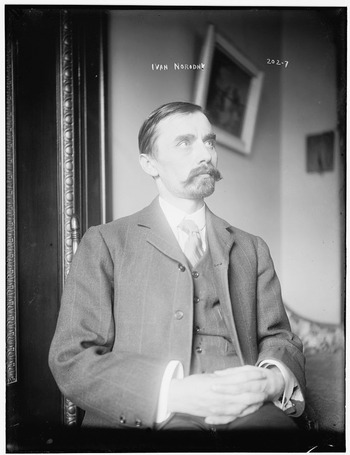
In 1906, Narodny presented himself as the self-appointed head of the Russian revolutionary party in exile.Footnote 6 In 1908 (see fig. 1) he claimed to have deposed the Russian emperor Nicholas II and proclaimed himself the leader of the “United States of Russia.” He also issued bonds on behalf of this fictitious entity. A talented con man and an arms dealer during World War I, Narodny was called “the worst fraud that ever came out of Russia to the United States” by an FBI agent (FBI case file).Footnote 7 In addition to his financial adventures, Narodny was also a prolific playwright, a book and music critic in the 1910s and 1920s, and an art promoter in the first half of the 1920s. It was he who welcomed Maxim Gorky in the United States in 1906 and introduced to the American public the father of Russian futurism, David Burliuk, and other Russian émigré artists. For several years he served as the secretary, promoter, and spiritual teacher of the flamboyant American modernist artist Robert Winthrop Chanler, heir to the Astor family.Footnote 8
Ivan Narodny in 1908. Bain News Service, Library of Congress, www.loc.gov/item/2014681151/.

In an article written by Narodny but published under the name of the journalist Parker Morell in Cosmopolitan in 1939, he recalled that when he, “the Russian philosopher and writer,” came to live with the artist, Chanler “became deeply interested in metaphysics and socialism” (Morell 52):
He immediately separated part of his house into a section which he fancifully named the Gobi, to which he would admit only a select few friends. He covered the walls of this room with fantastic panels which he maintained had mystic significance and exerted a hypnotic effect upon all who beheld them. He fashioned stained-glass windows covered with serpents and monster insects. Oriental vases adorned with skulls were strewn around, and luxuriant rugs, patterned with dragons lay on the floor. Behind a covered niche were dozens of crystal goblets for serving Napoleon brandy, the official drink [of the household]. . . . The Gobi Room was always a place set apart from the rest of the house, and strong locks on the doors kept it inviolate. (52–53)
By the mid-1920s, Narodny had become the leader of the Artel of the Arts, an international colony of New York artists who called themselves “the pilgrims” and contributed to a journal of the same name. He also founded a theosophical “cosmocratic” religion of art that, as he argued, marked the advance of a new age or cycle in the history of mankind associated with the unique transformative mission of the United States.Footnote 9 His major production of this period was a “mimodrama” titled The Skygirl (the action takes place in a Mongolian lamasery and on Mars some fifty thousand years in the future).
In all his incarnations, this Russian “revolutionist,” (con) artist, mystic, writer, and prolific journalist acted as a self-proclaimed national prophet who lauded American “universal responsiveness” (to use Dostoevsky's famous definition of Alexander Pushkin's cultural imagination) and its lofty mission to serve as a model for future mankind on its road to the United States of the Universe. He also presented himself as a “telepathic propagandist” with the ability to foresee and affect future events by the sheer force of his mind. From the 1910s to the 1930s, he created numerous forgeries that he attributed to prominent figures, ranging from Leo Tolstoy (his prophesy of World War I, mentioned in the article on Roerich) to the Finnish composer Jean Sibelius (whose supposed letter to Narodny has uncritically been accepted as real by numerous musicologists studying that composer). Last and for our purposes certainly not least, he was a close associate of Nikolai Roerich and his museum and published a laudatory book about Roerich's mystical art.
Starting as a columnist of Hearst's Sunday American Magazine in the 1910s, Narodny absorbed most of the “distinguished techniques” of the sensationalist press listed by Frank Luther Mott in his classical history of American journalism. His articles (signed in his name or published anonymously) had spectacular headlines that “screamed excitement, often about comparatively unimportant news, thus giving a shrill falsity to the entire make-up.” They were lavishly illustrated by pompous, often meaningless and faked, pictures and photographs and included lies of all kinds—in particular, “faked interviews and stories, misleading heads, pseudo-science, and [a] parade of false learning” (Mott 539).
In his newspaper articles and literary works, Narodny used a number of “personalities” (or, using theosophical vocabulary, “mahatmas”) who reenacted his philosophical and psychical ideas—the “drama of his life,” as he put it (“Drama”). These personalities were not completely invented, but rather created out of real people whom he had met in the past: a heretical monk Father Feodosi (probably a fellow patient in the clinic where Narodny—then Jaan Sibul—was examined during his criminal trial); a psychiatrist Professor Tchish (a noted Russian scientist, it was he who declared Sibul mad and thus saved him from being sent to Siberia); the Russian-Soviet composer Reinhold Gliere; the prominent Uzbek dancer Tani Khanum (presented by Narodny as a princess and religious reformer, by means of dance); and—the most important hero of Narodny's inner play—Dr. Lao Chin, presented as a famous art critic. This mysterious man was an archaeologist purportedly affiliated with the famous Russian scholar and traveler A. K. Kozlov, who discovered the ruins of the ancient city Khara Khoto in the Gobi Desert of Mongolia.Footnote 10 (Narodny may have known about a certain Dr. Lao Shi of Harvard, who would become the founder of the Chinese school of archaeology, and he definitely associated the name of his teacher with the founder of Taoism, Lao Tzu. In the 1910s and 1920s, that name was sometimes spelled Lao-chin.Footnote 11)
A mysterious bearer of secret knowledge, Lao Chin was also Narodny's theosophical instructor. Later, in the 1930s, Narodny would often refer to their communications. Lao Chin, he wrote, visited him in his New York apartment on his way to Washington, DC (to meet with the president, of course), and blessed his new study of “chronosophy,” titled “The Discovery of the Key of Time.” Lao Chin also sent him long prophetic letters from his travels across the Gobi Desert. He supposedly traded Narodny a letter from Kublai Khan in exchange for a Lenin autograph that Narodny owned. In the mid-1930s, Narodny wrote to William Bullitt, the United States ambassador in the Soviet Union, about his plans to go to Mongolia to save the rare collection of art works that belonged to Dr. Lao Chin, who had disappeared in the vast lands of Latin America (Letter). He also “translated” a theosophical book written by Lao Chin (though the manuscript is missing). Narodny's spiritual teacher is also mentioned in a science fiction tale by his friend the longtime editor of The American Weekly Abraham Merritt, “The Last Poet and the Robots” (Fantasy Magazine, April 1934Footnote 12), which portrays a utopian international underground colony in America created by the omnipotent Russian scientist and mystic Narodny and his friend Lao Chin. (The idea of the colony was borrowed from Ferdinand Ossendowski's account of Agarthi—the subterranean kingdom of gods—in part 5 of Beasts, Men, and Gods.)
There is no doubt that the sensational article about Lao Chin's discovery of the land of gods, published in Hearst's Sunday supplement to New York American, was authored from start to finish by Narodny. Among other things, the tale bears obvious stylistic features familiar from his numerous pieces published in this newspaper almost every Sunday. Among the sources of Narodny's vivid imagination were the theosophist Madam Blavatsky's prophecies of an ancient paradise hidden in the Mongolian desert, Hartmann's Rosicrucian myth (whose influence was noted by Elena Roerich, who certainly knew Lao Chin's real identity!), and Ossendowski (a fellow adventurist and forger, although of a higher cultural caliber), alongside other sensational accounts of English and American travelers to Mongolia and Tibet. The theme of a temple—a brotherhood of artists and sages—occupies a central place in Narodny's writings. In one of his artistic manifestos, Narodny wrote that “a new cathedral is being erected in a secret oasis of the desert and that the principal passages of the new temple ceremonies have been composed. All that is lacking is the final combinatory step: the proclamation of the new creed to the world” (“Coming Golden Horde” 795).
Narodny, an active participant in Nikolai Roerich's movement, published that article on the eve of the artist's historic travel to the heart of Asia. Perhaps he served as a kind of ghostwriter for Roerich. But it is also possible that Narodny's article might have had some effect on Roerich's vivid imagination and responded to the tremendous interest American society took in the East. For his part, Narodny might have stylized his mysterious Chinese scholar after Roerich. It is also tempting to suggest that Narodny believed that Dr. Lao Chin was his own theosophical alter ego—the very “Mongolian Slav” of Tolstoy's prophecy, a journalist who would save the world with his mystical (telepathic) writings. In any case, it is not surprising that Roerich referred to Lao Chin's narrative in his travel diary and programmatic works as a major proof of the reality of Shambhala.
Did Narodny ever acknowledge his authorship of the legend? Yes, but only indirectly. In one of his articles and a couple of letters dating from the mid-1930s, he indicated that James Hilton, the British freelance journalist and author of the best-selling novel Lost Horizon (1933), about the happy self-isolated kingdom of Shangri-la, had borrowed the storyline from his anonymous article about the secret colony of sages published in The New York American (“Coming Golden Horde” 798). Narodny also mentioned a story “composed by Dr. Lao Chin” in the bibliography of his works, which he intended to collect and publish in a single volume (“Leida”).
The House of Fantasies
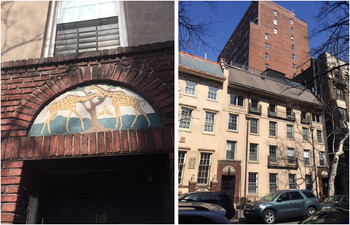
Let us return to the story of the discovery of the Temple of Life. The story speaks to Narodny's vivid tabloid fantasies, his secret megalomania, and the cultural and ideological milieu from which they emerged. Indeed, if we read the utopian story within the context of its author's life and activities in the first half of the 1920s, we notice that the ideal colony of Tibetan sages, comprising representatives of several nationalities (including five Russians), mirrors the life of the inner circle of his fellow American modernist artists—specifically, those who gathered to discuss the secrets of life and death in Chanler's “Gobi Room,” located in his Temple of Art, known to the profane as the House of Fantasy in Gramercy Park, New York City (figs. 2 and 3).
The House of Fantasy, 147 East 19th Street, New York City.

In other words, the mid-1920s Shambhala was to be found not in Tibet but in the small artistic community sponsored by the flamboyant American millionaire in an upscale Manhattan neighborhood near Greenwich Village.Footnote 13 From this perspective, I would call this secret Orientalist utopia an encrypted manifesto of the 1920s multinational New York cultural imagination, characterized by the belief that beauty, produced in this émigré melting pot, would save the rest of the world.
Moreover, it would not be an exaggeration to observe that the fake travel account of Dr. Lao Chin, penned by a self-promoting Russian journalist and theosophist of Estonian descent in the beginning of 1925, not only established the twentieth-century myth of Shambhala (which was then developed by international modernist artists and occultists) but also exemplified a peculiar isolationist version of American messianism, which flourished in the troubled 1930s and morphed into the triumphalism of the 1940s. Hilton's best seller Lost Horizon, about the happy, self-isolated kingdom of Shangri-la, inspired Frank Capra's beloved fantasy film of the same name in 1937. This film conveyed prewar fears and hopes, including a mythological belief that one day a secret force of great scientists and politicians (mostly fugitives from the terrifying outer world) will emerge from its self-imposed solitude and destroy, under American leadership, the immense power of darkness.Footnote 14
Many scholars have argued that Capra (an émigré from Italy) fashioned Shangri-la as a version of the United States of America—a haven in a mad world. In Neil Renwick's words, “[a]s the specter of Fascism and war grew in Europe, Capra's Shangri-la presented a metaphor for an America of liberty, charity and faith” (58).Footnote 15 As John M. Price summarizes in his recent dissertation on exceptionalism and transatlanticism in American literature and classic Hollywood cinema, both America and Shangri-la
must remain a haven, so as to redeem mankind. Just as the High Lama sees Shangri-La as the savior of humanity, so too did Winston Churchill [in the 1940s] wish the United States to one day shed its isolationism and save the Old World. The main difference, of course, between Churchill and the High Lama is that the latter perceives peace as the means for saving civilization, while Churchill sought a militaristic savior. With this in mind, the most fantastical aspect of Shangri-La is the notion that a culture can persevere against violence without the use of force. That makes America a realistic Shangri-La, not pure European romance, but the hybridized form of American Romance, a uniquely Capraesque utopia. (110–11)
Ironically (or symbolically?), this utopian kingdom of peaceful sages, created by the vivid imagination of a Russian émigré in New York in order to promote another Russian émigré's missionary agenda in Tibet, struck back militaristically in the middle of World War II. On 18 April 1942, American bombers embarked on a highly secret operation and attacked the Japanese home islands. When a journalist asked the president about the location from which the bombers launched the attack, Franklin Roosevelt responded “Shangri La.” In fact, “Shangri La” was the name of Roosevelt's presidential retreat located in Catoctin Mountain Park in Frederick County, Maryland (many other retreats were so named in the 1930s and 1940s, from Hilton's home in Essex to hotels and spas all over the world). The retreat, as the White House's official site summarizes, “has offered every president since Franklin D. Roosevelt an opportunity for solitude and tranquility, as well as an ideal place to work and host foreign leaders.” It was renamed Camp David by President Dwight D. Eisenhower after his grandson and “has been used extensively to host foreign dignitaries,” including Prime Minister Winston Churchill in 1943 and the Egyptian president Anwar al-Sadat and the Israeli prime minister Menachem Begin in 1978 (“Camp David”).
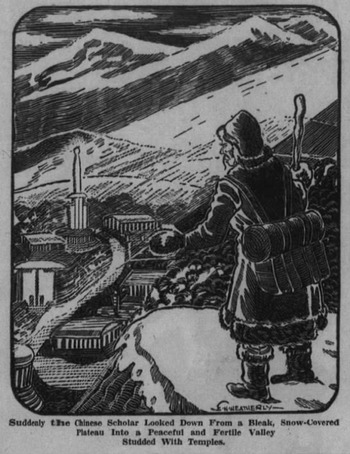
In this symbolic geopolitical context, I conclude the discussion of the odyssey to Narodny's dreamland with an anonymous article titled “Is the Fabulous Valley of Shangri-la More Than a Dream?,” published by Hearst's newspapers on Sunday, 30 August 1942. The author of this piece argued that “[w]hen President Roosevelt jokingly announced that the first American bombers to raid Tokyo took off from Shangri-la,” his reference to Hilton's novel also hinted at the information communicated by Lao Chin, “the famous Mongolian explorer,” who had claimed that “there is a Shangri-la hidden up around Thibet.” “When James Hilton, the British author, wrote ‘Lost Horizon,’” the anonymous author stated, “he wove his story about this supposedly legendary never-never land, and dubbed it Shangri-la. . . . Now, according to Dr. Lao Chin, this legend of the Temple of Thibet is no longer a legend at all—but a reality, a place that he, himself, visited in 1926.” This statement was followed by a lengthy summary of Lao Chin's journey to the temple, published in January 1925, and an illustration of an urban landscape in a “fertile valley,” presented as proof that the victorious American air attack on Japan was launched from the mysterious colony of mystics and scientists in Tibet (fig. 4).
Illustration from “Is the Fabulous Valley of Shangri-la More Than a Dream?,” The American Weekly, 30 Aug. 1942, p. 2, www.newspapers.com/image/523851852.

Looking at this illustration, I cannot get rid of a feeling that, despite never having been to Tibet, I have already seen this urban landscape with an obelisk-like tower, pantheon-like “imposing buildings,” and “a road as wide, smooth and as well built as you will find for motor cars in America.” I would suggest that by the summer of 1942 the fake (the metaphor, the prophecy of Shangri-la) had been realized and materialized into the vision of America the Powerful. Is there any doubt as to who the real author of the article was?
I contend that in the context of American cultural history from the 1920s to the 1940s, the lofty Tibetan myth, born and disseminated in the popular press by émigré authors and adventurists, served as a symbolic expansionist relocation of a foundational concept of American exceptionalism—John Winthrop's “city upon a hill.” This image, with its occult and millenarian resonance, has migrated to places as distant and exotic as the multinational American imagination permits it to go.
In all its weirdness, the tale of Shambhala forces us to rethink the parameters of American exceptionalism as a discourse that legitimizes various practices of benevolent meddling, appropriation, and extraterritorial violence. It presents American exceptionalism not as an abstract concept or policy but rather as a powerful source of the popular (and personal) imagination (a geopolitical muse, if you wish) for various fantasies of the transformative mission of America in the twentieth century. It also shows how closely the concept of American exceptionalism is connected to the phenomenon of American gullibility, which is always in search of the “real thing” (Eco 30) and is doomed to fabricate “the Absolute Fake” as an “offspring of the unhappy awareness of a present without depth” (31), but with a global, hopeful ambition. Last but not least, it is intimately connected to the figure of the Absolute Faker, a poor dreamy little man and a troubled refugee from the Old World, who “saves” the rest of the universe by and in his creatively repetitive American imagination.