Implications
Farming systems can repeatedly expose animals to various aversive events. Our results suggest that long-term exposure to such aversive events occurring unpredictably and uncontrollably increases subsequent emotional reactivity in sheep. Altered fear-related responses could be used as a warning sign of stress in sheep. Although our results were obtained in an experimental situation, the risk of increasing fear reactivity can easily be transposed to the real-world living conditions of farm animals because we used aversive events commonly occurring on farms as our stressors.
Introduction
Concern for animal welfare stems from the recognition that animals are capable of experiencing emotions (Dawkins, Reference Dawkins2006). Farming systems can repeatedly and unpredictably expose animals to aversive events such as social mixing, restraint, transport and delayed food delivery, which can subsequently lead to an accumulation of negative emotional experiences. Measuring emotional reactions is a key to assessing animal welfare state (Mendl et al., Reference Mendl, Burman, Laughlin and Paul2001; Doyle et al., Reference Doyle, Lee, Deiss, Fisher, Hinch and Boissy2011). Emotional reactions of animals can be inferred from acute physiological and behavioural adjustments, such as increased heart rate, elevated blood corticoid levels and specific behaviours in response to potential alarming events. Boissy (Reference Boissy1998) proposed the term ‘fearfulness’ as a temperamental trait characterizing the propensity of an individual to be frightened by a variety of alarming events, and which depends on the individual's own evaluation of the situation.
Numerous studies have investigated the emotional effects of acute alarming events in farm animals, each event being considered separately (for a review Forkman et al., Reference Forkman, Boissy, Meunier-Salauen, Canali and Jones2007), but little is known about the effects of long-term repeated emotional experiences on putative changes in fearfulness (Dantzer and Mormede, Reference Dantzer and Mormede1983; Rushen, Reference Rushen1991). It has been shown in both humans and laboratory animals that repeated negative emotional experiences can compromise immune function (Leonard and Song, Reference Leonard and Song1996; Zager et al., Reference Zager, Andersen, Ruiz, Antunes and Tufik2007) and lead to behavioural changes (for a review, Blanchard et al., Reference Blanchard, McKittrick and Blanchard2001). In addition, in humans, repeated negative emotional experiences known to induce chronic stress can ultimately heighten fearfulness (Glaser et al., Reference Glaser, van Os, Portegijs and Myin-Germeys2006). The effect of negative emotional experiences on animals’ fearfulness should depend on the strategies the animal is able to develop in response to the aversive event. Dantzer and Mormede (Reference Dantzer and Mormede1983) have hypothesized that whereas unavoidable aversive events are known to lead to apathy, aversive events to which animals can respond actively are likely to make them more ready to react to further changes in their environment. A chronic stress state could thus potentially be assessed by measuring the increase in fearfulness in acute challenging situations.
However, repeated exposure to aversive events under experimental conditions does not systematically change reactions to fear-eliciting events (Janssens et al., Reference Janssens, Helmond and Weigant1995; de Jong et al., Reference de Jong, Prelle, van de Burgwal, Lambooij, Korte, Blokhuis and Koolhaas2000; Doyle et al., Reference Doyle, Lee, Deiss, Fisher, Hinch and Boissy2011). Calandreau et al. (Reference Calandreau, Favreau-Peigne, Bertin, Constantin, Arnould, Laurence, Lumineau, Houdelier, Richard-Yris, Boissy and Leterrier2011) and Doyle et al. (Reference Doyle, Lee, Deiss, Fisher, Hinch and Boissy2011) suggest that this lack of change in fearfulness is due to inefficiency of the experimental treatment in significantly inducing a negative emotional experience. Interestingly, Ladewig (Reference Ladewig2000) asserts that unpredictable and uncontrollable exposure to various aversive events should be repeated to induce a chronic stress state.
The aim of our study was to analyse the putative changes in fearfulness in sheep after several weeks of exposure to various unpredictable and uncontrollable aversive events likely to occur in farming conditions (treated group). Their physiological (heart rate and cortisol level) and behavioural reactions towards fear-eliciting events based on novelty, suddenness and human proximity were then compared with those of a control group of sheep kept in standard farming conditions (predictable food, regular exposition to humans and objects). For basal parameters, blood cells were counted and a 24-h time budget was recorded over the treatment period.
We hypothesized that fearfulness of treated sheep would increase, their heart rate and cortisol level following an aversive event would increase (Dwyer and Bornett, Reference Dwyer and Bornett2004) and their total white blood cell count would decrease, as it does in depressed humans (Leonard and Song, Reference Leonard and Song1996; Bellingrath et al., Reference Bellingrath, Rohleder and Kudielka2010).
Material and methods
The experiment was carried out in accordance with the European Communities Council Directive of 24 November 1986 (86/609/EEC) and was approved by a local ethics committee (CE17-08 CEMEA Auvergne, France).
Animals and housing
Forty-eight Romane (Romanov × Berrichon-du-Cher) female lambs (aged 5 months) were housed in four indoor pens, twelve lambs in each. The lambs were fed a daily ration of concentrate in the morning (0830 h) and hay and straw in the afternoon (1600 h). The floor of the pen was bedded with straw and the room was artificially lit from 0730 to 1930 h. Lambs received half of their concentrate before each behavioural test to avoid lack of appetite. The other half of the concentrate was dispensed 30 min after test completion (between 1030 and 1600 h). Feed refusals were weighed daily and the lambs were weighed once a month.
Experimental design
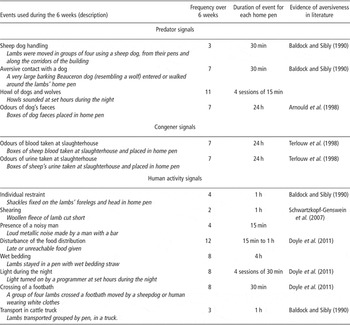
For 6 weeks, lambs in two indoor pens were exposed approximately daily to uncontrollable aversive events regularly encountered in farming systems (treated lambs). Aversive events were imposed as described in Table 1 (description, frequency and duration) and were adapted from the literature listed in Table 1 (evidence of aversiveness). The events fell into three classes known to be biologically significant for sheep: predator, congener and human activity cues (Table 1). Besides being uncontrollable, the aversive events were unpredictable for the lambs, as they occurred at different times of day and (or) night with no forewarning.
Assumed aversive events used during the 6-week treatment of chronic stressful experience

During the 6-week treatment, the treated lambs were poorly kept (unpredictable food distribution and only aversive handling), whereas the control lambs were housed in standard farming conditions (in two other pens):
1. Predictable food distribution: a light announcing the morning food distribution each day (5 min before feeding).
2. Familiarization with the human presence conducted twice weekly for 10 min. A familiar human wearing blue clothes entered the pen, stayed passive and only gave positive tactile contacts to animals that initiated contacts. Durations of habituation to human presence for control animals and handling during aversive events for treated lambs were similar.
3. Random presentation of four familiar objects (balls or plastic tubes or tyres) was introduced twice weekly for 10 min and a wool brush was used once per week for 1 h to increase the stimulating level of their housing conditions.
We decided not to rear the control lambs in a barren environment to avoid inducing a negative emotional state, as poor rearing conditions are stressful for animals (Brydges et al., Reference Brydges, Leach, Nicol, Wright and Bateson2011).
To help animals discriminate people via the colour of their clothing (Rushen et al., Reference Rushen, Taylor and de Passille1999), experimenters wore white clothes for aversive events imposed on treated lambs, grey-striped clothes for leading animals to tests and blue clothes for normal farming handling (habituation and feeding for the control group and feeding for the treated group).
Fear tests
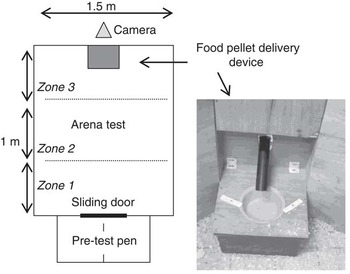
The test area (Figure 1) close to the home pens (on average 20 metres) consisted of a pre-test pen (waiting pen, 1.5 m2) and a test arena (4.5 m2) with full wooden walls (height 1.5 m). A sliding door enabled movement from one pen to another. The test arena contained a bucket at the end opposite the entrance filled with food pellets (25 g of concentrate and barley). The lambs underwent a habituation procedure lasting 1 week. For two days, lambs of the same home pen were allowed to explore the test arena freely in pairs for 180 s, with concentrate and barley offered ad libitum in the bucket. For the next 5 days, each lamb was led individually to the test arena once a day and stayed 75 s. Lambs that ate during the last 2 days of habituation were tested on two successive already-standardized fear-eliciting tests: novelty and suddenness (Désiré et al., Reference Désiré, Veissier, Despres and Boissy2004). Each lamb was tested twice in each test situation, that is, before and after the 6-week treatment period. The lambs were always moved to the test arena by a familiar human wearing grey-striped clothes.
Testing area of novelty and suddenness tests.

After they had undergone both tests, the lambs were exposed per group to a human test in their home pen to test their fear reactions.
Novelty test
The lamb entered the test arena where a novel white and orange traffic cone (height 50 cm) was placed 20 cm in front of the filled bucket. The test lasted 75 s.
Suddenness test
A blue and white plastic panel was held 1 m above the bucket behind a wooden board (hidden raised position). An automatic device caused a sudden vertical movement of the panel (at a speed of about 2 m/s) from the hidden up position to a visible lowered position just behind the bucket. This automatic device was triggered 5 s after the lamb began to eat in the bucket. The test lasted 75 s.
Human test
For each home pen, a familiar human in blue clothes quietly entered the home pen and sat at the end opposite the entrance. A direct 30-s scan sampling method was used to evaluate the position of lambs and count the number of contacts (sniffing or nibbling the observer) for 10 min. Two zones (Z) were established: Z1 1 m around the familiar human and Z2 for the rest of the pen. To facilitate the observations, the lambs were individually marked on the back. We hypothesized that long-term exposure to supposed aversive events would modify fear of humans. For example, repeated aversive handling treatments in pigs can lead to an increase in fear of humans as indicated by their approach behaviour (Hemsworth et al., Reference Hemsworth, Barnett and Hansen1987).
Equipment and measures
During individual fear tests
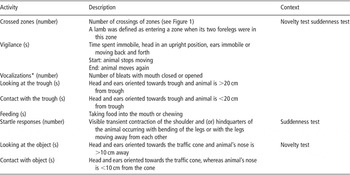
Following an aversive event, heart rate is a possible indicator of emotional response in domestic sheep (Palestrini et al., Reference Palestrini, Ferrante, Mattiello, Canali and Carenzi1998; Désiré et al., Reference Désiré, Veissier, Despres and Boissy2004). During the novelty and suddenness tests, we recorded cardiac activity for a 75-s period using a Polar Vantage NV system (Polar, Anglet, France). The heart rate monitor was placed directly before the test in the pre-test pen. The system consisted of two electrodes, an emitter and a watch-like receiver fixed to an elastic belt strapped around the animal's thorax. The heart rate data file created on the emitter was downloaded onto a computer for analysis. Three days before the test the lambs went through a habituation procedure in their home pen where they were caught and strapped with an elastic belt around the thorax, which was left in place for 1 h. Animal behaviour was also recorded using cameras (Sony, Tokyo, Japan) overlooking the test pens and connected to a video recorder (Sony SVT-96LP, Sony Corporation, Tokyo Japan). The videotapes were later analysed on The Observer software (Noldus, Wageningen, The Netherlands) using several behavioural patterns by the same observer (percentage of agreements: 96.8%; Table 2).
Description of observed activities during fear tests

*Noted manually.
In the home pen
After the treatment period, 14 animals (7 control and 7 treated) were randomly selected and their cardiac activity was recorded during two phases: (i) presence of a familiar human wearing blue clothes (0930 to 0945 h) and (ii) just after the familiar human left and with no other human activity (0945 to 1030 h). Cardiac activity was recorded as described above. Lambs were not pre-tested before the treatment period owing to technical constraints. The time budget was twice studied from a 24-h interval of observation, before the beginning and after the end of the treatment period, with the same apparatus as described above. The 24-h videos, running from the concentrate feed at 0800 h to the next concentrate feed the day after, were analysed by scan sampling every 10 min using the following ethogram: lying, standing, feeding (taking food into the mouth, chewing food, searching for food or drinking) and moving.
Assays
Blood samples from each lamb (5 ml, anticoagulant: EDTA (ethylenediaminetetraacetic acid)) were collected twice from the jugular vein, before and after the treatment period (0900 h), to determine cortisol level 10 min after a group confinement (an event known to be aversive) and blood parameters. Other blood samples were collected for cortisol level 20 min after each fear test (between 0930 and 1600 h).
Blood cell count and plasma cortisol levels
Blood cell count was performed using an electronic cell counter (Scil Vet abc, Scil Animal Care Company, Viernheim, Germany). To determine levels of cortisol, blood samples were centrifuged at 3000 g for 10 min at 4°C and plasma samples were stored at −20°C until assay. Plasma cortisol levels were determined by a radioimmunoassay method (Boissy and Bouissou, Reference Boissy and Bouissou1994) using an antibody produced by Cognié and Poulin (INRA, Tours, France).
Adrenocorticotropic hormone (ACTH) challenge
Lambs underwent an ACTH challenge after treatment, based on a previously validated method (Veissier et al., Reference Veissier, Boissy, dePassille, Rushen, van Reenen, Roussel, Andnason and Pradel2001), to assess the capacity of the adrenal cortex to produce cortisol. A first blood sample was collected in the afternoon (1700 h), and dexamethasone (20 μg/kg BW; Dexalone, COOPHAVET, Ancenis, France) was injected intramuscularly to obtain the lowest blood cortisol level before the ACTH challenge. On the following morning, ACTH (0.7 IU/kg; Synacthène ND Novartis-Pharma, Rueil-Malmaison, France) was injected intravenously. Blood samples were taken just before ACTH injection, and 30, 120 and 180 min after ACTH injection, via jugular venepuncture. Blood samples were immediately centrifuged, and plasma stored at −20°C. Plasma cortisol was measured as described above.
Statistical analysis
Data were analysed using SAS software (version sas9x, SASTM Institute, Cary, NC, USA). Cardiac activity (i.e. heart rate in beats per minute), behaviour in tests, cortisol levels and blood cell count data met the requirements for parametric tests in either untransformed or transformed state. Treatment effect was analysed by ANOVA. Values are expressed as means ± s.e.m. (estimated by the model). After treatment, for the human test, the sum of lambs’ numbers from each scan in zone Z1 (1 m around the observer) was analysed using χ 2- tests. The limit of significance was set at P = 0.05.
Results
Before treatment
Before treatment, no significant difference was observed in any of the physiological or behavioural parameters between the two animal groups.
After treatment
Fear tests
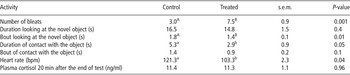
Novelty test (Table 3): Treated lambs vocalized more than controls. Treated and control lambs spent the same total time looking at the novel object (15.7 ± 1.5 s), but each look towards the novel object was shorter in treated lambs than controls. Treated lambs spent less time than controls making contacts with the novel object. There was no significant difference between the two groups in crossed zones (P = 0.6). Heart rates were lower in the treated lambs than in the controls. Plasma cortisol concentrations of treated and control groups were not significantly different.
Behaviours and physiological parameters (means ± s.e.m.) of treated (n = 23) and control animals (n = 24) during novelty test after 6 weeks of treatment (bout = duration/frequency)

a,bP < 0.05; A,BP < 0.01.
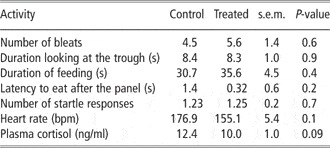
Suddenness test: No significant difference between treated and control lambs was found in any of the behavioural or physiological reactions (Table 4). Plasma cortisol concentrations tended to be lower in the treated group than in the controls (P = 0.09). The panel was activated around 13 s after the beginning of the test. Following this activation, all the animals exhibited a startle response and took around 0.9 s to resume eating. During the test, the lambs vocalized around five bleats, had an average heart rate of 166 bpm, and spent around 33 s feeding and 8 s looking at the trough.
Behaviours and physiological parameters (means ± s.e.m.) of treated (n = 23) and control animals (n = 24) during suddenness test after 6 weeks of treatment

Human test: The treated lambs made fewer contacts with the human than did controls (0.9 ± 0.3 v. 3.2 ± 0.3, F = 53.3, P < 0.001), and the controls moved closer to the human than treated lambs (67% v. 36% of animals in Z1, P < 0.0001).
Measures in home pen conditions during the treatment period
Time budget and weight
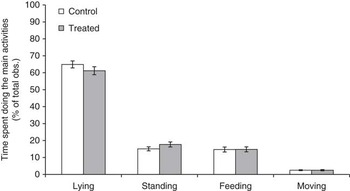
Over a 24-h interval, the proportions of lambs lying, standing, feeding and moving in the two groups (Figure 2) were not significantly different. Treated and control animals showed the same feeding behaviour, achieved the same feed intake and had the same weight levels (50.6 ± 0.4 kg).
Time spent doing the main activities (% of total observations) during time budget (24 h) for control and treated groups (n=48) after treatment.

Cortisol in response to confinement
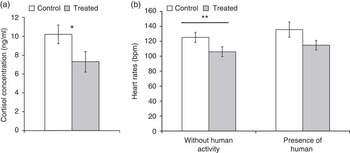
Treated lambs had lower cortisol level than controls (F = 3.9, P = 0.05), that is, 7.3 ± 1.1 ng/ml v. 10.2 ± 1.1 ng/ml for treated v. control lambs, respectively (Figure 3a).
Physiological measures of control and treated groups after treatment. (a) Average of basal cortisol concentrations (n=48, *P < 0.05). (b) Average of heart rates recorded during 45 min in period without human activity and 15 min in presence of human of control and treated lambs (n=14, **P < 0.0001).

ACTH challenge
Plasma cortisol concentrations of treated lambs were 12.9 ± 2.0 ng/ml the day before ACTH challenge, 0.2 ± 0.05 ng/ml on the day of the challenge just before the ACTH injection, 41.3 ± 1.8 ng/ml 30 min after ACTH injection, 9.3 ± 1.3 ng/ml at 120 min post injection and 2.7 ± 0.2 ng/ml at 180 min post injection. Plasma cortisol concentrations of control lambs at the same time points were 9.8 ± 2.0, 0.1 ± 0.05, 38.1 ± 1.8, 11.0 ± 1.3 and 3.0 ± 0.2 ng/ml, respectively. There was a significant effect of time (F = 284, P < 0.0001), but cross-comparison of these results indicated no significant treatment × time interactions (F = 1.4, P = 0.2) or effect of treatment per se (F = 0.7, P = 0.4).
Cardiac activity (Figure 3b)
In the presence of the familiar human (phase 1), heart rate tended to be lower in treated lambs than in controls (F = 3.55, P = 0.08). During phase 2, just after the familiar human left and with no other human activity, heart rate was significantly lower in treated lambs than in controls (F = 16.6, P < 0.0001).
Blood cell count (Table 5)
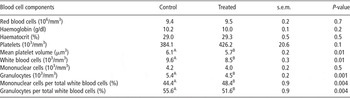
White blood cells, particularly granulocytes, were significantly fewer in treated lambs than in controls (F > 7.2, P < 0.01). The ratio of different white blood cell types (mononuclear leukocytes and granulocytes) to total white blood cells was significantly different between groups (F > 9.4, P = 0.004), with a lower granulocyte population in treated lambs. Mean platelet volume was lower in treated lambs than in controls (F = 7.1, P = 0.01).
Blood analysis of lambs 6 weeks after treatment (means ± s.e.m.)

a,bP < 0.05; A,BP < 0.01.
Discussion
After exposure to various unpredictable and uncontrollable aversive events over 6 consecutive weeks, lambs increased their reactions to alarming events such as the presence of novel object and the proximity with a familiar human, revealing an increased emotional arousal by these stimuli compared with control lambs.
In response to the novel object, treated lambs were more disturbed than controls (they vocalized more, spent less time making contact with the novel object and their bouts looking at the novel object were longer). Vocalizations are known to express negative feelings towards social isolation in farm animals (Manteuffel et al., Reference Manteuffel, Puppe and Schön2004). Many studies (Erhard et al., Reference Erhard, Mendl and Christiansen1999; Dalmau et al., Reference Dalmau, Fabrega and Velarde2009) have assumed that active avoidance of novel objects is an indicator of fear. Owing to the unpredictable part of the treatment, a novel object introduced in a usual environment may be seen as predicting a potential aversive event. Similarly, Hemsworth et al. (Reference Hemsworth, Barnett and Hansen1987) showed that pigs subjected to an unpredictable treatment (randomly applied unpleasant and pleasant handlings) generalized all handlings to aversive handlings. Thus, long-term exposure to uncontrollable common aversive events occurring unpredictably increases neophobia in lambs.
The control lambs had been exposed to the introduction of few objects in their home pen, and therefore such additional experiences may have reduced neophobia in control lambs. However, over the 6 weeks of treatment, the effective exposure to additional objects represented a total duration of only 480 min (10 min twice weekly and 1 h once a week). This duration was very short compared with the long duration of exposure to objects added to really enrich the environment, necessary to induce behavioural effects in rats (Brydges et al., Reference Brydges, Leach, Nicol, Wright and Bateson2011) or pigs (for a review van de Weerd and Day, Reference van de Weerd and Day2009). The environmental enrichment in these studies was permanent.
Our treated lambs made less contact with the motionless familiar person wearing blue clothes and remained farther away from him than did control lambs. According to Estep and Hetts (Reference Estep and Hetts1992), human–animal relationships are based on the history of interactions between two individuals. Throughout our experiments, humans wore white clothes for aversive events (only for the treated group) and blue clothes for normal farming handling (habituation and feeding for the control group and feeding for the treated group). Hence, despite the association of feeding (a positive event) with a human in blue, aversive experiences in the presence of a human in white seemed to have damaged the human–animal relationships in the treated group. Three explanatory hypotheses can be suggested:
(i) The human wearing blue clothes was seated during the test, instead of standing, the posture usually taken during feed distribution. The sitting posture of the human may have been perceived as new by the lambs. This novel situation may have been more stressful for treated lambs, as we found them more reactive to novelty.
(ii) The lambs did not take clothing colour into account despite their known ability to discriminate colours (Alexander and Stevens, Reference Alexander and Stevens1979), but did recognize the human, as the experimenter present during the test was one of their familiar handlers. Boivin et al. (Reference Boivin, Garel, Mante and Le Neindre1998)showed that beef calves were able to discriminate a familiar stockperson even when this person changed his/her clothes. It thus seems that treated lambs may not have taken into account the difference between the ‘aversive handler’ in white and the ‘gentle handler’ in blue because they were able to recognize the human responsible for both aversive and positive events during the treatment period. In this case, inability to discern the intention of the human according to the colour of their clothes could have placed the treated lambs in an ambiguous situation. Some recent papers in farm animals report the negative perception of animals in response to probe events under chronic stress (Doyle et al., Reference Doyle, Lee, Deiss, Fisher, Hinch and Boissy2011).
(iii) The lambs generalized their negative experience with the white human to all humans. Long-term exposure to unpredictable and uncontrollable aversive events increased lambs’ fearfulness of human delivering positive actions (in blue clothes here) and damaged the human–animal relationships. Confirming a number of experiments (for a review Rushen et al., Reference Rushen, Taylor and de Passille1999), treated animals may tend to generalize aversive experiences with one handler to all people.
To test these three hypotheses, complementary tests on reactivity to humans could be performed with an unfamiliar human and a familiar human wearing differently coloured clothes (here: white, blue and a new colour).
Unlike treated lambs, control animals may have developed a positive perception of the human wearing blue clothes. In addition, tactile stimulations could increase the control group's motivation to interact with humans (Hemsworth et al., Reference Hemsworth, Barnett and Hansen1987; Boivin et al., Reference Boivin, Garel, Mante and Le Neindre1998). Gentling sheep reduces fear of humans, but it seems that this effect may not be generalizable to other fear situations (Dwyer and Bornett, Reference Dwyer and Bornett2004).
During the suddenness test, all the lambs stopped eating and showed a startle response in reaction to the sudden event, with no difference between treated and control animals. This lack of difference may be due to a ceiling effect, because all the lambs exhibited very strong responses to the sudden vertical movement of the panel. This hypothesis was also suggested by Boissy et al. (Reference Boissy, Veissier and Roussel2001) for chronically stressed calves that reacted like control calves during a suddenness test (involving a suddenly opened umbrella). In addition, according to the appraisal theories of cognitive psychology to assess emotions (Scherer, Reference Scherer1999), the evaluation of suddenness is the most automatic evaluative process. It can be argued that suddenness caused specific reflex responses, making it difficult to discriminate the variation in sentience and decision making between individuals.
Our treatment may have lastingly but only partly altered the lambs’ fearfulness by negatively modifying their own perception of their environment, as differences in reactions to novelty and the human were found, even though lambs were not exposed to an alarming event just before being tested. This long-lasting change could have led to the development of a negative affective state, as is the case with chronic stress. However, more evidence is needed to confirm that lambs subjected to this long-term exposure to unpredictable and uncontrollable aversive events were experiencing chronic stress. Most physiological measures performed as biomarkers of chronic stress (cardiac activity, immune system, corticosteroids) did not differ between lambs, or were discrepant with the hypothesis. Acute stress in animals is often associated with higher cardiac activity and higher cortisol levels (for reviews Korte, Reference Korte2001; von Borell et al., Reference von Borell, Langbein, Després, Hansen, Leterrier, Marchant-Forde, Marchant-Forde, Minero, Mohr, Prunier, Valance and Veissier2007), whereas under chronic stress variation in these parameters is not always consistent (Rushen, Reference Rushen1991). Baseline plasma cortisol levels increased in long-term tethered pigs (Janssens et al., Reference Janssens, Helmond and Weigant1995), whereas no change was reported in some other experiments also developing chronic stress (Veissier et al., Reference Veissier, Boissy, dePassille, Rushen, van Reenen, Roussel, Andnason and Pradel2001; Doyle et al., Reference Doyle, Lee, Deiss, Fisher, Hinch and Boissy2011), and even a decrease in basal cortisol concentrations has sometimes been reported (de Jong et al., Reference de Jong, Prelle, van de Burgwal, Lambooij, Korte, Blokhuis and Koolhaas2000; Cyr and Romero, Reference Cyr and Romero2007). The physiological stress-related response seems to depend on time of day of the application, type of aversive event (i.e. physical or psychological challenge) and mainly whether the animal is able to develop a coping strategy. For example, a social instability challenge induced a higher sensitivity of the adrenal glands following an ACTH injection (Dantzer et al., Reference Dantzer, Mormede, Bluthe and Soissons1983; Veissier et al., Reference Veissier, Boissy, dePassille, Rushen, van Reenen, Roussel, Andnason and Pradel2001), whereas tethering induced apathy and a lower sensitivity of adrenal glands (Broom, Reference Broom1987; Ladewig and Smidt, Reference Ladewig and Smidt1989). Here, exposure to various unpredictable and uncontrollable aversive events tended to decrease cortisol levels in response to negative events (suddenness and confinement), but had no effect on ACTH challenge or on time budget. Physiological differences between treated and control groups were few, and a bias due to the pulsatile nature of cortisol release could be induced. Multiple blood sampling would enable us to determine the effect of treatment on the hypothalamic–pituitary–adrenal axis more exactly.
In addition, in experimental situations (novelty and with no human activity), treated lambs had a significantly lower heart rate than controls. This may appear somewhat surprising, but a few studies in humans (Lucini et al., Reference Lucini, Di Fede, Parati and Pagani2005) do report that chronically stressed individuals can also show a decrease in cardiac activity. During the heart rate recordings in home pens, the phase with no human activity could correspond to a baseline cardiac activity measure. However, interpretation of heart rate in our study is very difficult because heart rate is known to be influenced by motor activity, but no behavioural measurement was made to take into account a putative difference in behavioural activity. It would have been interesting to analyse the variation in cardiac activity during fear tests from this basal activity. Owing to a lack of data (cardiac activity in home pens was recorded only on seven animals per treatment), we were not able to carry out this analysis. In addition, although the number of crossed zones during the novelty test did not differ between the two groups, a more specific analysis of the locomotor activity could have explained the differences in cardiac activity.
White blood cells, and particularly granulocytes, were significantly fewer in treated lambs than in controls. This same pattern has been observed in humans, total white blood cells (leukocytes) decreasing in depressed patients (Leonard and Song, Reference Leonard and Song1996; Bellingrath et al., Reference Bellingrath, Rohleder and Kudielka2010). In addition, chronic stress in rats led to a decrease in total leukocyte and lymphocyte counts (Zager et al., Reference Zager, Andersen, Ruiz, Antunes and Tufik2007). These results therefore suggest that our long-term exposure to unpredictable aversive events may induce a chronic stress state in lambs, characterized among other things by a low granulocyte count.
Conclusion
To conclude, long-term negative experience based on repeated exposure to various unpredictable and uncontrollable aversive events increased lambs’ fear of humans and of novelty. The fact that some physiological markers of stress were also altered in treated lambs suggests the stressfulness of the treatment. Our findings suggest that the mechanism underlying a long-lasting negative affective state may be the accumulation of negative emotions. Measuring altered fearfulness may be used as a simple indicator of chronic stress in farm animals, but further work is still required to gain a fuller understanding of unexpected effects on physiological arousal.
Acknowledgements
The authors thank D. Chassaignes of the experimental farm for animal care and help in data collection. They are also grateful to H. Chandèze, C. Ravel, E. Delval, C. Mallet and S. Andanson for their help with data collection and analysis. This study was supported by the French National Research Agency (grant ANR-09-BLAN-0339-01) and the Région Auvergne.