INTRODUCTION
The recent explosion in the diversity and availability of molecular techniques for investigating population genetic structure has opened a world of possibilities to parasitologists interested in the geographic and host distribution of their study organisms. These tools have enabled students of free-living taxa to answer long-standing questions on how ancient events have shaped current distributions (Riddle et al. Reference Riddle, Dawson, Hadly, Hafner, Hickerson, Mantooth and Yoder2008; Thomson et al. Reference Thomson, Wang and Johnson2010). Inevitably, however, studies of genetic diversity across populations have revealed cryptic species that complicate definitions of geographic distribution. Thus, phylogeography quickly moves beyond describing current distributions, towards understanding them. Integrated into studies of community ecology, biodiversity, behaviour and micro-evolution, molecular data on genetic relationships within and between populations promise to greatly advance our understanding of a wide range of ecological and evolutionary processes (Kholodova, Reference Kholodova2009; Thomson et al. Reference Thomson, Wang and Johnson2010), including parasite epidemiology (Lymbery and Thompson, Reference Lymbery and Thompson2012). Among microparasites, for instance, rapid mutation rate and horizontal spread leave a molecular signature that can help track epidemiological patterns in time and space, and guide control efforts (Lam et al. Reference Lam, Hon and Tang2010). Such approaches are gaining increasing traction in studies of macroparasites, for example to trace the source of invasive parasites and to guide control strategies accordingly (e.g. Hansen et al. Reference Hansen, Bakke and Bachmann2007a).
The phylogeography and distribution of any species are influenced by both abiotic and biotic relationships with the environment. Extrinsic influences (e.g. geological events, distribution of food and climate, weather and predation) interact with a species' intrinsic characters (such as behavioural flexibility, food web specificity and vagility) and the combination of influences limits the range of a particular species. For parasites, these influences are magnified because these characters simultaneously influence both parasite and host, often in unpredictable ways though it is reasonable to assume some congruence in phylogeographic patterns (Criscione et al. Reference Criscione, Poulin and Blouin2005). Endoparasites may be more susceptible than ectoparasites to host influences since they often have lower intrinsic dispersal capacity; however, in species with multiple hosts during different life stages, distribution is likely limited by the most limited host. An added complication is that most parasites are small and not well characterized leading to an expectedly large underestimate of taxonomic diversity among them. In this capacity, ‘distribution’ among parasites may be considered in two ways. First, the geographic distribution of a parasite may vary based on its own interactions with the environment or through limitations experienced by any one of its hosts. Second, the distribution may be limited by the taxonomic diversity of its host-parasite relationships. We thus differentiate between geographic distribution and taxonomic distribution (i.e. the range of host species used) in this review.
The strong influence of host distribution and biology on parasite populations complicates the application of molecular phylogeography within parasitology. Thus, for example, attempts to superimpose parasite population genetic structure on that of their hosts have in some cases produced a close match (Criscione, Reference Criscione2008; Toon and Hughes, Reference Toon and Hughes2008; Bruyndonckx et al. Reference Bruyndonckx, Dubey, Ruedi and Christie2009a), but in others find discordance (Criscione et al. Reference Criscione, Poulin and Blouin2005; Nieberding et al. Reference Nieberding, Durette-Desset, Vanderpoorten, Casanova, Ribas, Deffontaine, Feliu, Morand, Libois and Michaux2008; Toon and Hughes, Reference Toon and Hughes2008). This could be due to, inter alia, host switching in evolutionary history or in more recent biological invasions, while different rates of evolution between hosts and parasites can make it difficult to synchronise observed molecular changes in time. These factors can hide or, potentially, generate spurious population genetic structure (Zachos, Reference Zachos2009; Criscione et al. Reference Criscione, Vilas, Paniagua and Blouin2011). It is not surprising, therefore, that much recent work in this field has focused on model organisms and case studies to pick apart the factors that generate genetic structure in parasite populations, and how these affect inference from studies of genotype distribution (e.g. Waltari et al. Reference Waltari, Hoberg, Lessa and Cook2007; Whiteman et al. Reference Whiteman, Kimball and Parker2007; Stefka et al. Reference Stefka, Hypsa and Scholz2009, Reference Stefka, Hoeck, Keller and Smith2011; Westram et al. Reference Westram, Baumgartner, Keller and Jokela2011). The remaining uncertainties, some fundamental, act as caveats to such studies in non-model organisms and could deter the application of molecular techniques to the epidemiology of parasites of socio-economic importance. In particular, prospecting for cryptic diversity in previously clearly defined morphotypes almost inevitably reveals hitherto unrecognised complexity, whose meaning is not always clear (De Leon and Nadler, Reference De Leon and Nadler2010; Detwiler et al. Reference Detwiler, Bos and Minchella2010; Nadler and De Leon, Reference Nadler and De Leon2011; Poulin, Reference Poulin2011), and which can therefore cloud rather than clarify existing understanding of the key biological questions. Recent parasite invasions (in geographic and host range) are superimposed on historic evolutionary events, confounding inference of population history from cross-sectional molecular data. Rapid and global, human-assisted movement of hosts makes this problem especially acute among parasites of socio-economic importance, yet it is in these parasites that the application of molecular phylogeography to the disease problems arising from global change is potentially most rewarding.
In this review we use a series of case studies first to illustrate the general difficulties of understanding patterns of parasite distribution in the light of new molecular evidence, and then to show how such understanding is worth pursuing in applied parasitology. We focus especially on how improved knowledge of parasite distribution at the sub-morphotype level, and better understanding of the biological factors that drive it, can enhance our ability to control parasites in an age of rapid global change. General issues arising from these cases are used to highlight areas that need further attention if molecular phylogeography is to become more fully integrated into the general armoury of parasitologists.
HIDDEN GENETIC DIVERSITY AND STRUCTURE IN PARASITE AND PARASITOID POPULATIONS
The use of molecular methods for the discovery of previously unrecognized species affects all scales of life, e.g. the discovery of Loxodonta cyclotis, the forest elephant (Roca et al. Reference Roca, Georgiadis, Pecon-Slattery and O'Brien2001), but it is particularly revealing among little known small organisms with few taxonomic characters that have not been closely investigated (Witt et al. Reference Witt, Threloff and Hebert2006). One solution to the rapid identification of these highly complex taxonomic groups is the use of molecular assays for species identification. By far the largest of these campaigns is the barcode of life methodology (Hebert et al. Reference Hebert, Cywinska, Ball and deWaard2003) which advocates the use of a common molecular marker for the identification of all animal life. This method has been used widely and quite successfully across Eukaryotes and approximately 1.6 million “DNA barcodes” now exist representing nearly 160 K species (Barcode of Life Data System, www.barcodinglife.org June 2012). Beyond the identification of species from any trace material irrespective of taxonomic characters, DNA barcoding is frequently used as a primary hypothesis generator for establishing potential patterns of cryptic speciation (e.g. Hebert et al. Reference Hebert, Penton, Burns, Janzen and Hallwachs2004).
Several hypotheses with clear predictions can be articulated about the specificity of parasites and their hosts and this relationship may influence both taxonomic and geographic distribution. Increased host-parasite specificity may lead to phylogenetic tracking, whereby the parasite co-diversifies with its host, either radiating into new taxa (speciation) or forming isolated populations, each with a discrete phylogeographic distribution which mirrors that of their hosts. However, this effect can be mediated by vagility of the parasite as well as its life cycle. As the capacity for movement increases, or when some portion of the parasite's life cycle is not closely tied to the main host, the chance of co-diversification likely decreases. For example, generalist facultative blowflies and the bot flies, which are highly-host-specific obligate parasites of mammals, show somewhat different patterns of molecular evolution, with increased evolutionary/phylogenetic divergence in the bot flies and somewhat reduced levels of sequence divergence in the Calliphoridae (Otranto and Stevens, Reference Otranto and Stevens2002; Stevens and Wallman, Reference Stevens and Wallman2006). There is also some evidence of this phenomenon from other host-parasite systems, including Hymenoptera (Dowton and Austin, Reference Dowton and Austin1995) and parasitic plants (Nickrent and Starr, Reference Nickrent and Starr1994).
Cryptic co-speciation in tachinid flies
Tachinid larvae are endoparasitoids of other insects which grow in and consume their host in the larval or pupal stage. To elucidate the biology of host-parasitoid relationships, Smith et al. (Reference Smith, Woodley, Janzen, Hallwachs and Hebert2006, Reference Smith, Wood, Janzen, Hallwachs and Hebert2007) applied DNA barcoding techniques to the Neotropical genus Belvosia (Smith et al. Reference Smith, Woodley, Janzen, Hallwachs and Hebert2006) and then to a variety of tachinid parasitoids (Smith et al. Reference Smith, Wood, Janzen, Hallwachs and Hebert2007) from Guanacaste Costa Rica, which had been reared from their caterpillar hosts.
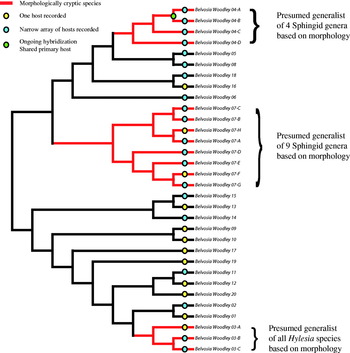
In the case of Belvosia, Smith et al. (Reference Smith, Woodley, Janzen, Hallwachs and Hebert2006) identified all individuals morphologically as representing 20 different species of which three were classified as taxonomic generalists parasitizing a wide diversity of available host caterpillar species (Smith et al. Reference Smith, Woodley, Janzen, Hallwachs and Hebert2006). When molecular variation measured by DNA barcode was considered, all 20 morpho-species were readily identifiable as discrete barcode clusters in a neighbour-joining (NJ) tree but the three ‘taxonomic generalists’ were found to contain 3, 4 and 8 distinct lineages respectively, each of which used a different narrow array of host caterpillar species, with one pair sharing a host (Smith et al. Reference Smith, Woodley, Janzen, Hallwachs and Hebert2006). Rather than three generalists, Smith et al. (Reference Smith, Woodley, Janzen, Hallwachs and Hebert2006) suggest that these are 15 cryptic species of taxonomic specialists (Fig. 1).
A neighbour joining (NJ) reconstruction of the parasitoid Belvosia (Tachinidae) complex in Costa Rica based on DNA barcodes (cytochrome c oxidase subunit 1 sequences). Feeding habits are depicted with circles and cases of suspected diversification are depicted as red branches. In three cases, presumed taxonomic generalists were revealed by multiple genetic loci to be distinct species with a much more limited host population.

While most were observed to have largely sympatric ranges, a few of these new parasitoid species showed parapatric distributions with occasional overlap into other species' contemporary geographic distributions which appear to be limited by the biology of the host. For example, the morphologically determined species Belvosia Woodley03 (interim name pending description) contained 3 cryptic lineages which were parasitoids of the caterpillar species Hylesia umbrata, Hylesia spp. from the rain forest and Hylesia spp. from the dry forest, respectively and the rain forest and dry forest Hylesia host species overlap only at the margins of their microgeographic distributions (Smith et al. Reference Smith, Woodley, Janzen, Hallwachs and Hebert2006). This suggests that the geographic distribution of members of the Belvosia Woodley03 cryptic species complex is limited by the hosts of these three lineages, and is therefore a case of geographic distribution being limited by a cryptic taxonomic distribution.
This story is further complicated in that there is one case where two of the new cryptic parasitoid species share a host and these individuals also appear to have ongoing hybridization between species as evidenced by the analysis of a second gene region (Smith et al. Reference Smith, Woodley, Janzen, Hallwachs and Hebert2006). The implication here is that 20 morphologically identified parasitoid taxa are actually 32 distinct species, that three generalists are, in reality, 15 specialists and finally, that the taxonomic distribution of the tachinid parasitoids on their hosts may also drive reproductive isolation (i.e. micro-allopatric speciation by means of host-parasitoid association rather than geographic distribution). As such, the limiting factor on both the geographic distribution of the parasitoid and its diversification may be controlled by the biology of the host.
With this new insight into the biology of Belvosia, Smith et al. (Reference Smith, Wood, Janzen, Hallwachs and Hebert2007) evaluated patterns of host distribution in the 16 tachinid species in Guanacaste with the reportedly most generalist relationships, i.e. parasitizing a large number of available host caterpillar species. In their evaluation of 2134 individuals from these 16 morphospecies Smith et al. (Reference Smith, Woodley, Janzen, Hallwachs and Hebert2006) observed a startling 73 cryptic species whose existences were supported by ecological data (host caterpillar, host food plant, ecosystem) and independent nuclear gene regions. Each of the 16 previously recognized species in reality represented one of 4 ecological cases: (1) a true ecological generalist that had been correctly classified; (2) a pair of cryptic species which were both generalists; (3) a complex of multiple species one of which was a generalist and the rest specialists or (4) a complex of species which were all specialists (Smith et al. Reference Smith, Wood, Janzen, Hallwachs and Hebert2007).
This suggests that while in some cases (e.g. 4) the radiation and distribution of the parasitoid was controlled by the hosts it is not an ecological rule. In fact, while 64 of the new species were specialists, nine of the species were observed to be true generalists. Smith et al. (Reference Smith, Wood, Janzen, Hallwachs and Hebert2007) comment that reviews of the tachinid family have concluded that the family is composed mostly of generalist species but that these records are primarily from temperate (rather than tropical) locations and based on morphological analysis only. In the Guanacaste region that Smith et al. (Reference Smith, Wood, Janzen, Hallwachs and Hebert2007) considered, the vast majority (>90%) of the tachinid flies appear to be specialists with a distribution that is thus limited by its hosts. However, even in this location it is possible to be a tachinid parasitoid and still be a generalist with a unique distribution which may be independent of any particular host-parasitoid interaction.
Anthropogenic movements influence more than parasite distribution: host preference and vampire bats
The most complex of all distribution systems for parasites is one in which the associations cover multiple trophic levels (e.g. hyperparasites, parasites and hosts), and which is influenced strongly by both intrinsic characters (e.g. host behaviour) and extrinsic characters (e.g. geological events) as well as anthropogenic effects on distribution patterns of some or all of the species in the system.
While not traditionally classified as parasites, a careful consideration suggests that the three vampire bat species (Desmodus rotundus, Diaemus youngi and Diphylla ecaudata) meet most, if not all of the common criteria for parasitism and may be classified, in terms of body size, as some of the largest parasites on earth (and the only mammalian parasites). Ecologically, a parasite is an organism which survives by exploiting its host and, while vampire bats do not use a variety of different hosts with different life stages (and of course as mammals use lactation early in life), their adult feeding behaviour is characterized as obligate sanguivory. Coen (Reference Coen2002) described Desmodus rotundus and Diaemus youngi as vertebrate-on-vertebrate temporary ectoparasites and a similar definition would extend to Diphylla.
The common vampire bat, Desmodus rotundus, occupies a vast geographic distribution from Mexico south through Central and South America to northern Chile and northern Argentina (Martins et al. Reference Martins, Ditchfield, Meyer and Morgante2007). Desmodus rotundus has a relationship that is very ectoparasitic, particularly with the cattle they exploit (Greenhall et al. Reference Greenhall, Joermann and Schmidt1983) and ecologically they are little different from invertebrate, winged sporadic blood feeders. Common vampire bats habitually return to the same hosts (or herd) to consume blood, but do not intentionally kill the host, though they can act as vectors of disease (e.g. rabies) (Greenhall et al. Reference Greenhall, Joermann and Schmidt1983; Coen, Reference Coen2002).
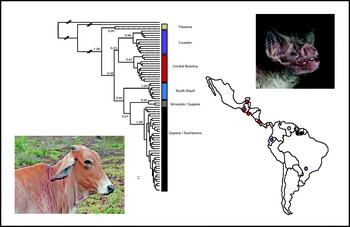
Despite their capacity for large-scale movements and dispersal and their occupation of diverse habitats, common vampire bats have a complex phylogeographic pattern across their range (Martins et al. Reference Martins, Ditchfield, Meyer and Morgante2007, Reference Martins, Templeton, Pavan, Kohlback and Morgante2009), and sex-biased dispersal with female phylopatry (Wilkinson, Reference Wilkinson1985), and it has been suggested that this pattern may represent a cryptic species complex (Clare, Reference Clare2011; Clare et al. Reference Clare, Lim, Fenton and Hebert2011) though the data are inconclusive (Clare, Reference Clare2011). Martins et al. (Reference Martins, Ditchfield, Meyer and Morgante2007) recognized five distinct clades that are geographically restricted to Central America, the northern Amazon and three smaller areas in southern Brazil and Paraguay. Clare (Reference Clare2011) identified an additional distinct group in Ecuador, a distinction between a Central American group and a Panama group and two apparently sympatric groups in the Northern Amazon (Fig. 2). Phylogeographic analysis suggests that there has been very restricted migration between groups and that all diversifications happened within the Pleistocene (Martins et al. Reference Martins, Ditchfield, Meyer and Morgante2007) likely in conjunction with climate change due to glaciation which caused fragmentation and drying of the available forest habitat (Ditchfield, Reference Ditchfield2000).
Phylogeographic pattern and distribution of sampling of the common vampire bat Desmodus rotundus based on Bayesian reconstruction of a 657 bp region from the mitochondrial gene cytochrome c oxidase subunit 1 (COI), suggesting marked population structure across Central and South America (see Clare Reference Clare2011). Branch supports are Bayesian posterior probabilities. The contemporary distribution of vampire bats may be influenced by their dependence on livestock, particularly cattle, and thus subject to anthropogenic effects. (Cattle photo credit M.B. Fenton; D. rotundus photo credit E.L. Clare.)

However, understanding the causes of phylogeographic patterning in D. rotundus is complicated by modern interactions with humans. Historically, the main prey of Desmodus were likely a variety of wild mammals, but with the arrival of intensive agricultural practices their prey preferences have switched to an almost exclusive relationship with domestic livestock, particularly cattle. Thus, the phylogeographic patterns in Desmodus may be complicated by their modern preference for livestock (Voigt and Kelm, Reference Voigt and Kelm2006), leading to a tendency to follow human settlements and very likely resulting in recent rapid population expansion and concomitant mixing of previously isolated populations (Ditchfield, Reference Ditchfield2000). Their role as vectors for rabies in cattle has also led to intensive human attempts to limit their populations through extermination (Almeida et al. Reference Almeida, Martorelli, Aires, Barros and Massad2008). Thus the new relationships of vampire bats as parasites of cattle cause a strong association between their distribution and anthropogenic trends. A similar scenario may exist for the white winged vampire bat Daiemus youngi and chickens.
As colonial mammals, vampire bats are host to a wide diversity of both ecto- and endoparasites (Greenhall et al. Reference Greenhall, Joermann and Schmidt1983) and the distribution of even relatively mobile parasitic species may be largely determined by the bat host, whose distribution has in turn changed due to the introduction of cattle and human movement. There is a direct connection then between the geographic distribution of dipteran and arachnid species and human geography through a series of intermediaries. This also highlights an interesting problem of terminology. A parasitic mite or fly on a mammal would be classified as a hyperparasite when on a vampire bat. This example demonstrates that, rather than considering the distribution of the parasite in isolation, the distribution of many parasitic species is best viewed as a community of species, in this case, from mite to fly to bat to cow to human, whose pattern has changed and is changing in relation to geography, geology and time. Getting to grips with this complex evolutionary and ecological history is impossible by conventional means, and is an opportunity and a challenge for molecular methods.
Dispersal alters but does not obscure structure
The above examples show that the problem of measuring distributions in parasites must be viewed from both a taxonomic and geographic perspective. As host-parasite relationships become more complex and more specialized, their distribution in both a taxonomic and geographic sense often become more uniform. What affects the host will, by extension, affect the obligate parasite and their bio-geographic patterns of dispersal converge. However, the standard ecological correlates of dispersal, for example higher movement capacity translates to lower population structuring, are not always as clear when the host becomes a vector for the parasite and may disperse apparently sedentary species across continents in accordance with the host's own movement ability. Thus recent host movement complicates parasite population genetic structure in space, but also makes it even more useful as an epidemiologically relevant marker.
TRACKING THE SPREAD OF EMERGING PARASITIC DISEASE
Canine pulmonary angiostrongylosis
Disease caused by the metastrongylid nematode Angiostrongylus vasorum has recently emerged in dogs in Europe (Helm et al. Reference Helm, Morgan, Jackson, Wotton and Bell2010) and North America (Conboy, Reference Conboy2011). Infection in dogs usually leads to mild to moderate respiratory disease, but in some cases can cause dyspnoea, or bleeding disorders and related complications that are severe and even fatal, while timely treatment is confounded by difficulties in rapid and specific diagnosis (Traversa and Guglielmini, Reference Traversa and Guglielmini2008; Koch and Willesen, Reference Koch and Willesen2009; McGarry and Morgan, Reference McGarry and Morgan2009; Schucan et al. Reference Schucan, Schnyder, Tanner, Barutzki, Traversa and Deplazes2012). Although previously confined to dogs in apparently well-defined endemic areas, recent years have seen the emergence of disease in several countries in Europe (Morgan et al. Reference Morgan, Shaw, Brennan, De Waal, Jones and Mulcahy2005). In North America, where infection has been documented in foxes since 1973, canine angiostrongylosis was documented only in 1996, and has subsequently increased in prevalence in dogs and coyotes (Conboy, Reference Conboy2004, Reference Conboy2011). Preliminary attempts to model the climatic constraints to transmission suggest that the potential geographic range is much larger than the parasite's apparent current distribution, and therefore that there is risk of further spread (Morgan et al. Reference Morgan, Jefferies, Krajewski, Ward and Shaw2009). The relationship between parasites in the fox wildlife reservoir and dog populations, and the cause and mechanisms of spread at global and local levels are fundamental to understanding the epidemiology of this parasite, and to the design of effective control strategies.
Inferring canid host-parasite co-evolution and co-distribution using molecular markers
Variation in mtDNA (COI) and nuclear (ITS-2) sequences among A. vasorum worms extracted from foxes and dogs in different countries in Europe was compared with that among worms collected in Brazil using a standard phylogenetic approach, with data from the congeneric nematodes A. cantonensis and A. costaricensis also included (Jefferies et al. Reference Jefferies, Shaw, Viney and Morgan2009a). A. vasorum sequences from Europe clustered together, while isolates from Brazil formed a distinct clade, a conclusion supported by independent analysis of mtDNA (Eamsobhana et al. Reference Eamsobhana, Lim, Solano, Zhang., Gan and Sen Yong2010a). Comparison of phylogenetic distances among isolates within the genus suggested that the European and South American populations of A. vasorum were quite divergent, possibly constituting different species. A similar argument was made previously on morphological grounds, and the taxonomic classification of Angiostrongylus found in South American foxes has changed several times since its first description (Jefferies et al. Reference Jefferies, Shaw, Viney and Morgan2009a). This is of applied importance because understanding aspects of the biological and medical characteristics of A. vasorum that are crucial to its diagnosis, clinical management and control relies heavily on experimental work conducted in South America on local parasites (Morgan et al. Reference Morgan, Shaw, Brennan, De Waal, Jones and Mulcahy2005). If genetic differences indicate divergent populations that might vary in their biological traits, such as pathogenesis or dynamics in the intermediate host, management of emerging disease in Europe should take account of this uncertainty in extrapolating from South American data, and might be better based on new, locally derived knowledge.
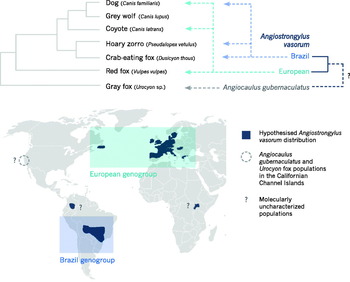
In terms of tracking global spread, the time of divergence between European and South American populations of A. vasorum was estimated using mtDNA nucleotide differences, assuming that rates of mutation were similar to those in other nematode taxa, and neutral to selection (Jefferies et al. Reference Jefferies, Shaw, Viney and Morgan2009a). Results indicated that these populations separated between 11 and 67 million years ago. A similar exercise was conducted on publicly available sequence data from the documented wild and domestic canid host species, including the European red fox Vulpes vulpes, the South American species Disicyon thous and Pseudalopex vetulus, and the domestic dog (Canis familiaris) and its wolf ancestor (Canis lupus). The South American canid species were estimated to diverge from V. vulpis more than 10 million years ago. Therefore, it is likely that A. vasorum arrived in South America with its canid hosts or their evolutionary ancestors, and not from more recent anthropogenic introductions of dogs in the past 10,000 years. The introduction of A. vasorum into South America would in that case have occurred as canids migrated across Beringia (Wang et al. Reference Wang, Tedford, Van Valkenberg, Wayne, MacDonald and Sillero-Zubiri2004) and south through the Americas (Fig. 3). However, potential host switching among the canid hosts (for example, from red foxes to domestic dogs; see below) and the extensive movement of domestic dogs throughout the world has likely influenced the phylogenetics of this nematode. Interestingly, the ancestral fox species Urocyon littoralis, native to the channel islands off the coast of California, is host to the metastrongylid Angiocaulus gubernaculatus (Faulkner et al. Reference Faulkner, Patton, Munson, Johnson and Coonan2001), which resembles Angiostrongylus and may represent a common ancestor to the Brazil and European populations of A. vasorum (Fig. 3). Including these species, along with the recently discovered novel Angiostrongylus sp. in badgers (Meles meles) (Gerrikagoitia et al. Reference Gerrikagoitia, Barral and Juste2010) in a wider molecular study might confirm the hypothesis that A. vasorum ancestrally spread globally with its canid hosts, and evolved into genetically distinct populations in different host species. Parallel approaches to the phylogeography of the zoonotic species Angiostrongylus cantonensis have so far not uncovered unequivocal geographic partitioning of population genetic structure (Eamsobhana et al. Reference Eamsobhana, Lim, Solano, Zhang., Gan and Sen Yong2010b), though as in other systems this could be due to a real lack of structure or to the limitations of the selected markers and sampling regimes. Indeed, A. vasorum might have been imported from Europe to South America in recent history and mixed with ancestral lineages to give rise to multiple genotypes in Brazil, potentially with differences in their biology, with such population structure remaining undiscovered due to the small sample sizes examined so far.
Hypothesised co-evolution between A. vasorum and its canid hosts. Potential host switching has occurred of the A. vasorum ‘Brazil’ genotype from the South American fox species to Canis familiaris and of the A. vasorum ‘Europe’ genotype between the Vulpes and Canis lineages. Phylograms are based on mtDNA analyses (Jefferies et al. 2009) and are not drawn to scale.

Dog movement and disease spread across the wildlife-livestock interface
Notwithstanding genetic partitioning of A. vasorum in different fox host species, and associated geographic heterogeneity, there remains considerable flexibility in host range, and hence potential for host switching. This is confirmed by the fact that dogs seem to become infected wherever the parasite is found in sympatric fox populations (Morgan et al. Reference Morgan, Tomlinson, Hunter, Nichols, Roberts, Fox and Taylor2008, Reference Morgan, Jefferies, van Otterdijk, McEniry, Allen, Bakewell and Shaw2011), while spill-over from dogs into species as taxonomically distant as the red panda, Ailurus fulgens, has been documented (Patterson-Kane et al. Reference Patterson-Kane, Gibbons, Jefferies, Morgan, Wenzlow and Redrobe2009; Bertelsen et al. Reference Bertelsen, Meyland-Smith, Willesen, Jefferies, Morgan and Monrad2010). The close association of dogs with humans has no doubt led to long-range global movements of A. vasorum, with the potential for subsequent establishment in local foxes. The relative roles of co-evolution with wild canids and recent spread through dogs in parasite range expansion should inform strategies to reduce further spread and protect dog and wild canid populations from disease.
A phylogeographic approach was used to address this question. Sequences from three mitochondrial genes (COI and NADH3) and one region of nuclear DNA (rrnL ribosomal coding gene) were compared between European and North American parasite populations in dogs, foxes and coyotes (Jefferies et al. Reference Jefferies, Shaw, Willesen, Viney and Morgan2010). The genetic diversity in Newfoundland, the only colonised part of North America, was found to be a subset of that in Europe, suggesting that parasites were introduced to the island in historic times, rather than having arrived with ancestral canid hosts. As well as pet and working dogs, European settlers to Newfoundland also brought with them foxes for fur farming, and gastropod molluscs, perhaps in animal feedstuff and other materials. Intentional release of red foxes in North America occurred to support sport hunting, likely resulting in interbreeding with native populations as well as mixing of parasite populations and potentially host switching to other wild canids such as coyotes (Canis latrans). It was not possible in this study to identify the European country of origin of A. vasorum in Newfoundland: although specimens from the UK, Ireland, Germany, the Netherlands, Denmark, France and Portugal were sequenced, many mitochondrial haplotypes were present, with substantial overlap in haplotypes between countries. Those found in Newfoundland could, in theory, have come from any European country. The role of domestic dogs as long-range vectors of infection, and the subsequent establishment in local red fox and coyotes, from which pet and working dogs are now routinely infected with often serious consequences for their health, should alert animal health authorities and dog healthcare providers of the possibility of onward spread to the North American mainland. Barriers to parasite flow could include compulsory treatment of travelling dogs with an effective anthelmintic. In this case, evidence from molecular phylogeography would greatly help to guide and justify rational disease control programmes to limit further global spread of potentially damaging parasites.
A major impediment to understanding the spread of emerging disease is that by the time detailed investigation is considered warranted, the disease has usually already emerged to the extent that tracking distribution forward in time gives limited information on crucial early events. Molecular phylogeography provides a means of inferring these events through current genetic structure. This could, in principle and with appropriate molecular markers, be applied across a wide range of temporal and spatial scales. For example, emergence of A. vasorum in the north of the UK (Helm et al. Reference Helm, Gilleard, Jackson, Redman and Bell2009; Yamakawa et al. Reference Yamakawa, McGarry, Denk, Dukes-McEwan, MacDonald, Mas, McConnell, Tatton, Valentine, Wayne, Williams and Hetzel2009) occurred fairly soon after surveys of foxes showed a limited distribution in the south of the country (Morgan et al. Reference Morgan, Tomlinson, Hunter, Nichols, Roberts, Fox and Taylor2008). The genetic relationship between parasites found in dogs in newly colonised areas and in dogs and foxes in the south of the UK could provide clues on the likely source of the invasion, and the relative roles of local spread through fox populations and long-distance movements by dogs in driving parasite spread. At the same time, the genetic structure of parasite populations in foxes and in gastropod intermediate hosts in new foci of infection could yield insights into biological events during colonisation. Current evidence shows a considerable degree of genetic overlap in A. vasorum populations in sympatric dogs and foxes (Jefferies et al. Reference Jefferies, Shaw, Willesen, Viney and Morgan2010) and suggests that parasite gene flow between these host species is common. However, individual hosts often contained parasites with more than one mitochondrial haplotype. This could indicate ingestion of multiple infected intermediate hosts carrying infections from different hosts or that intermediate hosts can become infected with more than one parasite haplotype. Comparing the genetic structure of parasites in sympatric foxes, dogs and molluscs would be instructive on the role of the fox as a reservoir of infection, and the risk factors, such as behaviour and habitat use, for infection in dogs. Such molecular studies of transmission dynamics require suitable genetic markers, with greater variation than for global biogeographic studies. Nevertheless, studies on a broad spatial scale can help to specify global genetic variation and to prospect for suitable markers for more detailed studies.
Implications for diagnosis and control
Molecular differences between parasite isolates in different regions also have applied relevance to diagnosis and control. Thus, diagnosis of A. vasorum infection in dogs can be difficult due to intermittent larval shedding (Oliveira et al. Reference Oliveira, Barcante, Barcante, Dias and Lima2006) and limited sensitivity and specificity of current tests for larvae in faeces (Traversa and Guglielmini, Reference Traversa and Guglielmini2008; Schnyder et al. Reference Schnyder, Maurelli, Morgoglione, Kohler, Deplazes, Torgerson, Cringoli and Rinaldi2011). Improved methods, e.g. using PCR (Jefferies et al. Reference Jefferies, Morgan and Shaw2009b, Reference Jefferies, Morgan, Helm, Robinson and Shaw2011a) rely on conserved molecular diagnostic markers between various populations of a parasite species in different parts of its range, for which knowledge of global genetic variation is a prerequisite. Meanwhile, pursuit of alternatives to chemical control in dogs such as vaccination by recombinant antigen, relies on identification of suitable immune-reactive proteins (Jefferies et al. Reference Jefferies, Morgan, Shaw and Heesom2011b), and again the integrity of the target species at crucial genetic loci is fundamental to success.
BIOGEOGRAPHY, GENETICS AND PARASITE CONTROL
Invasion of New Zealand by Lucilia cuprina
Myiasis, the invasion of tissues by insect larvae, is an economically important disease in livestock populations worldwide, as well as a sometimes serious disease in humans, mainly in tropical and sub-tropical areas (Hall and Wall, Reference Hall and Wall1995). Cutaneous myiasis or blowfly strike is a major disease of sheep, causing production loss and welfare issues wherever sheep are farmed. Control relies heavily on synthetic insecticides, to which fly populations are rapidly developing resistance (Tellam and Bowles, Reference Tellam and Bowles1997; Hartley et al. Reference Hartley, Newcomb, Russell, Yong, Stevens, Yeates, La Salle and Oakeshott2006), while climate change could affect seasonal and geographic patterns of disease (Rose and Wall, Reference Rose and Wall2011; Wall and Ellse, Reference Wall and Ellse2011) and attempts at control (Morgan and Wall, Reference Morgan and Wall2009; Wall et al. Reference Wall, Rose, Ellse and Morgan2011). In some major sheep-producing areas of the world, sheep production is probably unsustainable in the absence of effective chemical control of blowflies, and so the spread of resistant fly strains is of close interest to farmers, animal health authorities and applied parasitologists.
Blowfly strike in sheep in New Zealand, as in most temperate regions, is primarily caused by Lucilia sericata. However, in recent years, Lucilia cuprina, which is the dominant cause of strike in warmer regions including neighbouring Australia, has invaded the country. This species was first reported in the North Island in 1980, though it might have arrived some years before that, and has since spread southwards (Bishop, Reference Bishop1993; Gleeson and Sarre, Reference Gleeson and Sarre1997). Although L. sericata remains responsible for most strikes, the presence of L. cuprina is of concern because of the high incidence of insecticide resistance in this species, raising the possibility of L. cuprina strike in treated flocks, or possibly inter-breeding with L. sericata to produce resistant hybrids (Stevens and Wall, Reference Stevens and Wall1996; Tourle et al. Reference Tourle, Downie and Villet2009).
Population genetic structure inferred from multiple molecular markers suggests that L. cuprina has been introduced to New Zealand on several separate occasions, probably from Australia. Rapid population expansion following founder effects and possibly subsequent population bottlenecks as a result of control efforts has resulted in limited genetic diversity, with different genotypes arising presumably from different introduction events (Gleeson and Sarre, Reference Gleeson and Sarre1997).
The presence of L. cuprina in New Zealand has implications for control of blowfly strike in sheep. Not only does it signal the arrival of insecticide resistance in agents of ovine myiasis in this major sheep-producing country (Gleeson and Sarre, Reference Gleeson and Sarre1997), but the presence of fly populations from multiple sources raises the possibility that genetic control through the sterile insect technique (SIT) might not be equally effective against all introduced populations. This problem is pertinent to other agents of myiasis, as discussed below, and makes the definition of genotype, as well as species distribution, potentially crucial to control efforts. Moreover, introductions of agricultural pest species, for which dates and sometimes likely sources and routes are known, can act as models of biological invasions, and facilitate the testing of hypotheses concerning the effects of different mechanisms on observed population genetic structure (Gleeson, Reference Gleeson1995).
Blowfly hybridisation in Hawaii
Multiple genetic markers were also applied to blowfly populations in Hawaii in an attempt to identify the source of Lucilia populations found in the islands (Stevens and Wall, Reference Stevens and Wall1996; Stevens et al. Reference Stevens, Wall and Wells2002). L. cuprina from Hawaii had L. cuprina-like nuclear marker sequences (rDNA) but L. sericata-like mtDNA (COI and II). It was postulated that this could be the result of hybridisation; L. sericata alleles in the nuclear genome would then have been progressively lost by dilution with wild-type flies, while mtDNA sequence could have been fixed by lineage sorting through maternal inheritance. Given the Palaearctic distribution of L. sericata and the Afrotropical and Oriental distribution of L. cuprina, hybridisation seems unlikely without human interference, and the most likely source of introduced flies would have been Polynesian island colonisation by humans, arriving in Hawaii from 500 AD onwards. However, this timescale can explain the observed sequence data only by invoking extremely rapid mutation rates in this species, or by assuming hybridisation before human arrival. Both possible explanations are intriguing, but the dilemma highlights the potential perils of extrapolating mutation rates from model invertebrates with a very different, free-living lifestyle (Brower, Reference Brower1994) and different evolutionary pressures (and sometimes mating systems) from parasitic taxa. Evidence for hybridisation of these two blowfly species, meanwhile, has implications for fly control, by demonstrating potential for the transfer of genes for insecticide resistance, for example in New Zealand (above), and also for the applicability of biological information derived from a given study population to those in other regions. For example, growth curves used in forensic entomology derived from either species of Lucilia might be inapplicable to hybrids (Stevens et al. Reference Stevens, Wall and Wells2002; Wells and Stevens, Reference Wells and Stevens2008). Discordance between mtDNA and nuclear DNA markers in this case also emphasises the importance of using multiple markers in biogeographic studies.
Practical implications of geographic genetic population structure in blowflies
Genetic differences between Lucilia spp. populations in different parts of the world could indicate biological differences relevant to epidemiology and control. Thus, L. cuprina is present in North America, but appears to contribute little to blowfly strike in sheep, in contrast to Australia, where it causes major disease problems (Stevens and Wall, Reference Stevens and Wall1996), and differences in propensity to cause fly strike also exists between populations of L. sericata in the north and south of Europe (Martinez-Sanchez et al. Reference Martinez-Sanchez, Smith, Rojo, Marcos-Garcia and Wall2007). If this heterogeneity is a result of genetic differences, molecular tools could identify genotypes that are more or less pathogenic, and guide control efforts accordingly. On the other hand, studies (Stevens and Wall, Reference Stevens and Wall1997; Stevens et al. Reference Stevens, Wall and Wells2002) have identified limited mtDNA differences in L. sericata between the UK, where it is the main agent of myiasis in sheep with high flock-level annual incidence and fatality rates (Bisdorff and Wall, Reference Bisdorff and Wall2008), and Australia, where it has only a minor role in the disease. Within-genotype variation in behaviour may have important consequences for control and levels of gene flow between populations in areas of the world that appear to experience contrasting disease consequences of fly presence. It is of course possible that commonly used, often purportedly neutral, population genetic markers are poor representatives for biological variation of interest, in this case the ability to feed on living flesh. This would need further studies using markers that are linked to function, rather than neutral loci. The concurrent actions of speciation within fly taxa that already cause myiasis, and de novo acquisition of the myiasis habit in different taxa, complicate interpretation of phenotypic and population genetic data between fly populations, but could enlighten understanding of the evolutionary drivers of myiasis (Stevens et al. Reference Stevens, Wallman, Otranto, Wall and Pape2006).
The spatial scale of genetic variation can also shed light on life history and behaviour, with implications for applied entomology. Thus, studies of geographic variation in the molecular genetic structure of populations of the blowflies Phormia regina and Lucilia sericata using amplified fragment length polymorphism (AFLP) (Picard and Wells, Reference Picard and Wells2009, Reference Picard and Wells2010) found no real differences in populations between regions of North America, but considerable differences between isolates from individual baited traps. The authors explain this by attraction of batches of related flies emerging from pupae to the same odour plumes, such that larvae from individual traps, or probably in individual carrion or corpses, are closely related. This could enable forensic entomologists to elucidate the history of cadavers that are moved after homicides, since larvae left behind at different locations would be closely related to each other and to those still in the cadaver.
Phylogeography and control of New World screwworm
Genetic control of insects using the Sterile Insect Technique (SIT) has been used successfully to eradicate pest species from various regions (Lindquist et al. Reference Lindquist, Abusowa and Hall1992; Krafsur, Reference Krafsur1998), and offers potential for the eradication of vectors of disease, including malaria (Helinski et al. Reference Helinski, Parker and Knols2006). SIT was used to eradicate the New World screwworm fly, Cochliomyia hominovorax, from the USA and several Central American countries and Caribbean islands (Robinson et al. Reference Robinson, Vreysen, Hendrichs and Feldmann2009). This programme has been a central part of efforts to control myiasis in humans and livestock in that region. However, a recent SIT programme in Jamaica failed (Vreysen et al. Reference Vreysen, Gerado-Abaya, Cayol, Vreysen, Robinson and Hendrichs2007). In additional to several operational issues (Vreysen et al. Reference Vreysen, Gerado-Abaya, Cayol, Vreysen, Robinson and Hendrichs2007), one hypothesis for this failure is that genetic differences exist between fly populations, which may have acted to prevent mating between the introduced sterilised males and indigenous females in the field, though to date, no evidence of pre- or post-copulatory isolation has been found under laboratory conditions (Taylor et al. Reference Taylor, Hammack and Roehrdanz1991). Nonetheless, large variations in insect sterility have been observed between field trials of SIT in C. hominivorax (Klassen and Curtis, Reference Klassen, Curtis, Dyck, Hendrichs and Robinson2005) and studies of multiple genetic markers have revealed extensive cryptic diversity in the species, with genetic sub-structuring between island populations in the Caribbean (McDonagh et al. Reference McDonagh, García and Stevens2009; Torres and Azeredo-Espin, Reference Torres and Azeredo-Espin2009). Flies from the Caribbean (including Jamaica and Cuba) and museum specimens collected in 1933 and 1953 from the now extinct North American populations were genetically distinct (McDonagh et al. Reference McDonagh, García and Stevens2009), suggesting that most islands were colonised from South America, and perhaps explaining in part the limited success of SIT using Central American-derived mass-reared populations in Jamaica. The observed genetic structure supported a hypothesis of multiple colonisations of different islands, with subsequent isolation. However, patterns inferred from mitochondrial and nuclear markers did not fully agree; geographic structuring was most marked in the mitochondrial COI gene, as expected from maternal inheritance and lack of recombination, but was not so apparent from either the mitochondrial 12S or the nuclear EF-1α regions. This could have arisen from movement of flies with livestock since the 16th century (Taylor et al. Reference Taylor, Szalanski and Peterson1996), resulting in mixing of previously delineated populations, and confounding structure more markedly in recombining nuclear genes. This finding illustrates not only the importance of using multiple markers in studies of this type, but also how historical movement of humans and their associated domestic animals is superimposed on natural evolutionary radiations and distributions of parasite species to generate current biogeographic patterns. Such interaction therefore begs caution when interpreting population genetic data from parasites of domestic animals, but also opens possibilities for detecting historic movements that govern current and future epidemiological threats and the best strategies to combat them.
CONCLUDING REMARKS: PHYLOGEOGRAPHY AND GLOBAL CHANGE
The case studies described above show how information on geographic variation in parasite population genetic structure can be applied to problems of parasite control, and especially how parasitologists not specialising in this field can bring new technologies to bear on their study system. The potential for advancing understanding on a wide range of parasitological questions is immense. In this final section we broaden our scope further to consider examples of imaginative application of phylogeography within parasitology, and flag some issues and limitations for the deliberation of researchers planning to incorporate such novel approaches into their research.
Applying phylogeography to major human health problems of the 21st century
Phylogeography has recently been applied to parasites of long-standing medical importance to confirm or deny previous views of parasite taxonomy and biogeography that are fundamental to epidemiology and disease control. Thus, for example, recent results suggest that the human-infective forms of Trypanosoma brucei share common nuclear genotypes but are not reproductively isolated from the non-human infective forms (Balmer et al. Reference Balmer, Baedell, Gibson and Caccone2011). This increases the genetic resources available to the parasite to adapt to anthropogenic pressures such as drug administration, and perhaps increases the risks of ill-targeted livestock treatment for the long-term effectiveness of chemotherapy in humans. In Schistosoma, molecular data suggest that species divergence in Africa followed introduction of ancestral parasites with ungulate definitive hosts from Asia, followed by intermediate host switching to planorbid snails, and eventually of some species to hominid definitive hosts (Lawton et al. Reference Lawton, Hirai, Ironside, Johnston and Rollinson2011). The zoonotic fox tapeworm Echinococcus multilocularis also displays ancient macrogeographic genetic structure, with distinct populations on different continents thought to have arisen from glacial refugia (Nakao et al. Reference Nakao, Xiao, Okamoto, Yanagida, Sako and Ito2009). Taenia solium, by contrast, appears to have spread between Europe, Asia, Africa and Latin America along trade routes between the 15th and 19th centuries (Martinez-Hernandez et al. Reference Martinez-Hernandez, Jimenez-Gonzales, Chenillo, Alonso-Fernandez, Maravilla and Flisser2009). With no fossil record available for parasites, reconstruction of historic biogeographic and host-switching events in these systems of major socio-economic importance would be impossible without molecular evidence.
Host movement and genetic structure
Ecological studies on cestodes with complex life cycles involving fish and migrating birds have found that host movement can homogenise population genetic structure at local scales, while helping to generate structure on macrogeographic scales (Bouzid et al. Reference Bouzid, Stefka, Hypsa, Lek, Scholz, Legal, Ben Hassie and Loot2008). In cave-roosting bats, dispersion of mites within colonies leads to low intra-roost genetic diversity, but large differences between roosts and between years, arising from dispersal to new roosts through bat movement (Bruyndonckx et al. Reference Bruyndonckx, Henry, Christie and Kerth2009b). Differences in the population genetic structures of different monogenean parasite species of rays on the Australian coast (Glennon et al. Reference Glennon, Perkins, Chisholm and Whittington2008) and of butterfly fishes in the south Pacific (Plaisance et al. Reference Plaisance, Rousset, Morand and Littlewood2008), meanwhile, might reflect differences in life history, especially hatching and dispersal of infective stages. Detailed patterns of movement and contact between host populations through shared habitat use critically underlie parasite transmission (Morgan et al. Reference Morgan, Milner-Gulland, Torgerson and Medley2004), and phylogeography provides a tool to characterize these movements at a level that would be logistically challenging through observation alone. The application of phylogeography to elucidate parasite transmission within host populations has been underused relative to broad-scale macrogeographic approaches, but has increasing potential to yield insights of applied relevance as marker choice widens (Criscione, Reference Criscione2008). In some systems, answers might not be obvious, for example the apparent spatial genetic sub-structuring in tsetse fly populations over distances of several hundred metres, in spite of longer range feeding movements (Solano et al. Reference Solano, Ravel and Meeûs2010).
In some cases, the lack of discernible population genetic structure can be informative, for example in generalist gastrointestinal nematodes of ruminants, in which free gene flow between host species suggests a high capacity for transmission across the wildlife-livestock interface, and for rapid evolutionary change (Blouin et al. Reference Blouin, Dame, Tarrant and Courtney1992; Archie and Ezenwa, Reference Archie and Ezenwa2011). Species in this group showed fine structure among deer populations but not among domestic ruminants, suggesting that host movement enabled gene flow between livestock populations (Blouin et al. Reference Blouin, Yowell, Courtney and Dame1995). Along with large effective parasite population sizes, this would favour the spread of rare genes, for example those for anthelmintic resistance. On the other hand, high rates of gene flow might have led to relatively uniform parasite populations on a global scale, perhaps reducing parasite capacity to adapt to change (Rosenthal, Reference Rosenthal2009). Since geographic variation in parasite genetics might affect the response of populations to climate and other environmental change, there is a case for integrating molecular data into species distribution and ecological niche models (Scoble and Lowe, Reference Scoble and Lowe2010). This could be a prelude to ambitious predictive approaches that integrate spatial variation in parasite and environment, and dynamic changes in both at ecological and evolutionary levels.
Adding molecular markers to parasite tags
Phylogeography has an additional role in supporting the use of parasites as biological tags. Thus for instance, mitochondrial genetic diversity in North American populations of trematode parasites of the intertidal snail Littorina littorea confirmed a European origin for this invasive mollusc, resolving decades of debate (Blakeslee et al. Reference Blakeslee, Byers and Lesser2008). In Corsica, the presence of a European genetic lineage of mites in bats betrayed the earlier presence of an extinct host species (Bruyndonckx et al. Reference Bruyndonckx, Biollaz, Dubey, Goudet and Christie2010). It is possible that higher rates of molecular evolution in parasites can act as a biological magnifying glass to reveal events in the evolutionary histories of their hosts that are not detectable from host DNA alone (Nieberding and Olivieri, Reference Nieberding and Olivieri2007). This was shown, for example, in the nematode Heligmosomoides polygyrus in the field mouse Apodemus sylvaticus, in which greater genetic diversity indicated separate glacial refugia that were not reflected in host population genetic structure (Nieberding et al. Reference Nieberding, Morand, Libois and Michaux2004).
Marker choice: the right tool for the job
Choice of molecular marker is important, and depends on the question in hand and properties of the tractable molecular regions in the study organism. Mitochondrial genes, long favoured as species markers for population genetic and phylogeographic studies, for sound reasons (Solano et al. Reference Solano, Ravel and Meeûs2010), might be more open to bias than previously supposed (Ballard and Whitlock, Reference Ballard and Whitlock2004), and should routinely be complemented by suitable nuclear markers (Rubinoff et al. Reference Rubinoff, Cameron and Will2006). The use of multiple molecular markers in a bid to better validate relationships between parasite populations often leads to discordance in conclusions. Combining results from multiple markers can add value by achieving consensus phylogenetic relationships (Edwards, Reference Edwards2009), but discordance between markers may itself be informative, for example in the myiasis case studies above. The emphasis on standardised molecular markers to distinguish between taxa (Hebert et al. Reference Hebert, Cywinska, Ball and deWaard2003), while simplifying assessment of biodiversity, might not always be well suited to applied parasitology. Thus, for example, not only does classification of the economically important fish monogenean Gyrodactylus spp. based on mtDNA lead to taxonomic inflation and complication of control efforts, but observed variation in virulence and host preference correlates poorly with mtDNA haplotype (Hansen et al. Reference Hansen, Bakke and Bachmann2007b). In applying phylogeography to parasite epidemiology and control, therefore, the use of multiple markers and care in extrapolating the meaning of molecular differences from other systems are to be recommended.
Global change, environmental perturbation and emerging disease
Phylogeographic approaches, made possible by advances in molecular techniques and bioinformatics, are already improving understanding of the factors that determine parasite distribution in space and among hosts (Criscione et al. Reference Criscione, Poulin and Blouin2005). Especially for parasites of socio-economic importance, historic human movements, allied to rapid environmental change, have radically altered the landscape. It should not be surprising, therefore, that opportunities for host-switching, even for parasite species considered to be specialists, abound in this situation (Agosta et al. Reference Agosta, Janz and Brooks2010; Poulin et al. Reference Poulin, Krasnov and Mouillot2011). Such events, when superimposed on ancient host-parasite co-evolution, generate a mosaic of parasite population structure (Koehler et al. Reference Koehler, Hoberg, Dokuchev, Tranbenkova, Whitman, Nagorsen and Cook2009; Hoberg, Reference Hoberg2010) that can be difficult to discern unambiguously in cross-sectional molecular studies. Nevertheless, the present geographic distribution of parasite genetic diversity is fundamental to future adaptation that might affect the relationships of parasites with humans and with the animals and ecosystems on which they rely, for example by changes to host range and virulence of emerging diseases (Polley and Thompson, Reference Polley and Thompson2009; Thomson et al. 2010). In evolutionary history, periods of environmental perturbation have been associated with episodes of host switching, and subsequent co-evolution of parasites with their geographically isolated hosts (Hoberg and Brooks, Reference Hoberg and Brooks2008). In this context, anthropogenic disruption through facilitation of biological invasions and rapid environmental and climate change that alters parasite transmission is likely to constitute a force towards host switching and emergence of new host-parasite associations (Brooks and Hoberg, Reference Brooks and Hoberg2007). Molecular phylogeography provides promising approaches for assessing these processes and developing strategies to mitigate future challenges from parasitic disease.
ACKNOWLEDGEMENTS
EC is funded by a post-doctoral fellowship from the Natural Sciences and Engineering Research Council of Canada, and work by ERM and RJ on A. vasorum was funded by Morris Animal Foundation First Award D06CA-308. The authors wish to thank Alex Smith for useful comments on an earlier version.