

Introduction
It has been traditionally thought that La Tène art was imported by communities into Britain via the Continent from the early 4th century BC (eg, Cerrig-y-Drudion helmet and Fiskerton sword; see Harding Reference Harding2007, 87). It is also generally accepted that development of insular styles did not begin to flourish until the 3rd century BC (Hunter & Joy Reference Hunter, Joy, Farley and Hunter2015, 78; Megaw & Megaw Reference Megaw, Megaw, Garrow, Gosden and Hill2008, 53), and they predominately focused on non-naturalistic ornamentation (Joy Reference Joy2011, 212). However, recent research (Ellis Reference Ellis2022) has shown that some regions developed and used La Tène style figurative forms independently as early as the 3rd century BC, when insular styles were developing (see Ellis & Lamb Reference Ellis and Lamb2019).
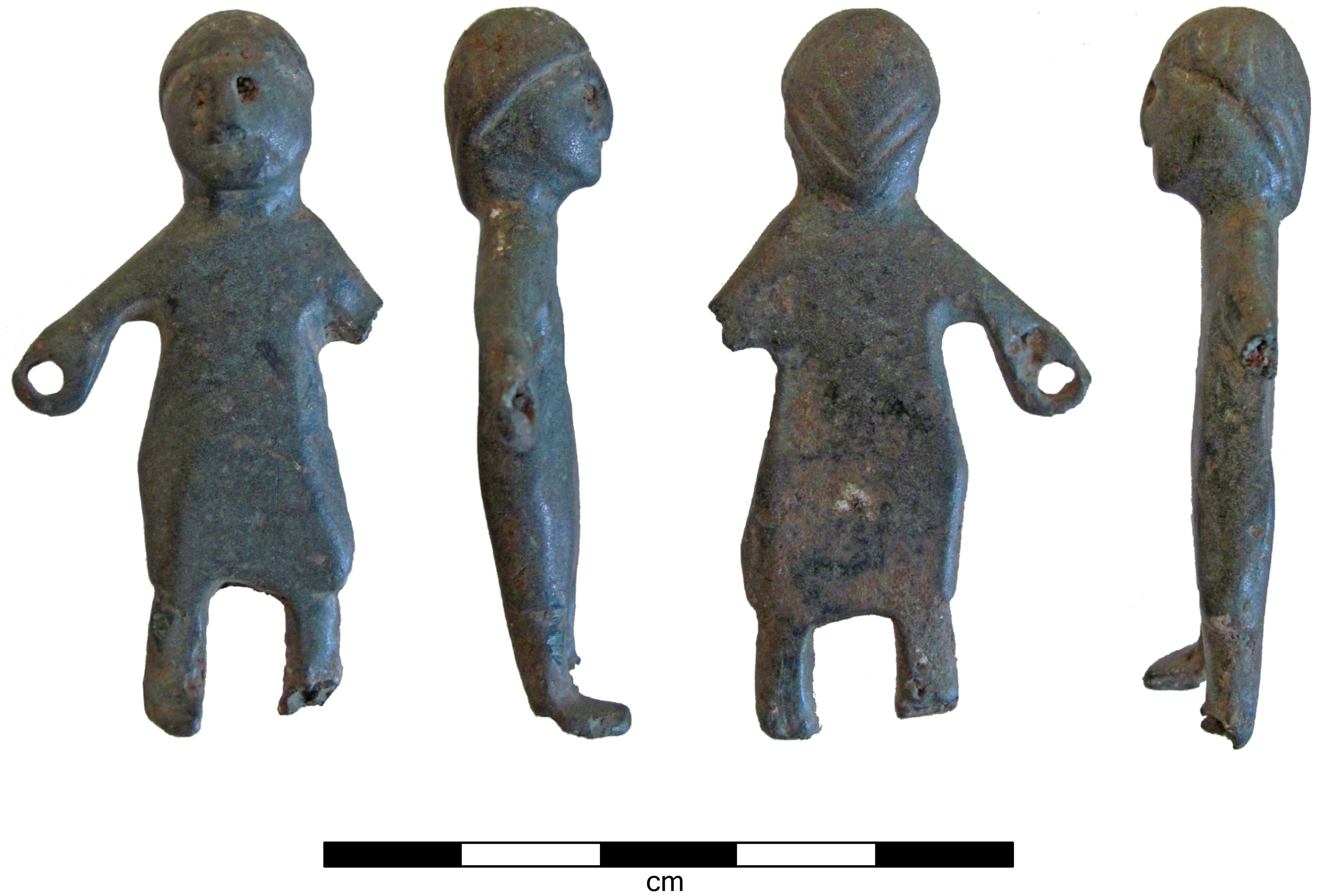
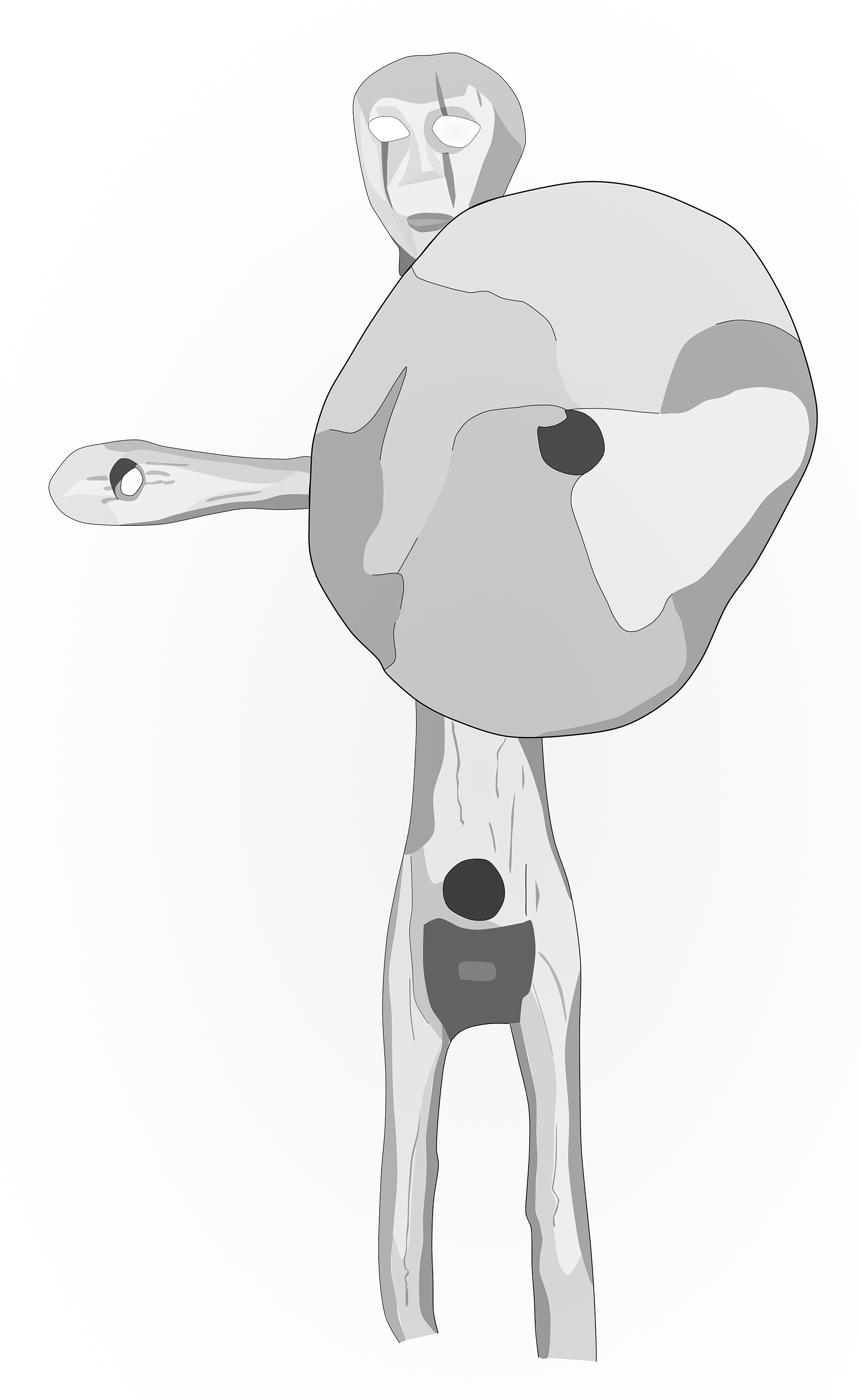
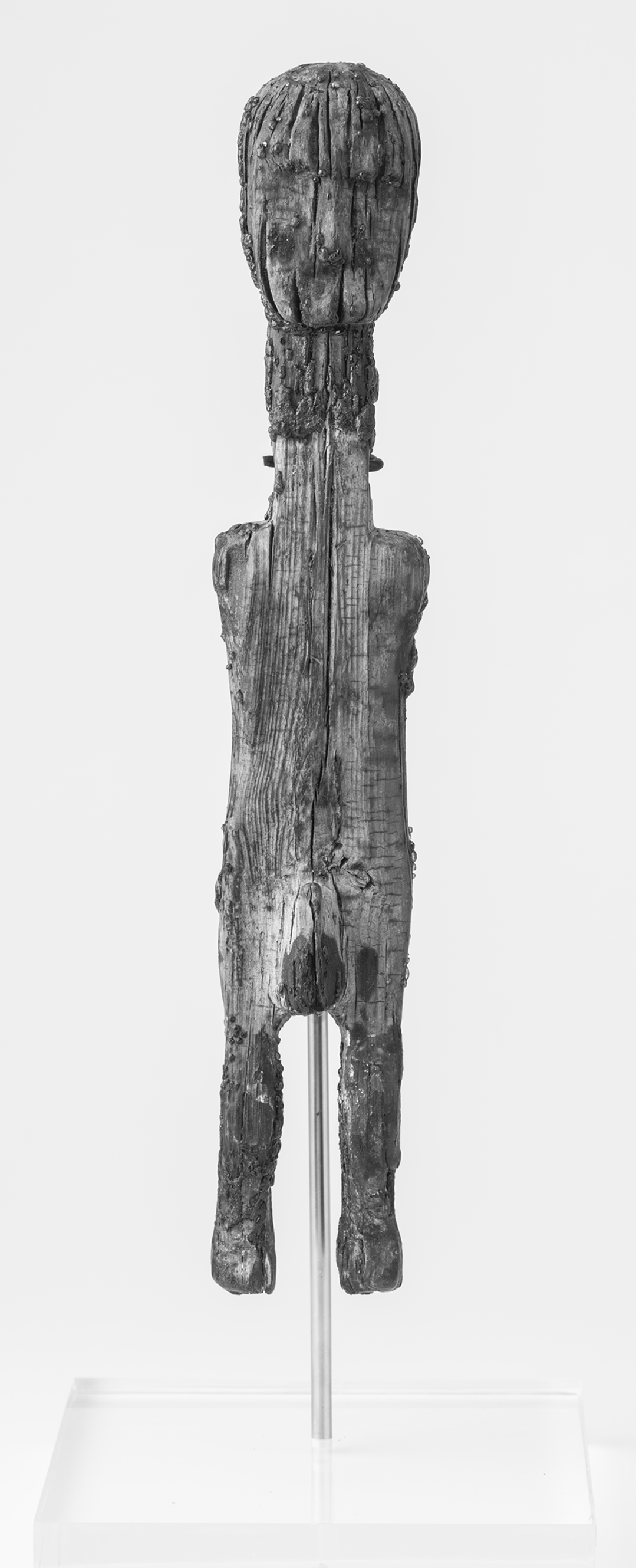
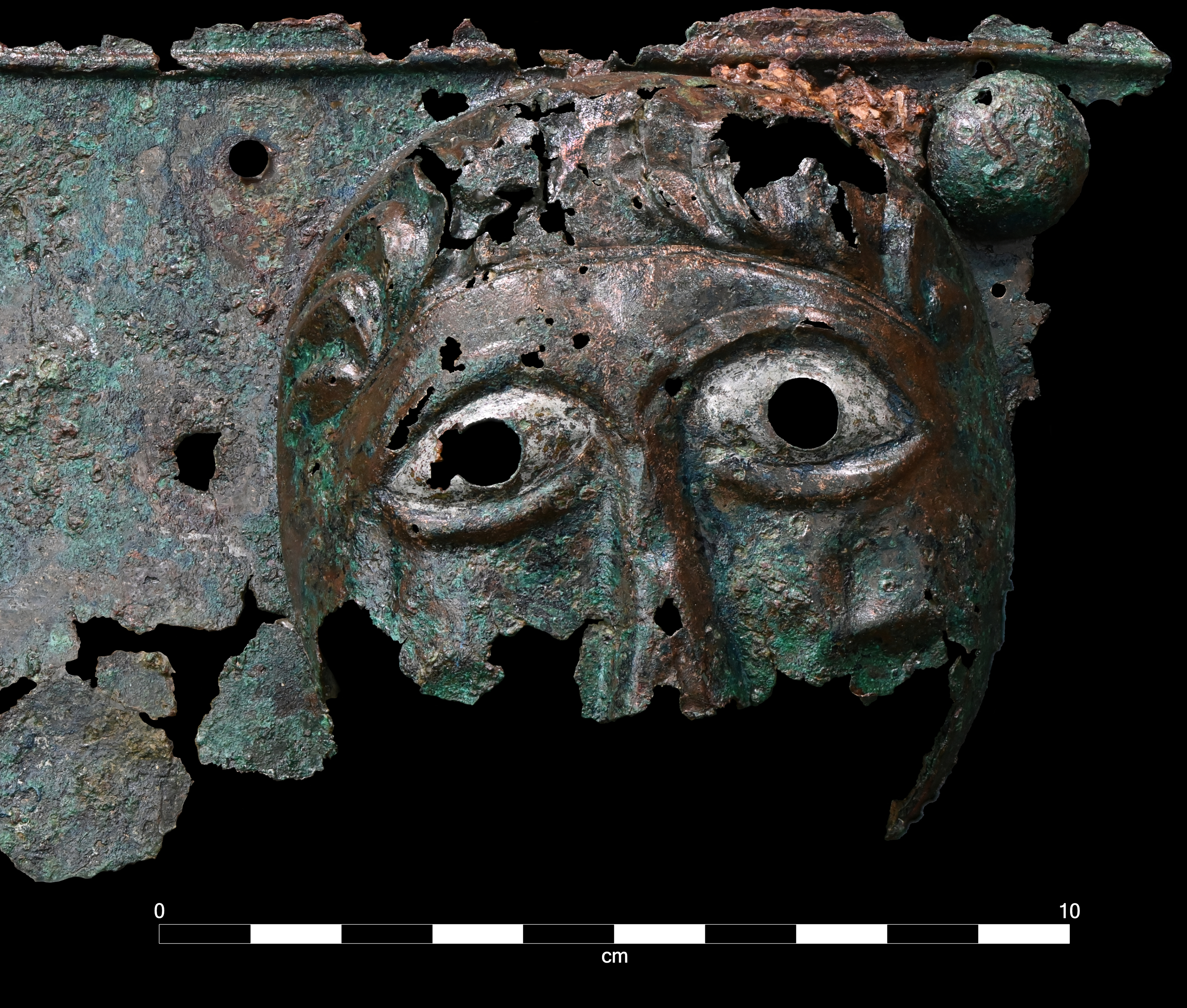
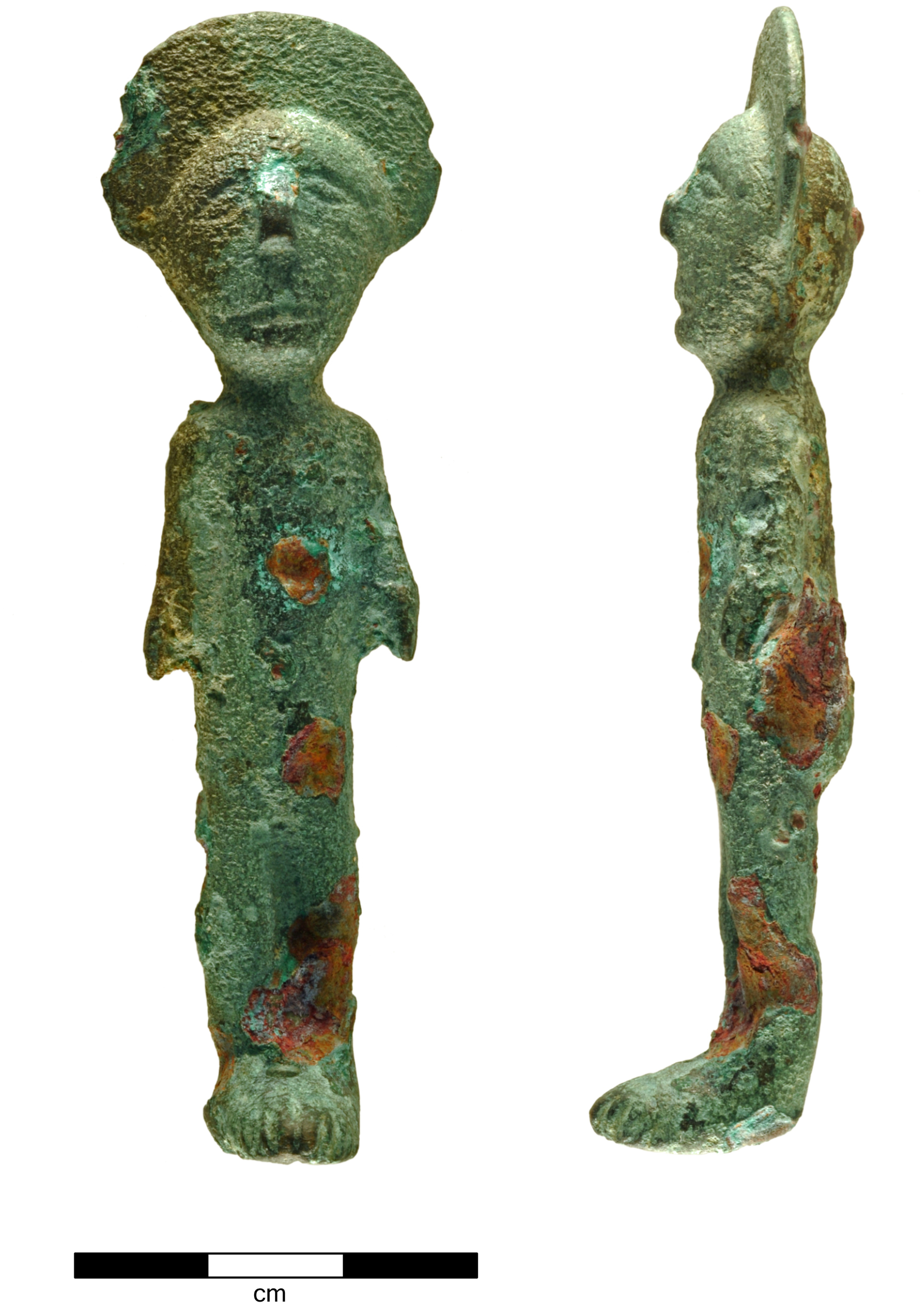
Whilst working on a thesis chapter on anthropomorphic art in England and Wales (which did not make it to the final draft), the author came across a copper alloy artefact – the West Garston figurine – that was recorded on the Portable Antiquities Scheme (PAS) in 2017: BERK-2C7233 (Figure 1). Noted as sharing characteristics with ‘several heads and busts from Iron Age Britain’ by the recorder, the figurine was classed as belonging to the Late Iron Age. Several features of the figurine could be paralleled to other more diagnostic artefacts belonging to the Late Iron Age (c. 120 BC–AD 43) and Early Roman (AD 43–c. AD 150) periods, such as the slicked-back hair with broad rim along the hairline (eg, bound captive figurine: HAMP-378231) and the simple face shape with hollowed out eyes (eg, tankard plate and handle depictions: BERK-A9109A and NMGW-A26065). However, it was less easy to find a parallel for the highly unusual style of the hand, being paddle like with a hole in the centre. The only parallel so far identified belongs to the Roos Carr wooden figurine (E. Yorkshire; Figure 2), which are potentially five hundred years older than the West Garton artefact. Could it be that the West Garton figurine is much older than it was first believed? Alternatively, could the appearance of this hand style represent a continuation of stylistic elements of early anthropomorphic imagery into Late Iron Age and Early Roman period metalwork?
BERK-2C7233: the West Garston figurine, a copper-alloy figurine with unusual paddle-like hand from Berkshire; 100 BC–AD 100; © Oxford County Council CC-BY.

Roos Carr wooden figurine, East Yorkshire; © author.

Inspired by the West Garton find, this paper will assess whether more artefacts support the notion that anthropomorphic art in the Late Iron Age and Early Roman periods in southern Britain included pre-La Tène stylistic elements seen in earlier periods in the region. This assessment will include new data from the PAS, such as the recently discovered maskenfibel style brooch from Gloucestershire (GLO-9F9743; see also Harris Reference Harris2022), which potentially pushes back the introduction of La Tène style human imagery in the UK to the late 5th to early 4th century BC.
Figurative Art in Late Iron Age Britain
The starting point most prevalent for this paper is the period in which figurative art use appears to notably increase in production, approximately at the beginning of the 1st century BC (see Lamb Reference Lamb2019; Ellis Reference Ellis, Kaercher, Arntz, Bomentre, Hermoso-Buxán, Kay, Ki, Maclead, Muñoz-Mojado, Timbrell and Wisher2020; Joy Reference Joy2011, 212). The stylistic development of animal and human imagery in the 1st centuries BC and AD is highly complex and non-linear. Animal and human figures are used to decorate swords (eg, West Row River Lark, Suffolk, Stead Reference Stead2006, no. 126; North Grimston, Stead Reference Stead1996, fig. 37), vessel fittings of various types (eg, Aylesford Bucket, British Museum (hereafter BM) no. 1886,1112.5), and are rendered into statuettes for presumed religious functions (eg, Henley Wood Temple figurine, Henig Reference Henig1996).
Accompanying this increase is a change in the use of figurative forms to decorate objects, which are also found in high-status burial contexts. The best and earliest example of this phenomenon can be found within the Baldock burial (see Fitzpatrick Reference Fitzpatrick2007). Amongst the grave good assemblage was a fire dog decorated with characterful bovine heads with capped horns, and at least one bucket decorated with humans adorned with horn-capped headdresses. Both the burial style and horn capped imagery may well have been imported from Gallo-Belgica, where it is seen in the mid-2nd century BC (see Ginoux Reference Ginoux2006). Horn capping has been theorised as both a reflection of a blacksmith’s ‘health and safety’ concern (Fox Reference Fox1958, 73) and as a symbol of religious significance, akin to a Christian halo (Green Reference Green1992, 146). Analysis of the items horn caps decorate and where they contextually and geographically occur suggests that they were an economic status marker in association with bovine imagery, which is seen beyond funerary contexts (Ellis Reference Ellis, Kaercher, Arntz, Bomentre, Hermoso-Buxán, Kay, Ki, Maclead, Muñoz-Mojado, Timbrell and Wisher2020). Therefore, figurative art in this period was not only increasing in production, but its use within society appears to have changed to one that is more complex in its purpose.
The burial at Baldock did not happen in isolation. Though depictions of humans on bucket handle escutcheons are sometimes combined with bucket bodies decorated in more simple, geometric forms, others are far more complex. The buckets from Aylesford (BM no. 1886,1112.5) and Lenham (PAS LON-E78C8A) clearly demonstrate how figurative forms (if stylised) were utilised to create active narratives (see also Ellis-Haken Reference Ellis-Haken2023b). However, on the Lenham Bucket we see not only the highly stylised and unmistakeably La Tène human imagery on the bucket handles, but also the borrowing of imagery from classical culture in the depiction of hippocampi. As the creatures who pulled Poseidon’s chariot through the waters in Roman myth, it is understandable that hippocampi may have been alluring to Late Iron Age chariot-using elites of Britain.
The borrowing of imagery from other cultures is by no means a new consideration within La Tène art studies, but in Britain this continues to develop most notably in the study of coinage, in which animal and human forms are popular and important subjects. However, around 25 BC, there is a notable change in terms of subject matter and stylistic execution from more traditional La Tène styles and figures to those of a much more classical Roman nature in both style and subject matter (see Creighton Reference Creighton2000). Art that included the depiction of animal and human forms was used as a notable socio-political tool, this time potentially demonstrating political alliances with the ever-expanding Roman empire.
Evidence clearly demonstrates that the naturalism of classical Rome and the stylistic nature of La Tène art are not diametrically opposed. Whereas vessels like trulla (eg, Staffordshire Moorlands Pan, BM no. 2005,1204.1) demonstrate this fusion of Roman vessel forms with La Tène abstract work, it is often the work of the stone mason and the metalsmith that can be argued to demonstrate fusion of these art styles in the depiction of living forms. One of the most famous examples is the Bon Marchè head from Gloucester (see Toynbee Reference Toynbee1964, pl. VIIIa), which mixes the Roman loose fringed Julio-Claudian hairstyle with the La Tène style lentoid eyes in the medium of local Cotswold stone.
Therefore, the 1st centuries BC and AD in Britain are a highly complex time for figurative art. Fusions of recognisable art styles occur at the whim of the artist, rather than in an organised or controlled manner. This, combined with the speed of socio-political change, the role of art within that sphere, and a lack of absolute dating, means we have few solid foundations on which to build our hypotheses about the duration in which these changes, and their catalysts, occurred. Several artefacts also demonstrate that the dominant art of the period actively borrowed artistic subjects and designs from previous and contemporary artistic traditions.
Approach
This paper is not going to interpret what human depictions may have meant to the Iron Age and Early Roman period populations who produced them. Instead, this paper attempts to determine from where some of the physical aspects of the imagery, such as the paddle hand of the West Garston figurine, may have originated.
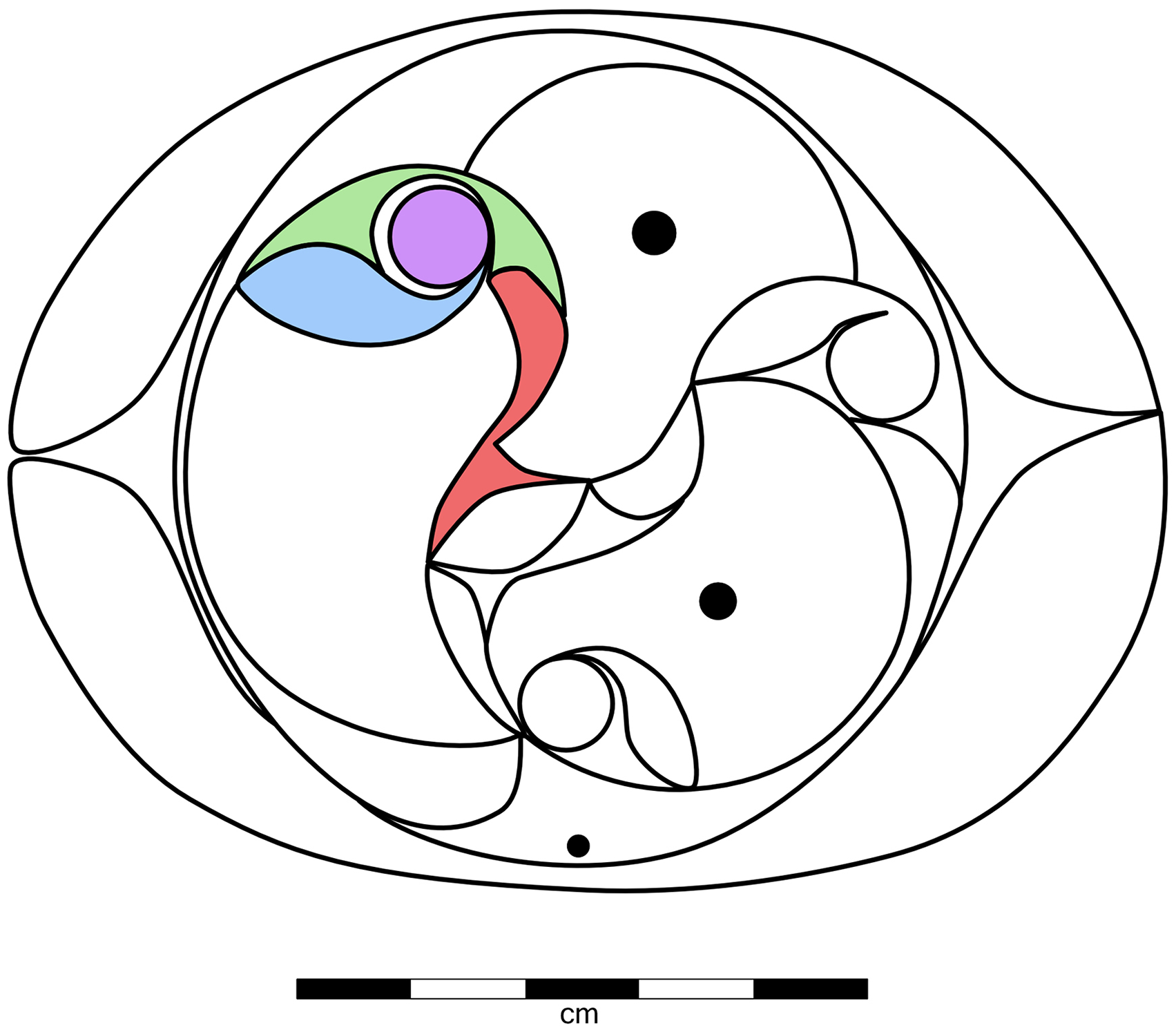
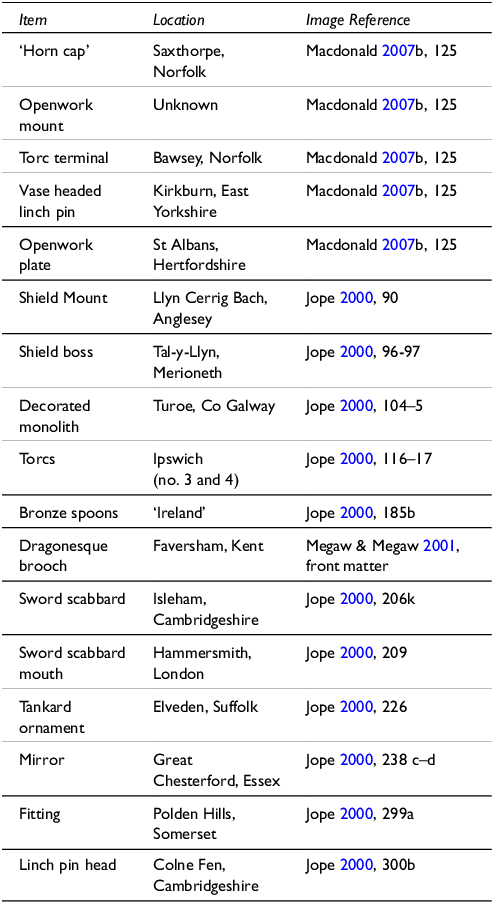
However, identifying human and animal forms in La Tène art is complex, as often they are situated amongst highly abstract motifs (see Megaw Reference Megaw1970). This is best exemplified in Britain by the example of the Llyn Cerrig Bach crescent mount (National Museum Wales no. 44.32/75) (Figure 3). It has been identified in three different ways since its discovery in the 1940’s: a non-figurative grammar of ornament (Fox Reference Fox1958, 121), a puffin (Jope Reference Jope2000, 271), and a running quadruped (Spratling Reference Spratling, Garrow, Gosden and Hill2008, 195). Two-dimensional variations of this motif have also been observed on material from the Polden Hills hoard, which have been argued to represent birds or horses (Foster Reference Foster, Gosden, Crawford and Ulmschneider2014). However, Macdonald (Reference Macdonald2007a, 123–5), in his analysis of the Llyn Cerrig Bach assemblage, rightly pointed out that this motif and its basic arrangement can be seen on numerous other examples of La Tène art in southern Britain, including linch pins and torcs, in close two- and three-dimensional variations (see also Macdonald Reference Macdonald, Haselgrove and Moore2007b, 334). When broken down into the arrangement of shapes of the central sphere, an underlying teardrop and an over-arch, I have managed to identify at least 17 further artefacts with this motif in the UK (see Table 1). None of these other artefacts have previously been identified as being decorated with a bird, despite sharing this same motif construction (if smaller). We therefore have inconsistency in the identification of figurative forms amongst the highly abstract. Furthermore, there is no discussion on how these highly abstracted forms may relate to figurative forms, such as is seen in the use of bird styles in England and Wales (see Ellis-Haken Reference Ellis-Haken, Warmenbol and Coa-Van2023a). In recognition of these problems, this work specifically moves the focus away from these highly abstracted examples until these problems with consistency in identification can be rectified and focuses instead on tracing the histories of specific physical attributes of human images.
Illustration of the motif construction of the Llyn Cerrig Bach Crescent mount found, Anglesey, Wales; diameter: 180 mm; c. 200 BC–AD 50; © author.

Examples of artefacts decorated with the same motif construction as Llyn Cerrig Bach crescent mount

Identifying relationships among artefacts requires multi-proxy analysis. It is not just about looking at the physical aspects, it is also important to consider contexts, dating evidence, object biographies, and distributions (to name but a few data strands). This is essentially the evidence-based approach already taken in several recent studies of prehistoric artefacts, from Olmsted’s (Reference Olmsted2001) analysis of silver working in Iron Age Western Europe, to Jones’ and Díaz-Guardaminos’ (Reference Jones and Díaz-Guardamino2019) analysis of the production of images in the British Neolithic, both of which have notably challenged the accepted narratives of their fields.
This approach may also challenge our scales of interpretations. There is an acceptance of variability and regionalism in the depiction of abstract motifs throughout Europe within La Tène art, such as the characteristic compass-based Early style pieces of the Somme-Bionne region (eg, Lenerz-De Wilde Reference Lenerz-De Wilde1977), or the recognised variations between east and west European Sword and Plastic sub-styles (see Harding Reference Harding2007, 93–140). Yet, there is a lack of exploration or acceptance that similar regional variability exists with naturalistic forms, and there is a habit of interpreting any potential symbolism imbued within art on a pan-European scale due to the assumptions that said symbolism was homogeneous throughout Celtic Europe (eg, Green Reference Green1992). However, more unusual zoomorphic artefacts clearly demonstrate that regionality is present in the depiction of genuinely figurative forms within La Tène period figurative art in Britain. The East Anglian conical fittings, for example, have stylised bovine and birds with clear anatomical details, such as beak shapes, horns, and eyes that leave little doubt of their identification (see Ellis & Lamb Reference Ellis and Lamb2019). Therefore, it is entirely possible that further regional patterns in the depictions of both animals and humans could exist in Britain, if not wider Europe.
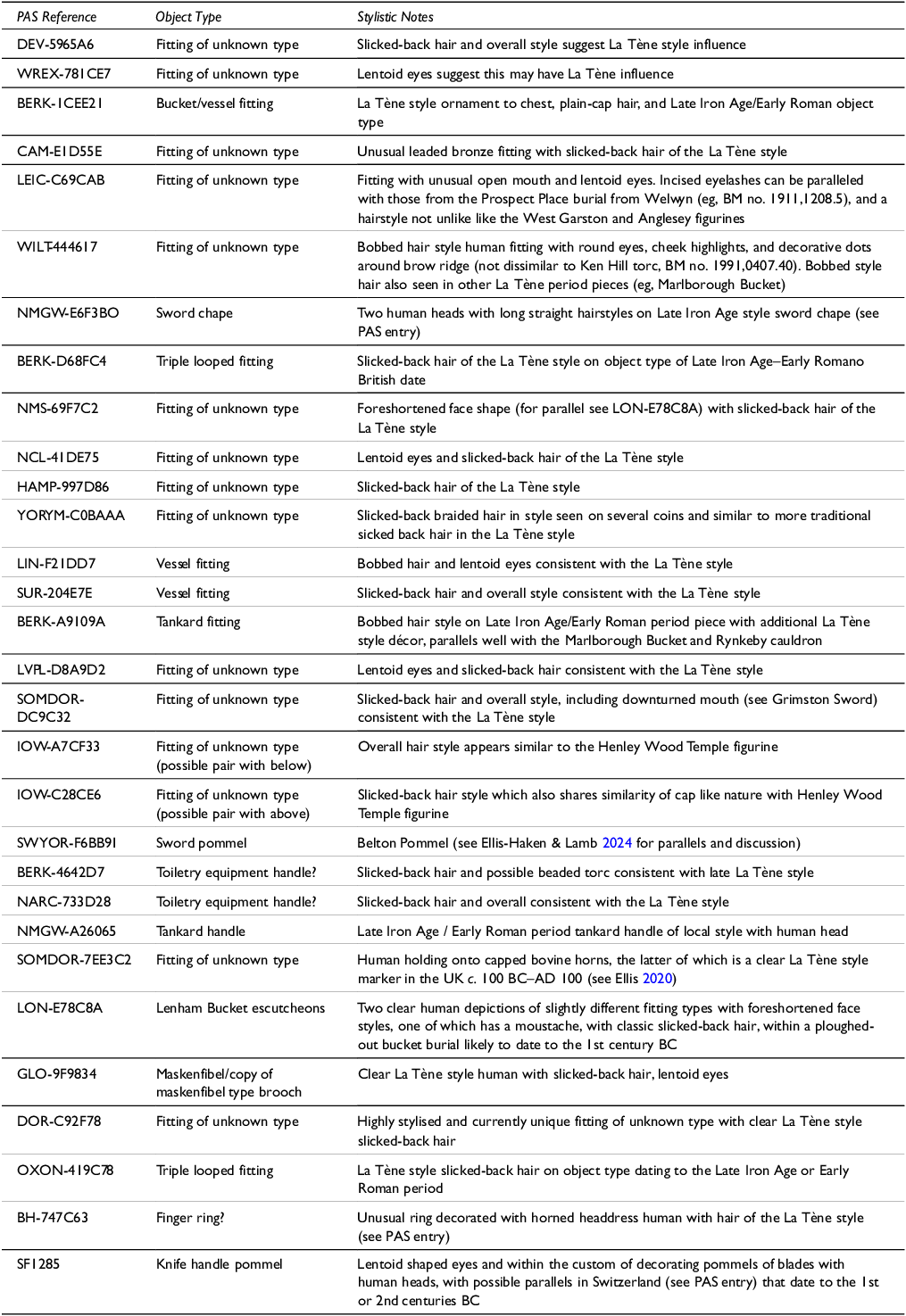
A lack of ability to perform absolute dating on much of British La Tène decorated artefacts has limited attempts to define a linear evolution of abstract motif development in the UK (see Macdonald Reference Macdonald, Haselgrove and Moore2007b), and subsequently the development of figurative art has also remained largely unconsidered. However, a wealth of new artefactual data on the PAS database, including new human depictions with clear affinities with the European La Tène style, makes this an area with significant potential for new advances in interpretation (see Appx 1). Though some of the artefacts in Appendix 1 may have been produced after the Claudian invasion of AD 43, stylistically they relate to La Tène rather than classical Roman styles (through comparison with well-dated and well-recognised continental examples, including features such as eye shape and hair styles). With the wealth of new data available, it is entirely possible that our current theories regarding the development of anthropomorphic art in England and Wales during the Iron Age, and the origins of inspiration and development of the physical aspects of it, may no longer be accurate.
Anthropomorphic depictions in stone and wood
Anthropomorphic depictions in stone and wood have been recognised in the Neolithic, Bronze, and Iron Age periods in the UK. Coles’ Reference Coles1990 publication summarised the then-known wooden figurines dated from the Late Neolithic to the middle Iron Age and identified several consistencies, such as the lack of depiction of definitive biological sex indicators and the unevenness of eyes/repeated damage to the left side of the faces. Some patterns in the construction of the forms were particularly noteworthy, since these artefacts were not closely related geographically or chronologically (Coles Reference Coles1990, 330–2).
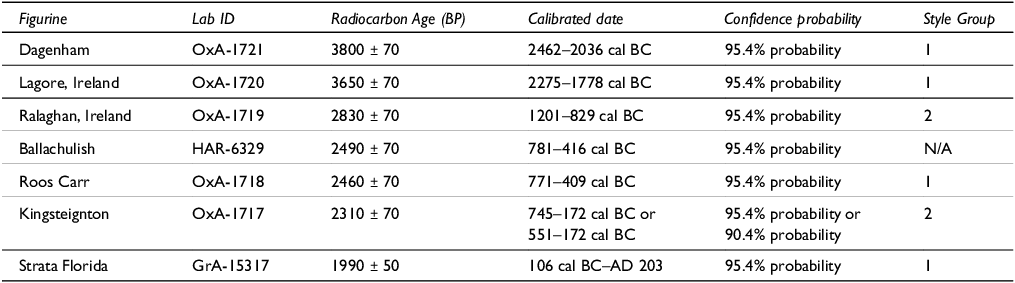
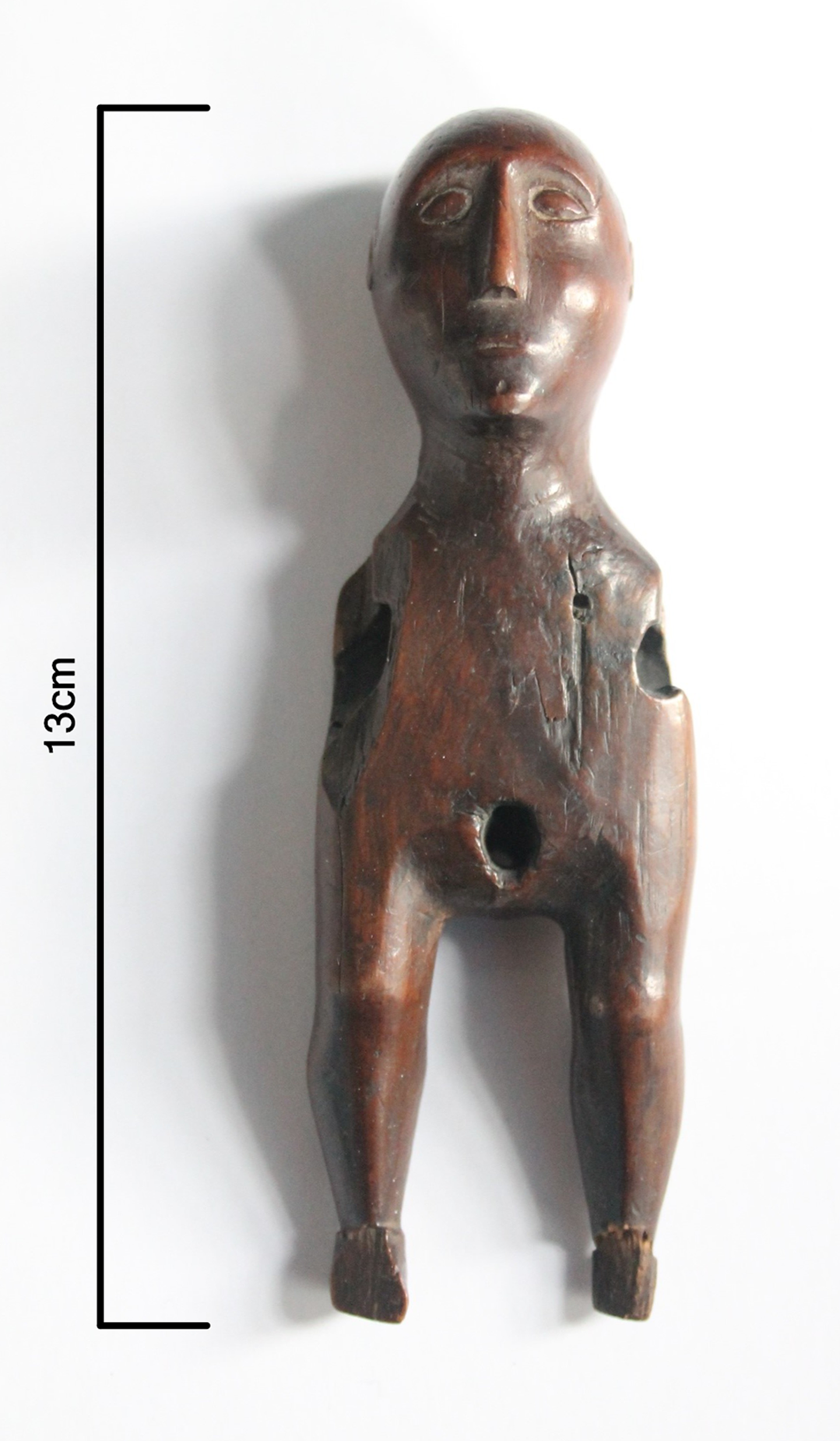
Van der Sanden and Turner (Reference Van der Sanden and Turner2004) discussed the context of the more recently discovered Strata Florida Manikin, a wooden figurine that shares stylistic elements with some of the figurines that Coles discussed. Based on its radiocarbon date (GrA-15317, 1990± 50 BP, 106 cal BC–cal AD 203, 95.4% probability; van der Sanden & Turner Reference Van der Sanden and Turner2004, 89), the Manikin was likely made in the 1st centuries BC and/or AD, during the period of increased production of figurative La Tène art (Lamb Reference Lamb2019; Ellis Reference Ellis, Kaercher, Arntz, Bomentre, Hermoso-Buxán, Kay, Ki, Maclead, Muñoz-Mojado, Timbrell and Wisher2020). Yet, this figurine has never been considered part of the La Tène art tradition and, as will be suggested below, it stylistically relates much more closely to wooden idols of an earlier date.
It is unsurprising to find prehistoric wooden figurines in England and Wales from the Iron Age and earlier periods, since anthropomorphic wooden figurines are well recorded in Europe. Perhaps the most well-known Iron Age wooden figurines are idols from religious contexts, such as that mentioned in the poetry of Lucan who described an encounter between Caesar and his soldiers and a Gaulish sacred grove on the outskirts of Marseille in 48 BC (Pharsalia III, 399–453; see also Aldhouse Green Reference Aldhouse Green2004). Other figurines from the continent are dated to the La Tène period, such as those from Oldenburg in northern Germany (3rd century BC; Aldhouse Green Reference Aldhouse Green2004), those within later Romano-Gallic sanctuaries from Fontes Sequanae (Dijon; Deyts Reference Deyts1983), and those more tightly dated to the 1st centuries BC and AD from Source de-la-Seine.
It is generally believed that there is no known evidence to suggest that La Tène art specifically from England and Wales inherited significant aspects of preceding figurative art styles. However, the paddle-like hand of the West Garston figurine, which is so far only paralleled to the Roos Carr figurines, challenges this. To assess this idea afresh, this paper will now discuss pre-La Tène and then La Tène period human imagery in detail with the goal of identifying specific stylistic markers. These will then be used to analyse figurines like that from West Garston in more detail to try and ascertain the stylistic influences which led to their creation.
Pre-La Tène anthropomorphic imagery
Anthropomorphic imagery in Neolithic Britain (c. 3800 BC–2500 BC) appears to be regionally specific to the unique settlement patterns and stone image production in Orkney (see Jones & Díaz-Guardamino Reference Jones and Díaz-Guardamino2019, 139). Due to this regionality, unique styling, and specific medium, they will not be discussed here. The present study further excludes the figurines from Ballykilleen (Ireland) dated to the Bronze Age, which are recognised as their own regional sub-group (see Stanley Reference Stanley2012), and the East Yorkshire chalk figurines dated approximately to the 3rd to 1st centuries BC, due to their highly fragmented nature. Therefore, the discussion will predominately focus on those finds from England and Wales, allowing use of PAS data (though other examples from Ireland and Scotland will be mentioned for context).
Table 2 summarises the pre-La Tène anthropomorphic figurines which form a crucial part of this study and are directly dated. The Somerset God Dolly is not considered here, because its suggested date derives from the Sweet Track (wooden trackway) next to which it was found (see Coles Reference Coles1990).
Summary of dated wooden figurines in the UK and Ireland, split into stylistic groups, organised by date; data derived from Coles Reference Coles1990 and van der Sanden & Turner 2004

The dates of the Kingsteignton Idol (Coles Reference Coles1990, 362) (Figure 4), Roos Carr figurines (Figure 2), and the Strata Florida Manikin (Figure 5) demonstrate that anthropomorphic wooden figurine production and La Tène art likely co-existed in the 4th century BC through to the 1st centuries BC and AD. This means that the transfer of aspects of pre-La Tène anthropomorphic imagery into La Tène metalwork is theoretically possible, even within the wide dating estimations provided by the recalibration of radiocarbon dates. Potentially this also provides greater context for the lentoid-shaped eyes on the Strata Florida Manikin, which may be an influence from La Tène art onto the wooden figurine tradition.
Kingsteignton figurine, Devon; height 34 cm; 426–352 cal BC; © Sibelco/Royal Albert Memorial Museum & Art Gallery, Exeter City Council.

Strata Florida Manikin, Cardiganshire, Wales; © Amgueddfa Ceredigion, reproduced with permission from Camarthenshire Museum.

All the figurines assessed here are consistent in the depiction of heads with no discernible hairstyles. Other features, however, allow these artefacts to be loosely classified for the purpose of analysis for this paper. Group 1 figurines are consistent in the portrayal of a hole in the pubic area. The examples that have no arms, from Dagenham and Ralaghan, are the earliest dated examples. Those with arms (Roos Carr and Strata Florida) also had the ability to hold accessories such as shields (see Coles Reference Coles1990, 318). The boat and feet of the Roos Carr figurines, and the feet of the Strata Florida Manikin, also indicate that they were designed to stand on a base. A further pattern of note is that, apart from the Ralaghan figure, the size of depictions with these characteristics seems to diminish over time.
Previous analysis of the Roos Carr figurines has suggested that the holes in the pubic area may have held detachable penises (Coles Reference Coles1990, 318). It is therefore possible, based on this suggestion, that these figurines were gender ambiguous or could be gender flexible (if depicting genitals was a key party of portraying sex or gender in prehistory, which we cannot guarantee they were). This possible flexibility in gender may be seen as not dissimilar from the Somerset God Dolly, which may also demonstrate gender ambiguity in a fixed dual-state of depicting both penis and breasts.
The figurines in Group 2 are distinctly male in the depiction of small upright penises. Furthermore, the legs of these figurines appear to be purposefully shortened in relation to their body proportions. The holes in the neck of Kingsteinton also suggest these may have been depicted with arms.
The Ballachulish figurine from Scotland shares the lack of hairstyle and is depicted with arms but is different from the other groups by being portrayed with female genitalia.
Even though the variation in the depiction of genitalia and what it potentially means is debateable, what cannot be ignored is the consistency in features depicted over several millennia, particularly those outlined here as Group 1 (lack of discernible hairstyle and holes in the pubic area, whatever their purpose) and Group 2 (clear male genitalia with foreshortened legs). This does potentially suggest the possible existence of two semi-standardised methods of producing anthropomorphic figurines which has not been fully recognised before. Of further importance is that examples of both Group 1 and Group 2 figures continued to be made into the Middle Iron Age.
La Tène style anthropomorphic imagery in England and Wales
If stylistic elements from any potentially surviving characteristics of pre-La Tène anthropomorphic imagery are to be identified, then we also need to identify those which derive from La Tène art. As demonstrated in Appendix 1, there are too many examples to discuss in detail, so instead this paper will focus on those which are better dated through their contextual associations or studies related to their artefact types.
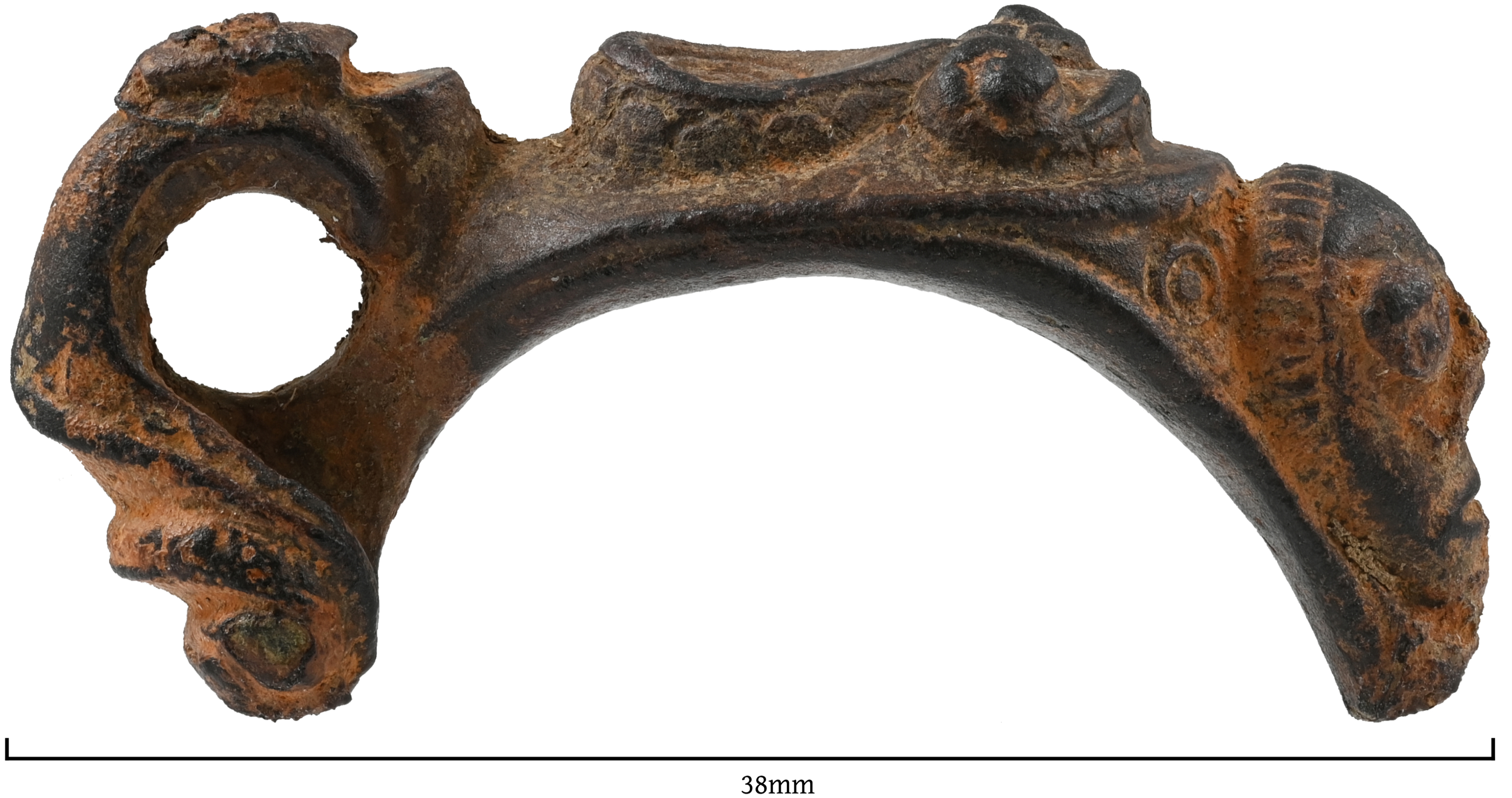
The understanding of La Tène style human depictions has recently been subject to scrutiny thanks to the reporting of a Maskenfibel type brooch by a metal detectorist in Gloucestershire. Usually made of copper alloy, though also occasionally decorated with other materials like coral, Maskenfibeln are generally known for being decorated with animated animal and human characters. They can vary enormously in their overall compositions, designs, and stylisation (Megaw Reference Megaw1982, 27). The focus of their development appears to be broadly in southern Germany, although examples have now been found as far east as Slovenia (Megaw Reference Megaw1982; Bagley & Schumann Reference Bagley, Schumann, Karl and Leskovar2013). Interpreted as prestige items, they have been found in a variety of contexts including graves and settlement sites (Bagley & Schumann Reference Bagley, Schumann, Karl and Leskovar2013). No examples of this type of brooch had previously been identified in the UK, until the reporting and donating of GLO-9F9843 (Figure 6) to the Corinium Museum (Cirencester, UK).
GLO-9D9843: copper alloy Maskenfibel style brooch decorated with human head from Gloucestershire; length: 38 mm; © R. Ellis-Haken and the Corinium Museum.

It must be said that this brooch is not typical. The terminal where the foot of the brooch meets the body appears non-naturalistic in style (rather than a human or animal head), and the central body decoration comprises of an unusual abstract lyre and loop. However, the decoration on the edges of the lyre and loop can be paralleled to other early La Tène art pieces, where similar border filling occurs with a variety of shapes. Examples include daggers belonging to the Thames school (eg, Minister Ditch, Oxford, see Jope Reference Jope2000, pl. 18) and along the edges of the Wisbech scabbard. I hypothesise that this brooch was made in Britain, because there are too many stylistic inconsistencies with material from Europe. Despite its slight unusualness, which may have occurred because of someone in Britain wanting to copy the Maskenfibel fashions of the continent, this brooch can be stylistically dated to around 450 BC–380 BC, making it the earliest La Tène style human image currently known in the UK.
This brooch is not the only evidence in Britain that demonstrates that design elements of Maskenfibeln made it to Britain, even if we have an absence of the physical objects themselves. The author’s (Ellis-Haken Reference Ellis-Haken, Warmenbol and Coa-Van2023a) Early Bird Style Ia in England and Wales appears to derive directly from birds seen on Maskenfibeln (eg, Jacobsthal Reference Jacobsthal1944, nos 291 & 298), and the earliest example of this can be seen on the recently discovered Burnby Lane brooch from Pocklington (360–275 cal BC; see Stephens Reference Stephens2023).
The clean-shaven face and slicked-back hair of the human depicted on GLO-9F9843 is typical of perhaps one of the most common styles of human imagery known in La Tène Europe. This style can be seen on other Early Style pieces such as the head in the mouth of the lion on the Dürrenberg flagon (see Olivier Reference Olivier, Gosden, Crawford and Ulmschneider2014), whilst it is also seen on later pieces of the 1st century BC, such as one of the portraits on the Marlborough Bucket (Wiltshire; Figure 7). Stylistically, it therefore originates in La Tène Europe. When seen on metal figurines and stone statuary from La Tène and classical art contexts (eg, the Dying Gaul), this face is generally deemed as male.
Male figure with slicked-back hair on Band 2 of the Marlborough Bucket, Wiltshire; © R. Ellis-Haken, M. Haken, and Wiltshire Museum 2022.

The next reasonably well-dated human depictions are found on anthropomorphic sword hilts. The best known from England and Wales are the examples from North Grimston (Stead Reference Stead1996, fig. 37), Shouldham (Stead Reference Stead2006, no. 217), and one of unknown provenance in the British Museum (BM no. 1888,0719.36). These finds tend to be portrayed with either short, slicked-back hair, the outline of hair, or clean-shaven heads with no discernible hairstyle. Clean-shaven heads are known throughout La Tène art in Europe, from the 4th century BC helmet from Umbria(?), Italy (Megaw & Megaw Reference Megaw and Megaw2001, 110, fig. 149) through to the 1st century BC knife handle from Zemplín (Czechia; Megaw & Megaw Reference Megaw and Megaw2001, 164). Though perhaps less common, they are not unusual. Whilst they could therefore be a La Tène style import to Britain, human depictions with clean-shaven heads could equally be based upon the hairless heads seen on pre-La Tène wooden figurines.
However, a recent find from England also demonstrates the variability of the human styles used to decorate this well-known class of objects. The sword pommel from Belton (Lincs; PAS SWYOR-F6BB91) (Figure 8), discovered and reported to the PAS in 2019, demonstrates a longer hair style with a flick at the end. This may indicate that this is a depiction of a female rather than male form, as can be seen elsewhere in Europe, and can again be safely identified as a La Tène style import (see Ellis-Haken & Lamb Reference Ellis-Haken and Lamb2024 for full discussion which includes gender association).
SWYOR-F6BB91: copper-alloy anthropomorphic sword hilt potentially depicting a female hairstyle from Lincolnshire; 2nd century BC; © West Yorkshire Archaeology Advisory Service CC-BY.

This increase in stylistic variation of human forms continues into the period of increased production in the 1st centuries BC and AD, with the introduction of two female forms, both of which can be seen together on the Marlborough Bucket, and which have clear parallels in Europe (see Ellis-Haken Reference Ellis-Haken2023b). The first is a bobbed hairstyle which terminates at the chin and occasionally has a curl at the hair end (eg, WILT-4444617 and LIN-F21DD7; for parallels on coins in conjunction with clear female anatomy, see Delestrée & Tache Reference Delestrée and Tache2002, nos 309–10). The second longer hairstyle is rarer (eg, NMGW-E6F3B0). Parallels recognised with female anatomy and similar longer hairstyles include a statuette from Neuvy-en-Sullias (France, see Megaw & Megaw Reference Megaw, Megaw, Garrow, Gosden and Hill2008, fig. 278), and several Gaulish coins issues (eg, Catalogue de Bibliothèque nationale de France FRBNF44805480; for other examples of longer hairstyles with female anatomy on coins see Ellis-Haken & Lamb Reference Ellis-Haken and Lamb2024, fig. 9).
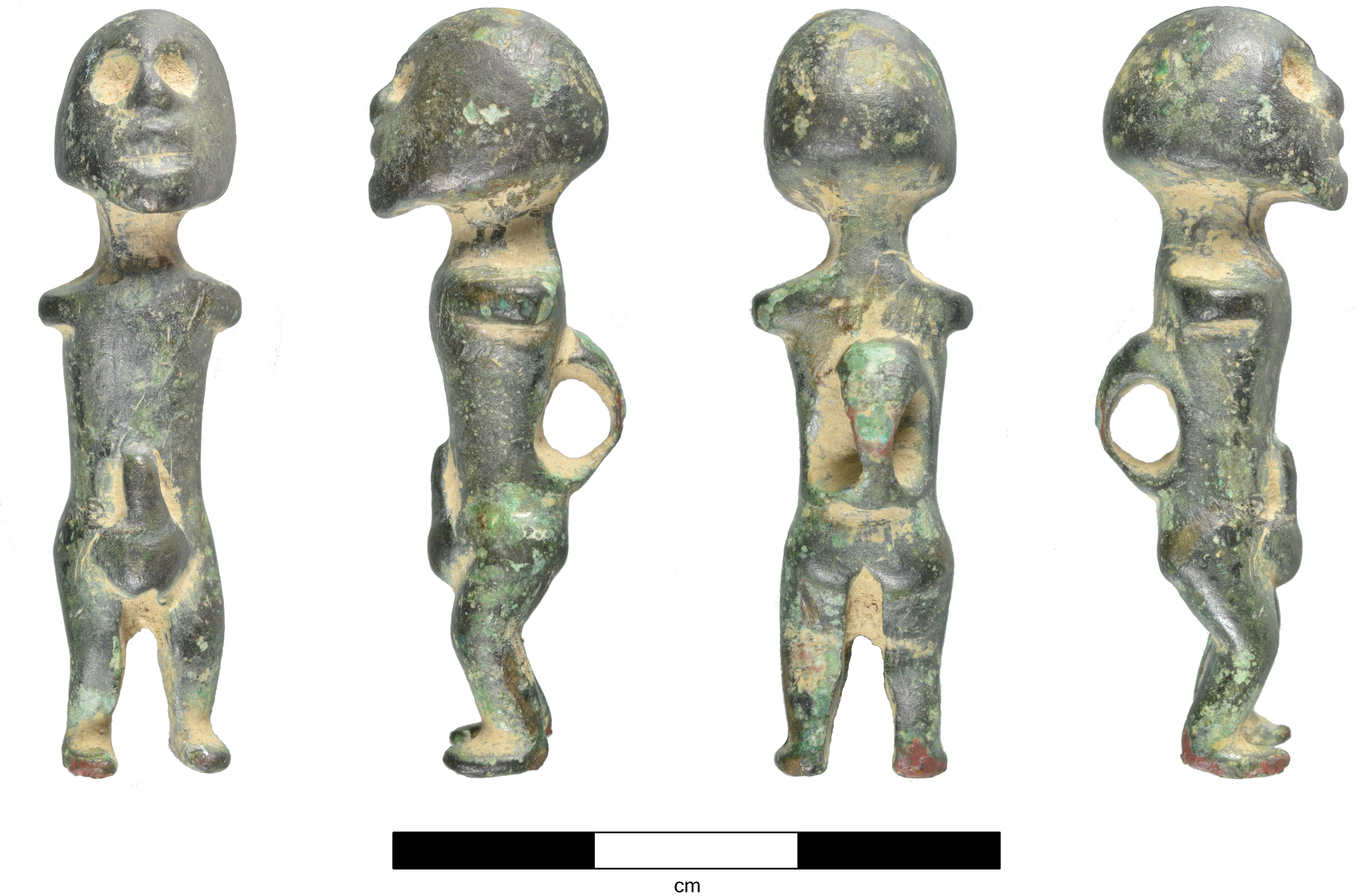
SF-9B73E9: the Little Chishill figurine, copper alloy pendant type figurine which appears to be in the pre-La Tène Group 2 style from Cambridgeshire; 100 BC–AD 100; © Suffolk County Council CC-BY.

The Marlborough Bucket also includes the addition of borrowed Roman hairstyles, which can be paralleled to the anthropomorphic sword hilt from Staré Hradisko (Czechia) that was probably originally made in Gaul (see Megaw & Megaw Reference Megaw and Megaw2001, no. 264). In Britain, this trend of depicting adopted Roman hairstyles continues (though less well dated) on objects such as Triple Looped Fittings which show a looser fringe variation (eg, PAS nos YORYM-CC4873 and NARC-565894).
As previously mentioned, in the 1st century BC human depictions are displayed with various forms of headgear, as demonstrated by the caprid-like horns of the bucket escutcheons from Malmains Farm, Alkham (Kent, BM no. 1990,0701.11.a, see Philp Reference Philp2014), the escutcheons from the buckets from the Baldock burial (see Fitzpatrick Reference Fitzpatrick2007), the Aylesford Bucket (BM no. 1886,1112.5), and the recently discovered Puckeridge ring (of possible 1st century BC or AD date, PAS BH-747C63). Moustachioed males are also known (with some slight stylistic variations), such as the three heads from the Prospect Place burial in Welwyn Garden City (BM no. 1911,1208.5-7) and the more recently discovered Lenham Bucket (PAS LON-E78C8A). This variation does not include the depiction of human forms on coinage, which require a dedicated study (Sills Reference Sills2017, 3).
The use of the La Tène style also continues onto objects which are more likely Early Roman in date, such as slave figurines (eg, PAS HAMP-378231), reminding us that something of La Tène style may not necessarily strictly be of Late Iron Age date. This does admittedly cloud the situation regarding dates of material, hence the focus here on styles and their original cultural origin. It is also another reason for being cautious in approaching any interpretative meaning of human depictions in this paper.
To summarise, La Tène style anthropomorphic imagery in England and Wales is highly complex and variable and includes both the depiction of male and female forms. Stylistically, several features aid in our identification of this style. Hairstyle is a very useful feature, as already discussed in relation to the Marlborough Bucket and the Belton anthropomorphic sword hilt. Artefacts such as possible pin heads (HAMP-997D86, WILT-444619, and DOR-C92F78), a tankard plate (BERK-A9109A), and a bucket fitting (SUR-204E7E), also challenge our preconceptions when it comes to the use of lentoid eyes. Despite all having identifiable La Tène hair styles, none of these artefacts have lentoid eyes. When combined with the evidence of lentoid eyes used on the Strata Florida Manikin, this suggests that lentoid eyes should not be used on their own as a diagnostic marker of the La Tène art style.
Though it is admittedly a small sample size, this paper has suggested that based on current evidence, it is possible that wooden figurine production and La Tène style human depictions do overlap chronologically. It has also suggested that aspects of the La Tène art style may have been used on figurines not of the same artistic school (ie, Strata Florida). This paper will now assess whether other identifiable aspects of pre-La Tène imagery can be identified as having been transferred to metalwork, as the initial analysis of the West Garston figurine has suggested.
Investigating pre-La Tène influences on anthropomorphic imagery of the 1st centuries BC and AD
This analysis focuses on figurines that display the whole human form, which allows us to analyse three key areas: hairstyles, bodily components like arms and feet, and biological sex indicators. All these characteristics have been demonstrated to be important components for the assessment of both pre-La Tène wooden figurines and humans in the La Tène art style.
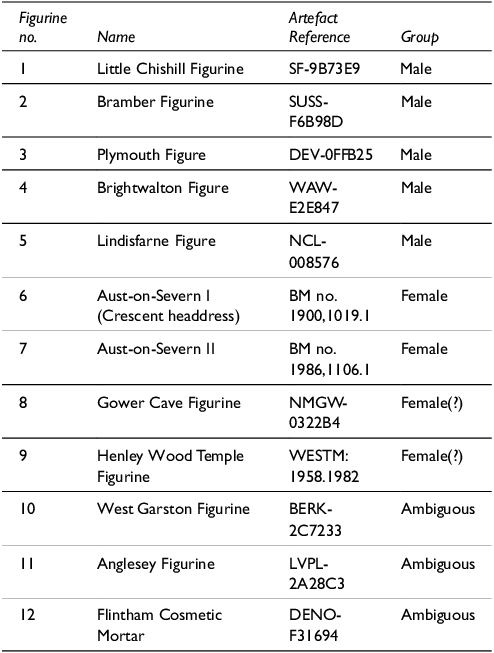
This paper initially identified 18 examples of full figurines suitable for study from England and Wales (Table 3). These were identified through their artistic characteristics (ie, La Tène), object type, and suggested date. It is possible that these figurines may date from the 1st century BC or 1st century AD. Of this initial group, five depictions were of enslaved individuals with bound hands and feet in (often) a crouched position. These were excluded since biological sex indicators were not clearly visible, in addition to the fact that it is unclear whether this imagery may be imported from Rome rather than being an insular development. A sword chape (PAS DUR-8474E1) was also discounted, as it is not clear whether the shape of the chape is intended to be a depiction of a human body or not. This left a sample of 12 figurines, all cast in copper alloy; two were potentially manufactured as pendants (nos 8 and 9) and one is on the back of a crescentic cosmetic mortar (no. 12).
Summary of 12 La Tène period metalwork anthropomorphic figurines in England and Wales

Nine of the 12 artefacts discussed here were reported to the PAS by metal detectorists, further highlighting the vital importance of PAS data in these kinds of artefactual studies. However, this also means they are without context. The same is also true for the pair of figurines from Aust-on-Severn (Gloucs, nos 6 and 7), which were recovered and reported in the early 20th century. Only one example, from Henley Wood Roman Temple (Somerset, no. 11), can be dated via its context to the late 1st century BC or 1st century AD (Watts & Leach Reference Watts and Leach1996). The other figurines and cosmetic mortar are thought to belong to the 1st centuries BC or AD (for dating of cosmetic mortars see Jackson Reference Jackson2010).
The most readily available variable by which to separate these figurines to analyse them was through their display of biological sex indicators. This is a classification of modern convenience rather than being argued to reflect a genuine Late Iron Age/Early Roman period ontology.
Males (nos 1–5)
Male figurines, defined through the clear portrayal of a penis in addition to a flat chest, make up almost half of the figurines.
The Little Chishill figurine pendant (SF-9B73E9, no. 1; Figure 9) has previously been described as an unusual piece belonging to the Roman period (see PAS entry). However, the lack of discernible hairstyle, the lack of arms, the small upright penis, and the shortened legs can clearly be directly paralleled to the anthropomorphic wooden imagery previously discussed in this paper, specifically the Group 2 Lagore and Kensington figurines. It is also incredibly different in style, size, and composition to other Romano-British human figurines of the period, such as those of the South Broom Hoard (see Durham Reference Durham2012). It is therefore possible that this figurine represents direct evidence for the continuation of the style of figurines from the tradition preceding the introduction of La Tène and classical art.
A parallel with this figurine was also reported to the PAS: SUSS-F6B98D (the Bamber figurine, no. 2). Though this example does not survive well, it also has no discernible hairstyle, penis, and shortened legs, though this time with the addition of arms. This again could also be a product of the same artistic influences.
The other figurine potentially related to these is DEV-0FFB25 (no. 3). Found during the excavation for a garage extension in 1984 and recorded ten years later, the figurine appears to show a male with clean shaven head, a small penis, and shortened legs. The overall profile is very similar to SF-9B73E9. However, one hand points to the genitalia, which may suggest this piece comes from an artistic tradition more Roman than local or La Tène.
The last two figurines in this group appear to be of a slightly different class. PAS nos WAW-E2E847 (no. 4) and NCL-008576 (no. 5) are damaged but are interpreted as male horse-and-rider figurines. WAW-E2E847 is perhaps more interesting, because it seems to show a form of slicked-back hair, which clearly suggests that it has La Tène style influence. There are no clear aspects to these figurines that suggest they may be related to the pre-La Tène anthropomorphic tradition.
Therefore, some male figurines analysed here appear to illustrate connections to the proceeding anthropomorphic tradition, demonstrating that the West Garston figurine may not be as unique as it first appeared.
Female and probably female (nos 6–9)
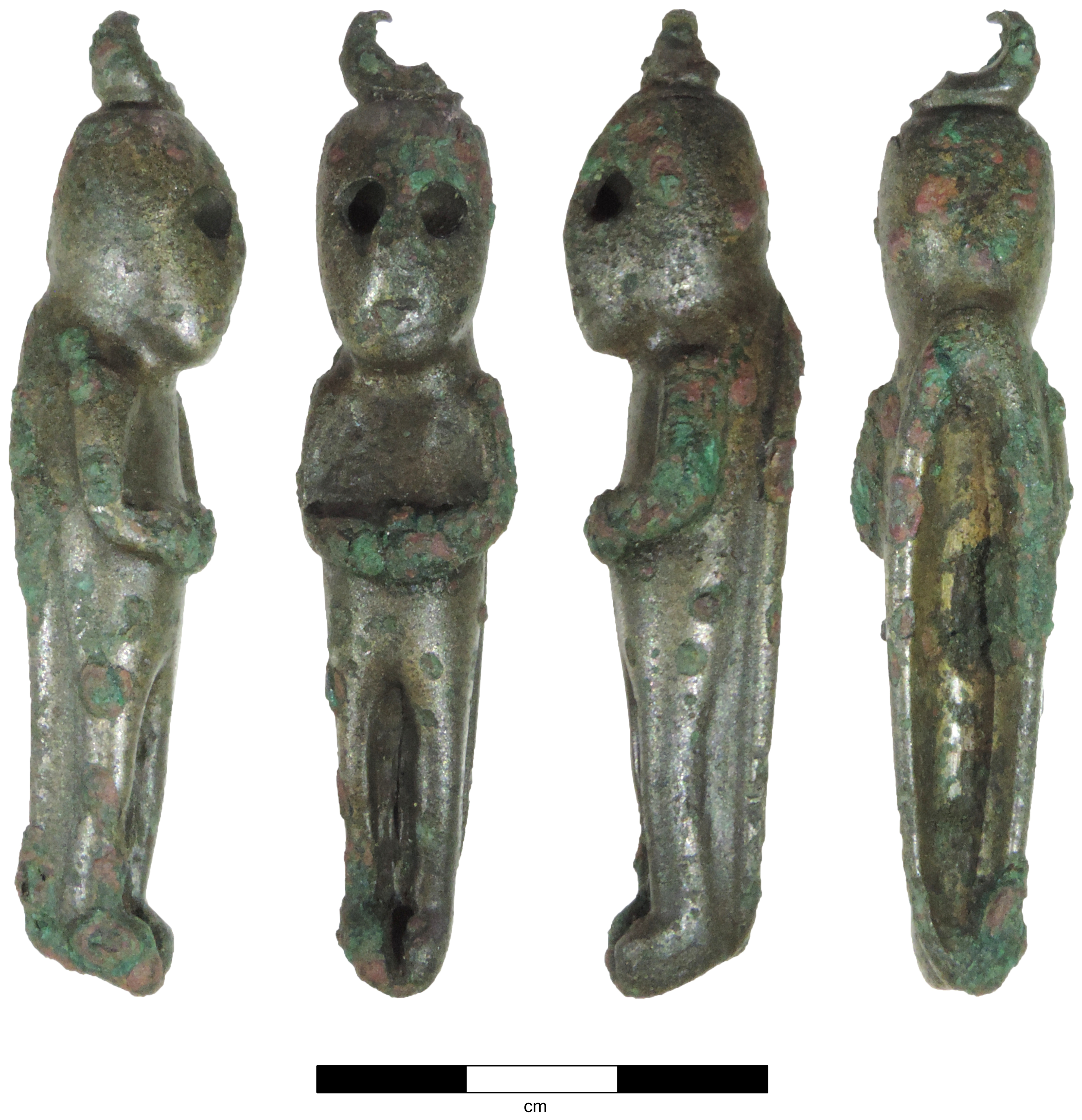
The Aust-on-Severn figurines are somewhat of an artistic enigma in Iron Age Britain (nos 6 and 7). Found in the early 20th century separately, though from the same area, the pair appear stylistically linked. Previous researchers have suggested that these might have an Iberian origin, but there is no stylistic reason to discount them as products from England or Wales (Cunliffe Reference Cunliffe2005, 472). This potential British origin was further supported by the find of an almost matching crescentic head-dressed figurine from the coast of Swansea in 2016, the Gower Cave figurine: NMGW-0322B4 (no. 8; Figure 10). It is therefore possible that the Aust-on-Severn and Gower cave figurines represent a hitherto unrecognised, if rare, British phenomenon, though this will only be confirmed with more examples.
NMGW-0322B4 the Gower Cave figurine, copper alloy figurine with crescentic headdress, presumed female due to close stylistic likeness to BM no. 1900,1019.1 from Swansea; © The Portable Antiquities Scheme CC-BY.

The Gower Cave figurine is more notable for two reasons. Firstly, this figurine also has a pin hole in the foot, demonstrating that it was likely meant to be displayed on a base, not unlike some pre-La Tène figurines. However, what is perhaps most interesting is that the biological sex markers of this figurine are absent compared to the Aust-on-Severn counterparts, which have clear breasts. Is this a result of the pitting of the surface caused by the marine environment it was recovered from, or is this an element of gender ambiguity? Unfortunately, we cannot be sure.
The Henley Wood Temple figurine (no. 9, WESTM: 1958.192) has very slight indications of breasts and is therefore thought to be female. It is also adorned with a beaded torc, suggesting and demonstrating the continued development of this style of figurative art in what is traditionally seen as the early ‘Roman’ period. However, the hairstyle of this figurine is unusual, described as ‘a plaited band around her hair’ (Henig Reference Henig1996). Unlike other examples of female La Tène hair, such as those on the Marlborough Bucket, this hair does not appear as though it originates from the scalp in a natural way. The thick outline makes the hair look almost cap like. However, with no other parallels to compare it to, there is little more that can be said.
It has therefore been difficult to find any strong stylistic relationships between these figurines and the pre-La Tène anthropomorphic tradition, though fittings of the feet do suggest they may have been displayed in a similar, possibly universal way. The author has also been unable to find close parallels between these heads and headdresses and examples of female forms from La Tène Europe. Therefore, based on current evidence, the female figurines appear to be somewhat independent in style from the rest of the sample, possibly representing a regional tradition, given their south-westerly distribution. However, only well-contextualised and dated finds will be able to confirm this in the future.
Ambiguous figurines (nos 10–12)
Three figurines appear to be gender ambiguous, and on this basis will be discussed individually.
BERK-2C7233 (no. 10)
Let us return to the West Garston figurine which prompted this investigation. The first notable feature is the paddle-like hand with a hole in the centre, which cannot yet be paralleled by any other La Tène style or period figurine in metalwork. If we parallel this to Roos Carr directly, then it suggests that this figurine was made to be able to hold an accessory. Though we are generally used to seeing accessories moulded as a fixed part of human depictions, as with the torc of Wimpole Man (Oxford Archaeology 2021), the beaded torc of the Henley Wood Roman Temple figurine, and PAS LVPL-2A28C3 (discussed below), evidence does potentially exist for separate items which could be attached. Is it possible that miniature artefacts like the shields from Nettleton Top and the Salisbury Hoard could have also been used as figurine accessories (see Farley Reference Farley2011 and Stead Reference Stead1998 for overviews of the assemblages)? Some of the Salisbury Hoard shield handles are bent, as though they have some damage or wear from being mounted (see BM no. 1998,0401.20, BM no. 1998,0401.17). It is therefore possible that some miniature weaponry may have had some further purpose, though if they were meant to be attached or used in combination with wooden counterparts our chances of finding evidence to definitively prove this remains slim.
What is distinctly different about this figurine compared to others discussed here is that it shows a human that is clothed, which is so far unique in England and Wales (if this is Late Iron Age in date as well as style). Furthermore, the hair has a broad rim which is rather unnatural compared to other examples of hair depictions from this period. It is described as sitting flat across the brow and tapering to the point at the base of the neck, but the overall shape was deemed so unusual by the identifier that they also questioned whether it may be a depiction of a helmet or mask (see PAS entry). Though of a different shape, it appears as unnatural as the female figurine from Henley Wood Temple.
However, this potential of the depiction of applied design aspects deserves further exploration due to the unique presence of clothing. Given the closeness to anthropomorphic wooden imagery in the form of the hand and gender ambiguity provided by the clothing, is this figurine a direct translation of pre-La Tène anthropomorphic wooden image, but made in metal (as argued for the Little Chishill figurine)? If this is the case, then this may provide evidence that our currently surviving wooden figurines are incomplete. Along with accessories, were the wooden figurines also dressed? For instance, is the apparent gender ambiguity of Group 1 related to the fact that they could be adapted, and could have the ability to represent different characters when required? If so, then this flexibility would have been largely lost with the choice to depict figurines in metalwork, and it could have represented a significant design challenge for the metalsmith.
LVPL-2A28C3 (no. 11)
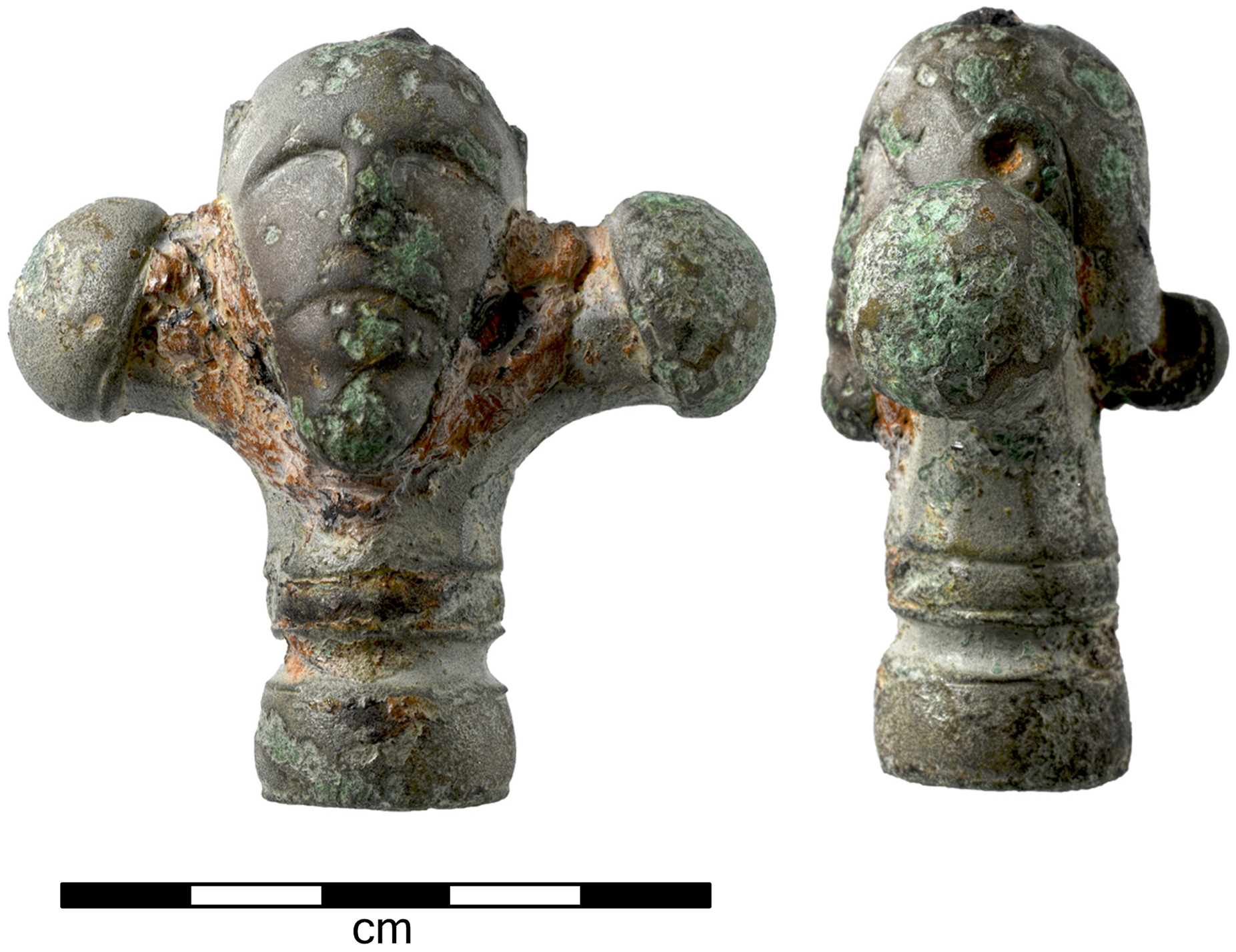
The hairstyle of this figurine is also unusual, paralleling quite closely with the West Garston figurine with its broad rim and cap like appearance. The texture of the hair may demonstrate that it does, however, take inspiration from La Tène styles, showing the hair direction slicked back on the head towards the neck with short striations (as opposed to more traditional La Tène flowing lines eg, as seen on the escutcheons of the Lenham Bucket: PAS LON-E78C8A).
The arms of the figurine survive well, moulded close to the chest. They hold at least one accessory which may be a dagger or spear head (corrosion makes it impossible to identify this object for certain). It is possible that there is another object in the right hand, something small and circular. Like the West Garston figurine, we have a lack of moulded genitalia. Intentionally or not, to our eyes we have here another gender ambiguous individual.
With the lack of parallels, this figurine may also represent a mix between earlier and La Tène artistic traditions. The accessories assigned to this figurine have become a static part of the overall composition of the piece, rather than removable. The possible lack of concern of portraying genitalia may also be inherited from this tradition, yet the hair suggests some awareness of La Tène designs. Rather than being totally flexible, it appears as though the potential identity of this figure has become fixed in the art of the metalsmith.
DENO-D31694 (no. 12; Figure 11)
The figurine from Flintham, Nottinghamshire is unique and is depicted on the back of a crescentic cosmetic mortar rather than free-standing. Human depictions on cosmetic mortars are notoriously rare, with only two other examples known (SF-DAC2D3 and Jackson Reference Jackson2010, no. 522), both of which are from Suffolk. They are rather different, being depictions of human heads paired with either a bovine or equine head on the opposite end. Unfortunately, the surface damage to these other mortars means it is impossible to compare these human heads to this figurine. Though this is an artefact type that has a pre-Claudian history and cultural origin (see examples from Arras in Guillemet & Eugène Reference Guillemet, Eugène, Cooney, Becker, Coles, Ryan and Sievers2009), it is also possible that this mortar was also produced in the Early Roman period.
Apart from its association with a specific class of object, this figure has similar aspects to the two previously discussed. It is naked, though with a clearly flat chest and no discernible genitalia. Furthermore, there is no evidence of hairstyle. Though a lack of hairstyle could represent a male La Tène form, the lack of other gender markers means it could be directly related to pre-La Tène anthropomorphic imagery. The hands are similar to LVPL-2A28C3 (and the Ballachulish figurine), being crossed over, though they do not appear to be holding a prop.
Given the lack of genitalia, the lack of definitive hairstyle, and small size, it is suggested that the anthropomorphic imagery on this cosmetic mortar is not related to La Tène depictions but is another potential example of the tradition of pre-La Tène anthropomorphic imagery being immortalised in metalwork.
DENO-D31694: cosmetic mortar with a human figurine on the reverse; © Derby Museums Trust CC-BY.

Distributional Analysis
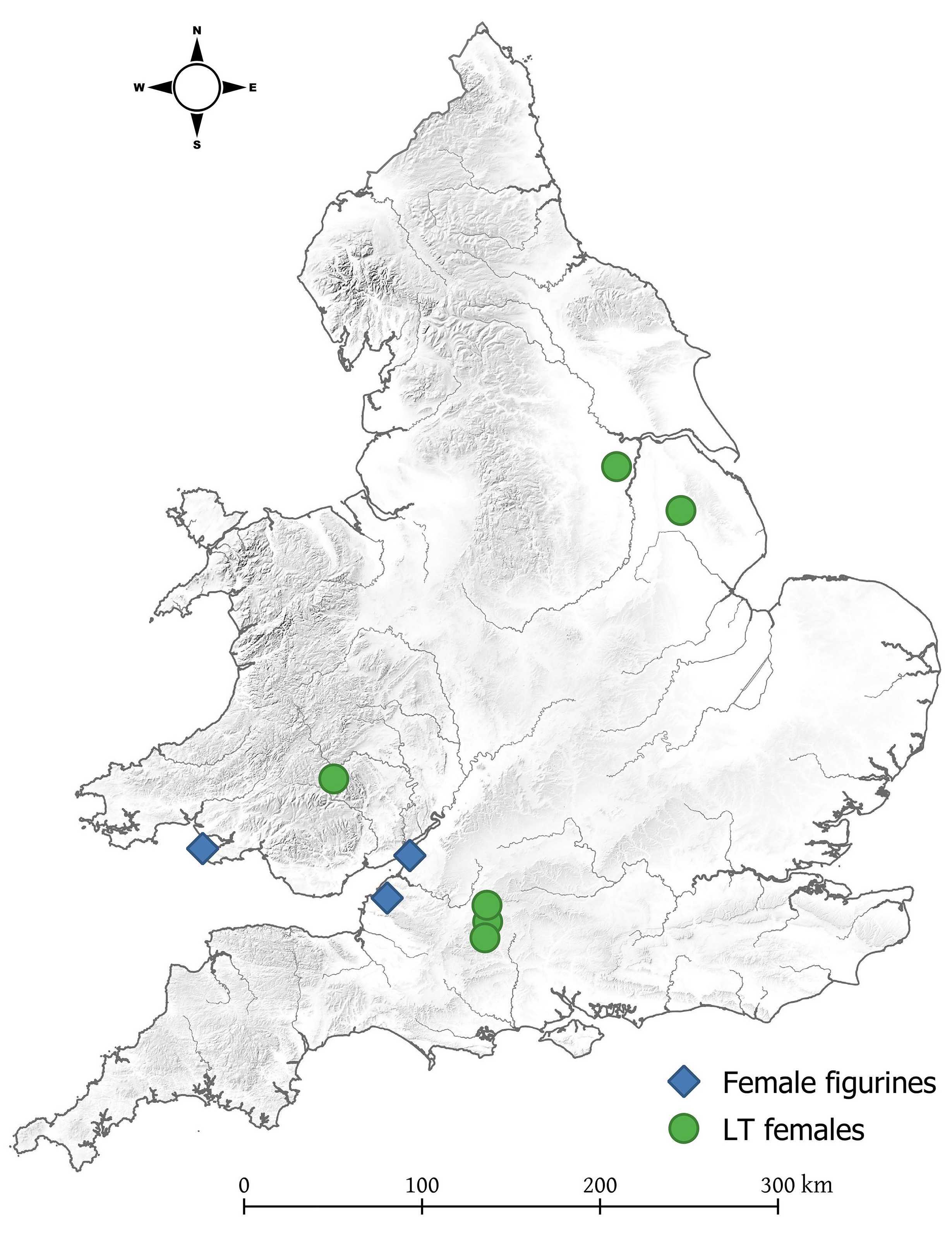
Whilst remembering that this is a small sample size, there appear to be some notable patterns in the distribution of these groups of artefacts. Female figurines cluster exclusively in the south-west region, namely the western side of the Severn Estuary and the southern Welsh coast (Figure 12). This becomes even more notable when considering that the majority of female La Tène head-only depictions are also found within the broader south-western region (including finds in Wiltshire and in Powys). Together, this overlap could suggest that communities in the southwest preferred or utilised the depiction of female forms – both figurines and of the imported La Tène style – more than other regions (as also suggested in Ellis-Haken Reference Ellis-Haken2023b). There is a potential satellite group in northern Lincolnshire that also appears to prefer female La Tène head-only depictions, but this requires further analysis.
Distribution of female figurines and La Tène style female head-only depictions © author.

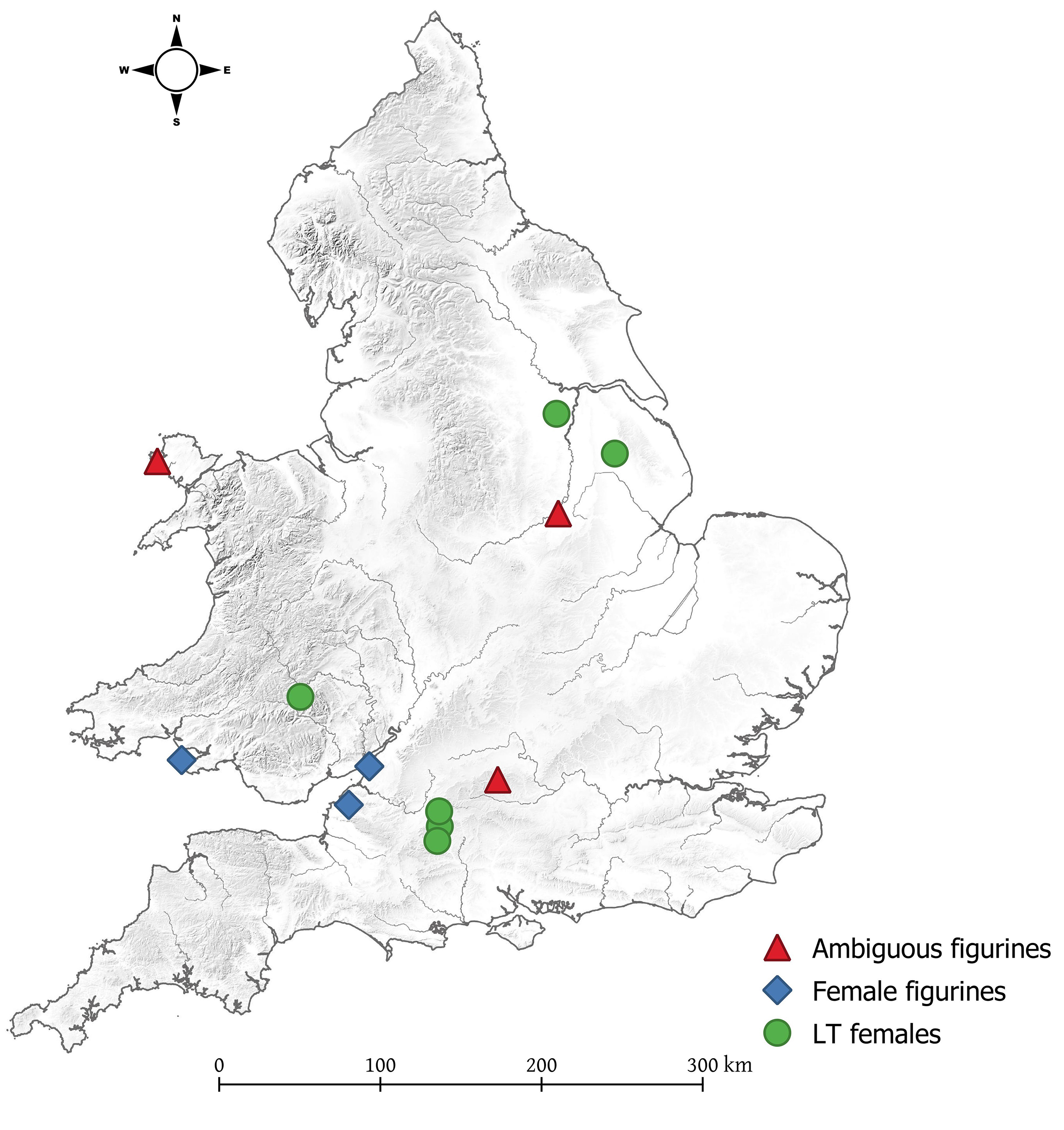
There is no distributional overlap between figurines portrayed with no clear biological sex indicators and female figurines (Figure 13). However, two of these more ambiguous figurines do appear to be found on the periphery of the La Tène style head-only female depiction distribution, notably in the central southwest and again in Lincolnshire. However, there are insufficient data to be able to argue that those groups that prefer female figurines or female La Tène head-only depictions are also the same groups that are depicting these other individuals.
Distribution of female figurines, La Tène style female head-only depictions and gender ambiguous figurines © R. Ellis-Haken.

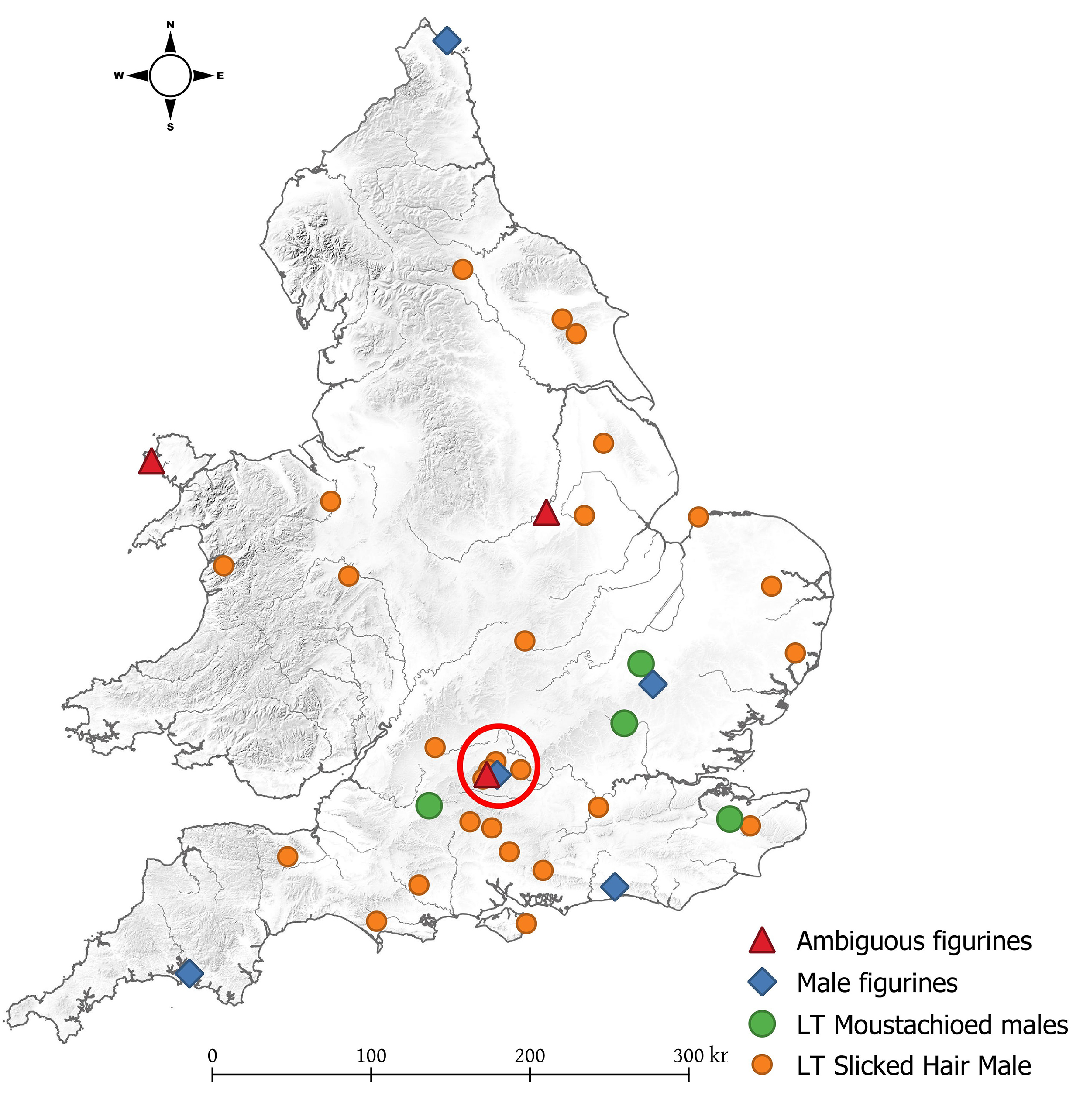
Male figurines have a more disparate distribution, with outliers in Northumberland and in Devon (Figure 14). Although there are no direct overlaps between different types of male depictions, there is a notable preference for moustachioed males in metalwork in south-east England with only two exceptions – the Marlborough Bucket (decorated with six different human designs) and an anthropomorphic sword hilt of a moustachioed male with a hairstyle comprising of Dutch braids (see Ellis-Haken Reference Ellis-Haken2023b, fig. 7).
Distribution of male figurines, La Tène style moustachioed males, gender ambiguous figurines, and La Tène style males with slicked-back hair, with high density find spot on the Oxfordshire/Berkshire border circled © R. Ellis-Haken.

However, in the counties of Oxfordshire and Berkshire a male figurine and a gender ambiguous figurine are found within the region of the highest density of slicked-back hair males currently known in England and Wales (Figure 14, red circle). This appears to be a notable area for finds featuring human depictions of the period, which is yet to be fully understood.
The clear clustering of female figurines and La Tène forms in metalwork in the southwest, with the apparent preference for moustachioed male La Tène forms in the southeast, suggests that different Late Iron Age/Early Roman communities in Britain had preferences for the depiction of certain genders and, potentially, certain designs over others. Given that all bar one of the female figurines are antiquarian or excavation finds, and that all bar one of the moustachioed males from the southeast are also excavation finds, this does not appear to be a pattern derived from geographical bias in metal detecting reporting amongst different regions. Therefore, it appears to be a genuine archaeological phenomenon. This demonstrates the importance of looking at data at multiple levels and clearly challenges notions of regional or symbolic homogeneity between communities in England and Wales, let alone across Europe. However, it is also accepted that due to the potential loss of data from figurines produced in organic materials, this may reflect a biased sample. Hopefully, well-dated finds will clarify this in the future.
Discussion and conclusion
This paper set out to test if there was any evidence to suggest that aspects of pre-La Tène wooden figurines may have survived and transferred into Late Iron Age/Early Roman anthropomorphic metalwork assigned in style to the La Tène tradition. It first pointed out that the chronological data demonstrated that production of wooden figurines and anthropomorphic subjects in La Tène period metalwork could have overlapped. Therefore, the transition of stylistic aspects between both schools of art was theoretically possible. Key and consistent stylistic elements were then identified in both pre-La Tène period wooden figurines and imported La Tène style human imagery. These were considered in the analysis of 12 metalwork figures which have been attributed to the Late Iron Age or Early Roman period which either have clear parallels with the La Tène style, or which distinctly have no clear parallels with that style or Roman Classical art. Based on this analysis, and with full acknowledgements of our limited dataset, this paper has suggested that male depictions and those with unclear biological sex markers may share stylistic aspects from the pre-La Tène wooden figurine tradition. Furthermore, it also suggests that the Strata Florida Manikin may also demonstrate the influence of La Tène characteristics, through the depiction of lentoid eyes which are absent from the other wooden figurines considered here.
In being open to reanalysing long held assumptions about the development of art and considering new data, this approach has challenged the scales of our interpretations, demonstrating the benefits of the inclusion of regional and local data perspectives. This directly led to the observation that different Iron Age communities appear to have different preferences for the depiction of certain genders over others during the Late Iron Age and Early Roman periods, represented in La Tène style anthropomorphic art (ie, female figurines and La Tène female depictions clustering in the southwest, c. 100 BC–AD 100). This is consistent with the discovery of other regional artefact types (see Ellis & Lamb Reference Ellis and Lamb2019).
The available chronological data suggest that certain stylistic aspects of the designs of anthropomorphic depictions in the UK could have been produced for the best part of a millennium (based on the dates of the Roos Carr figurines with the paddle-like hand for Group 1; based on the Ralaghan figurine from Ireland for Group 2). Though a lack of data makes it impossible to prove the observations here definitively, this paper has at least presented new hypotheses regarding the development and classification of anthropomorphic art that can be tested by future discoveries.
Acknowledgements
Many thanks to Dr Peter Halkon, Dr Rachel Pope, Professor Ian Armit and Mike Haken for their kind support and discussion during the formulation of this work. The author also wishes to thank James Harris of the Corinium Museum, Dr Andrew Fitzpatrick and Dr Fraser Hunter for the discussions on the Maskenfibel brooch GLO-9F9834, and thanks to the Corinium Museum for allowing access and photography of it. Many thanks also to the peer reviewers and editing team. Finally, many thanks to those metal detectorists who reported their finds to the Portable Antiquities Scheme, and further thanks to the Finds Liaison teams who facilitated the recording of the artefacts included in this work.
A table outlining the details of thirty finds reported to the Portable Antiquities Scheme, which are likely to be La Tène style human depictions dating from the Late Iron Age and Early Roman periods with brief notes. This does not include the figurines under stylistic discussion in the paper.